
Fateh-Hamas Agreement:
A Deal worth Nurturing
Khalil Shikaki *
The agreement signed on 8 February by Fateh, represented by President Mahmud Abbas, and Hamas, represented by the head of its political bureau Khalid Mishal, in Mecca to form a national unity government represents a return in Palestinian political culture to the traditions of dialogue and consensus building that guided most of the history of the Palestine Liberation Organization (PLO). It represents recognition that neither Fateh nor Hamas, when acting alone, can deliver effective governance or enforcement of signed agreements with Israel. However, as in all previous efforts to moderate Palestinian politics, consensus building produces only limited and gradual, though steady progress. Instead of searching for faults in the text of the agreement, the international community needs to nurture it by fully engaging the national unity government. As the case was with the Palestinian nationalist movement in the 1970s and the 1980s, only such an engagement can create an environment conducive to more moderation.
Instead of demanding an iron-clad guarantee that the national unity government headed by a Hamas prime minister would fully commit itself to agreements signed by the PLO, President Abbas opted for the more ambiguous term of “respecting signed agreements.” In Mecca, Palestinian President Mahmud Abbas changed his hierarchy of priorities. Up until recently he viewed the immediate and complete lifting of financial sanctions and diplomatic boycott as his top priority. Now, however, aborting civil war became his top priority. Moreover, the Saudi role was important: political support of the country closest to the US means that the US reaction could not be very hostile even if it did not like the agreement. Maintaining Saudi-American alliance in the face of terrorism and Iranian threat, he probably calculated, would prevent the US from rejecting the deal outright.
But as importantly, Abbas is not Arafat, the man who turned Palestinian politics in the second half of the 1990 into authoritarianism. He could not rule by dictate. As he did when he was first elected in January 2005, Abbas sought Hamas’s cooperation in arranging a ceasefire with Israel by integrating it into the formal political process, an integration that eventually led to its electoral victory. But it was not the dictates of electoral politics that led to the Mecca Agreement; Hamas already has a 60% majority in the parliament. Instead, it was the recognition of both Fateh and Hamas that the alternative to mutual compromise is continued bloodshed. Consensus building, not electoral politics, will now dominate Palestinian politics. This is a positive development that needs to be encouraged because it is the most effective means of bringing Hamas into the larger Palestinian and international consensus on the need for a two-state solution to end the Palestinian-Israeli conflict.
There are other reasons to view the Mecca Agreement positively. First, it is not a bad deal. Hamas dropped its insistence that the government's "respect" for PLO-Israel agreements and commitments be conditioned by its own definition of what is in Palestinian interest. The Mecca Agreement now "commits" the government to all PLO National Council and Arab Summit resolutions. This includes the National Council’s 19th session, referred to specifically in the Agreement, which explicitly endorses the two-state solution and recognizes the state of Israel. It also includes the Beirut Summit which endorsed the Saudi initiative with its conditional recognition of and normalization of relations with Israel. Second, without a deal, violence would have continued and public polarization increased. Israel would have been dragged into the conflict and Fateh would probably have lost out to Hamas in Gaza even if Abbas remains in control in the West Bank. Public opinion would not have been able to understand why Fateh and Abu Mazin rejected such a deal. Abu Mazin would have been weakened considerably and his ability to negotiate with Israel would have diminished.
Third, the agreement brings Fateh and its allies (like Salam Fayyad) to power in a power-sharing mechanism that does not give Hamas a majority vote. Yes, Hamas can bring the government down by a vote of no confidence, but by initiating such a process, it would be blamed for its outcome, i.e., civil war. Hamas is likely to think twice before voting the unity government out of office if it remains opposed to holding new elections. Control over money will be in the hands of Abu Mazin and Fayyad who enjoys the confidence of the US and Israel. Fourth, Abu Mazin will emerge much stronger domestically than before. In any area of cabinet responsibility, a disagreement in the government leaves Abu Mazin, the referee, in charge. This will apply most importantly to matters related to control over security services, but can also apply to conflicts related to the functioning of the judiciary, foreign policy, and public finance.
Fifth, Abu Mazin will emerge stronger in negotiations with Israel. While part of a national unity government with him, Hamas will not have a free hand to "frame" any deal he makes with Israel as "treason." Of course, this means he needs to bring Hamas into the consultation process, but this can only mean that Israeli-Palestinian negotiations would become more rational.
Ultimately, this is a good deal because only a coalition of Fateh and Hamas has the capacity and willingness to enforce law and order domestically as well as a ceasefire with Israel. Most likely, it will quickly lead to the release of the imprisoned Israeli soldier and to the extension of the ceasefire to the West Bank. Only such a coalition has the capacity to neutralize Islamic Jihad, war lords, and other spoilers. Finally, at the regional level, the deal will reduce Hamas' ties with Iran and strengthen its ties with Saudi Arabia. Without Hamas on board, the ability of the Saudis to confront the threat of Iran and Shiites in Iraq, Lebanon and the Gulf would be reduced.
____________________________________________________________________
* Director of the Palestinian Center for Policy and Survey Research in Ramallah
The World Cup in Qatar helps to restore Palestinian public trust in the Arab World after years of disappointment; and in light of the escalating armed clashes in the West Bank and the near formation of a right wing and extreme government in Israel, the Palestinian public becomes more hardline while indicating a greater confidence in the efficacy of armed struggle
7-10 December 2022

These are the results of the latest poll conducted by the Palestinian Center for Policy and Survey Research (PSR) in the West Bank and the Gaza Strip between 7 and 10 December 2022. The period before the conduct of the poll witnessed several developments including a decision by the President of the Palestinian Authority (PA), Mahmoud Abbas, to form a high judicial council under his chairmanship, a new reconciliation agreement reached in Algeria by Palestinian factions, and media outlets reporting various cases of drowning of Palestinian emigrants in the Mediterranean Sea. On the Israeli side, after winning the November parliamentary elections, the Likud and other right wing and extreme right-wing groups agreed to form a governing coalition under Benjamin Netanyahu’s premiership. In Palestinian-Israeli relations, a UN agency adopted a decision to seek the advisory opinion of the International Court of Justice on the legality of the Israeli occupation. Moreover, various armed groups resisting the Israeli occupation in the northern parts of the West Bank, such as the “Lions’ Den,” which received a wide press coverage, went public during this period. In Qatar, the World Cup football games started and were widely followed by the Palestinians due to a considerable expression of support for and solidarity with Palestine by the fans attending the games.
This press release addresses these issues and covers other matters such as the general conditions in the Palestinian territories, the peace process and future possible directions for Palestinians in the absence of a viable peace process. Total size of the sample is 1200 adults interviewed face to face in 120 randomly selected locations. Margin of error is +/-3%.
For further details, contact PSR director, Dr. Khalil Shikaki, or Walid Ladadweh at tel. 02-296 4933 or email pcpsr@pcpsr.org
Main Findings:
The findings of the last quarter of 2022 point to a limited change in the domestic balance of power favoring Hamas and centering in the West Bank. Moreover, the popularity of president Abbas drops several percentage points, mostly in the West Bank. In other domestic issues, findings indicate that only one quarter of the public thinks that the factional agreement in Algeria will lead to actual reconciliation between Fatah and Hamas and the level of pessimism about the prospects for reunification exceeds 70%. Findings also show that the public views negatively Abbas’ decree forming a high council for the judiciary under his chairmanship as only one in five Palestinians think it aims to strengthen the judiciary while a vast majority of more than 70% think it aims at weakening the independence of the judiciary.
The findings of the current quarter also indicate a significant decline in the level of support for the two-state solution accompanied by a significant rise in the percentage of those who think this solution is no longer feasible or possible due to settlement expansion. This change is not accompanied by an increase in the percentage of those who support the one-state solution in which Palestinians and Israeli Jews enjoy equal rights. To the contrary, support in the current quarter for this one-state solution has also dropped. These findings point to the possibility that the change in attitudes toward the political settlement with Israel reflects a hardening of public attitudes signifying less willingness to compromise. This hardening of attitudes can also be seen in the significant rise in support, in the West Bank, for a return to armed intifada. Furthermore, findings show a significant decrease, in both the West Bank and the Gaza Strip, in the percentage of those who view positively Israeli-Palestinian confidence building measures. On top of that, more than 70% of the public support the idea of forming armed groups, such as the “Lions’ Den,” and only one in ten says the PA has the right to arrest members of these groups or disarm them.
These findings come in a context of three major political and security-related developments, during the current quarter, that might have shaped Palestinian public attitudes, particularly in the West Bank:
- Perhaps the single most important development has been the escalating military clashes between Palestinian armed groups and the Israeli army in the northern part of the West Bank. The number of armed clashes and Israeli military incursions and the number of Palestinian casualties have been unprecedented since the end of the second intifada. This particular development sheds light on the fact that the most significant changes in our findings are centered in the West Bank.
- The results of the Israeli elections and the start of negotiations to form a right-wing coalition government, between the Likud, the religious parties, and the extreme right wing in Israeli politics, might have contributed to the increase in the percentage of those who think the two-state solution is no longer practical or possible. This same development might have also contributed to the rise in the belief that armed struggle, not negotiations, is the most effective means of ending the Israeli occupation. Indeed, the findings indicate that a large Palestinian majority expects the worse from the upcoming Israeli government including high expectation that it will change the status quo in holy places in al Haram al Sharif in East Jerusalem, expel Palestinian families from their homes in East Jerusalem, transfer Bedouin residents, such as Arab al Jahalin, from their villages and encampments in the southeastern parts of Jerusalem to other locations, and annex settlements or the Jordan Valley to Israel.
- Finally, it is clear from the findings that the pro-Palestine scenes at the World Cup in Qatar have contributed to a restoration of the confidence of the Palestinians in the justice of their cause and their right to resist the occupation by all legitimate means. The vast majority of the Palestinians say they have now regained much, or some, of the lost confidence in the Arab peoples in light of the solidarity with Palestine expressed by the fans during the football games. The findings show strong association between the restoration of trust and attitudes regarding the two-state solution and the return to an armed intifada.
(1) “Lions’ Den” and other armed groups:
- 72% support the formation of armed groups such as the “Lions’ Den”
- 79% stand against the surrender of the members of the armed groups or their arms to the PA
- 87% say the PA does not have the right to arrest members of the armed groups
- 59% expect the armed groups to spread to other areas in the West Bank
A majority of 72% of the public says they are in favor of forming armed groups such as the “Lions’ Den,” which do not take orders from the PA and are not part of the PA security services; 22% are against that. Support for the formation of armed groups is higher in the Gaza Strip (84%) than in the West Bank (65%), in refugee camps and cities (76% and 73% respectively) compared to villages/towns (70%), among women (74%) compared to men (70%), among those whose age is between 18 and 29 (75) compared to those whose age is 30 or above (72%), among refugees (78%) compared to non refugees (68%), among students and professionals (77% and 75% respectively), compared to merchants and employees (60% and 69% respectively), among those who work in the private sector (71%) compared to those who work in the pubic sector (65%), among the religious (77%) compared to the somewhat religious (68%), and among supporters of Hamas and third parties (87% and 78% respectively) compared to supporters of Fatah (66%).
Nonetheless, 59% are worried that the formation of such armed groups could lead to armed clashes with the PA security services; 39% are not worried. Despite this, 79% say they are against the surrender of the armed groups’ members and their arms to the PA in order to receive protection against Israeli assassination; 17% say they are for it. Similarly, the vast majority (87%) says the PA does not have the right to arrest member of these armed groups in order to prevent them from carrying out attacks against Israel or to provide them with protection; only 10% say they favor it.
A majority of 59% expects these armed groups to expand and spread to other areas in the West Bank; 15% expect Israel to succeed in arresting or killing their members; and 14% expect the PA to succeed in containing or coopting these groups.
(2) The formation of a new Israeli government of right wing and extreme right
- 61% expect the policies of the upcoming Israeli government led by Netanyahu to be more extreme than the previous one
- 58% expect the new Israeli government to change the status quo at al Haram al Sharif; 64% expect it to expel Palestinian families in al Sheikh Jarrah; 68% expect it to transfer Arab al Jahalin community; and 69% expect it to annex it to annex Israeli settlements or the Jordan Valley
- 67% are less optimistic today about the prospects for an improvement in Palestinian-Israeli relations
A majority of 61% expects the policies of the upcoming Israeli government, that is currently being formed under the leadership of Netanyahu from the right wing and the extreme right, to be more extreme and aggressive while 30% expect them to be similar to the current policies; 4% expect them to be less extreme. For example, a majority of 58% expects the upcoming Israeli government under Netanyahu to change the status quo in al Haram al Sharif in East Jerusalem by allowing Jews to pray at the site; 38% do not expect that. Similarly, a majority of 64% expects the upcoming Israeli government under Netanyahu to expel Palestinian families from al Sheikh Jarrah neighborhood in East Jerusalem; 33% do not expect that. Moreover, a majority of 68% expects the new Israeli government under Netanyahu to transfer the Palestinian Bedouin community currently living in the area between Jerusalem and Jericho, such as Arab al Jahalin, in order to build a big settlement to the east of Abu Din and al Ezariyya; 28% do not expect that. Also, a majority of 69% expects the upcoming Israeli government under Netanyahu to annex settlements or the Jordan Valley to Israel; 27% do not expect that.
A majority of 67% is less optimistic about the prospects of an improvement in Palestinian-Israeli relations, such as reaching new agreements on confidence building measures or reducing the expansion of the settlements during next year; 12% say they are more optimistic today; and 20% are neither optimistic nor pessimistic.
(3) Legislative and presidential elections:
- 69% support holding general elections now, but 63% do not expect elections to take place anytime soon
- In a competition between president Abbas and Hamas’ Ismael Haniyyeh, the latter wins by 54% and the former receives 36% of the vote; but Marwan Barghouti, from Fatah, defeats Haniyyeh 61% to 34%
- Satisfaction with the performance of president Abbas stands at 23%; and 75% demand his resignation
- In parliamentary elections, Fatah and Hamas receive equal percentage of popular vote, 34% each
A majority of 69% supports the holding of presidential and legislative elections in the Palestinian territories in the near future while 29% say they do not support that. Demand for elections stands at 75% in the Gaza Strip and 65% in the West Bank. However, a majority of 63% believes no legislative, or legislative and presidential, elections will take place soon.
If new presidential elections were held today and only two were nominated, Mahmoud Abbas and Ismail Haniyeh, only 46% would participate and from among those, Abbas would receive 36% and Haniyeh 54% of the votes (compared to 53% for Haniyeh and 38% for Abbas three months ago). In the Gaza Strip, Abbas receives 36% of the votes and Haniyeh receives 60%. In the West Bank, Abbas receives 36% and Haniyeh 46%. If the competition was between Marwan Barghouti and Ismail Haniyeh, participation would increase to 62% and from among those, Barghouti receives 61% and Haniyeh 34%. If the competition is between Prime Minister Mohammad Shtayyeh and Haniyyeh, participation rate would decrease to 43% and from among those, the former receives 31% and the latter 60%.
If Abbas does not run for elections, the public prefers Marwan Barghouti to succeed him as the largest percentage (39%) selected him in a closed-ended question, followed by Ismail Haniyyeh (17%), Mohammad Dahlan (5%), Yahya al Sinwar (4%), Mohammad Shtayyeh, Khalid Mish’al and Hussein al Sheikh (3% each), and 22% said they do not know or have not decided.
Level of satisfaction with the performance of president Abbas stands at 23% and dissatisfaction at 73%. Level of satisfaction with Abbas stands at 23% in the West Bank and 23% in the Gaza Strip. Satisfaction with the performance of Abbas three months ago stood at 26% and dissatisfaction at 74%. Moreover, a vast majority of 75% of the public wants president Abbas to resign while only 20% want him to remain in office. Three months ago, 74% said they want Abbas to resign. Demand for Abbas’ resignation stands today at 73% in the West Bank and 79% in the Gaza Strip.
If new legislative elections were held today with the participation of all factions that participated in the 2006 elections, 65% say they would participate. Of those who would participate, 34% say they will vote for Hamas and 34% say they will vote for Fatah, 10% will vote for all third parties combined, and 21% are undecided. Three months ago, vote for Hamas stood at 32% and Fatah at 34%. Vote for Hamas in the Gaza Strip stands today at 43% (compared to 44% three months ago) and for Fatah at 30% (compared to 29% three months ago). In the West Bank, vote for Hamas stands at 26% (compared to 21% three months ago) and Fatah at 38% (compared to 38% three months ago).
28% say Hamas is most deserving of representing and leading the Palestinian people while 25% think Fatah under president Abbas is the most deserving of representing and leading the Palestinians; 40% think neither side deserves such a role. Three months ago, 27% selected Hamas, 26% Fatah under Abbas, and 42% said neither side deserves such a role.
(4) Domestic conditions, the “assassination” of Yasir Arafat, independence of the Judiciary, and those responsible for the drowning of Palestinian emigrants:
- 64% believe that a Palestinian actor played a role in the death of Yasser Arafat, either alone (14%) or in cooperation with Israel (50%)
- 72% think the decree by president Abbas to form a high judiciary committee under his chairmanship aims at weakening the independence of the judiciary
- 27% blame Hamas for the drowning of Gazan illegal emigrants; 24% blame Israel; and 18% blame the PA
- 24% say they want to emigrate; 30% in the Gaza Strip and 20% in the West Bank
- 81% think there is corruption in PA institutions; 69% think there is corruption in public institutions controlled by Hamas
- 59% think the PA is a burden on the Palestinian people
- 72% are pessimistic about the prospects for reconciliation
- The vast majority does not expect the Shtayyeh’s government to succeed in holding general elections, delivering reconciliation, or improving economic conditions
In light of the leaks in the media regarding the investigation into the death of Yasir Arafat, 50% of the public believe a Palestinian party or actor had implemented the plot to get rid of Arafat but that the planning had been done by Israel; 24% think no Palestinian actor or party had been involved in the death of Arafat; and 14% think a Palestinian party or actor had plotted and implemented the killing of Arafat. The belief that a Palestinian actor implemented an Israel plot to get rid of Arafat is higher in the West Bank (53%) compared to the Gaza Strip (45%), in villages and refugee camps (55% and 52% respectively) compared to cities (49%), among men (52%) compared to women (48%), among those whose age is 30 and above (52%) compared to those whose age is between 18 and 29 (42%), among holders of BA degree (51%) compared to the illiterates (33%), among farmers and merchants (70% and 68% respectively) compared to laborers and students (44% and 47% respectively), and among supporters of Hamas and third parties (60% and 54% respectively) compared to supporters of Fatah (39%).
A large majority of 72% thinks the decree issued by president Abbas to form a high judiciary council under his chairmanship was meant to weaken the independence of the judiciary; 19% think it was meant to strengthen it. The percentage of those who think the decree aims at weakening the independence of the judiciary is higher in villages/towns and cities (75% and 72% respectively) compared to refugee camps (68%), among men (75%) compared to women (68%), among holders of BA degree (76%) compared to the illiterates (31%), among merchants, employees, and professionals (89%, 82%, and 80% respectively) compared to housewives and laborers (64% each), and among supporters of Hamas and third parties (86% and 88% respectively) compared to supporters of Fatah (49%).
We asked the public about the party indirectly responsible for the drowning in the Mediterranean Sea of Palestinian emigrants from the Gaza Strip while attempting to illegally reach Europe. The largest percentage (27%) puts the responsibility on Hamas, 24% on Israel, 18% on the PA, another 18% blame the emigrants themselves, and 3% blame Egypt. The percentage of those putting the blame on Hamas is higher in the Gaza Strip (31%) than in the West Bank (25%), in refugee camps (33%) compared to villages/towns and cities (24% and 27% respectively), among those who work in the private sector (28%) compared to those who work in the public sector (19%), among the unmarried (35%) compared to the married (26%), among those with the least income (33%) compared to those with the highest income (23%), and among supporters of Fatah and third parties (51% and 29% respectively) compared to supporters of Hamas (3%).
24% of the public say they want to emigrate due to political, security, and economic conditions. The percentage in the Gaza Strip stands at 30% and in the West Bank at 20%. Three months ago, 23% of West Bankers expressed a desire to emigrate and 29% of Gazans expressed the same desire.
Positive evaluation of conditions in the Gaza Strip stands at 6% and positive evaluation of conditions in the West Bank stands at 22%. Nonetheless, perception of safety and security in the Gaza Strip stands at 77% and in the West Bank at 46%.
Perception of corruption in PA institutions stands at 81%. When asked about institutions controlled by Hamas in the Gaza Strip, 69% indicated that there is corruption in these institutions. Three months ago, 86% said there is corruption in PA institutions and 73% said there is corruption in public institutions controlled by Hamas.
A large minority of 46% of West Bankers thinks people in the West Bank can criticize the PA without fear while 51% think they cannot. In the Gaza Strip, 48% think people in the Strip can criticize Hamas’ authorities without fear and 51% think they cannot. In its assessment of the PA, a majority of the Palestinians (59%) views it as a burden on the Palestinian people while 36% view it as an asset for the Palestinian people. Three months ago, 57% viewed the PA as a burden and 38% viewed it as an asset.
Only 26% are optimistic and 72% are pessimistic about the success of reconciliation. Three months ago, optimism stood at 25%. When asked about the prospects for the implementation of the agreement reached in factional meetings sponsored by Algeria, only 26% expressed the belief that the agreement would lead to actual reconciliation while 67% expressed the belief that it will not lead to reconciliation.
After more than three years since the formation of the Shtayyeh government, findings indicate persistent pessimism. Responding to a question about expectations regarding the ability of the Shtayyeh government to make progress in reconciliation and reunification, 78% expect failure; only 18% expect success. When asked about the ability of the government to organize legislative or legislative and presidential elections in the West Bank and the Gaza Strip, 20% of the public expect success and 76% expect failure. In another question about the ability of the new government to improve economic conditions, a majority of 79% expects failure and 17% expects success.
We asked the public about its TV viewership habits in the last three months. Findings indicate that al Jazeera TV has the highest viewership, standing at 31%, followed by Palestine TV (13%), al Aqsa TV (11%), Palestine Today TV (9%), Maan TV (6%), al Arabiya (3%), and al Mayadeen (2%).
(5) Palestinian-Israeli Relations, the Peace process, and the decision to go to ICJ:
- Support for the two-state solution drops from 37% to 32% and 69% think this solution is no longer feasible due to settlement expansion
- 26% favor a one-state solution with equal rights; 71% are opposed to that solution
- A majority of 55% support the return to an armed intifada
- A majority of 51% believe armed action is the most effective means of ending the Israeli occupation
- Half of the public believes that going to the International Court of Justice will not benefit the Palestinian people
Support for the concept of the two-state solution stands at 32% and opposition stands at 66%. No description or details were provided for the concept. Three months ago, support for the concept stood at 37%. A majority of 69% believes that the two-state solution is no longer practical or feasible due to the expansion of Israeli settlements while 28% believe that the solution remains practical. Moreover, 72% believe that the chances for the creation of a Palestinian state alongside the state of Israel in the next five years are slim or nonexistence while 25% believe the chances to be medium or high. Three months ago, only 64% said the two-state solution was no longer feasible or practical due to settlement expansion.
Reflecting on the latest UN speech of president Abbas in which he described the situation on the ground in the West Bank as “apartheid” and that the Palestinian people will demand equal rights in one state for two peoples, 26% say that they are in favor of such one state solution while 71% expressed opposition. Three months ago, support for Abbas’ position on the one-state solution stood at 30%.
When asked about support for specific policy choices to break the current deadlock, 59% supported joining more international organizations; 51% supported resort to non-violent resistance; 55% supported return to armed confrontations and intifada; 48% supported dissolving the PA; and 27% supported abandoning the two-state solution and embracing a one state solution for Palestinians and Israelis. Three months ago, 48% supported a return to armed confrontations and intifada; 46% supported dissolving the PA; and 23% supported abandoning the two-state solution in favor of a one-state solution. Support for the return to an armed intifada is higher in the Gaza Strip (61%) than in the West Bank (51%), in refugee camps (58%) compared to villages/towns and cities (50% and 55% respectively), among men (58%) compared to women (52%), and among supporters of Hamas (83%) compared to supporters of third parties and Fatah (50% and 40% respectively).
When asked about the most effective means of ending the Israeli occupation and building an independent state, the public split into three groups: 51% chose armed struggle, 21% negotiations, and 23% popular resistance. Three months ago, 41% chose armed struggle and 30% chose negotiations. The belief that armed struggle is the most effective means of ending the Israeli occupation is higher in the Gaza Strip (53%) than in the West Bank (50%), in refugee camps and cities (53% each) compared to villages/towns (42%), among men (56%) compared to women (47%) among holders of BA degree (61%) compared to illiterates (48%), and among supporters of Hamas (76%) compared to supporters of third parties and Fatah (50% and 36% respectively).
We asked the public about its views regarding Palestinian-Israeli confidence building measures that would improve living conditions in the West Bank and the Gaza Strip, such as approval of family unification permits or making available to the PA additional financial resources. A majority of 57% said it looks positively, while 38% said it looks negatively, at such measures. Three months ago, 69% of the public said it viewed these measures positively.
When asked about PA negotiations with the upcoming Israeli prime minister, Netanyahu, 47% said they opposed such negotiations while 25% said they support negotiations with him on a peace agreement and confidence building measures while 11% said they support negotiations if restricted to a peace agreement and 12% said they support negotiations with him if restricted to confidence building measures. In other words, a total of 36% are in favor of negotiations with Netanyahu about a peace agreement and 37% are in favor of negotiations with him about confidence building measures.
In light of the decision by a UN agency to go to the International Court of Justice (ICJ) to ask for its consultative opinion on the legality of the Israeli occupation, half of the public (50%) say the decision and any opinion by the ICJ will have no benefits for the Palestinian people; 28% say the benefit will be symbolic but will have no impact on Israeli policies; 16% say the decision will have an impact on constraining Israeli policies on matters such as settlement construction. The belief that going to the ICJ will not be beneficial is higher in the West Bank (56%) than in the Gaza Strip (40%), among men (54%) compared to women (46%), among holders of BA degree (49%) compared to the illiterates (28%), among those who work in the private sector (54%) compared to those who work in the public sector (44%), and among supporters of Hamas (52%) compared to supporters of third parties and Fatah (42% and 40% respectively).
(6) World Cup in Qatar:
- Two thirds say they have regained the lost trust in the Arab masses after seeing the solidarity with Palestine during the World Cup
- 68% think the international standing of Qatar has improved as a result of its effective organization of the World Cup
Two thirds of the public say that they, now after having seen the scenes of solidarity and support for Palestine in the World Cup in Qatar, have regained much of the trust in the Arab peoples after many disappointments stemming from the Arab normalization with Israel; 21% say they have regained some of that trust; 5% say their trust in the Arab peoples has remained small; and 4% say they have no trust at all in the Arab World.
In light of the Qatari organization of the World Cup, 68% of the Palestinians say they think Qatar’s international standing has improved a lot compared to where it was before; 17% say it has improved somewhat; 8% say Qatar’s standing has not changed; and 1% say it has worsened.
We asked the public about its predictions for the winner in the World Cup. When the number of remaining country teams was eight, 48% said it expected Morocco to win; when the number of country teams went down to six, 54% expected Morocco to win. By contrast, 22% expect Argentina to win; and 15% expect France to win.
(7) Most vital Palestinian goals and the main problems confronting Palestinians today:
- 39% say the most vital goal of the Palestinians should be the ending of Israeli occupation
- 25% say the spread of corruption is the main problem confronting Palestinian society today
- 38% say the Israeli occupation is the most pressing problem confronting Palestinians today
A plurality of 39% believe that the first most vital Palestinian goal should be to end Israeli occupation in the areas occupied in 1967 and build a Palestinian state in the West Bank and the Gaza Strip with East Jerusalem as its capital. By contrast, 33% believe the first most vital goal should be to obtain the right of return of refugees to their 1948 towns and villages, 14% believe that the first and most vital goal should be to build a pious or moral individual and a religious society, one that applies all Islamic teachings and 13% believes it should be to establish a democratic political system that respects freedoms and rights of Palestinians.
In a question about the main problem confronting Palestinian society today, the largest percentage, 25% (8% in the Gaz Strip and 36% in the West Bank), say it is corruption; 21% (26% in the Gaza Strip and 17% in the West Bank) say it is unemployment and poverty; 20% say it is the continuation of the occupation and settlement construction; 17% (26% in the Gaza Strip and 11% in the West Bank) say it is continued siege and blockade of the Gaza Strip; 10% say it is the split between the West Bank and the Gaza Strip; and 4% say it is the weakness of the judiciary and the absence of liberties, accountability and democracy.
When asked about the most pressing problem confronting the Palestinians today, the largest percentage (38%) said it is the Israeli occupation, while 22% said it is corruption, 15% said it is unemployment, 15% said it is the split or division, and 6% said it is the internal violence.
This poll has been conducted in cooperation with the Konrad-Adenauer-Stiftung in Ramallah
Dr. Khalil Shikaki
The agreement signed on 8 February by Fateh, represented by President Mahmud Abbas, and Hamas, represented by the head of its political bureau Khalid Mishal, in Mecca to form a national unity government represents a return in Palestinian political culture to the traditions of dialogue and consensus building that guided most of the history of the Palestine Liberation Organization (PLO). It represents recognition that neither Fateh nor Hamas, when acting alone, can deliver effective governance or enforcement of signed agreements withIsrael. However, as in all previous efforts to moderate Palestinian politics, consensus building produces only limited and gradual, though steady progress. Instead of searching for faults in the text of the agreement, the international community needs to nurture it by fully engaging the national unity government. As the case was with the Palestinian nationalist movement in the 1970s and the 1980s, only such an engagement can create an environment conducive to more moderation.
Instead of demanding an iron-clad guarantee that the national unity government headed by a Hamas prime minister would fully commit itself to agreements signed by the PLO, President Abbas opted for the more ambiguous term of “respecting signed agreements.” In Mecca, Palestinian President Mahmud Abbas changed his hierarchy of priorities. Up until recently he viewed the immediate and complete lifting of financial sanctions and diplomatic boycott as his top priority. Now, however, aborting civil war became his top priority. Moreover, the Saudi role was important: political support of the country closest to the US means that the US reaction could not be very hostile even if it did not like the agreement. Maintaining Saudi-American alliance in the face of terrorism and Iranian threat, he probably calculated, would prevent the US from rejecting the deal outright.
But as importantly, Abbas is not Arafat, the man who turned Palestinian politics in the second half of the 1990 into authoritarianism. He could not rule by dictate. As he did when he was first elected in January 2005, Abbas sought Hamas’s cooperation in arranging a ceasefire with Israel by integrating it into the formal political process, an integration that eventually led to its electoral victory. But it was not the dictates of electoral politics that led to the Mecca Agreement; Hamas already has a 60% majority in the parliament. Instead, it was the recognition of both Fateh and Hamas that the alternative to mutual compromise is continued bloodshed. Consensus building, not electoral politics, will now dominate Palestinian politics. This is a positive development that needs to be encouraged because it is the most effective means of bringing Hamas into the larger Palestinian and international consensus on the need for a two-state solution to end the Palestinian-Israeli conflict.
There are other reasons to view the Mecca Agreement positively. First, it is not a bad deal. Hamas dropped its insistence that the government's "respect" for PLO-Israel agreements and commitments be conditioned by its own definition of what is in Palestinian interest. The Mecca Agreement now "commits" the government to all PLO National Council and Arab Summit resolutions. This includes the National Council’s 19th session, referred to specifically in the Agreement, which explicitly endorses the two-state solution and recognizes the state of Israel. It also includes the Beirut Summit which endorsed the Saudi initiative with its conditional recognition of and normalization of relations with Israel. Second, without a deal, violence would have continued and public polarization increased. Israel would have been dragged into the conflict and Fateh would probably have lost out to Hamas in Gaza even if Abbas remains in control in the West Bank. Public opinion would not have been able to understand why Fateh and Abu Mazin rejected such a deal. Abu Mazin would have been weakened considerably and his ability to negotiate with Israel would have diminished.
Third, the agreement brings Fateh and its allies (like Salam Fayyad) to power in a power-sharing mechanism that does not give Hamas a majority vote. Yes, Hamas can bring the government down by a vote of no confidence, but by initiating such a process, it would be blamed for its outcome, i.e., civil war. Hamas is likely to think twice before voting the unity government out of office if it remains opposed to holding new elections. Control over money will be in the hands of Abu Mazin and Fayyad who enjoys the confidence of the US andIsrael. Fourth, Abu Mazin will emerge much stronger domestically than before. In any area of cabinet responsibility, a disagreement in the government leaves Abu Mazin, the referee, in charge. This will apply most importantly to matters related to control over security services, but can also apply to conflicts related to the functioning of the judiciary, foreign policy, and public finance.
Fifth, Abu Mazin will emerge stronger in negotiations with Israel. While part of a national unity government with him, Hamas will not have a free hand to "frame" any deal he makes with Israel as "treason." Of course, this means he needs to bring Hamas into the consultation process, but this can only mean that Israeli-Palestinian negotiations would become more rational.
Ultimately, this is a good deal because only a coalition of Fateh and Hamas has the capacity and willingness to enforce law and order domestically as well as a ceasefire with Israel. Most likely, it will quickly lead to the release of the imprisoned Israeli soldier and to the extension of the ceasefire to the West Bank. Only such a coalition has the capacity to neutralize Islamic Jihad, war lords, and other spoilers. Finally, at the regional level, the deal will reduce Hamas' ties with Iran and strengthen its ties with Saudi Arabia. Without Hamas on board, the ability of the Saudis to confront the threat of Iran and Shiites in Iraq, Lebanon and the Gulf would be reduced.
The Peace Process, Israeli Debate about Refugees, Safe Passage, Events in Nazareth, Refugees in Lebanon, Hamas and Jordan, Corruption and Democracy, Elections for the President and Vice-president, and Political Affiliation
2-4 December 1999
These are the results of opinion poll # 45, conducted by the Center for Palestine Research & Studies, between 2-4 December 1999. The poll deals with the Peace Process, Israeli debate about refugees, safe passage, events in Nazareth, refugees in Lebanon, Hamas and Jordan, corruption and democracy, elections for the President and Vice-president, and political affiliation. The total sample size of this poll is 1299 from Palestinians 18 years and older, of which 807 in the West Bank and 492 in the Gaza Strip. The margin of error is + 3% and the non-response rate is 3%.
1. The Peace Process
- 75% support the current peace process and 21% oppose it
- 36% support armed attacks against Israeli targets and 55% oppose it
- 18% have Trust in Barak's government
- 14% expect a framework agreement on final status issues to be completed by February 2000
- 30% believe it is possible to reach a mutually acceptable solution to final status issues
- 50% expect the current peace process to lead to the establishment of a Palestinian state in the near future
- 46% have confidence that the Palestinian leadership will remain committed to Palestinian basic rights in the final status negotiations and 28% do not have such confidence
- 51% describe their economic conditions today as being worse than they were when the peace process started and 13% describe them as being better than they were then
- 65% remain optimistic despite all
The results show a continued high level of support for the peace process, with 75% supporting it, as the case has been during the past several months. Support for armed attacks against Israeli targets decreased slightly from 39% two months ago to 36% in this poll. This result is the same as the one obtained last September. Trust in Barak's government reached 18% compared to 29% last July, 21% last September, and 19% last October. The level of no confidence in the intentions of Barak's government toward the peace process reached 71% in this survey.
The lack of confidence in Barak is reflected in the very low level of expectation from the peace process with only 14% expecting the two sides to conclude a framework agreement for the permanent settlement by February 2000 as stipulated by the Sharm al Sheikh agreement. A majority of 56% expected failure in meeting the deadline.
Moreover, the percentage of those who expect the two sides to reach a mutually acceptable solution to final status issues of refugees, Jerusalem, borders, and settlements, did not exceed 30%, while 58% believed that it will not be possible. The percentage of those who believed in the possibility of finding such a solution stood at 35% last September, while the highest level of expectation stood at 44% in June 1996. It is interesting to note that the percentage of those who believe that the current peace process will lead to the establishment of a Palestinian state in the near future is higher than the percentage of those who believe that the two sides will find a solution to the final status issues mentioned above. Half of the Palestinians today expects the peace process to lead to the establishment of a Palestinian state. In June 1999, 45% had such expectations. It is possible that Israeli news reports concerning the possibility of an Israeli recognition of a Palestinian state may have been responsible for the rising expectations.
On other matters related to the peace process, 46% of the Palestinians say that they have confidence that the Palestinian leadership will remain committed to declared and basic rights of the Palestinians in its final status negotiations with the Israelis. About 28%, however, have no such confidence. The Level of confidence increases in towns and villages (50%) compared to refugee camps (42%) and cities (44%), among women (49%) compared to men (44%), among illiterates (50%) compared to holders of BA degree (42%), among housewives (50%) compared to merchants (36%) and retired persons (30%), among those employed in the public sector (54%) compared to those employed in the private sector (40%), and among supporters of Fateh (63%) compared to supporters of Hamas (40%) the PFLP (37%) and the nonaffiliated (35%).
The results also show that most Palestinians (65%) are optimistic about the future. The current percentage of optimism represents an increase of bout four percentage points compared to the situation in June 1999. The lowest level of optimism was recorded in March 1994 when it stood at 21% in the aftermath of the Ibrahimi Mosque massacre. Despite the high level of optimism, most respondents (51%) describe their economic situation as worse than it was when the peace process started, while only 13% describe it as being better, and 34% as being the same.
2. Katz's statement on refugees' rights and the Israeli response:
- 13% believe that the Israeli response to the statements made by Israeli Knesset member Yossi Katz on refugees' rights indicates a positive development in Israeli thinking
- Half of the Palestinians has not heard of Katz's statement or the Israeli response to it
The results show that the statement made by Israeli member of Knesset from the Labor Party, Yossi Katz, on the possibility of the return of some Palestinian refugees to Israel and the Israeli response to that statement did not leave a noticeable positive impact on the Palestinian street. The percentage of those who saw some positive aspects to the Israeli debate about this issue did not exceed 13%, while about a third believed that it reflected continued Israeli insistence on refusing to deal positively with refugees' right of return. It is interesting to note that about half (49%) of the Palestinians did not hear about Katz's statement or the response to it.
The percentage of those who saw the statement and the response as reflecting continued insistence on denying refugees' right of return increases in the Gaza Strip (36%) compared to the West Bank (31%), among residents of refugee camps (42%) compared to residents of towns and villages (30%), among men (44%) compared to women (23%), among holders of BA degree (48%) compared to illiterates (21%), among housewives (20%) compared to merchants (56%) and retired persons (63%), and among supporters of Hamas (36%) and the PFLP (38%) compared to supporters of Fateh (30%).
The percentage of those unaware of Katz's statement and the ensuing Israeli debate increases in towns and villages (53%) compared to refugee camp residents (41%), among women (60%) compared to men (38%), among illiterates (55%) compared to holders of BA degree (33%), among farmers (66%) and housewives (61%) compared to merchants (27%), employees (33%) and retired persons (19%), and among those with the lowest income (52%) compared to those with the highest income (35%).
3. Safe Passage:
- 57% are pleased with the way the safe passage affected Gaza-West Bank relations and 26% are concerned
- Reasons for concern are economic (mostly in the West Bank) and social (in both areas)
Most Palestinians (57%) are pleased with the way the opening of the safe passage has affected the relationship between the residents of the West Bank on one hand with those in the Gaza Strip on the other. But 26% feel concerned. The percentage of those who are pleased with the impact of the safe passage opening increases among residents of the Gaza Strip (63%) compared to residents of the West Bank (54%), among residents of Nablus (67%) Jabalia (70%), and Rafah (71%) compared to residents of Ramallah (48%), Qalqilia (49%), and Jenin (51%). The percentage of those who are concerned about the impact of the opening of the safe passage is equal in the two areas of the West Bank and the Gaza Strip. But it increases in Ramallah (33%), Deir al Balah (36%), and Hebron (32%).
The reasons for concern are either economic or social or both. About 29% describe their reasons as being economic in nature, 31% describethem as social, and13% describe them as being both social and economic. The concerned residents of the West Bank have more economic reasons (44%) than those in the Gaza Strip (9%), while both areas are equally concerned about social matters. The most repeated economic reasons have been the expected increase in economic competition and the fear of the resultant increase in unemployment. Reasons of social nature ranged from the fears of some West Bankers of misbehavior, or unacceptable behavior, of some Gazans, to the fears of some Gazans of the more liberal social behavior of some West Bankers.
4.Events in Nazareth:
- One third is unaware of the events in Nazareth and 34% see it as a quarrel among brothers in the family
- Only 1% view the events as a violation committed by some Muslims against some Christians while 15% view them as a violation committed by some Christians against some Muslims
The results indicate that Palestinians do not view with alarm the events that have taken place in Nazareth over the issue of building a new mosque in an area adjacent the Church of Annunciation in the center of the city. One third did not hear about them, while another third viewed them as a domestic quarrel among brothers in the family. Only 16% viewed the events as transgression of one side against the other; from among those, the majority tended to blame the Christians (15% of the total sample), while the percentage of those who saw the events as a violation committed by some Muslims against some Christians did not exceed 1% of the total sample.
The percentage of those unaware of the events in Nazareth increases in the areas of Nablus (39%), Jenin and Tulkarm (37% each) compared to areas of Jerusalem (26%), Ramallah (22%), and Bethlehem (18%), among residents of villages and towns (35%) compared to residents of cities (26%), among women (43%) compared to men (18%), among illiterates (45%) compared to holders of BA degree (10%), among housewives (45%) compared to employees (10%) and professionals (5%), and among those with the lowest income (36%) compared to those with the highest income (18%). The percentage of those who see the events as a violation committed by some Christians increases in the West Bank (18%) compared to the Gaza Strip (11%), in Hebron (23%) compared to Rafah (5%), Ramallah (8%) and Khanyounis (9%), among men (19%) compared to women (12%), and among supporters of Hamas (25%) compared to supporters of Fateh (14%).
5. Situation of Refugees in Lebanon:
- One quarter is unaware of the situation of Palestinian refugees in camps in Lebanon
- 70% are concerned about the way refugees are being treated by the Lebanese government and only 3% are not concerned
The results show that almost all Palestinians who are aware of the situation of the refugees in Lebanon (70% of the total sample) are concerned about the way they are being treated by the Lebanese government. The results show that about one quarter of the Palestinians is unaware of that situation. The percentage of the respondents who are unaware of the refugee situation in Lebanon increases in areas of Rafah (39%), Jabalia (36%), Ramallah, Nablus, and Jenin (28% each) compared to areas of Khanyounis and Deir al Balah (15% each), among residents of villages and towns (26%) compared to those of refugee camps (21%), among women (32%) compared to men (15%), among illiterates (29%) compared to holders of BA degree (10%), among housewives (34%) compared to professionals (5%) and employees (15%), and among those with the least income (26%) compared to those with the highest income (18%).
6. The Transfer of Hamas Leaders by Jordan:
- 21% did not hear of Jordan's transfer of four Hamas Leaders to Qatar
- 67% see in the transfer a negative step toward the Palestinians by the Jordanian government and only 4% see it as a positive step
The results show a near consensus among those Palestinians of the West Bank and Gaza who are aware of the step taken by Jordan to transfer four Hamas leaders to Qatar to view it as a negative step toward the Palestinians. The percentage of those who view the step as such increases among men (77%) compared to women (58%), among holders of BA degree (75%) compared to the illiterates (56%), among students, laborers and merchants (77%, 77% and 76% respectively) compared to housewives (56%), among those with the highest income (79%) compared to those with the lowest income (65%), and among supporters of Hamas (78%) compared to supporters of Fateh (65%). These differences reflect mainly the relative lack of awareness of the situation among women, the illiterates, housewives, those with the least income, and supporters of Fateh.
7. Corruption and Status of Democracy and Human Rights:
- 68% believe that corruption exists in PA institutions
- 62% believe that corruption will increase or remain the same in the future
- Positive evaluation of the status of democracy and human rights under the PA reaches 23%
- 61% believe that people can not criticize the PA without fear
The results show an increase in the percentage of those who believe in the existence of corruption in PA institutions from 63% last October to 68% in this survey. There has also been a decrease in the positive evaluation of the status of democracy and human rights under the PA from 32% to 23% during the same period. Moreover, there has been an increase in the percentage of those who believe that people can not criticize the PA without fear from 56% to 61%. It should be indicated that this poll was conducted during the events that accompanied the release of the so-called the Statement of the Twenty. The statement accused the PA of corruption, violation of human rights, and absence of democracy. The PA, it should be recalled, arrested at the time several members of those who signed the statement. Although the poll did not ask about it, the streets response, as indicated by this poll, indirectly reveals a clear disappointment and perhaps opposition to the steps taken by the PA. The poll also indirectly reveals that the street tends to believe the accusations made in the statement to be true.
8. Elections for the President and the Vice President and Political Affiliation:
- In elections for the office of the president, Yasir Arafat receives 45%, Haydar Abdul Shafi 12%, and Ahmad Yasin 10%
- In elections for the office of the vice president, Abdul Shafi receives 39%, followed by al Faisal al Husseini (22%), Mahmud Abbas (14%), and Ahmad Qurei (11%)
- Support for Fateh stands at 37%, Hamas 9%, PFLP 3%, and the nonaffiliated 41%
The results show that Arafats popularity has not been negatively affected by the Statement of the Twenty or by the steps taken by the PA against those who signed it. Arafats popularity rose from 42% last October to 45% in this poll. Haydar Abdul Shafis popularity remained the same at 12%, while the popularity of Ahmad Yasin stood at 10%. Arafats popularity stands at 51% in the Gaza Strip and 40% in the West Bank.
In the election for the office of the vice president, little has changed compared to the situation last October. Abdul Shafi comes first with 39%, followed by Faisal al Hussieni with 22%, Mahmud Abbas (14%) and Ahmad Qurei (11%).
Fateh remained the strongest political faction with the support of 37% of the population, while Hamas received the support of 9%, and the PFLP 3%. The nonaffiliated rose from 39% last October to 41% in this poll...More
29 December 2016
Two thirds of the Palestinian public believe that the two-state solution is no longer viable; in the meanwhile, a majority does not have confidence in the newly elected Fatah leadership and about two thirds demand Abbas resignation
8-10 December 2016


These are the results of the latest poll conducted by the Palestinian Center for Policy and Survey Research (PSR) in the West Bank and the Gaza Strip between 8 and 10 December 2016. Internally, the period before the poll witnessed the holding of Fatah’s Seventh Convention and the election of its Central Committee and Revolutionary Council, the dismissal of the head of the Supreme Judicial Council, and the publication of a ruling by the recently appointed Constitutional Court that grants President Abbas the authority to revoke the immunity of the members of the parliament. The period also witnessed Abbas’ participation in the funeral of the former Israeli president Shimon Peres. The Israeli settlement construction accelerated considerably during this period and the Israeli government approved legislation that would legalize the seizure by settlers of private Palestinian land for the purpose of building settlements. The period also witnessed fires breakout across Israel, Netanyahu’s invitation to Abbas to speak in front of the Israeli Knesset, Israeli defense minister Avigdor Lieberman statement that Gazans can reopen their airport and build a seaport if Hamas ceases the digging of tunnels and the launching of rockets. The Israeli Knesset debated a government bill to ban the use of loudspeakers in the mosques’ call for prayer in Israel and the occupied East Jerusalem. At the international level, Donald Trump was elected as the new president of the United States and talks continued about a possible international conference in Paris, part of the French Initiative to resolve the Palestinian-Israeli conflict. This press release addresses many of these issues and covers attitudes regarding Fatah’s convention, judicial matters, reconciliation, and others. It also covers Palestinian-Israeli issues such as the peace process, the Israeli fires, and the French Initiative. Total size of the sample is 1270 adults interviewed face to face in 127 randomly selected locations. Margin of error is 3%.
For further details, contact PSR director, Dr. Khalil Shikaki, or Walid Ladadweh at tel. 02-296 4933 or email pcpsr@pcpsr.org.
Main Findings:
Findings of the last quarter of 2016 indicate an increase, particularly in the Gaza Strip, in the percentage of those demanding Abbas’ resignation. They also indicate a slight decline in public satisfaction with the performance of the president. If presidential elections were to take place today, Hamas’ candidate Ismail Haniyeh would win. But Marwan Barghouti remains the most popular among all nationalist and Islamist leaders. In the domestic balance of power, Hamas remains at the same
level it attained three months ago and Fatah improves its standing in the West Bank. It should be pointed out that the findings show a significant rise in public perception of safety and security in the West Bank.
Now in the aftermath of Fatah’s Seventh Convention, findings indicate that the newly elected Fatah leadership faces a tough challenge winning the trust and confidence of the public; a majority indicates that it does not have confidence in those elected. In fact, a majority is also dissatisfied with the Convention’s decision to declare Abbas the head of Fatah for five more years and does not believe that the meeting has helped to unify the movement, improve the chances for reconciliation, or facilitate the convening of the Palestinian National Council. It should be noted however, that a majority of the likely Fatah voters does have confidence in the new leadership, is satisfied with the selection of Abbas as the head of the movement, and believes that the convention did indeed help unify Fatah ranks.
Abbas faces an additional challenge as findings clearly indicate that the public rejects the recent ruling by the newly appointed Constitutional Court granting the PA president the authority to revoke the immunity of the members of the Palestinian parliament. Moreover, the public rejects Abbas’ decision to dismiss the head of the Supreme Judicial Council and believes that such dismissal is not part of the mandate of the presidency.
In matters related to the Palestinian-Israeli relations, public perception that the two state solution is no longer viable increases significantly, probably due to the dramatic increase in settlement construction during the period under consideration. Moreover, findings also show an increase in the percentage of those who favor the abandonment of the Oslo agreement. More significantly however, the poll found a majority in favor of armed attacks and a return to armed intifada. During the past nine months, support for violence has been in retreat. The overwhelming majority of the public sees nothing but incitement against Arabs in Netanyahu’s claim that some of the recent fires in Israel were initiated by Palestinians. Moreover, there is almost a consensus among the public that the decision by the Israeli government to ban the use of loudspeakers in the mosques’ call for prayer is tantamount to declaring war against Islam.
(1) Fatah’s Seventh Convention:
- Only one third of the Palestinian public has confidence in the newly elected Fatah leadership
- Only one third of the public is satisfied with the Seventh Convention’s selection of Abbas as head of Fatah
- Only one third believes that the Seventh Convention will contribute to Fatah’s unity
- Only one quarter believes that the Seventh Convention will help facilitate Fatah-Hamas reconciliation
In the aftermath of Fatah’s Seventh Convention and the election of its new leaders, only one third of the Palestinian public expresses confidence in the ability of the new leadership to attain the goals Palestinians aspire to; 54% do not have confidence in the new leadership. Distrust in the new Fatah leadership is higher in the Gaza Strip (58%) compared to the West Bank (51%), in cities (55%) compared to villages and refugee camps (50% each), among those opposed to the peace process (73%) compared to supporters of the peace process (40%), among the religious (60%) compared to the somewhat religious (49%), among supporters of Hamas and third parties, the undecided, and those who will not participate in future elections (79%, 61%, 62%, and 58% respectively) compared to supporters of Fatah (24%), among those who work in the private sector (59%) compared to those who work in the public sector (48%), among the retired, merchants, and professionals (74%, 64%, and 62% respectively) compared to housewives, laborers, and students (45%, 54%, and 58% respectively), and among holders of two-year college and BA degrees (62% and 58% respectively) compared to illiterates and holder of the preparatory certificate (35% and 46% respectively).
Similarly, only 33% of the public is satisfied with the choice made by the Seventh Convention in selecting President Abbas as head of Fatah for five more years; 57% of the public is dissatisfied with that choice. Yet, among Fatah’s likely voters, satisfaction with the selection of Abbas stands at 70%. Moreover, only 34% believe, and 52% do not believe, that the Seventh Convention has contributed to the unification of Fatah. Among Fatah’s likely voters, belief that the convention has contributed to Fatah’s unity stands at 62%. Furthermore, only a quarter (26%) believes, and 62% do not believe, that the Convention has increased the chances for reconciliation.
Only one third (34%) of the public believes that success in holding the Seventh Convention will lead to further success in holding the next session of the Palestinian National Council; 48% believe it will not lead to that. Nonetheless, 42% believe, and 48% do not believe, that the selection of Abbas as head of Fatah will help consolidate Abbas’ legitimacy as the president of the PA and chairman of the PLO Executive Committee.
(2) Presidential and parliamentary elections:
- 64% want Abbas’ resignation and 32% want him to stay in office
- In an election involving two candidates, Abbas and Ismail Haniyah, the latter receives 49% of the vote and the former 45%; if the two candidates are Marwan Barghouti and Haniyah, the latter receives 36% and the former 59%.
- In parliamentary elections, Fatah receives 41% of the vote, Hamas 32%, and third factions combined 10%
64% of the public want president Abbas to resign while 32% want him to remain in office. Three months ago, 61% said they want Abbas to resign. Demand for Abbas’ resignation increases in the Gaza Strip (72%) compared to the West Bank (59%), in refugee camps and cities (67% and 66% respectively) compared to villages (53%), among those opposed to the peace process (81%) compared to supporters of the peace process (52%), among the religious (68%) compared to the somewhat religious (61%), among supporters of Hamas and third factions (91% and 81% respectively) compared to Fatah supporters (29%), among those who work in the private sector (64%) compared to those who work in the public sector (56%), among the retired, the professionals, and students (82%, 71%, and 68% respectively) compared to housewives (62%), and among holders of BA degree (68%) compared to illiterates and holders of elementary certificate (41% and 51% respectively).
If president Abbas does not nominate himself in a new election, 36% prefer to see Marwan Barghouti replacing him, while 20% prefer Ismail Haniyeh; Khalid Mishal receives 6%; Rami al Hamdallah 5%; Mohammad Dahlan 4%; Mustapha Barghouti 3%; Salam Fayyad 2%, and Saeb Erekat 1%. Level of satisfaction with the performance of president Abbas stands at 35% today compared to 37% three months ago. Level of satisfaction with Abbas stands at 38% in the West Bank and 30% in the Gaza Strip. If new presidential elections were held today and only two were nominated, Ismail Haniyeh and Mahmoud Abbas, the former would receive 49% (compared to 48% three months ago) and the latter 45% (compared to 45% three months ago). In the Gaza Strip, Abbas receives 45% of the vote (compared to 47 three months ago) and Haniyeh receive 51% (compared to 50% three months ago). In the West Bank Abbas receives 45% (compared to 43% three months ago) and Haniyeh 47% (compared to 46% three months ago). If presidential elections were between three: Mahmud Abbas, Marwan Barghouti and Ismail Haniyeh, Abbas would receive 24%, Barghouti 39% and Haniyeh 33%. If presidential elections were between two: Marwan Barghouti and Ismail Haniyeh, Barghouti receives 59% and Haniyeh 36%.
If new legislative elections were held today with the participation of all factions, 70% say they would participate in such elections. Of those who would participate, 32% say they would vote for Hamas and 41% say they would vote for Fatah, 10% would vote for all other third parties combined, and 17% are undecided. Three months ago, vote for Hamas stood at 32% and Fatah at 37%. Vote for Hamas in the Gaza Strip stands today at 38% (compared to 37% three months ago) and for Fatah at 40% (compared to 39% three months ago). In the West Bank, vote for Hamas stands at 29% (compared to 29% three months ago) and Fatah at 41% (compared to 36% three months ago).
(3) Domestic conditions and the independence of the judiciary:
- Positive evaluation of conditions in the Gaza Strip stands at 11% and the West Bank at 31%
- Perception of safety and security stands at 47% in the Gaza Strip and 56% in the West Bank
- 46% of Gazans and 24% of West Bankers wish to emigrate to other countries
- 49% view the PA as a burden and 46% view it as an asset for the Palestinian people
- 60% reject the decision of the Constitutional Court giving Abbas the authority to revoke the immunity of PLC members
- 57% believe that Abbas does not have the authority to dismiss the head of the Supreme Judicial Council
Positive evaluation of conditions in the Gaza Strip stands at 11% and positive evaluation of conditions in the West Bank stands at 31%. Perception of safety and security in the Gaza Strip stands at 47%. In the West Bank perception of safety and security stands at 56%. Three months ago, perception of safety and security in the Gaza Strip stood at 48% and in the West Bank at 42%. Findings show that the percentage of Gazans who say they seek to immigrate to other countries stands at 46%; in the West Bank, the percentage stands at 24%. Three months ago 46% of Gazans and 29% of West Bankers said they seek to emigrate.
We asked the public about its viewership habits in the last two months. Findings indicate that al Jazeera TV viewership is the highest, standing at 19%, followed by al Aqsa TV (at 16%), Maan TV (at 15%), Palestine TV and Filasteen al Youm (Palestine Today) at 12 % each, Al Arabiya at 6%, al Quds TV at 5%, and al Mayadeen at 3%.
Perception of corruption in PA institutions stands at 76%. Moreover, only 36% of the Palestinian public say people in the West Bank can criticize the PA authority without fear. This percentage rises to 41% among West Bankers and drops to 27% among Gazans. Furthermore, 49% view the Palestinian Authority as a burden on the Palestinians while 46% view it as an asset.
60% of the public reject and 30% accept the decision of the recently-appointed Constitutional Court that gives president Abbas the authority to revoke the immunity of the members of the parliament. Rejection of the Court’s decision is higher in the Gaza Strip (64%) compared to the West Bank (57%), in cities (62%) compared to villages and refugee camps (54% and 52% respectively), among men (62%) compared to women (57%), among those who oppose the peace process (81%) compared to supporters of the peace process (48%), among the religious (65%) compared to the somewhat religious (55%), among supporters of the Hamas and third factions (85% and 77% respectively) compared to Fatah supporters (39%), among the retired, the professionals, and students (79%, 66%, and 61% respectively) compared to housewives and merchants (55% each), and among holders of BA degree (64%) compared to holders of the elementary and the preparatory certificates and the illiterates (51%, 53%, and 58% respectively).
Commenting on President Abbas’ recent dismissal of the head of the Supreme Judicial Council (SJC), 57% of the public believe that the president does not have the authority to do so while 31% believe that the president has such authority. Belief that the president does not have the authority to dismiss the head of the SJC rises to 65% in the Gaza Strip and drops to 52% in the West Bank. It is also higher in cities (61%) compared to villages and refugee camps (45% and 49% respectively), among men (59%) compared to women (55%), among those who oppose the peace process (74%) compared to supporters of the peace process (46%), among the religious (65%) compared to the somewhat religious (51%), among supporters of Hamas and third factions (80% and 71% respectively) compared to Fatah supporters (38%), among the retired and the professionals (89% and 66% respectively) compared to housewives (53%), and among holders of BA degree (63%) compared to holders of the elementary certificate and the illiterates (38% and 41% respectively).
(4) Reconciliation and the reconciliation government:
- Optimism about reconciliation stands at 35%, pessimism at 61%
- Only 28% are satisfied with the performance of the reconciliation government, 63% are dissatisfied
- Only 18% put the blame for the shortcomings of the reconciliation government on Hamas
- 71% want the reconciliation government to pay the salaries of the employees who worked for the former Hamas government and 71% support the integration of the police forces in the Gaza Strip and in the West Bank under the command and jurisdiction of the reconciliation government
Optimism about the success of reconciliation and the end of the split stands today at 35% and pessimism at 61%. Three months ago optimism stood at 31% and pessimism at 65%. 28% say they are satisfied and 63% say they are dissatisfied with the performance of the reconciliation government. In the Gaza Strip, dissatisfaction stands at 73% and in the West Bank at 56%. Belief that Hamas was responsible for hindering the functioning of the reconciliation government does not exceed 18% (9% in the West Bank and 32% in the Gaza Strip) while 34% believe that the PA and president Abbas were to blame for that and 13% blame the prime minister of the reconciliation government.
71% believe that the reconciliation government must be responsible for paying the salaries of the civilian employees of the former Hamas government in the Gaza Strip while 18% believe it is not its responsibility. Similarly, 67% believe that it is the responsibility of the reconciliation government to pay the salaries of Hamas’ former security sector and police while 21% believe it is not its responsibility. In return, 61% believe that the reconciliation government, not Hamas, should command and supervise the work of the security sector and police in the Gaza Strip while 25% believe that Hamas should continue to command and supervise this sector. Similarly, 71% support the unification of the security sectors in the West Bank and the Gaza Strip under the command and control of the reconciliation government while 22% support maintaining the status quo.
(5) Fires and the bill to ban use of loudspeakers in call for prayers:
- 50% support and 47% do not support the PA decision to send fire fighting vehicles and men to help put out fires in Israel
- 85% believe that Netanyahu’s claim that Palestinians stand behind some of the fires in Israel is tantamount to incitement against Arabs
- 87% believe that Israeli intent to ban use of loudspeakers to call for prayers is tantamount to waging war against Islam
A majority of 73% believes that the recent wave of fires in Israel has been the result of natural disasters; only 12% think it was initiated by Palestinians, and 9% think they were the outcome of other causes. Palestinians are divided in their position regarding the PA leadership decision to send fire fighting vehicles and men to combat the fires in Israel: 50% think it was a wrong decision and 47% think it was a right decision. Belief that it was the wrong decision is higher in the Gaza Strip (69%) compared to the West Bank (38%), among residents of refugee camps (65%) compared to residents of cities and villages (49% and 41% respectively), among women (51%) compared to men (48%), among those who oppose the peace process (64%) compared to supporters of the peace process (43%), among the religious (61%) compared to the somewhat religious (42%), among Hamas supporters (74%) compared to supporters of third factions and Fatah (46% and 31% respectively), among the married (51%) compared to non-married (46%), among those who work in the private sector (51%) compared to those who work in the public sector (45%), among holder of BA degree (58%) compared to illiterates (49%), and among refugees (56%) compared to non-refugees (45%).
The overwhelming majority of the public (85%) believes that anti-Arab incitement is what lies behind Israeli Prime Minister’s claim that Palestinians have carried out the fires in Israel; only 12% believe that Netanyahu actually believes what he claims. Similarly, an overwhelming majority (87%) believes that the Israeli government decision to legislate a law that would ban the use of loudspeakers when calling for prayer at mosques is an indication of a war against Islam waged by the government while only 9% believe that the Israeli government is simply trying to protect the Israeli public.
(6) The peace process:
- 33% believe that negotiation is the most effective means of creating a Palestinian state and 37% think armed resistance is the most effective
- Two thirds of the public believe that the two-state solution is no longer practical due to settlement construction
- 83% are unhappy with Abbas’ participation in Peres’ funeral
- 62% support abandoning the Oslo agreement, but 64% believe Abbas is not serious about doing so
- 46% support and 44% oppose the French Initiative; only 26% expect it to succeed
- 83% believe that the Obama Administration did not do all it could to advance Palestinian-Israeli peace and 53% want Trump to keep out of the peace process
- 74% support joining more international organizations; 62% support a non-violent resistance; and 53% support a return to an armed intifada
Palestinians are divided into three groups on the most effective means of building a Palestinian state next to the state of Israel: 33% believe that negotiation is the most effective; 37% think armed action is the most effective; and 24% think non-violent popular resistance is the most effective. Three months ago, 34% said armed action is the most effective means. Findings show a sharp increase in the percentage of those who believe that the two-state solution is no longer viable due to settlement expansion from 56% three months ago to 65% in this poll; today only 31% believe that it is still viable.
An overwhelming majority of 80% believe that Israeli Defense Minister Avigdor Lieberman was not serious when he indicated in a press interview that Israel would allow the rebuilding of the airport and a construction of a seaport in the Gaza Strip if Hamas stopped building tunnels and launching rockets; only 13% believe he is serious. An almost three quarters (73%) believe that Abbas should reject Israeli Prime Minister’s invitation to speak in front of the Israeli Knesset; 21% believe that Abbas should accept the invitation. An overwhelming majority of the public (83%) is unhappy and 14% are happy with Abbas participation in the funeral of the former Israeli president Shimon Peres.
62% support and 30% oppose abandoning the Oslo agreement. Three months ago, 54% of the public supported the abandonment of the Oslo agreement and 36% opposed it. Support for the abandonment of the Oslo agreement stands at 60% in the West Bank and 66% in the Gaza Strip. But 64% of the public believe that despite his statement to the contrary, president Abbas is not serious about abandoning Palestinian Oslo obligations and only 29% think he is serious. Three months ago, 63% expressed the view that the president is not serious. We also asked that public if it thinks Abbas is serious when he announced during Fatah’s Seventh Convention that the PA will withdraw its recognition of Israel if it continues to reject the recognition of the Palestinian state: 30% said he is serious and 61% said he is not.
We asked the public about its support for the French Initiative. The initiative we presented to respondents as one that “calls for the formation of an international support group for Palestinian-Israeli negotiations, the holding of an international peace conference that would seek a settlement based on the two-state solution and the Arab Peace Initiative in accordance with a specific time frame.” 46% of the respondents supported and 44% opposed the initiative. Three months ago, support for the French initiative stood at 53% and opposition at 38%. Opposition to the French Initiative is higher in the Gaza Strip (48%) compared to the West Bank (42%), in refugee camps (49%) compared to villages and cities (37% and 45% respectively), among those who oppose the peace process (68%) compared to supporters of the peace process (34%), among the religious (52%) compared to the somewhat religious (39%), among Hamas supporters (65%) compared to supporters of Fatah and third factions (26% and 44% respectively), among those who work in the private sector (49%) compared to those who work in the public sector (44%), among merchants and professionals (55% and 51% respectively) compared to housewives and students (42% each), and among holders of a two-year college degree and holders of BA degree (52% and 45% respectively) compared to the illiterates (30%). We also asked respondents to indicate their expectations regarding the success or failure of the French Initiative in assisting the goal of reaching Palestinian-Israeli peace. 26% expected success and 61% expected failure.
In evaluating the past eight years of President Obama’s efforts to resolve the Palestinian-Israeli conflict, an overwhelming majority of 83% said that he did not make serious efforts to resolve the conflict and only 10% said he did. When asked what they want the newly elected US President Donald Trump to do, a majority of 53% of the respondents said they want him to stay out of the peace process while 30% said they want him to play a strong role in that process and 10% said they want him to play the same role the current administration plays.
In the absence of peace negotiations, 74% support joining more international organizations, 62% support non-violent popular resistance, 53% support a return to an armed intifada, and 48% support the dissolution of the Palestinian Authority. Three months ago, support for a return to an armed intifada stood at 48% and 44% supported the dissolution of the PA. We asked the respondents if they wish to see the PA continue to seek support from and joint international organizations, like the UN, or to return to the bilateral negotiations with Israel: 58% said they prefer to stay with the international approach while only 24% said they prefer to return to bilateral negotiations.
The percentage of those who are worried that they would be hurt by Israel or that their land would be confiscated or homes demolished stands at 73%; 27% are not worried. Furthermore, a majority of 54% believes that Israel’s long term aspiration is to annex the lands occupied in 1967 and expel their population and 28% believe that Israel wants to annex the West Bank while denying the Palestinians their rights. 16% believe that Israel’s long term aspiration is to insure its security and withdraw from all or most of the territories occupied in 1967. A majority believes that al Haram al Sharif is in grave danger: 52% believe that Israel intends to destroy al-Aqsa Mosque and the Dome of the Rock and replace them with a Jewish temple; 15% believe that it intends to divide the plateau on which the two mosques sit so that Jews would have a synagogue alongside the Muslim holy places. Only 12% believe that Israel is interested in maintaining the status quo without change.
(7) The Arab World, ISIS:
- 80% believe that the Arab World is preoccupied with its own concerns and Palestine is no longer its principle cause
- 54% believe that there is an Arab Sunni alliance with Israel against Iran
- 90% view ISIS as an extremist group that does not represent true Islam; 82% support waging war against it
80% say the Arab World is too preoccupied with its own concerns, internal conflicts, and the conflict with Iran and that Palestine is no longer the Arab’s principal or primary issue or cause. Only 18% think Palestine remains the Arab’s principle cause. 54% believe that there is an Arab Sunni alliance with Israel against Iran despite the continued Israeli occupation of Arab land while 31% believe that the Arabs would not ally themselves with Israel until it ends its occupation and allows the creation of a Palestinian state.
An overwhelming majority of 90% believes that ISIS is a radical group that does not represent true Islam and 5% believe it does represent true Islam. 6% are not sure or do not know. In the Gaza Strip, 9% (compared to 2% in the West Bank) say ISIS represents true Islam. 82% support and 15% oppose the war waged by Arab and Western countries against ISIS.
(8) Most vital Palestinian goals and the main problems confronting Palestinians today:
- 46% believe that the first and most vital Palestinian goal should be the creation of a Palestinian state with East Jerusalem as its capital
- Poverty and unemployment is seen by 31% of the public as the most serious problem confronting Palestinians today
46% believe that the first most vital Palestinian goal should be to end Israeli occupation in the areas occupied in 1967 and build a Palestinian state in the West Bank and the Gaza Strip with East Jerusalem as its capital. By contrast, 30% believe the first most vital goal should be to obtain the right of return of refugees to their 1948 towns and villages, 13% believe that it should be to build a pious or moral individual and a religious society, one that applies all Islamic teachings, and 11% believe that the first and most vital goal should be to establish a democratic political system that respects freedoms and rights of Palestinians.
The most serious problem confronting Palestinian society today is poverty and unemployment in the eyes of 31% of the pubic; 28% say it is the continuation of occupation and settlement activities; 21% say it is the spread of corruption in public institutions; 15% say it is the siege of the Gaza Strip and the closure of its crossings; and 3% say it is the absence of national unity.
Popularity of Hamas and Haniyeh drops and the popularity of Fateh and Abbas rises but pessimism regarding reconciliation prevails once again and a majority believes the new Obama administration will not succeed in reviving the peace process
Popularity of Hamas and Haniyeh drops and the popularity of Fateh and Abbas rises but pessimism regarding reconciliation prevails once again and a majority believes the new Obama administration will not succeed in reviving the peace process
28-30 March 2013
These are the results of the latest poll conducted by the Palestinian Center for Policy and Survey Research (PSR) in the West Bank and the Gaza Strip between 28-30 March 2013. The period before the poll witnessed the formation of a new Israeli government and a visit by the US president to Israel and Palestine. The period also witnessed the development of a new form of popular resistance against settlements through the establishment of tent encampments in areas threatened by settlement expansion. Reconciliation efforts between Fatah and Hamas failed to make progress despite the fact that the election commission has completed its voter registration campaign in both the West Bank and the Gaza Strip. This press release covers public evaluation of the general West Bank and Gaza conditions, elections, reconciliation, public evaluation of the performance of the governments of Salam Fayyad and Ismail Haniyeh, the internal balance of power between Fateh and Hamas, and the views of the public on the most vital Palestinian goals and the main problems Palestinians confront today. It also covers issues related to the peace process, Obama’s visit, and Palestinian options in the confrontation against occupation. Total size of the sample is 1270 adults interviewed face to face in 127 randomly selected locations. Margin of error is 3%.
For further details, contact PSR director, Dr. Khalil Shikaki, or Walid Ladadweh at tel 02-296 4933 or email pcpsr@pcpsr.org.
Main Findings:
Findings of the first quarter of 2013 indicate a return to pre Gaza war balance between Fatah and Hamas. The popularity of Hamas and Ismail Haniyeh, the prime minister of the dismissed government, drops and Fatah’s popularity and that of president Abbas rises. Last December, the Gaza war gave Hamas and Haniyeh greater credibility and popularity while decreasing that of Fatah and Abbas. Yet, positive evaluation of conditions in the Gaza Strip remains higher than positive evaluation of conditions in the West Bank. Moreover, perception of safety and security remains higher in the Gaza Strip than in the West Bank. Positive evaluation of the performance of the Haniyeh government is much higher than the positive evaluation of the performance of the Fayyad government. Nonetheless, about half of Gazans say they would like to immigrate from the Strip while a little over a quarter of West Bankers say they wish to immigrate.
Findings also indicate a dramatic reversal in the level of optimism regarding the chances for reconciliation between Fatah and Hamas. Indeed, about half of the public believes that a successful reconciliation and reunification requires regime change in both the West Bank and the Gaza Strip or at least in one of the two areas. Furthermore, two-thirds to three-quarters believe that reconciliation is impossible under current conditions in which restrictions are imposed on the freedoms of supporters of Fatah or Hamas or in which no date is set for new elections.
Finally, findings indicate continued pessimism regarding the chances for reviving the peace process in the aftermath of the Obama visit. An overwhelming majority believes that president Obama will not succeed in pressing Israel to freeze settlement construction. Perhaps due to these conclusions, the percentage of those who say that their feelings toward president Obama have changed to the worse is four times higher than the percentage of those who say their feelings have changed to the better. Given the promised US financial assistance to the PA, a clear majority believes that this support will not be sufficient to resolve the PA’s financial problem but a majority believes that such support might in fact deter the PA from fighting Israel in the international arena including at the International Criminal Court. [Full Report]
___________________________________
*This survey was conducted with the support of the Konrad Adenauer Stiftung in Ramallah.
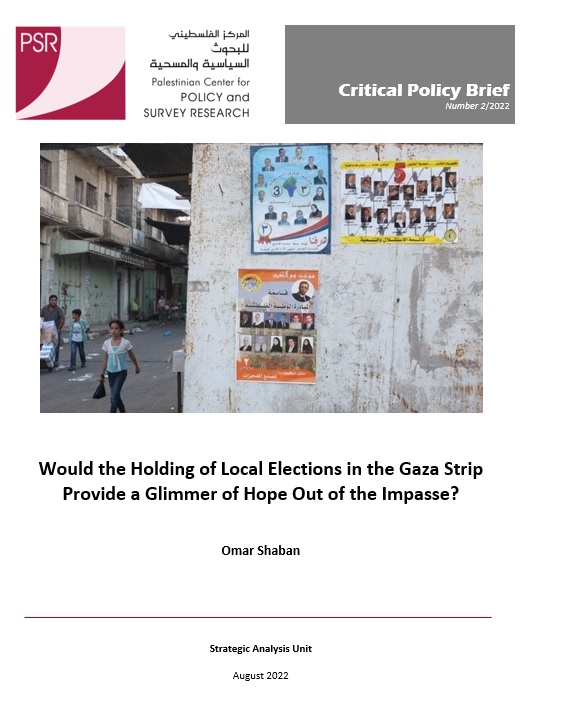
August 2022
Would the Holding of Local Elections in the Gaza Strip Provide a Glimmer of Hope Out of the Impasse?
Omar Shaban
The current difficult economic, social and psychological conditions in the Gaza Strip can only be understood when analyzed in the context of the blockade and repeated wars it has been suffering from since 2007. These conditions must also be placed in the context of internal division and a political failure in which all reconciliation efforts and factional dialogue led nowhere. Even when a consensus emerged over holding general elections for the Legislative Council, the Presidency and the PLO National Council, success remained elusive. Nonetheless, while general elections cannot be held in the foreseeable future, the pressure of the successive crises in the Gaza Strip forces a search for a way out of the impasse. This paper proposes the holding of local elections in the Gaza Strip as a small step that might trigger a gradual wider process. Local elections have been held three times in the northern governorates of the PA without the Gaza Strip’s participation since 2005. The paper argues that these local elections might provide a mechanism to gradually break the impasse and provide an opportunity for change that might enhance the confidence of the local community and its participation in administration and governance, enhance communication and engagement between local municipalities and the world, and might allow attracting projects to address pressing environmental crises and problems in the Gaza Strip. The continuation of the current fait accompli will only have more negative effects on the population, regardless of how much Hamas strives to improve it. The movement has already been hurt in appointing mayors even if it has made an effort to appoint the best in the management of the local bodies.
The Gaza Strip after 15 years of closure, wars, and the absence of elections:
The status quo in the Gaza Strip is characterized by the following:
1) Blocked political horizon and the loss of the hope for change: The political divide has led to the disruption of the democratic process and the fragmentation of the Palestinian political system. Palestinian division is likely to persist given the absence of any serious prospects for Palestinian reconciliation. Local and regional reconciliation efforts have so far been met with failure. This aspect of the status quo has proven to be the most resilient and resistant to change.
Main qualitative indicators continue to deteriorate: The Israeli blockade and repeated wars have caused a sharp deterioration in all indicators of life in the Gaza Strip, including health, education and the economy, with 1.3 million of Gaza's 2.1 million Palestinians in need of food assistance,[1] unemployment levels rising to 46.6% during the first quarter of 2022 compared to the average of 34.8% in 2006, while 81.4% of Palestinian households in the Gaza Strip live below the poverty line[2].
Unending rounds of escalation between the factions in Gaza and the occupation army: Since 2007, the Gaza Strip has been subjected to five major wars, dozens of short violent eruptions, and military and security tensions, causing thousands of victims from all segments of society and destroying tens of thousands of homes and infrastructure.
Psycho-social effects and extremism: The split and infighting have directly contributed to dividing the political system leading to the absence of the democratic process and the denial of the right of the population to choose their representatives, leading further to a state of frustration, despair and lack of horizon among Gazans. This has also led to a rise in the desire to emigrate among young people reaching 37%,[3] to unprecedented levels of attempted suicides, widespread hate speech and incitement, and to the strengthening of the political and legal divide between the Gaza Strip and the West Bank.
Moreover, compelling living conditions, rampant manifestations of corruption in the political and economic classes, and the prevalence of revenge tendencies have led many young people to embrace extremist ideology.[4] Hamas leader Khalil al-Haya said in 2015 at a session at the headquarters of the Legislative Council in Gaza that "our message to the whole world, which fears terrorism and extremism, is that delaying reconstruction and maintaining the siege on the Gaza Strip produce a suitable environment for the spawning of extremism and the increase of terrorism."
Proceeding from the fact that: (1) the continuation of the economic and political situation as it is has become untenable and represents a constant threat to the unity of the people and the opportunities for economic growth and political development, (2) the absence of opportunities to achieve reconciliation adds a further threat to the future of the Gaza Strip , and (3) the rejection by both Egypt and the Palestinian Authority of the option of creating a trade zone between Egypt and the Gaza Strip (because in their view it promotes the separation of the Gaza Strip away from the West Bank and the Palestinian Authority) reduces the prospects of ecnonmic development, (4) continued Israeli imposition of severe restrictions on the quality of goods entering Gaza, under the pretext of preventing the entry of "dual-use" goods, and on trade exchange with the West Bank and Israel adds yet another economic constraint, the holding of municipal elections in Gaza's governorates may present a gateway to a gradual exit from the crisis.
Why elections?
There are four reasons that call for the holding of local elections in the Gaza Strip:
Responding to legal entitlement and a developmental requirement: Holding elections for local bodies is a fulfillment of legal obligation based on the terms of law. It also provides an opportunity for change and sustainable development. For the youth, it represents a sign of hope for a better future of political and social participation.
The renewal of legitimacy strengthens international engagement: The renewal of the legitimacy of local bodies that rely heavily on international support contributes significantly to obtaining grants, projects and assistance, especially since there are a wide range of challenges in the field of service delivery, deterioration of infrastructure, environmental, hygiene and health problems suffered by the governorates of the Gaza Strip.
Local elections could serve as a first step on the road to general elections: The holding of local elections in the Gaza Strip is a real opportunity to persuade the international community to meet the Palestinians' desire for change and push it to work harder with the Israeli government to facilitate the holding of general elections.
It serves Hamas' interest: The holding of elections for local bodies shows Hamas' faith in, and support for, the democratic process. In the past, it favored these elections and it now has an opportunity to demonstrate its real intentions. The movement's approval and the quest to complete local elections in the Gaza Strip will strengthen its position as a political movement seeking to gain leadership through the election process thereby improving its image in front of the Palestinian society and the world. It is worth mentioning that Joseph Borrell, representing the EU foreign policy establishment, indicated on April 30, 2021, that the postponement of the Palestinian general elections, the first in 15 years, was "very disappointing."[5] The EU had consistently supported the holding of credible, inclusive and transparent elections for all Palestinians. Thus, even if the results are not satisfactory to everyone, if Hamas wins, they will be acceptable to many among the international community. It is also worth mentioning that Hamas did participate, directly or indirectly, in the elections of local and various other societal bodies in the West Bank. Therefore, it goes without saying that it is the duty of Hamas to meet Gazans’ needs to elect their own local leaders.
Completing the local election process in the Gaza Strip
The Palestinian political system has almost never respected the constitutional and legal dates for elections, whether legislative, presidential or local. Indeed, elections were held only when serving the political needs of the various political actors. In light of the Palestinian division, an additional constraint has been added leading to the holding of elections in certain parts of the Palestinian territories while abstaining from holding them in others. This happened with the local elections in 2012 when Hamas refused to participate in these elections and prevented them from taking place in the Gaza Strip. At that time, Hamas argued that holding local elections would have "deepened the state of division and increased tension." Fatah on the other hand said that given the fact that the holding of comprehensive general elections was difficult, the least that could be done was to go ahead with local elections. In 2016, Hamas agreed to enter the elections and allow them to be held in Gaza, but no Gazan elections took place after the filing of appeals against six Fatah lists, all accepted by the Central Election Commission (CEC), leading to a decision by the High Court in Ramallah to allow the holding of elections in the West Bank but not in the Gaza Strip. In this case, the court’s reasoning was the “absence of a legitimate judiciary, one formed according to the Basic Law and other relevant laws.”
A breakthrough occurred in 2021 after a series of successful meetings between the CEC and the various Palestinian factions in the West Bank and Gaza Strip. All factions, including Hamas, agreed to hold general elections. The Palestinian President Mahmoud Abbas issued Decree No. 3 of 2021 on January 15 specifying the dates for the holding of legislative, presidential, and National Council elections in three stages.
Three months later, in April 2021, a presidential decree No. (12) of 2021 was issued, providing for the postponement of the general elections, where the first article stated "Postponement of the general legislative and presidential elections and the National Council.... until the conditions for holding them are met in all Palestinian territories, especially Jerusalem, the capital, in accordance with the provisions of the law.”
Soon after that, the PA decided to hold local elections in the West Bank, including Jerusalem, in two phases. However, it was postponed in Gaza due to Hamas’ objections. In a press release on March 13, 2022, Hamas stressed that “fragmented elections” promote the approach of authoritarianism and exclusion, and that there is no solution except through inclusive national and local elections based on consensus.[6] Additionally, Hamas set three main conditions in order for it to allow the holding of elections for local bodies in the Gaza Strip. These included: first, that local elections should be part of the general elections, including parliamentary and presidential elections, and not a substitute for them; second, that there should be a written pledge from President Mahmoud Abbas to ensure that elections will not be cancelled at the last minute; and thirdly, for the president to retract the amendments he has made to the local elections law relating to the jurisdiction of the courts of first instance.
What can be gained by completing the local elections by holding them in the Gaza Strip
The right to participate: The holding of local elections enhances the chances of participation in the electoral process, the right to compete and vote, and restores dynamism to the Gaza Strip thus triggering greater activism and restoring hope in the face of the current stagnation. It can pump a new blood creating opportunities to address pressing issues and environmental problems in local bodies, and moves citizens from talking about wars and destruction to talking about hope and the future.
Easing tension and spreading hope among young people: Young people make up about two-thirds of Gaza's population (of two million people), none of whom participated in any elections whatsoever. The last local elections were held in the Gaza Strip in 2005. Depriving young people of participation in the selection of their representatives is a violation of the constitution; marginalizing young people and signaling to them their lack of importance, leading some of them to extremism and frustration.
The completion of local elections is a confidence building measure that could serve as a small step towards reconciliation: the completion of local elections will only take place in coordination between all relevant parties, namely the Palestinian government, CEC, and Hamas. It is a new phase, not a new round of elections, and it requires approval from all parties. It will also be completed within the laws governing the electoral process that has already been held in the West Bank without the Gaza Strip. Therefore, it must have the same specifications and procedures for any elections held in Palestine based on the laws in force. This development will enhance the dialogue between the Palestinian factions, especially Hamas, with CEC, the PA, and Fatah. Coordination for the participation of international and civil society election monitoring teams will also legitimize these elections. Although optimism about reconciliation may be far from real, the holding of these local elections in the Gaza Strip can be seen as a small confidence building measure that might improve the chances of holding general elections when time becomes ripe for that process to restart. The holding of local elections in the Gaza Strip will be the first successful sign of a joint national effort since the split in 2007 and might generate greater trust between the two sides of the split, Fatah and Hamas, and will likely reopen the door for dialogue to address the problems of holding general elections.
Local elections are a competition for service delivery and should not be politicized: Local elections are not as politicized as general elections, but are elections to renew legitimacy at the level of local administration and inject new blood, ideas and programs to serve the local community in service delivery sectors. Its results are expected to be acceptable even if Hamas wins, as the community of donors already deals with most municipalities in the Gaza Strip, and their Hamas-appointed heads. Several trade union elections have already been held with the participation of the Gaza Strip, the most recent of which was the Bar Association elections. All factions competed in the union elections and internal and external parties accepted the legitimacy of those elections and their results. All of this enhances the chances of holding local elections and reduces concerns about the international reaction regardless of their results, as most members of the international community, which demands the holding of elections, will find it difficult to reject their results.
The difficulties of holding local elections in the Gaza Strip
Hamas' concerns: The most important challenge to holding local elections is Hamas' position as reflected in a letter it submitted to CEC. According to the CEC, Hamas has requested "written" guarantees before it would allow local elections to take place in the Gaza Strip. These guarantees sought to ensure that the election will not be postponed in the last minute. CEC added that Hamas's letter also included issues related to the electoral law, namely: "abolishing the composition of the Election Court and restoring the jurisdiction to decide on appeals to the courts of first instance in the West Bank and Gaza Strip.”[7]
Administrative and technical procedures for holding elections: There are legitimate questions and concerns about the technical and logistical aspects of holding elections in accordance with the existing laws. However, it should be noted that these issues and procedures are meant to facilitate, not complicate, the election process and that policy makers must show the required flexibility in putting them in place. Thus, when elections are desired and accepted by all parties, procedural and technical challenges should be addressed and overcome by consensus.
Conclusions
This paper argues that the holding of local elections in the Gaza Strip is essentially a completion of the election process that has already taken place but has not been implemented in that part of the Palestinian territory; it is not a separate electoral process. Moreover, it believes that success in this matter might trigger greater dynamism in the Gaza Strip turning it into a workshop on many levels, while strengthening the economy and community engagement. It might also produce greater dialogue and constructive debate instead of the state of tension, hate speech and despair prevailing today.
Based on a review of the motives and difficulties, the paper also considers that holding local elections is a viable and practical option and may even constitute a small bridge towards Palestinian reconciliation. The completion of the municipal elections strengthens the cohesion of the Gaza Strip with the northern governorates in the West Bank and achieves a tangible interest for the Palestinian Authority and the presidency. These elections are also in Hamas' interest in terms of easing societal tensions, addressing the phenomena of extremism and frustration, and easing the burdens of local government administration. They can also serve as a signal of Hamas’ commitment to pluralism, which will greatly help it gradually return to the formal Palestinian political system.
[1] See OCHA report Gaza Strip | The humanitarian impact of 15 years of the blockade - June 2022: Gaza Strip | The humanitarian impact of 15 years of the blockade - June 2022 | United Nations Office for the Coordination of Humanitarian Affairs - occupied Palestinian territory (ochaopt.org)
[2] See report on poverty in the Gaza Strip issued by the Palestinian Center for Human Rights: https://pchrgaza.org/ar/%D8%AA%D9%82%D8%B1%D9%8A%D8%B1-%D8%AD%D9%88%D9%8...\
[3] See Omar Shaban, What Future for the Gaza Strip in the Next Five Years?: Critical Policy Brief, Number 6/2021 | PCPSR
[4] See, piece by Ghassan al Za’aneen on the consequences of cancelling local elections (no date) : http://palthink.org/2017/05/1585/
[5] See, France 24, 30 April 2021: https://www.france24.com/ar/%D8%A7%D9%84%D8%B4%D8%B1%D9%82-%D8%A7%D9%84%...
[6] See, statement in al Risalah, 13 March 2022: https://alresalah.ps/post/256993/%D8%AD%D9%85%D8%A7%D8%B3-%D8%A7%D9%84%D...
[7] See, al Sharq al Awsat, 2 January 2022: https://aawsat.com/home/article/3394071/%D8%A7%D8%B3%D8%AA%D8%A8%D8%B9%D...
Thirty years after the signing of the Oslo Accords, about two thirds describe conditions today as worse than they were before that agreement; two thirds think it has damaged Palestinian national interests, three quarters think Israel does not implement it; and a majority supports abandoning it despite the fact that about half believes that abandoning it would lead to the collapse of the PA and the return of the Israeli Civil Administration.
6-9 September 2023

These are the results of the latest poll conducted by the Palestinian Center for Policy and Survey Research (PSR) in the West Bank and the Gaza Strip between 6 and 9 September 2023. The period leading up to the poll witnessed a number of important developments, including the 30th anniversary of the signing of the Oslo Accords, the occupation of the Jenin refugee camp by the Israeli army and the killing of 12 Palestinian residents of the camp, and the visit of President Abbas to the camp after the withdrawal of the Israeli army. During this period, Palestinian faction leaders also met in City of El Alamein in Egypt in the presence of President Abbas but failed to agree on a joint statement. During this period, settler terrorist acts in Palestinian areas of the West Bank increased, as did armed attacks by Palestinians against settlers and Israelis. Finally, there have been press reports that there are US-Saudi negotiations to reach an agreement to normalize Saudi-Israeli relations and that Palestinian-Saudi and Palestinian-American meetings have been held to set Palestinian conditions for this normalization agreement. This press release addresses these issues and covers other matters such as the general conditions in the Palestinian territories, the peace process and future possible directions for Palestinians in the absence of a viable peace process. Total size of the sample is 1270 adults interviewed face to face in 127 randomly selected locations. Margin of error is +/-3%.
For further details, contact PSR director, Dr. Khalil Shikaki, or Walid Ladadweh at tel. 02-296 4933 or email pcpsr@pcpsr.org
Main Findings:
On the occasion of the 30th anniversary of the Oslo Accords, we asked the public a series of questions to gauge their position today on this agreement and its outcome. As we found five years ago, a majority (this time just under two-thirds) believes that the situation today is worse than it was before the implementation of the Oslo Accords. The vast majority still believes that it was wrong to sign that agreement. Today, a majority wants the PA to abandon the agreement and just over two-thirds believe that the agreement has harmed Palestinian interests. Above all, more than three quarters of the public believe that Israel does not implement this agreement all or most of the time.
In light of recent talk of a possible normalization of relations between Saudi Arabia and Israel, the poll asked the public what it thinks of the impact of such normalization on the chances of achieving Palestinian-Israeli peace. A majority says it would be detrimental to the chances of peace. However, the results indicate significant differences between the attitudes of residents of the Gaza Strip, some of whom tend to see positive aspects of normalization, and those of West Bankers, who show firm rejection of it. However, the largest percentage in both regions believes that normalization with Israel is not acceptable before the Arab-Israeli conflict is resolved. Moreover, a large majority, more than 70%, opposes a Palestinian engagement with the Saudis or the Americans to discuss Palestinian conditions for accepting the Saudi normalization.
We also asked about internal Palestinian reconciliation. The poll found that the vast majority believes that the meeting of the leadership of factions in the Egyptian City of El Alamein, about two months ago, was a failure. Among those who view the meeting as a failure, the percentage that places the blame on the Fatah leadership is greater than those who blame Hamas. However, one-third of the public places the blame for the failure on other parties.
Despite the failure of the reconciliation meeting in El Alamein and the greater blame placed on the Fatah leadership, Hamas's popularity has not changed compared to three months ago. In fact, Fatah's popularity improved in both the West Bank and the Gaza Strip. Perhaps the reason why Hamas' standing has not improved is the recent marches in the Gaza Strip demanding better living conditions. This may also have contributed to improving Fatah's image. As for President Abbas, although there are signs that his position might have improved slightly, in light of his decision to retire most governors, most of the indicators of improvement, such as the slight rise in his popularity if presidential elections were held between him and Ismail Haniyeh of Hamas, are due to the high percentage of boycott of presidential elections in which only these two candidates were competing.
Finally, we asked about Palestinian-Israeli relations. The findings show a rise, higher than the margin of error, in support for the two-state solution, reaching about a third. Nonetheless, the overwhelming majority still believes that this solution is no longer feasible due to settlement expansion. At the same time, these results indicate an increase in support for unarmed popular resistance, and a similar increase in support for a return to confrontation and armed intifada. Moreover, nearly half of West Bankers believe that the formation of armed groups from the towns and villages subjected to violent attacks by settlers is the most effective solution in combating settler terrorism.
| (1) 30 years after the signing of the Oslo Agreement: |
- 76% believe Israel does not implement the Oslo Accords; 49% believe the PA does not implement the Oslo Accords
- About two-thirds think current conditions are worse than those of the pre-Oslo period; 20% think current conditions are better
- 68% say the Oslo Accords have damaged Palestinian national interests and 11% say the Accords have served the national interests
- 63% support an abandonment of the Oslo Accords by the PA; 31%
A large majority of 73% knows the exact year in which the Oslo Accords were signed, but the rest do not know or chose the wrong year. 49% believe that the PA does not implement the Oslo agreement today while 44% believe it does that always or most of the time. When asked about the current Israeli government, 76% say it does not implement the Oslo agreement today while only 17% say it implements it all or most of the time. As shown in the following two figures, Gazans are more likely than West Bankers to think that Israel is currently implementing the Oslo Agreement, while there are no differences in perception in the two areas regarding the PA implementation of that agreement.

A majority of 64% believes that the situation today is slightly worse or much worse than it was before the Oslo agreement while 20% believe it is much better or slightly better, and 12% believe the situation today is the same as before the Oslo agreement. On the twenty-fifth anniversary of the signing of the Oslo Accords (i.e. September 2018), 73% said the situation today is worse than before the Oslo Agreement while 13% said the situation is better than before the Oslo Agreement. As shown in figure (3) below, today, in contrast with the situation five years ago, Gazans are more likely than West Bankers to view the Oslo Agreement more positively.
The percentage of those who think conditions today are worse than those prevailing before the signing of the Oslo Accords is higher among men (67%) compared to women (61%), among those whose age is 50 years or higher (69%) compared to those whose age is between 18 and 22 years (60%), among the non-refugees (72%) compared to refugees (54%), among those with the least income (64%) compared to those with the highest income (56%), and among the somewhat religious (68%) compared to the religious (59%).
Figure (3): Public assessment of conditions before and after the Oslo Agreement, in 2018 and in 2023

A majority of 68% believes that the Oslo agreement harmed Palestinian interests while only 11% believe it served Palestinian interests and 17% believe it did not serve and did not harm Palestinian interests. On the twenty-fifth anniversary of the signing of the Oslo Accords, 65% said the agreement harmed Palestinian interests and 16% said it served Palestinian interests. A majority of 71% believes it was wrong for the PLO to sign the Oslo agreement while 23% believe it was right to do so. A majority of 63% supports the PA abandoning the Oslo agreement while 31% oppose it. As shown in figure (4) below, Gazans are much more likely than West Bankers to oppose the abandonment of the Oslo Agreement.
Figure (4): support or oppose the Palestinian Authority's abandonment of the Oslo Accords

46% believe that the most likely scenario if the PA suspends the implementation of the Oslo agreement is the collapse of the PA and possibly the return of the Israeli Civil Administration while 40% believe that the most likely scenario if the PA stops implementing the Oslo agreement is a reversal of Israel’s current policy, perhaps ending its settlement expansion and returning to negotiations.
| (2) Normalization of relations between Saudi Arabia and Israel: |
- 56% think Saudi-Israeli normalization will cause damage to the prospects of reaching peace with Israel
- A majority of 53% opposes setting Palestinian conditions to Saudi normalization with Israel because such normalization is not permissible before the resolution of the conflict with Israel
- 72% oppose Palestinian entry into negotiations with Saudi Arabia and the US over the terms of Saudi normalization with Israel
A majority of 56% believes that reaching an agreement between Saudi Arabia and Israel to normalize relations constitutes a harmful development that would negatively affect the chances of reaching a Palestinian-Israeli peace (this percentage reaches 69% in the West Bank and drops to 38% in the Gaza Strip). By contrast, 17% (29% in the Gaza Strip and 8% in the West Bank) believe such normalization could improve the chances for reaching Palestinian-Israeli peace; 24% believe it is neither harmful nor beneficial. The percentage of those who think the Saudi normalization will be harmful to Palestinian-Israeli peace efforts is also higher among non-refugees (66%) compared to refugees (45%), among those working in the private and the non-governmental sector (59%) compared to those working in the public sector (49%), and among supporters of Hamas (65%) compared to supporters of Fatah and third parties (47% and 51% respectively).
We presented the public with five possible conditions related to the Palestinian-Israeli front that Saudi Arabia could demand from Israel in exchange for normalization with it and asked them to choose the condition they prefer the most. A majority of 53% (59% in the West Bank and 43% in the Gaza Strip) said it rejects all such conditions altogether because normalization with Israel is not permissible before resolving the Arab-Israeli conflict. But 12% chose the release of a number of prisoners; 10% chose Israel's recognition of the two-state solution based on the 1967 borders; 8% chose to transfer Area C land to Palestinian control; another 8% chose the release of tax revenues funds withheld by Israel; and 7% chose Israel's commitment not to annex any Palestinian areas in the West Bank.
As shown in figure (5) below, Gazans are more willing than West Bankers to consider Palestinian conditions for Saudi normalization with Israel and that Gazans are interested mainly in the transfer of control over land to the PA and in an Israeli acknowledgement of the two-state solution based on the 1967 borders.
Figure (5): If it is up to you, which of the following conditions should Saudi Arabia demand in order to normalize its relations with Israel?

We asked the public about support for a PA entry into negotiations with Saudia Arabia and the US over the setting of Palestinian conditions for Saudi normalization with Israel, such as Israeli transfer of land or the opening of the PLO representative office in Washington DC. An overwhelming majority (72%) opposes a PA entry into such negotiations (79% in the West Bank and 61% in the Gaza Strip) while 24% (38% in the Gaza Strip and 14% in the West Bank) support it. Opposition to Palestinian entry into negotiations with Saudi Arabia is also higher among non-refugees (80%) compared to refugees (62%), among the married (73%) compared to the non-married (68%), among supporters of Hamas (82%) compared to the supporters of Fatah and third parties (56% and 67%.
| (3) Legislative and presidential elections: |
- Haniyeh wins in presidential elections against Mahmud Abbas: 58% and 37% respectively
- But Marwan Barghouti wins against Haniyeh, 60% and 37% respectively
- 78% demand the resignation of president Abbas; 19% want him to stay in office
- In parliamentary elections, Fatah wins 36% of the vote and Hamas 34%
If new presidential elections were held today and only two candidates, Mahmoud Abbas and Ismail Haniyeh, the voter turnout would be only 42%, and among those who would participate, Abbas would receive 37% of the vote and Haniyeh 58% (compared to 56% for Haniyeh and 33% for Abbas three months ago). In the Gaza Strip, the vote for Abbas stands at 33% and for Haniyeh at 64%, while in the West Bank Abbas receives 43% and Haniyeh 50%. If the competition is between Marwan Barghouti and Haniyeh, participation would rise to 59% and among those voting, Barghouti receives 60% and Haniyeh 37%. If the competition were between Mohammad Shtayyeh and Ismail Haniyeh, participation would drop to only 41%, with Shtayyeh receiving 33% and Haniyeh receiving 62%.
In a closed question, we asked the public to select the person they prefer to see as President Abbas's successor. The largest percentage (34%) said they prefer Marwan Barghouti; 17% preferred Ismail Haniyeh; 6% preferred Mohammed Dahlan, 5% preferred Khaled Meshaal, 3% preferred Yahya al-Sinwar, Muhammad Shtayyeh, and Hussein al-Sheikh, and 30% said they did not know or chose someone else.
Level of satisfaction with the performance of president Abbas stands at 22% and dissatisfaction at 76%. Satisfaction with Abbas stands at 21% in the West Bank and 24% in the Gaza Strip. Three months ago, satisfaction with Abbas stood at 17% and dissatisfaction at 80%. 78% want Abbas to resign while 19% want him to remain in office. Three months ago, 80% said they want Abbas to resign. Demand for Abbas' resignation stands at 78% in the West Bank and 79% in the Gaza Strip. Demand for Abbas’ resignation is also higher among holders of BA degree (78%) compared to the holders of the elementary certificate (59%), and among supporters of Hamas and third parties (94% and 87% respectively) compared to supporters of Fatah (54%).
If new parliamentary elections were held today with the participation of all political forces that participated in the 2006 elections, 64% say they would participate in them, and among these participants, Fateh receives 36%, Hamas' Change and Reform 34%, all other lists combined 9%, and 21% say they have not yet decided whom they will vote for. Three months ago, vote for Hamas stood at 34% and Fatah at 33%. Vote for Hamas in the Gaza Strip stands today at 44% (compared to 44% three months ago) and for Fateh at 32% (compared to 28% three months ago). In the West Bank, vote for Hamas stands at 24% (compared to 25% three months ago) and Fatah at 40% (compared to 34% three months ago).
A little over a quarter (27%) believe that Hamas is the most deserving of representing and leading the Palestinian people today while 24% believe that Fateh under the leadership of Abbas is more deserving; 44% believe both are unworthy of representation and leadership. Three months ago, 31% said Hamas is the most deserving, 21% said Fateh led by Abbas is the most deserving, and 43% said both are unworthy of representation and leadership.
| (4) Domestic Conditions : |
- 87% believe corruption exists in PA institutions; 72% believe corruption exist in the institutions controlled by Hamas
- 62% think the PA is now a burden on the Palestinian people and 35% think it is an asset
- 53% support the decision by president Abbas to dismiss the governors; 53% view it as a reform measure
- 78% think Abbas’ visit to Jenin has not contributed to improving relations between the public and the Pal leadership
- 59% view the demonstrations in the Gaza Strip as a response to the difficult living conditions
- 73% think there are political prisoners in the PA prisons
- 60% are worried that possible internal infighting between armed groups and the PA security services could threaten stability
Positive evaluation of conditions in the Gaza Strip stands at 10% and positive evaluation of conditions in the West Bank stands at 21%. Despite this, perception of personal safety and security in the Gaza Strip stands at 69% and perception of security in the West Bank stands at only 48%. Three months ago, perception of security in the West Bank stood at 46% and in the Gaza Strip at 71%. Perception of corruption in PA institutions stands at 87%; 72% believe that there is corruption in Hamas-run institutions in the Gaza Strip. Three months ago, 84% said there is corruption in the PA institutions and 73% said there is corruption in public institutions run by Hamas. 42% of West Bankers believe that people can criticize the PA in the West Bank without fear while a majority of 56% believes it is not possible. Among residents of the Gaza Strip, 39% believe that criticism of the Hamas authority can be made without fear while 59% believe it is not possible.
A majority of 62% believes that the PA has become a burden on the Palestinian people and only 35% believe it is an asset for the Palestinian people. Three months ago, almost identical percentage of 63% said the PA is a burden and 33% said it was an achievement.
A majority of 53% supports, and 38% oppose, President Abbas' move to retire 12 governors in the West Bank and Gaza Strip; 53% agree that Abbas' move to retire the governors is a step in the right direction to reform the PA and inject new and young blood into it while 38% believe it is not. Abbas’s decision finds greater support in the West Bank (62%) compared to the Gaza Strip (40%), among supporters of Fatah and third parties (68% and 64% respectively), compared to supporters of Hamas (40%). Similarly, the belief that Abbas’ move is a step on the road to reform is greater in the West Bank (58%) compared to the Gaza Strip (46%), among supporters of Fatah and third parties (73% and 57% respectively( compared to supporters of Hamas (37%). An overwhelming majority (78%) believes that Abbas' visit to Jenin refugee camp after the withdrawal of the Israeli army did not contribute to improving relations between citizens and the Palestinian leadership while 20% believe it did.
59% believe that the marches held in the Gaza Strip a month ago to demand better living conditions were a reaction to the difficulties of life while 35% believe they were motivated by foreign political agendas. The belief that the marches are driving by external agenda is higher in the Gaza Strip (45%) compared to the West Bank (29%), among Hamas supporters (59%) compared to supporters of third parties and Fatah (47% and 24% respectively). 73% (82% in the West Bank and 60% in the Gaza Strip) believe that there are political prisoners in PA prisons while 21% believe there are none. The belief that there are political prisoners in PA prisons is greater in the West Bank (82%) compared to the Gaza Strip (60%), among those who work in the private and non-governmental sector (76%) compared to those who work in the public sector (65%), among those with the highest income (79%) compared to those with the lowest income (69%), and among supporters of Hamas and third parties (77% and 72% respectively) compared to supporters of Fatah (60%).
A majority of 60% of the public (67% in the West Bank and 51% in the Gaza Strip) is concerned that clashes between members of armed groups and Palestinian security forces could lead to clashes and violence that could threaten stability in the PA.
39% believe that filing a complaint with the Public Prosecution office against AMAN (the Palestinian independent institution that monitors corruption), for publishing information about suspicions of corruption related to some officials in the case of the whitewashing of settlements’ dates, will scare citizens and institutions from reporting suspicions of corruption while 32% believe it will encourage citizens and institutions to report suspicions of corruption; 20% believe that such a complaint will have no impact on reporting suspicions of corruption. When asked why the office of the president has filed a complaint against AMAN, 59% said it was to punish whistleblowers and 22% said it was because the information published was incorrect.
We asked the participants which TV station they had watched the most over the past three months. Findings show that Al Jazeera TV viewership is the highest at 28%, followed by Al Aqsa TV (11%), Palestine TV (9%), Palestine Today (8%), Ma'an TV (7%), and Al Arabiya and Al Mayadeen (3% each).
| (5) Reconciliation and the reunification of the West Bank and the Gaza Strip: |
- 78% view the factional meeting at El Alamin s a failure
- More people place the blame for the failure on Fatah leadership compared to that of Hamas, 29% and 18% respectively.
- Optimism about reconciliation stands at 24%
An overwhelming majority of the public (78%; 81% in the West Bank and 72% in the Gaza Strip) believes that the meeting of Palestinian factional leaders in El Alamein in Egypt in the presence of PA president Mahmoud Abbas was a failure while 12% believe it was a success. The largest percentage of those who believe that the meeting was a failure (34%; 38% in the West Bank and 26% in the Gaza Strip) blame the failure on the leadership of other forces and actors (other than Fateh and Hamas) while 29% blame the failure on the leadership of Fateh, and 18% (25% in the Gaza Strip and 14% in the West Bank) place the blame on Hamas’ leadership. The percentage of those who place the blame on Fatah for the failure of the factional meeting is higher in the Gaza Strip (40%) compared to the West Bank (23%), among supporters of Hamas (67%) compared to the supporters of third parties and Fatah (15% and 4% respectively). By contrast, the percentage of those who blame Hamas is higher in the Gaza Strip (25%) compared to the West Bank (14%), and among supporters of Fatah and third parties (47% and 29% respectively) compared to supporters of Hamas (8%).
The public is evenly divided in its position regarding Islamic Jihad's boycott of the meeting in El Alamein with 44% saying the movement should have participated while 43% believe the boycott was justified.
24% (38% in the Gaza Strip and 15% in the West Bank) are optimistic about the success of reconciliation while 73% are not optimistic. Three months ago, 22% said they were optimistic.
| (6) Palestinian-Israeli Relations and the Peace process: |
- Support for the two-state solution rises from 28% to 32%
- 76% believe the prospects for the creation of an independent Palestinian state alongside the state of Israel during the next five years is slim or nonexistent
- 58% support resoled to armed confrontations and intifada in order to break the current deadlock
- Support for armed struggle is much higher than support for negotiations as the most effective means of ending the Israeli occupation, 53% and 20% respectively
- To confront settlers’ terrorism, the largest percentage (45%) support the formation of armed groups in the areas targeted by settlers
32% support and 67% oppose the idea of a two-state solution, which was presented to the public without providing details of the solution. Three months ago, support for this solution in a similar question stood at 28%. Support for the two-state solution is linked to public assessment of the feasibility of such a solution and the chances for the establishment of a Palestinian state. Today, 71% believe the two-state solution is no longer practical due to settlement expansion but 27% believe it is still practical. Moreover, 76% believe that the chances for the establishment of an independent Palestinian state alongside Israel in the next five years are slim or nonextant, and 23% believe the chances are medium or high. Three months ago, 71% said that the two-state solution is no longer practical due to settlement expansion.
When asked about public support and opposition to specific policy measures to break the stalemate: 58% supported joining more international organizations; 53% supported resort to unarmed popular resistance; 58% supported a return to confrontations and armed intifada; 52% supported dissolving the PA; and 27% supported abandoning the two-state solution and demanding one state for Palestinians and Israelis. Three months ago, 53% supported a return to confrontations and armed intifada; 49% supported the dissolution of the PA; and 26% supported abandoning the two-state solution in favor of one state.
As shown in figure (6) below, Palestinian support for resort to arms increase 10 percentage points since the formation of the current far right Israel government and that support for dissolving the PA has increase five percentage points.
Figure (6): Comparison between public support and opposition to specific options to break the deadlock, today and a year ago

When asked about the best way to end occupation and establish an independent state, the public was divided into three groups: a majority of 53% (51% in the Gaza Strip and 54% in the West Bank) said it was armed struggle; 20% said it was negotiations; and 24% said it was popular non-violent resistance. Three months ago, 52% said armed struggle was the best way and 21% said negotiations were the best way.
An overwhelming majority (82%) believes that the Israeli army did not achieve its goal of arresting or killing fighters from the Jenin Brigade and other groups during its occupation of the camp more than two months ago.
In light of the increase in settler terrorist attacks against Palestinian towns and villages, we asked the public what means are most effective in combating this terrorism that are also the most feasible. The largest percentage (45%, 47% in the West Bank and 43% in the Gaza Strip) chose the formation of armed groups by residents of the targeted areas in order to protect their areas; 29% chose to deploy Palestinian police forces in the targeted areas; 13% chose the demand that the Israeli army take measures to prevent settler terrorism; and only 9% chose to form unarmed groups of residents of the targeted areas to protect their areas. Figure (7) below, show the extent of the public distrust, particularly in the West Bank, in the role of the Israeli army in protecting the vulnerable communities and that the trust of the public in the Palestinian police is much less than the trust it places in the armed groups. Findings show that support for the formation of armed groups to provide protection against settlers’ terrorism is higher among those who work in the private and non-governmental sector (47%) compared to those who work in the public sector (38%), among those with the highest income (44%) compared to those with the lowest income (38%), and among supporters of Hamas (57%) compared to supporters of Fatah and third parties (35% and 39% respectively).
Figure (7): Which one of the following methods do you think is the most effective in combating settlers’ terrorism, such as the attacks on Huwara, Turmusayya and Um, and at the same time the most realistic.

In light of demonstrations against the Netanyahu government, 39% believe the chances of these demonstrations turning into a civil war inside Israel are low, another 23% say they are nonexistent, and only 35% think they are high.
| (7) Most vital Palestinian goals and the main problems confronting Palestinians today: |
- 37% view the Israeli occupation and the establishment of a Palestinian state as the top most vital goal while 30% chose the right of return
- 37% view the ending of the occupation as the most pressing problem confronting the Palestinians today; 22% chose corruption, and 15% chose unemployment
37% believe that the first most vital Palestinian goal should be to end Israeli occupation in the areas occupied in 1967 and build a Palestinian state in the West Bank and the Gaza Strip with East Jerusalem as its capital. By contrast, 30% believe the first most vital goal should be to obtain the right of return of refugees to their 1948 towns and villages, 18% believe that the first and most vital goal should be to build a pious or moral individual and a religious society, one that applies all Islamic teachings and 14% believes it should be to establish a democratic political system that respects freedoms and rights of Palestinians.
In a question about the main problem confronting Palestinian society today, the largest percentage, 25% (11% in the Gaz Strip and 35% in the West Bank), say it is corruption; 24% (33% in the Gaza Strip and 18% in the West Bank) say it is unemployment and poverty; 18% say it is the continuation of the occupation and settlement construction; 17% (26% in the Gaza Strip and 10% in the West Bank) say it is continued siege and blockade of the Gaza Strip; 10% say it is the split between the West Bank and the Gaza Strip; and 4% say it is the weakness of the judiciary and the absence of liberties, accountability and democracy.
When asked about the most pressing problem confronting the Palestinians today, the largest percentage (37%) said it is the Israeli occupation, while 22% said it is corruption, 15% said it is unemployment; 14% said it is the split between the West Bank and the Gaza Strip, 7% said it is the internal violence, and 1% said it is the inadequate infrastructure.
_________________________
This poll has been conducted in cooperation with the Konrad-Adenauer-Stiftung in Ramallah
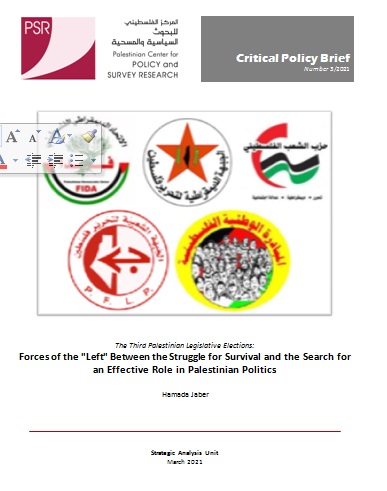 March 2021
The Third Palestinian Legislative Elections:
Forces of the "Left" Between the Struggle for Survival and the Search for an Effective Role in Palestinian Politics
Hamada Jaber
The presidential decree issued in mid-January is the first practical step for holding general elections, starting with elections for the Legislative Council of the Palestinian Authority on May 22. Regardless of the seriousness and possibility of holding the third Palestinian legislative elections, which were delayed or caused to be delayed for more than ten years, the forces of the left must prepare for these elections and decide what they want: is it merely survival, or working, despite their relatively small size, to be a third, effective force in the Palestinian political system?
This paper aims to discuss the left’s current options in dealing with the issue of legislative elections. It covers three such options: for the left-wing forces to contest the upcoming elections within a joint national list entailing components of the Palestine Liberation Organization (PLO), with or without Hamas, or as a unified left list, or with individual left lists. This paper highlights some of the advantages and drawbacks of these options. It ends with a proposal for a comprehensive, unified mobilization of the forces of the Palestinian left.
Background
If new legislative elections are held next May, they will be the third elections in 27 years since the establishment of the Palestinian Authority apparatus, after the elections of 1996 and 2006. These elections will be held through a different system from the previous ones, a full proportional representation system. The results of Public Opinion Poll No. 77 of the Palestinian Center for Policy and Survey Research indicate that, if new legislative elections are held with the participation of all political forces, 61% say that they will participate in them. The Hamas Change and Reform List will gain 34%, Fatah, 38%, and all other lists that had participated in the 2006 elections will gain 8% in total, while 20% have not yet decided who they will vote for. The findings indicate that 3 blocs (including two electoral lists, representing 4 parties/factions) who have passed the electoral threshold in the 2006 legislative elections, will not be able to do so if legislative elections are held today, taking into account a margin of error of +/- 3% and the transformation of the electoral system into one of full proportional representation.
As evidenced by the results of the aforementioned poll, the parties and fronts of the so-called Palestinian left may lose half their seats that they had collectively gained in the 2006 legislative elections, which were only 9 out of 132 seats. This expected loss is the result of the failure of these parties and fronts to maintain their principles and goals and implement their programs. Despite their awareness of this and their attempt to form a body that expresses minimum unity as a third force, such as the National Democratic Union that came into existence between September 2018 and January 2019, the calculations, based on narrow interests of the leaders of these parties and fronts, have caused them to lose another opportunity to protect themselves from extinction and prevent their exit from the Palestinian political scene. The experience of the Alternative List in the 2006 elections, which consisted of the Democratic Front coalition, the People’s Party, and the Palestinian Democratic Union (FIDA), was not a successful experiment in terms of persuading the masses to vote for it, because it was a temporary coalition that ended with the announcement of results, winning only two seats in those elections.
The forces of the left must realize that the Hamas-Fatah rapprochement and agreement express the depth of the crisis that the two movements have reached in the Gaza Strip and the West Bank, and do not express the alleged unity required to face the challenges witnessed by the Palestinians. This may be an opportunity for third or new forces to present themselves as alternatives. The depth of the Hamas crisis can be evidenced by its approval of the Fatah movement’s project based on the solution of a Palestinian state on the 1967 borders, at a time when many leaders of the Fatah movement themselves believe that this solution has become impossible and long dead. Likewise, the Hamas slogan of armed resistance has retreated from being a strategy to a mere tactic. This is evident in Hamas’ support, and then control, of the Return Marches that began in March 2018, as well as the fact that the last real armed confrontation with Israel was in 2014, and the various disputes between Hamas and Islamic Jihad about controlling and timing the use of arms.
On the other hand, the Fatah movement’s crisis appears to be deeper and more complex, leading it to the verge of fragmentation after its resounding failure, for more than a quarter of a century, to achieve its program based on the two-state solution, as well as its failure to build institutions capable of forming the nucleus of the state project. The slogans of “internationalization” and “changing the PA mandate” have not merely fallen, but brought the opposite results, ushering in Arab-Israeli normalization that has placed Fatah and its leadership in a spot of limited maneuver and submission, or a revolution for which it is no longer qualified. The call for a popular resistance strategy-- which was adopted by all PLO factions, as well as Hamas and Islamic Jihad, in the meeting of the general secretaries on September 3, 2020, which was held, allegedly, to confront the Deal of the Century and the wave of Arab-Israeli normalization-- has proven to be mere lip service. It has been more than six months since the first statement of the so-called Popular Resistance leadership, without the issuance of a second statement. This is evidence of a deficiency in describing the era, the program, and the appropriate tools. As a result, the call for popular resistance did not receive any response from the public. It should be noted that, according to the Palestinian Center for Policy and Survey Research, Palestinian support for the two-state solution has declined from 55% in 2011 to 39% in 2020 despite the support it has from all Palestinian parties and movements (including Hamas, and with no objection from Islamic Jihad). Moreover, 62% of the public believe that this solution is no longer practical due to Israeli settlement expansion, Support for the one-state solution in historic Palestine, with equal rights for all its citizens, has risen from 27% in 2011 to 37% in 2020, despite the fact that no Palestinian party or movement has adopted this solution.
The Hamas-Fatah dyad, based on partisan quotas and interests, which has forgotten or ignored their roles as national liberation movements, is not a true division, one based on the beliefs of the masses that support them. But it will remain as such in the absence of a real, third force. Palestinians today are thirsty for a party or a movement capable of mobilizing their energies and hopes, one that addresses their minds and present a revolutionary and a realistic vision and program.
Options and a window of opportunity
According to the results of the aforementioned poll, and after adding the percentage of those who will not participate in the elections (39%) and those who have not yet decided whom they will vote for (20% of the 61% who said they will participate), the total comes to 51% of all Palestinians who are entitled to vote. Thus, there is a real chance for a new party, faction or movement to convince the 39% to participate. It is believed that the main reason for the unwillingness to participate, among a large proportion of these, is their lack of confidence in the existing parties and movements, and also, perhaps, because they are not convinced of their programs. There is also a chance to reach out to the 20% of those who plan to participate in the elections, but have not yet decided to whom they will vote (12% of the total number eligible to vote). There is even an opportunity to compete for the votes of those who have already decided whom they will vote for, if the new party or movement is able to present a new, different, and perhaps revolutionary program, in terms of its nature and tools. Thus, the percentage of those who can be persuaded may reach more than 50% of all Palestinians who are entitled to vote. In other words, if a new party or movement is able to convince only 25% of all Palestinians who are entitled to vote, this party will outperform Fatah and Hamas and become the largest force in the Legislative Council.
The Palestinian left has three options. The first is to maintain a symbolic presence in the political system, as in the first option below. The second is to seek to exercise an influential role, by creating a unified left. This option however is dependent on the failure of Fatah and Hamas to create a joint list of their own. Finally, there is an option in which the left risks increasing its weakness, and possibly eradicating it completely from the political scene, in the form of individual lists of left parties.
(1) Joint National List
With reference to the outcomes of the dialogue between Hamas and Fatah, in particular, and other factions, in general, the last of which was held at Cairo on February 8 and 9, it appears that the idea of running in the next legislative elections with a joint list that includes Hamas, Fatah and the remaining PLO factions is under serious consideration by the official bodies of Fatah and Hamas.
Fatah may wish, through this joint list, to protect the movement from the almost certain fragmentation in its ranks, by restricting the ability of its prominent leaders to form electoral lists outside the official list of Fatah (the President’s list). The results of a public poll by the Palestinian Center for Policy and Survey Research last December indicated that, if Fatah leader Marwan Barghouti forms a list outside the official list of Fatah, his list would gain 25% of the votes, compared to 19% for the official list of Fatah. Similarly, if Mohammed Dahlan forms a list outside the official list of Fatah, his list would gain 7% of the votes, compared to 27% for the official list of Fatah. In both cases, the “official” Fatah list will lose to Hamas, which will receive about 33% of the votes. As for Hamas, it may have submitted to the idea of power-sharing and quotas, as it was not faithful to the votes cast by the majority in the last legislative elections. Perhaps Hamas sees the joint list as an opportunity for the beginning of its accession to and effective representation in PLO institutions, and an opportunity to be rid of the burdens of governance in Gaza, as well as an opportunity for its recognition by the international community, which has boycotted the government formed by Hamas after it won the majority of seats in the Legislative Council in 2006.
As for the forces of the left (Popular Front, Democratic Front, National Initiative, People’s Party and the Democratic Union – FIDA), they seem to be powerless, seeing in the joint national list a lifeline for their symbolic survival on the political scene, after the accumulated failure of their performance and the dissolution of most of their cadres and popular bases. There is a risk that most of them will not be able to reach the threshold, and thus may fall out of the political scene, if they run the upcoming legislative elections individually. If the forces of the Palestinian left want to preserve their current symbolic existence and dispense with the ambition of an alternative or influential force, they must join the joint list with Fatah and Hamas if such a list is agreed upon, or enter a joint list with Fatah and all the PLO factions. One of the advantages of this option is that it is easy to market as a unification option required by the current conditions, to keep the forces of the left in the political scene and give them an opportunity to try to reform their situation. It is also expected that the Fatah and Hamas movements will contribute to the bulk of the cost of the electoral campaign for this joint list, thus relieving the left of much-needed financial costs. However, among the drawbacks of this option is that it keeps these forces ineffective and under the influence of the two major parties, as it is not expected that Hamas and Fatah will agree to give these forces a weight (number of seats) greater than what they had jointly gained in the 2006 elections.Their presence and influence in the likely national unity government after the elections will be limited, as the Hamas-Fatah collusion may eliminate Fatah’s need to appease these factions by giving them ministerial portfolios, as was the case in the past. This option also denies the left the distinction (if any) in its programs.
(2) United Left List
There is a great opportunity for existing third forces or for new powers, especially if they are based on a new, young leadership that has not been tainted by the corruption of the Authority and the factions that constitute it. This should be seen as a call to all young men and women of the Palestinian left, in particular, and to all young men and women of Palestine, in general (who, in the 18-39 years age group, account for more than 60% of those with the right to vote, and, for more than half of the voters, it will be the first time in their lives that they are entitled to vote, being in the 18-32 years age group) to trust themselves and not to hesitate to present new, emancipatory visions and programs of struggle that address the minds of the masses, not in the defeatist “pragmatism” or the destructive militarism way, but in the belief that the will and unity of the masses, which trust their leadership, is capable of working miracles.
The forces of the left must realize that their audience no longer accepts any excuse for the continued existence of this number of ineffective left-wing parties and fronts, especially that the key reasons for failure of all attempts to unify the left forces are considered by many as due to reasons and interests of particular leaders of those parties and fronts. Further, there is no programmatic or ideological reason that hinders this unity. Thus, one of the advantages of the option of a united left list is that it may restore some lost confidence in the parties and fronts of the Palestinian left. Several attempts have been made to accomplish this outcome. One should build on these efforts in order to achieve it in a short period of time (before the end of the candidacy period on March 31). Also, this option doubles the chances for this list to gain a number of seats that enable it to build an alliance with Fatah or Hamas, if the two parties run in the elections separately and neither gains a majority in the Legislative Council. However, one of the drawbacks of this option is that, if Hamas and Fatah are allied before or after the elections, these forces will remain weak. Even if these forces double their number of seats compared to the 2006 elections, they will not be able to rise to the level of an effective force if they do not properly appraise the conditions of the country and offer programs that treat the malaise in our political system while addressing the reasons for their own previous failures, including the inability to bring forth new leaders. The leftist forces will do better if they ally themselves with social forces and independent figures that are close to their ideology while having a a presence at the grassroot level, such as the “Wa’ad” (promise) movement for homeland, justice and democracy, which announced its formation at a press conference on February 27, 2021, in Ramallah. The movement has declared that it is not “an electoral bloc”, but will support the lists seen as close to the issues and principles that the movement upholds. It is clear that most of the initiators of this movement are members and cadres with leftist backgrounds. We should keep in mind that the left today is not engaged with the needs and concerns of citizens, and, thus, its ability to properly decipher the public scene is hampered. It should remember the popular movement to bring down the Social Security law in 2018/2019, which was one of the most important reasons leading to overthrow of the previous government. Most of the leftist forces either supported or did not oppose the aforementioned law. Rather, the leadership pushed leftist leaders to the forefront to defend that law and try to convince the masses of its value. Eventually, the movement forced the PA president to abandon the law and stop its implementation.
(3) Individual Left Lists
In the event of failure to achieve the previous options, and given the fact that there has been no change in most or all of the top decision-makers in the forces of the left since the 2006 elections, these forces may choose to run in the next elections through separate lists or in coalitions similar to Badil (alternative) that ran in the previous election. one of the advantages of this option is that it gives the forces of the left the opportunity to present their own pure programs and visions, without having to compromise. It also gives them a greater margin of freedom and maneuver for potential coalitions after the elections. One or more of these forces may gain a number of seats that would force Fatah or Hamas to seek their participation in the next government, as neither Fatah nor Hamas are likely to obtain a majority that would enable it to form a government on its own. A drawback of this option is that some forces would risk failing to meet the threshold condition, thus increasing their weakness, potentially fading out, with the exception of the “Popular Front” which probably believes that it retains its presence and base of popularity to enable it to pass the threshold. Yet, this will not suffice to make it an influential force. Likewise, individual electoral campaigns for each list will multiply the demands on and deplete the financial resources of those forces that are in dire need of them. The left’s lack of financial resources has been the price it paid for submitting to the dictates of the PLO leadership which denied it the right to its legitimate share in the National Fund, allowing Fatah and its president to monopolize these resources and blackmail them on more than one occasion. Under this option, leftist factions will be forced to compromise further on their principles after the elections.
What to do?
To be an effective third force, the factions of the left must double their efforts, today, not only to maintain a presence in the Palestinian political scene, as in the first and second options, but to contribute to determining the next Palestinian domestic direction and the future direction of the relationship with Israel. The left and other third party fronts in the PLO, along with newly emerging parties wishing to be an alternative or influential third force, must review and study the causes of the “national project’s” crisis and the reality and the future of the PLO and its liberation program. The parties and fronts of the third force must also study the causes of failure of the aforementioned strategies and reconsider the reading and characterization of the status quo to be able to provide real programs and tools, removed from slogans. This requires a review of the pillars of the status quo and how to deal with them. For example, many leaders of these parties and fronts describe the situation that exists between the river and the sea as a reality of one state, ruled by Israel as “an apartheid system.” This is true, but how can this reality be marketed to the world to end it, given the continued existence of the PA apparatus? Here, it must be recalled that the majority of the Palestinian public (55%) sees the continued existence of the PA as a burden on it and on its cause.
The forces of the left that wish to become an alternative influential third force must instate a dramatic change that restores the confidence of their cadres and popular bases in them. They must take quick, practical steps, for example by electing or selecting a committee for unity and elections, from outside the governing bodies of each front/party, because these bodies have proved that they are part of the problem and cannot to be part of the solution. The public is eager to see new, young faces. The members of these committees may all be candidates for the upcoming legislative elections on a united left list. These committees should convene for several days to elect a leadership committee of 21 members from among them (it should be named the Higher Committee of Unity), with one representative, at least, of each party/front. This committee should make its decisions by an absolute majority (50%+1), in order to prepare the election program and everything related to the election campaign, and its decisions should be binding for the participating parties and fronts.
Among the disadvantages of this proposal is the lack of time (before the end of the candidacy period on March 31). Also, there does not seem to be real will among the leaders of the target forces to waive the privileges that they currently enjoy; rather, they will probably seek to uphold them. On the other hand, one of the advantages of this proposal is that it may be able to restore the confidence and energies of all the cadres and bases of the left forces, and may even represent a breakthrough, capable of attracting broad groups of society, as mentioned previously. This proposal, if adopted, make it more likely that the left will be better prepared to understand the nature of the status quo and present a political program that bypasses the challenges that led to the failure of previous strategies and slogans. If this happens, the leftist forces, with this new reality, will have a strong and influential presence in the political system, whether they are part of the government or the opposition.
Joint Palestinian-Israeli Public Opinion Poll
In the Backdrop of the Gaza Takeover by Hamas, Israelis and Palestinians Share Grim Expectations of the other Side’s Leadership and the Chances for the Resumption of Negotiations
These are the results of the most recent poll conducted jointly by the Harry S. Truman Research Institute for the Advancement of Peace at the Hebrew University of Jerusalem and the Palestinian Center for Policy and Survey Research in Ramallah, between June 12 and 20, 2007. The data for these surveys were collected while the Hamas’ violent takeover of the Gaza Strip took place. The evaluation of the reported figures must take into consideration this context.
The joint poll examined the two publics’ support of a renewed cease fire agreement between Israel and the Palestinian factions and several ideas to promote it including the deployment of international forces on the borders of the Gaza strip, and the security plan proposed by US Secretary of State Rice. In addition we examined assessments of the Arab League (Saudi) plan, the Israeli leadership's degrees of freedom to negotiate with various configurations of a Palestinian government, and an Israeli-Syrian settlement.
- · 89% of Israelis and 76% of Palestinians believed at the time of the survey that armed confrontations between the two sides will continue. 47% of Israelis and 51% of Palestinians believed that negotiations will resume. However only 31% of Palestinians believed it is possible to reach a compromise settlement with the current Israeli leadership. Among Israelis, 42% believed that it is possible to reach such a settlement with Abu Mazin, and 25% - with a Palestinian national unity government.
- · 63% of the Palestinians support the security plan proposed by the American Secretary of State last month, compared to 45% among Israelis who support it. The plan requests from the Palestinians the enforcement of law and order, fighting terrorism, preventing rocket attacks on Israel, and preventing smuggling through tunnels. It requests the Israelis to open the crossings of Rafah, Kerem Shalom, and Karni on a regular and permanent basis, to allow passage of people and goods between the Gaza Strip and the West Bank, and remove checkpoints in the West Bank. Presumably Israelis’ lukewarm support of the plan has been driven by fears of renewed violent attacks by Hamas following its takeover of Gaza if checkpoints are removed and Gazacrossings are open, echoing Israeli security authorities’ concerns.
- · Regarding another closely related issue, the deployment of international forces along the borders of Gaza, Egypt and Israel, in order to prevent arm smuggling and rocket launching on Israel, a considerable majority among Israelis (65%) support this step, while 35% of the Palestinians support it. Three years ago in June 2004, 53% of the Israelis and 60% among Palestinians supported the deployment of such an armed force.
Given the blowing of war winds in the region and speculations about a new war in the summer we attempted to asses the impact of these speculations on Israelis’ expectations and attitudes toward the use of force versus peaceful means to cope with threats that Israel faces.
- · 46% of the Israelis believe that another war can be expected this summer while 42% do not expect such a war.
- · 15% of the Israelis also believe that a ground operation in the Gaza strip can prevent a coming war in the summer while 49% believe that such an operation will rather promote war.
And Given the difficulties the Palestinians confront in their domestic scene, we attempted to assess how the Palestinian public views its options regarding the future of the PA, possible confederation with Jordan, and the chances for the establishment of a Palestinian state in the next five years.
- · 41% of the Palestinians want to dissolve the PA and replace it with an international trusteeship (26%) or return to full Israeli occupation (16%). 49% oppose the dissolution of the PA.
- · 42% support the establishment of a confederation with Jordan and 52% oppose that.
- · 70% believe the chances for the establishment of a Palestinian state in the next five years are low or nonexistent and 26% believe the chances are medium or high.
The joint poll further examined Israeli and Palestinian assessments of the capability of both leaderships to reach a political settlement these days.
Total Palestinian sample size is 1270 adults interviewed face-to-face in the West Bank and Gaza Strip in 127 randomly selected locations between June 14 and 20, 2007. The margin of error is 3%. The Israeli sample includes 598 adult Israelis interviewed by phone in Hebrew, Arabic, or Russian between June 12 and 19, 2007. The margin of error is 4%. The poll was planned and supervised by Dr. Yaacov Shamir, the Harry S. Truman Research Institute for the Advancement of Peace and the Department of Communication and Journalism at the Hebrew University and Dr. Khalil Shikaki, director of the Palestinian Center for Policy and Survey Research (PSR).
For further details on the Palestinian survey contact PSR director, Dr. Khalil Shikaki or Walid Ladadweh, at tel. 02-296 4933 or email pcpsr@pcpsr.org. On the Israeli survey, contact Dr. Yaacov Shamir at tel. 03-6419429 or email jshamir@mscc.huji.ac.il.
Main Findings
(A) Cease Fire Agreement and the renewal of the political process
- · At the time of the joint poll, Israelis and Palestinians do not hold high hopes regarding the resumption of negotiations. Only 17% of Palestinians and 9% of the Israelis believe that negotiations will resume soon enough and armed confrontations will stop. 34% of the Palestinians and 38% of the Israelis think that negotiations will resume but some armed attacks will continue. 41% of the Palestinians and 51% of the Israelis believe that armed confrontations will not stop and the two sides will not return to negotiations
- · 70% of the Israelis believe that neither side came out a winner in the current round of the conflict, 12% believe that the Palestinians won, 10% believe that Israel won and 5% believe that both won.
- · 9% of the Israelis also believe that Israel will gain more from the recent cease fire while 33% believe Palestinians will gain more, 40% believe both will gain and 16% think neither side will gain.
- · As to steps which can help to sustain a cease fire, 35% of the Palestinians and 65% of the Israelis support a proposal to deploy international armed forces in the Gaza Strip, especially on the border with Israel andEgypt to prevent arm smuggling and rocket launching on Israel. 61% and 29% oppose this proposal respectively.
- · Similarly, 63% of the Palestinians and 45% of the Israelis support the American security plan, which was presented to the Palestinians and Israelis last month. The plan requests from the Palestinians the enforcement of law and order, fighting terrorism, preventing rocket attacks on Israel, and preventing smuggling through tunnels. It requests from the Israelis to open the Rafah, Kerem Shalom, and Karni crossings on a regular and permanent basis, allow passage of people and goods between the Gaza Strip and the West Bank, and remove checkpoints in the West Bank. 36% of the Palestinians and 52% of the Israelis oppose this plan.
- · 40% of the Israelis support and 57% oppose the release of Marwan Barghouti from prison and negotiations with him in order to reach a compromise agreement with the Palestinians.
- · 60% of the Israelis support negotiations between Israel and Abu Mazin over a final status settlement.
- · Despite these levels of support only 42% of the Israelis believe that it is possible to reach nowadays a compromise settlement between Olmert and Abu Mazin. In December 2006, 46% believed so.
- · Similarly, 50% of the Israelis support and 46% oppose negotiations with a Palestinian national unity government which includes Hamas if needed to reach a compromise agreement. However only 25% of Israelis believe that it is possible, and 70% think it is impossible to reach a compromise settlement with the Palestinian national unity government. In March 2007, 33% believed this is possible. This drop in Israelis’ optimism regarding the chances to reach an agreement between the two leaderships is likely a reaction of Israelis to the leadership crisis in the PA, following the recent events in Gaza.
- · As to Palestinians, 31% believe it is possible and 65% think it is impossible to reach a compromise settlement with the current Israeli leadership.
- · A majority of 60% among Palestinians and 64% of the Israelis agrees with the proposal that after reaching a permanent agreement to all issues of the conflict, there would be mutual recognition of Israel as the state for the Jewish people and Palestine as the state for the Palestinian people. 38% and 30% respectively disagree. 51% of the Palestinians and 48% of the Israelis believe that a majority in their public supports such a proposal, and 37% and 36% respectively think the majority opposes it. However both publics are only partly aware of the majority support for such a step in the other side. Only 43% of the Palestinians and 35% of the Israelis think the other side public supports this step.
- · Despite the ongoing internal strife in the PA, these levels of support in a mutual recognition of identity did not change much. In December 2006, 63% of the Israelis and 58% of the Palestinians supported such a step.
- · Given the ongoing events, both publics are quite pessimistic regarding the chances for such a mutual recognition (marking support in a two state solution) to materialize. Only 26% of the Palestinians and 39% of the Israelis believe that there are medium or high chances that a Palestinian State will be established in the next 5 years. 70% of the Palestinians and 59% among Israelis believe that these chances are nil or low.
- · 66% of the Palestinians and 43% among Israelis believe that a political settlement will never be reached or only in many generations to come, 13% and 33% respectively think it will come in the next generation or next decade, and only 13% Palestinians and 18% Israelis think it will come in the next few years.
(B) The Arab league plan and negotiations with Syria
- · In addition to the Palestinian arena, we examined in the poll both publics’ attitudes regarding the Arab League (Saudi) plan, and Israelis’ attitudes toward a settlement with Syria over the Golan Heights.
- · As to the Arab League (Saudi) plan, and after briefing our respondents on its essential elements, 36% of the Israelis and 66% of the Palestinians support the plan compared to 59% and 31% respectively who oppose it.
- · When we framed the reference to the refugees issue in terms of President Clinton’s approach to the issue, support for the Saudi plan decreased among Palestinians and slightly increased among Israelis. Under this framing 46% of the Palestinians and 39% of the Israelis support the Saudi plan while 49% and 52% respectively oppose it.
- · 47% among Israelis believe that Israel should and 50% think that Israel should not enter negotiations with Syria's President Assad on full evacuation of the Golan Heights in return for a complete peace agreement
- · 25% of the Israelis support and 60% oppose full evacuation of the Golan Heights in return for a complete peace agreement with Syria.
- · Israelis’ support for the return of the Golan Heights increases noticeably when presented with the proposal to demilitarize the Golan Heights and to turn it into a recreational park under Syria's sovereignty, but administered jointly with Israel. Israeli citizens would be allowed to enter the park freely for vacation and recreational purposes. Under these terms, 31% support and 56% oppose full evacuation of the Golan Heights in return for a complete peace agreement.
(C) Other Conflict Related and Conflict Resolution Issues
- Given the current difficulties confronting the Palestinians, we examined Palestinian public perceptions of various threats and options:
- · A majority of Palestinians (56%) believe that the most serious threat confronting the Palestinians today is infighting and lawlessness, followed by poverty (21%), Israeli occupation and settlements (12%) and finally international boycott and sanctions (10%).
- · A large percentage (41%) of the Palestinians wants the dissolution of the Palestinian Authority but a larger percentage (49%) opposes that. The percentage of those in favor of dissolving the PA is divided among those who want it replaced with international trusteeship (26%) and those who want it replaced with a return to full Israeli occupation (16%).
- · Similarly, 42% of the Palestinians support the establishment of a confederation with Jordan while 52% oppose that. The percentage of those in favor the confederation solution is divided among those who want it now (25%) and those who want it only later after the establishment of a Palestinian state (17%).
- · Overwhelming majority of 82% of the Palestinians view acts such as the kidnapping of foreigners, the burning of internet cafe’s, and the bombing of foreign schools as criminal deserving condemnation while only 3% view them as nationalistic and deserving support. In the Gaza Strip, 85% view these acts as criminal and 2% as nationalistic.
- · Given the blowing of war winds in the region and speculations about a new war in the summer 46% of the Israelis believe that another war can be expected this summer while 42% do not expect such a war. We attempted to asses Israelis’ attitudes toward the use of force versus peaceful means to cope with threats that Israel faces. Israelis were presented with a list of possible steps Israel could take and were asked to assess the potential of each step to promote or rather prevent a war in the summer. The table below presents Israelis’ assessments of the possible outcomes of these steps.
| Percent believing it can prevent war | Percent believing it can neither prevent nor promote | Percent believing it can promote war |
Negotiations with Syria | 46% | 41% | 10% |
Negotiations with Abu Mazin | 26% | 61% | 10% |
Negotiations with a Palestinian national unity government | 24% | 47% | 14% |
Negotiations on the Saudi plan | 35% | 49% | 10% |
Preventative attack on Hizballa | 16% | 24% | 55% |
A ground operation in the Gaza Strip | 15% | 31% | 49% |
Bombing Iran's nuclear reactor | 15% | 15% | 65% |
Threatening Syria with harsh measures if it will start a war | 22% | 27% | 44% |
- Of all the negotiation options facing Israel these days, the most preferred one is negotiations over the Saudi plan, with 31% of the Israelis chose preferring it most. Second stands negotiations with the Palestinians on a compromise agreement, with 25% preferring it most. Only 17% prefer most negotiations with Assad and Syria over the Golan Heights in return for full peace.17% do not prefer any of these options.
(D) Palestinian Domestic Balance of Power
- · If new parliamentary elections are held today, Fateh would receive 43% of the vote, the same percentage it received three months ago in our March survey. But support for Change and Reform (Hamas) drops from 37% three months ago to 33% in this survey. Support for all other third parties combined stands at 12% and 13% remain undecided.
- · If new presidential elections are held today and the only two candidates were Mahmud Abbas and Ismail Haniyeh, 40% would not participate in these elections. Among those who would participate, 49% would vote for Abbas and 42% for Haniyeh. If the competition was between Marwan Barghouti and Ismail Haniyeh, non participation would drop to 31%. Among those who would participate, 59% would vote for Marwan Barghouti and 35% for Haniyeh. In the Gaza Strip, Barghouti wins against Haniyeh by 55% to 41%.
(E) General mood and attitudes toward democracy
- · 90% of the Palestinians describe current Palestinian conditions as very bad or bad while only 6% describe them as good or very good. 28% of the Palestinians say they want to immigrate to other countries and 23% say they are not proud of being Palestinians. As to Israelis, 44% think Israel’s general condition these days is bad or very bad, 38% believe it to be so-so and 17% describe Israel’s condition these days as good or very good.
- · In the backdrop of the internal strife in the Gaza strip 54% of the Palestinians and 85% of the Israelis see democracy in the Palestinian Authority as a failed system that cannot be implemented in Palestine. 41% of the Palestinians and 10% of the Israelis see democracy rather as a successful system that is suited for Palestine.
- · Nonetheless, 42% of the Palestinians who believe that democracy is a failed system believe that the Palestinian Authority should maintain that democratic system despite its problems, while 45% think that it should abandon it and adopt a non democratic system. 2% of the Israelis think that the current status of democracy and human rights in the Palestinian Authority is very good or good, 12% believe it is so-so, and 84% think it is bad or very bad.