
27 December 2020
Two thirds demand the resignation of president Abbas amidst a split around the resumption of coordination with Israel with a majority expressing the view that Israel came out the winner and fearing the step could expand Arab normalization deals with Israel and reduce the prospect for reconciliation and the holding of elections; but the majority expresses optimism about the Joe Biden election and support holding dialogue with the new U.S. administration
8-11 December 2020

These are the results of the latest poll conducted by the Palestinian Center for Policy and Survey Research (PSR) in the West Bank and the Gaza Strip between 8-11 December 2020. The period before the conduct of the poll witnessed several developments including the reversal of PA’s May 2020 decision to end security and civil coordination with Israel and the resumption of that coordination, the election of Joe Biden as president of the US, the signing of a normalization agreement between Sudan and Israel, and the failure of Palestinian reconciliation efforts to reach an agreement on holding Palestinian elections. This report addresses these issues and covers other matters such as Palestinian parliamentary and presidential elections, general conditions in the Palestinian territories, the peace process and the future possible directions for Palestinians in the absence of a viable peace process. Total size of the sample is 1270 adults interviewed face to face in 127 randomly selected locations. Margin of error is +/-3%.
For further details, contact PSR director, Dr. Khalil Shikaki, or Walid Ladadweh at tel. 02-296 4933 or email pcpsr@pcpsr.org.
Main Findings:
Findings of the last quarter of 2020 show a majority is opposed to the PA leadership decision to resume coordination with Israel. Yet, they also show that this opposition is not strong and that it is in fact closer to a split between support and opposition. Even when it comes to security coordination with Israel, attitudes reflect an almost even split. Nonetheless, the findings paint a dark public assessment of Palestinian conditions in light of the return to coordination with Israel. The majority believes that Israel is the one to came out a winner from this political battle over coordination and that the Palestinian side is the one that paid the heavy price for engaging in it. Moreover, the overwhelming majority believes Israel has not in fact agreed to honor its commitments under signed agreement; indeed, this overwhelming majority thinks Israel has not abandoned its annexation plans for the Jordan Valley and West Bank settlements. On top of all that, the public thinks that the resumption of coordination will lead to greater Arab
normalization with Israel, greater settlement expansion, and greater chances for annexation while at the same time diminishing the chances for reconciliation and the holding of elections. But the majority does express satisfaction with the resumption of coordination in the health sector; expects Israelis and Palestinians to resume negotiations; and a large minority expects an improvement in economic conditions.
The optimism about a resumption of negotiations seems linked more to public belief that the electoral victory of Joe Biden in the US elections will lead to an improvement in Palestinian-American relations. Similarly, the expectations about improved economic conditions seem to reflect the belief of two thirds of the public that the Biden Administration will resume financial aid to the PA. Despite the fact that the majority of the public does not expect Biden to abandon the Trump Plan, known as the deal of the century, or reverse the decision to transfer the US embassy to Jerusalem, a clear majority is in favor of resuming dialogue with the new administration.
Yet, despite the optimism generated by the election of Biden, support for the two-state solution remains low, unchanged from September. Moreover, three quarters do not expect the creation of a Palestinian state along side Israel in the next five years, and the majority thinks the two-state solution is no longer practical or realistic because of settlement expansion. Nonetheless, we see in this poll an increase in the percentage of those who prefer to reach a peace agreement with Israel compared to three months ago while the percentage of those who prefer waging an armed struggle against occupation declines during the same period. Still, the largest percentage of the public views armed struggle as the most effective means of ending occupation.
On domestic condition, findings show that the percentage of those demanding the resignation of president Abbas has increased to two-thirds despite the fact that the balance between Hamas and Fatah support remains unchanged compared to the previous six months. Findings show that three quarters of the public demand the holding of general legislative and presidential elections but only a third or less expects the PA to hold them. If elections are held under current conditions, findings show a sharp split among Fatah voters: the largest percentage of them is more likely to vote for an independent list formed by Marwan Barghouti than for an official Fatah list formed by Abbas and the Fatah leadership. Moreover, if Mohammad Dahlan forms his own independent list, he is more likely to take away from the official Fatah list about one fifth of Fatah voters, particularly in the Gaza Strip.
Finally, findings show that only half of the public is willing to take the coronavirus vaccine, when available, while the other half refuses to take it.
(1) The resumption of PA coordination with Israel:
- A majority of 53% opposes the resumption of coordination with Israel; the public is divided when transfer of clearance funds is conditioned by return of coordination
- A majority of 53% believes Israel came out a winner from the battle over coordination while 9% think the PA came out a winner; the majority thinks it was the Palestinian side that suffered the consequences of the cessation of coordination
- An overwhelming majority of 87% thinks Israel did not abandon its annexation plan
- 43% expect an improvement in economic conditions now after the resumption of coordination
- 61% believe the resumption of coordination will increase the cases of Arab normalization with Israel
- 57% believe the resumption of coordination diminishes the prospects of reconciliation
- 60% are satisfied with the resumption of coordination in health matters such as those aiming at combating the coronavirus pandemic
A large minority of 44% supports, and 53% oppose the decision by the PA leadership to resume civil and security coordination with Israel. When asked specifically about security coordination, 41% agreed, and 38% disagreed, with the statement that security coordination should be stopped even if it leads Israel to stop the transfer of clearance funds thereby stopping salary payment to PA employees; 18% said they neither agree nor disagree with the statement. A majority of 56% believes there is little or no chance the PA will reverse its decision and once again suspend security coordination with Israel; 13% think the chances of PA doing so are high or very high. Support for the PA decision to resume coordination with Israel is higher in the West Bank (54%) compared to the Gaza Strip (29%), in villages/towns (55%) compared to cities and refugee camps (43% and 32% respectively), among non-refugees (51%) compared to refugees (35%), among illiterates (49%) compared to holders of BA degree (39%), among farmers, housewives, laborers, and professionals (52%, 49%, 48%, and 46% respectively) compared to students (33%), among married respondents (45%) compared to the non-married (37%), among those with the highest income (53%) compared to those with the lowest income (40%), among the somewhat religious (48%) compared to the religious (40%), and among supporters of Fatah (66%) compared to supporters of Hamas and third parties (21% and 41% respectively).
A majority of 53% says that Israel came out the winner from the PA decision to stop and then resume coordination with Israel; only 9% think the PA came out a winner; 13% think both sides came out winners; and 22% think neither side came out a winner. A majority of 60% believes the Palestinians have paid a heavier price for stopping civil and security coordination with Israel while only 12% think Israel paid a heavier price.
The overwhelming majority (82%) says that Israel has not in fact agreed to honor its signed commitments with the PA despite the written letter submitted to the PA; only 14% think Israel has indeed agreed to honor its commitments. Even if Israel agreed to honor its commitment to signed agreements with the PA, the overwhelming majority (89%) believes Israel will not in fact abide by such commitment; only 8% think Israel will abide by these commitments. Similarly, 87% believe that Israel has not abandoned its plan for the annexation of the Jordan Valley and the West Bank settlements; 8% think it has.
Now, after the resumption of coordination with Israel, 43% expect, and 55% do not expect, an improvement in economic conditions. But two thirds (67%) expect, and 28% do not expect, the return of the Palestinian and Israeli sides to the negotiating table. A majority of 61% expects the resumption of coordination with Israel to lead to an increase in normalization agreements between Arab countries and Israel; 68% expect it to lead to greater settlement expansion; and 54% expect it to lead to greater chances for Israeli annexation of the Jordan Valley and the settlements in the West Bank.
On the domestic implication of the resumption of coordination with Israel, 57% expect it to diminish the chances for reconciliation and the largest percentage (44%) expects it to diminish the chances for holding general Palestinian elections. But 60% are satisfied, and 36% are dissatisfied, with the resumption of PA coordination with Israel on health issues and the combating of the coronavirus pandemic.
If Israel transfers partial clearance funds to the PA, the largest percentage (35%) thinks the PA should accept it and take Israel to the International Court of Justice to demand the rest of the funds; 28% say the PA should accept the partial transfer; and only 34% say the PA should not accept the partial transfer.
(2) Expectations from the Biden Administration and attitudes regarding resumption of Palestinian-American dialogue:
- The majority expects an improvement in Palestinian-American relation and two thirds expects an American resumption of economic aid to the PA
- A majority of 59% supports a resumption of PA dialogue with the new US administration, but only 44% support the return to negotiations with Israel under US leadership
Now that Joe Biden has won the US presidential elections, a majority of 58% expects, and 36% do not expect, an improvement in Palestinian-American relations. In fact, two-thirds (68%) expect the new US administration to resume economic aid to the PA and 52% expect it to allow the reopening of PLO diplomatic mission in the US capital. Yet, only 37% expect the Biden Administration to re-open the US consulate in East Jerusalem; 29% expect it to abandon the Trump Plan, known as the deal of the century; 26% expect it to relocate the US embassy to Tel Aviv; and 22% expect it to reverse the decision to recognize Jerusalem as the capital of Israel. At the regional level, a large minority of 42% expects, and 46% do not expect, the new US administration to recommit itself to the nuclear deal with Iran.
A majority of 59% supports and 36% oppose the resumption of Palestinian dialogue with the US under the new administration. Support for the resumption of dialogue with the US administration is higher in the Gaza Strip (61%) compared to the West Bank (58%), among men (63%) compared to women (55%), among those with the highest income (63%) compared to those with the lowest income (57%), among the somewhat religious (64%) compared to the religious (51%), and among supporters of Fatah and third parties (70% and 72% respectively) compared to supporters of Hamas (44%).
But only 44% think, and 49% do not think, Palestinians should return to negotiations with Israel under US leadership. Support for the resumption of negotiations with Israel under US leadership is higher in the West Bank (47%) compared to the Gaza Strip (39%), among those whose age is over 50 years (44%) compared to those whose age is between 18 and 22 years (38%), among the illiterates (51%) compared to holders of BA degree (40%), among the somewhat religious (50%) compared to the religious (37%), and among supporters of Fatah and third parties (62% and 48% respectively) compared to supporters of Hamas (19%).
(3) The Palestinian-Israeli Peace process:
- 40% support the two-state solution; but 62% think this solution is no longer practical due to settlement expansion
- When choosing between reaching a peace agreement or waging an armed struggle against occupation, 38% go for the former and 29% for the latter.
- But support for an armed intifada remains high at 48%
- 29% support abandoning the two-state solution and the adoption of the one-state solution
Support for the concept of the two-state solution declines to 40% and opposition stands at 59%. No description or details were provided for the concept. Three months ago, support for the concept stood at 39%. A majority of 62% believes that the two-state solution is no longer practical or feasible due to the expansion of Israeli settlements while 34% believe that the solution remains practical. Moreover, 75% believe that the chances for the creation of a Palestinian state alongside the state of Israel in the next five years are slim or nonexistence while 23% believe the chances to be medium or high.
The most preferred way out of the current status quo is “reaching a peace agreement with Israel” according to 38% of the public while 29% prefer waging “an armed struggle against the Israeli occupation.” 10% prefer “waging a non-violent resistance” and 19% prefer to keep the status quo. Three months ago, 27% said that they prefer reaching a peace agreement with Israel and 35% said they prefer waging an armed struggle. When asked about the most effective means of ending the Israeli occupation, 39% chose armed struggle, 35% negotiations, and 18% popular resistance. Three months ago, 41% chose armed struggle and 24% chose negotiations.
When asked about support for specific policy choices, 68% supported joining more international organizations; 63% supported resort to non-violent resistance; 48% supported return to armed confrontations and intifada; 44% supported dissolving the PA; and 29% supported abandoning the two-state solution and embracing a one state solution for Palestinians and Israelis.
(4) Taking the Coronavirus vaccine and PA performance during the COVID-19 pandemic:
- Half of the Palestinian public does not want to be vaccinated against the coronavirus
- Half of the public expresses satisfaction with the measures taken by the PA to contain the spread of the coronavirus
Only half of the public (50%) is willing to take the coronavirus vaccine when it is available and the other half refuses to take it. Those unwilling to be vaccinated are divided into those who are certain they will not take it (32%) and those who think they will not take it (18%). The percentage of those who indicate that they are certain they will not take the vaccine rejecting the vaccine is much higher in the West Bank (50%) compared to the Gaza Strip (5%), in villages/towns (55%) compared to cities and refugee camps (29% and 19% respectively), among non-refugees (43%) compared to refugees (18%), among those who work in the private and non-governmental sectors (36%) c0mpared to those who work in the public sector (20%), among those with the highest income (57%) compared to those with the lowest income (12%), among the somewhat religious (40%) compared to the religious (22%), and mong supporters of Fatah (30%) compared to supporters of Hamas and third parties (21% and 24% respectively).
Half of the public (50%) is satisfied with the measure taken by the PA to contain the spread of coronavirus pandemic and 48% are dissatisfied. The majority is satisfied with the performance of the various entities and individuals involved in the management of the Coronavirus crisis: 65% express satisfaction with the performance of the security services deployed in their areas and 53% are satisfied with the performance of the governor in their area. On the other hand, satisfaction with the performance of the prime minister Mohammad Shtayyeh stands at 45% today compared to 48% three months ago and 62% six months ago.
The majority indicates that it has been harmed economically as a result of the pandemic: 73% say their income or salary has been reduced; 62% say their income or salary has been stopped; and 54% say they stopped working or became unemployed.
(5) Legislative and presidential election
- Three quarters demand the holding of legislative and presidential elections
- 38% say they will vote for Fatah and 34% for Hamas
- But if Marwan Barghouti forms an independent list, his would receive 25% of the vote of the public while only 19% say they would in this case vote for the official Fatah list
- But if Mohammad Dahlan forms his own independent list, his would receive the vote of 7% of the public and 27% would vote in this case for the official Fatah list
- In presidential elections between Mahmoud Abbas and Ismail Haniyyeh, the former would receive 43% of the vote and the latter 50%
- 66% demand the resignation of president Mahmoud Abbas
- If presidential elections between Marwan Barghouti and Ismail Haniyyeh, the former receives 61% of the vote and the latter 37%; in elections between Mohammad Shtayyeh and Ismail Haniyyeh, the two receive the same percentage of the vote (47%)
Three quarters demand the holding of general legislative and presidential elections; but only 32% expect such elections to be held soon in the Palestinian territories. The demand for elections is higher in the Gaza Strip (76%) compared to the West Bank (70%), among those whose age is over 50 years (74%) compared to the youth between the ages of 18 and 22 years (67%), and among supporters of Fatah and third parties (85% and 81% respectively) and supporters of Hamas (78%).
Among those who demand the holding of elections, the majority (55%) says it should be for simultaneous legislative and presidential elections with no separation between them; 22% prefer holding simultaneous legislative and presidential elections but are not opposed to separating the two by holding them at different dates; and 21% prefer holding legislative elections first followed few months later by presidential elections. A majority of 56% supports, and 39% oppose, holding general elections if Israel does not allow holding them in East Jerusalem.
We asked the public about its willingness to participate in the upcoming elections and if so, to whom it will vote. If new legislative elections were held today with the participation of all factions, 69% say they would participate in such elections. Of those who would participate, 34% say they will vote for Hamas and 38% say they will vote for Fatah, 10% will vote for all other third parties combined, and 19% are undecided. Three months ago, vote for Hamas stood at 34% and Fatah at 38%. Vote for Hamas in the Gaza Strip stands today at 43% (compared to 45% three months ago) and for Fatah at 29% (compared to 30% three months ago). In the West Bank, vote for Hamas stands at 26% (compared to 23% three months ago) and Fatah at 45% (compared to 46% three months ago). If legislative elections are held today, 38% expect Fatah to win; 25% expect Hamas to win; 23% expect third parties and new lists that are unknow today to win.
If Marwan Barghouti forms an electoral list independent of the official Fatah list formed by Abbas and Fatah leadership, 25% of the entire public say they would vote for this Barghouti list; only 19% say they would in this case vote for Fatah’s official list. The vote for the Barghouti’s electoral list is higher in the West Bank (30%) compared to the Gaza Strip (18%), among men (28%) compared to women (22%), among non-refugees (29%) compared to refugees (20%), among holders of BA degree (27%) compared to illiterates (15%), among those with the highest income (38%) compared to those with the lowest income (18%), among the somewhat religious (31%) compared to the non-religious and the religious (14% and 19% respectively), and among supporters of Fatah and third parties (31% and 37% respectively) compared to supporters of Hamas (10%).
But if Mohammad Dahlan forms his own independent list, only 7% of the entire public (mostly in the Gaza Strip) would vote for his list while 27% would vote for the official Fatah list. The vote for Dahlan is higher in the Gaza Strip (10%) compared to the West Bank (5%), in villages/towns and cities (8% and 7% respectively) compared to refugee camps (3%), among men (10%) compared to women (4%), among the somewhat religious (8%) compared to the religious (3%), and among supporters of Fatah (11%) compared to supporters of third parties and Hamas (6% and 1% respectively).
If new presidential elections were held today and only two were nominated, Mahmoud Abbas and Ismail Haniyeh, the former would receive 43% and the latter 50% of the vote (compared to 52% for Haniyeh and 39% for Abbas three months ago). In the Gaza Strip, Abbas receives 32% of the vote (compared to 32% three months ago) and Haniyeh receives 64% (compared to 62% three months ago). In the West Bank, Abbas receives 52% (compared to 46% three months ago) and Haniyeh 38% (compared to 42% three months ago). If the competition was between Marwan Barghouti and Ismail Haniyeh, Barghouti receives 61% and Haniyeh 37%. If the competition is between prime minister Mohammad Shtayyeh and Haniyyeh, the former receives 47% and the latter 47%. Three months ago, Shtayyeh received the support of 41% and Haniyyeh 51%. Support for Shtayyeh is higher in the West Bank (54%) compared to the Gaza Strip (38%), in villages/towns (60%) compared to refugee camps and cities (43% and 45% respectively), among the youth between the ages of 23 and 29 years (53%) compared to those whose age is between 40 and 49 years (39%), among the non-refugees (54%) compared to refugees (37%), among the non-religious and the somewhat religious (55% and 50% respectively) compared to the religious (42%), and among supporters of Fatah and third parties (90% and 51% respectively) compared to supporters of Hamas (4%).
66% of the public want president Abbas to resign while 30% want him to remain in office. Three months ago, 62% said they want Abbas to resign. Demand for Abbas’ resignation stands at 61% in the West Bank and 74% in the Gaza Strip. Level of satisfaction with the performance of president Abbas stands at 33% and dissatisfaction at 65%. Level of satisfaction with Abbas stands at 37% in the West Bank and 27% in the Gaza Strip. Three months ago, satisfaction with Abbas stood at 31% (36% in the West Bank and 24% in the Gaza Strip). We asked, in a close-ended question, about potential Abbas successors: If president Abbas does not nominate himself in a new election, 37% prefer to see Marwan Barghouti replacing him, while 23% prefer Ismail Haniyeh. Mohammad Dahlan is preferred by 7% (2% in the West Bank and 15% in the Gaza Strip), Khalid Mishal by 4%, and Salam Fayyad and Mustafa Barghouti by 3% each.
If Fatah nominates Abbas as its candidate for the presidential elections, a majority of 52% of the public would view him as the wrong choice believing that Fatah has other better candidates; only 25% of the public think his is the best Fatah candidate. When asked to name a better candidate, 42% selected Marwan Barghouti, 10% selected Mohammad Dahlan, and 7% selected Mohammad Shtayyeh.
The largest percentage (28%) says that the top priority for Palestinian elections should be to restore unity between the West Bank and the Gaza Strip; 24% say it is improving economic conditions; 18% say it is the removal of the siege and blockade over the Gaza Strip; 15% say it is to fight corruption; 6% say it is to bring back democracy; and another 6% say it is to strengthen resistance to occupation. 52% say if elections are held today under current conditions, they will not be fair and free; 41% do not agree with that. Moreover, 76% think that if Hamas wins the elections, Fatah will not accept the results and 58% think if Fatah wins the elections, Hamas will not accept the results.
(6) Domestic conditions and satisfaction with the Shtayyeh government:
- About two thirds are opposed to changing the criteria for payment for the families of martyrs and prisoners
- Perception of safety and security stands at 54% in the West Bank and 72% in the Gaza Strip
- Perception of corruption in PA institutions stands at 86% and in institutions controlled by Hamas at 63%
- 45% think it is possible to criticize the PA in the West Bank without fear; 54% think it is possible to criticize the institutions of Hamas without fear
- 55% view the PA as a burden and 41% view it as an achievement for the Palestinian people
- Expectations from the Shtayyeh government reflect continued pessimism regarding reconciliation, elections, and economic conditions
31% of the public support and 65% oppose the idea of changing the criterial for payment for the families of martyrs and prisoners so that it would be based on financial needs and family members and not based on the act carried out by the martyr or the year of imprisonment. Support for the idea is higher in the West Bank (33%) compared to the Gaza Strip (29%), among the illiterates (50%) compared to holders of BA degree (26%), among the somewhat religious (34%) compared to the religious (28%), and among supporters of Fatah (40%) compared to supporters of Hamas and third parties (24% and 31% respectively).
Positive evaluation of conditions in the Gaza Strip stands at 5% and positive evaluation of conditions in the West Bank stands at 19%. Nonetheless, perception of safety and security in the Gaza Strip stands at 72% and in the West Bank at 54%. 28% of the public say they want to emigrate due to political, security, and economic conditions. The percentage in the Gaza Strip stands at 38% and in the West Bank at 21%. Three months ago, 24% of West Bankers expressed a desire to emigrate and only 25% of Gazans expressed the same desire.
Perception of corruption in PA institutions stands at 86%. Three months ago, 80% expressed a similar view. When asked about institutions controlled by Hamas in the Gaza Strip, only 63% indicated that there is corruption in these institutions. 45% of West Bankers think people in the West Bank can criticize the PA without fear while 51% think they cannot. In the Gaza Strip, 54% think people in the Strip can criticize Hamas authorities without fear and 46% think they cannot. The public is divided over its assessment of the PA: a majority of 55% views it as a burden on the Palestinian people while 41% view it as an asset for the Palestinian people. Three months ago, 62% viewed the PA as a burden.
A year and nine months since the formation of the Shtayyeh government, findings indicate persistent pessimism. Responding to a question about expectations regarding the ability of the Shtayyeh government to make progress in reconciliation and reunification, 66% expect failure; only 27% expect success. In a similar question about the ability of the new government to organize legislative or legislative and presidential elections in the West Bank and the Gaza Strip, a majority of 61% expects failure and 32% expect success. In another question about the ability of the new government to improve economic conditions, a majority of 61% expects failure and 35% expects success.
We asked the public about its viewership habits in the last three months. Findings indicate that Al Jazeera TV viewership remains the highest, standing at 22%, followed by Palestine TV, Al Aqsa TV, and Maan TV at 12% each, Palestine Today TV at 11%, Al Arabiya and al Mayadeen at 5% each, and finally al Manar at 1%.
(7) Reconciliation:
- The majority views the reconciliation efforts as lacking seriousness
- Only 29% are optimistic about reconciliation
An overwhelming majority (77%) thinks the reconciliation efforts are not serious and insufficient. As a result, only 29% are optimistic and 68% are pessimistic about the success of reconciliation. Three months ago, optimism stood at 37%.
(8) The Arab Peace Initiative, Arab normalization with Israel, and Arab visits to Jerusalem:
- 75% believe the Arab Peace Initiative is a “thing of the past”
- 57% believe Arab normalization hurts the prospects of peace with Israel
- The majority is opposed to visits to East Jerusalem by Arab tourists, particularly those from the Gulf
Three quarters of the public (75%) believe the Arab Peace Initiative is a thing of the past while 19% think it remains standing. In fact, 81% expect Saudi Arabic will soon join the Arab normalization train while 15% do not expect that. Only 11% believe that Arab normalization agreements help in resolving the conflict with Israel while 57% think they cause damage to the efforts to resolve the conflict. 29% say they are for and 69% say they are against visits from Arab countries, particularly from the Gulf, to East Jerusalem and for praying at Al Aqsa Mosque. But a majority of 52% says that these visitors should be allowed to pray at the mosque or should be left alone without interference.
(9) Most vital Palestinian goals and the main problems confronting Palestinians today:
- 45% think the top Palestinian goal should be achieving end of occupation and building a Palestinian state while 29% think it should be obtaining the right of return
- The most serious problem facing the Palestinian people today is poverty and unemployment in the eyes of 29% while 26% think it is the continuation of occupation
45% believe that the first most vital Palestinian goal should be to end Israeli occupation in the areas occupied in 1967 and build a Palestinian state in the West Bank and the Gaza Strip with East Jerusalem as its capital. By contrast, 29% believe the first most vital goal should be to obtain the right of return of refugees to their 1948 towns and villages, 13% believe that the first and most vital goal should be to build a pious or moral individual and a religious society, one that applies all Islamic teachings and an identical percentage (13%) believes it should be to establish a democratic political system that respects freedoms and rights of Palestinians.
The most serious problem confronting Palestinian society today is poverty and unemployment in the eyes of 29%, the continuation of occupation and settlement activities in the eyes of 26%, the spread of corruption in public institutions in the eyes of 20%, the continued siege of the Gaza Strip and the closure of its crossings in the eyes of 13%, and the lack of national unity in the eyes of 11%.
This poll has been conducted in cooperation with the Konrad-Adenauer-Stiftung in Ramallah
22 March 2022
The public favors a neutral stand in the Russian war against Ukraine even as slightly more people blame Russia for starting the war; closer to home, Israel-PA “confidence building measures” are increasingly viewed favorably even as two-thirds share the view that Israel is an apartheid state; and domestically, ten months after the Israel-Hamas War, Fatah’s popularity returns to its pre-May 2021 level despite the fact that almost three quarters continue to demand the resignation of president Abbas
16-20 March 2022
This poll has been conducted in cooperation with the Konrad-Adenauer-Stiftung in Ramallah

These are the results of the latest poll conducted by the Palestinian Center for Policy and Survey Research (PSR) in the West Bank and the Gaza Strip between 16 and 20 March 2022. The period before the conduct of the poll witnessed several domestic developments including the launching of a second round of the local election campaigns in the West Bank and the holding of a special session for the PLO Central Council in which important decisions relevant to Palestinian-Israeli relations and the filling of several senior positions in the organization’s leadership. It also witnessed increased settlers’ attacks in areas labeled B and C of the West Bank and increased tension in the Shaikh Jarrah neighborhood in East Jerusalem. Amnesty International issued a report in which it characterized Israel as an apartheid state. Finally, after weeks of anticipation, war erupted between Russia and Ukraine. This press release addresses these issues and covers other matters such as the general conditions in the Palestinian territories, the peace process and future possible directions for Palestinians in the absence of a viable peace process. Total size of the sample is 1200 adults interviewed face to face in 120 randomly selected locations. Margin of error is +/-3%.
For further details, contact PSR director, Dr. Khalil Shikaki, or Walid Ladadweh at tel. 02-296 4933 or email pcpsr@pcpsr.org.
Main Findings:
The results of the first quarter of 2022 indicate a return to the internal balance of power between Fatah and Hamas, as the case was before the May 2021 Israel-Hamas war. In other words, ten months after the war, Fatah's popularity returns to outperform Hamas’. It is noticeable that Fatah's popularity is rising equally in the West Bank and Gaza Strip. In other words, the rise is unlikely to be associated with the launch of the West Bank’s local election campaigns. The local elections, scheduled to take place on 26 March, will take place only in the West Bank. However, the rise might be linked to two things:
(1) the success of the so-called "confidence-building steps" between the Palestinian Authority (PA) and Israel, and (2) Hamas's inability to translate the gains it made in the May war with Israel to positive change on the ground in the Gaza Strip or East Jerusalem.
However, President Abbas' popularity has not risen. Indeed, Hamas’ leader, Ismail Haniyeh is still able to win presidential elections in which only the two compete. Fatah's competitiveness is also clearly diminished when its name is associated with President Abbas', as Hamas continues to outperform Fatah when the latter is listed as "Fatah under the leadership of President Abbas." For example, when asked about the party most deserving of representing the Palestinian people, Hamas or “Fatah under President Abbas' leadership,” Hamas still beats Fatah, even if just by a little.
The results also indicate that a large majority of the Palestinian public wants the PA to take a neutral stand in the Russian-Ukrainian war, although more people blame Russia for starting that war. The results show a small majority indicating concern about the prospect of war expansion and the entry of other countries in it. Moreover, a large majority says it expects prices to rise sharply in Palestine because of that war. When asked to compare the Palestinian-Israeli conflict to that of the Ukraine and Russia, the majority asserts that the war has demonstrated a western double standards as the US and Europe show no willingness to impose any sanctions on Israel, while showing a great enthusiasm to impose crushing sanctions on Russia. Moreover, more than three quarters of the public believe that the war has also shown European discrimination in the treatment of refugees from Ukraine as opposed to refugees from the Middle Eastern wars.
We also asked the public about the PLO’s Central Council meeting in Ramallah at the beginning of February and the resolutions it made. The findings show that a majority, albeit small, believes that the current PLO remains the sole legitimate representative of the Palestinian people. However, a larger majority believes that this particular meeting of the Central Council was illegitimate, although a majority, of more than sixty percent, supports the decisions it took. Perhaps the main reason for delegitimizing this meeting relates to the rejection of the results of the elections that were held during its sessions, with only a quarter or less accepting these election results, and the absence of Hamas and Islamic Jihad from the meeting. Two-thirds of the public say that Hamas’ and Islamic Jihad's entry into the PLO will make it more representative of the Palestinian people.
On Palestinian-Israeli relations, poll findings show that support for a two-state solution remains almost the same as it was three months ago while support for a one-state solution, with equal rights for Jews and Palestinians, rises to about a third during the same period. Despite the increased level of approval for the one-state solution, two thirds of the public support the description of Israel is an apartheid state. Indeed, the public sees the publication of the report of Amnesty International on the subject as an indication of the beginning of a shift in Western public opinion in favor of the Palestinians, as previously happened in the case of South Africa.
The results also show an increase in support for confrontations and an armed uprising and a decrease in the belief in the effectiveness of negotiations. Finally, in this survey, we asked, for the first time, about the belief in a Qur'anic prophecy about the demise of Israel. We found that a vast majority actually believes that such prophesy does indeed exist in the Qur'an. However, the poll found that most of the public does not believe the assessment that 2022 is the precise year of Israel's demise. Even among religious people and the believers of the existence of this prophecy in the Qur'an, only a minority believes the assessment regarding a specific year.
(1) The war between Russia and Ukraine:
- The largest percentage of the public (43%) blames Russia for starting the war with Ukraine while 40% blame Ukraine.
- An overwhelming majority (71%) wants the PA to stay neutral in the conflict in the Ukraine while 14% believe the PA should stand with Russia and 10% think it should stand with Ukraine.
- A majority of 54% says it is worried that the Russian-Ukraine war might expand to include other counties; 42% are not worried.
- The overwhelming majority thinks Palestine will be impacted by the war in the Ukraine while only 5% think the war will have no impact on Palestine. 63% think it will lead to a sharp rise in prices, 26% think Israel will exploit it to expand settlements and annex Palestinian territories, and 1% think it could lead to expansion of armed confrontations between Palestinians and Israelis.
- A majority of 57% says the war show the double standard of US and Europe when the conflict is about the Israeli occupation of the Palestinian territories compared to that of Russia-Ukraine conflict; 28% think the two conflicts are different, and 10% think the Western countries stand against the Israeli occupation just as they stand against the Russian occupation of Ukraine.
- An overwhelming majority of 76% thinks there is a difference in the manner in which Europe treats refugees from Ukraine compared to its treatment of refugees from the Middle East; refugees from Arab and Islamic countries are treated badly and in a discriminatory manner.
(2) PLO Central Council’s meeting and decisions:
- More than 60% support the decisions made by the PLO Central Council in its latest meeting in February 2022: 67% support the suspension of the PLO recognition of Israel and 61% support the decision to end the implementation of agreements with Israel including security coordination.
- Despite the fact that a majority of 62% support the Central Council’s decision to defer to the PLO Executive Committee on the setting of a mechanism to implement the Council’s decisions, a majority of 59% thinks the Executive Committee will not implement these decisions while only 31% think it will implement them.
- Indeed, 56% share the belief expressed by those who boycotted the Council’s meeting in viewing the session as illegitimate; only 29% think the session was legitimate.
- The largest percentage is not in favor of the election of the various members of the Central Council to senior positions in the PLO: only 24% support the election of Rouhi Fattouh as the Speaker of the PLO’s National Council; 26% support the election of Hussein al Shaikh to the Executive Committee; and only 22% support the election of Mohammad Mustafa or Ramzi Rihan to that committee.
- However, a majority of 51% views the current PLO as its own sole legitimate representative and 53% say the PLO is viewed by the Palestinian people as their sole legitimate representative.
- If the PLO is reformed and Hamas and Islamic Jihad become members in that organization, 65% think it would in this case become more representative of the Palestinian people while 12% think that, in this case, it will become less representative of the Palestinian people.
(3) Legislative and presidential elections:
- 72% say they support the holding of presidential and legislative elections in the Palestinian territories in the near future while 26% say they do not support that. Demand for elections stands at 75% in the Gaza Strip and 69% in the West Bank. However, a majority of 52% (57% in the Gaza Strip and 48% in the West Bank) believe no legislative or legislative and presidential elections will take place soon.
- If new presidential elections were held today and only two were nominated, Mahmoud Abbas and Ismail Haniyeh, only 51% would participate and from among those, Abbas would receive 38% and Haniyeh 54% of the votes (compared to 58% for Haniyeh and 35% for Abbas three months ago). In the Gaza Strip, Abbas receives 35% of the votes and Haniyeh receives 62%. In the West Bank, Abbas receives 41% and Haniyeh 47%. If the competition was between Marwan Barghouti and Ismail Haniyeh, participation would increase to 64% and from among those, Barghouti receives 59% and Haniyeh 37%. If the competition is between Prime Minister Mohammad Shtayyeh and Haniyyeh, participation rate would decrease to 50% and from among those, the former receives 33% and the latter 60%.
- If Abbas does not run for elections, the public would vote for the following: 37% say they want Marwan Barghouti, 20% say Ismail Haniyyeh, 6% say Dahlan and 4% say Yahia Sinwar, Khalid Mishaal 3%, and Mustafa Barghouti and Salam Fayyad 2% each.
- Level of satisfaction with the performance of president Abbas stands at 27% and dissatisfaction at 70%. Level of satisfaction with Abbas stands at 29% in the West Bank and 25% in the Gaza Strip. Satisfaction with the performance of Abbas three months ago stood at 26% and dissatisfaction at 71%. Moreover, 73% of the public want president Abbas to resign while only 23% want him to remain in office. Three months ago, 74% said they want Abbas to resign. Demand for Abbas’ resignation stands at 71% in the West Bank and 76% in the Gaza Strip.
- If new legislative elections were held today with the participation of all factions that participated in the 2006 elections, 64% say they would participate. Of those who would participate, 36% say they will vote for Hamas and 42% say they will vote for Fatah, 8% will vote for all other third parties combined, and 14% are undecided. Three months ago, vote for Hamas stood at 38% and Fatah at 35%. Vote for Hamas in the Gaza Strip stands today at 47% (compared to 47% three months ago) and for Fatah at 37% (compared to 29% three months ago). In the West Bank, vote for Hamas stands at 27% (compared to 30% three months ago) and Fatah at 47% (compared to 40% three months ago).
- The largest percentage (31%) says Hamas is most deserving of representing and leading the Palestinian people while 29% think Fatah under president Abbas is the most deserving of representing and leading the Palestinians; 33% think neither side deserves such a role. Three months ago, 34% selected Hamas, 23% Fatah under Abbas, and 36% said neither side deserves such a role.
- In the areas in which the second stage of local elections are set to take place soon, 55% say they will participate in these elections and 38% say they will not participate.
- When asked about the most important consideration that will influence their vote in the upcoming local elections, the largest percentage (42%) select the ability to deliver services to their area of residence; 14% select the political party of the list, another 14% select the closeness of the list to family and friends, and another 14% sat their vote will be influenced by the ability of the list to combat corruption. 9% say that their vote will depend on the extent to which the members of the list are religious, and 7% say it depends on the level of education among the list members.
(4) Domestic conditions and satisfaction with the Shtayyeh government:
- A majority of 54% say that the current rise in the cost of living affects them significantly or very significantly, while 45% say it affects them moderately or slightly.
- The vast majority (79%) says the Palestinian government is not doing enough to reduce prices, while 19% say it is doing so.
- Positive evaluation of conditions in the Gaza Strip stands at 7% and positive evaluation of conditions in the West Bank stands at 25%.
- Nonetheless, perception of safety and security in the Gaza Strip stands at 73% and in the West Bank at 57%.
- 27% of the public say they want to emigrate due to political, security, and economic conditions. The percentage in the Gaza Strip stands at 37% and in the West Bank at 20%. Three months ago, 23% of West Bankers expressed a desire to emigrate and 31% of Gazans expressed the same desire.
- Perception of corruption in PA institutions stands at 84%. When asked about institutions controlled by Hamas in the Gaza Strip, 69% indicated that there is corruption in these institutions. Three months ago, 84% said there is corruption in PA institutions and 69% said there is corruption in public institutions controlled by Hamas.
- 35% of West Bankers think people in the West Bank can criticize the PA without fear while 60% think they cannot. In the Gaza Strip, 42% think people in the Strip can criticize Hamas’ authorities without fear and 56% think they cannot.
- In its assessment of the PA, a majority of the Palestinians (55%) views it as a burden on the Palestinian people while 39% view it as an asset for the Palestinian people. Three months ago, 56% viewed the PA as a burden and 39% viewed it as an asset.
- 28% are optimistic and 69% are pessimistic about the success of reconciliation. Three months ago, optimism stood at 39%.
- After more than two years since the formation of the Shtayyeh government, findings indicate persistent pessimism. Responding to a question about expectations regarding the ability of the Shtayyeh government to make progress in reconciliation and reunification, 74% expect failure; only 20% expect success. When asked about the ability of the government to organize legislative or legislative and presidential elections in the West Bank and the Gaza Strip, 28% of the public expect success and 67% expect failure. In another question about the ability of the new government to improve economic conditions, a majority of 71% expects failure and 25% expects success.
- The vast majority (70%) says that domestic violence in which individual killings turn into family and clan confrontations for revenge reflects primarily the society's weak confidence in the justice and law enforcement system, while 27% say it reflects the traditional and tribal nature of Palestinian society.
- To stop these incidents of internal violence, the vast majority (72%) says law enforcement services should be strengthened, while 24% say tribal reform committees should be strengthened.
- We asked the public about its viewership habits in the last three months. Findings indicate that al Jazeera TV has the highest viewership, standing at 28%, followed by al Aqsa TV (12%), Palestine TV and Maan (11% each), Palestine Today (9%), al Arabiya (5%), and al Mayadeen (4%).
(5) The Coronavirus and PA performance during the pandemic:
- 53% are satisfied with the measures taken by the PA to contain the spread of the coronavirus while 46% are dissatisfied. Three months ago, 57% expressed satisfaction.
- The majority is satisfied with the performance of the various actors involved in the management of the Coronavirus crisis: 65% express satisfaction with the performance of the security services deployed in their areas and 67% are satisfied with the performance of the ministry of health. However, satisfaction with the performance of the prime minister in the management of the coronavirus crisis stands at 46%. Three months ago, satisfaction with the prime minister’s performance in the coronavirus crisis stood at 46%.
(6) Palestinian-Israeli Relations and the Peace process:
- Support for the concept of the two-state solution stands at 40% and opposition stands at 58%. No description or details were provided for the concept. Three months ago, support for the concept stood at 39%.
- Reflecting on the latest UN speech of president Abbas in which he described the situation on the ground in the West Bank as “apartheid” and that the Palestinian people will demand equal rights in one state for two peoples, only 32% say that they are in favor of such one state solution while 63% expressed opposition.
- When asked about support for specific policy choices to break the current deadlock, 60% supported joining more international organizations; 52% supported resort to non-violent resistance; 52% supported return to armed confrontations and intifada; 49% supported dissolving the PA; and 32% supported abandoning the two-state solution and embracing a one state solution for Palestinians and Israelis. Three months ago, 50% supported a return to armed confrontations and intifada; 48% supported dissolving the PA; and 24% supported abandoning the two-state solution in favor of a one-state solution.
- We asked the public about its views regarding Palestinian-Israeli confidence building measures that would improve living conditions in the West Bank and the Gaza Strip, such as approval of family unification permits or making available to the PA additional financial resources. A majority of 63% said it looks positively, while 30% said it looks negatively, at such measures. Three months ago, 61% of the public said it viewed these measures positively.
- A majority of 60% believes that the two-state solution is no longer practical or feasible due to the expansion of Israeli settlements while 36% believe that the solution remains practical. Moreover, 68% believe that the chances for the creation of a Palestinian state alongside the state of Israel in the next five years are slim or nonexistence while 30% believe the chances to be medium or high.
- When asked about the most effective means of ending the Israeli occupation and building an independent state, the public split into three groups: 44% chose armed struggle, 25% negotiations, and 24% popular resistance. Three months ago, 42% chose armed struggle and 31% chose negotiations.
- Under current conditions, a majority of 70% opposes and 22% support an unconditional resumption of Palestinian-Israeli negotiations. However, when asked about a resumption of negotiations in a multilateral forum, support for a return to Palestinian-Israeli negotiations under the leadership of the international Quartet increase to 38%; 57% are opposed.
- 64% are opposed, and 30% are supportive, of a return to dialogue with the new US administration under president Joe Biden.
- The vast majority (73%) believes the Qur'an contains a prophecy on the demise of the State of Israel, while 22% say it does not. However, the majority (57%) does not believe the assessment, stated by few Qur'anic scholars, that verses in the Qur'an predict the exact year of the demise of Israel and that it is the year 2022; 32% say they believe it.
- Against the backdrop of the assassination of three members of the Al-Aqsa Martyrs Brigades in Nablus, a majority of 64% says it is the duty of the Palestinian security forces to confront the Israeli armed forces when they enter areas under the control of the PA: 32% say they do not agree.
- The main reason for the failure of the Israeli army to stop settlers’ terrorism in the eyes of a majority of 54% is that the settlers are a tool in the hands of the army and it uses them to fight the Palestinian residents in order to expel them from their land; 20% say the reason is that settlers are the decision makers in the Israeli government; 12% say that settlers hide and wear masks, and 10% say that the army does not have the jurisdiction to arrest settlers.
- When asked why the Palestinian police and national security forces could not protect the residents from settlers’ terrorism in Area B, the largest percentage (34%) says it is because the Palestinian leadership and government prefer to maintain security coordination with the Israeli army than to provide protection to the Palestinian population; 29% say it is because the Palestinian police and national security forces do not want to engage in armed conflict with the Israeli army; 20% say it is because the Palestinian police does not have jurisdiction to protect the residents of area B; and 12% say terrorist attacks take place at night when Palestinian security services are not present.
- Two-thirds of the public (65%) approve and 27% disapprove of the assessment that Israel is an apartheid state. Moreover, 48% agree and 40% disagree that Amnesty International's report on Israel's racism is an indication of a shift in Western public opinion in favor of Palestinians and against Israel, as it has previously did regarding apartheid in South Africa.
(7) Most vital Palestinian goals and the main problems confronting Palestinians today:
- 38% believe that the first most vital Palestinian goal should be to end Israeli occupation in the areas occupied in 1967 and build a Palestinian state in the West Bank and the Gaza Strip with East Jerusalem as its capital. By contrast, 33% believe the first most vital goal should be to obtain the right of return of refugees to their 1948 towns and villages, 14% believe that the first and most vital goal should be to build a pious or moral individual and a religious society, one that applies all Islamic teachings and 13% believes it should be to establish a democratic political system that respects freedoms and rights of Palestinians.
- In a question about the two main problems confronting the Palestinians today, the largest (25%; 17% in the Gaz Strip and 30% in the West Bank) said it is corruption in the PA; 24% said it is the unemployment and poverty, 19% said it is the continued siege and blockade of the Gaza Strip; 15% said it is the continuation of the occupation and settlement construction; 12% said it is the split between the West Bank and the Gaza Strip; and 4% said it is the weakness of the judiciary and the absence of liberties, accountability and democracy.
- When asked about the most pressing problem confronting the Palestinians today, the largest percentage (33%) said it is the Israeli occupation, while 28% said it is corruption, 14% said it is unemployment, 14% said it is the split or division, and 8% said it is the internal violence.
19 March 2019
As about 80% reject the Trump peace plan expecting it to deny the Palestinians their most vital needs, the popularity of Fatah and Abbas rises as a result of the recent PA confrontation with Israel and the popularity of Hamas and Haniyyeh drops as a result of the forceful suppression of recent popular protests in the Gaza Strip, and as less than 30% of West Bankers indicate willingness to participate in the vote if restricted to parliamentary elections in the West Bank, three quarters demand the simultaneous holding of presidential and parliamentary elections in both the West Bank and the Gaza Strip 
13-16 March 2019
This poll has been conducted in cooperation with the Konrad-Adenauer-Stiftung in Ramallah

These are the results of the latest poll conducted by the Palestinian Center for Policy and Survey Research (PSR) in the West Bank and the Gaza Strip between 13-16 March 2019. The period before the conduct of the fieldwork of the poll witnessed several developments including the dissolution of the Palestinian Legislative Council (PLC) by the PA president, the announcement that a new PLC, but not presidential, elections will take place in the West Bank and the Gaza Strip within six months, the selection of Mohammad Shtayyeh to be the next prime minister following the resignation of the Hamdallah government, and the eruption of demonstrations in the Gaza Strip against high cost of living conditions and their violent suppression by Hamas’ police and armed wing . The period also witnessed the implementation of Israel’s decision to deduct a small amount of the Palestinian custom revenues it transfers every month to the PA and the PA response refusing to accept any of these funds, a Palestinian-Israeli escalation in al-Aqsa Mosque in the aftermath of a Waqf decision to re-open Bab al Rahma (Gate of Mercy) area for Muslim prayer and an Israeli ban on prayer in that area, and the formation of a new Israeli electoral list representing the center in preparation for Israeli parliamentary elections which are scheduled to take place next month. Finally, the US Administration announced during this period its intentions to release its peace plan, known as the “Deal of the Century,” after the holding of the Israeli elections. This press release addresses many of these issues and covers other matters such as Palestinian parliamentary and presidential elections, general conditions in the Palestinian territories, the peace process and the future possible directions for Palestinians in the absence of a viable process. Total size of the sample is 1270 adults interviewed face to face in 127 randomly selected locations. Margin of error is +/-3%.
For further details, contact PSR director, Dr. Khalil Shikaki, or Walid Ladadweh at tel. 02-296 4933 or email pcpsr@pcpsr.org.
Main Findings:
Findings of the first quarter of 2019 indicate a rise in support for the two-state solution, but the largest percentage remains opposed to this solution. Support for negotiations, as the most effective means of establishing a Palestinian state rises while the belief that armed struggle is the most effective means drops. But distrust in the seriousness of the Trump Administration increases. Similarly, findings show a significant rise in the belief that the Trump plan will not include a Palestinian state, nor will it include a reference to East Jerusalem as a capital for the state, or an emphasis on the 1967 borders, or a call to a just solution to the refugee problem, or a call to end the Israeli occupation and the withdrawal of the Israeli army. Given all these doubts about the plan, about 80% demand that the PA leadership reject the American plan when made public.
Findings also show that about three quarters of the public demand the simultaneous holding of presidential and parliamentary elections in both the West Bank and the Gaza Strip. A similar percentage indicates its rejection of holding parliamentary elections if no presidential elections were held at the same time and if restricted to the West Bank. 60% would oppose elections, even if held in both the West Bank and the Gaza Strip, if restricted to a parliamentary vote. If the PA manages to hold parliamentary elections only and only in the West Bank, less than 30% of West Bankers say they will participate in that vote.
Findings also show that if presidential elections are held today, Abbas would win against Hamas’ Haniyyeh. Three months ago, Haniyyeh was able to win against Abbas. Abbas’ recent confrontation with the Israeli government over payment to the families of prisoners and martyrs and the deduction from the Palestinian custom revenues might have contributed to the rise in his popularity. By contrast, Hamas’ violent suppression of the recent popular demonstrations in the Gaza Strip might have contributed to the decline in support for Haniyyeh. If parliamentary elections are held today, Fatah would win the largest share of the vote indicating a significant rise in its popularity compared to our findings three months ago. Support for Hamas on the other hand drops slightly compared to our findings three months ago. Vote for the two factions has probably been affected by the same factors that affected support for Abbas and Haniyyeh.
Findings indicate that the public is evenly divided over the selection of Shtayyeh as the next prime minister, one satisfied and the other dissatisfied with the selection. But the largest percentage believe a government led by Shtayyeh will not succeed in unifying the West Bank and the Gaza Strip, or in organizing elections, or in improving Palestinian economic conditions. Given the Israeli decision to deduct part of the custom revenues Israel transfers to the PA on monthly basis and the PA response by refusing to accept any of those funds, a large majority expresses pessimism about the ability of the PA to pay salaries to its public sector and a majority says that this development could lead to PA collapse.
(1) Presidential and parliamentary elections:
- Only 43% of the public expect elections, parliamentary or parliamentary and presidential, to take place in the Palestinian territories in the near future; 46% believe no elections will take place.
- An overwhelming majority (72%) wants elections to be for both, a parliament and a president, while only 10% want parliamentary elections only. 13% do not want any elections.
- An overwhelming majority (72%) expects Israel to refuse to allow election to take place in East Jerusalem and 15% expect Israel to allow it. Similarly, 53% believe that Hamas will not allow election to take place in the Gaza Strip if such vote was restricted to parliamentary elections and 33% believe it will allow such election.
- If elections were for a parliament and a president, 66% want Hamas to participate and to allow them in the Gaza Strip while 26% say they do not want Hamas to participate or allow elections in the Gaza Strip. But if elections were for a parliament only, 59% say they want Hamas to participate and to allow them in the Gaza Strip while 32% would oppose that.
- About three quarters (74%) oppose and 19% support the holding of parliamentary elections only and only in the West Bank. Similarly, 62% oppose and 31% support the holding of parliamentary elections only even if they are to take place in both the West Bank and the Gaza Strip.
- 54% say they will not participate in West Bank-Gaza Strip elections if they were restricted to a parliamentary vote and 41% say they will participate in such elections. Similarly, 61% say they will not participate in elections if they were parliamentary only and if they were to take place in the West Bank only; 29% say they will participate in such elections.
- If elections were parliamentary only and took place only in the West Bank but some of the members of the new parliament were from the Gaza Strip, only 50% say such a parliament would represent both the West Bank and the Gaza Strip while 34% say it would represent the West Bank only. In the Gaza Strip, the largest percentage (48%) say such a parliament would represent the West Bank only and 45% say it would represent both areas.
- 54% are dissatisfied with the dissolution of the PLC while 37% say they are satisfied. It is worth noting that three months ago, before the actual dissolution of the PLC, 47% said they would support its dissolution and 43% said they would oppose such a step. Today, 53% view the dissolution of the PLC as illegal and unconstitutional while 33% view it as legal and constitutional.
- 64% are worried and 34% are not worried that domestic conditions would deteriorate in case the position of the president become vacant. But 47% believe that when the position of the president is vacant, Palestinian factions will be able to reach an agreement on conducting presidential elections in the West Bank and the Gaza Strip in order to elect a successor; 45% believe that the factions will not reach such an agreement
- 60% of the public want president Abbas to resign while 35% want him to remain in office. Three months ago, 64% said they want Abbas to resign. Demand for Abbas’ resignation stands at 55% in the West Bank and 68% in the Gaza Strip. Three months ago, demand for Abbas resignation stood at 55% in the West Bank and 77% in the Gaza Strip.
- Level of satisfaction with the performance of president Abbas stands at 34% and dissatisfaction at 62%. Level of satisfaction with Abbas stands at 40% in the West Bank and 24% in the Gaza Strip. Three months ago, satisfaction with Abbas stood at 32% (38% in the West Bank and 23% in the Gaza Strip).
- If new presidential elections were held today and only two were nominated, Mahmoud Abbas and Ismail Haniyeh, the former would receive 51% and the latter 41% of the vote (compared to 42% for Abbas and 49% for Haniyeh three months ago). In the Gaza Strip, Abbas receives 47% of the vote (compared to 36% three months ago) and Haniyeh receives 51% (compared to 62% three months ago). In the West Bank, Abbas receives 55% (compared to 46% three months ago) and Haniyeh 33% (compared to 41% three months ago). If the competition was between Marwan Barghouti and Ismail Haniyeh, Barghouti receives 64% and Haniyeh 33%.
- If president Abbas does not nominate himself in a new election, 35% prefer to see Marwan Barghouti replacing him, while 19% prefer Ismail Haniyeh. Mohammad Dahlan is preferred by 7% (2% in the West Bank and 16% in the Gaza Strip). Rami al Hamdallah is selected by 4%; Khalid Mishal, Saeb Erikat, and Mustafa Barghouti by 3% each, and Salam Fayyad by 2%.
- If new legislative elections were held today with the participation of all factions, 70% say they would participate in such elections. Of those who would participate, 32% say they would vote for Hamas and 39% say they would vote for Fatah, 8% would vote for all other third parties combined, and 18% are undecided. Three months ago, vote for Hamas stood at 34% and Fatah at 35%. Vote for Hamas in the Gaza Strip stands today at 39% (compared to 39% three months ago) and for Fatah at 32% (compared to 31% three months ago). In the West Bank, vote for Hamas stands at 26% (compared to 29% three months ago) and Fatah at 45% (compared to 39% three months ago).
- A majority of 54% view and 42% do not view the PLO as the sole legitimate representative of the Palestinian people. It is worth noting that the belief that the PLO is the sole legitimate representative of the Palestinian people stood at 58% nine months ago and at 69% thirteen years ago.
(2) Mohammad Shtayyeh, a new prime minister:
- 38% are satisfied and 40% are dissatisfied with the selection of Mohammad Shtayyeh as the next prime minister. In the Gaza Strip, dissatisfaction reaches 52%.
- The largest percentage (48%) believes that a government led by Shtayyeh will not succeed in achieving reconciliation and unifying the West Bank and the Gaza Strip while 35% believe it will succeed.
- Similarly, the largest percentage (44%) believes that a government led by Shtayyeh will not be able to organize legislative and presidential elections in the West Bank and the Gaza Strip while 40% think it will succeed.
- Half of the public believes that a Shtayyeh government will not be able to improve economic conditions in the PA while 36% believe it will be able to do that.
(3) Domestic conditions:
- Now after Israel deducted part of the custom revenues it transfers to the PA and after the PA has refused to accept the incomplete transfer, an overwhelming majority (69%) is worried and 25% are not worried that the PA will not be able to pay salaries to its public sector. Moreover 54% are worried and 40% are not worried that the PA’s inability to pay salaries to its public sector will lead to PA collapse
- Positive evaluation of conditions in the Gaza Strip stands at 4% and positive evaluation of conditions in the West Bank stands at 20%.
- In a close-ended question, we asked respondents to identify the party or side responsible for the worsening conditions in the Gaza Strip: Israel, Hamas, the PA and Abbas, Egypt, or others. The largest percentage (37%) blames Israel while 25% blame Abbas and the PA, 21% blame Hamas, 4% blame Egypt, and 9% blame others. Responses of West Bankers differ from those of Gazans: 41% of Gazans, compared to 16% of West Bankers, blame Abbas and the PA and 27% of Gazans, compared to 17% of West Bankers, blame Hamas.
- Perception of safety and security in the Gaza Strip stands at 64%. In the West Bank perception of safety and security stands at 57%. Three months ago, perception of safety and security in the Gaza Strip stood at 55% and in the West Bank at 47%.
- 29% of the public say they want to emigrate due to political, security, and economic conditions. The percentage rises in the Gaza Strip to 43% and declines in the West Bank to 20%.
- Only 32% of the West Bankers say that people can criticize the authority in their area without fear and 65% say that they cannot. In the Gaza Strip, 41% say that people can criticize the authority in their area without fear and 53% believe that they cannot.
- Perception of corruption in PA institutions stands at 82%.
- The public is divided over the assessment of the PA: 47% view it as a burden on the Palestinian people while 47% view it as an asset for the Palestinian people.
- We asked the public about its viewership habits in the last two months. Findings indicate that Al Jazeera TV viewership remains the highest, standing at 18%, followed by Palestine and Al Aqsa TV (14% each), Maan TV and Palestine Today (at 12% each), Al Arabiya (at 6%) and al Mayadeen (at 5%).
(4) Reconciliation and the reconciliation government:
- 30% are optimistic and 67% are pessimistic about the success of reconciliation. Three months ago, optimism stood at 29%.
- The public is opposed to Abbas’ position that Hamas must fully hand over control over the Gaza Strip to the reconciliation government, including the ministries, the security sector, and the “arms:” only 38% agrees with Abbas’ demand but a majority of 58% disagrees. Three months ago, 34% said they agreed with Abbas.
- When the question of “arms” was further clarified by asking the public if it supports or opposes the continued existence of armed factional battalions in the Gaza Strip alongside the official PA security sector forces, 71% said that they prefer to keep the armed battalions in place and only 24% said that they oppose the continued existence of the armed battalions in the Gaza Strip. It is worth noting that on this matter, there are no major differences between the attitudes of the West Bankers and Gazans.
- Moreover, an overwhelming majority (82%) demands that the PA immediately lift all the measures taken against the Gaza Strip, such as public sector’s salary deductions and the reduction in access to electricity; only 14% say that such measures should be removed only after Hamas fully hands over control over the Strip to the reconciliation government.
5) The peace process
- Support for the concept of the two-state solution stands at 48% and opposition at 50%. No description or details were provided for the concept. Three months ago, support for the concept stood at 43%.
- Yet, when we asked the public to choose between the two-state solution, the one-state solution, or any other third solution, 49% said they prefer the two-state solution, 17% said they prefer the one-state solution, and 23% preferred some other solution. It should be noted however that in this question we have defined the two-state solution to mean “a Palestinian state alongside Israel based on the 1967 borders and East Jerusalem as its capital.” The one-state solution was defined as “a state that includes Israel, the West Bank and the Gaza Strip in which Palestinians and Israeli Jews enjoy equal rights in all matters.” Three months ago, support for the two-state solution stood at 45%, for the one state solution at 22%, and 23% preferred a third undefined alternative.
- A majority of 58% believes that the two-state solution is no longer practical or feasible due to the expansion of Israeli settlements while 37% believe that the solution remains practical. Moreover, 77% believe that the chances for the creation of a Palestinian state alongside the state of Israel in the next five years are slim or nonexistence while 21% believe the chances to be medium or high.
- The most preferred way out of the current status quo is “reaching a peace agreement with Israel” according to 39% of the public while 30% prefer waging “an armed struggle against the Israeli occupation.” Only 11% prefer “waging a non-violent resistance” and a minority of 17% prefers to keep the status quo. Three months ago, 34% said that they prefer reaching a peace agreement with Israel and 34% said they prefer waging an armed struggle.
- The public is divided over the role of negotiations and armed struggle in the establishment of a Palestinian state next to the state of Israel: 37% think that negotiation is the most effective means while 36% think armed struggle is the most effective means, while 22% believe that non-violent resistance is the most effective. Three months ago, 28% said negotiation is the most effective means and 44% said armed struggle is the most effective means.
- In light of the suspension of peace negotiations, Palestinians support various alternative directions: 55% support popular non-violent resistance; 47% support a return to an armed intifada; 41% support dissolving the PA; and 31% support abandoning the two-state solution and demanding the establishment of one state for Palestinians and Israelis. Three months ago, 54% said they prefer a return to armed intifada and 47% said they prefer to dissolve the PA.
- 65% support and 31% oppose the PLO Central Council’s decision to stop security coordination with Israel. But 78% believe that the PA leadership and security services will not stop security coordination with Israel
- More than three quarters (76%) believe that if Israel ban Muslim prayer at al Rahma Gate (Gate of Mercy) area, Palestinian protests will succeed, as the case was with the metal detector gates, in forcing Israel to allow such prayer; 21% believe Palestinian protests will not succeed this time.
- A majority 64% believe that visits of Israeli officials to Arab countries damage the chances for resolving the Palestinian-Israeli conflict; 8% believe the visits help to promote peace and 26% believe they neither help nor hurt conflict resolution.
- A slim majority of 51% expect the Israeli right wing led by Netanyahu to win the upcoming Israeli elections and 22% expect the center-left led by Gantz to win the elections. But three quarters believe that even if the center-left win the elections, conditions will stay as they are today or become worse; only 10% expect Palestinian-Israeli conditions to improve in that case.
6) Trump’s Peace Plan:
- An overwhelming majority (83%) believes that the Trump Administration is not serious about launching a new peace plan and 12% believe it is serious.
- A large majority of 79% believes that if the US does indeed offer a peace plan, it will not call for the establishment of a Palestinian state next to the state of Israel; 15% believe it will.
- A similar percentage (81%) believes that the plan will not call for a Palestinian capital in East Jerusalem; 14% believe it will.
- 78% believe the Trump plan will not call for the borders of the Palestinian state to be based on the lines of June 1967 with minor mutual land swaps; 17% believe it will.
- An overwhelming majority of 84% believes the plan will not call for a just solution to the refugee problem; 10% believe it will.
- Similarly, 84% believe the plan will not call for the ending of the Israeli occupation and the withdrawal of the Israeli army from the areas occupied in 1967; 11% believe it will.
- 79% believe that the Palestinian leadership should reject the US plan, if offered, and 14% believe it should accept it.
- But if the Trump plan does indeed include all such items, such as a Palestinian state with East Jerusalem as its capital, with borders based on the 1967 lines, a just solution to the refugees’ problem, and an Israeli army withdrawal from the territories occupied in 1967, a majority of 52% calls for rejecting it and 43% call for accepting it. Call for accepting the plan is higher in the Gaza Strip, standing at 55% while the call for rejecting it is higher in the West Bank, standing at 59%.
- A majority of 64% is opposed and 23% is not opposed to a resumption of dialogue between the Palestinian leadership and the Trump Administration. Official contacts between the PA and the US government were suspended by the PA after the US recognized Jerusalem as the capital of Israel.
Palestinian Public Opinion Poll No (45)
Mixed news for the PA: satisfaction with Abbas, Fateh, and Fayyad are down, positive evaluation of conditions in the West Bank is lower than positive evaluation of conditions in the Gaza Strip, and three quarters believe protests in the West Bank will continue and escalate, but about 70% side with Abbas in opposing return to negotiations before Israel freezes settlement construction and accepts the 1967 lines with swaps as a base for negotiations and almost three quarters support a UN bid seeking international recognition of Palestinian Statehood
13-15 September 2012
These are the results of the latest poll conducted by the Palestinian Center for Policy and Survey Research (PSR) in the West Bank and the Gaza Strip between 13-15 September 2012. This poll was conducted during a period that witnessed significant price hikes, particularly fuel prices, and right after the eruption of widespread protests in the West Bank that started in early September but quieted down after the Fayyad government restored the older prices of diesel and gas. In the Gaza Strip, a young unemployed man burned himself but no mass protests took place. The same period witnessed incidents of lawlessness in northern West Bank, including the assassination of a colonel in the Preventive Security force in Jenin. Preparation for local elections continued in the West Bank while reconciliation efforts stalemated with Abbas announcing that no reconciliation government will be formed until Hamas allowed the Election Commission to resume its work in the Gaza Strip and agreed to hold general elections, two conditions that Hamas rejected. Under these conditions, Fayyad proposed holding parliamentary elections in the West Bank. During this period, the PLO announced that it intends to seek UN recognition of Palestine as a non member state but did not specify a date for the request. The period witnessed continued settlers' violence against Palestinians and threats by Israeli foreign minister against Abbas. But with the end of Ramadan, Israeli Civil Administration issued more than one hundred thousand permits allowing Palestinians from the West Bank to visit Jerusalem and Israel. It is worth noting that president Abbas went into a visit to India during the worst days of West Bank mass protests. This survey covers Palestinian attitudes regarding West Bank protests, general and local elections, reconciliation, public evaluation of the performance of the governments of Salam Fayyad and Ismail Haniyeh, the internal balance of power between Fateh and Hamas, the views of the public on the most vital Palestinian goals and the main problems Palestinians confront today, the peace process, and other topics. Total size of the sample is 1270 adults interviewed face to face in 127 randomly selected locations. Margin of error is 3%.
For further details, contact PSR director, Dr. Khalil Shikaki, or Walid Ladadweh at tel 02-296 4933 or email pcpsr@pcpsr.org.
Main Findings:
The third quarter of 2012 brings bad news for the PA in the West Bank. Positive evaluation of West Bank conditions drops significantly. Similarly, positive evaluation of the performance of the Fayyad government drops sharply. Moreover, Fateh's popularity drops and satisfaction with the performance of president Abbas decreases. By contrast, positive evaluation of conditions in the Gaza Strip rises. Indeed, for the first time since the split in 2007, a larger percentage of Palestinians give more positive evaluation to conditions in the Gaza Strip than to conditions in the West Bank. It is clear that the wave of price hikes and the decisions taken by the Fayyad government, in raising prices of fuel, are responsible for this sudden shift in public attitudes and evaluations. Indeed, findings show that two thirds of the public say that the current difficult economic situation forces them to demonstrate and protest while more than three quarters of the public expect the current wave of protests to continue and escalate. More than half of the public (55%) expect the protests to spread into the Gaza Strip.
In the midst of this environment, pessimism regarding reconciliation increases with the percentage of those expecting the split to become permanent doubling in 18 months, since March 2011. Findings also show that two-thirds reject the idea of holding legislative elections in the West Bank only, believing that such elections would further consolidate the split. But a majority of Palestinians accept president Abbas' position that conditions reconciliation on a Hamas consent to holding elections in the West Bank and the Gaza Strip.
The good news for PA lies in public support for its UN bid and for its positions on negotiation with Israel. Findings show strong opposition (about 70%) to return to negotiations with Israel before it freezes settlement construction and accepts the 1967 lines with swap as a base for negotiations. Despite the realization of a large majority that going to the UN would bring about suspension of financial assistance and transfers from the US, Israel, and Europe, about 70% support such a step. But the public does not want a symbolic step; instead, it wants Palestinian assertion of sovereignty over the so-called "Area C" and over the border crossings with Jordan. Finally, findings show a huge gap between public assessment of the PLO's and the PA's long term goals and those of Israel. For the first time, we asked the public to assess the long term goals of the PLO and the PA. Specifically, we asked the public to tell us if it thinks the Palestinian long term goal is to recover the lands occupied in 1967 or alternatively to recover the land of 1948 and destroy the state of Israel. Two thirds said that the long term goal is to recover all or parts of the 1967 territories while less than one quarter indicated that the goal is to defeat Israel and recover the 1948 land. When asked about Israel's long term goal, more than 80% said it was to annex all lands occupied in 1967 and expel its population or deny them their political rights.
(1) Price Hikes and Popular Protests:
- More than three quarters of the public expect the continuation and escalation of popular protests against price hikes and two thirds say that high prices forces them to demonstrate and protest.
- 44% believe that the PA's financial crisis is manufactured and 51% believe it is real.
- 37% believe that the cause of the PA's financial crisis is the international crisis and the inability of donor to fulfill their commitments and 28% believe the cause is the cessation of Palestinian-Israeli negotiations.
- 51% oppose tax increase or retiring some of the public sector employees as the means to resolve the financial crisis.
- A majority of 53% believe the PA will be able to pay salaries during next year and 37% believe it will not be able to do so.
More than three quarters (76%) expect the West Bank protests to continue and escalate while 22% expect them to stop. Moreover, a majority of 55% expects the protests to spread into the Gaza Strip and 39% do not expect that and 66% say the price hikes and the inability to provide for a better life force them to take part in the protests and 33% say they do not wish to take part in these protests. The percentage of those who believe that the protests will spread to the Gaza Strip is equal among residents of the Gaza Strip and residents of the West Bank. But it increases among women (59%) compared to men (52%), and among supporters of Fateh (57%) compared to supporters of Hamas (45%). Similarly, the percentage of those who say that high prices force them to take part in the protests is equal in the West Bank and the Gaza Strip. But it increases among men (75%) compared to women (57%), among supporters of third parties and Fateh (80% and 72% respectively) compared to supporters of Hamas (60%), among holders of BA degree (68%) compared to illiterates (46%), and among laborers (78%) compared to housewives (52%).
51% of the public is convinced that the current financial crisis of the PA is real while 44% think it is manufactured. The belief that the crisis is manufactured increases in the West Bank (48%) compared to the Gaza Strip (38%), among those who oppose the peace process (54%) compared to supporters to the peace process (41%), among supporters of Hamas (60%) compared to supporters of Fateh and third parties (30% and 42% respectively), among those who are over 50 years of age (49%) compared to those whose age is between 18 and 28 years (38%), among illiterates (49%) compared to those who hold a BA degree (39%), among farmers, merchants, the unemployed, and the professionals (60%, 56%, 51%, and 50% respectively) compared to employees and students (38% and 40% respectively), among those who work in the private sector (48%) compared to those who work in the public sector (36%), and among those who earn the least income (49%) compared to those who earn the highest income (39%).
The largest percentage (37%) believe that the international financial crisis and the inability of the donor countries to fulfill their obligations to the PA is the reason behind the financial crisis of the PA while 28% say the reason is the cessation of Palestinian-Israeli negotiations and 16% say the reason behind the crisis is the revolts in the Arab World and the Arab preoccupation with their own problems.
Despite the seriousness of the financial crisis, 51% oppose increasing taxes or forcing a number of public sector employees into early retirement as means of resolving the crisis, while 30% support early retirement, 8% support a tax increase, and 10% support both, the early retirement and the tax increase. By contrast, 44% believe that a return to negotiations would resolve the financial crisis, as donor assistance would increase, while 34% believe that dissolving the PA resolves its financial crisis. In any case, a majority of 53% believes that the PA will continue to be able to pay salaries during next year while 37% believe the PA will not be able to do so.
(2) Reconciliation:
- A majority of 58% supports and 35% oppose Abbas' position linking reconciliation to a Hamas agreement on holding elections.
- But a majority of 66% oppose and only 28% support Fayyad's suggestion to hold elections in the West Bank only. A majority believes that holding elections in the West Bank only would consolidate separation.
- 42% believe that unity will not return, 14% think it will return soon, and 40% think it will return but only after a long time.
58% agree and 35% disagree with Abbas' position that the formation of a reconciliation government will come only after Hamas allows the Election Commission to resume work in the Gaza Strip and to set a date for elections. On the other hand, only 28% support and 66% oppose Fayyad's proposal to hold legislative elections in the West Bank only. Support for Abbas' position increases in the Gaza Strip (60%) compared to the West Bank (56%), among men (61%) compared to women (55%), among supporters of the peace process (64%) compared to those who are opposed to the peace process (42%), and among supporters of Fateh (81%) compared to supporters of Hamas and supporters of third parties (40% and 60% respectively). Opposition to Fayyad's suggestion increases in the Gaza Strip (70%) compared to the West Bank (64%), among those who are opposed to the peace process (77%) compared to supporters of the peace process (60%), among supporters of Hamas (85%) compared to supporters of Fateh and supporters of third parties (50% and 56% respectively), and among holders of BA degree (72%) compared to the illiterates (53%).
Indeed, 63% believe that holding legislative elections in the West Bank only would lead to the consolidation of the West Bank-Gaza Strip split while only 10% believe it will increase the chances for reconciliation. In light of the stalemate in the Fateh-Hamas reconciliation efforts, the largest percentage (42%) believes that unity will never be restored and that two separate entities will be established in the West Bank and the Gaza Strip; 14% believe that unity will be restored soon, and 40% believe unity will be restored but only after a long time. A year and a half ago, in March 2011, only 21% said unity will not be restored and two separate entities will be established.
(3) Domestic Conditions:
- Positive evaluation of conditions in the Gaza Strip reaches 25% and conditions in the West Bank 19%.
- Perception of corruption in PA institutions in the West Bank reaches 79% and in the public institutions in the Gaza Strip 63%.
- 42% believe that people in the West Bank can criticize the PA without fear and 26% believe that people in the Gaza Strip can criticize the authorities in the Gaza Strip without fear.
- Positive evaluation of the performance of the Haniyeh government reaches 35% and the Fayyad government 22%.
- Satisfaction with the performance of Abbas' continues to decrease reaching today 46%.
Positive evaluation of conditions in the Gaza Strip rises from 22% to 25% while 52% say conditions are bad or very bad. Positive evaluation of conditions in the West Bank drops significantly from 30% last June to 19% in this poll. Today, 60% say conditions in the West Bank are bad or very bad. Indeed, only 15% of West Bankers describe conditions in the West Bank today as good or very good. It is worth noting that this is the first time since the split in 2007 that more Palestinians evaluate conditions in the Gaza Strip as better than conditions in the West Bank.
79% say there is corruption in the PA institutions in the West Bank while only 63% say there is corruption in the institutions of the dismissed government in the Gaza Strip. On the other hand, 24% say there is, and 42% say there is to some extent, press freedom in the West Bank. By contrast, 17% say there is, and 35% say there is to some extent, press freedom in the Gaza Strip. Furthermore, 42% of the Palestinian public say people in the West Bank can criticize the authority in the West Bank without fear. By contrast, only 26% of the public say people in the Gaza Strip can criticize the authorities in Gaza without fear. These results indicate a significant increase in the perception of freedom to criticize authorities in the West Bank three months ago when it stood at 29%.
Perception of safety and security in the West Bank reaches 56% and in the Gaza Strip 64%. Three months ago these percentages stood at 58% in the Gaza Strip and 55% in the West Bank. But findings show that the percentage of Gazans who say they seek immigration to other countries stands at 42%; in the West Bank, the percentage stands at 29%.
Positive evaluation of the performance of the Haniyeh government stands today at 35% and positive evaluation of the performance of the Fayyad government stands at 22%. Three months ago, positive evaluation stood at 36% for the performance of Fayyad and 38% for the performance of Haniyeh. Percentage of satisfaction with the performance of President Abbas stands at 46% while 50% say they are dissatisfied with his performance. Satisfaction with Abbas stood at 49% three months ago in June 2012 and 55% six months ago in March 2012. Satisfaction with Abbas increases in the West Bank (50%) compared to the Gaza Strip (40%), in rural areas (60%) compared to cities (43%), among men (51%) compared to women (42%), among those who define themselves as "somewhat religious" (52%) compared to the religious (41%), among supporters of the peace process (56%) compared to those who are opposed to the peace process (26%), among supporters of Fateh and third parties (81% and 48% respectively) compared to supporters of Hamas (23%), among non-refugees (50%) compared to refugees (42%), among illiterates (47%) compared to those who hold a BA degree (41%), and among those who work in the public sector (53%) compared to those who work in the private sector (46%).
(4) Presidency, Legislative, and Local Elections:
- In presidential elections between Abbas and Haniyeh, the former receives 51% of the vote and the latter 40%.
- In a three way presidential elections, Abbas receives 20%, Haniyeh 29%, and Marwan Barghouti 45%).
- In parliamentary elections, Fateh receives 37% and Hamas 28% of the votes.
- 50% say that local elections will take place on time, 47% say they will participate in the local elections, and 44% believe the elections will be fair.
If new presidential elections are held today, and only two were nominated, Abbas would receive the vote of 51% and Haniyeh 40% of the vote of those participating. The rate of participation in such elections would reach 55%. Three months ago, Abbas received the support of 49% and Haniyeh 44%. In the Gaza Strip, Abbas receives 52% and Haniyeh 40% and in the West Bank Abbas receives 49% and Haniyeh 39%. If the presidential elections were between Marwan Barghouti and Ismail Haniyeh, the former would receive 61% and the latter would receive 32% of the participants’ votes. The rate of participation in this case would reach 66%. If the presidential elections were between three: Mahmud Abbas, Marwan Barghouti and Ismail Haniyeh, Barghouti receives the highest percentage (45%) followed by Haniyeh (29%), and Abbas (20%). The rate of participation in this case would reach 69%. In our previous poll last June, Barghouti received 37%, Haniyeh 33%, and Abbas 25%.
If new legislative elections are held today with the participation of all factions, 69% say they would participate in such elections. Of those who would participate, 28% say they would vote for Hamas and 37% say they would vote for Fateh, 13% would vote for all other third parties combined, and 23% are undecided. Vote for Hamas in the Gaza Strip stands in this poll at 31% and in the West Bank at 25%. Vote for Fateh in the Gaza Strip stands in this poll at 40% and in the West Bank at 35%. These results indicate a decline in Fateh's popularity in the West Bank by six percentage points and in Hamas' popularity in the West Bank by two percentage points.
Only 38% of the public believe that local elections, scheduled to take place next month in the West Bank, will indeed take place as scheduled while 50% say it will not take place on the set date. 47% of West Bankers say they will participate in the upcoming local elections and 50% say they will not participate. When asked about the fairness of the upcoming local elections, 44% of the public believe that these elections, set to take place next month, will not be fair and an equal percentage (44%) believes they will be fair. Belief that local elections will be fair increases in the West Bank(46%) compared to the Gaza Strip (42%), in the cities (45%) compared to refugee camps (40%), among men (49%) compared to women (40%), among the somewhat religious (49%) compared to the religious (40%), among supporters of the peace process (50%) compared to those who are opposed to the peace process (31%), among supporters of Fateh (72%) compared to supporters of Hamas and third parties (35% and 41% respectively), among non-refugees (47%) compared to refugees (41%), among holders of BA degree (45%) compared to the illiterates (36%), and among those who work in the public sector (53%) compared to those who work in the private sector (46%).
(5) Most vital Palestinian goals and the main problems confronting Palestinians today:
- 44% say that the first most vital Palestinian goal is to end Israeli occupation and establish a Palestinian state and 30% say it is the right of return for refugees.
- 32% say the most severe problem confronting Palestinians today is poverty and unemployment and 23% say it is the continuation of the Israeli occupation.
44% believe that the first most vital Palestinian goal should be to end Israeli occupation in the areas occupied in 1967 and build a Palestinian state in the West Bank and the Gaza Strip with East Jerusalem as its capital. By contrast, 30% believe the first most vital goal should be to obtain the right of return of refugees to their 1948 towns and villages, 15% believe that it should be to build a pious or moral individual and a religious society, one that applies all Islamic teachings, and 11% believe that the first and most vital goal should be to establish a democratic political system that respects freedoms and rights of Palestinians.
The most serious problem confronting Palestinian society today is the spread of poverty and unemployment in the eyes of 32% of the public while 23% believe the most serious problem is the continuation of occupation and settlement activities, 19% say it is the absence of national unity due to the West Bank-Gaza Strip split, 15% believe the most serious problem is corruption in some public institutions, and 9% believe it is the siege and the closure of the Gaza border crossings.
(6) The Peace Process and Palestinian Options in the confrontation with Israeli occupation:
- 52% support and 46% oppose the two-state solution but 57% believe such a solution is no longer practical due to continued settlement expansion.
- 71% believe that that the chances for establishing a Palestinian state alongside Israel in the next five years are slim to non-existent.
- But 68% oppose a one-state solution and only 30% support it.
- 69% oppose a return to Palestinian-Israeli negotiations before Israel freezes settlement construction and accept the 1967 lines with swaps as a base for negotiations.
- 73% support going to the UN, 61% support non-violent resistance, and 56% support a unilateral declaration of statehood.
- 59% oppose a return to an armed intifada and 52% oppose dissolving the PA.
- If Palestinians go to the UN, 80% believe Israel will stop the transfer of custom funds to the PA and 73% believe that the US will suspend its financial aid.
- In the aftermath of a UN recognition of Palestinian statehood, 66% support imposing Palestinian sovereignty over area C and 70% support taking control over the crossings with Jordan.
- 59% say they will participate in massive non-violent demonstrations that seek to break through check points and block roads used by the Israeli army and settlers.
- 72% are worried that they or members of their family will be hurt by Israelis.
- 81% believe that Israel's long term is to annex Palestinian territory occupied in 1967 and expel its population or deny them their rights.
- 66% believe that the PLO's and PA's long term goal is to recover all or parts of the land that was occupied in 1967 while 24% believe the goal is to defeat Israel and recover the land of 1948 or destroy its Jewish population.
Findings show that 52% of the public support and 46% oppose the two state solution. Support for this solution stood at 49% in our poll last June and 57% in March 2010. Findings also show that a majority of 57% (compared to 55% last June) believe that the two-state solution is no longer practical due to expanded settlement construction while only 37% believe the two state solution remains viable because settlements can be dismantled or evacuated once an agreement is reached. Findings also show that 71% believe that the chances for the establishment of a Palestinian state in the next five years are slim to non-existent while 27% believe the chances are medium or high. Despite this, a majority of 68% oppose a one-state solution and only 30% support it.
Support for the two-state solution increases in the West Bank (55%) compared to the Gaza Strip (48%), in villages and towns (59%) compared to cities and refugee camps (51% each), among men (58%) compared to women (47%), among the somewhat religious (57%) compared to the religious (47%), among supporters of the peace process (58%) compared to those who oppose the peace process (40%), among supporters of Fateh and third parties (69% and 64% respectively) compared to supporters of Hamas (26%), among those over 50 years of age (63%) compared to those between 18 and 28 years of age (44%), and among those who finished elementary and preparatory schools (62% and 61% respectively) compared to the illiterates and the holders of BA degree (45% each).
Support for the one-state solution increases in the West Bank (34%) compared to the Gaza Strip (24%), among the somewhat religious (35%) compared to the religious (25%), among supporters of the peace process (34%) compared to those who are opposed to the peace process (26%), among supporters of Fateh and third parties (39% each) compared to supporters of Hamas (19%), among the illiterates (39%) compared to holders of BA degree (25%), and among those who work in the private sector (35%) compared to those who work in the public sector (30%).
Findings show that a large majority of 69% opposes and 29% support a return to negotiations with Israel before it freezes settlement construction and accepts the 1967 lines with swaps as a base for negotiations. Unconditional return to negotiations is opposed equally in the West Bank and the Gaza Strip and by men and women. But opposition increases among the religious (73%) compared to the somewhat religious (66%), among those who oppose the peace process (80% compared to supporters of the peace process (64%) among supporters of Hamas and third parties (79% and 74% respectively) compared to supporters of Fateh (63%), and among holders of BA degree (71%) compared to illiterates (61%).
When asked about its views regarding six options that Palestinians have in their relations with Israel in the absence of negotiations, the public supported three and opposed three. Going to the UN for a recognition of a Palestinian state received the largest percentage of support (73%) while 26% opposed this option. 61% supported a non violent resistance while 38% opposed it. 56% supported a unilateral declaration of statehood while 43% opposed it. On the other hand a majority of 69% opposed the abandonment of the two-state solution in favor of a one-state solution and 28% supported it; 59% opposed a resort to armed confrontations and 39% supported it; and 52% opposed a dissolution of the PA and 44% supported it.
Support for going to the UN remains very high despite recognition by the public that such an option will trigger financial sanctions. Findings show that 73% of the public believe that in the event of a Palestinian request for the UN to recognize Palestine as a state, the US will suspend financial assistance to the PA. 80% believe that Israel in this case will suspend transfer of custom funds to the PA. 56% believe Europe too will suspend financial assistance to the PA.
Findings also show that public support for and understanding of the UN bid is not restricted to the step's symbolic meaning. Instead, 66% of the public believe the PA should impose its sovereignty over all Palestinian territories in the West Bank including so-called "Area C" and begin the construction of an airport and the deployment of security services in that area. Only 28% of the public oppose such a step. Furthermore, 70% support extension of PA control over the crossings with Jordan even if such a step would lead to the closure of the Allenby Bridge ; 24% of the public is opposed to this step. Overall, the public is divided into three groups on its view of the best means to force Israel to end its occupation of the Palestinian state once that state is recognized by the international community: 33% support resort to peaceful means, 32% support armed means, and 28% support return to negotiations. If massive popular demonstrations were to take place in the West Bank, including East Jerusalem, with the aim of breaking through checkpoints and blocking roads used by the Israeli army and settlers, 59% of the public say they will participate in such demonstrations and 39% say they will not participate.
Findings show that 72% of the Palestinian public are worried and 28% are not worried that they or members of their family will be hurt by Israelis or that their land will be confiscated or home demolished. Moreover, the level of perceived threat regarding the aspirations of Israel in the long run is very high. 81% of Palestinians think that Israel’s long term goal is to extend its borders to cover all the area between the Jordan River and the Mediterranean Sea and expel its Arab citizens or deny them political rights. When asked to assess the long term goal of the PLO and the PA, 66% believed it was to recover all or part of the land occupied in 1967 while 24% believed that it was to defeat Israel and recover the 1948 land or destroy its Jewish population. The percentage of those who believe that the PLO's and the PA's long term goal is to defeat Israel and recover the 1948 land or destroy the Jewish population increases among women (28%) compared to men (20%), among the religious (25%) compared to the somewhat religious (22%), among those between 18 and 28 years old (28%) compared to those whose age is over 50 (15%), among the illiterates (29%) compared to holders of BA degree (18%), and among students, laborers, and housewives (28% each) compared to merchants, the retired, professionals, and employees (15%, 16%, 17%, and 18% respectively).
(7) Other Topics: Iran, Egypt, Syria, and American Elections:
- 82% believe that a great regional war will follow an Israeli attack on Iranian nuclear facilities.
- Now after President Morsi has consolidated his power in Egypt, 42% believe that Egyptian-Israeli relations will remain unchanged, 21% believe it will improve, and 31% say the two sides will return to conflict.
- 90% condemn the armed attack against Egyptian soldiers on the Rafah border.
- 79% support Syrian demonstrators against the regime while 13% stand with the regime and Assad.
- If Obama wins the US presidential elections, 51% believe that such outcome will have no impact on Palestinian conditions while 32% believe it will have a negative impact and 9% believe it will have a positive impact.
- In light of the statement made by US presidential candidate Mitt Romney regarding the cause of the gap between Palestinian and Israeli economies, 54% believe the cause of the gap is occupation, 33% believe the cause lies in the differences between the Palestinian and Israeli economic and political systems and only 7% attribute it to culture.
Iran: 43% believe that Israel will attack Iran's nuclear facilities in the coming months but 51% believe it will not. If Israel does attack Iran, 82% believe that such an attack will trigger a great regional war while 16% believe the attack will not lead to such a war.
Egypt: With Egyptian president Morsi consolidating his power, 42% believe Egyptian-Israeli relations will not change but 31% believe relations will go back to conflict and 21% believe relations will improve. Almost two thirds (64%) believe that Israel stood behind the armed attack carried out against Egyptian position along the borders with Rafah recently while 12% blame the attack on Egyptian terrorist groups or Bedouins from Sinai and only 2% believe Hamas stood behind the attack. 90% of respondents condemn the attack 7% do not condemn it.
Arab Spring and Syria: Findings show that 48% believe that the Arab Spring will leave a positive impact on the Palestinian cause in the next year or two while 28% believe it will have no impact and 21% believe the impact will be negative. Findings also show that 79% of the public support the Syrian rebels while only 13% support the regime and Assad.
American Elections: A majority of 51% believe that an Obama victory in the upcoming American presidential elections will have no impact on the Palestinians while 32% believe it will have a negative impact and only 9% believe it will have a positive impact. Findings also show that the overwhelming majority of respondents reject the statement made by US presidential candidate Mitt Romney placing the cause of the wide gap between the Palestinian and Israeli economies on culture. Only 7% of the respondents agreed with Romney's statement while 54% saw occupation and 33% saw different political or economic systems as the causes for the wide gap between the two economies....Full Report
20 September 2022
While the domestic balance of power shifts a little in favor of Fatah, about 70% express worry, in light of the attempt to assassinate Dr. Nasser al Sha’ir, that internal armed strife might erupt at one point in the future, almost 90% do not trust the statements by the PA government regarding the transfer to Palestinian banks of the salaries of laborers who work in Israel, and about 80% oppose plans by the PA to cut down the size of the public sector employees; in Israeli-Palestinian relations, support for the two-state solution and for the one-state solution rises while support for armed attacks declines and support for negotiations increases
13-17 September 2022
This poll has been conducted in cooperation with the Konrad-Adenauer-Stiftung in Ramallah
These are the results of the latest poll conducted by the Palestinian Center for Policy and Survey Research (PSR) in the West Bank and the Gaza Strip between 13 and 17 September 2022. The period before the conduct of the poll witnessed several developments including armed confrontation between Islamic Jihad in the Gaza Strip and the Israeli army without the participation of Hamas, the visit of the US president Joe Biden to Bethlehem and his meeting with president Abbas, the appointment of Yair Lapid as a prime minister replacing Bennet and the setting of a date for new Israeli elections, an announcement by the United Arab Emirates of $25 millions in support to al Makasid Hospital in East Jerusalem, talk about opening the Israeli Ramon airport to Palestinian travel, an Israeli decision to increase the number of Gazan laborers working in Israel, an attempted assassination against the former deputy prime minister in Hamas’ government, Dr. Nasser al Sha’ir, near Nablus, a PA announcement that salaries of Palestinian laborers working in Israel would be paid via Palestinian banks, plans by the PA to reduce the number of employees working in the public sector, and Abbas talk during his visit to Germany of 50 Holocausts. This press release addresses these issues and covers other matters such as the general conditions in the Palestinian territories, the peace process and future possible directions for Palestinians in the absence of a viable peace process. Total size of the sample is 1270 adults interviewed face to face in 127 randomly selected locations. Margin of error is +/-3%.
For further details, contact PSR director, Dr. Khalil Shikaki, or Walid Ladadweh at tel. 02-296 4933 or email pcpsr@pcpsr.org
Main Findings:
The results of the third quarter of 2022 show a limited change in the domestic balance of power as the gap between Fatah and Hamas is now two percentage points in favor of Fatah while, three months ago, it was one point in favor of Hamas. Similarly, the gap in the
popularity of president Abbas vs. Ismail Haniyyeh has now narrowed to 15 percentage points in favor of Haniyyeh while, three months ago, it was 22 points in favor of Haniyyeh. It seems there are two main reasons for this limited change: the disapproval of Hamas, especially in the West Bank, regarding its non-involvement in the armed confrontation between Islamic Jihad and Israel in August and the rise of Abbas popularity, also especially in the West Bank, in light of the Israeli and German criticism of his reference to the “Holocaust” when describing the Israeli massacres against the Palestinians.
Among the findings on the domestic side, three in particular stand out and should raise an alarm:
- There is a widespread worry among all Palestinian sectors, reaching about 70% in the West Bank, who view the attempted assassination of Dr. Nasser al Sha’ir as an indication that an internal armed strife might erupt in the West Bank when conditions are ripe, as happened in the past in the Gaza Strip.
- The narrative of the PA government, regarding the transfer of salary payments to Palestinian laborers who work in Israel, has no credibility among the public as the poll finds only one in ten Palestinians trusting the PA statements regarding this matter while the vast majority stand with the laborers and sympathize with their fears.
- There is a widespread rejection, reaching about 80%, of the PA government plans to cut down the number of the public sector employees. In case the PA goes ahead with its plans, a large majority wants the cuts to take place in the security sector only which reveals existing concerns among the public regarding the justification for having such a large security sector to begin with.
On Israeli- Palestinian relations, support for the two-state solution and for the one-state solution rises in this poll. It now resembles the support that existed about 6 months ago. This development is accompanied, as expected, with a decline in the percentage of those who think the two-state solution is no longer feasible due to settlement expansion. The findings also show a continued rise in the positive view of the public regarding Palestinian-Israeli confidence building measures, reaching 70% for the first time, with an even greater appreciation of the measure in which a larger number of work permits are issued by Israel for laborers from the Gaza Strip.
Perhaps because of the above, but also due to the negative public assessment of the last armed confrontation between Islamic Jihad and Israel, the findings indicate a significant decline in support for armed attacks or a return to an armed intifada and a significant rise in support for Palestinian-Israeli negotiations.
(1) Legislative and presidential elections:
- 69% say they support the holding of presidential and legislative elections in the Palestinian territories in the near future while 29% say they do not support that. Demand for elections stands at 78% in the Gaza Strip and 63% in the West Bank. However, a majority of 57% believes no legislative or legislative and presidential elections will take place soon.
- If new presidential elections were held today and only two were nominated, Mahmoud Abbas and Ismail Haniyeh, only 46% would participate and from among those, Abbas would receive 38% and Haniyeh 53% of the votes (compared to 55% for Haniyeh and 33% for Abbas three months ago). In the Gaza Strip, Abbas receives 37% of the votes and Haniyeh receives 59%. In the West Bank, Abbas receives 40% and Haniyeh 46%. If the competition was between Marwan Barghouti and Ismail Haniyeh, participation would increase to 64% and from among those, Barghouti receives 63% and Haniyeh 33%. If the competition is between Prime Minister Mohammad Shtayyeh and Haniyyeh, participation rate would decrease to 45% and from among those, the former receives 32% and the latter 60%.
- If Abbas does not run for elections, the public prefers Marwan Barghouti to succeed him as the largest percentage (41%) selected him in a closed-ended question, followed by Ismail Haniyyeh (17%), Mohammad Dahlan (5%), Yahya al Sinwar (4%), Mohammad Shtayyeh (3%), Hussein al Sheikh (2%), and 22% said they do not know or have not decided.
- Level of satisfaction with the performance of president Abbas stands at 26% and dissatisfaction at 71%. Level of satisfaction with Abbas stands at 26% in the West Bank and 26% in the Gaza Strip. Satisfaction with the performance of Abbas three months ago stood at 23% and dissatisfaction at 73%. Moreover, a vast majority of 74% of the public want president Abbas to resign while only 23% want him to remain in office. Three months ago, 77% said they want Abbas to resign. Demand for Abbas’ resignation stands at 73% in the West Bank and 77% in the Gaza Strip.
- If new legislative elections were held today with the participation of all factions that participated in the 2006 elections, 68% say they would participate. Of those who would participate, 32% say they will vote for Hamas and 34% say they will vote for Fatah, 12% will vote for all other third parties combined, and 22% are undecided. Three months ago, vote for Hamas stood at 36% and Fatah at 35%. Vote for Hamas in the Gaza Strip stands today at 44% (compared to 43% three months ago) and for Fatah at 29% (compared to 32% three months ago). In the West Bank, vote for Hamas stands at 21% (compared to 30% three months ago) and Fatah at 38% (compared to 37% three months ago).
- 27% say Hamas is most deserving of representing and leading the Palestinian people while 26% think Fatah under president Abbas is the most deserving of representing and leading the Palestinians; 42% think neither side deserves such a role. Three months ago, 33% selected Hamas, 23% Fatah under Abbas, and 38% said neither side deserves such a role.
(2) Domestic conditions and satisfaction with the Shtayyeh government:
- Positive evaluation of conditions in the Gaza Strip stands at 7% and positive evaluation of conditions in the West Bank stands at 25%.
- Nonetheless, perception of safety and security in the Gaza Strip stands at 76% and in the West Bank at 54%.
- 25% of the public say they want to emigrate due to political, security, and economic conditions. The percentage in the Gaza Strip stands at 29% and in the West Bank at 23%. Three months ago, 26% of West Bankers expressed a desire to emigrate and 27% of Gazans expressed the same desire.
- Perception of corruption in PA institutions stands at 86%. When asked about institutions controlled by Hamas in the Gaza Strip, 73% indicated that there is corruption in these institutions. Three months ago, 86% said there is corruption in PA institutions and 71% said there is corruption in public institutions controlled by Hamas.
- 39% of West Bankers think people in the West Bank can criticize the PA without fear while 58% think they cannot. In the Gaza Strip, 46% think people in the Strip can criticize Hamas’ authorities without fear and 54% think they cannot.
- In its assessment of the PA, a majority of the Palestinians (57%) views it as a burden on the Palestinian people while 38% view it as an asset for the Palestinian people. Three months ago, 59% viewed the PA as a burden and 36% viewed it as an asset.
- 25% are optimistic and 73% are pessimistic about the success of reconciliation. Three months ago, optimism stood at 26%.
- After more than three years since the formation of the Shtayyeh government, findings indicate persistent pessimism. Responding to a question about expectations regarding the ability of the Shtayyeh government to make progress in reconciliation and reunification, 74% expect failure; only 21% expect success. When asked about the ability of the government to organize legislative or legislative and presidential elections in the West Bank and the Gaza Strip, 25% of the public expect success and 69% expect failure. In another question about the ability of the new government to improve economic conditions, a majority of 73% expects failure and 22% expects success.
- The majority is satisfied with the performance of the various actors involved in the management of the Coronavirus crisis: 67% express satisfaction with the performance of the security services deployed in their areas and 68% are satisfied with the performance of the ministry of health. Satisfaction with the performance of the prime minister in the management of the coronavirus crisis stands at 49%. Three months ago, satisfaction with the prime minister’s performance in the coronavirus crisis stood at 41%.
- We asked the public about its expectations regarding the identity of the perpetrators of the attempted assassination against Dr. Nasser al Sha’ir near Nablus two months ago. The responses did not indicate a clear trend but about 27% pointed the figure at the Palestinian security services and Fatah: 14% said the security services and 13% said armed men from Fatah. Additionally, about 14% said the assassination attempt came as a result of a struggle within al Najah university, where Dr. al Sha’ir works, while an identical percentage accused the Israeli army, 9% thought it resulted from personal or family conflict, and 6% thought it resulted from conflict within Hamas.
- A large majority of 63% is worried that this assassination attempt might lead to internal armed confrontations when conditions are ripe as had happened in the past in the Gaza Strip; 28% say they are not worried. The level of worry is higher in the West Bank than in the Gaza Strip, 69% and 53% respectively.
- A majority of 61% is opposed the lawyers’ strike which was waged to protest the decisions of the PA president to amend legislation affecting the judiciary; 26% stand in favor.
- An overwhelming majority of 79% says it opposes PA plans to cut down the size of the public sector while only 19% say they are in favor. When asked about the sector whose size should be cut, the majority (62%) selected the security sector, 15% selected education, 10% selected health, and 6% selected social affairs.
- The overwhelming majority (85%) expresses solidarity with Palestinian laborers who work in Israel in rejecting the PA announcement that the salaries of these laborers will be paid to them via Palestinian banks while only 12% say they trust the government assurances to the laborers that this measure will help protect their interests, allowing them to benefit from the banking services, and that no new taxes will be imposed on those salaries. Trust in the PA assurances stands at 6% in the West Bank and 22% in the Gaza Strip.
- The vast majority (73%) says the Palestinian government is not doing enough to reduce prices, while 25% say it is doing so.
- We asked the public about the burden imposed on their households due to the rise in prices and asked them to tell us which sector or sectors were the most affected: 48% selected the food sector; 27% selected energy such as electricity, solar, and gasoline, 14% said rent, 6% said education, 3% said transportation, and 3% said health.
- We asked the public about its viewership habits in the last three months. Findings indicate that al Jazeera TV has the highest viewership, standing at 29%, followed by al Aqsa TV (11%), Maan, Palestine Today TV, and Palestine TV (10% each), al Arabiya (4%), al Mayadeen (3%), and al Manar (1%).
(3) Islamic Jihad-Israel armed confrontation:
- The largest percentage (42%) thinks that neither Israel nor Islamic Jihad won the last armed confrontations between the two sides last month. But 27% (33% in the Gaza Strip and 24% in the West Bank) think Israel came out a winner while only 12% think Islamic Jihad came out a winner. Surprisingly, 11% think Hamas, who did not participate in the confrontation, came out a winner.
- Half of the public (50%) says that Hamas’ decision not to become directly involved in the armed exchange between Islamic Jihad and the Israeli army was the correct decision while 37% say it was the wrong decision. The percentage of those who think it was the correct decision is much higher in the Gaza Strip (68%) than in the West Bank (38%).
- But only 27% expect Hamas’ decision to lead to an improvement in economic conditions in the Gaza Strip while the largest percentage (42%) thinks economic conditions will remain unchanged and 22% think they will worsen. In the Gaza Strip, 34% expect conditions to improve while only 23% of West Bankers think that.
(4) Palestinian-Israeli Relations and the Peace process:
- Support for the concept of the two-state solution stands at 37% and opposition stands at 60%. No description or details were provided for the concept. Three months ago, support for the concept stood at 28%. When few details were added, such as “two states for two peoples” along the lines of 1967 with small and equal border modifications, support rose slightly to 38% and opposition dropped to 57%.
- A majority of 64% believes that the two-state solution is no longer practical or feasible due to the expansion of Israeli settlements while 32% believe that the solution remains practical. Moreover, 76% believe that the chances for the creation of a Palestinian state alongside the state of Israel in the next five years are slim or nonexistence while 18% believe the chances to be medium or high. Three months ago, only 70% said the two-state solution was no longer feasible or practical due to settlement expansion.
- Reflecting on the latest UN speech of president Abbas in which he described the situation on the ground in the West Bank as “apartheid” and that the Palestinian people will demand equal rights in one state for two peoples, 30% say that they are in favor of such one state solution while 67% expressed opposition. Three months ago, support for Abbas’ position on the one-state solution stood at 22%.
- When asked about support for specific policy choices to break the current deadlock, 63% supported joining more international organizations; 55% supported resort to non-violent resistance; 48% supported return to armed confrontations and intifada; 46% supported dissolving the PA; and 23% supported abandoning the two-state solution and embracing a one state solution for Palestinians and Israelis. Three months ago, 55% supported a return to armed confrontations and intifada; 47% supported dissolving the PA; and 23% supported abandoning the two-state solution in favor of a one-state solution.
- When asked about the most effective means of ending the Israeli occupation and building an independent state, the public split into three groups: 41% chose armed struggle (50% in the Gaza Strip and 35% in the West Bank), 30% negotiations, and 24% popular resistance. Three months ago, 50% chose armed struggle and 22% chose negotiations.
- We asked the public about its views regarding Palestinian-Israeli confidence building measures that would improve living conditions in the West Bank and the Gaza Strip, such as approval of family unification permits or making available to the PA additional financial resources. A majority of 69% said it looks positively, while 27% said it looks negatively, at such measures. Three months ago, 65% of the public said it viewed these measures positively. A vast majority of 78% looks positively at the Israeli decision to increase the number of laborers from the Gaza Strip who work in Israel; only 20% look at that decision negatively.
- We asked the public about its willingness to use the Israeli Ramon airport, located near Elate, instead of the Amman or Cairo airports: 41% expressed willingness to do so while a majority of 55% said it is not willing to do so. But when we asked the public if it looks positively or negatively about the possibility of allowing Gaza residents to use that airport, the majority (58%) said it looks at such a step positively and only 37% said it looks at it negatively.
- Under current conditions, a majority of 68% opposes and 24% support an unconditional resumption of Palestinian-Israeli negotiations. But when asked about support and opposition to negotiations with Israel under Arab and international sponsorship, 42% were in favor and 56% against.
- Similarly, when asked about PA negotiations with the current Israeli prime minister, Yair Lapid, only 35% said they opposed such negotiations while 30% said they support negotiations with him on a peace agreement and confidence building measures while 13% said they support negotiations if restricted to a peace agreement and an identical percentage said they support negotiations with him if restricted to confidence building measures. In other words, a total of 43% are in favor of negotiations with Lapid about a peace agreement and an identical percentage is in favor of negotiations with him about confidence building measures.
- The largest percentage (36%) expects Netanyahu to win the upcoming Israeli elections and form the next government while 21% expect Lapid to win the elections; 26% say neither will win.
- 61% are opposed, and 34% are supportive, of a return to dialogue with the US administration under president Joe Biden.
- In light of the visit to Bethlehem by the US president Joe Biden, 53% say they are less optimistic about the prospects for improvement in economic conditions after the visit and the meeting with Abbas while only 16% express optimism and 26% say they are neither optimistic nor pessimistic.
- Similarly, 53% are less optimistic that internal conditions, such as reconciliation or the holding of elections, will improve now after the visit by Biden; 17% are more optimistic and 27% are neither optimistic nor pessimistic.
- Moreover, 58% are less optimistic that Israeli-Palestinian relations, such as agreement on more confidence building measures or reduction in settlement construction, will see improvement now after the Biden visit; only 13% are more optimistic and 27% are neither optimistic nor pessimistic.
- Despite the overall lack of optimism, 43% say they now, after the Biden visit, expect the US to increase its aid to the PA while 53% say the do not expect that.
- Two-thirds think it was right for Abbas to use the “Holocaust” in reference to Israeli massacres against Palestinians during his visit to Germany; 26% think it was wrong for him to use that term.
(5) Support from the UAE to East Jerusalem hospital:
- We asked about the support provided by the United Arab Emirates to al Makasid Hospital in East Jerusalem: 61% said the support helps the steadfastness of the Palestinians while 36% said it does not help.
- We then asked about expectations that other Arab countries, that recently normalized relations with Israel, such as Bahrain and Morocco, would also provide similar support to Palestinians in East Jerusalem and the West Bank: a majority of 54% said it does not expect that while 42% said they expect that.
- We then asked the public if it welcomes or does not welcome support to Palestinians in East Jerusalem, the West Bank, and the Gaza Strip from these countries that recently normalized relations with Israel: two thirds said the do not and 31% said they do.
(6) Most vital Palestinian goals and the main problems confronting Palestinians today:
- 40% believe that the first most vital Palestinian goal should be to end Israeli occupation in the areas occupied in 1967 and build a Palestinian state in the West Bank and the Gaza Strip with East Jerusalem as its capital. By contrast, 32% believe the first most vital goal should be to obtain the right of return of refugees to their 1948 towns and villages, 17% believe that the first and most vital goal should be to build a pious or moral individual and a religious society, one that applies all Islamic teachings and 11% believes it should be to establish a democratic political system that respects freedoms and rights of Palestinians.
- In a question about the main problem confronting the Palestinians today, the largest percentage, 27% (28% in the Gaza Strip and 26% in the West Bank), said it is unemployment and poverty; another 27% (13% in the Gaza Strip and 37% in the West Bank) said it is corruption in the PA; 24% (34% in the Gaza Strip and 17% in the West Bank) said it is the continued siege and blockade of the Gaza Strip; 11% said it is the continuation of the occupation and settlement construction; 8% (11% in the Gaza Strip and 6% in the West Bank) said it is the split between the West Bank and the Gaza Strip; and 4% said it is the weakness of the judiciary and the absence of liberties, accountability and democracy.
- When asked about the most pressing problem confronting the Palestinians today, the largest percentage (36%) said it is the Israeli occupation, while 22% said it is corruption, 16% said it is unemployment, 13% said it is the split or division, and 9% said it is the internal violence.
Performance of the PNA, the Peace Process, the Status of Democracy in Palestine, and Corruption
18-20 September 1997
These are the results of opinion poll #29, conducted by the Center for Palestine Research & Studies, between 18-20 September 1997. The poll deals with the performance of the PNA, violence, the Peace process, the status of democracy in Palestine, and corruption. The total sample size of this poll is 1320 from Palestinians 18 years and older, of which 813 in the West Bank and 507 in the Gaza Strip.The margin of error is + 3%, and the non-response rate is 3%.
1. The Peace Process
- A majority of 56% opposes the West Jerusalem suicide attacks and 36% support them.
- A majority of 59% still supports the Oslo Agreement and 34% oppose it.
- A majority of 57% supports Palestinian-Israeli security cooperation and 36% oppose it.
- A majority of 56% supports the PNA decision to boycott some Israeli products and 39% oppose it.
The poll shows a relatively high level of support (36%) for the suicide attacks that took place in West Jerusalem during the past few weeks. Nonetheless, a majority of 56% opposes these attacks. Support for the suicide attacks of February-March 1996 did not exceed 21% as indicated by a CPRS March 1996 poll. The level of support for violence against Israelis began to rise since then to reach 40% in April 1997.
Support for violence is higher among those affiliated with opposition groups: 64% among Hamas supporters vs. 33% among Fateh supporters, and 28% among the "nonaffiliated."
A majority of 72% considers the Israeli government to be the party most responsible for the deterioration in Palestinian-Israeli relations, the deadlock in the peace process, the imposition of restrictions on the movement of people, and the prevention of laborers from working in Israel. Only 18% consider those who commit suicide attacks to be most responsible for the current impasse, while 6% put the blame first on the Palestinian Authority. Women, younger people between 18-22 years old, and the less educated tend to put more blame on those who commit suicide attacks as follows: 23% of women vs. 13% of men, 26% of those between 18-22 years old vs. 13% of those between 48-53 years old, and 23% of illiterates and those with elementary education vs. 4% of those with BA degree. On the other hand, supporters of the peace process tend to put more blame on those who commit suicide attacks as follows: 20% of Fateh supporters and 18% of the nonaffiliated vs. 16% of Hamas supporters and 11% of the PFLP's.
It should be noted that in the aftermath of the suicide attacks of February-March 1996 and the Israeli imposed restrictions that followed, only 50% put the blame first on Israel while 31% blamed Hamas and Islamic Jihad for the difficult conditions. It is likely that the deadlock in the peace process and the policies of the new right wing Israeli government may have persuaded more Palestinians to put less blame on the Islamic opposition and more on Israel.
A majority of 56% expressed support for the PNA's decision to boycott certain Israeli products while a large minority of 39% opposed it. Support for the decision is higher among professionals and employees (75% and 71% respectively) than merchants, housewives and farmers (49%, 51% and 44% respectively), and among supporters of Hamas (62%) than supporters of Fateh (56%).
Despite the deadlock in the peace process, the rise in support for violence against Israelis, the blaming of the Israeli government for the deteriorating conditions in Palestinian-Israeli relations, and the support for a boycott of Israeli products, a majority of Palestinians (59%) still supports the Oslo Agreement while about one third (34%) opposes it. As expected, support for the Oslo Agreement is high among Fateh supporters (76%) and within average (56%) among the nonaffiliated. Surprisingly however, support for the Agreement is also found among supporters of Hamas and PFLP (43% and 29% respectively). Support is also higher among housewives and the unemployed (65% each) than among students (44%). In a June 1996 poll, CPRS found that 68% of respondents supported the Palestinian-Israeli "peace process."
Moreover, a majority of 57% expressed support for security cooperation between the Palestinian and Israeli security services, as stipulated by the Oslo Agreement, if Israel fulfills its commitment under the terms of that Agreement. As expected, support for security cooperation is higher among Fateh's supporters (69%) and about average (53%) among the nonaffiliated. A large minority (45%) of Hamas supporters, however, has also expressed support for such cooperation.
2. US Role in the Peace Process
- A majority of 81% believes that the Albright visit demonstrates a US bias in Israel's favor
- Only 10% believe that the Albright visit gives the peace process a push forward.
The visit of the US Secretary of State, Madeleine Albright to the region did not help in enhancing the credibility of the US role in the peace process. Eighty one percent of the Palestinians said that the visit showed that the US policy is biased in Israel's favor while 11% said it was balanced. Moreover, the visit did not help in injecting some optimism in the Palestinian street. Only 10% of respondents said that the visit gave the peace process a push forward while 37% said that it did not, and 44% said it had no impact at all on the peace process. More men (90%) than women (72%) tend to see an American bias. Also the more educated tend to see an American bias as 97% of BA degree holders vs. 67% of illiterates tend to see a US bias. US bias is also seen more by professionals (96%), merchants (94%), and employees (95%), but less by housewives (71%). Political affiliation has little impact on the views of respondents as 81% of Fateh supporters, 83% of Hamas supporters, and 79% of PFLP supporters and the nonaffiliated characterize the US role as biased in Israel's favor.
3. The Status of Democracy in Palestine
- Serious decline in the positive evaluation of Palestinian democracy from 50% in April 1997 to 34% today.
- A decline in the evaluation of the status of the freedom of the Palestinian press from 28% in December 1996 to 21% today.
- A rise in the percentage of those who think that people can not criticize the PNA without fear from 52% in December 1996 to 58% today.
- A rise in the level of trust in the Palestinian judicial system from 26% in December 1996 to 34% today.
The poll shows a clear negative reversal in people's perception of the status of Palestinian democracy as only 34% gave it a positive evaluation describing it as "good" or "very good." Five months ago, 50% of respondents gave Palestinian democracy a positive rating. On the other hand, only 32%, compared to 20% five months ago, described the status of Palestinian democracy as "bad" or "very bad." Positive evaluation of Palestinian democracy is higher among women (38%) than men (29%), among those with elementary education (44%) than those with university degree (33%), among housewives (39%) than students (24%) and among supporters of Fateh (41%) than supporters of Hamas, the PFLP and the nonaffiliated (25%, 26% and 30% respectively).
The poll shows also that the perception of press freedom under the Palestinian Authority is worsening. Only 21% expressed the belief that the Palestinians have a free press while 25% said that they do not. In December 1996, 28% of respondents said that the Palestinians had free press. The belief that the Palestinians have a free press is higher among older people (25% among those over 53 years old) than younger people (13% among those between 18-22 years old), among the illiterates (29%) than those with BA degree (17%), among housewives (23%) than students (10%), and among Fateh's supporters (28%) than supporters of Hamas, the PFLP and the nonaffiliated (14%, 21%, and 17% respectively).
The results show an increase in the percentage of those who believe that people can not criticize the Palestinian Authority without fear from 52% in December 1996 to 58% today. The percentage of those who share this view is higher in the Gaza Strip (61%) than in the West Bank (55%), among BA degree holders (62%) than illiterates and those with elementary education (50%), among st(72%) than housewives and merchants (56% and 48% respectively), and among supporters of Hamas, the PFLP and the nonaffiliated (69%, 66%, and 62% respectively) than supporters of Fateh (52%).
On the positive side, the poll shows a rise in the level of street trust in the Palestinian judiciary and courts from 26% in December 1996 to 34% today. The trust in the judiciary is higher among women (37%) than men (30%), among the old (43% among those over 53 years old) than the young (30% among those between 18-22 years old), and among the illiterates and those with elementary education (44%) than those with BA degree (23%), and among housewives (39%) than employees and students (26% and 33% respectively), and among supporters of Fateh (43%) than supporters of Hamas, the PFLP and the nonaffiliated (21%, 18% and 31%respectively).
4. Corruption and the Reshuffling of the Cabinet
- For the fifth time, continued rise in the percentage of those who believe that corruption exists in the institutions of the PNA to reach 65%.
- A Significant majority of 83% support the decision by the PNC to demand that the PNA President reshuffle his cabinet.
The poll shows that the percentage of those who believe that corruption exists in the institutions of the PNA is still on the rise for the fifth consecutive time. It now stands at 65% compared to 63% in June 1997, 57% in April 1997, and 49% in September 1996. But the percentage of those who believe that corruption will increase or remain the same in the future decreased from 57% three months ago to 47% in this poll. The percentage of those who believe that corruption exists in PNA institutions is higher in the Gaza Strip (67%) than in the West Bank (63%), among men (74%) than women (56%), among holders of MA degree (100%) and BA degree holders (80%) than illiterates (46%), among professionals (82%) and employees (78%) than housewives (56%) and farmers (57%), and among supporters of the PFLP (81%) and Hamas (77%) than supporters of Fateh (64%) and the nonaffiliated (61%).
It seems that people's anxiety over the extent of corruption is behind the high level of support (83%) for the PLC's resolution calling on the PNA President to reshuffle his cabinet within a month. Prior to the PLC resolution, a special parliamentary committee has found that some ministers were involved in corruption and mismanagement. It is possible that the decrease in the percentage of those who think that corruption will increase, or remain the same, is due to people's expectations that the Council's activities in pursuing the subject would lead the executive branch to take measures against it.
Support for the PLC resolution is higher in the Gaza Strip (85%) than in the West Bank (81%), among city residents (87%) than residents of towns and villages (78%), among men (89%) than women (77%), among MA and BA degree holders (100% and 94% respectively) than illiterates (72%), among professional and employees (100% and 93% respectively) than farmers and housewives (74% and 76% respectively), and among PFLP supporters (92%) than supporters of Fateh, the nonaffiliated and Hamas (85%, 79% and 78% respectively).
5. Evaluation of the PNA Performance
- The Presidency receives the highest positive evaluation (73%) of all the PNA institutions.
- A decline in the positive evaluation of the performance of the PLC, despite its role in uncovering corruption, to reach 42%.
- The "opposition" receives the lowest positive evaluation for its performance (37%).
The poll shows an increase in the positive evaluation of the performance of the institution of the PNA presidency from 68% three months ago to 73% today. The evaluation of the performance of the security services remains at about the same with 68% of positive rating vs. 69% three months ago and 77% five months ago.
In the third place came the performance of the Cabinet with 56% positive rating. Three months ago, the Cabinet received 53% positive rating. It is surprising to see the Cabinet receiving such a relatively high rating despite the overwhelming support, given by the street, to PLC resolution demanding that the President reshuffle his cabinet.
The performance of the Judicial Authority came fourth with 49% positive rating. The rating of the judicial authority stood at 51% three months ago and 55% five months ago. The decline in the positive rating of the judiciary is surprising in light of the finding that shows an increase in the level of trust in it, from 26% to 34% , as mentioned earlier.
Most surprising however, is the continued decline in the positive rating of the PLC performance reaching 42% despite the major role played by the Council in uncovering corruption in the PNA institutions and despite the overwhelming support for the Council's resolution regarding this matter. The positive rating of the performance of the Council is lower in the Gaza Strip (38%) than in the West Bank (45%), among men (35%) than women (50%), among BA and MA degree holders (32%) than illiterates (45%), among employees (33%) and students (36%) than housewives (51%) and professionals (47%), and among supporters of the PFLP (24%), Hamas (32%) and the nonaffiliated (37%) than Fateh's (54%).
6. Political Affiliation
- A decline in the popularity of Fateh from 41% three months ago to 37% today.
- The combined percentage of the non-affiliated and the independents hits its highest level in four years to reach 47%
The poll shows that Fateh's popularity has declined from 41% three months ago to 37% today. Fateh is more popular in the Gaza Strip (42%) than the West Bank (34%); among craftsmen (41%) and workers (39%) than professionals, students, and housewives (32%, 35%, and 35% respectively). Support for Hamas and the PFLP remains about the same at 9% and 3% respectively. The percentage of the nonaffiliated remained the same also at 35%, but the combined strength of the nonaffiliated and the independents increased to reach a record high of 47%....More
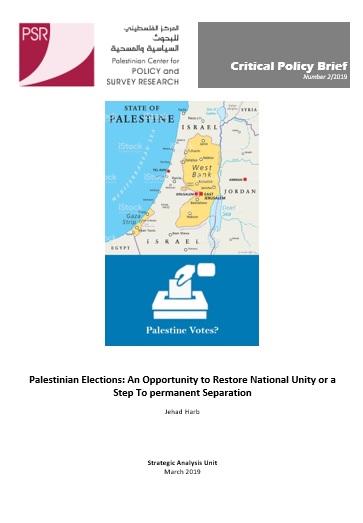 7 April 2019
Palestinian Elections: An Opportunity to Restore National Unity or a Step To permanent Separation
Jehad Harb *
The request, stated in President Abbas’ appointment letter to Mohammad Shtayyeh, the newly selected prime minister, to hold parliamentary, but not presidential, elections is a ready-made recipe inviting objection from and rejection by important Palestinian factions to these elections. The elections, under this condition, become an additional impediment to the reunification of the West Bank and the Gaza Strip rather than an opportunity to speed up the process of reconciliation and reunification. Given existing difficulties confronting Palestinians today, many due to the behavior of the various Palestinian factions, such elections are likely to consolidate the current West Bank-Gaza Strip split. In fact, such elections are likely to add further challenges making it highly unlikely that reconciliation or reunification can be restored in the near or medium term. Instead, regardless of intentions, parliamentary-only elections are likely to pose severe risks to the national project whose goal is the creation of a Palestinian state along the lines of June 1967. Refusing to hold presidential elections is tantamount to one of two things: elimination of the office of the presidency from the political system altogether or making the office unelectable and unaccountable.
It goes without saying that holding elections is a basic condition for building a legitimate and democratic Palestinian political system. It should be reminded that nine years have already passed since the electoral terms of the president and the Palestinian Legislative Council (PLC) have expired (back in January 2010). Moreover, holding elections is now mandated by the December 2018 decision of the Constitutional Court which called for the dissolution of the PLC. By doing so, that decision deprived the political system of its ability to transition democratically if and when the office of the presidency becomes vacant while simultaneously terminating the only collective political institution that unified the West Bank and the Gaza Strip.
It should also be remembered that the right of the citizens to elect their representatives, in addition to being a constitutional right, provides a way out of the current political crisis in which the institutions of the Palestinian political system suffer from a diminished legitimacy. One can no longer make claims based on the outcome of elections that took place thirteen years ago. Elections are also essential as a way out of the current constitutional crisis regarding the term of the PLC which has now extended to thirteen years. Holding elections bring back legitimacy and accountability to all the political institutions, protect the judiciary from outside interferences, widen the space for liberties and human rights, and assures the independent and pluralistic nature of civil society.
On top of all that, holding election at this time poses an additional challenge to the Palestinian leadership as it comes at highly complicated conditions in the relationship with the Israeli occupation and in the stalemate in the efforts to reunify the West Bank and the Gaza Strip. The purpose of this brief is to explore the various options Palestinians have in this regard and the impact of each of these options on the future of the political system and the entire Palestinian Authority (PA). The brief explores the prospects for holding elections and the positions of the various relevant players. The goal of the brief is to offer recommendations to the PA that allows the exploitation of this opportunity in a manner that might assist in restoring unity and legitimacy to the Palestinian political system.
Three options for holding elections vs. the status quo
Four options are currently being debated regarding the upcoming elections. The first calls for holding simultaneous presidential and parliamentary elections in both the West Bank and the Gaza Strip; the second calls for legislative elections only in the two Palestinian areas; the third calls for holding legislative elections only and only in the West Bank, and the fourth argues in favor of not holding any elections at this time. The first two options require Hamas’ approval, as well as the approval of the Israeli government if elections are to take place in post offices under Israeli control in East Jerusalem in accordance with the 1995 interim terms. The third option requires Israeli approval, for East Jerusalem participation. The fourth option maintains the current status quo in which the public has no ability to bring the existing authority to accountability.
Option #1: Hold simultaneous legislative and presidential elections in the West Bank and the Gaza Strip
It is certain that all factions and political parties will support the holding of legislative and presidential election and will be very critical of any actor, especially Hamas, who might impede such elections, particularly if guarantees are given regarding the free and fair nature of these elections. This option is also supported by the overwhelming majority (72%) of the Palestinian public according to a March 2019 PSR poll. Support for this option is higher in the Gaza Strip (83%) compared to the West Bank (65%). Moreover, two-thirds of the public want Hamas to participate in these elections and to allow them to take place in the Gaza Strip.
The most valuable advantage of this option is that it renews the legitimacy to all the public institutions of the political system and forces them to reunify the Palestinians by launching a dialogue inside the elected institutions, particularly the PLC, on the best means to address the split and its consequences.
Option #2: Hold legislative but not presidential elections:
As evident in the appointment letter to the designated prime minister, president Mahmoud Abbas, and Fatah behind him, wish to hold legislative elections only. Article two of the appointment letter states that the task of the new government is to “take the required measures, as quickly as possible, to hold legislative elections in the southern and northern governorates of the homeland, including East Jerusalem, in accordance with the rules of the Basic Law and other relevant laws.” By contrast, Hamas believes that it is essential to hold both parliamentary and presidential election simultaneously. In a statement issued by Dr. Khalil al-Hayyah, member of the Hamas’ Political Bureau, after his meeting with head of the Central Elections Commission (CEC), Hamas indicated that it is “ready to participate in presidential and legislative elections.” The founding statement by the Palestinian Democratic Coalition, which includes the Popular Front for the Liberation of Palestine, the Democratic Front for the Liberation of Palestine, the Peoples’ Party, Fida, al Mubadara, and some independents, requested the holding of “comprehensive elections,” meaning presidential and legislative, for the PA as well as for the PLO parliament, the Palestinian National Council.
Despite the strong public opposition to this option, standing at 70% in the Gaza Strip and 55% in the West Bank (according to PSR’s March 2019 poll), a large majority favors Hamas’ participation in such elections and wants (64% in the West Bank and 51% in the Gaza Strip) it to allow them in the Gaza Strip. About 41% of the public indicate willingness to participate in such election while 54% indicate unwillingness to participate if the elections are legislative only.
It is certain that Hamas will prevent the holding of such elections in the Gaza Strip. According to Dr. al Hayyah, “Hamas has rejected president Abbas’ position which, as conveyed to us by CEC, want to hold legislative elections only.” A majority of the public (53%) believes that Hamas will not allow such elections in the Gaza Strip. If such elections are to take place, they will not be truly competitive which contradicts the need to “insure political pluralism,” as requested by Abbas’ appointment letter to Shtayyeh. However, Hamas’ position might change at a later stage, particularly if president Abbas and Fatah provide assurances that presidential elections will take place later, within six months to a year.
It should be emphasized that the failure to hold presidential elections can mean one of two things: it is either that some are seeking to abolish the office of the presidency altogether or alternatively make the office unaccountable, not subject to election. If abolished, the office holder would be content being the president of the state or the chairman of the PLO Executive Committee, both unelected in general elections by the Palestinian citizens, and both are nonexistent in the Basic Law. If the office is not subject to election, it means it requires no electoral legitimacy. But this is a flagrant violation of the Basic Law and could in fact threaten the existence of the Basic Law itself, annulling it in the same way the PLC was dissolved. This is not farfetched. Here is a realistic scenario for how this could be done. Because, when appointing Shtayyeh, Abbas used his two titles, as the chairman of the PLO Executive Committee and as president of the state of Palestine, but not his title as president of the PA. Someone, taking the case to the High Court, might challenge the appointment of the designated prime minister on the ground that it violates the Basic Law, which mandates that the appointment must be made by the president of the PA. If, as expected, the case were to go to the Constitutional Court, that court might declare the Basic Law irrelevant on the ground that Palestine is now a state, unconstrained by the Oslo agreement or even by the Basic Law.
Despite all that, holding legislative elections in the West Bank and the Gaza Strip would restore to the Palestinian public its right to elect its representatives in the PLC and restore some balance in the political system. The new PLC will have a renewed legitimacy and, in the meanwhile, the office of the presidency will have little legitimacy left. If Hamas participates in these elections, the prospects for reunification would improve significantly.
Option #3: Holding legislative elections in the West Bank but not in the Gaza Strip
If Hamas refuses to allow legislative elections in the Gaza Strip, they might end up taking place in the West Bank only. West Bank PLC-only elections will face significant opposition from most factions. Naturally, Hamas will not participate and will view such elections as the means to deprive it of its current legitimacy. Islamic Jehad would also boycott the elections as would other major PLO factions, the PFLP and the DFLP, viewing them as a further threat to the unity of the Palestinian people. About three quarters (74%) of the public is opposed to this option, with 83% in the Gaza Strip and 68% in the West Bank. Moreover, only 29% say they would participate in such elections while 62% say they will not participate. Nonetheless, 50% of the public believes that if such elections were to take place, the resulting PLC, having members from both the West Bank and the Gaza Strip, will be seen as representing both areas while only 34% believe that it will be seen as representing the West Bank only.
Clearly, the non-participation of the Gazan voters in these elections and the limited turnout will make the elections partial and will deprive the PLC of its popular legitimacy. However, the new body will still be able to constrain the executive authority, put an end to its interference in the work of other public institutions, and provide a smooth transition when the office of the presidency becomes vacant.
Option #4: No elections
In this option, the status quo prevails because constrains beyond the control of the PA, such as an Israeli determination to prevent elections in Jerusalem or impede them in area C of the West Bank, mandate postponing them. Similarly, without Hamas’ consent, no elections can take place in the Gaza Strip. Also, groups within Fatah and other factions might be content with postponing elections for fear they might perpetuate disunity. Yet, only 13% of the Palestinian public are in favor of postponing the elections.
The main problem with this option is that it perpetuates authoritarianism and provides the office of the presidency with unlimited power without being accountable to any elected institution. Moreover, it provides no answer to the current constitutional vacuum when the office of the presidency becomes vacant while the PLC is dissolved thereby making the process of succession unsafe. The current disunity will continue as long as Palestinian citizens are denied the opportunity to take part in ending it by electing their representatives. In this option, Palestinian citizens are denied their constitutional right to vote, a right stipulated in the Basic Law.
Three Challenges confront Palestinian elections
In holding elections, three challenges confront the Palestinian leadership:
First, obtaining an Israeli approval for holding the elections in principle, so that East Jerusalemites can participate, might not be an easy matter. Such approval is unlikely to be forthcoming before the holding of the April 9 Israeli elections. Abbas might be interested in waiting until after these elections before requesting Israeli cooperation. In the meanwhile, he is allowing the CEC to consult with the various relevant actors. The decision of the Constitutional Court gave him six months to hold Palestinian legislative elections.
Second, obtaining Hamas’ approval, to participate and allow elections in the Gaza Strip, might not an easy matter as well. Hamas’ approval might be forthcoming if elections are for both, the presidency and the PLC. But most likely it will not allow elections in the Gaza Strip or participate in them if restricted to the PLC or without guarantees that presidential elections will soon follow. Such a position might impede efforts to hold the elections and undermine efforts to restore unity.
Third, reaching an agreement between Fatah and Hamas on the electoral system is also not easy. The debate in 2005 was settled in favor of a fifty-fifty mix of two systems: a majoritarian and a proportional representation. Hamas today believes that this mixed system serves its interests while Fatah and Abbas believe that the proportional representation is the one that serves theirs. Indeed, a fully proportional representation is the one that was decreed by Abbas, as law number 1, in 2007. To overcome this third challenge, it will be essential to abandon the tendency to aspire to win an overwhelming majority and instead aspire to partnerships and coalition building. Adopting a proportional representation system serves the goal of coalition building. In this case, the entire country can serve as one electoral district, or alternatively maintain the current districts while applying the same proportional representation in each. A third possibility would see the application of the proportional representation system in a mixed manner, this time with half the seats elected in a nation-wide district and the other half in the various electoral districts.
Recommendations
The Palestinian leadership can turn the holding of elections into an opportunity to end disunity and ten years of failed reconciliation by moving the unification efforts to the parliamentary dome. It can also turn it into an opportunity to restore legitimacy to the political system and to achieve a balance between the various political institutions through the popular mandate in accordance with the terms of the Basic Law which specifies the social contract between the citizens and the rulers as well as the constitutional timeframe for this popular mandate. Elections can also provide an opportunity to unify the efforts to better confront the American and Israeli plans to undermine Palestinian interests.
The first three options explored above emphasize the need to respect the right of the Palestinian public and its wish to hold elections. All three also provid a solution to the constitutional crisis that currently impedes a smooth succession and restore a needed balance to the political system by constraining the unlimited authority of the executive. It goes without saying that the first option, holding simultaneous presidential and legislative elections, provides an ideal solution to end disunity, insures participation of all factions, and insures holding them in both areas of the West Bank and the Gaza Strip thereby achieving the greatest popular participation.
Option two, holding legislative elections in both the West Bank and the Gaza Strip, provides an opportunity to insure a fair and free elections. If an agreement can be reached on holding presidential elections soon after the holding of the legislative elections, it might be possible to bring Hamas on-board while insuring the widest possible participation of all factions. The third option does not facilitate the restoration of unity, and might in fact deepen the current split, but it does remove the veto over holding elections, allow voters to choose their representatives, and restore a balance among PA institutions. It also provides a solution to the problem of succession.
To implement any of these three options, the following steps, or most of them, must be taken:
First, the Palestinian president must announce the date for holding elections. CEC has already concluded its consultations and therefore the date should respect the time period stipulated by the Constitutional Court.
Second, an agreement needs to be reached on the electoral system: proportional representation or a district-based majority system. A proportional representation system allows the participation of all factions making it possible for all or most to be represented in the PLC in accordance with their proportional size in the Palestinian society. One can apply this proportional representation system so that the entire country would serve as a single electoral unit or alternatively it can be applied at the district level thereby allowing the participation of independent factions with local and district-based interests.
Third, the PA government and de facto authority in the Gaza Strip, as well as Fatah and Hamas, must provide guarantees that the elections will be fair and free and that they will respect and accept their outcomes.
Fourth, CEC must undertake the necessary preparations that provide critically needed credibility to the electoral process and enhances its integrity and transparency with the presence of international observers who enjoy the confidence and trust of the various Palestinian factions, such as the UN or any Palestinian, Arab, Islamic or foreign organizations.
___________________________________
* Jehad Harb: is a researcher on Palestinian politics and government with a special focus on parliamentary affairs. He is a co-editor of the ARI’s report on the Arab Democracy Index: The State of Reform in the Arab World, and the Arab Security Index. He holds a Master’s degree in political science from Tunisia. He writes a weekly article and teaches occasionally at the department of political science at Birzeit University. His publications include work on the Palestinian political system, good governance, parliament, integrity, and the security sector.
Joint Israeli Palestinian Poll, September 2008
Sweeping majority of Israelis support release of Marwan Barghouti in return for Gilad Shalit; three-fourths of Palestinians back soldier kidnappings in exchange for Palestinian prisoners
Among other findings of joint Truman-PSR poll: both publics
support continuation of cease-fire agreement with Hamas
Seventy-eight percent of Israelis support and 16 percent oppose the release of Marwan Barghouti from an Israeli prison in return for the release of Gilad Shalit. However only 45 percent support and 50 percent oppose Barghouti’s release if needed in order to negotiate with him a compromise agreement with the Palestinians.
Most Palestinians (59 percent) think that the best way to free prisoners from Israeli jails is to reach a peace agreement that includes freeing all prisoners; 39 percent think that the best way is to kidnap soldiers and exchange them. However, when the question is asked within the context of the kidnapping of Gilad Shalit, support for kidnapping of soldiers to exchange them with Palestinian prisoners is 74 percent, and only 21 percent oppose such kidnapping.
These are the results of the most recent poll conducted jointly by the Harry S. Truman Research Institute for the Advancement of Peace at the Hebrew University of Jerusalem and the Palestinian Center for Policy and Survey Research in Ramallah, between Aug. 25 and Sept. 1, 2008. This joint survey was conducted with the support of the Ford Foundation Cairo office and the Konrad Adenauer Stiftung in Ramallah and Jerusalem.
With regard to the cease-fire with Hamas, after it has now gone into effect, 55 percent of the Israelis support its continuation and 39 percent oppose it. Sixty-eight percent of the Israelis opposed the cease-fire agreement in the June Truman-PSR poll before it went into effect. Among Palestinians, 78 percent supported it in June and 21 percent opposed it. In the current poll 81 percent support its continuation and 15 percent oppose it.
The joint poll also examined Israelis’ and Palestinians’ assessments of various negotiation tracks, including the Israeli-Palestinian track, the Israeli-Syrian track and the Saudi (Arab League) plan currently on the public agenda; attitudes toward reconciliation; threat perceptions and support of violence; and domestic political affairs.
The Palestinian sample size was 1270 adults interviewed face-to-face in the West Bank, East Jerusalem and Gaza Strip in 127 randomly selected locations between Aug. 28 and Aug. 30, 2008. The margin of error is 3 percent. The Israeli sample includes 611 adult Israelis interviewed by phone in Hebrew, Arabic or Russian between Aug. 25 and Sept. 1, 2008. The margin of error is 4.5 percent. The poll was planned and supervised by Dr. Yaacov Shamir of the Harry S. Truman Research Institute for the Advancement of Peace and the Department of Communication and Journalism at the Hebrew University, and Dr. Khalil Shikaki, director of the Palestinian Center for Policy and Survey Research (PSR).
For further details on the Palestinian survey contact PSR director, Dr. Khalil Shikaki or Walid Ladadweh, at tel. 02-2964933 or email pcpsr@pcpsr.org. On the Israeli survey, contact Dr. Yaacov Shamir at tel. 03-6419429 or email jshamir@mscc.huji.ac.il.
MAIN FINDINGS
(A) Negotiation Tracks on the Agenda
- 79% of the Israelis believe that the best solution to the Palestinian-Israeli conflict is the two-state solution, i.e. the establishment of an independent state for the Palestinians in the West Bank and the Gaza Strip and the state of Israel for the Israelis. Only 11% believe that the best solution is the establishment of one state (for Palestinians and Israelis) in all the territories west to the Jordan river. In our June poll, 58% of the Palestinians preferred the two-state solution, and 27% the one state solution.
- 71% of the Israelis support and 25% oppose mutual recognition of Israel as the state for the Jewish people and Palestine as the state for the Palestinian people as part of a permanent status agreement. Among Palestinians, 57% support and 41% oppose this step.
- 59% of the Israelis oppose and 38% support the Saudi initiative which calls for Arab recognition of and normalization of relations with Israel after it ends its occupation of Arab territories occupied in 1967 and after the establishment of a Palestinian state. These figures did not change from our June poll. Among Palestinians, 68% support the plan and 30% oppose it
- 78% of the Israelis support and 16% oppose the release of Marwan Barghouti from prison in return for the release of Gilad Shalit. However only 45% support and 50% oppose Barghouti’s release if needed in order to negotiate with him a compromise agreement with the Palestinians.
- 31% of the Israelis believe that there is greater likelihood to reach a compromise agreement if negotiated with Marwan Barghouti, while 34% think that negotiations with Abu Mazin has a greater chance to succeed.7% believe that both have similar chance to succeed, and 22% - that neither of them is likely to succeed.
- 57% of the Israelis support and 42% oppose talks with Hamas if needed to reach a compromise agreement with the Palestinians. In June 47% supported and 51% opposed such talks. A sizeable Israeli majority (65%) support and only 32% oppose talks with a national unity government composed jointly of Hamas and Fatah if such a government is reestablished.
- 64% of Israelis oppose full evacuation of the Golan Heights in return for a complete peace agreement with Syria, and 25% support it. In our June poll 67% opposed and 22% supported such an agreement. If in the peace agreement, Syria will commit to disconnect itself from Iran and stop its support of Hizbulla and Hamas, support increases somewhat to 31%.
(B) Threat perceptions and support of violence
The weeks preceding the poll were characterized by significant reduction in violent acts after the cease fire between Israel and Hamas came into effect.
- While 68% of the Israelis opposed the cease fire agreement with Hamas and 30% supported it in our June poll, now after it went into effect, 55% of the Israelis support its continuation and 39% oppose it. Among Palestinians 78% supported it in June and 21% opposed it. In our current poll 81% support its continuation and 15% oppose it.
- Among Israelis, 60% are worried that they or their family may be harmed by Arabs in their daily life, compared to 63% three months ago. Among Palestinians 53% fear that their security and safety and that of their family is not assured compared to 56% three months ago.
- Most Palestinians (59%) think that the best way to free prisoners from Israeli jails is to reach a peace agreement that includes freeing all prisoners; 39% think that the best way is to kidnap soldiers and exchange them. However, in the context of the kidnapping of Gilad Shalit, 74% support kidnapping soldiers to exchange them with Palestinian or Arab prisoners, and only 21% oppose such kidnapping.
- In this regard, 49% of Israelis think that Israel should pay almost any price to return Israeli prisoners of war or dead soldiers home because this is a moral obligation of the state. 41% believe that Israel should not release prisoners in return for soldiers’ bodies since this may diminish Arabs’ interest in keeping Israeli prisoners of war alive.
- Among Israelis, 26% suggest that Israel should reoccupy the Gaza Strip and stay there if the shelling of Israeli communities from the Gaza Strip continues; 41% think that Israel should carry out ad-hoc operations against the shelling and get out; 27% compared to 22% three months ago believe that Israel should use primarily diplomatic rather than military steps.
- A majority of Israelis (56%) support the bombing of the Iranian nuclear facilities in case all the international measures taken to prevent Iran from developing a nuclear weapon fail; 32% oppose it.
(C) Attitudes toward reconciliation
If a peace agreement is reached, and a Palestinian state is established and recognized by Israel, 70% of the Palestinians and 76% of the Israelis would support a process of reconciliation, While Palestinians would mainly support open borders and economic cooperation, Israelis see more favorably than Palestinians changes in the school curriculum, cessation of incitement in public discourse and social interaction.
More specifically:
84% of the Palestinians and 43% of the Israelis would support open borders;
71% of the Palestinians and 65% of the Israelis would support joint economic institutions and ventures;
41% of the Palestinians and 37% of the Israelis would support joint political institutions designed eventually to lead to a confederate system;
36% of the Palestinians and 57% of the Israelis would support legal measures to prevent incitement against the other side;
13% of the Palestinians and 39% of the Israelis would support a school curriculum, which educates school children to give up irredentist aspirations.
On a personal level, under conditions of peace, 58% of the Israeli Jews would invite a Palestinian friend to their home, and 49% are willing to visit a Palestinian friend in his home. 32% percent of the Palestinians would invite and 32% would visit an Israeli friend.
When asked how soon will full reconciliation between the two people be achieved, 31% of the Israelis and 43% of the Palestinians believe it will never be achieved, 40% of the Israelis and 29% of the Palestinians think it will be achieved only in many generations to come, or by the next generation; 24% of the Israelis and 20% of the Palestinians believe it will be achieved in the next decade, or the next few years.
(D) Domestic political affairs
If personal elections for prime minister were held today in Israel, 30% would vote for Bibi Netanyahu, Tzipi Livni would receive 19% of the vote, Shaul Mofaz would get 10%, and 11% would vote for Ehud Barak. Netanyahu is also considered by Israelis as the best candidate to lead the country toward peace with the Palestinians and/or Syria: 29% of the Israelis think he is the most able to do so; 16% choose Tzipi Livni; Barak comes out third with 9%, and Mofaz receives 8%. When security challenges are concerned, 29% of the Israelis trust Bibi Netanyahu most, 20% trust Barak, 16% trust Mofaz, and only 9% believe in Livni.
In the Palestinian Authority, if presidential elections were to take place today, Mahmud Abbas, the Fatah nominee, would receive 53% of the vote, while Ismail Haniyeh as the Hamas nominee would receive 39% of the vote.
12 December 2017
The American step increases Abbas’ weakness, raises further suspicion concerning the role of regional powers, and increases calls for armed action:
More than 90% view the US recognition of Jerusalem as capital of Israel as a threat to Palestinian interests and the largest percentage demands a strong response that includes a return to an armed intifada. Moreover, the overwhelming majority does not trust Trump’s peace intentions, nor trust the major Arab allies of the US, and 70% demand Abbas’ resignation, and a majority demands the resignation of the reconciliation government if it does not immediately lift the PA sanctions imposed on the Gaza Strip
7-10 December 2017
This poll has been conducted in cooperation with the Konrad-Adenauer-Stiftung in Ramallah

These are the results of the latest poll conducted by the Palestinian Center for Policy and Survey Research (PSR) in the West Bank and the Gaza Strip between 7-10 December 2017. The poll was conducted one day after the announcement by President Trump that he is recognizing Jerusalem as the capital of Israel and during a period in which limited clashes occurred between Palestinian protesters and Israeli soldiers throughout the West Bank and the Gaza Strip. By then, the Palestinian Authority has already publicly condemned the US measure and announced cessation of peace-related contacts with Washington. On the domestic front, reconciliation efforts continued to produce slow progress and a meeting held in Cairo declared that elections will take place before the end of 2018. This press release addresses these issues and covers other matters such as general conditions in the Palestinian territories and certain aspects of the peace process. Total size of the sample is 1270 adults interviewed face to face in 127 randomly selected locations. Margin of error is 3%.
For further details, contact PSR director, Dr. Khalil Shikaki, or Walid Ladadweh at tel. 02-296 4933 or email pcpsr@pcpsr.org.
Main Findings:
Findings of the last quarter of 2017 show that the overwhelming majority of the Palestinians view the decision by US President Donald Trump as a threat to Palestinian interests, one that requires an appropriate response. But the public is divided on what would be considered appropriate. While the largest percentage favors ending contacts with the US, submitting a formal complaint to the International Criminal Court, and a resumption of an armed intifada, the majority continues to favor responses that exclude armed struggle, despite the rise in support for such struggle during the past three months. Furthermore, it seems obvious that the public does not think that its leadership shares its view on what is considered to be an appropriate response to the American step.
In light of the US step, findings show an almost total public distrust of the role of regional powers, such as Saudi Arabia, the United Arab Emirates, Egypt, Jordan and Qatar, in the peace efforts organized by the US Administration. More than three quarters believe that Palestine is no longer the Arab’s first cause. Indeed, more than70% believe that despite the continuation of Israeli occupation, an alliance already exists between Sunni Arab states and Israel.
On top of that there is little or no confidence in the US Administration and its peace intentions. An overwhelming majority believes that any Trump peace plan will not meet the basic Palestinian need to end occupation and build an independent state. But here too one can see the gap between the position of the public and the public assessment of the position of the Palestinian leadership. Despite public confidence that the Trump ideas cannot serve as a basis for negotiations, about half of the public believes that President Abbas might accept the American ideas. Furthermore, more than 70% of the public believe that major Arab countries like Saudi Arabia and Egypt will also accept the Trump ideas.
Findings show that the public fully supports the assumption of security control by the reconciliation government in the Gaza Strip. In return, the public demands that the reconciliation government pay the salaries of the civil and security sectors which worked in the past under Hamas’ government. The public is also firmly opposed to the disarmament of the various armed groups in the Gaza Strip. Moreover, a majority demands the resignation of the reconciliation government if it does not lift the sanctions imposed by the PA over the Strip. If a national unity government is established, about half of the public rejects the idea that such a government should follow the peace program of President Abbas; only a minority wants the unity government to embrace Abbas’ peace program.
Finally, findings show how the US step has harmed Abbas’ popularity with further decline in his standing and increased demand for his resignation. Demand for Abbas resignation stands today at 70%, a first since such demand became high three years ago. If new presidential elections, in which Abbas competes against Hamas’ Ismail Haniyeh, are held today, the latter could easily win. Even if the candidate against Abbas came from the small third parties (such as Mustafa Barghouti from al Mubadara), findings show that it is doubtful that Abbas could win. On the other hand, the party balance remains relatively stable, compared to the findings three months ago, with Fatah having an edge against Hamas. Hamas is more popular than Fatah in the Gaza Strip while Fatah is more popular than Hamas in the West Bank.
(1) Presidential and parliamentary elections:
- 70% of the public want president Abbas to resign while 26% want him to remain in office. Three months ago, 67% said they want Abbas to resign. Demand for Abbas’ resignation stands at 64% in the West Bank and 80% in the Gaza Strip. Three months ago demand for Abbas resignation stood at 60% in the West Bank and 80% in the Gaza Strip.
- If president Abbas does not nominate himself in a new election, 35% prefer to see Marwan Barghouti replacing him, while 22% prefer Ismail Haniyeh; Mohammad Dahlan 7% (1% in the West Bank and 15% in the Gaza Strip); Mustapha Barghouti (5%); Rami al Hamdallah (5%), Khalid Mishal (3%), and Salam Fayyad (2%).
- Level of satisfaction with the performance of president Abbas stands at 31% and dissatisfaction at 66%. Level of satisfaction with Abbas stands at 36% in the West Bank and 22% in the Gaza Strip. Three months ago, satisfaction with Abbas stood at 31% (38% in the West Bank and 21% in the Gaza Strip).
- If new presidential elections were held today and only two were nominated, Ismail Haniyeh and Mahmoud Abbas, the former would receive 53% and the latter 41% of the vote (compared to 50% for Haniyeh and 42% for Abbas three months ago). In the Gaza Strip, Abbas receives 33% of the vote (compared to 36% three months ago) and Haniyeh receives 66% (compared to 62% three months ago). In the West Bank Abbas receives 47% (compared to 45% three months ago) and Haniyeh 43% (compared to 42% three months ago). If the competition was between President Abbas from Fatah and Mustafa Barghouti from al Mubadara (Initiative), the two receive an identical percentage of 45%. Mustafa Barghouti receives 57% of the vote in the Gaza Strip and 36% in the West Bank.
- If presidential elections were between three: Mahmud Abbas, Marwan Barghouti and Ismail Haniyeh, Abbas would receive 18%, Barghouti 41% and Haniyeh 36%. If presidential elections were between two: Marwan Barghouti and Ismail Haniyeh, Barghouti receives 58% and Haniyeh 37%.
- If presidential elections are held soon, 42% want Hamas to nominate one of its leader while 45% prefer to see Hamas supporting a third party or an independent candidate.
- If new legislative elections were held today with the participation of all factions, 66% say they would participate in such elections. Of those who would participate, 30% say they would vote for Hamas and 36% say they would vote for Fatah, 6% would vote for all other third parties combined, and 27% are undecided. Three months ago, vote for Hamas stood at 29% and Fatah at 36%. Vote for Hamas in the Gaza Strip stands today at 36% (compared to 31% three months ago) and for Fatah at 30% (compared to 28% three months ago). In the West Bank, vote for Hamas stands at 26% (compared to 28% three months ago) and Fatah at 41% (compared to 42% three months ago).
(2) Domestic conditions:
- Only 34% of the Palestinian public say people in the West Bank can criticize the PA without fear; 61% of the public say that people cannot criticize the PA without fear.
- Positive evaluation of conditions in the Gaza Strip stands at 5% and positive evaluation of conditions in the West Bank stands at 12%.
- Perception of safety and security in the Gaza Strip stands at 53%. In the West Bank perception of safety and security stands at 45%. Three months ago, perception of safety and security in the Gaza Strip stood at 49% and in the West Bank at 50%.
- Findings show that the percentage of Gazans who say they seek to immigrate to other countries stands at 41%; in the West Bank, the percentage stands at 22%. Three months ago, 43% of Gazans and 22% of West Bankers indicated that they seek to immigrate.
- We asked the public about its viewership habits in the last two months. Findings indicate that Al Jazeera TV viewership remains the highest, standing at 20%, followed by Maan TV (15%), al Aqsa TV (14%), Filasteen al Youm/Palestine Today (14%), Palestine TV (11%), Al Arabiya (6%) al Quds TV (6%), and al Mayadeen (3%).
- Perception of corruption in PA institutions stands at 77%.
(3) Reconciliation and the reconciliation government:
- 81% want the reconciliation government to pay the salaries of the civil employees of the former Hamas government but 14% do not want it to do so.
- Similarly, 81% of the public want the reconciliation government to pay the salaries of the security sector employees of the former Hamas government and 14% do not want it to do so.
- 78% support placing the police department in the Gaza Strip, which is currently under the control of Hamas, to come under the control of the reconciliation government so that the police departments in the West Bank and the Gaza Strip would come under the one command and control center; 19% are opposed to that and prefer to maintain the current status quo.
- Now that it has taken control of the border crossings and the headquarters of the ministries and other public agencies, 38% are satisfied and 55% are dissatisfied with the performance of the reconciliation government.
- 50% are optimistic and 45% are pessimistic about the success of reconciliation. Three months ago, optimism stood at 31% and pessimism at 61%.
- Despite the rise in optimism, only 43% expect the reconciliation government to take real control of the security conditions in the Gaza Strip; 47% do not expect that to happen.
- 78% support the formation of a national unity government composed of Fatah, Hamas, and other faction while only 17% prefer to keep the current reconciliation government.
- If a national unity government is established, the public is divided over its peace program: 43% want it to adhere to Abbas policy but 49% does not want to do so.
- Responding to Abbas’ call for “one government, one gun,” only 22% support disbanding the armed wings of the various Palestinian factions in the Gaza Strip and 72% want these armed groups to remain in place.
- Only 43% believe that the date set for elections in the latest factional meeting in Cairo is appropriate while 33% think it is late and 16% think it is too early.
- 70% support holding legislative and presidential elections but only after resolving all remaining issues such as control over security, PLO, and the armed factions; 26% support holding elections immediately, without resolving these other issues.
- The largest percentage (45%) believes that the reason behind Abbas’ decision not to remove the sanctions he had imposed on the Gaza Strip is to pressure Hamas to make more concessions that would remove the obstacles to reconciliation. On the other hand, 23% believe that he has not removed the sanctions in order to insure a slow process of reconciliation and 22% think he seeks to bring about the collapse of the process of reconciliation.
- 51% support and 38% oppose the resignation of the reconciliation government led by Rami al Hamdallah if it does not immediately remove the Abbas-imposed sanctions on the Gaza Strip.
- 45% of the public believe the latest factional meeting in Cairo has been neither a success nor a failure while 19% view it as a success and 27% as a failure.
- For the next three months, the top priority of the reconciliation government in the eyes of 42% of the public should be the delivery of electricity and water to Gazans on daily basis while 30% believe it should be the opening of the crossings, 10% think it should be the resolution of the problem of the payment to the employees of the former Hamas government, 9% believe it should be the holding of elections, 6% the imposition of control over security matters in the Gaza Strip, and 2% the convening of the existing Palestinian Legislative Council.
- For the next year, the top priority of the reconciliation government in the eyes of 41% of the public should be the opening of the crossings; delivery of electricity and water to Gazans on daily basis (31%), while 11% think it should be the holding of elections, 7% think it should be the resolution of the problem of the payment to the employees of the former Hamas government, 7% believe it should be the imposition of control over security matters in the Gaza Strip, and 3% the convening of the existing Palestinian Legislative Council.
- 51% believe that the reconciliation effort is not linked to the restoration of negotiations and the peace process while 43% think that it is indeed linked.
- 24% think Fatah and Abbas came out of reconciliation winners and 20% think Hamas came out a winner. But 48% believe that Fatah and Hamas have come out neither winners no losers.
- With regard to regional players, the largest percentage (51%) believes that Egypt came out of reconciliation a winner while only 34% described Saudi Arabia as a winner (and 25% as a loser), 33% said Qatar came out a winner (and 26% as a loser), and 27% said Iran came out a winner (and 26% as a loser). Although 33% characterized Israel as a winner, 46% characterized it as a loser.
(4) The peace process:
- 91% characterize Trumps declaration recognizing Jerusalem as a capital of Israel as a threat to Palestinian interests (79% as a great threat and 12% as a limited threat) while only 7% saw no threat in the declaration.
- The largest percentage (45%) believes that the most appropriate Palestinian measure against the US step is to stop all contacts with the American Administration, submit a formal complaint to the International Criminal Court (ICC), and resort to an armed intifada. But 27% think it should stop the contacts and submit a complaint to the ICC, but should resort to non-violent resistance. Still, 12% want the PA to only denounce the US step and stop the contacts with the US Administration and an identical percentage wants it to denounce the step while maintaining contacts with the US toward reaching a permanent peace.
- On the other hand, only 27% of the public believe that the Palestinian leadership will actually stop contacts with the US, submit an ICC complaint, and resort to an armed intifada while 24% believe the PA will denounce the US step but will maintain contacts with the Trump Administration.
- The largest percentage (44%) believes that armed resistance is the most effective means of establishing a Palestinian state next to the state of Israel while 27% think negotiation is the most effective means and 23% think non-violent resistance is the most effective. Three months ago, only 35% indicated that armed resistance is the answer and 33% sided with negotiation.
- An overwhelming majority of 72% believes that the Trump Administration will not submit any ideas or plans for Palestinian-Israeli peace while 24% think it will do so.
- But even if the US does submit a peace proposal, an even larger majority of 86% believes that such a proposal will not meet Palestinian need to end occupation and build a state; only 11% think the proposal will indeed meet such needs.
- Nonetheless, 49% believe that president Abbas might accept the American peace plan if one is indeed submitted to him while 42% believe he will not accept it.
- On the other hand, 65% think the Israeli Prime Minister Netanyahu will accept such American peace plan; only 26% think he will not accept it.
- Moreover, 72% of the public believe that major Arab countries such as Egypt and Saudi Arabia (or at least one of them) will accept this American plan if submitted; only 20% think they will not accept it.
- Regarding public trust in the roles and positions of major Arab countries in the peace process and the US efforts to develop a regional agreement in the context of Palestinian-Israeli peace, an overwhelming majority of 82% says that it does not trust the Saudi role, 75% do not trust the Emirati role, 70% do not trust the Egyptian role, and 59% do not trust the Jordanian or the Qatari roles.
- Moreover, 76% say the Arab World is too preoccupied with its own concerns, internal conflicts, and the conflict with Iran and that Palestine is no longer the Arab’s principal or primary issue or cause. Only 23% think Palestine remains the Arab’s principle cause.
- In fact, 71% believe that there is already an Arab Sunni alliance with Israel against Iran despite the continued Israeli occupation of Arab land while 21% believe that the Arabs would not ally themselves with Israel until it ends its occupation and allows the creation of a Palestinian state. Three months ago, only 64% said that an Arab Sunni alliance already exists with Israel.
(5) Most vital Palestinian goals and the main problems confronting Palestinians today:
- 48% believe that the first most vital Palestinian goal should be to end Israeli occupation in the areas occupied in 1967 and build a Palestinian state in the West Bank and the Gaza Strip with East Jerusalem as its capital. By contrast, 28% believe the first most vital goal should be to obtain the right of return of refugees to their 1948 towns and villages, 14% believe that it should be to build a pious or moral individual and a religious society, one that applies all Islamic teachings, and 9% believe that the first and most vital goal should be to establish a democratic political system that respects freedoms and rights of Palestinians.
- The most serious problem confronting Palestinian society today in the eyes of 29% of the public is the continuation of occupation and settlement activities while 26% say it is poverty and unemployment; 20% say it is the spread of corruption in public institutions; 17% say it is the siege of the Gaza Strip and the closure of its crossings; and 4% say it is the absence of national unity.
20 March 2018
While an overwhelming majority of Palestinians expresses rejection of the American role in the peace process and rejects ideas attributed to the “Deal of the Century,” the failure of reconciliation, the recent Gaza explosion, the worsening living and humanitarian conditions in the Gaza Strip, concerns about PA eavesdropping on citizens’ phone calls, diminished chances for democracy, and other concerns cast a shadow of pessimism, frustration, and despair over the public leaving it with no trust in its leadership and very little optimism about the medium or even the long term future
14-17 March 2018

These are the results of the latest poll conducted by the Palestinian Center for Policy and Survey Research (PSR) in the West Bank and the Gaza Strip between 14-17 March 2018. The poll was conducted after the explosion of a roadside bomb that targeted the convoy of Palestinian Prime Minister Rami al Hamdallah during his visit to the Gaza Strip and amid mutual accusations between Fatah and Hamas regarding the responsibility for the stalemate in reconciliation and the Gaza explosion. The period before the conduct of the poll witnessed also the publication of leaks concerning alleged substance of the American “Deal of the Century.” Several other developments may have influenced the findings of the poll: reports were published regarding an eavesdropping by PA security services on citizens’ phone calls; public participation in non-violent protests diminished considerably; talks emerged around possible participation of East Jerusalemites in Jerusalem’s municipal elections; and warnings were issued by international agencies concerning the worsening living and humanitarian conditions in the Gaza Strip. This press release addresses these issues and covers other matters such as general conditions in the Palestinian territories and various aspects of the peace process. Total size of the sample is 1200 adults interviewed face to face in 120 randomly selected locations. Margin of error is 3%.
For further details, contact PSR director, Dr. Khalil Shikaki, or Walid Ladadweh at tel. 02-296 4933 or email pcpsr@pcpsr.org.
Main Findings:
In the first quarter of 2018, PSR’s poll explored various issues and public concerns: (1) the American role in the peace process and reports concerning the “deal of the century,” (2) the Gaza explosion which targeted the Prime Minister’s convey, (3) the great decline in popular participation in non-violent confrontations, (4) the possible participation of East Jerusalemites in Jerusalem’s municipal elections, and (5) other internal matters such as the worsening living and humanitarian conditions in the Gaza Strip, eavesdropping on phone calls of Palestinian citizens, the status of Palestinian democracy and human rights, reconciliation, and the internal balance of power.
Findings show that the overwhelming majority of Palestinians views the American role in the peace process as biased in favor of Israel and refuses the purported American ideas that have been reportedly included in the American “deal of the century,” such as making Abu Dis a capital of the Palestinian state or expanding the southern borders of the Gaza Strip into Sinai. The majority views the American suspension of support for UNRWA as aiming at closing the refugees’ file and deny them their right of return. A large percentage worries that this American position might weaken the ability of the Palestinian side to defend the rights of the refugees. For all of this, about two-thirds are opposed to the renewal of contacts between the PA and the US or the resumption of Palestinian-Israeli negotiations. Despite the fact that a large percentage supports the peace process, more than 90% expect to see no peace between Palestine and Israel in the next five, ten, or even 100 years. The largest percentage views the medium and long term future with a great deal of trepidation, pessimism and frustration.
Findings show that about half of the public believes that Israel stands behind the explosion that targeted the convoy of the Palestinian Prime Minister during his visit to the Gaza Strip. About three quarters of the public think that the aim of the explosion was to foil reconciliation efforts. About a quarter of Gazans however believe that the explosion represented a protest against the policies of the PA government toward the Gaza Strip.
Despite great public support for non-violent protests and the great admiration the public has for the Palestinian youth, Ahd Tamimi, viewing her as a role model and a symbol of popular resistance, the largest percentage attributes the significant decrease in public participation in non-violent protests to a weak public confidence in the Palestinian leadership and factions. Many also believe that the public thinks that such protests are ineffective in the confrontation with Israel. Indeed, findings of the poll show that about half of the public is in favor of a return to an armed intifada.
Findings also show that despite concerns about being seen as an acceptance of the Israeli annexation of East Jerusalem, a majority of the public favors the participation of East Jerusalemites in the next Jerusalem municipal elections. Participation in the vote is seen as giving East Jerusalemites the ability to influence the municipal policies that affect them. Among all Palestinians, but more significantly among East Jerusalemites, less than a third are opposed to such participation.
Finally, when looking at internal conditions, findings show that:
 Almost all Palestinians view conditions in the Gaza Strip as dire, bad or very bad. Responsibility for this situation is placed first on Israel, then the PA, and finally Hamas. But for Gazans, the blame is placed first on the PA, with Israel and Hamas second and third respectively.
About two-thirds think that the PA security services do indeed eavesdrop on phone calls of citizens and officials and more than 60% believe that such eavesdropping is done illegally and without any just cause. A majority believes that such behavior benefits the occupation first and foremost and that the Palestinian judiciary is incapable of putting an end to it.
Those who positively view Palestinian democracy, seeing it as good or very good, are less than a quarter while about two-thirds believe that Palestinians in the West Bank and the Gaza Strip cannot criticize the PA without fear.
Optimism about the success of reconciliation plummets to less than a third; satisfaction with the performance of the reconciliation government does not exceed one third; and about half of the public puts the blame for the poor showing of the reconciliation government on the PA and the PA leadership while a small minority puts the blame on Hamas.
Finally, the domestic balance of power remains relatively unchanged compared to three months ago: more than two-thirds demand the resignation of president Abbas; a Hamas candidate wins against Abbas in presidential elections; but Fatah enjoys more popular support than Hamas, with a five point difference in its favor.
(1) Presidential and parliamentary elections:
- 68% of the public want president Abbas to resign while 27% want him to remain in office. Three months ago, 70% said they want Abbas to resign. Demand for Abbas’ resignation stands at 62% in the West Bank and 81% in the Gaza Strip. Three months ago, demand for Abbas resignation stood at 64% in the West Bank and 80% in the Gaza Strip.
- If president Abbas does not nominate himself in a new election, 29% prefer to see Marwan Barghouti replacing him, while 19% prefer Ismail Haniyeh; Mohammad Dahlan 8% (2% in the West Bank and 20% in the Gaza Strip), Rami al Hamdallah (7%), Mustafa Barghouti (4%); Khalid Mishal (3%), and Salam Fayyad (2%).
- Level of satisfaction with the performance of president Abbas stands at 33% and dissatisfaction at 63%. Level of satisfaction with Abbas stands at 40% in the West Bank and 20% in the Gaza Strip. Three months ago, satisfaction with Abbas stood at 31% (36% in the West Bank and 22% in the Gaza Strip).
- If new presidential elections were held today and only two were nominated, Ismail Haniyeh and Mahmoud Abbas, the former would receive 52% and the latter 41% of the vote (compared to 53% for Haniyeh and 41% for Abbas three months ago). In the Gaza Strip, Abbas receives 35% of the vote (compared to 33% three months ago) and Haniyeh receives 62% (compared to 66% three months ago). In the West Bank, Abbas receives 45% (compared to 47% three months ago) and Haniyeh 45% (compared to 43% three months ago). If the competition was between President Abbas from Fatah and Mustafa Barghouti from al Mubadara (Initiative), Abbas receives 48% and Mustafa Barghouti receives 43% of the vote.
- If presidential elections were between three: Mahmud Abbas, Marwan Barghouti and Ismail Haniyeh, Abbas would receive 22%, Barghouti 38% and Haniyeh 37%. If presidential elections were between two: Marwan Barghouti and Ismail Haniyeh, Barghouti receives 55% and Haniyeh 39%.
- If new legislative elections were held today with the participation of all factions, 61% say they would participate in such elections. Of those who would participate, 31% say they would vote for Hamas and 36% say they would vote for Fatah, 9% would vote for all other third parties combined, and 25% are undecided. Three months ago, vote for Hamas stood at 30% and Fatah at 36%. Vote for Hamas in the Gaza Strip stands today at 32% (compared to 36% three months ago) and for Fatah at 32% (compared to 30% three months ago). In the West Bank, vote for Hamas stands at 30% (compared to 26% three months ago) and Fatah at 38% (compared to 41% three months ago).
(2) Domestic conditions, status of democracy, eavesdropping on phone calls, and 3G:
- Only 33% of the Palestinian public say people in the West Bank can criticize the PA without fear; 63% of the public say that people cannot criticize the PA without fear. In a question about the status of democracy in Palestine and other countries, only 23% say Palestinian democracy is good or very good while only 10% say democracy in Egypt is good or very good. By contrast, 64% say democracy in Turkey is good or very good; 57% say democracy in Israel is good or very good, and 55% say democracy in France is good or very good.
- Positive evaluation of conditions in the Gaza Strip stands at 5% and positive evaluation of conditions in the West Bank stands at 20%. In an open-ended question, we asked respondents to identify the party or side responsible for the worsening of conditions in the Gaza Strip: the largest percentage (39%) blames Israel; 25% blame the PA, president Abbas, the reconciliation government, or Fatah; and 18% blame Hamas. Responses of West Bankers differ from those of Gazans: 43% of West Bankers compared to only 30% of Gazans blame Israel; and 16% of West Bankers compared to 43% of Gazans blame the PA, Abbas, the reconciliation government, and Fatah. However, responses of West Bankers and Gazans are almost identical regarding Hamas’ responsibility: 19% of West Bankers and 18% of Gazans blame Hamas.
- Perception of safety and security in the Gaza Strip stands at 54%. In the West Bank perception of safety and security stands at 53%. Three months ago, perception of safety and security in the Gaza Strip stood at 53% and in the West Bank at 45%.
- Findings show that the percentage of Gazans who say they seek to immigrate to other countries stands at 45%; in the West Bank, the percentage stands at 19%. Three months ago, 41% of Gazans and 22% of West Bankers indicated that they seek to immigrate.
- We asked the public about its viewership habits in the last two months. Findings indicate that Al Jazeera TV viewership remains the highest, standing at 19%, followed by Maan TV (15%), Palestine TV and Filasteen al Youm/Palestine Today (13% each), al Aqsa TV (12%), Al Arabiya, al Mayadeen, and al Quds TV (5% each).
- Perception of corruption in PA institutions stands at 78%.
- A majority of 52% views the PA as a burden on the Palestinian people while 41% view it as an asset for the Palestinian people.
- We asked the public about the media reports regarding a possible eavesdropping by the Palestinian security services on phone calls of Palestinian officials and citizens:
 62% say they believe that the reports are accurate and 29% believe they are inaccurate.
62% do not think, and 26% think, that the eavesdropping on phones was legal or for legitimate purposes.
56% think the primary beneficiary of eavesdropping conducted by the Palestinian security services is the Israel occupation while 25% think it is the PA administration and leadership, and only 12% think it is the Palestinian citizen and his or her security.
Moreover, a majority of 53% think that if a Palestinian citizen (or even a former head of a Palestinian security service) submits a complaint to the Palestinian judiciary, it would be incapable of putting an end to this eavesdropping. Only 37% believe that the judiciary is capable of ending the eavesdropping.
We asked the public about the rates for 3G service, a newly introduced service by Palestinian providers in the West Bank that allows for faster access to the internet on mobile phones: a majority of West Bankers (57%) describes the rates as high or very high and only 3% describe them as low. 11% think the rates are reasonable or medium. 30% did not know much about the service or the rates.
- We asked respondents about giving or donating money to the poor and charities:
Two-thirds believe that the primary motivation behind giving to the poor is to win God’s satisfaction while less than a quarter (23%) think that people give to the poor in order to win the satisfaction of other people.
Three quarters of the respondents say that they give to the poor and 23% say they do not. When asked in an open-ended question about its own motivation for giving, an overwhelming majority (80%) says that it is driven by religious incentive (such winning God’s satisfaction) while 20% say that it is driven by humanistic or social incentives (such as to ease the burden on or help the poor).
(3) Reconciliation and the reconciliation government:
- Now that it has taken control of the border crossings and the headquarters of the ministries and other public agencies, 26% are satisfied and 65% are dissatisfied with the performance of the reconciliation government. Three months ago, satisfaction stood at 38%.
- 30%, compared to 50% three months ago, are optimistic and 64% are pessimistic about the success of reconciliation.
- The largest percentage (45%) believes that the PA, president Abbas, and the prime minister are responsible for the poor showing of the reconciliation government. By contrast, only 15% believe that Hamas is responsible for that poor showing; 13% say the government is doing a good job; and 27% do not who is to blame. It is worth noting that the responses of West Bankers are greatly different from those of Gazans: while about one third (32%) of West Bankers blames the PA, Abbas and the prime minister, 69% of Gazans puts the blame on these three. By contrast, only 12% of West Bankers, compared to 21% of Gazans, blame Hamas.
- We also asked the public about two claims: the one made by the reconciliation government that Hamas is preventing it from assuming control over the Gaza Strip, particularly in financial and security matters, and the claim made by Hamas that the reconciliation government is failing to carry out its responsibilities and duties in the Strip and that it continues to impose sanction on Gazans. About a third (32%) believes the two claims are baseless while 14% think the two claims are accurate. By contrast, 23% believe Hamas’ claim to be accurate and only 14% believe that the claim of the reconciliation government is accurate.
- 37% (60% in the Gaza Strip and 26% in the West Bank) support the Dahlan-Hamas efforts to reach an agreement on creating a joint administration for the Gaza Strip while 45% (36% in the Gaza Strip and 50% in the West Bank) are opposed to such efforts.
- We asked respondents about the Gaza explosion that targeted the convey of the prime minister:
In an open question, we asked the public about its estimate of the party behind the explosion: the largest percentage (45%) believes it is the occupation; 14% believe it is Hamas and an identical percentage believes it is the PA or one of its agencies; 2% think it is Fatah, 1% think it is Dahlan, and 3% think it is one of the extremist groups.
About three quarters (74%) believe that the aim of the perpetrators is to foil the reconciliation efforts while 17% (23% in the Gaza Strip and 14% in the West Bank) believe that the aim is to protest against the policies of the reconciliation government toward the Gaza Strip.
(4) The peace process:
- 48% support the two-state solution and 50% oppose it. Moreover, 46% believe that a Palestinian majority supports the two-state solution and 47% say a majority is opposed to it. Similarly, 50% believe that a majority of Israelis are opposed to the two-state solution and 41% think an Israeli majority supports that solution.
- 57% say that the two-state solution is no longer practical or feasible due to settlement expansion while only 40% think that it remains feasible because settlements can be evacuated. Similarly, 73% believe that the chances for establishing an independent Palestinian state next to the state of Israel during the next five years are slim or nonexistent while 25% think the chances are high or medium.
- Despite the above, only 28% support a one-state solution in which Palestinians and Israelis have equal rights and 69% are opposed.
- The largest percentage (35%) believes that armed resistance is the most effective means of establishing a Palestinian state next to the state of Israel while 31% think negotiation is the most effective means and 25% think non-violent resistance is the most effective. Three months ago, 44% indicated that armed resistance is the answer and 27% sided with negotiation.
- 92% indicate that they have heard, and 8% have not heard, of Ahd Tamimi, a Palestinian youth activist being tried by the Israeli occupation on charges that she slapped an Israeli soldier. Among those who have heard about her, 64% say that they want her to be a role model for them and their relatives.
- 60% believe that Israel’s long-term aspiration is to expand the state of Israel to stretch from the Jordan River to the Mediterranean Sea and to expel the Palestinian population, and 23% think that Israel aims at annexing the occupied territories and deny the Palestinian citizens their rights. By contrast, only 16% think that Israel’s long-term aspiration is to insure its security and then withdraw from all or parts of the occupied territories.
- Similarly, 77% say that they are worried that they would be hurt on their daily life by Israelis or that their land would be confiscated or homes demolished; 22% are not worried.
- In light of the suspension of peace negotiations, Palestinians support various alternatives: 74% support joining more international organizations; 63% support popular non-violence; 48% support a return to an armed intifada; and 49% support dissolving the PA.
- A majority of 52% indicates that it supports the resolutions made by the recent meeting of the PLO’s Central Council, such as the cancellation of the recognition of Israel, the suspension of the Oslo Agreement, and others, while 18% indicate that they agree with some but not all of them, and 24% oppose them. Nonetheless, about two-thirds (65%) believe that president Abbas will not implement these decisions and only 24% believe he will implement them.
- We asked the public about its view on why popular participation in non-violent protests, particularly those related to the American recognition of Jerusalem as Israel’s capital, has been waning: 39% say it is due to lack of trust between the public on the one hand and the PA leadership and factions on the other; 27% say it is due to the fact that non-violence is ineffective; and 25% say that it is due to the fact that many people think that the responsibility for confronting Israel and the US falls on the shoulders of the PA.
- Moreover, 74% say the Arab World is too preoccupied with its own concerns, internal conflicts, and the conflict with Iran and that Palestine is no longer the Arab’s principal or primary issue or cause. Only 24% think Palestine remains the Arab’s principle cause.
- In fact, 70% believe that there is already an Arab Sunni alliance with Israel against Iran despite the continued Israeli occupation of Arab land while 20% believe that the Arabs would not ally themselves with Israel until it ends its occupation and allows the creation of a Palestinian state.
- 46% of all the Palestinian public support the participation of East Jerusalemites in the next Israeli municipal elections by nomination and voting while 15% support only voting, and 29% say that they are opposed to all kinds of participation. Support for participation, either by nomination or voting, declines to 42% among East Jerusalemites but the opposition to participation among them remains almost identical (30%) to that of the general population. It is worth noting however that a large percentage (28%) did not express any views on the matter, probably out of concern that it might be risky to state its views on the subject or that its answer might not be a popular one.
- We asked the public about its expectations regarding Israeli-Palestinian relations after 10 years and after 100 years:
25% believe that after 10 years conditions, or the status quo, will be as they are now with occupation and settlement expansion continuing with little change; 34% say settlements will expand and there will be one political entity characterized by a system of apartheid that discriminates against the Palestinians; 24% believe that there will be a war or an armed intifada that will end the occupation. Only 9% believe that there will be peace between Israel and the Palestinians and a Palestinian state will be established.
After 100 years, only 12% believe that things will be as they are now with occupation and settlement expansion continuing; 30% think settlements will expand and there will be one apartheid state that discriminates against the Palestinians; 29% think there will be a war or an intifada that will end the occupation. The belief that there will be peace between Israel and a Palestinian state remains unchanged at 9%.
(5) Palestinian-American relations and “the deal of the century”:
- 65% are opposed to the resumption of contacts with the American administration that have been suspended last December after the US recognition of Jerusalem as the capital of Israel; 21% favor a resumption of contacts. Similarly, 68% say that the PA leadership should not return to negotiations with Israel if the US administration asks it to do so while 27% say it should comply with the US request.
- A slim majority of 51% says that if the US submits its peace plan, the so-called “deal of the century,” the PA leadership should reject it regardless of its content because it must be bad for Palestinians while 29% say that the leadership should accept or reject the plan only after reviewing and discussing its content. Only 11% say that the Palestinian leadership should accept the “deal of the century.”
- If negotiations with Israel resume under US sponsorship, the US will be biased in favor of Israel in the eyes of 88% of the Palestinians while only 7% think the US will be an honest broker and 2% think it will be biased in favor of the Palestinians.
- A majority of 52% believes that the US administration has suspended its support for UNRWA because it seeks to close the file of the refugees and deny them their right of return while 43% think the US did that in order to pressure President Abbas to force him to return to negotiations with the US over the “deal of the century.” Moreover, 49% think that the suspension of US support for UNRWA will not weaken the Palestinian negotiating position regarding the rights of the refugees but 45% think it will indeed weaken it.
- We asked the public about its views regarding some of the leaked ideas that are allegedly linked to the “deal of the century:”
On Jerusalem, 94% say they are opposed to making Abu Dis a capital of the Palestinian state; 4% support the idea.
86% are opposed and 10% support the idea of expanding the Gaza Strip to include parts of Sinai in return for an Israeli annexation of parts of the West Bank.
63% oppose and 31% support the idea of allowing Israeli Jews to live in the Palestinian state as citizens or residents while respecting the Palestinian law and enjoying the same rights and duties as the Palestinians.
(6) Most vital Palestinian goals and the main problems confronting Palestinians today:
- 45% believe that the first most vital Palestinian goal should be to end Israeli occupation in the areas occupied in 1967 and build a Palestinian state in the West Bank and the Gaza Strip with East Jerusalem as its capital. By contrast, 30% believe the first most vital goal should be to obtain the right of return of refugees to their 1948 towns and villages, 15% believe that it should be to build a pious or moral individual and a religious society, one that applies all Islamic teachings, and 10% believe that the first and most vital goal should be to establish a democratic political system that respects freedoms and rights of Palestinians.
- The most serious problem confronting Palestinian society today in the eyes of 28% of the public is the continuation of occupation and settlement activities while 25% say it is poverty and unemployment; 22% say it is the siege of the Gaza Strip and the closure of its crossings; 20% say it is the spread of corruption in public institutions; and 4% say it is the absence of national unity.