
Joint Israeli Palestinian Poll, October 2010
PALESTINIANS BELIEVE THEY ARE OF GREATER NEED OF SUCCESS IN THE NEGOTIATIONS, ISRAELIS THINK BOTH SIDES NEED IT EQUALLY, BUT BOTH PUBLICS ARE SKEPTICAL ABOUT THEIR SUCCESS
These are the results of the most recent poll conducted jointly by the Harry S. Truman Research Institute for the Advancement of Peace at the Hebrew University of Jerusalem and the Palestinian Center for Policy and Survey Research in Ramallah, between September 30 to October 7. This joint survey was conducted with the support of the Ford Foundation Cairo office and the Konrad Adenauer Stiftung in Jerusalem and Ramallah.
64% of the Palestinians believe that they and not Israel are of greater need of success in the direct negotiations; 51% among Israelis believe that both sides are of equal need of success. Nevertheless both publics are skeptical about the success of the talks, Israelis overwhelmingly support their continuation while Palestinians oppose it.
If the peace talks fail, the option endorsed by most Palestinians is to ask the UN Security Council to recognize a Palestinian State. The second most popular option is to declare unilaterally the establishment of a Palestinian state. The options to resort to resistance are less popular. However Israelis misperceive these preferences, and fear that Palestinians will resume the Intifada.
The Palestinian sample size was 1270 adults interviewed face-to-face in the West Bank, East Jerusalem and Gaza Strip in 127 randomly selected locations between September 30 and October 2, 2010. The margin of error is 3%. The Israeli sample includes 610 adult Israelis interviewed by phone in Hebrew Arabic or Russian between October 3 and 7, 2010. The margin of error is 4%. The poll was planned and supervised by Prof. Yaacov Shamir, the Harry S. Truman Research Institute for the Advancement of Peace and the Department of Communication and Journalism at the Hebrew University, and Prof. Khalil Shikaki, Director of the Palestinian Center for Policy and Survey Research (PSR).
For further details on the Palestinian survey contact PSR director, Prof. Khalil Shikaki or Walid Ladadweh, at tel. 02-2964933 or email pcpsr@pcpsr.org. On the Israeli survey, contact Prof Yaacov Shamir at tel. 03-6419429 or email jshamir@mscc.huji.ac.il.
MAIN FINDINGS
(A) Palestinian Israeli talks
- Regarding the construction freeze in the settlements 29% of the Israelis support a full construction freeze in all settlements 36% support construction only in settlement blocks which will remain under Israeli rule in a future agreement and 28% support unlimited construction in all settlements.
- Now after more than a month since the beginning of the direct negotiations 78% of the Israelis support their continuation while only 30% among Palestinians support it.
- Nevertheless 64% of the Palestinians believe that they and not Israel are of greater need of success in the direct negotiations while 51% among Israelis believe that both sides are of equal need of success.
- Neither Palestinians nor Israelis think that the negotiations will succeed and yield an agreement. Only 6% of the Palestinians and 5% of the Israelis think that there are high or very high chances for that.
- If Palestinians withdraw from the negotiations, 30% of the Israelis suggest that Israel should change its policy which instigated the withdrawal, 23% suggest to leave the problem to the Americans to take care of, 31% believe that Israel should respond by similar threats to Palestinian counterproductive steps.
- If the peace talks fail, the option endorsed by most Palestinians is to ask the UN Security Council to recognize a Palestinian State (69%). The next most popular option (54% support) is to unilaterally declare a Palestinian state. 51% support the option to start a non-violent resistance. The other options asked about received only minority support: 41% support the resumption of the armed Intifada (57% oppose it); 40% support the dissolution of the PA if the talks fail (57% oppose it), and 27% support abandoning the two-state solution and demanding instead a one-state solution (71% oppose it).
- We also asked Israelis’ assessment as to Palestinian preferred response to a failure of the talks. Israelis perceive quite accurately Palestinians’ preferences to act in the international arena, but they misperceive their preferences on resistance. While Palestinians prefer popular non-violent resistance over armed resistance (51% vs. 41%), 63% of the Israelis fear the Palestinians will resume the intifada and only 42% estimate that they will start a non-violent resistance.
(B) The Saudi Plan
- 56% of the Israelis oppose and 33% support the Saudi initiative which calls for Arab recognition of and normalization of relations with Israel after it ends its occupation of Arab territories occupied in 1967 and after the establishment of a Palestinian state. The plan calls for Israeli retreat from all territories occupied in 1967 including Gaza, the West Bank, Jerusalem and the Golan Heights, and the establishment of a Palestinian state. The refugees problem will be resolved through negotiation in a just and agreed upon manner and in accordance with UN resolution 194. In return, all Arab states will recognize Israel and its right to secure borders, will sign peace treaties with her and establish normal diplomatic relations. In our June 2010 poll 59% of the Israelis opposed the plan while 35% supported it. Among Palestinians, 57% support the plan and 39% oppose it; 67% supported it in June and 30% opposed it.
- 35% of the Israelis support yielding to American pressure to accept and implement the Arab (Saudi) Peace Initiative, while 55% oppose it. Among Palestinians 53% accept such pressure while 42% will reject it. In June 2010, 31% of Israelis thought Israel should accept such American pressure and 60% thought it should reject such pressure. Among Palestinians 60% believed they should accept American pressure to adopt and implement the Saudi Plan, 36% said they should reject such pressure.
- As to their assessments of the other side’s response to such pressure: 26% of the Israelis believe Palestinians will reject and 60% think they will accept it, while 53% of the Palestinians think Israel will reject and 40% think it will accept it.
(C) Conflict management and threat perceptions
- 52% of the Israelis support and 44% oppose talks with Hamas if needed to reach a compromise agreement with the Palestinians. In our June 2010 poll, 49% supported and 49% opposed such talks. However 63% think that the majority of the Israeli public opposes such negotiations and only 22% think a majority supports it.
- Neither Palestinians nor Israelis consider it likely that an independent Palestinian State will be established next to the State of Israel in the next five years. Two thirds of the Palestinians and 60% of the Israelis think that chances for the establishment of an independent Palestinian State next to the State of Israel are non-existent or low; 35% of Israelis and 32% of Palestinians believe the chances are medium or high. In June 2010, two thirds in both publics thought that chances for the establishment of an independent Palestinian State next to the State of Israel are non-existent or low.
- In our poll we also examine periodically Israelis’ and Palestinians’ readiness for a mutual recognition of identity as part of a permanent status agreement and after all issues in the conflict are resolved and a Palestinian State is established. Our current poll shows that 64% of the Israelis support and 24% oppose mutual recognition of Israel as the state for the Jewish people and Palestine as the state for the Palestinian people. Among Palestinians, 49% support and 48% oppose this step. In June 2010, 60% of the Israelis supported and 32% opposed this mutual recognition of identity and among the Palestinians support stood at 58% and opposition at 39%.
- Despite the recent return to dialogue between Fateh and Hamas to reach a reconciliation agreement, neither Palestinians nor Israelis believe that unity of Gaza and the West Bank will be resumed soon: only 14% of Palestinians and 6% of Israelis think so. 51% of Palestinians and 29% of Israelis think that unity will be resumed only after a long time. 30% of Palestinians and 47% of Israelis believe that Gaza and the West Bank will stay two separate entities.
- Among Israelis, 54% are worried that they or their family may be harmed by Arabs in their daily life, compared to 58% in our June poll. Among Palestinians 76% (compared to 74% in June) are worried that they or a family member might be hurt by Israel in their daily life or that their land would be confiscated or home demolished.
 January 2019
Role of Public Opinion in the Resilience/Resolution of the Palestinian-Israeli Conflict
Khalil Shikaki and Dahlia Scheindlin
The Palestinian-Israeli Pulse is a joint poll conducted by the Palestinian Center for Policy and Survey Research (PSR) in Ramallah jointly with the Israel Democracy Institute (IDI) and the Tami Steinmetz Center for Peace Research (TSC), Tel Aviv University. Funding for the Pulse was provided by the European Union (EU), the Netherlands Representative Office in Ramallah, and the UNDP/PAPP on behalf of the Representative Office of Japan to Palestine. Five joint polls have been conducted during the period between June 2016 and June-July 2018. The Palestinian sample size ranged between 1270 and 2150 adults interviewed face-to-face in the West Bank, East Jerusalem and Gaza Strip. The Israeli sample ranged between 900 and 1600 Israelis, with occasional oversamples of settlers and Arab citizens. The margin of error ranged between +/-2.5% and +/-3%.
The surveys tested the details of a permanent peace agreement, incentives for those who were opposed to the agreement, perceptions of the other and levels of mistrust and fear of the other, and alternative scenarios to the two-state solution, including both equal and unequal versions of one state, and a confederation of two states.
The polls were planned and supervised by Dr. Khalil Shikaki, director of PSR, Walid Ladadweh, head of PSR’s polling unit, Dr. Tamar Hermann, the academic director of IDI’s Guttman Center for Surveys, and Dr. Dahlia Scheindlin and Dr. Ephraim Lavie from TSC.
The views and opinions expressed in this report are those of the authors and do not necessarily reflect the official policy or position of European Union (EU), the Netherlands Representative Office in Ramallah, the UNDP/PAPP, or the Representative Office of Japan to Palestine.
Role of Public Opinion in the Resilience/Resolution of the Palestinian-Israeli Conflict
Khalil Shikaki*, Dahlia Scheindlin**
*Director of the Palestinian Center for Policy and Survey Research, Ramallah, Palestine - **Tami Steinmetz Center for Peace Research at Tel Aviv University
Had Palestinian and Israeli negotiators reached a peace agreement any time during the past two decades, public opinion on both sides would have supported it. The same is probably true today, but reaching that support will be more difficult, as the starting point – the initial base of support – is weaker. Today, political leaders would need to work harder to win over a sufficient portion of the opposition on both sides. They will need adjustments or additions to the agreement, and external guarantees will be important as well. Under the right circumstances, a majority on both sides can support a permanent peace agreement. The public therefore, is not a direct obstacle to peace.
But at the same time, the public is not a driving force for peace on either side. The people are not taking the lead to demand progress from their leaders. Public despair helps sustain the conflict and ensure its perpetuation. Indeed, large portion of Israelis and Palestinians have elected, or would elect leaders who are unlikely to move ahead on peace at all. Public opinion in both Palestine and Israel is therefore not an impediment to an agreement but it will not drive one forward without a significant change of circumstances.
The guiding question of this research has been whether public opinion can be channeled away from the prevailing sense of inertia and despair. The study has sought to leverage the potential for public support, seeking all means by which the majority can still support peace.
To do this, we examine the following aspects here:
- What has happened to support for the two-state solution, and what are the main reasons for the erosion of support over the years? Who are the constituencies driving the decline in support?
- What is the map of opinions at present regarding the detailed items of a two-state agreement, which items present the greatest obstacles for each side – keeping each side apart?
- Are attitudes flexible and dynamic? Experience over the decades with actual changes in policy and negotiations indicates that they are. On this basis, we have asked throughout the project – can we confirm that attitudes are still flexible? What can shift the dynamics of slow erosion of support, and how can we reach a majority who state that they would support an agreement in the future?
- The Bad News: Declining support for the two-state solution and reasons for the shift
Over the three years of the project, support for a two-state solution has fallen steadily on both sides – not a precipitous crash but a slow decline.
The past decade has witnessed significant hardening of views among Palestinians and Israelis. Recent survey research findings[1] show an illustrative example, as in Chart 1 below. The findings show a drop in support for the two-state solution, during the period between 2006 and June 2018, from 71% among the Palestinians to 43% today and a parallel drop in Israeli support from 68% to 49%. This is the lowest level of support for this concept among the two publics during the past two years of the Pulse, the lowest in more than a decade, when a steady decline in support began, and the lowest in almost two decades of joint Palestinian-Israeli survey research.

The most troubling aspect of the decline in the level of support for the two-state solution is the fact that the youth in particular are the least supportive. As chart 2 below shows, Palestinians and Israeli Jews between the ages of 18 and 24 are the least supportive of the idea. In fact, among Israeli Jews, only 27%, compared to 51% among those who are over 55 years or older, are still supportive. While, among the Palestinians, the gap for same two groups in narrower, 41% to 55% respectively. The fact that age is such a decisive factor is highly instructive. This could mean that the future will bring even lower levels of support for this solution.

Other findings confirm the trend of decline in support for compromise. For example, support for a comprehensive peace agreement package, along the terms of the Clinton Parameters of 2000, the Geneva Initiative of 2003, and the outcome of the 2008 bilateral negotiations between the Palestinian President Mahmoud Abbas and the former Israeli Prime Minister Ehud Olmert, has also dropped over the past 15 years.[1] For example, while in December 2004, right after the death of Yasser Arafat, support for a comprehensive peace package stood at 54% among Palestinians and 57% among Israeli Jews, attitudes shifted by December 2014 when only 38% of the Palestinians and 41% of Israeli Jews supported that same package. In June 2018, in response to a similar-- but not identical—package, only 37% of the Palestinians and 39% of Israeli Jews gave their support (46% among all Israelis, factoring in high support from Arab citizens of Israel).
Still, the constituency for a two-state solution is still the largest on both sides, relative to those who support only some other approach.
Explaining the Decline
We identify three main sources of opposition and decline.
First, as in the past, part of the opposition to a two-state resolution emerges from the value system of minority groups who are highly motivated and highly opposed for ideological reasons: the national-religious and Haredi Israelis and the Palestinian Islamists. Most Palestinians, close to 70%, are in fact secular nationalist, not Islamists. Similarly, nearly 80% of Israelis are secular or traditionalists; only about one-fifth to one-quarter are religious or ultra-religious. However, traditionalists are significantly more likely to oppose peace than secular Jews as well, albeit for somewhat different reasons from the hardline, ideological opposition of the most religious Israelis.
Second, mutual perceptions of each side are generally poor; only a minority on each side expresses trust in the other or believes the other side supports peace. The majority on both sides believes that the other side does not want peace, is not trustworthy, does not support the two-state solution, and believes that the other side entertains deep-seated but hidden long term aspiration to wipe out the other side from existence.
Third, the main development over the last two years is a clear decline in perceptions that the two-state solution is even viable. At present, the two publics are highly skeptical about whether it is possible to reach a two-state solution given the wide-ranging spread of settlements: in June 2018, a majority of Palestinians (56%) and a plurality of Israelis (47%) say it is no longer feasible, in a mild upward trend on both sides. Indeed, the perception of viability is a critical driver of support for compromise. The decline in perceived viability goes hand in hand with a decline in support, as shown in the following graph.

This decline in both perceived viability and support is clear when considering trends on the Israeli side: there is a clear decline on these measures among the left, seculars and to some extent the centrist population, more so than on the right (who begin at a lower rate and remained mostly constant). These communities are not ideologically opposed to a two-state solution – but their perception that it is no longer viable is causing them to lose hope and therefore support.
- Mapping the opposition: Which aspects of negotiations and peace are obstacles?
On several critical issues, Israelis today are much more of a problem than the Palestinians; and on others, the Palestinians pose a greater problem.
In the most general sense, the Israelis are content with the status quo of continued occupation while the Palestinians are highly dissatisfied with it. This gap is most striking when observing the responses to a question about the overall conditions of life in Palestine and in Israel. Israelis show general contentment, with about half who say things are good and only 18% in June 2018 who say things are actually bad or very bad (the remainder are in-between); while just 15% among Palestinians say conditions are good – the vast majority, 62%, say conditions are bad. The more content Israelis are with the status quo they are the more likely the Israeli public will continue to support right wing politics and politicians. Most Israelis, including the mainstream, remain opposed to dismantling settlements, a critical requirement in any peace agreement.
Palestinians show significant flexibility on a critical issue for Israelis: demography and the maintenance of a Jewish majority. Nearly half of the Palestinians is willing to accept a permanent agreement that allows only one hundred thousand refugees, rather than all 6 million, to return to their homes and property inside Israel. On the other hand, the majority of Palestinians opposes mutual recognition of the two-states as the homeland of their peoples, and show strong commitment to the principle of the right of return to ’48 Israel – which prompts high resistance and backlash from Israelis. Further, the geo-political division between Gaza/Hamas and the West Bank/PA and the inability to transition to a democratic political system and a pluralistic civil society constitute an impediment to mutual confidence-building with Israeli society.
When examining the specific items of a two-state agreement as based on previous rounds of negotiations and adjusted over time the pattern of gaps between the two sides is clear. The two sides are highly polarized or mutually rejectionist over the issues of:
- Demilitarization of the Palestinian state (59% Israelis support this, Palestinians reject it with just 20% support)
- Refugee arrangement of a two-state solution (48% of Palestinians support it, but just 21% of Israeli Jews)
- The issue of dividing Jerusalem along the lines of the two-state plans receives only minimal support, between one-fifth and one-quarter on both sides and the majority of both sides reject it; this finding has been consistent throughout the period of the project
- Even the basic issue of borders to divide the land based on mutual territorial swaps receives the support of a minority on both sides, albeit more than the Jerusalem compromises
- Encouraging Signs: why the public is not an impediment to peace
Despite the inauspicious starting point, three positive indicators remain: public preference for diplomacy is relatively high, no other concept is more popular than the two-state solution, and incentives designed to increase support for compromise have proven to be highly effective.
First, despite the alarming developments regarding the substance of peace, the preference of the two publics is for peaceful means of conflict resolution. By June 2018, over forty percent of the Palestinian (41%) and Israeli public (45%) preferred reaching a peace agreement as the best means of changing the status quo. Only one-quarter (27%) of Palestinians and one- fifth of Israelis preferred violence or armed struggle as the preferred means of change. However, there are dangers here too: The portion of Israelis who believed “a definitive war” is the next step has risen eight points over the last year, from June 2017. The portion of Palestinians who support uprising rose sharply in December 2017, then dropped dramatically again in June. This shows how quickly both publics can come to support military strategies. Following the brinksmanship in Gaza in November, it is likely that large portions on both sides could come to support a new war.
The second positive indicator is that despite the gradual decline in support for the two-state solution, this approach remains by far, the most preferred solution by the two publics. As one can see in the following figures, alternatives, such as a democratic one-state solution, an apartheid one-state reality (one in which one side controls the entire land and denies equal rights to the other side), and expulsion (one in which one side expels or “transfers” the population of the other side) remain less popular than the two-state solution. The core constituencies for the strongest of these alternatives on each side, those who would support these, and only these alternatives, are less than half the size of the two-state constituency (19% of Israeli Jews support one equal state compared to 43% for two states; 17% of Palestinians support the transfer approach, compared to 43% for two states), as seen in the figures below.

A closer examination of the split within the Palestinian side shows that support for the two-state solution is greater than the support for any of the alternatives in both the West Bank and the Gaza Strip and most importantly among supporters of all factions except Hamas: among Hamas supporters in 2018, the highest portion support none of the approaches, and a slightly higher portion support expulsion than two states. The most religious support two states at a lower rate than the less religious – similar to Israeli Jews.
A similar examination of the Israeli Jewish side shows that support for the two-state solution is highest only among secular and traditional Jews, but not among the religious (who prefer apartheid over all other) and the Ultra-Orthodox (where the two states constituency is the same size as those who support an apartheid approach). When looking at the Israeli political spectrum, support for the two-state solution is highest among those who place themselves on the left and the center but not among those who place themselves on the right. Those who place themselves on the right side of the Israeli political spectrum prefer apartheid over all others.
This affirms the initial observation that while the population of both sides can still come to support two states, the process of getting there is held back by specific minorities who form the hard core of opposition on both sides.
The third and most important factor is the consistent finding over the last two years of survey research that support for a comprehensive agreement can be significantly increased, to levels that exceed two thirds on both sides, if various constituencies are given a stake in its success. For Palestinians, the most effective incentive, the one that persuades the greatest number of those who initially opposed an agreement, is the release of Palestinian prisoners as part of the agreement. This incentive alone causes over half of the opposition to change their minds and support an agreement, increasing total support for the comprehensive package to 70%. Similarly, access to the Israeli labor market and free movement for the two peoples between the two states are almost as effective. Intangible incentives, when offered to Palestinians, can be as effective. For example, an Israeli acknowledgement of the historic and religious roots of the Palestinians in historic Palestine or the Israeli recognition of the Arab and Islamic character of the Palestinian state is highly effective.

Similarly, an Israeli acknowledgement of responsibility for the creation of the refugee problem and/or an Israeli apology to the refugees for the suffering they have endured since 1948 can change the attitudes of a large minority of those opposed to compromise. Finally, leadership can play a significant role in increasing Palestinian support for compromise: Marwan Barghouti’s support for a comprehensive peace package can convince a third of the Palestinian opposition to switch position from opposition to support.
Similarly, on the Israeli side, both tangible and intangible incentives can increase the level of support for such a comprehensive package that implements the two-state solution from a large minority to approximately two-thirds. Effective tangible incentives include the following: compensation to Israeli Jews who left property behind in Arab countries when they immigrated to Israel after 1948 and assurance of permission for all Jews to visit the Temple Mount )al Haram al Sharif) and Palestinians changing textbooks to remove incitement against Jews; a defense treaty with the US, and peace, normal relations, and economic ventures with Arab countries. Ongoing security cooperation with Palestinians raises total support to nearly 60%. A combination of two such incentives can increase the support among Israeli Jews to more than 60%. Intangible incentives such as a Palestinian recognition of Israel as a Jewish state and an acknowledgement of the Jewish historic and religious ties to the land are also highly effective. Public endorsement of the peace package by leaders, such as Netanyahu, can also be an incentive to change minds of nearly 30% of those who oppose the plan.

Improving the agreement
In our fifth survey in the series and after two years of testing, in a pilot test, the top three incentives that were effective on both sides were incorporated into the basic agreement itself. None of these three are inherently controversial, and are perceived by both sides as win-win aspects rather than as a concession to the other:
- Ensuring that the Palestinian state would be democratic
- Providing guarantees from Arab countries and the US
- Full normalization and greater integration into the Arab Middle East following an agreement, as per the Arab Peace Initiative
The results of this pilot experiment showed a success for the research process: when tested among half of the sample as the core two-state peace plan, while the other half of respondents were offered only the original plan, the improved plan performed significantly better. Among Palestinians, 42% supported the new plan, five points higher than those who supported the original one; among Israelis the improved plan reached a majority for the first time in this phase of polling: 53% - although only 45% among Israeli Jews. By contrast, the original plan received the support of 46% of all Israelis but only 39% of Israeli Jews. Most importantly, the new plan achieved much stronger results among key constituencies within Israel – such as self-defined centrists, who went from 44% to 58% support when the two half-samples were compared. But gains were also clear among the toughest groups of ideologically opposed respondents. On the Palestinian side the gains were fairly even across different sectors but especially – and critically – among the religious respondents, and the youngest (18-22).
Changing minds
In the final survey, we also conducted a second experiment, a continuation of the pilot test mentioned above. Taking the eight most successful incentives on each side, we moved a step beyond the optimism of positive incentives and told each side about a corresponding incentive that would be offered to the other side. The goal was to mirror a realistic scenario in which each side will have to confront the other side getting incentives and gains that it might not like, but simultaneously enjoying its own incentives. Would support for the agreement based on incentives for each side, but alongside incentives for the other side change the dynamics?

The basic finding is that these pairs showing mutual gains in addition to the regular plan for a two-state peace, were not as successful as one-sided gain. All respondents were asked about the pairs, and some stated that the paired incentives made them more likely to support an agreement - others said it made them less likely. This was the case on both sides. The survey therefore calculated the net gain for support of an agreement after adding those who switched to the original level of support or opposition.
For the Israelis, six of the eight pairs were able to raise the total support and four of them pushed total support over 50%. The pair offering to change Palestinian textbooks, while Israelis would do the same, raised support to 61%.

For Palestinians, the pairs were not as successful: just two of them raised support above the original level, but not by a significant margin. Further, in all cases, opposition to the plan remained higher than support. Still, the findings affirmed earlier tests – the strongest incentive pair involved the release of Palestinian prisoners.

Conclusion and Recommendations
The most critical factor leading to declining support for a two-state agreement is the perceived lack of feasibility. Breaking down the reasons for this perception we find different aspects on the two sides: For Israelis, the sense that the status quo is good enough leads to complacency. For Palestinians, the sense that settlement spread has gone too far, abandonment by the US as a negotiator (and increasingly by the Arab world) is leading to the conclusion that there is no hope.
Both of these can be changed: The American-led peace framework that is expected to be released can remind Israelis that even the American President believes that reaching a resolution is a priority that cannot be permanently deferred.
For Palestinians – the plan is unlikely to provide true independence and sovereignty, but it can be an opportunity to respond by proposing the right kind of plan as long as attention will be focused on the issue. The core elements of that plan can be drawn from the successful items that have emerged from this research.
Raising the level of perceived feasibility is key.
Beyond that, two further recommendation are worth pursuing: Any regional development that will contribute either to increased likelihood of reaching a plan or successful implementation of a plan, should be considered a top priority. Strengthening the institutions of Palestinian political and civic life is such an aspect: it will provide greater immediate benefit to Palestinians, but also significantly strengthens the prospects for both Israeli and Palestinian acceptance of a two-state solution at any point. And in reality it will probably make that solution more sustainable.
The final recommendation is to continue searching for incentives that are mutually acceptable. Our research will continue this process through survey experiments based on policy analysis. The more new ideas that can be incorporated into an old plan, or adjustments that are perceived as mutually beneficial, the greater the possibility that visionary leaders in the future will have a basis for making peace.
[1] The package typically includes components such as a de-militarized Palestinian state, an Israeli withdrawal to the 1967 or Green Line with equal territorial exchange, a family unification in Israel of 100,000 Palestinian refugees, West Jerusalem as the capital of Israel and East Jerusalem as the capital of Palestine, the Jewish Quarter and the Western Wall under Israeli sovereignty and the Muslim and Christian quarters and the al Haram al Sharif/Temple Mount under Palestinian sovereignty, and the end of the conflict and claims.
[1] All findings are taken from the Palestinian-Israeli Pulse, a joint Palestinian-Israeli survey research project funded by the EU and other donors. The Pulse is currently designed and implemented by the Palestinian Center for Policy and Survey Research in Ramallah (PSR) and the Tami Steinmetz Center for Peace Research (TSC), Tel Aviv University. Data from the polls have been analyzed by Khalil Shikaki and Walid Ladadwa from PSR, and from TSC, Dahlia Scheindlin and David Reis. Poll results can be accessed by visiting: http://pcpsr.org/en/node/680
Armed Attacks, PNA Performance, The Palestinian Legislative Council, Corruption
December 1996
This is the twenty-fifth public opinion poll conducted by the Survey Research Unit (SRU), at the Center for Palestine Research & Studies (CPRS). It covers the topics of the peace process, armed attacks against Israelis, evaluation of the three branches of the Palestinian government and the police and security services, corruption in PA institutions and the status of democracy in Palestine and in other countries.
The SRU has been conducting regular public opinion polls to document an important phase in the history of the Palestinian people and to record the reactions of Palestinians in the West Bank and Gaza Strip to current events. The CPRS does not adopt political positions and does not tolerate attempts to influence the conclusions it reaches. It is committed to providing a scholarly contribution to the study of Palestinian politics. Toward this end, poll results provide a vital resource for researchers needing statistical information and analysis. The polls also give members of the Palestinian community an opportunity to voice their opinions and to seek to influence decision-makers on issues of concern to them. The following is an analysis of the results obtained in the twenty-fifth public opinion poll conducted by the SRU in the period from 26-28,December,1996.
General Background
The poll was preceded by continuous, but yet unsuccessful, efforts of Palestinian and Israeli negotiators to finalize the Hebron agreement, There were reports of continued Israeli efforts to build Jewish settlements in the Arab part of Jerusalem. Similarly, there were report of Israeli settlement activities and land confiscation on other parts of the West Bank. Several demonstrations took place against Israeli settlement policy. Israeli soldiers opened fire on one of these demonstration killing one and injuring 13 other Palestinians.
An armed attack carried out by PFLP members against Israeli settlers near Ramallah led to the death of a mother and her son and the wounding of five other members of the family. Israel imposed a siege on Ramallah for two weeks, and the Palestinian police succeeded in arresting the attackers who received sentences ranging between life imprisonment and 15 years in jail. The period before the poll also witnessed an incident in which an Israeli settler beat to death a Palestinian boy. Another Israeli shot to death a Palestinian worker from the Gaza Strip.
Elections at An-Najah university led to a victory for the Islamic bloc which received 39 seats compared to Fateh which received 36 only. There was talk of internal Palestinian dialogue. The Palestinian legislative council completed its debate about the civil service law and passed the local election law. In early December, a Palestinian prisoner died while in custody in a jail in Jericho.
Methodology
The questionnaire used in this poll was designed by CPRS researchers. Prior to the polling dates, the questionnaire was pre-tested on 50 respondents in the Nablus area. As in all of our polls, it includes numerous demographic and attitudinal variables. (See Table 1 for the demographic distribution of the sample and the attached list of questions.) Interviews were conducted between 26-28 December 1996 (Thursday, Friday and Saturday). The total sample is 1,307, with 804 from the West Bank and 503 from the Gaza Strip.
Sample Distribution
Demographic Distribution & Characteristics of Sample, weighted percentages & counts*
Characteristic | % of Total | Count | Characteristic | % of Total | Count |
Region |
|
| Education |
|
|
Area of Residence |
|
| Marital Status |
|
|
Age |
|
| Occupation |
|
|
Refugee Status |
|
| Retired | 0.7 | 7.0 |
Gender |
|
| Religion |
|
|
* Note, as discussed more fully below, the sample size (expressed in counts and percentages) has been weighted in order to obtain unbiased estimates.
** Includes all post-secondary degree holders.
*** Specialists are defined as Professors/University Instructors, Engineers, Doctors, Lawyers, Pharmacists or Executives.
**** Employees are defined as School Teachers, Government Employees, Nurses or Lower-Level Company Employees.
Sample Selection
The sample in this poll was obtained using a multi-stage sampling technique. There are four stages in the process of randomly selecting units of the population into the sample. These are the following:
1) selecting population locations with probabilities proportional to size of sample (PPS);
2) selecting one or two random blocs from each location;
3) selecting a household using systematic random sampling; and
4) selecting a person 18-years or older from the household.
We used 120 population locations in this poll, from which 1,307 respondents were selected into the sample. In this poll, the gender distribution does not reflect expected population parameters and therefore had to be weighted to obtain unbiased estimates of the actual population. Specifically, we obtained an unequal distribution of men and women in the sample (i.e., 41.5% men and 58.5% women), which was corrected by reducing the base of the sample size to n=1,092. This reduction does not affect the margin of error, but does equalize the gender distribution of the sample.
At the first stage of sampling, CPRS fieldworkers and researchers map the population centers randomly selected into the sample. These maps indicate the boundaries, main streets and clusters of residential neighborhoods in these areas. These areas are further divided into one or two sampling units (blocs), with each bloc comprising an average of 100 housing units.
Households are selected based on a systematic sampling procedure. For example, if the fieldworkers estimate the number of houses in the bloc to be 100 and were assigned 10 interviews, the fieldworkers divide 100 by 10, obtaining 10. The fieldworkers then conduct the first interview in the 10th household, the second in the 20th and so forth. Fieldworkers start their sample selection of households from a recognized landmark such as a post office, mosque or business. They are instructed to report the direction of their sampling routes and play an active role in drawing maps of each locality as well as estimating the number of housing units in each bloc.
Data Collection
Prior to the survey, our fieldworkers participate in a number of workshops and training sessions where we discuss the aims and methods of the poll. The topics we cover are household interviewing techniques, confidence building, mapping and sampling procedures. Four special training seminars were held prior to the poll which were attended by a total of 75 fieldworkers.
Fieldworkers are grouped into teams of two (male+female) who are supervised by senior CPRS researchers. Senior researchers visit the interview locations to discuss the survey process with the teams. More than fifty percent of our fieldworkers are female, so as to facilitate work and to ensure the representation of women in the sample. Tallow for careful interviewing, fieldworkers are assigned a limited number of interviews (an average of 22 per team), 11 for each location.
The non-response rate for this sample is approximately 7%. Some respondents, we believe, were reluctant to state their views out of fear or disinterest in the present political circumstances.
Data Analysis
The data were processed through SPSS/DE, a computer program that is able to detect illogical answers and other inconsistencies. SPSS/PC was used for data analysis.
For this poll, we estimate the margin of error to be +3%.
Results
Unemployment
The results of this poll show that the total unemployment rate for the West Bank and Gaza Strip is 31%, which indicates 7-percentage point decline since September 1996 (Poll #24) and an 18-point decrease since March 1996 (Poll #22). As consistently found in previous polls, unemployment in the Gaza Strip (44%) is higher than in the West Bank (25%). The high rates can be mainly attributed to the continued closures of the West Bank and Gaza Strip since the February and March 1996 bombings. Note, these figures are based on respondents 18-years or older and on a definition of unemployment used by the International Labor Organization (ILO).
Overview
Attitudes toward the continuation of the peace process with Israel is rising at the same time that support for armed attacks against Israelis has increased. Such support for political strategies and positions that contradict the basis of continuing peace process, is partly explained by a positive or negative evaluation of the Palestinian government and its institutions. In other words, the findings of this and previous polls suggest that there are strong relationships between assessment of the domestic national reconstruction and transition to democracy efforts and support or opposition to the peace process. This observation can be measured in several attitudinal variables, tested by the strength of the relationship between these variables as well as tracked over time.
The Peace Process & Armed Attacks
There has been a significant rise in support for the continuation of the peace process, from 70% three months ago to 78.7% in this survey. This rise brings the level of support to what it was six months ago, before its deterioration last September 1996, after the intense and violent confrontations between Palestinian police and citizens and Israeli military and settlers. (See the analysis of Poll #24 for a fuller discussion of Palestinian public opinion during this period).
The aftermath of these confrontations may be reflected in a significant rise in support for armed attacks against Israeli targets, reaching 39% in this survey, interestingly, at the same time that there is a rise in support for the peace process. In March 1996, support for suicide attacks, which took place in February 1996, was only 21%, compared to 33% in March 1995 (see Poll #22). This rise in support for armed attacks might be attributed to several factors:
(1) the set-back in the peace process, most directly relating to delays in re-deployment of the Israeli military in Hebron and other occupied territories; (2) the September confrontations which were viewed positively by Palestinians; and (3) the fact that this attitude was measured after a recent armed attack against settlers. (As found in September 1995, 19% supported armed attacks against Israeli civilians which is quite low relative to the 70% support for attacks against settlers and 69% for attacks against military targets).
It should be noted that there are significant differences among Palestinians in the West Bank and Gaza Strip in regard to support for armed attacks. These difference mainly relate to respondents' positions toward continuing the peace process with Israel and their affiliation with a political party or faction (see Table2).
Table 2
Continuation of the Peace Process by Attitude toward Armed Attacks, weighted percentages & counts
Position on Peace Process | |||
Support | Oppose | No Opinion | |
Support Attacks | 34.8 (298) | 63.7 (115) | 23.0 (12) |
Oppose Attacks | 54.9 (469) | 27.5 (50) | 22.7 (12) |
No Opinion | 10.3 (88) | 8.8 (16) | 54.3 (28) |
As displayed in Table 2, there is a strong relationship between support or opposition for the peace process and attitudes toward armed attacks. It is the case that a majority (54.9%) of those who support the process also oppose attacks. On the other hand, 63.7% of the respondents who oppose negotiations with Israel express support for armed attacks. Such an opinion is also reflected in a respondent's stated political affiliation, as responses from opposition parties and groups are more supportive of armed attacks than supporters of the peace process: for example, Hamas (70.1%), PFLP (64.0%) and Islamic Jihad (59.3%) compared to Fateh (32.1%) and Independent Nationalists (29.4%)..
Performance of the Palestinian Government
Overall, most respondents assessed the performances of the Legislative Council, Judicial and the Executive (including the President and his Cabinet) branches of the Palestinian Authority between a range of very good and good. The highest positive evaluation continues to be enjoyed by the Presidency, with 74.9% of all respondents believing that its performance to be 'very good' (39.5%) or 'good' (35.4%). This is a slight overall increase since December 1996, when it reached 72%, but a significant rise in the highest level of evaluation, very good, category (from 29.2% in Poll #24). The second highest evaluation was given to the Executive Cabinet, which is comprised of Ministers of the Palestinian Authority and closely affiliated with the President. 62% of all respondents rated the Cabinet as 'very good' (18.3%) or 'good' (43.7%). Lastly, the performance of the Palestinian Legislative Council received a positive evaluation of 48.9% from all respondents (indicating no change since September 1996), with only 10.6% rating it as 'very good', 38.3% as 'good' and 25% as 'fair' (see Chart 1).
Chart 1
Positive, Fair and Negative Evaluations of the Presidency, Cabinet and Legislative Council
Straddling the Presidency and Cabinet, the Palestinian police and security services obtained a high positive evaluation, as 71.1% of all respondents assessed its performance as 'very good' (28%) or 'good' (43.1%). As a basis of comparison, albeit inexact, in September 1996, 62.2% of the respondents who said that they have had direct experience with the police and security services evaluated their performance positively. This rise in support might reflect the public's approval of their performance in the September confrontations with the Israeli military.
There are some notable demographic differences between respondents in their evaluation of the performance of their government and institutions. As with many attitudinal variables, and consistency found in previous surveys, West Bank, men and higher educated Palestinians tend to be more critical than their counterparts. Table 3, Table 4 and Table 5 show the demographic breakdown by region, gender and level of education for the evaluation of the Presidency, Cabinet, Council and police and security services. (Note, for each of the tables, the categories of evaluation are collapsed into three levels: positive=very good/good, fair and negative=bad/very bad).
Table 3
Evaluation of the Government by Region, weighted percentages & counts*
Positive | Fair | Negative | ||||
West Bank | Gaza Strip | W. Bank | Gaza Strip | W. Bank | Gaza Strip | |
Presidency | 72.6 (501) | 78.6 (316) | 9.9 (68) | 10.7 (43) | 9.2 (63) | 4.7 (19) |
Police & Security | 68.4 (471) | 75.4 (301) | 14.4 (99) | 13.4 (54) | 11.5 (78) | 8.1 (32) |
Cabinet | 59.2 (407) | 66.6 (267) | 18.3 (125) | 17.4 (70) | 13.7 (94) | 9.6 (39) |
Council | 50.3 (343) | 46.5 (187) | 22.4 (152) | 29.4 (118) | 16.8 (114) | 12.7 (51) |
* The No Opinion category is excluded from Table 3, but percentages are based on the total number of responses.
Note, for nearly every category of the variable, Palestinians from the West Bank tend to be more critical of their government than Gazans. This trend is particularly evident for positive eof the Presidency, police and security services and Cabinet. For the Council, however, there is a slight, but significant, regional difference between evaluations, as West Bankers and Gazans are nearly equally as likely to assess its performance positively or negatively. Moreover, Gazans are more likely to assess the performance of each branch of government as 'very good' than West Bankers. (For a regional breakdown, please see the attached list of questions and distribution of responses).
It is also the case that in their assessment of the government and its institutions, men tend to be much more critical than women. Table 4 shows that there is around a 10-percentage point difference between men and women in their positive evaluations of the Presidency, police & security services, Cabinet and PLC. Moreover, men are nearly twice as likely than women to give a negative evaluation to each of these branches. In the middle-range, fair, category there are no significant gender differences.
Table 4
Evaluation of the Government by Gender, weighted percentages & counts*
Positive | Fair | Negative | ||||
Men | Women | Men | Women | Men | Women | |
Presidency | 70.6 (382) | 79.0 (434) | 10.0 (54) | 10.4 (57) | 10.9 (59) | 4.2 (23) |
Police & Security | 65.4 (352) | 76.5 (420) | 16.2 (87) | 11.9 (66) | 14.6 (79) | 5.7 (31) |
Cabinet | 57.1 (309) | 66.7 (365) | 18.1 (98) | 17.8 (97) | 17.6 (95) | 7.0 (38) |
Council | 43.4 (233) | 54.5 (297) | 26.2 (141) | 23.8 (130) | 22.7 (122) | 7.9 (43) |
* The No Opinion category is excluded from Table 4, but percentages are based on the total number of responses.
Table 5 shows that there is a strong linear relationship between educational level and evaluation of performances. For each branch of government, respondents with higher educational levels tend to more critical in their evaluations than those with lower educational levels. This is evident in the positive evaluation category as well as in the negative category. For example, 86.8% of the respondents with the lowest level of education evaluated the Presidency as 'very good' or 'good', but 69.8% of those with a B.A. degree or higher positively evaluated the Presidency's performance. On the other hand, 3% of the lowest educated gave a negative evaluation of the Presidency's performance. The percentage of negative evaluation increases to its highest point (16.1%) among the highest educated respondents.
Table 5
Evaluation of the Government by Educational Level, weighted percentages & counts*
Positive | Fair | Negative | |
Presidency |
|
|
|
Police & Security |
|
|
|
Cabinet |
|
|
|
Council |
|
|
|
* The No Opinion category is excluded from Table 5, but percentages are based on the total number of responses.
The Palestinian Legislative Council
After one year since the Legislative Council elections, it seems that the Palestinian public is unsatisfied with the Council's performance. As discussed above, the Council received the lowest overall evaluation of all the branches of government, in this and the previous poll. Moreover, the public is not making an effort to contact Council Members in order to convey their concerns, positions and request; 90.9% of all respondents said that they did not try to communicate with any Members during this year. Yet, 42.7% think Council Members are ready to offer their help to those who ask for it, but 33.1% believe that they would not offer their help in solving a problem. It is also the case that barely a majority all respondents (51.7%) believe that Council Members 'know what ordinary people think'; while 29.7% say that Members 'don't know' what they think.
Table 6 shows the relationship between the evaluation of the Council's performance in respect to contact with its Members and their ability to understand and solve problems of ordinary people.
Table 6
Evaluation of the Performance of the Legislative Council by Contact with Its Members, helping if asked, and Knowledge of Ordinary People, weighted percentages & counts*
Evaluation of the Legislative Council's Performance | |||
Positive | Fair | Negative | |
Contact with Members |
|
|
|
Would help if asked |
|
|
|
Know People's Problems |
|
|
|
* The No Opinion category is excluded from Table 6, but percentages are based on the total number of responses.
Based on Table 6, it appears that although nearly all people have not contacted any Members during this year, a positive evaluation of the Council's performance is related to the perception that its Members are ready to help with problems and understand how ordinary people think. It is the case that respondents who do not think that Members would help and that they don't know what ordinary people are twice and three times likely, respectively, to give a negative evaluation of the Council's performance. Conversely, those who believe that Council Members are easy to approach with their concerns, problems and requests give a positive assessment of its performance.
Corruption & Al-Wasta(Personal Connections and Nepotism)
Palestinians of the West Bank and Gaza Strip think that corruption constitutes one of the most serious problems in the process of state-building. The percentage of those who believe that there is corruption in the PA has increased from 49% three months ago to 52.7% in this survey. Moreover, respondents who think that there is corruption are split as to whether corruption will increase and/or remain the same or decrease in the future. Table 7 shows the distribution of responses on these issues by selected demographic variables.
Table 7
Corruption in the Palestinian Authority by Selected Demographic Variables, weighted percentages & counts*
Corruption in PA Institutions and Agencies | ||||
Yes | No | Will Increase/Remain | Will Decrease | |
Region |
|
|
|
|
Gender |
|
|
|
|
Education |
|
|
|
|
* The No Opinion category is excluded from Table 7, but percentages are based on the total number of responses.
As shown in Table 7, Palestinians in the Gaza Strip are less likely than in the West Bank to think that there is corruption in the Palestinian Authority's institutions and agencies. It is also the case that women are less critical of the government than men. The most critical group is comprised of respondents who have obtained a B.A. degree education or higher, as 74.8% think there is corruption in the PA. Moreover, the highest educated are also most likely to think that it will increase or remain at the same level in the future. The strength of this opinion declines as education decreases, as only 32.6% of the least educated, compared to 52.6% of the highest educated think corruption will increase or remain the same. In terms of outlook toward the future on this question, there are no siggender differences. Gazans, once again, are more optimistic than West Bankers, as 44.7% compared to 38.4%, respectively, expect that corruption will decrease in the future.
One form of corruption, al-wasta, or the use of personal connections and nepotism to gain employment and other advantages within institutions, is also considered a significant problem to the public. A full majority of all respondents (56.6%) believe that al-wasta is always used to get a job, 26.6% say it is often used, and only 7.7% think that it is never used. The opinion that al-wasta is widespread (always used), prevails to a great extent among refugee camp residents (63.8%), B.A. degree holders (68.4%), professionals (75.3%), the unemployed (65.3%) and opposition parties, such as Hamas (66.5%), in comparison to Fateh supporters (52.8%).
Supporters and opponents of continuing the negotiations with Israel also differ in their views toward corruption and al-wasta in Palestinian Authority institutions and agencies (see Table 8).
Table 8
Perception of Corruption and Al-Wasta by Attitude Toward the Peace Process, weighted percentages & counts*
Corruption in the PA | Necessity of al-Wasta to Obtain Employment | ||||
Yes | No | Always | Sometimes | Never | |
Peace Process |
|
|
|
|
|
* The No Opinion category is excluded from Table 8, but percentages are based on the total number of responses.
Noting the strength of the statistical (not numerical) relationship, respondents who think that there is no corruption in the PA are more likely to support the continuation of the peace process with Israel. Also, 70.8% of opponents of the negotiations greatly believe that al-wasta is a widespread problem within the PA. Barely a majority of supporters of the negotiations share this concern.
Dealing with Palestinian Authority Institutions
On the positive side, a majority of Palestinians (55.9%) say they feel comfortable (to a great or some extent) when dealing with official Palestinian institutions and agencies. Only 16.2% feel the opposite. This percentage increases slightly among Hamas supporters (20%), PFLP (28.6%) and declines to 11.1% among respondents affiliated with Fateh. It should also be pointed out that the majority of all respondents (54.3%) are confident that the Judicial branch of government and the court system have the ability to rectify any injustice imposed by the Palestinian Authority.
In a more general assessment of leaders of the Palestinian Authority, a majority of respondents believe that they are descent and honest. Specifically, more than a majority (60.9%) agree or strongly agree that Judges are honest, as are leaders of the police and security services (58.9%), Ministers (53.1%) and lastly the Members of the Palestinian Legislative Council (52.2%). Table 9 shows that confidence rises among women, the less educated and Gazans.
Table 9
Confidence in Ruling-Elite by Selected Demographic Variables, weighted percentages & counts
Strongly Agree & Agree that Leaders are Honest | ||||
Judges | Security Forces | Ministers | PLC Members | |
Region |
|
|
|
|
Gender |
|
|
|
|
Education |
|
|
|
|
* The No Opinion category is excluded from Table 9, but percentages are based on the total number of responses.
Interestingly, there is a strong relationship between respondents' belief that there is corruption in the Palestinian Authority and confidence in the leaders of the Judiciary, Legislative Council, police & security and Ministers. Unsurprisingly, respondents who think that there is corruption tend to also think that these leaders are not honest. Table 10 displays this relationship.
Table 10
Corruption in the Palestinian Authority by Confidence in Leaders, weighted percentages & counts*
Leaders Are Honest | |||||
Strongly Agree | Agree | Agree/Disagree | Disagree | Strongly Disagree | |
Judges |
|
|
|
|
|
PLC |
|
|
|
|
|
Ministers |
|
|
|
|
|
Security |
|
|
|
|
|
* The No Opinion category is excluded from Table 10, but percentages are based on the total number of responses.
Overall, there is a strong linear correlation between opinions on corruption and honesty of the leaders. Specifically, respondents who believe that there is corruption in the PA do not think that their leadership is honest. Note, however, that respondents who seem to be most critical of Ministers and leaders of the Security Forces, as 83.5% and 85.7%, respectively, strongly disagree that they are honest and also hold the opinion that the PA is corrupt. Palestinians also appear to be not as critical of Judges and PLC Members in this respect, as a relatively less percentage of respondents believe there is corruption and strongly disagree that they are honest. With this said, it should also be mentioned that of all these leaders, Judges receive the highest level of public confidence in terms of being the most honest regardless if they think that the PA is corrupt.
The Status of Democracy in Palestine
Criticism of the Palestinian Authority seems to be linked to larger critic of the transition to democracy in Palestine. Although 42.9% of all respondents assessed the status of democracy in Palestine as positive (33.7% as fair and 22.8% negatively), this is low compared to their evaluations of democracy in Israel, the USA and France, but higher than for Jordan and Egypt (see Chart 2).
Chart 2
Status of Democracy in Palestine, Israel, USA, France, Jordan and Egypt, weighted percentages
Criticism of the status of democracy in Palestine under the Palestinian Authority is stronger among certain demographic groups in this survey. Table 11 shows that men tend to be much more critical than women as are the less educated respondents.
Table 11
Evaluation of the Status of Democracy in Palestine by Selected Demographic Variable, weighted percentages and counts*
Status of Democracy | |||
Positive | Fair | Negative | |
Gender |
|
|
|
Education |
|
|
|
Political Affiliation |
|
|
|
* The No Opinion category is excluded from Table 11, but percentages are based on the total number of responses.
Dissatisfaction with the Palestinian Authority extends to other pertinent issues for the transition to democracy in Palestine. A sizable percentage (52.7%) of all respondents think that people, today, cannot criticize the Authority without fear. This opinion is also reflected in the low percentage (27.7%) of respondents who think that the press is free in Palestine. Moreover, only 35.3% expressed their belief that Palestine is heading toward democratic rule, while only 14.7% think the opposite (i.e., their government is heading toward dictatorship). As with the evaluation of the status of democracy in Palestine, certain demographgroups are more critical of the PA: specifically, men, West Bankers, opposition parties and groups as well as more educated Palestinians.
Although only around 15% of all respondents think that Palestine is heading toward a dictatorship, most respondents (38.7%) believe that their government is developing with both democratic and dictatorial tendencies. This view is strongly related to opinions toward the status of democracy in Palestine, including the freedom of expression and the ability to criticize the PA without fear (see Table12).
Table 12
Rule Tendency by Opinions on the Status of Democracy in Palestine, Freedom of the Press in Palestine, weighted percentages & counts*
Rule Tendency | |||
Democracy | Combination | Dictatorship | |
Evaluation of Democracy |
|
|
|
Freedom of the Press |
|
|
|
Criticism of PA |
|
|
|
* The No Opinion category is excluded from Table 12, but percentages are based on the total number of responses.
As can be expected there is a consistency of responses in regard to opinions on the direction of the Palestinian government. Respondents who believe that Palestine is becoming a democracy with respect for human rights are also more likely to believe that their freedom of expression is protected. On the other hand, those who think that Palestine is heading toward dictatorial rule, strongly believe that they cannot criticize the PA without fear and that the press is not free. Palestinians who think that the government is developing with both tendencies, give a 'fair' evaluation of the status of democracy in Palestine, think that press is 'somewhat' free, but a solid majority believe that they cannot criticize their government without fear.
The opinion that speech is restricted, however, hardly hinders the respondents from voicing their criticism of the government for corruption in its institutions and the practice of al-wasta. In other words, as shown in Table 13, people who believe that Palestine is becoming a dictatorship criticize their government for corruption.
Table 13
Rule Tendency by Opinion on Corruption in the PA and the Use of Al-Wasta, weighted percentages & counts*
Rule Tendency | |||
Democracy | Combination | Dictatorship | |
Corruption in PA |
|
|
|
Al-Wasta |
|
|
|
* The No Opinion category is excluded from Table 13, but percentages are based on the total number of responses.
Although a sizable percentage of people think Palestine is becoming a democracy, they also believe that there is corruption in the government, generally and in the form of al-wasta. These respondents differ, however, than those who think that Palestine is heading toward dictatorship by believing that corruption will decrease in the future. People who think that their government is becoming a dictatorship, are less optimistic about the future. They strongly believe that the level of corruption in the PA will increase or remain at the same level in the future (see Table 14).
Table 14
Rule Tendency by Attitude toward the Future of Corruption, weighted percentages & counts*
Rule Tendency | |||
Democracy | Combination | Dictatorship | |
Corruption in the Future |
|
|
|
* The No Opinion category is excluded from Table 14, but percentages are based on the total number of responses.
Attitudes toward the status of democracy in Palestine-including the freedom of press and expression-are related to positions on peace process, but it is so with opinions on armed attacks. Table 15 shows that opponents of continuing the negotiations with Israel as well as supporters of Armed attacks against Israelis are dissatisfied with their government in terms of allowing freedom of speech in the press, criticism of the PA without fear and the overall status of democracy in Palestine.
Table 15
Attitudes toward the Peace Process and Armed Attacks by Status of Democracy in Palestine, Criticism of the PA and Freedom of the Press, weighted percentages and counts*
Peace Process | Armed Attacks | |||
Support | Oppose | Support | Oppose | |
Evaluation of Democracy |
|
|
|
|
Criticism of PA |
|
|
|
|
Freedom of Press |
|
|
|
|
* The No Opinion category is excluded from Table 15, but percentages are based on the total number of responses.
The finding of the previous polls suggest that the position of Palestinians from the West Bank & Gaza Strip toward the continuation of the peace process is strongly related to their attitudes toward domestic issues. In other words, supporter opponents on the peace process differ greatly in other areas of concern.
Namely, supporters of the peace process are more likely than opponent, to be optimistic about their governments ability to reduce corruption in its institutional agencies. Supporters also give higher evaluations of their government-officials & institutions, as are women, less educated & Gazan respondents.
On the other hand, opponents of the peace process with Israel tend to also criticize their government for issues pertaining to the transition to democratic rule in Palestine, especially for the ability to voice their opinions without fear. ...More
Joint Palestinian-Israeli Public Opinion Poll
ISRAELIS AND PALESTINIANS ARE LUKEWARM AND FAR APART ON THE MAJOR COMPONENTS OF THE GENEVA DOCUMENT
The Palestinian Center for Policy and Survey Research (PSR) in Ramallah and the Harry S. Truman Research Institute for the Advancement of Peace at the Hebrew University, Jerusalem, in cooperation with the KonradAdenauer Foundation, conducted a joint survey of Palestinian and Israeli public opinion between December 4 and 9, 2003.
The poll was designed to examine in detail Palestinian and Israeli attitudes toward the Geneva Document, and toward reconciliation, as well as both publics' expectations of success of the new Abu Ala government. This is the seventh joint poll in an ongoing research project on the opinions of the two publics. The first poll was conducted in July 2000 in the wake of the Camp David summit.
The poll was planned and supervised by Dr. Yaacov Shamir, professor of Communication and Journalism at the Hebrew University, and Dr. Khalil Shikaki, professor of Political Science and director of PSR. The two surveys included both identical questions as well as specific questions for each public. A representative sample of 1319 Palestinians in 120 locations in the West Bank Gaza Strip and East Jerusalem was interviewed face-to-face with a sampling error of 3%. The interviews were conducted between December 4-9. The Israeli data are based on telephone interviews with a representative sample of the general Israeli public with 504 Israelis (sampling error of 4.5%). The interviews were conducted in Hebrew, Arabic and Russian between December 7-9.
The following summary highlights the findings of the joint poll. For further details on the Palestinian survey, contact Dr. Khalil Shikaki at tel.
02-2964933 or email kshikaki@pcpsr.org. On the Israeli survey, contact Dr. Yaacov Shamir at tel. 03-6419429 or email jshamir@mscc.huji.ac.il.
Summary of Results
(1) The Geneva Document
- The great majority of both Israelis (95%) and Palestinians (73%) have been exposed to the Geneva initiative to varying degrees. However only 34% of the Israeli public and 19% of the Palestinian public (25% who heard of the document) support the initiative. 43% of all Israelis and 44% of all Palestinians (61% of those who heard of it) oppose it.
- Both support and opposition for the initiative increased significantly after informing respondents in detail on the main components of the document. Among Palestinians the number of those in favor of the document increased by 20 percentage points from 19% to 39%. The number of those opposing it went up 14 percentage points from 44% to 58%. Among Israelis, the number of those in favor of the document increased by 13 percentage points from 34% to 47%. The number of those opposing it increased 6 percentage points from 43% to 49%. All the figures below referring to the Geneva document have been obtained after informing our respondents in detail about the various components of the Geneva document.
- The territorial component focusing on Israeli withdrawal from all of the West Bank and Gaza with mutual 1:1 territorial exchange of no more than 3% of the area, receives Palestinian majority support with 57% supporting it and 41% opposing it. Among Israelis 47% support the withdrawal from almost all of the West Bank and Gaza with 50% opposing it.
- The only other component receiving Palestinian majority support is the security arrangements involving the deployment of a multinational force with 58% supporting it and 40% opposing. 46% of the Israeli publicsupport this component with 52% opposing it.
- Israelis too grant majority support only to two components of the document. The first component receiving majority support among Israelis is the end of conflict component with 66% supporting it and 33% in opposition. Among Palestinians 42% support the end of conflict component and 55% oppose it.
- The only other component receiving Israeli majority support is the establishment of a demilitarized Palestinian state with 61% of Israelis supporting it and 38% opposing it. Among Palestinians 36% support this component and 63% oppose it.
- The Jerusalem component of the document received the support of 46% of the Palestinians with 52% opposing it, and the support of 41% of the Israelis with 57% against it.
- The refugees component receives only 25% support among Palestinians with 72% opposing it. No difference between refugees and non-refugees exists when it comes to the Geneva refugee solution. Both segments of the Palestinian society oppose it equally. Among Israelis 35% support the refugees component with 61% opposing it.
- Finally the security arrangements limiting the Palestinian state sovereignty are supported by only 23% of the Palestinians with 76% opposing it compared to 50% support among Israelis with 46% opposing it.
- In sum, the components raising most objections for the Israeli public are the Jerusalem and refugees articles, while those supported most are the end of conflict and a demilitarized Palestinian state. The Palestinian public dislikes most the components that deal with the refugees and the sovereignty limitations meant to provide security to Israel. The Palestinians like most the territorial component focusing on the withdrawal of the Israeli army and territorial exchange and the deployment of a multinational force to provide them with security. None of the document's major components affords majority support of both publics jointly.
(2) Violence and control of violence
- 58% of the Palestinians believe that the Roadmap is dead, compared to 68% last October. Only one third believes that there is still a chance to implement it.
- Percentage of support for attacks on Israeli soldiers and settlers in the West Bank and the Gaza Strip remains very high at 87%. But support for attacks on Israeli civilians drops to the lowest level since the start of the intifada (48%).
- Despite the high level of support for violence, a large majority of the Palestinian public, 83%, supports mutual cessation of violence while 15% oppose it.
- If an agreement on mutual cessation of violence were reached with Israel, 53% OF the Palestinians would support a crackdown on those who would continue the violence.
- 80% of the Palestinians are worried that such a crackdown would lead to internal Palestinian strife; on the other hand, 73% believe that continuation of the violence would impede return to negotiations.
- 64% of the Palestinians believe that armed confrontations have helped achieve Palestinian rights in ways that negotiations could not.
(3) Reconciliation
- After reaching a peace agreement, 77% of the Palestinians and 80% of the Israelis would support reconciliation between the two peoples. But support in specific reconciliation steps varies. For example, 87% of the Palestinians and 54% of the Israelis would support open borders between the two states, 69% of the Palestinians and 73% of the Israelis would support joint economic ventures and institutions. 42% Palestinians and 65% of Israelis would support measures against incitement against the other side, 29% Palestinians and 43% Israelis would support joint political institutions such as a parliament, and 10% of the Palestinians and 47% of the Israelis would support adopting a school curriculum that teaches against irredentist aspirations.
(4) Unilateral steps and Prospects for Renewed Negotiations
- The Israeli public is split half in its trust in Prime Minister Sharon's intentions. 45% of the Israeli public believe and 45% do not believe that Sharon will carry out the unilateral steps he alludes to.
- 46% of the Israeli public support and 47% oppose Minister Ehud Ulmert's plan for unilateral withdrawal to a line determined by the Israeli government, in order to preserve the Jewish nature of Israel.
- 61% of the Israelis support and 34% oppose dismantling of most of the settlements in the West Bank and the Gaza Strip as part of a peace agreement with the Palestinians.
- 29% of the Israeli public supports immediate resumption of the negotiations with the Palestinians. Additional 29% support it if the Palestinian government makes serious effort to stop violence.
- 42% of the Israeli public believe, and 52% do not believe that there exist serious partners for peace talks among the Palestinian leadership.
- 32% of the Israelis believe that Abu Ala may have a better chance than Abu Mazin to begin serious talks with Israel, 48% believe he has about the same chance and 10% think he has a worse chance.
- 67% of the Palestinians however have confidence in Abu Ala's government to resume negotiations with Israel but only 34% have confidence in its ability to control the security situation and enforce a cease fire.
- Palestinian Confidence in the ability of Abu Ala’s government to carry out political reforms does not exceed 39%, fighting corruption 37%, improve economic conditions 45%.
- As to an overall vote of confidence, 37% of the Palestinians are willing to give such a vote to Abu Ala’s government, 42% are not, and 21% undecided
(5) Domestic Palestinian Issues: Popularity of Arafat and the political factions
- Support for internal and external calls for fundamental political reforms reaches 89% with 9% opposing them.
- Belief in the existence of corruption in PA institutions reaches 81% with less than 10% believing it does not exist. Two thirds of those who believe in the existence of corruption believe that it will increase or remain the same in the future while 21% believe that it will decrease.
- Arafat’s popularity decreases from 50% last October to 38% in this poll.
- Fateh’s popularity stands at 25%, Hamas 20%, Islamic Jihad 5%, independent Islamists 6% (with the Islamists reaching a total of 31%). With national opposition groups (PFLP and DFLP) receiving the support of 4%, total support for nationalist and Islamist opposition stands today at 35%. The unaffiliated remains the largest group however with 40%. Last October, Fateh received the support of 28% and Hamas 21%.
Joint Palestinian-Israeli Public Opinion Poll
Stable majorities of the Israeli and Palestinians publics support the Quartet's roadmap. Abu Mazin's nomination as Prime Minister increases optimism about return to negotiations.
The Palestinian Center for Policy and Survey Research (PSR) in Ramallah and the Harry S. Truman Research Institute for the Advancement of Peace at the Hebrew University, Jerusalem, have conducted a joint survey of Palestinian and Israeli public opinion.
This joint poll is the fifth in an ongoing research project into the opinions of the two publics. The first poll was conducted in July 2000 at the wake of the Camp David summit. The current poll was designed to examine attitudes toward the appointment of Abu Mazin as a prime minister, issues of political reform, the war in Iraq, the Israeli-Palestinian conflict and reconciliation.
The poll was planned and supervised by Dr. Yaacov Shamir, professor of Communication and Journalism at the Hebrew University and Dr. Khalil Shikaki, professor of Political Science and director of PSR. The two surveys included both identical questions as well as specific questions for each public. A representative sample of 1315 Palestinians in 120 locations in the West Bank Gaza Strip and East Jerusalem was interviewed face-to-face with a sampling error of 3%. The interviews were conducted between April 3- 7. The Israeli data are based on telephone interviews with two representative samples of 502 Israeli Jews and 501 Israeli Arabs. The Israeli sample was properly weighted according to the proportion of the respective sectors to produce the overall Israeli estimates (sampling error of 3.9%). The interviews were conducted in Hebrew, Arabic and Russianbetween April 3 – 11.
The following summary highlights the findings of the joint poll. For further details on the Palestinian survey, contact Dr. Khalil Shikaki at Tel 02-2964933 or email kshikaki@pcpsr.org. On the Israeli survey, contact Dr. Yaacov Shamir at Tel. 03-6419429 or email jshamir@mscc.huji.ac.il.
Summary of Results
1) The Peace Process:
- Palestinian and Israeli attitudes toward the Quartet’s roadmap remain highly stable since last November and seem not to have been affected by the war in Iraq. 55% of the Palestinians and 61% of the Israelis support it. 39% percent of the Palestinians and 35% of the Israelis oppose it. Last November, 54% of the Palestinians and 59% of the Israelis supported and 42% and 38% respectively opposed it.
- A majority of 71% of the Palestinians (compared to 76% last November) supports a mutual cessation of violence while 27% (compared to 22% last November) oppose it. Under conditions of mutual ceasefire, 50% of the Palestinians would support taking measures against those who would continue to carry out attacks against Israeli civilians, while 45% would oppose doing so. Last November, support for such measures stood at 56% and opposition at 40%. Still, three quarters acknowledge that failure to take such measures would impede the revival of the peace process. On the other hand, 79% express concern that taking such measures may lead to civil war.
- In the absence of a mutual cessation of violence, a majority of 57% (compared to 53% last November) continues to support armed attacks against Israeli civilians inside Israel and 40% oppose it. Support for attacks on soldiers and settlers remains very high (over 90%) as in the previous poll. As in November, two thirds continue to believe that armed confrontations have so far helped achieve Palestinian rights in ways that negotiations could not. Among Israelis, only 23% believe that the Intifada has so far achieved Palestinian national and political goals.
- Palestinians are divided over whether the US and other members of the Quartet would put heavy pressure on Israel and the Palestinian Authority to accept the roadmap with 45% believing that they would and 46% that they would not. Israelis however are much more certain that such pressure is soon to come. 85% of the Israeli public believe so. A clear majority of 79% of the Palestinians and 60% of the Israelis would oppose such American and international pressure if it was put on the Palestinian Authority or on Israel respectively. However 36% of the Israelis but only 17% of the Palestinians would support it. Interestingly enough 38% of the Palestinians would support the deployment of international forces in the West Bank and the Gaza Strip in order to force the Palestinians and the Israelis to accept and implement the roadmap. An additional 9% would support such deployment only if the forces were European. Forty-eight percent would oppose any deployment of international forces, and less than one percent would support the deployment if the forces were made up of Americans only. Israelis are less supportive of the deployment of international forces in general but more favorable to American forces. 24% of the Israelis support the deployment of international forces, and additional 13% support it if these are American forces. Only 3% support it if the forces were to be European. 58% oppose the idea altogether.
- A majority of 65% of the Palestinians (compared to 73% last November) and 77% of the Israelis (75% last November) supports reconciliation between Palestinians and Israelis after a peace agreement is reached and a Palestinian state is established and recognized by the state of Israel.
2) Abu Mazin Appointment as Prime Minister
- A majority of Palestinians (64%) supports the creation of the position of a prime minister while 28% oppose that step. But support for Abu Mazin as a prime minister is slightly less, at 61%, and opposition slightly higher, at 32%.
- A majority of 70% of the Palestinians and 67% of the Israelis believes that a government headed by Abu Mazin would be able to renew negotiations with Israel. However, only 39% of the Palestinians believe that it would be able to control the security situation and enforce a ceasefire on all Palestinian factions and 53% believe that it would not. Similarly only 36% of the Israelis believe that Abu Mazin would be able to calm down the Intifada and reduce the violence, and 56% don't believe in that. It is worth noting that while the appointment of Abu Mazin has not changed Palestinian expectations regarding the prospect for joint cessation of violence and return to negotiations (standing at 18%, compared to 16% last November), a shift did occur in the expectations regarding the prospect for a continued armed confrontations and no return to negotiations. In this poll, only 27% of Palestinians (compared to 42% last November) believe that armed confrontations would not stop and the two sides would not return to negotiations. As to political reforms, only 43% of the Palestinians and 32% of the Israelis believe that Abu Mazin would be able to carry out political reform in the Palestinian authority. Moreover, Israelis seem to remain skeptical about the chances of a democratic regime to be established in the Palestinian authority or in a future Palestinian state. Only 9% percent of the Israeli public give it high or very high chances.
- Palestinians are divided in two halves over the issue of whether Abu Mazin will be able to form a government that could win the confidence of the Palestinians, with 43% believing he would and 43% believing he would not. It is worth remembering that only 40% were willing in November 2002 to give confidence to Arafat’s current government.
- Palestinians are also divided over the issue of whether the appointment of Abu Mazin represents erosion in the authority and status of Yasir Arafat with 50% agreeing with that and 43% disagreeing. Israelis are even more skeptical than that. Only, 38% of the Israeli public see the nomination of Abu Mazin's as signifying an erosion in Arafat's political status.
- While a Palestinian majority of 86% supports internal and external calls for wide and fundamental political reforms, only 44% support (and 50% oppose) the call for changing the Palestinian political system so that power would reside in the hands of the prime minister while the position of the president would become ceremonial. Support for this change in the political system stood at 47% last November and opposition at 49%.
3) War in Iraq
- Almost all Palestinians oppose the war on Iraq; with 58% of them believing that the primary motive of the US is to seize Iraqi oil, 32% believing the motive to be to help Israel, and only 2% believing it to be to disarm Iraq from weapons of mass destruction. The great majority of the Israeli public on the other hand, supports the war (76%), and 50% believe that the primary reason for the war was to disarm Iraq from weapons of mass destruction; 30% believe that the primary motive was to seize Iraqi oil and only 5% believe that it had anything to do with Israel. 60% of the Israelis also believe that France and Germany objected to the war primarily in order to protect their economic interests in Iraq and the Arab world.
- While 78% of the Palestinian respondents believe that the war in Iraq would strengthen Palestinian desire to carry out attacks on Israelis and 61% believe that it would take Israelis and Palestinians further away from the peace process, only 46% believe (and 44% do not believe) that Israel would be able to exploit the opportunity to carry out a mass expulsion of Palestinians from the West Bank and the Gaza Strip.
- Most Palestinians (61%) believe that Iraq of Saddam Hussein would win the war in Iraq while only 12% believe that the winner will be the US and its allies. Eighteen percent see all sides as losers. Among Israelis only 3% believed that Iraq of Saddam Hussein would win the war.
4) Domestic Israeli Issues
- The Israeli survey also examined the Israeli public's assessments of the current economic crisis. Fifty one percent of the Israelis believe that the crisis stems mainly from the Intifada and the cessation of foreign investments. Additional 29% put the blame on mismanagement of the economy by the current and previous government. Only 8% blame welfare payments which don't encourage people to go out to work. As to the conditions needed to put the economy back on track, 49% believe that it is impossible to solve the crisis without the opening of a political process with the Palestinians and 47% believe it is possible..
- Israelis were asked as to their preferences on government spending in several areas. 93% of the public support more spending for creating jobs, 81% support more spending for healthcare, 75% support more spending for education and only 47% support more spending for national security. On the other hand, 70% prefer to reduce spending of settlements, and 66% would like to see less spending for religious establishments and seminaries.
5) Domestic Palestinian Issues
- Arafat’s popularity, at 35%, remains unchanged since last November. Marwan Barghouti is the second most popular Palestinian leader with 20% support. Despite his appointment as a prime minister, Abu Mazin’spopularity remains unchanged at 3%.
- Fateh, at 26%, is still the most popular faction followed by Hamas at 17%. Fateh’s support stood at 27% last November. Total support for Islamists (including Hamas, Islamic Jihad and independent Islamists) stands at 29% compared to 25% last November. The combined strength of all Palestinian opposition factions, Islamist and nationalist, stands at 32% while 41% remain undecided.
- A majority of 81% believes that there is corruption in the Palestinian Authority and only 30% among those believe that corruption will decline in the future. Last November, 84% believed corruption existed in the PA.
- Palestinians are divided over the performance of the finance minister, Salam Fayyad, with 35% satisfied, 36% unsatisfied, and 29% unsure.
- Fourteen percent, compared to 20% last November, say that conditions in the West Bank and the Gaza Strip lead them to seek permanent emigration.
 29 October 2019
Role of Palestinian Public Opinion in the Making of PA Policy
Waleed Ladadweh
Role of public opinion in policy making
Professionally prepared public opinion polls represent one of most penetrating means of measuring the attitudes of the public on various socio-political issues. Proficient polls rely on scientifically tried and tested methodology that includes sample selection and design of the questions, among others. By examining its methodology, one can easily ascertain the validity and reliability of polls. As democracy gained ground, survey research became essential because it provided the means to explore public positions and demands in the various aspects of political life, including electoral behavior. As a result, survey research gained significant attention in democratic countries while attracting little attention in countries in their early stages of transition to democracy and no interest at all in authoritarian and totalitarian countries.
Public opinion research allows policy makers to uncover public needs and positions toward important policy questions thereby allowing them to take effective measures consistent with pubic requirements. It allows decision making to become more evidence-based and more responsive to the most urgent societal priorities while helping policy makers to avoid confrontation with the public. In doing so, it contributes to the formation of trust and harmony between the public and the political regime which helps to consolidate stability.
In the Palestinian case, a need exists to pay attention to public opinion polls due to the considerable complexity of the socio-political conditions and the rate of change in these conditions and the need to make carefully studied decisions that help avoid direct conflict with the public. There are considerable differences among Palestinians on some of the most vital political issues and survey research can easily demonstrate the gap between the public and the policy makers. Yet, it is evident that Palestinian policy makers pay little attention to survey research and show little interest in finding out what Palestinians think. One can hypothesize that the leaders of the Palestinian Authority (PA) do not care about public views and demands. Such a conclusion might lead one to anticipate the likelihood of internal confrontations: the PA against the people.
This critical policy brief sheds light on the issue by exploring the seriousness with which PA policy makers view Palestinian public opinion and proposes ways of probing the reasons for this PA behavior.
Does the PA take the Palestinian public seriously?
To answer this question, we will review the manner in which PA policy makers addressed public response to two recent policy issues. It is evident that for most of the time, policy makers showed little or no attention to public needs in two occasions: when addressing the case of public opposition to the proposed social security system and the case of security coordination with the Israeli security sector.
The PA issued a social security law around the end of 2018 with the intention of implementing the law by applying it on those who work in the private and non-governmental sectors. The law was met by a fierce opposition among the public that soon developed into a popular movement determined to derail its implementation. The movement expanded to all cities in a relatively short period of time. Public opinion surveys showed very early on that the overwhelming majority of the public rejected the law. Indeed, by mid-December 2018 a poll[1] conducted by the Palestinian Center for Policy and Survey Research (PSR) showed that 65% of the public in the West Bank opposed the implementation of the law and that this opposition rises to 84% among those who would be directly affected by it. These findings were widely published in the local media. But it seemed that policy makers were oblivious of the findings. Indeed, policy makers continued to demonstrate total ignorance of public mood. On 19 January 2019, the minister of local government publicly stated[2] that the “leader of the anti-social security law movement in Hebron lives in the settlement of Kiryat Arba and that the city just follows him.” The minister’s statement fueled public anger and consolidated the prevailing public perception of the huge gap between the public and the policy makers and the extent to which policy makers are willing to turn a blind eye to vital public needs. One Facebook comment argued that the episode reveals “a whole context of supremacy and invincibility over citizens exhibited by policy makers who rule out public needs as irrelevant.”
In an interview with the author[3], deputy minister of labor, Mr. Samir Salamah, stated that throughout the period in which the issue of the implementation of the social security law was being debated, he himself was not aware of any trusted findings on public views regarding the issue despite the fact that he, as one of the relevant policy makers, surely needed one and that he was not made aware of the results of PSR poll mentioned above. Salamah added that there is no department at the ministry, or at the entire PA, whose task was to ascertain public views on such matters.
The second example is an ongoing one involving PA security coordination with the Israeli security sector. The aim is not to discuss the policy itself; rather, we want to examine how policy makers viewed public attitudes regarding this and other similar critical issues in PA policy. It is evident from polling results that a clear majority of Palestinians are opposed to continued Palestinian coordination with Israel regarding security matters. This issues has the potential of damaging trust between the Palestinian public and the PA. Yet, policy makers seem uninterested in addressing the matter in a serious manner, a fact that is not hidden from the Palestinian public. Palestinian polls[4] have shown strong public demand for the termination of security coordination. The same polls have also shown that the public does not expect the PA to take its views on this matter seriously. On its part, the PA has done little to provide the public with a convincing argument in favor of continuing its current policy. Nor has the PA explained the types of coordination involved, the expected benefits of such a policy, and the difficulties involved in terminating it. The question one needs to address is why the PA makes no effort to seriously consider public opinion when reviewing its policy.
Dr. Ammar Duwaik, director general of the Palestinian Independent Commission for Human Rights has stated in an article on the subject[5] that this is “one of the most sensitive and controversial issues in Palestinian politics,” and that despite a great deal of public interest on the subject, “details on the nature and types of this coordination, the extent to which civilians are in control of this policy, and the how and what kind of intelligence information is shared or passed on remain hidden from the public.” He adds that “there has not been any quiet and objective dialogue at the national level regarding this matter.” Instead, the debate has been overwhelmed by mud-slinging and mutual accusations of treason. This environment only contributes to public distrust of the policy and the PA disregard of public opinion.
It is worth noting in this regard that public opinion firms have developed a negative impression of the extent to which the PA cares about their poll findings. Nadir Said[6], director of AWRAD, center for public opinion polling located in the West Bank, notices that the current PA regime shows less and less interest in polls and public opinion in general and he attributes that to what he sees as a tendency in the regime to become more centralized and under the control of a single individual. He senses that the PA policy makers see no point in a dialogue with civil society or research centers. He thinks that the PA has not developed an interest in studying or addressing public opinion needs and that no policy maker is willing to pay attention to polling research in any systemic way; thereby the PA finds itself lacking any readiness to develop preemptive or counter strategies to win hearts and minds. Said come to these conclusions based on his own experience in polling research. He concludes that there is lack of awareness on the part of the PA of the importance of public opinion research and a readiness to dismiss it as unimportant and irrelevant and that policy makers tend to think that they know more about the society than revealed by the polls.
Mr. Salamah agrees in part with this assessment. While he personally expresses interest in public opinion research, views it as important, and believes that it is critical that on-going research must be maintained, he nonetheless think that some policy makers treat opinion research with disdain, mere ink on paper. He adds that the trust of policy makers in polling is very limited and that they do not appreciate its importance. He explains that his ministry has no body whose responsibility is to gather updated information of public sentiments and that if some individuals show such an interest, it is usually a personal initiative.[7]
Understanding PA’s lack of interest in public opinion research:
One or more of the following factors are responsible for the lack of PA interest in public opinion research: distrust in poll findings, disregard of public opinion, institutional weakness within the PA that hinders its ability to ascertain public preferences.
1. Distrust in public opinion research: Among all factors, this might be the most critical in pushing policy makers away form public opinion. For example, Mr. Salama was quick to point out that polling results failed in 2006 to predict Hamas’s electoral victory when all polling centers predicted a victory for Fateh only to see Hamas winning a sweeping victory on the day of elections. This might have led to a great suspicion among policy makers and the public at large of the credibility of polling centers. Indeed, Salamah indicates that when the subject of polling is opened for discussion, the reaction is usually negative and distrustful.
If this is the only reason to disregard public opinion, it is certainly unwarranted. Skepticism about survey research must be based on methodological and scientific bases and a follow up to the progress made in state of the art of this research. It should be based on an examination of the methods currently employed in the polling centers at all levels, sample selection, design of questions, and statement of findings. This is not a difficult task at all; yet, the PA shows no interest in exploring it. As Salamah indicates, “despite the skeptical reception of polling, there is no interest in examining its deficiencies or in exploring research methodology.”[8] The author of this brief has been working for the past 15 years as a head of the polling unit at PSR, a survey research center that has been conducting quarterly surveys among the Palestinian public since 2000. Only in rare occasions did I receive requests for a description of our research methodology from PA officials despite the fact that we receive plenty of enquiries from international students and diplomats. This lack of interest in methodology on the part of the PA clearly indicates either a skepticism about the poll findings based on non-scientific analysis or that the PA has no interest in public opinion in general.
2. Lack of interest in the opinion of the Palestinian public: Some policy makers might subscribe to the notion that leaders’ job is to lead the public rather than being led by it; that instead of following a swinging public mood, leaders’ job is to do what they think is in the best interest of the country regardless of the prevailing public opinion at any given moment. Needless to say, this is a valid position in many cases. In some cases, policy makers face problems that require expert, not public, opinion. Moreover, leaders often have to make swift policy decisions long before public opinion is known. Still, complete disregard to public opinion is not only unwise, but also risky. Ultimately, leaders’ job is to strike a balance between leadership and representation of the views of the public that elected them. When a need arises to disregard public opinion, leaders must provide clarification and seek to persuade the public that their own unpopular policies are worth testing.
The risks involved in disregarding the views of the majority of the Palestinian public are evident in the scenes of confrontations between the public and the masses in countries like Lebanon, Iraq, Sudan, and Algeria and before that in those countries of the first wave of the Arab Spring. Indeed, the findings of the latest wave of the Arab Barometer[9], a survey of public opinion conducted regularly in most Arab countries since 2006, including Palestine, provides valuable indicators of trends in the Arab world. For example, the 2018-19 indicators highlight the extent of extreme discontent in countries like Algeria, Sudan and Lebanon thereby providing an early warning sign for policy makers, but only to those who do care about their own publics. These indicators of discontent include areas such as room for free speech, perception of prevailing and future economic conditions, perceptions of corruption, and so on.
PA policy makers follow the steps of their counterparts in the Arab countries in disregarding and underestimating the level of discontent among the Palestinian public. It should be clear to those policy makers that the public is fully aware of this fact. The result is a huge loss of trust. It is of course possible that the fact that Palestine has not witnessed any general elections since 2006 and the fact that elections might not take place any time in the near future might inevitably lead to authoritarianism and with it a total disregard to public opinion. Indeed, leaders will ignore their public as long as the public is not a threat to their place of power through the voting booths.
3. Institutional weaknesses in the PA: Individual PA policy makers might have an interest in public opinion but the lack of institutional support forces them to rely on their own initiative making it difficult to regularly incorporate public attitudes in their own policy input. As both Mr. Salamah and Mr. Said indicated, PA public institutions lack a systemic follow up or a regular review of existing public opinion research and the PA itself does not invest in building its own capacity to assess public opinion. This lack of readily available data on public positions from trusted sources forces senior policy makers to rely on instinct or guesses of their own and those of their close advisors that might not be informed by any kind of evidence.
Conclusions and recommendations
It is evident that the problem involved in the lack of attention to public opinion involves not only the policy making circles, but also the polling centers. Therefore, our recommendations address both sides. On the one hand, the PA must reassess its position regarding public opinion research not only to ensure that its policies are consistent with public needs and demands, but also to avoid conflict and the potential for violent confrontations with the public that placed them in their positions. On the other hand, polling centers share a responsibility that requires them to make an effort to regain public and PA trust in their research and in restoring the credibility of scientific research and methods.
The PA should do the following:
- It should educate its own staff and policy makers on the importance of public opinion and the need to carefully monitor it and find ways to measure public response to PA-initiated policies.
- The PA should establish a unit in the office of the president and/or the prime minister whose job is to monitor public attitudes. This unit should seek to inform policy making by routinely imbedding public opinion research in policy analysis. In doing so, it should also work closely with polling centers, examine their methods, and provide advice when necessary while showing willingness to consult.
Many Palestinian polling centers suffer from two major impediments to trusted public opinion research: political bias and cheap data. They must be aware of these impediments and find ways to overcome them.
- First, they should keep in mind that they are not political parties or advocacy groups and that the first enemy of good and reliable research is a conflict of interest that might inadvertently cloud minds of researchers and methods of research. Objective research, not tainted by political biases, is the most difficult problem to address. Researchers must be fully aware of it and must take deliberate precautionary measures to neutralize their biases.
- Second, polling centers, particularly the commercial ones, should not allow lack of funding to sacrifice rigorous and verifiable research methods. Polling centers who have to compete for funding or take part in biddings to secure badly needed funds tend to reduce costs embodied in fully trained manpower or utilization of advanced equipment. This is a highly problematic practice that must be stopped before polling can regain public and PA trust. In this regard, a certain responsibility lies with the funders themselves, particularly those who place a great focus of bids assessment on cost. It is their responsibility to insure full commitment to sound research methods, not only on paper, but also on the field.
[3] Interview conducted on 19 August 2019.
[4] See for example a March 2019 PSR poll: http://pcpsr.org/en/node/752
[5] See Ammar’s piece: https://www.alhadath.ps/article/65917/التنسيق-الأمني-من-منظور-حقوقي-بقلم-د-عمار-الدويك
[6] Interview conducted by the author on 12 August 2019.
[7] See footnote #3 above.
[8] Ibid.
 February 2023
Confronting the New Israeli Government
Ashraf Ajrami
The results of the recent Israeli elections last November led to a fundamental change in the Israeli political and partisan map, with the right and the extreme right winning a majority in the Knesset of 64 seats out of 120. This victory allowed Benjamin Netanyahu's Likud party to form the government in coalition with the "Religious Zionism" list, which includes the three most radical and racist Israeli parties, and with the religious fundamentalist movements "Shas" and "United Torah Judaism." This government is the most right-wing and extreme government in Israel's history. For the first time, the "Religious Zionism" movement won a large number of seats and became, with its fourteen members of the Knesset, the third list in the parliament. This victory gave its leaders Bezalel Smotrich, leader of the "Religious Zionism" party, Itamar Ben-Gvir, head of the "Jewish Power" party, and Avi Maoz, leader of the "Noam" party, the power to dictate their conditions to Netanyahu so that he could establish a stable government. The price that Netanyahu has paid will be at the expense of the Palestinians primarily and at the expense of the image and nature of Israel, its political system, and certain sectors of the Israeli society.
The current composition of the government undoubtedly demonstrates that it will work against any Palestinian aspiration for an independent state in the immediate and long-term. The Likud party and its leader, Netanyahu, embrace the principle of "conflict management" and "economic peace" contained in the Trump’s “Deal of the Century," which was originally drafted in full harmony with the position of Netanyahu and the Israeli right. Netanyahu completely rejects the withdrawal to the 1967 borders, and refuses to divide Jerusalem or "give up" any part of it on the grounds that "full and united Jerusalem is the capital of Israel," as stated in the Nation-State Law enacted by the Knesset in 2018. He wants to impose Israeli sovereignty over the Jordan Valley and the settlements in the West Bank, while retaining in Israel's hands full and absolute security control over all of historic Palestine. The Likud and the current government reject the return of any Palestinian refugees within Israel's borders, and consider Arab countries responsible for them. In conclusion, the Likud and the government consider that the conflict is not over part of historic Palestine, but over all of it, and that it is an existential conflict, not just over borders.
The tripartite "religious-Zionist" list is more hardline than the Likud, rejecting any political process that allows the establishment of a Palestinian state that its electoral platform calls a "state of terror." It wishes to "impose Israeli sovereignty over all areas of the Land of Israel," or historic Palestine.
In reality, we are dealing with an extreme right-wing government that engraves on its banner the killing of the idea of a political settlement based on the two-state solution on the borders of the fourth of June 1967. Instead, it will seek with all its strength to permanently block this idea. All the coalition parties, especially the trio of Netanyahu, Smotrich and Ben Gvir, do not even support maintaining the bad status quo as it is, but will escalate things further. They certainly pose a grave and immediate threat to Palestinian national rights and aspirations.
This paper aims to shed light on the changes taking place in the Israeli policy towards the Palestinian-Israeli conflict after the formation of the new government, the extent of its threat and impact on the reality in the Palestinian territories and on the overall national cause. But it mainly addresses what Palestinians can and should do to avoid the risks resulting from the developing threat and preserve national rights. It takes into consideration the magnitude of the domestic Israeli, regional and international opposition to the fledgling government's policy.
| Fundamental changes in Israel’s political system: |
The coalition agreements signal the birth of a "new Israel," one that is more extreme, racist and obscurantist and far removed even from the democracy that Israel used to claim for itself in front of Western societies. The agreement with Ben Gvir stipulates that he will take over the Ministry of Public Security with broad powers renaming it the "Ministry of National Security." It includes control over the Green Police, Green Patrols, the Law Enforcement Authority on the Territories, and the "Border Guard" unit operating in the West Bank, which is normally under the responsibility of the Central Command of the occupation army. It allows the establishment of a large national guard. His party holds the Ministry of Development of the Negev and the Galilee, to which was added “national immunity,” with an annual budget of 2 billion shekels. The Directorate of Planning under his party’s control is responsible for the "normalization" of settlements; i.e., placing them under the control of the various relevant ministries rather than the army and the defense ministry. The Ministry of Heritage is responsible for all archaeological sites in Israel, as well as those in the West Bank. It was also agreed to enact a law repealing the "disengagement" law and to legalize the settlement of Homesh, which was dismantled and recently returned to by settlers. Other settlements outposts will be legalized, including Avitar, located on Beita village, and more than 60 other outposts they call "Young Settlements" belonging to the "Hilltop Youth" gangs.
Then came the agreement with Smotrich's "Religious Zionism" party to take over as alternate finance minister, the Ministry of Immigration and Absorption and the Ministry of National Missions. A minister from his party will be placed at the Ministry of Defense and will be responsible for the Civil Administration as well as “Office of the Coordinator” in the Palestinian territories, the Settlement Brigade, the National Service and the Preparatory Schools for the army thereby removing them from the responsibility of the army. The minister in charge of all these missions will be in direct coordination with the prime minister. The party holds the chairmanship of the Special Committee on the Constitution, Law, the Judiciary and the Religious Service. He will also chair the Reform Committee that leads the judiciary reform.
Thus, Smotrich can in effect implement his annexation program by transferring the powers of the Civil Administration out of the Ministry of Defense to the civilian departments of the government, so that the settlements are placed outside the responsibility of the army and treated as areas located inside Israel. In this case, Israeli law would apply to them, which means a silent or "de facto" annexation that Smotrich urges. In other words, the settlement enterprise and creeping annexation will proceed at a rapid pace.
The coalition agreements that enabled Netanyahu to establish his government are tied to the enactment of new laws and the amendment of others, including basic laws. The so-called “Smotrich Law” allows him to separate the Civil Administration and supervise the settlers and the areas they occupy, i.e. a large part of Area C, from the Ministry of Defense and place them under his supervision and the responsibility of the Prime Minister. This could Include the appointment of the head of the Civil Administration and the head of the Coordination office.
The new laws and coalition agreements that inform the government's platform have significant implications for the nature of Israel's political system. The platform reflects an extreme racist ideology that rejects the idea of a political settlement. One of the most important paragraphs of the government's program states that “the Jewish people have an exclusive and unquestionable right to all areas of the Land of Israel. The government will promote and develop settlement in all parts of the Land of Israel — in the Galilee, the Negev, the Golan, Judea and Samaria." This provision does not at all observe the existence of the Palestinian people or any of their rights, does not abide by any agreement or any of the provisions or norms of international law, including those governing the role and powers of the occupying power. Instead, it will seek a silent de facto annexation of Jewish settlements in the West Bank. Nor does it care about the status of the Palestinian Authority (PA) or even the possibility of its collapse. It does not give weight to coordination with the PA or cooperation with it in solving problems on the ground.
What would a Palestinian confrontational strategy look like? |
The Israeli government's program and the coalition agreements that were implemented even before the government took the oath of allegiance in parliament do not allow any room for the Palestinians to cooperate with this government, appease it, or be patient with it. It has become clear that the Palestinians cannot deal with the new government like its predecessors or continue Palestinian-Israeli coordination. This government undermines all the foundations of Palestinian-Israeli relations and poses a threat to Palestinian national rights and interests. It is natural that we should define our relationship with the Israeli Government on the basis of Palestinian interests. In this context, it seems only logical that we should be in a clash with this government. This conclusion is derived from the fact that the aggressive and destructive policies of the new government leave no room for any other alternative. The new government seeks to destroy all the foundations and possibilities of a peaceful solution and a political settlement of the conflict on the basis of the two-state solution on the borders of June 1967. We are in fact in a race against time. The changes that could occur on the ground, politically and legally, will be irreversible over time.
The inevitable confrontation with the Israeli government's policy and aggressive measures should take place within the framework of careful Palestinian planning and creative initiatives. It should go beyond the usual demands and appeals addressed to the international community and various other parties. We cannot afford to waste more time and maintain a waiting policy. We must take the initiative. Such an initiative should be built around the following ten steps that should constitute the Palestinian response to the new Israel.
First, we urgently need the Palestinian leadership in the PLO, and President Mahmoud Abbas in particular, as well as the leadership of Hamas, to take a definitive decision to begin the process of building national unity. All Palestinian forces are required to agree on a joint program based on the demand of expelling the occupation and establishing an independent Palestinian state on the borders of June 1967. Disagreement over tactical issues should have by now narrowed to the farthest extent. Unity could begin by activating the PLO's “interim leadership” framework, which includes all factions as well as the PLO Executive Committee and some independents, to reassure Hamas that it is part of the unified political reaction of the Palestinian people until legislative elections are held and the Palestine National Council is reconstituted. A national unity government could be formed and it could start its work by preparing for general elections. In order to increase flexibility and create an atmosphere of trust between the various parties, the separation between the legislative and presidential elections may be acceptable to the Fatah leadership, meaning that no date is set soon for the election of the president, and to give a chance for unity within the framework of the legislative body and the government. This gradual unfolding of the election process is wise given the prevailing concern about the candidacy of Marwan Barghouti against President Mahmoud Abbas.
Second, we must break free from the shackles of Oslo, which no longer exists in the Israeli government's program. The announcement of the suspension of compliance with some of the obligations of Oslo that Israel cares about is consistent with the decisions of the Palestinian Central Council, such as the cessation of security coordination that has already been announced, which must be adhered to in full. Consideration should also be given to the transformation of the current PA, the one created by Oslo, to a PLO-led government of the State of Palestine in order to rehabilitate that organization, which must be reconstituted and activated as a result of a general election.
Third, we must call upon the Arab League to reemphasize the Arab Peace Initiative and to urge the Arab states to stop normalization with Israel in the light of its violation of international agreements. In this context, it is necessary to restore coordination and alliance relations with Arab countries within the framework of the League, with a special focus on influential Arab countries that are more closely tied to the Palestinian cause, such as Egypt, Saudi Arabia and Jordan, in order to ensure the return of Arab financial and political support for the Palestinian people. This component of the Palestinian initiative can be built on the tripartite summit held in Egypt between President Abdel Fattah Al-Sisi, King Abdullah II, and President Mahmoud Abbas on 17 January 2023. The Palestinian leadership must do everything possible to restore Arab solidarity and unify the Arab position in support of the Palestinian cause on the basis of the Arab Peace Initiative. Encouraging in this context is the Saudi position that rejects normalization with Israel as long as there is no real progress towards the establishment of an independent Palestinian state.
Fourth, the PA must embark a large-scale international diplomatic campaign to secure international recognition of the State of Palestine on the borders of June 1967. The real international response to Israel's annexation measures should be to confirm the recognition of the State of Palestine as a full member state under occupation and to stop unilateral Israeli measures in the occupied Palestinian territories. This should be taken in the context of the General Assembly resolution 19/67, which recognizes the State of Palestine as a non-member state of the United Nations. Security Council resolution 2334 sets a clear and unequivocal boundary between the occupied territories within the 1967 borders and Israel and considers everything Israel is doing in the occupied territories illegal and contrary to international law. This should be done despite the fact that UN resolutions remain unfortunately symbolic and do not rise to the level of actual pressure on Israel. It should be noted that some countries and private companies boycotted settlements based on such international decisions and resolutions. In this context, it is important to recruit support for this effort from the Palestinian and Arab diaspora communities.
Fifth, we should appeal to all international organizations concerned with the conflict, including human rights organizations, and focus in particular on the Human Rights Council, the International Court of Justice (ICJ) and the International Criminal Court (ICC), to issue political and legal positions against the Israeli occupation and its violations and to prosecute Israel and its political and security leaders for the crimes they commit against the Palestinian people.
Sixth, we must implement the decision of the Palestinian Central Council to freeze recognition of Israel and to link such recognition to an Israeli recognition of the right of our people to an independent state in the territories occupied since 1967, including East Jerusalem. Such a position represents an important moral step, a new political basis for dealing with the occupying authorities and a ground for future political negotiations. Most importantly, the Palestinian leadership must adapt to the difficult and painful reality that will most likely emerge, including enduring sanctions that Israel has begun to talk about simply for going to the ICJ to demand a legal advisory opinion on the continued Israeli occupation in the Palestinian territories.
Seventh, the Palestinian initiative should take advantage of the contradiction that has begun to appear in public between the position of the US administration and that of the new Israeli government. In particular, we should pay clear attention to the US warnings against any Israeli policy that may undermine the two-state solution and the US opposition to the policy of settlement expansion. This US position was evident in Secretary of State Antony Blinken's speech at the conference of the moderate Jewish organization, J Street, in Washington on 4 December 2022. We should also take note of the apparent contradiction between a large portion of the Jewish community in the US and the Netanyahu government on political matters related to annexation in the West Bank and on domestic issues related to religious imposition and undermining the foundations of democracy and liberalism in Israel. Moreover, we must work intensively in the American arena through those bodies in charge of the American file as well as the Palestinian, Arab and Islamic diaspora communities. We need to develop relations with the members of Congress of Palestinian and Arab descent to influence the position of the US Administration and Congress and provide mechanisms that could allow for American pressure on Israel, and in international forums.
Eighth, we should work intensively in the Israeli arena, capitalize on the unprecedented internal division in Israel, and coordinate intensively with the opposition to Netanyahu and the Palestinian citizens of Israel to contribute to the mobilization of the Israeli public opinion against the government and its policies. These policies pose a threat to the entire region, including Israel. The goal should be to generate popular pressure on the government to stop the process of annexation and settlement expansion. Twenty human rights organizations in Israel have warned against the annexation policy that the Israeli government intends to implement, out of interest in maintaining the State of Israel as a "Jewish" state, that is, with a large Jewish majority. Moreover, 10 Israeli organizations have expressed willingness to cooperate with international bodies to criminalize this Israeli annexationist policy.
Ninth, the Palestinian factions and popular forces must develop mechanisms and programs of large-scale non-violent popular resistance to allow for significant popular participation in hindering and disrupting the settlement program. We saw examples of this resistance in Beita and in the face of the threat of forced evacuation of Khan al-Ahmar and in the previous examples such as the village of Bab al-Shams. Since a majority of settlers comes to the occupied territories to obtain economic privileges, disrupting their daily life should be our goal. In this context, cooperation can be made with Israeli organizations that oppose the policy of annexation and settlement construction and support the rights of the Palestinian people.
Tenth, we should design a Palestinian development plan that aims at strengthening the steadfastness of the Palestinian citizens on their land, especially in Area C, which will be targeted more than ever. This plan should provide farmers and Bedouins with the means of resilience and survival, such as access to water, energy and animal feed. It should propose projects for land reclamation and cultivation, especially in the Jordan Valley, and provide financial incentives, whether by the government or international donors in cooperation with the government.
These are the main components of a Palestinian confrontational strategy based on on-ground activities as well as political and diplomatic offensives that seek to reshape the current relationship with the occupation authorities. The strategy aims to build on the PA decision to suspend security coordination. But it is not restricted to PA efforts. Factions, political parties, popular organizations, and civil society organizations, should join forces to carry out this national confrontational strategy.
Joint Israeli Palestinian Poll, December 2011
Increase in Palestinians’ and Israelis’ willingness to compromise amidst climate of feud and mistrust
These are the results of the most recent poll conducted jointly by the Harry S. Truman Research Institute for the Advancement of Peace at the Hebrew University of Jerusalem and the Palestinian Center for Policy and Survey Research in Ramallah. This joint survey was conducted with the support of the Ford Foundation Cairo office and the Konrad Adenauer Stiftung in Ramallah and Jerusalem.
The Joint Israeli-Palestinian Poll has been tracking the level of support and opposition to the Clinton permanent settlement framework regularly since 2003. Amidst a turbulent Middle East and the political and diplomatic stalemate between the two sides, our December poll shows an increase in support for the Clinton permanent settlement framework on both sides. 58% of Israelis and 50% of Palestinians support a permanent settlement package along the Clinton parameters; 39% of Israelis and 49% of Palestinians oppose such a settlement. These results mark a significant increase in both sides’ willingness to compromise compared to recent years.
At the same time both Palestinians and Israelis perceive the other side as opposing such a settlement: 61% of the Palestinians and 53% of the Israelis think so. About two thirds on both sides do not believe that it is possible to reach a final status settlement these days and see the chances for the establishment of an independent Palestinian state next to the state of Israel in the near future as slim.
Palestinians and Israelis support their government’s position with regard to return to negotiations. 78% of Palestinians support Abbas’s conditions of an acceptable term of reference or a freeze on settlement construction for returning to negotiations, while 69% of Israelis think that Israel should not accept these conditions.
The Palestinian sample size was 1270 adults interviewed face-to-face in the West Bank, East Jerusalem and Gaza Strip in 127 randomly selected locations between December 15 and 17 , 2011. The margin of error is 3%. The Israeli sample includes 605 adult Israeli Jews interviewed by phone in Hebrew, Arabic or Russian between December 11 and 14, 2011. The margin of error is 4.5%. The poll was planned and supervised by Prof. Yaacov Shamir, the Harry S. Truman Research Institute for the Advancement of Peace and the Department of Communication and Journalism at the Hebrew University, and Prof. Khalil Shikaki, Director of the Palestinian Center for Policy and Survey Research (PSR).
For further details on the Palestinian survey contact PSR director, Prof. Khalil Shikaki or Walid Ladadweh, at tel. 02-2964933 or email pcpsr@pcpsr.org. On the Israeli survey, contact Prof Yaacov Shamir at tel. 03-6419429 or email jshamir@mscc.huji.ac.il.
MAIN FINDINGS
(A) Attitudes, perceptions and expectations regarding a permanent settlement
Clinton/Geneva Parameters
The Clinton parameters for a Palestinian-Israeli permanent settlement were presented by President Clinton at a meeting with Israeli and Palestinian officials eleven years ago, on December 23, 2000, following the collapse of the July 2000 Camp David summit. The Geneva Initiative, along similar lines, was made public around the end of 2003. These parameters address the most fundamental issues which underlie the Palestinian-Israeli conflict: (1) Final borders and territorial exchange; (2) Refugees; (3) Jerusalem; (4) A demilitarized Palestinian state; (5) Security arrangements; and (6) End of conflict. We address these issues regularly since December 2003, and in the current poll we revisited these crucial issues, amidst a turbulent Middle East and the political and diplomatic stalemate between the two sides.
- 58% of Israelis and 50% of Palestinians support a permanent settlement package along the Clinton parameters; 39% of Israelis and 49% of Palestinians oppose such a settlement.
- The results indicate a significant increase in support for the Clinton / Geneva permanent settlement package both sides compared to recent years. In December 2010, the comparable figures were 52% support among Israelis and 40% support among Palestinians.
- Since 2003, we observed only once majority support for such a settlement on both sides: in December 2004, shortly after the death of Arafat. The level of support then was 64% among Israelis and 54% among Palestinians. Our current poll comes close to the 2003 results, where among Israelis there is 58% support, and among Palestinians – 50%.
Below we detail support and opposition to the individual items in the Clinton / Geneva permanent status package.
(1) Final Borders and Territorial Exchange
Among Palestinians 63% support or strongly support and 36% oppose or strongly oppose an Israeli withdrawal from the West Bank and the Gaza Strip with the exception of some settlement areas in less than 3% of the West Bank that would be swapped with an equal amount of territory from Israel in accordance with a map that was presented to the Palestinian respondents. The map was identical to that presented to respondents in December 2010, when support for this compromise, with its map, stood at 49% and opposition at 50% - an increase in support of 14 percentage points.
Among Israelis 51% support and 44% oppose a Palestinian state in the entirety of Judea, Samaria and the Gaza Strip except for several large blocks of settlements in 3% of the West Bank which will be annexed to Israel. Israel will evacuate all other settlements, and the Palestinians will receive in return territory of similar size along the Gaza Strip. In December 2010, 49% of the Israelis supported this component while 43% opposed it.
(2) Refugees
Among Palestinians 45% support and 53% oppose a refugee settlement in which both sides agree that the solution will be based on UN resolutions 194 and 242. The refugees would be given five choices for permanent residency. These are: the Palestinian state and the Israeli areas transferred to the Palestinian state in the territorial exchange mentioned above; no restrictions would be imposed on refugee return to these two areas. Residency in the other three areas (in host countries, third countries, and Israel) would be subject to the decision of these states. As a base for its decision Israel will consider the average number of refugees admitted to third countries like Australia, Canada, Europe, and others. All refugees would be entitled to compensation for their “refugeehood” and loss of property. In December 2010, 41% agreed with an identical compromise while 57% opposed it.
Among Israelis 42% support such an arrangement and 51% oppose it. In December 2010, 36% supported it and 52% opposed.
(3) Jerusalem
In the Palestinian public 40% support and 59% oppose a Jerusalem compromise in which East Jerusalem would become the capital of the Palestinian state with Arab neighborhoods coming under Palestinian sovereignty and Jewish neighborhoods coming under Israeli sovereignty. The Old City (including al Haram al Sharif) would come under Palestinian sovereignty with the exception of the Jewish Quarter and the Wailing Wall that would come under Israeli sovereignty. In December 2010, an identical compromise obtained 36% support and 63% opposition.
Among Israelis, 38% agree and 60% disagree to this arrangement in which the Arab neighborhoods in Jerusalem including the old city and the Temple Mount will come under Palestinian sovereignty, the Jewish neighborhoods including the Jewish quarter and the Wailing Wall will come under Israeli sovereignty, East Jerusalem will become the capital of the Palestinian state and West Jerusalem the capital of Israel. In December 2010, similarly, 38% supported this arrangement and 58% opposed it.
(4) Demilitarized Palestinian State
Among Palestinians 32% support and 67% oppose the establishment of an independent Palestinian state that would have no army, but would have a strong security force and would have a multinational force deployed in it to ensure its security and safety. Israel and Palestine would be committed to end all forms of violence directed against each other. A similar compromise received in December 2010, 24% support, and opposition reached 74%.
This item receives the lowest level of support by Palestinians, as in previous polls, although the current level of support is the highest since 2003. Unlike the refugees and Jerusalem components, this issue has not received due attention in public discourse, as it should, since it may become a major stumbling block in the efforts to reach a settlement.
Among Israelis 67% support and 33% oppose this arrangement compared to 62% support and 34% opposition obtained in December 2010.
(5) Security Arrangements
In the Palestinian public 50% support and 49% oppose a compromise whereby the Palestinian state would have sovereignty over its land, water, and airspace, but Israel would have the right to use the Palestinian airspace for training purposes, and would maintain two early warning stations in the West Bank for 15 years. A multinational force would remain in the Palestinian state and in its border crossings for an indefinite period of time. The task of the multinational force would be to monitor the implementation of the agreement, and to monitor territorial borders and coast of the Palestinian state including the presence at its international crossings. This is a significant increase in support compared to December 2010, when 38% of the Palestinians supported this parameter while 61% opposed it.
In the Israeli public 63% support and 33% oppose this arrangement compared to 52% who supported it and 39% who opposed it in December 2010 – s similar increase in support as among Palestinians.
(6) End of Conflict
In the Palestinian public 63% support and 35% oppose a compromise on ending the conflict that would state that when the permanent status agreement is fully implemented, it will mean the end of the conflict and no further claims will be made by either side. The parties will recognize Palestine and Israel as the homelands of their respective peoples. In December 2010 58% supported and 41% opposed this item.
In the Israeli public 70% support and 27% oppose this component in the final status framework. In December 2010, similarly, 68% of the Israelis supported it while 25% opposed it.
The Whole Package
Among Palestinians 50% support and 49% oppose the whole package combining the elements as one permanent status settlement. In December 2010, 40% supported and 58% opposed such a package.
Among Israelis 58% support and 39% oppose all the above features together taken as one combined package. In December 2010 52% supported and 39% opposed such a package.
It is important to see that the pattern of support for the overall package is more than the sum of its parts, suggesting that people’s calculus is compensatory and trade-offs are considered. Despite strong reservations regarding some of the components, the overall package always receives greater support in both publics, where the desirable components and the chance of reaching a permanent status agreement seem to compensate for the undesirable parts.
- Despite the actual majority support for the final status package in Israel, only 34% of the Israelis estimate that a majority in their society supports this package, while 55% believe that the majority opposes it. These perceptions tap the normative facet of public opinion and indicate that the package has not acquired widespread normative legitimacy in the Israeli public. Among Palestinians, who are split in their support for the package, 51% believe that a majority in their society supports it, and 41% believe that the majority opposes it.
- In terms of mutual perceptions, majorities of both Israelis and Palestinians think that there is no majority support for this permanent status settlement package on the other side. 53% of the Israelis think that a majority of Palestinians opposes such a package, and 61% of the Palestinians think that a majority of Israelis opposes the package.
- Both sides' expectations regarding a final status settlement are grim: 68% among Israelis and 62% among Palestinians think it is impossible to reach such a settlement these days.
- Both publics also consider the chances for the establishment of an independent Palestinian state next to the state of Israel in the next five years low. 66% of Israelis and 63% of Palestinians consider these chances to be low or non-existent.
Summary Table: Support for Clinton’s Permanent Settlement Framework 2003-2011
|
| Dec 03
| Dec 04
| Dec 05 | Dec 06 | Dec 07 | Dec 08 | Aug 09 | Dec 10 | Dec 11 |
1) Borders and Territorial Exchange | ISR | 47% | 55% | 53% | 44% | 46% | 46% | 47% | 49% | 51% |
PAL | 57% | 63% | 55% | 61% | 56% | 54% | 49% | 49% | 63% | |
2) Refugees
| ISR | 35% | 44% | 43% | 38% | 44% | 40% | 36% | 36% | 42% |
PAL | 25% | 46% | 40% | 41% | 39% | 40% | 37% | 41% | 45% | |
3) Jerusalem | ISR | 41% | 39% | 38% | 38% | 36% | 40% | 34% | 38% | 38% |
PAL | 46% | 44% | 33% | 39% | 36% | 36% | 31% | 36% | 40% | |
4) Demilitarized State | ISR | 61% | 68% | 69% | 62% | 61% | 64% | 56% | 62% | 67% |
PAL | 36% | 27% | 20% | 28% | 23% | 27% | 24% | 24% | 32% | |
5) Security Arrangements | ISR | 50% | 61% | 62% | 51% | 53% | 56% | 49% | 52% | 63% |
PAL | 23% | 53% | 43% | 42% | 51% | 35% | 34% | 38% | 50% | |
6) End of Conflict | ISR | 66% | 76% | 80% | 68% | 66% | 67% | 68% | 68% | 70% |
PAL | 42% | 69% | 64% | 62% | 66% | 55% | 55% | 58% | 63% | |
Overall Package | ISR | 47% | 64% | 64% | 52% | 53% | 52% | 46% | 52% | 58% |
PAL | 39% | 54% | 46% | 48% | 47% | 41% | 38% | 40% | 50% |
(B) Expectations regarding the recognition by the UN of the Palestinian state
- 52% of Palestinians think that a state of Palestine will become a UN member in 2012, while 42% do not believe so. Among Israelis, 44% think this will happen while 49% do not believe so.
- We asked Palestinians how they think Palestinians can force Israel to withdraw from the territories, if the UN recognizes the Palestinian state, and Israelis what they think Palestinians will do. 47% of Israelis think the Palestinians will resume the Intifada including armed confrontations, while 25% think they will start non-violent resistance such as peaceful demonstrations, and 17% think they will return to negotiations with the Israeli government. Palestinians however are split among these three options: 31% think peaceful non-violent resistance can force Israelis to withdraw; 30% think that armed attacks on army and settlers and 32% think that negotiations with Israeli can bring it to withdraw.
(C) Israeli military strike against Iran’s nuclear facilities
- 47% of Israelis support the bombing of Iran’s nuclear facilities, 41% oppose it. 56% believe that the majority of the Israeli public supports such a strike, 25% think that a majority opposes it.
- Palestinians are split in their evaluation whether Israel will actually carry out a military strike against Iran’s nuclear facilities: 48% think it will strike, and 48% do not think so.
- 76% of Israelis think that if Israel were to carry out a military strike against Iran, Hamas and Islamic Jihad would retaliate by carrying out a military strike against Israel; 18% do not think so. 48% of Palestinians support such retaliation by Hamas and Islamic Jihad and 46% oppose it.
(D) Conflict management and threat perceptions
- Palestinians and Israelis support their government’s position with regard to return to negotiations. 78% of Palestinians support Abbas’s conditions for an acceptable term of reference or a freeze on settlement construction for returning to negotiations, while 20% oppose this policy. 69% of Israelis support Netanyahu’s position that Israel should not accept these conditions; 29% oppose this position.
- Given the stalemate in the negotiations and the admittance of the Palestinians to UNESCO as a member state, 54% of the Israelis and 38% of the Palestinians think that armed attacks will not stop or even increase and the two sides will not return to negotiations. 37% of the Israelis and 28% of the Palestinians believe that negotiations will continue but some armed attacks will continue as well. Only 5% of Israelis and 27% of Palestinians believe negotiations will continue and armed confrontations will stop.
- In our poll we also examine periodically Israelis’ and Palestinians’ readiness for a mutual recognition of identity as part of a permanent status agreement and after all issues in the conflict are resolved and a Palestinian State is established. Our current poll shows that 66% of the Israeli public, support such a mutual recognition; 29% oppose it. Among Palestinians, 52% support and 47% oppose this step. In September 2011, 58% of the Israelis supported and 36% opposed this mutual recognition of identity, among Palestinians, the corresponding figures were 46% supported and 52% opposed.
- Among Israelis, 50% are worried and 48% are not worried that they or their family may be harmed by Arabs in their daily life, compared to 58% who are worried and 42% who are not worried in September 2011. Among Palestinians 70% fear that their security and safety and that of their family are not assured compared to 73% in September.
- The level of threat on both sides regarding the aspirations of the other side in the long run is very high. 60% of Palestinians think that Israel’s goals are to extend its borders to cover all the area between the Jordan River and the Mediterranean Sea and expel its Arab citizens, and 22% think the goals are to annex the West Bank while denying political rights to the Palestinians. The modal category among Israelis is that the Palestinians’ aspirations in the long run are to conquer the State of Israel and destroy much of the Jewish population in Israel (45%); 22% think the goals of the Palestinians are to conquer the State of Israel. Only 17% of the Palestinians think Israel’s aspirations in the long run are to withdraw from part or all of the territories occupied in 1967; and 29% of Israelis think the aspirations of the Palestinians are to regain some or all of the territories conquered in 1967.
Joint Israeli-Palestinian Public Opinion Poll
PALESTINIANS AND ISRAELIS DISAGREE ON HOW TO PROCEED WITH THE PEACE PROCESS
8-13 March, 2005
The Palestinian Center for Policy and Survey Research (PSR) in Ramallah and the Harry S. Truman Research Institute for the Advancement of Peace at the Hebrew University of Jerusalem, conducted a joint survey of Palestinian and Israeli public opinion between March 8 and 13 , 2005.
The poll was designed to examine the preferences of Palestinians and Israelis on how to proceed with the peace process, their attitudes towards the disengagement plan, and their attitudes towards reconciliation after Arafat’s death.
This is the eleventh joint poll in an ongoing research project on the opinions of the two publics. The first poll was conducted in July 2000 in the wake of the Camp David summit.
The poll was planned and supervised by Dr. Yaacov Shamir, professor of Communication and Journalism at the Hebrew University, currently a senior fellow at the US Institute of Peace, and Dr. Khalil Shikaki, professor of Political Science and director of PSR. The two surveys included both identical questions as well as specific questions for each public. A representative sample of 1319 Palestinians in 120 locations in the West Bank, Gaza Strip and East Jerusalem was interviewed face-to-face with a sampling error of 3%. The interviews were conducted March 10-12. The Israeli data are based on telephone interviews with a representative sample of the general Israeli public with 602 Israelis (sampling error of 4%). The interviews were conducted in Hebrew, Arabic and Russian between March 8 and 13.
The following summary highlights the findings of the joint poll. For further details on the Palestinian survey, contact Dr. Khalil Shikaki at tel. 02-2964933 or email kshikaki@pcpsr.org. On the Israeli survey, contact Dr.Yaacov Shamir at tel. 202-429-3870 or email jshamir@usip.org.
Summary of Results
(1) How to proceed with the peace process
- The poll examined Israeli and Palestinian preferences concerning the next steps that should be taken in the course of the peace process. 84% of the Palestinians and 85% of the Israelis support a return to negotiations on a comprehensive settlement. However the two publics differ greatly on how to proceed with the peace process. 59% of the Palestinians prefer immediate return to final status negotiations on all issues in dispute at once, and 31% prefer a gradual step by step approach. Among Israelis, 57% prefer a gradual a step by step approach and 34% prefer a final status solution of all issues at once.
- Despite these preferences, 53% of the Israelis and 51% of the Palestinians say they will support their leadership decision to proceed in the peace process with the approach they prefer less, while 37% of the Israelis and 41% of the Palestinians will not support their leadership decision in such a case.
- In the same context, 59% of the Palestinians and 60% of the Israelis support the Quartet’s Roadmap plan compared to 35% among Palestinians and 36% among Israelis who oppose it.
- 70% of the Israelis and 59% of the Palestinians believe that it is possible to reach a compromise settlement with the other side’s current leadership. 27% among Israelis and 41% among Palestinians don’t think it is possible. 61% among Israelis and 62% among Palestinians believe their own leadership is strong enough to convince its constituency to accept such an agreement. 65% of the Palestinians but only 38% of the Israelis believe that the other side’s leadership is strong enough to convince its public to accept such a compromise.
- 48% of the Israelis believe that Israel should negotiate also with the Hamas if it is necessary in order to reach a compromise agreement; 47% oppose it. Among Palestinians, 79% support the participation of theHamas in the negotiations between the Palestinian Authority and Israel compared to 19% who oppose it.
(2) Assessments of previous peace initiatives
- Israelis and Palestinians were further asked to assess the reasons for the Oslo process and the Camp David summit failures. Both sides put the blame on the other side. 63% of the Israelis believe that the main reason for why the Oslo process failed was because the Palestinians were not forthcoming enough and maintained the use of violence, but only 5% of the Palestinian think so. Palestinians (54%) put the blame mainly on Israel not being forthcoming enough and continuing to build settlements. Only 20% of the Israeli public think this is the major reason. 10% of Israelis and 33% of Palestinians blame the step by step procedure for the failure.
- As to the Camp David summit, 70% of the Israelis but only 5% of the Palestinians believe that it failed because Arafat did not seriously intend to reach a final and comprehensive settlement with Israel. On the other hand, 50% of the Palestinians but only 11% of the Israelis believe it failed because Barak yielded much less than he claimed he did. 13% of Israelis and 36% of Palestinians think the problems were too numerous and the differences too big to be solved all at once.
(3) Sharon’s Disengagement Plan and Settlements
- 52% of the Israelis support and 44% oppose a referendum on Sharon’s disengagement plan. If a referendum on Sharon’s disengagement plan were held today, 65% of the Israeli public would support it compared to 29% who would oppose it. 49% among Israelis support the participation of Israeli Arabs in such a referendum, compared to 48% who oppose it. 67% of the Israelis support and 30% oppose the dismantling of most of the settlements in the territories as part of a peace agreement with the Palestinians.
- 75% of the Palestinians see Sharon’s plan to evacuate the Israeli settlements from Gaza as a victory for the Palestinian armed struggle against Israel, while 23% do not see it as such. Among Israelis, 44% seeSharon’s plan to evacuate the Israeli settlements from Gaza as a victory for the Palestinian armed struggle against Israel, while 50% don’t think it is a Palestinian victory.
- 30% of the Palestinians and only 9% of the Israelis believe that the Palestinian Authority has high capacity to control matters in the Gaza Strip after Israel’s disengagement, 43% of the Palestinians and 34% of the Israelis think it has reasonable capacity and 23% among Palestinians and 51% among Israelis think it has low or no capacity.
- 36% of the Israelis believe that if Israel disengages fully in the Gaza Strip Palestinian armed attacks against Israeli targets outside the Gaza Strip will decrease, 27% think they will not change and 31% think they will increase. 29% of the Palestinians in turn support and 68% oppose the continuation of armed attacks against Israeli targets from the Gaza Strip after full Israeli disengagement.
(4) Palestinian Democratization and Expected American Policy
- 80% of the Palestinians and 66% of the Israelis believe that the successful Palestinian elections for presidency could be seen as a step forward towards democracy in the Palestinian authority, while 17% of the Palestinians and 30% of the Israelis don’t see the elections as such. 35% of the Palestinians and 43% of the Israelis think there are slim chances that a democratic system will be established in the Palestinian Authority or a future Palestinian State. 44% among Palestinians and 35% among Israelis think there are medium chances for that, and 19% of the Palestinians and 20% of the Israelis give it high chances.
- 35% of the Palestinians and 6% of the Israelis evaluate the current state of democracy in the Palestinian Authority as good or very good, 34% of the Palestinians and 28% of the Israelis think it is fair and 29% of the Palestinians and 61% of the Israelis think democracy is in bad or very bad condition.
- 55% among Israelis and 79% among Palestinians believe that the US should increase its involvement in trying to solve the Israeli Palestinian conflict, while 37% of the Israelis and 15% of the Palestinians say it should decrease its involvement.
(5) Reconciliation
- With Arafat’s departure from the scene and with the renewed political activity, expectations and support for reconciliation following a comprehensive solution increased in a meaningful way for the first time.
- 41% of the Israelis expect now full reconciliation to be achieved in the next decade or in the next few years compared to only 32% who thought so in June 2004. 24% of the Palestinians expect full reconciliation to be achieved in the next decade or in the next few years compared to 15% last June.
- General support for reconciliation among Israelis has also increased and stands now at 84 percent compared to 80% in June 2004. 81% of the Palestinians support reconciliation today compared to 67% last June. More important however is the consistent across the board increase in support for a list of specific reconciliation steps, varying in the level of commitment they pose to both publics.
- 55% of the Israelis and 89% of the Palestinians will support open borders to free movement of people and goods after a comprehensive settlement is reached, compared to 44% of the Israelis and 82% of the Palestinians who said so last June.
- 70% of the Israelis and 73% of the Palestinians support joint economic institutions and ventures compared to 66% and 66% respectively last June.
- · 43% of the Israelis and 40% of the Palestinians will support joint political institutions designed eventually to lead to a confederate system given a comprehensive settlement compared to 35% of the Israelis and 26% of the Palestinians who said so last June.
- · 66% of the Israelis and 42% of the Palestinians support taking legal measures against incitement directed towards the other side compared to 61% of the Israelis and 35% of the Palestinians who said so in June 2004.
- · 51% of the Israelis and 13% of the Palestinians will support adoption of a school curriculum that recognizes the sovereignty of the other state and educates against irredentist aspirations. In June 2004 41% of the Israelis and 4% of the Palestinians thought so.
August 1, 2017
Support for the two state solution rises among Palestinians but declines among Israeli Jews, while support for a comprehensive peace agreement remains unchanged among Palestinians but drops among Israeli Jews. But a package of incentives shows that attitudes are flexible on both sides, and motivates significant shift in favor of the peace package leading to majority support on both sides. Unilateral recognition of each side’s national claims is one of the most effective incentives for both. However, perceived lack of feasibility remains closely linked to rejection of the two-state solution and its package of implementation

PressRelease
Table of findings
These are the results of Palestinian-Israeli Pulse: A Joint Poll conducted by the Tami Steinmetz Center for Peace Research (TSC), Tel Aviv University and the Palestinian Center for Policy and Survey Research (PSR) in Ramallah, with funding from the European Union (EU) and the Netherlands Representative Office in Ramallah.
MAIN HIGHLIGHTS
- A majority of both Israelis (53%) and Palestinians (52%) support the two-state solution. Palestinian support has risen since December 2016, when 44% supported the solution in principle; among Jews support stood at 50% in December declining to 47% in the current poll.
- Still, fewer people support three possible alternatives to a two-state solution: one state with equal rights, one state without rights, and expulsion or “transfer.”
- Only 43% of Palestinians (hardly any change from December, when 42% supported it) and 32% of Israeli Jews (a nine-point decline from the previous survey) support a permanent peace agreement package, along with 83% of Israeli Arabs – typical of the high level support from Israeli Arabs in previous surveys. In total, 41% of Israelis support the detailed agreement. The peace package comprises: a de-militarized Palestinian state, an Israeli withdrawal to the Green Line with equal territorial exchange, a family unification in Israel of 100,000 Palestinian refugees, West Jerusalem as the capital of Israel and East Jerusalem as the capital of Palestine, the Jewish Quarter and the Western Wall under Israeli sovereignty and the Muslim and Christian quarters and the al Haram al Sharif/Temple Mount under Palestinian sovereignty, and the end of the conflict and claims. Fifty-three percent of Israelis and 54% of Palestinians are opposed to the two-state comprehensive package.
- The skepticism about the package appears closely related to serious doubts about feasibility. Palestinians and Israelis are both divided almost equally about whether a two state solution is still possible, or whether settlements have expanded too much to make it viable. Among all Israelis, nearly half believes the solution is still viable (49%), while 44% think settlements have spread too much for it to be viable. Among Palestinians, 52% say the two state solution is no longer viable, while 44% think it is. But fully 71% and 79% of Palestinians and Israeli Jews, respectively, do not expect a Palestinian state to be established in the next five years.
- Despite the majority rejection of the two state implementation package, their opposition can be shifted significantly based on added policy incentives. For example, 43% of Jews who are opposed would change their minds if the Palestinians recognize Israel as a Jewish state, including the historic and religious ties to the land – bringing total support to a 58% majority. Almost the same portion of Palestinians, 42%, would change their minds to support the agreement if Israel recognized the Arab and Muslim character of the Palestinian state. When the Palestinians who change their minds for this item are added to original supporters, 66% - nearly two thirds – support the agreement.
- When both sides are offered four similar options for what should happen next on the conflict, both Palestinians and Israelis choose “reach a peace agreement” by a clear plurality, in almost identical numbers: 44% and 45%, respectively. However, just over one-fifth of Palestinians called for an armed struggle against Israel, and 12% of Israelis sought a definitive war with the Palestinians.
The Palestinian sample size was 1,200 adults interviewed face-to-face in the West Bank, East Jerusalem and Gaza Strip in 120 randomly selected locations between 29 June-1 July, 2017. The number of interviewees in the West Bank (including East Jerusalem) is 780 and in the Gaza Strip 420. The margin of error is 3%. The Israeli sample includes 902 adult Israelis interviewed by phone in Hebrew, Arabic or Russian between 11 June – 6 July, 2017. The number of Jews interviewed inside Israel is 650, West Bank settlers 100, and Israeli Arabs 150. The Israeli settler and Israeli Arab samples were deliberately increased in order to allow for detailed analysis of their attitudes. The combined Israeli data file has been reweighted to reflect the exact proportionate size of these two groups in the Israeli society. The data file was further reweighted to reflect current demographic and religious-secular divisions. The margin of error is 3%. The survey and the following summary have been drafted by Dr. Khalil Shikaki, director of PSR, and Dr. Dahlia Scheindlin together with the Tami Steinmetz Center for Peace Research and its director, Dr. Ephraim Lavie.
MAIN FINDINGS
The following sections compare and contrast findings regarding Palestinian and Israeli public opinion in general. However, when important differences, mainly between Israeli Jews and Arabs, or between Israeli Jews living inside the Green Line and settlers living in the West Bank, or between Palestinians living in the West Bank (West Bankers) and Gazans were found, we also provided the respective findings for these sub groups.
(1) Israeli-Palestinian Peace Process
Two-state solution: Today, a slim majority of Palestinians and Israelis support the two state solution stated as a general principle, without details, in almost identical numbers: 52% of Palestinians and 53% of all Israelis. However, in the current survey, fewer than half of Israeli Jews support the principle – 47%. The Jewish respondents are evenly divided between support and opposition, which stands at 46% (another 8% did not give an opinion). The finding for support among Israeli Jews has declined in mild increments from June 2016, when it stood at 53%, to 50% in December. Over this time there was a decline in support among Israeli Arabs as well but the portion still stands at 81%, a large majority in favor – this increases the weighted average for all Israelis to the current 53% majority. Among Palestinians support rose eight points from December 2016, when 44% supported the basic two state solution in principle, to over half at present. Forty-five percent of Palestinians oppose the principle of two states. Significant differences are seen by region: in the West Bank, 48% support the two state solution, while in Gaza, 61% support it.

Perceptions of public support. When asked if they believe their own societies support the two state solution, 28% of Jews believe the majority of Israelis support it, unchanged from December, and 53% believe the majority opposes it; thus perceptions of their society are inaccurately weighted towards rejection, rather than the reality of evenly divided opinions. Among Israeli Arabs, 51% think that most Israeli Jews support the principle of a two state solution
On average the Palestinian perceptions of both Palestinian and Israeli attitudes towards the two state solution are as divided as the publics actually are, on both sides. Nearly half of Palestinians, 48%, think the majority of their fellow Palestinians support the two state solution, and 43% think the majority opposes it. Similarly, 42% of Palestinians think the majority of Jewish Israelis support this solution and 45% think they oppose it.
Feasibility. To understand the division of opinion about the two-state solution, it is useful to consider the findings regarding the feasibility and implementation of a two state solution. These findings help to explain why large portions are skeptical. When asked about the chances that an independent Palestinian state will be established in the next five years, among Palestinians, only 5% view the chances as high or very high that such a state will be established in the next five years. Fully 71% of Palestinians say the chances are low or very low.
Among Israeli Jews even a larger majority of 79% think the chances are low or very low, 43% of Israeli Arabs take this view, and the weighted average for all Israelis is 72% who do not believe a state will be established in that time. The remainder, fewer than one-fifth of Israelis and just over one-fifth of Palestinians, say the chances are “medium.”
Further, the view that the two-state solution is no longer even feasible can increasingly be heard in general social and public discourse. We tested this belief directly, asking respondents on both sides whether settlements have expanded too much, making a two-state solution impossible, or whether settlements can still be dismantled or evacuated and therefore the solution is still viable. Among Palestinians, a slight majority of 52% believes the solution is no longer viable – this rate is higher in the West Bank, 56%, compared to 46% of Gaza residents. Once again Israelis are divided, with 49% among both Jews and Arabs who think the solution is still viable, compared to 43% of Jews who think it is not, and 49% of Arabs.
Since settlements are commonly considered the primary obstacle to a future Palestinian state, Israelis were asked additionally the key question of whether they support or oppose evacuating settlements. The question explained in detail that most plans involve dismantling settlements outside the main blocs in the West Bank, requiring anywhere between 30,000-90,000 settlers to move – these are conservative numbers and neutral language. The survey found that a majority of 54% of Israeli Jews opposed the evacuation. Among settlers, 84% opposed it, with high intensity: 68% said they “strongly” opposed, and 16% “somewhat” opposed. Among Jews living inside the Green Line, 52% opposed evacuating settlements outside the bloc. Nearly three-quarters of Israeli Arabs respondents support this (73%).
Separately, all Israeli Jews were asked about cultural and economic boycott of Israel and its impact on the Israeli government policy toward the two-state solution. About one-third of these respondents said that if such boycotts worsen, Israel should change its policy and work towards a two state solution.
Trends favoring peace remain. Despite divisions of opinion over the two state solution and implementation, the public on both sides prefers peace to violence at present. When given four options for what should happen next, nearly half – 45% – of Palestinians said there should be a peace agreement, more than double the portion who chose armed struggle (21%). The findings are similar for Israelis, 45% chose peace, nearly four times as many as those who chose “a definitive war,” against Palestinians, just 12%.
Three competing alternatives to the two-state solution: One state with equal rights, one state without equal rights (apartheid), and expulsion or “transfer”
The joint poll sought to ascertain the breakdown of Palestinians and Israelis regarding various alternatives to the two-state solution. Three alternative options were offered: (1) one state solution with equal rights for Jews and Palestinians (one state), (2) one state solution in which one side or the other is denied equal rights (apartheid), (3) a single state in which the other side is “transferred” or expelled from the entire territory of historic or Mandatory Palestine (expulsion). It should be noted that for options two and three, Israeli Arabs were asked questions identical to those asked of Palestinians, i.e., in which rights of Jews are denied in the second option and expulsion is applied to Jews in the third option.
The findings show a high level of overlap: in other words, a single respondent often supported more than one of the three alternative options. In the following analysis we sought to identify a “core constituency” for each alternative option: i.e., the greatest number of respondents who would support the most desirable response – for the purposes of this analysis, the two-state solution – even if they support other responses. We then quantified the greatest number who supported the second, third and least desirable options.
To explain how this was done - in the first stage of the analysis, respondents who support a two-state solution are removed from the constituencies that support any of the other alternatives. In a second stage, those who support a one-state solution are removed from the constituencies that support either or both of the remaining two alternatives, apartheid and expulsion. In the final stage, we separate the remaining two groups by removing those who support apartheid from the constituency that supports expulsion.
As the two pies below show, the largest constituency is the one that supports the two state solution. Once those respondents are excluded from the sample and the remaining public is assigned one alternative at a time, the public splits almost equally on each side, between the three alternatives without any one emerging as the most preferred. The category called “other” refers to respondents who either rejected all options or responded “do not know.”

A closer examination of the split within the Palestinian side shows that aside from the support for the two-state solution, only minor differences exist between Gazans and West Bankers in their preferences for the three alternatives. But gaps do emerge when looking at the political affiliation or vote preferences. Yet even here, support among Hamas voters for the two-state solution emerges as the biggest followed by expulsion.


A similar examination of the Israeli Jewish side show that support for the two-state solution is highest only among secular and traditional Jews, but not among the religious (who prefer apartheid over all other) and the Ultra-Orthodox (who prefer expulsion over all other). But when looking at the political spectrum, support for the two-state solution is higher than all others among all except the right (who prefer apartheid).


Finally, when looking at Israeli Arabs, as the pie below shows, support for the two-state solution, as indicated above, is overwhelming, followed by support for the one state solution. This means that, as in the case of Israeli Jews and Palestinians, once the overlap in the Israeli Arab sample is removed, little support remains for these two alternatives.
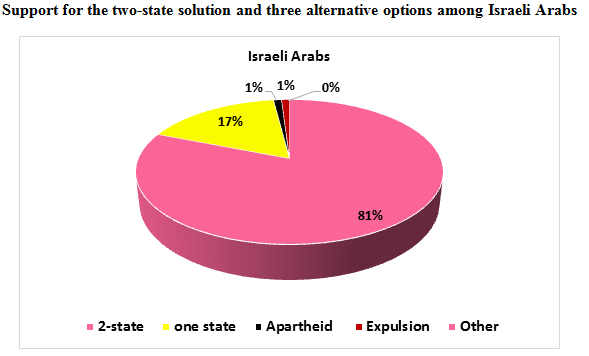
Confederation: For the second time, we tested an alternative to the traditional two-state solution in the form of a confederation between two states. In December 2016, the question was asked without a significant explanation of what this would mean. In the current survey we provided more detail about the idea, in the following form:
“Some people recommend the following solution: the creation of two states, Palestine and Israel, which enter into a confederation whereby citizens of one country are allowed to live as permanent residents in the territory of the other but each national group votes only in its state for elections. There would be freedom of movement for all, and Jerusalem is not divided but serves as the capital of two states. Israel and Palestine would deal jointly with security and the economy..
The new concept does not immediately appeal to Jews: 26% of Jewish Israelis said they would support the confederation of two states, a six point increase from six months ago, when the question did not provide the details above, but asked about support for the following:
“a confederation between the state of Israel and the state of Palestine whereby citizens of one country would be free to reside in the territory of the other and live under its own laws and where two the states jointly decide on matters of political, security and economic policy.”
Palestinian attitudes towards the more detailed confederation idea rose three points from December, to 37% support, but a majority, 58%, opposed. As is the case for all possible solutions, support for the confederation idea is highest among Israeli Arabs, at 61%, with 35% opposed.
Detailed package for implementation
Palestinians and Israelis were then asked to support or oppose a detailed combined package of a permanent settlement, gathered from previous rounds of Palestinian-Israeli negotiations. They responded first to each item separately, as component parts; following nine such items they were asked if they support or opposed the combined package, and given a short summary of the basic elements. Findings show that the level of support for the package reflects the change of opinion seen among each population regarding the general two-state solution: it has increased slightly among Palestinians, and decreased somewhat among Israelis. At present: 43% of the Palestinians support the full package (40% among West Bankers, who show no change from December – and half of Gazans. Among Gaza respondents, this represents a steady seven-point rise from June 2016 and December 2016; the current higher rate in Gaza accounts for the rise of the overall figure). Among all Israelis, 41% support this package: 32% among Israeli Jews and 83% among Israeli Arabs. Six months ago, 41% of Israeli Jews and 88% of Israeli Arabs supported the package.

In the current survey, 60% of Jews inside the Green Line and 80% of settlers oppose this package (61% for all Israeli Jews). 54% of Palestinians oppose the combined package, unchanged from six months earlier.
Items of an agreement. A detailed breakdown of attitudes regarding the nine components of the package follows (non-italicized questions were asked of Israeli Jews and if no other wording appears, also for Palestinians and Israeli Arabs. Italics refer to the questions worded separately for Palestinians; some of the Palestinian wordings were used for Israeli Arabs):
1) Mutual recognition of Palestine and Israel as the homelands of their respective peoples. The agreement will mark the end of conflict, the Palestinian state will fight terror against Israelis, and no further claims will be made by either side. 66% of Israeli Jews support this, including 45% of West Bank settlers.
Mutual recognition of Palestine and Israel as the homelands of their respective peoples. The agreement will mark the end of conflict, Israel will fight terror against Palestinians, and no further claims will be made by either side. Nearly half, 49%, of Palestinians support mutual recognition. In Gaza 56% support it, and 45% support it in the West Bank. Over three quarters of Israeli Arabs support mutual recognition, or 76%.
2) The independent Palestinian state which will be established in the West Bank and the Gaza Strip will be demilitarized (no heavy weaponry). Fewer than one quarter of Palestinians support this (23%), and three-quarters oppose the demilitarized state. Among Israeli Jews, 61% support this item, and half of Israeli Arabs.
3) A multinational force will be established and deployed in the Palestinian state to ensure the security and safety of both sides. Among Palestinians, 39% support this, but over half of Gazans: 52%, while one-third of West Bank respondents support the multinational force. Israeli Jews were evenly divided, with 47% for and 49% against this item; among Israeli Arabs, 63% supported it.
4) The Palestinian state will have full sovereignty over its air space, its land, and its water resources, but Israel will maintain two early warning stations in the West Bank for 15 years. One-third of Palestinians support this, and nearly twice as many Gazans as West Bank Palestinians (47%, compared to 25%, respectively). Just over one-third of Israeli Jews support this (35%) and 59% of Israeli Arabs.
5) The Palestinian state will be established in the entirety of West Bank and the Gaza strip, except for several blocs of settlement which will be annexed to Israel in a territorial exchange. Israel will evacuate all other settlements. 34% of Palestinians support this, with a similar pattern: half of Gazans (51%) and 26% of West Bank respondents). 37% of Israeli Jews support this, and 59% of Arabs.
6) The territories Palestinians will receive in exchange will be similar to the size of the settlement blocs that will be annexed to Israel. Just under one third of Palestinians support the territorial exchange, again twice as many Gazans as West Bank Palestinians). 37% of Israeli Jews support this, and 59% of Israeli Arabs, the same breakdown of support for the concept of a territorial exchange.
7) West Jerusalem will be the capital of Israel and East Jerusalem the capital of the Palestinian state. Just over one-fifth (22%) of Jews support this item, and only 8% among West Bank settlers.
East Jerusalem will be the capital of the Palestinian state and West Jerusalem the capital of the Israel. 29% of Palestinians support this, with very little distinction between West Bank and Gazan respondents. .Nearly two-thirds of Israeli Arabs support this (64%).
8) In the Old City of Jerusalem, the Jewish quarter and the Wailing Wall will come under Israeli sovereignty and the Muslim and Christian quarters and Temple Mount will come under Palestinian sovereignty. Just over one-quarter of Israeli Jews support the Old City arrangement, with 69% opposed.
In the Old City of Jerusalem, the Muslim and Christian quarters and al Haram al Sharif will come under Palestinian sovereignty and the Jewish quarter and the Wailing Wall will come under Israeli sovereignty. Here again, just over one-quarter of Palestinians support the division of the Old City, with only small differences between Gaza and the West Bank. The same portion of Palestinians are opposed as Jewish Israelis: 69%. Over half of Israeli Arabs support this (53%).
9) Palestinian refugees will have the right of return to their homeland whereby the Palestinian state will settle all refugees wishing to live in it. Israel will allow the return of about 100,000 Palestinians as part of a of family unification program. All other refugees will be compensated. A majority of Palestinians support this, 55%, and 40% are opposed. This item shows a very large difference between Gazans – nearly three-quarters (72%) support it – and West Bankers: just 47%. This item receives the lowest support from Israeli Jews out of all the items tested: 18%, fewer than one-fifth, support the arrangement on refugees, while 77% are opposed. Israeli Arabs show the opposite trend: 81% support it, with 18% opposed.
Perception of social support for package. On both sides, respondents also perceive their own societies support for the plan to be low. Palestinians are more likely to say that among other Palestinians the majority supports the plan – 39% believe this, compared to 43% of Palestinians who actually support it – a slight difference. Over half (51% ) of Palestinians believe the majority of Palestinians oppose it – close to the reality of 54%. Among Israeli Jews, however, a high portion accurately believe the majority rejects the agreement: 71%. Although 32% of Israeli Jews support the plan, fewer than half that number – 15% - believe that the majority supports it.
It is interesting to note that among Israeli Jews, a higher portion think Palestinians would accept the combined package, than those who think the majority of Jews support it: 35% say that the majority of Palestinians support the package. Similarly, 46% of Palestinians think the majority of Israelis support the package – higher than the portion who believe their own side has majority support. This could indicate that they believe the agreement to be advantageous to the other side – and could further explain the doubts for those who are opposed.
Regional and demographic trends. The higher support among Gaza residents for each item is consistent with their overall higher support for the full package. This trend has been consistent since June 2016. Moreover, it is worth pointing out that the findings show no difference in support between refugees and non-refugees (43% and 44% respectively). Support for the package drops to 37% among those between the ages of 18 and 22 years compared to all other age groups where support ranges between 43%-45%. Moreover, support for the package is higher among those who define themselves as “not religious” and “somewhat religious” (60% and 44%, respectively) compared to those who define themselves as religious (40%). Fatah voters and voters of third parties support the package with large majorities (58% and 57% respectively) compared to only 28% among Hamas voters.

Just 18% of Israeli settlers support the full package, but even fewer national religious Jews: only 7%, which is even lower than the Haredi level of support of 12%. The findings reflect a very consistent religious-secular divide, with nearly half (46%) of secular Jews who support the full package. Among Israeli Arabs, there is almost no variation based on levels of religious observance. A second demographic divide is found between younger and older Jews. One-quarter of the 18-34 year old Jews support the package, compared to 37% among those above 55. However, young secular Jews support it at the same rate as other seculars: 45%.
Among all Israelis, with Jews and Arabs combined, support varies most of all depending on where respondents place themselves on the right-left political continuum: Nearly 80% of those who consider themselves left-wing support the full package (78%), a slim majority of centrists (51%), and 22% of right-wingers.

Feasibility - doubts. Beyond demographic and political differences that typically characterize those who support or oppose the two-state solution and the detailed package, background attitudes are also clearly linked to support. In the previous survey, it became clear that trust in the other side was a powerful factor, and the belief that the other side wants peace. It also became clear that the perception of viability was important, therefore in the current survey we offer deeper analysis of this factor.
Among Israeli Jews who believe that the two state solution is still viable, 53% support the combined package. Further, for Israeli Jews, support for the agreement rises in part on whether the respondents believe there is chance of establishing a Palestinian state within the next five years.
Feasibility - doubts. Beyond demographic and political differences that typically characterize those who support or oppose the two-state solution and the detailed package, background attitudes are also clearly linked to support. In the previous survey, it became clear that trust in the other side was a powerful factor, and the belief that the other side wants peace. It also became clear that the perception of viability was important, therefore in the current survey we offer deeper analysis of this factor.
Among Israeli Jews who believe that the two state solution is still viable, 53% support the combined package. Further, for Israeli Jews, support for the agreement rises in part on whether the respondents believe there is chance of establishing a Palestinian state within the next five years.

Among the Palestinians who believe that the two state solution is still viable, 64% support the combined package. Further, support for the agreement rises incrementally the more the respondents believe there is chance of establishing a Palestinian state within the next five years.

Peace Incentives: Changing minds
Our joint poll sought to explore the extent to which the opposition to the combined package was “firm” or “flexible,” that is, whether additional policy items can act as incentives to change their minds in favor. To this end, we developed a series of policies that could be added to an agreement, and proposed them to respondents who originally said they opposed the full, detailed package. As noted above, this included 61% of Israeli Jews, 15% of Israeli Arabs, and 54% of Palestinians.
Each side was offered seven incentives. Some of the incentives were similar, reflecting either the same policy or a parallel item. Three items tested the same policy: making the Israeli-Palestinian agreement part of the Arab Peace Initiative; including joint Palestinian-Israeli economic ventures; and both sides were asked about the other side removing incitement from their education textbooks, as an incentive. One item was a policy area specifically favorable to one side: for Israelis – allowing the Israeli air force access to Palestinian airspace, and for the Palestinians, release of all prisoners. A fifth incentive stated that the agreement would include a gesture by each side, of a particularly sensitive aspect of the other side’s experience: an apology for the suffering of Palestinian refugees, and the recognition of Jewish holy sites in “Judea and Samaria.” Finally, each side was told that the other side would recognize the national and religious character of its state.
The items were tested as follows (italics indicates questions asked of Palestinians). Once again these questions were asked only among those who opposed the full package of the detailed two state agreement.
1) And if the agreement is part of a larger peace agreement with all Arab states according to the Arab Peace Initiative? 27% of Israeli Jews who opposed the agreement at first, said that they would now support it. Added to those who already support the agreement (32%), nearly half of Israeli Jews would support it with this item.
If in addition to the above items of the permanent settlement package, Israel agreed to accept the Arab peace initiative and in return all Arab countries supported this peace treaty? Nearly one-quarter of Palestinians who did not support the initial package said they would support it if this case (24%).
2) And if the agreement allows for joint Israeli-Palestinian economic ventures? One-quarter of Israeli Jews (25%) said this would make them support the agreement.
And if the agreement allows for joint Palestinian-Israeli economic ventures? Over one-quarter (27%) of Palestinians said they would support the agreement with this item.
3) And what if the Palestinians agree to change school textbooks to remove incitement against Jews? Over one-third of Jewish Israelis who initially opposed the agreement said they would support if it this item was included.
And what if the Israelis agree to change school textbooks so that they not include incitement against Palestinians? Nearly one-third (32%) of Palestinians opposed would support the agreement if it included this item.
4) What if the agreement allows the Israeli air force full access to Palestinian airspace? 30% of Israeli Jews would support the agreement with this item.
And if the agreement mandates the release of all Palestinian prisoners? Among those opposed, fully 56% said they would change their minds and support an agreement if all prisoners were released. Combined with those who support the original agreement already, close to three-quarters of Palestinians in total (73%) could support the agreement if it includes this incentive.
5) And if the agreement recognizes Jewish holy sites in Judea and Samaria and specifies that Jews have full rights to visit those places with security guarantees? One-third of Jewish Israelis would support the agreement in this case.
And if Israel agrees to apologize for the suffering the conflict has inflicted on the Palestinian refugees? 32% of Palestinians said this would make them change their minds and support an agreement.
6) And if the agreement states that the Palestinians explicitly recognize Israel as a Jewish state, and recognize the Jewish historic and religious ties to the land of Israel? For this item, 43% of Israeli Jews said they would change their minds from opposing to supporting the agreement. When added to the original number of supporters of the original agreement, 58% of Israeli Jews in total would support the package if it includes this incentive.
And if the agreement entails Israeli recognition of the Arab and Islamic character of the Palestinian state? Almost the same portion of Palestinians as Israeli Jews, 42%, said they would change their minds and support the original agreement based on this addition, bringing total Palestinian support to nearly two-thirds (66%).
7) And if Prime Minister Netanyahu declared his support for the package? 29% of Israeli Jews said they would support the agreement in that case.
And if Marwan Barghouti declared his support for the package? 34% of Palestinians said they would support the package in that case.
Israeli Arabs were asked about the incentives according to the Palestinian versions. However the number who initially opposed the agreement was very low – just 24 respondents. The breakdowns therefore are not statistically significant; however it is worth noting the most successful initiatives: three-quarters said they would change their minds in the case of joint Palestinian-Israeli economic ventures, and two-thirds said they would support it if incitement against Palestinians in Israeli textbooks is changed. The results above are shown in the following graphs:
Willingness of Israeli Jews who opposed to the peace agreement package to change position and support the combined package based on various incentives


In all, between one-quarter to 43% of Jews who were opposed to an agreement said they would change their minds and support it based on one of these incentives. Among Palestinians, from one-quarter to 56% of those who rejected the agreement could change their minds. With added support, several of the incentives could convince enough respondents to reach a majority, or even a strong majority. This indicates significant flexibility and openness of attitudes; it also implies that rejection of the two state implementation package is not entirely ideological, but can be changed with the right policies. Mutual recognition is a powerful incentive for both parties – while for Palestinians, releasing the prisoners Israel currently holds is the most powerful.
2) Approaches to Conflict Resolution
Negotiation Framework and Third Parties: The previous survey from December showed that the large majority of both Israelis and Palestinians believe the current US administration to be pro-Israel rather than neutral/balanced, or pro-Palestinian – about two-thirds of Israelis and over three-quarters of Palestinians.
In this context, it is valuable to consider alternatives to the US-brokered negotiation processes that characterized the last two decades. In the last two surveys, we tested five models for a multi-lateral approach to negotiations: 1) an Arab forum in which Saudi Arabia, Egypt and Jordan participate; 2) an American-led peace process; 3) an EU-led peace process; 4) a UN-led peace process; 5) and finally, a US-Russian-led peace process. Findings show that in both surveys, Palestinians are most receptive to the first, or Arab regional, approach (31% in December and the current June 2017 survey) followed by a UN and an EU approaches (17% and 10% respectively at present); 7% selected a US-led multi-lateral process, and 5% choose an American-Russian led peace process.
Israeli Jews preferred a US-led peace process consistently in both surveys (32%), while 19% selected a US-Russian approach, and 17% selected a regional approach led by Arab states. A UN-led process was selected by just 5% of Israeli Jews in both surveys and support for an EU-led process is just 2% - this reflects ongoing perceptions in Israeli society that both bodies are biased against Israel, a theme regularly repeated in public discourse.
Among Israelis Arabs, the Arab-led regional approach had the highest support, with over one-quarter (26%) who selected this option. 18% chose an EU process and the same portion preferred a US-led process; 15% selected a UN led process and 9% chose the US-Russian approach.
When all Israeli respondents are considered together, an Arab-led regional process ranks second choice, with 19% who preferred this approach – which is the top preference of both Palestinians and Israeli Arabs.
3) How Israelis and Palestinians View Each Other
We asked the two sides about perceptions of both the other, and themselves: whether they want peace or believe the other side does, whether they trust and whether they fear the other side, and for the first time since
June 2016, what they believe are the goals of both their side and the other side. We probed the extent of zero sum beliefs. The picture is mostly consistent with trends in our recent surveys.
Does the other side want peace? Among Palestinians, 44% agree that most Israelis want peace, a rise from December 2016, when 38% of the Palestinians felt this way. One-third (33%) of Israeli Jews think most Palestinians want peace, a decline from December, when 41% of Jews agreed with the statement that “most Palestinians want peace.” Among Israeli Arabs 54% agree that most Palestinians want peace, and 52% agree that Israeli Jews want peace.
Aspirations of each side: The majority on both sides believe that the opposing side has maximalist and destructive aspirations in the conflict.
Nearly one-quarter (24%) of Israeli Jews believe the Palestinians’ main aspiration is to take over the entire state of Israel from pre-’48 borders, and nearly forty percent (38%) believe that Palestinians want to conquer Israel and destroy much of the Jewish population. In total, 62% of Israelis believe Palestinians hold one of these maximalist positions.
In the eyes of the Palestinians, these assessments are inaccurate; in fact the strong plurality of Palestinians, 42%, believe that the long-term aspiration of the PA/PLO is to regain some of the territory from 1967, and another 19% believes the goal is to regain all of the ’67 territories; thus 61% combined view the PA as seeking more moderate goals. Just 11% believe the PA/PLO holds the extreme aspiration of conquering all of Israel and destroying the Jewish population, and 13% cites conquering all of Israel – one-quarter in total.
Among Palestinians, 57% believe Israel wants to extend its borders from the river to the sea and expel the Palestinian population. Another 21% believes Israel wants to annex the West Bank but deny the Palestinians political rights. Together, 78% believe Israel holds a maximalist position. There are significant differences between Palestinians in the West Bank and in Gaza regarding perception of Israeli aspirations: 42% of Gazans believe that Israel seeks a more moderate goal to withdraw from all (21%) or part (21%) of the territories it occupied in 1967, but just 9% of West Bankers combined, for both goals. By contrast, 69% of West Bank respondents held one of the two most extreme view of Israeli goals: extending its borders and expelling the Palestinians – but just one-third of Gazans.
In the eyes of the Israelis, these perceptions are inaccurate. Just one-third of Israeli Jews believes that their state holds the maximalist goals of either annexing all of the West Bank and expelling the Palestinians (14%) or annexing it without giving rights to the Palestinians there (20%) – one third in total.
Trust/Zero-Sum Conflict: As in previous recent surveys, levels of trust in the other side are very low and distrust is overriding. Among Palestinians a solid majority feels Israeli Jews are untrustworthy (87% - unchanged from 86% in December 2016). Israeli Arabs are deeply divided on this: 50% disagree that Israeli Jews can be trusted, and 49% agree.
On the Israeli Jewish side, over three-quarters (77%) believe that Palestinians cannot be trusted, up from 71% in December, and just 18% agreed with the statement that they can be trusted.
Distrust is reinforced by a prevailing perception on both sides that the Palestinian-Israeli conflict is characterized by zero-sum relations: “Nothing can be done that’s good for both sides; whatever is good for one side is bad for the other side.” Findings show that 53% of Israeli Jews (compared to 51% in December), 44% of Israeli Arabs (four points higher than December), and 72% of Palestinians (also up four points) agree with this dismal zero-sum characterization.
Fear: More Palestinians fear Israeli soldiers and armed settlers more than they fear Israeli Jews. Half agreed with the statement “I feel fear towards Israeli soldiers and armed settlers,” but 40% agreed with the statement made about Jews. This trend is nearly unchanged from December. There are significant differences between West Bank and Gaza respondents: 57% from the West Bank fear soldiers and settlers, while just 36% of Gazans do – this could reflect the fact that West Bankers have more significant daily contact with such figures; although it is also consistent with milder attitudes among Gaza in general.
Among Israelis, a larger majority of two-thirds agree with the statement “I feel fear toward Palestinians,” unchanged from December 2016. Among settlers fully three-quarters agree. Regarding Arab-Jewish relations among Israeli citizens, nearly half of Jews agree that they fear Israeli Arabs, and one-quarter of Israeli Arabs agree with a statement that they fear Israeli Jews; 73% disagree.
General Conditions of the two sides: 55% of the Palestinians describe conditions in the Palestinian territories as bad or very bad; the portion of those in Gaza who feel life condition are bad has risen 10 points since December, to nearly three-quarters (72%). Among Israelis, settlers are the most satisfied population, with 64% who say the country’s condition is good or very good, relative to 54% among both Jews (and the total for Israelis) who say the conditions are good or very good. Half of Israeli Arabs said conditions are good; around 30% among all Israeli groups, and nearly one-quarter of Palestinians, say conditions are “so-so.”
(4) Values and Goals
Values and Goals: We asked Israelis and the Palestinians about the hierarchy of the values and goals they aspire to maintain or achieve. Jews were asked about the values of: (1) a Jewish majority, (2) Greater Israel, (3) Democracy, (4) Peace. Among Israeli Jews, a Jewish majority is seen as the most important value (31%), followed by democracy (19%). The portion who chose democracy rose between June and December 2016, and has now decreased back to the June 2016 level. However, the number who chose peace rose from December, from 23% to 29% in June – close to the level of one year ago (32% in June 2016). Although “Greater Israel” is ranked lowest of the four, the portion of those who select this as the highest priority has grown in a mild but steady trend from one year ago: from 10% in June 2016, to 14% in December and 17% in the current survey.
Among the Palestinians, we asked about the following goals: (1) Israeli withdrawal and establishing a Palestinian state, (2) Obtaining right of return for refugees to ’48 Israel, (3) Establishing a democratic political system, (4) Building a pious or moral individual and religious society. For Palestinians, the ranking has been stable, with almost no change over the course of the year. The top priority for Palestinian goals remains Israeli withdrawal to the 1967 borders and the establishment of a Palestinian state in the West Bank and the Gaza Strip with East Jerusalem (43% chose this), followed by obtaining the right of return to refugees to their 1948 towns and villages (29%), building a pious or moral individual and a religious society (16%) and building a democratic political system (13%).
