
A slight majority of Israelis and Palestinians support the two-state solution. However, they do not trust each other, have disparate views on the terms of a permanent settlement, underestimate the level of compromise on the other side, and view its intentions as threatening. Nonetheless, at least a quarter of the opposition to a permanent settlement on both sides is flexible and it is likely that its opinion might be changed with the right incentives. 
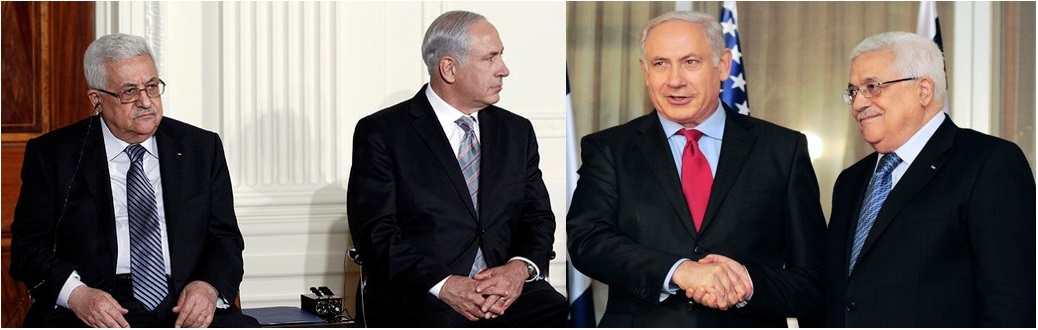
These are the results of Palestinian-Israeli Pulse: A Joint Poll conducted by the Israel Democracy Institute (IDI) in Jerusalem and the Palestinian Center for Policy and Survey Research (PSR) in Ramallah, in partnership with and support from the Konrad-Adenauer-Stiftung (KAS) and with funding from the European Union (EU).
STATISTICAL HIGHLIGHTS
- A small majority of Palestinians (51%) and Israelis (58.5%) supports the two-state solution.
- Support for a permanent agreement package, one based on previous rounds of negotiations, is much lower than the support for the two-state solution. Only 39% of Palestinians and 46% of Israelis support a peace agreement package that comprises: a de-militarized Palestinian state, an Israeli withdrawal to the Green Line with equal territorial exchange, a family unification in Israel of 100,000 Palestinian refugees, West Jerusalem as the capital of Israel and East Jerusalem as the capital of Palestine, the Jewish Quarter and the Western Wall under Israeli sovereignty and the Muslim and Christian quarters and the al Haram al Sharif/Temple Mount under Palestinian sovereignty, and the end of the conflict and claims. In general, support for all parameters of a permanent peace deal is highest among Israeli Arabs (see Tables of Findings). However, as their demographic share of the entire Israeli adult population is only around 16%, their contribution to the pro-peace bloc in Israel is limited.
- A quarter of Israelis and Palestinians who oppose the permanent agreement package are willing to reconsider their opposition to the peace deal if it was accompanied by a peace agreement with all Arab states according to the Arab Initiative's principles (for the Israeli public), and an Israeli acceptance of that initiative (for the Palestinian public).
- In selecting between bilateral, multilateral, and unilateral approaches to peacemaking, Palestinians prefer the multilateral (44%) while the Israelis prefer the bilateral (40%). Of various multilateral forums, an Arab forum, in which Saudi Arabia, Egypt and Jordan participate, is the least rejected by the two sides. All other multilateral forums – an American-led, an EU-led, or an UN-led forum – are acceptable to one side while unacceptable to the other.
- A quarter of Israelis and 35% of Palestinians support a one-state solution.
- Large majorities of Israelis and Palestinians estimate as low the chances that an independent Palestinian state will be established in the next five years.
- A majority (68%) of Palestinians admire Israeli democracy while only 10% of the Israelis see positively Palestinian democracy.
- A majority (62%) of Palestinians blame the collapse of peace negotiations on the Israelis. A somewhat smaller majority (52%) of Israelis blame the Palestinians for this collapse. However, significant minorities (on both sides 43%) believe that the majority on the other side wants peace.
Findings show significant Palestinian-Israeli mutual misperception and that this mutual misperception is positively correlated with hardline views. In contrast, clarity/accurate perception about the views on the other side is positively correlated with greater willingness to compromise.
The Palestinian sample size was 1,270 adults interviewed face-to-face in the West Bank, East Jerusalem and Gaza Strip in 127 randomly selected locations between June 2 and 4, 2016. The margin of error is 3%. The Israeli sample includes 1,184 adult Israelis interviewed by phone in Hebrew, Arabic or Russian between June 7 and 14, 2016. The margin of error is 3%. The poll was planned and supervised by Prof. Tamar Hermann, the academic director of IDI’s Guttman Center for Public Opinion and Policy Research and Dr. Khalil Shikaki, director of PSR.
MAIN FINDINGS
The following sections compare and contrast findings regarding Palestinian and Israeli public opinion in general. However, when important differences, mainly between Israeli Jews and Arabs and between Palestinians living in the West Bank (West Bankers) and Gazans were found, we also provided the respective findings for these sub groups.
(1) Israeli-Palestinian Peace Process
Two-state solution: Today, majorities on both sides – 59% of Israelis (53% among Jews and 87% among Arabs) and 51% of Palestinians – support what is known as the two-state solution. We asked Palestinians and Israelis to assess the majority view on their side and on the other side regarding this solution. Findings indicate that both sides underestimate and incorrectly assess the level of support for this solution on their side: among the Palestinians, 47% said a majority opposes it; among the Israelis, 57% said the majority opposes it. Worse yet, both sides underestimate the level of support for the two-state solution on the other side and think that there is a majority that opposes the two-state solution. Some 49% of the Palestinians believe a Jewish majority opposes it; on the Israeli side, 44% said a Palestinian majority opposes it.
Permanent status package: We presented Palestinians and Israelis with a detailed combined package of a permanent settlement, gathered from previous rounds of Palestinian-Israeli negotiations, and asked them if they would support or oppose each of its components and the combined package. The majority on both sides, 55% of Israeli Jews and 59% of Palestinians, opposed the combined package. A minority – 46% of Israelis (39% among Israeli Jews and 90% among Israeli Arabs) and 39% of the Palestinians (37% among West Bankers and 43% among Gazans) – support the combined package.
A detailed breakdown of attitudes regarding the nine components of the package:
1. Mutual recognition of Palestine and Israel as the homelands of their respective peoples. The agreement will mark the end of conflict, the Palestinian state will fight terror against Israelis and Israel will fight terror against Palestinians, and no further claims will be made by either side: a minority among the Palestinians (40%) and a majority among the Israelis (68%; 64% among Israeli Jews and 91% among Israeli Arabs) supported this item.
2. A demilitarized independent Palestinian state will be established in the West Bank and the Gaza Strip: a minority of Palestinians (20%; 27% in the Gaza Strip and 16% in the West Bank) and a majority (61%) among Israelis supported this item.
3. A multinational force will be established and deployed in the Palestinian state to ensure the security and safety of both sides: among the Palestinians, a minority (36%) supported it, and among the Israelis, a majority (58%) supported it.
4. The Palestinian state will have sovereignty over its air space, its land, and its water resources, but Israel will maintain two early warning stations in the West Bank for 15 years: on both sides only a minority supported this item: on the Palestinian side 33% (26% in the West Bank and 44% in the Gaza Strip) and among the Israelis, 42% (38% among Israeli Jews and 63% among Israeli Arabs).
5. The Palestinian state will be established in the entirety of West Bank and the Gaza strip, except for several blocs of settlements, which will be annexed to Israel in a territorial exchange. Israel will evacuate all other settlements: a minority (35%) among the Palestinians (28% in the West Bank and 48% in the Gaza Strip), and a small majority (52%) among the Israelis supported it (among the Israeli Jews only 49% supported it).
6. The territories Palestinians will receive in exchange will be similar to the size of the settlement blocs that will be annexed to Israel: minorities on both sides (31%) among the Palestinians (39% in the Gaza Strip and 26% in the West Bank) and 49% of Israelis, supported it. (The Israeli Jews were actually split in the middle: 46% supported it while 45% opposed it).
7. West Jerusalem will be the capital of Israel and East Jerusalem the capital of a Palestinian state: again, minorities – among the Palestinian 30% and among the Israelis 39% (32% among Israeli Jews and 75% among Israeli Arabs) supported it.
8. In the Old City of Jerusalem, the Jewish quarter and the Western Wall will come under Israeli sovereignty and the Muslim and Christian quarters and Temple Mount/al Haram al Sharif will come under Palestinian sovereignty: a minority (31%) among Palestinians (24% in the West Bank and 41% in the Gaza Strip) and a similar minority (39%) among Israelis (33% among Israeli Jews and 73% among Israeli Arabs) supported it.
9. Palestinian refugees will have the right of return to their homeland whereby the Palestinian state will settle all refugees wishing to live in it. Israel will allow the return of about 100,000 Palestinians as part of a of family unification program. All other refugees will be compensated: among the Palestinians, 49% (43% in the West Bank and 59% in the Gaza Strip) supported it and among the Israelis, 27% (17% among Israeli Jews and 84% among Israeli Arabs) supported it.
We asked the public to assess the attitudes of their side and that of the other side toward the combined package. Both sides assessed correctly that a majority on their side and a majority on the other side would oppose the package; only 23% of Israelis and 35% of Palestinians believed that a majority on their side would support the package. Similarly, 35% of the Israelis (30% among Israeli Jews and 63% among Israeli Arabs) and 40% of the Palestinians (32% in the West Bank and 53% in the Gaza Strip) thought that a majority on the other side would support the package.
It is worth noting that among Israeli Jews, support for the combined package among settlers stands at 16% compared to 40% among non-settlers. Support is much higher among Israeli Jews who define themselves as secular, standing at 56% compared to 36% among traditionalists, 10% among the religious, and 9% among the Haredim (ultra-Orthodox).
Support also varies depending on where respondents place themselves on the right-left political continuum: 88% on the left, 83% on the moderate-left, 59% on the center, 26% on the moderate-right, and 10% of the right support the package. Significantly, support for the package is much higher among those who believe that a majority of Palestinians support the two-state solution than among those who believe that a majority of Palestinians opposes that solution (64% to 33%). Support is much higher among those Israelis who perceive Palestinian long-term aspirations as least threatening (see the following section for details on Israeli threat perception), standing at 74%, compared to those (22%) who perceive Palestinian long-term aspirations as most threatening (see the following section for details on Israeli threat perception).

Among the Palestinians, as we saw earlier, support for the combined package is higher in the Gaza Strip than in the West Bank. It is worth noting that 70% of the residents of the Gaza Strip are refugees while only 28% of the residents of the West Bank are refugees. Part of the explanation for greater Gazan support is the fact that support for the package is higher among Palestinian refugees (43%) than non-refugees (37%). Surprisingly, however, those refugees living in refugee camps (estimated to be less than 60% of all refugees) are the least supportive of the combined package, standing at 35% compared to 40% among residents of cities and rural areas. Moreover, support for the package is higher among those who define themselves as “not religious” and “somewhat religious” (63% and 41%) compared to those who define themselves as religious (35%); and among Fatah voters (57%) compared to Hamas voters (25%). As in the Israeli case, support for the combined package is significantly higher among those Palestinians who believe that a majority of Israelis supports the two-state solution compared to those who believe that an Israeli majority is opposed to that solution (48% vs. 33%). Also, as in the Israeli case, support for the combined package is significantly higher among those Palestinians who perceive Israeli long-term aspirations as least threatening, standing at 61%, compared to those who perceive Israel’s long term aspirations as most threatening, standing at 31% (See the following section for details on Palestinian threat perception).

Peace Incentives: Our joint poll sought to explore the extent to which the opposition to the combined package was “firm” or “flexible.” For this end, we offered those who opposed the package various incentives in an attempt to understand the source of their opposition and the extent to which change was possible. Israeli Jews and Arabs and Palestinians opposed to the package were offered seven different incentives. Only the first three of the incentives offered to the three sides were identical or almost identical. The remaining four sought to address either presumed Palestinian or Israeli concerns. In this regard, it should be noted that Israeli Arabs were offered the same four distinct incentives offered to the Palestinian respondents. Below is a detailed breakdown of the responses to the various incentives:
Israeli Incentives (offered only to those Israeli Jews and Arabs who expressed opposition to the combined package):
1. And if the agreement would include peace with all Arab states according to the Arab Peace Initiative? 26% of Israeli Jews and 42% of Israeli Arabs were willing to change their mind and accept package if it included this amendment.
2. And if free movement throughout Jerusalem – West and East – was insured as if it is one city? 15% of Israeli Jews and 37% of Israeli Arabs were willing to change their mind and accept the combined package if it included this amendment.
3. And if Israel was offered by Europe to join the European Union? 12% of Israeli Jews and 37% of Israeli Arabs were willing to change their mind and accept the combined package if it included this amendment.
4. What if the agreement includes recognition by the Palestinian state of Israel as the state of the Jewish people? 26% of Israeli Jews were willing to change their mind and accept the combined package if it included this amendment.
5. And if the US signs a defense treaty with Israel in order to boost Israel’s security? 19% of Israeli Jews were willing to change their mind and accept the combined package if it included this amendment.
6. And if the agreement will not allow Palestinian refugees to return to Israel to exercise a right of return, but they will be compensated by an international fund? 33% of Israeli Jews were willing to change their mind and accept the combined package if it included this amendment.
7. And if the exchanged territory that the Palestinians would receive in compensation for the settlement blocs annexed to Israel would be the areas populated today by Israeli Arabs, such as the area known as the Triangle? 22% of Israeli Jews were willing to change their mind and accept the combined package if it included this amendment.
In short, on Israeli side: all seven incentive made only a minority of those opposed to a peace agreement package change their minds regarding the combined package.

Palestinian Incentives in addition to the combined package (offered only to Palestinians/Israeli Arabs who expressed opposition to the combined package):
1. If Israel agreed to accept the Arab peace initiative and in return all Arab countries supported this peace treaty? 25% of Palestinians were willing to change their mind and accept the combined package if it included this amendment.
2. And if free movement throughout Jerusalem, West and East, was insured as if it is one city? 31% of Palestinians were willing to change their mind and accept the combined package if it included this amendment.
3. If the state of Palestine was offered by Europe to join the European Union? 32% of Palestinians and an identical percentage of the Israeli Arabs were willing to change their mind and accept the combined package if it included this amendment.
4. If Israel acknowledged its responsibility for the creation of the refugee problem? 34% of Palestinians and 26% of the Israeli Arabs were willing to change their mind and accept the combined package if it included this amendment.
5. If the Palestinian state received $30 billion to $50 billion to help in settling those refugees wishing to live in the Palestinian state and compensating them? 31% of Palestinians and 37% of the Israeli Arabs were willing to change their mind and accept the combined package if it included this amendment;.
6. And if the exchanged territory that the Palestinians would receive in compensation for the settlements blocs annexed to Israel would be along the Gaza border? 18% of Palestinians and 21% of the Israeli Arabs were willing to change their mind and accept the combined package if it included this amendment.
7. And if the Palestinian state and Jordan become a confederation? 29% of Palestinians were willing to change their mind and accept the combined package if it included this amendment.
In short, on the Palestinian and Israeli Arabs sides, all seven incentives made only a minority of those opposed to a peace agreement package change their minds regarding the combined package.

As the findings detailed above indicate, of the three identical or almost identical incentives, a broader regional peace involving the Arab World and Israel is the least opposed, as 26% of Israeli Jews, 25% of Palestinians, and 42% of Israeli Arabs who opposed the combined package were willing to change their minds and accept a package with this amendment. A one-quarter "defection" from opposition to support for the combined package increases the level of support for it among Palestinians and Israeli Jews from a minority to a majority position (39% to 54%). Of the distinct Palestinian incentives, the most effective proved to be the inclusion, as part of the refugee solution, of an item in which Israel acknowledges its responsibility for the creation of the refugee problem; such an inclusion managed to persuade more than one-third of the Palestinians who initially opposed the package to change their minds and accept it. On the Israeli side, the most effective incentive proved to be the removal of the line item that allowed 100,000 Palestinian refugees to return to Israel, with one third willing to change their mind and accept the combined package.
Sacred Values: The Pulse also sought to assess the main impediments on the road to peace, the “sacred values” that pull some Palestinians and Israelis away from compromise. We offered each side four such values comprising aspects of history, national identity, holy places, refugees’ rights, and the 1967 borders.
Findings indicate that for Israeli Jews, the two most important of the four values examined related to history: (1) the demand by 79% for Palestinian recognition of the Jewish character of the state; (2) the demand by 73% for Palestinian recognition of the Jewish roots and history in the land of Israel; (3) the demand by 56% of Israeli Jews that the combined package should not include Israeli withdrawal to the 1967 line, or the Green Line; and (4) the demand by 55% of Israeli Jews for the inclusion in the agreement of Israeli sovereignty over the Temple Mount (al Haram al Sharif).
On the Palestinian side, findings show that the two most important of the four values related to history and territories: (1) the demand by 62% for an Israeli recognition of Palestinian roots/history in historic Palestine; (2) the demand by 61% that the agreement entail an Israeli withdrawal to the 1967 lines; (3) the demand by 58% for an Israeli recognition of the refugees’ right of return; and (4) the demand by 57% for Palestinian sovereignty over al Haram al Sharif (the Temple Mount) .
Mutual Recognition of National Identity: We asked Israelis and Palestinians about their readiness for a mutual recognition of national identity as part of a permanent status agreement and after all issues in the conflict are resolved and a Palestinian State is established. Findings show that a majority (64%) of the Israeli public support such a mutual recognition and among Palestinians, a large minority (43%) support it. We then asked the two sides to tell us whether such recognition should come before or after the signing of a final settlement. For Israeli Jews, the preference is to have the recognition come before: 53% of the Israelis (55% among Israeli Jews and 40% among Israeli Arabs) said it should come before. But the Palestinians are divided into two categories: 39% said it should come before and 41% said it should come after.
(2) Conflict Resolution Management |
We explored issues related to the process of peacemaking, specifically the most effective or “most promising” approaches to revive Israeli-Palestinian negotiations and the role of outside actors. In selecting from a list of three possible approaches, bilateral, multilateral, and unilateral, findings show that Palestinians and Israeli Arabs prefer the multilateral, while the Israeli Jews prefer bilateral between the Israeli government and the Palestinians.
Among the Palestinians (44%) and among the Israeli Arabs (54%) preferred a multilateral forum in which major powers sponsor the negotiations, while only 27% of the Israelis Jews preferred this approach. Only 22% of the Palestinians preferred bilateral negotiations while 41% of the Israeli Jews preferred this approach. Finally, only 18% of Palestinians and an identical percentage of Israelis selected the unilateral approach, one in which each side takes measures in order to promote its interests.
We also sought a deeper understanding of Israeli and Palestinian views of the multilateral approach. Four models of this approach were presented to the two publics: 1) an Arab forum in which Saudi Arabia, Egypt and Jordan participate; 2) an American-led multilateral approach; 3) an EU-led approach; 4) and finally, an UN-led approach. Findings show that Palestinians were almost equally open to three of the four (the Arab forum, the UN and the EU approaches), with support ranging between 20-22%, while only 8% preferred a US-led effort. Israeli Jews preferred almost equally an Arab forum (28%) and a US-led effort (26%). Among Israelis Arabs, support was greater for an UN-led approach (36%) and an EU-led one (27%).
(3) How Israelis and Palestinians View Each Other: |
We asked the two sides how they view various conditions on and attributes of the other side, and in some cases on their own side. The questions focused on matters ranging between democracy and rule of law to issues of long-term aspirations and threat perceptions, and, of course, who to blame for the failure to make peace. While the picture that emerges is discouraging, there are, nonetheless, a few glimmers of hope.
Democracy: 68% of the Palestinians (73% in the West Bank and 59% in the Gaza Strip) describe Israeli democracy as good or very good. When Israelis were asked to evaluate democracy in the Palestinian Authority, a solid majority (77%) described Palestinian democracy as bad or very bad. It is worth noting that only 32% of the Palestinians describe Palestinian democracy as good or very good. By contrast, 65% of the Israelis describe Israeli democracy as good or very good.
When Palestinians were asked about the future of democracy in Israel, 38% said it will remain as it is now, 26% said Israel will become more democratic and 28% said it will become less democratic. When Israelis were asked about the chances that a better democratic system will be established in the future Palestinian state, a solid majority (83%) said the chances are very slim or fairly slim.
Rule of Law: When Palestinians were asked if the rule of law in Israel is good, 50% (62% in the West Bank and 31% in the Gaza Strip) replied in the affirmative. By contrast, when Israelis were asked if Palestinian rule of law is good, only 20% replied in the affirmative.
Want Peace: 43% of the Palestinians and identical percentage among Israeli Jews agree that the other side wants peace; 77% among Israeli Arabs agree that Palestinians want peace.
Failure of Peace Efforts – Who to Blame: As expected, Palestinians blame Israelis and Israelis blame Palestinians for the collapse of peace negotiations over the years: 62% of the Palestinians put the blame on the Israeli side and 52% of Israeli Jews put the blame on the Palestinian side. Only 8% of the Palestinians and 12% of Israeli Jews blame their side. A little over a quarter (26%) of the Palestinians and about a third (31%) of Israeli Jews place the blame on both sides to the same extent.
Trust/Zero-Sum Conflict: The most disturbing, but not surprising, finding relates to the question of trust. Among Palestinians a solid majority (89%) feel Israeli Jews are untrustworthy. On the Israeli Jewish side, a somewhat smaller majority (68%) also indicated that Palestinians cannot be trusted. Distrust is reinforced by a prevailing perception on both sides, that the Palestinian-Israeli conflict is characterized by zero-sum relations: “Nothing can be done that’s good for both sides; whatever is good for one side is bad for the other side.” Findings show that 50% of Israeli Jews, 61% of Israeli Arabs, and 70% of Palestinians agree with this dismal characterization.
Long-Term Aspirations: The level of threat on both sides regarding the aspirations of the other side in the long run is very high: 54% of Palestinians think that Israel’s goal is to extend its borders to cover all area between the Jordan River and the Mediterranean Sea and expel its Arab citizens. Some 27% think Israel’s goal is to annex the West Bank while denying political rights to the Palestinians. Some 35% of Israelis (40% of Israeli Jews and 8% of Israeli Arabs) think Palestinians’ main aspiration is to conquer the State of Israel and destroy much of its Jewish population; 19% think the goal of the Palestinians is to take over the entire state of Israel.
Only 17% of the Palestinians think Israel’s long-term intention is to withdraw from all (7%) or some (10%) of the territories occupied in 1967 after guaranteeing its security. 37% of Israelis (33% of Israeli Jews and 61% of Israeli Arabs) think the aspirations of the Palestinians are limited to regaining some (21%) or all (16%) of the territories conquered in 1967.
However, when we asked Palestinians and Israelis to tell us what they think the long-term aspirations of their side are, the picture shows that the two sides perceive much more moderate aspirations on their side than anticipated by the other side. Only 12% of Israelis say the aspiration of Israel is to annex the West Bank and expel the Palestinians living there; 18% say that Israel intends to annex the West Bank without granting political rights to the Palestinians living there. Among the Palestinians, only 10% say that the Palestinian aspiration is to conquer the State of Israel and destroy much of its Jewish population; 15% say Palestinian aspirations are to conquer the State of Israel and regain control over pre-1948 Palestine.
Fear: Among the Palestinians, 54% do not fear Israeli Jews. By contrast, 65% of Israeli Jews indicate they feel fear toward the Palestinians.
Worry: A solid majority (76%) of the Palestinians are worried or very worried that they or a member of their family could be hurt by Israel in their daily life or that their land would be confiscated or home demolished. Likewise, among the Israelis, 71% are worried or very worried that they or a member of their family may be hurt by Palestinian attacks in their daily life.
We also asked the Israelis if they are worried that “efforts by Palestinian groups and their supporters, such as the BDS movement, will succeed in delegitimizing Israel in the international community.” Israeli Jews (52%) and Israeli Arabs (83%) say their worry in this regard is low or very low.
Our General Conditions and Theirs: 49% of the Palestinians describe conditions in general in Israel as good, 24% describe them as bad, and 20% say they are so-so. By contrast, 45% of the Palestinians describe conditions in the West Bank as bad, 29% say they are so-so, and 25% describe them as good. As for conditions in the Gaza Strip, 72% describe them as bad.
When asked about their future expectations for conditions in the Gaza Strip in the next three to five years, 41% expect them to be worse and 30% expect them to be better. Expectations regarding West Bank conditions were a little more optimistic: 35% expect them to be better and 31% expect them to be worse.
Among the Israelis, 43% describe Palestinian conditions in the West Bank as bad, 24% describe them as good, and 22% describe them as so-so. With regard to conditions in the Gaza Strip, 68% of the Israelis describe them as bad.
By contrast, 39% of the Israelis describe Israel’s conditions as good, 36% describe them as so-so, and 24% describe them as bad. With regard to future expectations regarding the general conditions in Israel in the next three to five years, 31% of the Israelis believe they will be worse, 26% that they will be better, and 33% believe they will remain about the same as today.
(4) Values, Goals, and Expectations |
Values and Goals: We asked Israelis and the Palestinians about the hierarchy of the values and goals they aspire to maintain or achieve. Among Israeli Jews, a Jewish majority is seen as the most important value (35%), followed by peace (32%), democracy (20%), and Greater Israel (10%). Among the Palestinians, Israeli withdrawal to the 1967 borders and the establishment of a Palestinian state in the West Bank and the Gaza Strip with East Jerusalem as its capital was seen as the most important value (45%), followed by obtaining the right of return to refugees to their 1948 towns and villages (32%), and building a pious or moral individual and a religious society (13%).
Expectations: We asked both sides about their expectations for the near future. Findings show that the Israelis are more pessimistic than the Palestinians. Among the Israelis, 44% think that some violent acts or armed attacks will take place and the two sides will not return to negotiations. Some 29% think the two sides will return to negotiations but some violent acts or armed attacks will take place. Some 10% think the two sides will soon return to negotiations. Some 8% think that the two sides will not return to negotiations and there will be no armed attacks. Among the Palestinians, 24% expect that some violent acts or armed attacks will take place and the two sides will not return to negotiations; 34% think that the two sides will return to negotiations but some violent acts or armed attacks will take place; 22% think that the two sides will soon return to negotiations; and 14% think that the two sides will not return to negotiations and there will be no armed attacks. In other words, 73% of the Israelis compared to 58% of the Palestinians expect violence to continue and 39% of the Israelis compared to 56% of the Palestinians expect the two sides to return to negotiations.
Palestinian State? We asked both side about the chances for the establishment of an independent Palestinian state next to the state of Israel in the next five years. On this issue, Israeli and Palestinian views are very similar: 77% of the Israelis and 73% of the Palestinians think the chances are low.
(5) Other |
One-State Solution: The joint poll sought to ascertain the current level of support for the idea of a one-state solution “by which Palestinians and Jews will be citizens of the same state and enjoy equal rights.” Support for the idea is highest among Israeli Arabs (standing at 52%). Only a minority among Palestinians (34%) and among Israeli Jews (20%) support this option.
Impact of Palestinian Authority (PA) Collapse on Security: We asked both sides to speculate about the likely impact of a PA collapse on security conditions. Responses were similar: 63% of Israelis and 60% of Palestinians indicated such a collapse will lead to an increase in Palestinian-Israeli violence.

22 August 2016
A slight majority of Israelis and Palestinians support the two-state solution. However, they do not trust each other, have disparate views on the terms of a permanent settlement, underestimate the level of compromise on the other side, and view its intentions as threatening. Nonetheless, at least a quarter of the opposition to a permanent settlement on both sides is flexible and it is likely that its opinion might be changed with the right incentives.

These are the results of Palestinian-Israeli Pulse: A Joint Poll conducted by the Israel Democracy Institute (IDI) in Jerusalem and the Palestinian Center for Policy and Survey Research (PSR) in Ramallah, in partnership with and support from the Konrad-Adenauer-Stiftung (KAS) and with funding from the European Union (EU).
STATISTICAL HIGHLIGHTS
- A small majority of Palestinians (51%) and Israelis (58.5%) supports the two-state solution.
- Support for a permanent agreement package, one based on previous rounds of negotiations, is much lower than the support for the two-state solution. Only 39% of Palestinians and 46% of Israelis support a peace agreement package that comprises: a de-militarized Palestinian state, an Israeli withdrawal to the Green Line with equal territorial exchange, a family unification in Israel of 100,000 Palestinian refugees, West Jerusalem as the capital of Israel and East Jerusalem as the capital of Palestine, the Jewish Quarter and the Western Wall under Israeli sovereignty and the Muslim and Christian quarters and the al Haram al Sharif/Temple Mount under Palestinian sovereignty, and the end of the conflict and claims. In general, support for all parameters of a permanent peace deal is highest among Israeli Arabs (see Tables of Findings). However, as their demographic share of the entire Israeli adult population is only around 16%, their contribution to the pro-peace bloc in Israel is limited.
- A quarter of Israelis and Palestinians who oppose the permanent agreement package are willing to reconsider their opposition to the peace deal if it was accompanied by a peace agreement with all Arab states according to the Arab Initiative's principles (for the Israeli public), and an Israeli acceptance of that initiative (for the Palestinian public).
- In selecting between bilateral, multilateral, and unilateral approaches to peacemaking, Palestinians prefer the multilateral (44%) while the Israelis prefer the bilateral (40%). Of various multilateral forums, an Arab forum, in which Saudi Arabia, Egypt and Jordan participate, is the least rejected by the two sides. All other multilateral forums – an American-led, an EU-led, or an UN-led forum – are acceptable to one side while unacceptable to the other.
- A quarter of Israelis and 35% of Palestinians support a one-state solution.
- Large majorities of Israelis and Palestinians estimate as low the chances that an independent Palestinian state will be established in the next five years.
- A majority (68%) of Palestinians admire Israeli democracy while only 10% of the Israelis see positively Palestinian democracy.
- A majority (62%) of Palestinians blame the collapse of peace negotiations on the Israelis. A somewhat smaller majority (52%) of Israelis blame the Palestinians for this collapse. However, significant minorities (on both sides 43%) believe that the majority on the other side wants peace.
Findings show significant Palestinian-Israeli mutual misperception and that this mutual misperception is positively correlated with hardline views. In contrast, clarity/accurate perception about the views on the other side is positively correlated with greater willingness to compromise.
The Palestinian sample size was 1,270 adults interviewed face-to-face in the West Bank, East Jerusalem and Gaza Strip in 127 randomly selected locations between June 2 and 4, 2016. The margin of error is 3%. The Israeli sample includes 1,184 adult Israelis interviewed by phone in Hebrew, Arabic or Russian between June 7 and 14, 2016. The margin of error is 3%. The poll was planned and supervised by Prof. Tamar Hermann, the academic director of IDI’s Guttman Center for Public Opinion and Policy Research and Dr. Khalil Shikaki, director of PSR.
MAIN FINDINGS
The following sections compare and contrast findings regarding Palestinian and Israeli public opinion in general. However, when important differences, mainly between Israeli Jews and Arabs and between Palestinians living in the West Bank (West Bankers) and Gazans were found, we also provided the respective findings for these sub groups.
(1) Israeli-Palestinian Peace Process
Two-state solution: Today, majorities on both sides – 59% of Israelis (53% among Jews and 87% among Arabs) and 51% of Palestinians – support what is known as the two-state solution. We asked Palestinians and Israelis to assess the majority view on their side and on the other side regarding this solution. Findings indicate that both sides underestimate and incorrectly assess the level of support for this solution on their side: among the Palestinians, 47% said a majority opposes it; among the Israelis, 57% said the majority opposes it. Worse yet, both sides underestimate the level of support for the two-state solution on the other side and think that there is a majority that opposes the two-state solution. Some 49% of the Palestinians believe a Jewish majority opposes it; on the Israeli side, 44% said a Palestinian majority opposes it.
Permanent status package: We presented Palestinians and Israelis with a detailed combined package of a permanent settlement, gathered from previous rounds of Palestinian-Israeli negotiations, and asked them if they would support or oppose each of its components and the combined package. The majority on both sides, 55% of Israeli Jews and 59% of Palestinians, opposed the combined package. A minority – 46% of Israelis (39% among Israeli Jews and 90% among Israeli Arabs) and 39% of the Palestinians (37% among West Bankers and 43% among Gazans) – support the combined package.
A detailed breakdown of attitudes regarding the nine components of the package:
1. Mutual recognition of Palestine and Israel as the homelands of their respective peoples. The agreement will mark the end of conflict, the Palestinian state will fight terror against Israelis and Israel will fight terror against Palestinians, and no further claims will be made by either side: a minority among the Palestinians (40%) and a majority among the Israelis (68%; 64% among Israeli Jews and 91% among Israeli Arabs) supported this item.
2. A demilitarized independent Palestinian state will be established in the West Bank and the Gaza Strip: a minority of Palestinians (20%; 27% in the Gaza Strip and 16% in the West Bank) and a majority (61%) among Israelis supported this item.
3. A multinational force will be established and deployed in the Palestinian state to ensure the security and safety of both sides: among the Palestinians, a minority (36%) supported it, and among the Israelis, a majority (58%) supported it.
4. The Palestinian state will have sovereignty over its air space, its land, and its water resources, but Israel will maintain two early warning stations in the West Bank for 15 years: on both sides only a minority supported this item: on the Palestinian side 33% (26% in the West Bank and 44% in the Gaza Strip) and among the Israelis, 42% (38% among Israeli Jews and 63% among Israeli Arabs).
5. The Palestinian state will be established in the entirety of West Bank and the Gaza strip, except for several blocs of settlements, which will be annexed to Israel in a territorial exchange. Israel will evacuate all other settlements: a minority (35%) among the Palestinians (28% in the West Bank and 48% in the Gaza Strip), and a small majority (52%) among the Israelis supported it (among the Israeli Jews only 49% supported it).
6. The territories Palestinians will receive in exchange will be similar to the size of the settlement blocs that will be annexed to Israel: minorities on both sides (31%) among the Palestinians (39% in the Gaza Strip and 26% in the West Bank) and 49% of Israelis, supported it. (The Israeli Jews were actually split in the middle: 46% supported it while 45% opposed it).
7. West Jerusalem will be the capital of Israel and East Jerusalem the capital of a Palestinian state: again, minorities – among the Palestinian 30% and among the Israelis 39% (32% among Israeli Jews and 75% among Israeli Arabs) supported it.
8. In the Old City of Jerusalem, the Jewish quarter and the Western Wall will come under Israeli sovereignty and the Muslim and Christian quarters and Temple Mount/al Haram al Sharif will come under Palestinian sovereignty: a minority (31%) among Palestinians (24% in the West Bank and 41% in the Gaza Strip) and a similar minority (39%) among Israelis (33% among Israeli Jews and 73% among Israeli Arabs) supported it.
9. Palestinian refugees will have the right of return to their homeland whereby the Palestinian state will settle all refugees wishing to live in it. Israel will allow the return of about 100,000 Palestinians as part of a of family unification program. All other refugees will be compensated: among the Palestinians, 49% (43% in the West Bank and 59% in the Gaza Strip) supported it and among the Israelis, 27% (17% among Israeli Jews and 84% among Israeli Arabs) supported it.
We asked the public to assess the attitudes of their side and that of the other side toward the combined package. Both sides assessed correctly that a majority on their side and a majority on the other side would oppose the package; only 23% of Israelis and 35% of Palestinians believed that a majority on their side would support the package. Similarly, 35% of the Israelis (30% among Israeli Jews and 63% among Israeli Arabs) and 40% of the Palestinians (32% in the West Bank and 53% in the Gaza Strip) thought that a majority on the other side would support the package.
It is worth noting that among Israeli Jews, support for the combined package among settlers stands at 16% compared to 40% among non-settlers. Support is much higher among Israeli Jews who define themselves as secular, standing at 56% compared to 36% among traditionalists, 10% among the religious, and 9% among the Haredim (ultra-Orthodox).
Support also varies depending on where respondents place themselves on the right-left political continuum: 88% on the left, 83% on the moderate-left, 59% on the center, 26% on the moderate-right, and 10% of the right support the package. Significantly, support for the package is much higher among those who believe that a majority of Palestinians support the two-state solution than among those who believe that a majority of Palestinians opposes that solution (64% to 33%). Support is much higher among those Israelis who perceive Palestinian long-term aspirations as least threatening (see the following section for details on Israeli threat perception), standing at 74%, compared to those (22%) who perceive Palestinian long-term aspirations as most threatening (see the following section for details on Israeli threat perception).
Among the Palestinians, as we saw earlier, support for the combined package is higher in the Gaza Strip than in the West Bank. It is worth noting that 70% of the residents of the Gaza Strip are refugees while only 28% of the residents of the West Bank are refugees. Part of the explanation for greater Gazan support is the fact that support for the package is higher among Palestinian refugees (43%) than non-refugees (37%). Surprisingly, however, those refugees living in refugee camps (estimated to be less than 60% of all refugees) are the least supportive of the combined package, standing at 35% compared to 40% among residents of cities and rural areas. Moreover, support for the package is higher among those who define themselves as “not religious” and “somewhat religious” (63% and 41%) compared to those who define themselves as religious (35%); and among Fatah voters (57%) compared to Hamas voters (25%). As in the Israeli case, support for the combined package is significantly higher among those Palestinians who believe that a majority of Israelis supports the two-state solution compared to those who believe that an Israeli majority is opposed to that solution (48% vs. 33%). Also, as in the Israeli case, support for the combined package is significantly higher among those Palestinians who perceive Israeli long-term aspirations as least threatening, standing at 61%, compared to those who perceive Israel’s long term aspirations as most threatening, standing at 31% (See the following section for details on Palestinian threat perception).
Peace Incentives: Our joint poll sought to explore the extent to which the opposition to the combined package was “firm” or “flexible.” For this end, we offered those who opposed the package various incentives in an attempt to understand the source of their opposition and the extent to which change was possible. Israeli Jews and Arabs and Palestinians opposed to the package were offered seven different incentives. Only the first three of the incentives offered to the three sides were identical or almost identical. The remaining four sought to address either presumed Palestinian or Israeli concerns. In this regard, it should be noted that Israeli Arabs were offered the same four distinct incentives offered to the Palestinian respondents. Below is a detailed breakdown of the responses to the various incentives:
Israeli Incentives (offered only to those Israeli Jews and Arabs who expressed opposition to the combined package):
1. And if the agreement would include peace with all Arab states according to the Arab Peace Initiative? 26% of Israeli Jews and 42% of Israeli Arabs were willing to change their mind and accept package if it included this amendment.
2. And if free movement throughout Jerusalem – West and East – was insured as if it is one city? 15% of Israeli Jews and 37% of Israeli Arabs were willing to change their mind and accept the combined package if it included this amendment.
3. And if Israel was offered by Europe to join the European Union? 12% of Israeli Jews and 37% of Israeli Arabs were willing to change their mind and accept the combined package if it included this amendment.
4. What if the agreement includes recognition by the Palestinian state of Israel as the state of the Jewish people? 26% of Israeli Jews were willing to change their mind and accept the combined package if it included this amendment.
5. And if the US signs a defense treaty with Israel in order to boost Israel’s security? 19% of Israeli Jews were willing to change their mind and accept the combined package if it included this amendment.
6. And if the agreement will not allow Palestinian refugees to return to Israel to exercise a right of return, but they will be compensated by an international fund? 33% of Israeli Jews were willing to change their mind and accept the combined package if it included this amendment.
7. And if the exchanged territory that the Palestinians would receive in compensation for the settlement blocs annexed to Israel would be the areas populated today by Israeli Arabs, such as the area known as the Triangle? 22% of Israeli Jews were willing to change their mind and accept the combined package if it included this amendment.
In short, on Israeli side: all seven incentive made only a minority of those opposed to a peace agreement package change their minds regarding the combined package.
Palestinian Incentives in addition to the combined package (offered only to Palestinians/Israeli Arabs who expressed opposition to the combined package):
1. If Israel agreed to accept the Arab peace initiative and in return all Arab countries supported this peace treaty? 25% of Palestinians were willing to change their mind and accept the combined package if it included this amendment.
2. And if free movement throughout Jerusalem, West and East, was insured as if it is one city? 31% of Palestinians were willing to change their mind and accept the combined package if it included this amendment.
3. If the state of Palestine was offered by Europe to join the European Union? 32% of Palestinians and an identical percentage of the Israeli Arabs were willing to change their mind and accept the combined package if it included this amendment.
4. If Israel acknowledged its responsibility for the creation of the refugee problem? 34% of Palestinians and 26% of the Israeli Arabs were willing to change their mind and accept the combined package if it included this amendment.
5. If the Palestinian state received $30 billion to $50 billion to help in settling those refugees wishing to live in the Palestinian state and compensating them? 31% of Palestinians and 37% of the Israeli Arabs were willing to change their mind and accept the combined package if it included this amendment;.
6. And if the exchanged territory that the Palestinians would receive in compensation for the settlements blocs annexed to Israel would be along the Gaza border? 18% of Palestinians and 21% of the Israeli Arabs were willing to change their mind and accept the combined package if it included this amendment.
7. And if the Palestinian state and Jordan become a confederation? 29% of Palestinians were willing to change their mind and accept the combined package if it included this amendment.
In short, on the Palestinian and Israeli Arabs sides, all seven incentives made only a minority of those opposed to a peace agreement package change their minds regarding the combined package.
As the findings detailed above indicate, of the three identical or almost identical incentives, a broader regional peace involving the Arab World and Israel is the least opposed, as 26% of Israeli Jews, 25% of Palestinians, and 42% of Israeli Arabs who opposed the combined package were willing to change their minds and accept a package with this amendment. A one-quarter "defection" from opposition to support for the combined package increases the level of support for it among Palestinians and Israeli Jews from a minority to a majority position (39% to 54%). Of the distinct Palestinian incentives, the most effective proved to be the inclusion, as part of the refugee solution, of an item in which Israel acknowledges its responsibility for the creation of the refugee problem; such an inclusion managed to persuade more than one-third of the Palestinians who initially opposed the package to change their minds and accept it. On the Israeli side, the most effective incentive proved to be the removal of the line item that allowed 100,000 Palestinian refugees to return to Israel, with one third willing to change their mind and accept the combined package.
Sacred Values: The Pulse also sought to assess the main impediments on the road to peace, the “sacred values” that pull some Palestinians and Israelis away from compromise. We offered each side four such values comprising aspects of history, national identity, holy places, refugees’ rights, and the 1967 borders.
Findings indicate that for Israeli Jews, the two most important of the four values examined related to history: (1) the demand by 79% for Palestinian recognition of the Jewish character of the state; (2) the demand by 73% for Palestinian recognition of the Jewish roots and history in the land of Israel; (3) the demand by 56% of Israeli Jews that the combined package should not include Israeli withdrawal to the 1967 line, or the Green Line; and (4) the demand by 55% of Israeli Jews for the inclusion in the agreement of Israeli sovereignty over the Temple Mount (al Haram al Sharif).
On the Palestinian side, findings show that the two most important of the four values related to history and territories: (1) the demand by 62% for an Israeli recognition of Palestinian roots/history in historic Palestine; (2) the demand by 61% that the agreement entail an Israeli withdrawal to the 1967 lines; (3) the demand by 58% for an Israeli recognition of the refugees’ right of return; and (4) the demand by 57% for Palestinian sovereignty over al Haram al Sharif (the Temple Mount) .
Mutual Recognition of National Identity: We asked Israelis and Palestinians about their readiness for a mutual recognition of national identity as part of a permanent status agreement and after all issues in the conflict are resolved and a Palestinian State is established. Findings show that a majority (64%) of the Israeli public support such a mutual recognition and among Palestinians, a large minority (43%) support it. We then asked the two sides to tell us whether such recognition should come before or after the signing of a final settlement. For Israeli Jews, the preference is to have the recognition come before: 53% of the Israelis (55% among Israeli Jews and 40% among Israeli Arabs) said it should come before. But the Palestinians are divided into two categories: 39% said it should come before and 41% said it should come after.
(2) Conflict Resolution Management |
We explored issues related to the process of peacemaking, specifically the most effective or “most promising” approaches to revive Israeli-Palestinian negotiations and the role of outside actors. In selecting from a list of three possible approaches, bilateral, multilateral, and unilateral, findings show that Palestinians and Israeli Arabs prefer the multilateral, while the Israeli Jews prefer bilateral between the Israeli government and the Palestinians.
Among the Palestinians (44%) and among the Israeli Arabs (54%) preferred a multilateral forum in which major powers sponsor the negotiations, while only 27% of the Israelis Jews preferred this approach. Only 22% of the Palestinians preferred bilateral negotiations while 41% of the Israeli Jews preferred this approach. Finally, only 18% of Palestinians and an identical percentage of Israelis selected the unilateral approach, one in which each side takes measures in order to promote its interests.
We also sought a deeper understanding of Israeli and Palestinian views of the multilateral approach. Four models of this approach were presented to the two publics: 1) an Arab forum in which Saudi Arabia, Egypt and Jordan participate; 2) an American-led multilateral approach; 3) an EU-led approach; 4) and finally, an UN-led approach. Findings show that Palestinians were almost equally open to three of the four (the Arab forum, the UN and the EU approaches), with support ranging between 20-22%, while only 8% preferred a US-led effort. Israeli Jews preferred almost equally an Arab forum (28%) and a US-led effort (26%). Among Israelis Arabs, support was greater for an UN-led approach (36%) and an EU-led one (27%).
(3) How Israelis and Palestinians View Each Other: |
We asked the two sides how they view various conditions on and attributes of the other side, and in some cases on their own side. The questions focused on matters ranging between democracy and rule of law to issues of long-term aspirations and threat perceptions, and, of course, who to blame for the failure to make peace. While the picture that emerges is discouraging, there are, nonetheless, a few glimmers of hope.
Democracy: 68% of the Palestinians (73% in the West Bank and 59% in the Gaza Strip) describe Israeli democracy as good or very good. When Israelis were asked to evaluate democracy in the Palestinian Authority, a solid majority (77%) described Palestinian democracy as bad or very bad. It is worth noting that only 32% of the Palestinians describe Palestinian democracy as good or very good. By contrast, 65% of the Israelis describe Israeli democracy as good or very good.
When Palestinians were asked about the future of democracy in Israel, 38% said it will remain as it is now, 26% said Israel will become more democratic and 28% said it will become less democratic. When Israelis were asked about the chances that a better democratic system will be established in the future Palestinian state, a solid majority (83%) said the chances are very slim or fairly slim.
Rule of Law: When Palestinians were asked if the rule of law in Israel is good, 50% (62% in the West Bank and 31% in the Gaza Strip) replied in the affirmative. By contrast, when Israelis were asked if Palestinian rule of law is good, only 20% replied in the affirmative.
Want Peace: 43% of the Palestinians and identical percentage among Israeli Jews agree that the other side wants peace; 77% among Israeli Arabs agree that Palestinians want peace.
Failure of Peace Efforts – Who to Blame: As expected, Palestinians blame Israelis and Israelis blame Palestinians for the collapse of peace negotiations over the years: 62% of the Palestinians put the blame on the Israeli side and 52% of Israeli Jews put the blame on the Palestinian side. Only 8% of the Palestinians and 12% of Israeli Jews blame their side. A little over a quarter (26%) of the Palestinians and about a third (31%) of Israeli Jews place the blame on both sides to the same extent.
Trust/Zero-Sum Conflict: The most disturbing, but not surprising, finding relates to the question of trust. Among Palestinians a solid majority (89%) feel Israeli Jews are untrustworthy. On the Israeli Jewish side, a somewhat smaller majority (68%) also indicated that Palestinians cannot be trusted. Distrust is reinforced by a prevailing perception on both sides, that the Palestinian-Israeli conflict is characterized by zero-sum relations: “Nothing can be done that’s good for both sides; whatever is good for one side is bad for the other side.” Findings show that 50% of Israeli Jews, 61% of Israeli Arabs, and 70% of Palestinians agree with this dismal characterization.
Long-Term Aspirations: The level of threat on both sides regarding the aspirations of the other side in the long run is very high: 54% of Palestinians think that Israel’s goal is to extend its borders to cover all area between the Jordan River and the Mediterranean Sea and expel its Arab citizens. Some 27% think Israel’s goal is to annex the West Bank while denying political rights to the Palestinians. Some 35% of Israelis (40% of Israeli Jews and 8% of Israeli Arabs) think Palestinians’ main aspiration is to conquer the State of Israel and destroy much of its Jewish population; 19% think the goal of the Palestinians is to take over the entire state of Israel.
Only 17% of the Palestinians think Israel’s long-term intention is to withdraw from all (7%) or some (10%) of the territories occupied in 1967 after guaranteeing its security. 37% of Israelis (33% of Israeli Jews and 61% of Israeli Arabs) think the aspirations of the Palestinians are limited to regaining some (21%) or all (16%) of the territories conquered in 1967.
However, when we asked Palestinians and Israelis to tell us what they think the long-term aspirations of their side are, the picture shows that the two sides perceive much more moderate aspirations on their side than anticipated by the other side. Only 12% of Israelis say the aspiration of Israel is to annex the West Bank and expel the Palestinians living there; 18% say that Israel intends to annex the West Bank without granting political rights to the Palestinians living there. Among the Palestinians, only 10% say that the Palestinian aspiration is to conquer the State of Israel and destroy much of its Jewish population; 15% say Palestinian aspirations are to conquer the State of Israel and regain control over pre-1948 Palestine.
Fear: Among the Palestinians, 54% do not fear Israeli Jews. By contrast, 65% of Israeli Jews indicate they feel fear toward the Palestinians.
Worry: A solid majority (76%) of the Palestinians are worried or very worried that they or a member of their family could be hurt by Israel in their daily life or that their land would be confiscated or home demolished. Likewise, among the Israelis, 71% are worried or very worried that they or a member of their family may be hurt by Palestinian attacks in their daily life.
We also asked the Israelis if they are worried that “efforts by Palestinian groups and their supporters, such as the BDS movement, will succeed in delegitimizing Israel in the international community.” Israeli Jews (52%) and Israeli Arabs (83%) say their worry in this regard is low or very low.
Our General Conditions and Theirs: 49% of the Palestinians describe conditions in general in Israel as good, 24% describe them as bad, and 20% say they are so-so. By contrast, 45% of the Palestinians describe conditions in the West Bank as bad, 29% say they are so-so, and 25% describe them as good. As for conditions in the Gaza Strip, 72% describe them as bad.
When asked about their future expectations for conditions in the Gaza Strip in the next three to five years, 41% expect them to be worse and 30% expect them to be better. Expectations regarding West Bank conditions were a little more optimistic: 35% expect them to be better and 31% expect them to be worse.
Among the Israelis, 43% describe Palestinian conditions in the West Bank as bad, 24% describe them as good, and 22% describe them as so-so. With regard to conditions in the Gaza Strip, 68% of the Israelis describe them as bad.
By contrast, 39% of the Israelis describe Israel’s conditions as good, 36% describe them as so-so, and 24% describe them as bad. With regard to future expectations regarding the general conditions in Israel in the next three to five years, 31% of the Israelis believe they will be worse, 26% that they will be better, and 33% believe they will remain about the same as today.
(4) Values, Goals, and Expectations |
Values and Goals: We asked Israelis and the Palestinians about the hierarchy of the values and goals they aspire to maintain or achieve. Among Israeli Jews, a Jewish majority is seen as the most important value (35%), followed by peace (32%), democracy (20%), and Greater Israel (10%). Among the Palestinians, Israeli withdrawal to the 1967 borders and the establishment of a Palestinian state in the West Bank and the Gaza Strip with East Jerusalem as its capital was seen as the most important value (45%), followed by obtaining the right of return to refugees to their 1948 towns and villages (32%), and building a pious or moral individual and a religious society (13%).
Expectations: We asked both sides about their expectations for the near future. Findings show that the Israelis are more pessimistic than the Palestinians. Among the Israelis, 44% think that some violent acts or armed attacks will take place and the two sides will not return to negotiations. Some 29% think the two sides will return to negotiations but some violent acts or armed attacks will take place. Some 10% think the two sides will soon return to negotiations. Some 8% think that the two sides will not return to negotiations and there will be no armed attacks. Among the Palestinians, 24% expect that some violent acts or armed attacks will take place and the two sides will not return to negotiations; 34% think that the two sides will return to negotiations but some violent acts or armed attacks will take place; 22% think that the two sides will soon return to negotiations; and 14% think that the two sides will not return to negotiations and there will be no armed attacks. In other words, 73% of the Israelis compared to 58% of the Palestinians expect violence to continue and 39% of the Israelis compared to 56% of the Palestinians expect the two sides to return to negotiations.
Palestinian State? We asked both side about the chances for the establishment of an independent Palestinian state next to the state of Israel in the next five years. On this issue, Israeli and Palestinian views are very similar: 77% of the Israelis and 73% of the Palestinians think the chances are low.
(5) Other |
One-State Solution: The joint poll sought to ascertain the current level of support for the idea of a one-state solution “by which Palestinians and Jews will be citizens of the same state and enjoy equal rights.” Support for the idea is highest among Israeli Arabs (standing at 52%). Only a minority among Palestinians (34%) and among Israeli Jews (20%) support this option.
Impact of Palestinian Authority (PA) Collapse on Security: We asked both sides to speculate about the likely impact of a PA collapse on security conditions. Responses were similar: 63% of Israelis and 60% of Palestinians indicated such a collapse will lead to an increase in Palestinian-Israeli violence.
Joint Israeli Palestinian Poll 17 - 23 June 2012
Israelis are split and Palestinians oppose a new Israeli unilateral plan designed to encourage settlers to move back to Israel in order to bolster the two-state solution and the Israeli government’s ability to reach a peace solution with the Palestinians. Neither Israelis nor Palestinians think that the plan is likely to be implemented by the Netanyahu government
These are the results of the most recent Joint Israeli-Palestinian Poll conducted jointly by the Harry S. Truman Research Institute for the Advancement of Peace at the Hebrew University of Jerusalem and the Palestinian Center for Policy and Survey Research in Ramallah. The poll was conducted in the backdrop of the recent round of violent clashes in Southern Israel and the Gaza Strip. The poll was supported by the Ford Foundation Cairo office and the Konrad Adenauer Stiftung in Ramallah and Jerusalem.
Recently a new plan was published in the Israeli media about an Israeli plan for unilateral steps in the West Bank. The plan was designed to bolster two-state solution and the government’s ability to reach a peace solution with the Palestinians. These are the features of the plan:
The Israeli government will declare that it is willing to return to negotiations anytime and that it has no claims of sovereignty on areas east of the existing separation wall/fence
Israel will end all settlement construction east of the wall/fence and in the Palestinian neighborhoods in East Jerusalem
At the same time, Israel will prepare to bring back settlers living outside the separation wall/fence and will establish a fair compensation plan for them.
IDF will remain in the Palestinian territories until a final status agreement is reached
The proposed plan will take place either unilaterally or with Palestinian cooperation.
· Among Israelis, 44% support the plan and 46% oppose it. Among Palestinians 35% view it as good for Palestinians and 59% view it as bad for Palestinians.
· 27% of the Israelis and 24% among Palestinians think that there are high or medium chances that this plan will be implemented by the Netanyahu government; 38% of the Israelis and 34% of Palestinians think the chances are low, and 30% of the Israelis and 36% of the Palestinians think that there are no chances.
The Palestinian sample size was 1200 adults interviewed face-to-face in the West Bank, East Jerusalem and Gaza Strip in 120 randomly selected locations between June 21 and 23, 2012. The margin of error is 3%. The Israeli sample includes 602 adult Israelis interviewed by phone in Hebrew, Arabic or Russian between June 17 and 21, 2012. The margin of error is 4.5%. The poll was planned and supervised by Prof. Yaacov Shamir, the Harry S. Truman Research Institute for the Advancement of Peace and the Department of Communication and Journalism at the Hebrew University, and Prof. Khalil Shikaki, Director of the Palestinian Center for Policy and Survey Research (PSR).
For further details on the Palestinian survey contact PSR director, Prof. Khalil Shikaki or Walid Ladadweh, at tel. 02-2964933 or email pcpsr@pcpsr.org. On the Israeli survey, contact Prof Yaacov Shamir at tel. 03-6419429 or email jshamir@mscc.huji.ac.il.
MAIN FINDINGS
(A) Attitudes and expectations regarding the peace process:
- Majorities among Israelis (71%) and Palestinians (68%) view the chances for the establishment of an independent Palestinian state next to Israel in the next five years as low or non-existent. A majority of Israelis (56%) supports a two-state solution while 40% oppose it; Palestinians are split 49% to 49% on this issue. But majorities on both sides, 58% of Israelis and 55% of Palestinians, think that the two-state solution is bound to fail because of the settlements. At the same time, majorities among Israelis (60%) and among Palestinians (65%) oppose the one state solution in which Arabs and Jews enjoy equality; 36% of Israelis and 31% of Palestinians support this solution.
- 51% of the Palestinians support the Saudi plan and 45% oppose it, while 36% of the Israelis support and 59% oppose it. The plan calls for Arab recognition of and normalization of relations with Israel after it ends its occupation of Arab territories occupied in 1967 and after the establishment of a Palestinian state. The plan calls for Israeli retreat from all territories occupied in 1967 including Gaza, the West Bank, Jerusalem and the Golan Heights, and the establishment of a Palestinian state. The refugee problem will be resolved through negotiations in a just and agreed upon manner and in accordance with UN resolution 194. In return, all Arab states will recognize Israel and its right to secure borders, will sign peace treaties with her and establish normal diplomatic relations. These results are similar to those obtained in our recent polls.
- As we do periodically in our joint polls, we have asked Israelis and Palestinians about their readiness for a mutual recognition of identity as part of a permanent status agreement and after all issues in the conflict are resolved and a Palestinian State is established. Our current poll shows that 53% of the Israeli public supports such a mutual recognition and 43% oppose it. Among Palestinians, 43% support and 55% oppose this step. In March 2012, 55% of the Israelis supported and 39% opposed this mutual recognition of identity; among Palestinians, the corresponding figures were similar to the current poll.
(B) Israeli military strike against Iran’s nuclear facilities:
- 51% of Israelis support the cooperation between the US and Israel in bombing Iran’s nuclear facilities, 19% support a strike by Israel alone without the cooperation of the US. 26% oppose any strike.
- 72 % of Israelis think that if Israel were to carry out a military strike against Iran, a major regional war will erupt; 22% of Israelis do not think so.
(C) Conflict management and threat perceptions:
- Given the expansion of the Likud government with Kadima, 50% of the Israelis think that armed attacks will not stop and the two sides will not return to negotiations. 36% of the Israelis believe that negotiations will continue but some armed attacks will continue as well. Only 6% of Israelis believe negotiations will continue and armed confrontations will stop. Among the Palestinians, 19% think that some armed attacks will take place and the two sides will not return to negotiations, 18% think the two sides will soon return to negotiations and 32% think the two sides will return to negotiations but some armed attacks will take place. Finally, 21% think the two sides will not return to negotiations and there will be no armed attacks.
- 73% of Israelis oppose an Israeli intervention in the events in Syria; 19% support humanitarian assistance and granting political asylum to rebels, 2% support supply of weapons and ammunition, and 4% support active intervention of the Israeli army.
- Among Israelis, 51% are worried and 48% are not worried that they or their family may be harmed by Arabs in their daily life, as they were in March 2012. Among Palestinians, 74% are worried that they or a member of their family could be hurt by Israel in their daily life or that their land would be confiscated or home demolished. In March 2012, perception of worry among Palestinians was similar.
- The level of threat on both sides regarding the aspirations of the other side in the long run is very high. 62% of Palestinians think that Israel’s goals are to extend its borders to cover all the area between the Jordan River and the Mediterranean Sea and expel its Arab citizens, and 19% think the goals are to annex the West Bank while denying political rights to the Palestinians. The modal category among Israelis is that the Palestinian aspirations in the long run are to conquer the State of Israel and destroy much of the Jewish population in Israel (41%); 15% think the goals of the Palestinians are to conquer the State of Israel. Only 17% of the Palestinians think Israel’s aspirations in the long run are to withdraw from part or all of the territories occupied in 1967; and 38% of Israelis think the aspirations of the Palestinians are to regain some or all of the territories conquered in 1967.
- Recently a new unilateral plan was published in the Israeli media, designed to bolster the two-state solution and the Israeli government’s ability to reach a peace solution with the Palestinians. These are the features of the plan:
- The Israeli government will declare that it is willing to return to negotiations anytime and that it has no claims of sovereignty on areas east of the existing separation wall/fence
- Israel will end all settlement construction east of the wall/fence and in the Palestinian neighborhoods in East Jerusalem
- At the same time, Israel will prepare to bring back settlers living outside the separation wall/fence and will establish a fair compensation plan for them
- IDF will remain in the Palestinian territories until a final status agreement is reached
- The proposed plan will take place either unilaterally or with Palestinian cooperation.
Among Israelis 44% support the plan and 46% oppose it. Among Palestinians 35% viewed it as good for Palestinians and 59% viewed it as bad for Palestinians. 27% of the Israelis and 24% among Palestinians think that there are high or medium chances that this plan will be implemented by the Netanyahu government; 38% of the Israelis and 34% of Palestinians think the chances are low, and 30% of the Israelis and 36% of Palestinians think that the chances are non-existent.
(D) Domestic affairs:
- When asked to choose among four basic values: regarding the identity of Israel: a Jewish state, Greater Israel, a democratic state (with equal political rights to all), and peace (low probability for war), 38% of Israeli Jews choose a Jewish state as the most desired value; 26% choose peace, and Democracy is most highly ranked by 23%. Only 12% chose Greater Israel as their most preferred value.
- On the Palestinian side, when asked to chose among four vital goals for the Palestinian people, 47% selected end of Israeli occupation in the areas occupied in 1967 and build a Palestinian state in the West Bank and the Gaza Strip with East Jerusalem as its capital, 30% selected obtaining right of return of refugees, 15% selected building a pious or moral individual and a religious society, and 8% selected the establishment of a democratic political system.
- As in other opinion polls carried out recently, the Likud leads by far the other parties in terms of vote intention of Israelis if the elections for the Knesset were to be held now. In March 2012, when we added to the list of political parties a party of the social protest movement, it came out a close second to the Likud with 14% to the Likud’s 16%. In the current poll, when we add to the list of political parties a party of the social protest movement, only 8% indicate they would vote for it. Since such a party has not been actually proclaimed, this prognosis is premature; however these results are noteworthy since they were obtained in the backdrop of the recent violent clashes with the Palestinians in the South while security and not social and economic issues were high on the political agenda.
- On the Palestinian side, if presidential and parliamentary elections were to take place today, Abbas receives 49% of the vote and Ismail Haniyeh 44% of those participating in the presidential elections, while Fateh wins 40% and Hamas 29% of the popular vote of those participating in the parliamentary elections; all other parties combined receive 12% of the vote and 19% say they have not decided yet to whom they will vote.
Joint Israeli Palestinian Poll, September 2012
Around 80% of Palestinians and of Israelis think that if Israel were to carry out a military strike against Iran’s nuclear facilities, a major regional war will erupt. However a majority of Israelis do not believe that Israel will strike and the climate of opinion is against it
These are the results of the most recent Joint Israeli-Palestinian Poll conducted jointly by the Harry S. Truman Research Institute for the Advancement of Peace at the Hebrew University of Jerusalem and the Palestinian Center for Policy and Survey Research in Ramallah. The poll was supported by the Ford Foundation Cairo office and the Konrad Adenauer Stiftung in Ramallah and Jerusalem.
82% of Palestinians and 77% of Israelis think that if Israel were to carry out a military strike against Iran’s nuclear facilities, a major regional war will erupt.
A majority of Israelis (70%) do not believe now that Israel will bomb Iran’s nuclear facilities without the US, and the climate of opinion in Israel regarding such a strike changed significantly since June: 65% of Israelis think now that the majority of the Israeli public opposes an Israeli strike against Iran without the US, compared to 52% in June. The actual level of support of Israelis for a strike against Iran has not changed: 52% support the cooperation between the US and Israel in bombing Iran’s nuclear facilities, 18% support a strike by Israel alone without the cooperation of the US, and 24% oppose any strike.
Given the ongoing stalemate in the negotiations between Israel and the Palestinians, the most popular options among Palestinians are to go to the Security Council to obtain recognition of a Palestinian state (73%), followed by popular non-violent and unarmed resistance (61%) and a unilateral declaration of a Palestinian state (56%). Israelis however think that the two most likely actions of the Palestinians are to approach the UN Security Council to obtain recognition of a Palestinian state (27%) and to return to the armed intifada (23%).
The Palestinian sample size was 1270 adults interviewed face-to-face in the West Bank, East Jerusalem and Gaza Strip in 127 randomly selected locations between September 13 and 15, 2012. The margin of error is 3%. The Israeli sample includes 600 adult Israelis interviewed by phone in Hebrew, Arabic or Russian between September 9 and 14, 2012. The margin of error is 4.5%. The poll was planned and supervised by Prof. Yaacov Shamir, the Harry S. Truman Research Institute for the Advancement of Peace and the Department of Communication and Journalism at the Hebrew University, and Prof. Khalil Shikaki, Director of the Palestinian Center for Policy and Survey Research (PSR).
For further details on the Palestinian survey contact PSR director, Prof. Khalil Shikaki or Walid Ladadweh, at tel. 02-2964933 or email pcpsr@pcpsr.org. On the Israeli survey, contact Prof Yaacov Shamir at tel. 03-6419429 or email jshamir@mscc.huji.ac.il.
MAIN FINDINGS:
(A) Israeli military strike against Iran’s nuclear facilities
- 77% of Israelis think that if Israel were to carry out a military strike against Iran, a major regional war will erupt; 20% of Israelis do not think so. Among Palestinians, 82% think that such a strike would lead to a major war and 16% do not think so.
- 52% of Israelis support the cooperation between the US and Israel in bombing Iran’s nuclear facilities, 18% support a strike by Israel alone without the cooperation of the US, and 24% oppose any strike. The corresponding figures in our previous poll in June were very similar: 51%, 19% and 26% correspondingly. However the climate of opinion changed significantly since June: 65% of Israelis think now that the majority of the Israeli public opposes an Israeli strike against Iran’s nuclear facilities without the US compared to 52% in June.
- Correspondingly, Israelis (70%) do not believe that Israel will bomb Iran’s nuclear facilities without the US in the coming months; 23% believe it will.
- 56% of Israelis think that all the Iranians hate Jews (26% oppose this statement). But only 20% believe that the purpose of the Iranians is to destroy Israel (60% oppose this statement), and 22% believe that the Iranians understand only the language of force (58% oppose). 28% blame only the Iranians for the current crisis, while 51% oppose it.
(B) Attitudes and expectations regarding the peace process
- Majorities among Israelis (73%) and Palestinians (71%) view the chances for the establishment of an independent Palestinian state next to Israel in the next five years as low or non-existent.
- A majority of 61% Israelis and 52% of Palestinians supports a two-state solution, while 36% of Israelis and 46% of Palestinians oppose it. However 50% of Israelis and 57% of Palestinians think that the two-state solution is bound to fail because of the settlements; 47% of Israelis and 37% of Palestinians think the two-state solution is still relevant. At the same time, majorities among Israelis (65%) and among Palestinians (68%) oppose the one state solution in which Arabs and Jews enjoy equality; 31% of Israelis and 30% of Palestinians support this solution.
- As we do periodically in our joint polls, we asked Israelis and Palestinians about their readiness for a mutual recognition of identity as part of a permanent status agreement and after all issues in the conflict are resolved and a Palestinian State is established. Our current poll shows that 62% of the Israeli public supports such a mutual recognition and 30% oppose it. Among Palestinians, 44% support and 54% oppose this step. In June 2012, 53% of the Israelis supported and 43% opposed this mutual recognition of identity; among Palestinians, 43% supported and 55% opposed this step.
(C) Conflict management and threat perceptions
- Given the ongoing stalemate in the peace process, 42% of the Israelis think that armed attacks will not stop and the two sides will not return to negotiations. 46% of the Israelis believe that negotiations will continue but some armed attacks will continue as well. Only 7% of Israelis believe negotiations will continue and armed confrontations will stop. Among the Palestinians, 19% think that some armed attacks will take place and the two sides will not return to negotiations, 31% think the two sides will soon return to negotiations, and 26% think the two sides will return to negotiations but some armed attacks will take place. Finally, 18% think the two sides will not return to negotiations and there will be no armed attacks.
- Given the stalemate in the negotiations between Israel and the Palestinians, the most popular options among Palestinians are to go to the Security Council to obtain recognition of a Palestinian state, followed by popular non-violent and unarmed resistance. 73% support the first option, 61% support the second. 56% support a unilateral declaration of a Palestinian state; 44% support the dissolution of the Palestinian Authority; 39% support return to an armed Intifada; and 28% support the abandonment of the two-state solution and the demand for the establishment of one state for Palestinians and Israelis
- When Israelis are asked what they think the Palestinians will do if there will be no negotiations in the near future, 27% of the Israelis say they will go to the Security Council to obtain a recognition of a Palestinian state; 23% think they will return to the armed intifada; 15% think they will unilaterally declare the establishment of a Palestinian state; 11% think they will abandon the two-state solution and demand the establishment of one state for Palestinians and Israelis; 6% think they will resort to popular non violent and unarmed resistance; and 6% say they will dissolve the Palestinian Authority.
- Among Israelis, 51% are worried and 48% are not worried that they or their family may be harmed by Arabs in their daily life, as they were in June 2012. Among Palestinians, 72% are worried that they or a member of their family could be hurt by Israel in their daily life or that their land would be confiscated or home demolished; 28% are not worried. Similar results were obtained in our June poll.
- The level of threat on both sides regarding the aspirations of the other side in the long run is very high. 58% of Palestinians think that Israel’s goals are to extend its borders to cover all the area between the Jordan River and the Mediterranean Sea and expel its Arab citizens, and 23% think the goals are to annex the West Bank while denying political rights to the Palestinians. The modal category among Israelis is that the Palestinian aspirations in the long run are to conquer the State of Israel and destroy much of the Jewish population in Israel (36%); 18% think the goals of the Palestinians are to conquer the State of Israel. Only 10% of the Palestinians think Israel’s aspirations in the long run are to withdraw from part of the territories occupied in 1967 after guaranteeing its security, and 6% think Israel aspires to withdraw from all of the territories occupied in 1967 after guaranteeing its security. 26% of Israelis think the aspirations of the Palestinians are to regain all of the territories conquered in 1967, and 16% think the Palestinians aspire to regain some of the territories conquered in 1967.
- These mutual perceptions are very much off the mark.
15% of the Israelis say the aspirations of Israel are to withdraw to the 1967 border after guaranteeing Israel’s security; 43% say it is to withdraw from parts of the territories after guaranteeing Israel’s security; 15% say it is to annex the West Bank without granting political rights to the Palestinians living there; and 15% say it is to annex the West Bank and expel the Palestinians living there.
- Among the Palestinians 37% say that the aspirations of the Palestinian Authority and the PLO are to regain some of the territories conquered in the 1967 war; 29% say it is to regain all the territories conquered in the 1967 war; 15% say it is to conquer the State of Israel and regain control over the pre 1948 Palestine; and 9% say it is to conquer the State of Israel and destroy much of the Jewish population in Israel
- Given the election of President Morsi in Egypt and the big changes he recently enacted in the senior military leadership, we asked Israelis and Palestinians what they expect will happen with the peace treaty and the relationship between Egypt and Israel. 9% of the Israelis and 12% of the Palestinians think that the peace treaty will be cancelled and armed conflict will resume; 28% of the Israelis and 19% of the Palestinians think that Egypt will work to erode the peace treaty but armed conflict will not resume; 47% of the Israelis and 42% of the Palestinians think that there will be no change in the relationship between Egypt and Israel or with regard to the peace treaty; and 12% of the Israelis and 21% of the Palestinians think that the Egyptian government will respect the peace treaty and relations between Israel and Egypt will improve.
(D) Domestic affairs and other issues
- A majority of the Palestinians think that if Obama wins the US Presidential elections, his victory will have no impact on Palestinian conditions (51%); 32% think it will have a negative impact, and 9% believe it will have a positive impact. Israelis prefer Mitt Romney to Barack Obama: 34% think Romney will be a better President for Israel, while only 26% say Obama; about a fifth of the respondents do not know.
- When Palestinians are asked to chose among four vital national goals for the Palestinian people, 44% selected the end of Israeli occupation in the areas occupied in 1967 and the establishment of a Palestinian state in the West Bank and the Gaza Strip with East Jerusalem as its capital; 30% selected the right of return of refugees, 15% selected building an Islamic society, and 11% selected the establishment of a democratic political system.
- As in other opinion polls carried out recently, the Likud leads in terms of vote intention of Israelis if the elections for the Knesset were to be held now with 16%` the Labor party is in second place with 12%. When we add to the list of political parties a party of the social protest movement, 10% indicate they would vote for such a party, which puts her in third place after the Likud which declines to 12% and Labor with 11%. Since such a party has not been actually proclaimed, this prognosis is premature and speculative; however these results are noteworthy as they hold for a long time after the social protest of the summer of 2011; in March 2012 14% indicated they would vote for such a party in a similar question, and in June – 8%.
- On the Palestinian side, if presidential and parliamentary elections were to take place today, Abbas receives 51% of the vote and Ismail Haniyeh 40% of those participating in the presidential elections, while Fateh wins 37% and Hamas 28% of the popular vote of those participating in the parliamentary elections; all other parties combined receive 13% of the vote and 23% say they have not decided to whom they will vote.
IN THE POST ARAFAT ERA, PALESTINIANS ARE MORE WILLING TO COMPROMISE: FOR THE FIRST TIME MAJORITY SUPPORT FOR CLINTON’S PERMANENT STATUS SETTLEMENT PACKAGE
30 - 31 December 2004
These are the results of the latest poll conducted by the Palestinian Center for Policy and Survey Research in the West Bank and the Gaza Strip on Thursday and Friday 30 and 31 December 2004. Total size of the sample is 1319 adults interviewed face to face in 120 randomly selected locations. Margin of error is 3% and rejection rate 2%.
For further details, contact PSR director, Dr. Khalil Shikaki or Ayoub Mustafa, at Tel 02-296 4933 or email pcpsr@pcpsr.org.
SUMMARY OF FINDINGS:
The poll aimed at examining possible changes in Palestinian public attitudes in the post Arafat era regarding six basic elements of Israeli-Palestinian permanent status negotiations: (1) Final borders and territorial exchange, (2) Refugees, (3) Jerusalem, (4) A demilitarized Palestinian state, (5) Security arrangements, and (6) End of conflict. Questions regarding similar and identical elements were asked in December 2003. While the 2003 elements were presented as constituting the main components of the Geneva Initiative, this poll made no mention of the Geneva initiative and the elements were presented as constituting a possible permanent status agreement. The poll also sought to revisit a question asked in June 2003 regarding public willingness to accept a settlement that would contain a mutual recognition of Israel as the state of the Jewish people and Palestine as the state of the Palestinian people. The findings indicate a significant increase toward more dovish views among Palestinians compared to the situation 12 and 18 months ago. It should be emphasized that these figures have been obtained after a prolonged period of reduced violence between the two sides and during the Palestinian election campaign. Here are the main findings:
(1) Final Borders and Territorial Exchange
63% support or strongly support and 35% oppose or strongly oppose an Israeli withdrawal from the West Bank and the Gaza Strip with the exception of some settlement areas in less than 3% of the West Bank that would be swapped with an equal amount of territory from Israel in accordance with a map that was presented to respondents. The map was identical to that presented to respondents in December 2003. At that time, support for this compromise, with its map, stood at 57% and opposition at 41%.
(2) Refugees
46% support and 50% oppose a refugee settlement in which both sides agree that the solution will be based on UN resolutions 194 and 242. The refugees would be given five choices for permanent residency. These are: the Palestinian state and the Israeli areas transferred to the Palestinian state in the territorial exchange mentioned above; no restrictions would be imposed on refugee return to these two areas. Residency in the other three areas (in host countries, third countries, and Israel) would be subject to the decision of these states. As a base for its decision Israel will consider the average number of refugees admitted to third countries like Australia, Canada, Europe, and others. All refugees would be entitled to compensation for their “refugeehood” and loss of property. In December 2003, only 25% agreed with an identical compromise while 72% opposed it.
(3) Jerusalem
44% support and 54% oppose a Jerusalem compromise in which East Jerusalem would become the capital of the Palestinian state with Arab neighborhoods coming under Palestinian sovereignty and Jewish neighborhoods coming under Israel sovereignty. The Old City (including al Haram al Sharif) would come under Palestinian sovereignty with the exception of the Jewish Quarter and the Wailing Wall that would come under Israeli sovereignty. In December 2003, an identical compromise had a similar reception with 46% supporting it and 52% opposing it.
(4) Demilitarized Palestinian state
27% support and 61% oppose the establishment of an independent Palestinian state that would have no army, but would have a strong security force and would have a multinational force deployed in it to ensure its security and safety.Israel and Palestine would be committed to end all forms of violence directed against each other. A similar compromise that contained all these elements with the exception of the part on the deployment of a multinational force received in December 2003 the support of 36% and the opposition of 63%.
(5) Security Arrangements
53% support and 45% oppose a compromise whereby the Palestinian state would have sovereignty over its land, water, and airspace, but Israel will have the right to use the Palestinian airspace for training purposes, and would maintain two early warning stations in the West Bank for 15 years. A multinational force would remain in the Palestinian state and in its border crossings for an indefinite period of time. The task of the multinational force would be to monitor the implementation of the agreement, and to monitor territorial borders and coast of the Palestinian state including the presence at its international crossings. In December 2003, a similar compromise that contained these same elements with the exception of the part on the multinational force received the support of 23% and the opposition of 76%.
(6) End of Conflict
69% support and 29% oppose a compromise on ending the conflict that would state that when the permanent status agreement is fully implemented, it will mean the end of the conflict and no further claims will be made by either side. The parties will recognize Palestine and Israel as the homelands of their respective peoples. An identical question received in December 2003 the support of 42% and the opposition of 55%.
The Whole Package
54% support and 44% oppose the whole package combining the elements as one permanent status settlement. In December 2003, 39% supported and 58% opposed an identical overall combined package presented in the context of the Geneva Initiative.
The main difference between the December 2003 and the December 2004 versions presented to the respondents is that while the first version stated that the package was that of the Geneva initiative, the second did not. In addition, in presenting the elements of the compromise in December 2004, we merged the parts dealing with the multinational force (presented in 2003 as a separate element) into the two elements of the demilitarized state and the security arrangements.
Mutual Recognition of Identity
63% support and 35% oppose the proposal that after the establishment of an independent Palestinian state and the settlement of all issues in dispute, including the refugees and Jerusalem issues, there would be a mutual recognition of Israel as the state of the Jewish people and Palestine as the state of the Palestinian people. In June 2003, only 52% of the Palestinians supported this proposal and 46% opposed it.
SUMMARY TABLE OF THE FINDINGS
Changes in Support for Clinton’s Permanent Settlement Framework among Palestinians in the last year
| Palestinians Dec. 2003 | Palestinians Dec. 2004 |
1) Borders and Territorial Exchange | 57% | 63% |
2) Refugees | 25% | 46% |
3) Jerusalem | 46% | 44% |
4) Demilitarized Palestinian State | 36% | 27% |
5) Security Arrangements | 23% | 53% |
6) End of Conflict | 42% | 69% |
Overall Package | 39% | 54% |
Mutual Recognition of Identity | 52% | 63% |
Results in Numbers
| Total% | West Bank % | Gaza Strip% |
01) There is a proposal that after the establishment of an independent Palestinian state and the settlement of all issues in dispute, including the refugees and Jerusalem issues, there will be a mutual recognition of Israel as the state of the Jewish people and Palestine as the state of the Palestinian people. Do you agree or disagree to this proposal. | |||
1) Definitely agree | 11.1 | 10.2 | 12.5 |
2) Agree | 51.4 | 56.3 | 43.4 |
3) Disagree | 27.1 | 24.2 | 31.9 |
4) Definitely disagree | 8.3 | 7.2 | 10.1 |
5) DK/NA | 2.1 | 2.2 | 2.0 |
02) When Palestinians and Israelis return to final status negotiations the following items might be presented to negotiators as the elements of a permanent compromise settlement. Tell us what you think of each item then tell us what you think of all combined as one permanent status settlement [ read the card and after reading each item ask the respondent about his or her view of that item] Now that you have been informed of each element of the permanent compromise settlement, tell us what you think of each of its item. Do you agree or disagree with it. | |||
| Total% | West Bank % | Gaza Strip% |
02-1) Item #1: withdrawal to 1967 borders with territorial swap | |||
1) Strongly agree | 12.8 | 10.8 | 16.2 |
2) Agree | 50.2 | 54.0 | 44.0 |
3) Disagree | 24.9 | 25.1 | 24.6 |
4) Strongly Disagree | 9.7 | 7.7 | 13.1 |
5) No Opinion /Don’t Know | 2.3 | 2.4 | 2.0 |
| Total% | West Bank % | Gaza Strip% |
02-2) Item #2: a state without an army but with international forces | |||
1) Strongly agree | 3.1 | 2.7 | 3.8 |
2) Agree | 24.3 | 24.7 | 23.6 |
3) Disagree | 52.8 | 53.3 | 51.9 |
4) Strongly Disagree | 18.5 | 17.4 | 20.2 |
5) No Opinion /Don’t Know | 1.3 | 1.8 | 0.4 |
| Total% | West Bank % | Gaza Strip% |
02-3) Item #3: East Jerusalem as capital of the state of Palestine after it is divided | |||
1) Strongly agree | 5.2 | 4.5 | 6.5 |
2) Agree | 38.8 | 42.0 | 33.3 |
3) Disagree | 37.9 | 38.0 | 37.8 |
4) Strongly Disagree | 16.5 | 13.9 | 20.8 |
5) No Opinion /Don’t Know | 1.6 | 1.6 | 1.6 |
| Total% | West Bank % | Gaza Strip% |
02-4) Item #4: refugees with five options for permanent residence | |||
1) Strongly agree | 6.2 | 6.7 | 5.5 |
2) Agree | 39.5 | 43.2 | 33.3 |
3) Disagree | 35.2 | 33.1 | 38.6 |
4) Strongly Disagree | 14.8 | 12.8 | 18.2 |
5) No Opinion /Don’t Know | 4.3 | 4.1 | 4.4 |
| Total% | West Bank % | Gaza Strip% |
02-5) Item #5: end of conflict | |||
1) Strongly agree | 13.9 | 12.9 | 15.6 |
2) Agree | 54.6 | 56.5 | 51.3 |
3) Disagree | 21.8 | 20.8 | 23.4 |
4) Strongly Disagree | 7.6 | 6.9 | 8.7 |
5) No Opinion /Don’t Know | 2.1 | 2.8 | 1.0 |
| Total% | West Bank % | Gaza Strip% |
02-6) Item #6: a sovereign state with security arrangements | |||
1) Strongly agree | 8.7 | 8.7 | 8.9 |
2) Agree | 44.0 | 46.0 | 40.6 |
3) Disagree | 34.0 | 34.4 | 33.5 |
4) Strongly Disagree | 11.1 | 8.8 | 14.9 |
5) No Opinion /Don’t Know | 2.2 | 2.3 | 2.0 |
| Total% | West Bank % | Gaza Strip% |
02-7) Item #7: the combined elements as one permanent status settlement | |||
1) Strongly agree | 5.9 | 4.9 | 7.5 |
2) Agree | 47.7 | 49.3 | 45.1 |
3) Disagree | 33.1 | 32.3 | 34.3 |
4) Strongly Disagree | 10.9 | 10.5 | 11.5 |
5) No Opinion /Don’t Know | 2.5 | 3.0 | 1.6 |
| Total% | West Bank % | Gaza Strip% |
03) Which of the following political parties do you support? | |||
1) PPP | 1.2 | 1.5 | 0.8 |
2) PFLP | 3.1 | 2.9 | 3.4 |
3) Fateh | 40.9 | 42.1 | 39.0 |
4) Hamas | 19.9 | 15.1 | 27.9 |
5) DFLP | 0.6 | 1.0 | 0.0 |
6) Islamic Jihad | 2.7 | 3.5 | 1.4 |
7) Independent Islamists | 3.6 | 3.8 | 3.2 |
8) Independent Nationalists | 6.1 | 7.3 | 4.0 |
9) None of the above | 20.5 | 21.0 | 19.6 |
10) Other, specify | 1.4 | 1.8 | 0.6 |
February 16, 2017
A majority of Israelis and just under half of Palestinians still support the two state solution in principle, but under half on both sides support the detailed framework for its implementation. However, despite mutual fear, distrust and pessimism regarding the likelihood and feasibility of the two-state solution, a majority of Palestinians and Israelis may support comprehensive peace agreement that ends the conflict if offered additional symbolic or concrete incentives

PressRelease 
Table of findings
These are the results of Palestinian-Israeli Pulse: A Joint Poll conducted by the Tami Steinmetz Center for Peace Research (TSC), Tel Aviv University and the Palestinian Center for Policy and Survey Research (PSR) in Ramallah, with funding from the European Union (EU).
MAIN HIGHLIGHTS
- A majority of Israelis (55%) and a large minority of Palestinians (44%) support the two-state solution. By contrast, support for a one-state solution stands at 36% among Palestinians, 19% among Israeli Jews and 56% among Israeli Arabs.
- Support for a detailed permanent agreement package, one based on previous rounds of negotiations, is lower than the support for the two-state solution. Only 42% of Palestinians, 41% of Israeli Jews, and 88% of Israeli Arabs support a peace agreement package that comprises: a de-militarized Palestinian state, an Israeli withdrawal to the Green Line with equal territorial exchange, a family unification in Israel of 100,000 Palestinian refugees, West Jerusalem as the capital of Israel and East Jerusalem as the capital of Palestine, the Jewish Quarter and the Western Wall under Israeli sovereignty and the Muslim and Christian quarters and the al Haram al Sharif/Temple Mount under Palestinian sovereignty, and the end of the conflict and claims.
- A quarter to one-third of Israelis and Palestinians who oppose the permanent agreement package are willing to reconsider their opposition to the peace deal if it was accompanied by a peace agreement with all Arab states according to the Arab Initiative's principles (for the Israeli public), and an Israeli acceptance of that initiative (for the Palestinian public). This incentive alone increases the overall support for the combined package on both sides, up to 57% to 59%, when those who changed their minds are added to the original supporters. While some of the incentives presented to those who opposed the package manage to change the attitude of fewer people, others, including non-zero sum ones, presented separately to each side, are able to change the attitude of many more people, 40% and above of the opposition, thereby considerably increasing the support to the combined package to much higher levels, up to 65% on both sides.
- In selecting between bilateral, multilateral, and unilateral approaches to peacemaking, Palestinians prefer the multilateral (51%) while the Israelis prefer the bilateral (61%). Of various multilateral forums, an Arab forum, in which Saudi Arabia, Egypt and Jordan participate, is the least rejected by the two sides. All other multilateral forums – an American-led, an EU-led, a US-Russian led, or an UN-led forum – are acceptable to one side while unacceptable to the other.
- Two-thirds of the Israelis and more than three quarters of the Palestinians view US President Donald Trump as pro-Israel. Moreover, a minority on both sides, 28% of Israeli Jews and 10% of Palestinians, think he will seek to renew peace negotiations
- Large majorities of Israelis and Palestinians estimate as low the chances that an independent Palestinian state will be established in the next five years.
The Palestinian sample size was 1,270 adults interviewed face-to-face in the West Bank, East Jerusalem and Gaza Strip in 127 randomly selected locations between December 8 and 10, 2016. Number of interviewees in the West Bank (including East Jerusalem) is 830 and in the Gaza Strip 440. The margin of error is 3%. The Israeli sample includes 1,207 adult Israelis interviewed by phone in Hebrew, Arabic or Russian between December 19 and 30, 2016. The number of Jews interviewed inside Israel is 727, West Bank settlers 300, and Israeli Arabs 180. Size of Israeli settlers and Israeli Arabs was deliberately increased in order to allow for detailed analysis of their attitudes. But the combined Israeli data file has been reweighted to reflect the exact proportionate size of these two groups in the Israeli society. The data file was further reweighted to reflect current societal religious-secular division. The margin of error is 3%. The following summary has been drafted by Dr. Khalil Shikaki and Walid Ladadwa from PSR, and Dr. Dahlia Scheindlin together with the Tami Steinmetz Center for Peace Research and its director, Dr. Ephraim Lavie.
MAIN FINDINGS
The following sections compare and contrast findings regarding Palestinian and Israeli public opinion in general. However, when important differences, mainly between Israeli Jews and Arabs, or between Israeli Jews living inside the Green Line and settlers living in the West Bank, or between Palestinians living in the West Bank (West Bankers) and Gazans were found, we also provided the respective findings for these sub groups.
(1) Israeli-Palestinian Peace Process
Two-state solution, one-state solution, and two-state confederation: Today, a majority of Israelis and a large minority of Palestinians– 55% of Israelis (50% among Jews and 82% among Arabs) and 44% of Palestinians – support what is known as the two-state solution in a general question testing the concept, but without giving specific details about an agreement. Six months ago, in June 2016, 59% of Israelis (53% among Jews and 87% among Arabs) and 51% of Palestinians supported that solution. We asked Palestinians and Israelis to assess the majority view on their side and on the other side regarding this solution. Findings indicate that that the Israelis underestimate and incorrectly assess the level of support for this solution on their side while the Palestinians correctly estimate the level of support on their side: only 26% of the Israelis said the majority of their own public supports while 63% of the Israelis said the majority opposes it; among the Palestinians, 41% said a majority supports and 53% said a majority opposes it. But while the Israelis correctly estimate the level of support for the concept of the two-state solution on the other side, the Palestinians underestimate the level of support for that solution among the Israelis: only 33% of the Palestinians believe the majority of Israelis supports that solution and 38% of the Israelis believe the majority of Palestinians supports it. However, wide majorities are skeptical about the implementation of such a solution. Over 80% of Israeli Jews and 72% of Palestinians do not believe a Palestinian state will be established in the next five years.
The joint poll sought to ascertain the current level of support for the idea of a one-state solution “by which Palestinians and Jews will be citizens of the same state and enjoy equal rights.” Support for the idea is highest among Israeli Arabs (standing at 56%). Only a minority among Palestinians (36%) and among Israeli Jews (19%) support this option (although 26% of settlers supported the one-state solution). When we asked Israeli Jews if they are for or against the annexation of the West Bank without granting the Palestinians their full citizen rights, two thirds said they are against it and only 31% said they support it. Forty-six percent of settlers supported annexation without full rights for Palestinians (almost precisely the same portion, 45%, of settlers are opposed).
We also sought to assess the level of support for the idea of a confederation between the state of Israel and the state of Palestine whereby citizens of one country would be free to reside in the territory of the other and live under its own laws and where two the states jointly decide on matters of political, security and economic policy. As the case in the one-state solution, support for the confederation idea is highest among Israeli Arabs (standing at 74%, significantly higher than Israeli Arab support for a one-state solution). But only a minority of Palestinians (34%) and Israeli Jews (20%) support the idea.
Permanent status package: For the second time in six months, we presented Palestinians and Israelis with a detailed combined package of a permanent settlement, gathered from previous rounds of Palestinian-Israeli negotiations, and asked them if they would support or oppose each of its components and the combined package. Findings show that the level of support for the package has increased slightly on both sides: 48% of the Israelis (41% among Israeli Jews and 88% among Israeli Arabs) and 42% of the Palestinians (40% among West Bankers and 46% among Gazans) support the combined package. Six months ago, only 39% of Israeli Jews and 39% of Palestinians supported the package. Current findings indicate that the majority on both sides, 56% of Israeli Jews and 55% of Palestinians, continue to oppose the combined package, if offered to them without any other additional incentives (see below the section on incentives).
A detailed breakdown of attitudes regarding the nine components of the package follows:
1. Mutual recognition of Palestine and Israel as the homelands of their respective peoples. The agreement will mark the end of conflict, the Palestinian state will fight terror against Israelis and Israel will fight terror against Palestinians, and no further claims will be made by either side: a minority among the Palestinians (43%) and a majority among the Israelis (69%; 66% among Israeli Jews and 84% among Israeli Arabs) supported this item.
2. A demilitarized independent Palestinian state will be established in the West Bank and the Gaza Strip: a minority of Palestinians (22%; 29% in the Gaza Strip and 17% in the West Bank) and a majority (56%) among Israelis supported this item.
3. A multinational force will be established and deployed in the Palestinian state to ensure the security and safety of both sides: among the Palestinians, a minority (42%) supported it, and among the Israelis, a majority (53%) supported it.
4. The Palestinian state will have sovereignty over its air space, its land, and its water resources, but Israel will maintain two early warning stations in the West Bank for 15 years: on both sides only a minority supported this item: on the Palestinian side 35% (29% in the West Bank and 46% in the Gaza Strip) and among the Israelis, 44% (42% among Israeli Jews and 57% among Israeli Arabs).
5. The Palestinian state will be established in the entirety of West Bank and the Gaza strip, except for several blocs of settlements, which will be annexed to Israel in a territorial exchange. Israel will evacuate all other settlements: a minority (37%) among the Palestinians (33% in the West Bank and 45% in the Gaza Strip), and 50% among the Israelis supported it (among the Israeli Jews 48% supported it).
6. The territories Palestinians will receive in exchange will be similar to the size of the settlement blocs that will be annexed to Israel: minorities on both sides (31%) among the Palestinians (34% in the Gaza Strip and 29% in the West Bank) and 47% of Israelis supported it. (The Israeli Jews were split: 45% supported it while 48% opposed it).
7. West Jerusalem will be the capital of Israel and East Jerusalem the capital of a Palestinian state: again, minorities – among the Palestinian 27% and among the Israelis 36% (29% among Israeli Jews and 76% among Israeli Arabs) supported it.
8. In the Old City of Jerusalem, the Jewish quarter and the Western Wall will come under Israeli sovereignty and the Muslim and Christian quarters and Temple Mount/al Haram al Sharif will come under Palestinian sovereignty: a minority (28%) among Palestinians and a similar minority (37%) among Israelis (33% among Israeli Jews and 63% among Israeli Arabs) supported it.
9. Palestinian refugees will have the right of return to their homeland whereby the Palestinian state will settle all refugees wishing to live in it. Israel will allow the return of about 100,000 Palestinians as part of a of family unification program. All other refugees will be compensated: among the Palestinians, 52% (50% in the West Bank and 56% in the Gaza Strip) supported it and among the Israelis, 30% (20% among Israeli Jews and 81% among Israeli Arabs) supported it.
It is worth noting that among Israeli Jews, support for the combined package among settlers stands at 16% compared to 42% among non-settlers. Support is much higher among Israeli Jews who define themselves as secular, standing at 61% compared to 34% among traditionalists (masortim), 9% among the religious, and 10% among the Haredim (ultra-Orthodox). Secular people make up the plurality of Israeli Jews, with roughly 45%; about one-third of Jews are traditional, and under one-quarter are religious (orthodox) or Haredi. Among Israelis, support also varies depending on where respondents place themselves on the right-left political continuum: Among Jews, 89% of the left, 47% of the center, and 18% of the right support the package.

Among the Palestinians, as we saw six months ago, support for the combined package is higher in the Gaza Strip than in the West Bank. But it is worth pointing out however that the findings show no difference in support between refugees and non-refugees (43% and 42% respectively). Nonetheless, residents of refugee camps (estimated to be less than 60% of all refugees) are the least supportive of the combined package, standing at 38% compared to 42% among residents of cities and 49% in rural areas. Moreover, support for the package is higher among those who define themselves as “not religious” and “somewhat religious” (64% and 47%) compared to those who define themselves as religious (35%); and among Fatah voters (64%) compared to Hamas voters (21%).
Beyond this regular demographic and political differences that typically signify support or opposition to peace, background attitudes also affect support. Among Israelis who believe that a majority of Palestinians support the two-state solution, support for the combined package is higher than among those who believe that a majority of Palestinians opposes that solution (53% to 33%). These comparisons are closely similar to those found in our previous joint poll six months ago. As in the Israeli case, support for the combined package is significantly higher among those Palestinians who believe that a majority of Israelis supports the two-state solution compared to those who believe that an Israeli majority is opposed to that solution (52% vs. 34%).

Peace Incentives: Our joint poll sought to explore the extent to which the opposition to the combined package was “firm” or “flexible.” For this end, we offered those who opposed the package various incentives in an attempt to understand the source of their opposition and the extent to which change was possible. Israeli Jews opposed to the package (56% of the total Jewish sample) were offered eight different incentives and Palestinians and Israeli Arabs opposed to the package (55% of all Palestinians, and 9% of the Israeli Arabs) were offered seven incentives in total. Only three of the incentives offered to the two sides were identical or almost identical. The remaining incentives sought to address either presumed Palestinian or Israeli concerns. In this regard, it should be noted that Israeli Arabs were offered the same four distinct incentives offered to the Palestinian respondents. Below is a detailed breakdown of the responses to the various incentives:
Israeli Incentives (offered only to those Israeli Jews and Arabs who expressed opposition to the combined package):
1. And if the Jews who left their homes and property in the Arab countries when they had to leave following the 1948 War and the establishment of the state of Israel will be compensated for the lost assets left behind? 40% of Israeli Jews were willing to change their mind and accept the combined package if it included this amendment.
2. And if the Palestinians acknowledge the historic and religious links between Jews and historic Palestine? 34% of Israeli Jews were willing to change their mind and accept the combined package if it included this amendment.
3. What if the agreement includes recognition by the Palestinian state of Israel as a Jewish state? 32% of Israeli Jews were willing to change their mind and accept the combined package if it included this amendment.
4. And if the agreement would include peace with all Arab states according to the Arab Peace Initiative? 30% of Israeli Jews and 13% of Israeli Arabs were willing to change their mind and accept package if it included this amendment.
5. And if free movement for both sides throughout the other side’s state was assured? 24% of Israeli Jews and 50% of Israeli Arabs were willing to change their mind and accept the combined package if it included this amendment.
6. And if the agreement guarantees that Israelis are guaranteed free access to holy sites in Jerusalem and other places? 23% of Israeli Jews were willing to change their mind and accept the combined package if it included this amendment.
7. And if settlers are allowed to choose to stay in their homes after the Israeli withdrawal, to keep their Israeli citizenship and at the same time have their safety guaranteed by the Palestinian state? 21% of Israeli Jews were willing to change their mind and accept the combined package if it included this amendment.
8. And if the holy sites are not under Israeli or Palestinian sovereignty but are placed under the custody of a multi-national committee made up of Israel, Palestine, Saudi Arabia, Jordan, and the US? 10% of Israeli Jews and 31% of Israeli Arabs were willing to change their mind and accept the combined package if it included this amendment.
In short, on the Israeli Jewish side a minority ranging between 10% and 40% of those who opposed the combined package were willing to change their minds and accept it were certain conditions to be met. On the Israeli Arab side, 13% to 50% of those who opposed the combined package were willing to change their minds and accept it based on the incentives offered to both Jews and Arab Israelis.

Palestinian incentives in addition to the combined package (offered only to Palestinians/Israeli Arabs who expressed opposition to the combined package):
1. And if Palestinian laborers can freely work in Israel after the establishment of the Palestinian state? 44% of Palestinians and 47% of the Israeli Arabs were willing to change their mind and accept the combined package if it included this amendment.
2. And if the state of Israel acknowledges the historic and religious links between Palestinians and historic Palestine? 44% of Palestinians and 38% of the Israeli Arabs were willing to change their mind and accept the combined package if it included this amendment.
3. And if refugees in camps in the Palestinian state are compensated and provided with homes and land in which they can be settled and rehabilitated? 42% of Palestinians and 56% of the Israeli Arabs were willing to change their mind and accept the combined package if it included this amendment.
4. And if free movement for both sides throughout the other side’s state was assured? 40% of Palestinians were willing to change their mind and accept the combined package if it included this amendment.
5. And if the peace agreement between the state of Palestine and the state of Israel is based on a long term hudna between the two sides? 34% of Palestinians and 31% of the Israeli Arabs were willing to change their mind and accept the combined package if it included this amendment;.
6. If Israel agreed to accept the Arab peace initiative and in return all Arab countries supported this peace treaty? 28% of Palestinians were willing to change their mind and accept the combined package if it included this amendment.
7. And if the holy sites are not under Israeli or Palestinian sovereignty but are placed under the custody of a multi-national committee made up of Israel, Palestine, Saudi Arabia, Jordan, and the US? 19% of Palestinians were willing to change their mind and accept the combined package if it included this amendment.
In short, on the Palestinian side, a minority ranging between 19% and 44% of those who opposed the combined package were willing to change their minds and accept it. On the Israeli Arab side, 31% to 56% of those who opposed the combined package were willing to change their minds and accept it.

As the findings detailed above indicate, of the three identical or almost identical incentives, a broader regional peace involving the Arab World and Israel is the least mutually opposed, as 30% of Israeli Jews and 28% of Palestinians who opposed the combined package were willing to change their minds and accept a package with this amendment. This incentive alone increases the level of support for it among Palestinians from the initial 42% to 57% and among Israeli Jews from the initial 41% to 58%. Of the distinct Palestinian incentives, three proved highly effective leading 42% to 44% of the opposition to change its view and accept the package: access to Israeli labor market for Palestinian laborers, an Israeli acknowledgement of the historic and religious links between Palestinians and historic Palestine, and granting refugees homes and land in the Palestinian state. On the Israeli side, the most effective incentive, reversing the attitude of 40% of the opposition, proved to be the compensation of Jews from Arab countries for the lost assets left behind. On both sides, gestures of symbolic recognition of their historical attachment, identity and experience are among the more powerful motivator for changing attitudes in support of the package.
(2) Approaches to Conflict Resolution |
Bilateral vs. multilateral approaches: We explored issues related to the process of peacemaking, specifically the most effective or “most promising” approaches to reviving Israeli-Palestinian negotiations and the role of outside actors. In selecting between two possible approaches, bilateral and multilateral, findings show that Palestinians and Israeli Arabs prefer the multilateral, while the Israeli Jews prefer bilateral between the Israeli government and the Palestinians.
Among the Palestinians (51%) and among the Israeli Arabs (52%) preferred a multilateral forum in which major powers sponsor the negotiations, while only 27% of the Israelis Jews preferred this approach. Only 29% of the Palestinians preferred bilateral negotiations while 61% of the Israeli Jews preferred this approach.
We also sought a deeper understanding of Israeli and Palestinian views of the multilateral approach. Five models of this approach were presented to the two publics: 1) an Arab forum in which Saudi Arabia, Egypt and Jordan participate; 2) an American-led peace process; 3) an EU-led peace process; 4) a UN-led peace process; 5) and finally, a US-Russian-led peace process. Findings show that Palestinians are most receptive to the first, or Arab regional, approach (31%) followed by a UN and an EU approaches (14% and 13% respectively); 7% selected the US-Russian peace process. Only 4% preferred a US-led effort. Israeli Jews preferred a US-led peace process (32%) followed by the regional approach and a US-Russian approach (18% each). The two other approaches, a UN-led process and EU-led process were selected by 5% and 4% of the Israeli Jewish public, respectively. Among Israelis Arabs, equal support (17%) went to an EU-led process, a UN-led process, and a regional process.
The Trump Administration: Our findings show that two thirds of the Israeli Jews (69%) and more than three quarters of Palestinians (77%) believe that Donald Trump is pro-Israel; 18% of the Israeli Jews and 8% of the Palestinians think he is neutral. We asked the two sides to tell us what they expect Trump to do about the Palestinian-Israeli conflict. Only 28% of Israeli Jews (still a plurality, with the highest score relative to other options offered) and 10% of Palestinians think the new US president will seek to renew peace negotiations and smaller percentages (16% of Israeli Jews and 8% of the Palestinians) think he will seek to impose a solution on both sides. But almost half of the Palestinians (47%) and a quarter of all Israelis (27%) think he will side with one side against the other while 19% of the Israelis and 30% of the Palestinians think he will do nothing.
Role of Israeli Arabs in the peace process: In assessing the role of Israeli Arabs in the peace process, we asked the two sides to tell us how they view them: as Israelis or Palestinians, or both. While 63% of the Palestinians view them as Palestinians, only 23% of Israeli Jews view them as such. Among Israeli Arabs, 31% said they view themselves as Palestinians. Only 10% of Palestinians compared to 41% of Israeli Jews and 27% of Israeli Arabs view them as Israelis. About one quarter (24%) of the Palestinians and 34% of Israeli Jews, and 37% of Israeli Arabs view them as both (Palestinians and Israelis). We also asked both sides to speculate about the manner in which Israeli Arabs view the PLO and its role in the peace process: do Israeli Arabs see it as representing them and all other Palestinians or do they see it as representing other Palestinians only? About half the Palestinians (49%) think that Israeli Arabs view the PLO as their representative as well as the representative of all Palestinians with only 41% thinking that they view it as representing other Palestinians only. By contrast, about half of the Israeli Jews (49%) think that Israeli Arabs view the PLO as representing other Palestinians only; 32% of Israeli Jews think Israeli Arabs view the PLO as their representative. Israeli Arabs think the same as Israeli Jews: 63% believe that Israeli Arabs see the PLO as representing other Palestinians only; 21% believe that they see it as their representative.
Bottom-up peace efforts: We asked the two sides for their assessment of the effectiveness of grassroots movements and religious leaders in putting pressure on leaders to pursue peace. Over two-thirds of the Israeli Jewish respondents (69%) think that groups such as “Women Wage Peace” are not effective but 53% think religious leaders are. Israeli Arabs think differently when it comes to groups such as “Women Wage Peace”: 68% think they are effective. But they think the same as the Israeli Jews when it comes to religious leaders: 61% think they are effective. Among the Palestinians 49% think peace groups are not effective and 41% think they are; and 47% think men of religion are not effective and 46% think they are.
Violence and countering violence: We asked Palestinians if they support or oppose attacks, such as stabbings, on Israeli civilians: 49% opposed such attacks and 47% supported them. Opposition to such attacks in the West Bank (60%) is twice as much as it is in the Gaza Strip (30%). Although the difference could be partly explained by the fact that West Bank residents experience Israeli retaliatory measures, Palestinians are likely to deny the effects. When Palestinian respondents were asked about the deterrent effect of the Israeli measures, such as home demolitions, used against the families of the attackers, more than three quarters (78%; 84% among West Bankers and 69% among Gazans) answered that such measures do not deter potential attackers. We asked Palestinians and Israelis to assess the majority view among the Palestinians regarding such attacks. Findings indicate that a majority on both sides (53% among the Palestinians and 52% among Israeli Jews) think a majority of Palestinians support them. We asked Israeli Jews if they support harsh policies (such as prolonged closures or curfews) against all residents of a village of town from which Palestinians attacked with knives or committed other violent acts against Israelis. A majority of Israeli Jews (58%) support such harsh measures and 38% oppose them.
(3) How Israelis and Palestinians View Each Other: |
We asked the two sides whether they have met or talked to each other and how they view the other. Issues raised included wanting peace, trust, fear, and how good or bad their current conditions are. But we also asked them how they view the nature of the conflict, in zero sum terms, or with some openness towards the other side. While the picture that emerges is discouraging, there are nonetheless, a few glimmers of hope.
Talking to each other: Palestinians and Israelis were asked if they have talked with each other during the past few months: 12% of Palestinians said they have talked to Israelis, other than soldiers and settlers, and 23% of Israeli Jews and 78% of Israeli Arabs said that they have talked to Palestinians. Among the Palestinians, 71% said the talk with the Israelis was pleasant and 95% of the Israeli Jews and the Israeli Arabs indicated the same.
Want Peace: 38% of the Palestinians and 41% of the Israeli Jews agree with a statement that the other side wants peace; 79% among Israeli Arabs agree that Palestinians want peace and 53% agree that Israeli Jews want peace.
Trust/Zero-Sum Conflict: The most disturbing, but not surprising, finding relates to the question of trust. Among Palestinians a solid majority (86%) feel Israeli Jews are untrustworthy. On the Israeli Jewish side, a somewhat smaller majority (71%) also indicated that Palestinians cannot be trusted. Among Israeli Arabs, two-thirds (67%) indicated that Palestinians can be trusted. Distrust is reinforced by a prevailing perception on both sides that the Palestinian-Israeli conflict is characterized by zero-sum relations: “Nothing can be done that’s good for both sides; whatever is good for one side is bad for the other side.” Findings show that 51% of Israeli Jews, 48% of Israeli Arabs, and 68% of Palestinians agree with this dismal zero-sum characterization. As with various other questions in the survey, young Israeli Jews show higher levels of hardline thinking and distrust than other groups: among 18-34 year old Jews, 59% agree with the zero-sum statement, compared to 43% among Jews aged 35-54.
Fear: We asked Palestinians and Israeli Jews about fear of each other. Among Israeli Jews, 66% indicate they feel fear toward the Palestinians but among the Palestinians, only 43% indicate that they fear Israeli Jews. When asked about fear of Israeli soldiers and armed settlers 52% of Palestinians replied in the affirmative. We also asked Israeli Jews and Israeli Arabs about fear of each other: 48% of the Jews feel fear toward Israeli Arabs while 82% of Israeli Arabs do not feel fear toward Israeli Jews. Jews living as settlers in the West Bank are more fearful of both Palestinians and of Israeli Arabs, relative to Jews inside Israel – 72% of settlers are afraid of Palestinians, and 60% are afraid of Israeli Arabs.
General Conditions of the two sides: 54% of the Palestinians describe conditions in the Palestinian territories as bad or very bad while only 22% of Israeli Jews and 34% of Israeli Arabs describe conditions in Israel in general as bad or very bad.
(4) Values and Goals |
Values and Goals: We asked Israelis and the Palestinians about the hierarchy of the values and goals they aspire to maintain or achieve. Among Israeli Jews, Jewish majority is seen as the most important value (34%), followed by democracy (27%), peace (23%), and Greater Israel (14%). Among the Palestinians, Israeli withdrawal to the 1967 borders and the establishment of a Palestinian state in the West Bank and the Gaza Strip with East Jerusalem as its capital was seen as the most important value (46%), followed by obtaining the right of return to refugees to their 1948 towns and villages (30%), building a pious or moral individual and a religious society (13%) and building a democratic political system (11%).

Joint Israeli Palestinian Poll, November-December 2010
A majority of Israelis opposes intolerant steps toward Arab citizens. Palestinians incorrectly believe that the majority of Israeli Jews supports such steps
These are the results of the most recent poll conducted jointly by the Harry S. Truman Research Institute for the Advancement of Peace at the Hebrew University of Jerusalem and the Palestinian Center for Policy and Survey Research in Ramallah. This joint survey was conducted with the support of the Ford Foundation Cairo office and the Konrad Adenauer Stiftung in Ramallah and Jerusalem.
In recent months Israel witnessed a wave of intolerance directed toward its Arab citizens. It is expressed by calls of rabbis not to rent apartments to Arab students and by several legislation proposals pending in the Knesset. We included several questions on these issues to examine the degree of support of these expressions in the Israeli public. Our poll indicates that only minorities of Israelis and of Israeli Jews support these steps. Palestinians however err in their assessment of the Israeli sentiment in this regard and believe that the majority of Israelis supports such expressions.
44% of Jews support and 48% oppose the call to avoid renting apartments to Arabs. 40% support a law that would allow small communities to reject admission of new candidates based on social national or economic suitability; 48% oppose it. 41% support and 52% oppose a law that would ban the use of burkas or other face cover of women in public places. However regarding a law that would require candidates for citizenship to pledge allegiance to Israel as a Jewish and democratic state, 27% of Israeli Jews oppose such a law altogether, and 55% support its application to all candidates.
There is a significant increase in support for the Clinton permanent settlement framework among Israelis and a marginal increase among Palestinians compared to 2009. 52% of Israelis support and 39% oppose it; 40% of Palestinians support and 58% oppose it.
The Palestinian sample size was 1270 adults interviewed face-to-face in the West Bank, East Jerusalem and Gaza Strip in 127 randomly selected locations between December 16 and 18, 2010. The margin of error is 3%. The Israeli sample includes 511 adult Israeli Jews and 408 Israeli Arabs weighted according to their proportion in the population interviewed by phone in Hebrew Arabic or Russian between November 21 and 29, 2010. The margin of error is 4.5%. The poll was planned and supervised by Prof. Yaacov Shamir, the Harry S. Truman Research Institute for the Advancement of Peace and the Department of Communication and Journalism at the Hebrew University, and Prof. Khalil Shikaki, Director of the Palestinian Center for Policy and Survey Research (PSR).
For further details on the Palestinian survey contact PSR director, Prof. Khalil Shikaki or Walid Ladadweh, at tel. 02-2964933 or email pcpsr@pcpsr.org. On the Israeli survey, contact Prof Yaacov Shamir at tel. 03-6419429 or email jshamir@mscc.huji.ac.il.
MAIN FINDINGS
(A) Israeli and Palestinian attitudes regarding the recent wave of intolerance directed toward the Arab citizens of Israel
- 44% of the Israeli Jews support the call to avoid renting apartments to Arab students in the city of Safed (Tzfat or Safad) while 48% oppose such a call. Among Israeli Arabs, 7% support and 90% oppose it. Overall, a slim majority in the general population (52%) opposes such a step. Palestinians (71%) however incorrectly believe that the Israeli majority supports such a step .
- A law considered these days by the Knesset proposes to allow small communities to reject candidates based on social, national or economic suitability. 40% of Israeli Jews 50% of Israeli Arabs oppose the law altogether. 40% of the Jews and 20% of the Arabs support such a law, 3% of the Jews and 22% of the Arabs oppose the law if it facilitates discrimination between Jews and Arabs, 5% of the Jews and 1% of the Arabs oppose the law if it facilitates discrimination between secular and religious. Palestinians (75%) however incorrectly believe that the Israeli majority supports such a law that would allow Israeli communities to reject admission of non-Jewish residents.
- Still another pending law is to ban the use of burkas or other face covers of women in public places. 52% of Israeli Jews and 88% of Israeli Arabs oppose such a law altogether. 10% of Israeli Jews and 3% of Israeli Arabs support the law if it applies only to Muslims, less than 1% of the Arabs and Jews support it if it applies only to Jews, 30% of Jews and 9% of Arabs support the law if it applies to all. Palestinians (78%) however incorrectly believe that the Israeli majority supports such a law.
- As to a law that would require candidates for citizenship to pledge allegiance to Israel as a Jewish and Democratic state, 6% of the Jews and 3% of the Arabs support such a law if it applies only to non- Jews; 9% of the Jews and 8% of the Arabs support the law if it applies only to Jews. 55% of the Jews and 17% of the Arabs support a law that would apply to all candidates for citizenship. 27% of Jews and 69% of Arabs oppose such a law altogether. Palestinians (71%) correctly perceive that the Israeli majority supports such a law.
(B) Negotiation Tracks on the Agenda
The Saudi Plan
- 61% of the Israelis oppose and 32% support the Saudi initiative which calls for Arab recognition of and normalization of relations with Israel after it ends its occupation of Arab territories occupied in 1967 and after the establishment of a Palestinian state. The plan calls for Israeli retreat from all territories occupied in 1967 including Gaza the West Bank, Jerusalem and the Golan Heights, and the establishment of a Palestinian state. The refugee’s problem will be resolved through negotiation in a just and agreed upon manner and in accordance with UN resolution 194. In return, all Arab states will recognize Israel and its right to secure borders, will sign peace treaties with her and establish normal diplomatic relation. In our October 2010 poll 56% of the Israelis opposed the plan while 33% supported it. Among Palestinians, 54% support the plan and 42% oppose it; 57% supported it in October and 39% opposed it.
Clinton/Geneva Parameters
The Clinton parameters for a Palestinian-Israeli permanent settlement were presented by President Clinton at a meeting with Israeli and Palestinian officials ten years ago, on December 23, 2000, following the collapse of the July 2000 Camp David summit. The Geneva Initiative, along similar lines, was made public around the end of 2003. These parameters address the most fundamental issues which underlie the Palestinian-Israeli conflict: (1) Final borders and territorial exchange; (2) Refugees; (3) Jerusalem; (4) A demilitarized Palestinian state; (5) Security arrangements; and (6) End of conflict. We addressed these issues several times in the past since December 2003, and in the current poll we revisited these crucial issues following the intensified diplomatic activity of the US with regard to the conflict and the efforts to resume the peace talks between the parties.
- The findings indicate that support for the overall package and most of its components on both sides increased compared to August 2009.
- 52% of the Israelis support the overall package and 39% oppose it. This level of support is significantly higher than in 2009. It is similar to the levels of support we observed in the years 2006, 2007 and 2008, but represents a significant decline compared to the close to two thirds majority support for the package among Israelis in 2004 and 2005.
- Among Palestinians 40% support the overall package in the current poll, compared to 38% support in August 2009.
- Since we have been tracking these issues in 2003, there was only once majority support for this package on both sides, in December 2004, shortly after the death of Arafat which was followed by a surge of optimism and considerable moderation in both publics.
Below we detail support and opposition to the individual items in the Clinton permanent status package.
(1) Final Borders and Territorial Exchange
Among Palestinians 49% support or strongly support and 50% oppose or strongly oppose an Israeli withdrawal from the West Bank and the Gaza Strip with the exception of some settlement areas in less than 3% of the West Bank that would be swapped with an equal amount of territory from Israel in accordance with a map that was presented to the Palestinian respondents. The map was identical to that presented to respondents in August 2009, when support for this compromise, with its map, stood at 49% and opposition at 50%.
Among Israelis 49% support and 43% oppose a Palestinian state in the entirety of the West bank and the Gaza Strip except for several large blocks of settlements in 3% of the West Bank which will be annexed to Israel. Israel will evacuate all other settlements, and the Palestinians will receive in return territory of similar size along the Gaza Strip. In August 2009 47% of the Israelis supported this component while 48% opposed it.
(2) Refugees
Among Palestinians 41% support and 57% oppose a refugee settlement in which both sides agree that the solution will be based on UN resolutions 194 and 242. The refugees would be given five choices for permanent residency. These are: the Palestinian state and the Israeli areas transferred to the Palestinian state in the territorial exchange mentioned above; no restrictions would be imposed on refugee return to these two areas. Residency in the other three areas (in host countries, third countries, and Israel) would be subject to the decision of these states. As a base for its decision Israel will consider the average number of refugees admitted to third countries like Australia, Canada, Europe, and others. All refugees would be entitled to compensation for their “refugeehood” and loss of property. In August 2009, 37% agreed with an identical compromise while 61% opposed it.
Among Israelis 36% support such an arrangement and 52% oppose it. In August 2009, 36% supported it and 58% opposed.
(3) Jerusalem
In the Palestinian public 36% support and 63% oppose a Jerusalem compromise in which East Jerusalem would become the capital of the Palestinian state with Arab neighborhoods coming under Palestinian sovereignty and Jewish neighborhoods coming under Israeli sovereignty. The Old City (including al Haram al Sharif) would come under Palestinian sovereignty with the exception of the Jewish Quarter and the Wailing Wall that would come under Israeli sovereignty. In August 2009, an identical compromise obtained 31% support and 68% opposition.
Among Israelis, 38% agree and 58% disagree to this arrangement in which the Arab neighborhoods in Jerusalem including the old city and the Temple Mount will come under Palestinian sovereignty, the Jewish neighborhoods including the Jewish quarter and the Wailing Wall will come under Israeli sovereignty, East Jerusalem will become the capital of the Palestinian state and West Jerusalem the capital of Israel. In August 2009, 34% supported this arrangement and 62% opposed it.
(4) Demilitarized Palestinian State
Among Palestinians 24% support and 74% oppose the establishment of an independent Palestinian state that would have no army, but would have a strong security force and would have a multinational force deployed in it to ensure its security and safety. Israel and Palestine would be committed to end all forms of violence directed against each other. A similar compromise received in August 2009 24% support, and opposition reached 76%.
This item receives the lowest level of support by Palestinians. Unlike the refugees and Jerusalem components, this issue has not received due attention in public discourse, as it should, since it may become a major stumbling block in the efforts to reach a settlement.
Among Israelis 62% support and 34% oppose this arrangement compared to 56% support and 40% opposition obtained in August 2009.
(5) Security Arrangements
In the Palestinian public 38% support and 61% oppose a compromise whereby the Palestinian state would have sovereignty over its land, water, and airspace, but Israel would have the right to use the Palestinian airspace for training purposes, and would maintain two early warning stations in the West Bank for 15 years. A multinational force would remain in the Palestinian state and in its border crossings for an indefinite period of time. The task of the multinational force would be to monitor the implementation of the agreement, and to monitor territorial borders and coast of the Palestinian state including the presence at its international crossings. In August 2009, 34% of the Palestinians supported this parameter while 64% opposed it.
In the Israeli public 52% support and 39% oppose this arrangement compared to 49% who supported it and 44% who opposed it in August 2009.
(6) End of Conflict
In the Palestinian public 58% support and 41% oppose a compromise on ending the conflict that would state that when the permanent status agreement is fully implemented, it will mean the end of the conflict and no further claims will be made by either side. The parties will recognize Palestine and Israel as the homelands of their respective peoples. In August 2009 55% supported and 44% opposed this item.
In the Israeli public 68% support and 25% oppose this component in the final status framework. In August 2009, similarly, 68% of the Israelis supported it while 28% opposed it.
The Whole Package
Among Palestinians 40% support and 58% oppose the whole package combining the elements as one permanent status settlement. In August 2009, 38% supported and 61% opposed such a package.
Among Israelis 52% support and 39% oppose all the above features together taken as one combined package. In August 2009 46% supported and 46% opposed such a package.
It is important to see that the pattern of support for the overall package is more than the sum of its parts, suggesting that people’s calculus is compensatory and trade-offs are considered. Despite strong reservations regarding some of the components, the overall package always receives greater support in both publics, where the desirable components and the chance of reaching a permanent status agreement seem to compensate for the undesirable parts.
- 32% of the Israelis estimate that a majority in their society supports the Clinton parameters as a combined final status package; 51% believe that the majority opposes it. These perceptions tap the normative facet of public opinion and indicate that the package has not acquired widespread normative legitimacy in the Israeli public. Among Palestinians 40% believe now that a majority in their society supports the Clinton parameters as a combined final status package and 51% believe that the majority opposes it.
- A majority among Palestinians (53%) incorrectly assumes that the majority of Israelis oppose the package, The assessment of Israelis of the Palestinian majority is split: 40% of Israelis think that a majority of Palestinians supports the parameters, 41%% think that a majority opposes them.
Summary Table: Support for Clinton’s Permanent Settlement Framework 2003-2010
|
| Dec 03 | Dec 04 | Dec 05 | Dec 06 | Dec 07 | Dec 08 | Aug 09 | Dec 10 |
1) Borders and Territorial Exchange | ISR | 47% | 55% | 53% | 44% | 46% | 46% | 47% | 49% |
PAL | 57% | 63% | 55% | 61% | 56% | 54% | 49% | 49% | |
2) Refugees
| ISR | 35% | 44% | 43% | 38% | 44% | 40% | 36% | 36% |
PAL | 25% | 46% | 40% | 41% | 39% | 40% | 37% | 41% | |
3) Jerusalem | ISR | 41% | 39% | 38% | 38% | 36% | 40% | 34% | 38% |
PAL | 46% | 44% | 33% | 39% | 36% | 36% | 31% | 36% | |
4) Demilitarized State | ISR | 61% | 68% | 69% | 62% | 61% | 64% | 56% | 62% |
PAL | 36% | 27% | 20% | 28% | 23% | 27% | 24% | 24% | |
5) Security Arrangements | ISR | 50% | 61% | 62% | 51% | 53% | 56% | 49% | 52% |
PAL | 23% | 53% | 43% | 42% | 51% | 35% | 34% | 38% | |
6) End of Conflict | ISR | 66% | 76% | 80% | 68% | 66% | 67% | 68% | 68% |
PAL | 42% | 69% | 64% | 62% | 66% | 55% | 55% | 58% | |
Overall Package | ISR | 47% | 64% | 64% | 52% | 53% | 52% | 46% | 52% |
PAL | 39% | 54% | 46% | 48% | 47% | 41% | 38% | 40% |
(C) Conflict management and threat perceptions
- Given the stalemate in the direct negotiations, 10% of the Israelis and 19% of the Palestinians expect that negotiations will continue and armed confrontations will stop, 46%of the Israelis and 42% of the Palestinians believe that negotiations will continue but some armed attacks will continue as well, 36% of the Israelis and 35% of the Palestinians think that armed attacks will not stop and the two sides will not return to negotiations.
- 54% of the Israelis support and 41% oppose talks with Hamas if needed to reach a compromise agreement with the Palestinians. However 57% think that the majority of the Israeli public opposes such negotiations and only 24% think a majority supports it.
- 27% of Israelis support full construction freeze in all settlements, 37% support the continuation of construction only in the settlement blocks which will remain under Israeli rule in a future agreement, and 29% support unlimited construction in all settlements. This distribution of opinion is quite similar to that obtained in October 2010.
- In our poll we also examine periodically Israelis’ and Palestinians’ readiness for a mutual recognition of identity as part of a permanent status agreement and after all issues in the conflict are resolved and a Palestinian State is established. Our current poll shows that 63% of the Israeli public, Jews and Arabs alike, support such a mutual recognition; 29% of the Jews and 32% of the Arabs oppose such a mutual recognition of identity. Among Palestinians, 49% support and 49% oppose this step. In October 2010, 64% of the Israelis supported and 24% opposed this mutual recognition of identity, among Palestinians, the corresponding figures were 49% and 48%.
- Among Israelis, 54% are worried and 43% are not worried that they or their family may be harmed by Arabs in their daily life, just like in our previous poll in October. Among Palestinians 75% are worried and 25% are not worried that they or a member of their family might be hurt by Israelis or that their land might be confiscated or homes demolished. In October 76% of the Palestinians were worried and 24% were not worried.
- Neither Palestinians nor Israelis consider it likely that an independent Palestinian State will be established next to the State of Israel in the next five years. 71% of the Palestinians and 66% of the Israelis think that chances for the establishment of an independent Palestinian State next to the State of Israel are non-existent or low; 29% of Israelis and 27% of Palestinians believe the chances are medium or high. In October 2010, two thirds of the Palestinians and 60% of the Israelis thought that chances for the establishment of an independent Palestinian State next to the State of Israel are non-existent or low.
- Now that the US has stopped to demand an Israeli settlement freeze as a condition for returning to direct negotiations and after Israel has resumed settlement construction, 67% of the Palestinians oppose and 30% support Palestinian entry into indirect negotiations with Israel through American mediation. Despite this, 59% of the Palestinians believe that Israel would come out the winner if the Palestinian side did not return to indirect negotiations with Israel through American mediation. While only 13% believe the Palestinians will come out the winner, 16% believe both sides will come out losers and 9% believe both sides will come out winners.
- In the absence of negotiations, going to the UN Security Council to obtain recognition of a Palestinian state is the option receiving the greatest level of support among Palestinians (31%) followed by the option calling for a return to armed confrontations and attacks against Israel (29%), and organizing widespread peaceful and nonviolent confrontations and dissolving the PA (16% each).
 10 september 2019
Palestinians Taking the Initiative:
Dissolve the PA and Embrace a One-State Solution Strategy… Now 
Hamada Jaber
This paper is grounded on three assumptions. First, it takes for granted the death or the impossibility of achieving the two-state solution due to the non-stop Israeli settlement expansion across the territories of the long-yearned for Palestinian state. Moreover, the Palestinian cause is off the agenda of the various Israeli parties and there is no genuine international willingness or ability to bring pressure to bear on Israel to have the withering solution off the hook. Many Palestinians and Israelis believe that by failing to provide a just solution to the problem of the Palestinian refugees, the two-state option, even if achieved, would not bring the conflict to an end.
Second, the collapse of the Palestinian Authority (PA), either due to economic causes or to internal conflict over power, is a mere matter of time. Falling short of the Palestinian people’s expectations, the PA has lost the grounds of its raison d'être and has failed to prove itself as a midwife for a corruption-free democratic state that respects citizenship rights and adheres to the separation of powers. For example, while 57 per cent of the Palestinians in the West Bank and the Gaza Strip deem Israel’s democracy good or very good, only 23 per cent do the same for the PA regime.[1]
Third, it is impossible to perpetuate the status quo that prevails today between the sea and the river. The status quo depicts a picture of a one-state reality in which Israel imposes every day more facts on the ground in its favor, with a growing discrimination against Palestinians. This discrimination renders the one-state reality as an advanced form of racism. Still, the Palestinians do have a chance, which may not last for long, to change the status quo by exposing the racism of this developing de facto reality and forcing the establishment of a democratic one-state solution in historic Palestine, one that can serve the interests of the Palestinians and compensate for the losses inflicted by the Oslo Accords.
The continued determined adoption and promotion of a two-state solution by Palestinians or other parties contributes to the perpetuation of the suffering of the Palestinian people. What is more, marketing the two-state solution as a viable option might cost the Palestinians a second Nakba (catastrophe). Bottom line, the two-state solution is dead and gone. It is, furthermore, nonsensical and incorrect to hold President Trump responsible for this eventuality, and thus rely on the day after the Trump Administration. Indeed, Trump, quite unwittingly, might be an opportunity to be seized on before it is too late. What he has done, and is doing, puts a stop to the Palestinian false hope dealers, railroading the Palestinian leadership to admit its mistake and adopt a new strategy.
Israel is the one and only ruling power in historic Palestine since 1967, and this rule continued even after the Oslo Accords and the establishment of the PA. Israel weaved its way through the “peace process” by circumventing the first intifada by establishing the PA to get out of the racism stigma hook. Zionism was recognized as a form of racism and racial discrimination by the United Nations General Assembly Resolution 3379.[2] It did not take but forty-five days after the Madrid Peace Conference in 1991 for that resolution to be nullified by Resolution 46/86 of 1991.[3] However, after only a few years of the Oslo Accords, Israel's intentions started to unfold. Israel won the very best 25 years in its history. On all levels, Israel distracted and deluded Palestinians with a never-ending peace process; meanwhile it enforced its control and power over all aspects Palestinian daily life. Buying time, Israel went on extending its control over more land and resources and imposing a new fait accompli. From the perspectives of many Israelis, some international actors, and even few Palestinians, whoever calls for changing the new status quo is disconnected from reality.
Israel succeeded in exploiting the Palestine Liberation Organization's (PLO) weakness and its leadership's eagerness to remain relevant - not to mention the collapse of its allies and the exhaustion of its financial resources. Israel used this state of affairs to impose on the PLO a poor agreement through the Oslo Accords. Striking two birds with one stone, Israel got rid of the racism stigma, which the first intifada revealed, while creating the PA to manage the affairs of the Palestinians on its behalf. From day one, the PA leadership began to act toward its people and allies as if it were an independent state, promoting itself as the nucleus of the desired Palestinian state. This made it difficult for it to consider going back to the pre “state” status. After the Camp David summit in 2000, the Palestinian leadership realized that it could not sell false hope to its people. Instead of turning the tables on the occupation, by taking a step back and returning the situation to what it was before Oslo, by dissolving the PA, the PA leadership showed an unwillingness to give up its formal and individual gains.
Ironically, two decades after the end of the transition period (1999) and the failure of the Camp David summit and as the strategy of internationalization and isolation of Israel fails, the dissolution of the PA remains the only option to try to save what can be saved. The proof for this can be clearly seen in the constant threats and warnings by the PA leadership, repeated many times during the past decade, to dissolve the PA and ‘hand over the keys’ to the occupation. This also applies to the Palestinian leadership’s decision to terminate the agreements signed with Israel last July in response to the demolition of Palestinian homes, some of which were located in area ‘A’ such as Wadi al-Hums in the town of Sur Baher, in Jerusalem. Like other decisions, the new one lacks credibility and remains unimplemented.
Dissolve the PA; do not wait for its collapse
What is sad and hard to believe today is that Israel’s bet is still valid to the point that the Palestinian leadership is ready to risk holding on to authority until it collapses instead of dissolving it. The collapse is imminent and can happen at any moment either due to economic reasons, the failure of the PA to carry out the tasks assigned to it, or due to internal conflict over power. The risks of this conflict are exacerbated by the dissolution of the Palestinian Legislative Council (PLC). The Basic Law indicates that if the office of the President of the PA becomes vacant, the Speaker of the PLC shall temporarily assume the powers and duties of the Presidency and prepare for free presidential elections within two months, just as happened after the death of President Yasser Arafat.
The difference between waiting for the PA collapse and initiating its dissolution is strategic and fateful. In the PA’s dissolution scenario, the leadership and the people will unite under the umbrella of the PLO. It would be highly recommended if parallel to the dissolution, changes and reforms in the PLO decision-making were made allowing for an inclusive representation. Such reforms would help to stop the massive drain on the PLO’s role as the sole legitimate representative of the Palestinians. Today, only 54%[4] of Palestinians in the West Bank and the Gaza Strip, compared to 69% 13 years ago, believe that the PLO is that kind of a representative. In parallel, the leadership should give wide powers to municipalities and local councils and form popular committees in the neighborhoods and villages to support municipalities and local councils in maintaining internal security and lead the popular resistance. It should also take the initiative to collect the arms of the security services and hand them over to a third party, such as the United Nations, in order to achieve three goals: (1) avoid Israel's attempt to drag the Palestinians into a situation similar to that of the second Intifada; (2) serve the strategy of a one-state solution which is based on peaceful popular resistance; and (3) attract more Israeli Jews to join the Palestinians in their struggle to end the racist de facto reality.
In the scenario of PA collapse, and its potential consequences, from anarchy, security chaos, and armed conflict, Israel would be in control to the point where it might exploit this situation by committing a second Nakba against the Palestinian people in the West Bank. Israel, as a state, may not even be a major participant in the new Nakba. Instead, it might leave the matter to settlers whose attacks have increased in recent years and their numbers reached more than 600,000[5] in the West Bank. Settlers do not lack the weapons to commit a new Nakba under the pretext of self-defense in an atmosphere of chaos and insecurity that is likely to arise after the collapse of the PA.
Therefore, dissolving the PA should be adopted as a policy that aims to avoid the unprecedented risks to the Palestinian cause. We can add to such risks the "Deal of the Century," a plan currently being imposed and implemented. The PLO leadership, without any hesitation or delay, should immediately dissolve the PA, an institution that has lost the justification for its existence. Another reason to dissolve the PA is that fact that its existence is the most crucial reason for the internal division. Furthermore, PA existence exempts Israel from shouldering the responsibility of the occupier. Indeed, the Israeli economy profits from more than 70%[6] of the total international aid for Palestinians. Also, by dissolving the PA, it is certain that the Palestinian leadership would regain a significant part of the people’s trust (regaining trust is a central element for the adoption and the success of the post-dissolution strategy and action plan), which is now virtually non-existent. Approximately half of the Palestinians in the West Bank and the Gaza Strip considers the PA a burden and supports its dissolution[7] although it is the largest employer, the main service provider for the public, and despite the fear of the unknown in the absence of a post-dissolution strategy. If, after embarking on a new and realistic post-dissolution strategy, we ask the Palestinians what they think of PA dissolution, the support will undoubtedly be much higher. Indeed, only those with vested interests -- interests that are incompatible with the collective national interest -- would remain opposed to its dissolution.
It is difficult to assess the likely reaction of Hamas (which controls the Gaza Strip) to the decision of dissolving the PA, but it will be difficult for it to stand against a popular consensus on a new and realistic national strategy that ensures the rights of the Palestinians.
A post-dissolution strategy: a one-state solution
The policy of wait-and-see, currently pursued by the Palestinian leadership, awaiting the results of the American or Israeli elections, or anticipating a change in the policy from the European Union and its member states, one that would exert pressure on Israel, has failed miserably. Palestinians paid and are paying a heavy price for it. The "Deal of the Century" certainly cannot be countered and foiled by waiting or simply saying "no" while it is being implemented on the ground. It is time to rely solely on ourselves to impose what we want within a national plan, and to invest in Arab and international positions as much as possible, but as enablers rather than essentials or doers.
A national, realistic, ethical, and popularly supported Palestinian plan is the only way to thwart “the Deal of the Century” and similar designs. This Palestinian plan must embrace a one democratic state solution in historic Palestine that guarantees:
- full equality for all its citizens;
- the right of return for refugees;
- no group dominates the other;
- the development of short and medium-term programs that seek to bridge the gap among the citizens in all spheres, especially the economic, on the basis of equal opportunity and positive discrimination towards the poor; the security sector must seek to integrate all, at all ranks and levels; and,
- that the one democratic state should pursue a foreign policy based on neutrality, i.e., that it will not engage in any international or regional alignment out of respect for the religious and historical significance of this land to a huge portion of humanity and in order to benefit from its promising tourism and commercial future.
The two-state solution is the official program for the PLO. Yet, despite the mobilizational efforts sought by the organization to promote this solution, the percentage of those supporting a two-state settlement between Palestinians and Israelis today is the lowest in more than two decades and does not constitute a majority on either side. On the other hand, although there is not a single Palestinian political party that embraces and promotes the option of a one-state solution, and despite Palestinian public perception of weakness and the inability of their leadership to compel the Israelis to accept a one-state solution, 31%[8] of the Palestinians support the abandonment of the two-state solution and the embrace a one-state solution. Indeed, the support for a one-state solution rises to 39% among those who reach the conclusion that the two-state solution is no longer feasible.[9]
The tools for achieving this strategy should be based on broad, peaceful, popular resistance. Most Palestinians support this form of resistance (63%)[10], but when asked why citizens are scarcely involved in the popular resistance, the largest percentage (39%)[11] say that it is due to the lack of public confidence in the leadership. As mentioned earlier, public confidence can only be restored by a bold decision, such as the decision to dissolve the PA. This will make the public an active participant in the non-violent resistance. We already have two clear examples of this. First, in the summer of 2017, Palestinians protested against the Israeli attempt to install electronic gates at the entrances to Al Aqsa Mosque in the Old City thereby providing an example of a broad and successful popular resistance in a place that lacked PA presence.
The second example is the massive public participation in the Great March of Return that has been ongoing since March 2018 on the Gaza Strip borders with Israel. Here too there is no PA presence. Imagine similar marches in the West Bank and Jerusalem. Or imagine the participation of the Palestinian citizens of Israel, from the 1948 areas, who are thirsty for an inclusive leadership for all Palestinians. These Palestinian citizens of Israel still suffer from the perception of abandonment resulting from the signing of the Oslo agreement by the PLO. This is particularly relevant today as the perception of being an oppressed minority has intensified since the recent Israeli adoption of the Nation State law. A great march in all parts of historic Palestine, exposing Israel’s discriminatory policies and demanding the restoration of the United Nations General Assembly resolution 3379 of 1975, which equated Zionism with racism, would also provide a momentum to the BDS movement (the Boycott, Divestment and Sanctions Movement targeting Israel). It will be difficult for those governments that seek to crack down on the movement to continue to do so for the fear of being accused of defending a one-state reality characterized by open discrimination, one that has been exposed to all.
Israel, as a small state, has a limited ability to confront and withstand the emerging new situation characterized by mass popular demonstrations, accusations of fostering a racist one-state reality, and calls for its boycott. This will force it to respond to the demands of the Palestinians in a record time, in order to avoid immediate repercussions on its image and on its economy, a modern and fast-growing economy that is unable to withstand major tremors and disruptions. This development would also have immediate repercussions on its tourism sector, which breaks consecutive records, most recently in 2018, where the number of tourists reached more than4 million with revenues reaching 24 billion NIS ($6.3 billion)[12].
Position of the Israelis
Although 54%[13] of Israeli Jews describe the situation in Israel as good or very good, 30% as average, and only 16% as bad or very bad, more than 20%[14] of them said in 2018 that they support the one-state option in which the rights of all citizens are equal. The claim that it is impossible for Israeli Jews to accept a one-state option cannot be credibly tested without putting Israel in a position where it is obliged, according to the aforementioned strategy, to choose between the two-state solution and the one-state solution. In addition, there are about two million Palestinians who are Israeli citizens or residents, forming 20% of the total population of Israel and more than two-thirds[15] of them support the one-state solution. The above-mentioned figures are positive indicators of the willingness of some Israelis to accept the Palestinian demands, if presented within the aforementioned strategy. It should be pointed out that these Israelis are probably confident that a one democratic state will guarantee their rights in the future regardless of their numbers. The attempts by some to intimidate them by raising the demographic factor are obviously ineffective. It should also be pointed out that there are some Israeli Jews who actually vote for Arab parties and that more than 30%[16]of the Palestinian citizens of Israel have in fact voted in April 2019 for Jewish parties.
Moreover, there are several initiatives that have been put forward by Israelis that fit within the framework of the one-state solution, such as the confederal initiatives: “Two States-One Homeland,” and the “Confederation” initiative. However, these are initiatives that do not live up to the rights and aspirations of all the Palestinians, but they are certainly better than the status quo and the two-state solution at its best. In addition, about a year ago, a group of Palestinian citizens of Israel, jointly with Israeli Jews, established an initiative called “One Democratic State Campaign” that calls for establishing “One Democratic State in historic Palestine that guarantees equality between all its citizens, the right of return, and the dismantling of the existing Zionist colonial regime.” This group aims to hold a conference to announce itself and its political agenda this year.
The position of the international community
As mentioned earlier, it is time to rely on ourselves, to impose what we want. Other factors such as the Arab and Islamic role, and that of the international community, provide an enabling environment and nothing more. The national community, led by the European Union, the biggest supporter of the two-state solution, has, especially in the last ten years, become interested in managing the conflict and prolonging the status quo for as long as possible. This can be seen in the fact that it has refrained from putting any pressure on Israel. At the same time, it has provided support for the authoritarian PA; all at the expense of the suffering of the Palestinian people. Yet, in its speech in front of the European Parliament on 16 April 2019, Federica Mogherini, the High Representative of the EU for Foreign Affairs and Security Policy, and the primary supporter of the two-state solution, said: “In fact, the two-state solution is not only fading, it is actually being dismantled piece by piece."
Many European politicians and diplomats recognize the demise of the two-state solution. But they find it hard to say so publicly given that fact that the Palestinian side continues to hold on to it and because of their multi-billion dollar investment in this solution from the pockets of European taxpayers. Therefore, they prefer that the declaration of its demise comes directly from the parties concerned. The Trump Administration, the main sponsor of the peace process, has at the first joint press conference between the US president and Netanyahu at the White House, indicated that it would support any solution that the two sides prefer, whether the two-state solution or the one-state solution. This means that the international community, which has done nothing to save the two-state solution, might not oppose a one-state solution. Indeed, the dissolution of the PA and the exposure of the one-state reality as nothing short of a system of discrimination, might put them in an unescapable position in which they have no choice but to support a democratic state that is equal to all its citizens.
[3]https://unispal.un.org/DPA/DPR/unispal.nsf/9a798adbf322aff38525617b006d88d7/0aea0b9fe5c99b0885256a9b0061300c?OpenDocument
[6] http://www.shirhever.com/wp-content/uploads/2018/01/InternationalAidToPalestiniansFeedsTheIsraeliEconomy.pdf
[7] See PSR poll of September 2015: http://www.pcpsr.org/en/node/621. The most recent PSR poll, conducted in June 2019 shows that 48% of the Palestinians continue to view the PA as a burden, but support for its dissolution has dropped to 38%: http://pcpsr.org/en/node/761
[8]http://www.pcpsr.org/sites/default/files/Table%20of%20Findings_English%20Joint%20Poll%203%20June%202017_1.pdf
[12] https://www.timesofisrael.com/israel-saw-record-breaking-4-million-tourists-in-2018-says-tourism-ministry/
أكثر من 60% من سكان قطاع غزة فقدوا أقرباء لهم في الحرب على غزة، لكن ثلثي الجمهور الفلسطيني يؤيدون هجوم السابع من أكتوبر و80% يعتقدون أنه وضع القضية الفلسطينية في بؤرة الاهتمام العالمي. نصف سكان قطاع غزة يتوقعون انتصار حماس وعودتها لحكم قطاع غزة بعد الحرب وربعهم يتوقع انتصار إسرائيل. ارتفاع في المطالبة باستقالة الرئيس عباس وفي شعبية حماس ومروان البرغوثي وفي تأييد العمل المسلح مع هبوط في تأييد حل الدولتين وأكثر من 60% يؤيدون حل السلطة الفلسطينية
26 أيار (مايو) -1 حزيران (يونيو) 2024

قام المركز الفلسطيني للبحوث السياسية والمسحية بإجراء استطلاع للرأي العام الفلسطيني في الضفة الغربية وقطاع غزة وذلك في الفترة ما بين 26 أيار (مايو) -1 حزيران (يونيو) 2024. شهدت الفترة السابقة للاستطلاع استمرار واتساع رقعة الحرب على قطاع غزة ليشمل الهجوم البري مدينة رفح في جنوب قطاع غزة واحتلال معبر رفح والسيطرة على محور أو كريدور صلاح الدين المعروف أيضا باسم كريدور فيلادلفيا، وعودة الجيش الإسرائيلي لاحتلال جباليا ومناطق أخرى في شمال قطاع غزة. أدى ذلك لتصاعد حدة المعاناة الإنسانية، وتهجير حوالي مليون نازح وغير نازح من منطقة وملاجئ رفح لمنطقة المواصي ومناطق أخرى انسحب منها الجيش الإسرائيلي في منطقة خانيونس ودير البلح ومناطق أخرى في وسط قطاع غزة. كما ازدادت حدة المجاعة في شمال قطاع غزة وغيره من المناطق التي لم يصلها إلا القليل من المعونة بسبب إغلاق معبر رفح مع مصر بعد احتلاله من قبل الجيش الإسرائيلي وتوقف الرصيف العائم في شمال القطاع عن العمل بسبب العواصف. اعلن المدعي العام في محكمة الجنايات الدولية أنه طلب من المحكمة إصدار أوامر اعتقال بحق رئيس الوزراء الإسرائيلي بنيامين نتنياهو ووزير الدفاع يوآف غالانت ورئيس حركة حماس إسماعيل هنية ورئيس الحركة في قطاع غزة يحيى السنوار وقائد جناحها العسكري محمد ضيف. فشلت خلال هذه الفترة جهود التوصل لوقف لإطلاق النار رغم استمرار هذه الجهود بقيادة قطر ومصر والولايات المتحدة ورغم قبول حركة حماس لاتفاق قدمه الوسطاء المصريين لها. استمر الحديث حول اليوم التالي لما بعد الحرب بدون احداث تقدم يذكر بسبب رفض الحكومة الإسرائيلية للفكرة. لكن الحديث حول ضرورة إصلاح وتقوية السلطة الفلسطينية أدى لتشكيل حكومة فلسطينية جديدة من المهنيين برئاسة الاقتصادي محمد مصطفى. في تلك الأثناء استمرت القيود على حركة الفلسطينيين في الضفة الغربية وإغلاق مداخل معظم البلدات والقرى من قبل الجيش الإسرائيلي بهدف منع وصول سكانها للطرق الرئيسية. كما استمرت أعمال العنف التي قام بها المستوطنون ضد بلدات وقرى فلسطينية في أماكن غير محمية في مناطق باء وجيم.
لضمان الأمان لباحثينا الميدانيين في قطاع غزة أجريت المقابلات مع سكان القطاع في مناطق محددة لا يدور فيها قتال يومي بحيث شملت منطقة رفح وأجزاء من منطقة خانيونس ووسط قطاع غزة وكافة مراكز الإيواء فيها، ولم تشمل شمالي القطاع المحاصر ومناطق القتال الأخرى في وسط القطاع وفي المنطقة الشرقية من رفح. يغطي هذا الاستطلاع كل القضايا المذكورة أعلاه بالإضافة لقضايا أخرى مثل الأوضاع الداخلية وتوازن القوى الداخلي، وعملية السلام والبدائل المتاحة للفلسطينيين في ظل الجمود الراهن في تلك العملية.
بلغ حجم العينة في هذا الاستطلاع 1570 شخصا، منهم 760 شخصا تمت مقابلتهم وجها لوجه في الضفة الغربية (في 76 موقعا سكنيا) و750 شخصا في قطاع غزة (في 75 موقعا). نظرا لعدم اليقين بشأن التوزيع السكاني تلك اللحظة في قطاع غزة، فقد ضاعفنا تقريبا حجم العينة في تلك المنطقة من أجل تقليل هامش الخطأ. وأعيد توزين العينة الكلية لتعكس الحجم النسبي الفعلي للسكان في المنطقتين الفلسطينيتين. ومن ثم، فإن العينة المستخدمة ممثلة لسكان المنطقتين.
للمزيد من المعلومات أو الاستفسارات عن الاستطلاع ونتائجه، الرجاء الاتصال بـ د. خليل الشقاقي أو وليد لدادوة في المركز الفلسطيني للبحوث السياسية والمسحية: رام الله ت: 2964933(02) فاكس:2964934(02) e-mail: pcpsr@pcpsr.org
ملخص بالنتائج الرئيسية: |
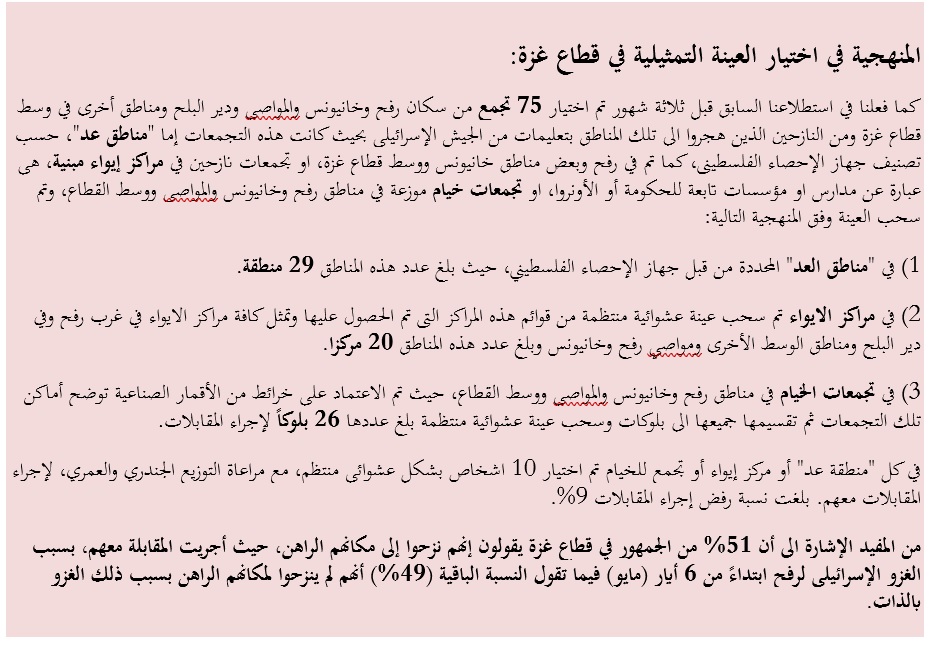 |
كما في استطلاعينا السابقين قبل ثلاثة وستة أشهر، دارت معظم أسئلة الربع الثاني من عام 2024 حول هجوم السابع من أكتوبر وما تبعه من حرب واجتياح إسرائيلي بري لقطاع غزة، وحول المعاناة الإنسانية غير المسبوقة لسكان القطاع، وحول فظائع الحرب، والنقاش حول مستقبل القطاع بعد الحرب، وحول إمكانية اجتياح كامل لرفح وتداعيات ذلك، وحول قرار المدعي العام لمحكمة الجنايات الدولية بطلب محاكمة قادة من إسرائيل وحماس، وحول مواقف الأطراف المختلفة ذات العلاقة بتلك الحرب. من الضروري الإشارة إلى أن العينة في كافة الاستطلاعات الثلاثة لا تشمل سكان شمال قطاع غزة الذين بقوا في بيوتهم منذ بدء الحرب لعدم قدرة باحثينا على الوصول لهم وعدم وجود بيانات موثوقة حول أعداد وأماكن تواجدهم في تلك المنطقة. كما أن من الضروري الإشارة إلى أن بيانات الاستطلاع الراهن والذي سبقه مباشرة قد تم جمعها في ظل استمرار القتال في قطاع غزة بينما تم جمع بيانات الاستطلاع الأول أثناء إطلاق إسرائيل سراح لسجناء من الضفة الغربية كجزء من اتفاق وقف إطلاق النار بين حماس وإسرائيل. وبخلاف وقف إطلاق النار، لم يكن هناك تطور مماثل يحدث في قطاع غزة في ذلك الوقت، أي نهاية شهر تشرين ثاني (نوفمبر) 2023. يغطي الاستطلاع الراهن، كما فعلنا في الاستطلاعين السابقين تبعات الحرب على توازن القوى الداخلي والتأييد للقيادة الفلسطينية، وعلى العلاقات الفلسطينية-الإسرائيلية والعملية السياسية.
تشير النتائج إلى أن حوالي 80% من سكان قطاع غزة قد فقدوا قريباً لهم أو أصيب لهم قريبٌ لهم في الحرب الراهنة. مع ذلك يؤيد ثلثا الجمهور الفلسطيني هجوم السابع من أكتوبر وحوالي 80% يعتقدون أنه قد وضع القضية الفلسطينية في بؤرة الاهتمام العالمي. بالرغم من أن أغلبية ساحقة لا تعتقد أن قرارات المحكمة الجنائية، لو صدرت، ستؤدي لاعتقال قادة في إسرائيل أو من حركة حماس، فإن الأغلبية تعتقد أنها قد تسهم في التعجيل بإنهاء الحرب. كما تشير النتائج إلى أن ثلثي الجمهور يتوقعون انتصار حماس في الحرب على غزة لكن هذه النسبة تهبط لحوالي النصف فقط في قطاع غزة. كما أن نصف سكان قطاع غزة فقط يتوقعون عودة حماس للسيطرة على القطاع بعد الحرب. وبينما يؤيد الجمهور نص بيان القمة العربية في المنامة فإن الغالبية العظمى لا توافق على تصريحات الرئيس عباس في تلك القمة. وتزداد المطالبة باستقالة الرئيس عباس بينما تزداد شعبية حماس ومروان البرغوثي. كما تشير النتائج لهبوط كبير في تأييد حل لدولتين في قطاع غزة رغم أن حوالي نصف الجمهور يعتقدون أن الأولوية يجب أن تكون لإنهاء الاحتلال وإقامة دولة فلسطينية مستقلة. في المقابل يرتفع التأييد للعمل المسلح ويؤيد أكثر من 60% حل السلطة الفلسطينية.
الظروف الإنسانية: نبدأ بالظروف الإنسانية والمعيشية في وسط وجنوب قطاع غزة. طرأ ارتفاع طفيف على نسبة من فقدوا أقرباء في هذه الحرب لتفوق 60٪ وتشير النتائج كما في الاستطلاع السابق إلى أن حوالي 80٪ من سكان غزة يقولون بأن واحدا على الأقل من أفراد أسرهم قد قتل أو أصيب. لكن الاستطلاع يظهر تحسنا في بعض المؤشرات التي تم رصدها مثل إمكانية العثور على الطعام، لكن الغالبية الساحقة لا تزال تقول إنها تستطيع الوصول لأماكن يوجد فيها الغذاء أو الماء فقط بصعوبة أو مخاطرة كبيرة وأن الملاجئ التي يعيشون فيها الآن تفتقر إلى معظم احتياجاتهم الأساسية. تقول نسبة من سكان قطاع غزة تبلغ 30٪ أن الرصيف البحري الذي أنشأه الجيش الأمريكي على ساحل شمال غزة يسهم في التخفيف من معاناة السكان من خلال إيصال المساعدات الإنسانية فيمل تقول الأغلبية أنه لا يسهم بذلك. تجدر الإشارة أيضا إلى أن هناك شكاوى كبيرة من التمييز لأسباب سياسية في توزيع المعونة الإنسانية، وأن هذه النسبة ازدادت لتبلغ الثلاثة أرباع في هذا الاستطلاع. ما يقرب من الثلثين يلومون إسرائيل على معاناتهم، ومعظم الآخرين يلومون الولايات المتحدة. وضع اللوم على حماس في قطاع غزة لا يتعدى 8٪ فقط.
التأييد لهجوم السابع من أكتوبر: في حين أن التأييد الإجمالي لهجوم حماس في 7 تشرين الأول/أكتوبر لا يزال مرتفعا، فإنه شهد انخفاضا قدره أربع نقاط مئوية مقارنة بالاستطلاع السابق، حيث يبلغ اليوم الثلثين. جاء الانخفاض في هذه النسبة من قطاع غزة، الذي شهد انخفاضا قدره 14 نقطة مئوية. من الضروري الإشارة إلى أن تأييد هذا الهجوم، كما سنرى لاحقا، لا يعني بالضرورة تأييدا لحماس ولا يعني تأييدا لأية أعمال قتل أو فظائع ارتُكبت ضد المدنيين. بل يأتي التأييد من دافع آخر: تظهر النتائج أن أكثر من 80٪ من الفلسطينيين يعتقدون أن الهجوم قد وضع القضية الفلسطينية في بؤرة الاهتمام وقضى على سنوات من الإهمال لها على المستويين الإقليمي والدولي.
جرائم الحرب: كما وجدنا في الاستطلاعين السابقين، قبل ثلاثة وستة أشهر، يعتقد جميع الفلسطينيين تقريبا أن إسرائيل ترتكب اليوم جرائم حرب فيما يعتقد جميعهم تقريبا أن حماس لا ترتكب جرائم حرب. كما أن أكثر من 90٪ يعتقدون أن حماس لم ترتكب في السابع من أكتوبر أي فظائع ضد المدنيين الإسرائيليين. واحد فقط من كل عشرة فلسطينيين شاهد مقاطع فيديوهات تظهر فظائع ارتكبتها حماس. تظهر النتائج أن أولئك الذين شاهدوا مقاطع الفيديو هم أكثر عرضة بنحو خمسة عشر مرة، ممن لم يشاهدوا هذه الفيديوهات، للاعتقاد أن رجال حماس ارتكبوا فظائع في 7 أكتوبر/تشرين الأول. من المفيد في هذا السياق الإشارة إلى أن الجزيرة هي المحطة الإخبارية التلفزيونية الأكثر مشاهدة في فلسطين حيث اختارها حوالي 70٪ كأكثر محطة مشاهدة خلال الشهرين الماضيين. سكان الضفة الغربية أكثر ميلا من سكان القطاع، بسبب ظروف الحرب الراهنة، لمشاهدة قناة الجزيرة حيث تقول نسبة من 83٪ من سكان الضفة أنها قناتهم المفضلة.
محكمة العدل الدولية والهجوم على رفح: توقع ثلاثة أرباع الجمهور الفلسطيني أن تفشل محكمة العدل الدولية في وقف الهجوم الإسرائيلي على رفح لأن الولايات المتحدة بنظرهم ستحمي إسرائيل من قرارات تلك المحكمة. ترتفع نسبة من يعتقدون من بين سكان قطاع غزة أن اجتياحا بريا إسرائيليا لكامل مدينة رفح سيؤدي إلى اندفاع جماعي للناس والنازحين تجاه الحدود مع مصر ليبلغ اليوم حوالي الثلث بزيادة قدرها 6 درجات مئوية مقارنة بالوضع قبل ثلاثة أشهر. من الجدير ذكره أن الدبابات الإسرائيلية كانت قد دخلت المنطقة الغربية من رفح واحتلت المعبر وكريدور صلاح الدين او فيلادلفيا الفاصل بين رفح ومصر قبل البدء بجمع البيانات لهذا الاستطلاع.
محكمة الجنايات الدولية: على ضوء قرار مدعي عام محكمة الجنايات الدولية الطلب من المحكمة إصدار أوامر اعتقال بحق رئيس الوزراء ووزير الدفاع الإسرائيليين وثلاثة من قادة حماس، تعتقد الغالبية العظمى (71%) أنه لن يتم فعلاً اعتقال ومحاكمة الإسرائيليين الاثنين. مع ذلك، فإن نسبة تقل قليلا عن النصف تعتقد أن إصدار أمر من المحكمة باعتقال نتنياهو وغالانت قد يسهم في إنهاء الحرب على قطاع غزة. كما تعتقد نسبة متطابقة أنه لن يتم فعلاً اعتقال ومحاكمة قادة حماس حتى لو صدر قرار بذلك من محكمة الجنايات. ترى الأغلبية في الضفة الغربية وثلت سكان قطاع غزة أن قرار المحكمة ضد قادة حماس سيزيد من شعبية الحركة.
وقف إطلاق النار ومن سيخرج منتصراً: قالت نسبة بلغت الثلثين أنها تؤيد قرار حماس الذي أعلنته قبل احتلال إسرائيل لمعبر رفح بالموافقة على مقترح وقف إطلاق النار الذي قدمته لها مصر. وتوقعت الأغلبية أن تتوصل حماس وإسرائيل لوقف لإطلاق النار في الأيام القليلة المقبلة. كما فعلنا في الاستطلاعين السابقين، سألنا في الاستطلاع الحالي عن الطرف الذي سيخرج منتصرا في هذه الحرب فقالت أغلبية تبلغ الثلثين أنها تتوقع فوز حماس، ويشكل هذا ارتفاعا في هذه النسبة يبلغ 4 نقاط مئوية مقارنة باستطلاعنا السابق قبل ثلاثة أشهر. من الجدير بالذكر أن عددا أقل من سكان قطاع غزة، بلغت نسبته 48٪ فقط، يتوقعون اليوم فوز حماس، وفي ذلك انخفاض قدره 8 نقاط مئوية مقارنة بالنتائج قبل ثلاثة أشهر. من الجدير بالذكر أيضا أنه في حين لا يتوقع أحد تقريبا في الضفة الغربية أن تفوز إسرائيل بالحرب الحالية، فإن ربع سكان غزة يتوقعون أن تنتصر إسرائيل.
من سيحكم قطاع غزة بعد الحرب: على عكس الاستطلاع السابق، تقول اليوم نسبة أكبر من سكان الضفة الغربية، مقارنة بالوضع قبل ثلاثة أشهر، أن قطاع غزة سيبقى تحت سيطرة حماس، فيما يعتقد المزيد من سكان غزة الآن أن حماس لن تكون هي القوة الحاكمة في المستقبل. وفي سؤال مشابه تضمن تكهنات أو تقديرات تتعلق بالسيناريو الأكثر ترجيحا لليوم التالي للحرب، جاءت النتائج متقاربة مع السؤال الأول حيث قالت نسبة من سكان قطاع غزة بلغت النصف أن حماس ستعود للسيطرة على قطاع غزة. سألنا عن رأي الجمهور وموقفه من هذه السيناريوهات. قالت نسبة من سكان قطاع غزة فاقت النصف بقليل أنها تفضل عودة حماس مقابل حوالي الثلثين في الضفة الغربية. قال أكثر من ربع سكان قطاع غزة أنهم يفضلون قيام سلطة فلسطينية جديدة برئيس وبرلمان وحكومة منتخبين، وهو خيار لم يكن متاحا في استطلاعنا السابق.
نشر قوة أمن عربية في قطاع غزة: كنا قد سألنا في كانون أول (ديسمبر) عن موقف الجمهور من نشر قوة أمنية عربية من مصر والأردن في قطاع غزة. وجدنا في ذلك الوقت معارضة واسعة بلغت 70٪ للفكرة حتى لو تم نشر هذه القوات لمساعدة قوات الأمن الفلسطينية. ترتفع في هذا الاستطلاع نسبة المعارضة لوجود قوة أمنية كهذه لتبلغ 75٪.
القمة العربية في المنامة وتصريحات الرئيس عباس فيها: سألنا الجمهور عن مدى رضاه على بيان القمة العربية الأخيرة في المنامة الذي طالب بوقف فوري لإطلاق النار في قطاع غزة وانسحاب إسرائيل من القطاع وعقد مؤتمر دولي للسلام. انقسم الجمهور لقسمين متساويين تماماً من حيث الرضا أو عدم الرضا. ولكن عند السؤال عن موافقتهم أو عدم موافقتهم على تصرح الرئيس عباس في مؤتمر القمة العربي في المنامة بأن "هجوم حماس في السابع من أكتوبر قد وفر لإسرائيل المزيد من الذرائع والمبررات لكي تهاجم قطاع غزة." قالت نسبة تزيد عن ثلاثة أرباع الجمهور أنها لا توافق على ذلك. وقالت نسبة أكبر، بلغت حوالي 80٪ أنها لا توافق على تصريح الرئيس عباس في المؤتمر ذاته بأن "موقف حماس الرافض لإنهاء الانقسام وقبول الشرعية الدولية خدم المخطط الإسرائيلي في تكريس فصل قطاع غزة عن الضفة الغربية."
الرضا عن الأطراف ذات العلاقة بالحرب على غزة: كما فعلنا في الاستطلاعين السابقين، سألنا في الاستطلاع الحالي عن رضا الجمهور عن الدور الذي لعبته خلال الحرب جهات فلسطينية وعربية/إقليمية ودولية. تظهر النتائج مستويات مشابهة للاستطلاعين السابقين باستثناء حصول ارتفاع كبير في مستوى الرضا عن إيران.
 | تبقى نسبة الرضا عن حماس ويحيى السنوار عالية جدا. وعلى النقيض من ذلك، يستمر التراجع في مستوى الرضا عن حركة فتح والرئيس عباس. كما تشير إلى أن الجمهور غير راغب في إعطاء رئيس الوزراء الجديد فرصة لتحسين أداء الحكومة، ربما لقربه من الرئيس عباس أو لعدم معرفة الجمهور به. |
| وعلى المستوى الإقليمي، ذهبت أعلى نسبة رضا إلى اليمن ثم حزب الله ثم قطر ثم إيران وتأتي الأردن ومصر بعد هؤلاء بكثير وبنسب منخفضة. يبدو ملموسا في هذا الاستطلاع الارتفاع في نسبة الرضا عن إيران، بمقدار 19 نقطة مئوية إضافية، ومن المؤكد أن السبب في ذلك يعود للهجوم الصاروخي الإيراني المباشر على إسرائيل في نيسان (إبريل). لكن رغم هذا الارتفاع الكبير في نسبة الرضا عن دور إيران في الحرب فإن من الغريب أن أغلبية الفلسطينيين ترى في ذلك الهجوم استعراضاً أو مسرحية. من المفيد هنا رؤية الانقسام بين الضفة الغربية وقطاع غزة حول ذلك، حيث تقول أغلبية من سكان قطاع غزة مقابل الثلث فقط في الضفة الغربية أنه كان تأييداً للشعب الفلسطيني وليس مسرحية. |
| أما بالنسبة للجهات الدولية غير الإقليمية فقد حصلت روسيا على أعلى نسبة رضا، أكثر قليلا من الربع، تتبعها الأمم المتحدة، وألمانيا، والولايات المتحدة. |
| في سياق رؤية الجمهور للتطورات الدولية التي أطلقتها الحرب على غزة يظهر الجمهور الفلسطيني تفاؤلاً بقدرة الاحتجاجات الطلابية في الجامعات الأمريكية على إحداث تغيير في سياسية الولايات المتحدة لتصبح أكثر تأييداً للطرف الفلسطيني أو أقل تأييداً للطرف الإسرائيلي حيث تعتقد بذلك نسبة كبيرة تبلغ حوالي 70٪. |
التأييد للقوى السياسية الفلسطينية: عند السؤال عن الحزب السياسي أو الاتجاه السياسي الذي يؤيدونه قالت النسبة الأكبر (40٪) أنها تفضل حماس، تتبعها فتح (20٪)، فيما اختارت نسبة من 7٪ قوى ثالثة، وقالت نسبة من 33٪ أنها لا تؤيد أيا منها أو لا تعرف. تعني هذه النتائج أن التأييد لحماس خلال الأشهر الثلاثة الماضية قد شهد ارتفاعا بمقدار 6 نقاط مئوية في حين ارتفع التأييد لفتح 3 نقاط مئوية خلال نفس الفترة. في السياق نفسه، تعتقد نسبة تزيد قليلا عن النصف أن حماس هي الأحق بتمثيل وقيادة الشعب الفلسطيني اليوم فيما تقول نسبة من 16٪ فقط أن فتح بقيادة الرئيس عباس هي الأحق.
التأييد للقيادات الفلسطينية: أما على المستوى القيادي، فإن الاستطلاع الحالي يظهر استمرار صعود التأييد لمروان البرغوثي. في انتخابات رئاسية بين ثلاثة، الرئيس الحالي محمود عباس وزعيم حماس إسماعيل هنية ومروان البرغوثي، يفوز البرغوثي بأغلبية المشاركين في الانتخابات. وفي منافسة ثنائية بين البرغوثي وهنية، يفوز الأول بحوالي 60٪ من الناخبين المشاركين. في سؤال مفتوح، أي بدون خيارات محددة مسبقا، طلبنا من الجمهور ذكر اسم مرشحه المفضل ليكون رئيسا للسلطة الفلسطينية بعد عباس. جاء ذكر اسم مروان البرغوثي أولا، حيث ذكره 29٪ من الجمهور، يتبعه إسماعيل هنية (14٪)، ثم محمد دحلان (8٪)، ثم يحيى السنوار (7٪)، ثم مصطفى البرغوثي (2٪).
المطالبة باستقالة الرئيس عباس: نسبة الرضا عن أداء الرئيس عباس تبلغ 12٪ ونسبة عدم الرضا 85٪. وتقول نسبة من حوالي 90 % أنها تريد استقالة الرئيس. تبلغ نسبة المطالبة باستقالة الرئيس اليوم 94٪ في الضفة الغربية و83٪ في قطاع غزة.
حكومة محمد مصطفى: الغالبية العظمى (72%) تعتقد أن الحكومة الفلسطينية الجديدة التي عينها الرئيس محمود عباس وتشكلت في آذار (مارس) لن تنجح في القيام بإصلاحات لم تكن الحكومة السابقة برئاسة محمد اشتيه قادرة على القيام بها. في كافة هذه البنود التي سألنا عنها وجدنا إن سكان قطاع غزة أكثر تفاؤلاً من سكان الضفة الغربية فيما يتعلق بقدرة الحكومة الجديدة على النجاح، لكن الغالبية هناك أيضاً لا تعتقد أن الحكومة ستنجح في أي من الإصلاحات التي تحدثت عنها.
ماذا يريد الجمهور من قيادة السلطة الفلسطينية: سألنا الجمهور للمرة الثانية عن التدابير السياسية التي ينبغي على قيادة السلطة الفلسطينية اتخاذها اليوم للمساعدة في معالجة آثار الحرب الحالية في قطاع غزة، وطرحنا على الجمهور ثلاثة خيارات: المصالحة، وتشكيل حكومة وحدة وطنية، وتقديم الخدمات الإنسانية. ارتفعت في الاستطلاع الراهن النسبة التي اختارت تحقيق مصالحة فورية وتوحيد للضفة والقطاع لتصل اليوم لأكثر من النصف. ثم جاء ثانيا تشكيل حكومة وحدة وطنية للتفاوض مع إسرائيل والمجتمع الدولي لإنهاء الحرب وإعادة إعمار قطاع غزة في المستقبل، حيث اختارته نسبة بلغت الثلث. واختار الباقي أن تقوم السلطة الفلسطينية "بقيادة حملة لتقديم الخدمات الإنسانية لسكان غزة بالتعاون مع مصر والمجتمع الدولي".
التأييد لحل الدولتين: أما بالنسبة للعلاقات الفلسطينية-الإسرائيلية فإن النتائج تختلف بشكل ملفت عن نتائج الاستطلاع السابق الذي نشرناه قبل ثلاثة أشهر. يبلغ حجم التأييد لحل الدولتين الثلث فقط وتقول الأغلبية أنها تؤيد العمل المسلح. تجدر الإشارة في هذا الملخص إلى نتيجتين: على عكس الاستطلاع السابق انخفض في الاستطلاع الحالي تأييد حل الدولتين بشكل ملحوظ، وارتفع التأييد للكفاح المسلح. لكن الانخفاض في تأييد حل الدولتين جاء فقط من قطاع غزة، بانخفاض دراماتيكي قدره 30 نقطة مئوية. رغم ذلك، فإن نسبة تبلغ حوالي النصف في كل من قطاع غزة والضفة الغربية تعتقد أن الغاية العليا الأولى للشعب الفلسطيني ينبغي أن تكون تحقيق انسحاب إسرائيلي لحدود عام 1967 وإقامة دولة فلسطينية في الضفة والقطاع وعاصمتها القدس الشرقية.
التأييد للعمل المسلح مقابل المفاوضات: عند النظر في ثلاثة خيارات ممكنة أمام الفلسطينيين لكسر الجمود في العملية السياسية لإنهاء الاحتلال الإسرائيلي، تشير النتائج الحالية إلى ارتفاع قدره 8 نقاط مئوية في تأييد الكفاح المسلح لتقترب من حوالي الثلثين؛ وارتفاع قدره 4 نقاط مئوية في تأييد المقاومة السلمية لتبلغ حوالي النصف. أيد أكثر من 60٪ حل السلطة الفلسطينية، وأيدت نسبة فاقت الخمس التخلي عن حل الدولتين والمطالبة بدولة واحدة للفلسطينيين والإسرائيليين. عرضنا على الجمهور ثلاث طرق لإنهاء الاحتلال الإسرائيلي وإقامة الدولة الفلسطينية المستقلة وطلبنا منه اختيار أكثرها فاعلية: اختارت نسبة فاقت النصف بقليل "العمل المسلح"؛ واختار الربع المفاوضات. تشير هذه النتائج إلى ارتفاع قدره 8 نقاط مئوية في تأييد العمل المسلح مع بقاء نسبة دعم المفاوضات بدون تغيير. يأتي الارتفاع في تأييد الكفاح المسلح من قطاع غزة حيث ترتفع هذه النسبة بمقدار 17 درجة مئوية.
التطبيع السعودي-الإسرائيلي: وجد الاستطلاع معارضة كبيرة بلغت ثلاثة أرباع الجمهور لقيام تطبيع سعودي-إسرائيلي حتى لو كان ذلك مشروطاً بقبول إسرائيل بدولة فلسطينية واتخاذ خطوات ملموسة ولا تراجع عنها نحو ذلك الهدف.
سقوط حكومة نتنياهو: يبدي الجمهور الفلسطيني تفاؤلاً بإمكانية سقوط حكومة نتنياهو قريباً وإجراء انتخابات سريعة في إسرائيل، لكن حتى في حالة حصول ذلك وقيام حكومة إسرائيلية جديدة بدون نتنياهو فإن الأغلبية من لا تعتقد أن هذه الحكومة ستكون على استعداد للتفاوض مع الطرف الفلسطيني لإنهاء الاحتلال على أساس حل الدولتين.
الرد على هجمات المستوطنين: أخيرا، على ضوء الزيادة في الهجمات التي يشنها المستوطنون ضد البلدات والقرى الفلسطينية، سألنا سكان الضفة الغربية عن الوسائل الأكثر فاعلية، والأكثر واقعية في الوقت ذاته، في مكافحة هذا العنف: لحماية مناطقهم اختارت أقل من النصف بقليل "تشكيل مجموعات مسلحة من قبل سكان المناطق المستهدفة"، واختار أكثر من الربع بقليل "نشر قوات الشرطة الفلسطينية في المناطق المستهدفة"، وقالت نسبة من حوالي الخمس أنها مع المطالبة ب"اتخاذ الجيش الإسرائيلي إجراءات فاعلة لمنع إرهاب المستوطنين"، واختارت نسبة ضئيلة "تشكيل مجموعات غير مسلحة من قبل سكان المناطق المستهدفة". تظهر هذه النتائج ارتفاعا محدودا بلغ 4 نقاط مئوية في دعم تشكيل الجماعات المسلحة مقارنة بالنتائج التي تم الحصول عليها قبل ثلاثة أشهر.
النتائج الرئيسية: |
| 1) السابع من أكتوبر والحرب على غزة |
- ثلثا الجمهور يعتقدون أن قرار حماس بشن هجوم 7 تشرين أول (أكتوبر) كان صحيحا.، و82٪ يعتقدون أن هذا الهجوم قد أحيا الاهتمام الدولي بالصراع الفلسطيني-الإسرائيلي وأنه قد يؤدي إلى زيادة الاعتراف بالدولة الفلسطينية
- 61٪ من سكان غزة يقولون أن أحد أفراد أسرهم قد قتل خلال الحرب الحالية
- 63٪ يلومون إسرائيل على المعاناة الراهنة لسكان قطاع غزة و22٪ يضعون اللوم على الولايات المتحدة، و8٪ فقط يلومون حماس
- 91٪ يعتقدون أن حماس لم ترتكب فظائع في 7 تشرين الأول (أكتوبر) و90٪ يقولون أنهم لم يروا مقاطع فيديو تظهر أعمالا ارتكبتها حماس ضد مدنيين إسرائيليين، مثل قتل النساء والأطفال في بيوتهم
- 71٪ يعتقدون أن نتنياهو وجالانت لن يعتقلوا ويحاكموا فيما تعتقد نسبة من 26٪ عكس ذلك. نسبة متطابقة تعتقد أن زعيمي حماس هنية والسنوار لن يعتقلا أو يحاكما
- 68٪ يؤيدون قرار حماس الذي أعلنته في مطلع أيار (مايو) الماضي بقبول اقتراح وقف إطلاق النار
- 67٪ يتوقعون أن تكسب حماس الحرب لكن سكان القطاع أقل تفاؤلا حيث تقول نسبة من 48٪ فقط أن حماس ستنتصر
- 61٪ يقولون أنهم يفضلون سيطرة حماس على قطاع غزة بعد الحرب.
- 76٪ لا يوافقون على تصريح الرئيس عباس في القمة العربية في المنامة بأن "هجوم حماس في 7 تشرين الأول (أكتوبر) وفر لإسرائيل ذرائع ومبررات لمهاجمة غزة. قطاع؛" وتقول نسبة من 79٪ أنها لا توافق على تصريح الرئيس عباس في نفس المؤتمر بأن "موقف حماس الرافض للانقسام والقبول بالشرعية الدولية خدم الخطط الإسرائيلية في ترسيخ فصل قطاع غزة عن الضفة الغربية".
- بالنسبة لأولويات السلطة الفلسطينية: 51٪ يريدون من قيادة السلطة الفلسطينية تحقيق مصالحة وتوحيد فوري للضفة والقطاع، 33٪ يريدون تشكيل حكومة وحدة وطنية، و12٪ يريدون من السلطة قيادة حملة لتقديم الخدمات الإنسانية للشعب
- نسبة الرضا عن أداء حماس خلال الحرب تبلغ 75٪، وأداء يحيى السنوار 65٪، وفتح 24٪، والرئيس عباس 10٪، ورئيس الوزراء الجديد محمد مصطفى 9٪
- بالنسبة للأطراف العربية/الإقليمية أعلى نسبة رضا ذهبت لليمن (80٪)، وحزب الله (57٪)، وقطر (55٪)، وإيران (49٪)، والأردن (25٪)، ومصر (18٪)
- بالنسبة للجهات الدولية تبلغ نسبة الرضا عن روسيا 26٪، والأمم المتحدة 12٪، وألمانيا 6٪، والولايات المتحدة 3٪.
1. انخفاض طفيف في نسبة تأييد قرار حماس بشن هجوم السابع من تشرين أول (أكتوبر): |
للمرة الثالثة منذ السابع من أكتوبر، سألنا المشاركين في هذا الاستطلاع من سكان الضفة الغربية وقطاع غزة عن رأيهم في قرار حماس بشن هجوم 7 أكتوبر، هل كان صائبا أم غير صائب؟ قالت نسبة بلغت الثلثين، مقارنة ب 71٪ قبل ثلاثة شهور، في آذار/مارس 2024، و72٪ قبل ستة شهور، في كانون أول (ديسمبر) 2023، إنه كان قرارا صائبا. جاء الانخفاض في هذه النسبة من قطاع غزة حيث تبلغ اليوم 57٪ مقارنة مع 71% قبل ثلاثة أشهر و57% قبل ستة أشهر.تزداد نسبة الاعتقاد بأن قرار حركة حماس بشن هجوم السابع من أكتوبر كان صائبا بين مؤيدي حماس والقوى الثالثة والذين لا يؤيدوا أي من القوى السياسية المعروفة والذين يقولون إنهم لن يشاركوا في الانتخابات لو جرت اليوم (82% و70% و64% و62% على التوالي) مقارنة بمؤيدي فتح (48%).

رغم الانخفاض بأربع نقاط مئوية في النظر بإيجابية لقرار الهجوم في السابع من أكتوبر فإن نسبة الاعتقاد بأن الحرب على غزة منذ 7 تشرين الأول (أكتوبر) قد "أحيت الاهتمام الدولي بالصراع الإسرائيلي-الفلسطيني وأنها قد تؤدي إلى زيادة الاعتراف بالدولة الفلسطينية" قد ارتفعت بمقدار ست نقاط مئوية لتبلغ 82٪ فيما قالت نسبة من 18٪ فقط أنها لا تعتقد ذلك.
2. المعاناة الإنسانية والظروف المعيشية في قطاع غزة: |
64٪ من سكان قطاع غزة يقولون إن لديهم ما يكفي من الطعام ليوم أو يومين 36٪ يقولون لا يوجد لديهم ما يكفي من الطعام ليوم أو يومين. تظهر هذه النتائج تحسنا ملموسا مقارنة بالنتائج التي حصلنا عليها قبل ثلاثة أشهر عندما قالت نسبة من 44٪ فقط إن لديهم ما يكفي من الطعام ليوم أو يومين. من الضروري التذكير بأن جمع البيانات لم يشمل منطقة شمال قطاع غزة المحاصرة، وهي المنطقة التي تشهد مجاعة متزايدة حسب التقارير الدولية.
عندما يحتاجون إلى الغذاء أو الماء، فإن 26٪ فقط من سكان قطاع غزة يقولون إنهم يستطيعون الوصول إلى مكان يمكنهم فيه الحصول على المساعدة. وتقول نسبة من 72٪ أنها تستطيع ذلك ولكن بصعوبة أو مخاطرة كبيرة، وتقول نسبة من 2٪ أنها لا تستطيع ذلك. تعكس هذه النتائج تحسنا طفيفا مقارنة بالوضع قبل ثلاثة أشهر.
61٪ من سكان قطاع غزة يقولون إن فردا أو أكثر من عائلتهم قد قُتل خلال الحرب الحالية، وفي سؤال منفصل تقول نسبة من 65٪ أن فردا أو أكثر من عائلتهم قد أُصيب خلال هذه الحرب. عند الجمع بين إجابات السؤالين وحذف الإجابات المشتركة، تظهر النتائج أن 78٪ قد قتل أو أصيب واحد أو أكثر من أفراد عائلتهم، وأن 22٪ فقط لم يُقتل أو يُصاب أحد من أفراد عائلتهم. قبل ثلاثة أشهر قالت نسبة من 60٪ من سكان قطاع غزة أن فردا أو أكثر من عائلتهم قد قُتل في الحرب وبلغت نسبة من قتل أو أُصيب خلال الحرب الراهنة 78٪.

سألنا سكان قطاع غزة عن توفر الاحتياجات الأساسية: الماء والغذاء والكهرباء والخيام والأغطية والملابس والرعاية الطبية والمراحيض. تراوحت نسبة الذين قالوا "نعم، متاحة" بين 26٪ للخيام 44٪ للطعام. لكن نسبة أكبر قالت إنه يمكن الحصول عليها أو الوصول إلى هذه الاحتياجات ولكن بصعوبة ومخاطر كبيرة. كان هذا هو الحال بشكل خاص بالنسبة للرعاية الطبية والخيام والغذاء والماء والكهرباء. تظهر النتائج أن الاحتياجات التي تبدو غير متوفرة بشكل كبير بالنسبة لمعظم سكان قطاع غزة هي الخيام والملابس والأغطية والعناية الطبية والكهرباء لشحن التليفونات. تشكل هذه النتائج تحسنا في معظم هذه المؤشرات

سألنا النازحين في الملاجئ أو مراكز الإيواء عن هوية الجهة المنظمة أو المسؤولة عن الملجأ. قالت غالبية النازحين (53٪) إنها الأونروا، وقالت نسبة من 17٪ أنها جهة حكومية، وقالت نسبة من 15٪ أنها مجموعة فلسطينية محلية، وقالت نسبة من 11٪ أنها منظمات دولية أخرى. تشير هذه النتائج لانخفاض بمقدار تسعة نقاط مئوية في نسبة الملاجئ التي تشرف عليها الأونروا وارتفاع في النسب الأخرى، ويشير هذا لحقيقة أن عدد مراكز الإيواء، كالمدارس، قد انخفض فيما ارتفع عدد تجمعات الخيم بسبب النزوح الأخير من رفح لمنطقة المواصي.
طلبنا من المستجيبين، بناء على تجربتهم الشخصية، تقييم مدى عدالة توزيع المساعدات على النازحين المقيمين حاليا في الملاجئ. قالت الغالبية العظمى (76٪) أنه يوجد تمييز في التوزيع بناءً على اعتبارات سياسية فيما قالت نسبة من 24٪ فقط أن التوزيع عادل. قبل ثلاثة أشهر قالت نسبة من 70٪ أنه يوجد تمييز.
سألنا الجمهور عن رأيه في دور الرصيف البحري الذي أنشأه الجيش الأمريكي على ساحل شمال غزة في إيصال المساعدات الإنسانية. قالت أغلبية من 78٪ أن هذا المشروع لا يساهم في التخفيف من معاناة السكان فيما قالت نسبة من 22٪ أنه يساهم في ذلك. تقول نسبة من سكان قطاع غزة تبلغ ضعف سكان الضفة الغربية تقريبا أن الرصيف الأمريكي يسهم في التخفيف من معاناة السكان، 30٪ و16 ٪ على التوالي.
أغلبية من 63٪ (مقارنة مع 64٪ قبل ثلاثة أشهر) تلوم إسرائيل على معاناة سكان قطاع غزة الراهنة فيما تقول نسبة من 22٪ (مقارنة مع 20٪ قبل ثلاثة أشهر) أنها تلوم الولايات المتحدة؛ 8٪ فقط (مقارنة مع 7٪ قبل ثلاثة أشهر) يضعون اللوم على حماس؛ و4٪ فقط (مقارنة مع 6٪ قبل ثلاثة أشهر) يلومون السلطة الفلسطينية. من الجدير بالذكر أن نسبة سكان قطاع غزة الذين يلومون حماس قد بلغت 10٪ في الاستطلاع الحالي مقارنة مع 9٪ قبل ثلاثة أشهر.
3. جرائم وفظائع الحرب: |
كما وجدنا في الاستطلاعين السابقين، قبل ثلاثة وستة أشهر، فإن جميع الفلسطينيين تقريبا (97٪) يعتقدون أن إسرائيل ارتكبت جرائم حرب خلال الحرب الراهنة. في المقابل فإن 9٪ فقط (مقارنة مع 5٪ قبل ثلاثة أشهر) يعتقدون أن حماس ارتكبت جرائم كهذه. 2٪ يعتقدون أن إسرائيل لم ترتكب جرائم كهذه 88٪ يعتقدون أن حماس لم ترتكب جرائم حرب خلال الحرب الراهنة.
90٪ (مقارنة مع 80٪ قبل ثلاثة أشهر) يقولون أنهم لم يروا مقاطع فيديو عرضتها وسائل إعلام دولية تظهر أفعالا أو فظائع ارتكبها أفراد من حماس ضد مدنيين إسرائيليين، مثل قتل النساء والأطفال في منازلهم. 9٪ فقط (6٪ في الضفة الغربية و13٪ في قطاع غزة) شاهدوا هذه المقاطع.
عند السؤال عما إذا كانت حماس قد ارتكبت هذه الفظائع التي تظهر في مقاطع الفيديو، قالت الغالبية العظمى (91٪) إنها لم ترتكبها، وقالت نسبة من 7٪ فقط أنها ارتكبتها. كما هو مبين في الشكل أدناه، ترتفع نسبة الاعتقاد بأن مقاتلي حماس قد ارتكبوا فظائع ضد المدنيين بين الذين شاهدوا مقاطع فيديو تظهر فظائع كهذه (44٪) مقارنة بالذين لم يشاهدوها (3٪).

4. الهجوم على رفح والتداعيات المحتملة لذلك: |
ثلاثة أرباع الجمهور الفلسطيني توقعوا أن تفشل محكمة العدل الدولية في وقف الهجوم الإسرائيلي على رفح لأن الولايات المتحدة ستحمي إسرائيل من قرارات المحكمة فيما قالت نسبة من 20% فقط أن المحكمة ستنجح في إجبار إسرائيل على وقف هجومها على رفح.
طلبنا من الجمهور التكهن بالسلوك المحتمل لسكان رفح والنازحين في حالة حدوث غزو بري إسرائيلي بالدبابات لتلك المدينة: هل سيسارع هؤلاء الأشخاص في هذه الحالة إلى بر الأمان في الجانب المصري؟ 31٪ من سكان غزة و 38٪ من سكان الضفة الغربية يقولون إن السكان والنازحين سيهرعون في تلك الحالة نحو الحدود ويعبرون إلى بر الأمان في مصر. في المجمل، قالت نسبة من 35٪، مقارنة ب 40٪ قبل ثلاثة أشهر، أنها تعتقد أنها ستفعل ذلك وقالت نسبة من 62٪ أنها تعتقد أنها لن تفعل ذلك. من الجدير ذكره أن الدبابات الإسرائيلية كانت قد دخلت المنطقة الشرقية من رفح واحتلت المعبر وكريدور صلاح الدين او فيلادلفيا الفاصل بين رفح ومصر قبل البدء بجمع البيانات لهذا الاستطلاع.
| 5. محكمة الجنايات الدولية: |
على ضوء قرار مدعي عام محكمة الجنايات الدولية الطلب من المحكمة إصدار أوامر اعتقال بحق رئيس الوزراء ووزير الدفاع الإسرائيليين تعتقد الغالبية العظمى (71%) أنه لن يتم فعلاً اعتقال ومحاكمة الاثنين، نتنياهو وغالانت، فيما تعتقد عكس ذلك نسبة من 26%.
مع ذلك، فإن نسبة من 45% تعتقد أن إصدار أمر من المحكمة باعتقال نتنياهو وغالانت قد يسهم في إنهاء الحرب على قطاع غزة فيما تقول نسبة من 52% أن ذلك الأمر لن يسهم في إنهاء الحرب.
كما تعتقد نسبة متطابقة (71%) أنه لن يتم فعلاً اعتقال ومحاكمة رئيس حركة حماس إسماعيل هنية ورئيس حركة حماس في قطاع غزة يحيى السنوار حتى لو صدر قرار بذلك من محكمة الجنايات بناءً على الطلب الذي قدمه لها المدعي العام لتلك المحكمة. في المقابل تقول نسبة من 23% أنه سيتم اعتقالهما في حال صدر القرار.
سألنا عن تأثير إصدار قرار محكمة الجنايات الدولية باعتقال ومحاكمة هنية والسنوار على مستوى التأييد الشعبي لحماس في الأراضي الفلسطينية. يقول نصف مجمل الفلسطينيين (59% في الضفة الغربية و34% في قطاع غزة) أن ذلك سيزيد من شعبية الحركة فيما تقول نسبة من 15% أنه سيضعفها وتقول نسبة من 33% أنه لن يكون له تأثير على شعبية الحركة.

6. التوقعات حول وقف إطلاق النار توقف الحرب ومن سيخرج منتصراً: |
قالت نسبة من 68% أنها تؤيد قرار حماس الذي أعلنته قبل احتلال إسرائيل لمعبر رفح بالموافقة على مقترح وقف إطلاق النار الذي قدمته لها مصر فيما قالت نسبة من 26% (33% في قطاع غزة و22% في الضفة الغربية) أنها تعارض ذلك القرار. وتوقعت أغلبية من 58% أن تتوصل حماس وإسرائيل لوقف لإطلاق النار في الأيام القليلة المقبلة فيما قالت نسبة من 39% أنه لا تتوقع ذلك.
كما فعلنا في كانون أول (ديسمبر) 2023، سألنا في الاستطلاع الحالي عن الطرف الذي سيخرج منتصرا في هذه الحرب. تتوقع أغلبية من 67٪ فوز حماس، مقارنة بنسبة بلغت 64٪ قبل ثلاثة أشهر و70٪ قبل ستة أشهر. من الجدير بالذكر، كما يظهر في الشكل أدناه، أن عددا أقل من سكان قطاع غزة، بلغت نسبته 48٪ فقط، يتوقعون اليوم فوز حماس مقارنة بالنتائج قبل ثلاثة وستة أشهر، عندما بلغت تلك النسبة 56٪ و50٪ على التوالي. في المقابل، فإن نسبة أكبر من سكان الضفة الغربية يتوقعون اليوم فوز حماس مقارنة بالاستطلاع السابق (79٪ و69٪ على التوالي). من الجدير بالذكر أيضا أنه في حين لا يتوقع أحد تقريبا في الضفة الغربية أن تفوز إسرائيل بالحرب الحالية، فإن ربع سكان غزة يتوقعون أن تنتصر إسرائيل.

7. من سيحكم قطاع غزة بعد توقف الحرب: |
طلبنا من المستطلعين التكهن بالطرف الذي سيسيطر على قطاع غزة في اليوم التالي لانتهاء الحرب الحالية. تقول أغلبية من 56٪ أن ذلك الطرف سيكون حماس. لكن على عكس الاستطلاع السابق تظهر في هذا الاستطلاع الراهن فروقات بارزة بين سكان الضفة وقطاع غزة، حيث تقول نسبة من 46٪ فقط من سكان قطاع غزة أن حماس ستسيطر فعلا على تلك المنطقة مقابل نسبة أعلى تبلغ 62٪ في الضفة الغربية، وكانت هذه النسبة تبلغ 59٪ في كل من المنطقتين قبل ثلاثة أشهر. يمثل الرقم الإجمالي الحالي انخفاضا بمقدار 3 نقاط مئوية مقارنة بالنتائج التي حصلنا عليها قبل ثلاثة أشهر. تعتقد نسبة من 4٪ فقط أن الجيش الإسرائيلي سيكون هو المسيطر على القطاع. وتظن نسبة من 11٪ أن سلطة فلسطينية جديدة برئيس وبرلمان وحكومة منتخبين هي الجهة المسيطرة فيما تقول نسبة من 6٪ أن السلطة الفلسطينية الراهنة برئاسة الرئيس عباس ستكون المسيطرة، وتقول نسبة من 7٪ أن السلطة الفلسطينية الراهنة ولكن بدون الرئيس عباس ستكون المسيطرة، واختارت نسبة من 2٪ دولة عربية واحدة أو أكثر، واختارت نسبة من 2٪ الأمم المتحدة.
أما عند السؤال عن الطرف الذي يفضل الجمهور أن يسيطر على قطاع غزة بعد الحرب، فقالت نسبة من 61٪ (71٪ في الضفة و46٪ في القطاع) أنه حماس، واختارت نسبة من 16٪ سلطة فلسطينية جديدة برئيس وبرلمان وحكومة منتخبين، واختارت نسبة من 6٪ السلطة الفلسطينية الراهنة بدون الرئيس عباس، واختارت نسبة من 6٪ أيضا عودة السلطة الفلسطينية تحت سيطرة الرئيس عباس، واختارت نسبة من 2٪ الأمم المتحدة، واختارت نسبة من 1٪ دولة عربية أو أكثر، واختارت نسبة من 1٪ الجيش الإسرائيلي. قبل ثلاثة أشهر، طرحنا سؤالا متطابقا، ولكن مع مجموعة خيارات مختلفة قليلا. في ذلك الوقت اختارت نسبة من 59٪ (64٪ في الضفة الغربية 52٪ في القطاع) عودة حماس للسيطرة على قطاع غزة بعد الحرب. تزداد نسبة تفضيل بقاء حماس مسيطرة على قطاع غزة بعد الحرب بين الأقل تعليماً (64%) مقارنة بالأكثر تعليماً (56%)، بين مؤيدي حماس ومؤيدي القوى الثالثة والذين لا يؤيدوا أي من القوى السياسية المعروفة والذين يقولون بأنهم لن يشاركوا في الانتخابات لو جرت اليوم (76%، 61% و59% و50% على التوالي) مقارنة بمؤيدي فتح (44%).

وفي سؤال مشابه تضمن تكهنات أو تقديرات تتعلق بالسيناريو الأكثر ترجيحا لليوم التالي للحرب، جاءت النتائج متطابقة تقريبا مع السؤال الذي طرح أعلاه حيث قالت نسبة من 57٪ (62٪ في الضفة الغربية و51٪ في قطاع غزة) أن حماس ستعود للسيطرة على قطاع غزة. توقعت نسبة من 21٪ قيام سلطة فلسطينية جديدة برئيس وبرلمان وحكومة منتخبين، وتوقعت نسبة من 6٪ عودة السلطة الفلسطينية بقيادة عباس، وتوقعت نسبة من 2٪ أن تقوم إسرائيل بتشكيل سلطات محلية، وتوقعت نسبة من 2٪ أن يتولى الجيش الإسرائيلي السيطرة، وتوقعت نسبة من 2٪ سيطرة العشائر والعائلات، وتوقعت نسبة من 1٪ تشكل مجموعات مسلحة متعددة.
هنا أيضا سألنا عن رأي الجمهور وموقفه من هذه السيناريوهات. تصل نسبة تفضيل عودة حماس إلى 59٪ (64٪ في الضفة الغربية و52٪ في قطاع غزة). أما التأييد لسيطرة سلطة فلسطينية جديدة برئيس وبرلمان وحكومة منتخبين فبلغت 25٪، وأيدت نسبة من 6٪ عودة السلطة الفلسطينية برئاسة عباس.

سألنا في كانون أول (ديسمبر) عن موقف الجمهور من نشر قوة أمنية عربية من مصر والأردن في قطاع غزة. وجدنا في ذلك الوقت معارضة واسعة بلغت 70٪ للفكرة حتى لو تم نشر هذه القوات لمساعدة قوات الأمن الفلسطينية. ترتفع في هذا الاستطلاع نسبة المعارضة لوجود قوة أمنية كهذه لتبلغ 75٪ فيما تبلغ نسبة التأييد 23٪ فقط.
8. مؤتمر القمة العربي في المنامة وتصريحات الرئيس عباس في ذلك المؤتمر: |
سألنا الجمهور عن مدى رضاه على بيان القمة العربية الأخيرة في المنامة الذي طالب بوقف فوري لإطلاق النار في قطاع غزة وانسحاب إسرائيل من القطاع وعقد مؤتمر دولي للسلام. انقسم الجمهور لقسمين متساويين تماماً حيث قالت نسبة من 48% (55% في قطاع غزة و44% في الضفة الغربية) أنها راضية عن ذلك البيان فيما قالت نسبة متطابقة أنها غير راضية.
سألنا الجمهور عن موافقتهم أو عدم موافقتهم على تصرح الرئيس عباس في مؤتمر القمة العربي في المنامة بأن "هجوم حماس في السابع من أكتوبر قد وفر لإسرائيل المزيد من الذرائع والمبررات لكي تهاجم قطاع غزة." قالت نسبة تزيد عن ثلاثة أرباع الجمهور (76%) أنها لا توافق على ذلك وقالت نسبة من 20% فقط أنها توافق على ذلك.
وقالت نسبة أكبر، تبلغ 79%، أنها لا توافق على تصريح الرئيس عباس في المؤتمر ذاته بأن "موقف حماس الرافض لإنهاء الانقسام وقبول الشرعية الدولية خدم المخطط الإسرائيلي في تكريس فصل قطاع غزة عن الضفة الغربية." تقول نسبة من 17% فقط (29% في قطاع غزة و9% في الضفة الغربية أنها توافق على ذلك التصريح. تزداد المعارضة لأقوال الرئيس عباس بأن رفض حماس إنهاء الانقسام خدم المخطط الإسرائيلي في تكريس فصل قطاع غزة عن الضفة الغربية بين سكان الضفة الغربية (86%) مقارنة بقطاع غزة (68%)، بين مؤيدي حماس والذين لن يشاركوا في الانتخابات لو جرت اليوم والذين لا يفضلون التصويت لأي من الأحزاب والقوى المعروفة والمؤيدين للقوى الثالثة (90% و80% و77% و69% على التوالي) مقارنة بمؤيدي فتح (62%)، وتزداد بين الذين قُتل لهم أقارب في الحرب الراهنة (73%) مقارنة بالذين لم يُقتل لهم أقارب (61%).

9. ماذا يريد الجمهور الفلسطيني من قيادته، ومدى الرضا عن الأطراف الفلسطينية والإقليمية والدولية ذات العلاقة: |
سألنا الجمهور للمرة الثانية عن التدابير السياسية التي ينبغي على قيادة السلطة الفلسطينية اتخاذها اليوم للمساعدة في معالجة آثار الحرب الحالية في قطاع غزة، وطرحنا على الجمهور ثلاثة خيارات: المصالحة، وتشكيل حكومة وحدة وطنية، وتقديم الخدمات الإنسانية. ارتفعت في الاستطلاع الراهن النسبة التي اختارت تحقيق مصالحة فورية وتوحيد للضفة والقطاع، من 42٪ لتصل اليوم إلى 51٪. ثم جاء ثانيا تشكيل حكومة وحدة وطنية للتفاوض مع إسرائيل والمجتمع الدولي لإنهاء الحرب وإعادة إعمار قطاع غزة في المستقبل، حيث اختارته نسبة من 33٪، مقارنة مع 37٪ قبل ثلاثة شهور. أما الخيار الثالث، الذي اختاره 12٪ فقط، فكان أن تقوم السلطة الفلسطينية "بقيادة حملة لتقديم الخدمات الإنسانية لسكان غزة بالتعاون مع مصر والمجتمع الدولي". من المفيد الإشارة إلى أن التأييد في قطاع غزة لتحقيق المصالحة يبلغ 61% مقابل 44% في الضفة الغربية فيما تبلغ نسبة من يفضل تشكيل حكومة وحدة وطنية 29% في قطاع غزة و36% في الضفة الغربية.
كما فعلنا في الاستطلاع السابق، سألنا في الاستطلاع الحالي عن رضا الجمهور عن الدور الذي تلعبه خلال الحرب جهات فلسطينية وعربية/إقليمية ودولية:
في الجانب الفلسطيني تزداد نسبة الرضا عن أداء حماس حيث تبلغ 75٪ (82٪ في الضفة 64٪ في قطاع غزة) يتبعها يحيى السنوار (65٪؛ 76٪ في الضفة الغربية 50٪ في قطاع غزة) وفتح (24٪؛ 25٪ في الضفة الغربية 23٪ في قطاع غزة)، ثم الرئيس عباس (10٪؛ 8٪ في الضفة الغربية و14٪ في قطاع غزة)، ثم رئيس الوزراء الجديد محمد مصطفى (9٪؛ 13٪ في قطاع غزة و6٪ في الضفة الغربية). تشير هذه النتائج في مجملها، كما يشير الشكل أدناه، لارتفاع في نسبة الرضا عن حماس والسنوار مقارنة بالوضع قبل ثلاثة أشهر. كما تشير لتراجع الرضا عن الرئيس عباس وحركة فتح خلال نفس الفترة، كما تشير إلى أن الجمهور غير راغب في إعطاء رئيس الوزراء الجديد فرصة لتحسين أداء الحكومة، ربما لقربه من الرئيس عباس أو لعدم معرفة الجمهور به.

أما بالنسبة للجهات العربية/الإقليمية الفاعلة، فقد ذهبت أعلى نسبة رضا إلى اليمن، وذلك كما وجدنا في استطلاعنا السابق، حيث تبلغ اليوم 80٪ (86٪ في الضفة الغربية 71٪ في قطاع غزة)، ثم حزب الله (57٪)، ثم قطر (55٪)، ثم إيران (49٪)، ثم الأردن (25٪)، ثم مصر (18٪). يبين الشكل التالي توزيع نسبة الرضا في الاستطلاع الحالي والسابق في الضفة الغربية خ غزة. يبدو ملموسا الارتفاع في نسبة الرضا عن إيران، بمقدار 19 نقطة مئوية، ومن المؤكد أن السبب في ذلك يعود للهجوم الصاروخي الإيراني المباشر على إسرائيل في نيسان (إبريل). تزداد نسبة من يرى في الهجوم الإيراني تأييداً للشعب الفلسطيني بين قطاع غزة (52%) مقارنة بالضفة الغربية (33%)، بين الأكثر تعليماً (44%) مقارنة بالأقل تعليماً (39%)، بين مؤيدي حماس والذين لا يؤيدون أياً من الأحزاب المعروفة ومؤيدي القوى الثالثة (50% و48% و47%) مقارنة بمؤيدي فتح والذين يقولون أنهم لن يشاركوا في انتخابات لو جرت اليوم (33% و30% على التوالي).
لكن رغم هذا الارتفاع الكبير في نسبة الرضا عن دور إيران في الحرب فإن من الغريب أن أغلبية الفلسطينيين (57%) ترى في ذلك الهجوم استعراضاً أو مسرحية، فيما تعتقد نسبة من 41% فقط أنه كان عملا لتأييد الشعب الفلسطيني. من المفيد هنا رؤية الانقسام بين الضفة الغربية وقطاع غزة حول ذلك، حيث تقول أغلبية من 52% من سكان قطاع غزة مقابل نسبة من 33% في الضفة الغربية أنه كان تأييداً للشعب الفلسطيني.

أما بالنسبة للجهات الدولية غير الإقليمية فقد حصلت روسيا على أعلى نسبة رضا (26٪؛ 31٪ في قطاع غزة و23٪ في الضفة الغربية)، تتبعها الأمم المتحدة (12٪)، وألمانيا (6٪)، والولايات المتحدة (3%). مقارنة باستطلاعنا السابق تظهر النتائج الراهنة ارتفاعا قدره 4 نقاط مئوية في نسبة الرضا عن روسيا حيث جاء الارتفاع من قطاع غزة (15 نقطة) بينما زاد الرضا عن روسيا في الضفة الغربية بمقدار نقطتين فقط. كما تضاعف الرضا عن الأمم المتحدة، مع بقائه ضئيلا، ولا يزال الرضا عن أداء الولايات المتحدة ضئيلا أيضا.

في سياق رؤية الجمهور للتطورات الدولية التي أطلقتها الحرب على غزة يظهر الجمهور الفلسطيني تفاؤلاً بقدرة الاحتجاجات الطلابية في الجامعات الأمريكية على إحداث تغيير في سياسية الولايات المتحدة لتصبح أكثر تأييداً للطرف الفلسطيني أو أقل تأييداً للطرف الإسرائيلي حيث تعتقد بذلك نسبة من 69% فيما لا تعتقد بذلك نسبة من 29% فقط.
| 2) الانتخابات التشريعية والرئاسية الفلسطينية وتوازن القوى الداخلي: |
- في انتخابات رئاسية بين مروان البرغوثي من فتح ومحمود عباس من فتح أيضا واسماعيل هنية من حماس تبلغ نسبة التصويت لمروان البرغوثي 42٪ يتبعه هنية (27٪) ثم عباس (5٪)
- لو كان المرشحان للرئاسة البرغوثي وهنية فإن 44٪ سيصوتون للبرغوثي و29٪ لهنية
- 89٪ يريدون استقالة الرئيس عباس و10٪ يريدون منه البقاء في منصبه
- وعند السؤال عن الحركة السياسية الذي يؤيدونها قالت نسبة من 40٪ أنها حماس وقالت نسبة من 20٪ أنها فتح و8٪ اختارت قوى ثالثة، وقالت نسبة من 33٪ أن أيا منها أو لا تعرف
لو جرت انتخابات رئاسية بين ثلاثة مرشحين هما مروان البرغوثي من فتح ومحمود عباس من فتح أيضا وإسماعيل هنية من حماس فإن نسبة المشاركة في الانتخابات ستبلغ 76٪. تبلغ نسبة التصويت لمروان البرغوثي بين كافة الجمهور، المصوتين وغير المصوتين، 42٪، وهي النسبة الأعلى له منذ أيلول (سبتمبر) 2023، يتبعه هنية (27٪) ثم عباس (5٪). أما بين المصوتين فقط، أي بين من يشاركوا فعلا في الانتخابات، فيحصل البرغوثي على 56٪ وهنية على 36٪ وعباس على 6٪. قبل ثلاثة أشهر بلغت نسبة التأييد للبرغوثي بين المصوتين فقط 56٪، وهنية 32٪، وعباس 11٪.

أما لو كانت المنافسة على الرئاسة بين مرشحين اثنين فقط، هما محمود عباس من فتح واسماعيل هنية من حماس، فإن نسبة المشاركة تنخفض إلى 57٪. في هذه الحالة تبلغ نسبة التصويت لهنية 43٪ وعباس 11٪ بين كافة الجمهور. أما بين المصوتين المشاركين فعلا في الانتخابات فيحصل هنية على 76٪ وعباس على 20٪. قبل ثلاثة أشهر بلغت نسبة التصويت لعباس بين المصوتين فقط 22٪ وبلغت نسبة التصويت لهنية 70٪.

أما لو كان المرشحان للرئاسة هما مروان البرغوثي من فتح وهنية من حماس فإن نسبة المشاركة ترتفع إلى 74٪. في هذه الحالة ستبلغ نسبة التصويت للبرغوثي بين كافة الجمهور 44٪ ولهنية 29٪. أما بين المصوتين المشاركين فعلا في الانتخابات فيحصل البرغوثي على 59٪ وهنية على 39٪. تشير هذه النتائج إلى انخفاض في نسبة التصويت للبرغوثي بين المصوتين بمقدار 3 نقاط مئوية وارتفاع في التصويت لهنية بمقدار نقطتين مئويتين.

في سؤال مفتوح، أي بدون خيارات محددة مسبقا، طلبنا من الجمهور ذكر اسم مرشحه المفضل ليكون رئيسا للسلطة الفلسطينية بعد عباس. جاء ذكر اسم مروان البرغوثي أولا، حيث ذكره 27٪ من الجمهور، يتبعه إسماعيل هنية (14٪)، ثم محمد دحلان (8٪)، ثم يحيى السنوار (7٪)، ثم مصطفى البرغوثي (2٪).
وفي سؤال مغلق طلبنا من الجمهور اختيار الشخص الذي يراه مناسباً كخليفة للرئيس عباس من قائمة خيارات محددة مسبقا. قالت النسبة الأكبر (39٪) أنها تفضل مروان البرغوثي، وقالت نسبة من 23٪ أنها تفضل إسماعيل هنية، واختار 8٪ كلا من محمد دحلان ويحيى السنوار، و2٪ اختاروا كلا من حسين الشيخ ومحمد اشتية، و1٪ فضلوا خالد مشعل، وقالت نسبة من 16٪ أنها لا تعرف أو اختارت شخصا آخر. ومن الجدير بالذكر أن تفضيل دحلان والشيخ واشتية يأتي كله تقريبا، كما في الاستطلاع السابق، من قطاع غزة.
نسبة الرضا عن أداء الرئيس عباس تبلغ 12٪ ونسبة عدم الرضا 86٪. تبلغ نسبة الرضا عن الرئيس عباس 8٪ في الضفة الغربية (مقارنة مع 8٪ قبل ثلاثة أشهر) وفي قطاع غزة 19٪ (مقارنة مع 27٪ قبل ثلاثة أشهر). قبل تسعة أشهر، أي قبل حرب 7 تشرين أول (أكتوبر) بلغت نسبة الرضا عن الرئيس عباس 22٪ ونسبة عدم الرضا 76٪.
تقول نسبة من 89 % أنها تريد استقالة الرئيس فيما تقول نسبة من 10٪ أنها تريد من الرئيس البقاء في منصبه. قبل ثلاثة أشهر قالت نسبة من 84٪ أنها تريد استقالة الرئيس، وقبل تسعة أشهر قالت نسبة من 78٪ أنها تريد منه الاستقالة. تبلغ نسبة المطالبة باستقالة الرئيس اليوم 94٪ في الضفة الغربية و83٪ في قطاع غزة.

عند السؤال عن الحزب السياسي أو الاتجاه السياسي الذي يؤيدونه قالت النسبة الأكبر (40٪) أنها تفضل حماس، تتبعها فتح (20٪)، فيما اختارت نسبة من 8٪ قوى ثالثة، وقالت نسبة من 33٪ أنها لا تؤيد أيا منها أو لا تعرف. قبل ثلاثة أشهر قالت نسبة من 34٪ أنها تؤيد حماس وقالت نسبة من 17٪ أنها تؤيد فتح. قبل تسعة أشهر بلغت نسبة التأييد لحماس 22٪ ولفتح 26٪. تعني هذه النتائج أن التأييد لحماس خلال الأشهر الثلاثة الماضية قد شهد ارتفاعا بمقدار 6 نقاط مئوية في حين ارتفع التأييد لفتح 3 نقاط مئوية خلال نفس الفترة. تبلغ نسبة التأييد لحماس في الضفة الغربية 41٪ (مقارنة مع 35٪ قبل ثلاثة أشهر) ولفتح 17٪ (مقارنة مع 12٪ قبل ثلاثة أشهر). اما في قطاع غزة فتبلغ نسبة التأييد لحماس 38٪ (مقارنة مع 34٪ قبل ثلاثة أشهر) ونسبة التأييد لفتح 24٪ (مقارنة مع 25٪ قبل ثلاثة أشهر).

لكن لو جرت انتخابات تشريعية جديدة اليوم بمشاركة كافة القوى السياسية التي شاركت في انتخابات عام 2006 فإن 70٪ يقولون إنهم سيشاركون فيها، ومن بين الجمهور كافة تقول نسبة من 32٪ أنهم سيصوتون لحماس، و17٪ لفتح، و4٪ لقوى ثالثة، و16٪ لم يقرروا بعد. أما بين المصوتين المشاركين فعلا في الانتخابات فتبلغ نسبة تأييد حماس 46٪ وفتح 25٪ والقوى الثالثة 6٪ وتقول نسبة من 25٪ أنهم لم يقرروا لمن سيصوتون. مقارنة بالنتائج التي حصلنا عليها قبل ثلاثة أشهر، فإن النتائج الحالية بين المصوتين المشاركين فعلا في الانتخابات تشير إلى انخفاض قدره نقطة مئوية لحماس وارتفاع 3 نقاط مئوية لفتح. في قطاع غزة تبلغ نسبة التصويت لحماس بين المصوتين المشاركين في الانتخابات 44٪ (مقارنة مع 45٪ قبل ثلاثة أشهر و44٪ قبل تسعة أشهر)، وتبلغ نسبة التصويت لفتح بين المصوتين المشاركين في الانتخابات 30٪ (مقارنة مع 26٪ قبل ثلاثة أشهر و32٪ قبل تسعة أشهر). اما في الضفة الغربية فتبلغ نسبة التصويت لحماس بين المصوتين المشاركين في الانتخابات 48٪ (مقارنة مع 48٪ قبل ثلاثة أشهر و24٪ قبل تسعة أشهر)، وتبلغ نسبة التصويت لفتح بين المصوتين المشاركين في الانتخابات 21٪ (مقارنة مع 16٪ قبل ثلاثة أشهر و40٪ قبل تسعة أشهر.

نسبة من 51٪ (مقارنة مع 49٪ قبل ثلاثة أشهر) تعتقد أن حماس هي الأحق بتمثيل وقيادة الشعب الفلسطيني اليوم فيما تقول نسبة من 16٪ (مقارنة مع 17٪ قبل ثلاثة أشهر) أن فتح بقيادة الرئيس عباس هي الأحق. 27٪ (مقارنة مع 29٪ قبل ثلاثة أشهر) يعتقدون أن كليهما غير جدير بالتمثيل والقيادة. قبل تسعة أشهر قالت نسبة من 27٪ أن حماس هي الأحق، وقالت نسبة من 24٪ أن فتح بقيادة الرئيس عباس هي الأحق، وقالت نسبة من 44٪ أن الحركتين لا تسحقان التمثيل والقيادة. تزداد نسبة من يرون أن حماس أكثر جدارة بتمثيل وقيادة الشعب الفلسطيني من حركة فتح بقيادة الرئيس عباس في الضفة الغربية (59%) مقارنة بقطاع غزة (38%)، بين مؤيدي حماس (88%) مقارنة بالذين لا يفضلون أياً من الأحزاب والحركات المعروفة والذين لن يشاركوا في الانتخابات لو جرت اليوم ومؤيدي القوى الثالثة ومؤيدي فتح (43% و39% و35% و12% على التوالي)، وبين الذين قُتل لهم أقارب في الحرب الراهنة (43%) مقارنة بالذين لم يُقتل لهم أي أقارب (32%).
3) الحكومة الفلسطينية الجديدة، ووسائل الإعلام ومكانة السلطة الفلسطينية والإحساس بالسلامة والأمن في الضفة الغربية: |
- 72٪ يعتقدون أن حكومة محمد مصطفى الجديدة لن تنجح في إجراء إصلاحات لم تتمكن الحكومة السابقة برئاسة محمد اشتية من القيام بها
- 77٪ يعتقدون أن حكومة مصطفى الجديدة لن تنجح في مكافحة الفساد و67٪ يقولون إنها لن تنجح في إصلاح مؤسسات السلطة الفلسطينية
- الجزيرة هي المحطة التلفزيونية الأكثر مشاهدة في فلسطين حيث اختارها 68٪ كأكثر محطة مشاهدة خلال الشهرين الماضيين. أما المحطة التلفزيونية الثانية فهي الأقصى (4٪) تليها فلسطين (3٪) وفلسطين اليوم والعربية ومعا والميادين (2٪ لكل منهما)
- 69٪ يعتقدون أن السلطة الفلسطينية قد أصبحت عبء على الشعب الفلسطيني و27٪ فقط يعتقدون أنها إنجاز للشعب الفلسطيني
- 13٪ فقط من سكان الضفة يشعرون بالأمن والسلامة و87٪ يشعرون بانعدام الأمن والسلامة
الغالبية العظمى (72%) تعتقد أن الحكومة الفلسطينية الجديدة التي عينها الرئيس محمود عباس وتشكلت في آذار (مارس) لن تنجح في القيام بإصلاحات لم تكن الحكومة السابقة برئاسة محمد اشتيه قادرة على القيام بها. في المقابل تقول نسبة من 21% أنها ستنجح في ذلك.
- سألنا الجمهور أيضا عن توقعاته بشأن قيام الحكومة الجديدة بإجراء إصلاحات محددة أعلنت عنها الحكومة وعن خطوات يعتبرها الجمهور من أولوياته:
| تقول نسبة من 77% أن الحكومة الجديدة لن تنجح في مكافحة الفساد |
| تقول نسبة من 74% أنها لن تنجح في تعزيز الصمود في القدس الشرقية |
| تقول نسبة من 73% أن الحكومة لن تنجح في الدفع نحو المصالحة وتوحيد الضفة والقطاع |
| تقول نسبة من 72% أنها لن تنجح في تحسين الأوضاع الاقتصادية في الضفة والقطاع |
| تقول نسبة من 71% أنها لن تنجح في إجراء انتخابات تشريعية ورئاسية |
| تقول نسبة من 71% أنها لن تنجح في إغاثة قطاع غزة وإعادة إعماره في المستقبل |
| تقول نسبة من 71% أنها لن تنجح في ضمان الاستقرار المالي |
| تقول نسبة من 71% أنها لن تنجح في تمكين الجهاز القضائي وإقرار سيادة القانون |
| تقول نسبة من 67% أنها لن تنجح في إصلاح مؤسسات السلطة الفلسطينية |
من الضروري الإشارة، كما يبدو في الشكل التالي، إلى أنه في كافة هذه البنود فإن سكان قطاع غزة أكثر تفاؤلاً من سكان الضفة الغربية فيما يتعلق بقدرة الحكومة الجديدة على النجاح، لكن الغالبية هناك أيضاً لا تعتقد أن الحكومة ستنجح في أي من هذه الإصلاحات.

الجزيرة هي المحطة التلفزيونية الأكثر مشاهدة في فلسطين حيث اختارها 68٪ كأكثر محطة مشاهدة خلال الشهرين الماضيين. سكان الضفة الغربية أكثر ميلا من سكان القطاع، بسبب ظروف الحرب الراهنة، لمشاهدة قناة الجزيرة حيث تقول نسبة من 82٪ من سكان الضفة و46٪ من سكان القطاع أنها قناتهم المفضلة. أما ثاني أكثر المحطات شعبية فهي الأقصى (4٪)، تليها فضائية فلسطين (3٪)، ثم فلسطين اليوم والعربية ومعا والميادين (2٪ لكل منهما).
أغلبية كبيرة من 69٪ (مقارنة مع 65٪ قبل ثلاثة أشهر) تعتقد أن السلطة الفلسطينية قد أصبحت عبئا على الشعب الفلسطيني، و27٪ فقط (مقارنة مع 27٪ قبل ثلاثة أشهر) يعتقدون أنها إنجاز للشعب الفلسطيني. قبل تسعة أشهر قالت نسبة من 62٪ أن السلطة عبء وقالت نسبة من 35٪ أنها إنجاز.
سألنا الجمهور في الضفة الغربية عن سلامته وأمنه الشخصي والعائلي. تظهر النتائج أن 13٪ فقط يشعرون بالأمن والسلامة بينما يشعر 87٪ بانعدام الأمن والسلامة. قبل ثلاثة أشهر بلغت نسبة الإحساس بالأمن والسلامة 11٪، وبلغت 48٪ قبل تسعة أشهر.
| 4) العلاقات الفلسطينية-الإسرائيلية وعملية السلام: |
- 32٪ يؤيدون و65٪ يعارضون حل الدولتين،، و63٪ يعتقدون أن حل الدولتين لم يعد عمليا بسبب التوسع الاستيطاني
- 63٪ يؤيدون العودة للمواجهات والانتفاضة المسلحة، و62٪ يؤيدون حل السلطة الفلسطينية، و22٪ يؤيدون التخلي عن حل الدولتين والمطالبة بدولة واحدة للفلسطينيين والإسرائيليين
- 54٪ يعتقدون أن العمل المسلح هو الأكثر فاعلية في إنهاء الاحتلال، و25٪ يعتقدون أن المفاوضات هي الأكثر فاعلية، و16٪ يعتقدون أن المقاومة الشعبية السلمية هي الأكثر فاعلية
- ثلاثة أرباع الجمهور يعارضون تطبيعا وتسوية سعودية-إسرائيلية حتى لو كانت مشروطة بقبول إسرائيل بدولة فلسطينية واتخاذ خطوات ملموسة لا رجعة فيها نحو ذلك
- 63٪ متفائلون بإمكانية سقوط حكومة نتنياهو في المستقبل القريب وإجراء انتخابات سريعة في إسرائيل
- على ضوء ازدياد اعتداءات المستوطنين على القرى والبلدات الفلسطينية، تقول نسبة من 45٪ أن تشكيل مجموعات مسلحة هو الطريق الأكثر فاعلية في مواجهة اعتداءات المستوطنين، و27٪ اختاروا نشر قوات الشرطة الفلسطينية في المناطق المستهدفة
32% يؤيدون و65٪ يعارضون فكرة حل الدولتين، وقد تم طرح هذا الحل على الجمهور بدون تقديم تفاصيل عنه. قبل ثلاثة أشهر بلغت نسبة التأييد لهذا الحل في سؤال مشابه 45٪، وقبل ستة أشهر بلغت 34٪. جاء الانخفاض الكبير في نسبة تأييد هذا الحل في الاستطلاع الحالي من قطاع غزة، بانخفاض قدره 30 نقطة مئوية، فيما هبطت نسبة التأييد في الضفة الغربية درجتين مئويتين.

عادة ما يكون تأييد حل الدولتين مرتبطا بتقييم الجمهور لواقعية أو إمكانية هذا الحل وفرص قيام دولة فلسطينية. تقول نسبة من 63٪ (مقارنة مع 61٪ قبل ثلاثة أشهر) أن حل الدولتين لم يعد عمليا بسبب التوسع الاستيطاني، لكن نسبة من 34٪ (مقارنة مع 37٪ قبل ثلاثة أشهر) تعتقد أنه لا يزال عمليا. كذلك، تقول نسبة من 68٪ أن فرص قيام دولة فلسطينية مستقلة إلى جانب إسرائيل خلال السنوات الخمسة المقبلة ضئيلة أو منعدمة وتقول نسبة من 31٪ أن الفرص متوسطة أو عالية.
وعند السؤال عن تأييد أو معارضة الجمهور لإجراءات سياسية محددة لكسر الجمود، أيد 66٪ الانضمام إلى المزيد من المنظمات الدولية، وأيد 49٪ اللجوء لمقاومة شعبية غير مسلحة، وأيد 63٪ العودة للمواجهات والانتفاضة المسلحة، وأيد 62٪ حل السلطة الفلسطينية، وأيدت نسبة من 22٪ التخلي عن حل الدولتين والمطالبة بدولة واحدة للفلسطينيين والإسرائيليين. قبل ثلاثة أشهر قالت نسبة من 55٪ أنها تؤيد العودة للمواجهات والانتفاضة المسلحة، وقالت نسبة من 45٪ أنها تؤيد اللجوء للمقاومة الشعبية غير المسلحة، وقالت نسبة من 58٪ أنها تؤيد حل السلطة الفلسطينية، وأيدت نسبة من 24٪ التخلي عن حل الدولتين لصالح حل الدولة الواحدة.
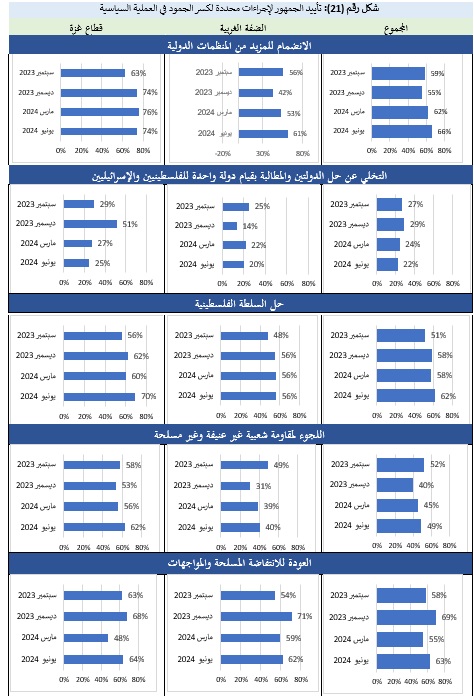
عرضنا على الجمهور ثلاث طرق لإنهاء الاحتلال الإسرائيلي وإقامة الدولة الفلسطينية المستقلة وطلبنا منه اختيار أكثرها فاعلية: 54٪ (52٪ في الضفة الغربية 56٪ في القطاع) اختاروا "العمل المسلح"؛ 25٪ (26٪ في الضفة الغربية و24٪ في القطاع) اختاروا المفاوضات؛ واختارت نسبة من 16٪ (14٪ في الضفة الغربية و19٪ في القطاع) المقاومة الشعبية السلمية. كما هو مبين في الشكل أدناه، تشير هذه النتائج إلى ارتفاع قدره 8 نقاط مئوية في تأييد العمل المسلح بالرغم من بقاء نسبة دعم المفاوضات بدون تغيير؛ وانخفاض قدره نقطتين في دعم المقاومة السلمية. يأتي الارتفاع في تأييد الكفاح المسلح من قطاع غزة حيث ترتفع هذه النسبة بمقدار 17 درجة مئوية.

وجد الاستطلاع معارضة كبيرة بلغت ثلاثة أرباع الجمهور لقيام تطبيع سعودي-إسرائيلي حتى لو كان ذلك مشروطاً بقبول إسرائيل بدولة فلسطينية واتخاذ خطوات ملموسة ولا تراجع عنها نحو ذلك الهدف. تقول نسبة من 21% فقط أنها تؤيد ذلك.
يبدي الجمهور الفلسطيني تفاؤلاً بإمكانية سقوط حكومة نتنياهو قريباً وإجراء انتخابات سريعة في إسرائيل، حيث تعتقد ذلك نسبة من 63% فيما لا تعتقد ذلك نسبة من 34%. لكن حتى في حالة حصول ذلك وقيام حكومة إسرائيلية جديدة بدون نتنياهو فإن أغلبية من 54% لا يعتقدون أن هذه الحكومة ستكون على استعداد للتفاوض مع الطرف الفلسطيني لإنهاء الاحتلال على أساس حل الدولتين فيما تقول نسبة من 41% أنها تعتقد ذلك.
على ضوء الزيادة في الهجمات الإرهابية التي يشنها المستوطنون ضد البلدات والقرى الفلسطينية، سألنا سكان الضفة الغربية عن الوسائل الأكثر فاعلية، والأكثر واقعية في الوقت ذاته، في مكافحة هذا الإرهاب: لحماية مناطقهم اختارت النسبة الأكبر (45٪) تشكيل مجموعات مسلحة من قبل سكان المناطق المستهدفة، واختار 27٪ نشر قوات الشرطة الفلسطينية في المناطق المستهدفة، وقالت نسبة من 19٪ أنها مع المطالبة باتخاذ الجيش الإسرائيلي إجراءات فاعلة لمنع إرهاب المستوطنين، واختار 6٪ فقط تشكيل مجموعات غير مسلحة من قبل سكان المناطق المستهدفة. كما يشير الشكل أدناه، تظهر هذه النتائج ارتفاعا محدودا بلغ 4 نقاط مئوية في دعم تشكيل الجماعات المسلحة مقارنة بالنتائج التي تم الحصول عليها قبل ثلاثة أشهر. كذلك حصل ارتفاع بلغ 4 نقاط مئوية في نسبة تفضيل طلب الحماية من قبل الشرطة الفلسطينية، وانخفاض قدره 4 نقاط مئوية في تفضيل المطالبة من الجيش الإسرائيلي باتخاذ إجراءات لوقف إرهاب المستوطنين.

| 5) الغايات العليا للشعب الفلسطيني: |
- نسبة من 47٪ تعتقد أن الغاية العليا الأولى للشعب الفلسطيني ينبغي أن تكون تحقيق انسحاب إسرائيلي لحدود عام 1967 وإقامة دولة فلسطينية في الضفة والقطاع وعاصمتها القدس الشرقية
- 50٪ يقولون أن المشكلة الأكثر إلحاحا التي تواجه الفلسطينيين اليوم هي استمرار الحرب في قطاع غزة وتقول نسبة من 28٪ أنها الاحتلال الإسرائيلي
نسبة من 47٪ تعتقد أن الغاية العليا الأولى للشعب الفلسطيني ينبغي أن تكون تحقيق انسحاب إسرائيلي لحدود عام 1967 وإقامة دولة فلسطينية في الضفة والقطاع وعاصمتها القدس الشرقية. في المقابل تقول نسبة من 31٪ أن الغاية الأولى ينبغي أن تكون الحصول على حق العودة للاجئين وعودتهم لقراهم وبلداتهم التي أخرجوا منها في عام 1948؛ 12٪ يعتقدون أن الغاية الأولى والحيوية ينبغي أن تكون بناء فرد صالح ومجتمع متدين يلتزم بتعاليم الإسلام كاملة؛ وتقول نسبة من 9٪ أن الهدف ينبغي أن يكون قيام نظام حكم ديمقراطي يحترم الحريات وحقوق الإنسان الفلسطيني.
وعند السؤال عن المشكلة الأكثر إلحاحا التي تواجه الفلسطينيين اليوم قالت النسبة الأكبر (50٪؛ 57٪ في قطاع غزة 45٪ في الضفة الغربية) أنها استمرار الحرب في قطاع غزة. وقالت نسبة من 28٪ أنها الاحتلال الإسرائيلي، وقالت نسبة من 8٪ إنها الفساد، وقالت نسبة من 8٪ إنها البطالة، وقالت نسبة من 5٪ أنها الانقسام بين الضفة والقطاع. قبل ثلاثة أشهر قالت نسبة من 56٪ (50٪ في الضفة الغربية و66٪ في قطاع غزة) أنها الحرب المستمرة في قطاع غزة، وقالت نسبة من 23٪ أنها الاحتلال الإسرائيلي.
Polls conducted in 2000
- Poll # 48: The Peace Process, Bir Zeit University Incident, the Status of Palestinian Democracy, Corruption, Elections for the President and vice-President, and Political Affiliation (30 March - 1 April 2000)

- Poll # 47: The Peace Process, Donors' Support, Domestic Conditions, Elections for the President and Vice President, Political Affiliation, Home and Mobile Phones, Computers, and Internet, and Satellite and TV Stations (24-26 February 2000)
- Poll # 46: The Peace Process, the "Petition of the Twenty," PLC and PA performance, Status of Democracy and Corruption, Elections for the President and Vice President, and Political Affiliation (27-31 January 2000)
Polls conducted in 1999
- Poll # 45: The Peace Process, Israeli Debate about Refugees, Safe Passage, Events in Nazareth, Refugees in Lebanon, Hamas and Jordan, Corruption and Democracy, Elections for the President and Vice-president, and Political Affiliation (2-4 December 1999)
- Poll # 44: The Peace Process, PA Performance, Status of Democracy and Human Rights, Corruption, Reform, Elections for the Presidency and Vice-presidency, and Political Affiliation (14-16 October 1999)
- Poll # 43: The peace process, Donor Community Assistance, Domestic Palestinian Conditions, Elections for the president and vice-president and political affiliation, Home and Mobile Phones, Computers and Internet, and Satellites and TV Stations (2-4 September 1999)
- Poll # 42: The Peace Process, Evaluation of PA and NGOs performance, Corruption in PA Institutions, the PLC and NGOs, Status of Democracy and Human Rights, Elections for the President and Vice-President and Political Affiliation (15-17 July 1999)
- Poll # 41: Barak's Victory and the Peace Process, Economic Conditions and Future Outlook, Perceptions of Corruption, Wasta, Democracy, and Freedom of the Press, Elections for the President and Vice-President and Political Sympathy (03-05 June 1999)
- Poll # 40: The Peace Process, Evaluation of PA Performance, Status of Democracy, Corruption, Death Penalty, Developments in Jordan, Elections for the President and Vice President, and Political Affiliation (15-17 April 1999)
- Poll # 39: The Peace Process, Donor Community Support, Domestic Affairs, Elections for the President and Vice-President, Internet, and Satellite Dishes (28-30 January 1999)
- Poll # 38: The Peace Process, Public Perception of PNA Performance, Corruption, Status of Palestinian Democracy and Elections for the PNA President and Political Affiliation (7-9 January 1999)
Polls conducted in 1998
- Poll # 37: The Peace Process and the Wye Memorandum, Elections for the President and Vice President, and Political Affiliation (12-14 November 1998)
- Poll # 36: The Peace Process, Domestic Situation, Presidential Elections and Political Affiliation (8-10 October 1998)
- Poll # 35: The Peace Process, Domestic Situation, Economic Situation, Ability to Confront Threats, Presidential Elections and Political Affiliation (30 July - 1 August 1998)
- Poll # 34: The American Initiative, Armed Attacks, Palestinian State, Cabinet Reshuffle, Corruption, Democracy, Election of the President and Vice President, Ownership of Satellite Dishes and Computers, and Subscription in the Internet Service (June 25-27, 1998)
- Poll # 33: Evaluation of the Performance of PLC and PA, Corruption, Attitudes Regarding new Legislative Elections, Local Elections, and Oslo Peace Agreement (June 3-6, 1998)
- Poll # 32: Evaluation of the Performance of PLC and PA, the Status of Democracy, Corruption, Attitudes Toward Proposed Legislation on Weapons, Political Parties, and Public Assembly, the Peace Process, and the Iraqi Crisis (March 5-7, 1998)
Polls conducted in 1997
- Poll # 31: Evaluation of the Performance of PLC and other PNA Institutions, Attitudes Regarding Proposed Legislation, and Political Affiliation (December 1997)
- Poll # 30: Elections for a President and a Vice-President of the PA, the Peace Process, Corruption, and Political Affiliation (November 1997)
- Poll # 29: Performance of the PNA, the Peace Process, the Status of Democracy in Palestine, and Corruption (September 1997)
- Poll # 28 : Corruption, Broadcasting PLC Sessions, Performance of PLC and Other Branches of the Government, the Peace Process and Local Elections (May 1997)
- Poll # 27 : PA and PLC Performance, Democracy, Armed Attacks, Local Councils, and a Permanent Status Plan (April 10-12, 1997)
- Poll # 26 : Abu Ghnaim, Armed Attacks, Permanent Settlement, Peace Process, and Local Elections (March 6-9, 1997)
Polls conducted in 1996
- Poll # 25: Armed Attacks, PNA Performance, The Palestinian Legislative Council, Corruption, (December 1996)
- Poll # 24 : Peace Process, Performance of the PNA, Performance of the PLC (September 1996)
- Poll # 23 : The Peace Process After Netanyahu's Elections, Freedom of Expression, Democratization Under the PNA, The Recent Arab Summit, The Performance of the Legislative Council (June 28-30,1996)
- Poll # 22 : Armed Operations, Peace Process, Elections, Unemployment (March 1996)
Polls Conducted in 1995
- Poll # 21 : Elections, Redeployment, Peace Process After Rabin's Assassination (December 7-10, 1995)
- Poll # 20 : Taba Agreement, Elections, Jordanian-Palestinian Relations, Evaluation of PNA (October 1995)
- Poll # 19 : The Armed Operations, Palestinian-Jordanian Relations, Negotiations, Elections and Other Issues of Concern (August-September 1995)
- Poll # 18 : Redeployment Agreement, PNA Performance, Prisoners Release, Electoral System and Other topics (July 6-9, 1995)
- Poll # 17 : Elections, Negotiations, Strike, Refugee Camps, Criticism of the PNA (May 18-20, 1995)
- Poll # 16 : Armed Attacks, Negotiations, Jenin Proposal, Elections, Economic Situation, and the Palestinian-Jordanian Relations (March 16-18, 1995)
- Poll # 15 : Armed Attacks, Negotiations, "Separation", Election, Unemployment, and Palestinian-Jordanian Relations (February 2-4, 1995)
Polls conducted in 1994 and earlier
- Poll # 14 : Negotiations, Palestinian National Authority and Opposition, Jordanian-Palestinian Relations, Elections and the Presidency of the PNA (December 29-31, 1994)
- Poll # 13 : Unemployment, Jordanian-Israeli Treaty, Armed Operations, Elections and Other Issues (November 17-19, 1994)
- Poll # 12 : The West Bank and Gaza Strip (September 29-30, 1994)
- Poll # 11 : Elections and Palestinian-Jordanian Relations (August 11-13, 1994)
- Poll # 10 : Elections, Economic Conditions, Palestinian Prisoners, Palestinian Police, and Jerusalem (June 30, 1994)
- Poll # 9 : The Palestinian-Israeli Agreement, the Palestinian National Authority, and Elections (May 31, 1994)
- Poll # 8 : Palestinian Elections, Participation of Women, and Other Related Issues (April, 1994)
- Poll # 7 : Palestinian Elections and the Hebron Massacre (March 20, 1994)
- Poll # 6 : Palestinian Elections and the Cairo-Agreement (February 19, 1994)
- Poll # 5 : Palestinian Political Attitudes Towards Elections and Other issues of Concern (January 16, 1994)
- Poll # 4 : Palestinian Elections and the DOP (December 12, 1993)
- Poll # 3 : Palestinian Elections (November 11, 1993)
- Poll # 2 : Palestinian Elections (October 5-10, 1993)
- Poll # 1 : The Palestinian-Israeli Agreement: "Gaza-Jericho First" (September 10-11, 1993)