
28 October 2025
A Dual Crisis- Palestinian Public Opinion Amidst Occupation and a Leadership Vacuum:
Palestinian opinion is polarized: the Trump Plan is widely known but support is split, with Gazans more favorable than West Bankers. Majorities back Hamas’s response yet reject disarming Hamas; most doubt the plan will end the war or deliver statehood. A leadership crisis endures—dissatisfaction with Abbas and the PA, Marwan Barghouti leading, and Hamas outpolling Fatah. Since Oct 7, support for the attack persists even as expectations of Hamas victory wane. Gazans are more open to negotiated arrangements;` West Bankers favor armed struggle. Across both, skepticism of external plans coexists with demands for elections and self-defense.
22-25 October 2025

These are the results of the latest poll conducted by PCPSR-Polling and Survey Research in the West Bank and the Gaza Strip between 22-25 October 2025. The immediate period prior to the poll witnessed the announcement of the Trump Plan at the end of September followed by a ceasefire agreement between Hamas and Israel based on that plan. Few days before the conduct of the poll interviews, Israeli hostages were and Palestinian hostages were released by Hamas and Israel respectively. Israel allowed humanitarian aid to enter the Gaza Strip and president Trump announced the end of the two-year Gaza War. Meanwhile, conditions in the West Bank continued to deteriorate due to increased settler violence. Settler attacks wreaked havoc on Palestinians during olive harvest which normally take place in October. The Israeli army evacuated tens of thousands of people from the Jenin, Tulkarm and Nur Shams refugee camps and demolished dozens of buildings in those camps. Restrictions on the movement of Palestinians in the West Bank also continued and entrances to most towns and villages were closed by the Israeli army in order to prevent residents from accessing main roads.
This poll covers all of the above issues as well as other issues such as domestic condition and the internal balance of power, the peace process and the alternatives available to the Palestinians in light of the current stalemate in that process.
To ensure the safety of our data collectors in the Gaza Strip, interviews were conducted with residents in areas to the west, south and north of what came to be known as the “yellow line,” areas that were free of Israeli army presence. Residents of the areas that were under Israeli military occupation, such as Rafah, and parts of Northern Gaza, and Khanyounis, were interviewed in shelters.
This survey was conducted face-to-face in both the West Bank and Gaza Strip using tablets or phones. When each interview is completed, it is automatically sent directly to our server where only our researchers can access. There is no way for anyone to intercept or manipulate the collected data.
The sample size of this survey was 1200 people, of whom 760 were interviewed face-to-face in the West Bank (in 76 residential locations) and 440 in the Gaza Strip (in 44 locations). Interviews in the Gaza Strip were conducted in 23 “counting areas,” or areas that existed before the war but were mostly destroyed. Residents of these “counting areas,” including those whose homes were completely or partially destroyed were interviewed either in their original homes or in tents erected between the rubbles of their homes. Residents of inaccessible areas, such as those of Rafah and most of Northern Gaza, were interviewed in 6 built-up shelters and 15 tent shelters.
The margin of error stands at +/-3.5%.
For further details, contact PSR director, Dr. Khalil Shikaki at tel. 02-296 4933 or email pcpsr@pcpsr.org
Summary of the Main Findings: |
Palestinian opinion on the Trump Plan is widely known and split: roughly seven in ten have heard of it, and when framed in Arab/Islamic terms support is near even, with Gazans much more favorable than West Bankers. Majorities back Hamas’s response yet draw a hard red line against disarming Hamas. Most doubt the plan will end the war or produce a state within five years; many expect renewed fighting, and nearly half anticipate Arab normalization even without statehood. Gazans are more optimistic than West Bankers about PA reforms. Palestinian public opinion reveals a profound crisis of confidence in the current leadership. Overwhelming dissatisfaction with President Abbas and a Palestinian Authority viewed as corrupt creates a leadership vacuum, filled by Fatah’s popular Marwan Barghouti in presidential polls, while Hamas consistently outpolls Fatah as a party. Regarding the October 7th war, majority support for Hamas’s decision to attack persists, even as expectations of its victory decline. However, a core, cross-regional red line remains: overwhelming opposition to disarming Hamas, complicating any post-war arrangement. A stark divide separates the Palestinian territories: despite immense suffering, Gazans exhibit greater pragmatism, showing more openness to negotiated settlements and practical governance. Conversely, West Bankers are more skeptical of external plans and more supportive of armed struggle. Overall, deep skepticism about the viability of external peace plans prevails, alongside a strong public demand for internal legitimacy through elections and self-reliant security, reflecting deep distrust in both the PA and the Israeli army. This complex landscape suggests that any sustainable path forward must address the dual crises of Israeli occupation and internal leadership legitimacy.
The following is a summary of the main findings:
The Trump Plan: Awareness of the Trump Plan is high: more than 70% have heard of it; but Palestinian public opinion on the Plan is deeply ambivalent, shaped by its framing and a significant divide between the West Bank and Gaza. Presented with a favorable “Arab and Islamic” framing, the plan is nearly split (47% support vs. 49% opposition), yet this masks a stark regional difference: almost 60% of Gazans support the framed plan, while the same percentage of West Bankers oppose it. Support is also higher among those aware of the plan (50% vs about 40% among the unaware of the plan). Despite this ambivalence toward the plan itself, there is strong majority support for Hamas’s response to it, coupled with high satisfaction with the prisoner exchange list Hamas secured. This support is linked to a core red line: about 70% of Palestinians, including almost 80% in the West Bank and 55% in Gaza, staunchly oppose the disarmament of Hamas, even as a condition to prevent the war’s return.
Overwhelming skepticism clouds the plan's long-term prospects. A vast majority (70%) does not believe it will lead to a Palestinian state within five years, and most (more than 60%) doubt it will permanently end the war. This pessimism is more pronounced in the West Bank, where residents are also more likely to expect the conflict to resume soon. Furthermore, nearly half believe the plan will facilitate Arab normalization with Israel even without a Palestinian state. While Gazans express some optimism that PA reforms could create a path to statehood, West Bankers remain largely unconvinced.
The Day After arrangements in the Gaza Strip: Palestinian opinion on "day after" governance in Gaza is deeply divided, revealing significant distrust in external plans and a strong preference for autonomous Palestinian control, though with notable regional differences. A slight majority opposes a committee of unaffiliated professionals managing Gaza under an international umbrella, as envisioned in the Trump Plan. However, this opposition flips to strong support from both West Bankers and Gazans when the proposal is framed as a Palestinian-led expert committee overseeing reconstruction with international support, omitting any mention of political non-affiliation.
There is minimal appetite for a return of direct Palestinian Authority (PA) control; only one-third of the public favors a scenario where the PA has full or shared governance. The idea of an armed Arab force entering Gaza to maintain security is overwhelmingly rejected by almost 70%, especially in the West Bank. Opposition softens somewhat, particularly in Gaza, if the force's mission is framed around border security and cooperation with local police, explicitly omitting the controversial goal of disarming Hamas. This highlights a core red line: any arrangement seen as undermining Palestinian arms is widely opposed. Finally, the prospect of the PA merely "coordinating" the work of an expert committee is met with majority opposition in the West Bank but finds majority support in Gaza, underscoring Gaza’s greater willingness to engage with pragmatic governance solutions.
October 7 and the Gaza War: Public opinion following the October 7th war reveals complex and evolving attitudes. Support for Hamas’s decision to launch the offensive, while declining from its peak, remains a majority at more than 50%, with recent gains in Gaza and sustained high support in the West Bank. Humanitarian conditions in Gaza present a stark contrast: while food access has significantly improved, a staggering 72% of Gazans report a family member has been killed or injured, and the vast majority have been displaced multiple times. Most Palestinians continue to blame Israel for this suffering, and a near-unanimous do not believe Hamas committed the atrocities against civilians depicted in international media.
Politically, expectations of a Hamas victory have fallen to about 40%, revealing a major split: West Bankers remain more optimistic, while a notable portion of Gazans, 3 in 10, now anticipate an Israeli win. This has not translated into a desire for capitulation, as an overwhelming majority opposes disarming Hamas to end the war, including 85% in the West Bank and 55% in Gaza. Satisfaction ratings reflect these dynamics, with Hamas (60%) enjoying far greater approval than President Abbas (about 20%). Regionally, Yemen’s Houthis are most popular, then Qatar, Hezbollah, Iran, Turkey, Jordan, and Saudi Arabia. Internationally, China comes first followed by Russia, Spain, France, UK, and finally the US or President Trump.
Domestic conditions: A profound sense of insecurity pervades the West Bank, where 85% of residents feel unsafe—a dramatic decline from about half two years prior. This is compounded by a widespread belief that the PA institutions are corrupt. Recent dismissals—of the transportation minister accused of bribery and the Director General of Crossings and Borders—do not convince most; more than half say these are not serious signals of an anti‑corruption drive. Consequently, a majority views the PA as a burden on the Palestinian people, compared to 40% who see it as an asset. Asked which step the PA should prioritize to address conditions in Gaza, enable West Bank–Gaza reunification, and engage Israel/international actors on statehood, the largest percentage favors holding presidential and legislative elections including Hamas, followed by forming a national unity government including Hamas, and thirdly ensure immediate reconciliation with Hamas. Media consumption is dominated by Al Jazeera, with far higher viewership than any other.
Palestinian elections: About two thirds support holding presidential and legislative elections in the West Bank and Gaza a year after the current Gaza ceasefire; support is higher in the West Bank than Gaza, suggesting some Gazans who oppose a one‑year timeline may prefer earlier elections. Yet 60% believe the PA does not genuinely intend to hold elections within a year and do not expect them to occur within a year, while only about one third think they will, with little difference between the two Palestinian areas. Furthermore, a significant majority opposes President Abbas’s precondition that all electoral candidates must accept PLO obligations, including agreements with Israel. This opposition is particularly strong in the West Bank. On the logistical challenge of voting in East Jerusalem if Israel bars East Jerusalem voting under Oslo arrangements, the largest percentage favors internet voting, followed by voting in holy places, and finally bussing voters to PA‑controlled areas.
Public opinion reveals continued profound dissatisfaction with President Mahmoud Abbas, with three quarters disapproving of his performance and 80% wanting his resignation. This unpopularity is reflected in presidential polls where Abbas secures only 13% of the vote. In sharp contrast, Fatah’s Marwan Barghouti emerges as the most popular leader, decisively winning hypothetical elections against Hamas’s Khalid Mishal in both three-way and two-way contests. On the party level, Hamas maintains a significant lead over Fatah, both in general preference and in a potential legislative election. This is reinforced by the perception that Hamas is more deserving of leadership than Fatah under Abbas. However, a substantial segment of the public is deeply disillusioned with the status quo, as nearly a third believe neither party is worthy of representing the Palestinian people. In terms of political dynamics, findings clearly indicate that public support for Hamas has grown over the past two years, a trend observed in both Palestinian areas but more pronounced in the West Bank.
Palestinian-Israeli Peace Process: Palestinian public opinion on a political settlement is deeply divided and conditional. A slight majority opposes the general concept of a two-state solution, a sentiment rooted in the belief that it is no longer practical due to settlement expansion. Support for the solution erodes further when linked to compromises like demilitarization or Arab normalization. This reveals a stark internal divide: Gazans are consistently far more supportive of negotiated settlements, even with significant conditions, than West Bankers. For example, support for a detailed two-state agreement is nearly twice as high in Gaza. Regarding strategies to end the occupation, there is a notable tension. While non-violent tactics like joining international organizations garner majority support, "armed struggle" is still viewed as the single most effective method, particularly in the West Bank. This is mirrored in responses to settler violence, where an overwhelming majority feels unprotected by both the complicit Israeli army and absent PA police forces, leading to significant public backing for either deploying PA police or forming local armed groups to ensure community defense.
| Main Findings |
(1) The Trump Plan and the arrangements for the Day After: |
- The majority of the Palestinians (71%) has heard of the Trump Plan, three quarters in the West Bank and about two-thirds (65%) in the Gaza Strip. We presented the public with the Trump Plan, using the Arab and Islamic framing of that plan as follows: the plan ends to the war on Gaza, releases hostages and Palestinian prisoners, abandons the forced transfer of Gazans, allows the entry of humanitarian aid, requires the gradual Israeli withdrawal from the Gaza Strip, requires the disarmament of Hamas, requires reforming the Palestinian Authority, and calls for the start of a political process toward the establishment of a Palestinian state. Given this deliberate framing of the Trump Plan, we asked the public whether it supports or oppose it: 47% supported the plan in this Arab and Islamic framing and 49% opposed it. Support is much higher in the Gaza Strip compared Satisfaction to the West Bank, 59% and 39% respectively. Support is also higher among those who have heard of the plan compared to those who have not: 50% t0 39% respectively.
- A majority of the Palestinians (62%) supports Hamas’ response to the Trump plan, with greater supported in the West Bank compared to the Gaza Strip, 65% and 56% respectively. Support is much higher among those who have heard of the plan compared to those who did not hear of it: 71% and 41% respectively. We asked specifically about public satisfaction with the names of Palestinian prisoners whose release Hamas has secured. A vast majority (69%) of all Palestinians indicated satisfaction, but satisfaction is much higher in the West Bank compared to the Gaza Strip, 76% and 59% respectively.
- The majority of Palestinians (62%) does not think the Trump Plan will succeed in ending the War in the Gaza Strip once and for all. Although Palestinians in both the West Bank and the Gaza Strip do not think the Trump Plan will indeed bring a permanent end to the war, this pessimism is higher in the West Bank than in the Gaza Strip, 67% and 54% respectively; only 42% of Gazans and 27% of West Bankers believe it will indeed put an end to the war once and for all. Moreover, in light of the statement by the Israeli prime minister Netanyahu that after the return of the hostages to Israel, Israel will return to the war on Gaza if Hamas does not give up its arms, a majority in the West Bank (59%) thinks the Gaza war will return soon while Gazans are divided evenly, 49%-48%. In the West Bank, only 33% think the war on Gaza will not return soon.
- The public in both the West Bank and the Gaza Strip, but more in the former, is highly opposed (69%) to the element in the Trump plan that demands the disarmament of Hamas in the Gaza Strip even “if this is a condition for the war to not to return the Gaza Strip,” with opposition standing at 78% in the West Bank and 55% in the Gaza Strip. Support for disarming Hamas stands at 18% in the West Bank and 44% in the Gaza Strip.
- The vast majority of West Bankers and Gazans (70%) do not believe that the Trump Plan will lead to the establishment of an independent Palestinian state in the West Bank and the Gaza Strip within the next five years; only 21% of West Bankers and 34% of Gazans think it will indeed lead to that.
- We asked the public about its views regarding the role of PA reforms, “if fully implemented,” in opening “the door to the establishment of a future Palestinian state in a manner that fulfills the aspirations of the Palestinian people:” While a majority of Gazans (59%) are optimistic that such real reforms would indeed achieve that outcome, the opposite is true in the West Bank, with only 44% think it would do that. A slim majority of West Bankers (51%) do not believe that such reforms, even if fully implemented, would indeed lead to the establishment of a Palestinian state.
- But when asked about the possibility that the Trump Plan “will lead to Arab and Islamic normalization with Israel within a year or two from now, even if a Palestinian state has not been established before then,” a half of the Palestinians (49%) said it will indeed lead to that while 48% said it will not. Both, West Bankers and Gazans, think that, 53% and 42% respectively think the Trump Plan will lead to Arab normalization with Israel even if a Palestinian state has not been established.
- We asked the public about the Day After arrangements pertaining to governing Gaza, the role of the PA, and the role of international bodies: We started by asking the public about its support and opposition to the formation of a Palestinian committee of professionals, that is not affiliated with the PA or Hamas, to manage the affairs of the Gaza Strip under and international umbrella in the accordance to the Trump Plan. A majority of 53% said it is opposed to such committee but a large minority (45%) supported it. It is noticeable that a slim majority of 51% of Gazans supported the formation of this committee while only 41% of the West Bankers supported it.
- When the question about the nature of this committee of Palestinian professionals omits reference to the fact that the committee will not be affiliated with Hamas or the PA and when the international auspices is linked to the implementation of the reconstruction program, attitudes change and the gap between West Bankers and Gazans narrow considerably. Indeed, a large majority of Palestinians (67% in total, 67% in the West Bank and 66% in the Gaza Strip) supports the “administration of the Gaza Strip by a committee of Palestinian experts and specialists, including the implementation of the reconstruction program under international auspices and support.” Opposition stands at 31%.
- We asked the public about its support for an alternative governing arrangement for the Gaza Strip whereby the PA would resume full control over governance in the Gaza Strip including the management of reconstruction. The largest percentage (41%) expressed opposition to the two options (44% in the West Bank and 37% in the Gaza Strip); about a quarter (24%) preferred the independent committee of professional; a similar percentage (23%) expressed support for the return of the PA to fully control the Gaza Strip; and a small percentage of 10% expressed preference to the committee if it came under the administration of the PA. In other words, only 33% prefer a full or shared PA control over the Gaza Strip.
- In the event in which the Palestinian committee of professional assumes responsibility over the affairs of the Gaza Strip under an international umbrella in accordance of the Trump Plan, a large majority (68%) would be opposed to the entry of an armed Arab force from Egypt, Jordan, and other Arab and Islamic countries to maintain security and disarm Hamas. It is worth noting that the opposition is much greater in the West Bank compared to the Gaza Strip, 78% and 52% respectively.
- When the question omits reference to one of the missions of the international force, disarming Hamas, public response changes, particularly in the Gaza Strip. We asked about support and opposition to the “entry into Gaza of an international force from Arab States whose mission is to secure the borders, prevent the entry of arms and ensure internal security in cooperation with the Committee of Experts and the local Palestinian police.” A majority of Gazans (53%) and a large minority of West Bankers (43%) supported this mission while 47% of Gazans and 60% of West Bankers opposed it.
- We asked about support and opposition to a specific role for the PA in which it would “coordinate” the work of the committee of experts and professionals in the administration of the Gaza Strip. A majority of West Bankers (56%) expressed opposition while only 40% expressed support, while a majority of Gazans (54%) supported and 45% opposed that “coordination.”
(2) October the 7th and the War in Gaza: |
1. Support for Hamas’ decision to launch the October the 7th offensive continues to decline: |
- For the sixth time since October 7, 2023, we asked respondents from the West Bank and the Gaza Strip what they thought of Hamas' decision to launch the October 7 attack, whether it was correct or incorrect: 53% compared to 50%, in May 2025, and 54% in September 2024, and 67% in June 2024, and 71% in March 2024, said it was the right decision. The increase in this poll came from the Gaza Strip, where it stands today at 44%, an increase of 7 percentage points, and 59% in the West Bank, compared to an identical percentage in May 2025.

2. Humanitarian conditions in the Gaza Strip: |
- 87% of Gazans say they have enough food for a day or two; 13% say they don't have enough food for a day or two. These results show a significant improvement over the results we obtained five months ago when only 53% said they had enough food for a day or two.
- 51% of Gazans say that one or more members of their family were killed during the current war, and in a separate question, 63% say that one or more members of their family were injured during this war. When combining the answers to the two questions and omitting the overlap, the results show that 72% report that one or more of their family members have been killed or injured. These results are almost identical with those we obtained five months ago.

- We asked residents of the Gaza Strip how often they had to move from one shelter to another since the war began on October 7, 2023: 31% said it ranged from two to three times, 36% said it ranged from four to six times, 13% said it ranged between 7 and 10 times, and 7% said it was once.
- A majority of 54% (compared to 51% five months ago) blames Israel for the current suffering of Gazans while 24% (compared to 28% five months ago) blame the US; only 14% (compared to 12% five months ago) blame Hamas; and only 6% (compared to 7% five months ago) blame the PA. It is worth noting that the percentage of Gazans blaming Hamas stood at 21% in the current poll compared to 23% five months ago.
3. War crimes and atrocities: |
- When asked if Hamas had committed the atrocities seen in the videos shown by international media displaying acts or atrocities committed by Hamas members against Israeli civilians, such as killing women and children in their homes. The overwhelming majority (86%) said it did not commit such atrocities, and only 10% said it did.
4. Expectations regarding the ceasefire and who will win the war |
- As we did in our previous five polls since the war, we asked in the current poll about the party that will emerge victorious in this war: 39% of the public expects Hamas to win, compared to 43% five months ago, 50% 12 months ago, and 67% 15 months ago. It is worth noting, as the figure below shows, that a larger percentage of Gazans, at 27% today, expect Hamas to win compared to the results five months ago. However, Hamas's expectation of victory has dropped in the West Bank, where today it stands at only 48% compared to 56% five months ago. It is also worth noting that while 6% in the West Bank expect Israel to win the current war, 29% of Gazans expect Israel to win.

5. Disarming Hamas and the expectation regarding ending the war |
- When asked whether it supports or opposes the disarmament of Hamas in the Gaza Strip in order to permanently end the war on the Gaza Strip, an overwhelming majority of 69% (87% in the West Bank and 55% in the Gaza Strip) said it is opposed to that; only 29% support it.
6. Satisfaction with selected Palestinian, regional, and international actors: |
- As we did in our previous poll, we asked in the current one about public satisfaction with the role played during the war by various Palestinian, Arab/regional, and international actors:
- On the Palestinian side, satisfaction with Hamas' performance rises to 60% (66% in the West Bank and 51% in the Gaza Strip), followed by Fateh (30%; 25% in the West Bank and 39% in the Gaza Strip), the PA (29%; 23% in the West Bank and 38% in the Gaza Strip), and finally, president Abbas (21%; 16% in the West Bak and 29% in the Gaza Strip).

- As for satisfaction with Arab/regional actors, the highest satisfaction rate went to Houthis in Yemen, as we found in our previous polls, today at 74% (84% in the West Bank and 60% in the Gaza Strip), followed by Qatar (52%), Hezbollah (50%), and Iran (44%). The findings show a significant rise in satisfaction with Qatar, Hizballah and Iran. We also asked, in this poll, about satisfaction with Turkey, Jordan, and Saudi Arabia and the findings were 42%, 34%, and 27% respectively.

- For the international actors, China received the highest satisfaction (34%), followed by Russia (25%), and the United States (6%; in this poll we asked about president Trump). We also asked, in this poll, about satisfaction with Spain, the UK, and France and the findings were 35%, 14%, and 20% respectively.

(3) Parliamentary and presidential elections and the domestic balance of power: |
- When asked about its support and opposition to the holding of Palestinian elections in the West Bank and the Gaza Strip after a year of the current ceasefire in the Gaza Strip, the majority (65%) said yes and only 32% said no. The majority in the West Bank is much larger than that in the Gaza Strip, 72% and 54% respectively, which might mean that those opposed to the holding of these elections might wish to hold these elections sooner than a full year from now.
- However, we found that the majority of the Palestinians (60%), with little differences between West Bankers and Gazans, believe the PA does not really intend to hold presidential and legislative elections a year from now; only a third believe the PA will hold such elections. Therefore, an identical majority (60%) does not think that Palestinian presidential and legislative elections will indeed be held a year from now. Only a third believe elections will indeed be held within a year from now.
- The majority of the public (63%) is opposed to the condition set by president Mahmoud Abbas on those who wish to participate in the elections, which required them to accept all the obligations of the PLO, including the agreements with Israel. The opposition is wider in the West Bank compared to the Gaza Strip, 70% and 52% respectively; and support for this condition stands at 24% in the West Bank and 48% in the Gaza Strip.
- We asked the public about its view on the best arrangements that would allow East Jerusalemites to participate in future Palestinian elections if Israel does not allow them to do so according to arrangement stipulated in the Oslo agreement. Three alternative arrangements were offered to the public: the largest percentage (41%) selected “voting through the Internet,” followed by “voting in the holy places,” selected by 31%; and finally, 22% selected providing “ free transportation of voters in buses to areas under the control of the Palestinian Authority.”
- We asked the public about its perception of Hamas two years after the Gaza war: has their support for the organization increased or decreased: 18% said its support for Hamas was big and it has not changed while 19% said its support increased a lot, and 17% said its support increased a little. By contrast, 16% said it did not support Hamas before and that its opposition to Hamas has not changed; 12% said its support decreased a little, and 10% said its support for Hamas has decreased a lot. The conclusion from these numbers is that the past two years have led to greater support for Hamas rather than the opposite and that this conclusion is true in both the West Bank and the Gaza Strip, but more so in the former.
- If presidential elections were held between three candidates, Marwan Barghouti of Fatah, Mahmoud Abbas of Fatah, and Khalid Mishal of Hamas, turnout would be 68%. Vote for Marwan Barghouti among the participants in the elections stands at 49%, followed by Khalid Mishal (36%) and Abbas (13). The following figure shows the results of the vote among all participants in the poll including those who do not intend to participate in the elections.

- If only two candidates were in the competition for the presidency, Mahmoud Abbas of Fatah and Khalid Mishal of Hamas, turnout would drop to 53%. In this case, among the actual voters Mishal stands at 63% and Abbas at 27%. Five months ago, only 25% among the actual voters chose Abbas and 68% chose Hamas’s candidate. The following figure shows the results of the vote among all participants in the poll including those who do not intend to participate in the elections.

- If the two presidential candidates were Marwan Barghouti of Fatah and Mishal of Hamas, turnout would rise to 64%. In this case, the vote for Barghouti among the participants in the elections would be 58% and for Mishal 39%. The following figure shows the results of the vote among all participants in the poll including those who do not intend to participate in the elections.

- In a closed question, we asked the public to choose the person it deems appropriate as President Abbas's successor from a predetermined list of options. The largest percentage (39%) said they prefer Marwan Barghouti, 25% said they prefer Khalid Mishal, 11% chose Mohammed Dahlan, 7% chose Mustafa Barghouti, and 18% said they do not know or chose someone other than those listed.
- Satisfaction with President Abbas' performance stands at 23% and dissatisfaction at 75%. Satisfaction with Abbas stands at 18% in the West Bank (compared to 13% five months ago) and in the Gaza Strip at 31% (compared to 29% five months ago).
- 80% want President Abbas to resign while 20% want him to remain in office. Five months ago, 81% said they want the president to resign. Today, 83% of the demand for the president's resignation comes from the West Bank and 73% comes from the Gaza Strip.

- When asked which political party or movement they support, the largest percentage (35%) said they prefer Hamas, followed by Fatah (24%), 9% selected third parties, and 32% said they do not support any of them or do not know. Five months ago, 32% said they support Hamas and 21% said they support Fatah. These results mean that support for Hamas over the past five months has increased by 3 percentage points, and the same is true for Fatah. Support for Hamas today stands at 32% in the West Bank (compared to 29% five months ago) and for Fatah at 20% (compared to 18% five months ago). In the Gaza Strip, support for Hamas stands at 41% (compared to 37% five months ago) and support for Fatah at 29% (compared to 25% five months ago).

- But if new legislative elections were held today with the participation of all political forces that participated in the 2006 elections, 65% say they will participate in them, and among the participants in the elections 44% say they will vote for Hamas, 30% for Fatah, 10% for third parties, and 16% have not yet decided. Compared to the results we obtained five months ago, the current results among voters actually participating in the elections indicate a very minor increase in the vote for both, Hamas and Fatah. In the Gaza Strip, vote for Hamas among voters participating in the elections stands at 49% (compared to 49% five months ago), and vote for Fatah among voters participating in the elections stands at 32% (compared to 30% five months ago). In the West Bank, vote for Hamas stands at 40% (compared to 38% five months ago) and Fatah among voters participating in elections stands at 29% (compared to 27% five months ago). The following figure shows the results of the vote among all participants in the poll including those who do not intend to participate in the elections.

- 41% (compared to 40% five months ago) believe that Hamas is the most deserving of representing and leading the Palestinian people today while 22% (compared to 19% five months ago) believe that Fatah led by president Abbas is the most deserving. Less than a third, (31%) compared to 35% seven months ago, believe both are unworthy of representation and leadership.
(4) Domestic conditions: |
- We asked the public in the West Bank about its personal and family safety and security. The findings show that only 15% feel safe and secure while 85% feel unsafe and unsecure. Five months ago, the perception of safety stood at 11% and two year ago at 48%.
- The poll found that 80% of the Palestinians (92% in the West Bank and 61% in the Gaza Strip) believe that there is corruption in the institutions of the Palestinian Authority. We asked the public about its views regarding the recent steps taken by the Palestinian Authority, such as the dismissal of the current government's Minister of Transportation, who is accused of bribery, or the Director General of Crossings and Borders. A slim majority (52%) does not think such steps represent a serious indication of the PA's intention to fight corruption while 45% think that they do indicate that.
- We asked the public about its views on the most important measures that the PA leadership should take now “to address the current conditions in Gaza in a manner that would allow the reunification of the West Bank and the Gaza Strip and negotiation with Israel and the international community regarding the establishment of a Palestinian state.” Three choices were offered: the largest percentage (37%) selected “the conduct presidential and legislative elections with the participation of all political factions including Hamas,” followed by the formation of “a national unity government that would include all political factions including Hamas,” selected by 31% ; and finally came bringing about “immediate reconciliation with Hamas as a first step,” selected by 27%.
- Al Jazeera is the most watched TV station in Palestine as 58% selecting it as the one they watched the most during the past two months. Due to the current war conditions, residents of the West Bankers are more likely than Gazans to watch Aljazeera, 74% and 34% respectively. The second most popular stations is Palestine Today and Al-Aqsa TV (3% each), followed by Palestine TV and Al-Arabiya and Al-Mayadeen TV (2% each), and finally Ma'an (1% each).
- A majority of 56% (compared to 60% five months ago) believes that the PA has become a burden on the Palestinian people and 40% (compared to 35% five months ago) believe it is an asset for the Palestinian people.
(5) Palestinian-Israeli Relations and the Peace process: |
- 45% support and 53% oppose the concept of a two-state solution, which was presented to the public without providing details. Last September, support for this solution in a similar question stood at 40%. As the figure below show, the rise in support in this poll came entirely from the Gaza Strip.

- Support for a two-state solution is usually linked to public assessment of the feasibility of such a solution and the chances for a Palestinian state. Today, 56% (compared to 64% five months ago) believe that the two-state solution is no longer practical due to settlement expansion, but 41% (compared to 33% five months ago) believe it remains practical. Moreover, 61% believe that the chances for the establishment of an independent Palestinian state alongside Israel in the next five years are slim or non-existent and 37% believe the chances are medium or high.
- In the context of the two-state solution, but with few added details, we asked about support and opposition to the establishment of an independent Palestinian state on the borders of June 4, 1967, one that would be demilitarized, with East Jerusalem as its capital, with limited land swaps so that it can live in peace with the State of Israel, with international guarantees. A majority of 53% expressed opposition and 44% expressed support. It is worth noting that support in the Gaza Stirp for this solution, with its various conditions, is almost twice in the Gaza Strip compared to the West Bank, 61% and 33% respectively. Opposition to this solution stands at 63% in the West Bank and 39% in the Gaza Strip.
- In the same context, but one in which we added the issue of Arab normalization with Israel, we found a majority of Palestinians (59%) in both the West Bank and the Gaza Strip, 63%% and 54% respectively, do not support “reaching a political and security agreement to end the Palestinian-Israeli conflict that includes the establishment of a Palestinian state through a regional agreement between the Arab states and Israel and the normalization of relations between them,” while 34% of West Bankers and 45% of the Gazans do support such agreement.
- We came back again to the same two-state solution issue. This time we asked the public if it agrees or disagrees with the following sentence: "I support a Palestinian political agreement that guarantees an end to the war, an end to the occupation, the establishment of a demilitarized Palestinian state and the normalization of relations between Israel and neighboring Arab states:” two thirds expressed opposition and only 31% expressed support. Support is higher among Gazans compared to West Bankers, 45% and 22% respectively. Opposition stands at 75% in the West Bank and 55% in the Gaza Strip.
- We asked about the public support for three possible solutions to the conflict: the two-state solution based on the 1967 borders, the solution of a confederation between the two states of Palestine and Israel, and a one-state solution in which the Jews and Palestinians live with equality, 47% (47% in the West Bank and 47% in the Gaza Strip) prefer the two-state solution based on the 1967 borders, while 18% (8% in the West Bank and 33% in the Gaza Strip) prefer a confederation between two states. 12% (10% in the West Bank and 14% in the Gaza Strip) prefer the establishment of a single state with equality between the two sides. 24% said they did not know or did not want to answer.
- When asked about the public's support or opposition to specific political measures to break the deadlock, 73% supported joining more international organizations, 54% supported resorting to unarmed popular resistance, 41% supported a return to confrontations and armed intifada, 45% supported the dissolution of the Palestinian Authority, and 27% supported abandoning the two-state solution and demanding one state for Palestinians and Israelis. Five months ago, 46% supported a return to confrontations and an armed intifada, 50% supported unarmed popular resistance, 42% supported the dissolution of the PA, and 26% supported abandoning the two-state solution in favor of a one-state solution.
- We found that a majority of 53% thinks that the recognition of Palestine by France, Britian, Canada, Australia, and other European countries brings the Palestinians closers to ending the Israeli occupation and reaching a real Palestinian state; 45% do not think so.
- A larger majority (65%) thinks that the global popular solidarity with the Palestinian people, such as the Global Steadfastness Flotilla, the ships breaking the siege, the popular demonstrations in the capitals of the world, and the decline in support for Israel in the world, including in the United States, does bring the Palestinians closer to ending the occupation and reaching a real state; one third do not think so.
- We presented the public with three ways to end the Israeli occupation and establish an independent Palestinian state and asked them to choose the most effective one: 41% (49% in the West Bank and 30% in the Gaza Strip) chose "armed struggle"; 36% (37% in the West Bank and 35% in the Gaza Strip) chose negotiations; and 19% (13% in the West Bank and 29% in the Gaza Strip) chose popular peaceful resistance. As shown in the figure below, these results indicate a very slight decrease in support for armed struggle, a 3-percentage point increase in support for negotiations, and a very slight decrease in support for peaceful resistance.

- We asked the public about the most effective means to confront settler terrorism: relying on the Israeli army to prevent such attacks, deploying Palestinian police forces in areas subject to attack, forming armed groups from the residents of those areas, or forming unarmed groups from those areas. The results were as follows:
- The option to deploy Palestinian police forces in these areas came in first place with 30% support. Similarly, reliance on the Israeli army came also in the first place with 30%.
- A quarter of the public said that forming armed groups is the most effective option
- The option of forming unarmed groups came last with only 10% opting for it.
- However, when asked about the role of the Israeli army in preventing or stopping settler attacks, a majority of 75% say the army supports settler attacks
- Moreover, an overwhelming majority (93%) say that the Palestinian security services do not enter the areas that are attacked by settlers, whether during or after the attacks.
(6) Most vital Palestinian goals and the most pressing problems confronting Palestinians today: |
- 41% believe that the first most vital Palestinian goal should be to end Israeli occupation in the areas occupied in 1967 and build a Palestinian state in the West Bank and the Gaza Strip with East Jerusalem as its capital. By contrast, 32% believe the first most vital goal should be to obtain the right of return of refugees to their 1948 towns and villages; 15% believe that the first and most vital goal should be to build a pious or moral individual and a religious society, one that applies all Islamic teachings; and 10% believe it should be to establish a democratic political system that respects freedoms and rights of Palestinians.
- When asked about the most pressing problem confronting the Palestinians today, the largest percentage (43%; 46% in the Gaza Strip and 40% in the West Bank) said it is the Israeli occupation; 22% said it is the continued war in the Gaza Strip; 12% said it is settlers’ attacks in the West Bank; 12% said it is corruption; and 8% said it is unemployment. Five months ago, 43% said it is the continued war in the Gaza Strip and 30% said it is the Israeli occupation.
 January 2026
After Gaza:
Enduring Consequences of the War and Palestinian Strategy
Khalil Shikaki
The Hamas attack of October 7, 2023, and the devastating two-year war that followed, was not merely another tragic cycle of violence; it was a system-disrupting event that has irrevocably altered the Israeli-Palestinian conflict and the regional order. Looking toward the next decade, it is clear that the war has shattered the paradigm of “conflict management,” triggered a profound crisis of legitimacy for international law and Western diplomacy, and exacerbated a deep political vacuum within the Palestinian national movement. This Brief distills what is likely to endure from the 2023–25 Gaza war and translates those trend lines into policy. It analyzes the enduring consequences of the war, assesses the deeply flawed Trump Peace Plan, and outlines the strategic options available to a Palestinian leadership grappling with a new and perilous reality. It argues that any path forward must begin not with external plans, but with internal Palestinian political renewal, as the old strategies have been rendered obsolete by a world remade by the trauma of war.
(1) Enduring Consequences of the 2023-2025 Gaza War
The Gaza war was not just another round in a familiar cycle; it was a system shock. Like 1948 and 1967, its effects will be measured in institutional and attitudinal shifts that persist beyond any ceasefire or the Trump plan for Gaza. It has unleashed a series of structural shifts whose consequences will define the next decade of the Palestinian-Israeli conflict and the broader Middle East. These trend lines are not fleeting headlines but fundamental realignments in public opinion, political power, and international norms.
First, the war has triggered a lasting realignment in global public opinion. In the United States, a profound generational and partisan chasm has opened. Polling by Gallup between 2023 and 2025,[1] Pew Research Center in October 2025[2], and Shibley Telhami July-August 2025 survey[3] consistently shows that while older Americans and Republicans remain staunchly pro-Israel, a majority of Democrats and voters under 35 now express more sympathy for Palestinians. This cohort, whose views are shaped by social media and a social justice framework, increasingly supports conditioning U.S. aid to Israel. Within the MAGA movement, an "America First" isolationism has emerged, questioning the cost of foreign entanglements, including aid to Israel, creating a fracture in the once-monolithic Republican pro-Israel consensus.[4] It is worth noting that these important shifts in the US are happening at a time when Israel has become much more dependent on the US than ever, as it coincides with heightened Israeli military reliance on the U.S., creating challenges for policymakers and increasing the perception of American support as an "existential" factor for Israel.[5] According to the New York Times, the Israel's dependence on U.S. political, military, and economic support has become "glaring" during recent conflicts, making the battle for American public opinion crucial for Israel's strategic outlook, according to the New York Times.[6] This trend is mirrored in Europe, where youth-led activism has raised the political cost of unconditional support for Israeli policies.[7] In the Arab world, Arab Barometer Wave VIII[8] shows large majorities opposing normalization absent credible steps toward statehood and sharply unfavorable views of the U.S. These opinion structures will constrain decision making on policy choices regarding Israel-Palestine.
Second, the war has shattered a decade-old paradigm of “conflict management.” In this approach “managing” rather than resolving the conflict—via security coordination, economic inducements, and periodic crisis mitigation—became orthodoxy. It assumed the conflict could be contained indefinitely while bypassing a political solution. The October 7 attack and the subsequent war discredited that doctrine. The violence recentered the Palestinian question, demonstrating that a people under occupation cannot be ignored. It demonstrated that occupation and blockade cannot be indefinitely contained and that bypassing Palestinians (the premise of the Abraham Accords) will not yield stable regional integration. The Palestinian issue was violently re-centered in Arab and global diplomacy; Saudi–Israeli normalization was rendered politically unviable without Palestinian gains. In Israel, this realization does not necessarily mean a turn to conflict resolution, as we will see below. Rather, it could mean that the Palestinian-Israeli conflict will now enter a more devastating phase of coercion and violence.
Third, the war has precipitated the terminal decline of the Palestinian Authority (PA) and a profound crisis of representation. Before the war, the PA faced deep illegitimacy. PSR polling showed supermajorities viewing the PA as corrupt and demanding President Abbas’s resignation.[9] The war provided Israel’s extreme right-wing government and settlers an opportunity to further weaken the PA and render it impotent. PA’s passivity and inability to protect its people cemented its irrelevance. Polling during the war consistently shows over 80% of Palestinians view the PA as corrupt and demand President Abbas’s resignation. The PA was absent and powerless; its security forces were unable to protect vulnerable Palestinian communities against settler terrorism; and it had no role in shaping the “day after” debate. Hamas emerged bloodied but politically validated among segments of the public as “steadfast,” even as its governing capacity in Gaza was significantly weakened. The result is not a single address for diplomacy but a vacuum: a weakened PA in the West Bank, residual Hamas influence and armed groups in Gaza.
This has created a leadership vacuum so complete that it has enabled the re-Arabization of the conflict, a fourth enduring consequence. From the late 1960s, “the Palestinian decision is independent” became doctrine. The Gaza war reversed that achievement. An Arab “contact group” (Saudi Arabia, Egypt, Jordan, Qatar, UAE) became the primary forum for “day after” planning; Egypt re‑assumed centrality on Gaza borders and security; Qatar and Egypt monopolized hostage and ceasefire mediation; Gulf capitals signaled that reconstruction money would be conditioned on PA reform and a credible political horizon. Arab states—primarily Egypt, Saudi Arabia, and Qatar—have stepped in as architects of the “day after,” effectively usurping Palestinian political agency. The Israeli September 2025 military strike on Doha gave the major Arab and regional powers an added motivation to step in and take charge of the management of the Palestinian-Israeli conflict. They are now the primary interlocutors with Washington, setting the terms for reconstruction and future governance in a direct reversion to the pre-PLO era. This development will endure because Palestinian institutions lack legitimacy and capacity, and because the U.S./EU are outsourcing stabilization to Arab partners. Until Palestinians rebuild a representative and legitimate national body, the file will be managed in Arab capitals.
Fifth, the trauma of October 7 has led to a profound and dangerous hardening of Israeli society and the political ascendancy of its extreme and religious Zionist right. October 7 did not produce a broad reckoning with occupation; it hardened threat perceptions and shifted the political center further right. The Israeli increased reliance on a less sympathetic US, as we have seen above, could further heighten Israel's perceived vulnerability and increase dependence on brute force to eliminate potential future threats. By now, the outcome is clear: the peace camp is diminished; two‑state diplomacy is widely viewed as dangerous; annexationist and punitive preferences gained ground. Far‑right ministers and settler movements have translated this into policy: accelerated settlement construction and outpost legalization, budgetary and administrative tools to entrench control, increased impunity for settler violence, and a security discourse that prioritizes domination over accommodation. The dominant Israeli narrative is not one of policy failure but of a failure of will, leading to a widespread rejection of compromise and a political discourse centered on permanent security control. Messianic and religious-nationalist parties, once on the fringe, are now central to Israeli policy, driving an agenda of de facto annexation in the West Bank and entrenching a one-state reality of unequal rights. This shift ensures no Israeli government will have the political mandate for a meaningful peace agreement in the foreseeable future. At the same time, pre‑war civil–military and constitutional conflicts (judicial overhaul, Haredi conscription) are re‑emerging, pitting right‑populist coalitions against centrist and liberal constituencies, including reservist networks. The next decade will see an internal struggle over Israel’s democratic character overlaid on a policy consensus that rejects meaningful concessions.
Sixth, the war provided Iran the opportunity to demonstrate its capacity to shape Middle Eastern outcomes. The behavior of Iran’s “Axis of Resistance” during the war, while highly costly for Iran and its allies, has significantly transformed the entire Middle East region increasing the level of instability and the prospects for war. In this environment, war has successfully derailed top-down, U.S.-led normalization efforts, handing a strategic victory to the Axis. The war made it politically impossible for Saudi Arabia to normalize relations with Israel, re-linking regional diplomacy to the Palestinian cause. While the cost for Iran and its allies has been devastating, the Axis increased its political capital by demonstrating integrated coercive capacity: calibrated pressure on northern Israel, long‑range fires, and maritime disruption. This raised the costs of U.S.‑led normalization that sidelines Palestinians; Saudi Arabia made normalization conditional on credible steps toward statehood. As importantly, the war made the Middle East more volatile and ensured the conflict remains a flashpoint for a wider regional confrontation. The Middle East is now marked by chronic low‑grade multi‑front instability rather than isolated crises, and the Palestinian issue is embedded in that strategic competition.
Finally, the war has triggered a profound crisis of the international legal and normative order. The proceedings at the International Court of Justice (ICJ) and the International Criminal Court (ICC), combined with the political assault on UNRWA, have solidified a perception across the Global South of Western double standards. Funding suspensions for UNRWA and pressure on humanitarian actors created a chilling precedent. The long‑term effect is clear: Western claims to lead a “rules‑based order” will carry less moral weight where selectivity is perceived. The West’s championing of international law in Ukraine while providing diplomatic and military cover for actions in Gaza has shattered its moral credibility. This has weakened the legitimacy of international institutions and accelerated the shift toward a more fragmented, multipolar world where the “rules-based order” is seen as a tool of power, not a set of universal principles.
(2) Israeli Untrustworthiness, Western Loss of Soft Power, and the Trump Plan
The enduring consequences of the Gaza war outlined above have been accompanied by other developments that might not be the direct outcome of that war or that might not be as enduring, but they, nonetheless, have implications to any future Palestinian strategy as they (1) raise questions about the usefulness of any future agreements with Israel; (2) affect the structure and norms of the emerging international system and their possible impact on the long term interests of the Palestinians; and (3) impact the Palestinian short term policy regarding the Gaza Strip and the Trump 20-point plan.
The Perception of Israeli Untrustworthiness: The experience of the Gaza war negotiations has led to a widespread perception among Palestinians and Arabs that Israel does not negotiate in good faith, that it exploits ambiguity, defers core obligations, and has a history of reneging on agreements. That view will not end bargaining—combatants still need tactical deals and the need for stability will ensure that talks continue. But it could affect the usefulness of such agreements and transform how agreements are designed and sold. While, the era of trust-based, gradualist peace-making, epitomized by the Oslo process, is over, future negotiations will be defined by transactionalism over trust, with every step requiring meticulous verification and enforcement.
For Palestinian, this means demanding front-loaded concessions and robust third-party guarantees. Any future PA leadership, to maintain public legitimacy, will have to abandon interim agreements and demand irreversible steps toward sovereignty upfront. For Arab states, this perception drastically raises the political risk of engaging with Israel. Mediators like Egypt and Qatar will insist on US and broader international backing to guarantee compliance, while potential normalizers like Saudi Arabia will make any deal explicitly contingent on US guarantees and tangible, upfront progress toward a sovereign Palestinian state. The price of normalization has significantly increased. The old model of deferring core issues is seen reckless; it could be replaced by a demand for concrete Israeli deliverables at the beginning of any process, creating a much higher bar for diplomatic success.
The Normative and Structural Change in the International System: Building on the seventh enduring outcome discussed above, the Gaza war has inflicted a deep and lasting wound on the credibility of the United States and Europe in the Arab world and across the Global South. The perception of a profound double standard—contrasting the West's robust, morally-charged defense of Ukraine with its diplomatic and military support for Israel's campaign in Gaza—has shattered the West’s claim to champion a "rules-based international order." This is not a fleeting disagreement but a fundamental crisis of legitimacy.
This credibility vacuum in norms is occurring at a critical moment of global structural change. The emerging normative change creates a strategic opening for non-Western and non-NATO powers like China and Russia. China, in particular, offers a pragmatic and predictable alternative. Its foreign policy, built on the principle of non-interference and transactional economic partnerships, is appealing to regional regimes weary of Western lectures on human rights. China’s credibility stems not from a shared moral vision but from its reliability as an economic and arms-exporting partner and its consistent (if self-serving) rhetoric of state sovereignty and multipolarism. Russia offers a potential source of weapon but it will not be seen as a strategic ally. Constrained by its Ukraine ambition, it finds itself unable to support its allies in the region or elsewhere in any meaningful way, as we have seen in Syria, Iran, Venezuela, and Cuba.
The long-term consequences of a multipolar world and the accelerated decline of Western soft power are difficult to predict. The United States will likely remain, at least in the medium term, the region’s primary security guarantor, but its influence is increasingly transactional. Arab states will continue to hedge their bets by diversifying partnerships—relying on the U.S. for security, China for economic engagement and arms development, and Russia for selective military needs. The West’s ability to forge broad international coalitions and act as a moral arbiter has been severely weakened, signaling the definitive arrival of a more fragmented and contested global order moving toward multipolarity. The 1947 partition of Palestine was a product of the post–World War II rules-based international order, yet that partition has remained unfulfilled. The emerging global order promises Palestinians neither independence nor equality; securing either will depend on their own capacity to define their place and shape their future within this new landscape.
The Trump Peace Plan: A Pause, Not a Peace: The Trump 20-Point Plan for the Gaza Strip, which secured a ceasefire and hostage release in its first phase in late 2025 and established a Palestinian technocratic committee-- the “National Committee for the Administration of Gaza (NCAG)—and a non-Palestinian “Gaza Executive Board” in preparation for the start of the second phase, is not a viable roadmap to a larger sustainable peace. Instead, it is a transactional arrangement poised to fragment and stall, achieving its immediate goals while failing in its broader strategic ambitions. The plan’s architecture is fundamentally misaligned with the political realities on the ground, creating a pause in the war but not a path to a resolution of the larger Palestinian-Israeli conflict.
The plan is unsustainable due to five core challenges. First, its demand for the disarmament of Hamas in the absence of a wider peace and end of occupation is likely to prove unrealistic. Islamist groups are unlikely to accept such total vulnerability to direct Israeli attacks or to attacks by armed domestic groups aligned with Israel. In that, it has public support, including among Gazans who have no trust in Israel or its proxies and continue to fear expulsion and genocide. In this regard, Hamas and its arms remain the sole leverage Gazans feel they have.
Second, the plan’s proposed governance model—a foreign-supervised administrative committee and foreign military force under American command—is a form of neo-colonialism that denies Palestinian agency and lacks any local legitimacy. While in the short term, the administrative committee will undoubtedly enjoy significant support from Gazans, its inability to navigate Israeli constraints or implement US political agenda will render it impotent and unable to significantly change the reality on the ground for more than two million Gazans.
Third, the plan’s ambiguous "political horizon" is correctly perceived as a deliberate evasion of the core issues of sovereignty, including the fundamental issues of borders and Jerusalem, making it impossible for any Palestinian leader to see it anything other than the discredited 2020 “Deal of the Century.” Fourth, despite the increased US willingness to use leverage to press Israel, the plan remains subject to an Israeli political veto, as any right-wing government will be beholden to extremist parties who oppose Palestinian statehood. Finally, it fails to resolve the crisis of Palestinian representation, bypassing the PA while expecting it to reform and negotiating with Hamas while seeking to sideline it.
Consequently, the plan will not reunify the West Bank and Gaza; it will formalize their separation by creating a separate governance track for the Gaza Strip. Reconstruction will be severely constrained by fears of recurrent experiences of the past decade when repeated military action by Israel destroyed all investments in infrastructure and homes by Egypt, Qatar, UAE and others. Therefore, reconstruction will be slow and heavily conditioned, not a comprehensive redevelopment.
The only way to overcome these challenges is to invert the plan's logic: prioritize inclusive Palestinian elections to produce a legitimate national leadership, define the two-state endgame based on international law first, and make disarmament an outcome of a final political settlement, not a precondition for it. Without these fundamental changes, the plan will simply replicate the failures of the past.
(3) Palestinian Options: A New National Strategy
A new Palestinian strategy must internalize the enduring consequences of the post–October 7 era—recognizing new constraints while capitalizing on emerging opportunities including those offered by the Trump 20-point plan. Given the ascendancy of Israel’s national-religious right, the profound crisis of Palestinian leadership, the collapse of the Oslo framework, and the perceived unreliability of Israeli governments as negotiating partners, the Palestinian people are at a strategic crossroads. The old, U.S.-mediated diplomatic strategy is defunct. A fundamental strategic rethink is therefore necessary for national survival, beginning with the core imperative of rebuilding national legitimacy.
The first and most urgent step must be to forge ties with the administrative committee of the Gaza Strip and hold inclusive presidential and legislative elections across the West Bank and Gaza, using all available methods to ensure participation. This is the only path to maintaining links to Gaza and to producing a new, legitimate leadership with a popular mandate. Following elections, a national unity government must be formed with a clear mandate for internal reform. Its priorities should be to restore basic governance and service delivery in health, education, and security for the West Bank and the Gaza Strip; ensure full commitment to the Palestinian Basic Law and amend all post-2007 legislation that violates it; reunify public institutions across the West Bank and Gaza; and take credible steps to combat corruption, including the creation of an independent commission.
Concurrently, the Palestine Liberation Organization (PLO) must be restored as a functional and representative institution, not a hollowed-out fiction. This requires holding elections for its governing bodies in the West Bank, Gaza, and the diaspora, using all available technological means to ensure broad participation. A reformed PLO must possess electoral legitimacy, be reconstituted to include all major factions, abide by its own internal regulations, and no longer be subject to the whims of a single individual or a small elite. Only under these conditions can the PLO once again serve as the sole, credible address for international negotiations.
Externally, the new strategy must pivot away from a near-total reliance on the United States and embrace a principled multilateralism. This requires strengthening alliances with supportive countries in the Global South and in Europe that have demonstrated a commitment to international law. It also means engaging with powers like China and Russia not as saviors, but as geopolitical counterweights at the UN Security Council to block initiatives detrimental to Palestinian interests. Furthermore, the systematic use of international legal institutions—the ICJ and the ICC—must be elevated from a tactic to a core strategic pillar. This “lawfare” reframes the conflict as a struggle against an illegal occupation with clear legal consequences, shifting the burden of compliance onto Israel and its international backers.
Finally, the national goal must be redefined to align with shifting global public opinion and the realities on the ground. Given the political trends within Israel, the traditional two-state paradigm is currently unrealistic. While the goal of a sovereign state must not be abandoned, the most viable path forward is to shift the immediate struggle from a specific political configuration to the realization of core, inalienable rights: self-determination, full civil and political equality for all people between the river and the sea, and justice for refugees based on international law.
This rights-based framework is strategically powerful because it builds on the changing landscape of global public opinion and forces the world to choose between supporting equal rights or endorsing a system of ethnic supremacy. It transforms the Palestinian struggle from an intractable territorial dispute into a global anti-apartheid movement—a terrain on which Israel is far more vulnerable. This strategy, grounded in internal unity, global alliances, and a rights-based struggle, offers the most effective path for Palestinians to reclaim their agency. Crucially, a rights-based framework keeps both end states—equality in one state and sovereignty in two states—conceptually open while prioritizing the immediate fight for concrete protections and freedoms.
Conclusion:
The 2023-25 Gaza War was a watershed event that shattered the illusions of conflict management and exposed the deep rot in both the international order and the Palestinian political system. The enduring consequences have created a new and more perilous strategic landscape. In this environment, externally imposed frameworks like the Trump Plan, which ignore the core issues of political legitimacy and sovereignty, are destined to fail. They may achieve a temporary pause in hostilities but cannot build a lasting peace.
For the Palestinian people, the path forward is not to be found in the chancelleries of foreign capitals but in the difficult and essential work of national renewal. The profound crisis of leadership is not just a symptom of the conflict's intractability; it is a primary obstacle to its resolution. The only viable strategy is one that begins with rebuilding internal legitimacy through democratic elections and national unity. A revitalized and representative Palestinian leadership can then pivot to a new global strategy: one that moves beyond a failed U.S.-led process and instead builds a broad international coalition grounded in international law and a non-negotiable demand for equal rights. This is a long and arduous path, but it is the only one that offers a chance to break the tragic cycle of violence and finally address the dual crises of occupation and internal legitimacy that continue to plague the Palestinian people.
[1] See a comparative summary here: https://www.axios.com/2025/07/29/israel-military-gaza-us-approval-low-gallup-survey and detailed findings here: https://news.gallup.com/poll/692948/u.s.-back-israel-military-action-gaz...
[2] See a detailed two-year comparison here: https://www.pewresearch.org/politics/2025/10/03/how-americans-view-the-i...
[4] See this November 2025 report: https://www.npr.org/2025/11/07/nx-s1-5558286/israel-republicans-antisemitism-carlson, and this January 2026 report by Fox: https://foxbaltimore.com/station/share/republican-split-on-israel-grows-wider-amid-conservative-infighting-gaza-war-donald-trump-jd-vance-tucker-carlson-ben-shapiro-megyn-kelly-steve-bannon; https://mondoweiss.net/2025/12/new-poll-shows-young-republicans-turning-...
[5] Leon Hadar, “Israel Is Growing More Dependent on a Less Sympathetic United States,” The National Interest, July 1, 2025: https://nationalinterest.org/blog/middle-east-watch/israel-is-growing-more-dependent-on-a-less-sympathetic-united-states.
[6] The New York Times piece can be seen here: https://www.nytimes.com/2025/10/12/world/middleeast/israel-us-polls-supp...
[7] See, for example, https://yougov.co.uk/international/articles/52279-net-favourability-towards-israel-reaches-new-lows-in-key-western-european-countries, and see a summary of these polls and trends here: https://www.theguardian.com/world/2025/jun/03/public-support-for-israel-...
[8] See more information based on the 2023-24 wave of the Arab Barometer here: https://www.arabbarometer.org/2025/01/support-for-the-two-state-solution-is-shifting-unexpectedly/, and here: https://www.arabbarometer.org/media-news/press-release-foreign-affairs-a...
[9] PSR polling since the start of the war can be seen here: https://www.pcpsr.org/ and here: https://www.pcpsr.org/en/node/154
كانون الثاني (يناير) 2026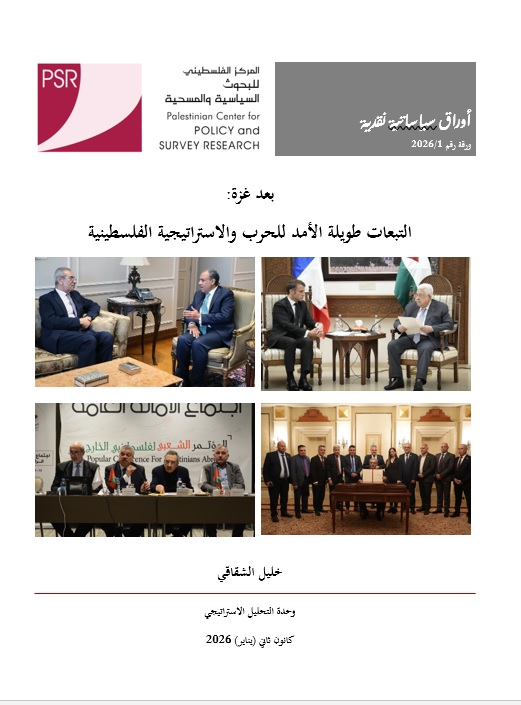
بعد غزة:
التبعات طويلة الأمد للحرب والاستراتيجية الفلسطينية
خليل الشقاقي
لم يكن هجوم حماس في 7 أكتوبر 2023، والحرب المدمرة التي تلته على مدى عامين، مجرد حلقة مأساوية أخرى من العنف؛ بل كان حدثًا مزلزِلاً ومزعزعًا للنظام القائم غيّر بشكل لا رجعة فيه الصراع الإسرائيلي-الفلسطيني والنظام الإقليمي. وبالنظر إلى العقد المقبل، من الواضح أن الحرب قد حطمت نموذج "إدارة الصراع"، وأثارت أزمة شرعية عميقة للقانون الدولي والدبلوماسية الغربية، وفاقمت من حالة الفراغ السياسي العميق داخل الحركة الوطنية الفلسطينية. تصف هذه الورقة تلك التطورات الناجمة عن السابع من أكتوبر وحرب غزة المتوقع أن تدوم طويلا بعد تلك الحرب وتناقش كيفية التعامل السياساتي الفلسطيني معها. تقوم الورقة بتحليل تلك التبعات الدائمة للحرب، وتقيّم خطة ترامب للسلام وإشكالياتها الجوهرية، وتحدد الخيارات الاستراتيجية المتاحة لقيادة فلسطينية تجد نفسها تتصارع مع واقع جديد ومحفوف بالمخاطر. تستنتج الورقة أن أي مسار للمضي قدمًا يجب أن يبدأ من تجديد سياسي فلسطيني داخلي وليس من خطط خارجية حيث أصبحت الاستراتيجيات التقليدية القديمة عقيمة بفعل عالم أعادت صياغته صدمة الحرب.
(1) التبعات طويلة الأمد لحرب غزة
لم تكن حرب غزة مجرد جولة أخرى في حلقة مألوفة من الحروب؛ بل كانت صدمة للمنظومة القائمة كلها. وكما في حربي 1948 و1967، فإن آثارها ستقاس بالتحولات المؤسسية والقيمية وفي المواقف التي ستستمر إلى ما بعد أي وقف لإطلاق النار أو خطة ترامب لغزة. لقد أطلقت سلسلة من التحولات الهيكلية التي ستحدد العقد المقبل من الصراع الإسرائيلي-الفلسطيني والشرق الأوسط الأوسع. هذه الاتجاهات ليست عناوين عابرة، بل هي إعادة تنظيم جوهرية في الرأي العام، والقوة السياسية، والمعايير الدولية.
أولاً، أدّت الحرب إلى إعادة اصطفاف في الرأي العام العالمي. ففي الولايات المتحدة، انفتح شرخ عميق بين الأجيال والأحزاب. تظهر استطلاعات الرأي التي أجرتها مؤسسة غالوب بين عامي 2023 و[1]2025، ومركز بيو للأبحاث في أكتوبر [2]2025، واستطلاع جامعة ميريلاند الذي أجراه د. شيبلي تلحمي في يوليو-أغسطس 2025[3] أنه في حين يظل كبار السن والجمهوريون مؤيدين لإسرائيل بقوة، فإن غالبية الديمقراطيين والناخبين تحت سن 35 عامًا يعبرون الآن عن تعاطف أكبر مع الفلسطينيين. وهذه الفئة، التي تتشكل آراؤها بفعل وسائل التواصل الاجتماعي وإطار العدالة الاجتماعية، تدعم بشكل متزايد ربط المساعدات الأمريكية لإسرائيل بشروط. وفي داخل حركة "ماغا" (اجعلوا أمريكا عظيمة مرة أخرى)، ظهرت نزعة انعزالية قائمة على مبدأ "أمريكا أولاً"، تشكك في تكلفة التدخلات الخارجية، بما في ذلك المساعدات لإسرائيل، مما خلق شرخًا في الإجماع الجمهوري المؤيد لإسرائيل الذي كان يومًا ما متماسكًا.[4] وتجدر الإشارة إلى أن هذه التحولات المهمة في الولايات المتحدة تحدث في وقت أصبحت فيه إسرائيل أكثر اعتمادًا على الولايات المتحدة من أي وقت مضى، حيث يتزامن ذلك مع زيادة الاعتماد العسكري الإسرائيلي على الولايات المتحدة، مما يخلق تحديات لصانعي السياسات ويزيد من نسبة الاعتقادات بأن الدعم الأمريكي هو عامل "وجودي" لإسرائيل.[5] ووفقًا لصحيفة "نيويورك تايمز"، فإن اعتماد إسرائيل على الدعم السياسي والعسكري والاقتصادي الأمريكي أصبح "فاضحا" خلال الحرب الأخيرة، مما يجعل المعركة على الرأي العام الأمريكي حاسمة بالنسبة للمنظور الاستراتيجي لإسرائيل.[6] وينعكس هذا الاتجاه في أوروبا، حيث أدت المظاهرات الشعبية وأنشطة الشباب إلى زيادة التكلفة السياسية للدعم غير المشروط لسياسات إسرائيل.[7] وفي العالم العربي، يظهر الباروميتر العربي في جولته الثامنة[8] بعد السابع من أكتوبر وبدء حرب غزة أن أغلبية كبيرة تعارض التطبيع مع إسرائيل في غياب تنفيذ خطوات موثوقة نحو إقامة الدولة، وتؤكد تلك الجولة وجود آراء سلبية حادة تجاه الولايات المتحدة. وستُقيّد هذه المواقف لدى الرأي العام العربي عملية اتخاذ القرارات بشأن خيارات السياسة المتعلقة بإسرائيل وفلسطين.
ثانيًا، حطّمت الحرب النهج أو النموذج المسمى «إدارة الصراع» الذي ساد عقداً كاملاً. فقد افترض هذا النهج الذي أصبح عقيدة راسخة إمكانية «احتواء» الصراع عبر التنسيق الأمني والحوافز الاقتصادية وإطفاء الحرائق دورياً، وتجاوز الحل السياسي. نسف هجوم 7 أكتوبر والحرب اللاحقة هذا الافتراض، إذ أعاد العنفُ القضيةَ الفلسطينية إلى مركز الدبلوماسية الإقليمية والدولية، وأثبت ذلك أنّ بقاء شعب تحت الاحتلال لفترة طويلة هو أمر لا يمكن تجاهله، وأن تجاوز الفلسطينيين (وهو افتراض بل وأساس «الاتفاقات الإبراهيمية») لن ينتج اندماجاً أو تكاملا إقليمياً مستداماً. لقد بات التطبيع السعودي–الإسرائيلي غير قابلٍ للتسويق سياسياً بلا مكاسب فلسطينية. في إسرائيل، لا يعني هذا بالضرورة إحداث تحول أو توجه نحو حل الصراع؛ بل قد يُفضي إلى مرحلة أشدّ فظاعة من الإكراه والعنف.
ثالثاً، عجّلت الحرب من ظهور تدهور خطير في مكانة السلطة الفلسطينية وأطلقت أزمة تمثيل عميقة. قبل الحرب، كانت شرعية السلطة متآكلة. وأظهرت استطلاعات المركز الفلسطيني للبحوث السياسية والمسحية وجود أغلبية كاسحة ترى السلطة فاسدة وتطالب برحيل الرئيس عباس.[9] وقد وفّرت الحرب فرصة للحكومة الإسرائيلية اليمينية المتطرفة والمستوطنين لإضعاف السلطة وجعلها عاجزة. وثبّتت سلبية السلطة وعجزها عن حماية الناس من قلة جدواها. وخلال الحرب، ظلّ أكثر من 80% يرون السلطة فاسدة ويطالبون برحيل الرئيس. كانت السلطة غائبة، وقواتها الأمنية عاجزة عن حماية البلدات والتجمعات الضعيفة من إرهاب المستوطنين، ولم يكن لها دور في نقاش «اليوم التالي». برزت حماس مثخنة الجراح لكنها «صامدة» سياسياً لدى شرائح من الجمهور، حتى مع تراجع قدرتها على الحكم في غزة. والنتيجة فراغ تمثيلي: سلطة ضعيفة في الضفة، وبقايا نفوذ لحماس ومجموعات مسلّحة أخرى في غزة.
وقد أفضى ذلك إلى بروز فراغ قيادي مكتمِل سمح بإعادة «تعريب» إدارة الصراع، وهي نتيجة رابعة طويلة الأمد للحرب. فمنذ أواخر الستينيات، صار «القرار الوطني الفلسطيني المستقل» عقيدة أساسية لمنظمة التحرير. أعادت حرب غزة عقارب الساعة إلى الوراء. وأصبحت "مجموعة الاتصال" المكونة من السعودية، ومصر، والأردن، وقطر، والإمارات محور التخطيط لـ«اليوم التالي»؛ واستعادت مصر مركزيتها في الحفاظ على الأمن على حدود غزة؛ واحتكرت قطر ومصر الوساطة في ملف الأسرى ووقف إطلاق النار؛ وربطت عواصم الخليج تمويل إعادة الإعمار بإصلاح السلطة وبوجود أفق سياسي ذي مصداقية. إن الدول العربية—خصوصاً مصر والسعودية وقطر—أضحت مهندسة «اليوم التالي»، وتولت فعلياً وكالة القرار الفلسطيني. ومنح القصف الإسرائيلي للدوحة في سبتمبر/أيلول 2025 القوى العربية والإقليمية الكبرى حافزاً إضافياً لتولي إدارة الصراع. وهي اليوم المحاور الرئيس لواشنطن، تحدد شروط الإعمار والحكم المستقبلي عودةً إلى ما قبل تأسيس منظمة التحرير. وسيستمر هذا التطور ما دامت المؤسسات الفلسطينية تفتقر إلى الشرعية والقدرة، وما دام الغرب يُفوّض الاستقرار لشركائه العرب. وحتى يعيد الفلسطينيون بناء جسم وطني تمثيلي وشرعي، سيُدار الملف من العواصم العربية.
خامساً، قادت صدمة 7 أكتوبر إلى تصلّب خطِر في المجتمع الإسرائيلي وصعود سياسي متزايد لليمين الديني–القومي المتطرف. لم تُنتِج الصدمة مراجعة واسعة لمخاطر استمرار الاحتلال، بل عززت من الاحساس بالتهديد ودفعت المركز السياسي أكثر نحو اليمين. ويمكن أن يؤدي الاعتماد الإسرائيلي المتزايد على الولايات المتحدة الأقل تعاطفًا معها، كما رأينا أعلاه، إلى زيادة إحساس إسرائيل بضعفها ويدفعها لزيادة الاعتماد على القوة الغاشمة لدرء التهديدات المستقبلية المحتملة. بات المشهد واضحاً: انحسر معسكر السلام؛ وبات حل الدولتين يشكل خطراً؛ وتعزّزت المطالبات بالضم والانتقام. وترجم وزراء اليمين المتطرف وحركات المستوطنين ذلك إلى سياسات: تسريع الاستيطان وتقنين البؤر، استحداث أدوات مالية وإدارية لتعميق السيطرة، إفلات أكبر من العقاب على عنف المستوطنين، وخطاب أمني يقدّم الهيمنة على التوافق والحلول الوسط. بل إن السردية الإسرائيلية الغالبة اليوم للسابع من أكتوبر ليست الإيمان بحدوث فشل سياساتي، بل فشل في فرض الإرادة، بما ينتجه ذلك من رفض واسع للتسوية وخطاب يتمحور حول السيطرة الأمنية الدائمة. صارت أحزاب دينية–قومية مسيانية (أو خلاصية) كانت هامشية قبل بضع سنوات فقط مركزية في صنع القرار، وهي تدفع نحو ضمّ فعلي في الضفة وتكريس واقع دولة واحدة بحقوق غير متساوية. ويضمن هذا التحول عدم وجود أي حكومة إسرائيلية لديها التفويض السياسي لاتفاق سلام حقيقي في المستقبل المنظور. وبالتوازي، عادت صراعات ما قبل الحرب، أي الصراعات المدنية–العسكرية والدستورية (إصلاح القضاء، تجنيد الحريديم)، لتضع ائتلاف اليمين الشعبوي في مواجهة تيارات وسطية وليبرالية، بما فيها شبكات جنود الاحتياط. سيشهد العقد المقبل صراعاً داخلياً على طابع إسرائيل الديمقراطي وهويتها الدستورية يتعايش مع إجماع سياسي يرفض التنازلات الجوهرية من أجل السلام.
سادساً، أتاحت الحرب لإيران أن تُظهر قدرتها على التأثير في مستقبل المنطقة. لقد غيّر أداء «محور المقاومة» خلال الحرب—برغم كلفته الباهظة على ذلك المحور—معادلات الشرق الأوسط برمّتها، فزاد من حالة عدم الاستقرار واحتمالات الحرب. في هذا السياق، نجحت الحرب في تعطيل جهود التطبيع الفوقي بقيادة الولايات المتحدة، مانحةً المحور نصراً استراتيجياً. فقد جعلت التطبيع السعودي–الإسرائيلي مستحيلاً، وأعادت ربط الدبلوماسية الإقليمية بالقضية الفلسطينية. وبينما كانت التكلفة على إيران وحلفائها مدمرة، زاد المحور من رأسماله السياسي من خلال إظهار قدرة قسرية متكاملة: ضغط مدروس على شمال إسرائيل، ونيران بعيدة المدى، وتعطيل لممر بحري أساسي. رفعت هذه الأدوات كلفة التطبيع الذي يتجاوز الفلسطينيين؛ وربطت الرياض التطبيع بخطوات ذات مصداقية نحو الدولة الفلسطينية. والأهم من ذلك، جعلت الحرب المنطقة أكثر تقلباً وانكشافا وضمنت بقاء الصراع بؤرة اشتعال متقد بانتظار مواجهة أوسع. يتميز الشرق الأوسط اليوم بكونه مسرحا لعدم استقرار مزمن منخفض الوتيرة ومتعدد الجبهات، ولم يعد مجموعة أزمات معزولة، وأضحت القضية الفلسطينية مندمجة في تلك المنافسة الاستراتيجية الدامية.
أخيراً، فجّرت الحرب أزمة عميقة في النظام القانوني والمعياري الدولي. فقد رسخت إجراءات محكمة العدل الدولية والمحكمة الجنائية الدولية، إلى جانب الحملة السياسية على «الأونروا»، انطباعاً واسعاً في الجنوب العالمي بازدواجية المعايير الغربية. وأسّس تعليق تمويل «الأونروا» والضغط على الفاعلين الإنسانيين سابقة خطيرة. إن الأثر بعيد المدى واضح: ستفقد مزاعم الغرب بقيادة «نظام قائم على القواعد والأنظمة ذات الطابع العالمي» وزنها الأخلاقي حيث تظهر بوضوح الانتقائية في الالتزام بهذا النظام. لقد قَوّض التباين بين التزام الغرب بالقانون في أوكرانيا وتوفير غطاء دبلوماسي وعسكري لإسرائيل في غزة مصداقيته الأخلاقية، وأضعف شرعية المؤسسات الدولية وسرّع الانتقال إلى عالم أكثر تجزؤاً وتعدداً، يُنظَر فيه لـ«النظام القائم على القواعد» كأداة قوة وليس كمجموعة مبادئ كونية.
(2) عدم الثقة بإسرائيل، وفقدان الغرب لقوته الناعمة، وخطة ترامب
رافقت النتائج بعيدة المدى للحرب تطورات أخرى قد لا تكون نتيجة مباشرة أو قد لا تبلغ الديمومة ذاتها، لكنها تحمل آثاراً على الاستراتيجية الفلسطينية المقبلة: (1) إذ تُشكك في جدوى أي اتفاقات مستقبلية مع إسرائيل؛ (2) وتؤثر في بنية النظام الدولي الصاعد ومعاييره، بما قد ينعكس على المصالح الفلسطينية طويلة الأمد؛ و(3) وتؤطر لسياسة فلسطينية قصيرة المدى حيال غزة وخطة ترامب ذات النقاط العشرين.
الانطباعات السائدة بعدم موثوقية إسرائيل: أفرزت تجربة مفاوضات حرب غزة انطباعاً واسعاً لدى الفلسطينيين والعرب بأن إسرائيل لا تفاوض بحسن نية، وتستغل الغموض، وتؤجل الالتزامات الجوهرية، ولها تاريخ في التنصّل من الاتفاقات. لن يقوض ذلك من إمكانيات التفاوض بشكل كامل—فالحاجة إلى الاستقرار والصفقات التكتيكية ستبقي المحادثات قائمة —لكنه قد يحدّ من جدوى الاتفاقات ويغير كيفية تصميمها وتسويقها. لقد انتهى عهد «بناء الثقة» والتدرّج (كما في أوسلو). وستتسم المفاوضات المقبلة بالصفقات المتبادلة بدلاً من الثقة، حيث ستتطلب كل خطوة تحققًا وإنفاذًا دقيقين.
بالنسبة للفلسطينيين، يعني ذلك المطالبة بتنازلات فورية وضمانات قوية من أطراف ثالثة. حفاظاً على شرعيتها، ستحتاج أي قيادة سلطة قادمة لنبذ الاتفاقات المرحلية والمطالبة بخطوات لا رجعة فيها نحو السيادة منذ البداية. وبالنسبة للدول العربية، يزيد هذا التصور بشكل كبير من المخاطر السياسية للتعامل مع إسرائيل. سيُصرّ الوسطاء كالقاهرة والدوحة على دعم أميركي ودولي أوسع لضمان الامتثال، فيما سيجعل «المطبّعون» المحتملون—ولا سيما السعودية—أي اتفاق مرتهناً بضمانات أميركية وتقدّم ملموس وفوري نحو دولة فلسطينية. لقد ارتفع ثمن التطبيع كثيراً. وغدا نموذج ترحيل القضايا الجوهرية عملا متهوراً، مما يستدعي المطالبة بتنازلات إسرائيلية ملموسة في بداية أي مسار، مما يخلق عائقًا أعلى بكثير للنجاح الدبلوماسي.
التغيير المعياري والهيكلي في النظام الدولي: توطئةً للنتيجة السابعة للحرب كما ذكرنا أعلاه، خلّفت تلك الحرب جرحاً عميقاً في مصداقية الولايات المتحدة وأوروبا في العالم العربي والجنوب العالمي. لقد حطمت ازدواجية المعايير—بين خطاب القانون في أوكرانيا والدعم الدبلوماسي والعسكري لإسرائيل—ادعاء الغرب بقيادة «نظام قائم على القواعد». ليس هذه خلافاً عابراً، بل أزمة شرعية بنيوية. يحدث هذا الفراغ في المصداقية المعيارية في لحظة تحوّل بنيوي عالمي، ما يخلق فرصة استراتيجية للقوى غير الغربية وغير الأعضاء في الناتو كالصين وروسيا. تقدّم الصين، خصوصاً، بديلاً براغماتياً متوقعاً. إذ تقوم سياستها الخارجية على «عدم التدخل» وشراكات اقتصادية تبادلية تُرضي أنظمة سئمت «محاضرات» حقوق الإنسان. تستمد بكين مصداقيتها لا من رؤية أخلاقية مشتركة بل من موثوقيتها كشريك اقتصادي ومورّد سلاح، ومن خطابها المتسق (ولو كان مصلحيا) عن السيادة والتعددية القطبية. أما روسيا فتوفر سلاحاً، لكن لن يُنظر إليها كحليف استراتيجي؛ إذ قيّدت حرب أوكرانيا يدها عن إسناد حلفائها، كما ظهر في سوريا وإيران وفنزويلا وكوبا.
ستكون عواقب «تعددية القطبية» وتراجع القوة الناعمة الغربية صعبة التنبؤ. وعلى الأرجح ستبقى الولايات المتحدة— على الأقل في المدى المتوسط—الضامن الأمني الأول للمنطقة، لكن نفوذها سيغدو معتمدا أكثر وأكثر على الصفقات المصلحية التبادلية. وستواصل الدول العربية التحوط من خلال الموازنة بتنويع الشراكات—الاعتماد على واشنطن أمنياً، وعلى الصين اقتصادياً وتكنولوجياً وتسليحاً، وعلى روسيا في احتياجات أمنية واقتصادية انتقائية. لقد ضعفت قدرة الغرب على بناء ائتلافات واسعة والقيام بدور حكم أخلاقي، مُدشّناً نظاماً عالمياً أكثر تجزؤاً وتنافسية وأكثر اتجاها نحو التعددية القطبية. لقد كان تقسيم فلسطين في عام 1947 نتاجًا للنظام الدولي القائم على قواعد رسمتها الولايات المتحدة والدول المنتصرة بعد الحرب العالمية الثانية، ومع ذلك بقي ذلك التقسيم غير متحقق. أما النظام الجديد قيد التبلور فلا يَعِد الفلسطينيين لا بالاستقلال ولا بالمساواة؛ ونيل أي منهما سيتوقف على قدرتهم على تحديد مكانتهم وتشكيل مستقبلهم داخل هذا المشهد الجديد.
خطة ترامب للسلام: هدنة، لا سلام: إن خطة ترامب ذات العشرين نقطة لقطاع غزة—التي أرست وقف إطلاق نار وتبادل أسرى في مرحلتها الأولى في أواخر 2025، وأنشأت اللجنة الوطنية لإدارة غزة والهيئة التنفيذية لمجلس السلام غير الفلسطينية تحضيراً للمرحلة الثانية—ليست خريطة طريق لسلام مستدام، بل ترتيبٌ مهدد بالتجزئة والتعثر، يحقق أهدافاً فورية ويفشل استراتيجياً. فهندستها لا تنسجم مع الواقع السياسي، فتخلق «توقفا» في الحرب ولكن ليس مسارًا لحل الصراع الفلسطيني-الإسرائيلي الأكبر. فهي غير مستدامة بسبب وجود خمسة تحديات أساسية: (1) من المرجح أن يكون مطلبها بنزع سلاح حماس في غياب سلام أوسع ونهاية للاحتلال غير واقعي؛ إذ لن تقبل الجماعات الإسلامية التسليم بانكشافها المطلق أمام ضربات إسرائيل أو مجموعات موالية لها، ولديها في ذلك تأييد شعبي واسع—حتى داخل غزة—حيث تنعدم الثقة بالخارج وتبقى مخاوف التهجير والإبادة وتظل، في هذا الصدد، حماس وأسلحتها الرافعة الوحيدة التي يشعر بها سكان غزة. (2) إن نموذج الحكم المقترح—أي لجنة إدارية بإشراف أجنبي وقوة عسكرية خارجية بقيادة أميركية—هي صيغة «انتداب جديد» تنفي الوكالة الفلسطينية وتفتقر لشرعية محلية. ورغم أن اللجنة الإدارية ستتمتع بلا شك، في المدى القصير، بدعم كبير من سكان غزة، فإن عجزها عن تجاوز القيود الإسرائيلية أو تنفيذ الأجندة السياسية الأمريكية سيجعلها عاجزة وغير قادرة على تغيير الواقع على الأرض بشكل كبير لأكثر من مليوني غزي .(3) ينظر الفلسطينيون إلى "الأفق السياسي" الغامض للخطة، وهم محقون في ذلك، على أنه تهرب متعمد من قضايا السيادة الأساسية، بما في ذلك القضايا المتعلقة بالحدود والقدس، مما يجعل من المستحيل على أي زعيم فلسطيني أن يرى فيها أي شيء آخر غير "صفقة القرن" المشؤومة لعام 2020. (4) على الرغم من زيادة الرغبة الأمريكية في استخدام النفوذ للضغط على إسرائيل، تظل الخطة خاضعة لحق النقض السياسي الإسرائيلي، حيث ستكون أي حكومة يمينية صاحبة حق فيتو سياسي؛ إذ يعتمد نجاح الخطة على وجود شريك إسرائيلي وهمي لا تسمح به خريطة الحكم اليمينية المقيدة بأحزاب متطرفة تعارض الدولة الفلسطينية. (5) وأخيرًا، تفشل الخطة في حل أزمة التمثيل الفلسطيني، متجاوزة السلطة الفلسطينية بينما تتوقع منها الإصلاح، وتتفاوض مع حماس بينما تسعى إلى تهميشها.
وعليه، لن تُوحّد الخطة الضفة وغزة؛ بل ستُكرّس الانفصال من خلال إنشاء مسار حكم منفصل لقطاع غزة. وسيتم تقييد إعادة الإعمار بشدة بسبب المخاوف من تكرار تجارب العقد الماضي عندما دمرت العمليات العسكرية الإسرائيلية المتكررة جميع الاستثمارات في البنية التحتية والمنازل من قبل مصر وقطر والإمارات العربية المتحدة وغيرها. لذلك، ستكون إعادة الإعمار بطيئة ومشروطة بشدة، وليست إعادة تطوير شاملة.
إن الطريق الوحيد لتجاوز هذه الإشكالات هو قلب منطق الخطة: إعطاء الأولوية للانتخابات الفلسطينية الشاملة لإنتاج قيادة وطنية شرعية، وتحديد حل الدولتين أفقا سياسيا مبنيا وفق القانون الدولي، وجعل نزع السلاح نتيجة لتسوية نهائية لا شرطاً مسبقاً. دون ذلك ستكرر الخطة ببساطة إخفاقات الماضي.
(3) الخيارات الفلسطينية: استراتيجية وطنية جديدة
يجب أن تأخذ الاستراتيجية الفلسطينية الجديدة في الاعتبار جميع التبعات طويلة المدى لما بعد 7 أكتوبر—فتعترف بقيودٍها طويلة الأمد وتلتقط الفرص الناشئة، بما في ذلك ما يتيحه مسار النقاط العشرين من أمور إيجابية في خطة ترامب. إن من الواضح أن صعود اليمين الديني–القومي في إسرائيل، وأزمة القيادة الفلسطينية، وانهيار أوسلو، وانعدام الثقة بموثوقية الحكومات الإسرائيلية، كلها تضع الفلسطينيون عند مفترق استراتيجي. لقد انقضى زمن الاعتماد على وساطة الدبلوماسية الأميركية التقليدية.
إن من الواضح أن الحفاظ على البقاءُ الوطني يستلزم إعادة تأطير جذرية تبدأ بإعادة بناء الشرعية. إن الخطوة الأولى والأكثر إلحاحًا هي إقامة علاقة وثيقة وعملية مع اللجنة الوطنية الإدارية للقطاع وإجراء انتخابات رئاسية وتشريعية شاملة في الضفة الغربية وقطاع غزة، بآليات تكفل المشاركة. وهذا هو المسار الوحيد للحفاظ على الروابط مع قطاع غزة ولإنتاج قيادة جديدة شرعية ذات تفويض شعبي. وبعد الانتخابات، يجب تشكيل حكومة وحدة وطنية ذات تفويض واضح للقيام بالإصلاح الداخلي المطلوب بما في ذلك ما يلي: استعادة الحوكمة الصالحة وتوفير الخدمات الأساسية في الصحة والتعليم والأمن لكلا المنطقتين؛ الالتزام التام بالقانون الأساسي وتعديل جميع التشريعات التي صدرت بعد عام 2007 المخالفة لذلك القانون؛ توحيد المؤسسات العامة في الضفة الغربية وقطاع غزة؛ واتخاذ خطوات ذات مصداقية ضد الفساد، بما في ذلك إنشاء هيئة قضائية مستقلة لمكافحة الفساد.
بالتوازي مع ذلك، يجب إعادة بناء منظمة التحرير كمؤسسة فاعلة وتمثيلية لا قشرة فارغة. إن هذا يتطلب إجراء انتخابات لهيئاتها الحاكمة في الضفة الغربية وغزة والشتات، باستخدام جميع الوسائل التكنولوجية المتاحة لضمان مشاركة فلسطينية واسعة. يجب أن تتمتع منظمة التحرير الفلسطينية الجديدة بشرعية انتخابية، وأن يعاد تشكيلها لتشمل جميع الفصائل الرئيسية، وأن تلتزم بقواعدها وأنظمتها الداخلية، وألا تخضع بعد الآن لأهواء فرد واحد أو نخبة صغيرة. وفقط في ظل هذه الظروف يمكن لمنظمة التحرير الفلسطينية أن تعمل مرة أخرى كجهة وحيدة موثوقة للمفاوضات الدولية.
خارجيًا، يجب أن تبتعد الاستراتيجية الجديدة عن الارتهان أو الاعتماد شبه الكامل على الولايات المتحدة وأن تسعى نحو تبنى تعددية دولية قائمة على القيم والمبادئ. إن هذا يتطلب تعزيز التحالفات مع الدول الداعمة في الجنوب العالمي وفي أوروبا التي أظهرت التزامًا بالقانون الدولي. ويعني أيضًا التعامل مع قوى مثل الصين وروسيا ليس كمنقذين، بل كثقل جيوسياسي ذي قدرة على خلق حالة من التوازن في مجلس الأمن التابع للأمم المتحدة لعرقلة المبادرات التي تضر بالمصالح الفلسطينية. علاوة على ذلك، يجب تحويل الاستخدام المنهجي للمؤسسات القانونية الدولية — مثل محكمة العدل الدولية والمحكمة الجنائية الدولية — من تكتيك إلى ركيزة استراتيجية أساسية. ستعيد هذه "الحرب القانونية" صياغة الصراع كنضال ضد احتلال غير قانوني ذي عواقب قانونية واضحة، مما ينقل عبء الامتثال إلى إسرائيل كدولة احتلال وداعميها الدوليين.
وأخيراً، يجب إعادة تعريف الهدف الوطني بما ينسجم مع اتجاهات الرأي العام العالمي والواقع على الأرض. فنظرًا للاتجاهات السياسية الراهنة داخل إسرائيل، يبدو نموذج حل الدولتين التقليدي غير واقعي حاليًا. وبينما لا ينبغي التخلي عن هدف الدولة ذات السيادة، فإن المسار الأجدى هو تحويل النضال الآني من صراع حول الدولة إلى تحقيق الحقوق غير القابلة للتصرف: تقرير المصير؛ المساواة المدنية والسياسية الكاملة لكل من يعيش بين النهر والبحر؛ والعدالة للاجئين على أساس القانون الدولي.
إن هذا الإطار القائم على الحقوق يتمتع بميزة استراتيجية؛ إذ يستند إلى تغيّر المزاج العالمي ويجبر العالم على الاختيار بين دعم الحقوق المتساوية أو تأييد نظام التفوق العرقي، ويحول النضال الفلسطيني من نزاع إقليمي مستعصٍ إلى حركة عالمية مناهضة للفصل العنصري — وهو ميدان ستكون فيه إسرائيل أكثر ضعفًا. كما يوفّر هذا الإطار استراتيجية قائمة على الوحدة الداخلية والتحالفات الدولية ونضالٍ حقوقي المسارَ، وهو المسار الأكثر فاعلية للفلسطينيين لاستعادة تأثيرهم وقرارهم المستقل. ومن الأهمية بمكان أن يُبقي الإطار القائم على الحقوق كلا الأفقين أو الحلين النهائيين—المساواة في دولة واحدة والسيادة في دولتين—مفتوحين، فيما يُقدّم الأولوية الآن لمعركة الحماية والحرية الملموستَين.
(4) الخلاصة:
كانت حرب غزة حدثاً مفصلياً حطم أوهام "إدارة الصراع" وكشف عن الاهتراء العميق في كل من النظام الدولي والنظام السياسي الفلسطيني. وقد خلقت التبعات بعيدة المدى لهذه الحرب مشهداً استراتيجياً جديداً وأكثر خطورة. وفي هذه البيئة، فإن الأطر المفروضة من الخارج، مثل خطة ترامب، التي تتجاهل القضايا الجوهرية المتعلقة بالشرعية السياسية والسيادة، مصيرها الفشل. فقد تحقق هذه الخطط هدنةً أو وقفاً مؤقتاً للقتل الجماعي، لكنها لا تستطيع بناء سلام دائم.
بالنسبة للشعب الفلسطيني، فإن المسار للمضي قدماً لا يكمن في أروقة العواصم الأجنبية، بل في العمل الشاق والجوهري للتجديد الوطني. إن أزمة القيادة العميقة ليست مجرد عرض من أعراض استعصاء الصراع؛ بل هي عقبة رئيسية أمام حله. والاستراتيجية الوحيدة القابلة للتطبيق هي تلك التي تبدأ بإعادة بناء الشرعية الداخلية من خلال انتخابات ديمقراطية ووحدة وطنية. حينها، يمكن لقيادة فلسطينية متجددة وتمثيلية أن تتحول إلى استراتيجية عالمية جديدة: استراتيجية تتجاوز العملية الفاشلة التي تقودها الولايات المتحدة، لتبني بدلاً من ذلك تحالفاً دولياً واسعاً يرتكز على القانون الدولي ومطلب غير قابل للتفاوض بالمساواة في الحقوق. هذا طريق طويل وشاق، لكنه الطريق الوحيد الذي يوفر فرصة لكسر حلقة العنف المأساوية، ومعالجة الأزمتين المزدوجتين المتمثلتين في الاحتلال والشرعية الداخلية، اللتين لا تزالان تعصفان بالشعب الفلسطيني.
[1] يجد القارئ هنا مقارنة مختصرة:
https://www.axios.com/2025/07/29/israel-military-gaza-us-approval-low-gallup-survey والمزيد من التفاصيل هنا: https://news.gallup.com/poll/692948/u.s.-back-israel-military-action-gaza-new-low.aspx
[2] يجد القارئ هنا مقارنة تفصيلية للنتائج خلال عامي الحرب:
[3] https://sadat.umd.edu/sites/sadat.umd.edu/files/Questionnaire%20July%20August%202025%2009122025.pdf
[4] أنظر لهذا التقرير من نوفمبر 2025:
https://www.npr.org/2025/11/07/nx-s1-5558286/israel-republicans-antisemitism-carlson, وهذا التقرير لقناة فوكس الإخبارية في يناير 2026:
https://foxbaltimore.com/station/share/republican-split-on-israel-grows-wider-amid-conservative-infighting-gaza-war-donald-trump-jd-vance-tucker-carlson-ben-shapiro-megyn-kelly-steve-bannon; https://mondoweiss.net/2025/12/new-poll-shows-young-republicans-turning-against-israel/
[5] Leon Hadar, “Israel Is Growing More Dependent on a Less Sympathetic United States,” The National Interest, July 1, 2025: https://nationalinterest.org/blog/middle-east-watch/israel-is-growing-more-dependent-on-a-less-sympathetic-united-states.
[6] يمكن مراجعة تقرير نيويورك تايمز هنا:
https://www.nytimes.com/2025/10/12/world/middleeast/israel-us-polls-support.html
[7] أنظر مثلا هنا:
https://yougov.co.uk/international/articles/52279-net-favourability-towards-israel-reaches-new-lows-in-key-western-european-countries, وتجد هنا ملخصا بنتائج هذه الاستطلاعات والتوجهات:
[8] يمكنك الحصول على التفاصيل المتعلقة بنتائج الباروميتر العربي لجولة 2023-24 هنا:
https://www.arabbarometer.org/2025/01/support-for-the-two-state-solution-is-shifting-unexpectedly/, and here: https://www.arabbarometer.org/media-news/press-release-foreign-affairs-article-how-arab-public-opinion-constrains-normalization-with-israel/
[9] يمكنك الاطلاع على استطلاعات المركز الفلسطيني للبحوث السياسية والمسحية خلال فترة الحرب هنا: