
With rising confidence that parliamentary elections will indeed take place soon, and given clear anxieties about the possibility that the siege and blockade over the Gaza Strip could then be tightened, the split consolidated, and that economic conditions could worsen, and given concerns about the potential reaction from the international community and Israel, public attitudes seem to shift a little in favor of Fatah and away from Hamas 
14-19 March 2021

These are the results of the latest poll conducted by the Palestinian Center for Policy and Survey Research (PSR) in the West Bank and the Gaza Strip between 14-19 March 2021. The period before the conduct of the poll witnessed several developments including the announcement of a presidential decree to hold parliamentary elections on 22 May and presidential elections on 31 July 2021. It also witnessed a significant rise in number of coronavirus deaths and infections. The coronavirus vaccine was not made available in large numbers by the PA government during the period before the conduct of the poll. A limited vaccination process did however start using a small quantity that was made available to the PA. The process however was marred by accusations of favoritism and lack of transparency. The ICC issued a statement affirming jurisdiction over the occupied Palestinian territories. Joe Biden assumed his position as the new US president during this period. Israel announced the holding of new parliamentary elections to take place on 23 March. This press release addresses these issues and covers other matters such as the general conditions in the Palestinian territories, the peace process and the future possible directions for Palestinians in the absence of a viable peace process. Total size of the sample is 1200 adults interviewed face to face in 120 randomly selected locations. Margin of error is +/-3%.
For further details, contact PSR director, Dr. Khalil Shikaki, or Walid Ladadweh at tel. 02-296 4933 or email pcpsr@pcpsr.org.
Main Findings:
The focus of our poll for the first quarter of 2021 has been placed on the expected election process. Findings show that the overwhelming majority is still in favor of holding these elections and that the public is much more optimistic that these elections will indeed take place soon. This realization seems to have impacted attitudes and voting intentions, which are now probably more serious and calculated. The poll sought to explore public priorities and expectations in these elections. In particular, we sought to examine the likely consequences of the election results, particularly if Hamas wins and forms a government. The poll sought also to understand the implications of the emergence of rivals to Fatah, from within its own ranks, to the movement’s performance in the elections.
Findings show that the top priorities in these elections for the voters are four: the unification of the West Bank and the Gaza Strip, improving economic conditions, combating corruption, and the removal of the siege and blockade over the Gaza Strip. The largest percentage believes that a Hamas electoral victory would most likely have a negative impact on all these priorities except combating corruption where no negative impact is expected. These expectations might have affected voting intentions as the findings indicate a rise in the vote for Fatah and a decline in the willingness to vote for Hamas compared to our findings three months ago.
Fatah does have its own problems, particularly in the Gaza Strip, because of the probable competition over the likely Fatah’s votes from two independent electoral lists of Mohammad Dahlan and Naser al Qidwah. More seriously, if Marwan Barghouti decides to have his own electoral list, Fatah’s vote would split into two equivalent shares. As for other third parties outside Fatah and Hamas, such as those of the left, Salam Fayyad’s, Hasan Khraishah’s, and others, it is probably too early to reach definitive conclusions at this stage regarding the likelihood that most of these lists would pass the 1.5% electoral threshold. The findings do show that al Mubadarah, led by Mustafa Barghouti, and the Popular Front for the Liberation of Palestine would probably succeed in passing that threshold. For the presidency, the findings indicate a limited increase in public demand for Abbas’ resignation despite the fact that he is doing better than he did three months ago in a competition with Hamas’ leader Ismael Haniyyeh. The findings make it clear however that the public prefers to see Marwan Barghouti as the next president of the PA as he is preferred over all other potential candidates including Fatah’s Abbas and Hamas’ Haniyyeh.
In other domestic issues, public attitudes seem stable compared to three months ago. This applies to the perceptions of safety and security as well as corruption within the PA. There is however a limited rise in optimism regarding reconciliation and in the perception that people can criticize the PA without fear. Slightly less than what we found three months ago, a large segment of the public, almost half, is still reluctant or unwilling to be vaccinated.
On the peace process, findings show that support for the two-state solution remains unchanged. Similarly, public preference for armed struggle vs. negotiations remains almost unchanged. But findings do show that a majority is opposed to a return to an unconditional bi-lateral Palestinian-Israeli negotiation despite the optimism generated by the election of the new Biden Administration. On the other hand, despite its recent decision to assert jurisdiction over the occupied Palestinian territories, the public is not optimistic about the ability of the International Criminal Court, to restrict Israeli behavior in the occupied territories. In fact, a large majority thinks that no Israeli official will ever be prosecuted by the court.
(1) Legislative and presidential elections:
- Great increase in public expectations that elections will take place soon from 32% to 61%
- But only 42% expect the elections to be free and fair
- In the West Bank and the Gaza Strip, the largest percentage wants Fatah to form the next government
- IF Marwan Barghouti forms a separate electoral list, Fatah would split into two equivalent parts and if Dahlan and Qidwah form their own separate electoral lists, Fatah would be weakened
- 57% support the formation of a joint Fatah-Hamas list
- In new legislative elections, Fatah receives 43% of the vote and Hamas 30%; and in an election in which Dahlan and Qidwah participate with two electoral lists, Fatah receives only 32% of the vote
- Top priorities of the voters are four: the unification of the West Bank and the Gaza Strip, improving economic conditions, combating corruption, and removing the siege on the Gaza Strip
- Hamas is seen less able to remove the siege and improve economic conditions and Fatah is seen as less able to combat corruption
- Most respondents want Marwan Barghouti president of the PA and in a trilateral election between Marwan Barghouti, Mahmoud Abbas, and Ismail Haniyyeh, the first receives 48% of the vote, the second 29% and the third 19%
76% demand the holding of general legislative and presidential elections and 61% expect parliamentary elections to take place soon. Three months ago, only 32% expected the holding of Palestinian elections soon. If Israel refuses to allow elections to take place in the occupied City of East Jerusalem, 65% believe elections should nonetheless take place and that East Jerusalemites should be allowed to vote in places in the Jerusalem district just outside the city limits; 27% oppose that and demand the cancelation of elections if Israel does not allow East Jerusalemites to vote in their city. Three months ago, only 56% supported, and 39% opposed, the holding general elections if Israel does not allow them in East Jerusalem. But only 42% believe the elections will be free and fair and 48% think they will not be free and fair. Moreover, 69% believe that if Hamas wins the elections, Fatah will not accept the results and 60% say that if Fatah wins the elections, Hamas will not accept that outcome.
Legislative Elections:
In an open-ended question, we asked the public to name the party or faction it nominates to lead the next PA government: 38% (40% in the West Bank and 34% in the Gaza Strip) nominated Fatah; 22% (15% in the West Bank and 33% in the Gaza Strip) nominated Hamas, 5% nominated an independent list, 2% nominated the Popular Front for the Liberation of Palestine (PFLP), 4% nominated other groups, and 29% did not nominate any party of faction. When asked about its expectations for the winner, 45% expected Fatah to win, 23% Hamas, 18% third or newly created parties.
The poll sought to assess the role played by three prominent individuals associated with Fatah on the likely consequences for the movement if the three decide to run with their own independent lists:
| If Marwan Barghouti forms his own independent list, 28% of the public say they will vote for his list while 22% say they will vote for the official Fatah list formed by president Abbas. |
| If Mohammad Dahlan forms his own independent list, 10% of the public say they will vote for his list while 29% say they will vote for the official Fatah list. The percentage of those voting for Dahlan’s electoral list rather than Fatah’s is higher in the Gaza Strip (17%) compared to the West Bank (5%) in refugee camps (14%) compared to villages/towns and cities (4% and 11% respectively), among refugees (14%) compared to non-refugees (7%), among those with the least income (16%) compared to those with the highest income (7%), among the unreligious and the somewhat religious (14% and 12% respectively) compared to the religious (6%), and among those whose age is between 18 and 22 years (12%) compared to those whose age is over 50 years (8%). |
| If Naser al Qidwah forms his own independent list, 7% of the public say they will vote for his list while 30% say they will vote for the official Fatah list. If Marwan Barghouti gives his support to al Qidwah’s list, support for it would rise to 11% and support for Fatah’s would drop to 28%. The percentage of those voting for Qidwah’s list rather than Fatah’s is higher in the Gaza Strip (10%) than in the West Bank (5%), in refugee camps (12%) compared to villages/towns and cities (2% and 7% respectively), among refugees (9%) compared to non-refugees (4%). |
A majority of 57% say they support and 38% say they oppose the formation of a joint Fatah-Hamas list to compete in the upcoming parliamentary elections. Support for a joint Fatah-Hamas list is higher in the West Bank (62%) than in the Gaza Strip (49%), in villages/towns and refugee camps (67% and 64% respectively) compared to cities (54%), among those who finished elementary school only (75%) compared to those who hold a BA degree (49%), among women (59%) compared to men (54%), among those who work in the private and non-governmental sectors (59%) compared to those who work in the public sector (53%), among the married (58%) compared to the unmarried (51%), among those with the least income (53%) compared to those with the highest income (42%), among the religious (61%) compared to the unreligious and the somewhat religious (39% and 55% respectively), and among supporters of third parties and Hamas (65% and 60% respectively) compared to supporters of Fatah (49%).
We asked the public which electoral list it will vote for in the upcoming elections. We sought to ascertain how respondents will vote in four different scenarios: (1) when the electoral lists are identical to those of 2006 elections, (2) when a joint Fatah-Hamas list is formed and Marwan Barghouti forms his own list, (3) when no joint list is created but Marwan Barghouti forms his own independent list, and (4) when no joint list is created and a Naser al Qidwah’s list replaces that of Marwan Barghouti’s. Here are the findings among those who say they intend to vote:
| 2006 lists: if new legislative elections were held today with the participation of all factions, 75% say they would participate in such elections. Of those who would participate, 30% say they will vote for Hamas and 43% say they will vote for Fatah, 8% will vote for all other third parties combined, and 18% are undecided. Three months ago, vote for Hamas stood at 34% and Fatah at 38%. Vote for Hamas in the Gaza Strip stands today at 36% (compared to 43% three months ago) and for Fatah at 32% (compared to 29% three months ago). In the West Bank, vote for Hamas stands at 25% (compared to 26% three months ago) and Fatah at 53% (compared to 45% three months ago). Support for Fatah is higher in villages/towns (55%) compared to refugee camps and cities (31% and 43% respectively), among those whose age is between 18 and 22 years (59%) compared to those whose age is over 50 years (36%), among those whose income is much higher than the poverty line (61%) compared to those whose income is much lower (38%), among those who think that a Hamas electoral victory would mean greater tightening of the siege on the Gaza Strip (50%) compared to those who think Hamas’ victory would lead to the lifting of the siege (24%), among those who think Hamas’ victory would lead to the worsening of economic conditions (54%) compared to those who think Hamas’ victory would lead to an improvement in economic conditions (12%), among those who think that Hamas’ victory will lead to greater split (57%) compared to those who think Hamas’ victory will lead to the strengthening of unity (17%). |
| Joint Fatah-Hamas list and a list for Marwan Barghouti: in this scenario, 78% indicate they will participate in the elections. Of those participating, 44% (41% in the West Bank and 48% in the Gaza Strip) say they will vote for the joint list, 28% (38% in the West Bank and 15% in the Gaza Strip) will vote for Marwan Barghouti’s list, 8% (2% in the West Bank and 15% in the Gaza Strip) will vote for Mohammad Dahlan’s list, 6% will vote for leftist and other lists, and 14% are undecided. |
| Independent Marwan Barghouti’s list and no joint list: in this scenario, 79% say they will participate in the elections. Of those who plan to participate, 27% (20% in the West Bank and 36% in the Gaza Strip) say they will vote for Hamas, 24% (27% in the West Bank and 19% in the Gaza Strip) intend to vote for Fatah, and 20% (29% in the West Bank and 9% in the Gaza Strip) intend to vote for the Marwan Barghouti’s list, 7% intend to vote for Dahlan’s, 5% for the National Initiative list (al Mobadarah) led by Mustafa Barghouti, 2% for the PFLP, 1% for Watan led by Hasan Khraisheh, and 1% for a list formed by Salam Fayyad, and 15% say they have not decided yet. |
| Independent list for Qidwah, no joint list, and no Marwan Barghouti’s list: In this scenario, 78% say they will participate and of those 32% (39% in the West Bank and 23% in the Gaza Strip) say they will vote for Fatah, 28% (21% in the West Bank and 36% in the Gaza Strip) say they will vote for Hamas, 6% for Dahlan’s, 5% for the National Initiative’s, 4% for Qidwah’s, 2% for the PFLP, 2% for Salam Fayyad, 1% for Watan led by Hasan Khraisheh, and 21% are undecided. |
The largest percentage (28%) says that the top priority for Palestinian elections should be to restore unity between the West Bank and the Gaza Strip; 23% say it is improving economic conditions; 17% say it is to combat corruption; 12% say it is the removal of the siege and blockade over the Gaza Strip; 11% say it is the strengthening of resistance to occupation, 4% say it is to increase the prospects for peace, and 2% say it is to create a democratic political system. When asked who is the most able to deliver the top priority selected by the respondents, 31% selected Fatah, 22% Hamas, and 9% third parties. 15% say all the competing parties and factions can equally deliver on their priorities while 19% say none can deliver.
We asked the public to speculate about the likely consequences of a Hamas victory on six issues: (1) the siege over the Gaza Strip, (2) Gaza-West Bank unity, (3) economic conditions, (4) corruption in the PA, (5) Hamas’s response to the Quartet conditions, and (6) Israel’s response to Hamas’ victory. These are the findings:
| Siege over Gaza: 49% say the siege will be tightened and 14% say it will be relaxed or removed and the rest said current conditions will remain unchanged. |
| West Bank-Gaza Strip unity: 36% say the split will be consolidated and 19% say the prospects for unity will increase. |
| Economic conditions: 45% say economic conditions will worsen and 17% say they will improve. |
| Corruption: 26% say corruption will decrease and 28% say it will increase |
| Quartet conditions: 62% say Hamas will not accept the conditions of the Quartet and 26% say it will accept them. |
| Israel’s reaction: a majority of 51% thinks that Israel will not allow Hamas to form a government in the West Bank, 28% think Israel will arrest Hamas’ members of the parliament, and only 11% think Israel will allow Hamas to form a government in the West Bank. |
Similarly, we asked the public about the consequences of a Fatah victory for two issues: (1) corruption, and (2) West Bank-Gaza Strip unity. These are the findings:
| Corruption: 16% say corruption in the PA will decrease and 36% think it will increase. |
 | Unity: 33% think separation will be consolidated while 22% think unity will be consolidated. |
Presidential elections:
In an open-ended question, we asked the public to state the name of the person it wants to be the next president of the PA. The largest percentage (22%) says Marwan Barghouti, 14% Ismail Haniyyeh, 9% Mahmoud Abbas, 7% Dahlan, 3% Khalid Mishal, 2% Mohammad Shtayyeh, 2% Mustafa Barghouti, 1% Yahya Sinwar, 6% selected various different names, and a third of the public did not know or declined to mention a name.
If Fatah nominates Abbas as its candidate for the presidential elections, a majority of 57% of the public would view him as the wrong choice believing Fatah has better candidates; only 23% of the public think Abbas is the best Fatah candidate. When asked to name a better candidate, 49% named Marwan Barghouti, 12% Mohammad Dahlan, 5% Mohammad Shtayyeh, and 4% Nasir al Qidwah. We asked, in a closed-ended question, about potential Abbas’ successors: If president Abbas does not nominate himself in a new presidential election, 40% prefer to see Marwan Barghouti replacing him, while 20% prefer Ismail Haniyeh. Mohammad Dahlan is preferred by 7% (1% in the West Bank and 16% in the Gaza Strip), Khalid Mishal and Mustafa Barghouti by 5% each, and Salam Fayyad by 2%.
If new presidential elections were held today and only two were nominated, Mahmoud Abbas and Ismail Haniyeh, the former would receive 47% and the latter 46% of the votes (compared to 50% for Haniyeh and 43% for Abbas three months ago). In the Gaza Strip, Abbas receives 41% of the votes (compared to 32% three months ago) and Haniyeh receives 56% (compared to 64% three months ago). In the West Bank, Abbas receives 52% (compared to 52% three months ago) and Haniyeh 38% (compared to 38% three months ago). IF the competition was between Abbas, Haniyyeh, and Marwan Barghouti, the first receives 19% of the vote, the second 29%, and the third 48%. In this three-sided competition, the vote for Marwan Barghouti is higher in the West Bank (55%) than in the Gaza Strip (40%), in the districts of Jericho, Bethlehem, Salfit, Nablus, Qalqilia, Tulkarm, Hebron, and Khanyounis (83%, 76%, 73%, 71%, 65%, 64%, 54%, and 53% respectively) compared to the districts of Gaza City, Ramallah, Tobas, and Jenin (22%, 33%, 39%, and 44% respectively), among those whose age is between 18 and 29 years (54%) compared to those whose age is over 40 years (43%), among women (51%) compared to men (45%), among the somewhat religious (58%) compared to the religious (35%), among supporters of Fatah (60%) compared to supporters of Hamas (14%), and among those who think peace negotiations is the best means to end the occupation (62%) compared to those who prefer armed struggle (35%). If the competition was between Marwan Barghouti and Ismail Haniyeh, Barghouti receives 63% and Haniyeh 33%. If the competition is between prime minister Mohammad Shtayyeh and Haniyyeh, the former receives 48% and the latter 44%. Three months ago, Shtayyeh received the support of 47% and Haniyyeh 47%.
Level of satisfaction with the performance of president Abbas stands at 32% and dissatisfaction at 65%. Level of satisfaction with Abbas stands at 35% in the West Bank and 26% in the Gaza Strip. These figures are similar to those obtained three months ago. 68% of the public want president Abbas to resign while 26% want him to remain in office. Three months ago, 66% said they want Abbas to resign. Demand for Abbas’ resignation stands at 64% in the West Bank and 74% in the Gaza Strip.
(2) The Coronavirus vaccine and PA performance during the COVID-19 pandemic:
- 43% do not wish to take the coronavirus vaccine
- 62% think there is a lack of fairness and transparency in the distribution of the vaccine
- 55% are dissatisfied with the government’s efforts to secure the vaccine
A majority of 55% (65% in the Gaza Strip and 49% in the West Bank) says that it is willing to take the vaccine when available or has already received it; 43% (35% in the Gaza Strip and 49% in the West Bank) say they and their families are not willing to take the vaccine when it becomes available.
A majority of 62% believes that the vaccination process in the West Bank has so far been lacking in transparency and justice while 33% believe the process has been transparent and just. 55% (36% in the Gaza Strip and 67% in the West Bank) are dissatisfied with the efforts made by the PA to obtain the vaccine and 43% (63% in the Gaza Strip and 30% in the West Bank) are satisfied. Half of the public (50%) are dissatisfied with the measures taken by the PA to contain the spread of the coronavirus while 47% are satisfied. Dissatisfaction in the West Bank stands at 61% and in the Gaza Strip at 34%. The majority is satisfied with the performance of the various actors involved in the management of the Coronavirus crisis: 60% express satisfaction with the performance of the security services deployed in their areas and 56% are satisfied with the performance of the ministry of health. Satisfaction with the performance of the prime minister stands at 45%.
(3) Domestic conditions and satisfaction with the Shtayyeh government:
- Perception of safety and security stands at 68% in the Gaza Strip and 64% in the West Bank. But the demand for emigration stands at 40% in the Gaza Strip and 23% in the West Bank
- 84% think there is corruption in PA institutions and 70% think there is corruption in the institutions run by Hamas
- 51% view the PA as a burden and 44% as an asset
- Only 34% are optimistic about reconciliation
- The majority does not think the Shtayyeh government will succeed in securing reconciliation, reunifying the West Bank and the Gaza Strip, or improving economic conditions
Positive evaluation of conditions in the Gaza Strip stands at 6% and positive evaluation of conditions in the West Bank stands at 19%. Nonetheless, perception of safety and security in the Gaza Strip stands at 68% and in the West Bank at 64%. On the other hand, 30% of the public say they want to emigrate due to political, security, and economic conditions. The percentage in the Gaza Strip stands at 40% and in the West Bank at 23%. Three months ago, 24% of West Bankers expressed a desire to emigrate and only 25% of Gazans expressed the same desire.
Perception of corruption in PA institutions stands at 84%. When asked about institutions controlled by Hamas in the Gaza Strip, 70% indicated that there is corruption in these institutions. 43% of West Bankers think people in the West Bank can criticize the PA without fear while 53% think they cannot. In the Gaza Strip, 40% think people in the Strip can criticize Hamas’ authorities without fear and 58% think they cannot.
The public is divided over its assessment of the PA: a slight majority of 51% views it as a burden on the Palestinian people while 44% view it as an asset for the Palestinian people. Three months ago, 41% viewed the PA as a burden. 34% are optimistic and 61% are pessimistic about the success of reconciliation. Three months ago, optimism stood at 29%.
A majority of 58% oppose and 37% support making payments to the families of martyrs and prisoners based on need assessment and number of family members rather than on the act committed by the martyr or the number of years in jail.
About two years since the formation of the Shtayyeh government, findings indicate persistent pessimism. Responding to a question about expectations regarding the ability of the Shtayyeh government to make progress in reconciliation and reunification, 61% expect failure; only 32% expect success. These results reflect a little increase in public expectations compared to three months ago when only 28% expected success. But when asked about the ability of the government to organize legislative or legislative and presidential elections in the West Bank and the Gaza Strip, half of the public expects success and 44% expects failure. Three months ago, 61% expected failure in holding elections. In another question about the ability of the new government to improve economic conditions, a majority of 60% expects failure and 32% expects success.
We asked the public about its viewership habits in the last three months. Findings indicate that Palestine TV viewership has become the highest standing at 19%, followed by Al Jazeera TV, at 16%, followed by Maan, Al Aqsa TV, and Palestine Today TV at 11% each, Al Arabiya at 5%, al Manar at 3% and finally al Mayadeen at 1%.
(4) The Palestinian-Israeli Peace process, Israeli elections, and the implications of the recent ICC decision:
- 40% support and 57% oppose the concept of the two-state solution; and 55% think this solution is no longer practical due to settlements’ expansion
- The best means of ending occupation is armed struggle according to 37% of the public while 36% think it is negotiations.
- Support for the one-state solution stands at 33%
- Two thirds do not expect any restraints on the Israeli policy in the occupied Palestinian territories as a result of the ICC decision on jurisdiction over Palestine and the overwhelming majority does not think the court will prosecute any Israeli officials
Support for the concept of the two-state solution stands at 40% and opposition stands at 57%. No description or details were provided for the concept. Three months ago, support for the concept stood at 40%. A majority of 55% believes that the two-state solution is no longer practical or feasible due to the expansion of Israeli settlements while 38% believe that the solution remains practical. Moreover, 77% believe that the chances for the creation of a Palestinian state alongside the state of Israel in the next five years are slim or nonexistence while 20% believe the chances to be medium or high.
The most preferred way out of the current status quo is “reaching a peace agreement with Israel” according to 36% of the public while 26% prefer waging “an armed struggle against the Israeli occupation.” 10% prefer “waging a non-violent resistance” and 21% prefer to keep the status quo. Three months ago, 38% said that they prefer reaching a peace agreement with Israel and 29% said they prefer waging an armed struggle. When asked about the most effective means of ending the Israeli occupation, the public split into three groups: 37% chose armed struggle, 36% negotiations, and 20% popular resistance. Three months ago, 39% chose armed struggle and 35% chose negotiations.
Under current conditions, a majority of 58% opposes and 28% support an unconditional resumption of Palestinian-Israeli negotiations. But only 51% think the PA should not return to peace negotiations with Israel under the sponsorship of the Quartet, made up of the US, Russia, the EU, and the UN; 43% support such return to negotiations.
When asked about support for specific policy choices, 66% supported joining more international organizations; 59% supported resort to non-violent resistance; 43% supported return to armed confrontations and intifada; 42% supported dissolving the PA; and 33% supported abandoning the two-state solution and embracing a one state solution for Palestinians and Israelis.
In the upcoming Israeli elections, scheduled to take place today, 49% expect the Likud (under the leadership of Netanyahu) and its allies among the extreme right and the religious parties to win the elections while 23% expected victory to go to a coalition of right wing, center and leftist parties under the leadership of Saar, Gantz, Lapid, and others; 28% do not know.
Two thirds (66%) of the public do not expect the decision of the International Criminal Court (ICC) confirming its jurisdiction over the occupied Palestinian territories to lead to restrictions on Israeli behavior in these territories while a quarter (25%) expects it to impose at least some restrictions. Similarly, a large majority of 73% believes that there will be no trials at the ICC for any Israeli officials; 21% think one or more Israeli officials might be prosecuted by that court.
(5) Expectations from the Biden Administration and attitudes regarding resumption of Palestinian-Israeli negotiations under its leadership:
- Half of the public expects the return of US economic aid but 51% think the Palestinian-Israeli peace policy of the new US administration will not be different from that of its predecessor
- But 44% support a return to peace talks with Israel under US sponsorship; 48% oppose such a return
Now that Biden has won the US presidential elections, 50% expect, and 41% do not expect, the US to resume financial support to the PA. But a slight majority of 51% does not expect Biden’s policy toward the Palestinian-Israeli conflict to be more balanced and less biased in favor of Israel; 41% expect it to be more balanced and less biased compared to the previous US administration. While 48% are opposed to a return to Palestinian-Israeli negotiations under the US leadership. 44% are supportive of such return. Support for a return to negotiations under US leadership is higher in the West Bank (45%) than in the Gaza Strip (42%), in cities and refugee camps (45% each) compared to villages/towns (34%), among businessmen and employees (61% and 50% respectively) compared to farmers and professionals (13% and 40% respectively), among the married (44%) compared to the unmarried (39%), among the unreligious and the somewhat religious (56% and 49% respectively) compared to the religious (36%), among supporters of third parties and Fatah (57% and 55% respectively) compared to supporters of Hamas (31%), and among those whose age is over 50 years (46%) compared to those whose age is between 18 and 29 years (42%).
(6) Ten years after the Arab Spring:
- About two-thirds recall that they felt sympathy with the demonstrators of the Arab Spring when the revolutions were first launched ten years ago, but most think the Arab Spring left a negative impact on Palestinian conditions
- One third of the public thinks the Arab Spring revolutions sought freedom, 28% think they sought a way out of poverty and unemployment, and 20% think they sought to combat corruption
Ten years after the Arab Spring, 73% say they felt sympathy at the time with the Arab demonstrators while 18% say they did not feel sympathy. The public is divided into three groups in its evaluation of what the Arab demonstrators wanted: 33% say they wanted freedom from regime oppression, 28% say they wanted a way out of poverty and unemployment, and 20% say they wanted to combat corruption. Only 5% say they wanted to replace the existing regimes with Islamists and another 5% say they wanted to express opposition to pro-Western policies of their regimes.
37% believe the Arab Spring has left a negative impact on Palestinian conditions while 18% think it left a positive impact and 37% say it had neither negative nor positive impact. A majority of 56% indicates that it did not feel at the time that there was a need for similar demonstrations in Palestine while 36% say they felt such need at that time.
(7) Most vital Palestinian goals and the main problems confronting Palestinians today:
- The top most vital goal should be the creation of a Palestinian state after ending the occupation according to 43% of the public
- The most serious problem confronting Palestinians today is poverty and unemployment according to 30% of the public followed by corruption and the continuation of occupation
Findings show that 43% of the public believe that the first most vital Palestinian goal should be to end Israeli occupation in the areas occupied in 1967 and build a Palestinian state in the West Bank and the Gaza Strip with East Jerusalem as its capital. By contrast, 31% believe the first most vital goal should be to obtain the right of return of refugees to their 1948 towns and villages, 14% believes it should be to establish a democratic political system that respects freedoms and rights of Palestinians, and 11% believe that the first and most vital goal should be to build a pious or moral individual and a religious society, one that applies all Islamic teachings. Moreover, the most serious problem confronting Palestinian society today is poverty and unemployment in the eyes of 30%, the spread of corruption in public institutions in the eyes of 25%, the continuation of occupation and settlement activities in the eyes of 24%, the continued siege of the Gaza Strip and the closure of its crossings in the eyes of 13%, and the lack of national unity in the eyes of 6%.
This poll has been conducted in cooperation with the Konrad-Adenauer-Stiftung in Ramallah
4 July2021
A semi-consensus that Hamas has won the May 2021 confrontation with Israel triggers a paradigm shift in public attitudes against the PA and its leadership and in favor of Hamas and armed struggle; moreover, a two-third majority rejects the PA decision to postpone the elections, 70% demand forcing legislative and presidential elections on Israel, and the majority says Hamas, not Fatah under Abbas, deserve to represent and lead the Palestinian people
9-12 June 2021
This poll has been conducted in cooperation with the Konrad-Adenauer-Stiftung in Ramallah

These are the results of the latest poll conducted by the Palestinian Center for Policy and Survey Research (PSR) in the West Bank and the Gaza Strip between 9-12 June 2021. The period before the conduct of the poll witnessed several developments including the decision by the PA president to postpone the holding of Palestinian elections that were scheduled to take place on 22 May 2021. It also witnessed the release of various Israeli decisions on an imminent expulsion of several Palestinian families from their homes in al Shaikh Jarrah and the impositions of various restrictions regarding Muslim’s access to al Aqsa Mosque during the month of Ramadan. These developments led to popular non-violent confrontations with the Israeli police and settlers in East Jerusalem that escalated to rocket attacks carried out be Hamas against Israeli cities. Hamas claimed that the attacks came in defense of East Jerusalem. The ensuing war between Hamas and Israel lasted for 11 days and led to the death of more than 250 Palestinians, including 66 children, and more than 10 Israelis, including two children. The period also witnessed a PA campaign to vaccinate Palestinian adults in the West Bank and the Gaza Strip against the coronavirus. The campaign led to a significant reduction in the daily rates of deaths and infections, particularly in the West Bank. This press release addresses these issues and covers other matters such as the general conditions in the Palestinian territories, the peace process and future possible directions for Palestinians in the absence of a viable peace process. Total size of the sample is 1200 adults interviewed face to face in 120 randomly selected locations. Margin of error is +/-3%.
For further details, contact PSR director, Dr. Khalil Shikaki, or Walid Ladadweh at tel. 02-296 4933 or email pcpsr@pcpsr.org.
Main Findings:
Findings of the second quarter of 2021 show significant changes in public attitudes toward the Palestinian Authority (PA) and its leadership, Hamas, and relations with Israel. Two drivers seem to have triggered the change: the popular confrontations in East Jerusalem, the Israel-Hamas war, and their public perception of their outcomes on the one hand and the postponement of elections by the PA leadership on the other.
The findings show a semi-public consensus that Hamas had won the confrontation with Israel and that Hamas’ launching of rockets at Israeli cities has been motivated by its desire to defend al Aqsa Mosque and the Palestinian families in al Shaikh Jarrah. Findings also show widespread public discontent with the performance of the PA government and leadership as well as Fatah during the confrontations and the war. They also show a two-third majority rejection of Abbas’ decision to postpone the elections. Two thirds of the public believe that Abbas has postponed the elections because he was afraid of their outcome, not because Israel has prevented the holding of elections in East Jerusalem.
As a result, support for Hamas, and willingness to vote for it, increases dramatically while support for Fatah drops significantly. Moreover, Hamas’ leader, Ismail Haniyyeh, manages to deliver an unprecedented victory over Abbas in a presidential election, if one is held today. Perhaps most importantly, a majority of the Palestinians think that Hamas is more deserving of representing and leading the Palestinian people while a small percentage thinks Fatah under Abbas’ leadership is the one who deserves to do that.
Findings also show that more than 70% want to hold legislative and presidential elections soon and a similar percentage wants the PA to impose elections in East Jerusalem despite Israeli objection, rather than wait for an Israeli approval. The poll results do not have good news for most of the newly created electoral lists that registered for the legislative elections as only nine out of 36 managed to cross the threshold of 1.5% required to win seats in the parliament.
The confrontations and the war between Hamas and Israel did not have an impact on the level of support for the two-state solution, which remained unchanged. But they did greatly impact other matters related to the Palestinian-Israeli conflict. For example, support for a return to armed confrontations and intifada rose sharply to 60%, and support for a resumption of negotiations with Israel and the belief that negotiation is the most effective means of ending occupation dropped. Moreover, the confrontations within Israel between the Palestinian citizens of Israel and the Israeli police seem to have contributed to a significant reduction in support for the one-state solution, which declined from a third to a fifth in three months.
It is worth noticing however that the current findings are not fundamentally different from similar findings we obtained in the past immediately after similar Hamas-Israel confrontations. Therefore, they might be reflecting a temporary emotional reaction that might revert back to where things stood before the confrontations. The change from emotional to normal attitudes usually takes three to six months, as can be seen in our previous polls. But it should be pointed out that a return to “normal” attitudes has in the past been associated with a Hamas failure to maintain its gains and a success on the part of the PA to take measures that helped to pacify the public and win back its trust.
For the new Israeli government led by prime minister Naftali Bennett, about a fifth seems to think that it is better for Israeli-Palestinian relations than a government led by Netanyahu. Findings also show that while the largest percentage, but not the majority, is opposed to the participation of the Unified Arab List led by Mansour Abbas in the current coalition government, a similar percentage does support (or does not oppose or support) such participation.
1) Jerusalem confrontations and the war between Hamas and Israel:
- 77% think Hamas has won the last confrontation with Israel and 65% think it has achieved its goals
- 72% think Hamas’ motive was the defense of Jerusalem and al Aqsa Mosque
- In their evaluation of the performance of various local and regional actors, the public describe as “excellent” that of East Jerusalemites, Israeli Arabs, and Hamas
- 53% say Hamas, not Fatah under Abbas, deserves to represent and lead the Palestinian people; only 14% say Fatah under Abbas, not Hamas, deserves to represent and lead the Palestinians
- If Israel evict or expel the Palestinian families in al Shaikh Jarrah, 68% would support launching rockets at Israeli cities in retaliation
- 94% say they are proud of Gaza for its performance during the war
An overwhelming majority of Palestinians (77%) believes that Hamas has come out a winner in its last war with Israel while only 1% think Israel came out a winner; 18% say no one came out a winner and 2% think both sides came out winners. Moreover, 65% think that Hamas has achieved its declared goal behind firing rockets at Israel: to force Israel to stop the expulsion of the families in al Shaikh Jarrah and to bring to an end Israeli restriction on Muslim access to al Aqsa; 26% think it did not. 72% think that Hamas’ decision to launch rockets at Israeli cities came in defense of Jerusalem and al Aqsa Mosque while 9% think it came as a protest against the PA cancelation of elections with the aim of weakening the PA leadership; 17% think Hamas’ decision was motivated by these two drivers.
In an evaluation of the performance of 10 local and regional actors during the Jerusalem confrontations and the ensuing war between Israel and Hamas, the overwhelming majority describes as “excellent” that of the residents of Jerusalem and its youth (89%) followed by that of Arab Palestinian citizens of Israel (86%), followed by that of Hamas (75%). About one fifth describes as excellent the performance of each of the following governments: Egypt’s (22%), Turkey’s (21%), Jordan’s (21%), and Iran’s (18%). Finally, only 13% describe as excellent the performance of Fatah, 11% the PA government, and 8% Abbas’. The belief that Hamas’ performance was “excellent” is higher in the West Bank (80%) compared to the Gaza Strip (67%), in villages/towns (85%) compared to cities and refugee camps (74% and 71% respectively), among holders of BA degree (69%) compared to illiterates (56%), among those who work in the private and non-governmental sector (78%) compared to those who work in the public sector (67%), and among supporters of Hamas and third parties (88% and 75% respectively) compared to supporters of Fatah (64%). t
A majority of 64% views the residents of East Jerusalem as the group most willing to defend Jerusalem and its holy places, followed by Hamas at 29%, and the PA at 3%. In light of the recent confrontations with Israel, a majority of 53% think Hamas is most deserving of representing and leading the Palestinian people while 14% think Fatah under president Abbas is the most deserving of representing and leading the Palestinians. The belief that Hamas, not Fatah under Abbas, should represent and lead the Palestinians is higher in cities (54%) compared to villages/towns and refugees (49% each), among holders of BA degree (52%) compared to the illiterates (47%), among farmers and housewives (57% and 56% respectively) compared to merchants and students (47% and48% respectively) among those with the least income (59%) compared to those with the highest income (51%), among the religious (59%) compared to the somewhat religious and the unreligios (50% and 35% respectively), and among supporters of Hamas (93%) compared to supporters of Fatah and third parties (22% and 36% respectively).
A majority of 60% thinks the participation of the Palestinian citizens of Israel in the recent confrontation was driven, first and foremost, by their desire to defend the holy sites, while 28% think it was driven by their desire to express rejection of integration in the Israeli society and their attachment to their national identity, and only 10% think it came as part of their struggle for equality and rejection of discrimination.
If Israel expels the families of al Shaikh Jarrah or reimposes restrictions on access to al Aqsa Mosque, 68% believe the response in this case should be the launching of rockets at Israeli cities, while 18% think it should be the waging of non-violent resistance, and 9% believe Palestinians should respond by submitting a complaint to the UN and the International Criminal Court (ICC). When asked about their expectations from the PA under Abbas leadership in case Israel expelled the Shaikh Jarrah families, the largest percentage (38%) said the PA will do nothing; 24% said it will write a complaint to the UN and the ICC; 20% think it will end security coordination with Israel, and 14% think it will launch popular non-violent resistance.
Public expectations from Hamas are very different: If Israel expels the Shaikh Jarrah families, 77% think Hamas will respond by launching rockets at Israeli cities; 10% think it will wage a non-violent campaign, 6% think it will issue protest statements, and only 5% think it will do nothing. But a majority of 55% think Israel will not expel the Shaikh Jarrah families and 40% think it will.
Two thirds of the public think there is a high or a medium chance that Hamas and Israel will reach a long-term truce that will ease the siege and blockade of the Gaza Strip; 31% think the chances are slim.
A majority of 52% think that the incident in al Aqsa Mosque in which chants were made against the Jerusalem PA-appointed Mufti during his Friday sermon in the aftermath of the ceasefire between Israel and the “resistance” forces does not reflect its views while 44% think it does reflect them.
94% say they are proud of the performance of the Gaza Strip during the May confrontation with Israel while 6% say they are not. When asked about the main reason for being proud, 39% said they are proud because Gaza has delivered a military and rocket strike in defense of Jerusalem that demonstrated the weakness of the Israeli army; another 39% said they were proud because Gaza has brought the Palestinian cause back to forefront of Arab and international politics; and 13% said the reason they are proud is because Gaza has sacrificed and endured all the death and destruction while expressing patience and dignity in defense of Jerusalem. The percentage of those who are proud of Gaza because it delivered a military and rocket strike to Israel is higher in the West Bank (42%) compared to the Gaza Strip (35%), in villages and refugee camps (51% and 45% respectively) compared to cities (36%), among women (42%) compared to men (35%), among those who hold a BA degree (37%) compared to the illiterates (29%), among those who work in the private and nongovernmental sector (38%) compared to those who work in the public sector (34%), among the religious (47%) compared to the somewhat religious and the unreligious (35% and 25% respectively), and among supporters of Hamas (48%) compared to supporters of Fatah and third parties (34% and 39% respectively).
2) The postponement of the legislative and presidential elections:
- 65% oppose the decision by president Abbas to postpone the elections and two thirds think the postponement came due to his fear of its outcome
- 72% demand the holding of presidential and parliamentary elections soon and 69% do not want a permission from Israel for holding them in East Jerusalem
- Ismail Haniyyeh wins in a presidential elections if held today by 59% against president Abbas who receives only 27%
- If the competition was between Marwan Barghouti and Ismail Haniyyeh, the former wins by 51% and the latter receives 42%
- In a new parliamentary elections, Hamas receives 41% of the popular vote and Fatah 30%
- Most of the new electoral lists that were formed in preparation for holding parliamentary elections in May could not pass the electoral threshold
65% oppose and 25% support the decision of president Abbas to postpone legislative and presidential elections because Israel refuses to allow the holding of elections in East Jerusalem. Two thirds of the public believe that Abbas postponed the elections because he was worried about the results while 25% think he postponed the elections because Israel refused to allow them in East Jerusalem. Opposition to the postponement decision is higher in the Gaza Strip (73%) compared to the West Bank (59%), in cities and villages (66% and 63% respectively) compared to refugee camps (57%), among men (67%) compared to women (62%), among refugees (68%) compared to non refugees (62%), among those who carry an AB degree (72%) compared to illiterates (43%), among merchants and professionals (76% and 66% respectively) compared to housewives (62%), among those who work in the private sector (68%) compared to those who work in the public sector (63%), and among supporters of Hamas and third parties (88% and 75% respectively) compared to supporters of Fatah (48%). Similarly, the belief that president Abbas postponed the elections because he was afraid of their outcome is higher cities (69%) compared to villages/towns (60%), among holders of BA degree (72%) compared to the illiterates (41%), among merchants, professionals and students (75%, 73%, and 70% respectively) compared to farmers and housewives (65% and 66% respectively), among those who work in the private and non-governmental sector (70%) compared to those who work in the public sector (63%), and among supporters of Hamas and third parties (88% and 70% respectively) compared to supporters of Fatah (41%).
The largest percentage (43%) believes that there is no point in protesting Abbas’ decision to postpone the elections and that we should therefore accept it. On the other hand, 31% think that there should be protests but they should be conducted through non-violent demonstrations; 17% think the protests should be expressed through the courts and the judicial system routes.
72% say they support the holding of presidential and legislative elections in the Palestinian territories in the near future while 25% say they do not support that. Demand for elections stands at 80% in the Gaza Strip and 66% in the West Bank. 69% say we should not wait for an Israeli approval of elections in East Jerusalem and that we should impose these elections on Israel while 15% say it is better to wait for an Israeli approval. The majority (56%) of those who want the PA to hold elections without an Israeli approval demands holding elections immediately, 24% are in favor of holding the elections within three months, and 13% within a year or more. But about half of the Palestinians (49%) believes there will be no elections in the near future while 44% think elections will take place in the near future.
If new presidential elections were held today and only two were nominated, Mahmoud Abbas and Ismail Haniyeh, the former would receive 27% and the latter 59% of the votes (compared to 46% for Haniyeh and 47% for Abbas three months ago). In the Gaza Strip, Abbas receives 30% of the votes (compared to 44% three months ago) and Haniyeh receives 60% (compared to 56% three months ago). In the West Bank, Abbas receives 25% (compared to 52% three months ago) and Haniyeh 59% (compared to 38% three months ago). If the competition was between Marwan Barghouti and Ismail Haniyeh, Barghouti receives 51% and Haniyeh 42%. If the competition is between prime minister Mohammad Shtayyeh and Haniyyeh, the former receives 26% and the latter 63%. Three months ago, Shtayyeh received the support of 48% and Haniyyeh 44%.
In an open-ended question on the preferred president, in case Abbas is not nominated, 29% say they want Marwan Barghouti, 28% say Ismail Haniyyeh, 6% Dahlan, 3% Yahia Sinwar, and 2% for each of the following: Khalid Mishaal, Mohammad Shtayyeh, Mustafa Barghouti, and Salam Fayyad. In a closed-ended question, about potential Abbas successors, 29% say they prefer to see Marwan Barghouti replacing him, while 28% prefer Ismail Haniyeh. Mohammad Dahlan is preferred by 7% (1% in the West Bank and 16% in the Gaza Strip), Mustafa Barghouti and Salam Fayyad (3% each), and Khalid Mishal (2%).
If new legislative elections were held today with the participation of all factions, that participated in the 2006 elections, 73% say they would participate in such elections. Of those who would participate, 41% say they will vote for Hamas and 30% say they will vote for Fatah, 12% will vote for all other third parties combined, and 17% are undecided. Three months ago, vote for Hamas stood at 30% and Fatah at 43%. Vote for Hamas in the Gaza Strip stands today at 45% (compared to 36% three months ago) and for Fatah at 28% (compared to 32% three months ago). In the West Bank, vote for Hamas stands at 38% (compared to 25% three months ago) and Fatah at 32% (compared to 53% three months ago).
We also asked about the vote for the 36 electoral lists that registered to compete in the parliamentary elections that was scheduled for May 2021. Only nine lists managed to pass the threshold of 1.5%: the largest percentage went to Hamas’ list, “Jerusalem is Our Call” (36%) followed by Fatah’s list with 19%, “the freedom list” led by Nasser al Qidwah (9%), “the Future List” of Dahlan (3%), the “National Initiative” 2%, and the following lists managed to pass the threshold: the PFLP, “Together” led by Salam Fayyad, the “Democratic Change” led by Ibrahim Abu Hijlah, and “Palestine for All” led by Mufeed al Hasayneh.
(3) Domestic conditions and satisfaction with the Shtayyeh government:
- Perception of safety and security stands at 65% in the Gaza Strip and 60% in the West Bank; but 42% of Gazans, compared to only 15% in the West Bank, say they want to emigrate
- 84% say there is corruption in the institutions of the PA and 57% say there is corruption in the institutions run by Hamas
- 56% say the PA is a burden on the Palestinian people and 35% view is as an asset
- Optimism about the prospects for reconciliation stands at 41% and pessimism at 56%
- The expectations that the Shtayyeh government will succeed in delivering reconciliation holding elections, or improving economic conditions stand at 30% or less
Positive evaluation of conditions in the Gaza Strip stands at 8% and positive evaluation of conditions in the West Bank stands at 24%. Nonetheless, perception of safety and security in the Gaza Strip stands at 65% and in the West Bank at 60%. 26% of the public say they want to emigrate due to political, security, and economic conditions. The percentage in the Gaza Strip stands at 42% and in the West Bank at 15%. Three months ago, 23% of West Bankers expressed a desire to emigrate and 40% of Gazans expressed the same desire.
Perception of corruption in PA institutions stands at 84%. When asked about institutions controlled by Hamas in the Gaza Strip, 57% indicated that there is corruption in these institutions. Three months ago, 84% said there is corruption in PA institutions and 70% said there is corruption in public institutions controlled by Hamas. 46% of West Bankers think people in the West Bank can criticize the PA without fear while 52% think they cannot. When asked to evaluate the status of democracy and human rights in the West Bank, 19% of West Bankers said it was good or very good. In the Gaza Strip, 50% think people in the Strip can criticize Hamas’ authorities without fear and 47% think they cannot. When asked to evaluate the status of democracy and human rights in the Gaza Strip, 46% of Gazans said it was good or very good. The public is divided over its assessment of the PA: a slight majority of 56% views it as a burden on the Palestinian people while 35% view it as an asset for the Palestinian people. Three months ago, 51% viewed the PA as a burden and 44% viewed it as an asset.
70% oppose and 26% support making payments to the families of martyrs and prisoners based on need assessment and number of family members rather than on the act committed by the martyr or the number of years in jail.
41% are optimistic and 56% are pessimistic about the success of reconciliation. Three months ago, optimism stood at 34%. Two years since the formation of the Shtayyeh government, findings indicate persistent pessimism. Responding to a question about expectations regarding the ability of the Shtayyeh government to make progress in reconciliation and reunification, 65% expect failure; only 29% expect success. When asked about the ability of the government to organize legislative or legislative and presidential elections in the West Bank and the Gaza Strip, one third of the public expects success and 60% expects failure. In another question about the ability of the new government to improve economic conditions, a majority of 62% expects failure and 32% expects success.
We asked the public about its viewership habits in the last three months. Findings indicate that al Jazeera TV has the highest viewership, standing at 36%, followed by al Aqsa TV (13%), Palestine TV (12%), Palestine Today (10%), Maan (7%), al Mayadeen (4%), al Arabiya (3%), and al Manar (1%).
(4) The Coronavirus vaccine and PA performance during the COVID-19 pandemic:
- Percentage of those who say they have received the coronavirus vaccine stands at 37% in the West Bank and 32% in the Gaza Strip
- 66% are satisfied with the efforts made by their government to make the vaccine available
- A majority of 57% are satisfied with the PA efforts to contain the spread of the coronavirus
23% (28% in the West Bank and 16% in the Gaza Strip) report that they have already received the coronavirus vaccination; 40% (33% in the Gaza Strip and 51% in the West Bank) says that they are willing to take the vaccine when available; and 35% (37% in the West Bank and 32% in the Gaza Strip) say they and their families are not willing to take the vaccine when it becomes available to them. Also, 66% (81% in the Gaza Strip and 57% in the West Bank) are satisfied with the efforts made by the government to obtain the vaccine and 31% (18% in the Gaza Strip and 40% in the West Bank) are dissatisfied.
A majority of 57% are satisfied with the measures taken by the PA to contain the spread of the coronavirus while 41% are dissatisfied. Dissatisfaction in the West Bank stands at 48% and in the Gaza Strip at 30%. The majority is satisfied with the performance of the various actors involved in the management of the Coronavirus crisis: 63% express satisfaction with the performance of the security services deployed in their areas and 68% are satisfied with the performance of the ministry of health. Satisfaction with the performance of the prime minister in the management of the Coronavirus crisis stands at 49%.
(5) The Palestinian-Israeli Peace process and the new Israeli government:
- Support for the two-state solution stands at 39% and opposition at 58%; but a majority of 61% believes that the two-state solution is no longer practical due to settlement expansion
- 49% believe that armed struggle is the most effective means of ending the occupation while 27% believe in negotiations
- 70% are opposed to a return to negotiations with Israel without conditions
- A drop in support for the one-state solution in three months from 33% to 20%
- 54% are opposed to return to dialogue with the new American administration and 63% are opposed to return to negotiations led by the US
- Only 19% of the public believe the new Israeli government under prime minister Bennett will be better for Palestinian-Israeli negotiations compared to a Netanyahu government
Support for the concept of the two-state solution stands at 39% and opposition stands at 58%. No description or details were provided for the concept. Three months ago, support for the concept stood at 40%. Support for the two-state solution increases to 41% and opposition drops to 56% when the borders of the Palestinian state are described as being based on the 1967 lines and its capital as East Jerusalem. When the public is asked to pick a choice from among three, 46% pick the two-state solution based on the 1967 lines, 10% pick a Palestinian-Israeli confederation, and only 6% pick a one-state for Jews and Arabs. We asked the public about its support for the idea of making Jerusalem, both East and West, an open city, whereby the Eastern part would be the capital of the Palestinian state and Western part would be the capital of the state of Israel. Less than a quarter (23%) supported and 73% opposed the idea.
A majority of 61% believes that the two-state solution is no longer practical or feasible due to the expansion of Israeli settlements while 33% believe that the solution remains practical. Moreover, 67% believe that the chances for the creation of a Palestinian state alongside the state of Israel in the next five years are slim or nonexistence while 29% believe the chances to be medium or high.
The most preferred way out of the current status quo is “reaching a peace agreement with Israel” according to 27% of the public while 39% prefer waging “an armed struggle against the Israeli occupation.” 11% prefer “waging a non-violent resistance” and 18% prefer to keep the status quo. Three months ago, 36% said that they prefer reaching a peace agreement with Israel and 26% said they prefer waging an armed struggle.
When asked about the most effective means of ending the Israeli occupation, the public split into three groups: 49% chose armed struggle, 27% negotiations, and 18% popular resistance. Three months ago, 37% chose armed struggle and 36% chose negotiations. Under current conditions, a majority of 70% opposes and 19% support an unconditional resumption of Palestinian-Israeli negotiations.
When asked about support for specific policy choices, 66% supported joining more international organizations; 58% supported resort to non-violent resistance; 60% supported return to armed confrontations and intifada; 47% supported dissolving the PA; and 20% supported abandoning the two-state solution and embracing a one state solution for Palestinians and Israelis. Three months ago, 43% supported a return to confrontations and armed intifada, 42% supported dissolving the PA, and 33% supported the abandonment of the two-state solution in favor of a one-state solution.
54% are opposed, and 39% are supportive, of a return to dialogue with the new US administration under president Joe Biden. Moreover, 63% are opposed, and 29% are supportive of a return to Palestinian-Israeli negotiations under the US leadership. Support for such negotiations stands at 38% under the leadership of the international Quartet and 55% are opposed. Moreover, 52% do not believe, and 38% believe, that the election of Biden and the resumption of American aid to the PA opens the door for a return to Palestinian-Israeli negotiations within the framework of the two-state solution.
The largest percentage (45%) are opposed to the participation of Israeli Arab parties in the Israeli governmental coalitions while 26% say they support Mansour Abbas’ decision to join the current coalition in Israel, and 21% say they neither support or oppose such participation. About one fifth (19%) thinks that an Israeli government led by Naftali Bennett from the extreme right wing Yamina party will be better for Israeli-Palestinian relations than a government led by Netanyahu; a large majority of 69% disagree with that.
(6) Most vital Palestinian goals and the main problems confronting Palestinians today:
- 47% view ending the Israeli occupation and building a Palestinian state as the top priority of the Palestinian people
- 24% believe that the Gaza siege is the main problem that confronts Palestinian society today and 21% think it is the spread of corruption
47% believe that the first most vital Palestinian goal should be to end Israeli occupation in the areas occupied in 1967 and build a Palestinian state in the West Bank and the Gaza Strip with East Jerusalem as its capital. By contrast, 34% believe the first most vital goal should be to obtain the right of return of refugees to their 1948 towns and villages, 10% believe that the first and most vital goal should be to build a pious or moral individual and a religious society, one that applies all Islamic teachings and 8% believes it should be to establish a democratic political system that respects freedoms and rights of Palestinians.
In a question about the two main problems confronting the Palestinians today, the largest percentage (24%; 31% in the Gaz Strip and 20% in the West Bank) said it is the continued siege and blockade of the Gaza Strip, 21% (27% in the West Bank and 12% in the Gaza Strip) said it is the spread of corruption, 20% said it is the unemployment and poverty, 17% said it is the continuation of the occupation, 14% (19% in the Gaza Strip and 10% in the West Bank) said it is the split between the West Bank and the Gaza Strip, and 3% said it is the weakness of the judiciary and the absence of liberties, accountability and democracy.
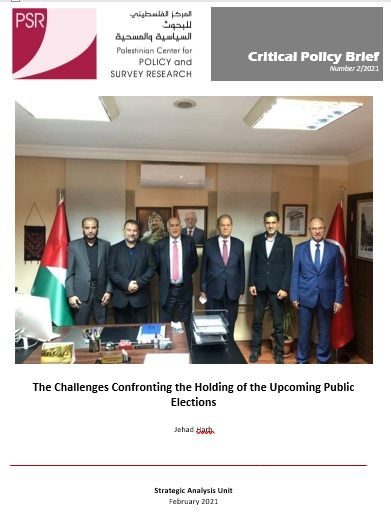 February 2021
The Challenges Confronting the Holding of the Upcoming Public Elections
Jehad Harb
The decree issued by president Abbas on the 15th of January 2021 calling for the holding of public elections is a highly significant step toward the actual holding of these elections, both legislative and presidential. The elections are to be held separately, in May for the parliament and in July for the president. The decree indicates that separate elections will follow these two for the National Council of the Palestine Liberation Organization (PLO). The revisions introduced on 11 January 2021 in the amened decreed law of the election law number 1 for the year 2007 remove some of the challenges and impediments and made it possible for the president to call for the elections with the agreement of all factions.
But the presidential decree and the amendments to the 2007 law did not provide answers to several remaining key issues that could derail the process and prevent the holding of elections. These include the manner in which elections can be held in East Jerusalem, the formation of the election court, the policing of the election process, the new conditions required for nomination, and the change in the title of the PA president to that of the president of the Palestinian state.
This policy brief reviews the main challenges and impediments that might derail the upcoming elections. It also offers recommendations to the Palestinian Authority (PA) and the main political factions that are expected to meet in Cairo in the next few days, in the hope of arriving at political and logistical solutions capable of ensuring the smooth running of the elections.
Amendments to the election law: some issues addressed; others ignored
Needless to say, holding general elections is a critical step to build a democratic and a legitimate system; a matter that must be stressed given the fact that the electoral terms of the president and the Palestinian Legislative Council (PLC) have expired nine years ago, back in January 2010, and given the fact that the political system has lost the capacity to affect a democratic transition in case the position of the PA president becomes vacant. Elections are also essential as the means to bypass the failed efforts to restore national unity, renew the legitimacy of the Palestinian political system, and restore the balance between the three branches of that system and ensure the implementation of the principle of the separation of powers.
The revisions expressed by the amended law are a step forward in the effort to facilitate the holding of the elections and are in harmony with the outcome of the recent dialogue held between Fatah and Hamas to overcome the problems that have derailed previous efforts to hold elections. These revisions included the following: (1) the adoption of an agree electoral system allowing full proportional representation in which the entire Palestinian territories serve as a single electoral district; (2) amending the article that required simultaneous presidential and parliamentary election thereby allowing the holding of separate elections, one after the other; (3) cancel the precondition that required participating electoral lists to abide by the PLO as the sole legitimate representative of the Palestinian people and by the Declaration of Independence and replace those with a commitment to abide by the Basic Law; (4) changing the women quota required in each of the electoral lists by increasing it to a minimum of 26%; and, (5) resolving some issues related to the time allowed for objections to decisions made by the Palestinian Central Election Commission (CEC).
Challenges and recommendations:
The actual holding of legislative election on 22 May and presidential elections on 31 July requires engagement from all factions in a dialogue that addresses those outstanding and disputed legal and logistical issues and comes to an agreement on the following six challenges:
The first challenge stems from the need for an Israeli approval for holding the elections in East Jerusalem, as has been the case in the PA elections that took place in 1996, 2005, and 2006. It is not certain that such an approval can come before the holding of the upcoming Israeli elections in March and the formation of a new Israeli government. Moreover, Israel might find itself having difficulties forming a new governmental coalition, given the precedents of the past three elections, which means that an Israeli response to a Palestinian request might never arrive.
Recommendations: (1) The Palestinian leadership should enlist international support to bring about pressure on Israel to allow Palestinians to vote in the city in accordance with the interim agreement on elections. (2) Ensuring the participation of East Jerusalemites in the elections should be viewed as an element of Palestinian struggle over Jerusalem and therefore the PA should, if Israel refused to allow them to participate, use this occasion to mobilize the city residents in a popular resistance campaign that aims at forcing Israel to allow the elections to take place in the city. (3) CEC should allow East Jerusalemites to participate in any voting station in the district of Jerusalem once they have registered to vote in that station.
The second challenge is the need to find consensus on the election court that would have to adjudicate all petitions, complaints and objections, related to the election process. Article 20 of the 2007 election law stipulates the formation of an election court by a presidential decree. The court is to consist of eight judges nominated by the Supreme Judicial Council (SJC). Given the fact that the split between the West Bank and the Gaza Strip has led to a split in the judiciary, with one in the West Bank appointed by the PA in Ramallah and one in the Gaza Strip appointed by the Hamas government, a need exists to agree on the means of selecting the members of the election court. The 2011 reconciliation agreement specified the formation of an election court from a chief judge and eight members to be nominated by a newly-created SJC that would be formed in implementation of the agreement. But this agreed upon body was never formed, even after the formation of the reconciliation government in 2014.
Recommendation: it is essential to issue a special law that would stipulate the formation of an election court and to give it immunity against cases that might be brought before the high court and to ensure acceptance and respect from all factions. The following are ways of doing that:
(1) Provide the Supreme Judicial Council the mandate to appoint the members of the election court from among those of the justice sector in the West Bank among whom there is already Gazan judges residing in the West Bank. This option ensures the legitimacy of the election court while respecting the role of the PA formal justice system and while enjoying the trust of the international community. But this option can be seen as undermining the justice system in the Gaza Strip which has been nurtured by Hamas during the past 13 years and might be seen as blocking any future efforts to integrate its members into a unified justice sector thereby leading Hamas to reject it.
(2) The formation of an election court from judges from both areas equally, or proportionate to the population size in the two areas. This option helps overcome this impediment but in return it might be seen as conferring legitimacy on the Gazan justice sector, particularly those who were appointed by Hamas since 2007.
(3) The formation of an election court from retired judges from the West Bank and the Gaza Strip. This option allows the factions to bypass the problem of the affiliation or biases of the judges or their loyalties, to Fatah or Hamas.
(4) The reconstitution of the election court that existed during the last general elections, in 2006, regardless of their current addresses, the Gaza Strip or the West Bank, and regardless of whether they have retired. Any shortages due to death can be met by enlisting retired judges while maintain the geographic distribution of the previous court.
The third challenge is to find an effective and acceptable security for the election process, particularly on the day of the election: would each of the two police establishments, the one in the West Bank and the one in the Gaza Strip, provide security in its area of operation? According to article 88 of the 2007 election law “the police will ensure the safety and security of the election process and the safety of the citizens.” This poses two questions, one about the neutrality of the police in the two areas and the other about the legitimacy of the police operation in the Gaza Strip. On de facto basis, CEC will find it essential to rely on Gazan area police in order to provide security to the voting stations. But this might bring about court cases that might challenge such a decision which in turn might lead West Bank courts to declare the CEC measure illegal thereby preventing the holding of elections in the Gaza Strip. To avoid such scenario, measures should be taken to protect such a step from legal deliberations.
Recommendations: Fatah and Hamas should reach an understanding according to which the two police forces, in the West Bank and the Gaza Strip, would commit themselves to full neutrality, agreeing to operate in accordance with rules set by CEC during the election process and on the voting day. Technical means can also be used to verify police compliance, for example, by installing cameras at all voting stations and in the areas around them. These and similar measures that can provide assurances regarding the safety of the ballot boxes can help provide peace of mind and reduce the concerns about the free and fair nature of the elections.
The fourth challenge is specific to the presidential elections. The January 2021 amendments replaced the title of the president from “PA president” to “president of the State of Palestine.” Moreover, article three of the amended law stated that “the president of the State of Palestine, Chairman of the PLO, the sole and legitimate representative of the Palestinian people, issues a presidential decree calling for presidential or legislative elections…” Article four states that “elections for the office of the president of the State of Palestine will take place in free and secret ballot.” It should be pointed out however that the election for the president of the State of Palestine, who is also the chairman of the PLO, is vitally different from the election for the PA president. The PA elections are limited to the areas of the West Bank (including East Jerusalem) and the Gaza Stirp while the president of Palestine is a president for all Palestinians, in Palestine and in the diaspora.
This amendment might generate conflict within the PLO if the winner of the presidential elections is not a member of the PLO Executive Committee or even a member of the PLO itself. It also denies Palestinians living outside the occupied territories the right to select their president because they are entitled to participate in the PA elections and because they have no right to return to the PA areas to participate in the election. Moreover, the amendment will force the PLO to change its own bylaws which stipulate the election process of its chairman. These PLO bylaws stipulate that members of the PLO Executive Committee are the ones who elect their chairman and that member of that committee are elected from within the membership of the PLO National Council.
On top of that, the change in the title of the president requires a revision in the terms of the Oslo Accords and the elections protocols agreed to in these accords if the Palestinians do not wish to provide Israel with an excuse to prevent presidential elections in East Jerusalem. Israel, who does not recognize the state of Palestine, can claim that the Oslo terms call for the election of a PA president and that the change to a president of the State of Palestine is an unacceptable unilateral step that violates these terms.
Recommendations: It is essential to reconsider the change brought about by this amendment with a view to abandon it and return to the original language of a PA president. There are two reasons for this recommendation: (1) to prevent a clash between the two Palestinian political system, the PA’s and that of the PLO while at the same time avoiding a situation in which the PA and PLO become subject of Israeli occupation; (2) to prevent Israel from using the amendment as a pretext to prevent East Jerusalemites from voting in the presidential elections by claiming that existing agreement calls only for the election of a PA president.
The fifth challenge is highlighted by another January 2021 amendment to the election law. This amendment altered article 8 in the 2007 and 2005 election law versions on the nomination process. It requested that for the nomination of certain officials in public and civil society positions, a resignation must be submitted and it must be accepted by the relevant authority, in writing, before that official can submit his or her candidacy application. Indeed, the application is required to be accompanied by a letter of acceptance of the resignation. The resignation must be effective on or before the day set for the closing date of nomination: “The following groups cannot nominate themselves for the presidency or the membership of the PLC until they resign from their positions and provide evidence of the acceptance of their resignation letter.”
This amendment restricts the right of nomination of certain category of official, particularly those in the public sector, by conditioning their nomination to approval by higher authorities including those in the government or the president’s office. Moreover, these higher authorities might postpone the issuance of the letter of acceptance of the resignation until the day after the closing date for nomination. In doing so, they would deprive these officials from the right to nominate themselves while at the same time denying them their jobs, form which they have just submitted a letter of resignation.
Recommendations: The right of elected and appointed officials to nomination should not force them to choose between that right and the right to have a decent job and living condition. Furthermore, given the fact that the Palestinian electoral system is now based fully on proportional representation, it should be clear that employees should be able to remain in their positions because their parties and factions are the ones who mostly organize the election campaign, not the individual candidates themselves. This should ease somewhat the concern that these candidates would exploit the public resources available to them during the election campaign. It is therefore suggested that we return to the original text in the pervious versions of the law that assumes that the resignation once submitted would be sufficient and would become valid on the closing date for nomination without requiring evidence of resignation acceptance. The return to the original clause in the election law allows PA and civil society officials to return to their position if they decide in the last minute to cancel their candidacy or alternatively seek an unpaid leave of absence from work until the announcement of the results of the elections.
The sixth challenge is to ensure that the entire election process is fully fair and free, that all factions receive the same treatment in being allowed to campaign freely without constraints or threats and that they are free to mobilize public support and publicize their election platforms. Moreover, the two authorities should strive to create an environment opposed to hate speech, violence, and any forms of coercion or actions that might be interpreted as physical assault on the election campaign of any faction and that the two security sectors commit themselves to refrain from any arrests or detentions targeting the opposition.
Recommendation: free and fair elections require the effective presence of observers and monitors, both from the Arab world and the international community, in addition to CEC and the Palestinian civil society. Forces should be combined to ensure comprehensive monitoring of the entire electoral process, from A to Z, and should not be restricted to the day of elections. Such extensive presence of observers and monitors can provide a level of confidence in the process and a peace of mind. Such presence can also deter violations and force those in charge, the governments and the police forces, to act in an impartial manner.
 November 2022
Birzeit Student Elections: Why Hamas Won and Fatah Lost
Alaa Lahluh Walid Ladadweh
Introduction:
The results of the student council elections at Birzeit University that took place in May 2022 came as a shock to supporters of Fatah after the heavy loss suffered by its student youth movement, al Shabiba, winning only 18 seats out of 51, compared to 28 seats for the Islamic Bloc, Al Kutlah al Islamiyyah, and 5 seats for the Student Pole, al Qutb al Tollabi, that represents leftist forces at the university. These results were shocking to Fatah because of the importance of the student elections, especially at Birzeit University, for what they represent for the future of the national movement. It was shocking because the students of this university, more than other university in the West Bank, represent many of the various regions of the West Bank as well as the various socio-economic classes and political currents thereby making the Birzeit elections a barometer of the attitudes and behavior of the educated Palestinian youth. Birzeit University has a special importance in the democratic process because this university has been a beacon of democratic practices preserving democratic traditions throughout the previous years in which Palestinians were deprived of national elections, while student elections were held annually at that university except in the most difficult conditions, such as the Covid pandemic in 2020 and 2021.
These elections came amid the near-total absence of democratic life in the Palestinian territories as no national elections have been held since 2005 and 2006, when presidential and legislative elections were held respectively. Back in December 2021 and earlier this year, in March 2022, local council elections were held in the West Bank, but they were not held in the Gaza Strip because of Hamas' objection to holding them in that part of the Palestinian territories
Background:
The past five years have witnessed a strong showing by Hamas’ Islamic Bloc at the expense of its main rival, al Shabiba, but without gaining a majority of Birzeit student vote. In the elections that preceded the closure of the university due to the Corona pandemic, in 2019-2020, al Shabiba was in fact able to win the same number of seats as the Islamic Bloc. The following figure shows the seat distribution at Birzeit University during the period between 2016-2022.
Figure (1): Distribution of Student Council Seats at Birzeit Student elections between 2016-2022

It should be noted that al Shabiba won all Birzeit University student elections that took place between 2007 and 2015, i.e., after Hamas violently took control of the Gaza Strip. For example, in 2008 it won 25 seats compared to 19 seats for the Islamic Bloc; in 2009 it won 24 seats compared to 22 for the Islamic Bloc; in 2010 and 2011 it won 31 seats and 29 seats respectively while the Islamic Bloc boycotted the student elections; in 2012 it won 26 seats compared to 19 seats for the Islamic Bloc; in 2013 and 2014 it won 23 seats compared to 20 seats for the Islamic Bloc.[1] During the two years that the Islamic Bloc boycotted the elections, the student turnout fell from 85% in 2009 to 58% and 50% respectively before rising again to 75% in 2012. Most of the votes that used to go to the Islamic Bloc abstained, resulting in lowering the number of votes required per seat from 117 in 2009 to 71 in the 2010 elections.[2]
The results of the Birzeit University student elections have opened the debate about the reasons behind Fatah's loss despite the group's greater popularity in the West Bank compared to that of Hamas as indicated by the most recent public opinion polls.[3] How can Fatah's loss by such a large margin be explained despite having such a great electoral base?
Explaining Fatah’s loss and Hamas’ victory
The loss of al Shabiba and the victory of the Islamic Bloc can be attributed to a number of reasons, the most prominent of which are the following five:
- Mistakes and blunders made by the Palestinian Authority (PA) during 2021
- Mistakes made by Fatah
- Internal problems within al Shabiba
- Hamas remains attractive to the youth
- Israel unintentionally helped Hamas
1. PA blunders and poor performance:
Over the past few years, the PA has taken a series of measures that have harmed the nature of the system of government that the Basic Law and another set of key laws had established in Palestine. Accountability and oversight over the work of the president and government have been abolished and the judiciary has been weakened and its independence threatened.[4] The year before the Birzeit University elections witnessed several events that contributed to al Shabiba’s loss including the postponement of the general elections (legislative and presidential) that were scheduled to be held in May and July 2021, the perceived PA mismanagement of the import of the coronavirus vaccines, and the killing of activist Nizar Banat during his arrest by the Palestinian security services. Public concern about corruption within the PA has been aggravated by the release of various reports including that of the Office of Financial and Administrative Control on the Ezz Waqf Fund and on Khalid Al-Hassan Hospital for Cancer Diseases.
There is considerable agreement among those interviewed for this Brief, among students, university professors, the public at large, or experts on the Palestinian political scene, that the PA's blunders and unpopular behavior were the main reasons for Fatah's loss. In-depth interviews with 14 Birzeit university students from different student political currents show that all of them agree that this has been the top most important factor shaping the outcome of the student elections: the students punished al Shabiba for the “crimes” of the PA.[5] One Birzeit University student who voted for the Islamic bloc says that the main reason for the Bloc's popularity is the link made by the students between the PA’s recent actions, such as the killing of Nizar Banat, and al Shabiba. Another student says that this shift in student attitudes did not occur in previous years because the magnitude of PA plunders in recent years has been unprecedented and the student awareness of these plunders has become much greater thanks to social media and the emergence of organized student groups, on WhatsApp and other platforms, that became much more active and effective compared to previous years. A new student at the university says that new students do not mainly look at the activities of the student blocs inside the university but rather look at the political situation in the country, and since the PA’s behavior has worsened in recent years, student perception of the PA is becoming overwhelmingly negative. Another student says that the main reason for the victory of the Islamic bloc is the great urge among the students to send a message to the PA and Fatah by voting against al Shabiba despite the fact that many of those students come in fact from Fatah affiliated families.
These findings are confirmed by university professors who witnessed various election rounds during past years. Reflecting the views of many, one lecturer at Birzeit University, who studied her bachelor's and master's degrees at the same university, asserted that Hamas’ victory was essentially a punishment for the PA and Fatah.
It is also the sentiment of the Palestinian public. The results of a public opinion poll conducted by the Palestinian Center for Policy and Survey Research right after the Birzeit University elections showed that 59% believe that the reason for the victory of the Islamic Bloc is a protest by students against the performance of the PA, while 32% of the Palestinian public believe that the reason for the Islamic Bloc victory is a shift among the Palestinian people towards greater support for Hamas.[6] But as can be seen in the following figure, while 70% of the likely Fatah voters think the vote for the Islamic Bloc was a punishment for the PA rather than a reward for Hamas, only 22% of likely Hamas voters think agree with that statement.
Figure (2): Reasons for the Islamic Bloc victory in Birzeit University student elections as expressed by the Palestinian public (PCPSR’s poll # 84, June 2022 )

In this context, it is useful to consider the attitudes of Palestinian youth in general towards the PA. The results of the latest polls conducted by the Palestinian Center for Policy and Survey Research conducted before the Birzeit elections indicate that the youths’ perception of the PA performance is highly negative. This negative perception leaves its impact on Fatah as well thereby reducing public support for it. As Figure (3) below indicates, the majority of 86% of the youth believes in the existence of corruption in PA institution, 73% think people cannot criticize the PA without fear, 64% are dissatisfied with the performance of president Abbas, and 57% want the president to resign.
Figure (3): Attitudes of youth between the ages of 18-22 regarding selected issues related to the PA (PCPSR’s poll # 83, June 2022)

2. Mistakes made by Fatah:
Fatah seems to lack a vision and strategy for how to deal with al Shabiba as a youth sector that represents its future. The movement seems to want to make its youth group a subordinate rather than a partner. It provides no guidelines for how the youth should relate to the Israeli occupation, a topic of the utmost importance to students and young people in general. To make things worse, Fatah lacks a clear vision on how to organize Palestinian society and deal with the day to day living conditions. Fatah’s failure in allowing its youth movement to develop its own national vision denies al Shabiba the ability to take the initiative and press the national leadership in the direction most favored by Palestinian youth.[7]
On top of that Fatah finds itself unable to distinguish itself from the PA, to the contrary, it provides full support to PA policies including those rejected by the overwhelming majority of the public. The example most cited by students and others is the manner in which Fatah dealt with the killing of Nizar Banat. Instead of distancing itself from the incident, Fatah mobilized its base and brought it to the streets to defend the PA in the face of public anger. This episode served as a dangerous precedent portraying Fatah as a party that assaults liberties and freedoms, rather than defending them, in total contradiction with Fatah’s values enshrined in its literature. Worse yet, Fatah dismissed its own Shabiba coordinator at Birzeit University and the organizing body working with him because the group issued a statement condemning the killing of Banat and rejecting repression and restrictions of freedoms. One student said that shortly before the elections, the Islamic Bloc focused its campaign on this and similar incidents to demonstrate how al Shabiba was no longer representing the aspiration of the youth and that, to the contrary, it was being used by the PA as a local militia to crack down on non-violent protests by the Palestinian civilians. Hamas distributed photos showing how Birzeit students from al Shabiba were taking part in counter demonstrations defending with the PA and its security officers. Reaction by the students to these images were decidedly negative generating a great deal of resentment against their own colleagues at the university.
Above all, Fatah has over the past years lacked the "revolutionary" discourse adopted by the movement's political rival, Hamas. Given the fact that Fatah has gained most of its popular base in the sixties and seventies of the last century as a result of its "revolutionary" discourse and action adopted and practiced by the movement in that past period. University students are considered to be among the most radical age groups in Palestinian society, one that most likely finds itself highly attracted to the "revolutionary" discourse that Fatah has now abandoned. PCPSR public opinion polls have shown, as indicated in the Figure (4) below, that a majority of 55% of the youth believe that armed struggle is the best means to achieve Palestinian goals of ending the occupation and establishing an independent state compared to only 14% of the youth who believe that negotiations are the best means. This of course is not the position adopted by the PA or the Fatah movement.
Figure (4): The most effective means of ending the Israeli occupation according to Palestinian youth between the ages of 18-22 vs. older Palestinians (PCPSR’s poll # 84, June 2022)

3. Al Shabiba’s internal problems:
Al Shabiba made its own significant contributions to its defeat. The following problems characterized the group’s behavior at Birzeit University in the months and years before the latest elections and doomed its chances of winning:
- Al Shabiba accepted to subordinate itself to the Fatah movement without any attempt to differentiate its position from that of the larger political movement: Al Shabiba at Birzeit University lost the leadership role when it acceded to interferences from Fatah in its internal affairs, for example by allowing it to appoint, rather than elect, the group’s coordinator and organizational body, thus subordinating itself to that of the larger movement.[8] One Birzeit University student, who voted for the Islamic Bloc, says that on top of existing links between al Shabiba and the PA, the group was in no position to declare any dissenting views because it was fully controlled by its mother organization, Fatah. In toeing the line, al Shabiba, therefore, had no choice but to threw its full weight behind the PA plunders, regardless of how distasteful and unpopular they were. With this in mind, students had no choice but to vote for its rival, the Islamic Bloc.[9]
- The absence of Al Shabiba organized activities and mobilization campaigns among the students compared to that of Hamas: One student says in her explanation of the advantage the Islamic Bloc had that while al Shabiba’s student activities were ad hoc and lacked consistency, the Islamic Bloc was much more organized and active in organizing student activities.
- Visible internal disagreements existed within al Shabiba’s own ranks and were based on geographical and regional bases: Conflicts within the ranks of al Shabiba were perceived by other students are evidence of discrimination practiced by the group against certain groups and geographic areas rather than disagreements based on an open exchange of ideas and genuine disagreements over policies. These perceptions turned students off and led them to stay away from the group.[10]
The failure of al Shabiba to act as a professional student union: Students expect their syndicate or union to aggregate their interests and protect them in negotiations with the university administration. Some students felt that, on occasions, al Shabiba failed to do that. They stressed that to be successful al Shabiba needed to pay greater attention to the needs of the students, as students, by helping to create an environment conducive to learning and scholarship. Indeed, many say the Student Pole, a rival, was the most successful in promoting pro student programs.[11]
- The absence of democratic practices within al Shabiba at Birzeit University: As indicated earlier, the leadership of al Shabiba before the latest student elections was appointed by the Fatah leadership. While some limited forms of mini elections continued to be seen in its activities, the group has stopped its previous practice in which its entire leadership was elected by a general conference of all members.[12] This lack of democratic practices has generated disappointment among the students, including among its own ranks, leading to indifference regarding the outcome of the student elections. Al Shabiba could not sell itself to the students as a democratic movement when it shunned democratic practices within its own ranks. It is worth noting that the election defeat forced Fatah to reevaluate its policy and to allow al Shabiba to hold its own elections; indeed, a new coordinator was elected but was soon arrested by the Israelis.
4. Hamas remains attractive:
Hamas has controlled the Gaza Strip since June 2007, and its control has contributed to a decline in its popularity for the following 8 years, until 2015, except for short periods during its armed confrontations with Israel. Despite the fact that Hamas does not offer a better model of governance than Fatah, it did manage to regain popularity as a result of a series of measures adopted by the PA and referred to earlier. Hamas prevents any democratic life in the Gaza Strip, where no local elections have been held, as has been done more than once in the West Bank. It does not allow student elections to be held in Palestinian universities located in the Gaza Strip. It interferes in trade union elections, allowing some and preventing others. The repression by the Hamas government in the Gaza Strip of the Bedna Neish (We Want to Live) movement back in 2019 contributed to the loss of the Islamic Bloc's popularity at Birzeit University. In that year, al Shabiba won more student votes than the Islamic Bloc.[13]
However, Hamas has been able to capitalize on its rhetoric regarding the resistance to occupation and the fact that it did engage in repeated armed confrontations with the Israeli army at a time when the Palestinian-Israeli peace process, championed by the PA, was dead and buried. The May 2021 war between Israel and Hamas led to a major spike in that movement’s popularity that benefited its student group, the Islamic Bloc. Within three months, Hamas managed to increase its popularity by one third as can be seen in the following figure.[14]
Figure (5): Voting intentions before and after the May 2021 war between Hamas and Israel (PCPSR’s polls # 79, March 2021 and # 80, June 2021)

5. How Israel, inadvertently, helps Hamas:
Days before the elections, the Israeli occupation forces carried out a series of arrests against a number of activists and candidates of the Islamic Bloc at the university. Hassan Farraj, a member of Fatah's Revolutionary Council and the person in charge of al Shabiba in the movement, believes that this interference by the occupation helps to increase the level of sympathy for the students of the Islamic Bloc and thus impacts the electoral preferences of the students. Farraj adds that these arrests create sympathy for those arrested by the occupation.[15] This was supported by a number of students, those who voted for al Shabiba and those who voted for the Islamic Bloc, who asserted that the arrests by the Israeli army contributes to increasing the popularity of the detainees and their student faction.
Recommendations:
The loss of al Shabiba and the victory of the Islamic Bloc can be attributed to a number of reasons, the most prominent of which is the mistakes and blunders made by the PA during 2021. Fatah and al Shabiba made their own mistakes as well; and Hamas was able to capitalize on its increased popularity in the aftermath of its May 2021 war with Israel.
The study concludes with a set of recommendations for the Palestinian Authority, Fatah, Hamas, and al Shabibah at Birzeit University.
To the PA:
- A policy of no-interference in student elections, as well as other student matters, especially by the Palestinian security services, is recommended. Such interference, when it occurs, reflects negatively on the results in light of the students' rejection of this PA behavior.
- It is recommended that the PA maintain the democratic process in the rest of the universities and unions and encourage the holding of elections in locations where they are not held.
To Fatah:
- The most important recommendation to Fatah is similar to the one made to the PA: stop the interference in the affairs of al Shabiba; give your youth the necessary space to make their own decisions and to act as a trade union serving the interests of its student base.
- Fatah should also reformulate its national program to be in sync with the national sentiments. For Fatah youth to win, they need to be seen as part of a leading movement engaged in the national struggle for liberty and freedom.
- Similarly, Fatah needs to be seen by the students as a movement in tune with the pulse of the public on local matters even if that means having distinctly different views than those of the PA.
- In particular, Fatah needs to reestablish its democratic credentials by holding its General Congress and electing its leadership in elections that are free of fear and intimidation with full representation to all sectors of its base.
To Hamas:
- The single most important recommendation to Hamas is to allow elections to be held regularly in local bodies, universities, trade unions, civil associations, etc., and allow more freedoms to dissenting activities and protests, and enable people to elect their representatives in their local councils. It is inconceivable that Hamas would pay tribute to its victories in West Bank universities while preventing elections and restricting freedoms in the Gaza Strip.
To the Shabiba:
- The single most important recommendation to al Shabiba is to move forward with strengthening its internal democratic practices and to hold internal elections for its bodies, as happened recently after the Birzeit University loss where its youth leadership was elected by the students.
- It should combat all negative phenomena within its ranks, such as regionalism and factionalism that lead to apathy, the dispersal of efforts, and the dispersal of votes.
- It should not embrace or defend unpopular PA policies as its own; as a youth movement it should strive to encourage critical thinking and open discussion of unpopular PA measures.
[1] See article by Hani al Masri, “Birzeit Elections, a turning point or a passing moment”,” https://www.masarat.ps/article/5966
[2] In 2009 al Shabiba received 2540 votes and in 2010 during the boycott by the Islamic Bloc it received 2200 only.
[3] See the most recent polls conducted by the Palestinian Center for Policy and Survey Research: https://www.pcpsr.org/sites/default/files/Poll-85-Arabic-press-release%2020Sep2022.pdf
[4] See, Khalil Shikaki, “Can a Newly Elected Parliament Repair the Damage Done to the Palestinian Political System in its Absence?” Critical Policy Brief, PCPSR, January 2021: http://pcpsr.org/en/node/831
[5] The 14-student interviews were conducted during the period 8-18 October 2022.
[6] PCPSR poll #84, June 2022: Public Opinion Poll No (84) | PCPSR
[7] An interview with Ibrahim Khraishah, former member of Fatah’s Revolutionary Council and a former head of Birzeit Student Council. The interview was conducted on 11 September 2022.
[8] Interview with Ibrahim Khraishah.
[9] Interview with student on 12 October 2022.
[10] Interview with Ibrahim Khraishah. One student said that chaos, disagreements and conflicts in al Shabiba’s ranks were widespread and visible to all to see while student members of the Islamic Bloc expressed curtesy and respect to each other in a show of solidarity and discipline.
[11] In a dialogue with students on 13 August 2022, six out of ten students testified that the Student Pole (the left) was the most effective in presenting the students with a student-friendly platform but that the students did not vote for it because they did not consider it a viable rival to al Shabiba or the Islamic Bloc.
[12] Interview with Ibrahim Khraishah.
[13] Interview with Hasan Farraj, a member of Fatah's Revolutionary Council and the person in charge of al Shabiba in the movement, on 17 August 2022.
[14] Compare the findings of PCPSR’s poll #79, in March 2021 (Press Release: Public Opinion Poll No (79) | PCPSR) with that of PCPSR’s poll #80, in June 2021, one month after the war with Israel: Public Opinion Poll No (80) | PCPSR
[15] The interview with Mr. Farraj took place in Ramallah on 17 August 2022.
June 2021 
Mapping Sources of Mutual Distrust in Palestinian and Israeli Societies and Politics: role of education, daily life experiences, and exposure to violence
Palestinians and Israelis distrust and fear each other. Evidence from joint Palestinian-Israeli survey research indicates that distrust and fear are detrimental to peace-making. It is suspected that school education, daily life experiences-- including economic costs related to the continuation of the status quo-- and exposure to mutual violence are critical sources that contribute to the very high levels of distrust and fear.
The overall objective of this research is to map out, identify, and explain how and why each of these sources impede the efforts toward a successful peace process and what must be done, by both sides, to dry up or neutralize them.
Specifically, we seek to:
(1) identify and map out the top three critical socio-political and economic elements the feed existing distrust thereby contributing to widespread misperception, unwillingness to compromise, and a stagnation in the peace process;
(2) empirically demonstrate a direct or indirect relationship between these sources and the high levels of mutual distrust and fear; and,
(3) building on our research findings, as well as experiences of other conflict areas in Europe and other places-- in which critical policy decisions related to school education, daily life experiences, such as movement, access, and economic opportunity, and modes of resistance were made—outline evidence-based policy recommendations that can potentially reduce mutual distrust/fear.
Table of Contents |
5) Case Studies |
8) Publications |
| 1) PRESS RELEASE |
Palestinian-Israeli Joint Poll on Sources of Mutual Distrust: Mutual Palestinian-Israeli distrust, found at the core of peace failure, is generated by socio-psychological forces heightened by daily life hardships, exposure to violence, and widespread negative perceptions about the other side’s educational system
September 15, 2021 --------- Palestinian and Israeli public support for peace stands at the lowest point since the beginning of the peace process 28 years ago. Just completed joint Palestinian-Israeli research reveals an unequivocal finding: extremely low level of mutual trust among the two publics is the most important explanation for the declining support of the peace process. The joint research sought to map out the sources of distrust and recommend policy measures to address the problem of the continually declining mutual trust.
The research was conducted by the Palestinian Center for Policy and Survey Research (PSR) and the Macro Center for Political Economics during the past three years with funding from the European Union (EU). One of the surveys conducted for the project was funded by the Netherland Representative Office in Ramallah and the Japan Representative Office to Palestine through the UNDP/PAPP.
The joint research relied on surveys conducted in the second half of 2020 among representative samples of the two publics, survey experiments among those hardest-hit by the prolonged conflict and military occupation, educational and classroom experiments among students, all complemented with more than a dozen focus groups with students and those paying the highest cost of the conflict. The research was supplemented by case studies, review of textbook, the development of “objective” textbook passages, and a review of the recent history of peace education in Europe and elsewhere. The report on the historical review focused on the lessons learned from previous international examples and was discussed in a workshop for Palestinian, Israeli, and international professionals who spent years exploring this sensitive topic.
The Joint polls were conducted between August and November 2020 among representative samples of the two publics. Survey research experiments were conducted in January and February 2021 with focus groups soon after. A poll in the Palestinian-Israeli Pulse series, was conducted in August 2020 among a Palestinian sample of 1200 adults interviewed face-to-face in the West Bank, East Jerusalem and Gaza Strip in 120 randomly selected locations and the margin of error is +/-3%. The Israeli sample included 900 adult Israelis interviewed through the internet by Midgam in Hebrew and Arabic The margin of error is +/-3.34%.
The joint poll on trust and the peace process was conducted among a Palestinian sample size of 1560 adults, including 592 youth, interviewed face-to-face in the West Bank, East Jerusalem and Gaza Strip in 120 randomly selected locations. The margin of error is +/-3%. The Israeli sample included 1201 adults, of which 272 were youth, interviewed through the internet by Rafi Smith in Hebrew and Arabic. The combined Israeli and Palestinian data files have been reweighted to reflect the exact proportionate size of the various groups and ages in the Palestinian and Israeli societies, and to reflect, for Israeli Jews, current demographic and religious-secular divisions. The margin of error for the Israeli poll is +/-3.34%.
Our survey research and experiments among the general public, residents of hard-hit areas, and students indicate the following (for project reports and documents, visit PSR and Macro’s websites):
- The contexts of the two societies, the Israeli and the Palestinian, are very different, leading to different results. The findings of the Israeli surveys show that trust is mostly determined by the psychological repertoire of beliefs, attitudes and emotions that are imparted and shaped in the political, educational and social culture that can be viewed as a culture of conflict. Israelis are less affected by the difficulties of daily life and violent events because their lives take place in a very different context and they lead routinized life – a normal life in the conflict
- Findings among the Palestinians show a correlation between the widespread mutual distrust on the one hand and the daily life hardships, exposure to violence, and negative perceptions of the educational system on the other side on the other hand.
- The research unveils other roots of distrust: socio-psychological variables representing the repertoire that both side are carrying, such as ethos of conflict and negative stereotyping relating to historic experiences and narratives. These variables indicate that the less a person adheres to ethos of conflict and the less negative stereotypes he or she holds regarding Palestinians or Israeli Jews, the more he/she finds the other side worthy of trust and therefore supports the peace process.
- The youth are more likely to hold hardline views, to indicate less trust, and to adhere to beliefs of ethos of conflict and hold stronger negative stereotype of the other.
- When linking support for peace with trust level, strong positive correlation emerges: the higher the trust, the higher the support for peace and the lower the trust, the lower the support for peace. Here is an example from our August 2020 joint poll: Palestinian support for the two-state solution stood at 60% among those who trust Israeli Jews and only 41% among those who distrust them; Israeli equivalent stood at 81% among those who trust Palestinians and only 34% among those who distrust them.
- A dozen Educational and classroom experiments indicated that students are more likely to trust the other side and to have a more positive attitude toward peace when the classroom text presented by the teachers were “objective” or presented the other side in a positive light.
- Six survey research experiments found residents in areas of great hardships are more likely to distrust the other and to oppose the peace process.
- A dozen focus groups among students and residents of areas of great hardships confirmed the project findings and helped to articulate the link between trust and peace and the role played by the sources of distrust.
Recommendations: It goes without saying that only the ending of occupation and the building of permanent peace can bring about a real restoration of trust and begin the process of reconciliation. Yet as our research demonstrates, progress toward peace is linked to the restoration of trust and hope. A major societal change is needed to change the state of mind that is supporting distrust. It should be accompanied by change in the information provided by leaders, mass-media, schools, ceremonies, memorial days, the imparted collective memory and existing dominant political ideologies. Additional interim measures are needed: change the reality on the ground, stop incitements and minimize negative language and phrasing, increase contact between People, deliberately use mass media to inform and enlighten, use the school system with the goal of changing the collective psychological repertoire of society; and encourage joint projects in less sensitive areas such as health, science, and agriculture.
For more information or interviews: contact Khalil Shikaki, PSR director, at kshikaki@pcpsr.org or 02-296 4933, and.Roby Nathanson, General Director, MACRO at roby@macro.org.il or 03-5251057
| 2) RESEARCH ACTIVITIES |
(1) Review selections of textbook material to be used in classroom experiments, the organization of at least a dozen classroom experiments on each side, the Palestinian and the Israeli, involving selected material and students, and the organization of at least a dozen focus groups with each side with teachers and students in various school types, religious, governmental, private, etc.;
(2) two major surveys on each side among representative samples, with added samples for youth, to measure overall public and youth exposure to violence, hardships, as well as personal tragedies and examine the ramifications of the findings with focus groups, particularly the youth;
(3) specially designed survey research experiments and case studies in which respondents under different levels of stress and hardship are observed and interviewed and compared to similar respondents who are exposed to no or less suffering and hardships;
(4) evaluate experiences and review lessons learned from other conflict areas, particularly in Europe through background research and meetings and workshops with experts and historians;
(5) prepare, publish and disseminate reports of findings of research and recommendations to the public and various beneficiaries, including the publication of proposed textbook material that can be used by both sides to supplement existing textbooks; and
(6) workshops with and briefings for various local and international policy making bodies, particularly among the final beneficiaries.
| 3) ROLE OF EDUCATION |
1) Educational Experiments and Textbook Passages for Sustainable Peace Education:
Two rounds of educational experiments were conducted during the period of the project. Each round included three experiments with students from the three selected classes in the three types of schools. The goal of the experiments was to explore the impact of school curriculum, in three varieties, “nonpositive,” meaning one that focused on pain, suffering, and costs of conflict to one’s own side, “positive,” meaning one that focused on the benefits of peace and diplomacy and the need to reach out to the other side and understand its fears, and “objective” passages, meaning one that focused on the two sides of the coin, the positive and the negative in a balanced manner. The project sought to document the impact of these types of texts on the students’ perception of the other side and on the attitudes regarding the question of peace and the two-state solution.
Each experiment involved the following:
1) Student participation: between 12 and 24 students, males and females, participated in each experiment in the three levels or grades. The consent of the students and their parents was secured before the sessions were held.
2) A selected text was presented by a teacher in a classroom setting. In the first round, three experiments are conducted, with students from the three types of schools. the passages used, (positive and nonpositive) are those selected from the existing textbooks. In the second round, three experiments are conducted with the same students from the three types of schools. The passages used by the teachers in the second round were those designed by PSR’s team and labelled “objective.” Each experiment of the first round was divided into two sessions. The nonpositive text was used in the first session and the positive text was used and in the second session. In the second round of experiments, the teachers used the “objective” texts drafted by PSR’s team. Only one session was conducted in the second round.
3) Teachers and locations: for the two rounds, PSR asked the teacher of each subject to teach the chapter to his or her class in the same way it is normally thought. However, while some of the sessions were held at the schools (government, private, and Islamic), others were held at PSR. The purpose of each session was explained to the teacher of each subject.
4) Questionnaire: students participating in all the sessions in the two rounds were asked to fill out a questionnaire that aimed at measuring student perception of the other (the Israelis), level of trust, and attitudes regarding the peace process and the two-state solution. The data was entered and analyzed in order to compare findings in the two rounds and in the two sessions in the first round.
Description of the experiments:
Each educational experiment has 18-24 student. Each educational experiment started with an introduction by the teacher. Then, each teacher presented and explained two lessons of the selected (one positive/one nonpositive) text book to his/her students. After each lesson, the students filled a questionnaire.
Three experiments were conducted in the first round: :
1. The first experiment involved 22 students (males and females) from a government school and was held in two sessions. The first session was held on 17 September 2020 at PSR. The positive text used was on fulfilling commitments from a religion textbook for the 9th grade. The nonpositive text used in the second session of the first experiment was on the grandfather’s memory from an Arabic textbook for the 9th graders.
2. The second experiment was conducted inside the classroom with 18 female students from an Islamic school, the Islamic Society School in Ramallah. The students came from two grades, the 10th and the 11th and the session was held on 4 October 2020. The positive text addressed the issue of traditional life in Palestine from the Arabic subject for the 9th grade. The nonpositive text address the killing of Palestinians by an Israeli sniper; the subject is also Arabic.
3. The third experiment was conducted with students from a private school, the American School, with a total of 24 male and female students. The positive text dealt with personal hygiene from the Arabic subject for the 9th grade. The nonpositive text addressed the issue of Palestinian prisoners in Israeli jails, also from the Arabic subject for the 9th grade.
Three additional educational experiments and three new focus groups were conducted in the second round of the educational experiments.
1. In the first experiment, 15 students from a governmental school participated in a session at PSR on 18 January 2021. The objective passage addressed in this session reviewed the recent history of Palestinian-Israeli negotiations.
2. In the second experiment, 14 female students form an Islamic school participated in a session at the school for students from the 10th and 11th grades. The session was held on 27 January 2021. The topic from the subject of religion addressed the common elements in the three Abrahamic religions.
3. In the third experiment, 12 students from a private school, the same American school used in the first round, participated in a session held on 9 February 2021. The objective text in civics address the issue of historic narratives of Palestinians and Israelis.
Findings:
Findings of the first round showed clearly that students attitudes and perceptions regarding trusting the other side changed based on the text presented to them. The positive text produced greater trust in the other side compared to the level trust when the nonpositive text was produced. Findings showed that 78% of the students had a low trust level and 19% had a medium trust level and only 3% had a high trust level when discussing the nonpositive text. The distrust level went down considerably from 78% to 23%, the medium trust went up from 19% to 56% and the high trust went up from 3% to 20% when discussing the positive text. Other findings confirmed this trend: the belief that the best means of ending the Israeli occupation is reaching a peace agreement stood at 53% among those who have a high level of trust on the other side declining to 17% among those with low level of trust.
Finding of round 2 reflected the fact that the only texts that were presented to the students were “objective” and were designed by the project team based on the lessons learned from the findings of round 1 and the other work that was generated by that time from other project activities, such as the work on lessons learned from the previous experiences in Europe and elsewhere in peace education. These texts focused on what the research team labeled “facts” and reflected views that are shared by many Palestinians and Israelis. The findings of the survey that was conducted among the students in this round showed that 54% of the students continued to have a low level of trust in the other side while 21% showed high level of trust; a little over a quarter (26%) expressed a medium level of trust. As we found in the first round, the increase in the level of trust led to a parallel increase in the acceptance of peace agreements as the best means of ending the conflict. For example, half of those with a high trust level endorsed peace agreements while the equivalent percentage stood at 11% among those with a low level of trust. The following table show the impact of text on the level of trust in the two rounds.
Text | Low trust | Medium trust | High trust |
Nonpositive | 78% | 19% | 3% |
Positive | 23% | 56% | 20% |
objective | 54% | 26% | 21% |
In the second round of the educational experiments, three experiments were conducted with the same schools and classes of the first round between December 2020 – February 2021, 10-15 students each, at PSR in Ramallah except the Islamic school that took place at the school premises in Ramallah. In this round the teachers presented and explained a short (alternative) passages of textbooks material that were designed by PSR’s researchers. And as in the first round, one questionnaire was filled out by the students after presenting the designed textbooks material.
In the first year, after reviewing existing textbook material for the various grades between the 6th and the 12th, PSR’s team identified areas where vacuum exists. Initial draft covering three subjects, history, religion, and civics, were prepared. During the second year of the project, the team revised the initial drafts in consultation with students, school teachers, and administrators. Along with other beneficiaries, the team came to the conclusion that these passages must be perceived at “objective,” reflecting the reality of conflict while aspiring to serve as texts useful for peace education. Emphasis was therefore placed on ensuring that the students are exposed to perspectives of the two sides, the costs of war and the benefits of peace, the cup half full and the cup half empty. Various drafts were tested on small groups of students. Semi-final draft were prepared by the end of the second year.
During the third year, further adjustments were made based on the findings of the first round of the educational experiments and the report on lessons learned from the European and other experiences. Three passages were finalized and used in the second round of the educational experiments. Copies were exchanged with the body in the Palestinian Authorities responsible for the development of curriculum. Copies were also shared with the UNRWA leadership.
These are the titles of the three passages:
Looking at the Other’s Viewpoint: Historical Narratives of Palestinians and Israelis Sustainable Peace Education
Palestinians and Israelis use their different historical narratives to prove their rights or the basis of their presence in this country. Each party claims that it has proven the truth concerning its connection to this land, the land of historical Palestine. At the same time, this raises controversy and clashes between successive generations on both sides.
The Oslo Agreement: The Difficult Road to Palestinian-Israeli Peace Sustainable Peace Education
The peace process faced many obstacles on both the Palestinian and Israeli sides. The Israeli government did not commit to transferring powers in accordance with the deadlines stipulated in the agreement, and continued to sponsor settlement activity in the Palestinian territories. The process also faced strong opposition from internal Palestinian parties, where some expressed their opposition by boycotting elections or refusing to participate in the PA authority. Others carried out bombing attacks against Israeli targets.
Guidance and Light: The Doctrine of Monotheism in Revealed Religions Brings People Together and does not Divide Them Sustainable Peace Education
The basic idea in the three religions, Judaism, Christianity and Islam, is centered on the doctrine of monotheism. This doctrine is derived from our prophet Ibrahim Al–Khalil, father of the prophets. The doctrine of monotheism is based on an established religious belief in one God with no second god and no partner.
Focus groups:
Focus groups were used extensively in this project, particularly in our efforts to understand the impact of various educational texts on students’ perceptions of the other side. In addition to educational experiments, focus groups were used in our research into the impact of daily living conditions on perception of the other.
Focus groups for Educational Experiments, Round 1: The focus group for the first educational experiment in round (1) was conducted with the same students who participated in that experiment. It was held on 18 September. The purpose of the focus group session, which was held at PSR, was to discuss the findings of the questionnaire that the students had filled out during the experiment. The focus group of the second experiment was held with the same students who took part in that experiment. It took place on 5 October 2020. The focus group of the third experiment was held with the same students who took part in that experiment. It was held on 13 October 2020.
Round 2 of the educational focus groups: For round two, the focus group for the first experiment was held at PSR on 19 January 2021. The focus group of the second experiment was held on 28 January with the same students who took part in that experiment. The focus group of the third experiment was held with the same students who took part in that experiment. It was held on 10 February 2021.
Findings:
As indicated earlier, three types of schools participated in the focus groups. The finding of the focus group sessions in all of them were similar. When discussing the nonpositive text and the findings based on the answers of the students after that session, it was clear that the ideological tendencies among the students were compounded by the emotional responses generated by the text contributed to the greater tendency to distrust the other: “they do not want peace; they want to demolish our homes, take away our land, expel us from our homeland, wage wars against us, and imprison and torture us.”
However, when reviewing the findings after the positive text, the emotional outbursts of the students were rare and the students were much more willing to engage in a more reasoned debate. In this environment, it was possible for the students to accept the concept of peace with the other. Students emphasized the importance of peace as the means to ensure security. Their demands now focused on the need for an honest implementation of agreements. When offered various scenarios to test willingness of the students to treat the other as a fellow human being the students showed remarkable openness and willingness to empathize and to emphasize the universal nature of human rights.
Following the second round of the educational experiments, three focus groups were conducted with the the same schools and classes between January-February 2021. Each focus group has 10-15 student.
The focus groups in the second round discussed the significance of “objective” texts and the findings of the surveys that were conducted after each experiment. The findings confirmed what we saw when reviewing the impact of the positive texts> students were more considerate of other views and more open to new ideas. Students were more willing to emphasize the benefits of peace: “leads to restoration of rights and provides security to both sides.” But some were also interested in exploring the impact of peace failure: “what if it gave us a failed state? Will the settlers be removed? Will the state be truly sovereign and independent?” When discussing the importance of understanding the narrative of the other side, students distinguished between knowing and accepting the other’s view of history: “while knowing the narrative of the other helps to reduce distrust, accepting the narrative of the other side is unacceptable because it means rejecting our own right to our land or accepting to be the scapegoats that pay the price for the oppression of the Jews throughout history.”
| 4) SURVEY RESEARCH EXPERIMENTS |
Survey Research Experiments and Case Studies The survey research experiments aimed at exploring the impact of daily living conditions, the hardships and suffering and exposure to violence, under a prolonged conflict. In order to select the areas, groups, and topis that would be the focus of the experiments, the Palestinian research team examined existing literature on life under occupation. Moreover, the team gained additional insights from the findings of the optional survey. Three areas/topics were selected: the H2 area in Hebron for their suffering from settlers’ attacks; the areas directly impacted by the location of the separation barrier; and those Palestinians residing in area C and denied building permits or see their homes and properties destroyed.
PSR has selected 243 participants for its three survey experiments in the following manner:
1) 80 people were selected for each area or experiment. Before the interviews were conducted, the respondents gave an oral consent. Respondents were assured of the confidentiality of their responses and were assured that they could stop the interview at any time and could refuse to answer any of the questions. The interviews were conducted between 25 January – 3 February 2021.
2) In the selected areas/topics, three localities were selected in which two were areas in which our optional and comprehensive surveys have shown significant hardships and one in which it indicated little or no significant hardships. 3) 27 individuals were selected in each locality.
3) Half of the sample comprised young respondents between the ages of 18- and 29-year-olds.
4) In areas of hardships, the coordinators have surveyed the area and asked local people before determining the plan for the selection of the respondents. After setting the plan, interviewers selected the homes, explained the purpose of the research to the selected adult respondents, asked if the criteria of hardships apply to the selected respondents. Once criteria confirmed, the interview was conducted with that person after obtaining his or her consent. Once completed, the interviewers proceeded to the next home determined randomly by the plan. All respondents were asked to identify other areas in their neighbourhoods with similar level of hardships.
5) In areas where people were not expected to suffer from significant hardships, respondents were not asked to identify other potential areas with a similar low level of hardships. The selection of the homes was done randomly based on existing maps
6) Respondents were asked to identify themselves for two reasons: they compensated in the amount of NIS 50 per respondent (respondents have had to sign a receipt for that amount) and because they might be potentially selected for the focus group discussion and therefore, they needed to provide a phone number so that they can be called later to arrange for the focus group.
Findings:
The survey experiments demonstrate the validity of our hypothesis on the Palestinian side: the greater the hardships, the greater the level of distrust and the opposition to the peace process. The areas selected did indeed show greater hardships with 78% to 100% of the respondents in those areas indicating extreme hardships and or exposure to violence, particularly when compared to those living in area A, where the level of hardships diminished to only 40%.
Findings show that the level of distrust in Israelis stood at 86% in areas of high hardships declining to 77% in areas of low hardships. And 82% in areas of medium hardships. High support for the peace process among those with low level of trust stood at 3% and medium support at 21%. By contrast the equivalent percentages were 35% and 29% respectively among those with a medium level of trust. For those expressing a high level of trust, support for the peace process stood at 100%. Findings have also shown that high support for the peace process stood at 13% among those with the highest level of hardships, 21% among those with the medium level of hardships, and only 7% among those with the highest level of hardships.
Two focus groups were conducted at PSR, both on 1 March 2021 with 12 participants in each group from among those who participated in the survey research experiments. Participants’ difficulties were the result of the building of settlement, the building of the separation barrier in the West Bank, and those residing in the H2 area of Hebron or area C. We also invited people with much less exposure to such difficulties and violence, such as those living in area A of the West Bank.
Findings of these focus groups showed significant lack of trust in Israelis among those with the highest level of difficulties. Similarly, those with the highest level of distrust showed little confidence in and support for the peace process. While some of the attitudes expressed by participants reflected ideological predispositions, others reflected the experiences of living through daily hardships or being witnesses to violence and hardships.
One participant expressed anger and hate: “My own land was confiscated to allow for the building of the separation barrier; I saw my own land, the one that has been in my family for generations, being taken away from me and my children without justification. On top of that, I was then arrested and thrown in jail. How can I not distrust and hate?” One participant from area A expressed the view that such Israeli practices must stop if peace is to prevail. One participant from expressed the view that “settlers’ violence, checkpoints, and army attacks make life a living hell, ensures there will never be peace. This comes from our own daily life experiences; we see violence every day. We therefore do not trust the state of Israel.” One of the participants whose land is located behind the separation barrier described daily life in the following terms: “Every day, I spend at least one hour of my time waiting at the gate each way. How can I trust Israelis and be convinced they want peace?”
| 5) CASE STUDIES |
Three case studies were written based on the findings of the survery experiments, focus groups, and other projects surveys. The purpose of the case studies is to use specific examples and dynamics generated by the prolonged conflict that can illustrate and demonstrate the correlation between exposure to hardships and violence on one hand and diminished trust in the other on the other hand. The case studies are selected with that goal in mind. The evidence they rely on are based on various tools utilized in the project: surveys, survey research experiments, focus groups, and interviews with victims, activists, and policy makers. In describing the hardships, these case studies rely not only on the findings demonstrated by these tools, but also on existing evidence gathered by local and international agencies. Here below is a description of the six Palestinian and Israeli case studies.
Impact of Daily Life Hardships on Mutual Trust and Support for Palestinian-Israeli Peace Process: Life in areas adjacent to the separation wall as a case study
This case study focused on studying one of the areas where suffering is high, those directly impacted by the construction of the Israeli separation wall, with the consequent barriers and restrictions on the residents, and how this affected the attitudes and perceptions of the people residing in the area towards the Israelis and the peace process.
The paper is intended to be a policy paper, discussing ways to alleviate the difficulties of life experienced by citizens in the areas adjacent to the wall, in an attempt to present a set of recommendations to the Palestinian government, Palestinian civil society, the international community, and the Israeli government that can be built upon in an attempt to enhance trust between the two parties if they want to move forward, in a serious peace process that ends all outstanding issues.
The paper utilized the findings of two public opinion polls conducted in the second half of 2020 by the Palestinian Center for Policy and Survey Research (PSR) on trust in the other side as well as three survey experiments conducted in January 2021 among a sample of 243 individuals, including 162 who live in areas of severe hardships due to the wall and other hardships of daily life under occupation, and 81 individuals from areas of less suffering that are more remote from areas of friction. One of the three survey experiments was conducted om the residents directly affected by the separation wall or barrier. We also held two focus groups to discuss the results of the two surveys and the survey experiments to explore perceptions of individuals directly affected by daily life difficulties in the selected hardships areas. The paper also relied on many interviews with decision-makers, specialists, and citizens, and on several press reports that dealt with the subject, in addition to reports issued by Palestinian and international institutions.
The findings of this case studies provide evidence confirming the basic hypothesis of the project. Here is one example from the case under investigation. The results of the surveys and experiments conducted among the residents of those areas adjacent to the wall indicate that the greater the difficulties, the less the trust in the Israelis and the less support for the peace process. For example, 86% of those who suffer from high difficulties say they have low trust in Israeli Jews, only 1% of them have high trust, and 13% have medium trust. Trust increases slightly among those who suffer from fewer difficulties, as 23% of them have medium trust and 77% have low trust. This is also reflected in support for the peace process. While 73% of those who suffer from high difficulties have low support for the peace process, 58% and 61%, respectively, of those who have moderate or little difficulties have low support for the peace process.
Impact of Daily Life Hardships on Mutual Trust and Support for Palestinian-Israeli Peace Process: Settlers’ attacks in H-2 areas of Hebron as a case study
This case study aimed at studying the difficulties caused by the settlers’ attacks on Palestinian residents of H2 area in the city of Hebron, which is one of the areas in which daily suffering and life difficulties increases dramatically as a result of the prolonged occupation and the settlers’ attacks in particular, and how this affects the attitudes and perceptions of the people of the area towards the Israelis and the peace process. As in the other two cases, this one too shows that the difficulties of daily life and the exposure to violence resulting from the conflict play an important role in reducing trust and increasing opposition to the peace process.
Also, like the other two, this case study relied on the findings of the surveys and experiments conducted by the Palestinian Center for Policy and Survey Research (PSR) on trust in the other party. The survey experiment specific to this paper was conducted in January 2021. The paper also relied on the findings of two focus groups that were organized by PSR to discuss the results of the attitudinal surveys and the survey experiments. Moreover, interviews with decision - makers, specialists, and citizens were conducted for a better understanding of the underlying forces at play in areas of increased suffering and hardships. We also relied on a set of press and documentary reports that dealt with the subject in addition to reports issued by Palestinian and international institutions.
Most of the residents of H2 are more likely than others to be subjected to violence by settlers and the occupation. The results obtained from a survey conducted for the residents of those areas indicate that the greater the difficulties, the less trust in the Israelis and the less support for a peace process between the two sides. The results of surveys among young people (18-29) also showed that there is a close relationship between difficulties and trust. The greater the difficulty, the lower the trust. The same applies to the elderly (30 and over), but to a lesser degree. Findings also show higher levels of distrust among those who have been exposed to more violence at the hands of the Israelis, reaching 87% among those who have been exposed to the highest levels and declining to 82% among those who have been subjected to a lower degree of violence.
Impact of Daily Life Hardships on Mutual Trust and Support for Palestinian-Israeli Peace Process: Home demolition and denial of building permits as a case study
This case study examined the impact of the Israeli policies in denying Palestinian’s housing improvement. It aims to examine the impact of the difficulties in obtaining building permits and the policy of house demolition in Area C on the level of Palestinians’ trust in the Israeli side, and the extent of its impact on the level of support for the peace process with the Israelis. The paper relied on the same data as the other two case studies. One of the survey experiments was carried out among residents living in areas suffering the most from house demolitions and denial of building permits. Focus groups and interviews helped to shed greater light on the relationship between hardships and distrust.
It is worth pointing out that the results of the survey experiment conducted by PSR, unlike the findings in the other case studies, indicate that there are no significant differences in the levels of trust in the Israelis among Palestinians who were refused a building permit or had their homes demolished compared to Palestinians who were not. However, about 78% of those who were refused building permits or had their homes demolished say that they have experienced high difficulties, compared to 40% of those who live in areas that do not experience difficulties in obtaining building permits from the Israeli authorities or demolishing homes.
| 6) SURVEYS OF ATTITUDES |
Joint Palestinian-Israeli public opinion polls on trust
Two surveys were conducted for this project:
After finalizing the questionnaire, PSR conducted four training sessions for its fieldworkers: three trainings sessions in the west bank (north, middle and south), and one training session in Gaza. The Palestinian sample size was 1200 adults interviewed face-to-face in the West Bank, East Jerusalem and Gaza Strip in 127 randomly selected locations between 12-26 August, 2020. The margin of error is +/-3%. The Israeli sample includes 900 adult Israelis interviewed through the internet by Midgam in Hebrew and Arabic 12 August and 3 September 2020. The number of Jews interviewed inside Israel is 500, 200 West Bank settlers, and 200 Israeli Arabs. The combined Israeli data file has been reweighted to reflect the exact proportionate size of these three groups in the Israeli society, and to reflect current demographic and religious-secular divisions. The margin of error is +/-3.34%. The survey and the following summary have been drafted by Dr. Khalil Shikaki, director of PSR, Dr. Nimrod Rosler from Tel Aviv University and Dr. Dahlia Scheindlin.
Here are some of the relevant findings of the first survey:
- Levels of trust in the other side are very low: 90% of Palestinians and 79% of Israeli Jews think the other side is not trust worthy. When asked about the role of leadership in fostering distrust: 40% of Israeli Jews, 44% of Israeli Arabs, and 34% of the Palestinians expressed the view that their side’s leadership diminishes trust with the other side. By contrast, two thirds of Israeli Jews, 38% of Israeli Arabs, and 78% of Palestinians think the leadership on the other side diminishes trust.
- When both sides are offered four similar options for what should happen next on the conflict, 34% of the Palestinians (49% in the West Bank and 13% in the Gaza Strip) 41% of Israeli Jews choose “reach a peace agreement.” This represents a decrease in support for a peace agreement among Palestinians and Israeli Jews compared to only 41% and 45% respectively who chose this option in 2018. 37% of Palestinians (compared to 27% two years ago) opt to “wage an armed struggle against the Israeli occupation.” Among Israeli Jews, 19% call for “a definitive war with the Palestinians” compared to 20% in 2018.
- Support for the two-state solution remains relatively stable at 43% among Palestinians and among Israeli Jews declines just slightly from 43% in mid-2018 to 42%. Among all Israelis, Jews and Arabs, 44% in total support the two-state solution. This is the lowest level of support for this concept among Israeli Jews, and all Israelis, since the beginning of the Pulse, in June 2016. Still, fewer people on both sides support two possible alternatives to a two-state solution: one state with equal rights and one state without rights.
- Palestinians and Israelis were presented with a peace package identical to the one we presented to them in mid-2018 and representing a modified version of the package we presented to both sides five times during the past four years. Findings show significant drop in support among the two publics. Only 27% of Palestinians (compared to 42% in mid-2018, a 15-point drop) and 36% of Israeli Jews (compared to 45% two years ago, a 9-point drop) support a permanent peace agreement package, along with 49% of Israeli Arabs. In total, 38% of Israelis support the detailed agreement. The peace package comprises: a de-militarized Palestinian state, an Israeli withdrawal to the Green Line with equal territorial exchange, family unification in Israel of 100,000 Palestinian refugees, West Jerusalem as the capital of Israel and East Jerusalem as the capital of Palestine, the Jewish Quarter and the Western Wall under Israeli sovereignty and the Muslim and Christian quarters and the al Haram al Sharif/Temple Mount under Palestinian sovereignty, Israeli and the future state of Palestine will be democratic, the bilateral agreement will be part of a regional agreement along the lines of the Arab Peace Initiative, the US and major Arab countries will ensure full implementation of the agreement by both sides, and the end of the conflict and claims. Fifty one percent of all Israelis (56% of Israeli Jews) and 70% of Palestinians are opposed to this two-state comprehensive package.
- The survey also tested the likely impact of previously tested zero-sum incentives on the level of support for the peace package. Drawing on six such incentives, we paired measures that show reciprocal benefits but also costs for each side. This is the second time that we have conducted this experiment. In this experiment, which was conducted among half the sample, we changed the pairs that were tested as the goal has been to pair incentives that received similar levels of success in previous test. Findings in the previous experiment, in mid-2018, showed significant success among Israeli Jews but very little success among the Palestinians. The current findings show significant potential for success among both publics, but the success among Israeli Jews remains greater: six of the six pairs generated higher levels of support for the peace package among Israeli Jews while on the Palestinian side only four generated higher levels of support. As a result, three pairs caused a majority of Jewish Israelis to say they were more likely to support the package while none of the paired incentives convinced a majority of Palestinians to say they were more likely to support the detailed two-state package.
- Moreover, the current joint poll conducted a second experiment among the other half of the sample. In this one, we sought to understand the hierarchy of priorities for the two publics: what were their most important demands and what concessions were the most difficult for them to make versus those that were less difficult. Broadly, for Israelis the top priority for demands involved symbolic recognition of the Jewish connection to the land, and the demand that Palestinians imprison those involved in violence. However, a plurality did not believe Israel should have to make concessions in return for its own demands, indicating that Israeli demands should be unconditional. Similarly, on the Palestinian side, a majority declined to choose a specific concession Palestinians should make in return for its negotiators’ demands. Yet the top demand Palestinians prioritized was the release of Palestinian prisoners; the main concession they accepted – those who chose one – was removing incitement from textbooks.
- A second peace package was tested in this poll: Trump’s peace plan, or the deal of the century. Like the peace package we have tested over the years, this one was broken into its most important components. The public was asked about each one and the package as a whole. Findings are dramatic: 93% of the Palestinians opposed the plan and 5% accepted it. Among Israelis, a majority of Israeli Jews (51%) accepted it, 30% rejected it, and 19% did not know or were uncertain. A large majority of Palestinians (69%) thought that Israeli Jews would accept the plan. On the Israeli side, two thirds thought the Palestinians would reject the plan.
Second Survey:
PSR and its new partner, MACRO, reviewed the comprehensive survey questionnaire that was prepared by PSR during the first and the second year of the project and agreed on major modifications. Before the end of the third year, the two teams agreed on a final version. Before conducting the survey, four training sessions were conducted by PSR in October 2020 to PSR’s fieldworkers: three training sessions in the West Banks (North, Middle and South), and one training session in Gaza.
The Palestinian sample size was 1560 adults, including 592 youth, interviewed face-to-face in the West Bank, East Jerusalem and Gaza Strip in 120 randomly selected locations between 29 October to 1 November, 2020. The margin of error is +/-3%. The Israeli sample includes 1201 adult Israelis interviewed through the internet by Rafi Smith in Hebrew and Arabic on 00 November 2020. The number of Jews interviewed inside Israel is 500, 200 West Bank settlers, and 200 Israeli Arabs. The combined Israeli and Palestinian data files have been reweighted to reflect the exact proportionate size of the various groups and ages in the Palestinian and Israeli societies, and to reflect, for Israeli Jews, current demographic and religious-secular divisions. The margin of error for the Israeli poll is +/-3.34%.
Findings:
Here are some of the main findings of the joint comprehensive survey:
Israeli and Palestinian Support for Peace: Our most unequivocal finding shows that trust is the most important predictor of support in the peace process among respondents from both sides.
On the Israelis side, we found additional socio-psychological variables such as ethos and stereotyping, which indicated that the less a person adheres to ethos of conflict and the less negative stereotypes he holds regarding Palestinians, the more he/she supports the peace process.
Among the Palestinians, we asked about support for the concept and details of the two-state solution. But peace has also been defined in term of support and opposition to an agreement based on many associated compromises as well as expression of attitudes consistent with that solution. For example, we examined attitudes regarding related topics: violence vs. diplomacy and perceptions of the other and themselves: whether they want peace or believe the other side does. We also probed the extent of zero-sum beliefs. These and other relevant questions informed our peace indicator building. The indicator of peace, has three levels: high, medium, and low. The peace indicators’ building exercise showed that support for peace is predominantly low in the two joint polls, but most significantly in the October poll, when an expanded set of 13 questions were used to build this peace indicator while only four were used to build the August indicator.
Israeli and Palestinian Distrust: On the Israeli side, the results indicate a low level of trust towards Palestinians, expressed by the Jewish samples. However, Israeli Arabs expressed somewhat a higher level of trust towards Palestinians. Both groups did not differentiate significantly in trust towards Palestinians in general and towards their leaders. The results of the Jewish sample in the survey study 2 show that most of the Jewish respondents (34.1%) attributed their lack of trust to the “Palestinian education system, which incites against Jews”.
Among the Palestinians, findings of our two joint surveys indicate that the levels of trust in the other side are very low and distrust is overriding. A solid majority feels Israeli Jews are untrustworthy. For trust, the building of the indicator went through three steps: the first step was to build an indicator based on measuring direct questions about willingness to trust the other side. The second step was based on a set of indirect questions about trust. In the third step, we combined the two indicators into one. Findings show mostly low levels of trust for all three trust indicators, but more so in October and in trust indicator #3 (the combined trust indicator). A large set of questions (15 direct and indirect questions) was used to build the October trust indicator while only five direct and indirect questions were used to build the August indicator.
Conclusions: The present study unveils the roots of distrust in the Israeli-Palestinian conflict. The study shows that although exposure to violence related to the conflict, experience of violence and hardships, and negative perceptions of the educational system of the other side have some effect on trust, particularly among the Palestinians who live under the harsh reality of military occupation, the primary determinants, particularly among the Israelis, are the socio-psychological variables representing the repertoire that Israeli Jews and Israeli Arabs are carrying. This repertoire includes beliefs, attitudes and emotions. Among Israeli Jews, these beliefs and attitudes of the conflict take the form of stereotypes, ethos of conflict, concerns about antisemitism and holocaust and political orientation. They lead also to cognitive closure, reflected in refusal to acquire information from a Palestinian. This socio-psychological repertoire influences what information receives attention and the way in which it is mentally coded and organized. Next, it functions as an interpretive framework, influencing evaluations, judgments, predictions and conclusions drawn by Israelis. This repertoire is the key determinant of trust. For example, Israeli Jews, who negatively stereotype Palestinians and even delegitimize them, while adhering to ethos of conflict as their ideology, show distrust towards Palestinians.
What should be of great concern is the well-established findings showing that this repertoire is acquired at the very early age. This is unavoidable, as children learn this repertoire from all agents of socialization, including parents, leaders, television, literature, teachers, social media and schoolbooks. The beliefs and attitudes regarding the conflict learned by children at an early age remain in their socio-psychological repertoire and may have latent influence later on. These contents serve as fertile ground for the later development of conflict attitudes. They may constitute a part of children’s general worldviews which remains relatively constant across time. Eventually, these will pose a barrier to peaceful conflict resolution.
Recommendations
Living under military occupation, Palestinians experience hardships and exposure to violence on daily basis. We suggest that these are some of the reasons for such strong distrust of Israeli Jews. On the Israeli Jewish side, some of these reasons also lies in the cultural-societal-political climate of the Israeli society, as reflected in the information provided by leaders, mass-media, schools, ceremonies, memorial days, the imparted collective memory and existing dominant political ideologies. On the Palestinian side, changing the reality on the ground and restoring hope for peace and the two-state solution is essential for restoring some level of trust. On the Israeli Jewish side, a major societal change is needed to change the state of mind that is supporting distrust. On both sides, conflict supporting narratives need to be addressed before any trust can be restored.
- Change the new reality on the ground: For Palestinians, the reality on the ground worsen by the day as land is confiscated, homes demolished, movement and access restricted, and settlers’ violence increases. The siege and blockade imposed on the Gaza Strip and the frequent eruption of massive violence and destruction of civilian infrastructure make the Strip a big prison for the two million Palestinians living in it. Israelis too, but particularly those who live in the south suffer the occasional barrages of rockets from the Gaza Strip while settlers who live in the occupied West Bank, face occasional violence and rock throwing. Although Palestinian and Israeli authorities coordinate with each other on essential civil and security matters, no dialogue takes place on how to ease daily living conditions, stop the building of settlements, or eradicate violence. To be effective in reducing distrust and hate, coordination between the two sides need to cover all these additional areas of daily friction and difficulties and search for ways to deliver security to both sides. It goes without saying that only the ending of occupation and the building of permanent peace can bring about a real restoration of trust and begin the process of reconciliation.
- Stop incitements and minimize negative language and phrasing: Various formal and informal sources in Israel, present the Palestinian school textbooks, teachers, mass media and the leaders as inciting against Israel, Zionism (Jewish Nationalism) and as being anti-Semitic. This practice can be found also on the Palestinian side. It is exaggerated and augmented serving the struggle between the two contradicting and rival narratives.
- Contact between People: Contact between members of the two societies is one of the most researched methods to change beliefs, attitudes, and emotions in order to improve the relations between them.
- Use of mass media: Mass media is one of the most powerful agents that provides information and shapes public opinion. Mass media should stop presenting the other side in negative way and develop peace journalism. It can supply major information about the other group; it can supply major information about the culture of the other- with films, theatrical plays, or entertainment programs; it can enlighten in a balance way, the eruption of the conflict, its major events and costs that have been paid for continuation of the conflict.
- Education: In the long run, education constitutes one of the most important methods for eradicating distrust. This method involves using the school system since this system is often the only institution of which the society can make wide scope use to change the psychological repertoire of society members. Education for building trust must begin at an early age and continue through the years of schooling. Also, it is possible to a establish joint Israeli-Palestinian committee to examine existing textbooks and curricula to eliminate any derogative expressions.
- Joint Projects: Joint projects of various kinds, but particularly those that are less sensitive, can serve as a method for building trust. They can be in different areas such as health, agriculture, or science. Joint projects can foster links between members of the two groups at different levels of society, such as elites, professionals, as well as grass roots. This method provides opportunities for personal encounters in which past opponents can form personal relations.
The following material represent the publications of our joint research.
Questionnaire of the first joint poll
Questionnaire of the second joint poll
Table of findings of the first joint poll
Table of findings of the second joint poll coming soon
Summary Report of findings of the joint polls
Combined Report of findings of the joint polls
Palestinian Report of findings of the joint polls
Israeli Report of findings of the joint polls
| 7) LESSONS LEARNED FROM EUROPE AND ELSEWHERE |
Sustainable Peace Education: Report on lessons learned from Europe and elsewhere
This report studies the practice of peace education. It offers an introduction into the way peace education has developed over time and how it is addressed academically. It draws from concrete examples mainly from Europe, while considering lessons from successful experiences for Israel/Palestine.
PSR and Macro commissioned Prof. Dr. Stephan Stetter, from the Bundeswehr University Munich, to prepare a report on lessons learned and evaluate experiences from other conflict areas, particularly in Europe. Stephan Stetter holds the Chair in International Politics and Conflict Studies at the Universität der Bundeswehr in Munich. He has studied political science, sociology and history at the Ruprecht-Karls-Universität Heidelberg, the Hebrew University of Jersualem and the London School of Economics and Political Science (LSE) where he has received his MSc (with distinction). He holds a PhD from the LSE (2004) and has written his dissertation on EU Foreign and Interior Policies at the LSE and the European University Institute in Florence. From 2003 until 2006 he was a researcher at the Institute for World Society Studies at Bielefeld Universität Bielefeld. From 2007 until 2008 he was a temporary Professor for Political Science at Bielefeld University. He received his Habilitation from the Faculty of Sociology at Bielefeld University in January 2008 with a work on "World Society and the Middle East". Since October 2008 he holds the Chair in International Politics and Conflict Studies at the Universität der Bundeswehr München. Stephan Stetter's main areas of expertise are Middle East politics (with a special focus on Israel/Palestine), theories of world politics, conflicts and globalisation/world society as well as EU foreign policies, in particular Euro-Mediterranean relations. He is the author of "World Society and the Middle East: Reconstructions in Regional Politics (Palgrave, 2008) and "EU Foreign and Interior Policies : Cross-Pillar Politics and the Social Construction of Sovereignty"(Routledge, 2007). He has published widely in leading peer-reviewed academic journals such as International Organization, Review of International Studies, Mediterranean Politics and Journal of European Public Policy. He is editor of several books such as "Territorial Conflicts in World Society" (Routledge, 2007), "The European Union and Border Conflicts" (Cambridge University Press, 2008, with Thomas Diez and Mathias Albert) and "Der Nahe Osten im Umbruch" (VS-Verlag 2009, with Martin Beck, Cilja Harders and Annette Jünemann). Since 2003 Stephan Stetter is EU-coordinator of the Israeli-European Policy Network (IEPN). In that capacity he has published jointly with Roby Nathanson four books on EU-Israeli relations and is also editor of the IEPN Working Paper Series.
PSR has asked Prof. Stetter to conclude his report with specific recommendations regarding the range of issues covered in the research: 1) how to design an educational system that promotes greater reconciliation, 2) how to remove or mitigate the consequences of hardships inflicted on individuals, groups and communities by the conflict, and (3) how to reverse the consequences of exposure to violence, particularly on the youth.
After reviewing the first draft of Prof. Stetter report by PSR and MACRO, Prof. Stetter revised his report and has prepared a semi-final version of the report that was discussed with experts form Palestine, Israel and Europe in a virtual workshop (due to COVID 19) on 25 January 2021, see below.
The report studied the practice of peace education. It offered an introduction into the way peace education has developed over time and how it is addressed academically. It drew from concrete examples mainly from Europe, while considering lessons from successful experiences for Israel/Palestine. In section 2 of the report, core concepts were presented that are of key importance when dealing with peace education, namely the concepts of “peace education”, “conflict” and “peace” as well as the notions of “(local) peace-building” and “(post-) conflict societies”. Section 3 looked at peace education in detail. It is divided in three sub-sections. It, firstly, offered an overview on how peace education is defined today in key policy documents, mainly from the international level where this concept has become mainstreamed. It secondly provided for an overview on the history of the practice of peace education, a history that dates back to the 19th century and attempts in that period for pedagogical reforms, on the one hand, and peaceful political relations between nations, on the other. Thirdly, by looking at contemporary practical experiences mainly in Europe this section discussed achievements but also pitfalls of peace education. Special attention was given here to the cases of Northern Ireland and Bosnia and Herzegovina as well as the process of European integration under the umbrella of the EU. Section 4 looked at two specific intervening contexts of relevance to peace education. On the one hand, the role of everyday dynamics and concrete life experience of people in conflict-settings were addressed and how they are fostering or hampering peace education. On the other hand, the impact exposures to violence have on peace education. What was emphasized here is the central role of violence in rendering mutual distrust a fundament of social relations, but also the strategic use of violence that works against peace education. Throughout sections 3 and 4 reference to the Israel/Palestine case was made in order to highlight similarities and differences with European experiences. The paper closed with a summary of successful examples from Europe and policy recommendations for Israel and Palestine.
| 8) PUBLICATIONS |
Here are the links to the publications in English:
1) Three Palestinian short passages of textbook material:
 Looking at the Other’s Viewpoint: Historical Narratives of Palestinians and Israelis Sustainable Peace Education
What Fosters and What Hampers Sustainable Peace Education? (pcpsr.org)
The Oslo Agreement: The Difficult Road to Palestinian-Israeli Peace Sustainable Peace Education
What Fosters and What Hampers Sustainable Peace Education? (pcpsr.org)
Guidance and Light: The Doctrine of Monotheism in Revealed Religions Brings People Together and does not Divide Them Sustainable Peace Education
What Fosters and What Hampers Sustainable Peace Education? (pcpsr.org)
2) One report on lessons gained from other experiences:
What Fosters and What Hampers Sustainable Peace Education? (pcpsr.org)
3) Three Palestinian case studies:
Impact of Daily Life Hardships on Mutual Trust and Support for Palestinian-Israeli Peace Process: Life in areas adjacent to the separation wall as a case study:
What Fosters and What Hampers Sustainable Peace Education? (pcpsr.org)
Impact of Daily Life Hardships on Mutual Trust and Support for Palestinian-Israeli Peace Process: Settlers’ attacks in H-2 areas of Hebron as a case study:
PSR case studies_H2 area_English.pdf (pcpsr.org)
Impact of Daily Life Hardships on Mutual Trust and Support for Palestinian-Israeli Peace Process: Home demolition and denial of building permits as a case study:
PSR case studies_building permits_English.pdf (pcpsr.org)
4) A joint Palestinian-Israeli report on the findings of the survey research and the survey research experiments on both sides.
Combined Report of findings of the joint polls:
Microsoft Word - Combined Report of Palestinian-Israeli Joint Polls.docx (pcpsr.org)
Summary Report of findings of the joint polls:
Summary Report of Joint Palestinian-Israeli Polls (pcpsr.org)
Palestinian Report of findings of the joint polls:
Microsoft Word - Palestinian Report of Joint Palestinian-Israeli Polls.docx (pcpsr.org)
Israeli Report of findings of the joint polls:
Microsoft Word - Israeli Report of Joint Palestinian-Israeli Polls.docx (pcpsr.org)
Questionnaire of the first joint poll:
Joint Poll Questionnaire English_August 2020.pdf (pcpsr.org)
Table of findings of the first joint poll:
Microsoft Word - Table of findings_english Joint Poll 6 June 2020.docx (pcpsr.org)
Questionnaire of the second joint poll:
|
This Palestinian-Israeli joint project on “Mapping Sources of Mutual Distrust in Palestinian-Israeli Relations” is funded by the European Union (EU). The joint surveys were funded by the European Union (EU), with additional funding from the Netherlands Representative Office in Ramallah and the Representative Office of Japan to Palestine through UNDP/PAPP. The content does not necessarily reflect the views of the European Union and its member states or the other donors. |


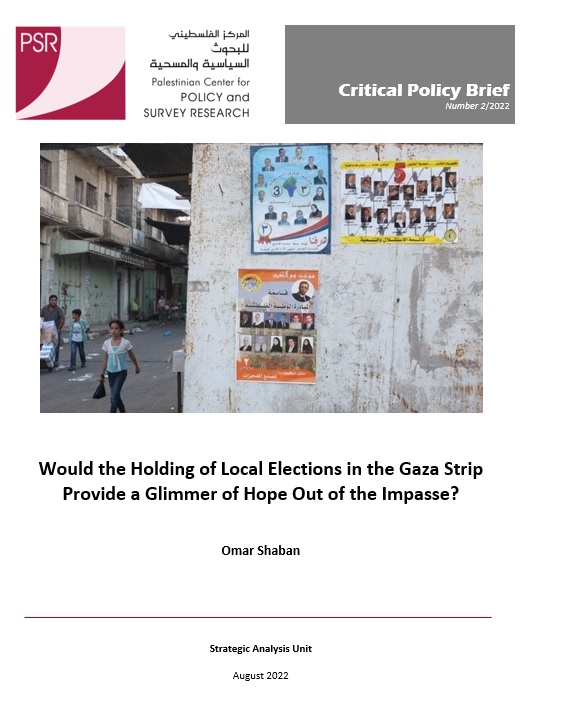
August 2022
Would the Holding of Local Elections in the Gaza Strip Provide a Glimmer of Hope Out of the Impasse?
Omar Shaban
The current difficult economic, social and psychological conditions in the Gaza Strip can only be understood when analyzed in the context of the blockade and repeated wars it has been suffering from since 2007. These conditions must also be placed in the context of internal division and a political failure in which all reconciliation efforts and factional dialogue led nowhere. Even when a consensus emerged over holding general elections for the Legislative Council, the Presidency and the PLO National Council, success remained elusive. Nonetheless, while general elections cannot be held in the foreseeable future, the pressure of the successive crises in the Gaza Strip forces a search for a way out of the impasse. This paper proposes the holding of local elections in the Gaza Strip as a small step that might trigger a gradual wider process. Local elections have been held three times in the northern governorates of the PA without the Gaza Strip’s participation since 2005. The paper argues that these local elections might provide a mechanism to gradually break the impasse and provide an opportunity for change that might enhance the confidence of the local community and its participation in administration and governance, enhance communication and engagement between local municipalities and the world, and might allow attracting projects to address pressing environmental crises and problems in the Gaza Strip. The continuation of the current fait accompli will only have more negative effects on the population, regardless of how much Hamas strives to improve it. The movement has already been hurt in appointing mayors even if it has made an effort to appoint the best in the management of the local bodies.
The Gaza Strip after 15 years of closure, wars, and the absence of elections:
The status quo in the Gaza Strip is characterized by the following:
1) Blocked political horizon and the loss of the hope for change: The political divide has led to the disruption of the democratic process and the fragmentation of the Palestinian political system. Palestinian division is likely to persist given the absence of any serious prospects for Palestinian reconciliation. Local and regional reconciliation efforts have so far been met with failure. This aspect of the status quo has proven to be the most resilient and resistant to change.
Main qualitative indicators continue to deteriorate: The Israeli blockade and repeated wars have caused a sharp deterioration in all indicators of life in the Gaza Strip, including health, education and the economy, with 1.3 million of Gaza's 2.1 million Palestinians in need of food assistance,[1] unemployment levels rising to 46.6% during the first quarter of 2022 compared to the average of 34.8% in 2006, while 81.4% of Palestinian households in the Gaza Strip live below the poverty line[2].
Unending rounds of escalation between the factions in Gaza and the occupation army: Since 2007, the Gaza Strip has been subjected to five major wars, dozens of short violent eruptions, and military and security tensions, causing thousands of victims from all segments of society and destroying tens of thousands of homes and infrastructure.
Psycho-social effects and extremism: The split and infighting have directly contributed to dividing the political system leading to the absence of the democratic process and the denial of the right of the population to choose their representatives, leading further to a state of frustration, despair and lack of horizon among Gazans. This has also led to a rise in the desire to emigrate among young people reaching 37%,[3] to unprecedented levels of attempted suicides, widespread hate speech and incitement, and to the strengthening of the political and legal divide between the Gaza Strip and the West Bank.
Moreover, compelling living conditions, rampant manifestations of corruption in the political and economic classes, and the prevalence of revenge tendencies have led many young people to embrace extremist ideology.[4] Hamas leader Khalil al-Haya said in 2015 at a session at the headquarters of the Legislative Council in Gaza that "our message to the whole world, which fears terrorism and extremism, is that delaying reconstruction and maintaining the siege on the Gaza Strip produce a suitable environment for the spawning of extremism and the increase of terrorism."
Proceeding from the fact that: (1) the continuation of the economic and political situation as it is has become untenable and represents a constant threat to the unity of the people and the opportunities for economic growth and political development, (2) the absence of opportunities to achieve reconciliation adds a further threat to the future of the Gaza Strip , and (3) the rejection by both Egypt and the Palestinian Authority of the option of creating a trade zone between Egypt and the Gaza Strip (because in their view it promotes the separation of the Gaza Strip away from the West Bank and the Palestinian Authority) reduces the prospects of ecnonmic development, (4) continued Israeli imposition of severe restrictions on the quality of goods entering Gaza, under the pretext of preventing the entry of "dual-use" goods, and on trade exchange with the West Bank and Israel adds yet another economic constraint, the holding of municipal elections in Gaza's governorates may present a gateway to a gradual exit from the crisis.
Why elections?
There are four reasons that call for the holding of local elections in the Gaza Strip:
Responding to legal entitlement and a developmental requirement: Holding elections for local bodies is a fulfillment of legal obligation based on the terms of law. It also provides an opportunity for change and sustainable development. For the youth, it represents a sign of hope for a better future of political and social participation.
The renewal of legitimacy strengthens international engagement: The renewal of the legitimacy of local bodies that rely heavily on international support contributes significantly to obtaining grants, projects and assistance, especially since there are a wide range of challenges in the field of service delivery, deterioration of infrastructure, environmental, hygiene and health problems suffered by the governorates of the Gaza Strip.
Local elections could serve as a first step on the road to general elections: The holding of local elections in the Gaza Strip is a real opportunity to persuade the international community to meet the Palestinians' desire for change and push it to work harder with the Israeli government to facilitate the holding of general elections.
It serves Hamas' interest: The holding of elections for local bodies shows Hamas' faith in, and support for, the democratic process. In the past, it favored these elections and it now has an opportunity to demonstrate its real intentions. The movement's approval and the quest to complete local elections in the Gaza Strip will strengthen its position as a political movement seeking to gain leadership through the election process thereby improving its image in front of the Palestinian society and the world. It is worth mentioning that Joseph Borrell, representing the EU foreign policy establishment, indicated on April 30, 2021, that the postponement of the Palestinian general elections, the first in 15 years, was "very disappointing."[5] The EU had consistently supported the holding of credible, inclusive and transparent elections for all Palestinians. Thus, even if the results are not satisfactory to everyone, if Hamas wins, they will be acceptable to many among the international community. It is also worth mentioning that Hamas did participate, directly or indirectly, in the elections of local and various other societal bodies in the West Bank. Therefore, it goes without saying that it is the duty of Hamas to meet Gazans’ needs to elect their own local leaders.
Completing the local election process in the Gaza Strip
The Palestinian political system has almost never respected the constitutional and legal dates for elections, whether legislative, presidential or local. Indeed, elections were held only when serving the political needs of the various political actors. In light of the Palestinian division, an additional constraint has been added leading to the holding of elections in certain parts of the Palestinian territories while abstaining from holding them in others. This happened with the local elections in 2012 when Hamas refused to participate in these elections and prevented them from taking place in the Gaza Strip. At that time, Hamas argued that holding local elections would have "deepened the state of division and increased tension." Fatah on the other hand said that given the fact that the holding of comprehensive general elections was difficult, the least that could be done was to go ahead with local elections. In 2016, Hamas agreed to enter the elections and allow them to be held in Gaza, but no Gazan elections took place after the filing of appeals against six Fatah lists, all accepted by the Central Election Commission (CEC), leading to a decision by the High Court in Ramallah to allow the holding of elections in the West Bank but not in the Gaza Strip. In this case, the court’s reasoning was the “absence of a legitimate judiciary, one formed according to the Basic Law and other relevant laws.”
A breakthrough occurred in 2021 after a series of successful meetings between the CEC and the various Palestinian factions in the West Bank and Gaza Strip. All factions, including Hamas, agreed to hold general elections. The Palestinian President Mahmoud Abbas issued Decree No. 3 of 2021 on January 15 specifying the dates for the holding of legislative, presidential, and National Council elections in three stages.
Three months later, in April 2021, a presidential decree No. (12) of 2021 was issued, providing for the postponement of the general elections, where the first article stated "Postponement of the general legislative and presidential elections and the National Council.... until the conditions for holding them are met in all Palestinian territories, especially Jerusalem, the capital, in accordance with the provisions of the law.”
Soon after that, the PA decided to hold local elections in the West Bank, including Jerusalem, in two phases. However, it was postponed in Gaza due to Hamas’ objections. In a press release on March 13, 2022, Hamas stressed that “fragmented elections” promote the approach of authoritarianism and exclusion, and that there is no solution except through inclusive national and local elections based on consensus.[6] Additionally, Hamas set three main conditions in order for it to allow the holding of elections for local bodies in the Gaza Strip. These included: first, that local elections should be part of the general elections, including parliamentary and presidential elections, and not a substitute for them; second, that there should be a written pledge from President Mahmoud Abbas to ensure that elections will not be cancelled at the last minute; and thirdly, for the president to retract the amendments he has made to the local elections law relating to the jurisdiction of the courts of first instance.
What can be gained by completing the local elections by holding them in the Gaza Strip
The right to participate: The holding of local elections enhances the chances of participation in the electoral process, the right to compete and vote, and restores dynamism to the Gaza Strip thus triggering greater activism and restoring hope in the face of the current stagnation. It can pump a new blood creating opportunities to address pressing issues and environmental problems in local bodies, and moves citizens from talking about wars and destruction to talking about hope and the future.
Easing tension and spreading hope among young people: Young people make up about two-thirds of Gaza's population (of two million people), none of whom participated in any elections whatsoever. The last local elections were held in the Gaza Strip in 2005. Depriving young people of participation in the selection of their representatives is a violation of the constitution; marginalizing young people and signaling to them their lack of importance, leading some of them to extremism and frustration.
The completion of local elections is a confidence building measure that could serve as a small step towards reconciliation: the completion of local elections will only take place in coordination between all relevant parties, namely the Palestinian government, CEC, and Hamas. It is a new phase, not a new round of elections, and it requires approval from all parties. It will also be completed within the laws governing the electoral process that has already been held in the West Bank without the Gaza Strip. Therefore, it must have the same specifications and procedures for any elections held in Palestine based on the laws in force. This development will enhance the dialogue between the Palestinian factions, especially Hamas, with CEC, the PA, and Fatah. Coordination for the participation of international and civil society election monitoring teams will also legitimize these elections. Although optimism about reconciliation may be far from real, the holding of these local elections in the Gaza Strip can be seen as a small confidence building measure that might improve the chances of holding general elections when time becomes ripe for that process to restart. The holding of local elections in the Gaza Strip will be the first successful sign of a joint national effort since the split in 2007 and might generate greater trust between the two sides of the split, Fatah and Hamas, and will likely reopen the door for dialogue to address the problems of holding general elections.
Local elections are a competition for service delivery and should not be politicized: Local elections are not as politicized as general elections, but are elections to renew legitimacy at the level of local administration and inject new blood, ideas and programs to serve the local community in service delivery sectors. Its results are expected to be acceptable even if Hamas wins, as the community of donors already deals with most municipalities in the Gaza Strip, and their Hamas-appointed heads. Several trade union elections have already been held with the participation of the Gaza Strip, the most recent of which was the Bar Association elections. All factions competed in the union elections and internal and external parties accepted the legitimacy of those elections and their results. All of this enhances the chances of holding local elections and reduces concerns about the international reaction regardless of their results, as most members of the international community, which demands the holding of elections, will find it difficult to reject their results.
The difficulties of holding local elections in the Gaza Strip
Hamas' concerns: The most important challenge to holding local elections is Hamas' position as reflected in a letter it submitted to CEC. According to the CEC, Hamas has requested "written" guarantees before it would allow local elections to take place in the Gaza Strip. These guarantees sought to ensure that the election will not be postponed in the last minute. CEC added that Hamas's letter also included issues related to the electoral law, namely: "abolishing the composition of the Election Court and restoring the jurisdiction to decide on appeals to the courts of first instance in the West Bank and Gaza Strip.”[7]
Administrative and technical procedures for holding elections: There are legitimate questions and concerns about the technical and logistical aspects of holding elections in accordance with the existing laws. However, it should be noted that these issues and procedures are meant to facilitate, not complicate, the election process and that policy makers must show the required flexibility in putting them in place. Thus, when elections are desired and accepted by all parties, procedural and technical challenges should be addressed and overcome by consensus.
Conclusions
This paper argues that the holding of local elections in the Gaza Strip is essentially a completion of the election process that has already taken place but has not been implemented in that part of the Palestinian territory; it is not a separate electoral process. Moreover, it believes that success in this matter might trigger greater dynamism in the Gaza Strip turning it into a workshop on many levels, while strengthening the economy and community engagement. It might also produce greater dialogue and constructive debate instead of the state of tension, hate speech and despair prevailing today.
Based on a review of the motives and difficulties, the paper also considers that holding local elections is a viable and practical option and may even constitute a small bridge towards Palestinian reconciliation. The completion of the municipal elections strengthens the cohesion of the Gaza Strip with the northern governorates in the West Bank and achieves a tangible interest for the Palestinian Authority and the presidency. These elections are also in Hamas' interest in terms of easing societal tensions, addressing the phenomena of extremism and frustration, and easing the burdens of local government administration. They can also serve as a signal of Hamas’ commitment to pluralism, which will greatly help it gradually return to the formal Palestinian political system.
[1] See OCHA report Gaza Strip | The humanitarian impact of 15 years of the blockade - June 2022: Gaza Strip | The humanitarian impact of 15 years of the blockade - June 2022 | United Nations Office for the Coordination of Humanitarian Affairs - occupied Palestinian territory (ochaopt.org)
[2] See report on poverty in the Gaza Strip issued by the Palestinian Center for Human Rights: https://pchrgaza.org/ar/%D8%AA%D9%82%D8%B1%D9%8A%D8%B1-%D8%AD%D9%88%D9%8...\
[3] See Omar Shaban, What Future for the Gaza Strip in the Next Five Years?: Critical Policy Brief, Number 6/2021 | PCPSR
[4] See, piece by Ghassan al Za’aneen on the consequences of cancelling local elections (no date) : http://palthink.org/2017/05/1585/
[5] See, France 24, 30 April 2021: https://www.france24.com/ar/%D8%A7%D9%84%D8%B4%D8%B1%D9%82-%D8%A7%D9%84%...
[6] See, statement in al Risalah, 13 March 2022: https://alresalah.ps/post/256993/%D8%AD%D9%85%D8%A7%D8%B3-%D8%A7%D9%84%D...
[7] See, al Sharq al Awsat, 2 January 2022: https://aawsat.com/home/article/3394071/%D8%A7%D8%B3%D8%AA%D8%A8%D8%B9%D...
21September 2021
While almost all Palestinians followed the news about the Gilboa prison break on daily basis viewing it as inspiring to popular resistance, the killing of the opposition activist Nizar Banat and the PA behavior in its aftermath damage the standing of the PA as almost 80% of the public demand the resignation of president Abbas
15-18 September 2021
This poll has been conducted in cooperation with the Konrad-Adenauer-Stiftung in Ramallah

These are the results of the latest poll conducted by the Palestinian Center for Policy and Survey Research (PSR) in the West Bank and the Gaza Strip between 15-18 September 2021. The period before the conduct of the poll witnessed several developments including the killing of a political activist, Nizar Banat, right after his arrest and sever beating by the Palestinian security services, the eruption of widespread demonstrations against the PA demanding justice for Banat, the escape of six Palestinian prisoners from the Gilboa prison in Israel and the capture of four of them (just before the fieldwork began), the continued Egyptian-mediated Hamas-Israeli negotiations to strengthen the ceasefire reached in May and begin the process of reconstruction, the meeting of PA president Mahmoud Abbas with the Israeli defense minister Benny Gantz in Ramallah to talk about Palestinian-Israeli relations and means of improving them while strengthening the PA by implementing various trust-building measures. This press release addresses these issues and covers other matters such as the general conditions in the Palestinian territories, the peace process and future possible directions for Palestinians in the absence of a viable peace process. Total size of the sample is 1270 adults interviewed face to face in 127 randomly selected locations. Margin of error is +/-3%.
For further details, contact PSR director, Dr. Khalil Shikaki, or Walid Ladadweh at tel. 02-296 4933 or email pcpsr@pcpsr.org.
Main Findings:
Findings of the third quarter of 2021 show the centrality of domestic issues on shaping public attitudes. Three developments in particular are worth observing: the killing of the political activist Nizar Banat by PA security services, the manner in which PA security services dealt with protests during the last few months, and the residual impact of the last Hamas-Israel war of May 2021. Findings also show the great importance attached by the public to the issue of prisoners in Israeli jails. Impacted by all of the above, findings reflect continued PA loss of status and support.
A large majority rejects that the notion that the killing of Banat was a mistake unintentionally made by security officers. Instead, the public is confident that the death of the political activist was premediated, ordered by the political or security leadership. Because of that, the public is not
satisfied with the step taken by the PA to ensure justice by putting all security officers involved on trial. The public is also angry with the manner in which the PA cracked down on public protests that demanded justice in the Banat case. In fact, three quarters view the behavior of the security services as a violation of liberties and human rights.
Findings show that the overwhelming majority of the public has been following, on daily basis, the news regarding the escape of six Palestinian prisoners from the Gilboa prison in Israel. The overwhelming majority views the prisoners’ behavior, even after they were captured, as inspiring to the Palestinians to rise and take the initiative to resist the occupation. Yet, on this issue of public consensus, one in which the PA is not a party, the Palestinian leadership and the security establishment do not come out looking good at all. While the public is easily convinced by Hamas’ proclamations and plans for freeing the prisoners, the PA is distrusted with the majority believes that the PA security services would not defend the prisoners.
The impact of the May 2021 confrontations in Jerusalem and the war between Hamas and Israel is still strongly felt in this poll. An overwhelming majority still thinks Hamas came out the winner and that Hamas goal has been to defend East Jerusalemites and al Aqsa Mosque. Indeed, the largest percentage (but not the majority) believes that Hamas is more deserving of representing and leading the Palestinian people. The majority calls upon Hamas to relaunch rockets against Israel if East Jerusalemites are expelled from their homes in the city or if restrictions are imposed on Palestinian access to al Aqsa Mosque. Nonetheless, it is worth noting that now, after three months have passed since our last poll, we do see some decline in some of those indicators that measure the ascendance of Hamas. In almost all indicators, we see a small decline ranging between two to eight percentage points.
If new presidential and parliamentary elections were to take place today, Hamas would do relatively well compared to Fatah. This is particularly true for a presidential election, assuming president Abbas is Fatah’s candidate. The outcome would be dramatically different and more beneficial to Fatah if its candidate for the presidency is Marwan Barghouti. Most importantly for Fatah, findings show a significant increase in the demand for Abbas’ resignation, with almost 80% making the demand, an unprecedent PSR finding.
Findings show that in the context of increased Covid-19 infection rates, the majority is in favor of mandatory vaccination; but opposition is slightly more than a third. Yet, even among those who reject making vaccination mandatory to all of the public, a minority favors making it mandatory to those working in the public sector such as schools and ministries.
Findings on the peace process show continued but slow decline in support for the two-state solution. They also show high levels of support for armed struggle as the best means of ending the occupation with almost half of the public endorsing this position. Consistent with that we find a slim majority opposing a resumption of Palestinian-Israeli negotiations under the sponsorship of the Quartet. Despite this, a majority of Palestinians view positively the confidence building measures that would improve living conditions in the West Bank and the Gaza Strip.
1) Prisoners escape from the Gilboa prison:
- An overwhelming majority of Palestinians (86%) says that it has heard about and followed on daily basis the news about the escape of the six Palestinian prisoners from the Gilboa prison in Israel and the capture of some of them while 12% say they did that occasionally and only 2% say they have not heard about or followed the news
- Similarly, 87% say the escape of the six prisoners and the capture of some of them will serve as an inspiration to Palestinians outside the prison to take the initiative and actively work toward the ending of occupation; only 7% think the escape and capture will have the opposite impact of bringing frustration and despair; 5% say it will have no impact.
- 81% believe that Hamas will soon succeed in making a deal with Israel on a prisoners’ exchange that will include the release of the escaped and recaptured prisoners; 14% believe no such exchange will take place soon.
- On the other hand, if the escaped prisoners managed to reach the Palestinian territories, only 24% think the PA security services would in this case protect them while 68% think they would not do so.
2) The death of Nizar Banat:
- A majority of 63% of the public believes that the killing of Nizar Banat soon after his arrest by PA security officials was a deliberate measure ordered by the PA political or security leaders while only 22% believe it was an unintentional mistake by those who arrested him.
- 63% support and 28% oppose the demonstrations that erupted after the death of Banat demanding the departure of the president from office and the removal of his government.
- A large majority of 69% feels the measures take by the PA to ensure justice in the Banat case, including putting on trial all 14 security officials who took part in his arrest, are insufficient; only 20% think they are sufficient.
- Almost three quarters (74%) believe the steps taken by the PA security services in arresting the demonstrators who demanded justice for Banat is a violation of liberties and human rights while only 18% view these measures as a legitimate enforcement of law and order.
3) Three months after the Jerusalem confrontations and the war between Hamas and Israel:
- An overwhelming majority of Palestinians (71%) believes that Hamas has come out a winner in its last war with Israel while only 3% think Israel came out a winner; 21% say no one came out a winner and 3% think both sides came out winners. Three months ago, 77% thought Hamas came out the winner. Moreover, 63% think that Hamas has achieved its declared goal behind firing rockets at Israel: to force Israel to stop the expulsion of the families in al Shaikh Jarrah and to bring to an end Israeli restriction on Muslim access to al Aqsa; 29% think it did not. Three months ago, 65% said Hamas has achieved its declared goal
- 67% think that Hamas’ decision to launch rockets at Israeli cities came in defense of Jerusalem and al Aqsa Mosque while 10% think it came as a protest against the PA cancelation of elections with the aim of weakening the PA leadership; 19% think Hamas’ decision was motivated by these two drivers. Three months ago, 72% thought that Hamas’ decision came in defense of Jerusalem and al Aqsa Mosque.
- In light of the recent confrontations with Israel, 45% think Hamas is most deserving of representing and leading the Palestinian people while only 19% think Fatah under president Abbas is the most deserving of representing and leading the Palestinians; 28% think neither side deserve such a role. Three months ago, 53% thought Hamas is more deserving of representation and leadership and 14% thought Fatah under the leadership of Abbas is the more deserving.
- If Israel expels the families of al Shaikh Jarrah or reimposes restrictions on access to al Aqsa Mosque, 60% believe the response in this case should be the launching of rockets at Israeli cities, while 20% think it should be the waging of non-violent resistance, and 13% believe Palestinians should respond by submitting a complaint to the UN and the International Criminal Court (ICC).
4) Legislative and presidential elections:
- 73% say they support the holding of presidential and legislative elections in the Palestinian territories in the near future while 23% say they do not support that. Demand for elections stands at 82% in the Gaza Strip and 67% in the West Bank. But a majority of 56% (63% in the Gaza Strip and 52% in the West Bank) believe no legislative or legislative and presidential elections will take place soon.
- If new presidential elections were held today and only two were nominated, Mahmoud Abbas and Ismail Haniyeh, only 51% would participate and from among those, Abbas would receive 34% and Haniyeh 56% of the votes (compared to 59% for Haniyeh and 27% for Abbas three months ago). In the Gaza Strip, Abbas receives 34% of the votes (compared to 30% three months ago) and Haniyeh receives 61% (compared to 60% three months ago). In the West Bank, Abbas receives 33% (compared to 25% three months ago) and Haniyeh 52% (compared to 59% three months ago). If the competition was between Marwan Barghouti and Ismail Haniyeh, participation would increase to 66% and from among those Barghouti receives 55% and Haniyeh 39%. If the competition is between prime minister Mohammad Shtayyeh and Haniyyeh, participation rate would decrease to 49% and from among those the former receives 31% and the latter 60%. Three months ago, Shtayyeh received the support of 26% and Haniyyeh 63%.
- If Abbas does not run for elections, the public would vote for the following: 33% say they want Marwan Barghouti, 22% say Ismail Haniyyeh, 6% say Dahlan and another 6% say Yahia Sinwar, Khalid Mishaal and Mustafa Barghouti 3% each, and Salam Fayyad 2%.
- Level of satisfaction with the performance of president Abbas stands at 24% and dissatisfaction at 73%. Level of satisfaction with Abbas stands at 22% in the West Bank and 26% in the Gaza Strip. Satisfaction with the performance of Abbas six months ago stood at 32% and dissatisfaction at 65%. Moreover, 78% of the public want president Abbas to resign while only 19% want him to remain in office. Three months ago, 68% said they want Abbas to resign. Demand for Abbas’ resignation stands at 78% in the West Bank and 77% in the Gaza Strip.
- If new legislative elections were held today with the participation of all factions that participated in the 2006 elections, 68% say they would participate. Of those who would participate, 37% say they will vote for Hamas and 32% say they will vote for Fatah, 13% will vote for all other third parties combined, and 18% are undecided. Three months ago, vote for Hamas stood at 41% and Fatah at 30%. Vote for Hamas in the Gaza Strip stands today at 47% (compared to 45% three months ago) and for Fatah at 27% (compared to 28% three months ago). In the West Bank, vote for Hamas stands at 28% (compared to 38% three months ago) and Fatah at 38% (compared to 32% three months ago).
5) Domestic conditions and satisfaction with the Shtayyeh government:
- Positive evaluation of conditions in the Gaza Strip stands at 7% and positive evaluation of conditions in the West Bank stands at 23%.
- Nonetheless, perception of safety and security in the Gaza Strip stands at 67% and in the West Bank at 59%.
- 27% of the public say they want to emigrate due to political, security, and economic conditions. The percentage in the Gaza Strip stands at 36% and in the West Bank at 21%. Three months ago, 15% of West Bankers expressed a desire to emigrate and 42% of Gazans expressed the same desire.
- Perception of corruption in PA institutions stands at 83%. When asked about institutions controlled by Hamas in the Gaza Strip, 61% indicated that there is corruption in these institutions. Three months ago, 84% said there is corruption in PA institutions and 57% said there is corruption in public institutions controlled by Hamas.
- 38% of West Bankers think people in the West Bank can criticize the PA without fear while 58% think they cannot. When asked to evaluate the status of democracy and human rights in the West Bank, 18% of West Bankers said it was good or very good. In the Gaza Strip, 58% think people in the Strip can criticize Hamas’ authorities without fear and 37% think they cannot. When asked to evaluate the status of democracy and human rights in the Gaza Strip, 43% of Gazans said it was good or very good.
- In its assessment of the PA, a majority of the Palestinians (59%) views it as a burden on the Palestinian people while 34% view it as an asset for the Palestinian people. Three months ago, 56% viewed the PA as a burden and 35% viewed it as an asset.
- 32% are optimistic and 63% are pessimistic about the success of reconciliation. Three months ago, optimism stood at 41%.
- After more than two years since the formation of the Shtayyeh government, findings indicate persistent pessimism. Responding to a question about expectations regarding the ability of the Shtayyeh government to make progress in reconciliation and reunification, 70% expect failure; only 22% expect success. When asked about the ability of the government to organize legislative or legislative and presidential elections in the West Bank and the Gaza Strip, 29% of the public expect success and 63% expect failure. In another question about the ability of the new government to improve economic conditions, a majority of 64% expects failure and 30% expects success.
- We asked the public about its view regarding the demands for a change in the current PA government. A majority of 54% expresses support for comprehensive change leading to the appointment of a new government and a new prime minister, while 26% want only to change some of the ministers, and 14% do not want to make any change and want the government to stay as it is.
- We also asked the public about its views on the recuring internal violence similar to the one witnessed recently in which an incident between two individuals led to widespread family and tribal violence. A majority of 57% expressed the view that such incidents indicate a weak pubic trust in the justice system including law enforcement agencies; but 35% expressed the view that such incidents reflect the traditional nature of Palestinian society that is difficult or impossible to change.
- When asked how should the PA deal with such incidents, 66% expressed the view that first and foremost, the PA should strengthen the law enforcement authorities while 27% expressed the view that the PA should strengthen the tribal reform committees and cooperate with them.
- We asked the public about its viewership habits in the last three months. Findings indicate that al Jazeera TV has the highest viewership, standing at 23%, followed by Palestine TV (14%), al Aqsa TV (12%), Palestine Today (11%), Maan (10%), al Mayadeen (4%), al Arabiya (3%), and al Manar (2%).
6) The Coronavirus: Mandatory vaccination and PA performance during the pandemic:
- With the big rise in the number of Covid infections, we asked the public about the steps it thinks the PA government should take in order to protect people from the pandemic: 39% said it should follow the normal procedures of enforcing social distance, face masks, and payment of fines for violators; a similar percentage (37%) said it should make vaccination mandatory to all those who are allowed to take it; 5% said it should impose a full closure; and 15% said they are in favor of all of the above.
- When asked specifically about mandatory vaccination, a majority of 63% expressed support while 35% expressed opposition.
- Among those who reject mandatory vaccination, 29% are in favor, and 69% are not in favor, of making it mandatory to those who work in the public sector such as those working in schools and ministries.
- 48% (55% in the West Bank and 39% in the Gaza Strip) report that they have already received the coronavirus vaccination; 27% (19% in the West Bank and 38% in the Gaza Strip) says that they are willing to take the vaccine when available; and 24 say they and their families are not willing to take the vaccine when it becomes available to them.
- 74% (84% in the Gaza Strip and 68% in the West Bank) are satisfied with the efforts made by the government to obtain the vaccine and 24% are dissatisfied.
- 45% are satisfied with the measures taken by the PA to contain the spread of the coronavirus while 53% are dissatisfied.
- The majority is satisfied with the performance of the various actors involved in the management of the Coronavirus crisis: 59% express satisfaction with the performance of the security services deployed in their areas and 63% are satisfied with the performance of the ministry of health. But satisfaction with the performance of the prime minister in the management of the Coronavirus crisis stands at only 39%.
7) The Palestinian-Israeli Peace process and the new Israeli government:
- Support for the concept of the two-state solution stands at 36% and opposition stands at 62%. No description or details were provided for the concept. Three months ago, support for the concept stood at 39%.
- A majority of 63% believes that the two-state solution is no longer practical or feasible due to the expansion of Israeli settlements while 32% believe that the solution remains practical. Moreover, 73% believe that the chances for the creation of a Palestinian state alongside the state of Israel in the next five years are slim or nonexistence while 23% believe the chances to be medium or high.
- The most preferred way out of the current status quo is “reaching a peace agreement with Israel” according to 28% of the public while 39% prefer waging “an armed struggle against the Israeli occupation.” 10% prefer “waging a non-violent resistance” and 18% prefer to keep the status quo. Three months ago, 27% said that they prefer reaching a peace agreement with Israel and 39% said they prefer waging an armed struggle.
- When asked about the most effective means of ending the Israeli occupation, the public split into three groups: 48% chose armed struggle, 28% negotiations, and 19% popular resistance. Three months ago, 49% chose armed struggle and 27% chose negotiations.
- We asked the public to speculate about the reasons for the lack of mass popular participation in non-violent resistance and provided the following list: trust in leadership and parties, burden of living conditions, or loss of will to fight. The largest percentage (44%) replied that it is due to lack of trust in the PA political leadership and; 39% said it has to do with the preoccupation and the burden of daily living conditions; and only 16% selected the loss of the will to fight.
- Under current conditions, a majority of 61% opposes and 24% support an unconditional resumption of Palestinian-Israeli negotiations.
- When asked about support for specific policy choices, 63% supported joining more international organizations; 54% supported resort to non-violent resistance; 54% supported return to armed confrontations and intifada; 47% supported dissolving the PA; and 27% supported abandoning the two-state solution and embracing a one state solution for Palestinians and Israelis. Three months ago, 60% supported a return to confrontations and armed intifada, 47% supported dissolving the PA, and 20% supported the abandonment of the two-state solution in favor of a one-state solution.
- 58% are opposed, and 36% are supportive, of a return to dialogue with the new US administration under president Joe Biden. Support for a return to Palestinian-Israeli negotiations under the leadership of the international Quartet stands at 39% and 52% are opposed. Moreover, 49% do not believe, and 41% believe, that the election of Biden and the resumption of American aid to the PA opens the door for a return to Palestinian-Israeli negotiations within the framework of the two-state solution.
- We asked the public about its views regarding Palestinian-Israeli confidence building measures that would improve living conditions in the West Bank and the Gaza Strip, such as approval of family unification permits or making available to the PA additional financial resources. A majority of 56% said it looks positively, while 35% said it looks negatively, at such measures.
8) American withdrawal from Afghanistan:
- 40% view the events leading to the withdrawal of the US from Afghanistan as a victory for Taliban against the US and its Afghani allies. But a third (33%) thinks that the events leading to the US withdrawal were orchestrated ahead of time between the US and Taliban; 27% say they not know.
- The largest percentage of the public (43%) does not expect what happened in Afghanistan to happen in Palestine in case of an Israeli withdrawal from the West Bank, a scenario in which such withdrawal would lead to the collapse of the PA and its government and the takeover of armed Islamist groups, such as Hamas; but 36% believe this scenario could indeed happen and 21% do not know.
- Moreover, 46% believe the Palestinians should learn a lesson from what happened in Afghanistan by strengthening the forces of armed resistance, but not the PA and its government, while 28% think the lesson should lead us to strengthen the PA and its legitimacy so that it would not collapse as the Afghani government did.
9) Most vital Palestinian goals and the main problems confronting Palestinians today:
- 44% believe that the first most vital Palestinian goal should be to end Israeli occupation in the areas occupied in 1967 and build a Palestinian state in the West Bank and the Gaza Strip with East Jerusalem as its capital. By contrast, 32% believe the first most vital goal should be to obtain the right of return of refugees to their 1948 towns and villages, 12% believe that the first and most vital goal should be to build a pious or moral individual and a religious society, one that applies all Islamic teachings and 10% believes it should be to establish a democratic political system that respects freedoms and rights of Palestinians.
- In a question about the two main problems confronting the Palestinians today, the largest (36%; 31% in the Gaz Strip and 40% in the West Bank) said it is the continued siege and blockade percentage of the Gaza Strip, 23% said it is the unemployment and poverty, 13% said it is the continuation of the occupation, 12% said it is the split between the West Bank and the Gaza Strip, 10% said it is the spread of corruption, and 6% said it is the weakness of the judiciary and the absence of liberties, accountability and democracy.

September 2021
What Future for the Gaza Strip in the Next Five Years?
Omar Shaban
Since the Palestinian division occurred in June 2007, the Gaza Strip has become a geographical area with a political and legal context different from the West Bank. The Gaza Strip is a small area in size, but a large one in problems. It is under the rule of Hamas, which is not recognized in the Arab world, nor internationally. After Hamas took control of the Strip, Israel imposed a comprehensive blockade and exposed it to four, long, destructive wars and dozens of smaller armed confrontations over 14 years. The policy of the suffocating blockade enforced by Israel, as well as the repeated wars and military attacks, have created an unprecedented humanitarian crisis and resulted in massive destruction of infrastructure and all economic sectors and activities.[1] The Gaza Strip is supposedly part of the territory of the Palestinian Authority (PA) and the future state, according to international resolutions and the Oslo Agreement signed between the PLO and Israel. However, as it is not geographically connected to the remaining Palestinian territory, and, since the Palestinian division in 2007 that brought it outside the control of the PA, and the failure of attempts at reconciliation and unity, the question is again raised: ‘What is the future of the Gaza Strip within the next five years?’
Four assumptions:
The following discussion takes for granted the continuation of four aspects of the current status quo:
Continued Palestinian division, continued Hamas control of the Gaza Strip: Numerous attempts have failed to achieve reconciliation and reinstate the PA as the ruler of the Gaza Strip. The last attempt was the formation of the reconciliation government in June 2014, as a result of the Shati agreement of April 2014. After a break of several years, rounds of dialogue were renewed between representatives of Hamas and Fatah, hosted in the capitals Istanbul, Cairo and Doha in September 2020.[2] However, they did not succeed in achieving reconciliation. The failure of the reconciliation rounds means that Hamas will remain in power in the Gaza Strip. Israel does not conceal its efforts to prevent national reconciliation and stop the return of the PA rule over the Gaza Strip.
The Israeli-Palestinian conflict remains unresolved: The optimism that prevailed in Palestinian and international circles with President Joe Biden’s coming to power in the United States soon faded, as the new US administration did not initiate any move to resume the track of negotiations between the Palestinian Authority and Israel. The first communication between presidents Biden and Mahmoud Abbas took place because of the war between Israel and the factions in Gaza in May 2012. The US intervention, which came somewhat late, was prompted by the war on Gaza but was limited to economic interventions and financial assistance while removed from any political path. Further, the first meeting between President Abbas and the Israeli government, the meeting with defense minister Benny Gantz in August 2021, dealt only with security and economic and humanitarian issues and aimed at strengthening the Authority, enhancing security coordination and preventing collapse. Israeli media quoted Prime Minister Naftali Bennett’s statements, stressing that ‘there is no political process with the Palestinians, and there will not be such a process.[3] ’There is no political path in the foreseeable future.
Ongoing blockade and closure: With the end of the May 2021round of confrontations between Israel and the Gaza Strip, the new Israeli government announced its clear position of continuing the blockade of the Strip, preventing the reconstruction process, and linking any easing of hardships to the issue of the Israeli prisoners, ostensibly held in Gaza.[4] This Israeli intransigence saw some flexibility with regard to the blockade, where pressure from mediators forced the new Israeli government to allow some relief to avert a new war, including transferring part of the Qatari grant funds, allowing the entry of raw materials, including building materials, the expansion of the fishing zone, and allowing thousands of Gazan workers to enter Israel. However, these facilities do not amount to the lifting the total blockade imposed on the Gaza Strip.[5]
Current regional environment remains unchanged: It is expected that the regional environment will remain relatively stable, without a meaningful or qualitative change. The main relevant regional players are Egypt, Iran, Jordan, Turkey and Qatar. These countries, which represent the various interests in the region, are not united in their position on Hamas and the Gaza Strip. At a time when Iran, Turkey and Qatar’s relations are open with Hamas, providing humanitarian aid and some political recognition, the relationship of Egypt and Jordan with Hamas is witnessing much fluctuation, governed by a de facto reality and no more. Disputes among the countries of the region are clearly reflected in their relations with Hamas. These countries are preoccupied with their internal issues and have no intention of bringing about a qualitative change in their relations and positions on Hamas, in particular, and the Gaza Strip, in general.
Anticipating the future of the Gaza Strip in the next five years
In light of these assumptions, this paper examines the available and possible options for the Gaza Strip in the next five years. It is based on a reading of the positions of the relevant parties and the degree of their interaction with the internal environment, as well as the ongoing discussion within Hamas on alternatives paths to take to get out of the crisis that has persisted for 14 years. In an attempt to anticipate the future of the Gaza Strip in the next five years, three alternatives to the status quo can be identified: a the return of the Gaza Strip to PA control, a Hamas-Israel long term truce, and an independent Gaza entity.
First option: achieving reconciliation, returning the PA to rule, with the participation of Hamas
This scenario assumes the realization of full national reconciliation. Since the division, attempts have not ceased in order to achieve this. Yet, despite many reconciliation agreements (Aden 2008, Cairo 2011, Doha 2012, Al-Shati 2014, and Cairo 2017), the outcome has been failure. The presidential decree that came in January 2021[6] to hold legislative and presidential elections in May and July 2021 restored hope for national reconciliation. But this hope was soon dashed by the president’s decision to postpone the elections, under the pretext of Israel’s refusal to hold them in Jerusalem. This was preceded by a series of attempts towards national reconciliation between Hamas and Fatah, the most recent of which was on September 24, 2020 in Istanbul, resulting in a shared vision towards the resolution of the outstanding issues between the two parties, such as reforming the PLO, the appropriate means of resisting occupation, and the use of popular resistance.[7] With the postponement of the elections and the war on Gaza in May 2021 (which contributed to a significant increase in the popularity of Hamas and was accompanied by a severe deterioration in the position of the Palestinian Authority), and given the assassination of activist Nizar Banat, the vaccine deal with Israel, perceived by the public as the result of corruption within the PA, and other issues, the gap between the two movements widened, making reconciliation more elusive than before. An opinion poll conducted by the Palestinian Center for Policy and Survey Research shows that the popularity of the Palestinian president dropped dramatically after the Israeli aggression on the Gaza Strip in May 2021, falling, in a contest between Abbas and Hamas’ Ismail Haniyyeh, from 47% in March 2021 to 27% in June 2021. Further, the poll indicates that 53% view Hamas as the worthiest of representing and leading the Palestinian people, compared with only 14% in favor of the Fatah movement led by President Abbas.[8]
After the tripartite meeting in Cairo between the Palestinian and Egyptian presidents and the Jordanian king, in September 2021, President Mahmoud Abbas highlighted “the need” for Hamas to recognize international legitimacy, and added that “if it recognizes that legitimacy, we can immediately form a national unity government.”[9] This is a position previously rejected by Hamas and some Palestinian factions.
Within Hamas, there is no consensus among its leaders on the terms for reconciliation with the Palestinian Authority and the Fatah movement. Inconsistent statements have been made by Hamas leaders on the extent of concessions that must be made. This is also the case within the Fatah movement and some of its allied factions. Positions of the two sides reflect different convictions on who should emerge as the predominant Palestinian player. Additionally, several thorny issues prevent reconciliation, including Hamas’ insistence on retaining its weapons and military and security apparatus, contrary to the desire of President Mahmoud Abbas, who demand one-weapon and one-law and rejects the model of Lebanon’s Hezbollah in Gaza. There is another difficulty represented in the administrative and security integration of employees working with the Hamas government, financial collection, the judiciary, land, and the lifting of sanctions.
Moreover, there is a belief within the Hamas movement that time works to its advantage, as it accumulates more experience and support in the region, as happened with the May 2021 war. Hamas believes that the prospects for reconciliation will be better in the absence of the Palestinian president. In the meanwhile, this view is bolstered by sustained deterioration in the popularity of its rival, Abbas and Fatah, and the potential outbreak of an internal conflict on succession, both within Fatah and the PA. In other words, Hamas is not in a hurry for reconciliation.
Second option: reaching a long-term truce with Israel
Since Hamas assumed control over the Gaza Strip in 2007, its relations with Israel have been tense, occasionally oscillating between various priorities. The need to meet the needs of the population under its control and to assert its control came in conflict at times, with its desire to preserve its position as a leader of armed struggle against Israel. Following armed confrontations, concerns about rebuilding the Strip’s destroyed infrastructure constituted another priority. Hamas has signed several truce agreements with Israel after these wars (2009, 2012 and 2014), but they were of short duration. Hamas is conducting a semi-continuous dialogue with Israel, with Egyptian, Qatari and UN mediation, to obtain a number of economic and material improvements as well as opening of the crossings, issuance of permits to workers, and others. On the onset of each conflict, Israel withdraws these facilities and then renegotiates them.
In the meanwhile, Hamas confirms, now and then, that it does not want more extensive military clashes with Israel, but is seeking to stop the escalation, on condition of easing the blockade, yet without abandoning the principle of armed struggle against Israel. Hamas sees its rule of the Gaza Strip and continued discourse of resistance and struggle against occupation as necessary elements in the formulation of its identity that ensures continued support for it, as well as gaining the attention of third parties, both allies (Qatar, Turkey and Iran) and opponents (Israel, Egypt, the Palestinian Authority). Hamas bears the burden of governance and realizes that it needs some kind of relationship with the occupation, which is the main regulator of the Gaza Strip.
Hamas cannot go so far as to recognize Israel and sign a peace agreement with it. This position is driven by ideological reasons and its awareness that such a recognition would deprive it of its status as a resistance movement, and might cause it to lose popular support. Thus, it prefers to talk about a long-term truce. This position enables Hamas to retain its identity as a ‘resistance’ movement, and, at the same time, obtain important economic gains that enhance its ability to rule the Gaza Strip; in other words, combining resistance and governance. This Hamas’ equation is premised on obtaining humanitarian facilities and improvements, bypassing the blockade, and opening up the Gaza Strip to the outside world, in return for Israel enjoying calm on the borders for a long period of time. In the meanwhile, the Hamas movement oscillates between its past as a resistance movement, from which it departed, in part, in June 2007, and its present as a government tasked with caring for 2 million Palestinians. As things stand today, Hamas is at an intermediate stage between an armed organization and a government. Given this context, a long term truce with Israel fits Hamas’ intermediate goals.
Third option: an independent Gaza entity
In this alternative, the Gaza Strip becomes a small political entity on its own, one that enjoys sovereignty. In a wider context, this alternative maintains the current split as the Gaza Strip and the West Bank remain two territories that enjoy different levels of control or sovereignty. On de facto basis, the West Bank remains a region of cantons, becoming smaller with time, while enjoying administrative autonomy. It would remain nominally linked to Gaza, in which the rule would be more broadly independent. This scenario gains traction due to the long, ongoing Palestinian division, without prospects for reconciliation as the rift between Hamas and Fatah deepens.
After the long years of division, a feeling has grown among some segments of Palestinian society that it is impossible to achieve reconciliation and that the Gaza Strip must seriously consider finding exits from the humanitarian crisis. The division has also caused other societal, political and economic transformations, which, in turn, have contributed to deepening the separation between Gaza and the West Bank. This alternative finds support in Israeli national security circles that view positively the separation between the West Bank and Gaza. It has been articulated by General Giora Eiland, the architect of the notion of expanding the Gaza Strip. He has called on the Israeli governments to come out of its traditional caution and reach a comprehensive deal with the Gaza Strip, including an exchange of prisoners. This would lead to the de facto creation of a Gaza emirate or statelet and the transformation of Gaza into the center of a Palestinian state, with the cantons in the West Bank serving as satellites to it.[10]
The PA leadership, the Fatah movement, and many opinion writers have accused Hamas of seeking to establish an independent entity in the Gaza Strip.[11] This accusation found evidence in the fertile ground in provided by procedures adopted and decisions taken by Hamas since it took the reins of power in the Gaza Strip. These included the formation of an administrative commission for de facto rule of Gaza; the shuttle visits by many Hamas leaders to some countries as representatives of the Palestinian people; and the presentation of its political document in May 2017, the Hamas’ modified platform, by which it aimed at marketing itself as a political movement more flexible and adaptable to the requirements of the international community.[12]
In many occasions, Hamas, the movement and the government, stated that the Gaza Strip contributes to the budget of the Palestinian Authority and that the Gaza Strip can thrive if it obtains its own clearing funds. Hamas understands that the Gaza Strip has natural resources, such as gas, overlooks the Mediterranean Sea, and has a reasonable wealth of fish, all of which are resources that encourage the thinking that the Strip can rely on its own. Hamas has in many occasions rejected the idea of an independent Gaza entity and has always affirmed its declared position that there is “no state in Gaza and no state without Gaza.” But President Abbas stated to the Egyptian magazine Rose al-Yousef that Hamas conducts “security coordination with the occupation” and has conducted negotiations with Israel during the term of ousted Egyptian President Mohamed Morsi in order to establish a state in Gaza. Mousa Abu Marzouk, of Hamas, replied: ‘Mr. President, Hamas wants a state not only in Gaza, but in all of Palestine, and you cannot shirk your responsibilities towards besieged Gaza with these excuses.’[13]
Positions of the relevant states
Positions differ among the relevant states and stakeholders that have an impact on the situation in the Gaza Strip. The declared Israeli position is in maintaining the Palestinian division, sparing Israel from starting on a negotiation path with the Palestinians. Meanwhile, the Palestinian Authority’s consistent position is to prevent the separation of the Gaza Strip and keep it under its control in order to strengthen its negotiating cards with Israel, the United States and the region. Egypt and Jordan, which take an ideological stance hostile to Hamas, agree with this position. Both countries employ a de facto policy in engaging with the Hamas movement as the force present on the ground, but without allowing it to become an entity recognized internationally. They do not, at all, want to be neighbors to an independent entity governed by a movement that is part of the Muslim Brotherhood. In reviewing the three scenarios, the stark difference in the positions of these countries towards the future of the Gaza Strip becomes apparent. Israel prefers the option of stalling, or maintaining the status quo, until conditions ripen to allow the option of disengagement along a long term truce to mature. The proposal of Israeli Foreign Minister Yair Lapid, which he presented at the Herzliya conference this week, can be included in this scenario, which is in line with the Israeli strategic position based on maintaining the Palestinian division and limiting the capabilities of Hamas and other armed factions, while providing attractive facilities to Hamas.
Conclusion
It is clear, from the review of the alternatives above, that the future of the Gaza Strip is difficult to design without Hamas being a key actor. It goes without saying that Israel, the principal decision maker regarding the Gaza Strip, is not interested in signing a peace agreement with Hamas. But Israel is inclined to pursue the option of a long-term truce, lasting perhaps for 15 to 20 years. This option is in line with its strategic interest to preserve the Palestinian division and prevent the return of the Palestinian Authority to Gaza. Furthermore, maintaining a state of hostility is in the interest of both parties, Israel and Hamas. Each uses this hostility to justify its policies. Thus, Israel, on the one hand, attacks the Gaza Strip from time to time and pursue an ongoing policy of assassinations and detentions while on the other hand conducts indirect negotiations with Hamas in order to curb its power and assign its jurisdiction to ‘internal police’. This is a balanced equation, with carefully thought-out outputs that support the scenario of stalling. Immediately after the last round of war between Israel and the Gaza Strip, which lasted for 11 days, the coalition government, led by Naftali Bennett, resumed its hints at “security in exchange for calm” with limited economic improvements, in the context of emphasizing the continuation of the division and preventing the collapse of the rule of Hamas. Successive Israel governments have succeeded in convincing the Israeli public that the continued separation between the West Bank and Gaza is in Israel’s interest and is the most appropriate solution for it. Israel also realizes the need and desire of Hamas to continue ruling Gaza.
While the ideal option for Palestinians is to achieve reconciliation between Ramallah and Gaza, which would preserve the two-state solution, the most likely scenario in the next five years is the continuation of the status quo, with no viable alternative. It is the scenario that does not anger the PA and will not find serious objection from Egypt and Jordan; it is the option that has become familiar to the region.
[1] covid-19 crisis, https://bit.ly/3lDxior
[2] Al-Quds Al-Arabi: Expected rounds and contacts between Fatah and Hamas to discuss entering the elections with a joint list https://bit.ly/3CtddrY
[3] Al Jazeera.net: After Abbas and Gantz meeting, Bennett denies the existence of a political process with the Palestinians, Hamas and Islamic Jihad condemn https://bit.ly/3CtAycH
[4] RT Arabic: A dispute over Israeli prisoners held by ‘Hamas’ hinders the reconstruction of Gaza https://bit.ly/2ZfXXjT
[5] Madar: Naftali Bennett’s strategy and options regarding the Gaza Strip... Is there a radical change? https://bit.ly/3lHvOcX
[6] WAFA: The President issues a presidential decree setting the date for holding general elections in three stages https://bit.ly/3kmd6bd
[7] Anadolu: ‘Fatah’ and ‘Hamas’ conclude ‘Turkey’ talks in agreement on a ‘vision of dialogue’ https://bit.ly/2XsOYLh
[8] Palestinian Center for Policy and Survey Research, Results of Public Opinion Poll No. (80) https://bit.ly/39ky7wQ
[9] Rose al-Yousef magazine: Palestinian President Mahmoud Abbas in an interview with ‘Rose al-Yousef’: Peace initiatives are ‘dead’, and there is no alternative to reconsidering all agreements with Israel https://bit.ly/3zmPvvo
[10] Press Briefing by Maj. Gen. Giora Eiland - Head of the IDF Operation Branch - on the Tenet cease-fire agreement-14-Jun-2001, https://bit.ly/3Cn7Fz5
[11] Sama al-Akhbariya: The making of the State of Gaza, D. Ibrahim Abrash, https://bit.ly/2Z5ZxVb
[12] A Document of General Principles and Policies (Hamas Movement), https://bit.ly/3zkHpDl
[13] Palestine Today: Abu Marzouk: Hamas wants a state in all of Palestine, not just in Gaza. https://bit.ly/2Xut3TG
 August 2021
Can Hamas, and does it Want to, “Lead” the Palestinian People?
Khalil Shikaki
Within a four-week period, between the end of April and the end of May 2021, Hamas exchanged its former status as the leader of the “resistance’ and the representative of the interests of the Gaza Strip to the leader of the resistance and the representative of all interests of the Palestinian people in its relations with the Israeli occupation. It did not do that through elections or control of the Palestine Liberation Organization (PLO) or the Palestinian Authority (PA). Instead, it did it by taking advantage of a leadership vacuum left by the PA and by winning the battle over the hearts and minds of the Palestinians living in the West Bank and the Gaza Strip, i.e., under the Israeli occupation. In a rare moment in the history of the Palestinian people, the majority of those living under in these occupied areas declared that Hamas is more deserving of representing and leading the Palestinian people. It is certain that the public meant to convey a mandate to Hamas to take the initiative in responding to and addressing Israeli threats to the interests of the Palestinian people living under the occupation. It is also certain that the public did that because it believed that Hamas own something that the PA did not: capacity, political will, and the readiness to take the initiative and lead. This development, if sustained and consolidated, could represent a paradigm shift in internal relations and in Palestinian-Israeli relations. But the big question arises: can Hamas do that, even in the limited sense of representation and leadership and does it really wish to do that?
Hamas does not have the required financial resources or the effective organizational and leadership presence on the ground in the West Bank or East Jerusalem. It does not have sufficient regional or international economic and political support and has no diplomatic recognition and presence in any of the world’s main capitals. To the contrary, the international community views it as a terrorist organization; Israel fights its fiercely financially, politically, and militarily; The PA seeks to punish it or at least contain it. Could Hamas, despite all that, take the greater responsibility for responding to Israeli policies and by doing so determine the nature of the daily relationship between the Palestinians and the state of Israel and take the conflict back to its original existential roots?
This critical brief seeks to analyze this important development in Palestinian politics in order to understand its origins and sustainability. It ends with a review of Hamas’ options and the options of the others in dealing with it.
Background:
The 2020 announcement of the Trump Plan, known as the deal of the century, and what followed it in Israeli measures and threats to annex large parts of the West Bank propelled Palestinian president Mahmoud Abbas and his Fatah movement to search for a partnership with Hamas in the hope of formulating a unified strategy of confrontation directed against Israel in the West Bank. Thus, shared interests emerged between Fatah and Hamas at a moment of PA and Fatah weakness and lack of determination and confidence to lead alone a confrontation against the US and Israeli annexation plan. Perhaps, it was this moment of Fatah and Abbas weakness that made possible the success of the efforts of Jibril al Rojoub, Fatah’s secretary general, representing the two, and Salih al Arouri, the deputy head of Hamas, to reach a reconciliation agreement that promised to hold legislative, presidential, and PLO Palestine National Council (PNC) elections in a successive manner, one after the other. Based on that success, Abbas issued a decree in January 2021 to hold legislative elections on 22 May 2021 to be followed at the end of July by presidential elections and later PNC elections.
The decree and the practical measures taken immediately after that provided the Palestinians a rare opportunity to reunify the West Bank and the Gaza Strip, to ease the siege and blockage as well as the financial and administrative restrictions imposed on the Gaza Strip by Israel, Egypt, and the PA. It also created conditions that might have facilitated the reformation of the Palestinian political system by giving it legitimacy, reforming its basic constitutional and legal structures, and bringing back accountability and oversight in a manner that would allow a separation of powers, rule of law, the independence of the judiciary, the ending of the restrictions on freedom of speech and the activities of civil society. All these areas have witnessed serious deterioration in a gradual slide to authoritarianism and one-man rule during the past several years, particularly since 2015. The decree signaled, at last, the success of reconciliation and represented a great achievement for Hamas in its efforts to reintegrate into the formal Palestinian political system, including winning a political and organizational foothold in the West Bank.
Setting the stage for the fourth Hamas-Israel war:
By contrast, the decision in late April by Abbas and Fatah to indefinitely postpone the elections, because Israel refused to allow them in East Jerusalem, represented a serious blow to the efforts of reconciliation, reunification, and the reformation of the Palestinian political system. It is evident that president Abbas canceled the elections because he was afraid of their outcome, particularly the certainty of his defeat in the presidential elections and the likely inability of Fatah to form a new government after the elections without a coalition with the two Fatah defectors, Mohammad Dahlan and his Future electoral list and Marwan Barghouti and Naser al Qidwah, and their Freedom electoral list, a coalition Abbas almost certainly did not want to pay the required price for.
Abbas’ use of the Israeli refusal to allow elections in East Jerusalem in order to postpone or cancel the elections, at a time when conditions on the ground in the city was characterized by daily popular non-violent confrontations against the Israeli army and police and extremist setters, exposed bad judgement and lack of understanding of the significance of his measure on the place and role of the PA leadership at such moments. In the eyes of the public, Abbas’ step showed an abandonment of leadership and lack of interest in directing the confrontation with Israel in East Jerusalem, thereby leaving it easy prey to the occupation and the Israeli extremist settlers. The overwhelming majority of the public opposed Abbas’ decision to postpone the elections and two thirds believed the decision came because of fear of the outcome. Moreover, the majority demanding the holding of these elections without any delay or hesitation and without waiting for an Israel approval to hold them in East Jerusalem. The public wanted the PA to create facts on the ground in East Jerusalem and to lead the efforts that assert Palestinian sovereignty in the city.[1] The variations in attitudes between those of the public and the leadership exposed a large gap between the two side that confirmed that the president lives in clear isolation form the environment around him and from the popular base that elected him in 2005. Abbas’ decision to postpone or cancel the elections caused a breakdown in Fatah-Hamas’s relations, one that might prove difficult to overcome, and forced Hamas to search for ways to confront the PA and its leadership to force it to come back to the previous understandings. But Hamas failed in its efforts to formulate a political alliance with other electoral lists outside Fatah that could force Fatah and Abbas to backdown.
Therefore, the popular confrontations in East Jerusalem presented Hamas with a great opportunity. It was Abbas who abandoned the electoral battle over Jerusalem, why should not Hamas turn Abbas’s blunder into a political battle with Israel, one in which it would break Israel’s will and force it to stop its hegemony over the Palestinian city and its holy places. To be able to do that, Hamas would have to risk engaging Israel in a fourth military confrontation, one in which Gaza would pay a huge price. Hamas has never before taken such a risk, even during the battle over the electronic gates to search worshippers at the entrances to al Aqsa Mosque. Therefore, neither the PA nor Israel expected Hamas to take such a gamble, particularly when the confrontation at that moment was mostly over a threat of expulsion to several Palestinian families or a threat to change the status quo at Al Haram al Sharif.
Hamas’ decision to take the risk of triggering a fourth war with Israel, in defense of Jerusalem and its residents, by launching dozens of rockets toward the city and other major Israeli cities, reflected a significant shift in its policy. Now, it was no longer seeking to ease the conditions in the Gaza Strip in return for giving Israel security assurances; rather, it was now taking a risk in which Gaza and the its interests were being sacrificed for a matter that has not been traditionally under its responsibility. It was the PA, the PLO, and president Abbas who were responsible for the confrontation with Israel on such matters as Jerusalem and the West Bank. It was a failure on the part of the Palestinian leadership, its inability to take the initiative and mobilize the required resources to force Israel to respect the status quo at al Aqsa Mosque and to protect the residents of al Shaikh Jarrah, that created an apparent vacuum and an opportunity that Hamas could not miss to fill that vacuum. There is no doubt that Hamas’ decision to initiate a military confrontation with Israel represented several developments, the most important of which was its perceived need to make the PA understand that Hamas, and Hamas alone, can embarrass it, deprive it from legitimacy, and demonstrate to the Palestinian public that the PA leadership is helpless when confronting Israel, or worse, that it conspired with Israel to prevent the elections. In all that, Hamas succeeded beyond expectations.
Hamas’ gains in its fourth war with Israel:
While this was Hamas’ fourth military confrontation with Israel, it was the first time that Hamas entered a war for reasons that had no direct relationship to the needs of the Gaza Strip; instead, this was a war in defense of al Aqsa and Jerusalem. Despite the fact that Hamas must have had multiple motives, and one of those was probably the desire to weaken president Abbas, the public was willing, without hesitation or reservation, to accept its full narrative regarding the reasons for and the outcome of the war. In the eyes of the public, this was a war for the sake of Jerusalem and the families of al Shaikh Jarrah that were threatened with expulsion or eviction. I was also a war that Hamas has won, not only politically, but militarily as well. Most consequentially however, when the public compared Hamas’ capacity to take the initiative and assume responsibility with that of Fatah under the leadership of president Abbas, it came to a stunning conclusion: Hamas, an organization that took part in the armed struggle against Israeli only during the first intifada, is more deserving and capable of leading the Palestinian people than Fatah, the organization that long before initiated armed struggle and one that established the modern Palestinian national liberation movement.[2]
This development had an immediate impact on the ground, as we saw in the nature of the public response to the killing of the Palestinian opposition figure Nizar Banat. The public came out to demonstrate and to challenge the PA and demand regime change and an end to the rule of president Abbas. The public became less willing to turn a blind eye to PA behavior when that behavior was seen contrary to public consensus. Earlier, we witnessed a timid, indeed frightened, reaction of the PA to the unexpected public reaction to the deal it secretly made with Israel, with coordination with the Pfizer company, the manufacturer of the coronavirus vaccine, in which Israel delivered in June some 90,000 doses in return for receiving an equivalent number of doses later in the year when the company was ready to deliver the Palestinian-ordered shipment. Despite the fact that the Israeli-delivered doses were still valid for at least another two weeks, the PA decided to return the Israeli shipment rather than administer the vaccine to its own people who needed it the most. It did so because it had to make the deal in secrecy and because its own credibility had sunk to a new low and almost no one was ready to believe its statements. In fact, most people believed, incorrectly, that the date of expiration for the delivered shipment had already passed before it was delivered to the PA. Realizing its own inability to convince the public of the facts, the PA concluded that it would be better for the sake of the vaccination process if the shipment was sent back to Israel. Finally, it was probably the PA’s realization that it had lost much of its legitimacy and credibility, along with its fear of internal criticism that constituted the greatest motivation behind the crackdown campaign it carried out against the opposition once the Hamas-Israel war ended. Indeed, the PA decision on how to handle the Nizar Banat headache might have also been the outcome of that same timid and freighted mind set.
Can Hamas play the role the public wants it to play?
Despite the public posture of Hamas’ leadership[3] that welcomes the new role for the movement, Hamas is almost certainly not ready to lead the Palestinian people, even if “leadership” is restricted to taking the initiative in responding to Israel’s expansionist policies. More importantly, Fatah and president Abbas will most likely strive to deny it that role regardless of the cost, indeed even if the cost is risking civil war in the West Bank. Four reasons clarify Hamas’ dilemma and why it might not be truly willing to play the requested role.
First, Hamas is not ready or able because it does not have the required resources to pressure Israel by means other than the risk of total war in the Gaza Strip. The Israeli measures might not be so threatening to deserve taking such a risk. What would Hamas do in such cases? It will realize that its hands are tight. But this would put Hamas in the same position as the PA finds itself today, i.e., without initiative or leverage except by dissolving itself and ending all types cooperation and coordination with Israel. It is true that Hamas enjoys much greater credibility among the Israelis than the PA. For example, Israeli leaders think that dissolving the PA and ending cooperation with Israel is a recipe for suicide for the PA’s political elite in control of the West Bank. However, after four wars in 13 years, Hamas on the other hand has already demonstrated its willingness to take extreme risks, in order to achieve its political goals, including those that would entail an utterly destructive war in Gaza.
Second, Hamas is not ready to lead the Palestinian people because it lacks internal alliances and coalitions that unify groups from the various political spectrum as well as civil society from among those outside Fatah. Hamas’ behavior since its election in 2006 prevented it from bringing a single domestic ally to stand with it, with the exception of Islamic Jehad and other minor armed groups in the Gaza Strip who do not enjoy an effective popular support. Perhaps the most glaring expression of a recent failure has been Hamas’ inability to build an effective coalition with other likeminded electoral lists to oppose Abbas’ decision, that cancelled the elections, despite the great common interest they all had. Without such coalitions in the future, Hamas will discover that its options are limited and hands tight in its dealings with the PA and Israel in the Gaza Strip and will not be, in this case, different than the PA and Fatah who failed miserably, because of lack of legitimacy and credibility, in mobilizing the public and in building a wide popular alliance able and willing to engage in a serious non-violent confrontation against the Israeli occupation despite the fact that they had no other realistic alternative.
Third, if Hamas assumed the leadership role the public seems to grant it, it will find itself much more battered by Israel than at any time in the past for two reasons. The first has to do with the role Hamas plays in domestic Palestinian politics and the direct impact of that role on Palestinian-Israeli relations. As long as Hamas’ role remains restricted to the business of the Gaza Strip, it will be less attacked by Israel because in such a role Hamas contributes to the weakening and fragmentation of the Palestinian side. Moreover, a Hamas restricted role poses only a marginal threat to Israel compared to the role Hamas aspires to assume, which poses a serious threat to Israel’s vital interests in Jerusalem and the West Bank. The second reason for the expected greater Israeli crackdown of Hamas has to do with the increased room for maneuver that Israel acquires when Hamas, not the PA and Fatah, is the enemy. It will be easier for Israel to win western public opinion when its conflict is with an organization accused of terrorism thereby gaining a greater western tolerance of its use of force against Hamas and its base in the Gaza Strip. It is true that the PA too has failed to effectively win western public opinion. This PA failure however has essentially been due to internal incompetence and loss of initiative on the part of the PA itself rather than due to the absence of a hospitable environment to deter Israel and contain its settlement expansion.
Fourth, the current popular shift, the one that views Hamas as more deserving of representing and leading the Palestinian people, might not last for long. It might be temporary, an emotional response reflecting the popular sentiments that while the PA has proven incompetent and absent at a time it was expected to play its most fundamental role in defending the Palestinian national interest, Hamas was willing to pay a heavy price in order to defend these interests. This shift in public attitudes could quickly turn against Hamas when the priorities of the public shift. It was the Netanyahu’s government that created the ideal circumstances for Hamas’ intervention in Jerusalem this past May. Netanyahu’s behavior coincided with Abbas’s decision to cancel the elections and thereby destroy public expectations of a better internal political future (one characterized by a return to democracy, liberties, and rule of law) and a better economic future (one characterized by prosperity) if elections were to take place on time and in which Fatah would win and lead a ruling coalition. Given such priorities, generated by the public belief that the prospects for that future seemed realistic, most Palestinians preferred a future led by Fatah, not Hamas. However, when president Abbas cancelled the elections, he in effect destroyed that dream and forced the public to abandon it and look for other priorities. The new priority was made possible by the measures taken by Netanyahu in Jerusalem. Needless to say, a little wisdom and a more rational policy on the part of the Palestinian and Israeli leaderships can bring about another reversal in public attitudes. In other words, given the right circumstances, the public sees Hamas as the most appropriate leader to confront Israel and sees Fatah, assuming Fatah is willing, as the most fit to lead in the domestic and economic realms.
Would these reasons convince Hamas to backtrack and abandon the confrontational role the public is asking it to undertake against Israel, not only because of its limited resources and the great challenges it would confront, but also in a search for alternative ways of escaping its current unilateral control over the Gaza Strip?
The backtracking option sounds convincing if Hamas’ leadership came to the conclusion that despite all, a reconciliation deal with Fatah and president Abbas remains feasible and therefore a return to elections and reintegration into the formal political process should remain the goal. However, it probably will not be easy for Hamas’ leadership, particularly the one that assumed that role in the Gaza Strip since 2017, to have trust in Abbas once again. That leadership, led by Yahya Sinwar, thinks it has granted Abbas all his wishes and accepted his conditions for reconciliation but that he deceived it and reneged on his promises more than once. Nonetheless, the calculation of other Hamas leaders might be different from those of the Gaza leadership and might therefore find itself forced to resume its dialogue with Abbas and Fatah in a search for an exit that would save the Palestinians the destiny of other Arabs, such as the Syrians, the Yemenis, and the Libyans. in the aftermath of the Arab Spring.
Hamas might also consider the backtracking option, by returning to its safer base in the Gaza Strip, if it believed in the feasibility of a long term hudna, or truce, with Israel. The prospects for this alternative seems more remote than the first one because Israel has various preconditions for such a deal involving Israeli prisoners and the bodies of two soldiers as well as Hamas’ arms and its military activities in the West Bank in return for negotiating Hamas’ conditions regarding the release of a large number of Palestinian prisoners, the removal of the restrictions on the movement of people and goods and international travel and transportation, access to greater quantities of water, electricity, and fuel, and the removal of obstacles in front of great economic investment and access to external markets.
By contrast, Hamas might want to play the role requested by the public if its leadership elite came to the conclusion that the prospects for reconciliation with Fatah and president Abbas are slim to non-existent and that the chances for reaching a long term hudna with Israel were low, not only because of the anticipated difficulties regarding the arrangements to be implemented in the Gaza Strip, but more so because the continued occupation of the West Bank entails an unavoidable clash sooner or later, which would lead to the collapse of any long term hudna.
Regardless of whether other options were available and even if public demand for a Hamas leadership of the conflict with Israel wanes, Hamas might decide to play the now publicly requested role if religions metaphysical motives were at play. For example, Hamas might insist on guarding its gains in the last war if its political and religious elites were convinced that the timing of the current conflict, despite all the risks, is one dictated by a higher authority, that of God; that it is an essential component of the “the second of the warnings,” or Wa’d al Akhirah, and the “inevitability of Israel’s demise,” or hatmiyyat zawal Isra’el, two highly controversial issues within the circles of Islamist scholars and activists, particularly in Palestine. The change in Hamas’ language, and that of other Islamists, that accompanied the pursuing of the last war with Israel, compared to the language used in other Hamas-Israel wars since 2008, might be partially explained by this metaphysical belief regarding the existence of a so-called “Quranic prophecy” that would take place in 2022. The Palestinian Islamist movement witnessed during the past 30 years a debate around a so-called “numerical or digital miracle,” of which the timing of Israel’s demise is central, a debate that started in 1992 with a publication by a highly respected Islamist scholar of Quarn. The last confrontation between Hamas and Israel played an important role in confirming the believers’ view of the accuracy of the prophecy and its perceived timing in al Isra’ chapter (soura 17) in the Quran. It should be stated however, that these assertions have been met with vigorous rejection of this kind of use of Quranic verses from various Islamist scholars[4].
Needless to say, an improved performance by the PA and Israel might slow down the current march toward a confrontation. A PA performance that acknowledges the place of Hamas in the Palestinian political system, puts that system back on the road to accountability, separation of powers, and rule of law, and restores hope in the viability of diplomacy and negotiations might bring about a new reality, one that could slow down or prevent a slide into a new paradigm shift in Palestinian-Israeli relations in which the conflict reverts to its existential nature under a Hamas leadership. Otherwise, a continuation of the current path provides Hamas a fertile ground to put in place a new basis for pursuing domestic and Palestinian-Israeli conflicts. Such conflict will most likely be characterized by the absence of internal trust and one in which popular confidence in the demise of Israel and the existential nature of the conflict, either us or them, prevails.
[1] See the results of poll 80, issued by the Palestinian Center for Policy and Survey Research in June 2021: http://pcpsr.org/sites/default/files/Poll%2080%20English%20full%20text%2...
[2] Ibid.
[3] In an interview with al Arabia TV on 4 July 2021 on the last war with Israel, Khalid Mish’al, the head of Hamas’ political bureau abroad, listed the various potential sources of armed conflict between Hamas and Israel. Mishal listed these sources in which Gazan-related issues came last. He said: “The war might be forced upon the ‘resistance’ because of the behavior of the occupation, its aggression and the settlement activities, aggression against Jerusalem and holy places, and the Gaza siege.” https://www.alwatanvoice.com/arabic/news/2021/07/04/1422088.html
[4] The original 1992 publication in Arabic has been written by Bassam Jarrar, Palestinian scholar, under the title “the demise of Israel, a prophecy or a numerical coincidence,” and published by the Ramallah-based Noon Center for Quranic Studies (issued on 5 August 1993). For an Islamist critique, see the following two YouTube examples. Mohammad al Mubayyed, under the title “numerical calculations and the question of Israel’s demise in the year 2022”: الحسابات العددية ومسألة زوال إسرائيل سنة 2022م - YouTube and Dr. Iyad al Qannibi under the title “Is the demise of Israel in the year 2022 a Quranic prophecy?”: هل زوال دولة إسرائيل عام 2022 نبوءة قرآنية ؟ د.إياد قنيبي - YouTube
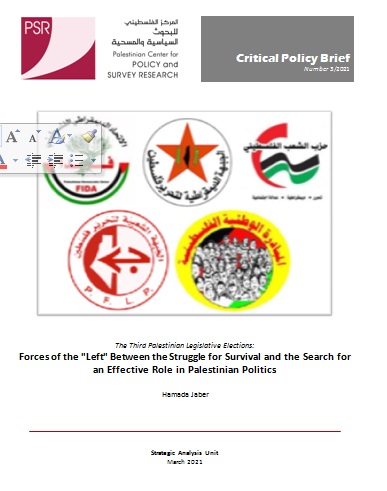 March 2021
The Third Palestinian Legislative Elections:
Forces of the "Left" Between the Struggle for Survival and the Search for an Effective Role in Palestinian Politics
Hamada Jaber
The presidential decree issued in mid-January is the first practical step for holding general elections, starting with elections for the Legislative Council of the Palestinian Authority on May 22. Regardless of the seriousness and possibility of holding the third Palestinian legislative elections, which were delayed or caused to be delayed for more than ten years, the forces of the left must prepare for these elections and decide what they want: is it merely survival, or working, despite their relatively small size, to be a third, effective force in the Palestinian political system?
This paper aims to discuss the left’s current options in dealing with the issue of legislative elections. It covers three such options: for the left-wing forces to contest the upcoming elections within a joint national list entailing components of the Palestine Liberation Organization (PLO), with or without Hamas, or as a unified left list, or with individual left lists. This paper highlights some of the advantages and drawbacks of these options. It ends with a proposal for a comprehensive, unified mobilization of the forces of the Palestinian left.
Background
If new legislative elections are held next May, they will be the third elections in 27 years since the establishment of the Palestinian Authority apparatus, after the elections of 1996 and 2006. These elections will be held through a different system from the previous ones, a full proportional representation system. The results of Public Opinion Poll No. 77 of the Palestinian Center for Policy and Survey Research indicate that, if new legislative elections are held with the participation of all political forces, 61% say that they will participate in them. The Hamas Change and Reform List will gain 34%, Fatah, 38%, and all other lists that had participated in the 2006 elections will gain 8% in total, while 20% have not yet decided who they will vote for. The findings indicate that 3 blocs (including two electoral lists, representing 4 parties/factions) who have passed the electoral threshold in the 2006 legislative elections, will not be able to do so if legislative elections are held today, taking into account a margin of error of +/- 3% and the transformation of the electoral system into one of full proportional representation.
As evidenced by the results of the aforementioned poll, the parties and fronts of the so-called Palestinian left may lose half their seats that they had collectively gained in the 2006 legislative elections, which were only 9 out of 132 seats. This expected loss is the result of the failure of these parties and fronts to maintain their principles and goals and implement their programs. Despite their awareness of this and their attempt to form a body that expresses minimum unity as a third force, such as the National Democratic Union that came into existence between September 2018 and January 2019, the calculations, based on narrow interests of the leaders of these parties and fronts, have caused them to lose another opportunity to protect themselves from extinction and prevent their exit from the Palestinian political scene. The experience of the Alternative List in the 2006 elections, which consisted of the Democratic Front coalition, the People’s Party, and the Palestinian Democratic Union (FIDA), was not a successful experiment in terms of persuading the masses to vote for it, because it was a temporary coalition that ended with the announcement of results, winning only two seats in those elections.
The forces of the left must realize that the Hamas-Fatah rapprochement and agreement express the depth of the crisis that the two movements have reached in the Gaza Strip and the West Bank, and do not express the alleged unity required to face the challenges witnessed by the Palestinians. This may be an opportunity for third or new forces to present themselves as alternatives. The depth of the Hamas crisis can be evidenced by its approval of the Fatah movement’s project based on the solution of a Palestinian state on the 1967 borders, at a time when many leaders of the Fatah movement themselves believe that this solution has become impossible and long dead. Likewise, the Hamas slogan of armed resistance has retreated from being a strategy to a mere tactic. This is evident in Hamas’ support, and then control, of the Return Marches that began in March 2018, as well as the fact that the last real armed confrontation with Israel was in 2014, and the various disputes between Hamas and Islamic Jihad about controlling and timing the use of arms.
On the other hand, the Fatah movement’s crisis appears to be deeper and more complex, leading it to the verge of fragmentation after its resounding failure, for more than a quarter of a century, to achieve its program based on the two-state solution, as well as its failure to build institutions capable of forming the nucleus of the state project. The slogans of “internationalization” and “changing the PA mandate” have not merely fallen, but brought the opposite results, ushering in Arab-Israeli normalization that has placed Fatah and its leadership in a spot of limited maneuver and submission, or a revolution for which it is no longer qualified. The call for a popular resistance strategy-- which was adopted by all PLO factions, as well as Hamas and Islamic Jihad, in the meeting of the general secretaries on September 3, 2020, which was held, allegedly, to confront the Deal of the Century and the wave of Arab-Israeli normalization-- has proven to be mere lip service. It has been more than six months since the first statement of the so-called Popular Resistance leadership, without the issuance of a second statement. This is evidence of a deficiency in describing the era, the program, and the appropriate tools. As a result, the call for popular resistance did not receive any response from the public. It should be noted that, according to the Palestinian Center for Policy and Survey Research, Palestinian support for the two-state solution has declined from 55% in 2011 to 39% in 2020 despite the support it has from all Palestinian parties and movements (including Hamas, and with no objection from Islamic Jihad). Moreover, 62% of the public believe that this solution is no longer practical due to Israeli settlement expansion, Support for the one-state solution in historic Palestine, with equal rights for all its citizens, has risen from 27% in 2011 to 37% in 2020, despite the fact that no Palestinian party or movement has adopted this solution.
The Hamas-Fatah dyad, based on partisan quotas and interests, which has forgotten or ignored their roles as national liberation movements, is not a true division, one based on the beliefs of the masses that support them. But it will remain as such in the absence of a real, third force. Palestinians today are thirsty for a party or a movement capable of mobilizing their energies and hopes, one that addresses their minds and present a revolutionary and a realistic vision and program.
Options and a window of opportunity
According to the results of the aforementioned poll, and after adding the percentage of those who will not participate in the elections (39%) and those who have not yet decided whom they will vote for (20% of the 61% who said they will participate), the total comes to 51% of all Palestinians who are entitled to vote. Thus, there is a real chance for a new party, faction or movement to convince the 39% to participate. It is believed that the main reason for the unwillingness to participate, among a large proportion of these, is their lack of confidence in the existing parties and movements, and also, perhaps, because they are not convinced of their programs. There is also a chance to reach out to the 20% of those who plan to participate in the elections, but have not yet decided to whom they will vote (12% of the total number eligible to vote). There is even an opportunity to compete for the votes of those who have already decided whom they will vote for, if the new party or movement is able to present a new, different, and perhaps revolutionary program, in terms of its nature and tools. Thus, the percentage of those who can be persuaded may reach more than 50% of all Palestinians who are entitled to vote. In other words, if a new party or movement is able to convince only 25% of all Palestinians who are entitled to vote, this party will outperform Fatah and Hamas and become the largest force in the Legislative Council.
The Palestinian left has three options. The first is to maintain a symbolic presence in the political system, as in the first option below. The second is to seek to exercise an influential role, by creating a unified left. This option however is dependent on the failure of Fatah and Hamas to create a joint list of their own. Finally, there is an option in which the left risks increasing its weakness, and possibly eradicating it completely from the political scene, in the form of individual lists of left parties.
(1) Joint National List
With reference to the outcomes of the dialogue between Hamas and Fatah, in particular, and other factions, in general, the last of which was held at Cairo on February 8 and 9, it appears that the idea of running in the next legislative elections with a joint list that includes Hamas, Fatah and the remaining PLO factions is under serious consideration by the official bodies of Fatah and Hamas.
Fatah may wish, through this joint list, to protect the movement from the almost certain fragmentation in its ranks, by restricting the ability of its prominent leaders to form electoral lists outside the official list of Fatah (the President’s list). The results of a public poll by the Palestinian Center for Policy and Survey Research last December indicated that, if Fatah leader Marwan Barghouti forms a list outside the official list of Fatah, his list would gain 25% of the votes, compared to 19% for the official list of Fatah. Similarly, if Mohammed Dahlan forms a list outside the official list of Fatah, his list would gain 7% of the votes, compared to 27% for the official list of Fatah. In both cases, the “official” Fatah list will lose to Hamas, which will receive about 33% of the votes. As for Hamas, it may have submitted to the idea of power-sharing and quotas, as it was not faithful to the votes cast by the majority in the last legislative elections. Perhaps Hamas sees the joint list as an opportunity for the beginning of its accession to and effective representation in PLO institutions, and an opportunity to be rid of the burdens of governance in Gaza, as well as an opportunity for its recognition by the international community, which has boycotted the government formed by Hamas after it won the majority of seats in the Legislative Council in 2006.
As for the forces of the left (Popular Front, Democratic Front, National Initiative, People’s Party and the Democratic Union – FIDA), they seem to be powerless, seeing in the joint national list a lifeline for their symbolic survival on the political scene, after the accumulated failure of their performance and the dissolution of most of their cadres and popular bases. There is a risk that most of them will not be able to reach the threshold, and thus may fall out of the political scene, if they run the upcoming legislative elections individually. If the forces of the Palestinian left want to preserve their current symbolic existence and dispense with the ambition of an alternative or influential force, they must join the joint list with Fatah and Hamas if such a list is agreed upon, or enter a joint list with Fatah and all the PLO factions. One of the advantages of this option is that it is easy to market as a unification option required by the current conditions, to keep the forces of the left in the political scene and give them an opportunity to try to reform their situation. It is also expected that the Fatah and Hamas movements will contribute to the bulk of the cost of the electoral campaign for this joint list, thus relieving the left of much-needed financial costs. However, among the drawbacks of this option is that it keeps these forces ineffective and under the influence of the two major parties, as it is not expected that Hamas and Fatah will agree to give these forces a weight (number of seats) greater than what they had jointly gained in the 2006 elections.Their presence and influence in the likely national unity government after the elections will be limited, as the Hamas-Fatah collusion may eliminate Fatah’s need to appease these factions by giving them ministerial portfolios, as was the case in the past. This option also denies the left the distinction (if any) in its programs.
(2) United Left List
There is a great opportunity for existing third forces or for new powers, especially if they are based on a new, young leadership that has not been tainted by the corruption of the Authority and the factions that constitute it. This should be seen as a call to all young men and women of the Palestinian left, in particular, and to all young men and women of Palestine, in general (who, in the 18-39 years age group, account for more than 60% of those with the right to vote, and, for more than half of the voters, it will be the first time in their lives that they are entitled to vote, being in the 18-32 years age group) to trust themselves and not to hesitate to present new, emancipatory visions and programs of struggle that address the minds of the masses, not in the defeatist “pragmatism” or the destructive militarism way, but in the belief that the will and unity of the masses, which trust their leadership, is capable of working miracles.
The forces of the left must realize that their audience no longer accepts any excuse for the continued existence of this number of ineffective left-wing parties and fronts, especially that the key reasons for failure of all attempts to unify the left forces are considered by many as due to reasons and interests of particular leaders of those parties and fronts. Further, there is no programmatic or ideological reason that hinders this unity. Thus, one of the advantages of the option of a united left list is that it may restore some lost confidence in the parties and fronts of the Palestinian left. Several attempts have been made to accomplish this outcome. One should build on these efforts in order to achieve it in a short period of time (before the end of the candidacy period on March 31). Also, this option doubles the chances for this list to gain a number of seats that enable it to build an alliance with Fatah or Hamas, if the two parties run in the elections separately and neither gains a majority in the Legislative Council. However, one of the drawbacks of this option is that, if Hamas and Fatah are allied before or after the elections, these forces will remain weak. Even if these forces double their number of seats compared to the 2006 elections, they will not be able to rise to the level of an effective force if they do not properly appraise the conditions of the country and offer programs that treat the malaise in our political system while addressing the reasons for their own previous failures, including the inability to bring forth new leaders. The leftist forces will do better if they ally themselves with social forces and independent figures that are close to their ideology while having a a presence at the grassroot level, such as the “Wa’ad” (promise) movement for homeland, justice and democracy, which announced its formation at a press conference on February 27, 2021, in Ramallah. The movement has declared that it is not “an electoral bloc”, but will support the lists seen as close to the issues and principles that the movement upholds. It is clear that most of the initiators of this movement are members and cadres with leftist backgrounds. We should keep in mind that the left today is not engaged with the needs and concerns of citizens, and, thus, its ability to properly decipher the public scene is hampered. It should remember the popular movement to bring down the Social Security law in 2018/2019, which was one of the most important reasons leading to overthrow of the previous government. Most of the leftist forces either supported or did not oppose the aforementioned law. Rather, the leadership pushed leftist leaders to the forefront to defend that law and try to convince the masses of its value. Eventually, the movement forced the PA president to abandon the law and stop its implementation.
(3) Individual Left Lists
In the event of failure to achieve the previous options, and given the fact that there has been no change in most or all of the top decision-makers in the forces of the left since the 2006 elections, these forces may choose to run in the next elections through separate lists or in coalitions similar to Badil (alternative) that ran in the previous election. one of the advantages of this option is that it gives the forces of the left the opportunity to present their own pure programs and visions, without having to compromise. It also gives them a greater margin of freedom and maneuver for potential coalitions after the elections. One or more of these forces may gain a number of seats that would force Fatah or Hamas to seek their participation in the next government, as neither Fatah nor Hamas are likely to obtain a majority that would enable it to form a government on its own. A drawback of this option is that some forces would risk failing to meet the threshold condition, thus increasing their weakness, potentially fading out, with the exception of the “Popular Front” which probably believes that it retains its presence and base of popularity to enable it to pass the threshold. Yet, this will not suffice to make it an influential force. Likewise, individual electoral campaigns for each list will multiply the demands on and deplete the financial resources of those forces that are in dire need of them. The left’s lack of financial resources has been the price it paid for submitting to the dictates of the PLO leadership which denied it the right to its legitimate share in the National Fund, allowing Fatah and its president to monopolize these resources and blackmail them on more than one occasion. Under this option, leftist factions will be forced to compromise further on their principles after the elections.
What to do?
To be an effective third force, the factions of the left must double their efforts, today, not only to maintain a presence in the Palestinian political scene, as in the first and second options, but to contribute to determining the next Palestinian domestic direction and the future direction of the relationship with Israel. The left and other third party fronts in the PLO, along with newly emerging parties wishing to be an alternative or influential third force, must review and study the causes of the “national project’s” crisis and the reality and the future of the PLO and its liberation program. The parties and fronts of the third force must also study the causes of failure of the aforementioned strategies and reconsider the reading and characterization of the status quo to be able to provide real programs and tools, removed from slogans. This requires a review of the pillars of the status quo and how to deal with them. For example, many leaders of these parties and fronts describe the situation that exists between the river and the sea as a reality of one state, ruled by Israel as “an apartheid system.” This is true, but how can this reality be marketed to the world to end it, given the continued existence of the PA apparatus? Here, it must be recalled that the majority of the Palestinian public (55%) sees the continued existence of the PA as a burden on it and on its cause.
The forces of the left that wish to become an alternative influential third force must instate a dramatic change that restores the confidence of their cadres and popular bases in them. They must take quick, practical steps, for example by electing or selecting a committee for unity and elections, from outside the governing bodies of each front/party, because these bodies have proved that they are part of the problem and cannot to be part of the solution. The public is eager to see new, young faces. The members of these committees may all be candidates for the upcoming legislative elections on a united left list. These committees should convene for several days to elect a leadership committee of 21 members from among them (it should be named the Higher Committee of Unity), with one representative, at least, of each party/front. This committee should make its decisions by an absolute majority (50%+1), in order to prepare the election program and everything related to the election campaign, and its decisions should be binding for the participating parties and fronts.
Among the disadvantages of this proposal is the lack of time (before the end of the candidacy period on March 31). Also, there does not seem to be real will among the leaders of the target forces to waive the privileges that they currently enjoy; rather, they will probably seek to uphold them. On the other hand, one of the advantages of this proposal is that it may be able to restore the confidence and energies of all the cadres and bases of the left forces, and may even represent a breakthrough, capable of attracting broad groups of society, as mentioned previously. This proposal, if adopted, make it more likely that the left will be better prepared to understand the nature of the status quo and present a political program that bypasses the challenges that led to the failure of previous strategies and slogans. If this happens, the leftist forces, with this new reality, will have a strong and influential presence in the political system, whether they are part of the government or the opposition.