
Pre-local elections: Palestinian Public Opinion Poll
Six months after the postponement of the legislative elections and months after the Hamas-Israel fourth War and the killing of Nizar Banat, and two months before the holding of the first phase of the local elections, Fatah recovers some of its lost support which gives it the ability to compete in the first phase of the local election but it remains unable to win in the second phase
14-23 October 2021

These are the results of the latest poll conducted by the Palestinian Center for Policy and Survey Research (PSR) in the West Bank and the Gaza Strip between 14-23 October 2021. The six-month period before the conduct of the poll witnessed several important developments including the indefinite postponement of the parliamentary elections that were planned for May 2021, the eruption of popular confrontations in East Jerusalem in protest against conflict over access to Muslim holy places and the threat of expulsion of Palestinians from their homes in al Shaikh Jarrah which were followed by the fourth Hamas-Israel war that was triggered by these confrontations. The Palestinians were also preoccupied with the killing of a political activist, Nizar Banat, by the Palestinian security services. PA president Mahmoud Abbas met with the Israeli defense minister Benny Gantz in Ramallah to talk about Palestinian-Israeli relations and means of improving them while strengthening the PA by implementing various trust-building measures. The period witnessed the escape and recapture of six Palestinian prisoners from the Gilboa prison in Israel. Finally, the period witnessed the setting of the month of December 2021 as a date for the holding of local elections in villages and small towns with population of less than 11,000. This press release addresses a selected number of domestic issues such as the evaluation of the status of Palestinian democracy and human rights, the internal balance of power, and the results of legislative and presidential elections if they were to take place today. It also covers attitudes regarding Israeli-Palestinian relations, such as the two-state solution, return to negotiations, and the best means to end the Israeli occupation given the current stalemate. Total size of the sample is 1800 adults interviewed face to face in 120 randomly selected locations. Margin of error is +/-3%.
For further details, contact PSR director, Dr. Khalil Shikaki, or Walid Ladadweh at tel. 02-296 4933 or email pcpsr@pcpsr.org.
Main Findings:
This poll was conducted six months after the indefinite postponement of legislative elections that were scheduled to take place in May 2021 and two months before the holding of the first phase of local elections, scheduled for December 2021. The past six months witnessed important developments that significantly decreased the popularity of Fatah and president Abbas, most importantly in addition to the postponement of elections, the fourth war between Hamas and Israel and the killing of the opposition activist Nizar Banat by members of a Palestinian security service.
In order to analyze the findings, we compared the levels of support for Fatah and Hamas before and during these developments. We also compared public attitudes regarding domestic issues and Palestinian-Israeli relations. Specifically, we compared the results obtained in March 2021 in the areas that will now go to the first phase of the local elections with the current findings for the same exact areas. The number of the relevant areas that were part of our sample in March and are part of the current sample is 27 and the total number of respondents is 270 in March and 405 in the current poll.
The current findings show that Fatah continues to suffer the consequences of the developments of the past six month but they also show that it has managed to narrow the gap with Hamas which gives it the ability to effectively compete in the upcoming first phase of the local elections, which will take place in places that are mainly rural. But it remains unable to win in the second phase of the local elections, which will take place mostly in cities and big towns. The findings show that the overall support for Fatah has increased and it is now higher than that of Hamas. But the gap between the two parties today, five percentage points in favor of Fatah, is smaller that the one that prevailed in March, which stood at 13 percentage points in favor of Fatah. Nonetheless, the current findings represent a huge improvement for Fatah compared to the findings of June 2021 when the gap between the two stood at 11 percentage points in favor of Hamas. The levels of dissatisfaction with the performance of president Abbas and the demand for his resignation remain very high as about three quarters continue to make that demand. Perhaps one reason for the rise in Fatah’s popularity might be the implementation by Israel of some of the confidence building measures that the PA and Israel agreed to recently, such as family unifications and the rise in the number of laborers working in Israel. It is worth mentioning that a month ago, in our September 2021 poll, majority of the Palestinians supported such measures.
The current findings indicate a significant rise in support for the two-state solution compared to our findings during the past six months. Similarly, the current poll shows an increase in public belief in the effectiveness of negotiations. Indeed, for the first time in six months the percentage of those who prefer to change the status quo through negotiations is higher than those who prefer to do so through waging armed struggle. It is possible that this change is driven by the same dynamics that increased the support for Fatah.
1) Domestic conditions: democracy, elections, the performance of the president, and the balance of power:
- We asked Palestinians to evaluate people’s ability to criticize the authority without fear in the area where they live, 71% of West Bankers believe that people in their area cannot criticize the PA without fear. In the Gaza Strip, 62% say people in that area cannot criticize Hamans’ authority without fear; 28% of West Bankers and 38% of Gazans say people in their areas can do that without fear.
- We asked the public to evaluate the status of democracy and human rights in the areas where they live, under the Palestinian Authority (PA) in the West Bank and under Hamas’ control in the Gaza Strip: 22% of West Bankers and 29% of Gazans describe these conditions as good or very good, 50% of West Bankers and 35% of Gazans describe them as bad or very bad, and the rest describe the conditions as neither good nor bad.
- As indicated in chart (1) below, positive (good or very good) evaluation of democracy and human rights is higher among those with the highest income (30%) compared to those with the lowest income (18%), among supporters of Fatah and Hamas (33% and 30% respectively) compared to supporters of third or other parties (13%).

- If parliamentary and presidential elections were to take place today, the following should, in the eyes of the public, be the top five priorities that these elections should aim to achieve: the unification of the West Bank and the Gaza Strip (selected by 29% of the public), followed by improving economic conditions (25%), combating corruption (15%), lifting the siege and blockade over the Gaza Strip (14%), and strengthening the resistance to occupation (9%). The percentage of those who selected “improving economic conditions” stands at 35% in the Gaza Strip, making it the top priority for Gazans, while the percentage of selecting “combating corruption” stands at 20% in the West Bank, making it the second priority in that area after the “unification of the West Bank and the Gaza Strip,” which is selected by 33% of the West Bankers.
- When asked about the party or faction that is better able to achieve the priority selected by the respondents, 26% selected Hamas while only 18% selected Fatah and 14% selected third or other parties. One third (33%) believe all factions and parties have equal ability to achieve the priorities selected. Hamas is selected as the most able by those who selected the following priorities: strengthen the resistance to occupation (45% selected Hamas as most able), lift the siege and blockade (39%), combat corruption and unify the West Bank and the Gaza Strip (24% each). Those who select Fatah are more likely to have selected the improvement of economic conditions (25%) and making progress in the peace process (21%). The peace process was not among the top five priorities selected by the Palestinian public. Those who selected the priority of creating a democratic political system with periodic elections, another priority that was not among the top five, selected third parties as the most able faction or political party (30%).
- Satisfaction with the performance of president Abbas stands at 27% and dissatisfaction at 71%. About three quarters (74%) want Abbas to resign while 22% want him to stay in the office. Demand for Abbas’ resignation stood at 78% in September 2021.
- If new presidential elections were to take place today with three candidates competing, president Abbas, Ismail Haniyyeh from Hamas, and Marwan Barghouti from Fatah 64% of the public would participate and from among those the first receives 16%, the second 30%, and the third 51%. Vote for Barghouti in this three-way competition is higher in the West Bank (61%) compared to the Gaza Strip (38%), among supporters of third parties and Fatah (96% and 57% respectively) compared to supporters of Hamas (15%), among the somewhat religious (57%) compared to the religious and the not religious (47% and 44% respectively), among those working in the private sector (60%) compared to those who work in the public sector (39%), among those with the highest income (51%) compared to those with the lowest income (45%). Vote for Haniyyeh is higher in the Gaza Strip (40%) compared to the West Bank (23%), among women (33%) compared to men (28%), among the religious (40%) compared to the not religious and the somewhat religious (7% and 23% respectively), among supporters of Hamas (83%) compared to supporters of third parties and Fatah (1% and 2% respectively). Vote for Abbas is higher in the Gaza Strip (20%) compared to the West Bank (12%), among men (18%) compared to women (13%), and among supporters of Fatah (39%) compared to supporters of third parties and Hamas (1% and 2% respectively).

- If the competition was between two, Abbas and Haniyyeh, only 46% say they would participate and from among those the former receives 39% and the latter 55%. But if the competing two candidates were between Marwan Barghouti and Haniyyeh, 62% would participate and from among those, the former would receive 65% and the latter 32%.
- If new parliamentary elections were to take place today, 60% would participate and from among those Fatah receives 38%, Hamas 33%, and the third parties combined 10%; 20% are undecided. It is worth mentioning that in September, Hamas received 37% of the vote and Fatah 32%. Voting for Fatah is higher in the West Bank (39%) compared to the Gaza Strip (36%), among men (40%) compared to women (35%), among those with the highest income (40%) compared to those with the lowest income (35%). Vote for Hamas is higher in the Gaza Strip (40%) compared to the West Bank (28%), among the religious (42%) compared to the not religious and the somewhat religious (12% and 27% respectively), and among those with the least income (39%) compared to those with the highest income (28%).

- 43% believe that the first most vital Palestinian goal should be to end Israeli occupation in the areas occupied in 1967 and build a Palestinian state in the West Bank and the Gaza Strip with East Jerusalem as its capital. By contrast, 33% believe the first most vital goal should be to obtain the right of return of refugees to their 1948 towns and villages, 13% believe that the first and most vital goal should be to build a pious or moral individual and a religious society, one that applies all Islamic teachings and 10% believes it should be to establish a democratic political system that respects freedoms and rights of Palestinians.
2) Comparing attitudes in areas of the first phase of local elections with attitudes in other areas:
- In order to assess attitudes of the residents of the villages and towns in which local elections will take place in December 2021, we divided respondents into three categories: those residing in the areas of the first phase of the local election, residents of cities and other urban areas in which the second phase of the local elections will take place, and residents of refugee camps who will not participate in local elections. Here below are the main attitudinal differences between the three areas:
- Fatah enjoys more support than Hamas and third parties (41%, 27%, and 7% respectively) in those areas where the first phase of the local election will take place. It is worth mentioning that back in March 2021 Fatah received the support of 56% of respondents in those areas that will participate in the first phase of the local elections while Hamas received the support of only 23% in those same areas. These findings are confirmed when looking at the outcome of a three-way presidential elections in which Marwan Barghouti receives 59% compared to Ismael Haniyyeh (23%) and Mahmoud Abbas (14%). It is worth mentioning that Fatah receives the highest percentage of the vote in the refugee camps followed by the areas participating in the first phase of the local elections and thirdly in cities and other urban areas that will participate in the second phase of the local elections: 48%, 41%, and 35% respectively. Hamas receives its highest vote from cities and other urban areas that will participate in the second phase of the local elections followed by areas that will participate in the first phase of the local elections, and finally in refugee camps (35%, 28%, and 27% respectively). In other words, Hamas and Fatah have exactly the same level of support in the areas that will participate in the second phase of the local elections.
- Satisfaction with the performance of president Abbas stands at 33% in the areas that will participate in the first phase of the local elections while standing at 24% in the urban areas that will participate in the second phase and 37% in refugee camps. Demand for Abbas resignation in the areas of the first phase of the local elections stands at 68% compared to 66% in refugee camps and 77% in cities and other urban areas that will participate in the second phase of the local elections.
- Evaluation of the status of democracy and human rights, standing at 25%, is the lowest among the residents of the areas that will participate in the first phase of the local elections, followed by the urban aeras that will participate in the second phase of the local elections (24%) and refugee camps (28%).
- Support for the two-state solution is the lowest in the areas that will participate in the first phase of the local elections (40%) compared to urban areas which will participate in the second phase (46%) and finally in refugee camps (50%).
- Support for waging an armed struggle against the occupation is the lowest in the areas that will participate in the first phase of the local elections, standing at 30% only, compared to 34% in the cities and urban areas and 38% in refugee camps.
- Support for a return to negotiations under US leadership is the lowest in the areas that will participate in the first phase of the local elections (27%) while standing at 35% in urban areas and 37% in refugee camps.
Comparing attitudes of those residing in the areas that will participate in the first phase of the local elections to other areas
| Local elections | |||
Phase 1 | Refugee camps | Phase 2 | ||
1) If new elections are held today in agreement between all factions in which the same list that participated in the 2006 elections were to participate, you would vote for: | 1) Fatah | 41.0% | 47.6% | 35.4% |
2) Hamas | 27.1% | 27.5% | 35.4% | |
3) Others | 7.2% | 8.6% | 10.5% | |
4) None/undecided | 14.0% | 11.8% | 13.0% | |
5) DK/NA | 7.6% | 4.6% | 4.5% | |
6) NA | 3.0% | 0.0% | 1.3% | |
2) What if the competition was between Marwan Barghouti, Ismael Haniyyeh, and Mahmoud Abbas, to whom you would vote? | 1) Marwan Barghouti | 59.0% | 44.6% | 49.8% |
2) Ismail Haniyyeh | 22.8% | 26.1% | 32.7% | |
3) Mahmoud Abbas | 13.7% | 24.4% | 15.0% | |
4) DK/NA | 4.6% | 4.9% | 2.5% | |
3) Are you satisfied or dissatisfied with the performance of president Abbas since his election? | 1) Very satisfied | 4.1% | 2.8% | 4.5% |
2) Satisfied | 29.4% | 34.5% | 19.2% | |
3) Dissatisfied | 36.8% | 31.6% | 32.1% | |
4) Not satisfied at all | 25.9% | 28.1% | 42.3% | |
5) DK/NA | 2.6% | 2.2% | 1.3% | |
6) NA | 1.2% | .9% | .5% | |
4) If it is up to you, you would want president Abbas to resign or stay in office? | 1) Certainly resign | 35.8% | 33.2% | 48.2% |
2) Resign | 31.8% | 33.0% | 28.8% | |
3) Stay in office | 20.8% | 24.8% | 15.4% | |
4) Certainly stay in office | 5.0% | 4.2% | 4.4% | |
5) DK/NA | 5.3% | 4.0% | 2.5% | |
6) NA | 1.3% | .9% | .6% | |
5) If you want to evaluate the status of democracy and human rights in the area where you live (West Bank under the PA and Gaza Strip under Hamas), you would say it is: | 1) Good/very good | 25.3% | 27.7% | 24.0% |
2) Neither good nor bad | 29.3% | 37.2% | 29.6% | |
3) Bad/very bad | 43.9% | 35.0% | 45.3% | |
4) DK/NA | 1.4% | .1% | .9% | |
5) NA | .2% | 0.0% | .2% | |
6) Do you support or oppose the solution based on the establishment of a Palestinian state along side the state of Israel, knows as the two-state solution? | 1) Support | 40.4% | 49.9% | 46.4% |
2) Oppose | 56.7% | 48.9% | 52.4% | |
3) DK/NA | 2.6% | .5% | .9% | |
4) NA | .3% | .7% | .3% | |
7) The following four alternatives point to what can be done now regarding Palestinian-Israeli relations. Which one you prefer? | 1) Maintain the status quo | 20.8% | 13.4% | 18.7% |
2) Wage armed struggle | 30.1% | 38.1% | 34.0% | |
3) Wage non-violent resistance | 8.7% | 10.0% | 8.6% | |
4) Reach a peace agreement with Israel | 37.3% | 36.5% | 36.2% | |
5) Other | .5% | 1.8% | .7% | |
6) DK/NA | 2.7% | .3% | 1.1% | |
7) NA | 0.0% | 0.0% | .6% | |
8) Do you support or oppose the return to negotiations with Israel led by the US under the Biden administration? | 1) Support | 26.9% | 36.5% | 34.5% |
2) Oppose | 68.5% | 61.6% | 62.6% | |
3) DK/NA | 4.6% | 1.3% | 2.2% | |
4) NA | 0.0% | .7% | .7% | |
(3) The Palestinian-Israeli Peace process:
- Support for the concept of the two-state solution stands at 46% and opposition stands at 53%. No description or details were provided for the concept. One months ago, support for the concept stood at 36%. Support for the two-state solution is higher among men (48%) compared to women (43%), among the not-religious and the somewhat religious (54% and 50% respectively) compared to the religious (39%), among supporters of Fatah (64%) compared to supporters of third parties and Hamas (43% and 31% respectively). More than three quarters (76%) believe that the chances for the creation of a Palestinian state alongside the state of Israel in the next five years are slim or nonexistence while 20% believe the chances to be medium or high.

- One third (33%) support return to negotiations with Israel under US leadership but a majority of 64% oppose it. Support is higher in the Gaza Strip (35%) compared to the West Bank (32%), among the somewhat religious and the not-religious (37% and 34% respectively) compared to the religious (29%), among supporters of Fatah and third parties (51% and 38% respectively) compared to supporters of Hamas (20%).
- When asked about the most effective means of ending the Israeli occupation, the public split into three groups: 44% chose armed struggle, 36% negotiations, and 16% popular resistance. One month ago, 48% chose armed struggle and 28% chose negotiations. Support for armed struggle is higher in the Gaza Strip (50%) compared to the West Bank (40%), among men (50%) compared to women (39%), among supporters of Hamas (74%) compared to supporters of Fatah and third parties (28% and 45% respectively). Support for negotiations is higher among women (38%) compared to men (34%), among those whose age in between 40 and 59 years (36%) compared to those whose age is between 18 and 22 years (29%), and among supporters of Fatah (51%) compared to supporters of Hamas and third parties (16% and 27% respectively).
- The most preferred way out of the current status quo is “reaching a peace agreement with Israel” according to 36% of the public while 34% prefer waging “an armed struggle against the Israeli occupation.” 9% prefer “waging a non-violent resistance” and 19% prefer to keep the status quo. One month ago, 28% said that they prefer reaching a peace agreement with Israel and 39% said they prefer waging an armed struggle. The percentage of those who prefer waging an armed struggle is higher in the Gaza Strip (39%) compared to the West Bank (30%), among men (38%) compared to women (30%), among the youth between the ages of 18 and 29 years (37%) compared to those whose age is between 40 and 59 years (32%), and among supporters of Hamas (61%) compared to supporters of Fatah and third parties (20% and 35% respectively).

15 June 2021
A semi-consensus that Hamas has won the May 2021 confrontation with Israel triggers a paradigm shift in public attitudes against the PA and its leadership and in favor of Hamas and armed struggle; moreover, a two-third majority rejects the PA decision to postpone the elections, 70% demand forcing legislative and presidential elections on Israel, and the majority says Hamas, not Fatah under Abbas, deserve to represent and lead the Palestinian people
9-12 June 2021
This poll has been conducted in cooperation with the Konrad-Adenauer-Stiftung in Ramallah

These are the results of the latest poll conducted by the Palestinian Center for Policy and Survey Research (PSR) in the West Bank and the Gaza Strip between 9-12 June 2021. The period before the conduct of the poll witnessed several developments including the decision by the PA president to postpone the holding of Palestinian elections that were scheduled to take place on 22 May 2021. It also witnessed the release of various Israeli decisions on an imminent expulsion of several Palestinian families from their homes in al Shaikh Jarrah and the impositions of various restrictions regarding Muslim’s access to al Aqsa Mosque during the month of Ramadan. These developments led to popular non-violent confrontations with the Israeli police and settlers in East Jerusalem that escalated to rocket attacks carried out be Hamas against Israeli cities. Hamas claimed that the attacks came in defense of East Jerusalem. The ensuing war between Hamas and Israel lasted for 11 days and led to the death of more than 250 Palestinians, including 66 children, and more than 10 Israelis, including two children. The period also witnessed a PA campaign to vaccinate Palestinian adults in the West Bank and the Gaza Strip against the coronavirus. The campaign led to a significant reduction in the daily rates of deaths and infections, particularly in the West Bank. This press release addresses these issues and covers other matters such as the general conditions in the Palestinian territories, the peace process and future possible directions for Palestinians in the absence of a viable peace process. Total size of the sample is 1200 adults interviewed face to face in 120 randomly selected locations. Margin of error is +/-3%.
For further details, contact PSR director, Dr. Khalil Shikaki, or Walid Ladadweh at tel. 02-296 4933 or email pcpsr@pcpsr.org.
Main Findings:
Findings of the second quarter of 2021 show significant changes in public attitudes toward the Palestinian Authority (PA) and its leadership, Hamas, and relations with Israel. Two drivers seem to have triggered the change: the popular confrontations in East Jerusalem, the Israel-Hamas war, and their public perception of their outcomes on the one hand and the postponement of elections by the PA leadership on the other.
The findings show a semi-public consensus that Hamas had won the confrontation with Israel and that Hamas’ launching of rockets at Israeli cities has been motivated by its desire to defend al Aqsa Mosque and the Palestinian families in al Shaikh Jarrah. Findings also show widespread public discontent with the performance of the PA government and leadership as well as Fatah during the confrontations and the war. They also show a two-third majority rejection of Abbas’ decision to postpone the elections. Two thirds of the public believe that Abbas has postponed the elections because he was afraid of their outcome, not because Israel has prevented the holding of elections in East Jerusalem.
As a result, support for Hamas, and willingness to vote for it, increases dramatically while support for Fatah drops significantly. Moreover, Hamas’ leader, Ismail Haniyyeh, manages to deliver an unprecedented victory over Abbas in a presidential election, if one is held today. Perhaps most importantly, a majority of the Palestinians think that Hamas is more deserving of representing and leading the Palestinian people while a small percentage thinks Fatah under Abbas’ leadership is the one who deserves to do that.
Findings also show that more than 70% want to hold legislative and presidential elections soon and a similar percentage wants the PA to impose elections in East Jerusalem despite Israeli objection, rather than wait for an Israeli approval. The poll results do not have good news for most of the newly created electoral lists that registered for the legislative elections as only nine out of 36 managed to cross the threshold of 1.5% required to win seats in the parliament.
The confrontations and the war between Hamas and Israel did not have an impact on the level of support for the two-state solution, which remained unchanged. But they did greatly impact other matters related to the Palestinian-Israeli conflict. For example, support for a return to armed confrontations and intifada rose sharply to 60%, and support for a resumption of negotiations with Israel and the belief that negotiation is the most effective means of ending occupation dropped. Moreover, the confrontations within Israel between the Palestinian citizens of Israel and the Israeli police seem to have contributed to a significant reduction in support for the one-state solution, which declined from a third to a fifth in three months.
It is worth noticing however that the current findings are not fundamentally different from similar findings we obtained in the past immediately after similar Hamas-Israel confrontations. Therefore, they might be reflecting a temporary emotional reaction that might revert back to where things stood before the confrontations. The change from emotional to normal attitudes usually takes three to six months, as can be seen in our previous polls. But it should be pointed out that a return to “normal” attitudes has in the past been associated with a Hamas failure to maintain its gains and a success on the part of the PA to take measures that helped to pacify the public and win back its trust.
For the new Israeli government led by prime minister Naftali Bennett, about a fifth seems to think that it is better for Israeli-Palestinian relations than a government led by Netanyahu. Findings also show that while the largest percentage, but not the majority, is opposed to the participation of the Unified Arab List led by Mansour Abbas in the current coalition government, a similar percentage does support (or does not oppose or support) such participation.
(1) Jerusalem confrontations and the war between Hamas and Israel:
- An overwhelming majority of Palestinians (77%) believes that Hamas has come out a winner in its last war with Israel while only 1% think Israel came out a winner; 18% say no one came out a winner and 2% think both sides came out winners. Moreover, 65% think that Hamas has achieved its declared goal behind firing rockets at Israel: to force Israel to stop the expulsion of the families in al Shaikh Jarrah and to bring to an end Israeli restriction on Muslim access to al Aqsa; 26% think it did not.
- 72% think that Hamas’ decision to launch rockets at Israeli cities came in defense of Jerusalem and al Aqsa Mosque while 9% think it came as a protest against the PA cancelation of elections with the aim of weakening the PA leadership; 17% think Hamas’ decision was motivated by these two drivers.
- In an evaluation of the performance of 10 local and regional actors during the Jerusalem confrontations and the ensuing war between Israel and Hamas, the overwhelming majority describes as excellent that of the residents of Jerusalem and its youth (89%) followed by that of Arab Palestinian citizens of Israel (86%), followed by that of Hamas (75%). About one fifth describes as excellent the performance of each of the following governments: Egypt’s (22%), Turkey’s (21%), Jordan’s (21%), and Iran’s (18%). Finally, only 13% describe as excellent the performance of Fatah, 11% the PA government, and 8% Abbas’.
- A majority of 64% views the residents of East Jerusalem as the group most willing to defend Jerusalem and its holy places, followed by Hamas at 29%, and the PA at 3%. In light of the recent confrontations with Israel, a majority of 53% think Hamas is most deserving of representing and leading the Palestinian people while 14% think Fatah under president Abbas is the most deserving of representing and leading the Palestinians.
- A majority of 60% thinks the participation of the Palestinian citizens of Israel in the recent confrontation was driven, first and foremost, by their desire to defend the holy sites, while 28% think it was driven by their desire to express rejection of integration in the Israeli society and their attachment to their national identity, and only 10% think it came as part of their struggle for equality and rejection of discrimination.
- If Israel expels the families of al Shaikh Jarrah or reimposes restrictions on access to al Aqsa Mosque, 68% believe the response in this case should be the launching of rockets at Israeli cities, while 18% think it should be the waging of non-violent resistance, and 9% believe Palestinians should respond by submitting a complaint to the UN and the International Criminal Court (ICC).
- When asked about their expectations from the PA under Abbas leadership in case Israel expelled the Shaikh Jarrah families, the largest percentage (38%) said the PA will do nothing; 24% said it will write a complaint to the UN and the ICC; 20% think it will end security coordination with Israel, and 14% think it will launch popular non-violent resistance.
- Public expectations from Hamas are very different: If Israel expels the Shaikh Jarrah families, 77% think Hamas will respond by launching rockets at Israeli cities; 10% think it will wage a non-violent campaign, 6% think it will issue protest statements, and only 5% think it will do nothing.
- A majority of 55% think Israel will not expel the Shaikh Jarrah families and 40% think it will.
- Two thirds of the public think there is a high or a medium chance that Hamas and Israel will reach a long-term truce that will ease the siege and blockade of the Gaza Strip; 31% think the chances are slim.
- A majority of 52% think that the incident in al Aqsa Mosque in which chants were made against the Jerusalem PA-appointed Mufti during his Friday sermon in the aftermath of the ceasefire between Israel and the “resistance” forces does not reflect its views while 44% think it does reflect them.
- 94% say they are proud of the performance of the Gaza Strip during the May confrontation with Israel while 6% say they are not. When asked about the main reason for being proud, 39% said they are proud because Gaza has delivered a military and rocket strike in defense of Jerusalem that demonstrated the weakness of the Israeli army; another 39% said they were proud because Gaza has brought the Palestinian cause back to forefront of Arab and international politics; and 13% said the reason they are proud is because Gaza has sacrificed and endured all the death and destruction while expressing patience and dignity in defense of Jerusalem.
(2) The postponement of the legislative and presidential elections:
- 65% oppose and 25% support the decision of president Abbas to postpone legislative and presidential elections because Israel refuses to allow the holding of elections in East Jerusalem. Two thirds of the public believe that Abbas postponed the elections because he was worried about the results while 25% think he postponed the elections because Israel refused to allow them in East Jerusalem.
- The largest percentage (43%) believes that there is no point in protesting Abbas’ decision to postpone the elections and that we should therefore accept it. On the other hand, 31% think that there should be protests but they should be conducted through non-violent demonstrations; 17% think the protests should be expressed through the courts and the judicial system routes.
- 72% say they support the holding of presidential and legislative elections in the Palestinian territories in the near future while 25% say they do not support that. Demand for elections stands at 80% in the Gaza Strip and 66% in the West Bank.
- 69% say we should not wait for an Israeli approval of elections in East Jerusalem and that we should impose these elections on Israel while 15% say it is better to wait for an Israeli approval. The majority (56%) of those who want the PA to hold elections without an Israeli approval demands holding elections immediately, 24% are in favor of holding the elections within three months, and 13% within a year or more. But about half of the Palestinians (49%) believes there will be no elections in the near future while 44% think elections will take place in the near future.
- If new presidential elections were held today and only two were nominated, Mahmoud Abbas and Ismail Haniyeh, the former would receive 27% and the latter 59% of the votes (compared to 46% for Haniyeh and 47% for Abbas three months ago). In the Gaza Strip, Abbas receives 30% of the votes (compared to 44% three months ago) and Haniyeh receives 60% (compared to 56% three months ago). In the West Bank, Abbas receives 25% (compared to 52% three months ago) and Haniyeh 59% (compared to 38% three months ago). If the competition was between Marwan Barghouti and Ismail Haniyeh, Barghouti receives 51% and Haniyeh 42%. If the competition is between prime minister Mohammad Shtayyeh and Haniyyeh, the former receives 26% and the latter 63%. Three months ago, Shtayyeh received the support of 48% and Haniyyeh 44%.
- In an open-ended question on the preferred president, in case Abbas is not nominated, 29% say they want Marwan Barghouti, 28% say Ismail Haniyyeh, 6% Dahlan, 3% Yahia Sinwar, and 2% for each of the following: Khalid Mishaal, Mohammad Shtayyeh, Mustafa Barghouti, and Salam Fayyad. In a closed-ended question, about potential Abbas successors, 29% say they prefer to see Marwan Barghouti replacing him, while 28% prefer Ismail Haniyeh. Mohammad Dahlan is preferred by 7% (1% in the West Bank and 16% in the Gaza Strip), Mustafa Barghouti and Salam Fayyad (3% each), and Khalid Mishal (2%).
- If new legislative elections were held today with the participation of all factions, that participated in the 2006 elections, 73% say they would participate in such elections. Of those who would participate, 41% say they will vote for Hamas and 30% say they will vote for Fatah, 12% will vote for all other third parties combined, and 17% are undecided. Three months ago, vote for Hamas stood at 30% and Fatah at 43%. Vote for Hamas in the Gaza Strip stands today at 45% (compared to 36% three months ago) and for Fatah at 28% (compared to 32% three months ago). In the West Bank, vote for Hamas stands at 38% (compared to 25% three months ago) and Fatah at 32% (compared to 53% three months ago).
- We also asked about the vote for the 36 electoral lists that registered to compete in the parliamentary elections that was scheduled for May 2021. Only nine lists managed to pass the threshold of 1.5%: the largest percentage went to Hamas’ list, “Jerusalem is Our Call” (36%) followed by Fatah’s list with 19%, “the freedom list” led by Nasser al Qidwah (9%), “the Future List” of Dahlan (3%), the “National Initiative” 2%, and the following lists managed to pass the threshold: the PFLP, “Together” led by Salam Fayyad, the “Democratic Change” led by Ibrahim Abu Hijlah, and “Palestine for All” led by Mufeed al Hasayneh.
(3) Domestic conditions and satisfaction with the Shtayyeh government:
- Positive evaluation of conditions in the Gaza Strip stands at 8% and positive evaluation of conditions in the West Bank stands at 24%.
- Nonetheless, perception of safety and security in the Gaza Strip stands at 65% and in the West Bank at 60%.
- 26% of the public say they want to emigrate due to political, security, and economic conditions. The percentage in the Gaza Strip stands at 42% and in the West Bank at 15%. Three months ago, 23% of West Bankers expressed a desire to emigrate and 40% of Gazans expressed the same desire.
- Perception of corruption in PA institutions stands at 84%. When asked about institutions controlled by Hamas in the Gaza Strip, 57% indicated that there is corruption in these institutions. Three months ago, 84% said there is corruption in PA institutions and 70% said there is corruption in public institutions controlled by Hamas.
- 46% of West Bankers think people in the West Bank can criticize the PA without fear while 52% think they cannot. When asked to evaluate the status of democracy and human rights in the West Bank, 19% of West Bankers said it was good or very good. In the Gaza Strip, 50% think people in the Strip can criticize Hamas’ authorities without fear and 47% think they cannot. When asked to evaluate the status of democracy and human rights in the Gaza Strip, 46% of Gazans said it was good or very good.
- The public is divided over its assessment of the PA: a slight majority of 56% views it as a burden on the Palestinian people while 35% view it as an asset for the Palestinian people. Three months ago, 51% viewed the PA as a burden and 44% viewed it as an asset.
- 70% oppose and 26% support making payments to the families of martyrs and prisoners based on need assessment and number of family members rather than on the act committed by the martyr or the number of years in jail.
- 41% are optimistic and 56% are pessimistic about the success of reconciliation. Three months ago, optimism stood at 34%.
- Two years since the formation of the Shtayyeh government, findings indicate persistent pessimism. Responding to a question about expectations regarding the ability of the Shtayyeh government to make progress in reconciliation and reunification, 65% expect failure; only 29% expect success. When asked about the ability of the government to organize legislative or legislative and presidential elections in the West Bank and the Gaza Strip, one third of the public expects success and 60% expects failure. In another question about the ability of the new government to improve economic conditions, a majority of 62% expects failure and 32% expects success.
- We asked the public about its viewership habits in the last three months. Findings indicate that al Jazeera TV has the highest viewership, standing at 36%, followed by al Aqsa TV (13%), Palestine TV (12%), Palestine Today (10%), Maan (7%), al Mayadeen (4%), al Arabiya (3%), and al Manar (1%).
(4) The Coronavirus vaccine and PA performance during the COVID-19 pandemic:
- 23% (28% in the West Bank and 16% in the Gaza Strip) report that they have already received the coronavirus vaccination; 40% (33% in the Gaza Strip and 51% in the West Bank) says that they are willing to take the vaccine when available; and 35% (37% in the West Bank and 32% in the Gaza Strip) say they and their families are not willing to take the vaccine when it becomes available to them.
- 66% (81% in the Gaza Strip and 57% in the West Bank) are satisfied with the efforts made by the government to obtain the vaccine and 31% (18% in the Gaza Strip and 40% in the West Bank) are dissatisfied.
- A majority of 57% are satisfied with the measures taken by the PA to contain the spread of the coronavirus while 41% are dissatisfied. Dissatisfaction in the West Bank stands at 48% and in the Gaza Strip at 30%.
- The majority is satisfied with the performance of the various actors involved in the management of the Coronavirus crisis: 63% express satisfaction with the performance of the security services deployed in their areas and 68% are satisfied with the performance of the ministry of health. Satisfaction with the performance of the prime minister in the management of the Coronavirus crisis stands at 49%.
(5) The Palestinian-Israeli Peace process and the new Israeli government:
- Support for the concept of the two-state solution stands at 39% and opposition stands at 58%. No description or details were provided for the concept. Three months ago, support for the concept stood at 40%.
- Support for the two-state solution increases to 41% and opposition drops to 56% when the borders of the Palestinian state are described as being based on the 1967 lines and its capital as East Jerusalem. When the public is asked to pick a choice from among three, 46% pick the two-state solution based on the 1967 lines, 10% pick a Palestinian-Israeli confederation, and only 6% pick a one-state for Jews and Arabs.
- We asked the public about its support for the idea of making Jerusalem, both East and West, an open city, whereby the Eastern part would be the capital of the Palestinian state and Western part would be the capital of the state of Israel. Less than a quarter (23%) supported and 73% opposed the idea.
- A majority of 61% believes that the two-state solution is no longer practical or feasible due to the expansion of Israeli settlements while 33% believe that the solution remains practical. Moreover, 67% believe that the chances for the creation of a Palestinian state alongside the state of Israel in the next five years are slim or nonexistence while 29% believe the chances to be medium or high.
- The most preferred way out of the current status quo is “reaching a peace agreement with Israel” according to 27% of the public while 39% prefer waging “an armed struggle against the Israeli occupation.” 11% prefer “waging a non-violent resistance” and 18% prefer to keep the status quo. Three months ago, 36% said that they prefer reaching a peace agreement with Israel and 26% said they prefer waging an armed struggle.
- When asked about the most effective means of ending the Israeli occupation, the public split into three groups: 49% chose armed struggle, 27% negotiations, and 18% popular resistance. Three months ago, 37% chose armed struggle and 36% chose negotiations.
- Under current conditions, a majority of 70% opposes and 19% support an unconditional resumption of Palestinian-Israeli negotiations.
- When asked about support for specific policy choices, 66% supported joining more international organizations; 58% supported resort to non-violent resistance; 60% supported return to armed confrontations and intifada; 47% supported dissolving the PA; and 20% supported abandoning the two-state solution and embracing a one state solution for Palestinians and Israelis. Three months ago, 43% supported a return to confrontations and armed intifada, 42% supported dissolving the PA, and 33% supported the abandonment of the two-state solution in favor of a one-state solution.
- 54% are opposed, and 39% are supportive, of a return to dialogue with the new US administration under president Joe Biden. Moreover, 63% are opposed, and 29% are supportive of a return to Palestinian-Israeli negotiations under the US leadership. Support for such negotiations stands at 38% under the leadership of the international Quartet and 55% are opposed. Moreover, 52% do not believe, and 38% believe, that the election of Biden and the resumption of American aid to the PA opens the door for a return to Palestinian-Israeli negotiations within the framework of the two-state solution.
- The largest percentage (45%) are opposed to the participation of Israeli Arab parties in the Israeli governmental coalitions while 26% say they support Mansour Abbas’ decision to join the current coalition in Israel, and 21% say they neither support or oppose such participation.
- About one fifth (19%) thinks that an Israeli government led by Naftali Bennett from the extreme right wing Yamina party will be better for Israeli-Palestinian relations than a government led by Netanyahu; a large majority of 69% disagree with that.
(6) Most vital Palestinian goals and the main problems confronting Palestinians today:
- 47% believe that the first most vital Palestinian goal should be to end Israeli occupation in the areas occupied in 1967 and build a Palestinian state in the West Bank and the Gaza Strip with East Jerusalem as its capital. By contrast, 34% believe the first most vital goal should be to obtain the right of return of refugees to their 1948 towns and villages, 10% believe that the first and most vital goal should be to build a pious or moral individual and a religious society, one that applies all Islamic teachings and 8% believes it should be to establish a democratic political system that respects freedoms and rights of Palestinians.
- In a question about the two main problems confronting the Palestinians today, the largest percentage (24%; 31% in the Gaz Strip and 20% in the West Bank) said it is the continued siege and blockade of the Gaza Strip, 21% (27% in the West Bank and 12% in the Gaza Strip) said it is the spread of corruption, 20% said it is the unemployment and poverty, 17% said it is the continuation of the occupation, 14% (19% in the Gaza Strip and 10% in the West Bank) said it is the split between the West Bank and the Gaza Strip, and 3% said it is the weakness of the judiciary and the absence of liberties, accountability and democracy.
 July 2021
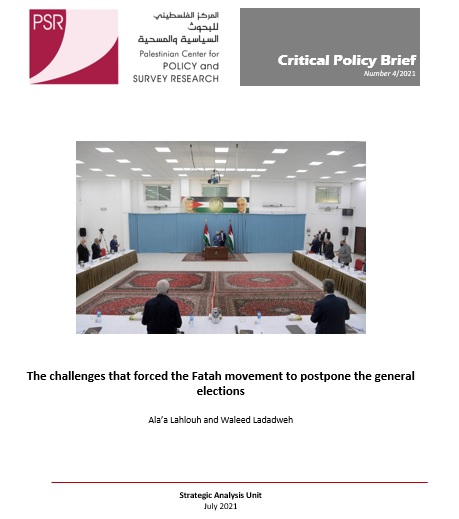
The challenges that forced the Fatah movement to postpone the general elections
Ala’a Lahlouh and Waleed Ladadweh
On April 20, 2021, President Mahmoud Abbas issued a decree to postpone the legislative elections that were scheduled to be held in on May 22, 2021 in accordance with a previous decree issued on January 15, 2021. The decree to postpone the elections shocked the majority of the Palestinian public who wanted the elections to be held in order to bring about a change in Palestinian governance and to restore unity and end the West Bank-Gaza Strip split. It also surprised the international community that had hoped that these elections would result in a legitimate government that would represent all Palestinians. What prompted the Palestinian president to overlook all the wishes of the various factions, electoral blocs, the large majority of the Palestinian people, and the wishes of the international community? This paper aims to know the challenges that forced President Abbas and the Fatah movement to postpone the elections and how they can overcome these challenges.
The president's stated justifications for postponing the elections:
The Palestinian President announced that the postponement of the elections came, "in light of the decision of the expanded Palestinian leadership meeting, which included the Executive Committee of the Palestine Liberation Organization, the Central Committee of Fatah Movement, the leaders of the Palestinian national action factions, and national figures." He justified the postponement decision by stating that the Israeli occupation prevented the holding of elections in the city of Jerusalem, asserting that "there is no abandonment of Jerusalem, and there is no abandonment of the people's exercise of their democratic right in Jerusalem." The president added that "Israel has decided to kill the Arabs in Jerusalem, and we will not allow that."
However, these justifications were not sufficient to satisfy the various parties; Sixty-five percent of the Palestinians expressed their opposition to President Abbas' decision to postpone the general elections, and two-thirds said that the postponement came out of fear of the results, and not for the sake of Jerusalem, according to a poll conducted by the Palestinian Center for Policy and Survey Research (PSR) in June 2021.[1] In a statement, the European Union described the decision to postpone the Palestinian elections as "disappointing."[2] The head of the political bureau of "Hamas", Ismail Haniyeh, considered the reasons for postponing the elections “unconvincing at all.” He stressed in a speech that his movement is not in disagreement with Fatah or with any party on the necessity of holding elections in Jerusalem,"but the disagreement with brother Abu Mazen is on making our decision and the will of our people subordinate to the Israeli occupation, or on submitting to the will of the occupier, or on responding to the desire of this party or that."[3] Hamas also described Abbas's decision as "a coup against the path of partnership and national consensus, and it is not permissible to subordinate the entire national situation and our popular and national consensus to the agenda of a particular faction."[4]
The challenges that prompted the president and the Fatah movement to postpone the elections:
There is no doubt that the justifications provided by the president and the Fatah movement were not the real reasons behind postponing the elections. Undoubtedly, the president and the Fatah movement knew that postponing the elections would bring them into direct conflict with the majority of the public and other parties. However, the president postponed the elections; an action that reveals that the extent of the difficulties that the president and the Fatah movement would have faced if elections were held, and the results that would ensued. These difficulties, it seems, were greater, in their view, than the cost of clashing with the people and violating the demands to hold elections. What are the challenges that might have prompted the president and Fatah movement to postpone the elections?
First challenge: Fragmentation and lack of discipline within the movement itself
The Fatah movement faced great challenges during its journey in the Palestinian Authority in the 1996 and 2006 general elections, and in the various local elections during the past years. Perhaps the most important problems facing the Fatah movement in all the previous rounds of elections is the division in the movement's ranks and the defection of some of its leaders and cadres to run for the elections independently. After the issuance of a decree to hold the general elections, the leadership of the Fatah movement represented by President Abbas took a decision to prevent the members of the Central Committee, the Revolutionary Council, the secretaries of the regions, members of parliament and former ministers, in addition to the security and military leaders from running for elections and to give the young generation the opportunity to run in an attempt to renew the movement’s energies and to exhibit a new image capable of attracting voters. The movement's leadership established a set of organizational and professional criteria for those running for elections. This decision did not satisfy many of the movement's leaders, who were waiting for this opportunity to consolidate their leadership positions by running for the upcoming legislative elections.
In the last days of March, and before Fatah submitted its official list, restlessness and anger emerged from some Fatah cadres in some areas as a result of their exclusion from the official list or as a result of their placement in unguaranteed positions within the official list. This anger was manifested in regional and factional statements that announced their boycott of the elections and that they would not vote for the movement's list. Then came the talk, which gained credibility at the time, about the inclusion in the electoral list of a selected number of the members of the Central Committee of Fatah, in great contravention of the decision made by the movement’s leader, thus weakening the chances of the movement's youth to assume leadership positions.
Moreover, the article in the election law, that stipulated that presidential candidates must be part of existing electoral lists or political parties, posed a critical threat to Marwan Barghouti’s candidacy for the presidency. Consequently, the election law itself formed a strong motivation for him and his supporters to form a separate electoral list that would compete with the official movement’s list in order to guarantee that Barghouti can run for the presidential elections, even if the official movement list refused to allow him to do so.[5]
These events led to the formation of two electoral lists representing defectors from the Fattah movement, in addition to the Fatah’s formal list. Marwan Barghouti (Member of Fatah’s Central Committee) and Dr. Nasser Al-Qidwa (also a Central Committee member, dismissed for intending to run for elections outside Fatah’s formal list), formed, together, a list in the name of “The Freedom List.” Former leader in Fatah, Mohammad Dahlan, a former Central Committee member expelled from the movement some 10 years earlier, formed “The Future Bloc.”
The results of a poll conducted by PSR in mid-March showed that Fatah (formal and defectors) has the largest electoral base among the Palestinian forces and factions. In a question about voting in new parliamentary elections with the participation of all the political forces that participated in the 2006 elections, the results showed that an all Fatah’s list would receive the vote of 43% of the participants, while the Change and Reform List, affiliated with Hamas, gets 30%, and all other lists combined at 8%, and 18% said they have not yet decided who they will vote for.
However, concerns emerged when respondents were asked about other options that might occur in the elections, such as the intention of Al-Kidwa or Dahlan to form lists to compete in the legislative elections, while the position of the prisoner Barghouti was still ambiguous about his intention to form an electoral list at that time. But one of the options offered to the public was related to Marwan Barghouti's formation of an independent list. The results showed that in this case, the formal Fatah's list would receive only 24% of the vote, and Barghouti's list would receive 20%, Dahlan's list 7%, and Hamas' list would receive 27%. In another question about Al-Kidwa forming a separate list, Fateh's formal list would receive 32%, Hamas' list would receive 28%, Dahlan's list would receive 6%, and Al-Kidwa's list would receive 4%. The point of all this is that there are legitimate fears that Hamas would have gotten a plurality of the parliamentary seats in the Palestinian Legislative Council (PLC). However, this would certainly not give it the majority or even the ability to form a coalition government, unless the official Fatah movement led by President Abbas refused to establish a coalition government with Barghouti, Al-Kidwa and Dahlan.
Second challenge: The decline in President Mahmoud Abbas’ popularity
The recent years, especially since 2014, have witnessed a decline in the popularity of Palestinian President Mahmoud Abbas. President Abbas was elected to the presidency of the Palestinian Authority in January 2005 and was elected as the head of the Fatah movement at the sixth General Conference of the Fatah movement in 2009 and was re-elected at the seventh conference in 2016.
The year 2014 marked a turning point in President Abbas’ popularity, as public opinion polls showed a decline in his popularity in favor of Hamas candidate Ismail Haniyeh as a possible candidate for the presidential elections; not to mention the great challenge posed by the high popularity of the Marwan Barghouti. The decline in President Abbas’ popularity is due to a number of reasons, the most important of which are the following:
- The political horizon of the peace process is closed: President Abbas has always been a proponent of a peaceful solution and negotiations and is not in favor of violent means of resistance. But with the dominance of the Israeli right headed by Benjamin Netanyahu since 2009, the peace process reached a dead end. With the continuation of the Israeli settlement expansion that disrupts the geographic contiguity of the promised Palestinian state and continuation to Judaize the city of Jerusalem, the Palestinians refused to return to negotiations unless settlement expansion stops, and thus the issue remained between ebb and flow throughout the first term of President Obama. Despite the efforts and success of US Secretary of State John Kerry in conducting negotiations between the two parties in 2013-14, these efforts met the same fate of failure. After that, the negotiations entered a state of clinical death. Nonetheless, President Abbas remained committed to the option of negotiations as the only option. Despite his advocacy of peaceful popular resistance, the Palestinian leadership did not succeed in promoting or supporting this option in a manner that would have made it an effective weapon.
Public opinion polls show a decline among Palestinians in support of the two-state solution in recent years, from about 48 % in March 2019 to 39% in June 2021, according to opinion polls conducted by PSR during this period. This decline is probably the result of public perception that diplomacy has reaching a dead end. In addition, polls showed that negotiations are no longer considered by the Palestinians the most effective way to establish a Palestinian state.
- Public dissatisfaction, especially in the Gaza Strip, with President Abbas’ policy towards the Strip: Recent years have witnessed a sharp decline in the President Abbas’ popularity in the Gaza Strip. Public opinion polls showed that the president’s popularity declined dramatically after the Israeli war on the Gaza Strip in the summer of 2014, when it dropped from 53% in June[6] 2014 before the war to 38% in September 2014[7] after the war. These findings reflected the decline of Abbas’ popularity and the rise of Hamas’ Ismail Haniyeh in hypothetical presidential elections, according to two opinion polls conducted by PSR during that period. Gazans felt that they were alone in their battle with the occupation, and that the PA leadership was contributing to the siege imposed by Israel and Egypt. The decline in President Abbas’ popularity in the Gaza Strip continued after a series of measures taken by the PA leadership that reduced the delivery of basic services, such as electricity and health services, followed by measures against a large number of public employees in the Gaza Strip, including early and compulsory retirement and a suspension of salaries. Gazans saw these measures as punitive, targeting citizens in the Gaza Strip, which suffers from the scourge of the continuous and tight blockade since 2006.[8]
- The transformation of the Palestinian political system under his rule into an authoritarian regime that lacks accountability: The Hamas movement's control of the Gaza Strip led to the split between the West Bank and the Gaza Strip in June 2007, which in turn led to the absence of the PLC, and the transfer of all the legislative and oversight responsibilities to the executive authority, in particular to the head of the authority, Mahmoud Abbas. Within a few years, President Abbas issued about 300 laws by decrees, the vast majority of which are ordinary, not urgent or emergency laws. The number of these decrees far exceeds the number of laws that the PLC issued during its entire tenure (1996-2007). Without a parliament, there was no longer any accountability for the executive authority, with the exception of the little exercised occasionally by the judiciary, the press, and civil society. In recent years, there has also been a major seizure of power, represented by the dissolution of the PLC in December 2018 after more than 11 years of disruption. The judiciary was also weakened by the executive authority’s failure to implement the decisions issued by the courts, in addition to interfering in the affairs of the judiciary authority, which culminated in the Decree Law No. (40) of 2020 amending the Judicial Authority Law, which strengthened the executive authority’s dominance over the judiciary. This period also witnessed the targeting of civil society’s institutions through a set of measures against non-profit companies and civil organizations, leading to the enforcement of various new restrictions on these institutions, recently represented in Decree Law No. (7) of 2021 amending the Law of Charitable Societies and Civil Organizations.[9]
The damage caused by postponing the elections:
There is no doubt that the decision to postpone the elections and the subsequent events related to Jerusalem and then the Israeli war on the Gaza Strip were the worst and most unprecedented on their effect on the popularity of the president and the popularity of Fatah. At a time when the majority of the public (about 70%) wanted the elections to be held, the president indefinitely postponed the elections. At a time when the president said that the postponement was for the sake of Jerusalem, the majority of the Palestinians (about 65%) saw the postponement not for the sake of Jerusalem, but rather for fear of the election outcome. This was followed by the events in Jerusalem, for which the elections were supposed to have been postponed. However, the president, the Palestinian Authority, and the Fatah movement did not show the public that it is doing what was expected from them in defense of Jerusalem, as only 8% of the public described the president’s performance in defending Jerusalem as strong, 11% went to the PA, and 13% went to Fateh’s, while 75% of the public described the performance of Hamas as strong.[10]
All of this was reflected in a resounding decline in the President Abbas’ popularity and a drop in the popularity of Fatah. President Abbas' ability to compete in legislative elections against Haniyeh fell to its lowest level since his election in 2005, as Haniyeh outperformed Abbas by a wide margin (59% to 27% respectively), according to the results of public opinion poll No. (80) conducted by PSR in June 2021, compared to the results of public opinion poll No. (79) conducted by PSR in March 2021, where the results indicated at that time that Abbas had received 47%, compared to 46% for Ismail Haniyeh.
In June, the popularity of Fatah against Hamas also fell. If the legislative elections were held, the latter would outperform the former by 11 points in its favor, as Hamas won 41% of the vote compared to 30% for Fatah, according to the results of the above-mentioned poll. Fatah had outperformed Hamas three months earlier, obtaining 43% compared to 30% for Hamas in a poll conducted by PSR in March 2021.[11] . The majority (53%) in June also considered Hamas as more qualified to represent and lead the Palestinian people, compared to only 14% who believed that Fatah, led by President Abbas, is better qualified.
Recommendations:
This paper proposes three recommendations to the Fatah movement and its leaders: (1) reverse the decision to postpone the elections, (2) declare Fatah’s readiness to build a governmental coalition with other (defected) Fatah lists, and (3) announce the movement's intention to compete in the presidential elections with a candidate other than President Abbas.
- Conducting elections immediately, including Jerusalem, and challenging occupation measures
Holding elections has become an urgent Palestinian demand supported by the majority, just as holding them inside the city of Jerusalem is the demand of all Palestinians. However, if the Israeli government insists on its refusal to hold elections in Jerusalem, the Central Elections Committee must announce alternative solutions to hold the elections inside the city, and to have these solutions supported by the Palestinian forces and factions, led by the Fatah movement. The Election Committee, with the support of the Palestinian leadership, can place ballot boxes in front of Israeli post offices, address the European Consulates General accredited to Palestine to place the ballot boxes in their missions, place the ballot boxes in the courtyards of Al-Aqsa Mosque, and address the various churches to place the ballot boxes in their premises. It can also build the capacity to hold elections electronically.
Of course, the Israeli government will work to thwart the election process and will arrest those responsible for it and prevent citizens from going to the polls to exercise their basic rights to vote and choose their representatives. This will happen in front of the eyes of the world and the international media and Israel will be shown in opposition to Palestinian democracy. The PA should let the election day be a day of popular and peaceful resistance that President Abbas has always called for, and the Fatah movement has taken a lead in the city of Jerusalem. This would be the opposite of what Fatah and other factions have done in the past and would provide an opportunity to demonstrate support for the city and its residents to compensate for past failures. Holding elections in Jerusalem is a form of defiance of the occupation and is the best electoral propaganda for Fatah in its upcoming electoral campaign.
- Unity in the PLC
In light of the dispersion of Fatah’s electoral base among three blocs, it must use the election results in a way that enables it to become the largest electoral bloc by uniting its elements within the new PLC, especially if it wants to form a government away from Hamas. It is almost certain that the Freedom List (Barghouti and Al-Kidwa) and the Future List (Dahlan) will not make an alliance with Hamas, especially since the Future List’s regional allies (Egypt and the United Arab Emirates) will not allow it to do so in light of their conflict with the parent group (the Muslim Brotherhood) and in light of the tense relations with Hamas’ allies in the region. (Qatar, Turkey, and Iran).
- Run in the presidential elections with a new candidate.
It seems that President Abbas has become a source of weakness for Fatah's popularity. His long stay in power without elections and without achievements that can be presented to the people, at the level of the peace process or at the internal level, in addition to the deterioration of economic conditions, civil liberties, separation of power, have led to a majority demand for his resignation. It is certain that President Abbas is unable to win the presidential elections that will take place in the Palestinian territories any time soon. Moreover, the Fatah movement would be much stronger if it were under other leaders, such as Marwan Barghouti, who would take the movement in terms of the masses to great strides forward, as he would outperform his rival Ismail Haniyeh by a wide margin in any presidential election. President Abbas had previously announced several times during television interviews that he did not want to run in the presidential elections, and thus this statement opens the way for the Fatah movement to contest the upcoming presidential elections with a new presidential candidate from its own ranks. On the other hand, the Central Committee member Marwan Barghouti[12], who enjoys great popularity among the Palestinian public, announced his intention to run in any presidential elections. Public opinion polls over the past years have shown that Barghouti is the strongest candidate from within Fatah who can win any presidential elections with ease. The polls showed that Barghouti can compete with the Hamas candidate and beat him by a wide margin ranging between 20 and 30 points. On the other hand, polls showed that current Hamas leader has over the past years surpassed President Mahmoud Abbas on many occasions.[13]
The reason for Barghouti’s superiority in opinion polls is that his electoral base includes the various components of Palestinian society, including Fatah’s base, Islamists, leftists, independents, and others. On the other hand, president Abbas’s electoral base includes Fatah only and perhaps some minor PLO factions. A Hamas candidate’s base is mainly among Hamas supporters and Islamist independents. The latest poll conducted by PSR in June 2021,during the peak of the popularity of Hamas and its candidate Ismail Haniyeh, showed that in the event of new presidential elections in which only two candidates, Mahmoud Abbas and Ismail Haniyeh ran, the first would receive 27% of the votes and the second would receive 59%, but if the competition is between Marwan Barghouti and Haniyeh, then Barghouti would receive 51% and Haniyeh would receive 41%.[14]
[1] See: Results of Public Opinion Poll No. 80 conducted by the Palestinian Center for Policy and Survey Research. Public Opinion Poll No (80) | PCPSR
[3] https://arabic.sputniknews.com/arab_world/202104301048859402-%D8%B9%D8%A8%D8%A7%D8%B3-%D9%8A%D8%B5%D8%AF%D8%B1-%D9%85%D8%B1%D8%B3%D9%88%D9%85%D8%A7-%D8%A8%D8%AA%D8%A3%D8%AC%D9%8A%D9%84-%D8%A7%D9%84%D8%A7%D9%86%D8%AA%D8%AE%D8%A7%D8%A8%D8%A7%D8%AA-%D8%A7%D9%84%D9%81%D9%84%D8%B3%D8%B7%D9%8A%D9%86%D9%8A%D8%A9-%D8%B1%D8%B3%D9%85%D9%8A%D8%A7/
[4] Ibid.
[5] The Palestinian Gazette published a notice on March 18, 2021, about an error in Law No. (1) of 2021 amending Law No. (1) of 2007 regarding general elections. The content of this notice is that a candidate for the presidential elections is not required to be nominated by a political party or electoral list.
[8] In December 2017, 70% demanded the resignation of President Abbas: Results of Public Opinion Poll No. 66 | PCPSR
[9] This decision was suspended by law following local and external pressure.
[10] See: Results of Public Opinion Poll No. 80 conducted by the Palestinian Center for Policy and Survey Research. http://pcpsr.org/ar/node/844
[12] In the 2005 presidential elections, the prisoner Marwan Barghouti ran for the presidential elections, but later withdrew in favor of Fatah candidate Mahmoud Abbas.
[13]The Palestinian Center for Policy and Survey Research, the center's polls during 2014-2021. http://www.pcpsr.org/en/node/602
[14]Palestinian Center for Policy and Survey Research, Poll No. ( 80 ), June 2021. http://www.pcpsr.org/sites/default/files/Poll-79-Arabic%20Full%20Text.pdf
 July 2023
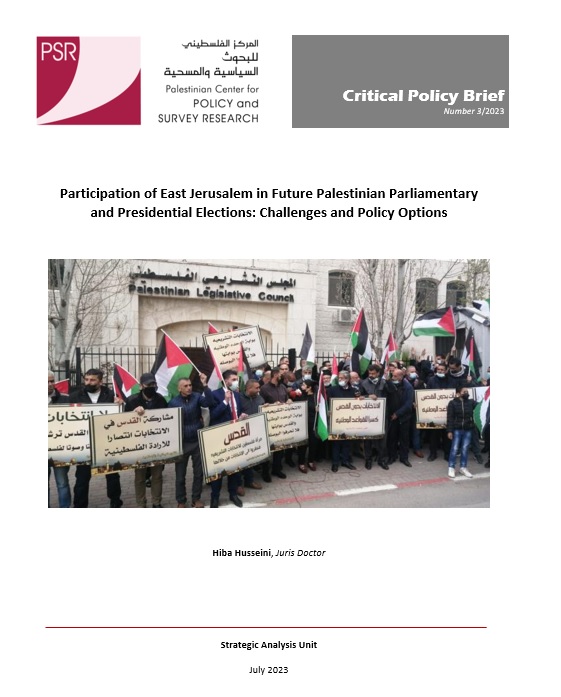
Participation of East Jerusalem in Future Palestinian Parliamentary and Presidential Elections: Challenges and Policy Options
Hiba Husseini, Juris Doctor*
Introduction
Presidential and legislative elections for the Palestinian Authority (PA) have been held twice each since 1996, the last taking place in 2005 and 2006 respectively. President Mahmoud Abbas (who was elected in 2005 with a five-year mandate, extended in 2009) announced in 2021 that presidential and legislative elections would be held that spring and summer in Gaza, the West Bank, and East Jerusalem. The right of the East Jerusalem residents was set out in the Oslo Accords. In April 2021, however, just a month before Palestinians were due to go to the polls to elect a new Palestinian Legislative Council (PLC), Abbas announced the indefinite postponing of elections, claiming the state of Israel’s refusal to permit elections in East Jerusalem.[1] Two years on, this postponement continues, at a cost to Palestine’s voters and their rights to self-government. Many have never voted in a national election, having turned 18 after 2006.
This policy brief will highlight the critical challenges facing future elections in East Jerusalem, namely Israel’s cooperation (and lack thereof) in holding elections and political participation of East Jerusalemites (including the obstacles East Jerusalemites face in participating in the political process). It will then assess options for Palestinian policy makers and the international community to overcome such challenges.
I. Background to future elections
Rationale of postponement in 2021
When Abbas postponed elections in April 2021, he cited Israel’s refusal to allow elections in East Jerusalem. During the last round of legislative elections in 2006, Israel curtailed the election by only allowing East Jerusalemites to vote from the outskirts of the city and at post offices. With Israel’s continued occupation of East Jerusalem, and insistence that it is part of an “undivided capital” in which Palestinian political activity is banned, it is unlikely that such a compromise would have been possible had elections gone ahead in 2021. Although Israel’s foreign ministry had said that elections were “an internal Palestinian issue, and that Israel has no intention of intervening in them or preventing them,” the reality would likely be very different.[2] It is also telling that this was not accompanied with a statement of support for the right of the Palestinian electorate to elect their political representatives, or similar. Should Abbas have forged on with holding elections, knowing that no East Jerusalemites would be voting for their political representatives, it could have been interpreted as the PA accepting the illegal occupation and annexation of East Jerusalem.
Nearly all the other Palestinian factions, however, rejected Abbas’s decision. Hamas referred to the postponement as a “coup”. There is a feeling amongst some of Fatah’s opponents that Israel’s lack of cooperation is simply an excuse to cover up internal divisions within Abbas’s party.[3] He is facing challenges from various Fatah splinter groups led by individuals including Marwan Barghouti (currently serving five life sentences in an Israeli prison), Nasser al-Kidwa (nephew of Abbas’s predecessor, Yasser Arafat), and Mohammed Dahlan (a former PA security chief). Dahlan has called the postponement “illegal” and described it as an action taken by a president who has “lost his legitimacy”.[4] Barghouti, in particular, has been signaled as Palestinian voters’ preferred candidate in polls conducted by the Palestinian Centre for Policy and Research Survey.[5] It is possible that Abbas worried that a Hamas victory might split Fatah into factions, or being usurped as Fatah’s leader and the PA’s president.
The possibility of a Hamas victory may also be related to alleged international pressure to delay the elections. Al-Quds reported that Abbas faced Arab and American pressure to postpone voting, fearing a Hamas victory. [6] Hamas were triumphant over Fatah in the 2006 elections in the PA and has since 2007 been holding de facto control. Hamas however is recognized as a terrorist group by both the United States and the European Union.
II. Critical challenges of East Jerusalem elections
Israeli refusal to cooperate
The prospect of any Palestinian elections taking place in East Jerusalem in the future is mired by the continued Israeli occupation and annexation of parts of the West Bank, and the presumption that they though would interfere or prohibit elections taking place. Since 2006, Israel’s government has only increased its aggressive expansion into East Jerusalem. The most recently elected government, led by Benjamin Netanyahu, is one characterized by extreme positions on further annexation and occupation.
In the 2006 elections, the Israeli government demonstrated an unwillingness to allow free and fair elections to go ahead in East Jerusalem. Voting and polling stations were prohibited, forcing voters to cast their ballot in post offices in Jerusalem where they were supervised by Israeli police. Although the exact effect of such intimidation is unknown, one can assume that such supervision created a hostile atmosphere which discouraged democratic participation. Furthermore, all Hamas offices were raided and shut down, and Hamas candidates were denied permission to campaign.
Ahead of the expected 2021 election, the Israeli government stated that they had ‘no plan’ to intervene in the elections, but refused to comment on the status of Jerusalem, and issued no statement of support for the elections or the Palestinian community’s right to elect its representatives. This should have been the basic response to any questions on the elections. President Abbas claims that he was told directly by officials that elections would not be permitted, but this claim cannot be verified.
As current laws stand in East Jerusalem, all political activity of the Palestinian Authority is strictly banned. This, and the prohibition of Hamas campaigning and participation, is unlikely to change in the foreseeable future.
Such disruption makes future elections difficult in a multitude of ways. One can expect significant levels of disruption to any voting process, either by a repeat of the 2006 methods of displacement, or by an escalation where East Jerusalem voters are stopped from voting in the city altogether. It would not be beyond belief to assume that voters would also be prevented from travelling outside of the city to vote. This disruption would likely be partnered with a use of state violence to maximize disruption. The physical presence of Israeli forces, regardless of whether they use force or not, is an act of political intimidation. It is a visual reminder of who holds power in the city, and a psychological reminder of violence enacted by such forces in the past. Furthermore, the supervision of voting by armed Israeli police reinforces the denial of Palestinian political agency and the historic colonial stereotype that Palestine is an ‘uncivilized’ society requiring mature (i.e. Western) supervision to develop into a self-governing state, as the original League of Nations mandate designated it in 1923.
Interference may also have the effect of radicalizing the Palestinian community in East Jerusalem. The longer elections are withheld from voters, the more likely voters are to embrace non-legislative methods of change, as democratic methods are seen as hopeless.
Lack of belief in political systems
Were any elections to go ahead in East Jerusalem, there is a serious problem regarding political participation and faith in the potential of legislative change. In a survey conducted in 2022 by the Palestinian Centre for Policy and Survey Research, 93% of East Jerusalemites said they hadn’t participated in Palestinian elections. Many respondents were too young to vote in 2006. However, most crucially, only 6% said they would participate in a future election. This is a 33-point drop from the number who said that they’d participate in 2010. The fact that this problem has worsened over a decade shows growing dissatisfaction with the Palestinian Authority. There has been a 22-point increase in the perception that politicians are unimpressive and cannot help East Jerusalemites.[7] It is reasonable to assume that the postponement of elections in 2021 has only increased such concerns.
It is important to note that the decline in enthusiasm for participating isn’t matched by a corresponding rise in belief in Israeli elections. These have similar levels of participation (95% of respondents said they had not participated in Knesset or municipal elections). It is key, however, that there has been a 12-point decline in the percentage of East Jerusalemites boycotting Israeli municipal or Knesset elections on the basis that the occupation makes such authority illegitimate.[8] This may not mean such respondents now view the power as legitimate and could rather signal both a collapse in belief that boycotts are worthwhile or effective and a strengthening of the idea that East Jerusalemites should try and make things work under the current occupation.
Alongside the decline in respondents boycotting elections due to the occupation is a corresponding decline in respondents who were willing to vote in Israeli elections at the request of the PA. In 2010, 23% of respondents said they would follow the request; in 2022 only 3% would.[9] This suggests a significant collapse in the authority of the PA in East Jerusalem.
Assuming these trends would be confirmed should a presidential or legislative election be held in the near future, a turnout of less than 10% in East Jerusalem would be incredibly damaging to the legitimacy of the newly elected PA or President. It is therefore imperative to try and address such concerns ahead of an election.
In an ideal world in which the Israeli government relaxed its restrictions and allowed the elections to run, this would likely ease the view that PA officials cannot help East Jerusalem. The likelihood of this, however, is minimal. One other factor is the inability of candidates to reach East Jerusalem residents because Israel will not allow them to campaign there. Thus, their potential impact to affect them as a constituency remains ambivalent to the East Jerusalem residents. Whether such concerns will be listened to or not cannot be known. It is likely that issues of candidate quality can only be meaningfully changed over time and successive elections as officials prove themselves to voters as trustworthy and capable of making meaningful improvements to the lives of East Jerusalemites.
Other obstacles to political participation
Aside from Israeli interference and lack of belief in the systems, there are additional problems – largely associated with the occupation of East Jerusalem – which could undermine political participation in an election.
East Jerusalemites face daily infringements on their rights to freedom of movement, expression, and education. This is a powerful tool of the Israeli government to gradually diminish Palestinian’s sense of identity, self-determination, and freedom. The cumulative effect is incredibly damaging in a democracy as voters become resigned to accepting – or at least tire of protesting against – their own oppression.
Education has also been restricted and disrupted by the occupation, with particular censorship of educational materials that refer to Palestinian national identity. This poses a problem to political participation as children are not instilled with a sense of civic responsibility to participate in democratic processes.
The restriction on freedom of movement is a particular challenge. Even if limited voting was allowed in post offices, for example, this would be further restricted to those who could take time off work to travel and had the means to do so.
III. Policy options
In light of these critical challenges, there are several options available for policymakers to consider.
Postponing elections indefinitely
The first option to consider is the continuation of the status quo: an indefinite postponement of the legislative and presidential elections until elections in East Jerusalem can be guaranteed to run without significant Israeli interference.
This option should be avoided at all costs. The main reasoning for this option is that in running the elections without East Jerusalem, the PA would be, or could be understood to be, implicitly accepting Israel’s illegal occupation and abandoning the rights of East Jerusalemites.
In making a stand against Israeli interference, however, the PA ensures that the rest of the Palestinian electorate is continued to be deprived of their right to self-determination and participation in elections. The effect of this could be catastrophic. Hamas has already won the previous PA elections, and Fatah risks alienating itself further from the electorate, particularly if they are considered to have acted in their own self-interest. As critics said after the postponement, Fatah can be accused of effectively allowing Israel to hold a veto over Palestinian elections.[10]
Furthermore, the PA must demonstrate it can run a functioning government – that follows international law - and regular elections. This is essential to both bolster domestic support against Israeli occupation, and unite Palestinians behind their own institutions, but also to garner international support as a self-governing nation and an equal player to Israel.
The basic fact remains that elections have not happened since 2006, and a significant portion of the Palestinian electorate is aged between 18 and 34, meaning they have never voted in Palestinian elections. This is an unacceptable reality that ensures ongoing political disillusionment and weakens the legitimacy and therefore authority of the PA.
Holding elections without East Jerusalem
There are several alternatives to the indefinite postponement. The first is to push ahead with both legislative and presidential elections irrespective of whether Israel allows them to be held in East Jerusalem. As aforementioned, there are obvious downsides to running an election knowing a significant number of voters likely will not get to vote. It is unfortunate that in this case the PA could be seen as being responsible for denying its population a vote.
However, it is crucial that the PLC sits, and that a President is elected with a new mandate. Having proof that the vote was suppressed could provide the newly elected PLC a strong starting point in establishing a robust policy agenda that stands up to Israeli aggression. Symbolic actions could be taken to represent the missing representatives from East Jerusalem, such as leaving seats empty.
Holding elections with East Jerusalem
Another option is to not only push ahead with elections but also attempt some form of a vote in East Jerusalem. This was the preferred option for Hamas in 2021. The Palestinian Central Elections Commission stated days before Abbas’ decision that it believed nearly 150,000 eligible Palestinian voters from East Jerusalem suburbs (almost half the city’s Palestinian population) wouldn’t depend on Israeli approval to vote.[11] This could be a powerful moment of resistance if numbers that large showed up to vote despite Israeli threats.
However, this could be a dangerous act of provocation that results in violence across Jerusalem and potentially elsewhere. It would likely see the mass arrests of anyone attempting to facilitate elections in East Jerusalem. This would not only be a strong psychological defeat for the PA but could also further destabilize the PA if large numbers of officials were detained, preventing the PA’s operational capacity.
Encouraging Israeli co-operation
The ideal scenario would, of course, be one in which Israel allowed a full, free, and fair vote to happen in East Jerusalem. To enable this to happen would likely need much stronger international pressure on Israel to allow the elections, and greater commitments to defending the Palestinian population’s right to democracy. This could take the form of the international community committing to work with the elected authority (likely with the caveat that they must follow international law). This commitment would probably be essential to garner the support of international groupings like the EU which considers Hamas a terrorist group. To gain US support, an election would probably have to be held sooner rather than later whilst the Democrats still hold the presidency, as the return of Donald Trump (or similar candidate) to the White House would presumably see an even stronger pro-Israel position.
The international community would have to be clear in setting out consequences should Israel interfere with elections; consequences that must be enforced resolutely if necessary. As Abbas himself pointed in his May 2023 speech to the UN on the 75th anniversary of the Nakba, there have been over one thousand UN resolutions on Palestine but not one has ever been implemented.[12] If the international community could set out consequences and see them through, it could be a critical moment for restoring a sense of trust in international institutions.
This option faces significant feasibility problems. Palestinian policy makers cannot force international actors to pursue this line of action. The international community is currently largely focused on the war in Ukraine and Palestine is not seen as a high priority. It could be where they focus their lobbying and diplomatic efforts, however, as this is the option which would most likely force Israel’s cooperation.
Addressing other motivations for the delayed elections
All the of the options above rest on the assumption that Abbas was honest in his reasoning for delaying the elections. Assuming, however, that his critics are correct in highlighting fears over a Hamas victory and potential challenges from within Fatah, then there are more feasible options for policy makers to consider.
Already Fatah and Hamas have taken steps to improve conditions between them; as of 2022 all 14 factions have agreed to hold national elections within a year. [13] Statements from Fatah and Hamas both promised that this will not be another broken promise, but only time will tell. Policy makers could also apply pressure to Hamas and any other faction that advocates violence as a political tool to commit to following international law if elected.
The internal Fatah split is not something that could be directly addressed by policy makers, but they could apply pressure to Fatah to put the country before the party, which may reap rewards.
Addressing political participation
As shown in Part I, even if elections were held, the PA faces an underlying fault line in the lack of political participation in East Jerusalem. It is hard for policy makers to try and address this without a firm promise that elections would be held in the future. Problems of restricted rights, particularly to movement, political organization, and education are particularly insidious to deal with. One area that could be addressed, however, is the one of corruption and trust in politicians. Policy makers could focus energy on ensuring greater responsibility and accountability in government, thereby gradually building trust in the politicians and institutions.
IV. Conclusion
The prospect of future elections in East Jerusalem and wider Palestinian is a bleak one. The PA are staring down two separate fronts: Israel and political apathy. Both must be removed or addressed in order for elections to be held successfully.
In the short term, policy makers should focus the majority of their efforts in convincing Fatah to hold some form of election as soon as possible, with or without Israel’s approval. Lobbying the international community for greater support could also reap rewards, although the likelihood of any significant shift in the status quo is minimal. In the long term, policy makers must address serious apathy to political participation. Running an election would partially reduce this apathy, but it would not resolve it completely.
*** “Special thanks from Hiba Husseini for the research and writing provided by Ms. Iona Clark, Candidate, MPhil at Cambridge in Politics and International Studies.”
[1] European Council on Foreign Relations, ‘Mapping Palestinian Politics’. https://ecfr.eu/special/mapping_palestinian_politics/elections-2021/
[2] Abbas delays Palestinian parliamentary polls, blaming Israel, Al Jazeera, 20 April 2021. https://www.aljazeera.com/news/2021/4/30/palestinian-factions-reject-abbas-decision-to-delay-polls
[3] Ibid, Palestinian leader delays parliamentary and presidential elections, blaming Israel, Reuters, 30 April 2021. https://www.reuters.com/world/middle-east/palestinian-elections-delayed-says-president-mahmoud-abbas-2021-04-29/
[4] Abbas delays Palestinian parliamentary polls, blaming Israel, Al Jazeera, 20 April 2021. https://www.aljazeera.com/news/2021/4/30/palestinian-factions-reject-abbas-decision-to-delay-polls
[5] Palestinian Centre for Policy and Survey Research, Public Opinion Poll No (86), 7 December 2022. https://pcpsr.org/en/node/926
[6] Abbas delays Palestinian parliamentary polls, blaming Israel, Al Jazeera, 20 April 2021. https://www.aljazeera.com/news/2021/4/30/palestinian-factions-reject-abbas-decision-to-delay-polls
[7] Palestinian Centre for Policy and Survey Research, A Special East Jerusalem Poll:
Comparing the Results of 2010 and 2022 Polls. https://pcpsr.org/en/node/931
[8] Ibid.
[9] Ibid.
[10] Abbas delays Palestinian parliamentary polls, blaming Israel, Al Jazeera, 20 April 2021. https://www.aljazeera.com/news/2021/4/30/palestinian-factions-reject-abbas-decision-to-delay-polls
[11] Jørgen Jensehaugen and Erling Lorentzen Sogge, ‘The Palestinian elections that weren't’, The Loop. https://theloop.ecpr.eu/palestinian-elections-hang-in-the-balance/
[12] ‘Marking Anniversary of Nakba, President Tells Palestinian Rights Committee ‘Tragedy Constitutes a Scar on Humanity’’, Committee on the Inalienable Rights of the Palestinian People, UN Meetings Coverage, 15 May 2023. https://press.un.org/en/2023/gapal1453.doc.htm.
[13] Lamine Chikhi and Nidal Al-Mughrabi, ‘Palestinian rivals agree to hold elections but doubts persist’, Reuters, 13 October 2022. https://www.reuters.com/world/middle-east/palestinian-rivals-agree-elections-end-dispute-doubts-persist-2022-10-13/
14 December 2021
Optimism about the holding the second phase of local elections and Fatah is more popular than Hamas in West Bank cities; but three quarters of the public demand the resignation of president Abbas while Hamas’ standing, as a potential representative and leader of the Palestinian people, witnesses a setback; in Palestinian-Israeli relations, support increases for confidence building measures to improve daily living conditions
8-11 December 2021
This poll has been conducted in cooperation with the Konrad-Adenauer-Stiftung in Ramallah

These are the results of the latest poll conducted by the Palestinian Center for Policy and Survey Research (PSR) in the West Bank and the Gaza Strip between 8-11 December 2021. The period before the conduct of the poll witnessed several developments including the preparation for the holding of the first phase of local elections in rural areas and small towns in the West Bank but without a confirmation of the date for holding the second phase of local elections in cities and big towns. Hamas prevented the holding of the local elections in the Gaza Strip. The first phase of local elections was held in the West Bank on 11 December, the last day of the field work, in 154 localities and the participation rate stood at 66% according the Palestinian Central Elections Commission. The number of participants stood at 262,827 voters. This period witnessed also various violent incidents in Palestinian universities and the death of one student. Israel classified 6 Palestinian human rights NGOs as terrorist organizations. The UK labeled Hamas as a terrorist organization. This press release addresses some of these issues and covers other matters such as the general conditions in the Palestinian territories, the peace process and future possible directions for Palestinians in the absence of a viable peace process. Total size of the sample is 1270 adults interviewed face to face in 127 randomly selected locations. Margin of error is +/-3%.
For further details, contact PSR director, Dr. Khalil Shikaki, or Walid Ladadweh at tel. 02-296 4933 or email pcpsr@pcpsr.org.
Main Findings:
Findings of the last quarter of 2021 show that while the public is pessimistic about the prospects of holding parliamentary or presidential elections in the near future, it is optimistic that the second phase of local elections will take place soon. The second phase of local elections is now set to take place in cities and big towns on 26 March 2022. The findings show that Fatah is more popular than Hamas in West Bank cities that will participate in the second phase of the local elections while Hamas is more popular in the Gazan cities that might participate in the second phase of the local elections. Nonetheless, the findings show that the overall domestic balance of power between Fatah and Hamas has not changed compared to our findings of September 2021. Hamas is more popular than Fatah, and Ismail Haniyyeh easily wins against president Abba and prime minister Mohammad Shtayyeh in one to one competitions. But Marwan Barghouti, also from Fatah, wins against Haniyyeh with two-thirds voting for him. Three quarters of the public demand the resignation of president Abbas.
What is noticeable however is that despite the stability in the domestic balance of power, there is a clear disappointment in Hamas’ leadership indirectly expressed by the public compared to the situation six and even three months ago. The findings show that the percentage of those who choose Hamas to represent and lead the Palestinian people has declined significantly and the gap between those who choose Hamas compared to those who choose Fatah, under Abbas’ leadership, has now narrowed to 11 percentage points in favor of Hamas; in September, the gap stood at 26 points in favor of Hamas and in June, a month after the Hamas-Israel May 2021 war, the gap stood at 39% in favor of Hamas. The percentage of those who believe that neither Fatah, under Abbas, nor Hamas deserve to represent and lead the Palestinian people has now increased considerably.
In this poll, we have asked about various political solutions to the conflict with Israel and about the confidence building measures that seek to improve the daily living conditions in the West Bank and the Gaza Strip. The findings show the following:
- The majority is still opposed to the two-state solution. But support for this solution has increased compared to the September 2021 findings and decreased compared to the October 2021 findings.
- The two-state solution remains the one with the largest percentage of support compared to other solutions, including that of the one-state solution in which the two sides, Palestinians and Israeli Jews, enjoy equal rights; support for the one-state solution is higher than one quarter and less than one third.
- There is a clear majority, higher than 60%, in favor confidence building measures that improves Palestinian daily living conditions in the West Bank and the Gaza Strip; the current level of support is higher than that of September 2021 when we first asked about the issue.
Findings also show that despite a two-third opposition to a resumption of unconditional bilateral Palestinian-Israeli negotiations, a large minority approaching about half of the public is in favor of a resumption of such negotiations under the sponsorship of the Quartet. Moreover, despite the opposition of the majority to the resumption of dialogue between the US and PA, a large minority approaching half of the public believes that the US is the most effective in influencing the decisions of the Palestinians and the Israelis on the matter of the renewal of the peace process. Also on the peace process, findings show a decrease in the percentage of those who believe that armed struggle is the most effective means of ending the Israeli occupation and an increase in the percentage of those who believe that negotiation is the most effective. Nonetheless, armed struggle is viewed as more effective than negotiations.
Findings also show that the largest percentage of respondents believes the main Israeli motivation behind the labeling of six Palestinian NGOs as terrorist organizations is to weaken the ability of these organizations to document Israeli violations of human rights and to weaken the PA efforts to take Israelis to the International Criminal Court.
(1) Legislative and presidential elections:
- 70% say they support the holding of presidential and legislative elections in the Palestinian territories in the near future while 27% say they do not support that. Demand for elections stands at 75% in the Gaza Strip and 67% in the West Bank. But a majority of 52% (62% in the Gaza Strip and 45% in the West Bank) believe no legislative or legislative and presidential elections will take place soon. Nonetheless, a majority of 59% (68% in the West Bank and 44% in the Gaza Strip) expect the holding of the second stage of local elections in cities and big towns in the near future; 34% do not expect that.
- Fatah is more popular than Hamas (38% to 30%) in West Bank cities which will participate in the second phase of local elections while Hamas is more popular than Fatah (47% to 29%) in the cities in the Gaza Strip that might participate in the second phase of local elections.
- If new presidential elections were held today and only two were nominated, Mahmoud Abbas and Ismail Haniyeh, only 51% would participate and from among those, Abbas would receive 35% and Haniyeh 58% of the votes (compared to 56% for Haniyeh and 34% for Abbas three months ago). In the Gaza Strip, Abbas receives 33% of the votes (compared to 34% three months ago) and Haniyeh receives 64% (compared to 61% three months ago). In the West Bank, Abbas receives 37% (compared to 33% three months ago) and Haniyeh 52% (compared to 52% three months ago). If the competition was between Marwan Barghouti and Ismail Haniyeh, participation would increase to 65% and from among those Barghouti receives 57% and Haniyeh 38%. If the competition is between prime minister Mohammad Shtayyeh and Haniyyeh, participation rate would decrease to 52% and from among those the former receives 33% and the latter 59%. Three months ago, Shtayyeh received 31% and Haniyyeh 60%.
- If Abbas does not run for elections, the public would vote for the following: 35% say they want Marwan Barghouti, 20% say Ismail Haniyyeh, 5% say Dahlan and 4% say Yahia Sinwar, Khalid Mishaal and Mustafa Barghouti 3% each, and Salam Fayyad 2%.
- Level of satisfaction with the performance of president Abbas stands at 26% and dissatisfaction at 71%. Level of satisfaction with Abbas stands at 27% in the West Bank and 25% in the Gaza Strip. Satisfaction with the performance of Abbas three months ago stood at 24% and dissatisfaction at 73%. Moreover, 74% of the public want president Abbas to resign while only 21% want him to remain in office. Three months ago, 78% said they want Abbas to resign. Demand for Abbas’ resignation stands at 73% in the West Bank and 77% in the Gaza Strip.
- If new legislative elections were held today with the participation of all factions that participated in the 2006 elections, 67% say they would participate. Of those who would participate, 38% say they will vote for Hamas and 35% say they will vote for Fatah, 9% will vote for all other third parties combined, and 18% are undecided. Three months ago, vote for Hamas stood at 37% and Fatah at 32%. Vote for Hamas in the Gaza Strip stands today at 47% (compared to 47% three months ago) and for Fatah at 29% (compared to 27% three months ago). In the West Bank, vote for Hamas stands at 30% (compared to 28% three months ago) and Fatah at 40% (compared to 38% three months ago).
- In light of the recent confrontations with Israel, 34% think Hamas is most deserving of representing and leading the Palestinian people while 23% think Fatah under president Abbas is the most deserving of representing and leading the Palestinians; 36% think neither side deserves such a role. Three months ago, 45% selected Hamas, 19% Fatah under Abbas, and 28% said neither side deserves such a role.
(2) Domestic conditions and satisfaction with the Shtayyeh government:
- Positive evaluation of conditions in the Gaza Strip stands at 5% and positive evaluation of conditions in the West Bank stands at 31%.
- Nonetheless, perception of safety and security in the Gaza Strip stands at 79% and in the West Bank at 51%.
- 27% of the public say they want to emigrate due to political, security, and economic conditions. The percentage in the Gaza Strip stands at 31% and in the West Bank at 23%. Three months ago, 21% of West Bankers expressed a desire to emigrate and 36% of Gazans expressed the same desire.
- Perception of corruption in PA institutions stands at 84%. When asked about institutions controlled by Hamas in the Gaza Strip, 69% indicated that there is corruption in these institutions. Three months ago, 83% said there is corruption in PA institutions and 61% said there is corruption in public institutions controlled by Hamas.
- 39% of West Bankers think people in the West Bank can criticize the PA without fear while 58% think they cannot. In the Gaza Strip, 40% think people in the Strip can criticize Hamas’ authorities without fear and 59% think they cannot.
- In its assessment of the PA, a majority of the Palestinians (56%) views it as a burden on the Palestinian people while 39% view it as an asset for the Palestinian people. Three months ago, 59% viewed the PA as a burden and 34% viewed it as an asset.
- 33% are optimistic and 63% are pessimistic about the success of reconciliation. Three months ago, optimism stood at 32%.
- After more than two years since the formation of the Shtayyeh government, findings indicate persistent pessimism. Responding to a question about expectations regarding the ability of the Shtayyeh government to make progress in reconciliation and reunification, 71% expect failure; only 23% expect success. When asked about the ability of the government to organize legislative or legislative and presidential elections in the West Bank and the Gaza Strip, 29% of the public expect success and 65% expect failure. In another question about the ability of the new government to improve economic conditions, a majority of 69% expects failure and 27% expects success.
- We asked the public about its viewership habits in the last three months. Findings indicate that al Jazeera TV has the highest viewership, standing at 27%, followed by al Aqsa TV (14%), Palestine TV (11%), Maan (10%), Palestine Today (9%), al Mayadeen (4%), and al Arabiya (3%).
(3) The Coronavirus: Mandatory vaccination and PA performance during the pandemic:
- 58% (68% in the West Bank and 41% in the Gaza Strip) report that they have already received the coronavirus vaccination; 18% (11% in the West Bank and 32% in the Gaza Strip) says that they are willing to take the vaccine when available; and 24% say they and their families are not willing to take the vaccine when it becomes available to them.
- 77% (87% in the Gaza Strip and 71% in the West Bank) are satisfied with the efforts made by the government to obtain the vaccine and 21% are dissatisfied.
- 57% are satisfied with the measures taken by the PA to contain the spread of the coronavirus while 42% are dissatisfied. Three months ago, only 45% expressed satisfaction.
- The majority is satisfied with the performance of the various actors involved in the management of the Coronavirus crisis: 69% express satisfaction with the performance of the security services deployed in their areas and 69% are satisfied with the performance of the ministry of health. But satisfaction with the performance of the prime minister in the management of the coronavirus crisis stands at 46%. Three months ago, satisfaction with the prime minister’s performance in the coronavirus crisis stood at 39%.
(4) The Palestinian-Israeli Peace process and the new Israeli government:
- Support for the concept of the two-state solution stands at 39% and opposition stands at 59%. No description or details were provided for the concept. Three months ago, support for the concept stood at 36%.
- When asked about their preferences regarding a political solution for the Palestinian-Israeli conflict from among three specific solutions, one third (33%) preferred the “two state solution, the state of Palestine next to the state of Israel,” 16% preferred a “one state solution, from the River to the Sea, with equal rights to Jews and Arabs,” and 11% preferred a one state solution in which the status of the Palestinians would be “the same as the status of the inside Palestinians,” and 32% preferred other solutions, such as “historic Palestine,” or “full Palestine,” or “independent Palestine,” and others.
- Reflecting on the latest UN speech of president Abbas in which he described the situation on the ground in the West Bank as “apartheid” and that the Palestinian people will demand equal rights in one state for two peoples, only 29% say that they are in favor of such one state solution while 65% expressed opposition.
- When asked about support for specific policy choices to break the current deadlock, 60% supported joining more international organizations; 56% supported resort to non-violent resistance; 50% supported return to armed confrontations and intifada; 48% supported dissolving the PA; and 24% supported abandoning the two-state solution and embracing a one state solution for Palestinians and Israelis. Three months ago, 54% supported a return to armed confrontations and intifada; 47% supported dissolving the PA; and 27% supported abandoning the two-state solution in favor of a one-state solution.
- We asked the public about its views regarding Palestinian-Israeli confidence building measures that would improve living conditions in the West Bank and the Gaza Strip, such as approval of family unification permits or making available to the PA additional financial resources. A majority of 61% said it looks positively, while 33% said it looks negatively, at such measures. Three months ago, 56% of the public said it viewed these measures positively.
- A majority of 59% believes that the two-state solution is no longer practical or feasible due to the expansion of Israeli settlements while 37% believe that the solution remains practical. Moreover, 72% believe that the chances for the creation of a Palestinian state alongside the state of Israel in the next five years are slim or nonexistence while 25% believe the chances to be medium or high.
- When asked about the most effective means of ending the Israeli occupation and building an independent state, the public split into three groups: 42% chose armed struggle, 31% negotiations, and 23% popular resistance. Three months ago, 48% chose armed struggle and 28% chose negotiations.
- A majority of 61% thinks that current international, regional, and local conditions does not make possible a resumption of negotiations between the Palestinians and the Israelis while 35% think that these conditions make a resumption of negotiations possible.
- Under current conditions, a majority of 66% opposes and 26% support an unconditional resumption of Palestinian-Israeli negotiations. But when asked about a resumption of negotiations in a multilateral forum, support for a return to Palestinian-Israeli negotiations under the leadership of the international Quartet increase to 46%; 49% are opposed.
- 56% are opposed, and 39% are supportive, of a return to dialogue with the new US administration under president Joe Biden. Yet, when asked about the country or party that is most influential in convincing the Palestinian and Israeli sides to return to the peace process, 46% said the US, 33% said Arab countries such as Jordan, Egypt, the UAE, or Qatar, 10% said Europe, and 3% said Russia.
- We asked the public to speculate about the reasons for the lack of mass popular participation in non-violent resistance and provided the following list: trust in leadership and parties, burden of living conditions, or loss of will to fight. The largest percentage (44%) replied that it is due to lack of trust in the PA political leadership and; 38% said it has to do with the preoccupation and the burden of daily living conditions; and only 19% selected the loss of the will to fight.
- When asked about the country or party most responsible for derailing the peace process in the region, 65% said it is Israel, 15% said it is the US, 15% said it is Arab countries, and 3% said Palestine.
- We asked the public about its views on the reason Israel labelled six Palestinian human rights NGOs, such as Al Haq and Addameer, as terrorists organizations. The largest percentage (40%) said the Israeli decision aimed at weakening the ability of these NGOs to document Israeli violations of Palestinian human rights; 20% said it aimed at weakening the PA-led campaign to try Israelis at the International Criminal Court; 17% said it aimed at weaking the ability of these NGOs to document PA violations of human rights in the West Bank; 11% said it aimed at weakening the ability of these NGOs to document Hamas’ violations of human rights in the Gaza Strip, and another 11% said it aimed at weakening the PFLP.
- In reaction to the UK government decision to label Hamas as a terrorist organization and the idea of boycotting British products, 49% expressed the belief that such a boycott would be effective in forcing the UK government to rescind its decision while 45% think the boycott would not be effective.
(5) Most vital Palestinian goals and the main problems confronting Palestinians today:
- 41% believe that the first most vital Palestinian goal should be to end Israeli occupation in the areas occupied in 1967 and build a Palestinian state in the West Bank and the Gaza Strip with East Jerusalem as its capital. By contrast, 34% believe the first most vital goal should be to obtain the right of return of refugees to their 1948 towns and villages, 14% believe that the first and most vital goal should be to build a pious or moral individual and a religious society, one that applies all Islamic teachings and 11% believes it should be to establish a democratic political system that respects freedoms and rights of Palestinians.
- In a question about the two main problems confronting the Palestinians today, the largest (26%; 15% in the Gaz Strip and 32% in the West Bank) said it is corruption in the PA; 22% said it is the unemployment and poverty, 20% said it is the continued siege and blockade percentage of the Gaza Strip; 16% said it is the continuation of the occupation and settlement construction; 12% said it is the split between the West Bank and the Gaza Strip; and 5% said it is the weakness of the judiciary and the absence of liberties, accountability and democracy.
- When asked about the most pressing problem confronting the Palestinians today, the largest percentage (33%) said it is the Israeli occupation, while 26% said it is corruption, 16% said it is unemployment, 13% said it is the internal violence, and 10% said it is the split or division.
Critical Policy Brief, Number 2026
- Critical Policy Brief, Number1/2026: After Gaza: Enduring Consequences of the War and Palestinian Strategy Khalil Shikaki
Critical Policy Brief, Number 2025
- Critical Policy Brief, Number2/2025:Reforming the Palestinian Authority: The Chasm Between International Dictates and Palestinian AspirationsKhalil Shikaki and Walid Ladadweh
- Critical Policy Brief, Number 1/2025:Gaza's Future:Why the Trump Plan Pauses War but Cannot Make Peace?Khalil Shikaki-
Critical Policy Brief, Number 2024
- Critical Policy Brief, Number 4/2024:Uniting the Public around the Programs of the Mohammad Mustafa’s Government and its Stated Priorities: Is It Possible? Walid Ladadweh-
- Critical Policy Brief, Number 3/2024:Did October the 7th and the Gaza War Put an End to the Palestinian-Israeli Peace Process and the Two-State Solution?-Khalil Shikaki
- Critical Policy Brief, Number 2/2024: Will the government of Mohamed Mustafa succeed in overcoming the reform challenges?Alaa Lahlouh-
- Critical Policy Brief, Number 1/2024: The Prospect for the Gaza War Expansion into a Regional War and What that Means to the PA and the Palestinian-Israeli Conflict -Khalil Shikaki
Critical Policy Brief, Number 2023
- Critical Policy Brief, Number 6/2023: Palestinian Future after the Israeli Reoccupation of the Gaza Strip -Khalil Shikaki
- Critical Policy Brief, Number 5/2023: Public Sector Strikes: Causes and Treatment-Walid Ladadweh
- Critical Policy Brief, Number 4/2023: Armed Groups in Northern West Bank:The Beginning of an Armed Intifada or the Seeds of an Internal Palestinian Conflict?-Alaa Lahlouh
- Critical Policy Brief, Number 3/2023: Participation of East Jerusalem in Future Palestinian Parliamentary and Presidential Elections: Challenges and Policy Options -Hiba Husseini, Juris Doctor
- Critical Policy Brief, Number 2/2023: The Road to Collision: a Weak Palestinian Authority and a New National-Religious Israel -Khalil Shikaki
- Critical Policy Brief, Number 1/2023: Confronting the New Israeli Government -Ashraf Ajrami
Critical Policy Brief, Number 2022
- Critical Policy Brief, Number 4/2022: Birzeit Student Elections: Why Hamas Won and Fatah Lost -Alaa Lahluh Walid Ladadweh
- Critical Policy Brief, Number 3/2022:Can the Demographic Advantage be an Effective Weapon in the Struggle to Achieve Palestinian Rights?-Walid Ladadweh and Khalil Shikaki
- Critical Policy Brief, Number 2/2022: Would the Holding of Local Elections in the Gaza Strip Provide a Glimmer of Hope Out of the Impasse? -Omar shaban
- Critical Policy Brief, Number 1/2022:With Recent Shifts in the Structure of the Palestinian Political System, What Choices Remain for a Safe Succession Process?-Jehad Harb
Critical Policy Brief, Number 2021
- Critical Policy Brief, Number 7/2021:On “Shrinking the Conflict,” Abbas’ UN Speech, and the PA’s Ability to Adjust to the Status Quo-Khalil Shikaki
- Critical Policy Brief, Number 6/2021: What Future for the Gaza Strip in the Next Five Years? - Omar Shaban
- Critical Policy Brief, Number 5/2021: Can Hamas, and does it Want to, “Lead” the Palestinian People? - Khalil Shikaki
- Critical Policy Brief, Number 4/2021: The challenges that forced the Fatah movement to postpone the general elections- Ala’a Lahlouh and Waleed Ladadweh
- Critical Policy Brief, Number 3/2021: The Third Palestinian Legislative Elections: Forces of the "Left" Between the Struggle for Survival and the Search for an Effective Role in Palestinian Politics -Hamada Jaber
- Critical Policy Brief, Number 2/2021: The Challenges Confronting the Holding of the Upcoming Public Elections - Jehad Harb
- Critical Policy Brief, Number 1/2021: Can a Newly Elected Parliament Repair the Damage Done to the Palestinian Political System in its Absence? - Khalil Shikaki
Critical Policy Brief, Number 2020
- Critical Policy Brief, Number 4/2020: Thirteen Years After the West Bank-Gaza Strip Split: Phased Policy Alternatives Between Reunification and Separation-Jehad Harb
- Critical Policy Brief, Number 3/2020: The New Israeli Government: Cooperation or Conflict? Ashraf Ajrami
- Critical Policy Brief, Number 2/2020: The Palestinian Health System: Improving its Financing and Enhancing the Quality of its Services- Jehad Harb

- Critical Policy Brief, Number 1/2020: Strengthen the Supreme Judicial Council to Protect the Independence of the Palestinian Judiciary - Alaa Lahluh and Jehad Harb
Critical Policy Brief, Number 2019
- Critical Policy Brief, Number 7/2019: How to overcome current impediments to holding Palestinian parliamentary elections- Jehad Harb
- Critical Policy Brief, Number 6/2019: Role of Palestinian Public Opinion in the Making of PA Policy Waleed Ladadweh
- Critical Policy Brief, Number 5/2019: Palestinians Taking the Initiative: Dissolve the PA and Embrace a One-State Solution Strategy… Now Hamada Jaber
- Critical Policy Brief, Number 4/2019: The Power Struggle Between Fatah and Hamas Prevents Palestinian Reconciliation and Reunification- Khalil Shikaki
- Critical Policy Brief, Number 3/2019: Reducing the Risks of President Abbas Succession-Jehad Harb
- Critical Policy Brief, Number 2/2019: Palestinian Elections: An Opportunity to Restore National Unity or a Step To permanent Separation - Jehad Harb
- Critical Policy Brief, Number 1/2019: The PA in 2019: Challenges and Sources of Threat - Khalil Shikaki
 October 2021
On “Shrinking the Conflict,” Abbas’ UN Speech, and the PA’s Ability to Adjust to the Status Quo
Khalil Shikaki
The September 2021 UN speech of Mahmoud Abbas, president of the Palestinian Authority (PA), and the careful language it used, indicate that he appreciates the severity of the crisis in which that leadership finds itself today and the limited options it has. For one, it seems almost certain that the current domestic conditions will continue to deteriorate given the dim prospects for holding elections, reaching a reconciliation deal, or bringing about significant economic growth. Similarly, Palestinian-Israeli stalemate will most likely persist for some time to come even after the handover of the premiership from Naftali Bennett to Yair Lapid. It is almost certain that the current Israeli governmental coalition, or any one that is likely to come after it in the near future, will not be able to enter into a serious negotiating process with the PA. Thirdly, the international community, including the U.S., seems to lack the vision and the political will to go beyond the current goal of managing the conflict, to prevent an explosion or a dramatic change in the current Palestinian-Israeli relations. A glance at the regional landscape points to the dismal setting of PA alignment; indeed, the collapsed Arab consensus on the Palestinian question provides the evidence, if any is needed, of the constrained environment in which the Palestinian leadership operates.
Does this pessimistic assessment allow the PA, in its search for political alternatives, to reach beyond the goal of maintaining the status quo? If the answer is positive, what are these alternatives? For example, can the concept of the so-called “shrinking the conflict,” an approach advocated by some of the leaders of the current Israeli coalition, provide a working framework for organizing Palestinian-Israeli relations in the short run despite the freeze in the political process? This brief explores the current Palestinian policy, especially as outlined by president Abbas in his 2021 UN speech. It concludes that while options do indeed exist, it is unlikely that the PA will be able to capitalize on any of them given the decisions already made by its leadership during the last few years, and particularly those made during the past six months. At best, it can aspire to maintain the status quo during the next year or two. But it also concludes that it would be dangerous for the PA and the international community to be drawn into the Israeli right-wing approach of “shrinking the conflict” given the likely destructive impact it could have on the future viability of the two-state solution.
Abbas’ declared policy:
In his 2021 UN speech Abbas asserted his conviction that the “policies of the international community and the UN organizations have so far all failed” in resolving the conflict or forcing Israel to abide by international law. Yet, in an obvious contradiction with this assertion, which is fully endorsed by an internal Palestinian consensus, the president stated that he intends to seek support from the International Court of Justice (ICJ) “to issue a decision on the legality of the occupation of the territories of the state of Palestine and the responsibilities of the UN and its member states in this regard.” He further added his belief that “all sides must abide by the resolution that will be issued by the ICJ because colonization and apartheid are banned by international law and they are crimes that must be confronted and dismantled.”[1] It is certain that the president fully understands the contradiction in his declared policy. This contradiction fades if we realize that the actual policy of the PA is not to rely on the international community and the UN to end the Israeli occupation and that it only seeks their support in managing the conflict and preventing further deterioration in the status quo.
The president and the rest of the PA’s political elite, no doubt realize that the best they can expect from ICJ is a moral victory, one that can be added to the one that was achieved back in 2004 when the court issued its advisory opinion regarding the separation wall or barrier. At that time, the court asserted that “Israel must put an immediate end to the violation of its international obligations by ceasing the works of construction of the wall and dismantling those parts of that structure situated within Occupied Palestinian Territory” and, most importantly, added that the Fourth Geneva Convention is “applicable in those Palestinian territories which, before the armed conflict of 1967, lay to the east of the 1949 Armistice demarcation line (or “Green Line”) and were occupied by Israel during that conflict.”[2] Israel did not stop the construction of the wall and continued to ignore its obligations under that convention. The PA’s complaint to the same court against the U.S. regarding its decision to relocate its embassy to Jerusalem, which was submitted in September 2018, has not yet been addressed more than three years later. Other international organizations, such as the International Criminal Court (ICC), have been looking into other Palestinian complaints, all of which contribute to the PA’s efforts to wage a diplomatic campaign against Israel. One should not however measure PA success in these efforts by criteria other than protecting the status quo. It cannot force Israel to end its occupation, halt settlement activities, or even stop demolition of Palestinian homes. It cannot force Israel to sit down at the negotiating table.
In his UN speech, president Abbas returned to a topic he addressed many times before during the past decade, asking Israel to choose between the two-state and the one-state solutions. But this time, he did not threaten to abandon the two-state solution; to the contrary, he reiterated his commitment to that solution. In the meanwhile, playing the role of a political analyst to convey his message to Israel, he described the current conditions as “the embodiment of a one apartheid state” and that “our people and the entire world will not accept that outcome and the data and developments on the ground will impose full and equal rights to all in the historic land of Palestine in a single state.” The president realizes that political analysis is no substitute for policy and that a continued adoption of the two-state solution by the Palestinian side, at a time in which he himself asserts that it has no future, is essentially an abandonment of his leadership role in policy making. The PA cannot continue to promote the two-state solution unless it sees in the one-state solution a threat to its vital interests. But the president’s analysis indicated the opposite and presented a one-state with equal rights as a vital Palestinian interest just as the two-state solution. It is clear that the aim of the president’s public statement is to maintain the status quo, to remain committed to the two-state solution, despite its lack of viability, while simultaneously threatening an adoption of the one-state solution; in other words, a continuation of the diplomatic offensive against Israel in the hope of slowing down the process of the one-state reality.
Finally, the president hinted that he might change PLO’s Israel’s recognition formula by wondering: “why should the recognition of Israel remain in place on the basis of the 1967 boundaries?” Earlier in his speech, the president pointed to the possibility of a Palestinian return “to a solution based on the Partition Resolution number 181 for the year 1947, one that gives the Palestinian state 44% of the land, which is twice the size of the land based on the 1967 boundaries.” Nothing in this formula indicates a threat to withdraw the PLO recognition of the state of Israel contained in the 1993 PLO-Israel exchanged letters of mutual recognition. If the president does officially inform Israel of his decision to revise the recognition letter, so that it would be restricted to Israel’s partition resolution boundaries, unlikely as that might be, he would be escalating the diplomatic campaign, but it would not affect the current relations between the two sides including the ongoing security and civil coordination.
“Shrinking the conflict:” the policy of the current Israeli coalition
The current Israeli policy towards the Palestinians indicates a continuation of the previous right-wing policy with small adjustments. The policy is comprised of three elements that form what seems to be the maximum understandings binding the current ruling coalition. They address the position on the two-state solution and the political process or negotiations, the modalities of progress in the settlement enterprise, and the search for confidence building measures. In the Gaza Strip, there does not seem to be any significant differences with the policy of the former prime minister Benjamin Netanyahu which sought to keep the siege the blockade in place, promote a continued split between the West Bank and the Gaza Strip, and ensuring a situation in which Hamas poses no real military threat to Israel but without threatening a humanitarian disaster or the collapse of the Hamas role or its ability to keep security and civil conditions under control.
Under U.S. pressure, Netanyahu, in his Bar Ilan University speech in 2009, declared verbally his acceptance of the two-state solution. The current prime minister publicly rejects that solution and reiterates continuously to his base and right-wing allies that he is more hardline line than Netanyahu. Similarly, despite the fact that the former government entered, between 2013 and 2014, into substantive negotiations with Abbas in a U.S. sponsored process, the current government refuses to sit down to a negotiating table with the Palestinians.
On settlements, the current ruling coalition seems able to proceed, albeit slowly, on a number of highly visible and charged settlement projects that are capable when completed to erase any prospects for a negotiated outcome on the basis of a two-state solution. For example, the Israeli Civil Administration started early this month to hear objections to planned construction in the area designated E-1, located between occupied East Jerusalem and Jericho, a critical phase among the last steps in the planning process before issuing final approval and invite tenders.[3] When established, this settlement divides the West Bank into two isolated parts, south and north, and isolates East Jerusalem from the West Bank, and makes it impossible for East Jerusalem to become the capital of the Palestinian state.
Similarly, during the past two months Israel started preparation for the planning phase of a large settlement to the north of East Jerusalem containing nine thousand housing units to be located in what is currently the Qalandia airport, between Ramallah and East Jerusalem.[4] Moreover, in mid-October, an Israeli committee approved plans to advance the building of thousands of housing units in Givat Hamatos settlement, a settlement designed to isolate East Jerusalem from Beth Lehem in the south, as it will be built on lands confiscated from Sharafat and Beit Safafa. Back in November 2020, the Israeli government gave the green light to issue tenders to begin construction in that area.[5]
Inside occupied East Jerusalem, plans have been advanced to build a new settlement dubbed the “Silicon Valley,” which will be build over an area extending 250 thousand square meters in the heart of Wadi al Joz. The settlement, intended to be a high tech park, leads to demolishing some 200 East Jerusalem establishments owned by Palestinian residents who have already received eviction orders back in mid-2020.[6] Similarly, Palestinian home owners in al Shaikh Jarrah are still threatened with eviction as their case is still under examination in Israeli courts without a final resolution while awaiting a compromise deal, proposed by the court, to allow the Palestinian residents to stay in an agreement with Israeli settlers but only if the home owners admit that they are not the rightful owners of the homes. Finally, the decision by an Israeli court early this month to allow “silent prayer” of Israeli Jews at al Haram al Sharif indicates an unprecedented and critical change in Palestinian-Israeli relations in this holy place since East Jerusalem was occupied in 1967. The Jerusalem district court that reversed that decision two days after the first decision was issued does not mitigate the gradual damage done to the “status quo” in the holy places by this and many other measures in recent years. The “status quo” arrangement has helped to maintain a fragile stability in Palestinian-Jewish relations in that location sensitive to both Jews and Muslims, without which the holy places could become once again the spark for the next explosion.[7]
Finally, while it was not feasible for Palestinians and Israelis during the past decade to explore means of addressing Israeli-imposed measures that negatively affect socio, economic, and daily life conditions of Palestinians, the current Israeli prime minister announced that Israel and the PA have a joint interest in improving living conditions of the Palestinians. Israeli defense minister Benny Gantz met with the Palestinian president in August in order to offer confidence building measures that aim at strengthening the Palestinian economy, as the minister announced[8], and begin to resolve thousands of cases of Palestinian family members who have been denied valid identity cards or passports, and provide the PA with access to about half a billion Shekels of advanced Palestinian custom clearance funds. Progress has also been reported on a formula that would allow Palestinian telecommunication companies access to 4-G technology, increasing the number of laborers allowed to work in Israel, and granting building permits for a number of units in area C. These measures seem to stem from a conceptual framework labeled “shrinking the conflict,”[9] one that Israel sees as an alternative to conflict resolution based on ending the occupation and building permanent peace based on the two-state solution. The Israeli prime minster described this vision of managing the conflict with the Palestinians during his first visit to the U.S. and his meeting with the U.S. president in August, as the U.S. was attempting to explore possible measures to revive political dialogue between Palestinians and Israelis.[10]
A new equation
A new equation emerges from the discussion so far: a temporary Palestinian interest in maintaining the status quo confronted by a more hardline Israeli government lacking any serious interest in reviving the political process but showing greater openness to engage in confidence building measures. It is clear that the Israeli policy is not satisfactory to the PA or the international community, but no one is questioning the shrinking of the conflict. Rather, the opposition to the idea is centered on the making it a substitute to a viable political process. Since the U.S. and most players in the international community share the view that the prevailing conditions are not ripe for a resumption of negotiations, there is no real resistance to the Israeli policy. The U.S. has positively viewed the Israeli confidence building measures and encouraged the two sides to engage in further mutual steps in the same direction. Similarly, the Palestinian side too has shown interest in the Israeli measures seeing them helpful in shoring up support for the weak PA. In fact, a majority of the Palestinian public itself (56%) expressed support for the such measures that aim at improving daily living conditions in the West Bank and the Gaza Strip, including such steps as family unifications or providing the PA with additional financial resources; only 35% expressed viewed them negatively.[11]
Can the Palestinian realization that maintaining the status quo is the best that can be expected and the Israeli willingness to engage in policies consistent with “shrinking the conflict” create a less volatile Palestinian-Israeli relation, one in which the next year or two see more stability compared to that of the last two years? What would the cost of such a short-term stability be for the longer run?
The answer to the short-term question is not necessarily negative despite the clear obstacles. Palestinian domestic push and pull and those necessitated by the Israeli coalition needs might produce a short-term stability. For example, on the one hand, the heightened competition between the Fatah-controlled PA and Hamas is a clear source of tension and polarization in Palestinian politics and society, especially in the aftermath of the fourth Hamas-Israel war of May 2021. PA weakness and lack of electoral legitimacy provide it with the incentive to strive to compensate for its failures by winning points against Hamas, either by delivering on some of the public needs, even if that comes as crumbs from the Israeli side, or by waging a widespread diplomatic campaign against Israel. Most likely the PA will find itself forced to pursue both channels simultaneously: diplomatic warfare and confidence building measures. This outcome will most likely be the product of the two other elements of the Israeli policy, the rejection of negotiations and the two-state solution and the pursuant of the most devastating settlement projects that can, if implemented, decide once and for all the destiny of the two-state solution.
Unfortunately, given its current policies, the PA will not be able to articulate an effective means of challenging the status quo. For example, if it wanted to capitalize on the “shrinking the conflict” approach by exploiting the process of Arab normalization with Israel to broaden and consolidate the confidence building measures, it will not have the capacity or the political will to use that process to push forward its own plans. These plans could encompass the strengthen of PA presence in East Jerusalem, or investing in area C, or even persuading the Israeli government to abandon or slow down its current settlement offensive. But the cost is too high. Any PA readiness to deal positively with Arab normalization will open a flood gate of normalization, with Saudi Arabia among the first to enter. Such a development could engender further dynamics of Palestinian marginalization and increase PA domestic isolation by widening the current gap with the Palestinian public and provide Hamas with a greater opportunity to affirm its leadership of the Palestinian people as an alternative to the national movement.
By contrast, if the PA wanted to strengthen its diplomatic confrontation with Israel by adding more effective non-violent means of resistance, for example, by channeling public anger and frustration toward massive civilian participation in that resistance, it will find itself unable to do so due to the current distrust expressed by the public toward the PA. On top of that, the PA security establishment will probably see such massive civilian participation a prelude to the “militarization” of the resistance and a threat to its current control over the street; indeed, it might fear that such popular mobilization and participation might get out of control and turn against the PA itself.
On the Israeli side, the right-wing government will be under great pressure to respond firmly against any important hostile PA diplomatic measures. Abbas’ UN speech has already given Israel a full year without embarking on such measures. Yet even if he embarks on such measures now, the Israeli leadership will probably understand the pressure he is under. To appease the right wing base, Israel’s response might focus on speeding up the settlement construction process rather than halting the implementation of the confidence building measures. On the other hand, if Abbas sought to capitalize on the normalization process, unlikely as it might seem, Israel might find itself having to deal positively with such PA initiatives or risk having to explain to the Arab normalizers why their willingness to abandon Arab consensus is not being reciprocated.
Conclusion: shrinking or expanding the conflict?
Needless to say, the only means of shrinking the conflict is by shrinking the occupation and the settlement enterprise. But the Israeli government’s understanding of the approach can only produce the opposite outcome. Major settlement plans will advance and along with them the consolidation and deepening of the occupation. Would the PA, given its interest in self-preservation, be content with modest diplomatic measures while engaging in confidence building measures in which it accepts what crumbs the Israeli government, given its interest in maintaining the cohesion of its parliamentary coalition, might be willing to offer?
This might indeed be the short-term policy of the PA. Given its inability to formulate a unified Palestinian position without reconciliation, elections, or deep reforms in its political system, the PA will be seen by all concerned as weak and incapable of taking the initiative or even responding to one. It will not earn international respect. Under these conditions, none of the major international players will use leverage against Israel to initiate a process capable of containing the current Israeli settlement activities, accept the two-state solution, or enter into a political process for a permanent settlement. The capitulation of the PA and the international community to the resilient status quo will inevitably bring Palestinian-Israeli relations to a point of no return, one in which all sides come to the conclusion that the two-state solution is no longer viable.
This is an inescapable conclusion. The belief that the PA, that has already tied its own hands by the decisions it has previously taken, remains capable of developing more effective options is wishful thinking. Similarly, the belief that the Palestinian public cannot be forced to swallow this outcome without resistance is a miscalculation. The public is leaderless and none of its movements and political parties are capable or willing, under current conditions, to forge ahead, influence the Palestinian masses, and earn its trust to the point at which it can provide a viable alternative path to that offered by the current Palestinian leadership. This conclusion applies to those who are capable, such as Hamas and the forces that support Marwan Barghouti, and those who are not, such as the leftist forces, the newly created electoral lists, or supporters of Mohammad Dahlan.
Finally, the international community will not move in any substantive manner if it believes the prospects of success are limited. But it might be willing to move in response to a new explosion in Palestinian-Israeli relations, an unexpected development at this time if it was not for Hamas’ propensity to take high risks that allows it to accumulate greater gains at the expense of the PA. Similarly, in the absence of a stronger and unified PA, one that enjoys electoral legitimacy and the trust of its people, accountable public institutions, and vibrant pluralistic civil society and free press, all currently lacking, the international community will have little incentives to take a stronger stand against the current Israeli policy.
[1] For more information on Abbas’ speech, see: Ali Sawafta and Zainah El-haroun, “Abbas tells U.N. Israeli actions could lead to 'one state',” Reuters, September 24, 2021: https://www.reuters.com/world/middle-east/abbas-tells-un-israeli-actions-could-lead-one-state-2021-09-24/
[2] Latest developments | Legal Consequences of the Construction of a Wall in the Occupied Palestinian Territory | International Court of Justice (icj-cij.org) [3] For details, see Terrestrial Jerusalem:
“Dangerous Developments towards Construction in E-1,” October 11, 2021: https://t-j.org.il/2021/10/11/dangerous-developments-towards-construction-in-e-1/
[4] On the planned Qalandia airport (or Atarot) settlement, see, Peace Now, “The plan for 9,000 units in Atarot south of Ramallah is promoted,” 08.8.21: https://peacenow.org.il/en/the-plan-for-9000-units-in-atarot- outh-of-ramallah-is-promoted
See also, Aljazeera, “New Israeli plan a ‘dangerous blow to the two-state solution’,” 17 Aug 2021: https://www.aljazeera.com/news/2021/8/17/new-israeli-plan-a-final-nail-in-coffin-of-two-state-solution, and Daoud Kuttab, “Another push to make Qalandia Airport a Jewish settlement,” al-Monitor, February 26, 2020: https://www.al-monitor.com/originals/2020/02/israel-plan-settlement-qala...
[5] For more information of recent developments regarding Givat Hamatos, see: Middle East Monitor, Israel approves thousands of illegal settlement homes in East Jerusalem, October 14, 2021: https://www.middleeastmonitor.com/20211014-israel-approves-thousands-of-illegal-settlement-homes-in-east-jerusalem/. For reports on this and other recent advances, see: Joseph Krauss, “Israel quietly advances settlements with little US pushback,” Associated Press, October 15, 2021: Israel quietly advances settlements with little US pushback (apnews.com). See also, Nir Hasson and Jonathan Lis, “Israel Advances Thousands of Housing Units in East Jerusalem as Biden Remains Silent: The Biden administration is so far refraining, at least publicly, from pressuring Israel to freeze construction plans beyond the Green Line,” Haaretz, Oct. 14, 202: Israel advances thousands of housing units in East Jerusalem as Biden remains silent. On the same subject, see, Ir Amim, Confluence of Major Settlement Advancements in East Jerusalem and Vicinity Further Imperils Viability of Agreed Political Resolution, 15 October 2021: Confluence of Major Settlement Advancements in East Jerusalem and Vicinity Further Imperils Viability of Agreed Resolution (mailchi.mp)
[6] On the “Silicon Wadi” settlement, see, Aaron Boxerman, “As mammoth high-tech hub is eyed for East Jerusalem, will it benefit locals?” Times of Israel, 14 June 2020: https://www.timesofisrael.com/as-mammoth-high-tech-hub-is-eyed-for-east-jerusalem-will-it-benefit-locals/; on same topic, see also, Ir Amim, “Local Planning Committee Advances Controversial "Silicon Wadi" Plan,” 13 October 2021:
https://mailchi.mp/ir-amim/local-planning-committee-advances-controversial-silicon-wadi-plan
[7] On silent prayer at al Haram al Sharif, see, Ir Amim, “Despite District Court Reversal, Lower Court Ruling is a Lethal Blow to Status Quo on Temple Mount/Haram al-Sharif,” 12 October 2021: https://mailchi.mp/ir-amim/despite-district-court-reversal-lower-court-ruling-is-a-lethal-blow-to-status-quo-on-temple-mountharam-al-sharif
[8] See the following reports on the meeting: Anna Ahronheim, Tovah Lazaroff, Lahav Harkov, “Gantz offers Abbas series of goodwill gestures in rare Ramallah meeting,” Jerusalem Post, August 30, 2021: https://www.jpost.com/breaking-news/gantz-meets-abu-mazen-in-ramallah-after-bennett-biden-meet-678070, and Aaron Boxerman, “In first top-level meeting in a decade, Gantz holds talks with Abbas in Ramallah,” Times of Israel, 30 August 2021, https://www.timesofisrael.com/in-rare-meeting-gantz-holds-talks-with-pa-...
[9] On the origin of the concept, see NPR interview with Micah Goodman: “Philosopher Micah Goodman Is An Unofficial Counsel To Israel's Prime Minister,” Philosopher Micah Goodman Is An Unofficial Counsel To Israel's Prime Minister : NPR; See also, Bennett’s interview with the New York Times: Israel's Naftali Bennett Backs Hard Line on Iran, Softer Tone With U.S. - The New York Times (nytimes.com). See also, Neri Zilber, “Israel's new plan is to 'shrink,' not solve, the Palestinian conflict. Here's what that looks like
September 16, 2021: https://edition.cnn.com/2021/09/16/middleeast/israel-palestinian-conflict-cmd-intl/index.html; Meron Rapoport, “The Israeli right tried to manage the conflict. Bennett wants to ‘shrink’ it,” 972mag, August 12, 202: https://www.972mag.com/bennett-saar-goodman-shrinking-conflict/; and, Jacob Kornbluh, “How Biden and Bennett will push the restart button on U.S.-Israel relations,” Forward, August 24, 2021: https://forward.com/news/474570/how-biden-and-bennett-intend-to-push-the-restart-button-on-us-israel/
[10] Ibid.
[11] See PSR’s September 2021 poll: http://www.pcpsr.org/en/node/858
23 March 2021
With rising confidence that parliamentary elections will indeed take place soon, and given clear anxieties about the possibility that the siege and blockade over the Gaza Strip could then be tightened, the split consolidated, and that economic conditions could worsen, and given concerns about the potential reaction from the international community and Israel, public attitudes seem to shift a little in favor of Fatah and away from Hamas
14-19 March 2021
This poll has been conducted in cooperation with the Konrad-Adenauer-Stiftung in Ramallah
These are the results of the latest poll conducted by the Palestinian Center for Policy and Survey Research (PSR) in the West Bank and the Gaza Strip between 14-19 March 2021. The period before the conduct of the poll witnessed several developments including the announcement of a presidential decree to hold parliamentary elections on 22 May and presidential elections on 31 July 2021. It also witnessed a significant rise in number of coronavirus deaths and infections. The coronavirus vaccine was not made available in large numbers by the PA government during the period before the conduct of the poll. A limited vaccination process did however start using a small quantity that was made available to the PA. The process however was marred by accusations of favoritism and lack of transparency. The ICC issued a statement affirming jurisdiction over the occupied Palestinian territories. Joe Biden assumed his position as the new US president during this period. Israel announced the holding of new parliamentary elections to take place on 23 March. This press release addresses these issues and covers other matters such as the general conditions in the Palestinian territories, the peace process and the future possible directions for Palestinians in the absence of a viable peace process. Total size of the sample is 1200 adults interviewed face to face in 120 randomly selected locations. Margin of error is +/-3%.
For further details, contact PSR director, Dr. Khalil Shikaki, or Walid Ladadweh at tel. 02-296 4933 or email pcpsr@pcpsr.org.
Main Findings:
The focus of our poll for the first quarter of 2021 has been placed on the expected election process. Findings show that the overwhelming majority is still in favor of holding these elections and that the public is much more optimistic that these elections will indeed take place soon. This realization seems to have impacted attitudes and voting intentions, which are now probably more serious and calculated. The poll sought to explore public priorities and expectations in these elections. In particular, we sought to examine the likely consequences of the election results, particularly if Hamas wins and forms a government. The poll sought also to understand the implications of the emergence of rivals to Fatah, from within its own ranks, to the movement’s performance in the elections.
Findings show that the top priorities in these elections for the voters are four: the unification of the West Bank and the Gaza Strip, improving economic conditions, combating corruption, and the removal of the siege and blockade over the Gaza Strip. The largest percentage believes that a Hamas electoral victory would most likely have a negative impact on all these priorities except combating corruption where no negative impact is expected. These expectations might have affected voting intentions as the findings indicate a rise in the vote for Fatah and a decline in the willingness to vote for Hamas compared to our findings three months ago.
Fatah does have its own problems, particularly in the Gaza Strip, because of the probable competition over the likely Fatah’s votes from two independent electoral lists of Mohammad Dahlan and Naser al Qidwah. More seriously, if Marwan Barghouti decides to have his own electoral list, Fatah’s vote would split into two equivalent shares. As for other third parties outside Fatah and Hamas, such as those of the left, Salam Fayyad’s, Hasan Khraishah’s, and others, it is probably too early to reach definitive conclusions at this stage regarding the likelihood that most of these lists would pass the 1.5% electoral threshold. The findings do show that al Mubadarah, led by Mustafa Barghouti, and the Popular Front for the Liberation of Palestine would probably succeed in passing that threshold. For the presidency, the findings indicate a limited increase in public demand for Abbas’ resignation despite the fact that he is doing better than he did three months ago in a competition with Hamas’ leader Ismael Haniyyeh. The findings make it clear however that the public prefers to see Marwan Barghouti as the next president of the PA as he is preferred over all other potential candidates including Fatah’s Abbas and Hamas’ Haniyyeh.
In other domestic issues, public attitudes seem stable compared to three months ago. This applies to the perceptions of safety and security as well as corruption within the PA. There is however a limited rise in optimism regarding reconciliation and in the perception that people can criticize the PA without fear. Slightly less than what we found three months ago, a large segment of the public, almost half, is still reluctant or unwilling to be vaccinated.
On the peace process, findings show that support for the two-state solution remains unchanged. Similarly, public preference for armed struggle vs. negotiations remains almost unchanged. But findings do show that a majority is opposed to a return to an unconditional bi-lateral Palestinian-Israeli negotiation despite the optimism generated by the election of the new Biden Administration. On the other hand, despite its recent decision to assert jurisdiction over the occupied Palestinian territories, the public is not optimistic about the ability of the International Criminal Court, to restrict Israeli behavior in the occupied territories. In fact, a large majority thinks that no Israeli official will ever be prosecuted by the court.
(1) Legislative and presidential elections:
- 76% demand the holding of general legislative and presidential elections and 61% expect parliamentary elections to take place soon. Three months ago, only 32% expected the holding of Palestinian elections soon. If Israel refuses to allow elections to take place in the occupied City of East Jerusalem, 65% believe elections should nonetheless take place and that East Jerusalemites should be allowed to vote in places in the Jerusalem district just outside the city limits; 27% oppose that and demand the cancelation of elections if Israel does not allow East Jerusalemites to vote in their city. Three months ago, only 56% supported, and 39% opposed, the holding general elections if Israel does not allow them in East Jerusalem.
- But only 42% believe the elections will be free and fair and 48% think they will not be free and fair. Moreover, 69% believe that if Hamas wins the elections, Fatah will not accept the results and 60% say that if Fatah wins the elections, Hamas will not accept that outcome.
Legisl Legislative Elections:
- In an open-ended question, we asked the public to name the party or faction it nominates to lead the next PA government: 38% (40% in the West Bank and 34% in the Gaza Strip) nominated Fatah; 22% (15% in the West Bank and 33% in the Gaza Strip) nominated Hamas, 5% nominated an independent list, 2% nominated the Popular Front for the Liberation of Palestine (PFLP), 4% nominated other groups, and 29% did not nominate any party of faction. When asked about its expectations for the winner, 45% expected Fatah to win, 23% Hamas, 18% third or newly created parties.
- The poll sought to assess the role played by three prominent individuals associated with Fatah on the likely consequences for the movement if the three decide to run with their own independent lists:
| If Marwan Barghouti forms his own independent list, 28% of the public say they will vote for his list while 22% say they will vote for the official Fatah list formed by president Abbas. |
 | If Mohammad Dahlan forms his own independent list, 10% of the public say they will vote for his list while 29% say they will vote for the official Fatah list. |
| If Naser al Qidwah forms his own independent list, 7% of the public say they will vote for his list while 30% say they will vote for the official Fatah list. If Marwan Barghouti gives his support to al Qidwah’s list, support for it would rise to 11% and support for Fatah’s would drop to 28%. |
- A majority of 57% say they support and 38% say they oppose the formation of a joint Fatah-Hamas list to compete in the upcoming parliamentary elections.
- We asked the public which electoral list it will vote for in the upcoming elections. We sought to ascertain how respondents will vote in four different scenarios: (1) when the electoral lists are identical to those of 2006 elections, (2) when a joint Fatah-Hamas list is formed and Marwan Barghouti forms his own list, (3) when no joint list is created but Marwan Barghouti forms his own independent list, and (4) when no joint list is created and a Naser al Qidwah’s list replaces that of Marwan Barghouti’s. Here are the findings among those who say they intend to vote:
| 2006 lists: if new legislative elections were held today with the participation of all factions, 75% say they would participate in such elections. Of those who would participate, 30% say they will vote for Hamas and 43% say they will vote for Fatah, 8% will vote for all other third parties combined, and 18% are undecided. Three months ago, vote for Hamas stood at 34% and Fatah at 38%. Vote for Hamas in the Gaza Strip stands today at 36% (compared to 43% three months ago) and for Fatah at 32% (compared to 29% three months ago). In the West Bank, vote for Hamas stands at 25% (compared to 26% three months ago) and Fatah at 53% (compared to 45% three months ago). |
| Joint Fatah-Hamas list and a list for Marwan Barghouti: in this scenario, 78% indicate they will participate in the elections. Of those participating, 44% (41% in the West Bank and 48% in the Gaza Strip) say they will vote for the joint list, 28% (38% in the West Bank and 15% in the Gaza Strip) will vote for Marwan Barghouti’s list, 8% (2% in the West Bank and 15% in the Gaza Strip) will vote for Mohammad Dahlan’s list, 6% will vote for leftist and other lists, and 14% are undecided. |
| Independent Marwan Barghouti’s list and no joint list: in this scenario, 79% say they will participate in the elections. Of those who plan to participate, 27% (20% in the West Bank and 36% in the Gaza Strip) say they will vote for Hamas, 24% (27% in the West Bank and 19% in the Gaza Strip) intend to vote for Fatah, and 20% (29% in the West Bank and 9% in the Gaza Strip) intend to vote for the Marwan Barghouti’s list, 7% intend to vote for Dahlan’s, 5% for the National Initiative list (al Mobadarah) led by Mustafa Barghouti, 2% for the PFLP, 1% for Watan led by Hasan Khraisheh, and 1% for a list formed by Salam Fayyad, and 15% say they have not decided yet. |
| Independent list for Qidwah, no joint list, and no Marwan Barghouti’s list: In this scenario, 78% say they will participate and of those 32% (39% in the West Bank and 23% in the Gaza Strip) say they will vote for Fatah, 28% (21% in the West Bank and 36% in the Gaza Strip) say they will vote for Hamas, 6% for Dahlan’s, 5% for the National Initiative’s, 4% for Qidwah’s, 2% for the PFLP, 2% for Salam Fayyad, 1% for Watan led by Hasan Khraisheh, and 21% are undecided. |
- The largest percentage (28%) says that the top priority for Palestinian elections should be to restore unity between the West Bank and the Gaza Strip; 23% say it is improving economic conditions; 17% say it is to combat corruption; 12% say it is the removal of the siege and blockade over the Gaza Strip; 11% say it is the strengthening of resistance to occupation, 4% say it is to increase the prospects for peace, and 2% say it is to create a democratic political system. When asked who is the most able to deliver the top priority selected by the respondents, 31% selected Fatah, 22% Hamas, and 9% third parties. 15% say all the competing parties and factions can equally deliver on their priorities while 19% say none can deliver.
- We asked the public to speculate about the likely consequences of a Hamas victory on six issues: (1) the siege over the Gaza Strip, (2) Gaza-West Bank unity, (3) economic conditions, (4) corruption in the PA, (5) Hamas’s response to the Quartet conditions, and (6) Israel’s response to Hamas’ victory. These are the findings:
| Siege over Gaza: 49% say the siege will be tightened and 14% say it will be relaxed or removed and the rest said current conditions will remain unchanged. |
| West Bank-Gaza Strip unity: 36% say the split will be consolidated and 19% say the prospects for unity will increase. |
| Economic conditions: 45% say economic conditions will worsen and 17% say they will improve. |
| Corruption: 26% say corruption will decrease and 28% say it will increase |
| Quartet conditions: 62% say Hamas will not accept the conditions of the Quartet and 26% say it will accept them. |
| Israel’s reaction: a majority of 51% thinks that Israel will not allow Hamas to form a government in the West Bank, 28% think Israel will arrest Hamas’ members of the parliament, and only 11% think Israel will allow Hamas to form a government in the West Bank. |
- Similarly, we asked the public about the consequences of a Fatah victory for two issues: (1) corruption, and (2) West Bank-Gaza Strip unity. These are the findings:
| Corruption: 16% say corruption in the PA will decrease and 36% think it will increase. |
| Unity: 33% think separation will be consolidated while 22% think unity will be consolidated. |
Presl Presidential elections:
- In an open-ended question, we asked the public to state the name of the person it wants to be the next president of the PA. The largest percentage (22%) says Marwan Barghouti, 14% Ismail Haniyyeh, 9% Mahmoud Abbas, 7% Dahlan, 3% Khalid Mishal, 2% Mohammad Shtayyeh, 2% Mustafa Barghouti, and 1% Yahya Sinwar. About half of the public did not know or declined to mention a name.
- If Fatah nominates Abbas as its candidate for the presidential elections, a majority of 57% of the public would view him as the wrong choice believing Fatah has better candidates; only 23% of the public think Abbas is the best Fatah candidate. When asked to name a better candidate, 49% named Marwan Barghouti, 12% Mohammad Dahlan, 5% Mohammad Shtayyeh, and 4% Nasir al Qidwah.
- We asked, in a closed-ended question, about potential Abbas’ successors: If president Abbas does not nominate himself in a new presidential election, 40% prefer to see Marwan Barghouti replacing him, while 20% prefer Ismail Haniyeh. Mohammad Dahlan is preferred by 7% (1% in the West Bank and 16% in the Gaza Strip), Khalid Mishal and Mustafa Barghouti by 5% each, and Salam Fayyad by 2%.
- If new presidential elections were held today and only two were nominated, Mahmoud Abbas and Ismail Haniyeh, the former would receive 47% and the latter 46% of the votes (compared to 50% for Haniyeh and 43% for Abbas three months ago). In the Gaza Strip, Abbas receives 41% of the votes (compared to 32% three months ago) and Haniyeh receives 56% (compared to 64% three months ago). In the West Bank, Abbas receives 52% (compared to 52% three months ago) and Haniyeh 38% (compared to 38% three months ago). If the competition was between Marwan Barghouti and Ismail Haniyeh, Barghouti receives 63% and Haniyeh 33%. If the competition is between prime minister Mohammad Shtayyeh and Haniyyeh, the former receives 48% and the latter 44%. Three months ago, Shtayyeh received the support of 47% and Haniyyeh 47%.
- Level of satisfaction with the performance of president Abbas stands at 32% and dissatisfaction at 65%. Level of satisfaction with Abbas stands at 35% in the West Bank and 26% in the Gaza Strip. These figures are similar to those obtained three months ago. 68% of the public want president Abbas to resign while 26% want him to remain in office. Three months ago, 66% said they want Abbas to resign. Demand for Abbas’ resignation stands at 64% in the West Bank and 74% in the Gaza Strip.
(2) The Coronavirus vaccine and PA performance during the COVID-19 pandemic:
- A majority of 55% (65% in the Gaza Strip and 49% in the West Bank) says that it is willing to take the vaccine when available or has already received it; 43% (35% in the Gaza Strip and 49% in the West Bank) say they and their families are not willing to take the vaccine when it becomes available.
- 62% believe that the vaccination process in the West Bank has so far been lacking in transparency and justice while 33% believe the process has been transparent and just.
- 55% (36% in the Gaza Strip and 67% in the West Bank) are dissatisfied with the efforts made by the PA to obtain the vaccine and 43% (63% in the Gaza Strip and 30% in the West Bank) are satisfied.
- Half of the public (50%) are dissatisfied with the measures taken by the PA to contain the spread of the coronavirus while 47% are satisfied. Dissatisfaction in the West Bank stands at 61% and in the Gaza Strip at 34%.
- The majority is satisfied with the performance of the various actors involved in the management of the Coronavirus crisis: 60% express satisfaction with the performance of the security services deployed in their areas and 56% are satisfied with the performance of the ministry of health. Satisfaction with the performance of the prime minister stands at 45%.
(3) Domestic conditions and satisfaction with the Shtayyeh government:
- Positive evaluation of conditions in the Gaza Strip stands at 6% and positive evaluation of conditions in the West Bank stands at 19%.
- Nonetheless, perception of safety and security in the Gaza Strip stands at 68% and in the West Bank at 64%.
- 30% of the public say they want to emigrate due to political, security, and economic conditions. The percentage in the Gaza Strip stands at 40% and in the West Bank at 23%. Three months ago, 24% of West Bankers expressed a desire to emigrate and only 25% of Gazans expressed the same desire.
- Perception of corruption in PA institutions stands at 84%. When asked about institutions controlled by Hamas in the Gaza Strip, 70% indicated that there is corruption in these institutions.
- 43% of West Bankers think people in the West Bank can criticize the PA without fear while 53% think they cannot. In the Gaza Strip, 40% think people in the Strip can criticize Hamas’ authorities without fear and 58% think they cannot.
- The public is divided over its assessment of the PA: a slight majority of 51% views it as a burden on the Palestinian people while 44% view it as an asset for the Palestinian people. Three months ago, 41% viewed the PA as a burden.
- 58% oppose and 37% support making payments to the families of martyrs and prisoners based on need assessment and number of family members rather than on the act committed by the martyr or the number of years in jail.
- 34% are optimistic and 61% are pessimistic about the success of reconciliation. Three months ago, optimism stood at 29%.
- About two years since the formation of the Shtayyeh government, findings indicate persistent pessimism. Responding to a question about expectations regarding the ability of the Shtayyeh government to make progress in reconciliation and reunification, 61% expect failure; only 32% expect success. These results reflect a little increase in public expectations compared to three months ago when only 28% expected success. But when asked about the ability of the government to organize legislative or legislative and presidential elections in the West Bank and the Gaza Strip, half of the public expects success and 44% expects failure. Three months ago, 61% expected failure in holding elections. In another question about the ability of the new government to improve economic conditions, a majority of 60% expects failure and 32% expects success.
- We asked the public about its viewership habits in the last three months. Findings indicate that Palestine TV viewership has become the highest standing at 19%, followed by Al Jazeera TV, at 16%, followed by Maan, Al Aqsa TV, and Palestine Today TV at 11% each, Al Arabiya at 5%, al Manar at 3% and finally al Mayadeen at 1%.
(4) The Palestinian-Israeli Peace process, Israeli elections, and the implications of the recent ICC decision:
- Support for the concept of the two-state solution stands at 40% and opposition stands at 57%. No description or details were provided for the concept. Three months ago, support for the concept stood at 40%.
- A majority of 55% believes that the two-state solution is no longer practical or feasible due to the expansion of Israeli settlements while 38% believe that the solution remains practical. Moreover, 77% believe that the chances for the creation of a Palestinian state alongside the state of Israel in the next five years are slim or nonexistence while 20% believe the chances to be medium or high.
- The most preferred way out of the current status quo is “reaching a peace agreement with Israel” according to 36% of the public while 26% prefer waging “an armed struggle against the Israeli occupation.” 10% prefer “waging a non-violent resistance” and 21% prefer to keep the status quo. Three months ago, 38% said that they prefer reaching a peace agreement with Israel and 29% said they prefer waging an armed struggle.
- When asked about the most effective means of ending the Israeli occupation, the public split into three groups: 37% chose armed struggle, 36% negotiations, and 20% popular resistance. Three months ago, 39% chose armed struggle and 35% chose negotiations.
- Under current conditions, a majority of 58% opposes and 28% support an unconditional resumption of Palestinian-Israeli negotiations. But only 51% think the PA should not return to peace negotiations with Israel under the sponsorship of the Quartet, made up of the US, Russia, the EU, and the UN; 43% support such return to negotiations.
- When asked about support for specific policy choices, 66% supported joining more international organizations; 59% supported resort to non-violent resistance; 43% supported return to armed confrontations and intifada; 42% supported dissolving the PA; and 33% supported abandoning the two-state solution and embracing a one state solution for Palestinians and Israelis.
- In the upcoming Israeli elections, scheduled to take place today, 49% expect the Likud (under the leadership of Netanyahu) and its allies among the extreme right and the religious parties to win the elections while 23% expected victory to go to a coalition of right wing, center and leftist parties under the leadership of Saar, Gantz, Lapid, and others; 28% do not know.
- Two thirds (66%) of the public do not expect the decision of the International Criminal Court (ICC) confirming its jurisdiction over the occupied Palestinian territories to lead to restrictions on Israeli behavior in these territories while a quarter (25%) expects it to impose at least some restrictions.
- Similarly, a large majority of 73% believes that there will be no trials at the ICC for any Israeli officials; 21% think one or more Israeli officials might be prosecuted by that court.
(5) Expectations from the Biden Administration and attitudes regarding resumption of Palestinian-Israeli negotiations under its leadership:
- Now that Biden has won the US presidential elections, 50% expect, and 41% do not expect, the US to resume financial support to the PA.
- But a slight majority of 51% does not expect Biden’s policy toward the Palestinian-Israeli conflict to be more balanced and less biased in favor of Israel; 41% expect it to be more balanced and less biased compared to the previous US administration.
- 48% are opposed, and 44% are supportive, of a return to Palestinian-Israeli negotiations under the US leadership.
(6) Ten years after the Arab Spring:
- Ten years after the Arab Spring, 73% say they felt sympathy at the time with the Arab demonstrators while 18% say they did not feel sympathy.
- The public is divided into three groups in its evaluation of what the Arab demonstrators wanted: 33% say they wanted freedom from regime oppression, 28% say they wanted a way out of poverty and unemployment, and 20% say they wanted to combat corruption. Only 5% say they wanted to replace the existing regimes with Islamists and another 5% say they wanted to express opposition to pro-Western policies of their regimes.
- 37% believe the Arab Spring has left a negative impact on Palestinian conditions while 18% think it left a positive impact and 37% say it had neither negative nor positive impact.
- A majority of 56% indicates that it did not feel at the time that there was a need for similar demonstrations in Palestine while 36% say they felt such need at that time.
(7) Most vital Palestinian goals and the main problems confronting Palestinians today:
- 43% believe that the first most vital Palestinian goal should be to end Israeli occupation in the areas occupied in 1967 and build a Palestinian state in the West Bank and the Gaza Strip with East Jerusalem as its capital. By contrast, 31% believe the first most vital goal should be to obtain the right of return of refugees to their 1948 towns and villages, 14% believes it should be to establish a democratic political system that respects freedoms and rights of Palestinians, and 11% believe that the first and most vital goal should be to build a pious or moral individual and a religious society, one that applies all Islamic teachings.
- The most serious problem confronting Palestinian society today is poverty and unemployment in the eyes of 30%, the spread of corruption in public institutions in the eyes of 25%, the continuation of occupation and settlement activities in the eyes of 24%, the continued siege of the Gaza Strip and the closure of its crossings in the eyes of 13%, and the lack of national unity in the eyes of 6%.
Polls conducted in the year 2024:
- Poll #93:For the first time since October 7, 2023, simultaneously in the West Bank and the Gaza Strip, findings show significant drop in the favorability of the October 7 attack and in the expectations that Hamas will win the current war, and a moderate drop in the level of support for Hamas; moreover, findings show a drop in the Gaza Strip in the preference for a continued Hamas control over that area in the day after the war and a rise in the preference for PA control. Nonetheless, despite all that, support for Hamas remains the highest compared to all Palestinian factions. Furthermore, findings show significant rise in support for the two-state solution accompanied by a drop in the preference for armed struggle and a rise in the preference for negotiations as the best means of ending the Israeli occupation. -3-7 September 2024
- Poll #92: More than 60% of Gazans report losing family members in the current war on Gaza, but two-thirds of the public continue to support the October 7 attack, and 80% believe it put the Palestinian issue at the center of global attention. About half of Gazans expects Hamas to win the war and return to rule the Gaza Strip; a quarter of Gazans expects Israel to win. Increased demand for the resignation of President Abbas is accompanied by a rise in Hamas’ and Marwan Barghouti's popularity. Increased support for armed struggle is accompanied by a drop in support for the two-state solution; more than 60% support the dissolution of the PA - 26 May-1 June 2024
- Poll #91:With humanitarian conditions in the Gaza Strip worsening, support for Hamas declines in the West Bank and the Gaza Strip; and as support for armed struggle drops in both the West Bank and the Gaza Strip, support for the two-state solution rises in the Gaza Strip only. Nonetheless, wide popular support for October the 7th offensive remains unchanged and the standing of the Palestinian Authority and its leadership remains extremely weak 5 -10 March 2024
Polls conducted in the year 2023:
- Poll #90:Wide public support for Hamas’ offensive on October the 7th, but the vast majority denies that Hamas has committed atrocities against Israeli civilians. The war increases Hamas’ popularity and greatly weakens the standing of the PA and its leadership; nonetheless, the majority of the Palestinians remains unsupportive of Hamas. Support for armed struggle rises, particularly in the West Bank and in response to settlers’ violence, but support for the two-state solution rises somewhat. The overwhelming majority condemns the positions taken by the US and the main European powers during the war and express the belief that they have lost their moral compass 22 November-2 December 2023
- Poll #89:Thirty years after the signing of the Oslo Accords, about two thirds describe conditions today as worse than they were before that agreement; two thirds think it has damaged Palestinian national interests, three quarters think Israel does not implement it; and a majority supports abandoning it despite the fact that about half believes that abandoning it would lead to the collapse of the PA and the return of the Israeli Civil Administration. 6-9 September 2023
- Poll #88: On the 75th anniversary of the Nakba, the Palestinian public sees the WBGS split as the most damaging development that has happened since 1948, followed by the occupation of the West Bank and the Gaza Strip in 1967. But two-thirds of the public do not fear a repeat of the Nakba; to the contrary, two-thirds say Israel will not celebrate the centenary of its establishment, and the majority believes that the Palestinian people will be able in the future to recover Palestine and return its refugees to their homes. 7-11 June 2023
- Poll #87: In light of the recent events in Huwara and the northern West Bank, Palestinian public attitudes become more militant as support for armed struggle rises, support for the two-state solution drops, and the vast majority opposes the Aqaba meeting; parallel to that, trust in the PA declines, demand for the resignation of president Abbas rises, and for the first time since the creation of the PA, a majority says that its dissolution or collapse serves the interest of the Palestinian people 8-11 March 2023
Polls conducted in the year 2022:
- Poll #86: The World Cup in Qatar helps to restore Palestinian public trust in the Arab World after years of disappointment; and in light of the escalating armed clashes in the West Bank and the near formation of a right wing and extreme government in Israel, the Palestinian public becomes more hardline while indicating a greater confidence in the efficacy of armed struggle - 7-10 December 2022
- Poll #85:While the domestic balance of power shifts a little in favor of Fatah, about 70% express worry, in light of the attempt to assassinate Dr. Nasser al Sha’ir, that internal armed strife might erupt at one point in the future, almost 90% do not trust the statements by the PA government regarding the transfer to Palestinian banks of the salaries of laborers who work in Israel, and about 80% oppose plans by the PA to cut down the size of the public sector employees; in Israeli-Palestinian relations, support for the two-state solution and for the one-state solution rises while support for armed attacks declines and support for negotiations increases - 13-17 September 2022
- Poll #84: Significant drop in support for Fatah and its leadership and a similar drop in support for the two-state solution and the one democratic state accompanied by a rise in support for a return to armed intifada and a majority support for the recent armed attacks inside Israel; but about two-thirds view positively “confidence building” measures and the largest percentage of West Bankers is opposed to armed attacks - 22-25 June 2022
Poll #83: The public favors a neutral stand in the Russian war against Ukraine even as slightly more people blame Russia for starting the war; closer to home, Israel-PA “confidence building measures” are increasingly viewed favorably even as two-thirds share the view that Israel is an apartheid state; and domestically, ten months after the Israel-Hamas War, Fatah’s popularity returns to its pre-May 2021 level despite the fact that - almost three quarters continue to demand the resignation of president Abbas-16-20 March 2022
Polls conducted in the year 2021
- Poll #82: Optimism about the holding the second phase of local elections and Fatah is more popular than Hamas in West Bank cities; but three quarters of the public demand the resignation of president Abbas while Hamas’ standing, as a potential representative and leader of the Palestinian people, witnesses a setback; in Palestinian-Israeli relations, support increases for confidence building measures to improve daily living conditions - 8-11 December 2021
- Pre-local elections: Palestinian Public Opinion Poll: Six months after the postponement of the legislative elections and months after the Hamas-Israel fourth War and the killing of Nizar Banat, and two months before the holding of the first phase of the local elections, Fatah recovers some of its lost support which gives it the ability to compete in the first phase of the local election but it remains unable to win in the second phase 14-23 October 2021
- Poll #81:While almost all Palestinians followed the news about the Gilboa prison break on daily basis viewing it as inspiring to popular resistance, the killing of the opposition activist Nizar Banat and the PA behavior in its aftermath damage the standing of the PA as almost 80% of the public demand the resignation of president Abbas 15-18 September 2021
- Poll #80: A semi-consensus that Hamas has won the May 2021 confrontation with Israel triggers a paradigm shift in public attitudes against the PA and its leadership and in favor of Hamas and armed struggle; moreover, a two-third majority rejects the PA decision to postpone the elections, 70% demand forcing legislative and presidential elections on Israel, and the majority says Hamas, not Fatah under Abbas, deserve to represent and lead the Palestinian people 9-12 June 2021
- Poll #79: With rising confidence that parliamentary elections will indeed take place soon, and given clear anxieties about the possibility that the siege and blockade over the Gaza Strip could then be tightened, the split consolidated, and that economic conditions could worsen, and given concerns about the potential reaction from the international community and Israel, public attitudes seem to shift a little in favor of Fatah and away from Hamas 14-19 March 2021
Polls conducted in the year 2020
- Poll #78: Two thirds demand the resignation of president Abbas amidst a split around the resumption of coordination with Israel with a majority expressing the view that Israel came out the winner and fearing the step could expand Arab normalization deals with Israel and reduce the prospect for reconciliation and the holding of elections; but the majority expresses optimism about the Joe Biden election and support holding dialogue with the new U.S. administration 8-11 December 2020
- Poll #77: The overwhelming majority of the Palestinians views the decision of the UAE to normalize relations with Israel as a betrayal or abandonment of the Palestinian cause, one that serves only the interests of Israel. A similar majority thinks that Saudi Arabia and Egypt, by endorsing that normalization, have in effect abandoned the Palestinian leadership. But most Palestinians also place the blame on themselves because they are divided and have normalized relations with Israel long before others 9-12 September 2020
- Poll #76: Two-thirds of the public expect Israel to annex the Jordan Valley and the settlement areas in the West Bank and the majority expresses support for the PA policy of ceasing to implement the Oslo agreement and to sever relations with Israel. But large majorities express worry about the likely consequences of the PA policy on them and on their daily lives. Findings also show that despite a decrease in the popularity of president Abbas and Fatah movement in this poll, large majorities of the pubic are satisfied with the performance of the government in managing the Corona crisis.17-20 June 2020
- Public Opinion Poll :Migration of Palestinian Christians: Drivers and Means of Combating it Results of a public opinion poll among Palestinian Christians 27 January-23 February 2020
- Poll #75: 94% of the Palestinians reject the “Deal of the Century;” large majorities support various responses to the plan including ending the WBGS split, the withdrawal of PA recognition of Israel, the ending of security coordination with Israel, the ending of the implementation of the Oslo agreement, and the resort to armed struggle; more than 80% believe the plan returns the conflict to its existential roots; support for the two-state solution drops to its lowest level since the signing of the Oslo agreement; and while about two-thirds endorse president Abbas’s policy against the plan, about 70% believe that he will not keep his word or follow through 5-8 February 2020
Polls conducted in the year 2019
- Poll #74: While optimism about the prospects for holding elections rises and a majority thinks that they should be held regardless of the Israeli position on East Jerusalem’s participation, half of the public thinks elections, if they were to take place, will neither be free nor fair; indeed, a majority does not have faith in the integrity or neutrality of the police forces, in both the West Bank and the Gaza Strip, in protecting the election process and a large majority believes that whoever loses the elections will reject the results. On the peace process, two thirds view the US announcement about the legality of Israeli settlements as destructive to the two-state solution and will lead to an Israeli annexation of parts of the West Bank 11-14 December 2019
- Poll #73: While a majority is dissatisfied with the behavior of the PA and Palestinian factions in response to the Israeli demolition of homes in Wadi al Hommos, a greater majority believes that Abbas’ response, to stop implementation of agreements with Israel, is merely a media stunt and will not be implemented; and while support for two-state solution declines, support for armed attacks rises and an overwhelming majority rejects the US “deal of the century” and believes it will not end the occupation. In domestic matters, an overwhelming majority views “honor killing” as a heinous crime, a majority has no trust in the Palestinian judiciary, and more than 60% demand the resignation of president Abbas- 11-14 September 2019
- Poll #72: Ninety percent do not trust the US Administration, 80% supported the boycott of the Bahrain workshop, 80% view the participation of Arab countries as an abandonment of the Palestinian cause, three quarters want the PA to reject the US “Deal of the Century,” and the majority expects Israel to annex parts of the West Bank. Despite fears of PA collapse, the majority supports PA decision not to accept partial custom revenues. On domestic issues, Shtayyeh’s government has not yet earned public confidence, the leak about ministers’ salary raise deepens perceptions of PA corruption, and the majority rejects setting preconditions for reconciliation-27-30 June 2019
Polls conducted in the year 2018
- Poll #70: A large majority rejects the Social Security Law, two-thirds are dissatisfied with the reconciliation government, and almost two-thirds demand the resignation of president Abbas. In the meanwhile, three quarters of the Palestinians welcome the role played by Qatar in the Gaza Strip and the last Palestinian-Israeli armed confrontations in the Gaza Strip and in the West Bank significantly increase the popularity of Hamas and the support for an armed intifada and decrease the support for diplomacy and negotiations. Indeed, three quarters demand Palestinian rejection of the Trump peace plan viewing it as failing to meet any of the basic needs of the Palestinians - 12-16 December 2018
- Poll #69: As Fatah and Hamas lose popular support and more than 60% demand the resignation of president Abbas, and as half of the public views the PA as a burden on the Palestinian people, two-thirds reject a Palestinian-Jordanian confederation, three-quarters view conditions today as worse than those prevailing before the Oslo agreement, and 90% view the Trump Administration as biased in favor of Israel; and despite the ending of US aid to UNRWA and the PA, 60% oppose resumption of contacts with the Administration and a majority expects US efforts to fail in shutting down UNRWA - 5-8 September 2018
- Poll #68: Abbas’ standing improves but the public is worried about possible deterioration in internal conditions in case of his absence and the majority demands compliance with the Basic Law in selecting his successor, as the case was in Arafat’s succession. By contrast, the public is dissatisfied with the manner in which the PNC managed its recent meeting and with the ability of the PLO leadership it elected to represent Palestine and its diaspora. An overwhelming majority demands immediate halt to all measures taken by the PA against Gaza. Despite wide support for popular resistance, the majority believes that the March of Return has failed to achieve its goals -25 June-1 July 2018
- Poll #67: While an overwhelming majority of Palestinians expresses rejection of the American role in the peace process and rejects ideas attributed to the “Deal of the Century,” the failure of reconciliation, the recent Gaza explosion, the worsening living and humanitarian conditions in the Gaza Strip, concerns about PA eavesdropping on citizens’ phone calls, diminished chances for democracy, and other concerns cast a shadow of pessimism, frustration, and despair over the public leaving it with no trust in its leadership and very little optimism about the medium or even the long term future - 14-17 March 2018
Polls conducted in the year 2017
- Poll #66: The American step increases Abbas’ weakness, raises further suspicion concerning the role of regional powers, and increases calls for armed action: More than 90% view the US recognition of Jerusalem as capital of Israel as a threat to Palestinian interests and the largest percentage demands a strong response that includes a return to an armed intifada. Moreover, the overwhelming majority does not trust Trump’s peace intentions, nor trust the major Arab allies of the US, and 70% demand Abbas’ resignation, and a majority demands the resignation of the reconciliation government if it does not immediately lift the PA sanctions imposed on the Gaza Strip - 7-10 December 2017
- Poll #65: An overwhelming majority of Palestinians is worried about the future of liberties in Palestine, two-thirds demand the resignation of President Abbas, and half of the public views the Palestinian Authority as a burden on the Palestinian people; but the confrontations at the gates of al Haram al Sharif (Noble Sanctuary) increase confidence in popular non-violent resistance at a time when about three quarters believe that the Trump Administration is not serious about Palestinian-Israeli peace -14-16 September 2017
- Poll #64: Widespread public rejection of two PA’s decisions: to reduce salary payments to its Gazan employees, and to suspend payment to cover the cost of Israeli-supplied electricity to the Gaza Strip; in the meanwhile, an almost total consensus rejects pressure on the PA to terminate payments to Palestinian security prisoners, and the largest percentage rejects any Hamas-Dahlan deal to jointly run the Gaza Strip seeing it as leading to total split between the West Bank and the Gaza Strip, but the findings point to clear differences on this matter between the West Bank and the Gaza Strip-29 June-1 July 2017
- Poll #63: On the 50th anniversary of the Israeli occupation of the West Bank and the Gaza Strip, a majority believes that most of the Arab and European countries do not stand with the Palestinian people; but the overwhelming majority believes that God stands with the Palestinians and that the occupation will end soon or within five to ten years - 8-11 March 2017
Polls conducted in the year 2016
- Poll #62: Two thirds of the Palestinian public believe that the two-state solution is no longer viable; in the meanwhile, a majority does not have confidence in the newly elected Fatah leadership and about two thirds demand Abbas resignation. -8-10 December 2016 -

- Poll #61: A majority rejects the high court decision to stop the local election process and views it as politically motivated and aimed at canceling the elections. On the political process, support for an armed intifada drops but the public is opposed to holding a meeting in Moscow between Abbas and Netanyahu and does not expect the French initiative to succeed - 22-24 September 2016
- Poll #60: With half of the public thinking that the recent Palestinian little uprising, or habba, has come to an end and with support for stabbing attacks continuing to decline and Hamas’ popularity slipping, half of the public supports the French Initiative but only a small percentage expects it to succeed- 2-4 June 2016
- Poll #59:A Majority backs a two-state solution and support for knifing attacks drops, but majorities in the West Bank and in the Gaza Strip continue to support a return to an armed intifada and 60% of West Bankers and three quarters of Gazans believe that if the current confrontations develop into an armed intifada, it would help achieve national rights in ways negotiations could not 17-19 March 2016
- German Poll 2016- Press Release: Palestinian Perception of Germany and its Policy on the Palestinian-Israeli Conflict
Polls conducted in the year 2015
- Poll #58:Three trends found in the last quarter continue: two thirds of the public demand Abbas resignation; two-thirds support an armed intifada and the current wave of stabbings; and support for the two-state solution continues to decline -10-12 December 2015
- Poll #57:As 80% of the public believe that Palestine is no longer the Primary Arab cause, as the public declines to grant confidence to the PLO and its Executive Committee, and as two thirds of the public believe that the PA is not doing all it can to protect Palestinians against settlers’ terrorism and view it as a burden on the Palestinian people, popularity of president Abbas and Fatah declines and two thirds demand the president’s resignation; indeed a majority supports a return to armed intifada. 17-19 September 2015
- Poll #56:With only one third of Palestinians satisfied with the Gaza War accomplishments and only one third satisfied with the performance of the reconciliation government, half of Gazans say they are thinking about emigrating and the largest percentage believes that Israel came out a winner in the battle at FIFA. Nonetheless, Ismail Haniyeh and Hamas would win the elections in Gaza Strip while Abbas and Fatah would win in the West Bank. 4-6 June 2015
Polls conducted in the year 2014
- German Poll: Palestinian Perception of Germany and its Policy on the Palestinian-Israeli Conflict . 3-6 December 2014
- Poll #54: Four months after the Gaza War, optimism about national reconciliation decreases while the popularity of Hamas and Ismail Haniyeh remains higher than that of Fatah and Abbas; in the meanwhile, support for peace compromises decreases while worry about Israel’s agenda for al Haram al Sharif drives greater support for violence against Israelis . 3-6 December 2014
- Poll #53: One month after the end of the Gaza War: a drop is found in the level of satisfaction with war achievements, in support for Hamas and Ismail Haniyeh, and in support for an armed intifada; but the public still favors Hamas’ “way” over negotiations, and Hamas and Haniyeh are still more popular than Fatah and Mahmud Abbas. 25-27 September 2014
- Special Gaza War Poll: Gaza War ends with a victory for Hamas leading to a great increase in its popularity and the popularity of its approach of armed resistance: for the first time since 2006, Hamas wins parliamentary and presidential elections if they were to take place today while West Bankers support transferring Hamas’ approach to the West Bank- 26-30 August 2014
- Poll #52: Success of reconciliation creates great expectations and restores confidence in the PA; meanwhile a majority does not view reconciliation as closing the door to negotiations with Israel; to the contrary, a majority supports the two-state solution and wants the conciliation government to accept existing agreements with Israel. 5-7 June 2014
- Poll #51: While a majority would reject the Framework document if it includes recognition of Israel as the state of the Jewish people, most Palestinians support extending negotiations and postponing joining international organizations to the end of the year in return for an Israeli release of new Palestinian prisoners; a majority also believes that Abbas will accept the Framework document and will extend negotiation to the end of 2014. 20-22 March 2014
Polls conducted in the year 2013
- Poll #50: While half of the public favors negotiations with Israel, three quarters reject a permanent settlement if it includes a 10-year transitional phase during which the Israeli army remains deployed in the Jordan Valley; and while fewer people believe that Hamas’ way is the best way to end occupation and build a state, satisfaction with the performance of Abbas and Hamdallah increases and more people believe that Abbas’ is the best way - 19-22 December 2013
- Poll #49: Palestinian public is spilt regarding the resumption of direct negotiations with Israel and pessimistic regarding the chances for success, but if the talks do lead to a peace agreement, the public believes that a majority of the Palestinians will approve it in a referendum. 19-21 September 2013
- Poll #48: While less than a third of the public views the Palestinian Authority as an accomplishment, and while half describes their leadership as a failed one, and while 80% thinks the West Bank-Gaza Strip split is permanent or long term, support for a confederation with Jordan rises; and while the public rejects Kerry’s ideas for return to negotiations without pre-conditions, a large majority supports going to the International Criminal Court in order to stop settlement expansion even if such a step leads to PA collapse 13-15 June 2013
- Poll #47: Popularity of Hamas and Haniyeh drops and the popularity of Fateh and Abbas rises but pessimism regarding reconciliation prevails once again and a majority believes the new Obama administration will not succeed in reviving the peace process. 28-30 March 2013
Polls conducted in the year 2012
- Poll #46: In the aftermath of the Gaza War: Hamas’ way is preferred by the majority over Abbas’ way as the most effective in ending occupation and building a Palestinian state and Haniyeh defeats Abbas in a presidential election13-15 December 2012
- Poll #45: Mixed news for the PA: satisfaction with Abbas, Fateh, and Fayyad are down, positive evaluation of conditions in the West Bank is lower than positive evaluation of conditions in the Gaza Strip, and three quarters believe protests in the West Bank will continue and escalate, but about 70% side with Abbas in opposing return to negotiations before Israel freezes settlement construction and accepts the 1967 lines with swaps as a base for negotiations and almost three quarters support a UN bid seeking international recognition of Palestinian Statehood 13-15 September 2012
- Poll #44: While the popularity of Fateh and President Abbas drops, and while Hamas' popularity improves, popular criticism of crackdown on freedoms increases and opposition to a two-state solution rises 21-23 June 2012
Polls conducted in the year 2011
- Poll #42: While Hamas wins greater public confidence and appreciation in the aftermath of the prisoner exchange deal, likely vote for the group remains unchanged and while the public opposes return to negotiations without terms of reference and a settlement freeze, support for a permanent status compromise increases 15-17 December 2011
- Poll #41: Massive support for going to the UN, but a majority expects US and Israeli financial and political sanctions and three quarters want an actual exercise of sovereignty throughout the West Bank 15-17 September 2011
- Poll #40: Palestinians want Abbas’ and PLO’s policy to be the platform of the reconciliation government and Fayyad to be its prime minister; an overwhelming majority wants a real state in September, one that exercises sovereignty in area C and at the international crossings with Jordan; and a majority wants to participate in big peaceful demonstrations that would breach checkpoints and block roads of Israeli settlers and army 16-18 June 2011
- Poll #39: While youth revolts in the Arab World pose a threat to Hamas and its government in the Gaza Strip, al Jazeera leaks of PLO documents recording Palestinian-Israeli negotiations pose a threat to Fateh and the Palestinian Authority in the West Bank, and the US use of its veto power against the UNSC resolution denouncing Israeli settlements destroys much of American credibility in the peace process 17-19 March 2011
Polls conducted in the year 2010
- Poll #38: In the fourth quarter of 2010: While demand for holding local elections increases, and while pessimism regarding the chances for reconciliation increases, and while criticism of the PA for suppression of freedoms increases, credibility of the authorities in the West Bank and the Gaza Strip diminishes, support for a permanent settlement along the lines of the Clinton Parameters and the Geneva Initiative decreases, and two thirds oppose return to negotiations with Israel before it freezes settlement construction despite the fact that a majority believes Israel would be the first to benefit from no negotiations. 16-18 December 2010
- Poll #37: A confused and uncertain public: While the Majority Opposes Return to Negotiations Under the Shadow of Settlement Construction, and While the Majority Opposes Alternatives to Negotiations Such as Violence, the Dissolution of the Palestinian Authority, or the Adoption of a One-State Solution, and While the Majority Supports Alternatives Such as Going to the UNSC, a Unilateral Declaration of Statehood, and Resort to Non-Violent Resistance, the Overwhelming Majority has no Confidence in the Efficacy of any of the Alternatives it Supports. 30 September- 02 October 2010
- Special Poll: With a Total Absence of trust in the Intentions of Israel, the Netanyahu Government, and the Jerusalem Municipality Coupled with a Firm Belief in the Existence of Discrimination against Arabs, a Solid Majority Prefers Palestinian or International Sovereignty Over East Jerusalem. Yet, with High Levels of Satisfaction with Israeli Basic Services, and Significant Worry about Losing Israeli Medical Services, Free Movement Inside Israel, and Loss of Freedom of Expression in the Permanent Settlement, three Quarters of East Jerusalemites Prefer to See East and West Jerusalem as an Open City and One Quarter Prefers to Hold Israeli Citizenship 16 - 30 July 2010
- Poll #36: In the aftermath of the Free Gaza flotilla incident, Turkey is the most popular regional country, but Hamas’s popularity remains unchanged while Salam Fayyad and his government gain greater public support, and while support for compromise increases, two thirds remain pessimistic about the future of the peace process and the majority does not believe in the efficacy of alternative options to negotiations such as popular resistance or unilateral declaration of statehood. 10-13 June 2010
- Poll #35:While a majority of Palestinians supports holding local elections and while a majority supports the two-state solution, an overwhelming majority opposes the proximity talks in the absence of a settlement freeze in East Jerusalem and the popularity and legitimacy of the president weaken in light of corruption reports and in light of the ending of his electoral term 4-6 March 2010
Polls conducted in the year 2009
- Poll #34: While the status of President Abbas and Prime Minister Fayyad improves a little, the majority supports Abbas’s decision not to run in the next elections and opposes return to negotiations before the implementation of a comprehensive freeze on settlement construction and about 40% support return to armed intifada as an alternative to negotiations 10-12 December 2009
- Poll #33: While the popularity of Abbas and Fateh increases and the popularity of Ismail Haniyeh and Hamas decreases, and while the public shows some enthusiasm for a strong American role in the peace process and greater support for the Arab Peace Initiative, Palestinians are pessimistic about the chances for the reunification of the West Bank and the Gaza Strip and are less willing to accept concessions in a permanent settlement 13-15 August 2009
- Poll #32: While Abbas’s popularity improves and while a majority of Palestinians accepts Fateh’s position that a national unity government must accept agreements signed with Israel, and while a majority supports the two-state solution, pessimism prevails regarding the future of the peace process and the chances for Fateh-Hamas reconciliation 21-23 May 2009
- Poll #31: With the popularity of Abbas and Fayyad declining sharply and the popularity of Haniyeh and Hamas increasing significantly, the public becomes more hawkish and pessimistic about the peace process and the overwhelming majority believes Palestinians after the war on Gaza are worse off than before the war 5-7 March 2009
Polls conducted in the year 2008
- Poll #30: Palestinians want legislative and presidential elections in early 2009 to resolve Fateh-Hamas power struggle and want a strong intervention from the Obama Administration to resolve the conflict with Israel 3-5 December 2008
- Poll #29: As the gap between Mahmud Abbas and Ismail Haniyeh widens in favor of the former, a majority supports continuation of the current ceasefire between Hamas and Israel and prefers peace negotiations to free Palestinian prisoners but shows little confidence in diplomacy and supports kidnapping of Israeli soldiers in order to exchange them with Palestinian prisoners 28-30 August 2008
- Poll #28: With Abbas Regaining Some of his Popularity and Hamas losing some of its popularity, and despite widespread support for a ceasefire between Hamas and Israel, an overwhelming majority of Palestinians opposes a ceasefire that does not include the West Bank or does not stipulate an immediate opening of the Rafah crossing to Egypt - 5-7 June 2008
- Poll #27: With Increased Dissatisfaction with the Performance of Mahmud Abbas and with the Government of Ismail Haniyeh Seen as Having Greater Legitimacy and Better Performance than the Government of Salam Fayyad, and with Confidence in the Negotiations with Israel Collapsing, Hamas's and Haniyeh's Popularity Increase and Fateh's and Abbas's Decrease While Support for Rocket Launching and Suicide Attacks Increase - 13-15 March 2008
- Special Poll : Mass Rafah Border Crossing Consolidates Hamas's and Ismail Haniyeh's Standing and Weakens Fateh's and Mahmud Abbas's - 23 January - 03 February 2008.
Polls conducted in the year 2007
- Poll #26 : A Total Lack of Confidence in the Annapolis Process Keeps Hamas's Popularity Stable despite Worsening Conditions in the Gaza Strip - 11-16 December 2007
- Poll #25 : While Three Quarters of the Palestinians Reject Hamas's Military Action in the Gaza Strip and While Fateh and President Mahmud Abbas Gain Popular Support as a Result of Hamas's Step, and While a Majority Supports the Presidential Decree Regarding Election Law and Supports Early Elections, 40% Want the Government of Ismail Haniyeh to Stay in Power and Half of Gazans Feel They and Their Families are Secure and Safe in Their Homes - 06-08 September 2007
- Poll #24: Anger and lack of confidence prevails in the Palestinian Street: While Popularity of Hamas Decreases, and Status of Ismail Haniyeh and Mahmud Abbas Declines, and While the Public Loses Confidence in its Leadership, in Most of the Security Services, and in the Various Armed "Brigades," Three Quarters Demand Early Presidential and Parliamentary Elections and 63% support the American Security Plan -14-20 June 2007
- Poll #23 : An Overwhelming Majority is Satisfied with the Make-Up of the National Unity Government but the Public is Split into Two Equal Halves with Regard to its Acceptance of the Quartet Conditions and Almost Three Quarters are in Favor of the Saudi Initiative - 22-24 March 2007
Polls conducted in the year 2006
- Poll #22 : With Increased Public Dissatisfaction with the Performance of the President and the Hamas Government and with a Widening of the Gap Between the Popularity of Fateh and Hamas in Favor of the Former, a Majority Supports the Holding of Early Presidential and Parliamentary Elections, and is in Favor of the Arab (Saudi) Initiative, and Prefers a Comprehensive Settlement over an Interim Political Track - 14-16 December 2006
- Poll #21 : Despite Dissatisfaction with the Performance of the Hamas Government, Especially Regarding Salaries, and Despite Public Preference for a National Unity Government in which Fateh and Hamas are Equal, Hamas' Popularity Remains Largely Unchanged and the Majority does not Think it Should Recognize Israel - 14-16 September 2006
- Poll #20 : In An Environment of Increased Pessimism, Greater Support for Violence and Decreased Support For a Permanent Status Agreement Similar to the Clinton Parameters and the Geneva Document, Three Quarters Agree with the Prisoners' Document, but only 47% would Actually Vote for it if a Referendum is to Take Place Today - 15-18 June 2006
- Poll #19 : On The Eve of the Formation of the New Palestinian Government, Hamas' Popularity Increases and Fateh's Decreases, but a Majority of the Palestinians Wants the Continuation of the Peace Process and the Implementation of the Road Map and Supports a New Negotiated, rather than a Unilateral, Israeli Disengagement in the West Bank - 16-18 March 2006
- Special Poll - Results of PSR Exit Polls For Palestinian PLC Elections: On the Election Day for the Second Palestinian Parliament: A Crumpling Peace Process and a Greater Public Complaint of Corruption and Chaos Gave Hamas a limited Advantage Over Fateh, but Fragmentation within Fateh Turned that Advantage into an Overwhelming Victory 15 February 2006
- Special Poll: Few Days Before the Legislative Elections, a PSR Pre Election Poll Shows Hamas Impoving its Position at the National Level, but Fateh and Hamas Remain Tied in the Districts 21 January 2006
- Special Poll: Before the Start of the Election Campaign, and About One Month Before the Elections, a PSR Pre Election Poll Shows Fateh List Winning at the National Level While Showing a Tie Between Candidates of Fateh and Change and Reform in the Electoral Districts 01 January 2006
Polls conducted in the year 2005
- Special Poll - Results of PSR Exit Polls For Palestinian Presidential and Local Elections: In The Presidential Elections, Mahmud Abbas Won Because He Was Perceived As Most Able To Improve The Economy And Make Progress In The Peace Process; In The Local Elections Hamas Won Because Its Candidates Were Seen As Uncorrupt December 2004 - January 2005
- Poll #18 : With Optimism Fading, and Three Months After the Completion of the Israeli Unilateral Disengagement from the Gaza Strip, Support for a Permanent Settlement along the Clinton Parameters and the Geneva Initiative Drops, but a Large Majority Continues to Support the Hudna and Fateh's Popularity Increases - 06-08 December 2005
- Special Poll - Results of PSR Exit Poll For Palestinian Local Elections: Amid Widespread Belief that Corruption Exits in Existing Local Councils, and in Parallel with the Split Within Fateh, PSR's Local Elections' Exit Poll in the cities of Nablus, Ramallah, al-Bireh, and Jenin Shows First Signs of Crack in Fateh's Standing in the Legislative Elections 15 December 2005
- Poll #17 : On The Eve Of The Israeli Withdrawal From The Gaza Strip, 84% See It As Victory For Armed Resistance And 40% Give Hamas Most Of The Credit For It; But 62% Are Opposed To Continued Attacks Against Israelis From The Gaza Strip, 60% Support Collection Of Arms From Armed Groups In Gaza, Fateh's Electoral Standing Improved At Hamas' Expense (47% To 30%), Optimism Prevails Over Pessimism, And 73% Support The Establishment Of A Palestinian State In The Gaza Strip That Would Gradually Extend To The West Bank 07-09 September 2005
Poll #16 : Despite Negative Evaluation Of Palestinian Conditions Since The Election Of Abu Mazin, And Despite The Continued Rise In The Popularity Of Hamas, Expected Elections' Outcome Gives Fateh 44% And Hamas 33% Of The Seats Of The Next Plc 09-11 June 2005
Special Poll - Pre Elections: One Week Before Palestinian Presidential Elections:65% for Mahmud Abbas and 22% for Mustafa Barghouti. 31 Dec.04 - 2 January 2005
Polls conducted in the year 2004
Poll #14 : FIRST SERIOUS SIGNS OF OPTIMISM SINCE THE START OF INTIFDA. 01-05 December 2004
Special Poll - Pre Elections: I n the Post Arafat Era, Palestinians are More Willing to Compromise: For the First Time Majority Support for Clinton's Permanent Status Settlement Package.30 and 31 December 2004
- Poll #12 : In The Context Of The Sharon Disengagement Plan, Wide Support For The Egyptian Initiative And For Various Forms Of International Presence, But Ending Armed Attacks From he Gaza Strip Is Contingent On A Full Israeli Withdrawal From It 24-27 June 2004
- Poll #11 : While Three Quarters Of The Palestinians Welcome Sharon's Plan Of Withdrawal From Gaza And While Two Thirds See It As Victory For Armed Struggle Against Occupation, 58% Of The Palestinians Prefer To See The Palestinian Atuhority And Israel Negotiate The Withdrawal Plan And 61% Believe Sharon Is Not Serious And Will Not Withdraw 14-17 March 2004
Polls conducted in the year 2003
- Poll #10 : While A Majority Opposes The Geneva Document, Palestinian Attitudes Vary Regarding Its Core Components: A Large Majority Opposes The Refugee Solution And The Restrictions On Palestinian Sovereignty, But A Majority Endorses Equal Territorial Swaps And The Deployment Of A Multinational Force 04-09 December 2003
- Poll #9 : With Arafat's Populairty Reaching Its Highest Level In Five Years, Three Quarters Of The Palestinians Support The Maxim Resturant Suicide Bombing And Two Thirds Believe The Roadmap Is Dead. Nonetheless, An Overwhelming Majority Of 85% Supports Mutual Cessation Of Violence, Two Thirds Support Return To Hudna, And 59% Support Taking Measures Against Those Who Would Violate A Ceasefire. 07-14 October 2003
- PSR Polls on Palestinian Refugees: Results Of PSR Refugees' Polls In The West Bank/Gaza Strip, Jordan And Lebanon On Refugees' Preferences And Behavior In A Palestinian-Israeli Permanent Refugee Agreement. January - June 2003
- Poll # 8 : While Support For Abu Mazin Drops, Support For A Ceasefire Increases With A Majority Supporting Ending The Armed Intifada And Agreeing To A Mutual Recognition Of Israel As The State Of The Jewish People And Palestine As The State Of The Palestinian People. 19-22 June 2003
- Poll # 7 :Appointment of Prime Minister, Political Reform, Roadmap, War in Iraq, Arafat's Popularity, and Political Affiliation. 03-07 April 2003
Polls conducted in the year 2002
- Poll # 6 : While Indicating Important Shifts In Palestinian Public Attitudes Toward The Intifada And The Peace Process, Psr Poll Shows Significant Support For The Appointment Of A Prime Minister And Refusal To Give Confidence In The New Palestinian Government. 14-22 November 2002
- Poll # 5 : While Sharply Divided Over The Ceasefire And Bombing Attacks Against Civilians, An Overwhelming Majority Supports Political Reform But Have Doubts About The Pa's Intentions To Implement It. 18-21 August 2002
- Poll # 4 :Palestinians Give Less Support For Bombings Inside Israel While Two Thirds Support The Saudi Plan And 91% Support Reforming The Pa, But A Majority Opposes Arrests And Opposes The Agreements That Led To Ending The Siege On Arafat's Headquarter, Nativity Church, And Preventive Security Headquarter 15-18 May 2002
Polls conducted in the year 2001
- Poll # 3 :Palestinians Support The Ceasefire, Negotiations, And Reconciliation Between The Two Peoples But A Majority Opposes Arrests And Believe That Armed Confrontations Have Helped Achieve National Rights, 19-24 December 2001
- Poll # 2: The Mitchell Report, Cease Fire, and Return to Negotiations; Intifada and Armed Confrontations; Chances for Reconciliation; and, Internal Palestinian Conditions 5-9 July 2001
Polls conducted in the year 2000
Optimism about the holding the second phase of local elections and Fatah is more popular than Hamas in West Bank cities; but three quarters of the public demand the resignation of president Abbas while Hamas’ standing, as a potential representative and leader of the Palestinian people, witnesses a setback; in Palestinian-Israeli relations, support increases for confidence building measures to improve daily living conditions
8-11 December 2021
This poll has been conducted in cooperation with the Konrad-Adenauer-Stiftung in Ramallah

These are the results of the latest poll conducted by the Palestinian Center for Policy and Survey Research (PSR) in the West Bank and the Gaza Strip between 8-11 December 2021. The period before the conduct of the poll witnessed several developments including the preparation for the holding of the first phase of local elections in rural areas and small towns in the West Bank but without a confirmation of the date for holding the second phase of local elections in cities and big towns. Hamas prevented the holding of the local elections in the Gaza Strip. The first phase of local elections was held in the West Bank on 11 December, the last day of the field work, in 154 localities and the participation rate stood at 66% according the Palestinian Central Elections Commission. The number of participants stood at 262,827 voters. This period witnessed also various violent incidents in Palestinian universities and the death of one student. Israel classified 6 Palestinian human rights NGOs as terrorist organizations. The UK labeled Hamas as a terrorist organization. This press release addresses some of these issues and covers other matters such as the general conditions in the Palestinian territories, the peace process and future possible directions for Palestinians in the absence of a viable peace process. Total size of the sample is 1270 adults interviewed face to face in 127 randomly selected locations. Margin of error is +/-3%.
For further details, contact PSR director, Dr. Khalil Shikaki, or Walid Ladadweh at tel. 02-296 4933 or email pcpsr@pcpsr.org.
Main Findings:
Findings of the last quarter of 2021 show that while the public is pessimistic about the prospects of holding parliamentary or presidential elections in the near future, it is optimistic that the second phase of local elections will take place soon. The second phase of local elections is now set to take place in cities and big towns on 26 March 2022. The findings show that Fatah is more popular than Hamas in West Bank cities that will participate in the second phase of the local elections while Hamas is more popular in the Gazan cities that might participate in the second phase of the local elections. Nonetheless, the findings show that the overall domestic balance of power between Fatah and Hamas has not changed compared to
our findings of September 2021. Hamas is more popular than Fatah, and Ismail Haniyyeh easily wins against president Abba and prime minister Mohammad Shtayyeh in one to one competitions. But Marwan Barghouti, also from Fatah, wins against Haniyyeh with two-thirds voting for him. Three quarters of the public demand the resignation of president Abbas.
What is noticeable however is that despite the stability in the domestic balance of power, there is a clear disappointment in Hamas’ leadership indirectly expressed by the public compared to the situation six and even three months ago. The findings show that the percentage of those who choose Hamas to represent and lead the Palestinian people has declined significantly and the gap between those who choose Hamas compared to those who choose Fatah, under Abbas’ leadership, has now narrowed to 11 percentage points in favor of Hamas; in September, the gap stood at 26 points in favor of Hamas and in June, a month after the Hamas-Israel May 2021 war, the gap stood at 39% in favor of Hamas. The percentage of those who believe that neither Fatah, under Abbas, nor Hamas deserve to represent and lead the Palestinian people has now increased considerably.
In this poll, we have asked about various political solutions to the conflict with Israel and about the confidence building measures that seek to improve the daily living conditions in the West Bank and the Gaza Strip. The findings show the following:
- The majority is still opposed to the two-state solution. But support for this solution has increased compared to the September 2021 findings and decreased compared to the October 2021 findings.
- The two-state solution remains the one with the largest percentage of support compared to other solutions, including that of the one-state solution in which the two sides, Palestinians and Israeli Jews, enjoy equal rights; support for the one-state solution is higher than one quarter and less than one third.
- There is a clear majority, higher than 60%, in favor confidence building measures that improves Palestinian daily living conditions in the West Bank and the Gaza Strip; the current level of support is higher than that of September 2021 when we first asked about the issue.
Findings also show that despite a two-third opposition to a resumption of unconditional bilateral Palestinian-Israeli negotiations, a large minority approaching about half of the public is in favor of a resumption of such negotiations under the sponsorship of the Quartet. Moreover, despite the opposition of the majority to the resumption of dialogue between the US and PA, a large minority approaching half of the public believes that the US is the most effective in influencing the decisions of the Palestinians and the Israelis on the matter of the renewal of the peace process. Also on the peace process, findings show a decrease in the percentage of those who believe that armed struggle is the most effective means of ending the Israeli occupation and an increase in the percentage of those who believe that negotiation is the most effective. Nonetheless, armed struggle is viewed as more effective than negotiations.
Findings also show that the largest percentage of respondents believes the main Israeli motivation behind the labeling of six Palestinian NGOs as terrorist organizations is to weaken the ability of these organizations to document Israeli violations of human rights and to weaken the PA efforts to take Israelis to the International Criminal Court.
(1) Legislative and presidential elections:
- Pessimism about holding national elections and optimism about holding local elections
- Fatah wins against Hamas in West Bank cities and Hamas wins in Gaza Strip cities
- In presidential elections, Ismail Haniyyeh wins against president Abbas and prime minister Shtayyeh but loses against Marwan Barghouti
- In parliamentary elections, Hamas wins 38% of the vote and Fatah 35%
- 34% see Hamas, and 23% see Fatah, more deserving to represent and lead the Palestinians
70% say they support the holding of presidential and legislative elections in the Palestinian territories in the near future while 27% say they do not support that. Demand for elections stands at 75% in the Gaza Strip and 67% in the West Bank. But a majority of 52% (62% in the Gaza Strip and 45% in the West Bank) believe no legislative or legislative and presidential elections will take place soon. Nonetheless, a majority of 59% (68% in the West Bank and 44% in the Gaza Strip) expect the holding of the second stage of local elections in cities and big towns in the near future; 34% do not expect that.
Fatah is more popular than Hamas (38% to 30%) in West Bank cities which will participate in the second phase of local elections while Hamas is more popular than Fatah (47% to 29%) in the cities in the Gaza Strip that might participate in the second phase of local elections.
If new presidential elections were held today and only two were nominated, Mahmoud Abbas and Ismail Haniyeh, only 51% would participate and from among those, Abbas would receive 35% and Haniyeh 58% of the votes (compared to 56% for Haniyeh and 34% for Abbas three months ago). In the Gaza Strip, Abbas receives 33% of the votes (compared to 34% three months ago) and Haniyeh receives 64% (compared to 61% three months ago). In the West Bank, Abbas receives 37% (compared to 33% three months ago) and Haniyeh 52% (compared to 52% three months ago). If the competition was between Marwan Barghouti and Ismail Haniyeh, participation would increase to 65% and from among those Barghouti receives 57% and Haniyeh 38%. If the competition is between prime minister Mohammad Shtayyeh and Haniyyeh, participation rate would decrease to 52% and from among those the former receives 33% and the latter 59%. Three months ago, Shtayyeh received 31% and Haniyyeh 60%.
If Abbas does not run for elections, the public would vote for the following: 35% say they want Marwan Barghouti, 20% say Ismail Haniyyeh, 5% say Dahlan and 4% say Yahia Sinwar, Khalid Mishaal and Mustafa Barghouti 3% each, and Salam Fayyad 2%.
Level of satisfaction with the performance of president Abbas stands at 26% and dissatisfaction at 71%. Level of satisfaction with Abbas stands at 27% in the West Bank and 25% in the Gaza Strip. Satisfaction with the performance of Abbas three months ago stood at 24% and dissatisfaction at 73%. Moreover, 74% of the public want president Abbas to resign while only 21% want him to remain in office. Three months ago, 78% said they want Abbas to resign. Demand for Abbas’ resignation stands at 73% in the West Bank and 77% in the Gaza Strip.
If new legislative elections were held today with the participation of all factions that participated in the 2006 elections, 67% say they would participate. Of those who would participate, 38% say they will vote for Hamas and 35% say they will vote for Fatah, 9% will vote for all other third parties combined, and 18% are undecided. Three months ago, vote for Hamas stood at 37% and Fatah at 32%. Vote for Hamas in the Gaza Strip stands today at 47% (compared to 47% three months ago) and for Fatah at 29% (compared to 27% three months ago). In the West Bank, vote for Hamas stands at 30% (compared to 28% three months ago) and Fatah at 40% (compared to 38% three months ago).
In light of the recent confrontations with Israel, 34% think Hamas is most deserving of representing and leading the Palestinian people while 23% think Fatah under president Abbas is the most deserving of representing and leading the Palestinians; 36% think neither side deserves such a role. Three months ago, 45% selected Hamas, 19% Fatah under Abbas, and 28% said neither side deserves such a role. In this poll, the percentage of those selecting Hamas for representation and leadership is higher in the Gaza Strip (40%) compared to the West Bank (30%), among those whose age is 50 years and above (35%) compared to the youth between the ages of 18 and 22 (30%), among Hamas supporters (89%) compared to supporters of Fatah and third parties (6% and 15% respectively), in refugee camps and cities (39% and 34% respectively) compared to villages (28%), among professionals and students (43% and 36% respectively) compared to laborers (30%), among those who work in the public sector (36%) compared to those who work in the private and non-governmental sector (31%), among those with the lowest income (37%) compared to those with the highest income (24%), among the religious (47%) compared to the non-religious and the somewhat religious (18% and 24% respectively).
(2) Domestic conditions and satisfaction with the Shtayyeh government:
- Positive evaluation of conditions in the West Bank stands at 31% and in the Gaza Strip at 5%; but perception of safety and security in the Gaza Strip stands at 79% and the West Bank at 51%.
- 27% want to emigrate; the percentage stands at 31% in the Gaza Strip and 23% in the West Bank.
- 84% say there is corruption in the institutions of the PA and 69% say there is corruption in the institutions controlled by Hamas in the Gaza Strip
- Only one third is optimistic about the prospects of reconciliation; and 56% view the PA as a burden on the Palestinian people
Positive evaluation of conditions in the Gaza Strip stands at 5% and positive evaluation of conditions in the West Bank stands at 31%. Nonetheless, perception of safety and security in the Gaza Strip stands at 79% and in the West Bank at 51%. 27% of the public say they want to emigrate due to political, security, and economic conditions. The percentage in the Gaza Strip stands at 31% and in the West Bank at 23%. Three months ago, 21% of West Bankers expressed a desire to emigrate and 36% of Gazans expressed the same desire.
Perception of corruption in PA institutions stands at 84%. When asked about institutions controlled by Hamas in the Gaza Strip, 69% indicated that there is corruption in these institutions. Three months ago, 83% said there is corruption in PA institutions and 61% said there is corruption in public institutions controlled by Hamas.
A minority of 39% of West Bankers think people in the West Bank can criticize the PA without fear while 58% think they cannot. In the Gaza Strip, 40% think people in the Strip can criticize Hamas’ authorities without fear and 59% think they cannot.
In its assessment of the PA, a majority of the Palestinians (56%) views it as a burden on the Palestinian people while 39% view it as an asset for the Palestinian people. Three months ago, 59% viewed the PA as a burden and 34% viewed it as an asset. Looking at the prospects of reconciliation, 33% are optimistic and 63% are pessimistic. Three months ago, optimism stood at 32%.
After more than two years since the formation of the Shtayyeh government, findings indicate persistent pessimism. Responding to a question about expectations regarding the ability of the Shtayyeh government to make progress in reconciliation and reunification, 71% expect failure; only 23% expect success. When asked about the ability of the government to organize legislative or legislative and presidential elections in the West Bank and the Gaza Strip, 29% of the public expect success and 65% expect failure. In another question about the ability of the new government to improve economic conditions, a majority of 69% expects failure and 27% expects success.
We asked the public about its viewership habits in the last three months. Findings indicate that al Jazeera TV has the highest viewership, standing at 27%, followed by al Aqsa TV (14%), Palestine TV (11%), Maan (10%), Palestine Today (9%), al Mayadeen (4%), and al Arabiya (3%).
(3) The Coronavirus: Mandatory vaccination and PA performance during the pandemic:
- A majority in the West Bank says it has already received the Covid-19 vaccination and about one quarter in the West Bank and the Gaza Strip does not want to take the vaccine.
- 77% are satisfied with the efforts of the PA government to make the vaccine available but only 57% are satisfied with the measures taken by the PA to contain the spread of the virus.
58% (68% in the West Bank and 41% in the Gaza Strip) report that they have already received the coronavirus vaccination; 18% (11% in the West Bank and 32% in the Gaza Strip) says that they are willing to take the vaccine when available; and 24% say they and their families are not willing to take the vaccine when it becomes available to them. An overwhelming majority of 77% (87% in the Gaza Strip and 71% in the West Bank) are satisfied with the efforts made by the government to obtain the vaccine and 21% are dissatisfied. But only 57% are satisfied with the measures taken by the PA to contain the spread of the coronavirus while 42% are dissatisfied. Three months ago, only 45% expressed satisfaction.
The majority is satisfied with the performance of the various actors involved in the management of the Coronavirus crisis: 69% express satisfaction with the performance of the security services deployed in their areas and 69% are satisfied with the performance of the ministry of health. But satisfaction with the performance of the prime minister in the management of the coronavirus crisis stands at 46%. Three months ago, satisfaction with the prime minister’s performance in the coronavirus crisis stood at 39%.
(4) The Palestinian-Israeli Peace process and the new Israeli government:
- 39% support the two-state solution and 59% are opposed; support for a one-state solution reaches up to 29%.
- To break the deadlock, 56% support popular non-violent resistance, 50% support a return to armed intifada, and 48% support dissolving the PA
- 61% view positively the confidence building measures between the PA and Israel that aim at improving livening conditions in the West Bank and the Gaza Strip
- The largest percentage (42%) views armed struggle as the most effective means of ending the occupation
- 61% say the international, regional, and local conditions does not make it possible to resume peace negotiations, but 46% support a resumption of negotiations under the sponsorship of the Quartet
- The largest percentage believes that the Israeli classification of Palestinian human rights organizations as terrorist aims at weaking the efforts of these organizations to document Israeli violations
Support for the concept of the two-state solution stands at 39% and opposition stands at 59%. No description or details were provided for the concept. Three months ago, support for the concept stood at 36%. When asked about their preferences regarding a political solution for the Palestinian-Israeli conflict from among three specific solutions, one third (33%) preferred the “two state solution, the state of Palestine next to the state of Israel,” 16% preferred a “one state solution, from the River to the Sea, with equal rights to Jews and Arabs,” and 11% preferred a one state solution in which the status of the Palestinians would be “the same as the status of the inside Palestinians,” and 32% preferred other solutions, such as “historic Palestine,” or “full Palestine,” or “independent Palestine,” and others. In this context, reflecting on the latest UN speech of president Abbas in which he described the situation on the ground in the West Bank as “apartheid” and that the Palestinian people will demand equal rights in one state for two peoples, only 29% say that they are in favor of such one state solution while 65% expressed opposition. Support for the one-state with equal rights in the West Bank (30%) compared to the Gaza Strip (27%), among youth between the ages of 18 and 22 (32%) compared to those whose age is 50 years or higher (29%), among supporters of Fatah (45%) compared to supporters of Hamas and third parties (17% and 30% respectively), in villages and small towns (44%) compared to refugee camps and cities (26% and 27% respectively), among women (30%) compared to men (27%), and among laborers and students (36% and 33% respectively) compared to employees and professionals (24% each).
When asked about support for specific policy choices to break the current deadlock, 60% supported joining more international organizations; 56% supported resort to non-violent resistance; 50% supported return to armed confrontations and intifada; 48% supported dissolving the PA; and 24% supported abandoning the two-state solution and embracing a one state solution for Palestinians and Israelis. Three months ago, 54% supported a return to armed confrontations and intifada; 47% supported dissolving the PA; and 27% supported abandoning the two-state solution in favor of a one-state solution.
We asked the public about its views regarding Palestinian-Israeli confidence building measures that would improve living conditions in the West Bank and the Gaza Strip, such as approval of family unification permits or making available to the PA additional financial resources. A majority of 61% said it looks positively, while 33% said it looks negatively, at such measures. Three months ago, 56% of the public said it viewed these measures positively. Support for confidence building measures is higher in the West Bank (66%) compared to the Gaza Strip (54%), among those whose age is 50 years or higher (62%) compared to the youth between the ages of 18 and 22 (52%), among supporters of third parties and Fatah (74% and 72% respectively) compared to supporters of Hamas (51%), in villages and cities (66% and 61% respectively) compared to refugee camps (56%), among women (64%) compared to men (59%), among businessmen (67%) compared to students (55%), among those who work in the private sector and the non-governmental institutions (64%) compared to those who work in the public sector (47%), among the married (62%) compared to the unmarried (56%), and among those whose has the highest income (68%) compared to those with the lowest income (52%).
A majority of 59% believes that the two-state solution is no longer practical or feasible due to the expansion of Israeli settlements while 37% believe that the solution remains practical. Moreover, 72% believe that the chances for the creation of a Palestinian state alongside the state of Israel in the next five years are slim or nonexistence while 25% believe the chances to be medium or high. When asked about the most effective means of ending the Israeli occupation and building an independent state, the public split into three groups: 42% chose armed struggle, 31% negotiations, and 23% popular resistance. Three months ago, 48% chose armed struggle and 28% chose negotiations.
A majority of 61% thinks that current international, regional, and local conditions does not make possible a resumption of negotiations between the Palestinians and the Israelis while 35% think that these conditions make a resumption of negotiations possible. Under current conditions, a majority of 66% opposes and 26% support an unconditional resumption of Palestinian-Israeli negotiations. But when asked about a resumption of negotiations in a multilateral forum, support for a return to Palestinian-Israeli negotiations under the leadership of the international Quartet increase to 46%; 49% are opposed. Support for a return to negotiations under a Quartet sponsorship is higher in the West Bank (47%) compared to the Gaza Strip (45%), among supporters of third parties and Fatah (69% and 68% respectively), compared to supporters of Hamas (32%), in villages (50%) compared to refugee camps and cities (45% and 46% respectively), among students and businessmen (53% and 52% respectively) compared to professionals and employees (38% and 44% respectively), among those who work in the public sector (49%) compared to those who work in the private and nongovernmental sectors (45%), among those with the highest income (55%) compared to those with the lowest income (40%), and among the non-religious and the somewhat religious (59% and 48% respectively) compared to the religious (43%).
56% are opposed, and 39% are supportive, of a return to dialogue with the new US administration under president Joe Biden. Yet, when asked about the country or party that is most influential in convincing the Palestinian and Israeli sides to return to the peace process, 46% said the US, 33% said Arab countries such as Jordan, Egypt, the UAE, or Qatar, 10% said Europe, and 3% said Russia.
We asked the public to speculate about the reasons for the lack of mass popular participation in non-violent resistance and provided the following list: trust in leadership and parties, burden of living conditions, or loss of will to fight. The largest percentage (44%) replied that it is due to lack of trust in the PA political leadership and; 38% said it has to do with the preoccupation and the burden of daily living conditions; and only 19% selected the loss of the will to fight.
When asked about the country or party most responsible for derailing the peace process in the region, 65% said it is Israel, 15% said it is the US, 15% said it is Arab countries, and 3% said Palestine.
We asked the public about its views on the reason Israel labelled six Palestinian human rights NGOs, such as Al Haq and Addameer, as terrorists organizations. The largest percentage (40%) said the Israeli decision aimed at weakening the ability of these NGOs to document Israeli violations of Palestinian human rights; 20% said it aimed at weakening the PA-led campaign to try Israelis at the International Criminal Court; 17% said it aimed at weaking the ability of these NGOs to document PA violations of human rights in the West Bank; 11% said it aimed at weakening the ability of these NGOs to document Hamas’ violations of human rights in the Gaza Strip, and another 11% said it aimed at weakening the PFLP.
In reaction to the UK government decision to label Hamas as a terrorist organization and the idea of boycotting British products, 49% expressed the belief that such a boycott would be effective in forcing the UK government to rescind its decision while 45% think the boycott would not be effective. The belief in the efficacy of the boycott of British products is higher in the West Bank (52%) compared to the Gaza Strip (45%), among the youth between the ages of 18 and 22 (54%) compared to those whose age is 50 or higher (45%), in villages (57%) compared to refugee camps and cities (46% and 48% respectively), and among women (52%) compared to men (47%).
(5) Most vital Palestinian goals and the main problems confronting Palestinians today:
- 41% view ending the occupation and building a Palestinian state as the most vital national goal
- The largest percentage (33%) view Israeli occupation as the most pressing problem confronting the Palestinians today
41% believe that the first most vital Palestinian goal should be to end Israeli occupation in the areas occupied in 1967 and build a Palestinian state in the West Bank and the Gaza Strip with East Jerusalem as its capital. By contrast, 34% believe the first most vital goal should be to obtain the right of return of refugees to their 1948 towns and villages, 14% believe that the first and most vital goal should be to build a pious or moral individual and a religious society, one that applies all Islamic teachings and 11% believes it should be to establish a democratic political system that respects freedoms and rights of Palestinians.
In a question about the two main problems confronting the Palestinians today, the largest (26%; 15% in the Gaz Strip and 32% in the West Bank) said it is corruption in the PA; 22% said it is the unemployment and poverty, 20% said it is the continued siege and blockade percentage of the Gaza Strip; 16% said it is the continuation of the occupation and settlement construction; 12% said it is the split between the West Bank and the Gaza Strip; and 5% said it is the weakness of the judiciary and the absence of liberties, accountability and democracy.
When asked about the most pressing problem confronting the Palestinians today, the largest percentage (33%) said it is the Israeli occupation, while 26% said it is corruption, 16% said it is unemployment, 13% said it is the internal violence, and 10% said it is the split or division.