
19 February 2024
Report II: Palestinian perception of international actors and international relations
Palestinians see the Israeli occupation as the most critical threat facing Palestine and their most preferred countries are Turkey, Qatar, and China. In a comparison between China's and U.S. foreign policies, the Palestinian public views China's policies more positively than those of the U.S. on all issues at hand. Wide-ranging opposition to Arab normalization with Israel remains as strong as it was two years ago, but most express optimism about the world's solidarity with the Palestinians, and the vast majority expresses opposition to Russia's invasion of Ukraine. 
28 September and 8 October 2023

These are the results of the latest wave of the Arab Barometer (AB) poll in Palestine, the 8th to be conducted since the start of these polls in the Arab World. The poll was conducted by the Palestinian Center for Policy and Survey Research (PSR) in the West Bank and the Gaza Strip essentially during the period immediately before the start of the October the 7th war in the Gaza Strip and its envelop on the Israeli side.
The period leading up to the poll witnessed a number of important developments, including the 30th anniversary of the signing of the Oslo Accords. The period saw a rise in the number of Israeli incursions into Palestinian cities and refugee camps, particularly in the northern parts of the West Bank. During this period, Palestinian factional leaders met in City of El Alamein in Egypt in the presence of President Abbas but failed to agree on a joint statement. During this period, settler terrorist acts in Palestinian areas of the West Bank increased, as did armed attacks by Palestinians against settlers and Israelis. Finally, there have been press reports that there are US-Saudi negotiations to reach an agreement to normalize Saudi-Israeli relations and that Palestinian-Saudi and Palestinian-American meetings have been held to set Palestinian conditions for this normalization agreement.
This report is the first in a series of reports that cover the findings of the current wave of AB. It addresses two important issues covered by AB8: the domestic balance of power in the Palestinian territories and the state of Palestinian-Israeli relations. While the focus is placed on the findings of AB8 regarding these two topics, the report sets to compare these findings with those obtained by PSR in two of its regular polls, one conducted before AB8 and one after it. The poll conducted after AB8 came several weeks after the launch of Hamas’ October the 7th offensive against Israeli towns and military bases bordering the Gaza Strip and the Israeli launch of the current ground invasion of the Gaza Strip. In the meanwhile, in the West Bank, the Israeli army blocked or restricted Palestinian access to main roads while settler attacks increased against vulnerable towns and villages in various parts of the B and C areas.
Methodology: |
The Arab Barometer interviews were conducted face-to-face during the period between 28 September and 8 October 2023 with a random sample of 1,189 adults in 120 residential locations in the West Bank, Gaza Strip and East Jerusalem. The interviews in the Gaza Strip were completed on October 6, one day before the start of Hamas's offensive on the Gaza periphery, which Hamas called the "Al-Aqsa Flood." The sample size in the Gaza Strip is 399 people and in the West Bank 790, and the margin of error is +/-3%. The other two surveys that are cited frequently, for comparative purposes, in this report, were conducted before and after this AB poll. The first was conducted than a month before AB8, between 6-9 September 2023, and the second was conducted less than two months after the AB poll, between 22 November and 2 December 2023. Respondents in the first poll were interviewed face-to-face and the sample size was 1,270 adults randomly selected in 127 residential locations with a margin of error of +/-3%. For further details on the methodology and findings of this survey, see PSR’s report here: https://www.pcpsr.org/en/node/955 The third poll in this report, the one conducted after the outbreak of war in the Gaza Strip and its envelop, had a sample size of 1,231 people, of whom 750 were interviewed in the West Bank and 481 in the Gaza Strip. All interviewed for this poll were conducted face-to-face in 121 randomly selected locations. The sample was representative of the residents of the two areas. Because of the fact that residents had to abandon their homes during the war, interviews with residents of the northern cities and localities of the Gaza Strip were conducted in 24 UNRWA or government shelters. The margin of error for this poll was +/- 4%. The increased margin of error for this poll, despite the large sample size, reflects the lack of reliable information regarding the number of individuals who did not leave their homes in the northern Gaza Strip and were therefore not included in the sample. For further details on the methodology and findings of this survey, see PSR’s report here: https://www.pcpsr.org/en/node/963 |
|
Main Findings: |
The following are some of the main conclusions of the current wave of the Arab Barometer in Palestine: (1) Palestinians identify the Israeli occupation as the most critical threat facing Palestine; (2) the most favorite countries to Palestinians are Turkey, Qatar, and China; (3) indeed, in a comparison between the foreign policies of China and the United States, the former is viewed much more positively than the latter on all issues; (4) Opposition to Arab normalization with Israel remain as solid as it was two years earlier; (5) most Palestinians express optimism about world solidarity with the Palestinians, and (6) a great majority expresses opposition to the Russian invasion of Ukraine.
The focus of this report is on public perception of international actors and issues. Five areas are covered: favorability of and satisfaction with major international and regional powers, threat perception of various developments, attitudes regarding the foreign policies of major powers, most importantly the US, views on foreign aid and where it should go, and preferences for economic relations with major international and regional countries. In addition to these areas, AB8 asked about three specific recent developments in the region and the world: Arab normalization with Israel, world solidarity with the Palestinians, and the Russian invasion of Ukraine.
As in AB7 two years ago, findings in late 2023 show that the most favored country remains Turkey. Qatar comes second followed by China, Saudi Arabia, Russia, Iran, the UK, and finally the United States. It is worth noting that satisfaction with, or favorability of, Saudi Arabia increased significantly compared to the findings of AB7. The most likely explanation for this change is the fact that AB7 was conducted during a year that witnessed additional normalization agreements between Israel and some of the Arab countries. Saudi Arabia was seen a driving force behind this development. The favorability of the US and the UK in 2023 remained identical to that of 2021.
It is also worth noting that PSR’s December 2023 poll, conducted less than two months after the completion of AB8 and the eruption of October 7 war found that satisfaction with the performance of most of those international players has declined significantly compared to the satisfaction or favorability obtained in that AB8 poll. Few findings are worth highlighting: a majority expressed satisfaction with Qatar’s performance; satisfaction rate with Iran after the eruption of the war was higher than satisfaction before it; Saudi Arabia saw the greatest decline; and satisfaction with China, the US, the UK saw significant decline.
We asked about various sources of potential threats to the national security of Palestine. As would be expected the continued Israeli occupation remained the most critical. But the threat perception was high for other developments including Iran’s nuclear program, the development of American economic power, and Iran’s political influence in the region. Three other threats were not seen as critical: climate change, the development of China’s economic power, and the Saudi political influence in the region.
We also asked the public about the foreign policies of major international and regional leaders. The responses paralleled those of attitudes on favorability or satisfaction with the major powers. As in AB7, Erdogan’s foreign policy came on top. The Chines leader, Xi Jinping, came second followed Mohamed bin Zayed, Mohammad bin Salman, Putin, Ali Khamenei, Biden, and, at the bottom, Syria’s Bashar al Asad. As the case with the earlier issue of favorability, a significant change in the evaluation of the foreign policy of the leaders of UAE and Saudi Arabia is probably due to the fact that AB7 was conducted much closer to the normalization developments between some Arab countries and Israel. The increased support for the Chines and Russian leaders is probably to the increased tensions between these leaders and the US leadership.
In a comparison between American and Chinese policies on various issues, Palestinian respondents saw the Chinese policy as better than that of the US in all issues under examination, not just on addressing the Palestinian-Israeli conflict and maintaining regional security, but also on the promotion of economic development and the protection of freedoms and rights. But it is worth mentioning that the largest percentage said that the policies of the two countries are equally bad when it comes to the first two issues of addressing the Israeli-Palestinian conflict and maintaining regional security.
When asked about their preferences for what the US priorities should be in the Middle East, the Palestine question came first followed by economic development. Terrorism, infrastructure, and human rights were deemphasized. It is worth noting that while West Bankers increased their emphasis on the Palestine question in AB8 compared to AB7, Gazans increased their emphasis on economic development.
When asked about their preference for areas that should receive foreign aid, economic development followed by building infrastructure, and education came on top. All other areas, including environment, women rights, protecting rights, and civil society development received little preference.
When asked about future economic relations with the countries listed in the question about favorability, it is worth noting that the responses were highly consistent with Turkey coming on top and the United States at the bottom.
As in the past, we asked about the quality of products in various Western and non-Western countries. As in AB7, the highest quality products in AB8 are found in Germany followed by those of Turkey. Others countries, including the UK, France, and Italy did not do well at all. When the question turned to the country whose companies should be contracted to do business in Palestine, the responses followed those on quality.
AB8 asked about three recent developments, Arab normalization with Israel, solidarity with the Palestinian cause since the World Cup in Qatar, and the war in Ukraine. Findings show that public attitudes regarding Arab normalization remain as negative as they were in 2021. Yet, the public expressed a great optimism about solidarity with the Palestinian cause since the World Cup in Qatar. On Ukraine, AB8 shows an overwhelming opposition to the Russian invasion of that country, with no notable differences between the West Bank and the Gaza Strip.
(1) Favorability of major international and regional powers before the October 7 war and satisfaction with the performance of major powers during the war: |
AB8 asked about favorability of 8 countries. The most favored is Turkey, followed by Qatar, China, Saudi Arabia, Russia, Iran, the UK, and finally the United States. As indicated in the chart below, five of these countries were among the countries we asked about two years earlier, in AB7. Four out of those five received added favorability while one, Turkey, witnessed a limited decrease in favorability. Turkey’s favorability dropped in 2023 by 4 points, China’s increased by 9 points, Saudi Arabia’s increased by 14 points, Russia’s increased by 2 points, and the US increased by 4 points. Among the three countries we asked about in Wave 8 but not in Wave 7, Qatar emerged as the most favored, at 61%, followed by Iran, at 28%, and finally the UK. The favorability of the US and the UK in 2023 is identical, standing at 19%.
Figure (1): Please tell me if you have a very favorable, somewhat favorable, somewhat unfavorable, or very unfavorable opinion of the following country (AB8):

In comparing these findings on favorability to those we obtained in late November and early December 2023, more than 6 weeks after the eruption of the October 7 war, on satisfaction with the performance of international, regional, and Arab actors, we found that satisfaction with Qatar, at 56%, tops the list even though that percentage is lower than that of favorability before the war. The only country in which satisfaction after the war is higher than favorability before the war is Iran, 35% and 28% respectively. Saudi Arabia’s image suffered the greatest drop, with satisfaction with their performance during the war standing at only 5% compared to their favorability standing at 38% prior to the Oct 7 war. Additionally, levels of satisfaction with all other countries were lower than what was measured for their favorability before the war by substantial margins, including for Turkey, China, the US, the UK, and Russia.
Figure (2): Now I will ask you about your satisfaction with the role of a number of Arab and international actors in this last war: said they are "satisfied"

(2) Regional and international threat perception: |
When asked about various sources of possible threats to the national security of Palestine, the continued Israeli occupation remained the most critical, with 85% selecting it in AB8 and AB7, today and two years ago. Iran’s nuclear program emerged as a critical threat, with 58% citing it, followed by the development of American economic power, 55%, Iran’s political influence in the region, 47%, climate change, 46%, the development of China’s economic power, 29%, and the Saudi political influence in the region, 28%.
Figure (3): To what extent do you see each of the following as a threat to the national security interests?

(3) Attitudes regarding the foreign policies of major international and regional powers: |
Public attitudes are also consistent when it comes to the preference of foreign policies of various international and Arab leaders. Turkey’s Erdogan comes on top on both AB8 and AB7, with a slight decline in public preference similar to the decline in favorability of Turkey we saw above. The Chinese leader, Xi Jinping, comes second followed by leaders of the UAE (Mohamed bin Zayed), Saudi Arabia (Mohammed bin Salman), Russia (Putin), Iran (Ali Khamenei), the United States (Joseph Biden), and finally Syria (Bashar al Asad). The hierarchy of foreign policy preferences is similar to what we saw two years earlier, but it is worth highlighting the change between the two waves: UAE leader gained 14 points, the Saudi leader gained 12 points, the Chinese leader gained 9 points, the Iranian leader gained 5 points, and the Russian leader gained 4 points. The significant change in the evaluation of the foreign policy of the leaders of UAE and Saudi Arabia is probably due to the fact that AB7 was conducted much closer to the normalization developments between some Arab countries and Israel which was started by the UAE with the support of Saudi Arabia. The increased support for the Chinese and Russian leaders is probably due to the increased tensions between these leaders and the US leadership.
Figure (4): Do you think the foreign policies of the following leaders have been very good, good, bad, or very bad for the Arab region?

When asked to compare American and Chinese policies on certain issues, Palestinians viewed the Chinese policy as better than that of the US in all issues under examination including on promoting economic development (33% for China vs. 14% for the US), protecting freedoms and rights (28% vs. 16%), addressing the Israeli-Palestinian conflict (26% vs. 13%), and maintaining regional security (28% vs. 9%). It is worth mentioning that the largest percentage (37%) said that the policies of the two countries are equally bad when it comes to the two issues of addressing the Israeli-Palestinian conflict and maintaining regional security.
Figure (5): For each of the following issues, please tell me if you think Chinese policy is better, American policy is better, Chinese and American policies are equally good, or Chinese and American policies are equally bad.

AB8 asked Palestinians about their preferences for the US priorities in the Middle East and North Africa out of seven priorities. The most cited priority was the “Palestine question,” followed by economic development, stability and security, education, human rights, infrastructure, and terrorism. It is worth noting that Palestinian emphasis on the “Palestine question” remained unchanged in the last two years, though there were notable differences between West Bankers and Gazans on this matter. West Bankers increased their emphasis on the Palestine question in AB8 compared to AB7 while Gazans did the opposite. During the same period, Gazans increased their emphasis on economic development. In the West Bank, the greater prioritization of the Palestinian question and the economic development came at the expense of a lesser emphasis on stability and security.
Figure (6): What do you think should be the Biden administration’s number one priority in the Middle East and North Africa?

(4) Preferences for areas of foreign aid: |
Both AB8 and AB7 asked about the areas most preferred for foreign aid to be dedicated. Palestinians in both the West Bank and the Gaza Strip indicated preference for economic development followed by building infrastructure, and education. All other areas, including environment, women rights, protecting rights, and civil society development received little preference. The responses in both AB waves were highly similar. It is clear however, that while Gazans placed more emphasis on economic development, West Bankers placed more emphasis on education and building infrastructure. Perhaps not surprisingly, given Gaza’s water and sewage concerns, Gazans placed more emphasis than West Bankers on environment and climate control.
Figure (7): To which of the following areas would you most prefer foreign aid to Palestine be dedicated?

(5) Preferences for economic relations with major international and regional countries: |
When respondents were asked about future economic relations with the countries listed in the question about favorability, it is worth noting that the responses were highly consistent. Turkey came on top here too, with 51% saying they want stronger economic ties with it in AB8. But this percentage represents a decline of 10 points when compared to that of AB7 two years earlier. Qatar came next in the list of countries with which Palestinians would like stronger economic relations, followed by China, Saudi Arabia, Russia, Iran, UK and finally the United States.
Figure (8): Do you prefer that future economic relations between Palestine and the following countries become stronger, remain the same, or become weaker?

As in the past, we asked about the quality of products of various Western and non-Western countries. As in AB7, the highest quality products in AB8 is perceived to be made in Germany. Turkey follows, with a gap of 12 points, then China and the United States. In both AB8 and AB7, others like the UK, France, and Italy did not do well at all.
Figure (9): Which country would build the highest quality?

When the question turned to the country whose companies should be contracted to do business in Palestine, the responses followed those on quality. Nonetheless, AB8 shows that Turkey would compete with Germany for the first spot despite the fact that it came distant second in quality. The reason for this might have to do with the issue of favorability mentioned above.
Figure (10): Which country would you prefer to get the contract?

(6) Recent developments: |
We asked about three recent developments, Arab normalization with Israel, solidarity with the Palestinian cause since the World Cup in Qatar, and the war in Ukraine. Findings show that public attitudes regarding Arab normalization remain extremely negative with more than 90% expressing opposition. The findings are exactly the same as they were in 2021.
Figure (11): To what extent do you favor or oppose the normalization of relations between Arab states and Israel?

The public expressed a great optimism about solidarity with the Palestinian cause since the 2022 World Cup in Qatar. Solidarity with the Palestinian cause at that time was very high and the largest percentage (43%) of Palestinians think it stayed the same. Moreover, 37% think it is even higher today and only 15% think it declined. It is worth noting that West Bankers are more optimistic than Gazans; 22% of Gazans compared to only 11% of West Bankers think it decreased.
Figure (12): Since the World Cup in 2022, do you believe that solidarity with the Palestinians has increased, decreased, or stayed the same?

On Ukraine, AB8 shows an overwhelming opposition, standing at 70%, to the Russian invasion of the country, with no notable differences between the West Bank and the Gaza Strip.
Figure (13): To what extent do you approve or disapprove of Russia’s invasion of Ukraine

Report on Results of a Public Opinion Poll among Palestinians,
Based on the findings of PCPSR’s December 2021 public opinion poll
Khalil Shikaki
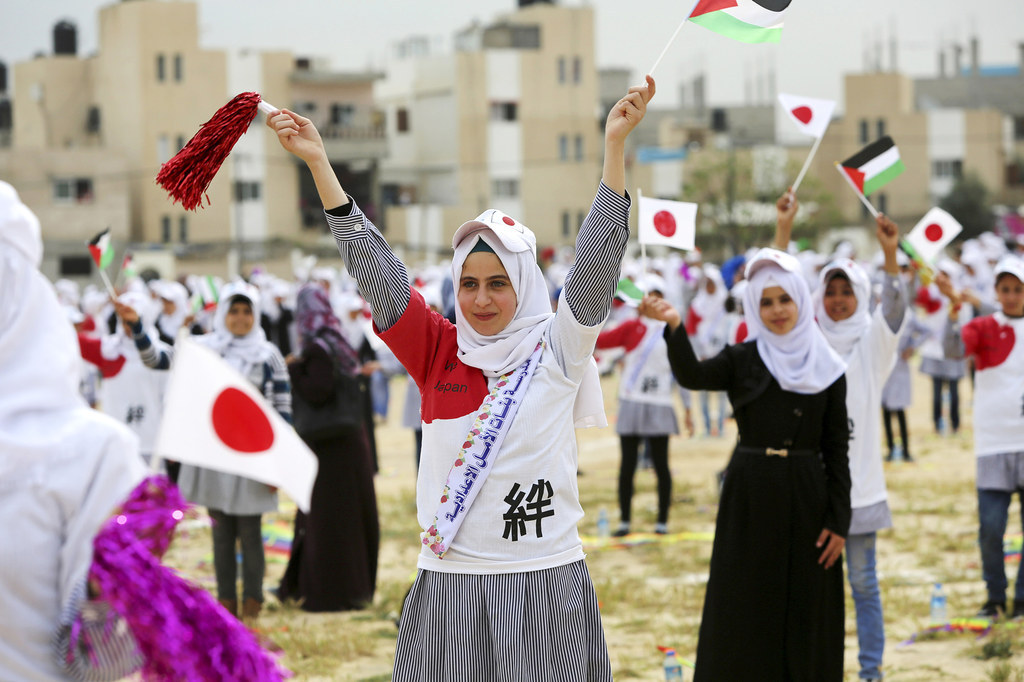 The Palestinian Center for Policy and Survey Research conducted a public opinion poll among Palestinians in the West Bank and the Gaza Strip during the period between 8 and 11 December 2021. The poll sought to assess public perception of Japan, its people, and its policies regarding the Palestinian-Israeli conflict. The period before the conduct of the poll witnessed several domestic and Palestinian-Israeli developments including the preparation for the holding of the first phase of local elections in rural areas and small towns in the West Bank. Hamas prevented the holding of the local elections in the Gaza Strip. This period witnessed also various violent incidents among students in some Palestinian universities and the death of one student. Israel classified 6 Palestinian human rights NGOs as terrorist organizations. The UK labeled Hamas as a terrorist organization. In the months leading to the conduct of the poll, Israeli-Palestinian relations witnessed some positive developments when the Palestinian president met with the Israeli defense minister to discuss confidence building measures aimed at improving daily living conditions in the West Bank and the Gaza Strip, such as family unifications, transfer of funds to the PA, and an increase in the number of laborers working in Israel.
Total size of the sample is 1270 adults interviewed face to face in 127 randomly selected locations. Margin of error is +/-3%.
For further details, contact PSR director, Dr. Khalil Shikaki, or Walid Ladadweh at tel. 02-296 4933 or email pcpsr@pcpsr.org. ..Full Report
Mr.Ala'a Lahlouh

Ala'a Lahlouh is a resarcher of the Palestinian Center for Policy and Survey Resarch Center since 2003. He finishes his Master degree in contemporary Arab Studies from Birzeit University in 2003.
Mr. Lahlouh resarch has foucused of transition of Democracy, Palestinian Political Parties, Public opinion, Public opinion. He published study of the social agenda of Hamas (PSR), 2010, Fateh position of the Peace Prosess in partnership with Hamas (PSR) 2009.
Email:Alaa Lahlouh

Ala'a Lahlouh is a resarcher of the Palestinian Center for Policy and Survey Resarch Center since 2003. He finishes his Master degree in contemporary Arab Studies from Birzeit University in 2003. Mr. Lahlouh resarch has foucused of transition of Democracy, Palestinian Political Parties, Public opinion, Public opinion. He published study of the social agenda of Hamas (PSR), 2010, Fateh position of the Peace Prosess in partnership with Hamas (PSR) 2009.
PALESTINIANS SUPPORT THE CEASEFIRE, NEGOTIATIONS, AND RECONCILIATION BETWEEN THE TWO PEOPLES BUT A MAJORITY OPPOSES ARRESTS AND BELIEVE THAT ARMED CONFRONTATIONS HAVE HELPED ACHIEVE NATIONAL RIGHTS

19-24 December 2001
These are the results of opinion poll # 3, conducted by the Palestinian Center for Policy & Survey Research, between 19-24 December 2001. The poll deals with the ceasefire, immediate return to negotiations, support for Israeli-Palestinian reconciliation, and domestic affairs. The total sample size of this poll is 1357 from Palestinians 18 years and older, of which 851 in the West Bank and 506 in the Gaza Strip. The margin of error is + 3% and the non-response rate is 3%.
MAIN RESULTS:
(1) Ceasefire and Return to Negotiations
- A majority of 60% supports an immediate and comprehensive ceasefire as declared by president Arafat, and 71% support an immediate return to negotiations
- More than half (52%) agree with what Colin Powell stated in his November 19 speech about the obligations of Israelis and Palestinians, but a clear majority of 84% still sees the US position biased in favor of Israel
- More than three quarters (76%) oppose the arrests being carried out by the Palestinian security services
- Level of (hypothetical) support for different types of armed attacks remain high: 92% for attacks against soldiers, 92% for attacks against settlers, and 58% for attacks against civilians inside Israel
- A majority of 61% believes that armed confrontations have helped achieve Palestinian national rights in ways that negotiations could not
- Only 21% expect that armed confrontations will stop and negotiations will resume soon
The main conclusion of this poll with regard to the intifada and negotiations is the shift of about 10% of the population towards more support for a comprehensive and immediate ceasefire and more support for an immediate return to negotiations compared to the situation that prevailed last July in the aftermath of the release of the Mitchell Report. This development may have been caused by four factors: the Powell statement of Novemeber 19 providing some political horizon, the increase in international pressure on Arafat and the Islamists after the Haifa-Jerusalem suicide attacks, the decline in confidence in the intifada's ability to continue to serve the national interest, and the fear of internal infighting, some of which was taking place in Jabalia in the Gaza Strip during the peioid in which the poll was being conducted.
The survey shows that 60% of the street, compared to 50% last July, supports the comprehensive and immediate ceasefire declared by Yasir Arafat in December. Moreover, 71% (compared to 63% last July) support an immediate return to negotiations. There has been a drop in the percentage of those who believe that armed confrontations have helped achieve national objectives which negotiations failed to achieve from 70% last July to 61% in this poll. The fact that such a majority continues to view armed attacks so positively does not contradict with the public support for the ceasefire. It seems to reflect street thinking that the Palestinians have more than one option in the search for their vital needs: ceasefire and negotiations is one while armed confrontation is another.
This may explain the high level of support for armed attacks against soldiers and settlers (92% for each) and the relatively high level of support for attacks against Israeli civilians inside Israel (58%). This support however remains hypothetical for now. But not for long, as most Palestinians do not expect the ceasefire to last. Only 21% expect to see continued ceasefire and return to negotiations. This may reflect the lack of trust in the intentions of the Sharon government. This may explain the high level of opposition (76%) to the arrests carried out by the Palestinian security services against Islamists and others.
The poll finds that a majority of 52% agree with the statement issued by the US Secretary of State, Colin Powell, in his November 19 speech regarding the obligations of the two sides, including the US support for a Palestinian state, end of occupation, freeze of settlement construction, implementation of the ceasefire, and putting an end to incitement against Israel. This does not mean that the street has changed its assessment of the overall American policy; 84% still view it as biased in favor of Israel.
Support for ceasefire increases among residents of the West Bank (62%) compared to residents of the Gaza Strip (56%); in cities (63%) compared to refugee camps (53%); among the old (67%) compared to the young (49%); the non-refugees (64%) compared to the refugees (54%); the illiterates (65%) compared to those who hold BA degree (58%); retired persons (75%) and professionals (83%) compared to students (40%); and supporters of Fateh (79%) compared to supporters of Hamas (36%).
(2) Palestinian-Israeli Reconciliation
- Almost three quarters (73%) would support reconciliation between the two peoples after reaching a peace agreement leading to the establishment of a Palestinian state recognized by Israel
- An overwhelming majority of 85% would in that case support open borders between the two states
- 66 % would support joint Palestinian-Israeli economic institutions and ventures
- 29% would support joint political institutions leading to an Israeli-Palestinian confederation
- 36% would support taking legal measures against incitement in the state of Palestine
- But only 6% would support adopting school curriculum that recognizes Israel and teaches children not to demand return of all Palestine to Palestinians
- Br>
- 37% would invite an Israeli colleague to visit at home and 35% would visit an Israeli colleague at his home
- 46% believe that reconciliation is possible, and 41% believe that it is not possible
- 28% believe that a lasting peace is possible, and 20% believe that a majority of Israelis believes that it is possible
Respondents were asked for the third time since July 2000 to express support or opposition, and to speculate about the chances, for reconciliation between the two peoples in the aftermath of a successful conclusion of negotiations that would lead to the establishment of a Palestinian state recognized by Israel. The results show a consistent and overwhelming support for reconciliation but a split in confidence regarding its feasibility. They also show that the Palestinian overwhelming support for reconciliation is based on cold calculations of interests and needs rather than friendship, forgiveness, or tolerance. Moreover, a majority of Palestinians does not believe that a lasting peace is possible between Israelis and Palestinians; a larger majority thinks that most Israelis think similarly.
In the context of an agreement leading to a two-state solution, a majority of 73% would support or strongly support the process of reconciliation, just as it was last July. But only 46% believe that reconciliation is possible, and 41% believe that it "is not possible ever." When asked to speculate about the views of the majority of Israelis regarding the prospects for reconciliation, 54% expressed the belief that they think that reconciliation "is not possible ever."
An overwhelming majority (85%) of the Palestinians support or strongly support open borders to free movement of people and goods in the context of a peace agreement. Similarly, a majority of 66% supports the creation of joint economic institutions and ventures. However, even in the context of a peace agreement, a majority of Palestinians opposes, or strongly opposes, other forms of cooperation and reconciliation. For example, only 29% support the "creation of joint political institutions, such as a parliament, designed eventually to lead to a confederate system;" 36% support "taking legal measures against incitagainst Israel;" 6% suppadopting "school curriculum in the Palestinian state that would recognize Israel and teach school children not to demand return of all Palestine to the Palestinians;" 37% would invite an Israeli colleague to home for a visit; and 35% would accept an invitation to the home of an Israeli colleague. Moreover, only 28% believe that a lasting peace between Israelis and Palestinians is possible.
Support for reconciliation increases among the old (81%) compared to the young (59%); the illiterates (85%) compared to those holding BA degree (69%); professionals (88%) compared to students (54%); and supporters of Fateh (80%) compared to supporters of Hamas (64%).
(3) Terrorism
- Only 36% support the position taken by Arafat toward the American campaign against terror; indeed 94% oppose the US campaign against Ben Laden and his group, with only 16% believing that Ben Laden is responsible for the attacks on the World Trade Center
- 37% believe that there are circumstances under which the use of terrorism to achieve political goals would be justified
- Only 33% support a UN international initiative to fight terrorism
- An overwhelming majority, ranging between 91%-98%, views all Israeli violent acts against Palestinians as acts of terror. Yet a majority, ranging between 52%-67%, believes that the international community does not view these events as acts of terrorism.
- An overwhelming majority, ranging between 81%-87%, does not view Palestinian violent acts against Israelis as acts of terrorism. Yet an overwhelming majority, ranging between 88%-92%, believes that the international community does view these acts as acts of terrorism.
- 41% view the attack on the Twin Towers in New York on 11 September as acts of terrorism; 46% view as terrorism the bombing of a Pan Am plan over Lockerbie, Scotland; and 63% view the distribution of Anthrax envelopes in the US as an act of terrorism.
- While 94% would view as an act of terrorism a future use by Israel of chemical and biological weapons against Palestinians, only 26% would view the same act as terrorism if carried out by Palestinians against Israelis
- 45% of the Palestinians are concerned about a possible Israeli use of chemical and biological weapons
- Br>
- 43% believe that the 11 September Twin Towers attacks would delay a Palestinian-Israeli agreement while only 18% believe that it would speed up the process of reaching an agreement
The findings show that Arafat's position toward the US campaign against terror is supported by only 36%. Indeed, the overwhelming majority of Palestinians (94%) is opposed to the American campaign against Ben Laden. The reason for this opposition seems to lie in the finding showing that only 16% believe that Ben Laden was behind the Twin Towers attack of 11 September.
An overwhelming majority, ranging between 91%-98%, views the following Israeli violent acts against Palestinians as acts of terror: the Goldestein massacre of 29 Palestinians in 1994, the assassination of the leader of the PFLP, Abu Ali Mustafa, by Israel, the killing of 13 Israeli Arabs by the Israeli police in the intifada, and the Israeli incursions into area "A" of the Palestinian Authority. Yet, surprisingly, a majority, ranging between 52%-67%, believes that the international community does not view these events as acts of terrorism. This may indicate a growing Palestinian suspicion of the motivation of the international community.
An overwhelming majority, ranging between 81%-87%, does NOT view the following Palestinian violent acts as acts of terrorism: the assassination of the Israeli Minister Ze'evi by armed PFLP men, the shooting at Gilo in Jerusalem by armed Palestinians, the killing of 21 Israeli youths at the Dolphinarium club in Tel Aviv by a Palestinian suicide bomber, and the killing of 3 Israelis in Nahari in Israel at the hands of an Israeli Arab suicide bomber. Yet, an overwhelming majority, ranging between 88%-92%, believes that the international community does view these events as terrorism
Despite the fact that the overwhelming majority (ranging between 81%-87%) does not view Palestinian attacks against Israeli civilians or politicians as terrorism, 37% does agree that there are circumstances under which use of terrorism to achieve political goals would be justified. It is noticeable that while the majority of Palestinians does not agree that Palestinian attacks on Israelis are terrorist acts, an even larger majority (91%-98%) does agree that Israeli attacks on Palestinians are acts of terror. For example, while 98% view the 1994 Baruch Goldstein massacre against Palestinians as terrorism, 82% does not agree that the killing of 21 Israeli youths by a Palestinians in a Tel Aviv night club was an act of terror.
But the Palestinian position is split on events not linked to the Palestinian-Israeli conflict. The findings show that 41% does view the attack on the Twin Towers on 11 September as an act of terrorism. Similarly, 46% agree that the bombing of the Pan Am jet over Lockerbie in Scotland was an act of terror. A majority of 62% agrees that the distribution of Anthrax envelopes in the US is an act of terror.
It is obvious that the Palestinian perception of terror focuses on the aims of the perpetrators rather than their methods. In this case, any violent act aimed at ending Israeli occupation, regardless of the means, is not likely to be viewed as terror, while all violent acts of the Israeli occupier are seen as acts of terror. For example, while 94% would view an Israeli use of chemical and biological weapons against Palestinians as an act of terror, only 26% would view the same exact attack as an act of terror if it was carried out by Palestinians against Israelis. The findings indicate that 45% of the Palestinians are indeed concerned about a possible Israeli use of such weapons.
Finally, the poll finds that more people (43%) tend to believe that the September 11 attacks will delay a peace agreement between Palestinians and Israelis than those (18%) who believe that the attacks will speed up the peace process.
Support for Arafat position toward the American campaign against terror increases among holders of BA degree (41%) compared to the illiterates (33%), professionals (50%) compared to students (32%); those who do not observe any religious rules and traditions (67%) compared to those who do observe all religious rules and traditions (30%); those with the highest income level (44%) compared to those with the lowest income level (34%); and supporters of Fateh (52%) compared to supporters of Hamas (20%).
(4) Arafat's Popularity, Political Affiliation, Corruption and Democracy
- Arafat's popularity reaches 36% compared to 33% last July and 46% in July 2000
- The most popular Palestinians after Arafat are: Ahmad Yasin (14%), followed by Marwan Barghouti (11%), Haidar Abdul Shafi (11%), Sa'eb Erikat (9%), and Hanan Ashrawi (9%)
- Support for Fateh reaches 28% compared to 29% last July and 37% in July 2000
- Support for the Islamists reaches 25% compared to 27% last July and 17% in July 2000
- 74% believe that corruption exists in PA institutions, and 60% believe that it will increase or remain the same in the future
- Positive evaluation of Palestinian democracy stands at 23% and 49% believe that people can not criticize the PA without fear
- Only 17% would support a political system "as in Iran" for the future Palestinian state. 42% said they would prefer a system "as in other Arab countries, like in Egypt, Jordan, and Syria; and 19% said they would prefer a system "as in the US, Europe and Israel."
Arafat's popularity increased from 33% in our last poll in July 2001 to 36% in this poll. Arafat did not lose support over the ceasefire decision and the subsequent arrest of Islamists and other militants. Arafat may have gained some sympathy during the past few weeks in response to Sharon decision to prevent him from visiting Bethlehem during Christmas. The public may be responding negatively to Sharon's attempts to delegitimize the Palestinian president. It is also possible that the trend of continued decline in Arafat's popularity may have finally ended. His popularity on July 2000 stat 46% compato 71% in January 1996.
Support for Fateh remained essentially unchanged at 28%, while the popularity of the Islamist groups dropped slightly from 27% last July to 25% in this poll. This indicates that the continued decline in support for Fateh may have also stopped. Fateh's popularity stood at 55% in January 1996. The rise in support for the Islamists may have also stopped. In July 2001, the popularity of Hamas, Islamic Jihad and other Islamists reached 27% compared to 17% in July 2000. In this poll, the Islamists received the support of 25% of the Palestinians. Some Palestinians may be blaming the Islamists for the loss of international support in the aftermath of the suicide attacks in Haifa and Jerusalem three weeks before the poll was taken. Others may be blaming the Islamists for the bloodshed in Jabalia in the Gaza Strip which resulted form internal infighting during the period of the in which the poll was conducted.
The findings indicate that well-known Palestinian figures, like Mahmud Abbas (Abu Mazin) and Ahmad Quari (Abu Ala'), may have lost much of their popularity dropping to less than 2% for each. But the rising figure seems to be Fateh leader Marwan Barghouti, who received the support of 11%. His name did not show up at all before the start of the intifada in September 2000. Hamas leader Ahmad Yasin received the support of 14%, Haidar Abdul Shafi 11%, Saeb Erikat 9%, compared to 7% last July, and Hanan Ashrawi 9%, compared to 1% last July. The increase in Ashrawi's popularity may have been the result of her appointment as the spokesperson of the Arab League and the resulting media exposure. It should be noticed that while in the last survey respondents were not given a list of name to chose from, this time a list was presented. The list was compiled based on the responses to the same questions last July.
The results indicate a persistent negative public perception of governance in Palestine despite a drop in the perception of PA corruption from 83% in the last poll to 74% in this one. An increase occurred in the percentage of those who believe that corruption will increase or remain the same in the future, from 57% to 60% during the same period. Positive evaluation of Palestinian democracy remains low, at 23%, while the percentage of those who believe that people cannot criticize the PA without fear decreased from 51% in July 2001 to 49% in this poll.
Finally, after making a slight change in the question related to preferences for a future Palestinian political system, the results changed dramatically. In our last survey we asked respondents to tell us which political system they would prefer for Palestine after the establishment of the state. At that time, one of the answers, "an Islamic system as in Iran," received the support of 46%. In this poll, the same answer, after dropping the adjective "an Islamic system" to read "as in Iran" received only 17%.
SPSS Data File:

Palestinians Give Less Support For Bombings Inside Israel While Two Thirds Support The Saudi Plan And 91% Support Reforming The Pa, But A Majority Opposes Arrests And Opposes The Agreements That Led To Ending The Siege On Arafat's Headquarter, Nativity Church, And Preventive Security Headquarter
15-18 May 2002
These are the results of opinion poll # 4, conducted by the Palestinian Center for Policy and Survey Research (PSR) between 15-18 May 2002. The poll deals with public attitudes toward the peace process and reconciliation, armed confrontations, evaluation of PA performance, calls for political reform, and popularity of Arafat, Fateh, and Islamist groups. The total sample size of this poll is 1317 from Palestinians 18 years and older, interviewed face-to-face in 120 locations in the West Bank (810) and the Gaza Strip (507). The margin of error is 3%.
MAIN RESULTS:
The results of this poll indicate that while the latest Israeli incursion into the West Bank left little impact on Palestinian public attitudes regarding peace and violence, it did have a significant impact on attitudes regarding domestic affairs. The incursion exposed to full view the faults of the Palestinian Authority (PA) leading the street to demand fundamental reforms. As a result, the issue of internal political reform became an important issue by itself; indeed, from this moment on, it can go hand in hand with that other most important issue, ending occupation. This is the most important finding of this poll.
1. Peace Process and Reconciliation
- Two-thirds support the Saudi initiative (defined as two states, 1967 borders, full normalization and peace)
- 70% support reconciliation between the two peoples after peace and statehood
- 54% support Palestinian participation in the peace conference called for by the US
- But only 17% expect to see a quick end to armed confrontations and return to negotiations
The results of the poll show a high level of support for the Saudi initiative even when the issue of refugees is omitted. Two-thirds of the respondents supported the initiative that has been defined as meaning: (1) the establishment of two states, Palestine and Israel, (2) Israeli withdrawal to the 1967 borders, and (3) full normalization and peace between Israel and the Arab states. This dovish attitude is confirmed by the high level of readiness to embrace reconciliation (70%) between the two peoples in the context of a peace agreement and the establishment of a state recognized by Israel. It is also confirmed by the willingness to support (54%) participation of the Palestinian side in the peace conference that has been called for by the US. It is important to note the reference in the question to the US role in holding the conference, which may have led some to oppose it.
Despite these positive peace-related signals, the public remains pessimistic. Only 17% expect negotiations to resume soon enough and armed confrontations to stop. An additional 39% do expect that negotiations will resume but expect to see some armed attacks continuing, while 36% expect that armed confrontations will not stop and the two sides will not return to the negotiations table. These expectations are not different from those found in our two previous polls in December and July 2001.
Support for the Saudi initiative increases in the Gaza Strip (70%) compared to the West Bank (64%), in the Ramallah region (70%) compared to Nablus (61%), Hebron (62%) and Jerusalem (54%), among women (70%) compared to men (62%), among the young (61%) compared to the old (74%), among the illiterates (79%) compared to holders of BA degree (51%), among students (57%) compared to housewives (72%) and retired persons (90%), and among supporters of Fateh (77%) compared to supporters of Hamas (56%). The high level of support for the Saudi initiative among Fateh supporters indicates that the Palestinian national movement remains solidly behind a two-state solution for the Palestinian-Israeli conflict despite 19 months of violence.
2. Armed Confrontations
- Support for bombings inside Israel drops to 52%, but support for armed attacks against soldiers and settlers remain very high (92% and 89% respectively).
- 86% oppose the arrest of those who carry out bombing attacks inside Israel
- 67% believe that armed confrontations have helped achieve Palestinian national rights in ways that negotiations could not
The results show a reduction in the level of support for bombings against Israeli civilians inside Israel from 58% last December to 52% in this poll. This reduction does not seem to be the outcome of street dissatisfaction with the intifada or military confrontations. To the contrary, the street seems more confident in this poll, compared to the one in December, that armed confrontations have helped achieve Palestinian national objectives in ways that negotiations could not, with the percentage rising from 61% to 67%. The results also show a wide-spread opposition to the arrests of those who carry out bombing attacks reaching 86%, compared to 76% last December. The percentage of support for armed attacks against Israeli soldiers and settlers inside the West Bank and the Gaza Strip remained as high as it was last December, 92% and 89% respectively.
Support for bombing attacks inside Israel increases in the Gaza Strip (59%) compared to the West Bank (47%), in Tulkarm (60%) compared to Jerusalem (35%), in refugee camps (65%) compared to cities and villages (50%), among the young (61%) compared to the old (43%), among refugees (58%) compared to non-refugees (47%), among holders of BA degree (57%) compared to illiterates (47%), among students (66%) compared to retired persons (25%), among those with the lowest income (55%) compared to those with highest income (28%), and among supporters of Hamas (70%) compared to supporters of Fateh (47%).
3. Evaluation of PA Performance, and the Calls for Reform
- 39% give positive evaluation to the performance of the Palestinian leadership during the latest Israeli incursion
- 65% oppose the agreement to end the siege on the Preventive Security headquarter, 58% oppose the deal on the Nativity Church, and 49% oppose the Muqata'a deal in Ramallah
- 83% believe there is corruption in PA institutions
- 21% give positive evaluation to Palestinian democracy
- 91% support fundamental reforms in the PA, 85% support unification of security services, 95% support the dismissal of ministers accused of mismanagement or corruption, 83% support the holding of elections, and 92% support the adoption of a basic law or constitution
- 48% support and 44% oppose changing the Palestinian political system so that power would reside into the hands of a prime minister making the office of the president ceremonial
- 89% support a democratic system of government
The results show a high level of disappointment with the performance of the PA during the latest Israeli incursion into the West Bank. Moreover, there is a broad disappointment with the perceived corruption in PA institutions and with the status of democracy in Palestine. For example, positive evaluation of the performance of the PA leadership during the Israeli incursion did not exceed 39%, while the performance of the security services received 40% positive rating, and the ministries received 32% positive rating. On the other hand, civil society organization received a much higher positive rating of 72%.
The poll also shows strong opposition to deals made to end the siege on the Preventive Security headquarter in Beitunia (65%), the Nativity Church in Bethlehem (58%), and the Muqata'a (Arafat's headquarter) in Ramallah (49%). The percentage of those who believe there is corruption in PA institutions reached 83%, and the positive evaluation of the status of democracy in Palestine did not exc21%.
This negative assessment of the PA led to an overwhelming demand for reform as indicated by the findings of this pol. The level of support for the internal and external calls for reform stands at 91%. Specifically, a majority of 85% support the calls for the unification of the security services under one command; 95% support the dismissal of ministers accused of mismanagement or corruption; 83% support the holding of general elections for the president and the Legislative Council in the next few months; and, 92% support the adoption of a basic law or constitution. But only 48% support and 44% oppose the call for changing the political system so that power would reside in the hands of a prime minister while the office of the president would become ceremonial.
The poll shows an overwhelming support (89%) for a democratic system of government characterized by the following five main features: periodic political elections (receiving 95% support when standing alone), the election of the head of the state for a limited period only (82% alone), full freedom to form political parties (80% alone), free press with no state censorship (82% alone), and a judiciary independent of the executive (78% alone).
The results indicate that support for changing the Palestinian system of government, so that power would reside into the hands of a prime minister and the position of the president would become ceremonial, increases in the West Bank (51%) compared to the Gaza Strip (43%), in Hebron (60%) and Jerusalem (53%) compared to Ramallah (39%), among men (56%) compared to women (41%), and among non-refugees (53%) compared to refugees (42%). This is the first time that this question has been asked and therefore the results can not be compared to pervious periods.
4. Popularity of Arafat, Fateh, and the Islamists
- 35% would elect Arafat as a president compared to 36% last July and 46% in July 2000
- 19% give support to Marwan Barghouti, 13% to Ahmad Yasin, and 10% to Haidar Abdul Shafi and Sa'eb Erikat
- Fateh has the support of 32% of the street compared to 28% last December and 37% in July 2000
- The Islamist groups have the support of 25%, the same as in December, but compared to 17% in July 2000
The poll shows that Arafat's popularity has remained almost unchanged since December standing at 35%. This represents a significant drop compared to Arafat's popularity before the eruption of the intifada, where it stood at 46% in July 2000. But the popularity of Marwan Barghouti, a member of the Palestinian Legislative Council and Fateh Secretary General currently in an Israeli jail, almost doubled from 11% in December to 19% in this poll. Barghouti's name has never showed up in our surveys prior to the start of the second Palestinian intifada in September 2000. In a third place came Ahmad Yasin of Hamas with 13%, followed by Haidar Abdul Shafi and Sa'eb Erikat (10% each), Farouq Qaddoumi (8%), Hanan Ashrawai (6%), Ahamd Qurai' (2%), and Mahmud Abbas (1%).
Fateh improved its position from 28% in December to 32% in this poll while that of the Islamist groups remained unchanged at 25%. Of the Islamists, Hamas is the strongest, with 16%, followed by independent Islamists (5%) and Islamic Jihad (4%). One possible reason for the rise in the popularity of Fateh may have been the public satisfaction with attacks carried out by Fateh's armed wing, al Aqsa Brigades, inside Israel and against Israeli check points in the West Bank since December.
SPSS Data File:
 October 2021
On “Shrinking the Conflict,” Abbas’ UN Speech, and the PA’s Ability to Adjust to the Status Quo
Khalil Shikaki
The September 2021 UN speech of Mahmoud Abbas, president of the Palestinian Authority (PA), and the careful language it used, indicate that he appreciates the severity of the crisis in which that leadership finds itself today and the limited options it has. For one, it seems almost certain that the current domestic conditions will continue to deteriorate given the dim prospects for holding elections, reaching a reconciliation deal, or bringing about significant economic growth. Similarly, Palestinian-Israeli stalemate will most likely persist for some time to come even after the handover of the premiership from Naftali Bennett to Yair Lapid. It is almost certain that the current Israeli governmental coalition, or any one that is likely to come after it in the near future, will not be able to enter into a serious negotiating process with the PA. Thirdly, the international community, including the U.S., seems to lack the vision and the political will to go beyond the current goal of managing the conflict, to prevent an explosion or a dramatic change in the current Palestinian-Israeli relations. A glance at the regional landscape points to the dismal setting of PA alignment; indeed, the collapsed Arab consensus on the Palestinian question provides the evidence, if any is needed, of the constrained environment in which the Palestinian leadership operates.
Does this pessimistic assessment allow the PA, in its search for political alternatives, to reach beyond the goal of maintaining the status quo? If the answer is positive, what are these alternatives? For example, can the concept of the so-called “shrinking the conflict,” an approach advocated by some of the leaders of the current Israeli coalition, provide a working framework for organizing Palestinian-Israeli relations in the short run despite the freeze in the political process? This brief explores the current Palestinian policy, especially as outlined by president Abbas in his 2021 UN speech. It concludes that while options do indeed exist, it is unlikely that the PA will be able to capitalize on any of them given the decisions already made by its leadership during the last few years, and particularly those made during the past six months. At best, it can aspire to maintain the status quo during the next year or two. But it also concludes that it would be dangerous for the PA and the international community to be drawn into the Israeli right-wing approach of “shrinking the conflict” given the likely destructive impact it could have on the future viability of the two-state solution.
Abbas’ declared policy:
In his 2021 UN speech Abbas asserted his conviction that the “policies of the international community and the UN organizations have so far all failed” in resolving the conflict or forcing Israel to abide by international law. Yet, in an obvious contradiction with this assertion, which is fully endorsed by an internal Palestinian consensus, the president stated that he intends to seek support from the International Court of Justice (ICJ) “to issue a decision on the legality of the occupation of the territories of the state of Palestine and the responsibilities of the UN and its member states in this regard.” He further added his belief that “all sides must abide by the resolution that will be issued by the ICJ because colonization and apartheid are banned by international law and they are crimes that must be confronted and dismantled.”[1] It is certain that the president fully understands the contradiction in his declared policy. This contradiction fades if we realize that the actual policy of the PA is not to rely on the international community and the UN to end the Israeli occupation and that it only seeks their support in managing the conflict and preventing further deterioration in the status quo.
The president and the rest of the PA’s political elite, no doubt realize that the best they can expect from ICJ is a moral victory, one that can be added to the one that was achieved back in 2004 when the court issued its advisory opinion regarding the separation wall or barrier. At that time, the court asserted that “Israel must put an immediate end to the violation of its international obligations by ceasing the works of construction of the wall and dismantling those parts of that structure situated within Occupied Palestinian Territory” and, most importantly, added that the Fourth Geneva Convention is “applicable in those Palestinian territories which, before the armed conflict of 1967, lay to the east of the 1949 Armistice demarcation line (or “Green Line”) and were occupied by Israel during that conflict.”[2] Israel did not stop the construction of the wall and continued to ignore its obligations under that convention. The PA’s complaint to the same court against the U.S. regarding its decision to relocate its embassy to Jerusalem, which was submitted in September 2018, has not yet been addressed more than three years later. Other international organizations, such as the International Criminal Court (ICC), have been looking into other Palestinian complaints, all of which contribute to the PA’s efforts to wage a diplomatic campaign against Israel. One should not however measure PA success in these efforts by criteria other than protecting the status quo. It cannot force Israel to end its occupation, halt settlement activities, or even stop demolition of Palestinian homes. It cannot force Israel to sit down at the negotiating table.
In his UN speech, president Abbas returned to a topic he addressed many times before during the past decade, asking Israel to choose between the two-state and the one-state solutions. But this time, he did not threaten to abandon the two-state solution; to the contrary, he reiterated his commitment to that solution. In the meanwhile, playing the role of a political analyst to convey his message to Israel, he described the current conditions as “the embodiment of a one apartheid state” and that “our people and the entire world will not accept that outcome and the data and developments on the ground will impose full and equal rights to all in the historic land of Palestine in a single state.” The president realizes that political analysis is no substitute for policy and that a continued adoption of the two-state solution by the Palestinian side, at a time in which he himself asserts that it has no future, is essentially an abandonment of his leadership role in policy making. The PA cannot continue to promote the two-state solution unless it sees in the one-state solution a threat to its vital interests. But the president’s analysis indicated the opposite and presented a one-state with equal rights as a vital Palestinian interest just as the two-state solution. It is clear that the aim of the president’s public statement is to maintain the status quo, to remain committed to the two-state solution, despite its lack of viability, while simultaneously threatening an adoption of the one-state solution; in other words, a continuation of the diplomatic offensive against Israel in the hope of slowing down the process of the one-state reality.
Finally, the president hinted that he might change PLO’s Israel’s recognition formula by wondering: “why should the recognition of Israel remain in place on the basis of the 1967 boundaries?” Earlier in his speech, the president pointed to the possibility of a Palestinian return “to a solution based on the Partition Resolution number 181 for the year 1947, one that gives the Palestinian state 44% of the land, which is twice the size of the land based on the 1967 boundaries.” Nothing in this formula indicates a threat to withdraw the PLO recognition of the state of Israel contained in the 1993 PLO-Israel exchanged letters of mutual recognition. If the president does officially inform Israel of his decision to revise the recognition letter, so that it would be restricted to Israel’s partition resolution boundaries, unlikely as that might be, he would be escalating the diplomatic campaign, but it would not affect the current relations between the two sides including the ongoing security and civil coordination.
“Shrinking the conflict:” the policy of the current Israeli coalition
The current Israeli policy towards the Palestinians indicates a continuation of the previous right-wing policy with small adjustments. The policy is comprised of three elements that form what seems to be the maximum understandings binding the current ruling coalition. They address the position on the two-state solution and the political process or negotiations, the modalities of progress in the settlement enterprise, and the search for confidence building measures. In the Gaza Strip, there does not seem to be any significant differences with the policy of the former prime minister Benjamin Netanyahu which sought to keep the siege the blockade in place, promote a continued split between the West Bank and the Gaza Strip, and ensuring a situation in which Hamas poses no real military threat to Israel but without threatening a humanitarian disaster or the collapse of the Hamas role or its ability to keep security and civil conditions under control.
Under U.S. pressure, Netanyahu, in his Bar Ilan University speech in 2009, declared verbally his acceptance of the two-state solution. The current prime minister publicly rejects that solution and reiterates continuously to his base and right-wing allies that he is more hardline line than Netanyahu. Similarly, despite the fact that the former government entered, between 2013 and 2014, into substantive negotiations with Abbas in a U.S. sponsored process, the current government refuses to sit down to a negotiating table with the Palestinians.
On settlements, the current ruling coalition seems able to proceed, albeit slowly, on a number of highly visible and charged settlement projects that are capable when completed to erase any prospects for a negotiated outcome on the basis of a two-state solution. For example, the Israeli Civil Administration started early this month to hear objections to planned construction in the area designated E-1, located between occupied East Jerusalem and Jericho, a critical phase among the last steps in the planning process before issuing final approval and invite tenders.[3] When established, this settlement divides the West Bank into two isolated parts, south and north, and isolates East Jerusalem from the West Bank, and makes it impossible for East Jerusalem to become the capital of the Palestinian state.
Similarly, during the past two months Israel started preparation for the planning phase of a large settlement to the north of East Jerusalem containing nine thousand housing units to be located in what is currently the Qalandia airport, between Ramallah and East Jerusalem.[4] Moreover, in mid-October, an Israeli committee approved plans to advance the building of thousands of housing units in Givat Hamatos settlement, a settlement designed to isolate East Jerusalem from Beth Lehem in the south, as it will be built on lands confiscated from Sharafat and Beit Safafa. Back in November 2020, the Israeli government gave the green light to issue tenders to begin construction in that area.[5]
Inside occupied East Jerusalem, plans have been advanced to build a new settlement dubbed the “Silicon Valley,” which will be build over an area extending 250 thousand square meters in the heart of Wadi al Joz. The settlement, intended to be a high tech park, leads to demolishing some 200 East Jerusalem establishments owned by Palestinian residents who have already received eviction orders back in mid-2020.[6] Similarly, Palestinian home owners in al Shaikh Jarrah are still threatened with eviction as their case is still under examination in Israeli courts without a final resolution while awaiting a compromise deal, proposed by the court, to allow the Palestinian residents to stay in an agreement with Israeli settlers but only if the home owners admit that they are not the rightful owners of the homes. Finally, the decision by an Israeli court early this month to allow “silent prayer” of Israeli Jews at al Haram al Sharif indicates an unprecedented and critical change in Palestinian-Israeli relations in this holy place since East Jerusalem was occupied in 1967. The Jerusalem district court that reversed that decision two days after the first decision was issued does not mitigate the gradual damage done to the “status quo” in the holy places by this and many other measures in recent years. The “status quo” arrangement has helped to maintain a fragile stability in Palestinian-Jewish relations in that location sensitive to both Jews and Muslims, without which the holy places could become once again the spark for the next explosion.[7]
Finally, while it was not feasible for Palestinians and Israelis during the past decade to explore means of addressing Israeli-imposed measures that negatively affect socio, economic, and daily life conditions of Palestinians, the current Israeli prime minister announced that Israel and the PA have a joint interest in improving living conditions of the Palestinians. Israeli defense minister Benny Gantz met with the Palestinian president in August in order to offer confidence building measures that aim at strengthening the Palestinian economy, as the minister announced[8], and begin to resolve thousands of cases of Palestinian family members who have been denied valid identity cards or passports, and provide the PA with access to about half a billion Shekels of advanced Palestinian custom clearance funds. Progress has also been reported on a formula that would allow Palestinian telecommunication companies access to 4-G technology, increasing the number of laborers allowed to work in Israel, and granting building permits for a number of units in area C. These measures seem to stem from a conceptual framework labeled “shrinking the conflict,”[9] one that Israel sees as an alternative to conflict resolution based on ending the occupation and building permanent peace based on the two-state solution. The Israeli prime minster described this vision of managing the conflict with the Palestinians during his first visit to the U.S. and his meeting with the U.S. president in August, as the U.S. was attempting to explore possible measures to revive political dialogue between Palestinians and Israelis.[10]
A new equation
A new equation emerges from the discussion so far: a temporary Palestinian interest in maintaining the status quo confronted by a more hardline Israeli government lacking any serious interest in reviving the political process but showing greater openness to engage in confidence building measures. It is clear that the Israeli policy is not satisfactory to the PA or the international community, but no one is questioning the shrinking of the conflict. Rather, the opposition to the idea is centered on the making it a substitute to a viable political process. Since the U.S. and most players in the international community share the view that the prevailing conditions are not ripe for a resumption of negotiations, there is no real resistance to the Israeli policy. The U.S. has positively viewed the Israeli confidence building measures and encouraged the two sides to engage in further mutual steps in the same direction. Similarly, the Palestinian side too has shown interest in the Israeli measures seeing them helpful in shoring up support for the weak PA. In fact, a majority of the Palestinian public itself (56%) expressed support for the such measures that aim at improving daily living conditions in the West Bank and the Gaza Strip, including such steps as family unifications or providing the PA with additional financial resources; only 35% expressed viewed them negatively.[11]
Can the Palestinian realization that maintaining the status quo is the best that can be expected and the Israeli willingness to engage in policies consistent with “shrinking the conflict” create a less volatile Palestinian-Israeli relation, one in which the next year or two see more stability compared to that of the last two years? What would the cost of such a short-term stability be for the longer run?
The answer to the short-term question is not necessarily negative despite the clear obstacles. Palestinian domestic push and pull and those necessitated by the Israeli coalition needs might produce a short-term stability. For example, on the one hand, the heightened competition between the Fatah-controlled PA and Hamas is a clear source of tension and polarization in Palestinian politics and society, especially in the aftermath of the fourth Hamas-Israel war of May 2021. PA weakness and lack of electoral legitimacy provide it with the incentive to strive to compensate for its failures by winning points against Hamas, either by delivering on some of the public needs, even if that comes as crumbs from the Israeli side, or by waging a widespread diplomatic campaign against Israel. Most likely the PA will find itself forced to pursue both channels simultaneously: diplomatic warfare and confidence building measures. This outcome will most likely be the product of the two other elements of the Israeli policy, the rejection of negotiations and the two-state solution and the pursuant of the most devastating settlement projects that can, if implemented, decide once and for all the destiny of the two-state solution.
Unfortunately, given its current policies, the PA will not be able to articulate an effective means of challenging the status quo. For example, if it wanted to capitalize on the “shrinking the conflict” approach by exploiting the process of Arab normalization with Israel to broaden and consolidate the confidence building measures, it will not have the capacity or the political will to use that process to push forward its own plans. These plans could encompass the strengthen of PA presence in East Jerusalem, or investing in area C, or even persuading the Israeli government to abandon or slow down its current settlement offensive. But the cost is too high. Any PA readiness to deal positively with Arab normalization will open a flood gate of normalization, with Saudi Arabia among the first to enter. Such a development could engender further dynamics of Palestinian marginalization and increase PA domestic isolation by widening the current gap with the Palestinian public and provide Hamas with a greater opportunity to affirm its leadership of the Palestinian people as an alternative to the national movement.
By contrast, if the PA wanted to strengthen its diplomatic confrontation with Israel by adding more effective non-violent means of resistance, for example, by channeling public anger and frustration toward massive civilian participation in that resistance, it will find itself unable to do so due to the current distrust expressed by the public toward the PA. On top of that, the PA security establishment will probably see such massive civilian participation a prelude to the “militarization” of the resistance and a threat to its current control over the street; indeed, it might fear that such popular mobilization and participation might get out of control and turn against the PA itself.
On the Israeli side, the right-wing government will be under great pressure to respond firmly against any important hostile PA diplomatic measures. Abbas’ UN speech has already given Israel a full year without embarking on such measures. Yet even if he embarks on such measures now, the Israeli leadership will probably understand the pressure he is under. To appease the right wing base, Israel’s response might focus on speeding up the settlement construction process rather than halting the implementation of the confidence building measures. On the other hand, if Abbas sought to capitalize on the normalization process, unlikely as it might seem, Israel might find itself having to deal positively with such PA initiatives or risk having to explain to the Arab normalizers why their willingness to abandon Arab consensus is not being reciprocated.
Conclusion: shrinking or expanding the conflict?
Needless to say, the only means of shrinking the conflict is by shrinking the occupation and the settlement enterprise. But the Israeli government’s understanding of the approach can only produce the opposite outcome. Major settlement plans will advance and along with them the consolidation and deepening of the occupation. Would the PA, given its interest in self-preservation, be content with modest diplomatic measures while engaging in confidence building measures in which it accepts what crumbs the Israeli government, given its interest in maintaining the cohesion of its parliamentary coalition, might be willing to offer?
This might indeed be the short-term policy of the PA. Given its inability to formulate a unified Palestinian position without reconciliation, elections, or deep reforms in its political system, the PA will be seen by all concerned as weak and incapable of taking the initiative or even responding to one. It will not earn international respect. Under these conditions, none of the major international players will use leverage against Israel to initiate a process capable of containing the current Israeli settlement activities, accept the two-state solution, or enter into a political process for a permanent settlement. The capitulation of the PA and the international community to the resilient status quo will inevitably bring Palestinian-Israeli relations to a point of no return, one in which all sides come to the conclusion that the two-state solution is no longer viable.
This is an inescapable conclusion. The belief that the PA, that has already tied its own hands by the decisions it has previously taken, remains capable of developing more effective options is wishful thinking. Similarly, the belief that the Palestinian public cannot be forced to swallow this outcome without resistance is a miscalculation. The public is leaderless and none of its movements and political parties are capable or willing, under current conditions, to forge ahead, influence the Palestinian masses, and earn its trust to the point at which it can provide a viable alternative path to that offered by the current Palestinian leadership. This conclusion applies to those who are capable, such as Hamas and the forces that support Marwan Barghouti, and those who are not, such as the leftist forces, the newly created electoral lists, or supporters of Mohammad Dahlan.
Finally, the international community will not move in any substantive manner if it believes the prospects of success are limited. But it might be willing to move in response to a new explosion in Palestinian-Israeli relations, an unexpected development at this time if it was not for Hamas’ propensity to take high risks that allows it to accumulate greater gains at the expense of the PA. Similarly, in the absence of a stronger and unified PA, one that enjoys electoral legitimacy and the trust of its people, accountable public institutions, and vibrant pluralistic civil society and free press, all currently lacking, the international community will have little incentives to take a stronger stand against the current Israeli policy.
[1] For more information on Abbas’ speech, see: Ali Sawafta and Zainah El-haroun, “Abbas tells U.N. Israeli actions could lead to 'one state',” Reuters, September 24, 2021: https://www.reuters.com/world/middle-east/abbas-tells-un-israeli-actions-could-lead-one-state-2021-09-24/
[2] Latest developments | Legal Consequences of the Construction of a Wall in the Occupied Palestinian Territory | International Court of Justice (icj-cij.org) [3] For details, see Terrestrial Jerusalem:
“Dangerous Developments towards Construction in E-1,” October 11, 2021: https://t-j.org.il/2021/10/11/dangerous-developments-towards-construction-in-e-1/
[4] On the planned Qalandia airport (or Atarot) settlement, see, Peace Now, “The plan for 9,000 units in Atarot south of Ramallah is promoted,” 08.8.21: https://peacenow.org.il/en/the-plan-for-9000-units-in-atarot- outh-of-ramallah-is-promoted
See also, Aljazeera, “New Israeli plan a ‘dangerous blow to the two-state solution’,” 17 Aug 2021: https://www.aljazeera.com/news/2021/8/17/new-israeli-plan-a-final-nail-in-coffin-of-two-state-solution, and Daoud Kuttab, “Another push to make Qalandia Airport a Jewish settlement,” al-Monitor, February 26, 2020: https://www.al-monitor.com/originals/2020/02/israel-plan-settlement-qala...
[5] For more information of recent developments regarding Givat Hamatos, see: Middle East Monitor, Israel approves thousands of illegal settlement homes in East Jerusalem, October 14, 2021: https://www.middleeastmonitor.com/20211014-israel-approves-thousands-of-illegal-settlement-homes-in-east-jerusalem/. For reports on this and other recent advances, see: Joseph Krauss, “Israel quietly advances settlements with little US pushback,” Associated Press, October 15, 2021: Israel quietly advances settlements with little US pushback (apnews.com). See also, Nir Hasson and Jonathan Lis, “Israel Advances Thousands of Housing Units in East Jerusalem as Biden Remains Silent: The Biden administration is so far refraining, at least publicly, from pressuring Israel to freeze construction plans beyond the Green Line,” Haaretz, Oct. 14, 202: Israel advances thousands of housing units in East Jerusalem as Biden remains silent. On the same subject, see, Ir Amim, Confluence of Major Settlement Advancements in East Jerusalem and Vicinity Further Imperils Viability of Agreed Political Resolution, 15 October 2021: Confluence of Major Settlement Advancements in East Jerusalem and Vicinity Further Imperils Viability of Agreed Resolution (mailchi.mp)
[6] On the “Silicon Wadi” settlement, see, Aaron Boxerman, “As mammoth high-tech hub is eyed for East Jerusalem, will it benefit locals?” Times of Israel, 14 June 2020: https://www.timesofisrael.com/as-mammoth-high-tech-hub-is-eyed-for-east-jerusalem-will-it-benefit-locals/; on same topic, see also, Ir Amim, “Local Planning Committee Advances Controversial "Silicon Wadi" Plan,” 13 October 2021:
https://mailchi.mp/ir-amim/local-planning-committee-advances-controversial-silicon-wadi-plan
[7] On silent prayer at al Haram al Sharif, see, Ir Amim, “Despite District Court Reversal, Lower Court Ruling is a Lethal Blow to Status Quo on Temple Mount/Haram al-Sharif,” 12 October 2021: https://mailchi.mp/ir-amim/despite-district-court-reversal-lower-court-ruling-is-a-lethal-blow-to-status-quo-on-temple-mountharam-al-sharif
[8] See the following reports on the meeting: Anna Ahronheim, Tovah Lazaroff, Lahav Harkov, “Gantz offers Abbas series of goodwill gestures in rare Ramallah meeting,” Jerusalem Post, August 30, 2021: https://www.jpost.com/breaking-news/gantz-meets-abu-mazen-in-ramallah-after-bennett-biden-meet-678070, and Aaron Boxerman, “In first top-level meeting in a decade, Gantz holds talks with Abbas in Ramallah,” Times of Israel, 30 August 2021, https://www.timesofisrael.com/in-rare-meeting-gantz-holds-talks-with-pa-...
[9] On the origin of the concept, see NPR interview with Micah Goodman: “Philosopher Micah Goodman Is An Unofficial Counsel To Israel's Prime Minister,” Philosopher Micah Goodman Is An Unofficial Counsel To Israel's Prime Minister : NPR; See also, Bennett’s interview with the New York Times: Israel's Naftali Bennett Backs Hard Line on Iran, Softer Tone With U.S. - The New York Times (nytimes.com). See also, Neri Zilber, “Israel's new plan is to 'shrink,' not solve, the Palestinian conflict. Here's what that looks like
September 16, 2021: https://edition.cnn.com/2021/09/16/middleeast/israel-palestinian-conflict-cmd-intl/index.html; Meron Rapoport, “The Israeli right tried to manage the conflict. Bennett wants to ‘shrink’ it,” 972mag, August 12, 202: https://www.972mag.com/bennett-saar-goodman-shrinking-conflict/; and, Jacob Kornbluh, “How Biden and Bennett will push the restart button on U.S.-Israel relations,” Forward, August 24, 2021: https://forward.com/news/474570/how-biden-and-bennett-intend-to-push-the-restart-button-on-us-israel/
[10] Ibid.
[11] See PSR’s September 2021 poll: http://www.pcpsr.org/en/node/858
The Peace Process, PA Performance, Status of Democracy and Human Rights, Corruption, Reform, Elections for the Presidency and Vice-presidency, and Political Affiliation
14-16 October 1999
These are the results of opinion poll # 44, conducted by the Center for Palestine Research & Studies, between 14-16 October 1999. The poll deals with the peace process, PA performance, status of democracy and human rights, corruption, reform, elections for the Presidency and Vice-presidency, and political affiliation.
The total sample size of this poll is 1316 from Palestinians 18 years and older, of which 823 in the West Bank and 493 in the Gaza Strip. The margin of error is + 3% and the non-response rate is 3%.
1. The Peace Process
- 75% support the current peace process and 21% oppose it
- 52% oppose armed attacks against Israelis and 39% support it
- Trust in Baraks government stands at 19% in the aftermath of Sharm al Sheikh agreement
- 86% support the collection of unlicensed weapons and 12% oppose it
The results indicate that little or no change has taken place in the way the Palestinians view the peace process compared to our last survey one month ago. A large majority of 75% still supports the current peace process. Nonetheless, a slight increase took place in the percentage of those supporting violence against Israelis from 36% last September to 39% now. Opposition to violence dropped from 57% to 52% during the same period. The level of support for violence against Israelis began to decrease in early 1999 after it had reached a high level of 53% at the end of 1998 in the aftermath of the Israeli decision to suspend the implementation of the Wye River Memorandum.
The level of trust in the Israeli government under Baraks leadership stands today, after the conclusion of Sharm al Sheikh agreement, at 19%. Three months ago, it stood at 29% before dropping to 21% one month ago. These results show a negative change in the public perception of Baraks government and the future of the peace process. This change may have been the result of Palestinian disappointment with Baraks position regarding the continued settlements construction in the West Bank and the Gaza Strip and the delays in the implementation of the Wye agreement.
On the other hand, the results show that there is an apparent consensus, reaching 86%, among Palestinians in support for the campaigns conducted by the Palestinian police and security services to collect unlicensed weapons from citizens. This consensus may be a reflection of the depth of disgust felt by most people at the illegal use of guns in infighting among few armed groups, with particular reference to events in Nablus that preceded this poll. In these events, armed groups from the city and the Balata refugee camp exchanged fire and sought to intimidate each other and terrorize residents. Support for collection of unlicensed weapons increases in Jabalia (98%), Gaza City (93%), and Nablus (89%) and decreases in Hebron and Bethlehem (78%). It also increases in cities in general (93%) compared to refugee camps (82%) and among holders of BA degree (96%) compared to illiterates (77%). It is worth noticing that a large percentage of Hamas sympathizers (84%) supports the collection of unlicensed weapons, even if that percentage is slightly less than those who support such collection among Fateh supporters (90%).
2. Performance of the PLC, PA, and NGOs
- Positive evaluation of the performance of the PLC reaches 37%
- Positive evaluation of the performance of the courts and judiciary reaches 40%
- Positive evaluation of the performance of the presidency reaches 53%, police and security services 53%, and the cabinet 44%
- Positive evaluation of the performance of Palestinian NGOs is the highest, reaching 60%
- Positive evaluation of the performance of the Palestinian opposition is the lowest, reaching 33%
These results show a slight decline in the positive evaluation of the performance of the PLC from 40% three months ago to 37% in the current poll. Similarly, positive evaluation of the performance of the judiciary stands today at 40% compared to 42% three months ago. The evaluation of the performance of the presidency declined from 58% to 53%; police and security services from 56% to 53%, and the cabinet from 47% to 44% during the same period. But the positive evaluation of the performance of Palestinian NGOs remained the same, 60% in the current poll compared to 59% three months ago. The positive evaluation of the performance of the NGOs remains the highest among all institutions and groups listed in the poll. Positive evaluation of the performance of the Palestinian opposition remains the lowest, standing today at 33% compared to 32% during the same period.
Figure 44.1: Positive Evaluation of the performance of selected Palestinian Institutions and groups (July 1999 and October 1999)
3. Status of Democracy and Human Rights, Corruption, and Reform
- Positive evaluation of the status of democracy and human rights in Palestine does not exceed 32% compared to 67% in Israel, 55% in the US, 50% in France, 32% in Jordan, and 29% in Egypt
- 56% believe that people can not criticize the PA without fear
- 38% believe that corruption exists in Palestinian NGOs
- 63% believe that corruption exists in PA institutions; from among those 80% believe that it exists in ministries and governmental offices, 77% in police and security services, 51% in the PLC, and 42% in the office of the presidency
- 59% believe that corruption in PA institutions will increase or remain the same in the future
- 61% trust the intentions of the PA toward reforming its public institutions
The results show that no change has taken place during the past three months on the way Palestinians view the status of their democracy. Positive evaluation of Palestinian democracy stands today at 32% compared to 30% one month ago and 31% three months ago. The level of positive evaluation of the status of democracy and human rights in Israel remained high at 67% compared to 69% one month ago and 70% three months ago. Positive evaluation of democracy in the US stands today at 55% compared to 58% one month ago and 60% three months ago. For France, it stands at 50% as it was a month ago. Evaluation of Jordanian democracy remained the same at 32% while increasing slightly for Egyptian democracy from 27% to 29% during the same period. The percentage of those who believe that people can not criticize the PA without fear dropped from 60% one month ago to 56% in the current poll.
Figure 44.2: Positive Evaluation of the Status of Democracy in Palestine and Selected Countries
The percentage of those who believe that corruption exists in PA institutions remains the same, as it was one month ago (63%). Also the percentage of those who believe that corruption will increase or remain the same did not change, standing at 59%. Among those who believe that corruption exists in the PA, the percentage of those who believe that it exists in ministries and governmental offices remains the highest at 80%, followed by police and security services at 77%, PLC at 51%, and the presidency office at 42%. The belief that corruption exists in Palestinian NGOs stands today at 38% compared to 43% three months ago and 35% one month ago.
Despite the low level of positive evaluation of Palestinian democracy and human rights and the high level of belief in the existence of corruption in PA institutions, a large percentage of Palestinians (61%) trusts the intentions of the PA to reform its institutions. The percentage of those trusting PA intentions increases among women (66%) compared to men (56%), among holders of elementary school certificate (73%) compared to holders of BA degree (41%), among workers (68%) and housewives (65%) compared to professionals (25%) and farmers (40%), among the low income people (64%) compared to midincome people (44%) and hincome people (37%), and among supporters of Fateh (73%) compared to supporters of the PFLP (50%).
These results show that while people have little expectations regarding PA ability or willingness to address the problem of corruption, most people tend to be optimistic and trusting about PA willingness to reform its institutions. This may mean that people expect a great deal from the recently appointed PA reform committee which started its work two months ago after the release of reports that were highly critical of PA institution building process. The failure of this committee to reach its declared objectives could cause a great deal of frustration and disappointment in the Palestinian street.
4.Elections of the President and vice President and Political Affiliation
- In elections for the office of the president, Yasir Arafat receives 42% of the vote, Haydar Abdul Shafi 12%, and Ahmad Yasin 11%. Arafats popularity reaches 50% in the Gaza Strip and 38% in the West Bank
- In elections for the office of the vice president among 8 candidates, Haydar Abdul Shafi receives 16%, followed by Saeb Erikat (9%), Faisal al Husseini and Mahmud Abbas (7% each), Farouq Qaddoumi and Hanan Ashrawi (6% each), Ahmad Qurai (5%), and Nabil Shaath (3%)
- In elections for the office of the vice president among 4 candidates only, Abdul Shafi receives 36%, followed by al Husseini (22%), Abbas (14%), and Qurei (10%).
- 68% state that they will participate in a future election for the presidency and the PLC while 29% state that they will not participate in such election
- Support for Fateh stands at 36%, Hamas 10%, PFLP 3%, and the nonaffiliated at 39%
The results show that Arafats popularity has remained unchanged during the past several months standing at 42% in this poll, while Abdul Shafi receives 12% and Yasin receives 11%. But the gap in Arafats popularity in the West Bank compared to the Gaza Strip increased slightly reaching 50% in the Gaza Strip compared to 38% in the West Bank. One month ago, Arafats popularity stood at 46% in the Gaza Strip and 40% in the West Bank.
In the competition for the office of the vice president among eight candidates, we have returned in the current poll to our previous methodology, used in polls before the last one, in which we provided the respondents with a list of candidates. (In our last poll, respondents were asked to remember the name of their candidate from memory.) In this poll, Abdul Shafi remains on top with 16% of the vote, followed by Erikat (9%), al Husseini and Abbas (7% each), Qaddoumi and Ashrawi (6% each), Qurei (5%), and Nabil Shaath (3%). In a competition among four candidates only, Abdul Shafi receives 36%, followed by al Husseini (22%), Abbas (14%), and Qurei (10%). These results are similar to those obtained three months ago except for Qureis popularity which stood then at 14%.
The results show that a large minority of 29% does not intend to participate in a future election for the president and the PLC while 68% intend to participate in such election. The percentage of those not wishing to participate in the future election is the highest ever registered since we started polling in 1993. The highest percentage of nonparticipation stood at 23% in January 1994 while the lowest stood at 14% in July 1995. The percentage of nonparticipation in future elections increases in the areas of Jerusalem (36%) Hebron (38%), and Khan Younis (36%) and decreases in the areas of Tulkarm and Jabalia (20% each) and Nablus (23%). It also increases among holders of BA degree (39%) compared to the illiterates and holders of the elementary school certificate (24%), among professionals (50%) and craftsmen (38%) compared to the unemployed (23%) and workers (24%), among the highest income people (38%) compared to the lowest income people (27%), and among supporters of Hamas (45%) compared to supporters of Fateh (13%) and the PFLP (21%).
Support for Fateh reached 36% compared to 38% last month. Hamas support stands today at 10%, as it was last month. The percentage of the nonaffiliated remained the same at 39%...More
 July 2020
Thirteen Years After the West Bank-Gaza Strip Split:
Phased Policy Alternatives Between Reunification and Separation
Jehad Harb
On July 2, 2020, Jibril Rajoub, member of the Fatah Central Committee, and Saleh Al-Arouri, deputy head of the Hamas political bureau, held a joint press conference to announce joint plans to confront the Israeli annexation plan. The joint statement issued by the two men comes after a rift of more than two years. The statement did not refer to a vision of how to end the split and restore unity after thirteen years of internal Palestinian division. The ability of this meeting and subsequent dialogue to bridge differences between the two sides is unclear.
The solutions proposed since the 2011 Cairo Agreement to restore unity have failed to reach the intended goal, in part because of their ambitious goal of restoring full reunification. This failure reflect the inability to overcome existing obstacles as both sides refuse to abandon their goal of dominating and controlling the other while strengthening their own positions and manipulating the political system. Today, we remain unable to develop a unified Palestinian vision able to overcome this division or put in place interim solutions to end it. Indeed, the Palestinian public seems to have lost hope of a quick fix as the results of a poll conducted by the Palestinian Center for Policy and Survey Research (PSR) in June 2020 reveal that about two-thirds of the public are pessimistic about the possibility of restoring unity in the near future.[1]
Over the years of the split, a review has taken place of the nature and form of the Palestinian Authority’s administrative system and its relationship to the vision for the Palestinian political entity. This review sought to examine various organizational concepts, such as centralization vs. decentralization, integrative vs. federal or even confederal unity. Moreover, during the past thirteen years, the gap between the West Bank and the Gaza Strip has widened, not only due to the division, but also due to the totality of cultural, social, economic and legal factors and developments. The gap in citizens’ perception in the West Bank and the Gaza Strip has also widened, with increasing feelings of isolation and neglect among residents of the Gaza Strip, matched by a feeling of frustration and distrust in the political system and the future of the two-state solution.
In light of the current deadlock in the efforts to restore full unity, this critical brief aims to review three phased or temporary alternatives: a confederation, a federal system, and a decentralized administration. The assessment of each of these alternatives is based on four main considerations: (1) the ability to shorten the transitional period to end the split, (2) acceptance by the Palestinian public, (3) the ability to protect the goal of state-building in the context of the Palestinian-Israeli peace process, and (4) the ability to positively affect a transition to democracy in the Palestinian political system.
(1) Background: why this paper?
The restoration of unity is of great importance to the Palestinian people as a supreme national interest. But the gap widens between the positions of the two rival parties whenever the reconciliation dialogue affects their interests, status, or gains. Division and discord are also more entrenched with the passage of time. After thirteen years, the possibility of restoring unity has become more difficult than it was at the outset, due to institutional changes, cultural developments, and social structures that have evolved over time in order to accommodate and deal with the split.
The dialogues and signed agreements have failed, whether between Fatah and Hamas or the collective agreement signed by the Palestinian factions starting with the 2011 Cairo Agreement, through the Doha Agreement, the Beach Camp Agreement, and the October 2017 agreement to hand control of PA institutions in the Gaza Strip and management of the border crossings to a unity government. Successive governments have failed to unify institutions and create conditions to hold general elections, whether legislative or presidential. The last attempt to end the division, led by the Central Elections Commission, headed by Dr. Hanna Nasser as ‘mediator’, which aimed to conduct legislative elections as a step toward presidential elections and the restoration of unity, has also failed when the expected presidential decree was not issued, on the pretext of uncertainty about the possibility of holding these elections in Jerusalem. It seems that the conflicting parties still believe that they can achieve their aims to neutralize the other within the areas of their control, or take the reins of the political system while not allowing others access or participation. This is no longer feasible due to objective factors and the overriding forces of geography, material ability, and popular support.
Prevailing pessimism
Opinion polls by PSR[2] show the public to be pessimistic on reconciliation and restoration of unity in the near future. Ending the division and unifying the West Bank and Gaza Strip enjoys a wide public support as a supreme national interest. Results of PSR Poll #75, conducted in February 2020, show a 90% support (89% in the West Bank and 91% in the Gaza Strip) for ending the division and unifying the West Bank and the Gaza Strip as a response to the Trump plan and the Israeli annexation threat. Yet, only 29% of the public are optimistic about the prospects of reconciliation while 64% are not, according to the results of a PSR poll conducted in June 2020. Also, 41% believe that unity will not return and two separate entities will be established in the West Bank and Gaza while 40% believe unity will return, but after a long period; only 12% believe that it will return in the near future.[3]
Division widens the gap between residents of the two regions
In addition to the previous findings, PSR’s February 2020[4] poll shows important attitudinal differences between residents of the West Bank and the Gaza Strip on various issues, with a gap of more than 20 points, in some instances. For example, while 25% of Gazans see the continuing blockade and the closing of the Gaza’s border crossings as the top priority problem for the Palestinian Authority, only 8% of West Bankers feel the same. The same variation is reflected in the primacy of fighting corruption in PA institutions, with a difference of 23 points: 34% in the West Bank see it as the top priority, compared to 11% in the Gaza Strip.
The differences are wide in the level of religiosity with 30% of West Banker describing themselves as religious, compared to 50% of the Gazans; 67% of West Bankers describe themselves as somewhat religious, compared to 44% in the Strip. The gap increases by about 28 points in the evaluation of the performance of President Mahmoud Abbas since his election, with 77% of Gazans indicating dissatisfaction, compared to 49% in the West Bank. A difference also appears in the issue of holding elections even if, unlike the previous legislative and presidential elections that took place in 2005 and 2006, it results in voting by Jerusalem residents in polling stations outside the city, with 51% of West Bankers, compared to only 37% of Gazans supporting such electoral arrangement. There is a gap of 11 points between the opinion of the two groups in assessing the value of the Palestinian Authority, with 51% of West Bankers describing it as an asset for the Palestinian people, compared to 39% in the Gaza Strip. Conversely, 55% of Gazans see the PA as a burden on the Palestinian people, compared to 42% in the West Bank.
The gap increases to 21 points in the level of satisfaction with the Palestinian leadership’s response to the American plan, with 47% of West Bankers, compared to only 26% of Gazans, satisfied with that response. There are also differences on what should be done by the Palestinians in response to the Trump plan and the Israeli annexation threat, with 81% of Gazans in favor of a resort to armed struggle or a return to an armed uprising, versus 53% in the West Bank. Moreover, 59% of Gazans, compared to only 36% of West Bankers support a dissolution of the Palestinian Authority. Finally, 49% of Gazans, compared to 29% of West Bankers, support the abandonment of the two-state solution and embracing a one-state solution.
Effects of the split on the economic gap between the West Bank and Gaza Strip
Thirteen years of division have led to profound transformations in the economy of the Gaza Strip compared to that of the West Bank. This has been partly the result of the Israeli blockade of the Gaza Strip, that has continued for more than fourteen years, and repeated Israeli wars that have destroyed infrastructure, individual property and economic establishments, leading to a sharp decline in economic development. Additionally, the gap has been caused by the separation from the West Bank, which has received economic support from both international donors or broad government spending, whether in employment or investment in various sectors, as well as the flow of labor in Israel.
Some of the main economic indicators point to wide economic gaps. The poverty rate in the Gaza Strip for 2017, according to the Palestinian Central Bureau of Statistics, is 53%, compared to only 13% in the West Bank. Unemployment in the Gaza Strip is also three times higher than that in the West Bank (45% versus 15%).[5] The average daily wage for workers in the private sector drops to NIS 44 in the Gaza Strip compared to NIS 118 for workers in the West Bank. The total number of wage employees in the private sector who are paid less than the minimum wage (i.e., NIS 1,450) is about 109,000 workers, of which only 24,300 are found in the West Bank (representing about 22% of the total wage employees in the private sector in the West Bank) with a monthly wage rate of NIS 1,038, compared to 84,400 wage employees in the Gaza Strip (representing about 78% of the total wage employees in the private sector in the Gaza Strip) at a monthly wage of no more than NIS 700.[6]
According to the 2018 indicators of national accounts in Palestine, the gross domestic product was $15.6 billion, of which the West Bank contributed about $12.8 billion versus $2.8 billion only by the Gaza Strip. Per capita GDP in the Gaza Strip is about a third of that in the West Bank ($1,458 compared to $4,854).[7]
The Future of democracy
The split has halted the main pillar of the political system, free elections to choose one’s own representatives to the Palestinian Legislative Council (PLC) and elect the President of the PA. Ten years have passed since 2010, the date for the end of the term of the President and the PLC, according to the election law which the 2006 elections were based on.
The holding of Palestinian elections is essential to build a democratic system that enjoys legitimacy. The lack of elections in the West Bank and the Gaza Strip deprives the political system of the ability for democratic transition, impedes the right of citizens to choose their government representatives, and increases the political deadlock by the continued erosion of institutional legitimacy of the political system. There is no doubt that the lack of elections deprives PA institutions of accountability and legitimacy, keeps the judiciary subject to executive interventions, restricts public freedoms and human rights, and undermines the independence and pluralism of civil society.
Regional conflict and axis at Palestinian expense and continuation of the Gaza blockade
Thirteen years of internal division have transformed the Palestinian issue to become one of the components of the regional conflict. The alignment of Palestinian parties to regional powers and axis have also weakened the Palestinian front and limited the possibility of restoring unity due to the disputes between those outside forces. Palestinians, especially in the Gaza Strip, have been subjected to additional burdens resulting from regional conflicts.
Becoming part of the regional rivalry and scattering Palestinian and regional efforts while failing to establish a legitimate governing body, have made it more difficult to end the Israeli blockade. Instead, it gave Israel the opportunity to take advantage and gain acceptance for its imposed blockade by some international powers and kept the attention paid to the Gaza Strip restricted to humanitarian assistance, without regard to the Palestinian political needs of ending the occupation and establishing an independent state. This situation has also reinforced Israel’s claim that there is no peace partner capable of speaking on behalf of all Palestinians.
(2) Possible alternatives to full reunification
The widespread public desire to restore unity invites the political elite to consider temporary alternatives to a return to ‘full’ integrative unity, such as a federation or confederation which could provide a form of phased or temporary partial unity between the West Bank and Gaza. There is no doubt that a return to full unity-- represented by political and administrative control by the center (the capital) over the remaining parts, the existence of unified budgets, a single tax system, and the setting of developmental priorities and the control over public security by a single political authority-- is the best option to preserve territorial unity that the Palestinians seek to ensure in any future agreement with Israel. It is also the broadest expression of Palestinian nationalism, in the absence of fundamental differences in cultural structures. But the rival groups have failed since the 2011 Cairo Agreement to achieve this goal. The impeding dynamics of the rivalry, the desire to have access to the privileges of governance and its control, have remained in place. This brief presents three temporary alternatives to a possible restoration of unity between the West Bank and the Gaza Strip with the aim of overcoming the split and preventing it from leading to a permanent separation:[8]
Alternative one, a confederation: This temporary alternative is based on the establishment of two entities or “states,” one in the Gaza Strip and the other in the West Bank. The two would be separate but related through joint economic relations and the unification of external political positions within a joint council addressing the international community. This alternative offers the possibility of building separate institutional systems and granting them legitimacy through holding legislative and presidential elections in both states. It allows each state to choose the form and limits of its political system, and to select its economic system in accordance with its needs. But this alternative increases the risk of cementing separation and raises fears that it will not be possible to return in the future to full unity. Likewise, it raises the danger of Israel exploiting and marketing to the world that the Palestinian state already exists in the Gaza Strip, strengthening Israel’s control over the West Bank and implementing its ambitions to annex and control it. Also, it enables Israel to maintain its blockade of the Gaza Strip, “the hostile state controlled by Hamas.” In addition, there is a continued risk of failure to build a democratic system in either of the two states given the absence of any general elections for fourteen years.
Alternative two, a federation: A federal system is one with political and administrative decentralization, so that each “region” undertakes different economic policies, taxation systems, and budgets. The legal and educational systems may also be different. It allows control by the local authorities over the security forces. The local authorities derive their political and administrative jurisdiction from a political constitutional decision. The federal government controls security and foreign relations and signs agreements with outside powers.
This alternative maintains Palestinian central unity in a single state, while taking into account the needs, circumstances, and economic and cultural particularities of the population of each region separately. It offers a path to a democratic transition in each region and at the national level. A reunification of the institutional systems, as a transitional stage, allows for a gradual return to a fuller unity of the two regions. This alternative however preserves separation given the existence of two different legal systems, with each region adhering to the correctness of its regime. Separation might be strengthened in the presence of two systems of institutions competing for resources and jurisdiction leading to elite conflict over interests, influence and powers.
Alternative Three, decentralization: Decentralized unity represented by a centralized political and decentralized administrative authority is a third alternative to full unity. In this case, two regional administrative powers coexist in the West Bank and Gaza Strip. The two centers of administrative power coordinate the plans and efforts of the local authorities in each region, as each region has a degree of internal economic and administrative homogeneousness with which it can be considered an independent unit capable of crystallizing its individual developmental plans in light of general economic policies laid down by the central authority. In this system, the central authority assumes control over major decisions and adopts a single economic policy, while regional and local authorities adopt local tax systems, separate and distinct local budgets, and common elements in the legal and educational system at the state and local levels. Central, regional and local authorities cooperate in controlling the security forces according to specific rules, which reduce the grip of the central authority on the security services and contributes to enhancing their professionalism.
One of the advantages of this temporary alternative is that it maintains the political unity of the West Bank and Gaza Strip and it is the closest to full reunification. At the same time, it takes into account the needs, circumstances and economic and cultural capacities of the population of each region separately. It provides the means for a democratic transition at the national and local levels and promotes local development on the basis of administrative decentralization in the country. However, the fear remains of persisting partisan domination in the West Bank and Gaza Strip over the local establishment, on the one hand, and control of their security forces and the expansion of their separatist culture in the newly created institutions, on the other.
Conclusion:
There is no doubt that finding a way out of the current deadlock on the road to restore unity requires an open mind and new thinking in looking at the nature of the relationship between the West Bank and the Gaza Strip. This scrutiny should be done in the light of the multiple experiences in the world around us. Failure to do so risks the inevitability of a permanent separation over time. It also requires providing a solution that creates a balance between the interest in protecting the political system, preserving cultures, protecting the particularities of the population, and the special circumstances of each geographical area, with tools to link them effectively.
Under today’s conditions, decentralization, represented by the existence of a centralized political and decentralized administrative authority, as stated in the third alternative above, is the most capable of creating this balance. It provides mechanisms and tools for national fusion and promotes political unity between the West Bank and the Gaza Strip, while taking into account the needs, circumstances and economic and cultural capacities of the people of each region separately. It also allows the adoption of local development on the basis of administrative decentralization in the country, and gives the possibility of holding general elections to enhance the legitimacy of the political system and reduces the risks of a democratic transition. This alternative reduces the risks of permanent separation, which is a risk present in the two other alternatives, and is consistent with the position of the majority in Palestinian public, a majority of which (60%) rejects[9] other alternatives, such as a confederation. Decentralization also helps to reduce the suffering of the Palestinians in the Gaza Strip, unifies Palestinian efforts to confront Israeli colonization, and strengthens the official political position in international fora. In addition, with time, it can help bypass the existing obstacles to reach the full unity desired by the majority of the Palestinian people.
[1] See the Palestinian Center for Policy and Survey Research website: http://pcpsr.org/en/node/813
[2] See the public polls of the Palestinian Center for Policy and Survey Research: www.pcpsr.org
[5] Palestinian Central Bureau of Statistics, Palestine in Numbers, 2019. Ramallah, 2020: http://www.pcbs.gov.ps/Downloads/book2512.pdf
[6] See Palestinian Central Bureau of Statistics: http://www.pcbs.gov.ps/portals/_pcbs/PressRelease/Press_Ar_13-4-2020-lab.pdf
[7] Ibid., p. 60.
[8] For an early review of such ideas, see, Khalil Shikaki, West Bank and Gaza Strip: Future Political and Administrative Relations, Jerusalem: The Palestinian Academic Society for the Study of International Affairs (PASSIA), 1994, pp. 91-116. Likewise, see Jihad Harb, Opportunities and Obstacles to Restoring Unity between the West Bank and Gaza: Changes in the Political System and Public Administration since the Split, Ramallah: Palestinian Center for Policy and Survey Research, 2011, pp . 17-19.
[9] See results of Poll #76 of the Palestinian Center for Policy and Survey Research: http://pcpsr.org/sites/default/files/Poll-76-Arabic-Full%20Text.pdf
 December 2024
Uniting the Public around the Programs of the Mohammad Mustafa’s Government and its Stated Priorities: Is It Possible?
Walid Ladadweh
After nearly five years since its formation in March 2019, President Mahmoud Abbas accepted on February 26, 2024 the resignation of the government of Muhammad Shtayyeh, the Eighteenth Government, replacing it with a government led by Muhammad Mustafa. The new government assumed its duties on March 31, 2024. There is no doubt that the formation of Mustafa government came in the midst of the most critical circumstances experienced by the Palestinians since the formation of the Palestinian Authority (PA): the ongoing war on the Gaza Strip, the deterioration of the security conditions in the West Bank, the financial crisis of the PA, the deterioration of the economic conditions, the significant rise in unemployment rates, the dispute with Hamas and the Palestinian factions that rejected the formation of this government[1], and the widespread popular discontent with the performance of the PA and the government in all fields. The previous government witnessed a continuous decline in public confidence in it, from the day of its formation until its resignation, in terms of achieving the priorities it sat for itself or in meeting the expectations of the public. Could Mustafa's government succeed in gaining or improving people's trust in it? And what should it do to gain this trust?
This policy Brief sheds light on the priorities of the government and on the extent to which they are consistent with the priorities of the Palestinian public. It defines the issues that the government should focus on in order to achieve the aspirations and meet the priorities of the public so that it can gain their trust and support. Finally, it discusses the extent to which the government is able to meet public expectations.
Uniting the public around the government or its program requires an analysis of public priorities
In his speech at the beginning of the first cabinet session, Prime Minister Mustafa said "Our message is not to rally around the government, but around its work program as a comprehensive national program, and therefore we must all be on the same side, and with the same inclusive national effort, in one front, coherent and solid, so that we can implement it, and for our people to cross from the most difficult and darkest conditions to the light of freedom and independence." He demanded that "all Palestinians must work to help empower the government and facilitate its work."[2] It is clear however that the public's rallying around the government's programs, empowering it and facilitating its work must be preceded by gaining the confidence of the public in the government. It goes without saying that there will be no rallying around the government and supporting it in the absence of this trust.
But the Prime minister's statement indicates his interest in strengthening public confidence in his government. To achieve this goal, there must be full knowledge of what the Palestinians want, how they define their needs, and what their attitudes towards the previous government were and why.
Palestinian perception of the previous government:
In addition to its formation under extremely difficult conditions, as mentioned above, the Mustafa government came at a time when popular discontent and dissatisfaction with the performance of the entire PA was extremely high. The political system was suffering from a huge loss of popular confidence and trust. Findings from two PSR opinion polls conducted on the eve of October 7 showed that almost three quarters of the Palestinians (73%, 75% in the West Bank and 71% in the Gaza Strip) did not trust the president, 74% did not trust the Palestinian government, and 58% did not trust the Palestinian police and national security forces. Two thirds of Palestinians expressed distrust in the courts and the judiciary. The results also indicated that confidence in the ability of the previous government, from the day of its formation until the day it was dismissed, to achieve its declared goals has decreased dramatically. The belief in its ability to achieve reconciliation decreased from 33% in June 2020 to 15% in June 2023; the belief in its ability to hold legislative and presidential elections decreased from 34% to 16%; and the belief in its ability to improve the economic conditions decreased from 34% to 16%. Finally, the findings showed that 62% of the public evaluated as bad the PA's performance in providing security; 85% evaluated as bad its ability to keep prices low; and 81% evaluated as bad its ability to reduce the gap between rich and poor.[3]
On top of that, large majorities expressed dissatisfaction with the government's performance in the provision of basic services, with 64% saying they are dissatisfied with this performance in general; 51% were dissatisfied with the educational system; 52% were dissatisfied with the health system; 57% were dissatisfied with the quality of the streets; and 53% were dissatisfied with garbage collection. Worse yet, 79% believed that the government was not responsive to what the people want. Additionally, an overwhelming majority (85%) believed that corruption existed in PA institutions while the majority also believed that the government was not fighting that corruption.[4]
Assuming that the Mustafa government is indeed serious in its desire to rally the public around it and around its program, it must be aware of these negative public trends. It must realize that its credibility and ability to bring about meaningful positive changes will not be possible if it does not take into account the current priorities of the public. It must show seriousness in working to prioritize public needs and to do so in a manner that convinces the public of its serious intent.
The priorities of the Palestinian public
PSR’s September 2023 poll, on the eve of October 7, indicated that the most important challenges facing Palestinian society were those related to their daily life, the living conditions and security. Among the list of challenges, the biggest was the economic conditions, as was seen by 29%, followed by instability and internal security, financial and administrative corruption (18%) and finally settler terrorism (13%). All previous governments failed to convince the public of their seriousness in addressing these challenges. The public gradually grew distrustful of the governments’ seriousness in working to change the status quo.[5] October 7 and the war on Gaza changed the priorities, as the concern of all Palestinians now is focused on (1) ending the war and providing relief to the Gaza Strip, and (2) on settler terrorism that has dramatically increased, thereby greatly changing the public’s hierarchy of priorities.[6]
Mustafa's government came to deal with the new challenges created by the war on the Gaza Strip and the suffering of the Gazans. There is no doubt that the first priority of all Palestinians at the present time is to end the war, the killing and the starvation in the Gaza Strip. The deteriorating economic situation, the lack of security, the increase in settler terrorism, and the widespread perception of financial and administrative corruption are also among these priorities. PSR’s September 2024 poll indicated that the public has its own view of the most important measures that the government and the political system must take to address the impact of this war. The largest percentage (42%) believes in the urgent need to form a national unity government to negotiate with Israel and the international community; 38% believe that the PA should embark on reconciliation and reunification of the West Bank and the Gaza Strip; and 16% believe that the priority should go to leading the provision of humanitarian services to the residents of the Gaza Strip in cooperation with Egypt and the international community.[7]
The priorities of the Mustafa's government
Mohamed Mustafa stated that because of the urgent and critical needs that cannot be delayed, his government will focus on three priorities[8], namely:
(1) Alleviating the suffering of the people in the Gaza Strip, starting with emergency needs for humanitarian relief and ending with reconstruction.
(2) Stabilizing the financial situation in order to achieve economic and social security and maintain the strength of the financial and economic institutions.
(3) Implement an ambitious work plan to reform and improve the performance of the PA public institutions, aiming at achieving greater productivity, transparency and accountability; the plan calls for reviewing and correcting the various measures that affect the performance of these public institutions.
These priorities, as set by the government, contain a large part of the priorities that Palestinians want, especially with regard to saving the Gaza Strip and improving economic conditions, and combating the financial and administrative corruption. On the other hand, the list ignored two important priorities demanded by the public: settler terrorism and internal instability and security. These two priorities should have been on the list set by the government because of their importance to the public at a time when the government, as Mustafa said, seeks to win public support.
Moreover, these governmental priorities remain rhetorical, and the public hardly pays any attention to these plans and programs announced by the government. Instead, the public will probably judge the performance based on what it sees on the ground. In theory, the programs of all previous governments were viewed positively, but they were empty promises arousing public discontent. It goes without saying that the confidence of the masses, as well as the political elites, in government promises is low. Public opinion polls, for example, indicated that about 60% of the public believed that the PLO's Executive Committee would not implement decisions it had taken regarding the relationship with the Israeli occupation. According to Essam Haj Hassan, director of the Aman Coalition, "The government's program, like previous governments, sounds good in theory, but in practice it is a failure, as all previous governments failed to implement their programs."[9]
A PSR poll[10] conducted six months after the formation of Mustafa's government indicated that only 15% of the Palestinians were satisfied with the role played by that government regarding the war in Gaza, a role the government was created to engage in and address. It also indicated that the overwhelming majority of Palestinians believe that the Mustafa government will not succeed in achieving any of the priorities it said it intended to focus on: 71% believed it will not succeed in providing relief and reconstruction for the Gaza Strip in the future. A similar majority (69%) believed it will not succeed in carrying out reforms that the previous government headed by Mohammad Shtayyeh was unable to carry out. Three quarters said the government will not succeed in pushing ahead for reconciliation and unification; 72% believed it will not succeed in improving economic conditions in the West Bank and the Gaza Strip; and 73% believed it will not succeed in holding legislative and presidential elections.
Although the government says it has drawn up plans for relief and reconstruction in Gaza, the unification of institutions in the West Bank and Gaza, and a comprehensive institutional reform, it acknowledges that until this moment it is still unable to accomplish much that can be felt by the public. In an interview on November 19, 2024 with Al-Quds newspaper[11], after more than six months of assuming office, the Minister of Planning, addressing the top priority of the government, said: "In Gaza, the humanitarian situation is very complex, with the main challenges being the restrictions on movement and the repeated destruction of the infrastructure. The most important thing we can do is to make the voice of our children heard, to demand that countries with strong influence in the international community use its influence on the Israeli occupation to stop the aggression and stop the ongoing destruction in Gaza. We also call for increased humanitarian assistance to meet the needs of the affected population."
As for the institutional reform program, the second priority set by the government, the minister said: "We have also developed a reform plan and already started implementing part of it, but the bulk of the comprehensive plan has not yet begun. "We are about to start implementing the rest of the plan after completing internal discussions about it in the government." [12]
So far, there is no indication that this government is different from previous governments. There is no tangible progress in improving the economic conditions, in providing full salaries for the public sector employees, or in addressing the financial and administrative corruption. There are no concrete indicators of progress regarding the provision of relief to the Gaza Strip. The government has not shown any tangible progress with regard to meeting other public priorities, neither in providing security against settlers’ attacks, nor in stability and internal security. Until proven otherwise, the public will remain unconvinced that the government's plans and programs will be seen as nothing but slogans and wishful thinking.
Recommendations
How can the government change this perception so that it is possible for the public to rally around it? If the government really wants to change people's perceptions about it, and rally the masses around its program, it must consider the following measures:
1) Ending the war and providing relief for Gaza: The government has made it one of its most important priorities to address the suffering of Palestinians in the Gaza Strip and has developed an emergency plan for that. But it does not seem that the public or the political elites see an effective implementation on the ground that suggests that the government is serious about this, and therefore the government must take some practical measures that can be felt by the public, such as:
- As mentioned above, the formation of a national unity government to negotiate with Israel and the international community is the top priority of the public, seen as able to bring about an end to the ongoing suffering. The government must strive to reach a consensus with Hamas and other Palestinian forces and consult with them on the formation of unified positions regarding relations with Israel and the provision of aid and services to Gaza.
- Reconciliation and reunification of the West Bank and the Gaza Strip is the second public priority. Such step is vital in any plan for to alleviate the burden imposed on Gazans. This may go beyond the government's powers and capacity, but the government must demonstrate to the public its willingness to move in this direction.
- The government should form a high-level and permanent committee based in Egypt to supervise, organize and lobby to provide food, medical and other assistance to the residents of the Gaza Strip. This committee should lead international and public pressure at all levels through international and local institutions and civil society and mobilize what is possible in an organized, systematic and continuous manner.
- The Prime Minister should visit the Gaza Strip and take a temporary headquarter there for the purpose of supervising the work of this committee directly for a period of time, even if short, in accordance with a declared or undeclared agreement with Hamas, Egypt, and the relevant international institutions.
2) Confronting settlers’ attacks: Although the government did not place this priority anywhere on its agenda, it is a vital need for the Palestinian public and it must address it as it is within its own jurisdiction and it is responsible for law enforcement in all areas under that jurisdiction. It should address it for another reason. Failure by the security services to deliver safety and security affects public perception of these services: state builders or collaborators? The issue is also related to how the public perceives the entire PA in its relation with the Israeli occupation, is the PA an asset or a burden on the Palestinian people?
Settler attacks pose a serious threat to all Palestinians, as they are not limited to Area C, which is not under the security or law enforcement jurisdiction of the PA, but also include all areas, including Area B and even Area A, both of which are nominally under the legal, administrative, and law enforcement control of the PA. The years 2023 and 2024 witnessed a significant increase in the frequency of settler attacks on all Palestinian areas, with 1,300 attacks in 2023 alone, an increase of 40% over the previous year. In a poll conducted by PSR between the end of September and 12 October 2023, 80% of the residents of Area C, 73% of the residents of Area B, and 61% of the residents of Area A said they feared attacks by settlers. The survey also found that 56% of the residents of Area C, 21% in Area B and 7% of Area A have actually been attacked by settlers.[13]
Therefore, the government must show seriousness in dealing with this matter, especially since the public, the political elites and the various factions expect it to act in accordance with its jurisdiction. Researcher Jehad Harb says: "The government can and must act to protect the public against the settlers, whether by deploying national security forces or otherwise."[14] Issam Haj Hassan says: "Although the PA is limited in its powers and jurisdiction by agreements with Israel, the government can deploy members of the security forces in their areas of residence by forming defense committees against the settlers."[15]
The government can demonstrate its seriousness in protecting the public, particularly in those areas vulnerable to settler attacks by taking measures such as the following:
- Identify and publicize the areas most vulnerable to settler attacks
- Deploy contingents of police and national security forces permanently in these areas. Members of the force should come from the residents of these area. One PSR poll indicated that 27% of the public are in favor of deploying such force as a means of protection for the vulnerable areas.[16]
- This police deployment will most likely place pressure on the Israeli army to act more effectively to put an end to settler attacks while such confrontation of the settlers might grant the PA, particularly the security services, the legitimacy they need to be able to act more forcefully against those Palestinians who carry unauthorized arms.
- The government should join forces with political parties and civil society to create permanent defense committees in other areas that are less vulnerable to settler attacks. These committees, which will most likely be unarmed, might add a deterrent element helping to reduce the incidence of settler violence.
If these steps prove effective in preventing settler attacks, a majority of Palestinians may abandon the demand for the formation of armed groups in these areas vulnerable to settler attacks. By contrast, the formation of these groups may increase the chances of clashes between the public and the Israeli army and may increase the chances of clashes between these armed groups and the PA security services when the PA attempts to arrest or disarm those who carry arms.
3) Improving economic conditions: The worsening economic conditions can be seen in the diminished ability of the PA to pay the full salaries of its public sector, the disruption of work inside Israel, and the diminished capacity for local production due to Israeli restrictions on movement. It is true that the PA is suffering from a stifling financial crisis, and there is little or no chance of financial stability in the near future under the current Israeli government and in light of the reluctance of many Arab and European countries to support the PA in its current form. Despite these constrained, the government should take measures that the public can see. Here are few examples:
- Reducing governmental expenditures, particularly those associated with the high paid staff, in a manner that can be seen and appreciated by the public.
- Paying the full salary to employees with salaries of 3000 shekels and less. This is the largest group in the public sector and the most severely affected by the current economic difficulties.
- In cooperation with the banks, loans should not be made a burden on the public sector at a time when salaries are not paid in full. Similarly, in cooperation with service providers, such as the electricity, water, and telecommunication companies as, well as universities, the government should find ways to assist in postponing payment without incurring interest.
4) Reforming PA institutions and combating corruption: It goes without saying that reforming PA institutions and combating corruption is one of the most important priorities for any Palestinian government. All previous governments claimed full commitment to the goal of reform and clean government. In reality however, the actual performance of successive governments on the ground has been less than satisfactory to the Palestinians. The vast majority still believes that there is corruption in the PA institutions, and the majority also still believes that the PA is a burden on the Palestinian people. The problem is not in the government's plan, but, as many researchers and politicians believe, lies in the government's ability to implement its own plan. As Essam Haj Hassan said: "a real reform process is a process that is bigger than the government's capabilities because the PLO must be part of the reform process, the security services must be part of the reform process, the private sector must be part of the reform process, and the political parties too. Therefore, the reform process can only succeed if it is a comprehensive process. " [17]
Jihad Harb believes that "the reform process needs surgical steps that are not limited to the government only."[18] In a paper published after the formation of the Mustafa government, Alaa Lahlouh pointed out the challenges facing the reform process, in which he explained the magnitude of the challenges facing this process and the limited achievements of the government in that regard. Lahlouh concluded that the government, in its current state and given the lack of public trust, is incapable of carrying out a real reform process: "This government does not have a supportive popular base, nor meaningful public trust, or parliamentary confidence, or a factional mandate. Rather, the facts on the ground so far show that this government does not have the vision, the boldness or the capabilities to face these challenges.[19]"
However, the government should be able and willing to take the following steps in order to demonstrate to the public its serious intent to reform and combat corruption:
- Promote the formation of a national committee comprising influential Palestinian actors capable of taking practical steps on the ground to implement a real reform process that includes the government, the PLO, political parties, civil society, the private sector and the security services. The committee should consist of people known for their credibility, patriotism and experience; it should operate professionally without succumbing to any pressure from any party.
- Activate the Corruption Crimes Court in earnest and show the public that officials accused of corruption are indeed being tried before that court.
5) Improving communication with the public: The government needs to improve its communication capacity with the public. The process should be made direct and extensive. It must focus on detailing the government performance regarding the four areas mentioned above. It must be transparent; the government must clarify its own jurisdiction and specify the limitations imposed on it. In addition to what it promises to do, the government should also specify what it cannot deliver and why. In a recently published paper[20] Jehad Harb demonstrates how weak the government's communication and community outreach is and how this affects the government's image in front of the public. Harb thinks that news and interactive media outlets are essential in the government’s effort to clarify and project its image for the public and equally important for it to assess its own shortcomings and influence the behavior of the society and motivate the public. This is particularly true since the public understands the difficult circumstances under which the government operates, give the prevailing financial crisis and the deterioration of the security conditions due to the various practices of the Israeli occupation in the West Bank.
Conclusion:
There is then a possibility of restoring people's trust in the government and rallying around its programs. But can the government, in its current state, act, or does the government have the capacity to act, according to the priorities of the public? Given the prevailing public opinion and what it would take for the government to gain its confidence, the answer to this question seems to depend on its ability first and foremost to form a national unity government to negotiate with Israel and the international community. However, this does not seem to be the current goal of the government or the PA leadership. Indeed, the current government seems to have been formed against the prevailing public consensus, and certainly without the consent of Hamas and other factions. Moreover, the second priority of the public, the implementation of an immediate reconciliation and reunification of the West Bank and Gaza Strip, is also outside the priorities of the Mustafa government. There is thus a gap between the government's aspirations to gain public trust and its actual ability to gain such trust. Although the recommendations made in this Brief may reduce this gap, bridging the gap completely will be difficult to achieve in the foreseeable future.
[4] Ibid.
[7] Ibid.
[9] Personal interview, 1 July 2024
[12] Ibid
[14] Jehad Harb is the Executive Director of Thabat for Research, personal interview, 4 July 2024.
[15] Issam Haj Hasan, Ibid.
[17] Issam Haj Ali, ibid.
[18] Jehad Harb, ibid.
[20] Jehad Harb, “Communication and Community Outreach: A Necessity to Reshape the Government," Watan, https://www.wattan.net/ar/news/446140.html?fbclid=IwY2xjawGAZPpleHRuA2FlbQIxMQABHVhcxP_ctJal27FHQFZnXxWvuP2anQHYACKlkFwmiI2Kuu_sILqpRKRSQA_aem_mEXM7ORr2JVMghx83_Ko1g