
20 March 2024
With humanitarian conditions in the Gaza Strip worsening, support for Hamas declines in the West Bank and the Gaza Strip; and as support for armed struggle drops in both the West Bank and the Gaza Strip, support for the two-state solution rises in the Gaza Strip only. Nonetheless, wide popular support for October the 7th offensive remains unchanged and the standing of the Palestinian Authority and its leadership remains extremely weak
5 -10 March 2024
This poll has been conducted in cooperation with the Konrad-Adenauer-Stiftung in Ramallah

These are the results of the latest poll conducted by the Palestinian Center for Policy and Survey Research (PSR) in the West Bank and the Gaza Strip between 5-10 March 2024. The period leading up to the poll witnessed the continuation and expansion of the war on the Gaza Strip to include a ground offensive in the center and south of the Gaza Strip, with few exceptions. This development led to an worsening of the humanitarian suffering, the displacement of hundreds of thousands more, the killing of some thirty thousand, mostly women and children, and the arrival of signs of famine in the northern Gaza Strip, which has received little food aid delivery. There were also fears of the magnitude of the catastrophe that may befall the Rafah area if the ground war spreads to it. South Africa has filed a complaint against Israel at the International Court of Justice accusing it of genocide against the Palestinian people in the Gaza Strip. Efforts to reach a ceasefire before the start of Ramadan have failed during this period, although these efforts led by Qatar, Egypt and the United States have continued. Talk of the day after the war continued with little progress. But talk of the need to revitalize the Palestinian Authority (PA) led to the resignation of Mohammad Shtayyeh's government and talk of possible alternatives. Meanwhile, restrictions on the movement of Palestinians in the West Bank continued, as the entrances to most towns and villages were blocked by the Israeli army in order to prevent residents from accessing the main roads. Settler violence against Palestinian towns and villages in certain vulnerable parts of areas B and C also continued.
This poll covers all these issues, in addition to others such as the peace process and the alternatives options available to the Palestinians in light of the current stalemate in that process.
To ensure the safety of our data collectors in the Gaza Strip, we have restricted the interviews with residents and displaced persons to specific areas where there was no on-going daily fighting. These areas included the Rafah area, parts of the Khanyounis area, the central Gaza Strip, and all shelters in these areas. Our data collectors were not deployed in the besieged northern Gaza area nor in parts in the central Gaza Strip and parts in the Khanyounis area that saw daily fighting or Israeli army deployment.
The data collection dates where selected carefully in the hope that the interviews would be conducted under two different conditions: continued war and a ceasefire. We hoped (1) to be able to document and measure the change that might be generated by the ceasefire, which we expected to take place on the first day of the month of Ramadan, and (2) to be able compare the findings under the two conditions. Therefore, half of the interviews were completed during the first three days of data collection. At that point, on the fourth day, 8 March, we suspended data collection in order to assess the prospects for a ceasefire. On that day, we concluded that no ceasefire would take place as we originally expected. Therefore, we resumed data collection on the fifth day and continued until 10 March.
The sample size of this poll is 1580 adults, of whom 830 were interviewed face to face in the West Bank (in 83 locations) and 750 in the Gaza Strip (in 75 locations). Given the uncertainty about the population distribution in the Gaza Strip, we almost doubled the size of the sample in that area in order to lower the margin of error, which stands at +/-3%. The combined West Bank-Gaza Strip data file was reweighted to reflect the actual proportionate size of the population in the two Palestinian areas. Therefore, the sample is representative of the residents of the two areas.
For further details, contact PSR director, Dr. Khalil Shikaki, or Walid Ladadweh at tel. 02-296 4933 or email pcpsr@pcpsr.org

Summary of the Main Findings: |
As in our previous poll, conducted three months ago, most of the questions asked in the first quarter of 2024 revolved around October the 7th offensive and the subsequent Israeli war and ground invasion of the Gaza Strip, the unprecedented humanitarian suffering of the population, the horrors and atrocities of the war, the debate about the future of the Gaza Strip after the war, the likely repercussions of an Israeli ground offensive in Rafah, the South African case before the International Court of Justice, and public satisfaction with the performance of the various relevant actors during the war. One of the surprising developments documented in this poll is that the differences between the attitudes of West Bankers compared to Gazans have narrowed on most of these issues. One reason for this might have been the fact that the data in the West Bank, for the pervious poll, was collected during the release by Israel of West Bank prisoners as part of the Hamas-Israel ceasefire agreement. Other than the ceasefire, no equivalent development was unfolding in the Gaza Strip at that time. This poll also examined the impact of the war on the internal balance of power, support for the Palestinian leadership, and the Palestinian-Israeli relations and the peace process.
We begin with the humanitarian and living conditions. Conditions in the Gaza Strip continue to worsen. The poll shows that the majority of Gazans are still unable to find food, that the shelters where they now live lack most of the basic needs, and that efforts to have access to some of the basic needs involve great difficulties and risks. It is also worth noting that there are significant complaints of discrimination, on political grounds, in the distribution of humanitarian aid. But perhaps the most disturbing is that fact that almost 80% of Gazans report that at least one of their family members have been killed or injured. Three months ago, only 64% reported the same. Indeed, 60% report today that at least one family member has been killed. Almost two-thirds blame Israel for their suffering and most of the others blame the US; in the Gaza Strip, only 9%, a 10-point drop from our previous poll, blame Hamas.
While support for Hamas’ offensive on October the 7th remains as high as it was three months ago, Palestinian support in the West Bank has in fact dropped by 11 points while, surprisingly, support in the Gaza Strip has increased by 14 points. It is clear from the findings however, that support for the offensive does not mean support for Hamas. Instead, the findings show that three quarters of the Palestinians believe that the offensive has put the Palestinian-Israeli issue at the center of attention after years of neglect at the regional and international levels.
As we have found in the previous poll, almost all Palestinians think Israel is committing war crimes while almost all believe Hamas is not committing war crimes in the current war. Moreover, more than 90% believe that Hamas did not commit any atrocities against Israel civilians during its October the 7th offensive. Only one in five Palestinians has seen videos showing atrocities committed by Hamas. Only one fifth of those who did not see the videos had access to such videos but decided not to see them; the rest report that the media they watched did not show these videos. The findings show that those who have seen the videos are almost 10 times more likely to think that Hamas men have committed atrocities on October 7.
We explored possible ramifications of an Israeli ground offensive in Rafah. The findings show that only one quarter of Gazans think an Israeli ground operation in Rafah would lead to a mass rush to the border with Egypt. Indeed, 70% of Gazans say that even if the Rafah-Egypt barrier is to collapse they would not seek safety in Egypt. Perhaps one reason for the reluctance to cross the border is the fact that almost 70% of Gazans think the Egyptian army and police will shoot at those crossing the borders.
The vast majority is satisfied with the South African efforts to take Israel to the International Court of Justice (ICJ) accusing it of genocide. But two thirds of the public express dissatisfaction with the court’s decision that did not ask Israel to abide by a ceasefire. Moreover, less than 40% think the ICJ will eventually convict Israel of genocide. But even if convicted, more than 70% of the Palestinians think Israel will not reassess its continued occupation of the Palestinian territories.
The findings show that while half of the West Bankers are optimistic about a ceasefire soon, only a little over a quarter of Gazans express the same expectation. Indeed, the largest percentage of Gazans (38%) expects the war to continue. Surprisingly however, while less West Bankers expect Hamas to win, compared to our findings three months ago, more Gazans express that expectation today. Indeed, Gazans’ expectation that Israel will win the war has dropped by one third.
Furthermore, while less West Bankers think today, compared to three months ago, that Hamas will remain in control of the Gaza Strip in the future, more Gazans now think Hamas will be in control. Indeed, almost 60% of Gazans think that. When asked about their own preference, Gazans’ support for continued Hamas control over the Gaza Strip has increased to more than 50%, a 14-point rise. Indeed, given the magnitude of the suffering in the Gaza Strip, this seems to be the most counter intuitive finding of the entire poll. Nonetheless, it is consistent with the increase in the percentage of Gazans who think Hamas will win the current war. This is particularly interesting because the opposite happened in the West Bank, with the preference for Hamas staying in control dropping significantly while West Bankers’ expectations that Hamas will win dropped by 14 points.
As we did in our previous poll, we asked in the current one about public satisfaction with the role played during the war by various Palestinian, Arab/regional, and international actors. The findings show similar results, with the satisfaction with Hamas and Yahya Sinwar remaining very high. By contrast, satisfaction with Fatah and president Abbas remains very low. At the regional level, satisfaction with Yemen and Qatar increases while satisfaction with Iran, Jordan, and Egypt remains low. Indeed, satisfaction with Egypt in particular has drops by half in both the West Bank and the Gaza Strip. None of the international players, including Russai, receive high satisfaction. The findings continue to show almost zero satisfaction with the US.
We explored the impact of the war on the internal Palestinian balance of power. The current poll indicates a significant change compared to the previous one. In total, only one third of the Palestinians support Hamas today, an 11-point drop. The drop has been almost equal in the West Bank and the Gaza Strip. However, Fatah does not benefit from the drop in support for Hamas as its own support remains unchanged compared to our findings three months ago. It is worth remembering that our previous poll was conducted during the release of Palestinian women and children as part of the Hamas-Israel ceasefire agreement. Undoubtedly, Hamas’ popularity benefited greatly as a result of that deal.
At the leadership level, the current poll also shows significant change. The most important change is the rise in support for Marwan Barghouti. In presidential elections against current president Mahmoud Abbas and Hamas’ leader Ismail Haniyeh, Barghouti wins the majority of those participating in the elections. In a two-way competition between Barghouti and Haniyeh, the former wins by more than 60% of the participating voters. These findings indicate an 11-point rise in the vote for Barghouti among voters and an 8-point drop in the vote for Haniyeh. By contrast, in the two-way competition is between Haniyeh and Abbas, the former wins 70% of the participating voters. Indeed, the demand for the resignation of president Abbas, while declining a little in the Gaza Strip, has increased slightly in the West Bank.
Also domestically, the resignation of the Shtayyeh government is not seen as a sign of reform and the vast majority rejects the appointment of Mohammad Mustafa as prime minister. More than 60% of the public want a government that is neither under the control of a political party nor under the control of president Abbas. Two thirds continue to express the belief that the PA is now a burden on the Palestinian people and the majority favors its dissolution. Finally, perception of personal and family safety and security in the West Bank keep dropping, as 9 out of 10 West Bankers say they do not feel safe or secure.
On Palestinian-Israeli relations, the findings are also different than those reported in our previous poll three months ago. Two findings are worth noting: support for the two-state solution has increased significantly and support for armed struggle has dropped significantly. However, the increased support for the two-state solution, while dramatic, came only from the Gaza Strip, a 27-point increase, while remaining stable in the West Bank. Given three choices for ending the Israeli occupation, the current findings indicate a 17-point decrease in support for armed struggle; a 5-point rise in support for negotiations; and a 5-point rise in support for non-violence. The drop in three months in support for armed struggle comes equally from the West Bank and the Gaza Strip.
1) October the 7th and the War in Gaza: |
1. Support for Hamas’ decision to launch the October the 7th offensive remains unchanged:
- As we did in our previous poll three months ago, we asked the respondents in this poll what they thought of Hamas’ decision to launch the October the 7th offensive. A vast majority of 71%, compared to 72% in December 2023, say it was correct. However, despite the stability of the total response, the findings do show significant change when looking at the two areas separately. As the figure below shows, the perception that the decision of the offensive was correct drops in the West Bank by 11 points and increases in the Gaza Strip by 14 points.

- The continued and consistent support for Hamas’ offensive despite significant changes in public attitudes during the past three months, including a significant decline in Hamas’ popularity in both the West Bank and the Gaza Strip, as we will see later in this report, can be partially explained by the findings regarding a question about the diplomatic fallout from that offensive and the Israeli response to it. We asked the public if it thinks that “the war on Gaza since October 7 has revived international attention to the Israeli-Palestinian conflict that it could lead to increased recognition of Palestinian statehood.” Three quarters say “yes”; only 22% say “no.”
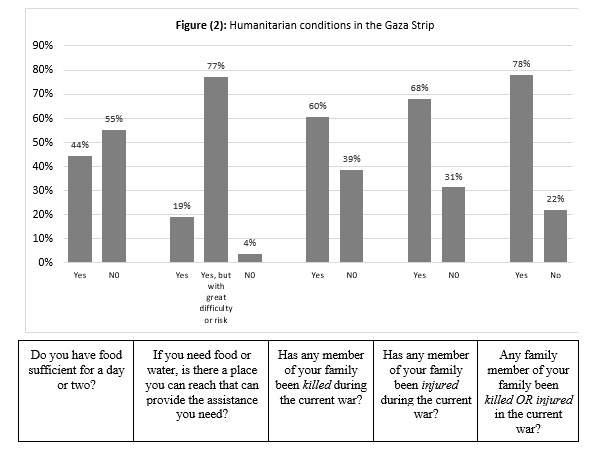
2. Humanitarian conditions in the Gaza Strip:
- Only 44% of Gazans say they have enough food for a day or two and 55% say they do not. These are almost identical to the same findings we obtained three months ago. It is worth remembering that we did not conduct any interviews in the besieged northern parts of the Gaza Strip.
- When they need food or water, only 19% of Gazans say they can reach a place where they can have access to assistance; another 77% say they can but with a great difficulty or risk, and 4% say they cannot.
- Sixty percent of all Gazans say a member of their family has been killed during the current war. In a separate question, 68% say a member of their family has been injured. When combining the two questions, the findings show that 78% say a member of their family has been either killed or injured; only 22% of Gazans say none of their family members have been killed or injured. Three months ago, 64% of Gazans said a member of their family had been killed or injured during the current war.
- We asked Gazans about the availability of essential needs: water, food, electricity, tents, covers, clothing, medical care, and toilets. Those who said “Yes, available” ranged between 10% for tents and 33% for water. But the largest percent said these needs are available but with great difficulty and risk. This was particularly the case for medical care, tents, food, water, and electricity. The needs that seem unavailable at all for the largest percentage of Gazans are tents, clothing, and covers.

We asked those in shelters about the identity of the organizers in charge. The majority of the respondents (62%) said it was UNRWA, 15% said it was government, 13% local Palestinian group, and 8% said other international organization.

- We asked respondents to assess, based on their personal experience, the fairness of aid distribution to displaced residents currently in shelters. The vast majority (70%) said it was discriminatory while only 27% said it was fair. When we crosstabulated these responses based on the identity of the shelters’ organizers, it becomes clear, as shown in the following figure, that greatest complaint (90%) comes from those in shelters organized by local Palestinian groups, followed by those organized by UNRWA, other international organizations, and the government.

- A majority of 64% (compared to 52% three months ago) blames Israel for the current suffering of Gazans in the current war while 20% (compared to 26% three months ago) place the blame on the US; only 7% (compared to 11% three months ago) place the blame on Hamas, and 6% (compared to 9% three months ago) blame the PA. It is worth noting that the percentage of Gazans who place the blame on Hamas has dropped from 19% to 9%.
3. War crimes and atrocities:
- As we found in the previous poll, almost all Palestinians (94% think Israel has committed war crimes during the current war. By contrast, only 5% (compared to 10% three months ago) think Hamas also committed such crimes; 4% think Israel has not committed such crimes and 91% think Hamas did not commit war crimes during the current war.
- 80% (compared to 85% in December 2023) say they did not see videos, shown by international news outlets, showing acts committed by Hamas against Israeli civilians, such as the killing of women and children in their homes; only 19% (11% in the West Bank and 30% in the Gaza Strip) saw these videos.
- We asked those who did not see the videos to tell us the reasons they have not seen them: 60% said that the media they watched did not show them while 20% (14% in the West Bank and 31% in the Gaza Strip) said that they did not want to watch them.
- When asked if Hamas did commit these atrocities that are seen in these videos, the overwhelming majority (93%) said no, it did not, and only 5% said it did. As shown in the figure below, the belief that Hamas fighters have committed atrocities against civilians is higher among those who did watch videos showing such atrocities (17%) compared to those who did not (2%).

4. Possible ramifications of an Israeli ground invasion of Rafah:
We explored three possible ramifications of an Israeli invasion of Rafah: people rushing to cross the border with Egypt, perception of likely Egyptian police and army response to such development, and the likely behavior of the residents and displaced person when they see people crossing the border toward Egypt:
- We asked the public to speculate about the likely behavior of Rafah residents and displaced persons in the event of an Israeli invasion of that city: would these people in this case rush to safety on the Egyptian side? While half of the West Bankers expect them to do so, only 24% of Gazans say residents and displaced person would rush towards the border and cross to safety in Egypt. In total, 40% said they think they would and 51% said they think they would not.
- We then examined public perception of the likely behavior of the Egyptian army and police, on the other side of the border, when seeing masses of people rushing and crossing the border into Egypt. Findings show a majority of 61% thinks the Egyptian army and police would indeed shoot at those crossing the borders. Gazans are more likely than West Bankers to think so, 68% and 55% respectively.

- We asked Gazans about their own behavior if they see people rushing toward the Egyptian border and seeing the separation barrier between Egypt and Rafah falling, would they leave home or shelter in search of safety and cross the borders with the others? Almost 70% said no, they would not; only 25% said yes, they would.

5. South Africa and the case of genocide at the International Court of Justice
- We asked the public about its satisfaction or dissatisfaction with South Africa for bringing the case of genocide against Israel to the international Court of Justice (ICJ). The vast majority (78%) expressed satisfaction; only 19% expressed dissatisfaction. But almost two thirds of the public (65%) expressed dissatisfaction with the court’s decision that did not ask Israel to abide by a ceasefire; only 31% expressed satisfaction with the court’s decision. Moreover, only 37% expressed the belief that the ICJ would indeed eventually convict Israel of genocide. A majority of 59% said it did not expect the ICJ to issue such a conviction.
- Finally, when asked if such conviction, if it happens, would contribute to force Israel to consider ending its occupation of the Palestinian territories in the West Bank and the Gaza Strip, a majority of 72% said no; only 23% said yes. It is noticeable that Gazans, as shown below, show a little more satisfaction with the court’s decision and optimism regarding the likely court decision and the impact of such a decision on the larger question of the Israeli occupation of the Palestinian territories.

6. Expectations regarding the ceasefire and who will win the war
- We asked the public about its expectations for the following weeks and months regarding the war and the prospects for a ceasefire. The largest percentage (40%) expect Israel and Hamas to reach a permanent ceasefire while 27% expect the continuation of the war and 25% expect the expansion of the war to include other regional and non-regional states and actors. The expectations of a ceasefire is much higher in the West Bank than in the Gaza Strip, 50% and 27% respectively. The largest percentage of Gazans (38%) expects the war to continue while only 20% of West Bankers expect that.

- As we did in December 2023, we asked in the current poll “who will win” this war. Today, the majority expects Hamas to win. But it is a little smaller majority than we found three months ago, 64% and 70% respectively. It is worth noting, as indicated in the figure below, that today, more Gazans expect Hamas to win than three months ago, 56% and 50% respectively. By contrast, today, less West Bankers expect Hamas to win than three months ago, 69% and 83% respectively. It is worth noting also that while almost no one in the West Bank expect Israel to win the current war, almost one fifth (19%) of Gazans expect Israel to win. The current percent of those Gazans who expect Israel to win is more than a third less than the case three months ago, 19% and 31% respectively.

7. “The Day After:” Who will rule Gaza after the war?
- We asked the respondents to speculate about the party that will be in control of the Gaza Strip in the day after the end of the current war. Gazans and West Bankers agree by 59%, for each side, that it will be Hamas. This represents a drop of 5 points compared to our findings three months ago. The drop came from the West Bank, declining by 14 points while in the Gaza Strip the percentage of those who thought Hamas will be in control increased by 8 points. Only 5% think the Israeli army will be in control; 9% selected a PA under president Abbas, and another 9% selected the PA without Abbas; 2% selected one or more Arab country; and 2% selected the UN.
- When asked about their own preferences for the party that should be in control in the Gaza Strip after the war, 59% (64% in the West Bank and 52% in the Gaza Strip) selected Hamas; 13% selected the PA without President Abbas; 11% selected the PA with Abbas; 3% selected one or more Arab country;1% selected the UN, and 1% selected the Israeli army. Three months ago, we asked an identical question, but with a slightly different set of options to choose from. At that time, a similar percentage (60% in total; 75% in the West Bank and 38% in the Gaza Strip) selected Hamas as the party preferred by the respondents to control the Gaza Strip after the war. The change in the preferences of the Gazans, with a 14-point increase among them selecting Hamas today, is one of the most intriguing findings of the current poll. But it is consistent with the increase, indicated above, in the percentage of Gazans who think Hamas will win the current war. This is particularly interesting because the opposite happened in the West Bank, with the preference for Hamas dropping significantly by 11 points. Yet, this West Bank finding is consistent with the significant decrease by 14 points, also indicated above, in the percentage of West Bankers who think Hamas will win the war.

- In another question involving speculation about the most likely scenario for the day after the war, the results were almost identical, to the question asked above, as 59% said Hamas will return to control the Gaza Strip. But unlike the first question above, 63% of the West Banker and only 52% in the Gazans expected that. The reason for the change has to do with the available set of scenarios we provided in which we omitted the option of a return of the PA without president Abbas and provided new possibilities, such as the establishment by Israel of local authorities, tribal and family control, the emergence of multiple armed groups. The return of the PA under Abbas was expected by 11%, 6% expected Israel to establish local authorities, another 6% expected the Israeli army to assume control, 4% expected control by tribes and families, and another 4% expected the establishment of multiple armed groups.
- Here too we asked about preferences regarding these scenarios. Given the new choices, the most important change, compared to the earlier question, about preferences in the day after the war, has been the rise in the percentage that selected Hamas. As shown in the figure below, the return of Hamas reaches 63%, with a 7-point increase in the Gaza Strip compared to only 2-point increase in the West Bank. Gazans were also more likely to increase their support for the return of the PA, even if under Abbas’ control, with a 14-point rise. West Bankers increased their support for a PA under Abbas by only 3 points.

- Our previous poll in December 2023 asked about the deployment of an Arab security contingent from Egypt and Jordan in the Gaza Strip. At that time, three months ago, we found a 70% opposition to the idea even if the forces were deployed to assist the PA security forces. In this poll, we asked the respondents to speculate about attitudes of Gazans toward a possible deployment of Turkish forces in the Gaza Strip. But this scenario stated that such deployment would take place with Hamas’ approval and international cover and funding. The findings show the majority thinks Gazans would reject the idea. The assessment of Gazans however shows a split with 51% believing Gazans would welcome the deployment and 48% believing they would reject it.

- Finally, we asked the public about if it is for or against an idea of a long-term vision for the day after in which the US and an Arab coalition comprising Egypt, Saudi Arabia, and Jordan would develop a plan that would strengthen the PA, restore negotiations based on the two-state solution, and bring about an Arab-Israeli peace and normalization. Almost three quarters (73%) said it stands against the idea and only 23% said it stands for it. It is worth noting that the support for the idea among Gazans is much higher than it is among West Bankers, 36% and 14% respectively.+

8. Satisfaction with relevant Palestinian, regional, and international actors:
- The vast majority (83%) thinks the US administration repeated declarations about the reaching a two-state solution are not serious; only 15% (9% in the West Bank and 23% in the Gaza Strip) think they are serious.
- As we did in our previous poll, we asked in the current one about public satisfaction with the role played during the war by various Palestinian, Arab/regional, and international actors:
1. On the Palestinian side, satisfaction with the role of Hamas remains stable at 70% (75% in the West Bank and 62% in the Gaza Strip) was the highest followed by the role played by Yehia Sinwar (61%; 68% in the West Bank and 52% in the Gaza Strip), Fatah (27%; 24% in the West Bank and 32% in the Gaza Strip), and president Abbas (14%; 8% in the West Bank and 22% in the Gaza Strip). As the figure below indicates, support for Hamas, while indeed stable for the total, has in fact dropped in the West Bank by 10 points, from 85% three months ago to 75% today. The opposite happened in the Gaza Strip: satisfaction with Hamas increased by 10 points. Satisfaction with Sinwar remains stable in the Gaza Strip and drops 13 points in the West Bank. Satisfaction with Fatah increases by 5 points for the total, 1 point in the West Bank and 11 points in the Gaza Strip. Finally, satisfaction with Abbas increases by 3 points, 1 point in the West Bank and 5 points in the Gaza Strip.

2. For the Arab/regional actors, as in our previous poll, the highest level of satisfaction goes to Yemen (83%; 88% in the West Bank and 75% in the Gaza Strip), followed by Qatar (56%), Hizballah (48%), Iran (30%), Jordan (22%), and Egypt (12%). The following figure shows the distribution of satisfaction in the two polls over the West Bank and the Gaza Strip. In the Gaza Strip, the figure shows a significant rise in satisfaction with Yemen and Qatar and a decrease in satisfaction with Hezbollah and Egypt. In the West Bank, the figure shows a rise in satisfaction with Hezbollah and a decrease in satisfaction with Qatar, Iran, Jordan, and Egypt. The regional Arab country that has lost satisfaction in both the West Bank and the Gaza Strip is Egypt, cut down by half to 12% for the total, 5% in the West Bank and 23% in the Gaza Strip.

3. For the non-regional international actors, the highest level of satisfaction goes to Russia (19%, 21% in the West Bank and 16% in the Gaza Strip), followed by the UN (7%), and the US (1%). The following figure shows a drop of 3 points in satisfaction with Russia for the total sample. The drop came from the Gaza Strip (12 points) while satisfaction with Russia in the West Bank increased by 4 points. Satisfaction with the US performance remains non-existent.

(2) Parliamentary and presidential elections and the domestic balance of power: |
If a presidential competition is to take place between three, Marwan Barghouti from Fatah, Mahmoud Abbas, also from Fatah, and Ismael Haniyeh from Hamas, participation in the election would stand at 72%; vote for Marwan Barghouti would stand at 40%, the highest rate in the last three hypothetical elections since September 2023, followed by Haniyeh at 23%, and Abbas at 8%. Among the voters, Barghouti receives 56%, Haniyeh 32%, and Abbas 11%. Three months ago, support for Barghouti among the voters stood at 47% and Haniyeh at 43%, and Abbas at 7%. These findings show Barghouti’s vote increasing by 9 points while vote for Haniyeh drops by 11 points.

- However, if the new presidential elections were held with only two candidates, Mahmoud Abbas from Fatah and Ismail Haniyeh from Hamas, competing, the voter turnout would drop to 52%; vote for Haniyeh would stand at 37% and Abbas at 11%. Among the voters, Haniyeh would receive 70% and Abbas 22%. Three months ago, the vote for Abbas among the voters stood at 16% and vote for Haniyeh stood at 78%.

- But if the two presidential candidates were Marwan Barghouti from Fatah and Haniyeh from Hamas, participation would rise to 69%; 42% would vote for Barghouti and 26% for Haniyeh. Among the voters, Barghouti would receive 62% and Haniyeh 37%. These findings indicate a rise in the vote for Barghouti among voters by 11 points and a drop in the vote for Haniyeh by 8 points.

- If the two presidential candidates were Haniyeh from Hamas and a different Fatah candidate, prime minister Mohammad Shtayyeh, participation would drop to 53%; 13% would vote for Shtayyeh and 38% for Haniyeh. Among the voters, Shtayyeh receives 24% and Haniyeh 72%.

- Finally, if the two presidential candidates were Haniyeh from Hamas and a non-Fatah candidate, Mustafa Barghouti, the leader of al Mubadara and a former presidential candidate, the voter turnout rises slightly to 56%; Mustafa Barghouti receives 23% and Haniyyeh 31%. Among the voters, Mustafa Barghouti receives 40% of the vote and Haniyyeh 56%.

- In a closed question, we asked the public to select the person they prefer to see as President Abbas's successor. The largest percentage (40%) said they prefer Marwan Barghouti; 19% preferred Ismail Haniyeh; 10% chose Yahya al Sinwar; 6% chose Hussein al-Sheikh; 4% preferred Mohammed Dahlan, 2% preferred Khaled Meshaal, 1% chose Muhammad Shtayyeh, and 18% said they did not know or chose someone else. It is worth noting that the preference for Dahlan, al-Sheikh, and Shtayyeh comes almost only from the Gaza Strip.
- Level of satisfaction with the performance of president Abbas stands at 16% and dissatisfaction at 81%. Satisfaction with Abbas stands at 8% in the West Bank (compared to 10% three months ago) and 27% in the Gaza Strip (compared to 19% three months ago). Six months ago, before the October 7 war, satisfaction with Abbas stood at 22% and dissatisfaction at 76%.
- 84% want Abbas to resign while 14% want him to remain in office. Three months ago, 88% said they want Abbas to resign. Six months ago, 78% wanted him to resign. Demand for Abbas' resignation today stands at 93% in the West Bank and 71% in the Gaza Strip.

- When asked which political party or political trend they support, the largest percentage selected Hamas (34%), followed by Fatah (17%), while 11% selected other or third-party groups, and 37% said none of them or did not know. Three months ago, 43% supported Hamas and 17% selected Fatah. Six months ago, before the current war, support for Hamas stood at 22% and support for Fatah stood at 26%.This means that support for Hamas during the past three months has witnessed an 11-point drop while support for Fatah remained unchanged during the same period. In the West Bank, support for Hamas today stands at 35% (compared to 44% three months ago), and for Fatah at 12% (compared to 16% three months ago). In the Gaza Strip, support for Hamas today stands at 34% (compared to 42% three months ago) and support for Fatah at 25% (compared to 18% three months ago).

- However, if new parliamentary elections were held today with the participation of all political forces that participated in the 2006 elections, only 64% say they would participate in them, 30% would vote for Hamas, 14% for Fatah, 6% for third parties, and 15% remain undecided. Among the voters, support for Hamas stands at 47%, Fatah 22%, third parties 9%, and the undecided at 24%. Compared to our findings three months ago, the current results among the voters indicate a 4-point drop by for Hamas and a 3-point rise by Fatah. In the Gaza Strip, vote for Hamas among the voters stands today at 45% (compared to 52% three months ago and 44% six months ago) and vote for Fatah among the voters stands today at 26% (compared to 21% three months ago and 32% six months ago). In the West Bank, vote for Hamas among the voters stands today at 48% (compared to 50% three months ago and 24% six months ago) and vote for Fatah among the voters stands today at 16% (compared to 18% three months ago and 40% six months ago).

- 49% (compared to 54% three months ago) believe that Hamas is the most deserving of representing and leading the Palestinian people today while 17% (compared to 13% three months ago) believe that Fateh under the leadership of Abbas is more deserving; 29% (compared to 26% three months ago) believe both are unworthy of representation and leadership. Six months ago, 27% said Hamas is the most deserving, 24% said Fateh led by Abbas is the most deserving, and 44% said both are unworthy of representation and leadership.
(3) Domestic conditions, the resignation of Shtayyeh, and perception of safety and security: |
- We asked the public about the meaning of the resignation of the government of prime minister Mohammad Shtayyeh: is it, in its view, a step toward reforming the PA? A majority of 62% said it is not and only 30% said it is. Gazans are more likely than West Bankers to view the resignation as a step toward reform, 41% and 23% respectively.
- In the aftermath of the resignation of prime minister Shtayyeh, two candidates emerged as the most likely successors: Mohammad Mustafa (reportedly favored by Abbas) and Salam Fayyad (reportedly favored by some regional and international donors). We asked the public, which of the two it favors: 55% said none of them; 22% favored Fayyad and 10% favored Mustafa. Eventually, after the completion of data collection, Mustafa was appointed by Abbas as his next prime minister.
- We asked the public about the make-up and source of authority for the new government: a national unity government that would come under the control of a political party, control of president Abbas, or one that does not come under the control of Abbas or a political party. As the figure below shoes, 62% opted for the third choice while only a quarter selected the two other choices combined. It is worth noting that Gazans are less likely than West Bankers to go for the third choice.

- A majority of 65% (compared to 68% three months ago) believes that the PA has become a burden on the Palestinian people and only 27% (compared to 28% three months ago) believe it is an asset for the Palestinian people. Six months ago, 62% said the PA is a burden and 35% said it was an achievement.
- We asked the public in the West Bank about its personal and family safety and security. The findings show that only 11% feel safe and secure while 89% feel unsafe and unsecure. Three months ago, the perception of safety stood at 14% and six months ago at 48%.
- Aljazeera is the most watched TV station in Palestine with 61% selecting it as the one they watched the most during the past two months. West Bankers are more likely than Gazans to watch Aljazeera as 45% of Gazans (compared to 10% in the West Bank) say they do not watch or have no access to TV these days. The second most popular TV station is Palestine Today (4%), followed by Alarabiyya and al Mayadeen (3% each), Palestine TV (2%), Alaqsa and Ma’an (1% each).
(4) Palestinian-Israeli Relations and the Peace process: |
- 45% support and 52% oppose the idea of a two-state solution, which was presented to the public without providing details of the solution. Three months ago, support for this solution in a similar question stood at 34% and six months ago support stood at 32%. In the current poll, support for this solution came from Gaza Strip, a 27-point increase while remaining stable in the West Bank at 34%.

- Support for the two-state solution is usually linked to public assessment of the feasibility of such a solution and the chances for the establishment of a Palestinian state. Today, 61% (compared to 65% three months ago) believe the two-state solution is no longer practical due to settlement expansion but 37% (compared to 32% three months ago) believe it is still practical. Six months ago, 71% said that the two-state solution is no longer practical due to settlement expansion. Moreover, 72% believe that the chances for the establishment of an independent Palestinian state alongside Israel in the next five years are slim or nonextant, and 27% believe the chances are medium or high.
- When asked about public support and opposition to specific policy measures to break the stalemate: 62% supported joining more international organizations; 45% supported resort to unarmed popular resistance; 55% supported a return to confrontations and armed intifada; 58% supported dissolving the PA; and 24% supported abandoning the two-state solution and demanding one state for Palestinians and Israelis. Three months ago, 69% supported a return to confrontations and armed intifada; 39% supported resort to unarmed popular resistance; 58% supported the dissolution of the PA; and 29% supported abandoning the two-state solution in favor of one state. Six months ago, before the current war, 58% supported a return to confrontations and armed intifada; 53% supported resort to unarmed popular resistance; 52% supported the dissolution of the PA; and 27% supported abandoning the two-state solution in favor of one state.
- We offered the public three methods to end the Israeli occupation and establish an independent state and asked it to select the most effective. 46% (51% in the West Bank and 39% in the Gaza Strip) selected “armed struggle;” 25% (27% in the West Bank and 23% in the Gaza Strip) selected negotiations; and 18% (12% in the West Bank and 27% in the Gaza Strip) selected popular non-violent resistance. As shown in the figure below, these findings indicate a 17-point drop in support for armed struggle; a 5-point rise in support for negotiations; and a 5-point rise in support for non-violence. The drop in three months in support for armed struggle comes equally from both the West Bank and the Gaza Strip.

- Support and opposition to negotiations is seen in the results to a question about attitudes regarding “a return to Palestinian-Israeli peace negotiations in order to achieve a two-state solution under international and Arab auspice.” Support for such return to negotiations received the support of 38% (46% in the Gaza Strip and 33% in the West Bank) of the public.

- In light of the increase in settler terrorist attacks against Palestinian towns and villages, we asked West Bankers what means are most effective in combating this terrorism that are also the most feasible.
The largest percentage (41%) chose the formation of armed groups by residents of the targeted areas in order to protect their areas; 23% chose to deploy Palestinian police forces in the targeted areas; another 23% chose the demand that the Israeli army take measures to prevent settler terrorism; and only 8% chose the formation, by residents of the targeted areas, of unarmed groups to protect their areas. As the figure below indicates, these results show significant change compared to out findings three months ago. The most important change is a 15-point drop in support for the formation of armed groups, an 8-point increase in the demand for protection by the PA police; and a 7-point increase in the demand for an Israeli army measures to stop the settlers.

(5) Most vital Palestinian goals and the most pressing problems confronting Palestinians today: |
- 42% believe that the first most vital Palestinian goal should be to end Israeli occupation in the areas occupied in 1967 and build a Palestinian state in the West Bank and the Gaza Strip with East Jerusalem as its capital. By contrast, 33% believe the first most vital goal should be to obtain the right of return of refugees to their 1948 towns and villages; 13% believe that the first and most vital goal should be to build a pious or moral individual and a religious society, one that applies all Islamic teachings; and 11% believe it should be to establish a democratic political system that respects freedoms and rights of Palestinians.
- When asked about the most pressing problem confronting the Palestinians today, the largest percentage (56%; 66% in the Gaza Strip and 50% in the West Bank) said it is the continued war in the Gaza Strip; (23%) said it is the Israeli occupation; 8% said it is corruption; 6% said it is unemployment; and 5% said it is the split between the West Bank and the Gaza Strip. Three months ago, (51%, 42% in the West Bank and 64% in the Gaza Strip) said it is the continued war in the Gaza Strip; and 32% said it is the Israeli occupation.
Palestinian Public Opinion Poll No (46)
In the aftermath of the Gaza War: Hamas’ way is preferred by the majority over Abbas’ way as the most effective in ending occupation and building a Palestinian state and Haniyeh defeats Abbas in a presidential election
13-15 December 2012
These are the results of the latest poll conducted by the Palestinian Center for Policy and Survey Research (PSR) in the West Bank and the Gaza Strip between 13-15 December 2012. Two major developments preceded the conduct of the poll: (1) the Gaza war between Hamas and Israel followed by a ceasefire, a visit by Khalid Mish’al to the Gaza Strip, and Hamas’ celebration of victory in the war on the occasion of the movement’s launch, (2) the submission of a Palestinian request for the upgrading of the status of Palestine to a non-member state at the UN, the vote at the General Assembly on the request with 138 countries voting in favor, and the return of president Mahmoud Abbas to the West Bank amid public celebrations in support of his UN bid. This press release covers public evaluation of the general West Bank and Gaza conditions, elections, reconciliation, public evaluation of the performance of the governments of Salam Fayyad and Ismail Haniyeh, the internal balance of power between Fateh and Hamas, views of the public on the most vital Palestinian goals and the main problems Palestinians confront today, the Gaza war, the UN vote, and others. Total size of the sample is 1270 adults interviewed face to face in 127 randomly selected locations. Margin of error is 3%.
For further details, contact PSR director, Dr. Khalil Shikaki, or Walid Ladadweh at tel 02-296 4933 or email pcpsr@pcpsr.org.
Main Findings:
The events of the past several weeks have given Hamas a significant boost similar to the one it enjoyed in the aftermath of the breaching of the Rafah border with Egypt in early 2008. The fourth quarter of 2012 shows a dramatic change in public attitude favoring Hamas. Haniyeh’s popularity increases significantly allowing him to defeat Abbas if new presidential elections are held today. A parliamentary election, if held today, would give Hamas and Fateh an almost equal number of votes. Moreover, positive public evaluation of conditions in the Gaza Strip increases dramatically and the gap in public perception of conditions in the West Bank compared to conditions in the Gaza Strip widens in favor of the latter; this gap was first registered in our previous poll last September. Needless to say, the outcome of the latest Gaza war between Hamas and Israel is responsible for this change.
Findings are also somewhat positive for Abbas. Evaluation of conditions in the West Bank is more positive today than it was three months ago. Similarly, positive evaluation of Abbas’ performance increases in this poll. These results might have been generated by the outcome of the diplomatic warfare at the UN between the PA and Israel. The cessation of demonstrations and internal confrontations that erupted in the West Bank more than three months ago in protest against price rises and the deteriorating economic conditions might have also contributed to the general public perception of improvement in the general conditions in the West Bank. Finally, findings show a dramatic increase in the level of optimism regarding the chances for reconciliation and the reunification of the West Bank and the Gaza Strip compared to the situation not only three months ago but most importantly since the separation in June 2007.
But most significantly the poll shows that Hamas’s way, as represented by the Gaza war and its outcome, receives the support and confidence of the majority of the public while Abbas’ way, represented by the UN bid and the international recognition of the Palestinian state, receives the support and confidence of a little over one quarter. In this regard, it is worth mentioning that the overwhelming majority of Palestinians believe that Hamas has come out victorious in its war with Israel. A majority also believe that conditions in the Gaza Strip will now improve while a majority believes that conditions in the West Bank will now become worse or stay as it was before the UN vote.
(1) Presidential, Legislative, and Local Elections:
- Haniyeh defeats Abbas in a presidential election by 48% to 45%, but Barghouti wins against Haniyeh, 51% to 42%.
- In a three way presidential elections, Haniyeh receives 39%, Marwan Barghouti 29%, and Abbas 27%.
- In a parliamentary election, Fateh wins 36% and Hamas 35% of the voters.
If new presidential elections are held today, and only two were nominated, Abbas would receive the vote of 45% and Haniyeh 48% of those participating. The rate of participation in such elections would reach 69%. Three months ago, Abbas received the support of 51% and Haniyeh 40%. In this poll, in the Gaza Strip, Abbas receives 44% and Haniyeh 52% and in the West Bank Abbas receives 45% and Haniyeh 45%. The percentage of vote for Haniyeh is the highest since Hamas’ electoral victory in 2006. The previous highest percentage of vote for Haniyeh stood at 47% in March 2008 immediately after the breaching of the Rafah borders with Egypt. Percentage of support for Abbas at that time stood at 46%.
The vote for Haniyeh increases among those who do not use the internet (52%) compared to those who use it on daily basis (44%), among the religious (57%) compared to the somewhat religious (40%), among those who oppose the peace process (74%) compared to those who support the peace process (39%), among non-refugees (50%) compared to refugees (45%), among the illiterates (52%) compared to those holding a BA degree (38%), among the professionals (65%) compared to employees, laborers, and students (37%, 48%, and 48% respectively), and among those who work in the private sector (47%) compared to those who work in the public sector (40%).
If the presidential elections were between Marwan Barghouti and Ismail Haniyeh, the former would receive 51% and the latter 42% of the participants’ votes. The rate of participation in this case would reach 73%. In our September poll Barghouti received 61% of the vote and Haniyeh 32%.
If the presidential elections were between three: Mahmud Abbas, Marwan Barghouti and Ismail Haniyeh, Haniyeh would receive the largest percentage (39%) followed by Barghouti (29%), and Abbas (27%). The rate of participation in this case would reach 77%. In our previous poll last September, Barghouti received 45%, Haniyeh 29%, and Abbas 20%.
If new legislative elections are held today with the participation of all factions, 78% say they would participate in such elections. Of those who would participate, 35% say they would vote for Hamas and 36% say they would vote for Fateh, 10% would vote for all other third parties combined, and 20% are undecided. Vote for Hamas in the Gaza Strip stands in this poll at 39% and in the West Bank at 33%. Vote for Fateh in the Gaza Strip stands in this poll at 38% and in the West Bank at 34%. These results indicate a sharp increase in Hamas’ popularity compared to our September results when it stood at 28% (31% in the Gaza Strip and 25% in the West Bank). By contrast, Fateh’s popularity remained almost unchanged during the same period.
Support for Hamas increases in cities (36%) compared to refugee camps (33%), among women (37%) compared to men (34%), among those whose age is over 50 (39%) compared to those whose age is between 18 and 28 years (30%), among those who do not use the internet (39%) compared to those who use it on daily basis (32%), among the religious (45%) compared to the somewhat religious (28%), among those who oppose the peace process (55%) compared to those who support it (29%), among the illiterates (38%) compared to holders of a BA degree (25%), among the professional (50%) compared to students, laborers, and employees (33%, 30%, and 29% respectively).
(2) Domestic Conditions:
- Positive evaluation of conditions in the Gaza Strip is higher than positive evaluation of conditions in the West Bank: 43% to 35%.
- Percentage of belief that corruption exists in the PA institutions in the West Bank is higher than the percentage of belief that corruption exists in the institutions of the dismissed government in the Gaza Strip: 74% to 53%.
- 35% believe that people in the West Bank can criticize the PA in the West Bank without fear and 29% believe that people can criticize the authorities in the Gaza Strip without fear.
- Percentage of safety and security stands at 60% among West Bank residents and 70% among residents of the Gaza Strip.
- Positive evaluation of the performance of the Haniyeh government is higher than the positive evaluation of the performance of the Fayyad government: 56% to 34%; satisfaction with the performance of president Abbas stands at 54%.
- Optimism regarding the chances for reconciliation rises to highest level since the split in 2007.
Positive evaluation of conditions in the Gaza Strip rises sharply from 25% three months ago to 43% in this poll while 33% say conditions are bad or very bad. Similarly, positive evaluation of conditions in the West Bank rises sharply from 19% three months ago to 35% in this poll and 36% say conditions are bad or very bad.
Perception of corruption in PA institutions in the West Bank drops from 79% in our previous poll three months ago to 74% in this poll. Perception of corruption in the public institutions of Hamas’ Gaza government stands at 53% compared to 63% three months ago. 24% say there is, and 45% say there is to some extent, press freedom in the West Bank. Similarly, 23% say there is, and 40% say there is to some extent, press freedom in the Gaza Strip. 35% of the Palestinian public say people in the West Bank can criticize the PA in the West Bank without fear. By contrast, 29% of the public say people in the Gaza Strip can criticize the authorities in Gaza without fear. These results indicate a decrease in the perception of freedom to criticize authorities in the West Bank compared to results obtained three months ago when it stood at 42%. Only 49% of the public believe that the local elections that took place in the West Bank last October were fair and 34% say they were not fair.
Perception of safety and security in the West Bank stands at 60% and in the Gaza Strip at 70%. Three months ago these percentages stood at 56% and 64% respectively. Nonetheless, findings show that the percentage of Gazans who seek immigration to other countries stands at 41%; in the West Bank, the percentage stands today at 22%. Last September these percentages stood at 42% and 29% respectively.
Positive evaluation of the performance of the Haniyeh government rises sharply from 35% three months ago to 56% in this poll and positive evaluation of the performance of the Fayyad government increases from 22% to 34% during the same period. Percentage of satisfaction with the performance of President Abbas stands at 54% while 44% say they are dissatisfied with his performance. Three months ago, satisfaction with Abbas stood at 46%. The percentage of positive evaluation of the performance of the Haniyeh government is higher in the West Bank (60%) compared to the Gaza Strip (49%), among men (58%) compared to women (54%), among those over 50 years of age (59%) compared to those between 18 and 28 years old (52%), among Hamas supporters (88%) compared to Fateh supporters (35%), among the religious (64%) compared to the somewhat religious (50%), among those opposed to the peace process (73%) compared to supporters of the peace process (52%), among the illiterates (63%) compared to holders of a BA degree (47%), among merchants (78%) compared to students and employees (52% and 49% respectively), and among those working in the private sector (57%) compared to those who work in the public sector (51%).
In light of the resumption of the dialogue between Fateh and Hamas, 39% say they expect unity between the West Bank and the Gaza Strip to be restored in the near future, 40% believe that unity will be restored but only after a long time, and only 18% say unity will never be restored and that two separate entities will be established in the West Bank and the Gaza Strip. In our September poll, the largest percentage (42%) said that unity will never be restored and two separate entities will be established; only 14% said unity will be restored in the near future. The current percentage of optimism regarding reconciliation and restoration of unity is the highest since separation in 2007. At that time, a percentage of 29% believed that unity will be restored within months while 22% said separation will become permanent.
(3) Most vital Palestinian goals and the main problems confronting Palestinians today:
- 44% believe that the most vital Palestinian goal should be the ending of Israeli occupation and the building of a Palestinian state and 33% say it should be to obtain the right of return.
- 27% believe that the most serious problem confronting Palestinian society today is the spread of poverty and unemployment and 25% say it is the continuation of occupation and settlement construction.
44% believe that the first most vital Palestinian goal should be to end Israeli occupation in the areas occupied in 1967 and build a Palestinian state in the West Bank and the Gaza Strip with East Jerusalem as its capital. By contrast, 33% believe that the first most vital goal should be to obtain the right of return of refugees to their 1948 towns and villages, 14% believe that it should be to build a pious or moral individual and a religious society, one that applies all Islamic teachings, and 9% believe that the first and most vital goal should be to establish a democratic political system that respects freedoms and rights of Palestinians. The most serious problem confronting Palestinian society today is the spread of poverty and unemployment in the eyes of 27% of the public while 25% believe the most serious problem is the continuation of occupation and settlement activities, another 25% say it is the absence of national unity due to the West Bank-Gaza Strip split, 15% believe the most serious problem is corruption in some public institutions, and 6% believe it is the siege and the closure of the Gaza border crossings.
4) Gaza War and the UN Vote:
- 81% say Hamas came out the winner from its war with Israel.
- 41% believe that the truce between Israel and Hamas in the Gaza Strip serves Palestinian interests and 39% say it serves the interests of the two sides.
- The largest percentage (39%) believes that it was Iran that gave Hamas the greatest power to stand up to Israel during the Gaza war, 29% say it was Hamas own capacity that gave it that power, and 20% say it was Egypt.
- 63% say that now after the truce agreement between Hamas and Israel that followed the last Gaza war conditions in the Gaza Strip are becoming better than before the war.
- After the UN vote, only 41% expect Palestinian conditions to change for the better.
- 64% believe that now after the UN vote the US will punish the PA by suspending financial assistance and 79% believe that Israel too will punish the PA.
- 76% believe that the PA president and government should impose Palestinian sovereignty throughout the West Bank but only 37% believe they will actually do that.
- To force Israel to withdraw from the Palestinian state, the largest percentage (41%) believes that armed attacks on Israeli army and settlers would be the best way but 24% believe the best way is to return to negotiations.
- 60% believe that Hamas’ way is the best way to end Israeli occupation while only 28% believe Abbas’ is the best way.
Findings indicate that Hamas has gained a great political victory in its war with Israel: 81% believe that it came out the winner and only 3% believe that Israel came out the winner; 13% believe neither side came out a winner. Percentage of those who believe that Hamas came out a winner stands at 75% in the Gaza Strip and 84% in the West Bank. Findings also show that 41% believe that the truce that followed the war serves Palestinian interests and a similar percentage (39%) believes that it serves the interests of the Palestinians and Israelis alike and 16% believe that it serves the Israeli interests only. Furthermore, a majority of 63% believes that conditions in the Gaza Strip, now after the truce, are becoming better than before the war while 27% say conditions are the same as before the war and 8% say conditions are becoming worse. Yet, in parallel with this optimism, a majority of 52% believes that Israel will launch a ground offensive against the Gaza Strip in the near future and 43% say it will not.
Findings show that the largest percentage (39%) believes that it was Iran’s support and contribution that gave Hamas the greatest power to stand up to Israel during the last war while 29% attribute Hamas’ achievement to its own capacity and 20% believe Egypt’s contribution was the most helpful. Percentage of those who attribute Hamas’ success to Iran increases in the Gaza Strip (41%) compared to the West Bank (38%), in cities and villages (40% and 41% respectively) compared to refugee camps (30%), among men (47%) compared to women (31%), among those whose age is over 50 years (44%) compared to those whose age is between 18 and 28 years (37%), among supporters of Fateh (47%) compared to supporters of Hamas (35%), among holders of a BA degree (46%) compared to illiterates (24%), and among those who work in the public sector (52%) compared to those who work in the private sector (44%).
With regard to conditions of occupation and settlement construction in the aftermath of the UN vote, findings show that only 41% believe they will improve while 37% believe they will remain the same as before the vote and 21% believe they will worsen. Moreover, the overwhelming majority (79%) believes that Israel will punish the Palestinians by suspending the transfer of custom duties and other taxes and 64% believe the US will suspend financial assistance to the PA.
The overwhelming majority (76%) believes that the PA president and government should impose Palestinian sovereignty over the entire West Bank, for example by deploying the Palestinian security services in area C, currently under Israeli control, even if such a deployment leads to a confrontation with the Israeli army and settlers; 21% oppose this measure. Despite this high level of support for imposing sovereignty in the West Bank, most Palestinians (56%) do not believe the PA government and president will actually take this measure while 37% believe they will. Similarly, while 71% support and 25% oppose Palestinian insistence on taking control of the border terminal with Jordan at the Allenby Bridge even if such a step leads to suspension of travel across the bridge, a majority of 56% believes the PA president and government will not do that and 36% believe they will do that.
We asked the public about its views regarding the best means of forcing Israel to end its occupation of the territories of the Palestinian state, now after the UN vote. The largest percentage (41%) believe that the answer lies in armed attacks against the army and settlers, 30% said it was return to negotiations, and 24% believed it was non-violent resistance. In our previous poll in September 2012, 32% selected armed attacks, 33% selected non-violent resistance, and 28% selected negotiations.
Belief that armed resistance is the answer is higher in the Gaza Strip (46%) than in the West Bank (39%), among men (47%) than women (35%), among those whose age is between 18 and 28 years (44%) compared to those whose age is over 50 years (38%), among those who use the internet on daily basis (46%) compared to those who use it once a month (24%), among supporters of Hamas (63%) compared to supporters of Fateh (25%), among the religious (46%) compared to the somewhat religious (38%), among those who oppose the peace process (67%) compared to those who support the peace process (33%), among holders of BA degree (47%) compared to illiterates (39%), among students (47%) compared to farmers, housewives, laborers, and retirees (30%, 34%, 35%, and 37% respectively), and among those who work in the private sector (46%) compared to those who work in the public sector (38%).
Finally, we asked the public to compare Hamas’ way or approach, given the Gaza war and its outcome, to Abbas’ way, given the UN vote and its outcome, and to select the one it prefers as the most effective in ending occupation and building a Palestinian state. Findings show that 60% believe that Hamas’ way is the most preferable while only 28% selected Abbas’ way. Belief in Hamas’ way increases in the Gaza Strip (66%) compared to the West Bank (56%), among supporters of Hamas (93%) compared to supporters of Fateh (30%), among the religious (64%) compared to the somewhat religious (57%), among those who oppose the peace process (81%) compared to those who support the peace process (53%), and among students (65%) compared to farmers and employees (43% and 52% respectively).
5) Peace Process:
- Support for a permanent settlement along the lines of the Clinton Parameters and the Geneva Initiative drops from 50% a year ago to 43% in this poll.
- 52% support and 48% oppose the two-state solution but 62% believe that it is impossible these days to reach a permanent settlement with Israel and 60% believe the chances for the establishment of a Palestinian state are slim to non-existent.
- 58% believe the two-state solution is no longer practical and 39% believe it is still possible.
- Only 27% support a one-state solution in which Jews and Palestinians would have equal rights and 71% oppose it.
- 53% support and 45% oppose the Arab initiative for peace with Israel.
- 74% are worried that they or members of their family would be hurt by Israelis or that their land would be confiscated or homes demolished.
- 61% believe that Israel’s long term goal is to extend its borders to include all areas between the Jordan River and the Mediterranean Sea and to expel its Arab population and 20% believe Isreal’s long term goal is to annex the occupied territories and deny the Palestinians their political rights.
Findings show that 43% support and 56% oppose a package of a permanent status agreement based on the Clinton Parameters and the Geneva Initiative. Support for this package stood at 50% in December 2011. The Clinton parameters for a Palestinian-Israeli permanent settlement were presented by President Clinton at a meeting with Israeli and Palestinian officials almost ten years ago, on December 23, 2000, following the collapse of the July 2000 Camp David summit. The Geneva Initiative, along similar lines, was made public around the end of 2003. These parameters address the most fundamental issues which underlie the Palestinian-Israeli conflict: (1) final borders and territorial exchange; (2) refugees; (3) Jerusalem; (4) a demilitarized Palestinian state; (5) security arrangements; and (6) end of conflict. We have been addressing these issues periodically since December 2003, and in the current poll we revisited these crucial issues following the diplomatic stalemate throughout 2012.
Findings, as the summary table below shows, indicate that the public rejects four items in the package and accept two. The following is a summary of the items and the attitudes to each:
(1) Final Borders and Territorial Exchange: 53% support or strongly support and 45% oppose or strongly oppose an Israeli withdrawal from the West Bank and the Gaza Strip with the exception of some settlement areas in less than 3% of the West Bank that would be swapped with an equal amount of territory from Israel in accordance with a map that was presented to the Palestinian respondents. The map was identical to that presented to respondents in December 2011, when support for this compromise, with its map, stood at 63% and opposition at 36%.
(2) Refugees: 41% support and 56% oppose a refugee settlement in which both sides agree that the solution will be based on UN resolutions 194 and 242. The refugees would be given five choices for permanent residency. These are: the Palestinian state and the Israeli areas transferred to the Palestinian state in the territorial exchange mentioned above; no restrictions would be imposed on refugee return to these two areas. Residency in the other three areas (in host countries, third countries, and Israel) would be subject to the decision of these states. As a base for its decision Israel will consider the average number of refugees admitted to third countries like Australia, Canada, Europe, and others. All refugees would be entitled to compensation for their “refugeehood” and loss of property. In December 2011, 45% agreed with an identical compromise while 53% opposed it.
(3) Jerusalem: 29% support and 70% oppose a Jerusalem compromise in which East Jerusalem would become the capital of the Palestinian state with Arab neighborhoods coming under Palestinian sovereignty and Jewish neighborhoods coming under Israeli sovereignty. The Old City (including al Haram al Sharif) would come under Palestinian sovereignty with the exception of the Jewish Quarter and the Wailing Wall that would come under Israeli sovereignty. In December 2011, an identical compromise obtained 40% support and 59% opposition.
(4) Demilitarized Palestinian State: 28% support and 71% oppose the establishment of an independent Palestinian state that would have no army, but would have a strong security force and would have a multinational force deployed in it to ensure its security and safety. Israel and Palestine would be committed to end all forms of violence directed against each other. A similar compromise received in December 2011, 32% support, and opposition reached 67%. This item receives the lowest level of support by Palestinians. Unlike the refugees and Jerusalem components, this issue has not received due attention in public discourse, as it should, since it may become a major stumbling block in the efforts to reach a settlement.
(5) Security Arrangements: 46% support and 53% oppose a compromise whereby the Palestinian state would have sovereignty over its land, water, and airspace, but Israel would have the right to use the Palestinian airspace for training purposes, and would maintain two early warning stations in the West Bank for 15 years. A multinational force would remain in the Palestinian state and in its border crossings for an indefinite period of time. The task of the multinational force would be to monitor the implementation of the agreement, and to monitor territorial borders and coast of the Palestinian state including the presence at its international crossings. In December 2011, 50% of the Palestinians supported this parameter while 49% opposed it.
(6) End of Conflict: 59% support and 39% oppose a compromise on ending the conflict that would state that when the permanent status agreement is fully implemented, it will mean the end of the conflict and no further claims will be made by either side. The parties will recognize Palestine and Israel as the homelands of their respective peoples. The comparable figures in December 2011 were 63% support and 35% opposition.
Summary Table: Support for Clinton’s Permanent Settlement/ Geneva Initiative Framework 2003-2012
| Dates |
| |||||||||
Dec 2003 | Dec 2004 | Dec 2005 | Dec 2006 | Dec 2007 | Dec 2008 | Aug 2009 | June 2010 | Dec 2010 | Dec 2011 | Dec 2012 | |
1) Borders and Territorial Exchange | 57% | 63% | 55% | 61% | 56% | 54% | 49% | 60% | 49% | 63% | 53% |
2) Refugees | 25% | 46% | 40% | 41% | 39% | 40% | 37% | 48% | 41% | 45% | 41% |
3) Jerusalem | 46% | 44% | 33% | 39% | 36% | 36% | 31% | 37% | 36% | 40% | 29% |
4) Demilitarized State | 36% | 27% | 20% | 28% | 23% | 27% | 24% | 28% | 24% | 32% | 28% |
5) Security Arrangements | 23% | 53% | 43% | 42% | 51% | 35% | 34% | 41% | 38% | 50% | 46% |
6) End of Conflict | 42% | 69% | 64% | 62% | 66% | 55% | 55% | 63% | 58% | 63% | 59% |
Overall Package | 39% | 54% | 46% | 48% | 47% | 41% | 38% | 49% | 40% | 50% | 43% |
Support for the package is higher in the Gaza Strip, standing at 53%, than in the West Bank, standing at 37%, among supporters of the peace process (50%) compared to those opposed to the peace process (24%), among those who would vote for Fateh and third parties (54% and 50% respectively) compared to those who would vote for Hamas or those who are undecided regarding whom they will vote for (36% and 40% respectively), among those whose age is between 18 and 28 years (48%) compared to those whose age is between 40 and 50 years (35%), and among those who live in cities (45%) compared to those who live in villages and towns (32%), and among those who work in the public sector (49%) compared to those who work in the private sector (41%).
Findings also show that 42% of the public believe that a majority among Palestinians supports a settlement along these lines while 49% believe a majority opposes it and 10% say it does not know the position of the majority. Only 33% believe that a majority among Israelis supports such a package while 56% believe a majority of Israelis opposes it. Perhaps for this reason, and others, only 36% believe that it is possible these days to reach a permanent settlement with Israel while 62% believe that it is impossible to reach such a settlement. Moreover, the public is pessimistic about the chances for the establishment of a Palestinian state alongside Israel in the next five years: 60% believe the chances to be slim or non-existent and 38% believe them to be medium or high.
As in our September 2012 poll, findings show that a small majority of 52% supports the two-state solution and 48% oppose it. Similarly, 53% support and 45% oppose the Arab Peace Initiative that calls for a two-state solution and the normalization of relations between Israel and the Arab states. But findings show also that a majority of 58% does not believe that the two-state solution is practical due to Israeli settlement expansion while 39% believe it is still feasible. Moreover, a similar percentage (60%) believes that the chances for the establishment of a Palestinian state alongside Israel are slim or non-existent while 38% believe the chances are medium or high. It is worth mentioning in this regard that the percentage of those who believe that the chances for Palestinian statehood are medium or high have increased by 11 percentage points since our last poll in September. The increase might be due to Palestinian success in gaining UN recognition of Palestinian statehood. It is also worth mentioning that despite the belief that the two-state solution is no longer practical, a large majority of 71% opposes the alternative one-state solution in which Arabs and Jews are treated equally; only 27% support the one-state solution.
Findings show that three quarters of the public (74%) are worried and 26% are not worried that they or members of their families would be hurt by Israelis or their land confiscated or homes demolished. Moreover, 80% believe that Israel’s long term goal is to expand its borders to include all territories between the Jordan River and the Mediterranean Sea and expel their Palestinian population or deny them their political rights. When asked about the long term goal of the PLO and the PA, 62% said that it is to recover all or some of the Palestinian territories occupied in 1967 and 32% said it is to defeat Israel and recover the 1948 territories or defeat Israel and destroy its Jewish population....Full Report
Four months after the Gaza War, optimism about national reconciliation decreases while the popularity of Hamas and Ismail Haniyeh remains higher than that of Fatah and Abbas; in the meanwhile, support for peace compromises decreases while worry about Israel’s agenda for al Haram al Sharif drives greater support for violence against Israelis

This PSR Poll has been conducted with the support of the Konrad Adenauer Stiftung in Ramallah.
3-6 December 2014
These are the results of the latest poll conducted by the Palestinian Center for Policy and Survey Research (PSR) in the West Bank and the Gaza Strip between 3-6 December 2014. The period before the poll witnessed increased tension in al Haram al Sharif (Noble Sanctuary, known to Israeli Jews as the Temple Mount) and the Jerusalem area leading to repeated clashes and various knife and other attacks. The period also witnessed continued stalemate in the implementation of the Fatah-Hamas reconciliation agreement. But the ceasefire agreement between Hamas and Israel remained in effect with both sides observing it. Palestinian efforts to secure international support for statehood recognition gained an added momentum while Israeli-Palestinian violence continued to rise. Domestically, the PA arrested and then released the head of the union of public sector employees while declaring the union illegal. This press release covers public perception of domestic developments such as reconciliation, elections, and balance of power. It also covers aspects of the Gaza War, the peace process, and a permanent peace agreement. Total size of the sample is 1270 adults interviewed face to face in 127 randomly selected locations. Margin of error is 3%.
For further details, contact PSR director, Dr. Khalil Shikaki, or Walid Ladadweh at tel 02-296 4933 or email pcpsr@pcpsr.org.
Main Findings:
Four months after the end of the latest Gaza war, the initial findings are still strongly felt. Despite a relative improvement in the balance of power in favor of Abbas and Fatah, the popularity of Hamas and Ismail Haniyeh remains higher. Indeed, Hamas can easily win a new presidential election if one is held today. Hamas can also do better than Fatah in a new parliamentary election. Optimism regarding the chances for a successful implementation of the reconciliation agreement between Fatah and Hamas continues to diminish. Similarly, satisfaction with the performance of the reconciliation government and the performance of President Abbas continues to drop. Despite the fact that most of the public does have much confidence in the union of the public sector employees, about two thirds view as unacceptable the steps taken by the PA government against the union and its head.
Most Palestinians continue to believe that Hamas won the war. Morevoer, an overwhelming majority of Palestinians continues to support launching of rockets from the Gaza Strip if the blockade is not lifted. Findings also show that the level of support for a return to an armed intifada remains high; indeed support for armed struggle has increased compared to our previous findings three months ago particularly in light of the dangerous tension in Jerusalem and the holy places. The Palestinian public believes the worst regarding Israeli intentions and goals for al Haram al Sharif, the Nobel Sanctuary, and half of the public fears that Israel will succeed in achieving those goals. Perhaps driven by this fear, the overwhelming majority tends to support those acts of violence, such as knifing and run-over, that have become lately more frequent in Jerusalem. Along with this development, findings show a significant decline in the percentage of support for a permanent peace settlement along the lines of the Clinton Parameters and the Geneva Initiative. A decline has also been registered in the level of support for the two-state solution.
Finally, we asked the public about its views on the group known as the Islamic State of Iraq and Syria (ISIS). Findings show that the overwhelming majority believes that the group does not represent true Islam. But the belief that it does represent true Islam was found twice as much in the Gaza Strip compared to the West Bank. Findings also show that the majority of the public, in both the West Bank and the Gaza Strip, supports the current war against ISIS.
(1) Al Haram al Sharif (the Noble Sanctuary):
- The overwhelming majority believes that al Haram al Sharif is in grave danger
- Half of the public believes that Israel will succeed in implementing its designs for al Haram.
An overwhelming majority (87%) believes that al Haram al Sharif is in grave danger: 56% believe that Israel intends to destroy al Aqsa Mosque and the Dome of the Rock and replace them with a Jewish temple; 21% believe that it intends to divide the plateau on which the two mosques sit so that Jews would have a synagogue alongside the Muslim holy places; and 9% believe that Israel intends to change the status quo prevailing in the plateau since 1967 by allowing Jews to pray there. Only 6% believe that Israel is interested in maintaining the status quo without change. Moreover, half of the public believes that Israel will indeed succeed in implementing its plans for al Haram al Sharif.
(2) Presidential and Legislative Elections:
- Haniyeh wins against Abbas in a presidential election
- Satisfaction with Abbas continues to decline
- Marwan Barghouti wins against Haniyeh in a presidential election
- Hamas wins the largest percentage of the public vote in a new legislative election
- More than 70% want presidential and legislative elections within a period that does not exceed six months
If new presidential elections are held today and only two were nominated, Ismail Haniyeh and Mahmoud Abbas, the former would win a majority of 53% (compared to 55% three months ago) and the latter 42% (compared to 38% three months ago). In the Gaza Strip, Abbas receives 44% and Haniyeh 54%. In the West Bank, Abbas receives 41% and Haniyeh 53%. In this regard, the evel of satisfaction with the performance of Abbas drops to 35% (compared to 39% three months ago). Satisfaction with Abbas stood at 50% before the Gaza war. Satisfaction with Abbas is higher in the West Bank (37%) compared to the Gaza Strip (32%), among those whose age is over 50 years (40%) compared to those whose age is between 18 and 28 years (30%), among Fatah supporters (84%) compared to supporters of Hamas , the undecided, those who do not intend to participate in elections, and supporters of third parties (9%, 25%, 25%, and 29% respectively), among supporters of the peace process (48%) compared to those who oppose the peace process (15%), among the illiterates (51%) compared to those with a BA degree (33%), among employees (38%) compared to students (29%), and among those who work in the public sector (40%) compared to those who work in the private sector (35%).
If presidential elections were between Marwan Barghouti and Haniyeh, the former would receive 52% and the latter would receive 43% of the participants’ votes. Three months ago, Barghouti received 48% and Haniyeh 46%. Before the Gaza War Barghouti received the support of 58% and Haniyeh 38%. If presidential elections were between three: Mahmud Abbas, Marwan Barghouti and Ismail Haniyeh, Abbas would receive 24%, Barghouti 33%, and Haniyeh 40%.
If new legislative elections were held today with the participation of all factions, 70% say they would participate in such elections. Of those who would participate, 36% say they would vote for Hamas and 34% say they would vote for Fatah, 11% would vote for all other third parties combined, and 20% are undecided. Three months ago, vote for Hamas stood at 39% and Fatah at 36%. Before the Gaza war vote for Hamas stood at 32% and Fatah 40%. Vote for Hamas in the Gaza Strip stands in this poll at 42% and for Fatah at 34%. In the West Bank vote for Hamas stands at 32% and Fatah at 33%. These findings indicate a drop in Hamas’ popularity in the West Bank compared to the findings three months ago when it stood at 38%. They also indicate a drop in support for Fatah in the Gaza Strip from 39% to 34% during the same period. In this context, a majority of 71% wants elections to take place within few to six months from today, 8% want them to take place after a year or more, and 16% do not want elections.
(3) Domestic Conditions:
- Positive evaluation of conditions in the Gaza Strip stands at 10% and positive evaluation of conditions in the West Bank stands at 23%.
- Perception of safety and security rises in the Gaza Strip to 46% and drops in the West Bank to 38%.
- Viewership of al Aqsa TV station drops to 18%.
- Only 30% believe that people in the West Bank can criticize PA authorities without fear.
- About two thirds of West Bankers believe that the arrest of the head of the public sector employee union is unacceptable or illegitimate.
- 18% borrowed loans from banks in Palestine
Positive evaluation of conditions in the Gaza Strip stands at 10% and positive evaluation of conditions in the West Bank stands at 23%. Yet, perception of safety and security in the Gaza Strip increase from 31% three months ago to 46% in this poll. Six months ago, before the Gaza war, the percentage of safety and security in the Gaza Strip stood at 64%. In the West Bank perception of safety and security drops from 47% three months ago to 38% in this poll; three months ago, it stood at 51%. But despite the improved security in the Gaza Strip, findings show that the percentage of Gazans who say they seek immigration to other countries stands at 43%; in the West Bank, the percentage stands at 23%.
Viewership of Hamas TV, al Aqsa, drops from 24% three months ago to 18% in this poll. Al Jazeera viewership rises from 24% to 26%, Palestine TV from 20% to 22%, Maan-Mix from 12% to 13%, and al Arabiyya from 7% to 8%.
Perception of corruption in PA institutions stands at 81% compared to 78% three months ago. Moreover, only 21% say there is press freedom in the West Bank and 20% say the same about the status of the press in the Gaza Strip. Similarly, 30% of the Palestinian public say people in the West Bank can criticize the authority in the West Bank without fear. By contrast, a larger percentage of 34% say people in the Gaza Strip can criticize the authorities in Gaza without fear.
In the West Bank, 33% say they believe the union of the West Bank public sector employees works first and foremost for the benefit of the employees while 51% believe it only serves political and partisan agenda. Despite this lack of trust in the union, 65% of West Bankers consider the arrest of the head of the union, Bassam Zakarnah, and his deputy unacceptable or illegal while only 16% consider it acceptable or legal. In the Gaza Strip, 49% believe the union of the Gazan public sector employees works first and foremost for the benefit of the employees while 47% believe it serves political and partisan agenda. Nonetheless, 70% of Gazans consider the arrest of Zakarnah and his deputy to be unacceptable or illegal. The belief that the arrest is unacceptable or illegal increases also among men (69%) compared to women (65%), among those whose age is over 50 years (71%) compared to those whose age is between 18 and 28 years (66%), among supporters of Hamas and third parties (81% and 76% respectively) compared to Fatah supporters, those who do not intend to participate in elections and the undecided (58%, 61% and 64% respectively), among the religious (70%) compared to the somewhat religious (65%), among those who oppose the peace process (80%) compared to those who support the peace process (62%), among the holders of BA degree (71%) compared to the illiterates (65%), and among merchants, farmers, and employees (75%, 73%, and 70% respectively) compared to students and laborers (63% each).
18% of the public (11% in the West Bank and 28% in the Gaza Strip) say that they have received loans from the local banks. Among those who have received loans, 88% say they are currently repaying them. Loans have been received mostly to buy or build homes, followed by investments in projects, buying cars, or marriage. Half of the public is satisfied with the facilities received from the banks and the other half is dissatisfied
(4) The reconciliation government and its role in Gaza after the war:
- Pessimism about reconciliation rises to 58%.
- Satisfaction with the performance of the reconciliation government drops to 26%.
- 44% believe that Hamas has a shadow government in the Gaza Strip, but only 21% blame Hamas for the bad performance of the reconciliation government.
- A majority of 55% believes that the PA is a burden on the Palestinian people.
- 40% blame extremist groups outside Fatah and Hamas for the responsibility for the explosions that took place in the Gaza Strip in November 2014
Optimism about the success of reconciliation and the end of the split drops from 53% three months ago to 40% in this poll. Pessimism rises from 43% to 58%. Moreover, satisfaction with the performance of the reconciliation government drops from 36% three months ago to 26% in this poll. Dissatisfaction rises from 54% to 67%. It is worth mentioning thatsix months ago, right after its establishment, 61% had confidence in the reconciliation government.
49% (61% in the Gaza Strip) want to place the reconciliation government in charge of the Rafah crossing, but 36% (26% in the Gaza Strip) prefer to keep it under Hamas’ control. The same applies to the crossings with Israel with 50% (58% in the Gaza Strip) wishing to place them under the control of the reconciliation government. 46% want the reconciliation government to be in charge of the reconstruction of the Gaza Strip and 35% want it placed in the hands of Hamas.
Satisfaction with the implementation of the reconciliation agreement drops from 48% three months ago to 36% in this poll. 44% believe that Hamas has established a shadow government in the Gaza Strip and 41% reject this claim. But the belief that Hamas was responsible for hindering the functioning of the reconciliation government does not exceed 21% while 32% believe that the PA and president Abbas were to blame for that and 15% blame the head of the reconciliation government. Belief that Hamas is responsible for the poor performance of the reconciliation government is higher in the Gaza Strip (31% compared to the West Bank (14%), among men (24%) compared to women (18%), among Fatah supporters (46%) compared to supporters of Hamas (5%), among supporters of the peace process (26%) compared to those who oppose the peace process (11%), among employees (31%) compared to housewives (16%), among those working in the public sector (33%) compared to those working in the private sector (23%).
In light of the dissatisfaction with the performance of the reconciliation government, 55% believe the PA has become a burden on the Palestinian people and only 40% believe it is an accomplishment. Six months ago, right after the formation of the reconciliation government, 50% said the PA was an accomplishment and 45% said it was a burden.
The largest percentage (40%) believes that radical groups, not from Fatah or Hamas, were behind the explosions that targeted cars and homes of Fatah leaders in the Gaza Strip while 18% blame Fatah or groups within Fatah and 17% blame Hamas or groups within Hamas for these explosions. 10% blame others, most prominently Israel.
(5) Gaza War and the peace process:
- Two thirds believe that Hamas won the Gaza war, but satisfaction with the accomplishment of the war drops to 42%.
- Majority continues to support launching rockets from Gaza if the siege and blockade are not lifted.
- Less than half of the respondents have heard about Abbas plan which seeks to set a deadline for ending occupation and 43% of those who have heard about it believes its chances of success are high or medium.
- 48% support the two-state solution but 58% believe that this solution is no longer practical due to settlement expansion; yet, 71% oppose the one-state solution.
- The largest percentage (42%) believes that armed action is the most effective means for establishing Palestinian state while 26% believe in negotiations and 28% believe in popular non violent action.
- 80% favor joining additional international organizations.
- 79% support Hamas’ way of confronting Israeli occupation and only 28% support merging al Qassam Brigades in the Palestinian National Forces.
- 80% support attempts by individuals to stab or run over Israelis.
- 38% support and 60% oppose a package containing a permanent settlement along the lines of the Clinton Parameters and the Geneva Initiative, but 23% of those who oppose the package accept it if Israel accepted the Arab Peace Initiative.
- An overwhelming majority (82%) is worried that it will be hurt at the hands of the Israelis and a similar percentage (83%) thinks Israel’s long term aspiration is to annex Palestinian territories and expel its population or deny them their political rights.
Belief that Hamas has won the Gaza War drops from 69% three months ago to 66% in this poll; 22% believe the two sides were losers. In the Gaza Strip, only 58% say Hamas came out a winner. Similarly, percentage of satisfaction with war achievements compared to the human and material losses sustained by the Gaza Strip drops from 49% a month ago to 42% in this poll. 56% are currently dissatisfied with the achievements. In the Gaza Strip, 66% are dissatisfied with war achievements. Despite that, an overwhelming majority of 77% supports the launching of rockets from the Gaza Strip at Israel if the siege and blockade are not ended. Similarly, a majority of 79% favors Hamas way of resisting occupation; this percentage stood at 81% three months ago. Support in the West Bank for Hamas’ way stands at 80% and in the Gaza Strip at 78%. Support for Hamas’ way rises to 98% among Hamas supporters compared to 62% among Fatah’s. Similarly, support increases among the religious (86%) compared to the somewhat religious (76%), among those who oppose the peace process (92%) compared to those who support the peace process (73%), and among holders of BA degree (79%) compared to the illiterates (56%).
Furthermore, 62% favor the transfer of Hamas’ armed approach to the West Bank and 36% oppose that. Three months ago support for this transfer stood at 63%. Moreover, only 28% support the merging of Hamas’ al Qassam Brigades into the PA’s National Security Forces as a way of meeting the demand for disarming Hamas and 68% oppose that. Additionally, support for the proposal to dissolve Gazan armed groups stands at 47%. But the support is conditional: 19% support it only after reaching a peace agreement, 15% support it only after the removal of the siege and blockade, and 6% support it after the holding of elections. 8% support dissolving armed groups now without any conditions. Opposition to disarming Gazan armed groups stands at 49%. In the Gaza Strip opposition to disarming these groups stands at 45%.
48% support and 51% oppose the two-state solution. But 58% say that the two-state solution is no longer practical due to Israeli settlement expansion and 38% think it is still practical. Similarly, 70% believe that the chances for establishing a Palestinian state next to the state of Israel in the next five years are slim or non-existent. Despite that, only 28% support and 71% oppose the abandonment of the two-state solution and the adoption of the one-state solution. The public is divided over the most effective means of ending occupation and building a Palestinian state: 42% believe that armed confrontation is the most effective means; 26% believe negotiation is the best means, and 28% believe that popular non-violent resistance is the most effective route to statehood. Three months ago, 44% said armed confrontations were the most effective means while 29% selected negotiations, and 23% selected popular non-violent resistance. Percentage of those who believe that armed action is the most effective means of establishing a Palestinian state alongside Israel increases in the Gaza Strip (45%) compared to the West Bank (40%), among men (45%) compared to women (39%), among those whose age is between 18 and 28 years (45%) compared to those whose age is over 50 years (42%), among Hamas supporters and the undecided (66% and 48% respectively) compared to supporters of Fatah and third parties (21% and 34% respectively), among the religious (45%) compared to the somewhat religious (39%), among those who oppose the peace process (71%) compared to those who support the peace process (30%), among holders of BA degree (51%) compared to the illiterates (21%), and among students (50%) compared to housewives (37%).
In the absence of viable negotiations, 80% support joining more international organizations; 73% support joining the International Criminal Court; and 60% favor resort to popular non-violent resistance; 56% support return to an armed intifada, and 49% support dissolving the PA. Three months ago, support for a return to armed intifada stood at 50% and six months ago at 41%. Findings also show that only 46% of the public has heard about President Abbas’ plan to set a deadline for ending occupation and building a state. Among those who have heard about the plan 69% support it and 28% oppose it. Only 43% of those who have heard about the plan believe the chances for its success were medium or high and 56% believe its chances for success were low or non-existent. Findings also show that in light of the tension in East Jerusalem and the increase in the level of mutual violence, 79% support and 20% oppose attempts by individual Palestinians to stab or run over Israelis in Jerusalem and the rest of the West Bank.
Findings show that 38% support and 60% oppose a package of a permanent status agreement based on the Clinton Parameters and the Geneva Initiative. Support for this package stood at 46% in December 2013. The Clinton parameters for a Palestinian-Israeli permanent settlement were presented by President Clinton at a meeting with Israeli and Palestinian officials almost ten years ago, on December 23, 2000, following the collapse of the July 2000 Camp David summit. The Geneva Initiative, along similar lines, was made public around the end of 2003. These parameters address the most fundamental issues which underlie the Palestinian-Israeli conflict: (1) final borders and territorial exchange; (2) refugees; (3) Jerusalem; (4) a demilitarized Palestinian state; (5) security arrangements; and (6) end of conflict. We have been addressing these issues periodically since December 2003, and in the current poll we revisited these crucial issues following the most recent Gaza War.
Findings, as the summary table below shows, indicate that the public rejects five out of six items in the package and accept two. The following is a summary of the items and the attitudes to each:
(1) Final Borders and Territorial Exchange: 45% support or strongly support and 54% oppose or strongly oppose an Israeli withdrawal from the West Bank and the Gaza Strip with the exception of some settlement areas in less than 3% of the West Bank that would be swapped with an equal amount of territory from Israel in accordance with a map that was presented to the Palestinian respondents. The map was identical to that presented to respondents in December 2013, when support for this compromise, with its map, stood at 52% and opposition at 48%.
(2) Refugees: 40% support and 58% oppose a refugee settlement in which both sides agree that the solution will be based on UN resolutions 194 and 242. The refugees would be given five choices for permanent residency. These are: the Palestinian state and the Israeli areas transferred to the Palestinian state in the territorial exchange mentioned above; no restrictions would be imposed on refugee return to these two areas. Residency in the other three areas (in host countries, third countries, and Israel) would be subject to the decision of these states. As a base for its decision Israel will consider the average number of refugees admitted to third countries like Australia, Canada, Europe, and others. All refugees would be entitled to compensation for their “refugeehood” and loss of property. In December 2013, 46% agreed with an identical compromise while 52% opposed it.
(3) Jerusalem: 29% support and 71% oppose a Jerusalem compromise in which East Jerusalem would become the capital of the Palestinian state with Arab neighborhoods coming under Palestinian sovereignty and Jewish neighborhoods coming under Israeli sovereignty. The Old City (including al Haram al Sharif) would come under Palestinian sovereignty with the exception of the Jewish Quarter and the Wailing Wall that would come under Israeli sovereignty. In December 2013, an identical compromise obtained 32% support and 68% opposition.
(4) Demilitarized Palestinian State: 28% support and 71% oppose the establishment of an independent Palestinian state that would have no army, but would have a strong security force and would have a multinational force deployed in it to ensure its security and safety. Israel and Palestine would be committed to end all forms of violence directed against each other. A similar compromise received in December 2013, 28% support, and opposition reached 71%.
(5) Security Arrangements: 46% support and 53% oppose a compromise whereby the Palestinian state would have sovereignty over its land, water, and airspace, but Israel would have the right to use the Palestinian airspace for training purposes, and would maintain two early warning stations in the West Bank for 15 years. A multinational force would remain in the Palestinian state and in its border crossings for an indefinite period of time. The task of the multinational force would be to monitor the implementation of the agreement, and to monitor territorial borders and coast of the Palestinian state including the presence at its international crossings. In December 2013, 52% of the Palestinians supported this parameter while 48% opposed it.
(6) End of Conflict: 61% support and 37% oppose a compromise on ending the conflict that would state that when the permanent status agreement is fully implemented, it will mean the end of the conflict and no further claims will be made by either side. The parties will recognize Palestine and Israel as the homelands of their respective peoples. The comparable figures in December 2013 were 63% support and 36% opposition.
Summary Table: Support for Clinton’s Permanent Settlement/ Geneva Initiative Framework 2003-2014
| Dates | ||||||||||||
Dec 2003 | Dec 2004 | Dec 2005 | Dec 2006 | Dec 2007 | Dec 2008 | Aug 2009 | June 2010 | Dec 2010 | Dec 2011 | Dec 2012 | Dec 2013 | Dec 2014 | |
1) Borders and Territorial Exchange | 57% | 63% | 55% | 61% | 56% | 54% | 49% | 60% | 49% | 63% | 53% | 52% | 45 |
2) Refugees | 25% | 46% | 40% | 41% | 39% | 40% | 37% | 48% | 41% | 45% | 41% | 46% | 40% |
3) Jerusalem | 46% | 44% | 33% | 39% | 36% | 36% | 31% | 37% | 36% | 40% | 29% | 32% | 29% |
4) Demilitarized State | 36% | 27% | 20% | 28% | 23% | 27% | 24% | 28% | 24% | 32% | 28% | 28% | 28% |
5) Security Arrangements | 23% | 53% | 43% | 42% | 51% | 35% | 34% | 41% | 38% | 50% | 46% | 52% | 46% |
6) End of Conflict | 42% | 69% | 64% | 62% | 66% | 55% | 55% | 63% | 58% | 63% | 59% | 63% | 61% |
Overall Package | 39% | 54% | 46% | 48% | 47% | 41% | 38% | 49% | 40% | 50% | 43% | 46% | 38% |
If president Abbas presented this package to the public in a referendum, 38% say they would vote in favor and 58% say they would vote against it. If the package contained an Israeli acceptable of the Arab Peace Initiative, 23% of those who oppose the package would change their mind and vote in favor. Support for the package increases in the Gaza Strip (43%) compared to the West Bank (35%), among supporters of Fatah and third parties (62% and 49% respectively) compared to supporters of Hamas and the undecided (19% and 30% respectively), among the somewhat religious (41%) compared to the religious (33%), among supporters of the peace process (47%) compared to those who are opposed to the peace process (20%), among the illiterates (49%) compared to holders of BA degree (34%), among employees, laborers and housewives (44%, 41%, and 40% respectively) compared to students (27%), and among those working in the public sector (46%) compared to those working in the private sector (37%).
Findings show that the overwhelming majority of the public (82%) are worried and 19% are not worried that they or members of their families would be hurt by Israelis or their land confiscated or homes demolished. Moreover, 83% believe that Israel’s long term goal is to expand its borders to include all territories between the Jordan River and the Mediterranean Sea and expel their Palestinian population or deny them their political rights. When asked about the long term goal of the PLO and the PA, 69% said that it is to recover all or some of the Palestinian territories occupied in 1967 and 25% said it is to defeat Israel and recover the 1948 territories or defeat Israel and destroy its Jewish population.
(6) Most vital Palestinian goals and the main problems confronting Palestinians today:
- 43% believe that that the first most vital Palestinian goal should be end of Israeli occupation and building a Palestinian state.
- 29% believe that the continuation of occupation and settlements is the most serious problem confronting Palestinian society today and 25% believe it is the spread of corruption.
43% believe that the first most vital Palestinian goal should be to end Israeli occupation in the areas occupied in 1967 and build a Palestinian state in the West Bank and the Gaza Strip with East Jerusalem as its capital. By contrast, 31% believe the first most vital goal should be to obtain the right of return of refugees to their 1948 towns and villages, 16% believe that it should be to build a pious or moral individual and a religious society, one that applies all Islamic teachings, and 9% believe that the first and most vital goal should be to establish a democratic political system that respects freedoms and rights of Palestinians.
The most serious problem confronting Palestinian society today is the continuation of occupation and settlement activities in the eyes of 29% of the public, while 25% say it is the spread of corruption in some public institutions; 23% say it is poverty and unemployment; and 18% believe it is the siege of the Gaza Strip and the closure of its crossings.
(7) The Islamic State of Iraq and Syria (ISIS)
- Three quarters views ISIS as a radical fringe that does not represent true Islam and 12% view it as representing true Islam.
- Among those who view ISIS as not representing true Islam, 74% support the current war against it.
- Among those who view ISIS as representing true Islam, 61% believes that a group loyal to it should be established in Palestine.
Three quarters of the public believe that ISIS is a radical group that does not represent true Islam and 12% believe it does represent true Islam. 14% are not sure or do not know. In the Gaza Strip, 19% (compared to 8% in the West Bank) say ISIS represents true Islam. 74% of those who say ISIS does not represent true Islam support, and 20% oppose, the war currently waged by Arab and West countries against the group. 61% of those who say ISIS represents true Islam believe that an Islamist movement loyal to the group should be established in the Palestinian territories; 36% of them oppose that. Belief that ISIS represents true Islam is higher among men (14%) compared to women (10%), among those whose age is between 18 and 28 years (15%) compared to those whose age is over 50 years (8%), among Hamas supporters (19%) compared to supporters of Fatah, the undecided and supporters of third parties (7%, 7%, and 10% respectively), among those who oppose the peace process (18%) compared to supporters of the peace process (7%), among refugees (15%) compared to non-refugees (9%), among holders of BA degree (15%) compared to illiterates (6%), among students and employees (20% and 17% respectively) compared to professionals and retirees (7% each). 
Palestinian Public Opinion Poll No (37)
A confused and uncertain public:
While the Majority Opposes Return to Negotiations Under the Shadow of Settlement Construction, and While the Majority Opposes Alternatives to Negotiations Such as Violence, the Dissolution of the Palestinian Authority, or the Adoption of a One-State Solution, and While the Majority Supports Alternatives Such as Going to the UNSC, a Unilateral Declaration of Statehood, and Resort to Non-Violent Resistance, the Overwhelming Majority has no Confidence in the Efficacy of any of the Alternatives it Supports
30 September- 02 October 2010
These are the results of the latest poll conducted by the Palestinian Center for Policy and Survey Research (PSR) in the West Bank and the Gaza Strip between 30 September and 2 October 2010. The poll was conducted right after the expiration of the Israeli partial settlement freeze and during Palestinian deliberations on the future of their direct negotiations with the Israeli government. Few weeks before the conduct of the poll, Hamas carried out an armed attack near Hebron that led to the death of four Israeli settlers. The poll covers issues related to direct negotiations, alternatives Palestinians have in case of pulling out of direct negotiations, Hamas's attack against settlers, and internal Palestinian matters such as the withdrawal of government cars from senior civil servants, current conditions in the West Bank and the Gaza Strip, elections, future of reconciliation, and others. Total size of the sample is 1270 adults interviewed face to face in 127 randomly selected locations. Margin of error is 3%.
For further details, contact PSR director, Dr. Khalil Shikaki, or Walid Ladadweh at tel 02-296 4933 or email pcpsr@pcpsr.org.
Main Findings:
Findings of the third quarter of 2010 show a clear majority, almost two thirds, demanding Palestinian pull out of direct negotiations as long as Israel returns to settlement construction. But the public is uncertain, indeed confused, about the best course of action for the Palestinian side. On the one hand, while strongly rejecting negotiations while settlement construction is underway, it opposes resort to violence, the dissolution of the Palestinian Authority (PA), or the abandonment of the two-state solution and the adoption of a one state solution. And despite the fact that the public supports alternatives such as going to the UN Security Council, the unilateral declaration of statehood, and non violent resistance, about three quarters have no confidence in the efficacy of any of these alternatives. It is worth noting however that despite the lack of support for a general return to violence, findings show a majority support for the Hamas attack on settlers near Hebron in the previous month. This attack took place on the eve of the inauguration of the direct Israeli-Palestinian negotiations in Washington, DC. More puzzling is the finding that despite the majority opposition to violence, the overwhelming majority of respondents expressed opposition to the steps taken by the PA to crack down on Hamas's violence, steps that appear to be consistent in theory with the public view that does not see violence as a viable alternative, one that can help Palestinians achieve national rights in ways that negotiations could not. It is also worth noting that half of the Palestinians believe that Hamas's attack on settlers aimed at derailing the peace process and the direct negotiations.
It is also interesting to note that the balance of power between Fateh and Hamas has remained unchanged since the second quarter of 2010. In fact, the popularity of President Mahmud Abbas has risen during the current period compared to that of Ismail Haniyeh. The implication of this is that Hamas did not gain more popularity despite public support for its armed attack on settlers.
Moreover, Abbas and Fateh did not lose public support despite conceding to direct negotiations in the few weeks before the conduct of the poll, negotiations that did not receive public support, and despite the crackdown on Hamas after its armed attack, a crackdown opposed by the overwhelming majority of the public.
Findings also show that the public is not optimistic about the chances for reconciliation between Fateh and Hamas, despite the latest meeting in Damascus between representatives of the two sides, and that half of the public still believes that if Hamas wins the next elections, separation between the West Bank and the Gaza Strip will be consolidated while only a quarter of the public believes that a Fateh victory would consolidate separation. Finally, findings show that a clear majority is in favor of the Fayyad government decision to withdraw government cars from senior civil servants.
(1) Domestic Conditions
- 70% describe conditions in the Gaza Strip and 34% describe conditions in the West Bank as bad or very bad.
- 58% believe there is, or there is to some extent, free press in the West Bank and 32% say there is, or there is to some extent, free press in the Gaza Strip.
- Perception of safety and security is identical in the West Bank and the Gaza Strip: 60% say that these days they feel that their safety and security is assured.
- Positive evaluation of the performance of public institutions in the West Bank reaches 43% and in the Gaza Strip 30%.
- If new presidential elections were held today, Abbas would receive 57% and Ismail Haniyeh 36%, and if competition is betweenMarwan Barghouti and Haniyeh, the former would receive 65% and the latter 30%.
- If new legislative elections were held today, Fateh would receive 45%, Hamas 26%, all other electoral lists combined 12%, and 17% remain undecided.
- Despite the latest reconciliation meeting between Fateh and Hamas in Damascus, 30% say the separation between the West Bank and the Gaza Strip is permanent, 51% say unity will be resumed but only after a long time, and only 14% say unity will be resumed soon.
- A Hamas victory in new elections will lead to the consolidation of separation between the West Bank and the Gaza Strip in the eyes of half of the public and to the tightening of the siege and blockade in the eyes of 86% of the public.
- 63% support the decision of the Fayyad government to withdraw government cars from senior civil servants and 32% oppose it.
- Acts of burning and destruction of summer camps and touristic installations in the Gaza Strip are committed by groups belonging to Hamas or extreme Islamist groups, or groups that have split from Hamas in the eyes of 48% of the public while only 5% put the blame for these acts on Fateh.
11% describe conditions in the Gaza Strip as good or very good and 70% describe them as bad or very bad. By contrast, 33% describe conditions in the West Bank as good or very good and only 34% describe them as bad or very bad. However, 70% say there is corruption in PA institutions in the West Bank while only 60% say there is corruption in the institutions of the dismissed government in the Gaza Strip.
58% say there is, or there is to some extent, press freedom in the West Bank and 32% say there is no such freedom in the West Bank. But only 36% describe conditions of democracy and human rights in the PA under President Mahmud Abbas as good or very good and 33% say they are bad or very bad. Moreover, only 30% say people in the West Bank can criticize the Palestinian Authority without fear while 65% say people cannot do that without fear. By contrast, 42% say there is, or there is to some extent, press freedom in the Gaza Strip while 43% say there is no such freedom in the Gaza Strip. Moreover only 24% say people in the Gaza Strip can criticize the authorities in Gaza without fear and 66% say people cannot do that without fear.
Perceptions of safety and security are almost identical: in the Gaza Strip, 60% say they feel safe and secure in their homes these days and only 40% do not feel safe and secure. In the West Bank, 61% say they feel safe and secure and 39% say they do not.
Positive evaluation of the performance of the PA public institutions in the West Bank reaches 43% and negative evaluation reaches 26%. By contrast, positive evaluation of the performance of the public institutions of the dismissed government in the Gaza Strip reaches 30% and negative evaluation reaches 31%. Moreover, 29% say that political, security, and economic conditions force them to seek immigration to other countries. The percentage of those seeking immigration reaches 37% in the Gaza Strip and 24% in the West Bank. Positive evaluation of the performance of the dismissed government of Ismail Haniyeh reaches 36% and negative evaluation reaches 27% while positive evaluation of the performance of the government of Salam Fayyad reaches 43% and negative evaluation reaches 25%. Percentage of satisfaction with the performance of President Abbas reaches 51% and dissatisfaction reaches 45%. Satisfaction is higher in the West Bank (53%) than in the Gaza Strip (49%). 26% say the government of Haniyeh is the legitimate Palestinian government and 30% say the Fayyad government is the legitimate one. 30% say both governments are illegitimate and 9% say the two governments are legitimate. These results are almost identical to those obtained last June.
If new presidential elections were held today, and only two, Abbas and Haniyeh, were nominated, the former would receive the vote of 57% and the latter 36% of the vote of those participating. The rate of participation in such election would reach 61%. Last June Abbas received 54% and Haniyeh 39%. In the Gaza Strip, Abbas receives today 59% and Haniyeh 37% and in the West Bank Abbas receives 55% and Haniyeh 35%. If the presidential elections were between Marwan Barghouti and Ismail Haniyeh, the former would receive 65% and the latter would receive 30% of the participants’ votes. The rate of participation in this case would reach 70%. In the Gaza Strip, Barghouti receives 67% and Haniyeh 32% and in the West Bank Barghouti receives 64% and Haniyeh 28%. Most popular figures selected by the public as possible vice presidents from a list of five provided to respondents are Marwan Barghouti (selected by 30% of the public), Ismail Haniyeh (18%), Salam Fayyad (13%) Mustafa Barghouti(11%), and Saeb Erekat (6%).
If new legislative elections are held today with the participation of all factions, 69% say they would participate in such elections. Of those who would participate, 26% say they would vote for Hamas and 45% say they would vote for Fateh, 12% would vote for all other third parties combined, and 17% are undecided. These results are identical to those obtained in June. Vote for Hamas in the West Bank (27%) is higher than the vote it receives in the Gaza Strip (24%) and vote for Fateh in the Gaza Strip (53%) is higher than it receives in the West Bank (41%). Percentage of the undecided in the West Bank reaches 19% and 14% in the Gaza Strip.
In light of the latest Damascus meeting between Fateh and Hamas, the public is not optimistic about the future of unity between the West Bank and the Gaza Strip: 30% say the split is permanent, 51% say unity will return but only after a long time, and only 14% say unity will return soon.
Responsibility for the continued split between the West Bank and the Gaza Strip is placed on Hamas by 15% of the respondents and on Fateh by 11% and on both together by 66%. But when asked about the future of the unity of the West Bank and the Gaza Strip if Hamas wins new elections, 49% say such a win would consolidate the split. But if Fateh wins, only 25% say its win would consolidate the split. Only 17% say a Hamas electoral victory would consolidate unity while 34% say a Fateh electoral victory would consolidate unity. While the West Bank and the Gaza Strip are similar in believing that a Hamas victory would consolidate the split, a major difference between respondents in the two areas emerges regarding the future of the split in the case of a Fateh victory: 25% of West Bankers say such a victory would consolidate unity while 49% of Gazans think it would consolidate unity.
Moreover, findings show that a majority of 86% believes that if Hamas wins the next presidential and legislative elections such victory would lead to the consolidation of the siege and boycott on the Palestinian government or would keep things as they are today. But if Fateh wins the next elections, 37% believe this would lead to the tightening of the siege and blockade or would keep conditions as they are today. 56% believe that a Fateh victory would lead to the lifting of the siege and boycott and only 9% believe a Hamas victory would lead to the lifting of the siege and boycott.
In this regard, what worsens conditions for Hamas is the public belief that the two issues of national unity and ending the siege should be two of the most important Palestinian priorities. In an open question about the main problems confronting Palestinians which should be the top priorities of the PA, 26% mentioned the absence of national unity due to the split, while 15% mentioned the siege and the closure of the Gaza border crossings, 28% mentioned poverty and unemployment, 16% mentioned occupation and settlement activities, and 11% mentioned corruption in some public institutions.
63% support and 32% oppose the decision of the government of Salam Fayyad to withdraw government cars from senior civil servants. Support for the decision is higher in the West Bank (68%) than in the Gaza Strip (54%).
When asked who is behind the wave of burning and destruction of summer camps and tourist installations in the Gaza Strip, 19% said Hamas groups were the culprit, 11% said it was groups that had split from Hamas, 18% said it was radical Islamist groups from outside Hamas. Only 5% said Fateh groups were behind the wave of attacks while the rest said they do not know or selected other groups such as Israel (7%) or collaborators (5%).
(2) Peace Process
- 66% want the Palestinian side to pull out of the direct negotiations as long as settlement construction is underway, but 30% support continuation of negotiations despite the resumption of settlement construction.
- Despite opposition to negotiations, 64% of the Palestinians believe that the Palestinian side needs success in the negotiations more than the Israeli side.
- In the case of a pull out of negotiations or in case negotiations fail, the majority supports three alternative options: going to the UN Security Council, a unilateral declaration of statehood, and resort to non violent resistance.
- But the majority believes that these three alternatives will not be effective in changing current Palestinian condition or in ending occupation or stopping settlement construction.
- A majority opposes return to armed intifada, the dissolution of the PA, or the abandonment of the two-state solution and the adoption of a one-state solution.
- But Hamas's armed attack on settlers near Hebron receives the support of 51% of the public and the opposition of 44%. Moreover, more than three quarters of the public oppose measures taken by the PA against Hamas in the aftermath of that attack.
- More than three quarters of the public are worried that they or members of their families might be harmed by Israelis or that their land would be confiscated or homes demolished.
- A majority of 57% support the Arab Peace Initiative and 39% oppose it. But only 49% support and 48% oppose a mutual recognition of Israel as the state for the Jewish people and Palestine as the state for the Palestinian people.
66% believe the Palestinian side should withdraw from the direct negotiations now that the Israeli settlement moratorium has ended and construction has been resumed while 30% believe it should not withdraw. Percentage of those demanding withdrawal from negotiations increases to 68% in the West Bank compared to 62% in the Gaza Strip. Even if the US succeeds in finding a compromise for the settlement issue, one that is partial or temporary, a majority of 56% would still oppose return to direct negotiations while only 39% would support a return. It seems that the opposition to negotiations while settlement construction continues is driven by extreme pessimism about their chances for success. If direct negotiations continue, the chances for success are low or very low in the view of 63% and high or very high in the view of 6% and medium in the view of 29%. Indeed, 67% believe that the chances for the establishment of a Palestinian state next to the state of Israel in the next five years are slim or non-existent while 32% believe the chances are medium or high. The opposition to negotiation might also be driven by prevailing doubts about the legitimacy of any agreement that might come out of it given the fact that the term of the President and the legislative council has ended: even if it was possible to reach an agreement, 51% say such an agreement would be illegitimate while 43% say it will be legitimate.
Despite opposition to negotiations, 64% of the Palestinians believe that the Palestinian side is in more need for these negotiations to succeed than the Israelis while only 14% believe that Israel is in more need for success, and 20% believe that the two sides need success in negotiations equally. Percentage of those believing that Palestinians need success more than Israelis increases in the Gaza Strip (68%) compared to the West Bank (61%). Moreover, a majority of Palestinians (53%) believes that the Israelis too believe that the Palestinian side need success more than the Israelis. Here too, differences between the West Bank and the Gaza Strip emerge: 60% of Gazans but only 49% of West Bankers believe that Israelis think Palestinians need success more than Israelis.
In case of Palestinian pull out of the direct negotiations or in case negotiations fail, a majority of Palestinians (69%) supports going to the UN Security Councils to obtain a recognition of a Palestinian state while 54% support a unilateral declaration of Palestinian statehood and 51% support resort to non violent and non armed resistance. Support for a unilateral declaration of statehood increases in the West Bank, reaching 58%, compared to the Gaza Strip (47%). Similarly, support for non violent resistance is higher in the West Bank (53%) compared to the Gaza Strip (47%). By contrast, a majority (71%) is opposed to the abandonment of the two-state solution and the adoption of a one-state solution while 57% is opposed to return to armed intifada and an identical majority is opposed to the dissolution of the PA. Support for a return to armed intifada increases in the Gaza Strip (52%) compared to the West Bank (35%). Similarly, support for PA dissolution increases in the Gaza Strip (44%) compared to the West Bank (37%).
Despite the support for going to the UN Security Council, 76% of the Palestinians believe that if the Palestinians do indeed do that, the US will use its veto power to prevent recognition of the Palestinian state. Moreover, if Palestinians unilaterally declare statehood, 75% are convinced that such a declaration would be meaningless, that it will not change Palestinian conditions or will change them to the worse. Similarly, despite the support for non violent resistance, 72% believe that such resistance will not succeed in ending occupation or stopping settlement construction.
On the other hand, if armed confrontations were to erupt between Palestinians and Israelis, only 41% of Palestinians believe such confrontations would help achieve national rights in ways that negotiations could not while 55% believe they would not help. Belief that armed confrontations, if erupted, would help achieve national rights in ways that negotiations could not increases in the Gaza Strip (46%) compared to the West Bank (38%). But if such confrontations were indeed to erupt, 47% would support them and 49% would oppose them. Support increases in the Gaza Strip (55%) compared to the West Bank (42%). Nonetheless, a majority of 51% supported and only 44% opposed Hamas's latest armed attack near Hebron which led to the death of four settlers. A majority of the support for the attack came from the Gaza Strip, reaching 61%, while only 44% supported it in the West Bank. An overwhelming majority of Palestinians (76%) opposes the PA crackdown on Hamas, a crackdown that took place in the aftermath of the attack on settlers. Only 20% supported the crackdown. About half of the public (49%) believes that the main motive behind Hamas's attack on settlers was the impede the peace process and direct negotiations while 39% believe that the motivation was to resist occupation and settlements.
76% are worried that they or a member of their family might be hurt by Israelis or that their land might be confiscated or homes demolished while 24% say they are not worried. Moreover, about three quarters believe that Israel's long term goal is to expand so that it stretches between the Mediterranean and the Jordan River while expelling the Arab population and an additional 20% believe its goal is to annex the West Bank and deny the Palestinians political rights and 13% believe its goal is to withdraw from all or part of the occupied Arab land after insuring its security.
57% support and 39% oppose the Arab Peace Initiative. But if the US decides to pressure the Palestinians and the Israelis to accept and implement the initiative, 53% believe that the Palestinian side should accept such American intervention and 42% believe it should not. Moreover, 49% support and 48% oppose a mutual recognition of Israel as the state for the Jewish people and Palestine as the state for the Palestinian people after all issues of the conflict have been resolved and after a Palestinian state has been established.
(3) Turkey Remains Popular:
- Turkey is the most popular among Palestinians followed by Egypt, Syria, Iran, and Saudi Arabia
In an open question about the regional country most supportive of the Palestinians, Turkey was selected by 25% of the public, remaining the most popular among respondents, followed by Egypt with 17%, Syria with 8%, and Iran and Saudi Arabia with 7% each. These results indicate a reduction in the percentage of those who selected Turkey from 43% last June and an increase of those who selected Egypt from 13% during the same period. It is worth noting that Egypt came first in the Gaza Strip with 30% selecting it. ....Full Report
SPSS Data File:

2 September 2014
Gaza War ends with a victory for Hamas leading to a great increase in its popularity and the popularity of its approach of armed resistance: for the first time since 2006, Hamas wins parliamentary and presidential elections if they were to take place today while West Bankers support transferring Hamas’ approach to the West Bank

These are the results of the latest poll conducted by the Palestinian Center for Policy and Survey Research (PSR) in the West Bank and the Gaza Strip between 26-30 August 2014. The period before the poll witnessed the eruption of the Gaza War which was preceded by the kidnapping and killing of three Israelis. More than 2000 Palestinians, mostly civilians, were killed during the war. About 70 Israelis, mostly from the military, were killed during the war. Our fieldwork started on the last day of the war and continued during the first four days of the ceasefire. This press release covers public perception of the war, who came out a winner, the ceasefire agreement, targeting of civilians, evaluation of the performance of various Palestinian actors during the war, and war impact on reconciliation. It also covers Palestinian elections, the internal balance of power, the June kidnapping and killing of the three Israelis, and others. Total size of the sample is 1270 adults interviewed face to face in 127 randomly selected locations. Margin of error is 3%.
For further details, contact PSR director, Dr. Khalil Shikaki, or Walid Ladadweh at tel 02-296 4933 or email pcpsr@pcpsr.org.
Main Findings:
Findings of this special Gaza War poll highlight dramatic changes in public attitudes regarding major issues. It goes without saying that the war was the major driver behind these changes. As expected, and as we saw in previous instances during and immediately after Israeli wars with Hamas, findings show a spike in the popularity of Hamas and its leaders and a major decline in the popularity of Fatah and president Abbas. But, as in previous cases, these changes might be temporary and things might revert in the next several months to where they were before the war.
It is worth noting that the size of the change in favor of Hamas is unprecedented since 2006. Indeed, if presidential elections were to take place today, Ismail Haniyeh would easily win over Abbas and Hamas would win the largest percentage of the popular vote in parliamentary elections. The overwhelming majority of the public views Hamas as the winner and Israel as the loser in this war. Furthermore, a similar majority views Hamas’ approach of armed confrontation with Israel as the most effective means of ending Israeli occupation. Indeed, an overwhelming majority of West Bankers wants to transfer “Hamas’ way” to the West Bank and rejects the demand to disarm the Islamist group or to disband the other Gazan armed groups. Findings also indicate that the public see Iran, Turkey, and Qatar as the most instrumental in supporting Hamas and helping Gazans remain steadfast against the Israeli attacks. By contrast, Egypt’s role is seen as week and unhelpful. Indeed, a majority believes that Egypt played a negative role in the ceasefire negotiations.
Finally, despite the fact that the Palestinian Authority, Abbas, and prime minister Rami al Hamdallah received little positive evaluation for their role during the war, a majority tends to give the reconciliation government a big role in the affairs of the Gaza Strip in the post war period. For example, a majority wants it to control border crossings and to supervise police and security sector employees; the largest percentage wants it to control borders with Israel and Egypt and to lead the reconstruction process in the Strip.
(1) Gaza War:
- 79% believe that Hamas has won the Gaza War; 3% believe Israel came out the winner; and 17% believe the two sides were losers.
- 79% believe Israel was responsible for the eruption of the Gaza war; 5% believe Hamas was responsible; and 12% believe the responsibility lies with the two sides.
- 63% believe that the ceasefire agreement satisfies Palestinian interests, but 34% disagree with that. Moreover, 59% are satisfied with the accomplishment gained in the agreement compared to the human and material losses sustained by the Gaza Strip; 39% are dissatisfied with the accomplishment.
- An overwhelming majority of 86% support the launching of rockets from the Gaza Strip at Israel if the siege and blockade are not ended.
- 60% say that Hamas does not launch rockets from populated areas, but 30% say it does. 49% think it is justified for Hamas to launch rockets from populated areas and 46% disagree with that. Percentage of those who believe that launching rockets from populated areas is unjustified increases to 59% among Gazans while standing at 38% among West Bankers.
- Only 30% believe that Hamas should warn Israeli civilians in the specific targeted areas before launching its rockets; 68% believe it should not do so.
- 57% oppose disarming armed groups in the Gaza Strip while 25% support such a measure after the ending of the siege and the conduct of elections; 13% support this measure but only after reaching a peace agreement with Israel. In our June 2014 poll, only 33% said it opposed disarming and dissolving armed groups in the Gaza Strip.
- Despite the current opposition to disarming Gaza groups, a majority of 54% support and 40% oppose Abbas’ position that argues that the reconciliation government must be committed to existing agreements reached between the PLO and Israel and rejects Hamas position that opposes Abbas’ argument. In our previous poll in June, support for Abbas’ position stood at 59%.
- Yet, only 43%, compared to 53% last June, agrees with the statement that the inclusion of Hamas into the PLO means an implicit acceptance by Hamas of the PLO peace program and the existing agreements with Israel.
- About two thirds (64%) believe that Iran, Turkey and Qatar combined have given the Gaza Strip the ability to remain steadfast against Israeli attacks and to be able to continue to launch rockets during the war; only 9% believe Egypt too has contributed to that. Iran comes on top with 28%, followed by Turkey (21%) and Qatar (15%); 25% select other countries or actors.
- Moreover, only 25% describe Egypt’s role in the ceasefire negotiations as positive while a majority of 52% describe it as negative and 22% as neutral.
- 94% are satisfied with Hamas’ military performance in confronting Israeli forces; 78% are satisfied with its defense of civilians in Gaza; and 89% are satisfied with its media and communication performance.
- In an evaluation of the performance of the various Palestinian actors during the war, Prime Minister Rami al Hamdallah comes at the bottom, with 35% giving him a positive rating. The PA comes next with 36%, Abbas with 39%, the reconciliation government with 43%, and the PLO with 44%. On top comes Khalid Mish’al with 78% approval and Hamas with 88% approval. The approval rating for Abbas rises to 49% in the Gaza Strip and drops to 33% in the West Bank. By contrast, Khalid Mish’al’s approval rating drops in the Gaza Strip to 70% and rises to 83% in the West Bank.
(2) The reconciliation government and its role in Gaza after the war:
- Optimism about the success of reconciliation and the end of the split rises to 69%; 28% remain pessimistic. In our last poll in June 62% were optimistic.
- Three months after its establishment, 46% are satisfied with the performance of the reconciliation government and 46% are dissatisfied. Indeed, 60% prefer to get rid of the reconciliation government and form a unity government in which leaders and politicians from all major factions would participate; 34% oppose such a step and prefer to keep the reconciliation government. The preference for a unity government drops significantly to 49% in the Gaza Strip and increases to 66% in the West Bank.
- A majority of 51% wants to place the reconciliation government in charge of the Rafah crossing, but 38% prefer to keep it under Hamas’ control. In the Gaza Strip, 64% want to place the Rafah crossing under the control of the reconciliation government and only 25% want it under Hamas’ control. The same, with minor variation, applies to control over the crossings with Israel.
- 48% want the reconciliation government to control the border with Egypt and 39% want it under Hamas’ control. The same, with minor variation, applies to the border with Israel; with 45% in favor of keeping the border under the control of the reconciliation government and 41% say they should stay under Hamas’ control. In the Gaza Strip, 56% say borders with Egypt should come under the control of the reconciliation government and 49% say the border with Israel too should come under the control of the reconciliation government.
- 44% believe the responsibility for the reconstruction of the Gaza Strip should be placed in the hands of the reconciliation government while 39% prefer to place it in Hamas’ hands.
- 83% want the reconciliation government to pay the salary of the Gaza public sector that served the previous Hamas government; 13% are opposed to that.
- 65% want the reconciliation government to be in charge of supervising the work of the employees of Gaza security sector who worked in the past under Hamas government; 29% disagree with that, wanting instead to keep these employees under Hamas’ control. In the Gaza Strip, the demand for placing the security sector employees under the control of the reconciliation government rises to 72% and only 24% want them under Hamas’ control.
- Nonetheless, 72% agree with Hamas’ demand that security and police should remain under its control during the next 6 months, up until the elections; 24% disagree with that. Two months ago 66% agreed with that.
(3) Presidential and Legislative Elections:
- If new presidential elections are held today and only two were nominated, Haniyeh, for the first time since we have started asking about his popularity about 8 years ago, would receive a majority of 61% and Abbas would receive 32%. Vote for Haniyeh stands at 53% in the Gaza Strip and 66% in the West Bank. Abbas receives 43% in the Gaza Strip and 25% in the West Bank. Two months ago, Abbas received the support of 53% in the West Bank and the Gaza Strip and Haniyeh 41%. The rate of participation in such elections would reach 71%.
- Level of satisfaction with the performance of Abbas decreases from 50% two months ago to 39% in this poll.
- If presidential elections were between Marwan Barghouti and Haniyeh, the former would receive 45% and the latter would receive 49% of the participants’ votes. This is the first time in 8 years in which Haniyeh receives more votes than Barghouti. In our previous poll, Barghouti received the support of 58% and Haniyeh 38%. The rate of participation in this case would reach 77%.
- If presidential elections were between three: Mahmud Abbas, Marwan Barghouti and Ismail Haniyeh, Haniyeh would receive 48% of the vote, Barghouti 29%, and Abbas 19%. The rate of participation in this case would reach 80%. In our previous poll in June 2014, Barghouti received 36% of the vote, Haniyeh 33%, and Abbas 28%.
- If new legislative elections were held today with the participation of all factions, 78% say they would participate in such elections. Of those who would participate, 46% say they would vote for Hamas and 31% say they would vote for Fatah, 7% would vote for all other third parties combined, and 17% are undecided. Two months ago, vote for Hamas stood at 32% and for Fatah at 40%. Vote for Hamas in the Gaza Strip stands in this poll at 44% and in the West Bank at 47%. Vote for Fatah in the Gaza Strip stands in this poll at 36% and in the West Bank at 27%.
- A majority of 69% wants elections to take place within few to six months from today, 14% want them to take place after a year or more, and 12% do not want elections.
(4) Domestic Conditions:
- Positive evaluation of conditions in the Gaza Strip drops from 24% two months ago to 20% today, and positive evaluation of conditions in the West Bank remains almost unchanged at 32%.
- Perception of safety and security in the Gaza Strip drops dramatically from 64% two months ago to 22% in this poll. In the West Bank perception of safety and security drops from 51% to 47% during the same period.
- Findings show that the percentage of Gazans who say they seek immigration to other countries stands at 43%; in the West Bank, the percentage stands at 20%.
- For the first time ever, Hamas’ official TV station, Al Aqsa, is the one with the most viewership (37%) in both the West Bank and the Gaza Strip followed by al Jazeera (21%), Palestine TV (16%), Ma’an-Mix (11%), and al Arabiya (5%).
- In the West Bank, 35% of the respondents expected economic conditions in their area to improve and a similar percentage (33%) expected them to worsen. But in the Gaza Strip 56% expected economic conditions to improve and only 20% expected them to worsen.
(5) Peace Process:
- Only 47% believe the chances for the resumption of Palestinian-Israeli negotiations are medium or high; 51% believe the chances are low or non-existent.
- The public is divided over the two-state solution: 49% support it and 50% oppose it. In our last poll two months ago, 54% supported this solution and 46% opposed it.
- A majority of 53% believe that armed confrontation is the most effective means to establish a Palestinian state next to the state of Israel. Only 22% believe negotiation is the best means to establish a Palestinian state and 20% believe that popular non-violent resistance is the most effective route to statehood.
- 62% say that the two-state solution is no longer practical due to Israeli settlement expansion and 35% think it is still practical. Yet, only 24% support the alternative one-state solution; 75% reject the one-state solution. These findings indicate a drop in the support for the one-state solution which two months ago stood at 31%.
- 81% are worried that they could be hurt by Israelis in their daily life or that their homes would be demolished and land confiscated. Only 19% are not worried.
- An overwhelming majority of 81% believe that Israel’s long term aspiration is to annex the land occupied in 1967 and expel its population or deny them their political rights. By contrast, 63% believe that the long term aspiration of the Palestinian Authority and the PLO is to recover part or all of the land occupied in 1967.
- 57% of the public say that they supported the June 2014 kidnapping of the three Israelis in the West Bank when that incident took place. Support for the kidnapping reached 67% in the Gaza Strip and only 45% in the West Bank.
- Similarly, a majority of 54% supported the killing of the three kidnapped Israelis and 42% opposed it. Support for the killing reached 69% in the Gaza Strip and only 42% in the West Bank. 52% of the West Bankers opposed the killing of the three kidnapped Israelis.
- The public is divided over the identity of those who carried out the kidnapping and the killing of the three Israelis: 32% accuse Israel, 30% accuse Hamas, 21% believe a Palestinian acted on his own, and 2% accuse Fatah.
- In the absence of viable negotiations, 85% support joining more international organizations; 84% support joining the International Criminal Court; 62% favor resort to popular non-violent resistance; 60% support a return to an armed intifada; 42% support a dissolution of the PA; and 24% support abandoning the two-state solution in favor of a one-state solution. It is worth mentioning that two months ago only 41% indicated support for a return to an armed intifada.
- 61% believe that massive popular demonstrations could contribute to ending the Israeli occupation. But a larger majority of 72% favors the transfer of Hamas’ armed approach to the West Bank. Support for emulating Hamas in the West Bank stands at 70% among West Bankers and 74% among Gazans.
- 82% say they participate in boycotting Israeli goods that have local alternatives and 18% say they do not participate in the boycott. An overwhelming majority believes that the boycott movement is effective and 11% believe it to be ineffective.
Palestinian Public Opinion Poll No (42)
While Hamas wins greater public confidence and appreciation in the aftermath of the prisoner exchange deal, likely vote for the group remains unchanged and while the public opposes return to negotiations without terms of reference and a settlement freeze, support for a permanent status compromise increases
15-17 December 2011
These are the results of the latest poll conducted by the Palestinian Center for Policy and Survey Research (PSR) in the West Bank and the Gaza Strip between 15-17 December 2011. Several important developments preceded this poll: a Hamas-Israel prisoner exchange deal, an increase in settlers’ violence against Palestinians in the West Bank, Palestinian submission of a request to join the United Nations, admission of Palestine as a member state at UNESCO, and Abbas-Mish’al meeting and the renewal of Fateh-Hamas reconciliation efforts including the setting of May 2012 as a date for new elections. The poll covers Palestinian attitudes regarding the prisoner exchange deal, reconciliation, the performance of the governments of Salam Fayyad and Ismail Haniyeh, the internal balance of power between Fateh and Hamas, and the views of the public on the most vital Palestinian goals. Total size of the sample is 1270 adults interviewed face to face in 127 randomly selected locations. Margin of error is 3%.
For further details, contact PSR director, Dr. Khalil Shikaki, or Walid Ladadweh at tel 02-296 4933 or email pcpsr@pcpsr.org.
Main Findings:
Findings of the final quarter of 2011 show that Hamas has won the confidence and respect of the public in the aftermath of the prisoner exchange deal with Israel. About three quarters believe that Hamas came out winning from the deal more than Israel. Moreover 37% say their support for Hamas has increased as a result of the deal while only 10% say their support has decreased. As importantly, confidence in Hamas is expressed in the acceptance of a majority of the public of Hamas’ decision in the deal to concede to Israeli conditions regarding two important issues: the exclusion from the deal of major political figures and the deportation of many released prisoners. Confidence in Hamas is also reflected in the increase in the positive evaluation of the Hamas government in the Gaza Strip and in the increased popularity of Ismail Haniyeh, its potential candidate to the presidential elections. Despite all this however, the percentage of likely vote for Hamas in parliamentary elections, if one is held today, remains unchanged compared to the situation before the exchange deal.
Findings also show a limited decline in the popularity of president Mahmud Abbas and reveal a problem Fateh is likely to face in selecting a candidate for the presidency, if Abbas continues to insist on not running. The most popular alternative is Marwan Barghouti. He is also the one most able to win similar levels of support from both the West Bank and the Gaza Strip. All other potential Fateh candidates receive very small percentages of support, not exceeding 7%. Moreover, most potential candidates have highly different levels of support in the West Bank compared to the Gaza Strip.
Findings also show that despite the continued public opposition to return to negotiations with Israel before it accepts terms of reference based on the 1967 borders and agrees to a settlement freeze, the public shows more willingness than any time during the past six years to accept a permanent settlement compromise based on the Geneva Initiative and the Clinton Parameters. In the meanwhile, the public strongly supports going to the UN and launching a popular non violent resistance and opposes the dissolution of the PA, a return to an armed intifada, or the abandonment of the two-state solution and the adoption of the one-state solution.
(1) Domestic Conditions, Elections, and Reconciliation:
- Positive evaluation of conditions in the West Bank (47%) is higher than positive evaluation of conditions in the Gaza Strip (26%).
- Similarly, perception that press freedom exists in the West Bank is higher, standing at 67%, than perception that it exists in the Gaza Strip, standing at 52%. Perception that people can criticize the West Bank PA without fear stands at 35% while perception that people can criticize the Gaza Hamas government stands at 24%.
- But belief that corruption exists in the West Bank PA institutions stands at 70% while belief that corruption exists in the institutions of the Gaza dismissed government stands at 60%.
- Moreover, perception of safety and security is higher in the Gaza Strip, standing at 69%, than in the West Bank, standing at 59%.
- Increase in the positive evaluation of the performance of the Haniyeh government and a decrease in the positive evaluation of the performance of the Fayyad government
- Satisfaction with the performance of President Abbas rises from 52% to 60% in three months.
- If new presidential elections are to be held today, Abbas would receive 55% and Haniyeh 37%.
- If new legislative elections are to be held today, Hamas would receive 29%, Fateh 43%, all other electoral lists 11%, and 17% remain undecided.
- The strongest alternative Fateh candidate to Abbas is Marwan Barghouti (54%) followed by Saeb Erikat (7%).
- Half of the public is optimistic about the chances for reconciliation and 43% believe that new elections will indeed take place in May or a little after that, but only 21% believe that a reconciliation government will be formed any time soon.
- The largest percentage (47%) opposes the exclusion of Fayyad as possible prime minister of a reconciliation government while 44% agree with the exclusion.
- 72% believe that the US and Israel will suspend financial assistance and transfer of custom funds to the PA after the formation of the reconciliation government.
- 71% believe that the PA should accept American financial assistance while 27% believe it should reject it; 64% believe that alternative sources of financial assistance do exist.
26% describe conditions in the Gaza Strip as good or very good and 47% describe them as bad or very bad. By contrast, 36% describe conditions in the West Bank as good or very good and 30% describe them as bad or very bad. 67% say there is, or there is to some extent, press freedom in the West Bank and 28% say there is no such freedom in the West Bank. By contrast, 52% say there is, or there is to some extent, press freedom in the Gaza Strip while 36% say there is no such freedom in the Gaza Strip. Similarly, 35% say people in the West Bank can criticize the authority in the West Bank without fear. By contrast, 24% say people in the Gaza Strip can criticize the authorities in Gaza without fear.
However, while 70% say there is corruption in the PA institutions in the West Bank, only 60% say there is corruption in the institutions of the dismissed government in the Gaza Strip. These percentages are similar to those obtained three months ago. Moreover, perception of safety and security stands at 59% in the West Bank and 69% in the Gaza Strip. These findings show an improvement in the Gaza conditions, probably reflecting perception after the prisoner exchange deal while showing deterioration of conditions in the West Bank, probably in response to an increase in settlers’ violence against West Bankers.
Findings show an increase in the positive evaluation of the performance of the Haniyeh government and a decrease in the positive evaluation of the performance of the Fayyad government. Positive evaluation of the performance of the governments of Ismail Haniyeh stands at 41% and Salam Fayyad’s at 44%. Three months ago, these percentages stood at 34% and 53% respectively. But findings show also that the percentage of Gazans who say they seek immigration to other countries stands at 43%; in the West Bank, the percentage stands at 24%. Three months ago, these figures stood at 49% and 28% respectively.
Percentage of satisfaction with the performance of President Abbas stands at 60% while 38% say they are dissatisfied with his performance. These figures stood at 52% and 44% respectively. The increase in the satisfaction with the performance of Abbas is probably reflecting public appreciation for his UN speech about three months ago. Satisfaction with the performance of the president stands today at 47% in the Gaza Strip and 67% in the West Bank.
If new presidential elections are held today, and only two were nominated, Abbas would receive the vote of 55% and Haniyeh 37% of the vote of those participating. The rate of participation in such election would reach 64%. In the Gaza Strip, Abbas receives 54% and Haniyeh 42% and in the West Bank Abbas receives 56% and Haniyeh 33%. These results indicate a decrease in Abbas’ popularity and an increase in Haniyeh’s compared to the situation three months ago when Abbas received the support of 59% and Haniyeh 34%. If the presidential elections were between Marwan Barghouti and Ismail Haniyeh, the former would receive 64% and the latter would receive 30% of the participants’ votes. The rate of participation in this case would reach 71%. If new legislative elections are held today with the participation of all factions, 73% say they would participate in such elections. Of those who would participate, 29% say they would vote for Hamas and 43% say they would vote for Fateh, 11% would vote for all other third parties combined, and 17% are undecided. These results indicate a decrease of two percentage points in Fateh’s popularity compared to the situation three months ago. Vote for Hamas in the Gaza Strip in this poll stands at 35% and in the West Bank 25%. Vote for Fateh in the Gaza Strip stands at 43% and in the West Bank 44%.
In an open question, one without a list to choose from, respondents were asked to propose a candidate for Fateh in the next presidential elections--assuming president Abbas would not run. The largest percentage (40%) favored Marwan Barghouti while 8% favored Salam Fayyad, 5% favored Saeb Erekat, 3% favored Mohammad Dahlan, 2% favored Azzam al Ahmad, and another 2% favored Mustapha Barghouti. When respondents were asked to select a favored candidate from a list of names, 54% selected Marwan Barghouti, followed by Erekat (7%), Mahmud Al Aloul (4%), and Azzam al Ahmad (3%). 2% went to each of the following names: Abu Mahir Ghnaim, Nasir al Qidwa, Jibril al Rojoub, and Ahmad Qurie’.
Now, after the meeting between president Mahmud Abbas and Khalid Mish’al, 50% believe Fateh and Hamas will succeed in implementing the reconciliation agreement and reunify the West Bank and the Gaza Strip while 46% believe they will not succeed. Optimism is higher in the West Bank (53%) than in the Gaza Strip (46%), among those who would vote for Hamas and Fateh (58% and 52% respectively) compared to those who do not wish to participate in new elections or those who would vote for third parties (42% and 44% respectively), among illiterates and those with primary education (66% and 58% respectively) compared to those who carry a BA degree (40%), among those who use the internet once a month or those who do not use it at all (60%) compared to those who use it on daily basis (46%).
Despite the optimism expressed by half of the public, only 21% expect to see the formation of a reconciliation government or a government of experts within days or weeks. 46% expect one to be formed after a long time and 27% believe one will never be formed. Percentage of those who believe a reconciliation government will be formed in few days or weeks increases in the Gaza Strip (24%) compared to the West Bank (19%), among those who describe themselves as religious (24%) compared to those who describe themselves as somewhat religious (17%), among those who would vote for Hamas and Fateh (25% and 22% respectively) compared to those who will not participate in elections (16%), among the illiterates (34%) compared to those who carry a BA degree (17%), and among those who use the internet on daily basis (23%) compared to those who use it once a month or not at all (13%).
With regard to presidential and parliamentary elections, now proposed for May 2012, 43% expect them to be held on time or a little after that while 47% believe elections will not be held around that time. 47% oppose the exclusion of Salam Fayyad from leading the government of reconciliation or experts while 44% agree to his exclusion as Hamas wishes. Percentage of opposition to the exclusion of Fayyad increases in the Gaza Strip (49%) compared to the West Bank (46%), among supporters of the peace process (53%) compared to those who oppose the peace process (31%), among those who would vote for Fateh (64%) compared to those who would vote for Hamas (27%), among holders of BA degree (52%) compared to illiterates (44%), and among those who work in the public sector (56%) compared to those who work in the private sector (47%).
If a government of reconciliation or experts is formed soon, 72% expect the US government to punish the PA by suspending financial support. A larger percentage (80%) believes Israel too would most likely suspend transfer of custom money to the PA. But a smaller percentage (52%) expects the EU to suspend financial support when a government of reconciliation or experts is formed. Findings also show that a large majority (71%) believes that under the present conditions the PA should accept American financial assistance while 27% believe it should reject it. In case the PA rejected American assistance or if the assistance stopped for some other reason, 64% believe the PA will find alternative sources in the Arab World and friendly countries while 33% believe it will not find alternative sources. The percentage of those who believe the PA should accept American assistance increases among those who describe themselves as somewhat religious (74%) compared to those who describe themselves as religious (66%), among supporters of the peace process (75%) compared to those who oppose the peace process (61%), and among those who would vote for Fateh (80%) compared to those who would vote for Hamas (60%). The belief that the PA will find alternative sources of assistance to that of the US increases in the Gaza Strip (68%) compared to the West Bank (61%), among those opposed to the peace process (74%) compared to those who support the peace process (62%), and among holders of BA degree (67%) compared to illiterates (41%).
(2) Hamas-Israel Prisoner Exchange Deal:
- About three quarters believe that Hamas came out winning more than Israel in the prisoner exchange deal and 37% say that their support for Hamas has increased after the deal.
- A majority agrees that Hamas was right to agree to Israel’s tough conditions in the prisoner exchange deal such as those that stipulated that top political leaders would not be released or that some would be deported.
About three quarters of the public believe Hamas came out winning more than Israel in the prisoner exchange deal while only 22% believe Israel won more out of the deal. Moreover, 37% say their support for Hamas has increased after the exchange deal while 50% say their support did not change and only 10% say their support decreased. Percentage of those who say their support for Hamas has increased rises in the West Bank (41%) compared to the Gaza Strip (32%), among those who describe themselves as religious (45%) compared to those who describe themselves as somewhat religious (32%), among those who oppose the peace process (54%) compared to those who support the peace process (33%), among those who would vote for Hamas (76%) compared to those who would vote for Fateh, third parties, those who have not decided yet to whom they would vote, and those who will not participate in new elections (21%, 32%, 26%, and 33% respectively), among those who work in the private sector (36%) compared to those who work in the public sector (30%), and among those who use the internet once a month or not at all (39%) compared to those who use it on daily basis (30%).
A majority of 55% believe that Hamas was right to agree to Israel’s condition that stipulated that top leaders like Ahmad Sa’dat, Ibrahim Hamid, and Marwan Barghouti would be excluded from the exchange deal while 40% believe that Hamas should not have agreed to this condition. Similarly, a majority of 53% believe that Hamas was right to agree to Israel’s condition that a number of released prisoners would be deported while 43% believe that Hamas should not have agreed to this condition. Percentage of those who believe that Hamas should have accepted the condition that no top political leaders should be released increases in the West Bank (57%) compared to the Gaza Strip (52%), among those who describe themselves as religious (60%) compared to those who describe themselves as somewhat religious (53%), among those who are opposed to the peace process (71%) compared to supporters of the peace process (51%), among those who would vote for Hamas (76%) compared to those who vote for Fateh and third parties (44% and 47% respectively), among those whose age is over 50 years (60%) compared to those whose age is between 18 and 28 years (53%), among the illiterates (60%) compared to holders of BA degree (52%), and among those who use the internet once a month or do not use it at all (62%) compared to those who use it on daily basis (53%).
(3) Peace Process
- Rise in support for a permanent settlement along the lines of the Clinton Parameters and the Geneva Initiative from 40% a year ago to 50% in this poll. A majority supports compromises related to borders and territorial exchange and end of conflict (63% each), half supports proposed security arrangements, but only a minority supports compromises related to refugees (45%), Jerusalem (40%), and the establishment of a state without an army (32%).
- 59% support and 39% oppose the Arab Peace Initiative.
- 63% believe that the chances for establishing a Palestinian state in the next five years are slim or non existent and 36% believe the chances are medium or high.
Findings show that 50% support and 49% oppose a package of a permanent status agreement based on the Clinton Parameters and the Geneva Initiative. Support for this package stood at 40% in December 2010. The Clinton parameters for a Palestinian-Israeli permanent settlement were presented by President Clinton at a meeting with Israeli and Palestinian officials almost ten years ago, on December 23, 2000, following the collapse of the July 2000 Camp David summit. The Geneva Initiative, along similar lines, was made public around the end of 2003. These parameters address the most fundamental issues which underlie the Palestinian-Israeli conflict: (1) final borders and territorial exchange; (2) refugees; (3) Jerusalem; (4) a demilitarized Palestinian state; (5) security arrangements; and (6) end of conflict. We have been addressing these issues periodically since December 2003, and in the current poll we revisited these crucial issues following the diplomatic stalemate throughout 2011.
Findings, as the summary table below shows, indicate that the public rejects three items in the package and accept the other three. The following is a summary of the items and the attitudes to each:
(1) Final Borders and Territorial Exchange: 63% support or strongly support and 36% oppose or strongly oppose an Israeli withdrawal from the West Bank and the Gaza Strip with the exception of some settlement areas in less than 3% of the West Bank that would be swapped with an equal amount of territory from Israel in accordance with a map that was presented to the Palestinian respondents. The map was identical to that presented to respondents in December 2010, when support for this compromise, with its map, stood at 49% and opposition at 50%.
(2) Refugees: 45% support and 53% oppose a refugee settlement in which both sides agree that the solution will be based on UN resolutions 194 and 242. The refugees would be given five choices for permanent residency. These are: the Palestinian state and the Israeli areas transferred to the Palestinian state in the territorial exchange mentioned above; no restrictions would be imposed on refugee return to these two areas. Residency in the other three areas (in host countries, third countries, and Israel) would be subject to the decision of these states. As a base for its decision Israel will consider the average number of refugees admitted to third countries like Australia, Canada, Europe, and others. All refugees would be entitled to compensation for their “refugeehood” and loss of property. In December 2010, 41% agreed with an identical compromise while 57% opposed it.
(3) Jerusalem: 40% support and 59% oppose a Jerusalem compromise in which East Jerusalem would become the capital of the Palestinian state with Arab neighborhoods coming under Palestinian sovereignty and Jewish neighborhoods coming under Israeli sovereignty. The Old City (including al Haram al Sharif) would come under Palestinian sovereignty with the exception of the Jewish Quarter and the Wailing Wall that would come under Israeli sovereignty. In December 2010, an identical compromise obtained 36% support and 63% opposition.
(4) Demilitarized Palestinian State: 32% support and 67% oppose the establishment of an independent Palestinian state that would have no army, but would have a strong security force and would have a multinational force deployed in it to ensure its security and safety. Israel and Palestine would be committed to end all forms of violence directed against each other. A similar compromise received in December 2010, 24% support, and opposition reached 74%. This item receives the lowest level of support by Palestinians. Unlike the refugees and Jerusalem components, this issue has not received due attention in public discourse, as it should, since it may become a major stumbling block in the efforts to reach a settlement.
(5) Security Arrangements: 50% support and 49% oppose a compromise whereby the Palestinian state would have sovereignty over its land, water, and airspace, but Israel would have the right to use the Palestinian airspace for training purposes, and would maintain two early warning stations in the West Bank for 15 years. A multinational force would remain in the Palestinian state and in its border crossings for an indefinite period of time. The task of the multinational force would be to monitor the implementation of the agreement, and to monitor territorial borders and coast of the Palestinian state including the presence at its international crossings. In December 2010, 38% of the Palestinians supported this parameter while 61% opposed it.
(6) End of Conflict: 63% support and 35% oppose a compromise on ending the conflict that would state that when the permanent status agreement is fully implemented, it will mean the end of the conflict and no further claims will be made by either side. The parties will recognize Palestine and Israel as the homelands of their respective peoples. The comparable figures in December 2010 were 58% support and 41% opposition.
Summary Table: Support for Clinton’s Permanent Settlement/ Geneva Initiative Framework 2003-2011
| Dec 2003 | Dec 2004 | Dec 2005 | Dec 2006 | Dec 2007 | Dec 2008 | Aug 2009 | June 2010 | Dec 2010 | Dec 2011 |
1) Borders and Territorial Exchange | 57% | 63% | 55% | 61% | 56% | 54% | 49% | 60% | 49% | 63% |
2) Refugees | 25% | 46% | 40% | 41% | 39% | 40% | 37% | 48% | 41% | 45% |
3) Jerusalem | 46% | 44% | 33% | 39% | 36% | 36% | 31% | 37% | 36% | 40% |
4) Demilitarized State | 36% | 27% | 20% | 28% | 23% | 27% | 24% | 28% | 24% | 32% |
5) Security Arrangements | 23% | 53% | 43% | 42% | 51% | 35% | 34% | 41% | 38% | 50% |
6) End of Conflict | 42% | 69% | 64% | 62% | 66% | 55% | 55% | 63% | 58% | 63% |
Overall Package | 39% | 54% | 46% | 48% | 47% | 41% | 38% | 49% | 40% | 50% |
Support for the package is higher in the Gaza Strip, standing at 53%, than in the West Bank, standing at 47%, among supporters of the peace process (54%) compared to those opposed to the peace process (37%), among those who would vote for Fateh, third parties, and those who will not participate in new elections (62%, 54%, and 47% respectively) compared to those who would vote for Hamas or those who are undecided regarding whom they will vote for (36% and 43% respectively), among those whose age is between 18 and 28 years (54%) compared to those who are over 50 years of age (44%), and among those who use the internet on daily basis (59%) compared to those who use it once a month or never (38%).
Findings also show that 51% of the public believe that a majority among Palestinians supports a settlement along these lines while 41% believe a majority opposes it and 8% say it does not know the position of the majority. Yet, only 30% believe that a majority among Israelis support such a package while 61% believe a majority of Israelis opposes it. Perhaps for this reason, and others, only 37% believe that it is possible these days to reach a permanent settlement with Israel while 62% believe that it is impossible to reach such a settlement. Moreover, 63% of the public is pessimistic about the chances for the establishment of a Palestinian state alongside Israel in the next five years: 63% believe chances to be slim or non existent and 36% believe them to be medium or high.
(4) Alternatives to Negotiations and Going to the UN:
- 78% support and 20% oppose President Abbas’ position which views as useless any negotiations with Israel without a prior agreement on terms of reference and a settlement freeze and that therefore, Palestinians need to go to the UN to obtain international recognition of their state.
- In the absence of negotiations, 78% supports going to the UN Security Council to obtain membership, 61% supports resort to popular non violent resistance, and 58% supports a unilateral declaration of statehood; but only 28% support abandoning the two state solution in favor of one state solution, 34% support the dissolution of the PA, and 41% support return to armed intifada and confrontations.
- A mere declaration of statehood will not change any thing on the ground or make things worse in the eyes of 72% of the public, therefore, when declaring a state, two thirds say the PA should impose its sovereignty even if such a step leads to a clash with occupation and settlers.
- When declaring a state or after UN General Assembly vote recognizing Palestine as a state, 71% want the PA to assert control over the Allenby Bridge crossing with Jordan even if such a step leads to suspension of travel across the bridge.
- Only 36% believe that popular non violent resistance will be able to end occupation or stop settlement construction, but 52% believe that large scale peaceful demonstrations would contribute to speeding up the end of occupation.
- 68% believe that there is a practical benefit for Palestinians in winning state membership in UNESCO and 28% do not believe that.
- 63% believe the Palestinian side should seek recognition of Palestine as an observer state from the UN General Assembly and 31% do not believe that.
- 77% believe that Israel will suspend transfer of customs’ funds to the PA if the UN General Assembly recognized Palestine as a state and 20% do not believe that.
- After a UN General Assembly recognition of Palestine as a state, the public is split into three groups on the best means of forcing Israel to end its occupation of Palestinian territories: 32% for negotiations, 31% for massive peaceful demonstrations, and 30% for armed attacks
Findings show an overwhelming support for the position advanced by PA president seeing no point in returning to negotiations with Israel without a prior Israeli acceptance of a specific term of reference (i.e., acceptance of the 1967 borders with swap) and settlement freeze and that in the meanwhile the PA should go to the UN seeking an international recognition of a Palestinian state. This position is supported by 78% and opposed by 20%. Support increases in the West Bank to 83% and decreases in the Gaza Strip to 70%. We proposed six different options for Palestinians as alternatives to negotiations: a majority supported three, going to the UN Security Council, resort to popular non violent resistance, and unilateral declaration of statehood, while opposing the other three, dissolution of the PA, abandoning the two state solution, and return to armed intifada. The biggest level of support (78%) went to going to the UN Security Council to obtain membership while 22% expressed opposition. A majority of 61% also supported resort to popular non violent resistance while 38% opposed it. 58% supported a unilateral declaration of statehood while 41% opposed it. By contrast, only 28% supported abandoning the two state solution in favor of a one state solution while 71% opposed it. Moreover, only 34% supported the option of dissolving the PA and 65% opposed it. Finally, 41% supported and 58% opposed return to armed intifada.
Findings show that a large majority (72%) believes that a mere declaration of statehood will not change any thing on the ground or that it will make things worse; therefore, when declaring a state, two thirds of the public want the PA to exercise sovereignty throughout the entire West Bank even if such a measure leads to a confrontation between the PA and the Israeli army and settlers. Moreover, an international recognition of Palestine as a state, requires in the eyes of 71% of the public a Palestinian assertion of sovereignty over the Allenby crossing with Jordan even if such a step leads to the closure of the crossing. Findings also show that while 61% do not believe that popular non violent resistance by itself is capable of ending occupation or stopping settlement construction, 52% believe that large scale peaceful demonstrations can contribute to speeding up the ending of occupation.
Findings also show that a majority (63%) is in favor of going to the UN General Assembly today to obtain recognition of Palestine as an observer state while 31% oppose this step. An overwhelming majority of 77% believes that Israel will suspend transfer of custom funds to the PA if the UN General Assembly recognized Palestine as a state. After such recognition, findings show Palestinians divided into three groups over the best means of forcing Israel to end its occupation: 32% want to return to negotiations, 31% want large scale popular non violent demonstrations, and 30% want a return to armed attacks.
(5) Most vital Palestinian goals and the main problems confronting Palestinians today:
- 48% believes that the first most vital Palestinian goal should be to end Israeli occupation and build a state and 30% believe it should be to obtain the right of return
- 28% believe the first problem confronting Palestinians today is the continuation of Israeli occupation while 32% believe it is poverty and unemployment
48% believes that the first most vital Palestinian goal should be to end Israeli occupation in the areas occupied in 1967 and build a Palestinian state in the West Bank and the Gaza Strip with East Jerusalem as its capital. By contrast, 30% believe the first most vital goal should be to obtain the right of return of refugees to their 1948 towns and villages, 14% believe that it should be to build a pious or moral individual and a religious society, one that applies all Islamic teachings, and 9% believe that the first and most vital goal should be to establish a democratic political system that respects freedoms and rights of Palestinians. Three months ago, at the peak of Palestinian UN statehood bid 59% viewed statehood within the 1967 borders as the most vital goal. It is likely that the stalemate in the UN drive to gain statehood and membership has somewhat reduced public interest in it compared to the situation three months ago.
The most serious problem confronting Palestinians today is the spread of poverty and unemployment, selected by 32% of the public, while 28% believe that it is the continuation of occupation and settlement activities. Among Gazans, the top three problems are: the continuation of occupation, selected by 30%, followed by the continuation of the siege on the Gaza Strip and poverty and unemployment (26% for each). Among West Bankers, the top three problems are: poverty and unemployment, with 36% selecting it, followed by continuation of occupation, selected by 27%, and corruption, selected by (27%).
(6) Regional Issues: Egypt and Iran
- Despite the expected electoral victory of Islamists in Egypt, 60% expect the continuation of the implementation of the Egyptian peace treaty with Israel while 39% expect the treaty to be annulled
- 48% expect and 48% do not expect Israel to carry out a military strike against Iran in the coming months
- After an Israeli military strike against Iran, 56% expect a combined Iranian-Hizballah military response and 23% expect an Iranian response only
Findings show that a majority of the Palestinian public (60%) does not believe that an expected Islamist electoral victory will lead to a meaningful change in the relationship between Egypt and Israel, particularly regarding the peace treaty between the two sides, while 39% believe it will lead to a big change including the annulment of the peace treaty.
Findings also show that in light of the talk about the Iranian nuclear developments, the public is divided into two halves regarding the chances of an Israeli military strike to destroy the Iranian nuclear facilities. If indeed Israel does carry out such a strike, 56% believe that Iran and Hizballah together will respond by carrying out a military retaliation against Israel, 23% believe that Iran alone will retaliate against Israel, 9% believe that Hizballah alone will retaliate, and 9% believe that neither Iran nor Hizballah will retaliate. Findings also show that 48% of the public believe that Hamas and Islamic Jihad should retaliate against Israel if it carries out a military strike against Iranian nuclear facilities.
SPSS Data File:
12 June 2024
More than 60% of Gazans report losing family members in the current war on Gaza, but two-thirds of the public continue to support the October 7 attack, and 80% believe it put the Palestinian issue at the center of global attention. About half of Gazans expects Hamas to win the war and return to rule the Gaza Strip; a quarter of Gazans expects Israel to win. Increased demand for the resignation of President Abbas is accompanied by a rise in Hamas’ and Marwan Barghouti's popularity. Increased support for armed struggle is accompanied by a drop in support for the two-state solution; more than 60% support the dissolution of the PA
26 May-1 June 2024
This poll has been conducted in cooperation with the Konrad-Adenauer-Stiftung in Ramallah

These are the results of the latest poll conducted by the Palestinian Center for Policy and Survey Research (PSR) in the West Bank and the Gaza Strip between May 26 and June 1, 2024. The period prior to the poll witnessed the continuation and expansion of the war on the Gaza Strip, to include the ground offensive in the outskirts of the city of Rafah in the southern Gaza Strip, the occupation of the Rafah crossing with Egypt, the control of the Salah al-Din Corridor, also known as Philadelphia Corridor, and the return of the Israeli army to occupy Jabalia and other areas in the northern Gaza Strip. These developments led to an escalation of humanitarian suffering, and the displacement of about one million displaced and non-displaced people from the Rafah area and shelters to the Al-Mawasi area and other areas from which the Israeli army withdrew in the Khan Younis area, Deir al-Balah and other areas in the central Gaza Strip. Famine has also intensified in the northern Gaza Strip and other areas with little aid arriving those areas due to the closure of the Rafah crossing with Egypt after it was occupied by the Israeli army and the inability of the US-constructed floating dock in the north of the Strip, which became inactive due to storms. The Prosecutor of the International Criminal Court (ICC) announced that he has asked the court to issue arrest warrants for Israeli Prime Minister Benjamin Netanyahu and Defense Minister Yoav Galant, Hamas leader Ismail Haniyeh, head of a movement in the Gaza Strip Yahya Sinwar, and the commander of its military wing, Muhammad Deif. Efforts to reach a ceasefire failed during this period, despite the continuation of these efforts led by Qatar, Egypt and the United States, and despite Hamas' acceptance, in early May, of a ceasefire agreement presented to it by Egyptian mediators.
Talk of the “day after” continued with little progress due to the Israeli government's rejection of the idea. But talk of the need to reform and “revitalize” the PA led to the formation of a new Palestinian government, made up of professionals, headed by economist Muhammad Mustafa. Meanwhile, restrictions on the movement of Palestinians in the West Bank continued, and the entrances to most towns and villages continued to be closed by the Israeli army in order to prevent residents from accessing main roads. Settler violence against Palestinian towns and villages in unprotected areas in areas B and C of the West Bank also continued.
To ensure the safety of our data collectors in the Gaza Strip, interviews were conducted with residents in specific areas where no active combat was present. The areas covered included parts of the Rafah and Khan Younis areas and the central Gaza Strip and all shelters therein, but not the northern besieged enclave and other areas of combat in the central Gaza Strip and in the eastern area of Rafah. This poll covers all of the above issues as well as other issues such as the domestic conditions and the domestic balance of power, the peace process and the alternative options available to the Palestinians in light of the current stalemate in that process.
The sample size of this poll was 1570 adults, of whom 760 were interviewed face-to-face in the West Bank (in 76 residential locations) and 750 in the Gaza Strip (in 75 locations). Due to the uncertainty about the exact population size and distribution at that moment in the Gaza Strip, we almost doubled the sample size in that area in order to reduce the margin of error. The total sample was reweighted to reflect the actual relative size of the population in the two Palestinian areas. Thus, the sample used is representative of the entire populations of the two regions. The margin of error stands at +/-3%.
For further details, contact PSR director, Dr. Khalil Shikaki, or Walid Ladadweh at tel. 02-296 4933 or email pcpsr@pcpsr.org
Methodology of data collection in the Gaza Strip: |
As we did in our previous poll three months ago, 75 communities were selected from residents of Rafah, Khan Younis, Al-Mawasi, Deir al-Balah and other areas in the central Gaza Strip and from the displaced people who were sheltering in those areas under the instructions of the Israeli army, so that these communities were either "counting areas," according to the classification of the Palestinian Bureau of Statistics, as was done in Rafah, some areas of Khan Younis and the central Gaza Strip, or displaced communities in built-up shelters, which are schools and other institutions affiliated with the government or UNRWA, or tent gatherings located in the areas of Rafah, Khan Younis, Al-Mawasi and the central Gaza Strip. The sample was drawn according to the following methodology: 1) In the "counting areas" specified by the Palestinian Bureau of Statistics, where the number of these areas reached 29. 2) In the built-up shelters, a regular random sample was withdrawn from the lists of these centers that were obtained, representing all the shelter centers in western Rafah, Deir al-Balah and other areas in central Gaza Strip, Rafah and Khan Younis areas, and the number of these areas reached 20. 3) In the tent gatherings in the areas of Rafah, Khan Younis, Al-Mawasi and the central Gaza Strip, where satellite maps showing the locations of these communities were relied upon. These areas were divided into blocks and a regular random sample of 26 blocks was drawn. In each "counting area", built-up shelter, or tent gathering, 10 people were randomly selected for interviews while taking into account gender and age distribution. Refusal to conduct interviews was 9%. It is worth noting that 51% of the public in the Gaza Strip say they were displaced to their current location, where they were interviewed, because of the Israeli invasion of Rafah starting on May 6, while the remaining 49% say they were not displaced to their current location because of that particular attack.
|
Summary of the Main Findings: |
As in our previous two polls, three and six months ago, most of the questions in this poll, covering the second quarter of 2024, revolved around the October 7 attack and the subsequent Israel-Hamas war and the Israeli ground invasion of the Gaza Strip, the unprecedented human suffering of the Gaza Strip's residents, the atrocities of the war, the debate regarding the future of the Gaza Strip after the war, the possibility of fully invading Rafah and its repercussions, the decision of the Prosecutor General of the International Criminal Court (ICC) to request the arrest of leaders from Israel and Hamas, and public satisfaction with the performance of the various parties during the war. It should be noted that the samples in all three surveys does not include residents of the northern Gaza Strip who have remained in their homes since the beginning of the war due to the inability of our researchers to reach them and the lack of reliable data on their numbers and whereabouts in that area. It should also be noted that data from the current poll and the one immediately preceding it were collected during the ongoing fighting in the Gaza Strip, while the first poll was conducted during Israel's release of prisoners from the West Bank as part of the ceasefire agreement between Hamas and Israel. Apart from the ceasefire, there was no similar development taking place in the Gaza Strip at that time, i.e. the end of November 2023. The current poll, as in the previous two polls, covers the consequences of the war on the internal balance of power, support for the Palestinian leadership, Palestinian-Israeli relations, and the political process.
Findings indicate that about 80% of Gazans have lost a relative or that a relative has been injured in the current war. Nevertheless, two thirds of the public support the October 7 attack and nearly 80% believe it has placed the Palestinian issue at the center of global attention. Although an overwhelming majority does not believe that the ICC's decisions, if issued, would lead to the arrest of leaders in Israel or Hamas, a majority believes such decisions could contribute to speeding the process of ending the war. Findings also indicate that two thirds of the public expect Hamas to win the war on Gaza, but this percentage drops to only about half in the Gaza Strip. Also, only half of Gazans expects Hamas to return to controlling the Strip after the war. While the public supports the text of the declaration of the Arab summit in Manama, the vast majority disagrees with President Abbas's statements at that summit. Demand for Abbas' resignation is increasing and the findings show a rise in the popularity of Hamas and Marwan Barghouti. Findings also indicate a significant drop in in the Gaza Strip in the support for the two-state solution, although about half of the public believes that the Palestinian priority should be ending the occupation and establishing an independent Palestinian state. By contrast, support for armed struggle rises and support for dissolving the PA stands at more than 60%.
Humanitarian conditions: We start with the humanitarian and living conditions in the central and southern Gaza Strip. There has been a slight increase in the percentage of those who have lost relatives in this war to more than 60% and the results, as in the previous poll, indicate that about 80% of Gazans say that at least one of their family members has been killed or injured. The survey shows improvements in some indicators that have been monitored, such as the possibility of finding food, but the overwhelming majority still say they cannot reach those places where they can access food or water without a great difficulty or risk and that the shelters where they now live lack most of the basic needs. Thirty percent of Gazans say that the pier established by the US military on the coast of northern Gaza contributes to alleviating the suffering of the population through the delivery of humanitarian aid, but a majority says it does not. It should also be noted that there are significant complaints of discrimination on political grounds in the distribution of humanitarian aid, and that this percentage has increased to three-quarters in this survey. Nearly two-thirds blame Israel for their suffering, and most others blame the United States. Putting the blame on Hamas in the Gaza Strip does not exceed 8%.
Support for the attack on October 7: While overall support for the October 7 Hamas offensive remains high, it has seen a four-percentage point decline compared to the previous poll, now at two-thirds. The decrease in this percentage came from the Gaza Strip, which saw a decrease of 14 percentage points. It is important to note that support for this attack, as we will see later, does not necessarily mean support for Hamas and does not mean support for any killings or atrocities committed against civilians. Support comes from another motive: findings show that more than 80% of Palestinians believe that the attack has put the Palestinian issue at the center of attention and eliminated years of neglect at the regional and international levels.
War crimes: As we found in the previous two polls, three and six months ago, almost all Palestinians believe that Israel is committing war crimes today while almost all believe that Hamas is not committing war crimes. Moreover, more than 90% believe that Hamas did not commit any atrocities against Israeli civilians on the seventh of October. Only one in ten Palestinians have seen videos showing atrocities committed by Hamas. The results show that those who watched the videos are about fifteen times more likely than those who did not to believe that Hamas fighters committed atrocities on October 7. It is useful in this context to mention that Al Jazeera is the most watched TV news station in Palestine as about 70% chose it as the most watched station during the past two months. Due to the current war conditions, West Bankers are more inclined than Gazans to watch Al Jazeera, with 83% of West Bankers saying it is their preferred channel.
The ICJ and the attack on Rafah: Three quarters of the public expect the ICJ to fail to stop a comprehensive ground invasion of Rafah because the US would protect Israel from the court's decisions. The percentage of Gazans who believe that an Israeli ground incursion into the entire city of Rafah will lead to a mass rush of people and displaced persons towards the border with Egypt is rising to about a third today, an increase of 6 points compared to our findings three months ago. It should be noted that Israeli tanks had entered the eastern area of Rafah and occupied the border with Egypt and the Salah al-Din, or Philadelphia, Corridor between Rafah and Egypt before data collection began for this poll.
The ICC: In light of the ICC prosecutor general's decision to request the court to issue arrest warrants for the Israeli prime minister Netanyahu and defense minister Galant, and three Hamas leaders, an overwhelming majority (71%) believes that the Israeli leaders will not actually be arrested and prosecuted. However, just under half believe that a court order for the arrest of Netanyahu and Galant could contribute to ending the war on the Gaza Strip. A similar percentage )71%) also believes that even if the ICC issues arrest warrants against them, Hamas leaders will not actually be arrested and tried even based on an ICC decision. A majority in the West Bank and one-third of Gazans believe that the ICC decision against Hamas leaders will only increase the movement's popularity.
Ceasefire and who comes out the winner: Two-thirds said they support Hamas' decision, announced before the Israeli occupation of the Rafah crossing, to accept the ceasefire proposal submitted by Egypt. A majority expected Hamas and Israel to reach a ceasefire agreement in the next few days. As we did in the previous two polls, we asked in the current one who would emerge victorious in this war, and a two-thirds majority said they expected Hamas to win, an increase of 4 percentage points compared to our previous poll three months ago. It is worth noting however that fewer Gazans, at just 48%, now expect Hamas to win, a decrease of 8 percentage points compared to the results three months ago. It's also worth noting that while almost no one in the West Bank expects Israel to win the current war, a quarter of Gazans expects Israel to win.
Who will control Gaza after the war: Unlike the previous poll, a larger percentage of West Bankers says today, compared to three months ago, that the Gaza Strip will remain under Hamas’ control, while more Gazans now believe that Hamas will not be the ruling power in the future. In a similar question, which included speculation or estimates regarding the most likely scenario for the day after the war, the results were close to the first question, with half of Gazans saying that Hamas would return to control the Gaza Strip. We asked about the public's opinion of these scenarios. A little more than half of Gazans said they would prefer the return of Hamas, compared to about two-thirds in the West Bank. More than a quarter of Gazans said they would prefer a new Palestinian Authority with an elected president, parliament and government, an option that was not available in our previous poll.
Deployment of Arab security forces in the Gaza Strip: In December 2023, we asked the public about its view towards the deployment in the Gaza Strip of an Arab security force, from Egypt and Jordan. At the time, we found widespread opposition of 70% to the idea even if these forces were deployed to assist the Palestinian security forces. In this poll, opposition to such a security force rises to 75%.
The Manama Arab Summit and Abbas statement: We asked the public how satisfied it was with the statement of the recent Arab summit in Manama, which demanded an immediate ceasefire in the Gaza Strip, Israel's withdrawal from the Gaza Strip and the convening of an international peace conference. The public was divided into two completely equal groups in terms of satisfaction or dissatisfaction. However, when asked whether or not they agree with Abbas' statement at that same Arab Summit in Manama in which he said that "the Hamas attack on the seventh of October provided Israel with more pretexts and justifications to attack the Gaza Strip," more than three quarters of the public said they disagreed with it. A larger percentage, about 80%, said they also disagreed with President Abbas' statement at the Summit that "Hamas's position rejecting ending the split and accepting international legitimacy served the Israeli plan to perpetuate the separation of the Gaza Strip from the West Bank."
Satisfaction with the performance of various parties during the war: As we did in the previous two polls, we asked in the current one about public satisfaction with the role played during the war by Palestinian, Arab/regional and international actors. The results show similar levels of satisfaction to the previous two polls, except for a significant rise in satisfaction with Iran.
 | The percentage of satisfaction with Hamas and Yahya Sinwar remains very high. By contrast, satisfaction with Fatah and President Abbas continues to decline. The findings also suggests that the public is unwilling to give the new prime minister, Mohammad Mustafa, a chance to improve the government's performance, perhaps because he is close to President Abbas or perhaps the public does not know much about him. |
| At the regional level, the highest satisfaction rate went to Yemen, Hezbollah, Qatar, and Iran, with Jordan and Egypt far behind them and in low rates. Evident in this poll is the increase in satisfaction with Iran, by an additional 19 percentage points compared to three months ago, probably due to Iran's direct missile attack on Israel in April. But despite this spike in satisfaction with Iran's role in the war, it is odd that the majority of Palestinians see this attack as a show or a play rather than an Iranian determination to support the Palestinians. It is useful to see the division between the West Bank and Gaza Strip on this, with a majority of Gazans, versus only a third in the West Bank, saying that the Iranian missile attack was in support of the Palestinian people rather than theatrics. |
| As for international non-regional actors, Russia had the highest satisfaction rating, slightly more than a quarter, followed by the United Nations, Germany, and the United States. |
| In the context of the public's perception of the international repercussions triggered by the war on Gaza, the Palestinian public is optimistic that student protests at American universities will indeed bring about a change in US policy to make it more supportive of the Palestinian side or less supportive of the Israeli side, with about 70% believing this. |
Support for Palestinian factions: When asked which political party or movement they prefer, the largest percentage (40%) said they prefer Hamas, followed by Fateh (20%), 8% chose third forces, and one third said they do not support any of them or have no opinion. These results mean that support for Hamas over the past three months has increased by 6 percentage points; support for Fatah has risen by 3 percentage points over the same period. In the same context, just over half believe that Hamas is the most deserving of representing and leading the Palestinian people today while only 16% believe that Fateh under the leadership of Abbas is the most deserving.
Support for Palestinian leaders: At the leadership level, the current poll shows that support for Marwan Barghouti continues to rise. In a presidential election between three candidates, incumbent President Mahmoud Abbas, Hamas leader Ismail Haniyeh and Marwan Barghouti, a Fatah leader currently in an Israeli jail, Barghouti wins a majority of participants. In a two-way competition between Barghouti and Haniyeh, the former wins the vote of about 60% of the participating voters. In an open-ended question, i.e. without predetermined responses, we asked the public to name their preferred candidate to be president of the PA after Abbas. Marwan Barghouti came first, with 29% of the public mentioning his name, followed by Ismail Haniyeh (14%), Mohammed Dahlan (8%), Yahya Sinwar (7%), and Mustafa Barghouti (2%).
Demand for the resignation of president Abbas: Satisfaction with Abbas' performance stands at 12% and dissatisfaction with 85%. About 90% want the president to resign. Today, 94% of West Bankers and 83% of Gazans demand the resignation of the president.
The new government of Mohammad Mustafa: An overwhelming majority (72%) believes that the new Palestinian government appointed by President Mahmoud Abbas and formed in March will not succeed in carrying out reforms that the previous government headed by Mohammad Shtayyeh was unable to carryout. In all of the reform items we asked about, we found that Gazans are more optimistic than West Bankers about the new government's ability to succeed, but a majority there also does not believe that the government will succeed in any of the reforms agenda items.
What the public wants from the PA leadership: We asked the public for the second time since October 7 what political measures the PA leadership should take immediately to help address the effects of the current war in the Gaza Strip. We presented the public with three sets of priorities: reconciliation and reunification of the West Bank and the Gaza Strip, the formation of a new PA national unity government, and the leadership and management of humanitarian service delivery to the Gaza Strip. In the current poll, the percentage that chose the first priority, to achieve immediate reconciliation and unification of the West Bank and the Gaza Strip, has risen to more than half. The formation of a national unity government “to negotiate with Israel and the international community an end to the war and the rebuilding of the Gaza Strip in the future,” came second with one-third selecting it. The rest chose the third priority whereby the PA "leads a campaign to provide humanitarian services to the people of Gaza in cooperation with Egypt and the international community."
Support for the two-state solution: On Palestinian-Israeli relations, the results differ markedly from the results of the previous poll we published three months ago. Support for a two-state solution stands at just one-third and a majority says it supports armed struggle. In this regard, it is worth noting two findings: unlike the previous poll, in the current one, support for the two-state solution decreased significantly, and support for armed struggle increased. But the decline in support for a two-state solution came almost completely from the Gaza Strip, a dramatic drop of 30 percentage points. Despite this, nearly half, in both the Gaza Strip and the West Bank, believe that the top most vital goal for the Palestinian people should be an “Israeli withdrawal to the 1967 borders and the establishment of a Palestinian state in the West Bank and the Gaza Strip with East Jerusalem as its capital.”
Support for Armed struggle: When considering three possible options for Palestinians to break the current deadlock in the political process to end the Israeli occupation, current findings point to an 8 percentage point rise in support for armed struggle to nearly one-third; and a 4-percentage point increase in support for non-violent resistance to nearly half. More than 60% supported the dissolution of the Palestinian Authority, and more than a fifth supported abandoning the two-state solution and demanding one state for Palestinians and Israelis. Moreover, we we presented the public with three possible means of ending Israeli occupation and establishing an independent Palestinian state and asked them to choose the most effective, a little over half chose "armed struggle"; and a quarter chose negotiations. These results indicate an 8-percentage point increase in support for armed struggle with support for negotiations remaining unchanged. The rise in support for armed struggle comes from the Gaza Strip, where this percentage rises by 17 points.
Saudi-Israeli normalization: The poll found significant opposition of three quarters of the public to Saudi-Israeli normalization, even if it is conditioned on Israel accepting a Palestinian state and taking concrete and irreversible steps toward that goal.
The fall of the Netanyahu government: The Palestinian public is optimistic that Netanyahu's government can fall soon and that quick elections will be held in Israel. However, even if this happens and a new Israeli government is established without Netanyahu, the majority does not believe that this government will be willing to negotiate with the Palestinian side to end the occupation on the basis of a two-state solution.
How to respond to settler violence: Finally, in light of the increase in settler deadly attacks against Palestinian towns and villages, we asked West Bankers about the most effective, and at the same time, most realistic, means of combating this violence: To protect their areas, a little less than half chose to form armed groups by residents of the targeted areas, a little more than a quarter chose to deploy Palestinian police forces in the targeted areas, and about a fifth said they supported the demand for the “Israeli army to take effective measures to prevent settler terrorism.” A small percentage supported the “formation of unarmed groups by the residents of the targeted areas.” These results show a limited increase of 4 percentage points in support for the formation of armed groups compared to results obtained three months ago.
(1) October the 7th and the War in Gaza: |
1. Support for Hamas’ decision to launch the October the 7th offensive remains unchanged: |
- For the third time since October 7, we asked the respondents in this poll what they thought of Hamas’ decision to launch the October the 7th offensive. Two thirds, compared to 71% in March 2024 and 72% in December 2023, say it was correct. As the figure below shows, the drop in supporting the decision came from the Gaza Strip. Current support in that area stands at 57% compared to 71% three months ago and 57% six months ago.

- Despite a four-percentage point drop in positively viewing the October 7 attach decision, the belief that the war on Gaza since that attack has "revived international attention to the Israeli-Palestinian conflict and that it could lead to increased recognition of Palestinian statehood" rose by six percentage points to 82% while only 18% said that it did not do so.
2. Humanitarian conditions in the Gaza Strip: |
- 64% of Gazans say they have enough food for a day or two; 36% say they don't have enough food for a day or two. These results show a significant improvement compared to the results we obtained three months ago when only 44% said they had enough food for a day or two. It is important to recall that the data collection did not include the northern area of the besieged Gaza Strip which, according to international reports, is currently witnessing a growing famine.
- When they need food or water, only 26% of Gazans say they can reach a place where they can get help. 72% say they can but with great difficulty or risk, and 2% say they cannot. These results reflect a slight improvement compared to the situation three months ago.
- Sixty one percent of all Gazans say a member of their family has been killed during the current war. In a separate question, 65% say a member of their family has been injured. When combining the two questions, the findings show that 78% say a member of their family has been either killed or injured; only 22% of Gazans say none of their family members have been killed or injured. Three months ago, 60% of Gazans said that one or more members of their family had been killed in the war and 78% were killed or injured during the current war.

- We asked Gazans about the availability of essential needs like water, food, electricity, tents, blankets, clothes, medical care, and toilets. The percentage of those who said "yes, available" ranged from 26% for tents to 44% for food. But a larger percentage said they could be obtained or accessed, but with great difficulty and risk. This was especially the case for medical care, tents, food, water and electricity. The results show that the seemingly unmet needs for most residents of the Gaza Strip are tents, clothes, blankets, medical care and electricity to charge telephones. These results constitute an improvement in most of these indicators compared to our findings three months ago.

- We asked those in shelters about the identity of the organizers in charge. The majority of the respondents (53%) said it was UNRWA, 17% said it was government, 15% local Palestinian group, and 11% said other international organization. These findings indicate a nine-percentage point decrease in the proportion of UNRWA-supervised shelters and an increase in the other percentages, essentially due to the fact that the number of built-up shelters, such as schools, has decreased while the number of tent gatherings has increased due to the recent displacement from Rafah to the Mawasi area.
- We asked respondents to assess, based on their personal experience, the fairness of aid distribution to displaced residents currently in shelters. The vast majority (76%) said it was discriminatory while only 24% said it was fair. Three months ago, 70% said it was discriminatory.
- We asked the public what they thought of the role of the temporary pier, established by the US military on the coast of northern Gaza, in delivering humanitarian aid. A majority of 78% said that this initiative does not contribute to alleviating the suffering of the population while 22% said it does. A larger percentage of Gazans, almost twice as much as we found in the West Bank, says that the American pier contributes to alleviating the suffering of the residents, 30% and 16% respectively.
- A majority of 63% (compared to 64% three months ago) blames Israel for the current suffering of Gazans in the current war while 22% (compared to 20% three months ago) place the blame on the US; only 8% (compared to 7% three months ago) place the blame on Hamas, and only 4% (compared to 6% three months ago) blame the PA. It is worth noting that the percentage of Gazans who place the blame on Hamas stands today at 10% compared to 9% three months ago.
3. War crimes and atrocities: |
- As we found in the previous two polls, three and six months ago, almost all Palestinians (97% think Israel has committed war crimes during the current war. By contrast, only 9% (compared to 5% three months ago) think Hamas also committed such crimes; 2% think Israel has not committed such crimes and 88% think Hamas did not commit war crimes during the current war.
- Ninety percent, compared to 80% three months ago, say they did not see videos, shown by international news outlets, showing acts committed by Hamas against Israeli civilians, such as the killing of women and children in their homes; only 9% (6% in the West Bank and 13% in the Gaza Strip) saw these videos.
- When asked if Hamas did commit these atrocities that are seen in these videos, the overwhelming majority (91%) said no, it did not, and only 7% said it did. As shown in the figure below, the belief that Hamas fighters have committed atrocities against civilians is higher among those who did watch videos showing such atrocities (44%) compared to those who did not (3%).

4. Possible ramifications of an Israeli ground invasion of Rafah: |
- Three quarters of the public expect the ICJ to fail to stop the Israeli offensive on Rafah because the US will protect Israel from the court's decisions while only 20% believe the ICJ will succeed in forcing Israel to stop its attack on Rafah.
- We asked the public to speculate on the likely behavior of Rafah residents and displaced persons in the event of an Israeli ground tank invasion of that city: would these people in this case rush to safety on the Egyptian side? 31% of Gazans and 38% of West Bankers say that in that case residents and displaced people would rush towards the border and cross to safety in Egypt. Overall, 35%, compared to 40% three months ago, said they thought they would and 62% said they thought they wouldn't. It should be noted that Israeli tanks had entered the eastern area of Rafah and occupied the border crossing and the Salah al-Din or Philadelphia Corridor between Rafah and Egypt before data collection began.
5. The International Criminal Court |
- In light of the ICC prosecutor's decision to request the court to issue arrest warrants against the Israeli prime minister and the defense minister, an overwhelming majority (71%) believes that the two, Netanyahu and Galant, will not actually be arrested and tried while 26% believe they will be.
- Despite this, 45% believe that a court order for the arrest of Netanyahu and Galant would contribute to ending the war on the Gaza Strip while 52% believe it would not contribute to ending the war.
- Moreover, an identical percentage (71%) believes that Hamas leader Ismail Haniyeh and Hamas leader in the Gaza Strip Yahya Sinwar will not actually be arrested and tried even if a decision is issued by the ICC at the request of the Prosecutor General of that court. By contrast, 23% believe they will be arrested if a decision is issued.
- We asked about the impact of the ICC's decision to arrest and try Haniyeh and Sinwar on the level of popular support for Hamas in the Palestinian territories. Half of all Palestinians (59% in the West Bank and 34% in the Gaza Strip) believe it will increase the popularity of the movement while 15% believe it will decrease it and 33% believe it will have no impact on the movement's popularity.

6. Expectations regarding the ceasefire and who will win the war: |
- 68% support Hamas' decision, announced in early May just before Israel's occupation of the Rafah crossing, to accept the ceasefire proposal submitted by Egypt while 26% (33% in the Gaza Strip and 22% in the West Bank) oppose it. A majority of 58% expected Hamas and Israel to reach a ceasefire in the next few days while 39% did not expect it.
- As we did in December 2023, we asked in the current poll who will emerge victorious in this war. A majority of 67% expects Hamas to win, compared to 64% three months ago and 70% six months ago. It is worth noting, as the figure below shows, that fewer Gazans today, at only 48%, expect Hamas to win compared to the results three and six months ago, when the percentages stood at 56% and 50%, respectively. By contrast, a larger percentage of West Bankers today, 79%, expect Hamas to win compared to the previous poll, at 69%. It's also worth noting that while almost no one in the West Bank expects Israel to win the current war, a quarter of Gazans expects Israel to win.

7. “The Day After:” Who will rule Gaza after the war? |
- We asked the respondents to speculate about the party that will be in control of the Gaza Strip in the day after the end of the current war. A majority of 56% think it will be Hamas. However, unlike previous polls, there are significant differences between West Bankers and Gazans, with only 46% of Gazans saying Hamas will actually control that area, compared to a higher 62% in the West Bank, up from 59% in both areas three months ago. The current total represents a decrease of 3 percentage points compared to the results obtained three months ago. Only 4% believe that the Israeli army will be in control of the Gaza Strip. 11% believe that a new PA with an elected president, parliament, and government will be in control, 6% believe the current PA headed by Abbas will be in control, 7% believe the current PA but without Abbas will be in control, 2% choose one or more Arab states, and 2% choose the UN.
- When asked who the public would prefer to control the Gaza Strip after the war, 61% (71% in the West Bank and 46% in the Gaza Strip) said it was Hamas, 16% chose a new Palestinian Authority with an elected president, parliament and government, 6% chose the current PA without Abbas, 6% also chose the return of the PA but under Abbas' control, 2% chose the UN, 1% selected one or more Arab states, and 1% selected the Israeli army. Three months ago, we asked an identical question, but with a slightly different set of options. At that time, 59% (64% in the West Bank and 52% in the Gaza Strip) preferred to see Hamas return to control the Gaza Strip after the war.

- In a similar question that included speculation or estimates regarding the most likely scenario for the day after the war, the results were almost identical to the question posed above with 57% (62% in the West Bank and 51% in the Gaza Strip) saying that Hamas would return to control the Gaza Strip. 21% expected a new PA to be established with an elected president, parliament, and government, 6% expected the return of the PA under Abbas, 2% expected Israel to form local authorities, 2% expected the Israeli army to take over, 2% expected tribes and families to take over, and 1% expected multiple armed groups to assume control in the Gaza Strip.
- Here too we asked about preferences regarding these scenarios. Preference for the return of Hamas stands at 59% (64% in the West Bank and 52% in the Gaza Strip). Support for a new PA with an elected president, parliament, and government stands at 25%, and 6% support the return of the PA under Abbas.

- In December 2023, we asked about the public's attitude towards the deployment of an Arab security force from Egypt and Jordan in the Gaza Strip. At that time, we found widespread opposition, standing at 70%, to the idea even if these forces were deployed to assist the Palestinian security forces. In this poll, opposition to such a security force rises to 75% and support stands at only 23%.
8. The Arab Summit in Manama and the Abbas statement at that conference: |
- We asked the public how satisfied it was with the statement of the recent Arab summit in Manama, which demanded an immediate ceasefire in the Gaza Strip, Israel's withdrawal from the Gaza Strip and the convening of an international peace conference. The public was divided into two equal parts: 48% (55% in the Gaza Strip and 44% in the West Bank) said they were satisfied with the statement and an identical percentage said they were dissatisfied.
- We asked the public whether or not they agree with Abbas' statement at the Arab Summit in Manama that "Hamas' attack on October 7 provided Israel with more pretexts and justifications to attack the Gaza Strip." More than three quarters (76%) disagree and only 20% agree with Abbas’ statement.
- A larger percentage (79%) said they disagree with Abbas' statement at the same conference that "Hamas' position rejecting ending the split and accepting international legitimacy served the Israeli plan to consolidate the separation of the Gaza Strip from the West Bank." Only 17% (29% in the Gaza Strip and 9% in the West Bank) agree with this statement.

9. What Palestinians want from their leadership and the level of satisfaction with selected Palestinian, regional, and international actors: |
- We asked the public for the second time what political measures the PA leadership should take today to help address the effects of the current war in the Gaza Strip. We presented the public with three options: reconciliation, the formation of a national unity government, and the provision of humanitarian services. In the current poll, the percentage that opted for “ an immediate reconciliation and unification of the West Bank and the Gaza Strip” has risen from 42% to 51% today. Second came “the formation of a national unity government whose mission is to negotiate with Israel and the international community an end to the war and the rebuilding of the Gaza Strip in the future,” with 33% opting for it, compared to 37% three months ago. The third option, chosen by only 12%, was for the PA to "lead a campaign to provide humanitarian services to the people of Gaza in cooperation with Egypt and the international community." It is worth noting that support in the Gaza Strip for reconciliation and reunification is higher than in the West Bank, 61% and 44% respectively, while support for the formation of a national unity government is higher in the West Bank than in the Gaza Strip, 36% and 29% respectively.
- As we did in our previous poll, we asked in the current one about public satisfaction with the role played during the war by various Palestinian, Arab/regional, and international actors:
- On Palestinian actors, satisfaction with Hamas' performance increases to 75% (82% in the West Bank and 64% in the Gaza Strip), followed by Yahya Sinwar (65%; 76% in the West Bank and 50% in the Gaza Strip), Fateh (24%; 25% in the West Bank and 23% in the Gaza Strip), President Abbas (10%; 8% in the West Bank and 14% in the Gaza Strip), and new prime minister Muhammad Mustafa (9%; 13% in the Gaza Strip and 6% in the West Bank). Taken together, these findings, as indicated in the figure below, indicate an increase in satisfaction with Hamas and Sinwar compared to the situation three months ago. It also indicates that satisfaction with President Abbas and Fatah declined during the same period, and that the public is unwilling to give the new prime minister a chance to improve the performance of the government, perhaps because he is close to President Abbas or perhaps due to the fact that the public knows little about him.

- For the Arab/regional actors, the highest satisfaction rate went to Yemen, as we found in our previous poll, where today it stands at 80% (86% in the West Bank and 71% in the Gaza Strip), followed by Hezbollah (57%), Qatar (55%), Iran (49%), Jordan (25%), and Egypt (18%). The following figure shows the distribution of satisfaction in the current and previous poll in the West Bank and Gaza Strip. The 19-percentage point rise in satisfaction with Iran is tangible, almost certainly due to Iran's direct missile attack on Israel in April. But despite this significant increase in satisfaction with Iran's role in the war, it is surprising that a majority of Palestinians (57%) sees the attack as a show or theatrics while only 41% believe it was an act of support for the Palestinian people. It is interesting to see the division between the West Bank and the Gaza Strip on this, with a majority of 52% of Gazans compared to only 33% of West Bankers saying it was in support of the Palestinian people.

- For the international actors, Russia received the highest satisfaction (26%; 31% in the Gaza Strip and 23% in the West Bank), followed by the United Nations (12%), Germany (6%), and the United States (3%). Compared to our previous poll, the current results show a 4-percentage point increase in satisfaction with Russia, with the increase coming from the Gaza Strip (15 points) while satisfaction with Russia in the West Bank increased by only two points. Satisfaction with the United Nations has doubled, while remaining small, and satisfaction with U.S. performance also remains small.

- In the context of the public's perception of the international developments triggered by the war on Gaza, the majority is optimistic about the ability of student protests in American universities to bring about a change in US policy making it more supportive of the Palestinian side or less supportive of the Israeli side (69% believe this while only 29% do not.
(2) Parliamentary and presidential elections and the domestic balance of power: |
- If a presidential competition is to take place between three, Marwan Barghouti from Fatah, Mahmoud Abbas, also from Fatah, and Ismael Haniyeh from Hamas, participation in the election would stand at 76%; vote for Marwan Barghouti would stand at 42%, the highest rate since September 2023, followed by Haniyeh at 27%, and Abbas at 5%. Among those who plan to vote, Barghouti receives 56%, Haniyeh 36%, and Abbas 6%. Three months ago, support for Barghouti among those planning to vote stood at 56% and Haniyeh at 32%, and Abbas at 11%.

- However, if the new presidential elections were held with only two candidates, Mahmoud Abbas from Fatah and Ismail Haniyeh from Hamas, competing, the voter turnout would drop to 57%; vote for Haniyeh would stand at 43% and Abbas at 11%. Among those intending to vote, Haniyeh would receive 76% and Abbas 20%. Three months ago, the vote for Abbas among those intending to vote stood at 22% and vote for Haniyeh stood at 70%.

- But if the two presidential candidates were Marwan Barghouti from Fatah and Haniyeh from Hamas, participation would rise to 74%; 44% would vote for Barghouti and 29% for Haniyeh. Among those intending to vote, Barghouti would receive 59% and Haniyeh 39%. These findings indicate a drop in the vote for Barghouti among those intending to vote by 3 points and a rise in the vote for Haniyeh by 2 points.

- In our annual open-ended question, i.e. without predetermined options, we asked the public to name their preferred candidate to be president of the PA after Abbas. Marwan Barghouti came first, with 27% of the public, followed by Ismail Haniyeh (14%), Mohammed Dahlan (8%), Yahya Sinwar (7%), and Mustafa Barghouti (2%).
- In a closed question, with predetermined options, we asked the public to select the person they prefer to see as President Abbas's successor. The largest percentage (39%) said they prefer Marwan Barghouti; 23% preferred Ismail Haniyeh; 8% chose Yahya al Sinwar and Mohammad Dahlan; 2% chose Hussein al-Sheikh and Muhammad Shtayyeh; 1% preferred Khaled Meshaal, and 16% said they did not know or chose someone else. It is worth noting that the preference for Dahlan, al-Sheikh, and Shtayyeh, as in our previous survey, comes almost only from the Gaza Strip.
- Level of satisfaction with the performance of president Abbas stands at 12% and dissatisfaction at 86%. Satisfaction with Abbas stands at 8% in the West Bank (compared to 8% three months ago) and 19% in the Gaza Strip (compared to 27% three months ago). Nine months ago, before the October 7 war, satisfaction with Abbas stood at 22% and dissatisfaction at 76%.
- 89% want Abbas to resign while 10% want him to remain in office. Three months ago, 84% said they want Abbas to resign. Nine months ago, 78% wanted him to resign. Demand for Abbas' resignation today stands at 94% in the West Bank and 83% in the Gaza Strip.

- When asked which political party or political trend they support, the largest percentage selected Hamas (40%), followed by Fatah (20%), while 8% selected other or third-party groups, and 33% said none of them or did not know. Three months ago, 34% supported Hamas and 17% selected Fatah. Nine months ago, before the current war, support for Hamas stood at 22% and support for Fatah stood at 26%. This means that support for Hamas during the past three months has witnessed an 6-point rise while support for Fatah rose 3 points during the same period. In the West Bank, support for Hamas today stands at 41% (compared to 35% three months ago), and for Fatah at 17% (compared to 12% three months ago). In the Gaza Strip, support for Hamas today stands at 38% (compared to 34% three months ago) and support for Fatah at 24% (compared to 25% three months ago).

- However, if new parliamentary elections were held today with the participation of all political forces that participated in the 2006 elections, only 70% say they would participate in them, 32% would vote for Hamas, 17% for Fatah, 4% for third parties, and 16% remain undecided. Among those intending to vote, support for Hamas stands at 46%, Fatah 25%, third parties 6%, and the undecided at 25%. Compared to our findings three months ago, the current results among those intending to vote indicate a 1-point drop by for Hamas and a 3-point rise by Fatah. In the Gaza Strip, vote for Hamas among those intending to vote stands today at 44% (compared to 45% three months ago and 44% nine months ago) and vote for Fatah among those intending to vote stands today at 30% (compared to 26% three months ago and 32% nine months ago). In the West Bank, vote for Hamas among the voters stands today at 48% (compared to 48% three months ago and 24% nine months ago) and vote for Fatah among those intending to vote stands today at 21% (compared to 16% three months ago and 40% nine months ago).

- 51% (compared to 49% three months ago) believe that Hamas is the most deserving of representing and leading the Palestinian people today while 16% (compared to 17% three months ago) believe that Fateh under the leadership of Abbas is more deserving; 27% (compared to 29% three months ago) believe both are unworthy of representation and leadership. Nine months ago, 27% said Hamas is the most deserving, 24% said Fateh led by Abbas is the most deserving, and 44% said both are unworthy of representation and leadership.
(3) New Palestinian government, media, PA status, and perception of safety and security: |
- An overwhelming majority (72%) believes that the new Palestinian government appointed by President Mahmoud Abbas and formed in March will not succeed in carrying out reforms that the previous government headed by Mohammad Shtayyeh was unable to do. By contrast, 21% believe it will succeed.
- We also asked the public about its expectations for the new government , such as carrying out specific reforms announced by this government or meeting the priorities of the public:
| 77% believe that the new government will not succeed in combating corruption |
| 74% say it will not succeed in strengthening steadfastness in East Jerusalem |
| 73% believe that the government will not succeed in pushing for reconciliation and unification of the West Bank and the Gaza Strip |
| 72% believe it will not succeed in improving economic conditions in the West Bank and the Gaza Strip |
| 71% believe it will not succeed in holding legislative and presidential elections |
| 71% say it will not succeed in providing relief for the Gaza Strip and reconstruction in the future |
| 71% say it will not succeed in ensuring financial stability |
| 71% say it will not succeed in empowering the judiciary and re-establishing the rule of law |
| 67% say it will not succeed in reforming PA institutions |
It is important to note, as the following figure shows, that in all of these measures, Gazans are more optimistic than West Bankers about the new government's ability to succeed, but the majority there also does not believe that the government will succeed in any of these reforms.

- Aljazeera is the most watched TV station in Palestine with 68% selecting it as the one they watched the most during the past two months. West Bankers are more likely than Gazans to watch Aljazeera, 82% and 46% respectively. The second most popular TV station is Alaqsa (4%) followed by Palestine TV (3%), Palestine Today, Al-Arabiya, Ma’an and al Mayadeen (2% each).
- A majority of 69% (compared to 65% three months ago) believes that the PA has become a burden on the Palestinian people and only 27% (compared to 27% three months ago) believe it is an asset for the Palestinian people. Nine months ago, 62% said the PA is a burden and 35% said it was an achievement.
- We asked the public in the West Bank about its personal and family safety and security. The findings show that only 13% feel safe and secure while 87% feel unsafe and unsecure. Three months ago, the perception of safety stood at 11% and nine months ago at 48%.
(4) Palestinian-Israeli Relations and the Peace process: |
- 32% support and 65% oppose the idea of a two-state solution, which was presented to the public without providing details of the solution. Three months ago, support for this solution in a similar question stood at 45% and six months ago support stood at 34%. In the current poll, support for this solution came from Gaza Strip, a 30-point increase while dropping only two points in the West Bank.

- Support for the two-state solution is usually linked to public assessment of the feasibility of such a solution and the chances for the establishment of a Palestinian state. Today, 61% (compared to 63% three months ago) believe the two-state solution is no longer practical due to settlement expansion but 34% (compared to 37% three months ago) believe it is still practical. Moreover, 68% believe that the chances for the establishment of an independent Palestinian state alongside Israel in the next five years are slim or nonextant, and 31% believe the chances are medium or high.
- When asked about its support and opposition to specific policy measures to break the stalemate: 66% supported joining more international organizations; 49% supported resort to unarmed popular resistance; 63% supported a return to confrontations and armed intifada; 62% supported dissolving the PA; and 22% supported abandoning” the two-state solution and demanding one state for Palestinians and Israelis. Three months /’, 55% supported a return to confrontations and armed intifada; 45% supported resort to unarmed popular resistance; 58% supported the dissolution of the PA; and 24% supported abandoning the two-state solution in favor of one state.

- We offered the public three methods to end the Israeli occupation and establish an independent state and asked it to select the most effective. 54% (52% in the West Bank and 56% in the Gaza Strip) selected “armed struggle;” 25% (26% in the West Bank and 24% in the Gaza Strip) selected negotiations; and 16% (14% in the West Bank and 19% in the Gaza Strip) selected popular non-violent resistance. As shown in the figure below, these findings indicate an 8-point rise in support for armed struggle despite the fact that support for negotiations did not change; and a 2-point drop in support for non-violence. The rise in support for armed struggle comes from the Gaza Strip, where it increases by 17 points.

- The poll found significant opposition of three quarters to Saudi-Israeli normalization, even if it is conditional on Israel accepting a Palestinian state and taking concrete and irreversible steps toward that goal. Only 21% support this process.
- The public is optimistic about the possibility of the fall of the Netanyahu government in the near future and the holding of quick elections in Israel: 63% believe this while 34% do not. However, if this happens and a new Israeli government is established without Netanyahu, a majority of 54% does not believe that such a government would be willing to negotiate with the Palestinian side an end to the Israeli occupation on the basis of the two-state solution while 41% believe so.
- In light of the increase in settler terrorist attacks against Palestinian towns and villages, we asked West Bankers what means are most effective in combating this terrorism that are also the most realistic and feasible. The largest percentage (45%) chose the formation of armed groups by residents of the targeted areas in order to protect their areas; 27% chose to deploy Palestinian police forces in the targeted areas; another 19% chose the demand that the Israeli army take measures to prevent settler terrorism; and only 6% chose the formation, by residents of the targeted areas, of unarmed groups to protect their areas. As the figure below indicates there is 4-point rise in support for the formation of armed groups when compared to the finding of March, a 4-point increase in the demand for protection by the PA police; and a 4-point drop in the demand for an Israeli army measures to stop the settlers.

(5) Most vital Palestinian goals and the most pressing problems confronting Palestinians today: |
- 47% believe that the first most vital Palestinian goal should be to end Israeli occupation in the areas occupied in 1967 and build a Palestinian state in the West Bank and the Gaza Strip with East Jerusalem as its capital. By contrast, 31% believe the first most vital goal should be to obtain the right of return of refugees to their 1948 towns and villages; 12% believe that the first and most vital goal should be to build a pious or moral individual and a religious society, one that applies all Islamic teachings; and 9% believe it should be to establish a democratic political system that respects freedoms and rights of Palestinians.
- When asked about the most pressing problem confronting the Palestinians today, the largest percentage (50%; 57% in the Gaza Strip and 45% in the West Bank) said it is the continued war in the Gaza Strip; 28% said it is the Israeli occupation; 8% said it is corruption; 8% said it is unemployment; and 5% said it is the split between the West Bank and the Gaza Strip. Three months ago, 56% (50% in the West Bank and 66% in the Gaza Strip) said it is the continued war in the Gaza Strip; and 23% said it is the Israeli occupation.
 November 2022
Birzeit Student Elections: Why Hamas Won and Fatah Lost
Alaa Lahluh Walid Ladadweh
Introduction:
The results of the student council elections at Birzeit University that took place in May 2022 came as a shock to supporters of Fatah after the heavy loss suffered by its student youth movement, al Shabiba, winning only 18 seats out of 51, compared to 28 seats for the Islamic Bloc, Al Kutlah al Islamiyyah, and 5 seats for the Student Pole, al Qutb al Tollabi, that represents leftist forces at the university. These results were shocking to Fatah because of the importance of the student elections, especially at Birzeit University, for what they represent for the future of the national movement. It was shocking because the students of this university, more than other university in the West Bank, represent many of the various regions of the West Bank as well as the various socio-economic classes and political currents thereby making the Birzeit elections a barometer of the attitudes and behavior of the educated Palestinian youth. Birzeit University has a special importance in the democratic process because this university has been a beacon of democratic practices preserving democratic traditions throughout the previous years in which Palestinians were deprived of national elections, while student elections were held annually at that university except in the most difficult conditions, such as the Covid pandemic in 2020 and 2021.
These elections came amid the near-total absence of democratic life in the Palestinian territories as no national elections have been held since 2005 and 2006, when presidential and legislative elections were held respectively. Back in December 2021 and earlier this year, in March 2022, local council elections were held in the West Bank, but they were not held in the Gaza Strip because of Hamas' objection to holding them in that part of the Palestinian territories
Background:
The past five years have witnessed a strong showing by Hamas’ Islamic Bloc at the expense of its main rival, al Shabiba, but without gaining a majority of Birzeit student vote. In the elections that preceded the closure of the university due to the Corona pandemic, in 2019-2020, al Shabiba was in fact able to win the same number of seats as the Islamic Bloc. The following figure shows the seat distribution at Birzeit University during the period between 2016-2022.
Figure (1): Distribution of Student Council Seats at Birzeit Student elections between 2016-2022

It should be noted that al Shabiba won all Birzeit University student elections that took place between 2007 and 2015, i.e., after Hamas violently took control of the Gaza Strip. For example, in 2008 it won 25 seats compared to 19 seats for the Islamic Bloc; in 2009 it won 24 seats compared to 22 for the Islamic Bloc; in 2010 and 2011 it won 31 seats and 29 seats respectively while the Islamic Bloc boycotted the student elections; in 2012 it won 26 seats compared to 19 seats for the Islamic Bloc; in 2013 and 2014 it won 23 seats compared to 20 seats for the Islamic Bloc.[1] During the two years that the Islamic Bloc boycotted the elections, the student turnout fell from 85% in 2009 to 58% and 50% respectively before rising again to 75% in 2012. Most of the votes that used to go to the Islamic Bloc abstained, resulting in lowering the number of votes required per seat from 117 in 2009 to 71 in the 2010 elections.[2]
The results of the Birzeit University student elections have opened the debate about the reasons behind Fatah's loss despite the group's greater popularity in the West Bank compared to that of Hamas as indicated by the most recent public opinion polls.[3] How can Fatah's loss by such a large margin be explained despite having such a great electoral base?
Explaining Fatah’s loss and Hamas’ victory
The loss of al Shabiba and the victory of the Islamic Bloc can be attributed to a number of reasons, the most prominent of which are the following five:
- Mistakes and blunders made by the Palestinian Authority (PA) during 2021
- Mistakes made by Fatah
- Internal problems within al Shabiba
- Hamas remains attractive to the youth
- Israel unintentionally helped Hamas
1. PA blunders and poor performance:
Over the past few years, the PA has taken a series of measures that have harmed the nature of the system of government that the Basic Law and another set of key laws had established in Palestine. Accountability and oversight over the work of the president and government have been abolished and the judiciary has been weakened and its independence threatened.[4] The year before the Birzeit University elections witnessed several events that contributed to al Shabiba’s loss including the postponement of the general elections (legislative and presidential) that were scheduled to be held in May and July 2021, the perceived PA mismanagement of the import of the coronavirus vaccines, and the killing of activist Nizar Banat during his arrest by the Palestinian security services. Public concern about corruption within the PA has been aggravated by the release of various reports including that of the Office of Financial and Administrative Control on the Ezz Waqf Fund and on Khalid Al-Hassan Hospital for Cancer Diseases.
There is considerable agreement among those interviewed for this Brief, among students, university professors, the public at large, or experts on the Palestinian political scene, that the PA's blunders and unpopular behavior were the main reasons for Fatah's loss. In-depth interviews with 14 Birzeit university students from different student political currents show that all of them agree that this has been the top most important factor shaping the outcome of the student elections: the students punished al Shabiba for the “crimes” of the PA.[5] One Birzeit University student who voted for the Islamic bloc says that the main reason for the Bloc's popularity is the link made by the students between the PA’s recent actions, such as the killing of Nizar Banat, and al Shabiba. Another student says that this shift in student attitudes did not occur in previous years because the magnitude of PA plunders in recent years has been unprecedented and the student awareness of these plunders has become much greater thanks to social media and the emergence of organized student groups, on WhatsApp and other platforms, that became much more active and effective compared to previous years. A new student at the university says that new students do not mainly look at the activities of the student blocs inside the university but rather look at the political situation in the country, and since the PA’s behavior has worsened in recent years, student perception of the PA is becoming overwhelmingly negative. Another student says that the main reason for the victory of the Islamic bloc is the great urge among the students to send a message to the PA and Fatah by voting against al Shabiba despite the fact that many of those students come in fact from Fatah affiliated families.
These findings are confirmed by university professors who witnessed various election rounds during past years. Reflecting the views of many, one lecturer at Birzeit University, who studied her bachelor's and master's degrees at the same university, asserted that Hamas’ victory was essentially a punishment for the PA and Fatah.
It is also the sentiment of the Palestinian public. The results of a public opinion poll conducted by the Palestinian Center for Policy and Survey Research right after the Birzeit University elections showed that 59% believe that the reason for the victory of the Islamic Bloc is a protest by students against the performance of the PA, while 32% of the Palestinian public believe that the reason for the Islamic Bloc victory is a shift among the Palestinian people towards greater support for Hamas.[6] But as can be seen in the following figure, while 70% of the likely Fatah voters think the vote for the Islamic Bloc was a punishment for the PA rather than a reward for Hamas, only 22% of likely Hamas voters think agree with that statement.
Figure (2): Reasons for the Islamic Bloc victory in Birzeit University student elections as expressed by the Palestinian public (PCPSR’s poll # 84, June 2022 )

In this context, it is useful to consider the attitudes of Palestinian youth in general towards the PA. The results of the latest polls conducted by the Palestinian Center for Policy and Survey Research conducted before the Birzeit elections indicate that the youths’ perception of the PA performance is highly negative. This negative perception leaves its impact on Fatah as well thereby reducing public support for it. As Figure (3) below indicates, the majority of 86% of the youth believes in the existence of corruption in PA institution, 73% think people cannot criticize the PA without fear, 64% are dissatisfied with the performance of president Abbas, and 57% want the president to resign.
Figure (3): Attitudes of youth between the ages of 18-22 regarding selected issues related to the PA (PCPSR’s poll # 83, June 2022)

2. Mistakes made by Fatah:
Fatah seems to lack a vision and strategy for how to deal with al Shabiba as a youth sector that represents its future. The movement seems to want to make its youth group a subordinate rather than a partner. It provides no guidelines for how the youth should relate to the Israeli occupation, a topic of the utmost importance to students and young people in general. To make things worse, Fatah lacks a clear vision on how to organize Palestinian society and deal with the day to day living conditions. Fatah’s failure in allowing its youth movement to develop its own national vision denies al Shabiba the ability to take the initiative and press the national leadership in the direction most favored by Palestinian youth.[7]
On top of that Fatah finds itself unable to distinguish itself from the PA, to the contrary, it provides full support to PA policies including those rejected by the overwhelming majority of the public. The example most cited by students and others is the manner in which Fatah dealt with the killing of Nizar Banat. Instead of distancing itself from the incident, Fatah mobilized its base and brought it to the streets to defend the PA in the face of public anger. This episode served as a dangerous precedent portraying Fatah as a party that assaults liberties and freedoms, rather than defending them, in total contradiction with Fatah’s values enshrined in its literature. Worse yet, Fatah dismissed its own Shabiba coordinator at Birzeit University and the organizing body working with him because the group issued a statement condemning the killing of Banat and rejecting repression and restrictions of freedoms. One student said that shortly before the elections, the Islamic Bloc focused its campaign on this and similar incidents to demonstrate how al Shabiba was no longer representing the aspiration of the youth and that, to the contrary, it was being used by the PA as a local militia to crack down on non-violent protests by the Palestinian civilians. Hamas distributed photos showing how Birzeit students from al Shabiba were taking part in counter demonstrations defending with the PA and its security officers. Reaction by the students to these images were decidedly negative generating a great deal of resentment against their own colleagues at the university.
Above all, Fatah has over the past years lacked the "revolutionary" discourse adopted by the movement's political rival, Hamas. Given the fact that Fatah has gained most of its popular base in the sixties and seventies of the last century as a result of its "revolutionary" discourse and action adopted and practiced by the movement in that past period. University students are considered to be among the most radical age groups in Palestinian society, one that most likely finds itself highly attracted to the "revolutionary" discourse that Fatah has now abandoned. PCPSR public opinion polls have shown, as indicated in the Figure (4) below, that a majority of 55% of the youth believe that armed struggle is the best means to achieve Palestinian goals of ending the occupation and establishing an independent state compared to only 14% of the youth who believe that negotiations are the best means. This of course is not the position adopted by the PA or the Fatah movement.
Figure (4): The most effective means of ending the Israeli occupation according to Palestinian youth between the ages of 18-22 vs. older Palestinians (PCPSR’s poll # 84, June 2022)

3. Al Shabiba’s internal problems:
Al Shabiba made its own significant contributions to its defeat. The following problems characterized the group’s behavior at Birzeit University in the months and years before the latest elections and doomed its chances of winning:
- Al Shabiba accepted to subordinate itself to the Fatah movement without any attempt to differentiate its position from that of the larger political movement: Al Shabiba at Birzeit University lost the leadership role when it acceded to interferences from Fatah in its internal affairs, for example by allowing it to appoint, rather than elect, the group’s coordinator and organizational body, thus subordinating itself to that of the larger movement.[8] One Birzeit University student, who voted for the Islamic Bloc, says that on top of existing links between al Shabiba and the PA, the group was in no position to declare any dissenting views because it was fully controlled by its mother organization, Fatah. In toeing the line, al Shabiba, therefore, had no choice but to threw its full weight behind the PA plunders, regardless of how distasteful and unpopular they were. With this in mind, students had no choice but to vote for its rival, the Islamic Bloc.[9]
- The absence of Al Shabiba organized activities and mobilization campaigns among the students compared to that of Hamas: One student says in her explanation of the advantage the Islamic Bloc had that while al Shabiba’s student activities were ad hoc and lacked consistency, the Islamic Bloc was much more organized and active in organizing student activities.
- Visible internal disagreements existed within al Shabiba’s own ranks and were based on geographical and regional bases: Conflicts within the ranks of al Shabiba were perceived by other students are evidence of discrimination practiced by the group against certain groups and geographic areas rather than disagreements based on an open exchange of ideas and genuine disagreements over policies. These perceptions turned students off and led them to stay away from the group.[10]
The failure of al Shabiba to act as a professional student union: Students expect their syndicate or union to aggregate their interests and protect them in negotiations with the university administration. Some students felt that, on occasions, al Shabiba failed to do that. They stressed that to be successful al Shabiba needed to pay greater attention to the needs of the students, as students, by helping to create an environment conducive to learning and scholarship. Indeed, many say the Student Pole, a rival, was the most successful in promoting pro student programs.[11]
- The absence of democratic practices within al Shabiba at Birzeit University: As indicated earlier, the leadership of al Shabiba before the latest student elections was appointed by the Fatah leadership. While some limited forms of mini elections continued to be seen in its activities, the group has stopped its previous practice in which its entire leadership was elected by a general conference of all members.[12] This lack of democratic practices has generated disappointment among the students, including among its own ranks, leading to indifference regarding the outcome of the student elections. Al Shabiba could not sell itself to the students as a democratic movement when it shunned democratic practices within its own ranks. It is worth noting that the election defeat forced Fatah to reevaluate its policy and to allow al Shabiba to hold its own elections; indeed, a new coordinator was elected but was soon arrested by the Israelis.
4. Hamas remains attractive:
Hamas has controlled the Gaza Strip since June 2007, and its control has contributed to a decline in its popularity for the following 8 years, until 2015, except for short periods during its armed confrontations with Israel. Despite the fact that Hamas does not offer a better model of governance than Fatah, it did manage to regain popularity as a result of a series of measures adopted by the PA and referred to earlier. Hamas prevents any democratic life in the Gaza Strip, where no local elections have been held, as has been done more than once in the West Bank. It does not allow student elections to be held in Palestinian universities located in the Gaza Strip. It interferes in trade union elections, allowing some and preventing others. The repression by the Hamas government in the Gaza Strip of the Bedna Neish (We Want to Live) movement back in 2019 contributed to the loss of the Islamic Bloc's popularity at Birzeit University. In that year, al Shabiba won more student votes than the Islamic Bloc.[13]
However, Hamas has been able to capitalize on its rhetoric regarding the resistance to occupation and the fact that it did engage in repeated armed confrontations with the Israeli army at a time when the Palestinian-Israeli peace process, championed by the PA, was dead and buried. The May 2021 war between Israel and Hamas led to a major spike in that movement’s popularity that benefited its student group, the Islamic Bloc. Within three months, Hamas managed to increase its popularity by one third as can be seen in the following figure.[14]
Figure (5): Voting intentions before and after the May 2021 war between Hamas and Israel (PCPSR’s polls # 79, March 2021 and # 80, June 2021)

5. How Israel, inadvertently, helps Hamas:
Days before the elections, the Israeli occupation forces carried out a series of arrests against a number of activists and candidates of the Islamic Bloc at the university. Hassan Farraj, a member of Fatah's Revolutionary Council and the person in charge of al Shabiba in the movement, believes that this interference by the occupation helps to increase the level of sympathy for the students of the Islamic Bloc and thus impacts the electoral preferences of the students. Farraj adds that these arrests create sympathy for those arrested by the occupation.[15] This was supported by a number of students, those who voted for al Shabiba and those who voted for the Islamic Bloc, who asserted that the arrests by the Israeli army contributes to increasing the popularity of the detainees and their student faction.
Recommendations:
The loss of al Shabiba and the victory of the Islamic Bloc can be attributed to a number of reasons, the most prominent of which is the mistakes and blunders made by the PA during 2021. Fatah and al Shabiba made their own mistakes as well; and Hamas was able to capitalize on its increased popularity in the aftermath of its May 2021 war with Israel.
The study concludes with a set of recommendations for the Palestinian Authority, Fatah, Hamas, and al Shabibah at Birzeit University.
To the PA:
- A policy of no-interference in student elections, as well as other student matters, especially by the Palestinian security services, is recommended. Such interference, when it occurs, reflects negatively on the results in light of the students' rejection of this PA behavior.
- It is recommended that the PA maintain the democratic process in the rest of the universities and unions and encourage the holding of elections in locations where they are not held.
To Fatah:
- The most important recommendation to Fatah is similar to the one made to the PA: stop the interference in the affairs of al Shabiba; give your youth the necessary space to make their own decisions and to act as a trade union serving the interests of its student base.
- Fatah should also reformulate its national program to be in sync with the national sentiments. For Fatah youth to win, they need to be seen as part of a leading movement engaged in the national struggle for liberty and freedom.
- Similarly, Fatah needs to be seen by the students as a movement in tune with the pulse of the public on local matters even if that means having distinctly different views than those of the PA.
- In particular, Fatah needs to reestablish its democratic credentials by holding its General Congress and electing its leadership in elections that are free of fear and intimidation with full representation to all sectors of its base.
To Hamas:
- The single most important recommendation to Hamas is to allow elections to be held regularly in local bodies, universities, trade unions, civil associations, etc., and allow more freedoms to dissenting activities and protests, and enable people to elect their representatives in their local councils. It is inconceivable that Hamas would pay tribute to its victories in West Bank universities while preventing elections and restricting freedoms in the Gaza Strip.
To the Shabiba:
- The single most important recommendation to al Shabiba is to move forward with strengthening its internal democratic practices and to hold internal elections for its bodies, as happened recently after the Birzeit University loss where its youth leadership was elected by the students.
- It should combat all negative phenomena within its ranks, such as regionalism and factionalism that lead to apathy, the dispersal of efforts, and the dispersal of votes.
- It should not embrace or defend unpopular PA policies as its own; as a youth movement it should strive to encourage critical thinking and open discussion of unpopular PA measures.
[1] See article by Hani al Masri, “Birzeit Elections, a turning point or a passing moment”,” https://www.masarat.ps/article/5966
[2] In 2009 al Shabiba received 2540 votes and in 2010 during the boycott by the Islamic Bloc it received 2200 only.
[3] See the most recent polls conducted by the Palestinian Center for Policy and Survey Research: https://www.pcpsr.org/sites/default/files/Poll-85-Arabic-press-release%2020Sep2022.pdf
[4] See, Khalil Shikaki, “Can a Newly Elected Parliament Repair the Damage Done to the Palestinian Political System in its Absence?” Critical Policy Brief, PCPSR, January 2021: http://pcpsr.org/en/node/831
[5] The 14-student interviews were conducted during the period 8-18 October 2022.
[6] PCPSR poll #84, June 2022: Public Opinion Poll No (84) | PCPSR
[7] An interview with Ibrahim Khraishah, former member of Fatah’s Revolutionary Council and a former head of Birzeit Student Council. The interview was conducted on 11 September 2022.
[8] Interview with Ibrahim Khraishah.
[9] Interview with student on 12 October 2022.
[10] Interview with Ibrahim Khraishah. One student said that chaos, disagreements and conflicts in al Shabiba’s ranks were widespread and visible to all to see while student members of the Islamic Bloc expressed curtesy and respect to each other in a show of solidarity and discipline.
[11] In a dialogue with students on 13 August 2022, six out of ten students testified that the Student Pole (the left) was the most effective in presenting the students with a student-friendly platform but that the students did not vote for it because they did not consider it a viable rival to al Shabiba or the Islamic Bloc.
[12] Interview with Ibrahim Khraishah.
[13] Interview with Hasan Farraj, a member of Fatah's Revolutionary Council and the person in charge of al Shabiba in the movement, on 17 August 2022.
[14] Compare the findings of PCPSR’s poll #79, in March 2021 (Press Release: Public Opinion Poll No (79) | PCPSR) with that of PCPSR’s poll #80, in June 2021, one month after the war with Israel: Public Opinion Poll No (80) | PCPSR
[15] The interview with Mr. Farraj took place in Ramallah on 17 August 2022.
15 June 2021
A semi-consensus that Hamas has won the May 2021 confrontation with Israel triggers a paradigm shift in public attitudes against the PA and its leadership and in favor of Hamas and armed struggle; moreover, a two-third majority rejects the PA decision to postpone the elections, 70% demand forcing legislative and presidential elections on Israel, and the majority says Hamas, not Fatah under Abbas, deserve to represent and lead the Palestinian people
9-12 June 2021
This poll has been conducted in cooperation with the Konrad-Adenauer-Stiftung in Ramallah

These are the results of the latest poll conducted by the Palestinian Center for Policy and Survey Research (PSR) in the West Bank and the Gaza Strip between 9-12 June 2021. The period before the conduct of the poll witnessed several developments including the decision by the PA president to postpone the holding of Palestinian elections that were scheduled to take place on 22 May 2021. It also witnessed the release of various Israeli decisions on an imminent expulsion of several Palestinian families from their homes in al Shaikh Jarrah and the impositions of various restrictions regarding Muslim’s access to al Aqsa Mosque during the month of Ramadan. These developments led to popular non-violent confrontations with the Israeli police and settlers in East Jerusalem that escalated to rocket attacks carried out be Hamas against Israeli cities. Hamas claimed that the attacks came in defense of East Jerusalem. The ensuing war between Hamas and Israel lasted for 11 days and led to the death of more than 250 Palestinians, including 66 children, and more than 10 Israelis, including two children. The period also witnessed a PA campaign to vaccinate Palestinian adults in the West Bank and the Gaza Strip against the coronavirus. The campaign led to a significant reduction in the daily rates of deaths and infections, particularly in the West Bank. This press release addresses these issues and covers other matters such as the general conditions in the Palestinian territories, the peace process and future possible directions for Palestinians in the absence of a viable peace process. Total size of the sample is 1200 adults interviewed face to face in 120 randomly selected locations. Margin of error is +/-3%.
For further details, contact PSR director, Dr. Khalil Shikaki, or Walid Ladadweh at tel. 02-296 4933 or email pcpsr@pcpsr.org.
Main Findings:
Findings of the second quarter of 2021 show significant changes in public attitudes toward the Palestinian Authority (PA) and its leadership, Hamas, and relations with Israel. Two drivers seem to have triggered the change: the popular confrontations in East Jerusalem, the Israel-Hamas war, and their public perception of their outcomes on the one hand and the postponement of elections by the PA leadership on the other.
The findings show a semi-public consensus that Hamas had won the confrontation with Israel and that Hamas’ launching of rockets at Israeli cities has been motivated by its desire to defend al Aqsa Mosque and the Palestinian families in al Shaikh Jarrah. Findings also show widespread public discontent with the performance of the PA government and leadership as well as Fatah during the confrontations and the war. They also show a two-third majority rejection of Abbas’ decision to postpone the elections. Two thirds of the public believe that Abbas has postponed the elections because he was afraid of their outcome, not because Israel has prevented the holding of elections in East Jerusalem.
As a result, support for Hamas, and willingness to vote for it, increases dramatically while support for Fatah drops significantly. Moreover, Hamas’ leader, Ismail Haniyyeh, manages to deliver an unprecedented victory over Abbas in a presidential election, if one is held today. Perhaps most importantly, a majority of the Palestinians think that Hamas is more deserving of representing and leading the Palestinian people while a small percentage thinks Fatah under Abbas’ leadership is the one who deserves to do that.
Findings also show that more than 70% want to hold legislative and presidential elections soon and a similar percentage wants the PA to impose elections in East Jerusalem despite Israeli objection, rather than wait for an Israeli approval. The poll results do not have good news for most of the newly created electoral lists that registered for the legislative elections as only nine out of 36 managed to cross the threshold of 1.5% required to win seats in the parliament.
The confrontations and the war between Hamas and Israel did not have an impact on the level of support for the two-state solution, which remained unchanged. But they did greatly impact other matters related to the Palestinian-Israeli conflict. For example, support for a return to armed confrontations and intifada rose sharply to 60%, and support for a resumption of negotiations with Israel and the belief that negotiation is the most effective means of ending occupation dropped. Moreover, the confrontations within Israel between the Palestinian citizens of Israel and the Israeli police seem to have contributed to a significant reduction in support for the one-state solution, which declined from a third to a fifth in three months.
It is worth noticing however that the current findings are not fundamentally different from similar findings we obtained in the past immediately after similar Hamas-Israel confrontations. Therefore, they might be reflecting a temporary emotional reaction that might revert back to where things stood before the confrontations. The change from emotional to normal attitudes usually takes three to six months, as can be seen in our previous polls. But it should be pointed out that a return to “normal” attitudes has in the past been associated with a Hamas failure to maintain its gains and a success on the part of the PA to take measures that helped to pacify the public and win back its trust.
For the new Israeli government led by prime minister Naftali Bennett, about a fifth seems to think that it is better for Israeli-Palestinian relations than a government led by Netanyahu. Findings also show that while the largest percentage, but not the majority, is opposed to the participation of the Unified Arab List led by Mansour Abbas in the current coalition government, a similar percentage does support (or does not oppose or support) such participation.
(1) Jerusalem confrontations and the war between Hamas and Israel:
- An overwhelming majority of Palestinians (77%) believes that Hamas has come out a winner in its last war with Israel while only 1% think Israel came out a winner; 18% say no one came out a winner and 2% think both sides came out winners. Moreover, 65% think that Hamas has achieved its declared goal behind firing rockets at Israel: to force Israel to stop the expulsion of the families in al Shaikh Jarrah and to bring to an end Israeli restriction on Muslim access to al Aqsa; 26% think it did not.
- 72% think that Hamas’ decision to launch rockets at Israeli cities came in defense of Jerusalem and al Aqsa Mosque while 9% think it came as a protest against the PA cancelation of elections with the aim of weakening the PA leadership; 17% think Hamas’ decision was motivated by these two drivers.
- In an evaluation of the performance of 10 local and regional actors during the Jerusalem confrontations and the ensuing war between Israel and Hamas, the overwhelming majority describes as excellent that of the residents of Jerusalem and its youth (89%) followed by that of Arab Palestinian citizens of Israel (86%), followed by that of Hamas (75%). About one fifth describes as excellent the performance of each of the following governments: Egypt’s (22%), Turkey’s (21%), Jordan’s (21%), and Iran’s (18%). Finally, only 13% describe as excellent the performance of Fatah, 11% the PA government, and 8% Abbas’.
- A majority of 64% views the residents of East Jerusalem as the group most willing to defend Jerusalem and its holy places, followed by Hamas at 29%, and the PA at 3%. In light of the recent confrontations with Israel, a majority of 53% think Hamas is most deserving of representing and leading the Palestinian people while 14% think Fatah under president Abbas is the most deserving of representing and leading the Palestinians.
- A majority of 60% thinks the participation of the Palestinian citizens of Israel in the recent confrontation was driven, first and foremost, by their desire to defend the holy sites, while 28% think it was driven by their desire to express rejection of integration in the Israeli society and their attachment to their national identity, and only 10% think it came as part of their struggle for equality and rejection of discrimination.
- If Israel expels the families of al Shaikh Jarrah or reimposes restrictions on access to al Aqsa Mosque, 68% believe the response in this case should be the launching of rockets at Israeli cities, while 18% think it should be the waging of non-violent resistance, and 9% believe Palestinians should respond by submitting a complaint to the UN and the International Criminal Court (ICC).
- When asked about their expectations from the PA under Abbas leadership in case Israel expelled the Shaikh Jarrah families, the largest percentage (38%) said the PA will do nothing; 24% said it will write a complaint to the UN and the ICC; 20% think it will end security coordination with Israel, and 14% think it will launch popular non-violent resistance.
- Public expectations from Hamas are very different: If Israel expels the Shaikh Jarrah families, 77% think Hamas will respond by launching rockets at Israeli cities; 10% think it will wage a non-violent campaign, 6% think it will issue protest statements, and only 5% think it will do nothing.
- A majority of 55% think Israel will not expel the Shaikh Jarrah families and 40% think it will.
- Two thirds of the public think there is a high or a medium chance that Hamas and Israel will reach a long-term truce that will ease the siege and blockade of the Gaza Strip; 31% think the chances are slim.
- A majority of 52% think that the incident in al Aqsa Mosque in which chants were made against the Jerusalem PA-appointed Mufti during his Friday sermon in the aftermath of the ceasefire between Israel and the “resistance” forces does not reflect its views while 44% think it does reflect them.
- 94% say they are proud of the performance of the Gaza Strip during the May confrontation with Israel while 6% say they are not. When asked about the main reason for being proud, 39% said they are proud because Gaza has delivered a military and rocket strike in defense of Jerusalem that demonstrated the weakness of the Israeli army; another 39% said they were proud because Gaza has brought the Palestinian cause back to forefront of Arab and international politics; and 13% said the reason they are proud is because Gaza has sacrificed and endured all the death and destruction while expressing patience and dignity in defense of Jerusalem.
(2) The postponement of the legislative and presidential elections:
- 65% oppose and 25% support the decision of president Abbas to postpone legislative and presidential elections because Israel refuses to allow the holding of elections in East Jerusalem. Two thirds of the public believe that Abbas postponed the elections because he was worried about the results while 25% think he postponed the elections because Israel refused to allow them in East Jerusalem.
- The largest percentage (43%) believes that there is no point in protesting Abbas’ decision to postpone the elections and that we should therefore accept it. On the other hand, 31% think that there should be protests but they should be conducted through non-violent demonstrations; 17% think the protests should be expressed through the courts and the judicial system routes.
- 72% say they support the holding of presidential and legislative elections in the Palestinian territories in the near future while 25% say they do not support that. Demand for elections stands at 80% in the Gaza Strip and 66% in the West Bank.
- 69% say we should not wait for an Israeli approval of elections in East Jerusalem and that we should impose these elections on Israel while 15% say it is better to wait for an Israeli approval. The majority (56%) of those who want the PA to hold elections without an Israeli approval demands holding elections immediately, 24% are in favor of holding the elections within three months, and 13% within a year or more. But about half of the Palestinians (49%) believes there will be no elections in the near future while 44% think elections will take place in the near future.
- If new presidential elections were held today and only two were nominated, Mahmoud Abbas and Ismail Haniyeh, the former would receive 27% and the latter 59% of the votes (compared to 46% for Haniyeh and 47% for Abbas three months ago). In the Gaza Strip, Abbas receives 30% of the votes (compared to 44% three months ago) and Haniyeh receives 60% (compared to 56% three months ago). In the West Bank, Abbas receives 25% (compared to 52% three months ago) and Haniyeh 59% (compared to 38% three months ago). If the competition was between Marwan Barghouti and Ismail Haniyeh, Barghouti receives 51% and Haniyeh 42%. If the competition is between prime minister Mohammad Shtayyeh and Haniyyeh, the former receives 26% and the latter 63%. Three months ago, Shtayyeh received the support of 48% and Haniyyeh 44%.
- In an open-ended question on the preferred president, in case Abbas is not nominated, 29% say they want Marwan Barghouti, 28% say Ismail Haniyyeh, 6% Dahlan, 3% Yahia Sinwar, and 2% for each of the following: Khalid Mishaal, Mohammad Shtayyeh, Mustafa Barghouti, and Salam Fayyad. In a closed-ended question, about potential Abbas successors, 29% say they prefer to see Marwan Barghouti replacing him, while 28% prefer Ismail Haniyeh. Mohammad Dahlan is preferred by 7% (1% in the West Bank and 16% in the Gaza Strip), Mustafa Barghouti and Salam Fayyad (3% each), and Khalid Mishal (2%).
- If new legislative elections were held today with the participation of all factions, that participated in the 2006 elections, 73% say they would participate in such elections. Of those who would participate, 41% say they will vote for Hamas and 30% say they will vote for Fatah, 12% will vote for all other third parties combined, and 17% are undecided. Three months ago, vote for Hamas stood at 30% and Fatah at 43%. Vote for Hamas in the Gaza Strip stands today at 45% (compared to 36% three months ago) and for Fatah at 28% (compared to 32% three months ago). In the West Bank, vote for Hamas stands at 38% (compared to 25% three months ago) and Fatah at 32% (compared to 53% three months ago).
- We also asked about the vote for the 36 electoral lists that registered to compete in the parliamentary elections that was scheduled for May 2021. Only nine lists managed to pass the threshold of 1.5%: the largest percentage went to Hamas’ list, “Jerusalem is Our Call” (36%) followed by Fatah’s list with 19%, “the freedom list” led by Nasser al Qidwah (9%), “the Future List” of Dahlan (3%), the “National Initiative” 2%, and the following lists managed to pass the threshold: the PFLP, “Together” led by Salam Fayyad, the “Democratic Change” led by Ibrahim Abu Hijlah, and “Palestine for All” led by Mufeed al Hasayneh.
(3) Domestic conditions and satisfaction with the Shtayyeh government:
- Positive evaluation of conditions in the Gaza Strip stands at 8% and positive evaluation of conditions in the West Bank stands at 24%.
- Nonetheless, perception of safety and security in the Gaza Strip stands at 65% and in the West Bank at 60%.
- 26% of the public say they want to emigrate due to political, security, and economic conditions. The percentage in the Gaza Strip stands at 42% and in the West Bank at 15%. Three months ago, 23% of West Bankers expressed a desire to emigrate and 40% of Gazans expressed the same desire.
- Perception of corruption in PA institutions stands at 84%. When asked about institutions controlled by Hamas in the Gaza Strip, 57% indicated that there is corruption in these institutions. Three months ago, 84% said there is corruption in PA institutions and 70% said there is corruption in public institutions controlled by Hamas.
- 46% of West Bankers think people in the West Bank can criticize the PA without fear while 52% think they cannot. When asked to evaluate the status of democracy and human rights in the West Bank, 19% of West Bankers said it was good or very good. In the Gaza Strip, 50% think people in the Strip can criticize Hamas’ authorities without fear and 47% think they cannot. When asked to evaluate the status of democracy and human rights in the Gaza Strip, 46% of Gazans said it was good or very good.
- The public is divided over its assessment of the PA: a slight majority of 56% views it as a burden on the Palestinian people while 35% view it as an asset for the Palestinian people. Three months ago, 51% viewed the PA as a burden and 44% viewed it as an asset.
- 70% oppose and 26% support making payments to the families of martyrs and prisoners based on need assessment and number of family members rather than on the act committed by the martyr or the number of years in jail.
- 41% are optimistic and 56% are pessimistic about the success of reconciliation. Three months ago, optimism stood at 34%.
- Two years since the formation of the Shtayyeh government, findings indicate persistent pessimism. Responding to a question about expectations regarding the ability of the Shtayyeh government to make progress in reconciliation and reunification, 65% expect failure; only 29% expect success. When asked about the ability of the government to organize legislative or legislative and presidential elections in the West Bank and the Gaza Strip, one third of the public expects success and 60% expects failure. In another question about the ability of the new government to improve economic conditions, a majority of 62% expects failure and 32% expects success.
- We asked the public about its viewership habits in the last three months. Findings indicate that al Jazeera TV has the highest viewership, standing at 36%, followed by al Aqsa TV (13%), Palestine TV (12%), Palestine Today (10%), Maan (7%), al Mayadeen (4%), al Arabiya (3%), and al Manar (1%).
(4) The Coronavirus vaccine and PA performance during the COVID-19 pandemic:
- 23% (28% in the West Bank and 16% in the Gaza Strip) report that they have already received the coronavirus vaccination; 40% (33% in the Gaza Strip and 51% in the West Bank) says that they are willing to take the vaccine when available; and 35% (37% in the West Bank and 32% in the Gaza Strip) say they and their families are not willing to take the vaccine when it becomes available to them.
- 66% (81% in the Gaza Strip and 57% in the West Bank) are satisfied with the efforts made by the government to obtain the vaccine and 31% (18% in the Gaza Strip and 40% in the West Bank) are dissatisfied.
- A majority of 57% are satisfied with the measures taken by the PA to contain the spread of the coronavirus while 41% are dissatisfied. Dissatisfaction in the West Bank stands at 48% and in the Gaza Strip at 30%.
- The majority is satisfied with the performance of the various actors involved in the management of the Coronavirus crisis: 63% express satisfaction with the performance of the security services deployed in their areas and 68% are satisfied with the performance of the ministry of health. Satisfaction with the performance of the prime minister in the management of the Coronavirus crisis stands at 49%.
(5) The Palestinian-Israeli Peace process and the new Israeli government:
- Support for the concept of the two-state solution stands at 39% and opposition stands at 58%. No description or details were provided for the concept. Three months ago, support for the concept stood at 40%.
- Support for the two-state solution increases to 41% and opposition drops to 56% when the borders of the Palestinian state are described as being based on the 1967 lines and its capital as East Jerusalem. When the public is asked to pick a choice from among three, 46% pick the two-state solution based on the 1967 lines, 10% pick a Palestinian-Israeli confederation, and only 6% pick a one-state for Jews and Arabs.
- We asked the public about its support for the idea of making Jerusalem, both East and West, an open city, whereby the Eastern part would be the capital of the Palestinian state and Western part would be the capital of the state of Israel. Less than a quarter (23%) supported and 73% opposed the idea.
- A majority of 61% believes that the two-state solution is no longer practical or feasible due to the expansion of Israeli settlements while 33% believe that the solution remains practical. Moreover, 67% believe that the chances for the creation of a Palestinian state alongside the state of Israel in the next five years are slim or nonexistence while 29% believe the chances to be medium or high.
- The most preferred way out of the current status quo is “reaching a peace agreement with Israel” according to 27% of the public while 39% prefer waging “an armed struggle against the Israeli occupation.” 11% prefer “waging a non-violent resistance” and 18% prefer to keep the status quo. Three months ago, 36% said that they prefer reaching a peace agreement with Israel and 26% said they prefer waging an armed struggle.
- When asked about the most effective means of ending the Israeli occupation, the public split into three groups: 49% chose armed struggle, 27% negotiations, and 18% popular resistance. Three months ago, 37% chose armed struggle and 36% chose negotiations.
- Under current conditions, a majority of 70% opposes and 19% support an unconditional resumption of Palestinian-Israeli negotiations.
- When asked about support for specific policy choices, 66% supported joining more international organizations; 58% supported resort to non-violent resistance; 60% supported return to armed confrontations and intifada; 47% supported dissolving the PA; and 20% supported abandoning the two-state solution and embracing a one state solution for Palestinians and Israelis. Three months ago, 43% supported a return to confrontations and armed intifada, 42% supported dissolving the PA, and 33% supported the abandonment of the two-state solution in favor of a one-state solution.
- 54% are opposed, and 39% are supportive, of a return to dialogue with the new US administration under president Joe Biden. Moreover, 63% are opposed, and 29% are supportive of a return to Palestinian-Israeli negotiations under the US leadership. Support for such negotiations stands at 38% under the leadership of the international Quartet and 55% are opposed. Moreover, 52% do not believe, and 38% believe, that the election of Biden and the resumption of American aid to the PA opens the door for a return to Palestinian-Israeli negotiations within the framework of the two-state solution.
- The largest percentage (45%) are opposed to the participation of Israeli Arab parties in the Israeli governmental coalitions while 26% say they support Mansour Abbas’ decision to join the current coalition in Israel, and 21% say they neither support or oppose such participation.
- About one fifth (19%) thinks that an Israeli government led by Naftali Bennett from the extreme right wing Yamina party will be better for Israeli-Palestinian relations than a government led by Netanyahu; a large majority of 69% disagree with that.
(6) Most vital Palestinian goals and the main problems confronting Palestinians today:
- 47% believe that the first most vital Palestinian goal should be to end Israeli occupation in the areas occupied in 1967 and build a Palestinian state in the West Bank and the Gaza Strip with East Jerusalem as its capital. By contrast, 34% believe the first most vital goal should be to obtain the right of return of refugees to their 1948 towns and villages, 10% believe that the first and most vital goal should be to build a pious or moral individual and a religious society, one that applies all Islamic teachings and 8% believes it should be to establish a democratic political system that respects freedoms and rights of Palestinians.
- In a question about the two main problems confronting the Palestinians today, the largest percentage (24%; 31% in the Gaz Strip and 20% in the West Bank) said it is the continued siege and blockade of the Gaza Strip, 21% (27% in the West Bank and 12% in the Gaza Strip) said it is the spread of corruption, 20% said it is the unemployment and poverty, 17% said it is the continuation of the occupation, 14% (19% in the Gaza Strip and 10% in the West Bank) said it is the split between the West Bank and the Gaza Strip, and 3% said it is the weakness of the judiciary and the absence of liberties, accountability and democracy.
Joint Palestinian-Israeli Public Opinion Poll
Overwhelming Majority Among Israelis and Palestinians for Negotiated Rather than Unilateral Further Disengagements 60% of the Israelis support negotiations with Abu Mazin over a final status settlement
These are the results of the most recent poll conducted March 16-21 jointly by the Harry S. Truman Research Institute for the Advancement of Peace at the Hebrew University of Jerusalem and the Palestinian Center for Policy and Survey Research in Ramallah
The joint poll examined Israeli and Palestinian attitudes towards unilateralism in handling the Israeli- Palestinian conflict. These tendencies became prominent on the political agenda in the region following Israel’s disengagement in Gaza and the rise of Hamas to power in the Palestinian Authority (PA). Our results indicate consistent and strong support in both publics for negotiated over unilateral steps in handling the conflict by both sides. Specifically,three quarters of the Palestinians (73%) and Israelis (76%) prefer to see further disengagements in the West Bank negotiated between the PA and Israel. Only 23% of the Palestinians and 17% of the Israelis prefer further disengagements to be unilateral. Moreover, 60% of the Israelis support entering talks with Abu Mazin and the Fateh leadership over a final status settlement.
The survey further examined the impact of the political turnabout in the PA on both publics’ support for mutual recognition of identity and political recognition. Only 37% of the Palestinians support the recognition of the State of Israel by Hamas, while 59% oppose it. However, under conditions of peace and given an independent Palestinian State, 66% of the Palestinians and 68% of the Israelis support a mutual recognition of Israel as the state of the Jewish people and Palestine as the state of the Palestinian people. Similar levels of support among Israelis and Palestinians were obtained in September 2005 before Hamas rose to power in the PA.
The Palestinian sample consists of 1270 adults interviewed face-to-face in the West Bank and Gaza Strip in 127 randomly selected locations between March 16 and 18, 2006. The margin of error is 3%. The Israeli sample includes 603 adult Israelis interviewed by phone in Hebrew, Arabic, or Russian between March 16 and 21, 2006. The margin of error is 4%.The poll was planned and supervised by Dr. Yaacov Shamir, the Harry S. Truman Research Institute for the Advancement of Peace and the Department of Communication and Journalism at the Hebrew University, and Dr. Khalil Shikaki, director of the Palestinian Center for Policy and Survey Research (PSR).
For further details on the Palestinian survey contact PSR director, Dr. Khalil Shikaki or Walid Ladadweh, at tel. 02-2964933 or email pcpsr@pcpsr.org. On the Israeli survey, contact Dr. Yaacov Shamir at tel. 03-6419429 or email jshamir@mscc.huji.ac.il.
SUMMARY OF FINDINGS
(A) Unilateralism vs. negotiations in handling the conflict
- · About three quarters of the Palestinians (73%) and Israelis (76%) prefer to see further disengagements in the West Bank negotiated between the PA and Israel while 23% of the Palestinians and 17% of the Israelis prefer further disengagements to be unilateral.
- · A majority in both publics (59% of the Palestinians and 63% of the Israelis) also believe that taking the unilateral path decreases the chances to eventually reach a final status settlement.
- · Consequently, a considerable majority among Israelis (60%) support entering talks with Abu-Mazin over for a final status settlement, while only 38% oppose. These results are highly significant given the internal debate in Kadima between Olmert and Peres on whether to take a unilateral or negotiated path in handling the conflict with the Palestinians.
- · Despite these levels of support, Israelis are not very optimistic with regard to the results of such talks. 46% believe that it is possible these days to reach such a settlement with Abu Mazin and the Fateh leadership while 51% think it is impossible.
- · Given the recent salience of unilateralism on Israel’s political agenda, we examined Palestinians’ attitudes towards unilateral steps that the PA may consider, such as unilateral declaration of an independent state. 59% of the Palestinians would support a unilateral declaration of a Palestinian State while 37% would oppose it. However if such a step were negotiated with Israel, 80% of the Palestinians would support it, and 17% would oppose it. As to Israelis, if an independent state were to be declared by Palestinians, 83% of the Israelis would prefer it to be negotiated with Israel while 14% would prefer it to be unilateral.
(B) Attitudes towards full separation
- · 47% of the Palestinians believe it is possible and 51% believe it is not possible to achieve in the future full economic, political, and physical separation from Israel. If such a separation was possible, 75% among Palestinians would support it while 24% would oppose it.
- · As to Israelis, they too prefer fuller rather than partial separation from Palestinians. 56% support and 41% oppose the evacuation of both settlements and the army from parts of the West Bank. However only 41% of the Israelis support and 56% oppose the evacuation of civilian settlements in the West Bank without the evacuation of the army their. 17% support and 80% oppose the evacuation of the army without the evacuation of settlements and 38% support and 58% oppose the evacuation of neither. In the same vein, 61% of the Israelis support and 34% oppose the dismantling of most settlements in the territories as part of a peace agreement with the Palestinians.
(C) The political turnabout in the PA
(1) Interpretations of Hamas’ victory
The survey examined Israelis’ and Palestinians’ explanations of Hamas victory in the PA and attitudes towards the complex policy dilemmas that both sides face following the political turnabout in the PA.
- · Palestinians and Israelis seem to attribute different reasons to Hamas’ victory in the PA. 37% of the Palestinians and 20% of the Israelis believe that Hamas won because Palestinians wanted an Islamic authority that rules according to Sharia and religion. The prevalent explanation among Israelis however (33%) was that Hamas won because Palestinians wanted a fighting Authority that resists Israel by force but only 7% of the Palestinians think so.
- · Following Hamas victory in democratic elections there is no change in Palestinians’ evaluations of the status of democracy and human rights in the PA. 34% of the Palestinians believe that the current status of democracy and human rights in the PA is good or very good (35%) thought so in December 2005, 26% think it is fair (28% in December) and 37% believe it is bad or very bad (36% in December). Among Israelis however, 6% believe the status and democracy in the PA is good or very good, 22% think it is fair and 70% think it is bad or very bad. A year ago in March 2005, 6% of the Israelis evaluated the status of democracy and human rights in the PA as good or very good, 28% thought it was fair and 61% believed it was bad or very bad.
(2) Israelis’ reactions to Hamas’ victory
- · Only 42% of the Israelis think that the threat to Israel’s security increased following Hamas’ rise to power in the PA. 50% of the Israeli public think the level of threat did not change as a result of it and 7% believe the threat rather decreased.
- · At the same time, 58% of Israelis believe that the aspirations of the Hamas leadership eventually are to conquer the State of Israel or to conquer it and annihilate a considerable part of the Jewish population in the State. Only 38% believe that these aspirations are to take back part or all of the pre-67 territories.
- · On a personal level, 75% of the Israeli Jews are worried and 24% are not worried that they or their family may be harmed by Arabs in their daily life. This constitutes a marginal increase in their threat perceptions compared to June 2005 when 71% of the Israeli Jews were worried and 27% were not. As to Palestinians, the level of personal threat also increased somewhat. 75% believe their own and their families’ security and safety are not assured these days compared to 64% who felt so in June 2005. 25% feel their security is assured compared to36% who thought so in June 2005.
- · The majority of the Israeli public (55%) believes there are low or very low chances that Hamas will moderate over time. 44% of the Israelis think there are medium or high chances for this to happen.
- · Nevertheless, 62% think that Israel should talk to Hamas if this is required in order to reach a settlement with the Palestinians while 37% think Israel should not do it. Only 33% of the Israelis however believe that this is the majority position. This suggests that talks with Hamas are not considered normative in the eyes of Israelis.
- · Among Palestinians, 75% think Hamas-led PA should negotiate with Israel if it agrees to conduct peace negotiations with it while 22% think a Hamas-led PA should not negotiate with Israel.
- · Nevertheless, only about a third among Palestinians (37%) support the recognition of the State of Israel by Hamas. 59% oppose it even under international pressure.
(3) Israeli attitudes towards Abu Mazin and Fateh
- · Israelis seem to be less threatened by the Fateh leadership. Only 37% believe their aspirations eventually are to conquer the State of Israel or to conquer it and annihilate a considerable part of the Jewish population in the State; 58% believe that these aspirations are to take back part or all of the pre-67 territories. Thus a considerable majority among Israelis (60%) support entering talks for a final status settlement with Abu-Mazin while only 38% oppose it. Nevertheless only 46% among Israelis believe that it is possible these days to reach such a settlement with Abu Mazin and the Fateh leadership compared to 51% who believe it is impossible.
- · In this regard 19% of the Israelis believe that Abu Mazin and Fateh have the most say nowadays with regard to the PA policy with regard to the conflict with Israel while only 58% believe that it is Hanyeh and Hamas who have the most say in this regard.
- · 34% of the Israelis believe that it is Hanyeh and Hamas who represent more faithfully the position of the majority of Palestinians in the PA with regard to Israel compared to 40% who believe it is Abu Mazin and Fateh who represent Palestinian positions more. 4% think both represent them to a similar extent and 10% think that neither does.
- · As to the influence that Palestinian public opinion has on its leaders, Israelis don’t see much difference in this regard between Fateh and Hamas’ leaderships. 44% of the Israelis think public opinion has little influence on Abu Mazin and the Fateh leadership, 30% think it has medium influence and 22% think it has much influence. With regard to Hamas, 43% of the Israelis think it has little influence on Hamas leadership 23% think it has medium influence and 29% who think it has much influence.
(4) Expectations for future developments
- · Following Hamas victory in the PA elections, 18% of the Palestinians and only 6% of the Israelis believe that negotiations will resume soon enough and armed confrontations will stop, 41% of the Palestinians and 39% of the Israelis believe that negotiations will resume but some armed attacks will continue and 34% of the Palestinians and 52% of the Israelis think that armed confrontations will not stop and the two sides will not return to negotiations.
- · Following Hamas victory in the PA elections, 59% of the Palestinians and 45% of the Israelis expect negotiations to resume with or without violence continuing. 75% of the Palestinians and 91% of the Israelis expect violence to continue with or without negotiations.
- · These expectations mark a sharp decline in hopes for the resumption of negotiations from what they were before the rise of Hamas in the PA. In our December 2005 poll, 75% of the Palestinians and 72% of the Israelis expected negotiations to resume with or without violence continuing. However expectations with regard to continuing violence have not changed: in December, 77% of the Palestinians and 90% of the Israelis expected violence to continue with or without negotiations.
(D) Long range issues: Reconciliation and mutual recognition of identity
- · 68% of the Israelis and 66% of the Palestinians support a mutual recognition of Israel as the state of the Jewish people and Palestine as the state of the Palestinian people after the establishment of an independent Palestinian state and the settlement of all issues in dispute. 28% of the Israelis and 32% of the Palestinians oppose such a step. Among Israeli Jews 67% support and 28% oppose this mutual recognition of identity. Similar levels of support among Israelis and Palestinians were obtained in September 2005 before the Hamas rose to power in the PA.
- · 50% of the Israelis and 57% of the Palestinians believe that a majority in their society supports a mutual recognition of identity under conditions of peace and the existence of an independent PalestinianState. These levels of awareness indicate that such a step is acquiring normative legitimacy in both societies.
- · Following the rise of Hamas to power in the PA, there is no change in both publics support for reconciliation under conditions of peace and the existence of a Palestinian state. Among Israelis it stands now at 82% percent compared to 85% in December 2005. Similarly among Palestinians, 74% support reconciliation today compared to 75% who supported it in December.
- · There is also no change in the two publics’ expectations as to when reconciliation will be achieved. 29% of the Israelis expect now full reconciliation to be achieved in the next decade or in the next few years compared to 30% who thought so in December 2005. 18% of the Palestinians expect full reconciliation to be achieved in the next decade or in the next few years now and in December. 27% of the Israelis and 45% of the Palestinians believe now reconciliation is not possible ever compared to 24% of the Israelis and 42% of the Palestinians who thought so in December.
(E) Israeli Elections
- · At the time of the survey, 18% have not decided yet whom to vote for in the coming election. The survey was not designed to predict election outcomes, therefore we do not attempt to “crack” the undecided. 7% of Israeli eligible voters claim they will not vote. “Kadima” obtains 20% of the vote, the Labor party headed by Amir Peretz obtains 13% of the vote, and the Likud 7% of the vote.
- · 24% of the Israelis believe that the security issue will have the most influence on their vote; 10% will be influenced most by the political process with the Palestinians. 34% believe that social economic issues influence their vote most in the current elections, and 10% think they are influenced most by corruption and rule of law issues.
- · 37% of the Israelis believe that among the major parties, the Likud will stand firm in negotiations over territories and peace. 34% believe that of the major parties, it is Kadima that will lead to true peace with the Arabs. 36% believe that the Likud will know best how to deal with terror,.and 44% think that the Likud will best secure a Jewish majority in the state. 55% think that among the major parties, Labor will decrease social gaps. Finally, among the major parties, 33% choose the Likud as the party with corruption in it.
(F) Palestinian Elections
- · If elections are held today, 47% of the Palestinians would vote for Hamas and 39% for Fateh. In the Gaza Strip, Hamas receives 51% of the vote and Fateh 37%. (In this poll 46% said that on the day of the elections in January 25, they have voted for Hamas and 44% said they have voted for Fateh. The actual official figures of the Palestinian Central Elections commission gave only 44% for Hamas and 41% for Fateh.)