
ARAB BAROMETER 9 in Palestine
Yet, despite the hardships, a majority indicate that they would choose to remain in Gaza rather than leave if given the opportunity 8-26 October 2025
Report II: Palestinian perception of domestic challenges, the Palestinian-Israeli Conflict and international relations
War, Hardship, and Shifting Alignments: Palestinian Public Opinion Two Years After Gaza: Palestinian Public Opinion Before and After October 7. 8-26 October 2025
Report I: Governance and the Domestic Balance of Power after Two Years of War on the Gaza Strip
ARAB BAROMETER 8 in Palestine
Report I: Domestic Balance of Power and Palestinian-Israeli Relations before and after October the 7th
Domestically, AB8 Shows most Palestinians did not support Hamas on the eve of October the 7th war; but the war led to a significant rise in Hamas’ popularity and a significant decline in the standing of the PA leadership among the Palestinians. The war also led to a significant rise in support for armed struggle in the West Bank. Nonetheless, after the eruption of the war, Hamas did not gain a majority support in either Gaza or the West Bank and support for the two-state solution did not decline
28 September and 8 October 2023
Report II: Palestinian perception of international actors and international relations
Palestinians see the Israeli occupation as the most critical threat facing Palestine and their most preferred countries are Turkey, Qatar, and China. In a comparison between China's and U.S. foreign policies, the Palestinian public views China's policies more positively than those of the U.S. on all issues at hand. Wide-ranging opposition to Arab normalization with Israel remains as strong as it was two years ago, but most express optimism about the world's solidarity with the Palestinians, and the vast majority expresses opposition to Russia's invasion of Ukraine.
28 September and 8 October 2023
Report III: Palestinian perception of governance
On the eve of October the 7th, the Palestinian perception of PA governance was grim: trust in the PA leadership, PA public institutions, civil society organizations, and Hamas was low and declining; perception of corruption in PA institutions was overwhelming; and public assessed the performance of the government in providing security, keeping the prices down, and narrowing the gap between rich and poor as bad or very bad; but satisfaction with service delivery was mixed
28 September and 8 October 2023
With Optimism Fading, and Three Months After the Completion of the Israeli Unilateral Disengagement from the Gaza Strip, Support for a Permanent Settlement along the Clinton Parameters and the Geneva Initiative Drops, but a Large Majority Continues to Support the Hudna and Fateh’s Popularity Increases
6-8 December 2005
These are the results of the latest poll conducted by the Palestinian Center for Policy and Survey Research in the West Bank and the Gaza Strip between December 6-8, 2005. The poll deals with the “tahdi’a” or calm, Israeli withdrawal from the Gaza Strip, agreement on border crossings, permanent status agreement, bombing attacks in Amman hotels, and voting intentions in the upcoming legislative elections. Total size of the sample is 1316 adults interviewed face to face in the West Bank (840) and the Gaza Strip (476) in 118 randomly selected locations. Margin of error is 3%.
For further details, contact PSR director, Dr. Khalil Shikaki, or Walid Ladadweh at tel 02-296 4933 or email pcpsr@pcpsr.org.
Main Findings
Findings show that one year after the death of Yasir Arafat and three months after the implementation of Sharon’s unilateral plan for disengagement, optimism which prevailed a year ago is now fading. Expectations that violence will stop and negotiations will resume soon drop by more than one third while the percentage of those who believe that violence will not stop and there will be no return to negotiations increases by more than 50%. Belief that a political settlement with Israel is impossible and that reconciliation between the two peoples is not possible ever has deepened. Expectations that internal and security conditions will improve are not being met as the percentage of those who feel that they lack personal safety and security is increasing. Similarly, percentage of those who believe corruption exists in the PA remains very high.
The implications of the Israeli unilateral disengagement are being strongly felt. Belief that disengagement is victory for armed struggle increases while at the same time most people view the Gaza Strip as a big prison and that conditions inside the Strip are now the same or worse than they were before the Israeli withdrawal. The greatest impact of the unilateral withdrawal and the widespread belief that it was the outcome of Palestinian armed resistance is felt on public support for a permanent settlement along the Clinton Parameters and the Geneva Initiative. Support for the compromises of this settlement has dropped considerably in this poll compared to the situation one year ago when a majority of Palestinians supported it. Apparently, some Palestinians are no longer convinced of the need to compromise as long as Israel is intent on ending its occupation unilaterally. Despite the fact that these developments do not apparently weaken support for Fateh, they do considerably increase support for Hamas. Compared to a year ago, support for Hamas has increased by about 55%.
(1) Peace Process and Permanent Settlement
- · Support for a permanent settlement along the lines of the Clinton Parameters drops from 54% in December 2004 to 46% in this poll
- · Drop in support for the permanent settlement is significant in all items including borders, refugees, Jerusalem, sovereignty, security arrangements, and end of conflict
Palestinian support for a permanent settlement agreement similar to that of the December 2000 Clinton Parameters, the January 2001 Taba Talks, and the Geneva Initiative drops from 54% one year ago to 46% in this poll. Support for the item on final borders -- which would be based on the 1967 lines except for about 3% of the West Bank which would be exchanged with an Israeli territory of equal size—drops from 63% to 55%. Support for the item on refugees – which would be based on UNGA resolution 194 while giving refugees five different options for permanent residency with return to Israel being subject to Israeli decision—drops from 46% to 40%. Support for the item on Jerusalem – which would make East Jerusalem capital of the Palestinian state but would put Jewish settlements in East Jerusalem under Israeli sovereignty – drops from 44% to 33%. Support for the item on the establishment of a Palestinian state that has no army drops from 27% to 20%. Support for the item on security arrangements – which would allow Israel to use Palestinian airspace and maintain two early warning stations in Palestinian territories – drops from 53% to 43%. Support for the item on ending the conflict once the permanent status agreement is implemented – which would allow neither side to make further claims and would require both sides to acknowledge that Palestine and Israel are the homelands of their peoples – drops from 69% to 64%.
(2) Israeli Withdrawal from the Gaza Strip and the Agreement on Border Crossings
- · 83% see the Israeli withdrawal from the Gaza Strip as victory for armed struggle, but support for armed attacks from the Gaza Strip does not exceed 36%
- · 52% see the Israeli withdrawal as the beginning of the end of occupation and the establishment of a Palestinian state and 46% do not agree
- · Only 45% evaluate the situation in the Gaza Strip after the Israeli withdrawal as better, 53% say it has not changed or has become worse, and 55% sees the Gaza Strip as a big prison
- · 56% oppose and 41% support the agreement made with Israel on the operation of the Rafah international crossing
The overwhelming majority of Palestinians view the Israeli withdrawal from the Gaza Strip as a victory for armed struggle against the Israeli occupation and 17% do not agree with that. Moreover, more than two thirds (68%) believe that armed confrontations during the intifada have helped achieve national rights in ways that negotiations could not while only 29% do not agree with that.
Despite this assessment of the role of violence, the percentage of those supporting armed attacks from the Gaza Strip does not exceed 36% while 60% oppose it. Opposition to such attacks increases to 66% in the Gaza Strip compared to 57% in the West Bank. Findings also show that support for armed attacks against Israeli civilians does not exceed 40% with opposition standing at 58%. Moreover, 62% of all Palestinians in the West Bank and the Gaza Strip oppose, and 33% support bombing attacks or the launching of rockets from the Gaza Strip.
The public is divided in its evaluation of the implication of the Israeli withdrawal on the national goal of ending occupation and establishing an independent Palestinian state: 52% see the Israeli withdrawal from the Gaza Strip as a beginning for achieving that goal and 46% do not agree with that. Moreover, only 45% evaluate the situation in the Gaza Strip after disengagement as better than before, 28% see it unchanged, and 25% see it worse. Specifically, while only 3o% say that the Gaza Strip has become free and open, 55% say it has become a big prison and 11% see no change.
This negative outlook applies also to the performance of the PA in the Gaza Strip in the aftermath of the Israeli withdrawal. 55% see this performance as remaining unchanged compared to PA performance under Israeli occupation or becoming worse and 40% evaluate the performance of the PA as better than before. This negative evaluation is also evident in the opposition of 56% and the support of 41% to the Rafah Crossing’s agreement. Opposition to the agreement is clear when it comes to European presence with only 40% supporting such presence and 58% opposing it. Despite this, 58% say the agreement strengthens Palestinian sovereignty; 37% disagree with that.
The public sees the future in negative terms with regard to control of border crossings and settlements in the West Bank. Only one third expects, and 62% do not expect, Israel to continue to implement the agreement on the crossings. Similarly, the majority (58%) expects and 13% do not expect, Israel to close the Rafah crossing if bombing attacks or rockets were launched from the Gaza Strip. Moreover, despite the fact that 59% expect, and 36% do not expect, Israel to carry out a further unilateral disengagement steps from other areas in the West Bank in the future, only 42% expect the evacuation of most or some settlements in the West Bank and 45% expect Israel to build more settlements.
(3) Calm, Collection of Arms, and Optimism about the Future
- · 80% support and 18% oppose the extension of the current “Tahdi’a” or calm
- · 47% support the collection of arms from armed factions and 51% oppose it. In the Gaza Strip, support for collection of arms reaches 54%
- · But support for collection of arms from armed factions in the Gaza Strip only reaches 63%
- · 82% support and 17% oppose the merging of armed militias into the PA security services
- · Level of optimism continues to drop
Finding show strong support for the continuation of the calm with 80% support and 18% opposition. Moreover, a similar percentage (75%) supports, and 23% oppose, the current ceasefire. Percentages of support for extending the “calm” period and for the ceasefire are larger in the Gaza Strip (86% and 77% respectively) than in the West Bank (77% and 74% respectively). But findings show that a majority of 51% opposes the collection of arms from armed groups in the West Bank and the Gaza Strip and 47% support it. When it comes to collection of arms from armed groups in the Gaza Strip only, overall support increases to 63% and opposition drops to 34%. Support for collection of arms from armed groups in both the West Bank and the Gaza Strip is greater in the Gaza Strip (54%) than in the West Bank (43%). In the Gaza Strip, support for collection of arms from Gazan armed groups reaches 68% compared to 61% in the West Bank. Support for collection of arms from the Gaza Strip increases among supporters of Fateh (78%) compared to supporters of Hamas (41%) and among those who are willing to buy lottery tickets (79%) compare to those who are not willing to do so (46%).
A large majority of 82% supports and 17% oppose the absorption of members of armed groups from Hamas, Islamic Jihad, and Fateh into the Palestinian security services so that they would become part of the PA. Support for this measure reaches 84% in the Gaza Strip compared to 80% in the West Bank.
Findings show a significant decrease in the level of optimism regarding the possibility of a return to negotiations and cessation of violence in the near future from 25% in June to 19% in this poll. One year ago, this percentage stood at 30%.
(4) Bombing Attacks in Amman’s Hotels
- · 88% oppose and 9% support the bombing attacks that took place in Amman hotels in Jordan in November 2005
- · 78% view these attacks as criminal acts condemned by Islam and 10% view it as martyrdom attacks
88% of the Palestinians in the West Bank and the Gaza Strip oppose, and 9% support, the bombing attacks that took place in Amman hotels last November. 78% see these attacks as criminal acts condemned by Islam while 10% see them as martyrdom operations supported by Islam. Belief that these attacks are martyrdom acts is greater in the Gaza Strip (14%) than in the West Bank (8%), among men (12%) than women (8%), among students (20%) compared to housewives (7%) and laborers (8%), among the unmarried (17%) compared to the married (9%), among the youngest (18%) compared to the oldest (4%), and among supporters of Hamas (18%) compared to supporters of Fateh (7%).
(5) Upcoming Legislative Elections and Other Domestic Issues
- · 78% say they will participate in the upcoming legislative elections, and among those, 50% say they will vote for Fateh, 32% say they will vote for Hamas, 9% for other lists, and 9% are undecided
- · 37% view poverty and unemployment as the most pressing problem facing Palestinians today followed by the practices of Israeli occupation forces and the spread of corruption (25% each)
- · Satisfaction with the performance of Abu Mazin stands at 62% and dissatisfaction 34%
- · Popularity of Marwan Barghouti reaches 30% as vice president, followed by Dahlan (14%), Ismail Hanyieh (13%), and Mahmud Zahhar (11%)
- · Popularity of Fateh stands at 45% and Islamists 35%
- · 86% believe there is corruption in the PA
If elections are held today, findings show that 78% of the Palestinians would participate (compared to 74% last September). Among those intending to participate in the upcoming parliamentary elections, 50% will vote for Fateh, 32% for Hamas, 9% for other factions and groups including independents, and 9% remain undecided. Last September, Fateh received 47% of the vote, while Hamas received 30%, other factions 11%, and 11% were undecided. In the Gaza Strip, vote for Fateh increases from 47% to 53% during the same period. Among the whole population (those intending and those not intending to participate in the elections), support for Fateh reaches 45% and Hamas 28%. Last September, support for Fateh stood at 39% and Hamas at 27%. Support for Fateh in the Gaza Strip increases from 40% to 49% during the same period.
Poverty/unemployment is the most serious problem confronting Palestinians today in the eyes of 37% of the public, followed by corruption and Israeli occupation measures (25% each), and finally internal anarchy and chaos (12%). Last September, poverty/unemployment received 40%, occupation and corruption received 25% each, and internal anarchy received 8%. From among a list of eight vital considerations for voting in the parliamentary elections, # 1 is the ability to fight corruption receiving 30%, # 2 the name or party affiliation of the list with 15%, # 3 and 4 ability to improve economic conditions and ability to reach a peace agreement with Israel with 13% each, # 5 ability to maintain national unity with 9%, # 6 ability to enforce law and order with 8%, # 7 ability to protect refugees’ rights in negotiations with 7%, and finally # 8 ability to insure continuation of the intifada with 4%. This order is similar to the September findings with the exception of the first consideration which three months ago received 24%.
In a detailed comparison of the ability of the different groups to deliver on seven of the vital voters’ considerations, Fateh is seen as the most able in five and Hamas in two. These results are similar to those we obtained last September with Fateh widening the gap against Hamas in its favor. Fateh is perceived as the most able to improve the economy (receiving 50% vs. 30% for Hamas), to push the peace process forward (receiving 66% vs. 21% for Hamas), to protect national unity (receiving 47% vs. 36% for Hamas), to protect refugees’ rights (receiving 48% vs. 36% for Hamas), and to enforce law and order (receiving 56% vs. 31% for Hamas). Hamas is perceived as the most able to fight corruption (receiving 48% vs. 36% to Fateh) and to insure the continuation of the intifada (receiving 64% vs. 24% to Fateh).
Public satisfaction with the performance of PA president Mahmud Abbas stands at 62% compared to 64% last September. In this survey 34% say they are not satisfied with Abbas’ performance. In a closed question, in a contest for the office of PA president between Mahmud Abbas, Mahmud Zahhar, and Mustafa Barghouti, Abbas comes first with 41% followed by Zahhar with 21% and Barghouti with 19%. These results are similar to those obtained in our last poll in September. In another closed question with a list of 8 candidates, in a contest over the office of vice president, Marwan Barghouti receives the greatest level of support with 30% followed by Mohammad Dahlan with 14%, Ismail Haniyyah (13%), Mahmud Zahhar (11%), Mustafa Barghouti (8%), Saeb Erikat and Farouq Qaddoumi (6% each), and finally Ahmad Qurai (3%). The percentages for the September poll were as follows: 24% for Marwan Barghouti, 9% for Dahlan, 13% for Haniyyah, 14% for Zahhar, 9% for Mustafa Barghouti, 6% for Erikat, 8% for Qaddoumi, and 6% for Qurai. In a closed question with a list of five candidates, in a contest over the office of prime minister, Marwan Barghouti comes first with 36% followed by Zahhar with 20%, Mustafa Barghouti with 14%, Dahlan with 11%, and Qurai with 6%. Last September, Marwan Barghouti received 30%, Zahhar 22%, Mustafa Barghouti 17%, Dahlan 8%, and Qurai 8%.
Findings show that 86% believe corruption exists in the PA; among those, 58% expect corruption to increase or remain the same in the future. The poll also shows only 35% feel they and their families are safe and secure and 64% do not feel that. Positive evaluation of Palestinian democracy reaches 35%..... Full Report
SPSS Data File:

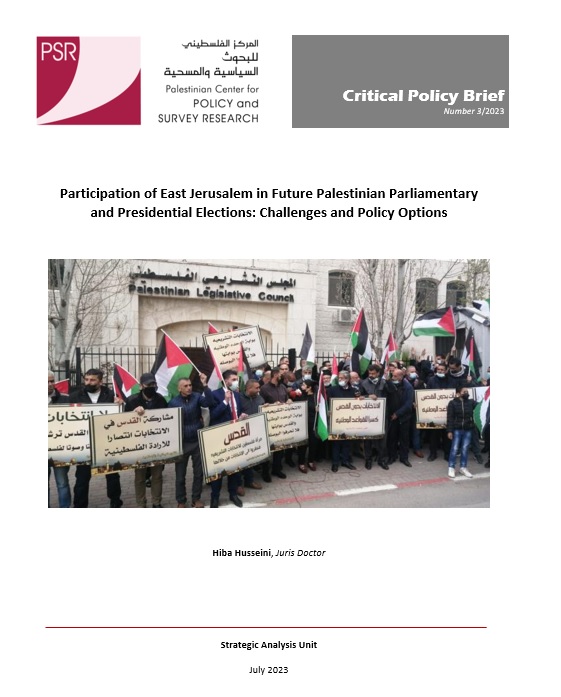 July 2023
Participation of East Jerusalem in Future Palestinian Parliamentary and Presidential Elections: Challenges and Policy Options
Hiba Husseini, Juris Doctor*
Introduction
Presidential and legislative elections for the Palestinian Authority (PA) have been held twice each since 1996, the last taking place in 2005 and 2006 respectively. President Mahmoud Abbas (who was elected in 2005 with a five-year mandate, extended in 2009) announced in 2021 that presidential and legislative elections would be held that spring and summer in Gaza, the West Bank, and East Jerusalem. The right of the East Jerusalem residents was set out in the Oslo Accords. In April 2021, however, just a month before Palestinians were due to go to the polls to elect a new Palestinian Legislative Council (PLC), Abbas announced the indefinite postponing of elections, claiming the state of Israel’s refusal to permit elections in East Jerusalem.[1] Two years on, this postponement continues, at a cost to Palestine’s voters and their rights to self-government. Many have never voted in a national election, having turned 18 after 2006.
This policy brief will highlight the critical challenges facing future elections in East Jerusalem, namely Israel’s cooperation (and lack thereof) in holding elections and political participation of East Jerusalemites (including the obstacles East Jerusalemites face in participating in the political process). It will then assess options for Palestinian policy makers and the international community to overcome such challenges.
I. Background to future elections
Rationale of postponement in 2021
When Abbas postponed elections in April 2021, he cited Israel’s refusal to allow elections in East Jerusalem. During the last round of legislative elections in 2006, Israel curtailed the election by only allowing East Jerusalemites to vote from the outskirts of the city and at post offices. With Israel’s continued occupation of East Jerusalem, and insistence that it is part of an “undivided capital” in which Palestinian political activity is banned, it is unlikely that such a compromise would have been possible had elections gone ahead in 2021. Although Israel’s foreign ministry had said that elections were “an internal Palestinian issue, and that Israel has no intention of intervening in them or preventing them,” the reality would likely be very different.[2] It is also telling that this was not accompanied with a statement of support for the right of the Palestinian electorate to elect their political representatives, or similar. Should Abbas have forged on with holding elections, knowing that no East Jerusalemites would be voting for their political representatives, it could have been interpreted as the PA accepting the illegal occupation and annexation of East Jerusalem.
Nearly all the other Palestinian factions, however, rejected Abbas’s decision. Hamas referred to the postponement as a “coup”. There is a feeling amongst some of Fatah’s opponents that Israel’s lack of cooperation is simply an excuse to cover up internal divisions within Abbas’s party.[3] He is facing challenges from various Fatah splinter groups led by individuals including Marwan Barghouti (currently serving five life sentences in an Israeli prison), Nasser al-Kidwa (nephew of Abbas’s predecessor, Yasser Arafat), and Mohammed Dahlan (a former PA security chief). Dahlan has called the postponement “illegal” and described it as an action taken by a president who has “lost his legitimacy”.[4] Barghouti, in particular, has been signaled as Palestinian voters’ preferred candidate in polls conducted by the Palestinian Centre for Policy and Research Survey.[5] It is possible that Abbas worried that a Hamas victory might split Fatah into factions, or being usurped as Fatah’s leader and the PA’s president.
The possibility of a Hamas victory may also be related to alleged international pressure to delay the elections. Al-Quds reported that Abbas faced Arab and American pressure to postpone voting, fearing a Hamas victory. [6] Hamas were triumphant over Fatah in the 2006 elections in the PA and has since 2007 been holding de facto control. Hamas however is recognized as a terrorist group by both the United States and the European Union.
II. Critical challenges of East Jerusalem elections
Israeli refusal to cooperate
The prospect of any Palestinian elections taking place in East Jerusalem in the future is mired by the continued Israeli occupation and annexation of parts of the West Bank, and the presumption that they though would interfere or prohibit elections taking place. Since 2006, Israel’s government has only increased its aggressive expansion into East Jerusalem. The most recently elected government, led by Benjamin Netanyahu, is one characterized by extreme positions on further annexation and occupation.
In the 2006 elections, the Israeli government demonstrated an unwillingness to allow free and fair elections to go ahead in East Jerusalem. Voting and polling stations were prohibited, forcing voters to cast their ballot in post offices in Jerusalem where they were supervised by Israeli police. Although the exact effect of such intimidation is unknown, one can assume that such supervision created a hostile atmosphere which discouraged democratic participation. Furthermore, all Hamas offices were raided and shut down, and Hamas candidates were denied permission to campaign.
Ahead of the expected 2021 election, the Israeli government stated that they had ‘no plan’ to intervene in the elections, but refused to comment on the status of Jerusalem, and issued no statement of support for the elections or the Palestinian community’s right to elect its representatives. This should have been the basic response to any questions on the elections. President Abbas claims that he was told directly by officials that elections would not be permitted, but this claim cannot be verified.
As current laws stand in East Jerusalem, all political activity of the Palestinian Authority is strictly banned. This, and the prohibition of Hamas campaigning and participation, is unlikely to change in the foreseeable future.
Such disruption makes future elections difficult in a multitude of ways. One can expect significant levels of disruption to any voting process, either by a repeat of the 2006 methods of displacement, or by an escalation where East Jerusalem voters are stopped from voting in the city altogether. It would not be beyond belief to assume that voters would also be prevented from travelling outside of the city to vote. This disruption would likely be partnered with a use of state violence to maximize disruption. The physical presence of Israeli forces, regardless of whether they use force or not, is an act of political intimidation. It is a visual reminder of who holds power in the city, and a psychological reminder of violence enacted by such forces in the past. Furthermore, the supervision of voting by armed Israeli police reinforces the denial of Palestinian political agency and the historic colonial stereotype that Palestine is an ‘uncivilized’ society requiring mature (i.e. Western) supervision to develop into a self-governing state, as the original League of Nations mandate designated it in 1923.
Interference may also have the effect of radicalizing the Palestinian community in East Jerusalem. The longer elections are withheld from voters, the more likely voters are to embrace non-legislative methods of change, as democratic methods are seen as hopeless.
Lack of belief in political systems
Were any elections to go ahead in East Jerusalem, there is a serious problem regarding political participation and faith in the potential of legislative change. In a survey conducted in 2022 by the Palestinian Centre for Policy and Survey Research, 93% of East Jerusalemites said they hadn’t participated in Palestinian elections. Many respondents were too young to vote in 2006. However, most crucially, only 6% said they would participate in a future election. This is a 33-point drop from the number who said that they’d participate in 2010. The fact that this problem has worsened over a decade shows growing dissatisfaction with the Palestinian Authority. There has been a 22-point increase in the perception that politicians are unimpressive and cannot help East Jerusalemites.[7] It is reasonable to assume that the postponement of elections in 2021 has only increased such concerns.
It is important to note that the decline in enthusiasm for participating isn’t matched by a corresponding rise in belief in Israeli elections. These have similar levels of participation (95% of respondents said they had not participated in Knesset or municipal elections). It is key, however, that there has been a 12-point decline in the percentage of East Jerusalemites boycotting Israeli municipal or Knesset elections on the basis that the occupation makes such authority illegitimate.[8] This may not mean such respondents now view the power as legitimate and could rather signal both a collapse in belief that boycotts are worthwhile or effective and a strengthening of the idea that East Jerusalemites should try and make things work under the current occupation.
Alongside the decline in respondents boycotting elections due to the occupation is a corresponding decline in respondents who were willing to vote in Israeli elections at the request of the PA. In 2010, 23% of respondents said they would follow the request; in 2022 only 3% would.[9] This suggests a significant collapse in the authority of the PA in East Jerusalem.
Assuming these trends would be confirmed should a presidential or legislative election be held in the near future, a turnout of less than 10% in East Jerusalem would be incredibly damaging to the legitimacy of the newly elected PA or President. It is therefore imperative to try and address such concerns ahead of an election.
In an ideal world in which the Israeli government relaxed its restrictions and allowed the elections to run, this would likely ease the view that PA officials cannot help East Jerusalem. The likelihood of this, however, is minimal. One other factor is the inability of candidates to reach East Jerusalem residents because Israel will not allow them to campaign there. Thus, their potential impact to affect them as a constituency remains ambivalent to the East Jerusalem residents. Whether such concerns will be listened to or not cannot be known. It is likely that issues of candidate quality can only be meaningfully changed over time and successive elections as officials prove themselves to voters as trustworthy and capable of making meaningful improvements to the lives of East Jerusalemites.
Other obstacles to political participation
Aside from Israeli interference and lack of belief in the systems, there are additional problems – largely associated with the occupation of East Jerusalem – which could undermine political participation in an election.
East Jerusalemites face daily infringements on their rights to freedom of movement, expression, and education. This is a powerful tool of the Israeli government to gradually diminish Palestinian’s sense of identity, self-determination, and freedom. The cumulative effect is incredibly damaging in a democracy as voters become resigned to accepting – or at least tire of protesting against – their own oppression.
Education has also been restricted and disrupted by the occupation, with particular censorship of educational materials that refer to Palestinian national identity. This poses a problem to political participation as children are not instilled with a sense of civic responsibility to participate in democratic processes.
The restriction on freedom of movement is a particular challenge. Even if limited voting was allowed in post offices, for example, this would be further restricted to those who could take time off work to travel and had the means to do so.
III. Policy options
In light of these critical challenges, there are several options available for policymakers to consider.
Postponing elections indefinitely
The first option to consider is the continuation of the status quo: an indefinite postponement of the legislative and presidential elections until elections in East Jerusalem can be guaranteed to run without significant Israeli interference.
This option should be avoided at all costs. The main reasoning for this option is that in running the elections without East Jerusalem, the PA would be, or could be understood to be, implicitly accepting Israel’s illegal occupation and abandoning the rights of East Jerusalemites.
In making a stand against Israeli interference, however, the PA ensures that the rest of the Palestinian electorate is continued to be deprived of their right to self-determination and participation in elections. The effect of this could be catastrophic. Hamas has already won the previous PA elections, and Fatah risks alienating itself further from the electorate, particularly if they are considered to have acted in their own self-interest. As critics said after the postponement, Fatah can be accused of effectively allowing Israel to hold a veto over Palestinian elections.[10]
Furthermore, the PA must demonstrate it can run a functioning government – that follows international law - and regular elections. This is essential to both bolster domestic support against Israeli occupation, and unite Palestinians behind their own institutions, but also to garner international support as a self-governing nation and an equal player to Israel.
The basic fact remains that elections have not happened since 2006, and a significant portion of the Palestinian electorate is aged between 18 and 34, meaning they have never voted in Palestinian elections. This is an unacceptable reality that ensures ongoing political disillusionment and weakens the legitimacy and therefore authority of the PA.
Holding elections without East Jerusalem
There are several alternatives to the indefinite postponement. The first is to push ahead with both legislative and presidential elections irrespective of whether Israel allows them to be held in East Jerusalem. As aforementioned, there are obvious downsides to running an election knowing a significant number of voters likely will not get to vote. It is unfortunate that in this case the PA could be seen as being responsible for denying its population a vote.
However, it is crucial that the PLC sits, and that a President is elected with a new mandate. Having proof that the vote was suppressed could provide the newly elected PLC a strong starting point in establishing a robust policy agenda that stands up to Israeli aggression. Symbolic actions could be taken to represent the missing representatives from East Jerusalem, such as leaving seats empty.
Holding elections with East Jerusalem
Another option is to not only push ahead with elections but also attempt some form of a vote in East Jerusalem. This was the preferred option for Hamas in 2021. The Palestinian Central Elections Commission stated days before Abbas’ decision that it believed nearly 150,000 eligible Palestinian voters from East Jerusalem suburbs (almost half the city’s Palestinian population) wouldn’t depend on Israeli approval to vote.[11] This could be a powerful moment of resistance if numbers that large showed up to vote despite Israeli threats.
However, this could be a dangerous act of provocation that results in violence across Jerusalem and potentially elsewhere. It would likely see the mass arrests of anyone attempting to facilitate elections in East Jerusalem. This would not only be a strong psychological defeat for the PA but could also further destabilize the PA if large numbers of officials were detained, preventing the PA’s operational capacity.
Encouraging Israeli co-operation
The ideal scenario would, of course, be one in which Israel allowed a full, free, and fair vote to happen in East Jerusalem. To enable this to happen would likely need much stronger international pressure on Israel to allow the elections, and greater commitments to defending the Palestinian population’s right to democracy. This could take the form of the international community committing to work with the elected authority (likely with the caveat that they must follow international law). This commitment would probably be essential to garner the support of international groupings like the EU which considers Hamas a terrorist group. To gain US support, an election would probably have to be held sooner rather than later whilst the Democrats still hold the presidency, as the return of Donald Trump (or similar candidate) to the White House would presumably see an even stronger pro-Israel position.
The international community would have to be clear in setting out consequences should Israel interfere with elections; consequences that must be enforced resolutely if necessary. As Abbas himself pointed in his May 2023 speech to the UN on the 75th anniversary of the Nakba, there have been over one thousand UN resolutions on Palestine but not one has ever been implemented.[12] If the international community could set out consequences and see them through, it could be a critical moment for restoring a sense of trust in international institutions.
This option faces significant feasibility problems. Palestinian policy makers cannot force international actors to pursue this line of action. The international community is currently largely focused on the war in Ukraine and Palestine is not seen as a high priority. It could be where they focus their lobbying and diplomatic efforts, however, as this is the option which would most likely force Israel’s cooperation.
Addressing other motivations for the delayed elections
All the of the options above rest on the assumption that Abbas was honest in his reasoning for delaying the elections. Assuming, however, that his critics are correct in highlighting fears over a Hamas victory and potential challenges from within Fatah, then there are more feasible options for policy makers to consider.
Already Fatah and Hamas have taken steps to improve conditions between them; as of 2022 all 14 factions have agreed to hold national elections within a year. [13] Statements from Fatah and Hamas both promised that this will not be another broken promise, but only time will tell. Policy makers could also apply pressure to Hamas and any other faction that advocates violence as a political tool to commit to following international law if elected.
The internal Fatah split is not something that could be directly addressed by policy makers, but they could apply pressure to Fatah to put the country before the party, which may reap rewards.
Addressing political participation
As shown in Part I, even if elections were held, the PA faces an underlying fault line in the lack of political participation in East Jerusalem. It is hard for policy makers to try and address this without a firm promise that elections would be held in the future. Problems of restricted rights, particularly to movement, political organization, and education are particularly insidious to deal with. One area that could be addressed, however, is the one of corruption and trust in politicians. Policy makers could focus energy on ensuring greater responsibility and accountability in government, thereby gradually building trust in the politicians and institutions.
IV. Conclusion
The prospect of future elections in East Jerusalem and wider Palestinian is a bleak one. The PA are staring down two separate fronts: Israel and political apathy. Both must be removed or addressed in order for elections to be held successfully.
In the short term, policy makers should focus the majority of their efforts in convincing Fatah to hold some form of election as soon as possible, with or without Israel’s approval. Lobbying the international community for greater support could also reap rewards, although the likelihood of any significant shift in the status quo is minimal. In the long term, policy makers must address serious apathy to political participation. Running an election would partially reduce this apathy, but it would not resolve it completely.
*** “Special thanks from Hiba Husseini for the research and writing provided by Ms. Iona Clark, Candidate, MPhil at Cambridge in Politics and International Studies.”
[1] European Council on Foreign Relations, ‘Mapping Palestinian Politics’. https://ecfr.eu/special/mapping_palestinian_politics/elections-2021/
[2] Abbas delays Palestinian parliamentary polls, blaming Israel, Al Jazeera, 20 April 2021. https://www.aljazeera.com/news/2021/4/30/palestinian-factions-reject-abbas-decision-to-delay-polls
[3] Ibid, Palestinian leader delays parliamentary and presidential elections, blaming Israel, Reuters, 30 April 2021. https://www.reuters.com/world/middle-east/palestinian-elections-delayed-says-president-mahmoud-abbas-2021-04-29/
[4] Abbas delays Palestinian parliamentary polls, blaming Israel, Al Jazeera, 20 April 2021. https://www.aljazeera.com/news/2021/4/30/palestinian-factions-reject-abbas-decision-to-delay-polls
[5] Palestinian Centre for Policy and Survey Research, Public Opinion Poll No (86), 7 December 2022. https://pcpsr.org/en/node/926
[6] Abbas delays Palestinian parliamentary polls, blaming Israel, Al Jazeera, 20 April 2021. https://www.aljazeera.com/news/2021/4/30/palestinian-factions-reject-abbas-decision-to-delay-polls
[7] Palestinian Centre for Policy and Survey Research, A Special East Jerusalem Poll:
Comparing the Results of 2010 and 2022 Polls. https://pcpsr.org/en/node/931
[8] Ibid.
[9] Ibid.
[10] Abbas delays Palestinian parliamentary polls, blaming Israel, Al Jazeera, 20 April 2021. https://www.aljazeera.com/news/2021/4/30/palestinian-factions-reject-abbas-decision-to-delay-polls
[11] Jørgen Jensehaugen and Erling Lorentzen Sogge, ‘The Palestinian elections that weren't’, The Loop. https://theloop.ecpr.eu/palestinian-elections-hang-in-the-balance/
[12] ‘Marking Anniversary of Nakba, President Tells Palestinian Rights Committee ‘Tragedy Constitutes a Scar on Humanity’’, Committee on the Inalienable Rights of the Palestinian People, UN Meetings Coverage, 15 May 2023. https://press.un.org/en/2023/gapal1453.doc.htm.
[13] Lamine Chikhi and Nidal Al-Mughrabi, ‘Palestinian rivals agree to hold elections but doubts persist’, Reuters, 13 October 2022. https://www.reuters.com/world/middle-east/palestinian-rivals-agree-elections-end-dispute-doubts-persist-2022-10-13/
 January 2021
Can a Newly Elected Parliament Repair the Damage Done to the Palestinian Political System in its Absence?
agenda for political reform
Khalil Shikaki
In mid-January 2021, president Abbas issued a decree calling for holding parliamentary elections on 22 May. It is not certain that any elections will take place in the near future and the goal of holding such elections, if they do take place, is almost certainly not the reform of the political system. Indeed, the goal most emphasized by Palestinian leaders, from Fatah and Hamas alike, is “the unification of the Palestinians people.” Nonetheless, it is essential to explore the implications of the revival of a parliamentary life, in the form of an elected PLC, on the prospects for reform even if elections do not take place soon. Once a Palestinian parliament is created, the political system will find it impossible to continue its current slide to authoritarianism.
The paper outlines the main target areas of reform which the council should focus on from the first day of its existence. Doing so is critical to the success of the parliament in making itself a strong and effective public institution, one capable of representing the public that elected it and delivering on its promises to that public. The paper outlines the expected challenges that will confront the parliament as it sets its own agenda. If not addressed, these challenges can impede the parliament’s efforts to accomplish its mission in bringing accountability back into the Palestinian political system. Based on that review, the paper proposes a list of reform priorities that are relevant to parliament’s own role and function but can also have a multiplying effect on the entire political system. Despite their importance, this policy paper does not directly address highly relevant domestic issues, such as those dynamics that led to the split between the West Bank and the Gaza Strip, how to reform the Palestine Liberation Organization (PLO), what to do about the Palestinian regional problems or how to improve relations with Israel. Instead, it is restricted to those political issues that are directly related to the reform of the political system and particularly those that require parliamentary intervention. Moreover, in outlining the challenges and impediments to reform, the paper is focused essentially on the functioning of the Palestinian Authority (PA) in the West Bank and does not directly address the Hamas’ practices in the Gaza Strip, despite the fact that these practices have been more determinantal to the future of accountability in the political system.
Challenges: evidence of authoritarianism in the Palestinian Political System, 2007-2021:
In the past several years, the PA in the West Bank has taken several measures that have severely undermined good governance. Four areas have been damaged: the separation of power, the independence of the judiciary, the independence and pluralism of civil society and its organizations, and the media and freedom of expression. These areas should constitute the reform agenda of a newly elected PLC.
Without general elections since 2006, the impact of the four measures on PA institution building and governance has been destructive: rule of law has been sacrificed, the judiciary has been weakened and its independence damaged, media freedoms have been highly curtailed, and the space for civil society has significantly shrunk as its organizations lost much of its independence from the government. The behavior of the Hamas government in the Gaza Strip has not been better, indeed worse; it was more ruthless and much less bothered by constitutional principles and norms or even rule of law.
Diminished Accountability and Oversight:
The suspension of the activities of the Palestinian Legislative Council (PLC) in the West Bank in 2007, in the immediate aftermath of the Hamas violent takeover of the Gaza Strip, has been one of the most damaging governance measures taken by the PA since its creation. But the clearest evidence of the slide to authoritarianism has been the decision taken by the party that lost the 2006 elections, Fatah, to dissolve the PLC in 2018. The inevitable outcome of the suspension of the PLC meetings has been the transfer of its legislative and oversight functions to the executive authority represented by the president. Since 2007, president Abbas issued more laws by decree than those ever issued by the PLC during its entire life since the first election in 1996. Most of these laws were not urgent, as required by the Basic Law, and many of them violated the terms of that law. In the absence of a parliament, the president gave himself the power to rule by decree without accountability or oversight, with the exception of the little opposition expressed occasionally by the judiciary, the media, and civil society before they too came under the heavy hand of authoritarianism. Without a parliament able to defend its members, the president gave himself the power to annul the immunity of the PLC members, to suspend the payment of their salaries, to send them to court, and to close their offices ending eventually in his decision in December 2018 to dissolve the entire PLC utilizing for that mission the services of a body he created for that purpose, the constitutional court.[1]
Without a parliament during the period between 2007 and 2021, the Palestinian public has been denied the ability to influence legislation directly affecting their life; the political system become devoid of any formal accountability. If the PLC comes back to life soon, it will be up to it to accept or reject all those laws decreed by the president. The new parliament should also determine its own priorities in strengthening and fortifying legislative texts that the executive has managed to undermine in order to grant the president powers he did not have, such as the ability to issue normal laws by decrees during the period in which the parliament was not in session or the ability of the president and the institutions he created, such as the constitutional court, to commit grave constitutional violations.
The Diminished Independence of the Judiciary:
The need to ensure regime security in the West Bank in the aftermath of Hamas’ violent takeover of the Gaza Strip provided the initial impetus to the drive to weaken the independence of the judiciary. The PA crackdown on Hamas’ military, financial, religious and political infrastructure in the West Bank aimed at destroying or weakening its organization but lacked legal justification and entailed significant violations of human rights and rule of law. The PA wanted to prevent a Hamas takeover of the West Bank, one similar to what that movement did in the Gaza Strip. When the judiciary intervened in order to impose restraint, the PA security services, which carried out most of the crackdown, simply ignored its rulings, and it got away with it. While the Palestinian Basic Law defines failure to implement court decisions by PA officials and security services as a “crime punishable by imprisonment and dismissal,” rulings by the highest court, the High Court of Justice, demanding the release of detainees, were routinely ignored by the security services. In fact, between 2007 and 2009, the PA formed military courts to try civilians. Only in early 2011, right after the eruption of the Arab Spring, did the PA stop the practice of sending civilians to military courts and began to show a little more attention to court rulings.
The attacks on the judiciary however became much more serious during the past five years. In the conflict between president Abbas and Mohammad Dahlan, the former head of the Preventive Security apparatus, the president sought a judgement from the courts accusing the latter of corruption. In order to force Dahlan, a member of the PLC, to face the court, Abbas, gave himself the right to annul the immunity of a members of the parliament. When the high court objected, deeming such a step unconstitutional, the president turned his attention in October 2016 to the judiciary, dismissing the Chief Justice and appointing a new one. In doing so, he explicitly violated the Basic Law and the Law of the Judiciary. Seeking a stamp of approval that would legalize his actions, the president amended the constitutional court law that then allowed him to form a court to his own liking[2]. In November 2016, the newly established body, the Constitutional Court, did what was expected: rubber stamped all decisions taken by Abbas regarding Dahlan and the judiciary. Abbas went further: in December of that year, the president annulled the immunity of four other pro-Dahlan members of the PLC, all from his own Fatah party.
Despite Abbas’ failure in mid-2017, under pressure from civil society, to amend the law of the judiciary in a manner that would have given him effective control over that institution, he did impose his control in violation of that law. Moreover, in 2019 he dismissed the Supreme Judicial Council (SJC) and appointed a transitional council in a clear violation of the Basic Law and the law of the judiciary. This was followed in January 2021 by a presidential decree that did finally amend that law in such a manner that provided him all the control he needed over the appointment of the Chief Justice, head of the high court and the head of the SJC. The amendment allowed the dismissal of the judges and forcing them into retirement.[3]
All measures taken by the president regarding the judiciary and PLC members, including the establishment of the Constitutional Court, were condemned by all mainstream civil society groups, including all human rights groups and the Independent Commission for Human Rights (ICHR), expressing shock at the manner in which the president acted and labeling his measures unconstitutional. It goes without saying that an executive control over the judiciary could dimmish the ability of the PLC to reform the Palestinian political system. Therefore, defending the judiciary by rejecting the amendments decreed by the president must be a top priority for the newly elected parliament. The PLC must also reject all changes made by the president on the constitutional court law and work closely with the judiciary and the executive to ensure the full independence of that court by disbanding the current court and establishing a new one made up by judges and professor of law with a record of integrity and independence.
Weakening the independence and pluralism of civil society:
After the first wave of attacks on civil society, which targeted Hamas’ infrastructure between the years 2007 and 2009, a second wave started in 2015, this time targeting the larger civil society. The PA’s new campaign started with the confiscation of funds belonging to an NGO established two years earlier by former Prime Minister Salam Fayyad. This was followed by government decision to amend existing regulations governing the funding of Palestinian NGOs established under the non-profit companies (NPC) laws. The amended regulation instructed all NPCs to obtain “prior approval” from the cabinet before they could conduct any activities or receive any funding from local or foreign donors for their projects. In one government decision, the PA asserted its control over about 300 such civil society institutions and deprived them the ability to work without an approval from the executive despite the fact that they were operating under the terms of the law that led to their establishment. None of the existing laws in the PA grant the executive such overriding jurisdiction over civil society. The new regulation was clearly illegal and in violation of the Basic Law. Instead of serving the interests of the public they serve, the government wanted these NGOs to follow its own instructions by controlling their activities and funding. They could only function if the government approves their plans and donors. All banks operating in Palestine were instructed to reject any fund transfers to the accounts of these NGOs without a written permission form the cabinet.
The inevitable result of the government regulation has been the destruction of pluralism in Palestinian civil society. By making all non-profit companies subject to direct PA control using the threat of possible denial of approval as a tool of intimidation, the PA diminished the independence of these institutions making them less able to represent their constituencies. All Palestinian civil society and human rights organizations, without exception, opposed the new regulation, considering it a violation of the law and an attempt by the PA to restrict the ability of NGOs to operate outside the boundaries set for it by the government thereby shrinking the space for civil society.[4]
Civil society constitutes an important institution that supports and supplements the oversight responsibility of the parliament. In weakening it, the PA weakens the PLC’s role in bringing the government to accountability. In the absence of a parliament between 2007 and 2021, civil society organizations served an important role in setting limits on the PA slide to authoritarianism. It should be one of the priorities of the newly elected parliament to ensure the annulment of regulations that violate the law and restrict the ability of civil society organizations to play their role in strengthening other public institutions while ensuring an independent and pluralistic civil society. One of those regulations should be the one introduced in July 2015 that requires a prior government approval of the activities and the funding of non-profit companies.
Targeting the Media and free speech:
In the years immediately following Hamas’ violent takeover of the Gaza Strip, dozens of journalists were arrested in the West Bank and the Gaza Strip for expressing their views and many more were beaten while covering demonstrations and other expressions of protest against the PA or the Hamas government. The PA has gone further in 2017: with little or no consultation, the president issued a cybercrime law. The law regulates online activities, media websites, and social networks, imposing jail time and fines on those violating public order or inciting hatred. Journalists and normal citizens paid a price for expressing their own views as more arrests followed the publication of the law. Responding to a huge public outcry, the president and the government introduced various amendments and re-introduced the law again in 2018. Despite positive changes in the new law, it still continued to “criminalize acts and writings that should come under free speech.”[5] It continued to use open-ended terms, such as those used in article 39: “national security or public order or public administration” when providing justification for closing or blocking access to websites. In implementation of this article, the PA blocked access on October 2019 to 59 sites, added to another 30 that were blocked in 2017.
The newly elected parliament should strive to protect liberties and ensure the rights of the opposition, the media, and normal citizens by amending the 2018 cybercrime law by removing all these open-ended terms and by restricting the jurisdiction of the executive in blocking access to websites. It should ensure the privacy of users of the internet and social media.
Sources of Palestinian Authoritarianism
Before embarking on any serious reform effort pertaining to the previous four reform agenda, the PLC should ask itself how we arrived at this point of slide to authoritarianism: how did the PA manage to undo much of the progress it built in the first half of its existence? Without a full understanding of the forces and dynamics that brought us to where we are today, the PLC will not be able to realize and appreciate the impediments it will confront in the first day of its existence. On that day, it will have to decide whether it too wants to respect and implement the rules set by the Basic Law or put them aside as the executive authority did since 2007 claiming various justifications, such as the need to confront the consequences of the split triggered by Hamas’ violent take over of the Gaza Strip. Some of the forces and circumstances behind the Palestinian grave failure to respect the legacy of those who preceded us are obvious and have already been mentioned while others are not so obvious. The following is a list of four sources that brought us to where we are today.
The Split: The first and most obvious source of authoritarianism goes back to mid-2007, in the form of measure put in place in response to Hamas’ use of force in the Gaza Strip against forces loyal to President Mahmoud Abbas. This armed coup against the PA president, and the decisions made by Abbas immediately after the coup, led to the current political split that added further agony to the existing geographic separation between the two Palestinian regions of the West Bank and the Gaza Strip. In response to Hamas’ coup, Abbas dismissed the National Unity Government, which was led at that time by Hamas’ Ismail Haniyeh, formed a new government led by Salam Fayyad, and prevented the PLC from holding its meetings in the West Bank. This led to the creation of two governments, one in the Gaza Strip, the dismissed or caretaker government led by Haniyeh, and one in the West Bank, led by Fayyad. Fayyad’s government never obtained a parliamentary vote of confidence as required by the Basic Law. The absence of a parliamentary approval for the Fayyad government provided the Haniyeh government with the legal justification to remain in office for the entire period between 2007 and 2014, when it finally resigned in the aftermath of the formation of the “reconciliation government” led by Rami Al Hamdallah. In late 2018, the failure of the reconciliation government to unify the West Bank and the Gaza Strip played a role in heightening tensions between Fatah and Hamas leading Fatah’s Revolutionary Council (the elite of the party that lost the 2006 elections) to demand from the PLO Central Council (an unelected body) the dissolution of the elected PLC, a clear indication of the extent to which the split has destroyed Palestinian political norms.
Intra-Fatah rivalry: In the last five years however, the slide to authoritarianism has received a greater impetus from a second source: the heightening of internal power struggle inside Fatah, particularly the conflict between President Abbas and Mohammad Dahlan. Between 2011 and 2014, this internal power struggle led, under Abbas’ instructions, to the expulsion of Dahlan and several other senior Fatah leaders from the Fatah movement, mostly from the Gaza Strip. However, during the period between 2015-19, the conflict spilled into the larger arena of the PA and its political system. The impact has been huge: PLC members were intimidated and their ability to criticize the executive significantly curtailed; the judiciary was brought under control and further stripped of its independence; civil society was weekend and forced to play by rules set by the executive; and the media, including social media, was brought under severe restrictions and forced to exercise self-censorship. Because of that and given prevailing apathy in the street, as people were busy struggling to make a living or respond to greater repression from the Israeli occupation and its settlers, the PA became much bolder in ignoring the Basic Law and rule of law and more open in strengthening the institution of the presidency and the executive as a whole while weakening all opposition including that of civil society.
The nature of the Palestinian ruling elite: The third source of authoritarianism came from the Palestinian political elite, particularly those staffing the executive. There is no doubt that many of the elite (particularly among the Islamist one) are anti-democratic. Nonetheless, most are simply non-democratic. The real problem lies in the fact that only few of the members of the secular nationalist elite and almost none of the Islamist elite are truly democratic. Without the breaks normally found among democratic elites, the senior Palestinian bureaucracy in the executive branch found itself free of any meaningful oversight. Without restrictions on its ability to rule as it saw fit, members of the PA cabinets, find it easier to rule without being bothered by courts, civil society, or the media.
The task of the current PA elite is made easier by the absence of an effective opposition from within and outside Fatah. The replacement of Prime Minister Salam Fayyad with al Hamdallah in 2013 accelerated this process and played a significant role in facilitating the slide to authoritarianism. The opposition to the Fayyad government from within Fatah imposed constraints on its ability to work without accountability and many of its own members, including the prime minister, built a barrier that contributed to slowing down the rush to authoritarianism. On top of its own authoritarian instinct, the Hamdallah cabinet seemed unwilling to question measures instituted by Abbas and the PA security services to undermine rule of law or weaken civil society and indeed to restructure the entire political system. Instead of correcting the PA direction, Fatah’s own political elite, not only in its Central Committee, but also in its Revolutionary Council, became apologists for the slide to authoritarianism justifying it on grounds of the split or a preoccupation with standing up to the Israeli occupation. This elite behavior demonstrated how empty and fake the calls for democracy that Fatah and other nationalist and Islamist movement pretended to embrace. This does not mean that these movement are essentially anti-democratic. But it means that the political leaderships and elite members of these movements, unlike their own base, find it easier and more natural to be authoritarian in the absence of accountability and oversight.
The diminishing role of the international community: With little or no attention from the international community, the PA has over the last decade, particularly since the Arab Spring, become bolder in ignoring its own Basic Law and rule of law while seeking to strengthen the power of the presidency and the executive as a whole and to weaken all opposition, including that of civil society. The international community seems much less interested in Palestinian good governance. American and European diplomats stationed in the Palestinian territories argued that due to rise of Islamism, civil wars, terrorism, and sectarianism in the post-Arab Spring environment, a focus on stability is replacing the traditional agenda of democracy and good governance. Moreover, given the failure of the international community to take a strong stand or concrete measures against Israeli settlement policy, the major international actors are reluctant to press the PA—which remains committed to the two-state solution-- on domestic issues. One should also keep in mind that having reduced its own financial support to the PA by almost half during the past decade, the international community has lost considerable leverage. It is not surprising that this loss of leverage has been accompanied by a gradual detachment from Palestinian governance. Rule of law and good governance is no longer a priority for any of the major donor countries.
This policy brief started with a skeptical view regarding the prospect of holding Palestinian legislative elections any time soon. However, the skepticism did not stop it from looking for ways in which elections, if they were held, can be capitalized on to serve the interests of Palestinian society, particularly in the area of political reforms. The previous analysis described the various indications of the slide to authoritarianism in the Palestinian political system and the four drivers of this slide. This analysis gave implicit support to the skeptical view by raising various indications questioning the seriousness of the PA leadership and the main Palestinian political parties in holding elections.
For the Palestinian political system to exit the current slide to authoritarianism and to be able to stand on a solid ground for a transition to good governance, it will be essential for all public institutions to work in harmony, including the legislature, the executive, the judiciary, civil society, and the media. The discussion in this paper has been restricted to the role of the PLC, once elected, because it will represent the aspiration of the Palestinian people and its civil society to build a political system characterized by accountability and rule of law.
During the years of the split, Palestinians discovered that they are not different from the rest of the Arab peoples, leaders, and political parties despite their own unique experience of living under occupation and in exile. Moreover, they discovered that they too are not much different than other Arab masses that tolerated oppression and authoritarianism for decades before the eruption of the Arab Spring in 2011. The Arab Barometer’s fifth round, conducted in Palestine around the end of 2018, found that only one third of the Palestinians trust their own government, that the majority does not believe that it has guarantees of freedom of expression, and 83% said there is corruption in the PA public institutions. Despite the fact that the overwhelming majority agrees that “democracy, despite its problems, is the best system there is,” about three quarters describe the status of democracy in Palestine as bad or very bad. Yet, no more than one third indicate that they participate in some kind of opposition activities.[6]
The holding of legislative (and presidential, at a latter stage) could provide the Palestinian public with the ability to make a difference and institute the change they have always aspired for through a widespread participation in these elections. Once a parliament is elected, it will have the mandate required for reforms thereby providing a solid ground for the PLC to take up the four areas of reform agenda covered in this paper. In order to succeed in its efforts to reform the PA, the PLC will have three effective tools in its arsenal: amending the Basic Law, reviewing, amending or rejecting selected laws issued by presidential decrees, and forcing a newly established government to amend or cancel anti-democratic regulations adopted by previous governments.
- Amending the Basic Law: This measure will be the most difficult because it is not clear that the PLC will have the majority needed to approve the proposed amendments. Nonetheless, it will be valuable for the parliament to open a debate on the need to transform the Palestinian political system into a parliamentary one or at least to take steps to decrease the powers of the office of the president so as to remove any ambiguity about the ability of a president to issue legislation during the absence of the parliament and put in place greater protection for the immunity of its members. It should ensure that the president does not have the capacity to make top senior appointments in the public sector without explicit parliamentary approval, that the executive cannot take away jurisdiction belonging to the judiciary, that free speech is guaranteed, and that the space available to civil society is not shrunk and their activities curtailed or controlled. The amendments and clarifications must make it clear, beyond any shadow of a doubt, that a government that does not receive a parliamentary vote of confidence is illegitimate and its decisions invalid.
- Rule by decrees: The Palestinian political system should not tolerate rule by decree. The PLC should review, amend, or reject in its first session all those laws issued by decree that have caused great damage to the principle of separation of powers or violated the terms of the Basic Law, including those affecting the judiciary, the constitutional court, the cybercrime law, and others.
- Illegal governmental regulations: The PLC should also reject all those decisions and orders issued by the various PA governments since 2007 that violated the separation of powers and represented an attack on the jurisdiction of the parliament, such as the amendment introduced in 2015 to the regulations governing the functioning of the non-profit companies.
[1] For more details on the suspension of the PLC activities, see a paper by Salah al Wadya on the impact of the split on the PLC: "أثر الانقسام السياسي على المجلس التشريعي الفلسطيني،" أبريل 25, 2018، https://icspr.ps/ar/?p=1644 ،22.12.2018.
See also, قانونيون ونواب لـوطن: قرار حل التشريعي غير قانوني وخطير
https://www.wattan.net/ar/news/271807.html
المركز الفلسطيني لحقوق الانسان: العملية التشريعية والرقابة البرلمانية خلال فترة الانقسام السياسي الفلسطيني ( من يونيو 2007 وحتى أغسطس 2012 )
http://www.pchrgaza.org/files/2012/bookPCHR12-2012.pdf
و "مفتاح، تقرير أداء المجلس التشريعي الفلسطيني 2009":
http://www.miftah.org/Publications/Books/The_Performance_of_the_Palestinian_Legislative_Council4.pdf
[2] See the letter sent to president Abbas by the Independent Commission for Human Rights and a group of civil society organizations requesting the withdrawal of the amended law of the constitutional court and viewing the changes decreed by the president as an effort to impose the hegemony of the executive over the other branches of the PA and a challenge to the independence of the judicial authority “in violation of the PA priorities of rule of law and separation of power:”
الهيئة المستقلة لحقوق الانسان 'ديوان المظالم' - مواضيع مهمة (ichr.ps)
[3] For more details on the efforts of the president and the executive to weaken the judiciary, see the following:
"نقابة المحامين ومؤسسات المجتمع المدني وفصائل يطالبون بإلغاء القرارات بقوانين الاخيرة المتعلقة بالقضاء ويؤكدون ان ما يحدث هو جريمة بكل المقاييس"، كانون ثاني (يناير) 2021
https://www.wattan.net/ar/video/330598.html
"بيان صادر عن المؤسسات الحقوقية ومؤسسات المجتمع المدني نحو تعزيز واستقلال السلطة القضائية." أكتوبر 2016:
http://www.istiqlal.ps/?q=node/101
عصام عابدين، "ملاحظات على القرار بقانون بتعديل قانون المحكمة الدستورية العليا"، الحق، مارس 2013:
https://www.alhaq.org/ar/publications/7933.html
"المركز الفلسطيني لحقوق الانسان: شريعة القانون أم شريعة الغاب، المركز يقرع ناقوس الخطر: استقلالية القضاء الفلسطيني في مهب الريح،" 2016
http://pchrgaza.org/ar/?p=12844
الهيئة المستقلة لحقوق الانسان: مذكرة للرئيس الفلسطيني لسحب قراره المُعدِّل لقانون المحكمة الدستورية، 2016
وانظر كذلك نص المذكرة القانونية حول القرار بقانون رقم (40) لسنة 2020 بشأن تعديل قانون السلطة القضائية رقم (01) لسنة 2002 التي أصدرتها الهيئة والائتلاف الأهلي لإصلاح القضاء وحمايته تعرب فيها عن أسفها لإصدار القرار بقانون المعدل لقانون السلطة القضائية وذلك لأن هذا القرار ينسف جهود الإصلاح القضائي، ويعزز من هيمنة السلطة التنفيذية على القضاء، إضافة إلى مساسها الخطير باستقلال القاضي الفرد، "في انتهاك واضح لمبادئ سيادة القانون، والفصل بين السلطات، واستقلال القضاء، التي يقوم عليها النظام الدستوري الفلسطيني وفقاً لما جاء في القانون الأساسي المعدل لسنة 2003 وتعديلاته"، وطالبت بالإلغاء الفوري لهذه القرارات، وتشكيل مجلس قضاء أعلى دائم وفقاً لقانون السلطة القضائية رقم (01) لسنة 2002. وانظر أيضا: الهيئة المستقلة" تطالب بالإلغاء الفوري للقرارات بقوانين الأخيرة المتعلقة بالشأن القضائي، 9.01.2021
[4] See statements by al Haq, and the Palestinian Center for Human Rights and the Independent Commission for Human Rights:
قراءة في تعديلات نظام الشركات غير الربحية وعلاقتها بالمنظمات الاهلية، أغسطس 2015:
https://www.alhaq.org/ar/publications/7929.html
المركز الفلسطيني لحقوق الانسان: التقرير السنوي 2016.
http://pchrgaza.org/ar/wp-content/uploads/2017/10/Annual-report-arabic2016.pdf
"بموجب مذكرة قدمتها لرئيس الوزراء الهيئة المستقلة تطالب مجلس الوزراء التراجع عن القرارين (7) و(8) لعام 2015 بنظام معدل لنظام الشركات غير الربحية رقم (3) لسنة 2010",
[5] See the statement issued by the Independent Commission for Human Rights: "الهيئة ترحب بصدور القرار بقانون رقم (10) لسنة 2018 بشأن الجرائم الإلكترونية وتقدم مجموعة من الملاحظات والتحفظات"، آيار 2018
الهيئة المستقلة لحقوق الانسان 'ديوان المظالم' - الهيئة ترحب بصدور القرار بقانون رقم (10) لسنة 2018 بشأن الجرائم الإلكترونية وتقدم مجموعة من الملاحظات والتحفظات (ichr.ps). See also, statements issued by al Haq and Mada: : الحق: الانقسام الفلسطيني صفحة سوداء في مسار الحقوق والحريات، نوفمبر 2011
https://www.alhaq.org/ar/publications/7945.html
الهيئة المستقلة لحقوق الانسان: الهيئة المستقلة لحقوق الإنسان تعبر عن قلقها لتزايد توقيف واحتجاز مواطنين على خلفية الرأي والتعبير والعمل الصحافي، فبراير 2016
مدى: انتهاكات الحريات الإعلامية في فلسطين التقرير السنوي 2017. ص31- ص44:
http://www.madacenter.org/images/text_editor/annualrepA2017.pdf
Joint Israeli Palestinian Poll, December 2008
Following Obama’s Election, Palestinians and Israelis Seek a more active role of the US in Moderating the Conflict
Among other findings of the joint Truman-PSR poll: both publics support continuation of the cease-fire agreement between Hamas and Israel. Only about a quarter of Israelis support reoccupation of the Gaza Strip if shelling of Israeli communities continues
November 26-December 5, 2008
These are the results of the most recent poll conducted jointly by the Harry S. Truman Research Institute for the Advancement of Peace at the Hebrew University of Jerusalem and the Palestinian Center for Policy and Survey Research in Ramallah, between November 26 and December 5, 2008. This joint survey was conducted with the support of the Ford Foundation Cairo office and the Konrad Adenauer Stiftung in Ramallah and Jerusalem.
Following the election of Obama for president, a majority of the Palestinians and half of the Israelis want the US to play a more active role in moderating the conflict. Half of the Israelis and half of the Palestinians think that a more active American involvement will be successful, whereas the other half splits between expecting it to have no impact or to fail. Nevertheless both sides expect no change in the US role in the conflict. While the Israelis expect no change in US military economic and political support of Israel, the Palestinians expect that US support of Israel will strengthen.
Our poll also examined both publics’ attitudes toward the Arab League (Saudi) plan, given the recent public diplomacy campaign by the PLO negotiation team which published the full plan in Israeli newspapers in order to increase Israelis’ awareness of the plan. Only 25% of the Israelis reported having seen the ad. Following this public diplomacy initiative the level of support for the plan remained stable: 36% of the Israelis support and 61% oppose the plan now, while in September 38% supported and 59% opposed the plan. Among Palestinians 66% support the Arab League plan and 30% oppose it.
With regard to the cease fire with Hamas, support is slightly down compared to three months ago: 51% of the Israelis support its continuation and 44% oppose it; among Palestinians, 74% support and 23% oppose the continuation of the cease fire agreement.
The joint poll examined Israelis’ and Palestinians’ expectations and assessments of the US policy toward the conflict, following the election of President Obama. The poll also examined various negotiation tracks including the Israeli-Palestinian track, the Israeli-Syrian track and the Saudi (Arab League) plan currently on the public agenda; threat perceptions, support of violence, and domestic political affairs.
The Palestinian sample size was 1270 adults interviewed face-to-face in the West Bank, East Jerusalem and Gaza Strip in 127 randomly selected locations between December 3 and December 5, 2008. The margin of error is 3%. The Israeli sample includes 600 adult Israelis interviewed by phone in Hebrew Arabic or Russian between November 26 and December 2, 2008. The margin of error is 4.5%. The poll was planned and supervised by Dr. Yaacov Shamir, the Harry S. Truman Research Institute for the Advancement of Peace and the Department of Communication and Journalism at the Hebrew University, and Dr. Khalil Shikaki, director of the Palestinian Center for Policy and Survey Research (PSR).
For further details on the Palestinian survey contact PSR director, Dr. Khalil Shikaki or Walid Ladadweh, at tel. 02-2964933 or email pcpsr@pcpsr.org. On the Israeli survey, contact Dr. Yaacov Shamir at tel. 03-6419429 or email jshamir@mscc.huji.ac.il.
MAIN FINDINGS
(A) Expectations regarding the US policy toward the conflict following the election of Barack Obama for President
- 49% of Israelis and 57% of Palestinians want a more active role for the US in the conflict following the election of Obama for president. 31% of Israelis do not want the US to intervene, and 18% want the US to continue to play its current role in the peace process. 35% of Palestinians do not want the US to intervene, and only 4 % want it to continue to play its current role.
- As to the results of such an involvement, 49% on both sides expect it to be successful, while 22% of Israelis and 30% of Palestinians think it will be a failure, and 23%of Israelis and 16% of Palestinians think it will have no impact.
- Despite the two publics’ preference for a more active American role, 50% of Israelis and 59% of Palestinians expect that the US role will not change. 19% of Israelis and 7% of Palestinians even think the US will play a weaker role than in the past.
- 59% of Israelis believe that US support of Israel will not change, and the others are split between expecting that this support will weaken (19%) or strengthen (15%). Palestinians on the other hand expect US support of Israel to strengthen (56%), and 29% more expect it not to change. Only 7% expect it to weaken.
- Two thirds of Palestinians think that Israel would benefit more if the US intervened strongly in the peace process. Among Israelis 39% say that both sides would benefit, 25% - that the Palestinians would benefit and only 14% - that Israel would benefit from such intervention.
- Israelis and Palestinians are quite split as to the possibility of American pressure on the two sides to accept and implement the peace plans currently on the agenda. On each side a majority would accept such pressure with regard to the plan on which there is majority support in the society, but reject pressure with regard to the plan on which there is no majority support. Thus, with regard to the Arab (Saudi) Peace Initiative (detailed below in section B), 44% of Israelis think Israel should accept such American pressure and 50% think it should reject such pressure. With regard to a permanent settlement along the Clinton/Geneva parameters (as detailed below) 51% think Israel should accept such pressure and 43% think that it should reject it. Among Palestinians the pattern is the other way around: 56% of them think they should accept American pressure to accept and implement the Saudi Plan, 39% say they should reject such pressure. As to a permanent settlement along the Clinton/Geneva parameters, 47% of Palestinians think they should accept and 49% think they should reject such American pressure.
- Among Israelis, 48% believe that the Palestinians would accept American pressure on the two sides on both plans, and 39% believe that the Palestinians would reject it. Similarly, more Palestinians believe that most Israelis would accept than reject American pressure on both plans: on the Arab/Saudi plan, 49% believe most Israelis would accept American pressure, and 43% think that most Israelis would reject such pressure. On the Clinton/Geneva parameters, 55% think most Israelis would accept American intervention, and 36% think Israelis would reject it.
(B) Negotiation Tracks on the Agenda
The Saudi Plan
- 61% of the Israelis oppose and 36% support the Saudi initiative which calls for Arab recognition of and normalization of relations with Israel after it ends its occupation of Arab territories occupied in 1967 and after the establishment of a Palestinian state. The plan calls for Israeli retreat from all territories occupied in 1967 including Gaza the West Bank, Jerusalem and the Golan Heights, and the establishment of a Palestinian state. The refugees problem will be resolved through negotiation in a just and agreed upon manner and in accordance with UN resolution 194. In return, all Arab states will recognize Israel and its right to secure borders, will sign peace treaties with her and establish normal diplomatic relation. In our September poll 59% of the Israelis opposed the plan while 38% supported it. Among Palestinians, 66% support the plan and 30% oppose it, just like in September.
- Following the extraordinary step of public diplomacy initiated by the PLO negotiation department which published the full plan in the Israeli papers on November 20, 2008, 11% of the Israelis report they saw the ads but did not read it, and 14% claim they saw it and also read it. 75% did not see the ad. About half of those who report that they saw the ad and those who saw it and also read it expressed support for the plan while only a third of those who did not see the ad at all supported it. The fact that there is no difference in support between those who only noticed the ad and those who also read it indicates a self selection process where respondents who are more interested in peace also exposed themselves more to the Palestinian campaign, and the difference in support between those who did not see the ad at all and those who saw it does not necessarily indicate a success of the Palestinian campaign.
Clinton/Geneva Parameters
The Clinton parameters for a Palestinian-Israeli permanent settlement were presented by President Clinton at a meeting with Israeli and Palestinian officials eight years ago, on December 23, 2000, following the collapse of the July 2000 Camp David summit. The Geneva Initiative, along similar lines, was made public around the end of 2003. These parameters address the most fundamental issues which underlie the Palestinian-Israeli conflict: (1) Final borders and territorial exchange; (2) Refugees; (3) Jerusalem; (4) A demilitarized Palestinian state; (5) Security arrangements; and (6) End of conflict. We addressed these issues several times in the past since December 2003, and in the current poll we revisited these crucial issues following the Annapolis conference and the resumption of the peace talks between the parties. The findings indicate stability in support of the overall package among Israelis compared to 2006 and 2007, with a slight majority supporting the package (52%). This is a significant decline from close to two thirds support in December 2004 and December 2005. Among Palestinians, a minority of 41% supports the overall package, down from 47% a year ago. Since we have been tracking these issues in 2003, there was only once majority support for this package on both sides, in December 2004, shortly after the death of Arafat which was followed by a surge of optimism and considerable moderation in both publics. Among Israelis there is consistent majority support for the Clinton package since 2004, but this majority has shrunk. Palestinian support for this permanent status framework package seems to have been affected in the past more by the disengagement and the disappointment from it, than by Hamas' rise to power. Israeli support only fell following the Palestinian political turnabout, and does not seem to have been affected by the disengagement. Below we detail support and opposition to the individual items in the Clinton permanent status package.
(1) Final Borders and Territorial Exchange
Among Palestinians 54% support or strongly support and 44% oppose or strongly oppose an Israeli withdrawal from the West Bank and the Gaza Strip with the exception of some settlement areas in less than 3% of the West Bank that would be swapped with an equal amount of territory from Israel in accordance with a map that was presented to the Palestinian respondents. The map was identical to that presented to respondents in December 2007, when support for this compromise, with its map, stood at 56% and opposition at 42%.
Among Israelis 46% support and 48% oppose a Palestinian state in the entirety of Judea, Samaria and the Gaza Strip except for several large blocks of settlements in 3% of the West Bank which will be annexed to Israel. Israel will evacuate all other settlements, and the Palestinians will receive in return territory of similar size along the Gaza Strip. In December 2007, similarly 46% of the Israelis supported this component while 50% opposed it.
(2) Refugees
Among Palestinians, 40% support and 58% oppose a refugee settlement in which both sides agree that the solution will be based on UN resolutions 194 and 242. The refugees would be given five choices for permanent residency. These are: the Palestinian state and the Israeli areas transferred to the Palestinian state in the territorial exchange mentioned above; no restrictions would be imposed on refugee return to these two areas. Residency in the other three areas (in host countries, third countries, and Israel) would be subject to the decision of these states. As a base for its decision Israel will consider the average number of refugees admitted to third countries like Australia, Canada, Europe, and others. All refugees would be entitled to compensation for their “refugeehood” and loss of property. In December 2007, 39% agreed with an identical compromise while57% opposed it.
Among Israelis 40% support such an arrangement and 54% oppose it. In December 2007 44% supported it and 52% opposed.
(3) Jerusalem
In the Palestinian public 36% support and 63% oppose a Jerusalem compromise in which East Jerusalem would become the capital of the Palestinian state with Arab neighborhoods coming under Palestinian sovereignty and Jewish neighborhoods coming under Israeli sovereignty. The Old City (including al Haram al Sharif) would come under Palestinian sovereignty with the exception of the Jewish Quarter and the Wailing Wall that would come under Israeli sovereignty. In December 2007, an identical compromise obtained 36% support and 63% opposition.
Among Israelis, 40% agree and 57% disagree to this arrangement in which the Arab neighborhoods in Jerusalem including the old city and the Temple Mount will come under Palestinian sovereignty, the Jewish neighborhoods including the Jewish quarter and the Wailing Wall will come under Israeli sovereignty, East Jerusalem will become the capital of the Palestinian state and West Jerusalem the capital of Israel. In December 2007, 36% supported this arrangement and 63% opposed it.
(4) Demilitarized Palestinian State
Among Palestinians 27% support and 73% oppose the establishment of an independent Palestinian state that would have no army, but would have a strong security force and would have a multinational force deployed in it to ensure its security and safety. Israel and Palestine would be committed to end all forms of violence directed against each other. A similar compromise received in December 2007 23% support, and opposition reached76%.
This item receives the lowest level of support by Palestinians. Unlike the refugees and Jerusalem components, this issue has not received due attention in public discourse, as it should, since it may become a major stumbling block in the efforts to reach a settlement.
Among Israelis 64% support and 33% oppose this arrangement compared to 61% support and 38% opposition obtained in December 2007.
(5) Security Arrangements
In the Palestinian public 35% support and 64% oppose a compromise whereby the Palestinian state would have sovereignty over its land, water, and airspace, but Israel would have the right to use the Palestinian airspace for training purposes, and would maintain two early warning stations in the West Bank for 15 years. A multinational force would remain in the Palestinian state and in its border crossings for an indefinite period of time. The task of the multinational force would be to monitor the implementation of the agreement, and to monitor territorial borders and coast of the Palestinian state including the presence at its international crossings. In December 2007, 51% of the Palestinians supported this parameter while 47% opposed it.
In the Israeli public 56% support and 40% oppose this arrangement compared to 53% who supported it and 44% who opposed it in December 2007.
(6) End of Conflict
In the Palestinian public 55% support and 44% oppose a compromise on ending the conflict that would state that when the permanent status agreement is fully implemented, it will mean the end of the conflict and no further claims will be made by either side. The parties will recognize Palestine and Israel as the homelands of their respective peoples. An identical question received in December 2007 the support of 66% and the opposition of 32%.
In the Israeli public 67% support and 29% oppose this component in the final status framework. In December 2007, similarly, 66% of the Israelis supported it while 30% opposed it.
The Whole Package
Among Palestinians 41% support and 57% oppose the whole package combining the elements as one permanent status settlement. This level of support is lower by 6 percentage points than that obtained in December 2007, when 47% supported and 49% opposed such a package.
Among Israelis 52% support and 43% oppose all the above features together taken as one combined package. In December 2007, similarly, 53% supported and 43% opposed such a package.
It is important to see that the pattern of support for the overall package is more than the sum of its parts, suggesting that people’s calculus is compensatory and trade-offs are considered. Despite strong reservations regarding some of the components, the overall package always receives greater support in both publics, where the desirable components and the chance of reaching a permanent status agreement seem to compensate for the undesirable parts.
31% of the Israelis estimate that a majority in their society supports the Clinton parameters as a combined final status package. 55% believe that the majority opposes it. These perceptions tap the normative facet of public opinion and indicate that despite the consistent support in the package over time, it has not acquired widespread normative legitimacy in the Israeli public. Among Palestinians 45% believe now that a majority in their society supports the Clinton parameters as a combined final status package and 46% believe that the majority opposes it. In addition 48% among Palestinians incorrectly assume that the majority of Israelis opposes the package, and 40% think there is an Israeli majority for the package. The assessment of Israelis of the Palestinian majority is quite split: 43% of Israelis think that a majority of Palestinians supports the parameters, and 40% think that a majority opposes them.
Summary Table: Support for Clinton’s Permanent Settlement Framework (2003-2008) | ||||||||||||
| Israelis | Palestinians | |||||||||||
| Dec 03 | Dec 04 | Dec 05 | Dec 06 | Dec 07 | Dec 08 | Dec 03 | Dec 04 | Dec 05 | Dec 06 | Dec 07 | Dec 08 | |
1) Borders and Territorial Exchange | 47% | 55% | 53% | 44% | 46% | 46% | 57% | 63% | 55% | 61% | 56% | 54% |
| 2) Refugees | 35% | 44% | 43% | 38% | 44% | 40% | 25% | 46% | 40% | 41% | 39% | 40% |
| 3) Jerusalem | 41% | 39% | 38% | 38% | 36% | 40% | 46% | 44% | 33% | 39% | 36% | 36% |
| 4) Demilitarized Palestinian State | 61% | 68% | 69% | 62% | 61% | 64% | 36% | 27% | 20% | 28% | 23% | 27% |
| 5) Security Arrangements | 50% | 61% | 62% | 51% | 53% | 56% | 23% | 53% | 43% | 42% | 51% | 35% |
| 8) End of Conflic | 66% | 76% | 80% | 68% | 67% | 67% | 42% | 69% | 64% | 62% | 66% | 55% |
| Overall Package | 47% | 64% | 64% | 52% | 53% | 52% | 39% | 54% | 46% | 48% | 47% | 41% |
- In addition to our systematic assessment of the two sides’ support of the Clinton parameters we also examine periodically Israelis and Palestinians readiness for a mutual recognition of identity. Our current poll shows that 69% of the Israelis support and 28% oppose mutual recognition of Israel as the state for the Jewish people and Palestine as the state for the Palestinian people as part of a permanent status agreement. Among Palestinians, 54% support and 46% oppose this step after all issues in the conflict are resolved and a Palestinian State is established.
Other Tracks
- 63% of Israelis oppose full evacuation of the Golan Heights in return for a complete peace agreement with Syria, and 25%, like three months ago, support it. If in the peace agreement, Syria will commit to disconnect itself from Iran and stop its support of Hizbulla and Hamas, support increases somewhat to 29%.
- 55% of the Israelis support and 43% oppose talks with Hamas if needed to reach a compromise agreement with the Palestinians. In September 57% supported and 42% opposed such talks. A sizeable Israeli majority (67%) support and only 31% oppose talks with a national unity government composed jointly of Hamas and Fatah if such a government is reestablished. In September these figures were 65% and 32% respectively.
(C) Conflict management, threat perceptions and support of violence
- 51% of the Israelis support the continuation of the cease fire agreement with Hamas and 44% oppose it. Three months ago in our September poll, 55% supported and 39% opposed it. Among Palestinians 74% support the continuation of the cease fire agreement and 23% oppose it. Also among Palestinians, this level of support is somewhat lower than it was in September, when 81% supported and 15% opposed it.
- A majority of Israelis (59%) support the deployment of a Palestinian Authority military force in Hebron. Palestinians are quite split as to what this force will accomplish: 45% think it will bring about law order and safety to the residents, while 48% think it will not do that.
- Among Israelis, 62% are worried that they or their family may be harmed by Arabs in their daily life. Among Palestinians 47% fear that their security and safety and that of their family are not assured.
- Among Israelis, 27% suggest that Israel should reoccupy the Gaza Strip and stay there if the shelling of Israeli communities from the Gaza Strip continues; 40% think that Israel should carry out ad-hoc operations against the shelling and get out; 28% believe that Israel should use primarily diplomatic rather than military steps.
- A majority of Israelis (59%) think that Israel should bomb the Iranian nuclear facilities in case all the international measures taken to prevent Iran from developing a nuclear weapon will fail; 34% oppose it.
D) Domestic political affairs
- If personal elections for prime minister were held today in Israel, 37% would vote for Bibi Netanyahu, Tzipi Livni would receive 30% of the vote, and 11% would vote for Ehud Barak. Netanyahu is also considered by Israelis as the best candidate to lead the country toward peace with the Palestinians and/or Syria: 33% of the Israelis think he is the most able to do so; 26% choose Tzipi Livni; Barak comes out third with 10%. When security challenges are concerned, 38% of the Israelis trust Bibi Netanyahu most, 20% trust Barak, and 20% believe in Livni. As to the economic challenges Israel is currently facing, 49% trust Netanyahu, 26% believe in Livni, and 7% in Barak.
- In the Palestinian Authority, if presidential elections were to take place today, Mahmud Abbas, the Fatah nominee, would receive 48% of the vote, while Ismail Haniyeh as the Hamas nominee would receive 38% of the vote.
Two-thirds of the public expect Israel to annex the Jordan Valley and the settlement areas in the West Bank and the majority expresses support for the PA policy of ceasing to implement the Oslo agreement and to sever relations with Israel. But large majorities express worry about the likely consequences of the PA policy on them and on their daily lives. Findings also show that despite a decrease in the popularity of president Abbas and Fatah movement in this poll, large majorities of the pubic are satisfied with the performance of the government in managing the Corona crisis.
17-20 June 2020

These are the results of the latest poll conducted by the Palestinian Center for Policy and Survey Research (PSR) in the West Bank and the Gaza Strip between 17-20 June 2020. The period before the conduct of the poll witnessed several developments including the spread of the Corona virus throughout the world and in the Palestinian territories leading the Palestinian Authority to impose a lockdown throughout the Palestinian territories which brought to a standstill many economic activities. It also witnessed the formation of a new Israeli government lead by prime minister Netanyahu and the announcement of the government intentions to annex the Jordan Valley and the settlement areas in the occupied West Bank. In response, the PA announced ending its commitment to the Oslo agreement and severed relations with Israel in security and civil realms. This was followed by ending Palestinian-Israeli security coordination and Israel stopped the transfer of Palestinian clearance funds thereby negatively affecting the PA’s ability to pay salaries for the month of May 2020. This press release addresses these issues and covers other matters such as Palestinian parliamentary and presidential elections, general conditions in the Palestinian territories, the peace process and the future possible directions for Palestinians in the absence of a viable peace process. Total size of the sample is 1200 adults interviewed face to face in 120 randomly selected locations. Margin of error is +/-3%.
For further details, contact PSR director, Dr. Khalil Shikaki, or Walid Ladadweh at tel. 02-296 4933 or email pcpsr@pcpsr.org.
Main Findings:
This quarterly poll was conducted during a period in which the spread of the Corona virus was believed to have been brought under control thereby allowing us to conduct face-to-face interviews throughout the West Bank, including East Jerusalem, and the Gaza Strip. The poll covered various
issues, most importantly the intention of the Israeli government to annex Palestinian territories and the Palestinian response to the Israeli plans which amounted to a decision to stop implementation of the Oslo agreement and to sever relations with the Israeli government. We also focused on public perception of the PA government and its performance during the Coronavirus pandemic.
Findings show that two-thirds of the public believe that the new Israeli government led by prime minister Netanyahu will indeed annex Palestinian territories. This realization created a great deal of public concern and worry about the future. Public worry focused on the salary payment to the public sector, access to medical treatment, shortages in water and electricity supplies, eruption of armed clashes, return of security chaos and anarchy, PA collapse, and inability to travel to Jordan.
A large majority supports a Palestinian response to annexation that involves stopping the implementation of the agreements with Israel and severing all relations with it. But the public has doubts about the sincerity of the PA in stopping security coordination with Israel. Despite the fact that a slim majority supports responding to the plan by returning to armed struggle, the findings of this poll in fact show a decrease in supporting armed struggle compared to the findings of our last poll which was conducted four months ago. Moreover, despite the fact that two-thirds are worried about the likely collapse of the PA, only one third thinks that Israel will bring back its military rule and civil administration to the Palestinian territories; three quarters express rejection of such return, if it were to happen.
With regard to the government performance in managing the Coronavirus pandemic, a large majority expresses satisfaction with the performance of the PA and with the various measures taken by the PA government. More than three quarters indicate that they trust that the government has been working to protect the interests of public. But two-thirds say that their income or salary has been reduced and a majority indicates that it has stopped working or has become unemployed during that period. Moreover, more than three quarters express the view that the PA government did not do its best to compensate those who suffered the most due to the closure and lockdown. It is interesting that despite the tense relations between the PA and Israel, two-thirds of the public express agreement with Palestinian-Israeli cooperation and coordination in the health sector that took place during the period of the pandemic.
Findings show a rise in favor of the two-state solution but half of the public remains opposed to this solution. Findings also show a consensus against the Trump plan, or the deal of the century, with a prevailing perception that the plan does not end the Israeli occupation and does not lead to the creation of a Palestinian state. Indeed, most of the public believe now that the plan has returned the conflict to its original existential roots. For all of this, a large majority is opposed to a resumption of dialogue with the US.
Finally, despite a decline in the demand for the resignation of president Abbas, findings indicate that he would lose a presidential election in which he competes against Ismail Haniyyeh. Findings also show that the gap between Fatah and Hamas, which stood at 6 points four months ago in Fatah’s favor, has now narrowed to 2 points in its favor.
(1) Israeli annexation of Palestinian territories and its potential consequences:
- Two thirds believe Israel will annex the Jordan Valley and settlements areas
- 71% want the PA to stop implementing the Oslo agreement and to sever relations with Israel while 52% support a return to armed struggle in a response to annexation
- 36% support and 53% oppose the initiation of a Palestinian counter proposal to the Trump plan and to enter negotiations with Israel and the US based on that proposal
- Large majorities believe that Arab and non-Arab countries will not impose sanctions on Israel because of the annexation
- The public is highly worried about the consequences of the annexation and the PA response, such as the inability to pay salaries to the public sector or even the collapse of the PA
- But a majority does not expect Israel to return its direct military rule or the its civil administration
Two-thirds (66%) believe that the new Israeli government will indeed annex the Jordan Valley and the settlement areas in the occupied West Bank while 28% think it will not do so. However, the majority (59%) does not expect the new Israeli government to reach a prisoners’ exchange deal with Hamas; in fact, 56% expect Israel to wage war against the Gaza Strip while 36% do not expect it to do so. Similarly, the majority (57%) does not expect the new Israeli government to reach peace arrangements with the PA in the West Bank while the largest percentage (48%) expects, and 43% do not expect, Israel to wage war against the PA to force it to collapse. However, a large majority of 73% expects the new Israeli government to deepen the normalization steps with some of the Arab Gulf countries but 53% do not expect, and only 30% expect, Israel to wage war against Iran.
When asked what the PA should do in response to an Israeli annexation of Palestinian territories: (1) the largest majority (71%) said it should, and 21% said it should not, stop implementing the Oslo agreement and should sever all relations with Israel; (2) 61% said Palestinians should resort to peaceful resistance and 35% disagreed with that; (3) 52% said they support and 42% oppose a return to armed struggle; (4) 37% said they support the abandonment of the two-state solution in favor of a one-state solution; and (5) 36% said they support, and 53% said they oppose, a return to the negotiation with Israel and the US based on a detailed Palestinian peace plan that can serve as a counter proposal to the Trump plan.
Support for abandoning the Oslo agreement and severing ties with Israel is higher among men (75%) compared to women (67%), among holders of BA degree (74%) compared to illiterates and those who finished elementary school (67% each), among those who work in the public sector (79%) compared to those who work in the private and non-governmental sector (70%), among those who support third parties and Hamas (84% and 76% respectively) compared to Fatah supporters (70%).
By contrast, support for a return to negotiations based on a Palestinian counter proposal is higher in the West Bank (40%) compared to the Gaza Strip (30%), in villages/towns (51%) compared to cities and refugee camps (34% and 36% respectively), among the non-refugees (39%) compared to refugees (33%), among holders of BA degree (39%) compared to illiterates (29%), among professionals, laborers, and merchants (48%, 42%, and 39% respectively) compared to students (24%), among those who work in the private and non-governmental sector (41%) compared to those who work in the public sector (32%), among the non-religious and the somewhat religious (49% and 42% respectively) compared to the religious (30%), among those with the highest income (43%) compared to those with the lowest income (27%), and among supporters of Fatah (52%) compared to supporters of Hamas and third parties (12% and 38% respectively).
When forced to choose only one of these five possible responses, the largest percentage (31%) says that it prefers a return to armed struggle, 23% prefer resumption of negotiations based on a detailed Palestinian counter proposal, 18% prefer non-violent resistance, 15% prefer abandoning the Oslo agreement and the severing of relations with Israel, and 6% prefer to abandon the two-state solution in favor of a one-state solution.
We asked the public about its expectations regarding the likely responses of external actors to an Israeli annexation, if one is to actually take place. A majority expresses pessimism with 63% indicating that they do not expect Jordan to abandon its peace agreement with Israel; 70% do not expect Jordan or Egypt to recall their ambassadors from Israel; 78% do not expect European countries to impose sanctions on Israel; and another 78% do not expect Arab countries in the Gulf, or some of them, to end normalization measures with Israel.
Twice we asked the public about its support for the PA leadership’s declared policy of stopping the implementation of the Oslo agreement, stopping security coordination, and severing relations with Israel, once before detailing possible consequences of such a policy and once again after going over these details. The initial response showed that a majority of 59% support and 31% oppose the leadership’s decision.
When the question turns to the details and possible consequences, the public indicates great worries about the future. For example, 81% say they are worried that Israel will stop transfer of clearance revenues, which would mean that the PA would not be able to pay the public sector. 73% say they are worried that patients would not be able to travel from the Gaza Strip to the West Bank or Israel for medical treatment. 70% are worried that they would soon witness shortages or complete cut-off in supplies of water and electricity from Israel. 65% are worried that armed clashes would erupt with Israel. Another 65% are worried that the PA would collapse or fail to deliver services. 63% are worried that security chaos and anarchy would return to Palestinian life. Finally, 62% say they are worried that they would not be able to travel abroad via Jordan.
Despite all these concerns, in answer to the second question about support/opposition to the PA leadership decision to sever relations with Israel, a larger majority of 63% says it supports the decision and only 29% say they oppose it. Yet, the level of support for the PA decision in response to both questions is lower than the support the public is willing to grant to the policy itself, which, as we indicated above, stood at 71%.
It is interesting to note that despite the great worry, a majority of the public (57%) does not believe that the PA has in fact ended security coordination with Israel and only 32% believe it indeed did.
A majority of 55% does not expect Israel to resume its military rule and that of its civil administration now after Abbas’ decision to sever relations with Israel and his invitation to Israel to assume full responsibility for the occupied territories. One third (33%) expects Israel to do so. A large majority of 74% says it does not prefer the return of Israeli military rule or civil administration while only 18% say they do prefer that. 50% of the public believe that the PA will back down and resume relations with Israel if the latter declares its intention to resume its direct military rule over the Palestinian territories while 37% believe the PA will not back down.
(2) PA performance during the COVID-19 pandemic:
- `Satisfaction with the performance of the Palestinian government in dealing with the Coronavirus pandemic ranges between 80% and 57%
- Similarly, 62% are satisfied with the performance of prime minister Mohammad Shtayyeh in managing the crisis
- Two thirds say they have suffered economically due to the pandemic
- Two thirds agree with the cooperation that took place with Israel in managing the Coronavirus pandemic
Large majorities are satisfied with the measures taken by the PA to contain the Coronavirus pandemic. But the level of satisfaction differs from one measure to the other. For example, 88% are satisfied with the closure of areas that witnessed the spread of the virus; 80% are satisfied with the closure of schools and universities; 77% are satisfied with the cessation of transportation between the various governorates; 73% are satisfied with the ban on laborers working in Israeli settlements; 60% are satisfied with the closure of mosques and churches; and 57% are satisfied with the ban on Friday prayers and Sunday mass. Similarly, the findings show that the majority is satisfied with the performance of the various entities and individuals involved in the management of the Coronavirus crisis. For example, 82% express satisfaction with the ministry of health; 75% are satisfied with the performance of the security services deployed in their areas; 67% are satisfied with the performance of the “emergency committee” in their area; 65% are satisfied with the performance of the government spokesperson, Mr. Ibrahim Milhem; 64% are satisfied with the performance of the local municipalities or councils; 62% are satisfied with the performance of the prime minister Mohammad Shtayyeh; and 61% are satisfied with the performance of the governor in their area. Satisfaction with the performance of the prime minister in managing the Coronavirus pandemic is higher in the West Bank (76%) compared to the Gaza Strip (41%), in villages/towns (83%) compared to cities and refugee camps (60% and 48% respectively), among those whose age is 50 years and above (67%) compared to those whose age is between 18 and 22 years (58%), among the non-refugees (69%) compared to the refugees (54%), among the illiterates (77%) compared to the holders of BA degree (60%), among farmers and laborers (69% and 67% respectively) compared to students (48%), among those who work in the private and the non-governmental sector (64%) compared to those who work in the public sector (57%), among the somewhat religious and the non-religious (70% and 69% respectively) compared to the religious (54%), among those with the highest income (77%) compared to those with the lowest income (52%), and among supporters of Fatah and third parties (85% and 62% respectively) compared to supporters of Hamas (31%).
Similarly, 76% say they have trust, and 22% say they have no trust, that the government, in taking the measures it took, has been working for the interest of the people. But when asked about the amount of donations made to the “dignity fund:” 48% expressed satisfaction and 44% dissatisfaction. But an overwhelming majority of 77% says that it is not certain that the donation would reach those who truly need it.
Public trust in the government is also evident in the fact that 56% believe the announcements regarding the number of infections and deaths while 36% believe that the government has not been transparent. Similarly, 57% express the belief that the measures taken by the PA have been adequate, while 23% believe them to be inadequate, and 18% believe they were exaggerated.
The majority indicates that it has been harmed economically as a result of the pandemic: 67% say their income or salary has been reduced; 61% say their income or salary has been stopped; and 55% say they stopped working or became unemployed.
When asked about its impression about of people’s implementation of social distancing, the largest percentage (45%) say it believes the implementation was medium, 18% say it was high, and 36% say it was low. A majority of 69% indicates that the closure and lockdown did not cause domestic problems within their own families while 29% indicates that they did have such problems. 57% think that remote education has not been useful while 37% think it has been. 65% believe that it was not appropriate to allow laborers to continue to work in Israel during the closure and lockdown while 31% think it was appropriate.
A small majority of 54% believes the pandemic is a divine punishment for people and states for their corruption and injustice while 37% believe it is not. However, the largest percentage (45%) thinks the virus is manmade and not natural while a similar percentage of 43% thinks it is a product of nature. The belief that the pandemic is a divine punishment is higher in the Gaza Strip (58%) compared to the West Bank (51%), in cities and refugee camps (55% and 51% respectively) compared to villages/towns (46%), among those whose age is 50 years or over (57%) compared to those whose age is between 18 and 22 years (50%), among the illiterates (72%) compared to the holders of BA degree (42%), among farmers (75%) compared to professionals (44%), among the religious (62%) compared to the somewhat religious and the non-religious (46% and 36% respectively), among those with the least income (64%) compared to those with the highest income (48%), and among supporters of Hamas (63%) compared to supporters of Fatah and third parties (51% and 35% respectively).
A two-third majority (67%) agrees with the cooperation and coordination in the health sector which took place between the PA and Israel during the period in which the Coronavirus was spreading while 25% say they disagreed with that. Approval of cooperation with Israel in the health sector is higher in the West Bank (74%) compared to the Gaza Strip (57%), in villages/towns (77%) compared to refugee camps and cities (69% and 65% respectively), among men (71%) compared to women (64%), among those whose age is 50 and over (68%) compared to those whose age is between 18 and 22 years (56%), among non-refugees (72%) compared to refugees (61%), among those who hold a BA degree (72%) compared to the illiterates (62%), among laborers and employees (75% and 69% respectively) compared to students (45%), and among supporters of third parties and Fatah (82% and 76% respectively) compared to supporters of Hamas (55%).
44% say popular social solidarity, such as debt forgiveness, increased during the pandemic while 31% say the level of solidarity did not change and 23% think it decreased. More than three quarters of the public (77%) believe that the government has not done all it could to compensate those who suffered the most from the closure and lockdown, such as laborers, farmers, cattle breeders, and others, and only 16% believe it did all it could.
(3) The Peace process and the US “Deal of the Century”:
- Support for the two-state solution rises from 39% to 45%
- The public is divided on the best means of ending the Israeli occupation: 45% believe it is armed struggle, 24% think it is negotiation, and 22% think it is non-violent resistance
- 88% reject the Trump plan and only 5% accept it
- 69% oppose a resumption of PA dialogue with the US Administration
Support for the concept of the two-state solution rises to 45% and opposition stands at 50%. No description or details were provided for the concept. Four months ago, support for the concept stood at 39%. 38% of the public believe that a majority of the Palestinians supports this solution and 51% believe that the majority opposes it. A majority of 63% believes that the two-state solution is no longer practical or feasible due to the expansion of Israeli settlements while 27% believe that the solution remains practical. Moreover, 77% believe that the chances for the creation of a Palestinian state alongside the state of Israel in the next five years are slim or nonexistence while 21% believe the chances to be medium or high.
The most preferred way out of the current status quo is “reaching a peace agreement with Israel” according to 28% of the public while 38% prefer waging “an armed struggle against the Israeli occupation.” Only 15% prefer “waging a non-violent resistance” and 13% prefer to keep the status quo. Four months ago, 22% said that they prefer reaching a peace agreement with Israel and 45% said they prefer waging an armed struggle.
When asked about the most effective means of ending the Israeli occupation, 45% chose armed struggle, 24% negotiations, and 22% popular resistance. Four months ago, 50% chose armed struggle and 21% chose negotiations. Support for armed struggle is higher in the Gaza Strip (69%) compared to the West Bank (41%), in refugee camps (66%) compared to cities and villages/towns (52% and 44% respectively), among men (56%) compared to women (48%), among the youth between the ages of 18 and 22 years (55%) compared to those whose age is 50 years or above (52%), among refugees (56%) compared to non-refugees (48%), among holders of BA degree (57%) compared to the illiterates (45%), among employees and students (67% and 66% respectively) compared to professionals, laborers, and housewives (43%, 46%, and 48% respectively), among those who work in the public sector (61%) compared to those who work in the private and non-governmental sectors (51%), among the religious (56%) compared to the non-religious and the somewhat religious (45% and 48% respectively), and among supporters of Hamas (70%) compared to supporters of the third parties and Fatah (49% and 46% respectively).
We asked the public about the Trump plan, known as the “deal of the century:” 88% say they oppose it and 5% say they support it. Four months ago, 94% expressed opposition to the plan when presented to them in its full details. Similarly, 87% believe that a majority of Palestinians is opposed to the plan and 8% believe a majority supports it. By contrast, 66% believe that a majority of Israeli Jews supports the American plan while 23% think a Jewish majority is opposed to it. In light of the terms of the US plan, a majority of 70% believes the plan brings the conflict with Israel to where it originally was, as an existential conflict, while 5% think the plan makes peace more attainable. If the Palestinians accept the Deal of the Century, what are the chances that such acceptance would lead to the end of the Israeli occupation and to the building of a Palestinian state? 57% think the chances are zero; 22% think the chances are less than 50%; and only 16% think that the chances are 50% or more.
A majority of 69% is opposed and 16% are not opposed to a resumption of dialogue between the Palestinian leadership and the Trump Administration. Official contacts between the PA and the US government were suspended by the PA after the US, in December 2017, recognized Jerusalem as the capital of Israel. Four months ago 76% said they were opposed to the resumption of dialogue with the US. A majority of 68% expects president Trump to lose the next US presidential election and 24% expect him to win it.
(4) Legislative and presidential election
- Demand for Abbas’ resignation drops from 62% to 58%
- But in new presidential elections, Ismail Haniyyah from Hamas receives the support of 49% of the public and Abbas 42%
- Marwan Barghouti receives the support of 57% to Haniyyah’s 36% while prime minister Shtayyeh receives the support of 48% to Haniyyah’s 45%
- In parliamentary elections, Fatah wins 36% of the vote and Hamas 34%
58% of the public want president Abbas to resign while 34% want him to remain in office. Four months ago, 62% said they want Abbas to resign. Demand for Abbas’ resignation stands at 48% in the West Bank and 74% in the Gaza Strip. Level of satisfaction with the performance of president Abbas stands at 36% and dissatisfaction at 60%. Level of satisfaction with Abbas stands at 44% in the West Bank and 24% in the Gaza Strip. Four months ago, satisfaction with Abbas stood at 37% (47% in the West Bank and 22% in the Gaza Strip).
If new presidential elections were held today and only two were nominated, Mahmoud Abbas and Ismail Haniyeh, the former would receive 42% and the latter 49% of the vote (compared to 44% for Abbas and 49% for Haniyeh four months ago). In the Gaza Strip, Abbas receives 32% of the vote (compared to 32% four months ago) and Haniyeh receives 61% (compared to 63% four months ago). In the West Bank, Abbas receives 51% (compared to 54% four months ago) and Haniyeh 38% (compared to 38% four months ago). If the competition was between Marwan Barghouti and Ismail Haniyeh, Barghouti receives 57% and Haniyeh 36%. If the competition is between prime minister Mohammad Shtayyeh and Haniyyah, the former receives 48% and the latter 45%. We asked about potential Abbas successors: If president Abbas does not nominate himself in a new election, 35% prefer to see Marwan Barghouti replacing him, while 22% prefer Ismail Haniyeh. Mohammad Dahlan is preferred by 6% (1% in the West Bank and 13% in the Gaza Strip), Khalid Mishal by 4%, and Mustafa Barghouti and Salam Fayyad by 2% each.
We also asked the public about its willingness to participate in parliamentary elections and if so, to whom it will vote. If new legislative elections were held today with the participation of all factions, 66% say they would participate in such elections. Of those who would participate, 34% say they will vote for Hamas and 36% say they will vote for Fatah, 8% will vote for all other third parties combined, and 23% are undecided. Four months ago, vote for Hamas stood at 32% and Fatah at 38%. Vote for Hamas in the Gaza Strip stands today at 47% (compared to 43% four months ago) and for Fatah at 28% (compared to 30% four months ago). In the West Bank, vote for Hamas stands at 23% (compared to 22% four months ago) and Fatah at 42% (compared to 45% four months ago).
(5) Domestic conditions:
- Perception of safety and security stands at 74% in the Gaza Strip and 65% in the West Bank
- Demand for emigration stands at 24%
- Belief that corruption exists in PA institutions stands at 81%
- 52% view the PA as a burden on the Palestinian people while 41% view it as an asset
Positive evaluation of conditions in the Gaza Strip stands at 5% and positive evaluation of conditions in the West Bank stands at 20%. Nonetheless, perception of safety and security in the Gaza Strip stands at 74% and in the West Bank at 65%. 24% of the public say they want to emigrate due to political, security, and economic conditions. The percentage rises in the Gaza Strip to 34% and declines in the West Bank to 18%. Perception of corruption in PA institutions stands at 81%. Four months ago, 85% expressed a similar view. Overall, the public is divided over its assessment of the PA: a majority of 52% view it as a burden on the Palestinian people while 44% view it as an asset for the Palestinian people.
With more than a year passing since the formation of the Shtayyeh government, findings indicate persistent pessimism. Responding to a question about expectations regarding the ability of the Shtayyeh government to make progress in reconciliation and reunification, 56% expect failure; only 33% expect success. In a similar question about the ability of the new government to organize legislative or legislative and presidential elections in the West Bank and the Gaza Strip, a majority of 52% expects failure and 34% expect success. In another question about the ability of the new government to improve economic conditions, a majority of 57% expects failure and 34% expects success.
We asked the public about its reaction to the PA decision not to accept medical supplies sent by the UAE via two planes that landed at Ben Gurion airport. About half (49%) of the public indicated approval of the decision but 41% expressed disapproval. Support for the PA decision is higher in the West Bank (51%) compared to the Gaza Strip (47%), in cities (50%) compared to refugee camps (45%), among supporters of Fatah (56%) compared to supporters of Hamas and third parties (48% and 46% respectively).
We asked the public about its viewership habits in the last four months. Findings indicate that Al Jazeera TV viewership remains the highest, standing at 19%, followed by Palestine TV (15%), Al Aqsa TV (14%), Maan TV at 13%, Palestine Today TV at 10%, Al Arabiya at 4%, and finally al Mayadeen at 3%.
(6) Reconciliation:
- Optimism about the success of reconciliation declines to 29% only
- But a majority is opposed to the idea of a confederation between the West Bank and the Gaza Strip as an alternative to full reunification
Only 29% are optimistic and 64% are pessimistic about the success of reconciliation. Four months ago, optimism stood at 40%. Similarly, 41% believe that unity will not be resumed and that two separate entities will evolve in the West Bank and the Gaza Strip while 40% believe unity will eventually return but only after a long time and only 12% believe unity will return soon. While waiting for reunification, we asked the public if it would meanwhile support some form of confederation between the two areas. A majority of 60% expressed opposition while 31% supported this type of relationship.
(7) Most vital Palestinian goals and the main problems confronting Palestinians today:
- 44% think the most vital goal of the Palestinians should be the ending of Israeli occupation and the building of a Palestinian state
- One third of the public believes that the most serious problem confronting the Palestinian society today is continued occupation and settlement expansion
44% believe that the first most vital Palestinian goal should be to end Israeli occupation in the areas occupied in 1967 and build a Palestinian state in the West Bank and the Gaza Strip with East Jerusalem as its capital. By contrast, 31% believe the first most vital goal should be to obtain the right of return of refugees to their 1948 towns and villages, 12% believe that the first and most vital goal should be to establish a democratic political system that respects freedoms and rights of Palestinians, and 11% believe that it should be to build a pious or moral individual and a religious society, one that applies all Islamic teachings.
The most serious problem confronting Palestinian society today in the eyes of 33% of the public is the continuation of occupation and settlement activities followed by poverty and unemployment in the eyes of 27%, and the spread of corruption in public institutions (27%); 6% say see lack of national unity as the most serious problem and 5% say it is the siege of the Gaza Strip and the closure of its crossings.
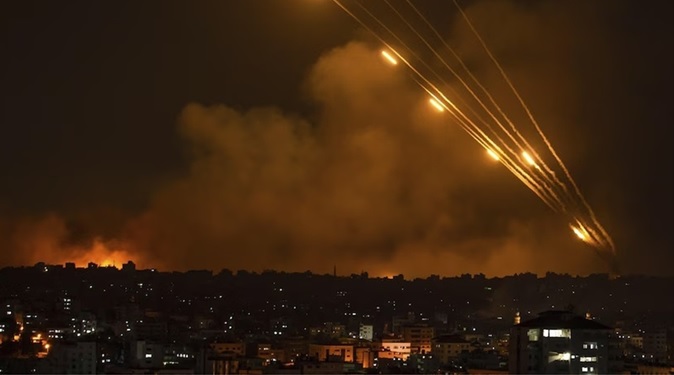 May 2024
The Prospect for the Gaza War Expansion into a Regional War and What that Means to the PA and the Palestinian-Israeli Conflict
Khalil Shikaki
It is no exaggeration to say that the reverberations of October 7 have impacted the Middle East region and beyond in ways that no other past Palestinian-Israeli confrontation did in the past two decades. It is almost certain that it will define the manner in which the history of the conflict will be written in this and perhaps future decades. On top of that, it might be a defining moment for our understanding of the meaning of the principles of human rights, international law, and free speech. We can already see some of the current aftershocks impacting not only the domestic Palestinian and Israeli environments, but also the manner in which the international community and global public opinion interacts with the conflict, as well the regional dynamics and balance of power.
It is the regional dynamics that this Policy Brief seeks to address. The unprecedented direct Iran-Israel armed confrontation in April 2024 represents the highest level of risk-taking that the Gaza war might have generated in the two countries since the eruption of the conflict between the two counties. Despite the apparent calm in the open conflict between Iran and Israel, the developments of the war in Gaza and on the Lebanese front between Israel and Hezbollah might increase the prospects of a return to a similar escalation that may continue to rise, threatening to destabilize the entire region, and might threaten a large-scale regional war. The prospects for such expansion and the potential repercussions on the future of the Palestinian-Authority (PA) and Palestinian-Israeli conflict is the subject of this Brief. Some of the questions addressed in the Brief include the following: did the Iran-Israel rules of the game change? If so, how will this impact the Arab-Israeli and Palestinian-Israeli dynamics, the normalization process, the peace process, security and civil coordination, the future of the PA and Palestinian access to basic needs and utilities, and how should the PA respond to this development.
Background:
The attack carried out by Hamas on October 7 is unprecedented in the entire bilateral Palestinian-Jewish and Palestinian-Israeli conflict of the past 120 years. It is unique in many ways. The attack demonstrated the ability of an armed Palestinian group to execute a large scale and lethal military maneuver on fortified Israeli military bases; to easily occupy, at least for a day, all Israeli towns adjacent to the entire border with the Gaza Strip; and to take about 250 soldiers and civilian hostages and war prisoners while killing 1200 Israeli soldiers and civilians. It goes without saying, that the magnitude of civilian death and destruction is unprecedented, with hundreds of Israelis and tens of thousands of Palestinian civilians killed and close to 70% of Gazan homes, factories, farms, public buildings and civilian infrastructure destroyed. The scale and magnitude of atrocities that have been committed in violation of international law have never been seen before.
The domestic, regional and interactional ramifications for Palestinians and Israelis are also unprecedented. Domestically, the Palestinian Authority has lost almost all support and credibility in the eyes of its own public.[1] Public support for the resumption of PA control over the Gaza Strip after the war does not exceed 11% while 59% support a return to Hamas’ control.[2] In other words, if the choice is between the PA and Hamas, the majority of the public, including a large number of people opposed to Hamas, would prefer it over the PA. In Israel, the political future of the longest serving prime minister, the one most responsible for the deadlock in the Palestinian-Israeli peace process, is threatened, if not completely ruined. Resignation of senior Israeli army officials, while the war is ongoing, is an indication of a deep rift within the Israeli political and security establishments and a great Israeli public eagerness for accountability.
While the Palestinian and Israeli publics continue to show significant distrust, reaching high levels of dehumanization, the findings from the Gaza Strip are extremely helpful in illustrating the dynamics of conflict resolution. While West Bankers and Israeli Jews express strong opposition to the two-state solution, standing, at least, at a two-third majority,[3] PSR’s March 2024 findings show that Gazan support for that solution has increased from 35% to 62% in six months, a dramatic 27-point increase.[4] When faced with a real existential threat of expulsion or genocide, Gazans turned to the two-state solution as a savior. Nothing shows the vitality and the contribution of that solution to the Palestinian-Israeli conflict better than this finding from the Gaza Strip.
Regionally, the Iranian role and influence have expanded significantly and the threat of a regional war has become real more than any time before, at least since the end of the US 2003 invasion of Iraq. Actors loyal to Iran, in three Arab countries, Yemen, Iraq, and Lebanon, are taking part in the armed conflict with Israel in solidarity with Hamas and the Palestinians. Yemen has blocked normal shipping access in the Red Sea and in doing so brought about direct military intervention by the US and UK against targets inside that Arab country.
The Palestinian issue is now seen as central to regional stability and the search for a solution to the Palestinian-Israeli conflict has become more pressing than it has been since 2014. The international community embrace of the two-state solution is perhaps more meaningful today than in the past. The US has presented the relevant parties with its own vision for ending the entire Palestinian-Israeli conflict that combines plans for an end to the war, a “revitalization” of the PA, and a design for the day after the war in a context of a two-state solution and an Arab-Israeli normalization of relations with Israel.[5] Countries in Europe, such as Spain, Irland, and others are discussing possible recognition of the Palestinian state. The International Court of Justice finds it appropriate and urgent to examine charges that Israel is committing genocide against the Palestinians in the Gaza Strip. The ICC is considering issuing arrest warrants against Israeli leaders and military commanders.[6] The United States and the EU are imposing sanctions on violent settlers and entities that support them financially. Moreover, international public opinion is shifting against Israel in a decisive manner. Public opinion polls show Israel losing support, particularly among the youth, in almost all counties of the world, including in the US, Germany, and the UK, with significant domestic implications in many of these countries.[7] The most recent manifestation of this development can be seen in American universities where students are testing the meaning and limits of free speech in American colleges and in the entire country.
Changing the rules of the game: direct Israel-Iran armed conflict
One of the latest, but potentially the most consequential, reverberations that has impacted the region has been the expansion of the Gaza war to directly include Iran. The Israeli bombing of the Iranian consulate building and the killing of a top Iranian military commander on April 1 might have triggered a new phase in an expanded regional conflict. In one blow, perhaps inadvertently, Israel helped transform the Iran-Israel confrontation from one fought by proxies to direct state-to-state conflict. Nothing demonstrates better the severity of this development than the specter of hundreds of Iranian drones and cruise and ballistic missiles crossing Iran, Iraq, and Jordan on their way to targets inside Israel on April 13. While the vast majority were successfully intercepted by the US and Israel, with help from one or more Arab countries, the Iranian message to Israel, the US, and many Gulf and Arab countries was heard loud and clear. The potential threat to more vulnerable American bases and the Arab countries that hosts them, being much more adjacent to Iran, is much more lethal than the threat to Israel. The success of the US administration and its allies in intercepting the Iranian attack, and in containing Israeli response to that attack, was critical in preventing this episode from escalating into a larger and more devastating armed conflict. Nonetheless, this incidence does raise many questions about the Israeli and Iranian calculus and the potential for miscalculation.
Why did the regional escalation happen in the first place? Why did Israel attack the Iranian consulate in Damascus thereby escalating the low-level warfare it has been waging against Iran. In other words, why did Israel change the rules of the game? Netanyahu might have an interest in diverting the attention away from the atrocities committed in the Gaza Strip. Bringing Iran into the picture also provides a way to deflect attention away from the humanitarian catastrophe that was unfolding because Israel was restricting humanitarian service delivery, using starvation as a tool of war, particularly in the aftermath of the killing of 7 staff members of the World Central Kitchen who were delivering humanitarian aid to people in northern Gaza.
However, the reports that the attack was a serious miscalculation by the Israeli Military Intelligence, rather than a deliberate provocation by Israeli leaders, should also be taken seriously.[8] In this analysis, the Israeli intelligence did not anticipate the Iranian response and assumed that Iran will continue its previous policy of indirect retaliation. Had it been known that Iran would act differently, Israel would not have attacked. After six months of war, Israel has not yet managed to defeat Hamas or prevent it from governing the Gaza Strip. It has not secured the release of all Israeli hostages and prisoners of war. It has not succeeded in restoring deterrence with Hezbollah or preventing it from attacking northern Israel. The threat to Red Sea shipping has not yet been contained. The West Bank has been boiling, indeed threatening to explode at any moment. In other words, given all that, Israel probably had no reason to seek further escalation by provoking a direct Iranian attack.
Regardless of the Israeli motivation, the question about the Iranian behavior on April 13 is even more important. Why did Iran respond by direct retaliation this time when it did not in the past? After more than a decade of Israeli attacks against Iran in Syria and some inside Iran itself, a traditionally cautious and calculating Iran acted in an unprecedented manner, even historic, by directly attacking Israel from its own territories rather than by using its own proxies. One might argue that as Israel changed the rules of the game, and so did Iran. The Israeli April 1 attack, in this analysis, served as a tipping point. The problem with this analysis is that it ignores the fact that Israel attacked Iran, directly on its own territories, many times in the past by assassinating its nuclear scientists and military commanders and stealing documents related to its nuclear program.
A more likely explanation links the change in the Iranian behavior to dynamics unleashed by the Gaza war. October the 7th might have empowered Iran, just as it empowered its allies in Lebanon, Yemen and Iraq. If the Israeli army is unable to defeat its weakest enemy, Hamas, in six months, why would Israel possess the will to enter a direct war with Iran or risk opening yet another front, this time with the strongest of all adversaries. One might add that Iran, perhaps wishing to maintain its standing among its own allies and in the region, found it difficult to stay out when its proxies are all engaged in the fight with its full encouragement and support.
Nonetheless, it should be pointed out that the Iranian retaliation, while apparently massive, was in fact greatly constrained and calculated, indicating its wish to avoid further escalation. Israel and its allies had plenty of time to prepare and intercept incoming drones and missiles that needed to travel more than 1000 kilometer. Perhaps the Iranian message was not just for the Israelis, but also for the US and its Arab allies: geographic proximity leaves the American bases and other targets close to Iran much more vulnerable to these Iranian military assets. For Israel, the Iranian message is perhaps one of political resolve rather than military capacity. Hours before the Israeli response to its direct attack, Iran spelled out what seemed like a new policy: “In case the Israeli regime embarks on adventurism again and takes action against the interests of Iran, the next response from us will be immediate and at a maximum level.”[9] Iran, it seems, wants to tell Israel that the rules of the game have changed in yet another way: any future attacks against Iranian assets, regardless of the location, will be met by a direct Iranian retaliation.
On April 19, Israel did retaliate by carrying out a single limited strike near the city of Isfahan, deep inside Iranian territory. The limited nature of the Israeli response, while strongly encouraged by the US, does reflect an Israeli understanding of the Iranian message. But unlike Iran, Israel did not need to send a message of political resolve; it has already attacked on Iranian soil in the past. Rather, Israel wanted to send a message of military capacity; that it can penetrate and attack targets deep inside Iran without Iran’s ability to intercept them; simply put, Iran cannot win. Israel perhaps hopes Iran will get the message and will not seek to retaliate, in a similar manner to that of April 13, in the future. In this regard, Israel perhaps wants to signal to Iran its intention to continue its shadow war when necessary and that the Iranian direct attack does not deter it from doing so. The muted Iranian response to this Israel retaliatory attack near Isfahan, one in which Iran did not point the finger at Israel, might encourage Israel to think that the rules of the game are now restored to their status quo ante. Nonetheless, it is worth noting that Israel has refrained, since April 1, from further targeting Iranian assets in the region.
Implications for the PA and the Palestinian-Israeli conflict
It is in this exchange of messages that the greatest immediate risks to the region lies. If Iran has indeed embarked on a new policy (of direct retaliation) while Israel thinks the rules have not changed (war by proxies), the threat of escalatory dynamics remains in place, just as it was in the immediate aftermath of the Israeli attack on the Iranian consulate building in Damascus. Will Israel now stop or continue its attacks on Iranian targets in Syria and elsewhere? Would Iran retaliate directly against Israel if Israel does make such attacks? The answers to these questions are currently unknown. Because of that, the prospect for a dramatic escalation cannot be ruled out, particularly given the uncertainty about the future of the war in the Gaza Strip and its “day after” and the current limited military exchange between Israel and Hezbollah; regional war must not therefore be ruled out. If so, what are the implications for the Palestinians in their conflict with Israel?
One can think of three possible scenarios for a regional armed escalation. A low-level direct Iranian-Israeli armed confrontation restricted to exchange of missiles without escalation to a full-blown war is a first scenario. The US and Arab allies might restrict their role to one similar to what they did in April. The behavior of Iran and Israel in April, influenced greatly by US pressure, shows that the two states are unlikely to deliberately seek escalation.
In this scenario, the impact on the PA and the Palestinian-Israeli conflict might be small. The PA is likely to stay on the sideline but the Israeli-Palestinian relations are likely to continue to deteriorate. Arab-Israeli efforts to normalize relations might be postponed but regional US-sponsored security coordination is likely to increase. The Palestinian-Israeli peace process might appear to gain some momentum behind the scenes in order to justify Arab cooperation with the US and Israel. Palestinian civil and security coordination is not likely to be affected and Palestinian access to basic needs, utilities, and other necessities is not likely be interrupted. But Palestinian public dissatisfaction and perhaps anger at the PA is likely to increase. Nonetheless, the PA will most likely be able to manage its growing domestic challenges without provoking a violent Palestinian public reaction.
In a second scenario, a more comprehensive armed confrontation is likely to involve attacks on a wide range of military and infrastructural targets and might cause great civilian deaths. Israel’s ability to inflict huge damage on Iran and the inability of Iran’s retaliatory attacks to inflict large scale damage on Israel, due to US and allies’ interception of Iranian drones and missiles, might lead Iran to expand the theatre of war to include US bases and Arab military targets and well as oil and gas fields and related infrastructure. This could immediately change the US posture from defense to offence. Iran might respond by encouraging domestic allies in the Arab countries to join the war in the hope of destabilizing the Arab regimes in the entire Gulf area as well as Jordan. Public opinion in some of these countries might turn against their own rulers and contribute to greater destabilization.
In this second scenario, Arab normalization with Israel is likely to stop. Similarly, no attention is likely to be paid to the Palestinian-Israeli peace process. Security and civil coordination between the PA and Israel is likely to be constrained but unlikely to stop completely. Palestinian access to basic needs and utilities will probably witness major disruptions but unlikely to stop completely. The domestic Palestinian scene is likely to see significant economic, political and security destabilization leading to further weakening of the PA, the expansion of the current armed groups into new areas, and greater armed confrontations between these armed groups and the Israeli settlers and army. Occasional unplanned confrontations between the Palestinian security services and local armed groups might increase. The ability to the PA leadership to survive under these dramatic developments is uncertain. Yet even in this scenario, the likelihood of the eruption of a third Palestinian intifada is not very high as long as the PA security services remain intact. Nonetheless, the West Bank will continue to boil, settlers’ violence is likely to expand significantly, Hamas will continue its efforts to reestablish its armed wing, and in the Gaza Strip, it will find it easier to rebuild its armed wing and reestablish its governing administration.
In a third scenario, a worst-case scenario, Iranian forces might infiltrate into neighboring countries, like Bahrain and Saudi Arabia, to support Shi’ite groups (against a likely crackdown by their governments) and might encourage local armed groups to infiltrate into Jordan, who might be perceived as an ally of the US and Israel. Armed groups from Lebanon, Syria, and Iraq might seek to infiltrate into Israel and Jordan in the hope of bringing a ground offensive dimension to the conflict and bring the fight directly to the West Bank and Israeli territories. In this case, Israeli ground forces will most likely invade Lebanese and Syrian territories and might attack targets in Jordan and Iraq. The US will most likely find itself fighting alongside Israel in both offensive and defensive capacities.
In this third scenario, the expansion of the regional war is likely to end Arab normalization with Israel and all talk of Palestinian-Israeli peace. Security and civil coordination is likely to cease and Palestinian access to basic needs, utilities, and other necessities normally supplied by Israel will probably be almost completely cut off. The expansion of the war in this scenario will also most likely bring about a certain collapse of the PA and the departure of the current leadership of Abbas and the ruling elite, who are currently rejected by the overwhelming majority of the Palestinian public. A third intifada is likely to erupt as members of the PA security services might join the armed groups. Fatah might revive its own armed group, al Aqsa Brigade, while Hamas might finally succeed in rebuilding its armed wing in the West Bank. Taking advantage of the thin presence of the Israeli army in the Gaza Strip, Hamas might rebuild its armed forces in that area thereby weakening the ability of the Israeli army to fight effectively on multiple fronts.
Confronting its vulnerabilities? Three steps the PA must immediately take:
Despite the numerous after-shocks triggered by the Gaza war, the PA remained relatively unmoved, essentially sitting on the sideline, awaiting the outcome of that war. This paralysis testifies to the extent of PA irrelevance and lack of leadership and initiative at a time when the Palestinians are faced with the most serious existential threat since 1967. This state of affairs adds to the challenges the Palestinians face as they confront the challenge of the “day after” and the potential of a regional war.
The PA operates today under three tremendous vulnerabilities that reduce its capacity to cope with the current and likely future challenges: the lack of legitimacy, disunity, and incompetence. To meet current and “day after” challenges and to be in a position to mitigate some of the consequences of a regional war, the PA must immediately confront these vulnerabilities and address them.
Holding national elections as soon as possible: Perhaps the most damaging vulnerability lies in its lack of legitimacy in the eyes of the vast majority of its public and the lack of credibility of its leadership not only among Palestinians but also among many, if not all, others. This lack of legitimacy is the direct outcome of the lack of periodic national elections. Lack of legitimacy affects the standing of the various political forces in the Palestinian political life. If the choice is between Hamas and the PA, the public does not hesitate to prefer Hamas over Fatah and the PA for the future control over the Gaza Strip. Asked in March 2024 about the group most deserving of representing and leading the Palestinian people, Fatah under the leadership of Abbas or Hamas, about half of the public selected Hamas and only 17% selected Fatah. Only by putting itself immediately on the road to parliamentary and presidential elections can the PA manage to survive the current and impending challenges. At the moment, only the ongoing war represents a valid impediment to postpone the elections. The PA should therefore plan to hold elections in 6 to 12 months from today. It should do so without reservations or preconditions. Alternatively, if it finds it cannot hold such elections, the PA leadership should immediately step down. Without elections, the PA has no future and history will deal very harshly with its current leadership and ruling elite.
Reunification of the West Bank and the Gaza Strip requires domestic reconciliation: Palestinian division is the second PA vulnerability. Its failure to reconcile with Hamas and reunify the West Bank and the Gaza Strip during the past 17 years intensified Palestinian political polarization and has now come back to haunt us at a moment of great Palestinian peril. The reunification process must proceed now without hesitation. It must not wait for the end of the war in the Gaza Strip. It should be plainly clear to the PA leadership that Israel will treat it with utmost contempt and rejection regardless of whether it reconciles or does not reconcile with Hamas. But reunification will not be possible without the formation of a transitional government, one that meets public expectations. In March 2024, the public demanded the formation of such transitional government but insisted on imposing three conditions on it: (1) it must be made up of competent professionals, (2) representing national unity or consensus, and (3) it must be independent of political parties or president Abbas. The current PA government does not meet most of these conditions. The current government lacks legitimacy and public acceptance. It cannot be expected to deal successfully with any of the major challenges facing Palestinians today, those that it will face in the “day after,” or manage the consequences of a regional war.
Addressing PA incompetence: The PA’s failure to meet the basic needs of the public in delivering good or competent governance, fight corruption, build strong and accountable public institutions, ensure financial stability, or build an independent capacity to deliver water, electricity, and fuel after 30 years of its existence, testifies to its utter incompetence in ensuring the wellbeing of the Palestinian people. While the continued Israeli occupation and the interests of some of the donor counties have certainly played a role in this dismal outcome, the fact that the PA did not prioritize these national goals in its negotiations and interactions with Israel and the international community testifies to its own failure in prioritizing the national interest. A transitional government made up of the best and brightest minds. from Palestinians residing in the occupied Palestinian territories and Palestinians from the diaspora, representing the national consensus, working closely with the PLO, must outline a workplan and a timetable to restore the constitutional functioning of the political system and remove from the PA legal system all those presidential decrees and administrative decisions that have over the past decade corrupted the entire political system and destroyed its accountability and oversight. The plan must demonstrate convincing commitment to combating corruption and strengthening of the independence of the anti-corruption institutions. It must gradually reduce dependence on Israel for transfer of clearance funds and basic needs and utilities and ensure greater Palestinian self-reliance.
It is prudent, and certainly imperative, for the PA to take measures today rather than wait for the “day after” or the onset of regional war. Immediate steps are required in order to help alleviate some of the great difficulties that the Palestinian population will definitely face once the “day after” arrives or if the Gaza war escalates to a regional one. It goes without saying that once the “day after” arrives, facts on the ground in the Gaza Strip will dictate the future and the PA will continue to be irrelevant. Hamas will resume control over that Palestinian territories and Palestinian division will become more consolidated. Furthermore, if the third scenario of the regional war, as described above, begins to unfold, the PA’s ability to prevent its own collapse, no matter what it does, if it has not already taken strong measures, will be negligeable. Even under the second scenario, the ability of the PA to act, will be significantly constrained. Only today, and under conditions of the first scenario, can the PA take measures to ensure its ability to continue to provide services to the public under conditions similar to those entailed in the second scenario.
[1] PSR December 2023 poll showed that satisfaction with the role of the PA standing at 14% only (10% in the West Bank and 21% in the Gaza Strip) and with Mahmoud Abbas at 11% (7% in the West Bank and 17% in the Gaza Strip), and with Prime Minister Mohammad Shtayyeh at 10% (6% in the West Bank and 16% in the Gaza Strip). See: http://www.pcpsr.org/en/node/963. In March 2024, support for Hamas stood at 34%, Fatah at 17% and the demand for the resignation of president Abbas at 84% (93% in the West Bank and 71% in the Gaza Strip. See, http://www.pcpsr.org/en/node/973.
[2] Another 13% support control by the PA but only if it is not under the control of president Abbas. See PSR’s March 2024 poll: http://www.pcpsr.org/en/node/973. .
[3] For the Palestinian findings, see ibid. For the Israeli findings see IDI poll, https://en.idi.org.il/articles/52976. The poll also shows that 68% of Israeli Jews are opposed to the transfer of humanitarian aid to the Gaza Strip. On the same topic, see also, https://www.jpost.com/israel-news/article-788114 and https://mondoweiss.net/2024/02/over-2-3-of-jewish-israelis-oppose-humanitarian-aid-to-palestinians-starving-in-gaza/.
[4] Ibid.
[5] In early February 2024, Blinken reported that he spoke with Prime Minister Benjamin Netanyahu about a clear path for a Palestinian State and permanent peace that means “an Israel that’s fully integrated into the region, with normal relations with key countries including Saudi Arabia…Alongside a concrete, time-bound and irreversible path to a Palestinian state living side by side in peace and security with Israel, with the necessary security assurances.” See Ynet, 8 February 2024, https://www.ynetnews.com/article/h1ruhu11ip#autoplay
[6] “ICC may issue arrest warrants for Israeli officials over the war in Gaza, reports say,” NPR, April 29, 2024, https://www.npr.org/2024/04/29/1247741600/icc-may-issue-arrest-warrants-....
[7] See, “How public opinion on the Israel-Hamas war has shifted,” Financial Times, 21 November 2023, https://www.ft.com/content/6bf4f6ed-b705-4e66-ac6f-59b5ef6c0c77. See also Gallup’s March 2024 poll “Majority in U.S. Now Disapprove of Israeli Action in Gaza: Approval has dropped from 50% to 36% since November,” 27 March 2024, https://news.gallup.com/poll/642695/majority-disapprove-israeli-action-gaza.aspx. Time Magazine reported that “Net favorability—the percentage of people viewing Israel positively after subtracting the percentage viewing it negatively—dropped globally by an average of 18.5 percentage points between September and December, decreasing in 42 out of the 43 countries polled.” https://time.com/6559293/morning-consult-israel-global-opinion/.
[8] See, “Miscalculation Led to Escalation in Clash Between Israel and Iran,” The New York Times, April 17, 2024,
https://www.nytimes.com/2024/04/17/world/middleeast/iran-israel-attack.html.
[9] See statement by the Iranian Foreign Minister to CNN: “Iran’s military response will be ‘immediate and at a maximum level’ if Israel attacks, foreign minister says,” https://edition.cnn.com/2024/04/18/middleeast/iran-foreign-minister-isra...
January 2019
Elites on both sides are influenced by their perceptions of their society, and also by their perceptions of opinion on the opposing side: Those who believe their side or the other side is supportive of a two-state solution are more willing to take action and speak out in favor. But Palestinian and Israeli elites are just as divided by ideological attitudes and party identification as the general public on both sides; they may be more committed to their own attitudes over time than the general public, but also show a greater gap between theoretical positions and support for detailed policies. Pre-existing ideology influences reactions to new information about their own and the other side’s support for a two-state solution.

These are the results of Palestinian-Israeli Pulse: A Joint Elite Poll conducted by the Tami Steinmetz Center for Peace Research (TSC), Tel Aviv University and the Palestinian Center for Policy and Survey Research (PSR) in Ramallah, with funding from the European Union (EU).
The Palestinian sample was conducted among 490 elites, and the Israeli sample included 153 – both samples comprised academics, business leaders, media, politicians, and civil society figures. The Israeli sample was interviewed in August and September of 2018, with fieldwork conducted by telephone, by Midgam Research. Palestinians were interviewed face-to-face, by PSR staff, in July 2018.
(1) Goal and methods:
The purpose of the elite survey is to explore certain attributes of the elite members, such as their familiarity with the prevailing attitudes among the majority in their society and in the society of the other side, and the links between attitudes, most importantly regarding the two-state solution. Specifically, the survey was an experiment designed to: (1) explore the impact of learning that the majority of one’s own side is willing to support compromise for a two-state solution; (2) the impact of learning that the majority of the opposing side is willing to support compromise for a two-state solution. For these first two goals, the research question was: does knowing these trends make the elite interviewees more willing to support compromise? (3) explore the impact of knowledge and information on collective ignorance and misperception of the elite members. The research question for this goal was: is an informed elite more able to assess attitudes on the other side correctly and less likely to misperceive the other side’s long-term intentions regarding the conflict?
To test these questions, the survey provided the interviewees with actual information about credible public opinion studies (referring to the Palestinian-Israeli pulse conducted in the framework of this project), which examined the larger population of both sides, then questioned the reaction of the elite respondents to the information. Based on this exercise, the survey assessed how elites reacted to information that may affirm or contradict their original world view, how they assessed its credibility, and whether they changed perspectives in light of the information.
Specifically, three questions were asked about support/opposition for the peace process, which serve as the dependent variables of the survey:
(1) Attitudes toward the two-state solution,
(2) Attitudes toward an implementation package of the two-state solution,
(3) Willingness to speak or take action for or against a two-state solution agreement.
Three questions were used to assess the attitudes of the elites, most importantly their perception of positions on one’s own side and the other side (these were the independent variables of the survey):
(1) Perception of the majority view regarding the two-state solution on one’s own side,
(2) Perception of the majority view regarding the two-state solution on the other side, and
(3) Perception on the accuracy/inaccuracy of polling findings showing support among Palestinians and Israelis for the two-state solution and its implementation.
Description of the sample:
It is important to note that from a methodological perspective, the survey did not set out to define or provide quantitative generalizations about the attitudes of the Palestinian and Israeli elite regarding the peace process; since there is no baseline for defining an “elite” sample, the survey does not claim to represent this population. Rather, it represents the mode of thinking and the potential for changing attitudes within the sample of interviewees, who are influential in each of their respective communities. It also assesses the internal consistency and contrasts of attitudes within this sample of elites, such as whether their own positions are consistent, and how this group reacts to new information.
The methodological challenge was compounded by a high rejection rate of response. The best description is that of a convenience sample, or a non-probability sample, on both sides. We could theoretically weight the data to ensure equal representation of all elite types, trends, and ideologies, but this would be speculative weighting – since there is no baseline setting the size of each group (either by profession or by ideology) in the actual elite society of either side. Therefore, we cannot generalize to the entire Palestinian and Israeli elite society at this point. The current project which included two surveys, in 2017 and 2018, should be seen as a pilot study.
Although the basic findings regarding the attitudes of the elite cannot be considered generalizable, the results remain highly useful for the internal analysis that was the goal of this study. Since the goal of the survey is to establish links rather than describe attitudes, the lack of representation does not undermine the validity of these links. Still, it was important that all relevant groups or elite types and all political and ideological trends in the two societies are represented. The Palestinian sample include 490 elite members divided as follows: 18% academics, 26% members of organized civil society, 22% members of the political elite, 17% from the media, and 18% from the private sector. The Israeli sample is smaller, 153 members, and divided as follows: 39% academic, 26% upper-level management private sector employees, 13% were political figures, 12% are from the media, and 10% from NGO community.
The samples include representatives of all political and ideological trends in both societies. On the Israeli side, the proportion of self-identified left, center and right wing is different than that of the general population: slightly more than 33% identify themselves as left wing, 32% center, and 33% right wing – in other words a nearly balanced breakdown of one-third in each camp, or nearly two-thirds for the center and left-wing together (in the general Jewish public, the right wing accounts for over half; while the center and left combined is roughly 42%) . Moreover, 69% are secular, 16% traditional, 12% religious, and 3% Ultra-Orthodox. On the Palestinian side, the largest group (36%) is not affiliated with any faction, 34% Fatah, 10% Hamas, and 17% third parties. These findings are significantly closer to the political breakdown of the general Palestinian population.
(2) Main findings:
Although the sample cannot be presumed to be representative, at the same time, the possibility that these findings do represent the elite of either side cannot be ruled out either. For this reason, we believe it is most useful for this pilot study to describe the attitudes of the elite based on their political perspectives: right, center, and left for the Israeli elite, and Fatah, Hamas, third parties, and non-affiliated for the Palestinians. As in our other public opinion surveys, the findings here show that political/ideological self-identification is the most significant predictor of attitudes.
Attitudes regarding the concept of the two-state solution:
We asked the elite members about their support or opposition to the general concept of the two-state solution “based on the establishment of a Palestinian state alongside Israel, known as the two-state solution.” A majority of all Palestinian elite groups interviewed for this survey support the two-state solution: Fatah elite interviewees showed the highest support with 83%, followed by support third parties (52%), unaffiliated (52%) and even 54% of Hamas supporters – twice as many as the previous survey. On the Israeli Jewish side, support is very high among the elite on the left (96%) and center (78%), declining to 30% among the right.
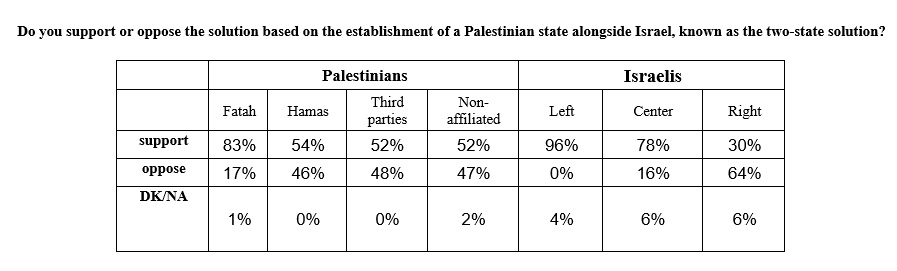
These findings confirm what has been found in previous studies among the general population on both sides, that self-definition by political or ideological affiliation is meaningful and describes highly distinct positions and world views with relation to the conflict. They also confirm a finding that has been seen consistently: even among the hard-liners on both sides, Hamas supporters in Palestine and right-wingers in Israel, there is some support for the two-state solution; further, on the Israeli side, centrists hold positions that are significantly closer to the left than to the right, but in slightly lower proportions.
There is also a contrast on the Israeli side, when considering the general public: the elite left-wing and centrists show much higher support this year for a two state solution than their counterparts in the general public. Over the last two years, the left in particular showed significantly declining support (which stood closer to the elite range in December 2016); and the center supports the general solution fairly consistently at around 64-65%. This indicates that the elites may be showing more consistency between policy attitudes and the label of “left” and a more dovish center; but possibly also more consistency over time.
The latter observation holds for both sides, whose trends of support have hardly changed since 2017 – by contrast to declining support among both Israelis and Palestinians. The one exception is Hamas, since the current sample shows over double the portion who support the two state solution, but here the small and non-generalizable sub-sample should be kept in mind.
Attitudes regarding a two-state solution package:
We also asked both sides if they support or oppose a plan of implementation package for the two-state solution that would include the following: “establishment of a demilitarized Palestinian state close to the 1967 borders; Israel annexes the large blocs of settlements in return for equal size territory given to Palestine, and Israel evacuates outlying settlements; East Jerusalem is the capital of Palestine and West Jerusalem remains the capital of Israel, each side controls its holy sites in the Old City; Palestinian refugees return to a Palestinian state, and a limited number to Israel for family reunification.” This is the same question about the full package for implementation that is asked in our joint survey among the general population on both sides.
Among the Palestinian elite respondents, a majority of Fatah supporters also supported the package (61%). All others rejected the package with only 30% of Hamas, 31% of third party supporters, and 34% of the non-affiliated supporting it. Among the Israelis, support was high among the left (90%) and the center (51%), but only 10% of the right supported it.

The findings are not significantly different from the previous year, and therefore the general trend appears consistent: that there is a significant gap between the percentage of those who support a two state solution in principle and those who support it once they see the details. This gap is larger among elites than among the general public.
- Among the Israeli elites in total, 67% support the idea, but just 50% support the plan – a 17-point gap. Among the general public, 49% support the principle in June 2018, and 46% support the original detailed plan – only a three-point gap (the same gap holds for Israeli Jews and Arabs separately)
- Among Palestinian elites, 62% support the two state principle, but just 42% support the detailed plans – a 20-point gap similar to the Israeli Jewish elites. Here again, there is less of a gap among the general Palestinian public, 43% support the general two state solution, and 37% support the detailed plan – a gap of just six points.
- The gap between theoretical and policy support appears even higher in the case of subgroups. For example, 78% of the centrist elites support the two state principle, but just 51% support the plan – a 26-point gap. Similarly, 83% of Fatah-supporting elite respondents approve of the principle, but 21-points fewer, 61%, support the plan.
- Among the total Israeli population, the center and the left also show a sizable gap between theory and practice; the only outlier to this trend is the Israeli right among the general public – just 23% support the concept of a two state solution, but in the June 2018 survey, 31% supported the detailed plan.
Role of incentives:
To test the strength of the opposition to the package, we offered those Palestinians and Israelis who opposed it an amendment intended to serve as an incentive. To the Palestinians, the measure stated that “the Israeli government [would] announce that it recognizes the Palestinian’s national and historic right to a state on the land from the 1967 borders and recognizes Israel’s role in the suffering of Palestinian refugees.” The response among Hamas’ elite was surprisingly positive with over four-in-ten (43%) changing their mind and supporting the package if it contained this incentive; Fatah elite showed the greatest flexibility with 54% who changed their mind, along with 30% of the nonaffiliated, and 31% of third parties who changed their mind to accept the package.
For the Israelis who opposed the package, the incentive stated that “the Palestinian leadership [would] announce that it recognizes Israel’s religious and national connection to the region, and its right to exist as a Jewish state.” Among the Israeli elite, the highest positive response came from the center, with 30% changing their mind and accepting the package if it contained this incentive; only 21% of the right. For the Israeli sample, the number of center and left-wingers who opposed the package was so small, the findings cannot be considered highly significant.

Perception of the majority view on one’s own side:
We asked both sides to assess the majority opinion today among their own publics regarding the concept of the two-state solution. Majorities from Fatah (72%) and third parties (51%) believed the majority of the Palestinian public supports it while only 39% of the nonaffiliated and 48% of Hamas believed this is the case. Among the Israeli elite, only the left (45%) believed that a majority of Israelis supports the two-state solution; 49% of the center and 24% of the right believed the same.
This trend is broadly similar to findings among the general population: the ideology of the respondents influences their assessment of their own society – Israelis on the left or Palestinian Fatah supporters are therefore more likely to view society as sharing their support for the two-state solution, and those on the right or Hamas supporters are less likely to view their society as supporting a position that most of them to do not support.

Perception of the majority view on the other side:
We also asked both sides to assess the majority opinion today among the public on the other side regarding the concept of the two-state solution. Nearly half of Fatah’s elite, 58% of Hamas-identified respondents, 35% of third party respondents, and 25% of the nonaffiliated believe that a majority of Israelis support the two-state solution. Among the Israeli elite, about half of the left (49%) believe that a majority of Palestinians supports the two-state solution – similar to the rate among Fatah; 39% of the center and 18% of the right believe the same.

Perceptions regarding accuracy of findings:
The questionnaire then informed respondents that credible polling of the Palestinian and Israeli general public found that the majority of Palestinians and Israelis support a two-state solution and a plan for its implementation that includes regional peace within the context of the Arab Peace Initiative. In response, a majority of all Palestinian and Israeli elites (except the left in Israel) doubted the accuracy of the findings. Among the Palestinians 33% of Fatah, 14% of the nonaffiliated, 17% of third parties, and 26% of Hamas said the findings were accurate. More Palestinians believe that finding was accurate for the Palestinians but not the Israelis: 31% of Fatah, 26% of third parties, 29% of the nonaffiliated, and 34% of Hamas.
Among the Israelis, a majority on the left (63%) believed the finding to be accurate, but only 39% on the center and 10% on the right believed the same. More elite members on the right (16%) believe the finding to be accurate for the Israelis only, while only 14% of the center and 4% of the left believed that only the Israeli finding was accurate.
It is worth noting that this doubtful approach is not completely mistaken. In the general survey taken very close to the time of the elite survey, fewer than half – in other words, only a minority – of Israelis and Palestinians supported the general two state solution. The doubt among the elites indicates a fair reading of both Israeli and Palestinian society.

Impact of knowledge on elite attitudes:
We asked both sides if, regardless of their current position, the finding that the majority of the public supports the two-state solution and its implementation makes them more or less likely to support that solution, or whether knowledge about the public has no influence over their attitudes. A large minority of Fatah elite (42%) said it makes them more likely to support that solution; 21% of the third parties, 18% of the nonaffiliated, and 16% of Hamas indicated the same. Interestingly, on this question as on most questions of the survey, Hamas respondents showed roughly double the level of openness and potential support – in 2017 the equivalent rate was 8% of Hamas supporters who said public support would make them more likely to support the agreement as well.
The largest percentage for all, except Fatah, indicated that the finding has no influence over their own views: 52% of Hamas, 56% of third parties, 56% of the nonaffiliated, and 45% of Fatah. Only a small percentage of all groups indicated that the finding makes them less willing to support the two-state solution: 32% of Hamas, 22% of the nonaffiliated, 17% of third parties, and 11% of Fatah.
Among the Israelis, the pattern was similar. The higher percentage of those who said the finding makes them more likely to support the two-state solution was found among the left (25%) followed by the center (20%) and the right (14%). Large majorities of all groups indicated that the finding has no influence over their own views: 82% of the right, 76% of the center, and 75% of the left. Only a small percentage of all groups indicated that the finding makes them less willing to support the two-state solution: 4% of the right, 0% of the center, and 0% of the left. 
These findings indicate a confirmation bias: the idea that people’s pre-existing attitudes have a strong influence over how they process new data and information. Those who reject a two-state solution are less likely to accept information, including credible data, showing that the majority support a position that they do not, and vice versa. It could also likely indicate that elites in large part base their positions on their own analysis, rather than letting their views be swayed by public attitudes alone.
Impact of knowledge on elite behavior:
We asked both sides if, knowing that the majority of their public was in favor of the detailed peace package based on polling, whether they would speak or act against or in favor of the two-state implementation package. Among the Palestinians, a clear majority among Fatah supporters (70%) said it would speak or act in favor while only 13% said they would speak against such an agreement. Among Hamas elite, the picture was the reverse: only 34% said they would speak in favor and 40% said they would speak or act against it. The other groups were somewhat balanced: 36% of the nonaffiliated and 38% of the third parties said they would speak in favor while 30% of the third parties and 29% of the nonaffiliated said they would speak against the agreement.
Among the Israelis, only a majority of those on the left (55%) said they would speak or act in favor while only 10% said they would speak against it. Among the right, 42% said they would speak or act against it and only 16% said they would speak in favor. For those in the center, 33% said they would speak or act in favor and only 29% said they would speak or act against. Although just one-quarter Israeli centrists stated that they would take action in favor, this too affirms previous data showing that a greater portion of centrists support a two-state agreement than those who actively oppose it (in this case, three times more).

(3) Links between attitudes:
1. Those who think the majority on their side supports the two-state solution in general are more likely to support that solution and also the detailed package for its implementation. Those who think that the majority on their side does not support the two-state solution are less likely to support that solution and the detailed implementation package.

2. Those who think the majority on the other side supports the two-state solution are more likely to support that solution and its implementation package. Those who think that the majority on the other side does not support the two-state solution are less likely to support that solution and its implementation package.

3. Those who see the polling findings showing a majority of Israelis and Palestinians supporting the two-state solution and its implementation as accurate, are more likely to support the two-state solution and an implementation package of that solution. Those who see the same polling findings as inaccurate are less likely to support the two-state solution and an implementation package of that solution.

4. Willingness to speak in favor of a two-state solution is much higher among those who believe that the majority on their side supports the two-state solution than among those who believe the majority on their side is opposed to the two-state solution. Similarly, willingness to speak in favor of a two-state solution is much higher among those who believe in the accuracy of the polling findings showing that a majority of the public on both sides supports the two-state solution and its implementation than among those who believe those findings to be inaccurate.

5. Willingness to speak in favor of a two-state solution is much higher among those who believe that the majority on the other side supports the two-state solution than among those who believe the majority on the other side is opposed to the two-state solution.

6. Willingness to speak in favor of a two-state solution is much higher among those who believe in the accuracy of the polling findings showing a majority of Israelis and Palestinians supporting the two-state solution and its implementation than among those who believe in the inaccuracy of those findings.

January 2018
Elites on both sides are influenced by their perceptions of their society, and also by their perceptions of opinion on the opposing side: Those who believe their side or the other side is supportive of a two-state solution are willing to take action and speak out in favor. But Palestinian and Israeli elites are just as divided by ideological attitudes and party identification as the general public on both sides. Pre-existing ideology influences reactions to new information about their own and the other side’s support for a two-state solution.

These are the results of Palestinian-Israeli Pulse: A Joint Elite Poll conducted by the Tami Steinmetz Center for Peace Research (TSC), Tel Aviv University and the Palestinian Center for Policy and Survey Research (PSR) in Ramallah, with funding from the European Union (EU).
The Palestinian sample was conducted among 570 elites, and the Israeli sample included 175 – both samples comprised academics, business leaders, media, politicians, and civil society figures. The Israeli sample was interviewed in May and June of 2017, with fieldwork conducted by telephone, by Midgam Research. Palestinians were interviewed face-to-face, by PSR staff, in May and June 2017.
(1) Goal and methods:
The purpose of the elite survey is to explore certain attributes of the elite members, such as their familiarity with the prevailing attitudes among the majority in their society and in the society of the other side, and the links between attitudes, most importantly regarding the two-state solution. Specifically, the survey was an experiment designed to: (1) explore the impact of learning that the majority of one’s own side is willing to support compromise for a two-state solution; (2) the impact of learning that the majority of the opposing side is willing to support compromise for a two-state solution. For these first two goals, the research question was: does knowing these trends make the elite interviewees more willing to support compromise? (3) explore the impact of knowledge and information on collective ignorance and misperception of the elite members. The research question for this goal was: is an informed elite more able to assess attitudes on the other side correctly and less likely to misperceive the other side’s long-term intentions regarding the conflict?
To test these questions, the survey provided the interviewees with actual information about credible public opinion studies (referring to the Palestinian-Israeli pulse conducted in the framework of this project), which examined the larger population of both sides, then questioned the reaction of the elite respondents to the information. Based on this exercise, the survey assessed how elites reacted to information that may affirm or contradict their original world view, how they assessed its credibility, and whether they changed perspectives in light of the information.
Specifically, three questions were asked about support/opposition for the peace process, which serve as the dependent variables of the survey:
(1) Attitudes toward the two-state solution,
(2) Attitudes toward an implementation package of the two-state solution,
(3) Willingness to speak or take action for or against a two-state solution agreement.
Three questions were used to assess the attributes of the elites, most importantly their perception of positions on one’s own side and the other side (these were the independent variables of the survey):
(1) Perception of the majority view regarding the two-state solution on one’s own side,
(2) Perception of the majority view regarding the two-state solution on the other side, and
(3) Perception on the accuracy/inaccuracy of polling findings showing support among Palestinians and Israelis for the two-state solution and its implementation.
Description of the sample:
It is important to note that from a methodological perspective, the survey did not set out to define or provide quantitative generalizations about the attitudes of the Palestinian and Israeli elite regarding the peace process; since there is no baseline for defining an “elite” sample, the survey does not claim to represent this population. Rather, it represents the mode of thinking and the potential for changing attitudes within the sample of interviewees, who are influential in each of their respective communities.
The methodological challenge was compounded by a high rejection rate of response. The best description is that of a convenience sample, or a non-probability sample, on both sides. We could theoretically weight the data to ensure equal representation of all elite types, trends, and ideologies, but this would be speculative weighting – since there is no baseline setting the size of each group (either by profession or by ideology) in the actual elite society of either side. Therefore, we cannot generalize to the entire Palestinian and Israeli elite society, yet. The current survey should be seen as a pilot study. A second survey will be carried out in 2018. Any characteristics that are confirmed in a second study, among a different group of respondents, can be considered a more significant indicator of those characteristics among Israeli and Palestinian elites.
Although the basic findings regarding the attitudes of the elite cannot be considered generalizable, the results remain highly useful for the internal analysis that was the goal of this study. Since the goal of the survey is to establish links rather than describe attitudes, the lack of representation does not undermine the validity of these links. Still, it was important that all relevant groups or elite types and all political and ideological trends in the two societies are represented. The Palestinian sample include 570 elite members divided as follows: 26% academics, 23% members of organized civil society, 20% members of the political elite, 17% from the media, and 15% from the private sector. The Israeli sample is smaller, 175 members, and divided as follows: 45% academic, 27% upper-level management private sector employees, 11% were political figures, 11% are from the media, and 5% from NGO community.
The samples include representatives of all political and ideological trends in both societies. On the Israeli side, the proportion of self-identified left, center and right wing is nearly reversed relative to the general population: slightly more than half identify themselves as left wing, 22% center, and 27% right wing. Moreover, almost three quarters are secular, 11% traditional, 9% religious, and 3% Orthodox. On the Palestinian side, the largest group (37%) is not affiliated with any faction, 27% Fatah, 18% Hamas, and 16% third parties. These findings are significantly closer to the political breakdown of the general Palestinian population.
(2) Main findings:
Although the sample cannot be presumed to be representative, at the same time, the possibility that these findings do represent the elite of either side cannot be ruled out either. For this reason, we believe it is most useful for this pilot study to describe the attitudes of the elite based on their political perspectives: right, center, and left for the Israeli elite, and Fatah, Hamas, third parties, and non-affiliated. As in our other public opinion surveys, the findings here show that political/ideological self-identification is the most significant predictor of attitudes.
Attitudes regarding the concept of the two-state solution:
We asked the elite members about their support or opposition to the general concept of the two-state solution “based on the establishment of a Palestinian state alongside Israel, known as the two-state solution.” With the exception of the Hamas elite, Palestinian elite members interviewed for this survey support the two-state solution: Fatah elite interviewees showed the highest support with 83%, followed by support third parties (53%), unaffiliated (52%) and Hamas (24%). On the Israeli Jewish side, support is very high among the elite on the left (99%) and center (78%), declining to 26% among the right.
Do you support or oppose the solution based on the establishment of a Palestinian state alongside Israel, known as the two-state solution?

These findings confirm what has been found in previous studies among the general population on both sides, that self-definition by political or ideological affiliation is meaningful and describes highly distinct positions and world views with relation to the conflict. They also confirm a finding that has been seen consistently: even among the hard-liners on both sides, Hamas supporters in Palestine and right-wingers in Israel, there is a minority that supports the two-state solution; further, on the Israeli side, centrists hold positions that are significantly closer to the left than to the right, but in slightly lower proportions.
Attitudes regarding a two-state solution package:
We also asked both sides if they support or oppose a plan of implementation package for the two-state solution that would include the following: “establishment of a demilitarized Palestinian state close to the 1967 borders; Israel annexes the large blocs of settlements in return for equal size territory given to Palestine, and Israel evacuates outlying settlements; East Jerusalem is the capital of Palestine and West Jerusalem remains the capital of Israel, each side controls its holy sites in the Old City; Palestinian refugees return to a Palestinian state, and a limited number to Israel for family reunification.” This is the same question about the full package for implementation that is asked in our joint survey among the general population on both sides.
Among the Palestinian elite respondents, a majority of Fatah supporters also supported the package (54%). All others rejected the package with only 12% of Hamas, 39% of third party supporters, and 37% of the non-affiliated supporting it. Among the Israelis, support was high among the left (90%) and the center (57%), but only 13% of the right supported it.
Now consider a plan for implementation of the two state solution that includes: Establishment of a demilitarized Palestinian state close to the 1967 borders; Israel annexes the large blocs of settlements in return for equal size territory given to Palestine, and Israel evacuates outlying settlements; East Jerusalem is the capital of Palestine and West Jerusalem remains the capital of Israel, each side controls its holy sites in the Old City; Palestinian refugees return to a Palestinian state, and a limited number to Israel for family reunification. Do you support or oppose this peace package?

Role of incentives:
To test the strength of the opposition to the package, we offered those Palestinians and Israelis who opposed it an amendment intended to serve as an incentive. To the Palestinians, the measure stated that “the Israeli government [would] announce that it recognizes the Palestinian’s national and historic right to a state on the land from the 1967 borders and recognizes Israel’s role in the suffering of Palestinian refugees.” The response among Hamas’ elite was the most positive with a third (33%) changing their mind and supporting the package if it contained this incentive; 29% of Fatah elite, 27% of the nonaffiliated, and 24% of third parties changed their mind and accepted the package.
For the Israelis who opposed the package, the incentive stated that “the Palestinian leadership [would] announce that it recognizes Israel’s religious and national connection to the region, and its right to exist as a Jewish state.” Among the Israeli elite, the highest positive response came from the center, with 30% changing their mind and accepting the package if it contained this incentive; only 14% of the right and the left did the same and accepted the package. For the Israeli sample, it should be noted that for the center and left, very small actual numbers of respondents opposed the original peace package, therefore these findings should be considered with even greater caution.

Perception of the majority view on one’s own side:
We asked both sides to assess the majority opinion today among their own publics regarding the concept of the two-state solution. Majorities from Fatah (69%) and third parties (52%) believed the majority of the Palestinian public supports it while only 45% of the nonaffiliated and 31% of Hamas believed this is the case. Among the Israeli elite, only the left (64%) believed that a majority of Israelis supports the two-state solution; 41% of the center and 22% of the right believed the same.
This trend is broadly similar to findings among the general population: the ideology of the respondents influences their assessment of their own society – Israelis on the left or Palestinian Fatah supporters are therefore more likely to view society as sharing their support for the two-state solution, and those on the right or Hamas supporters are less likely to view their society as supporting a position that most of them to do not support.

Perception of the majority view on the other side:
We also asked both sides to assess the majority opinion today among the public on the other side regarding the concept of the two-state solution. Only one third of Fatah’s elite, 30% of Hamas-identified respondents, 24% of third party respondents, and 22% of the nonaffiliated believe that a majority of Israelis support the two-state solution. Among the Israeli elite, only the left (64%) believe that a majority of Palestinians supports the two-state solution; 30% of the center and 26% of the right believe the same.

Perceptions regarding accuracy of findings:
The questionnaire then informed respondents that credible polling of the Palestinian and Israeli general public found that the majority of Palestinians and Israelis support a two-state solution and a plan for its implementation that includes regional peace within the context of the Arab Peace Initiative. In response, all Palestinian and Israeli elites (except the left in Israel) doubted the accuracy of the findings. Among the Palestinians 33% of Fatah, 19% of the nonaffiliated, 18% of third parties, and 15% of Hamas said the findings were accurate. More Palestinians believe that finding was accurate for the Palestinians but not the Israelis: 34% of Fatah, 30% of third parties, 30% of the nonaffiliated, and 19% of Hamas.
Among the Israelis, a majority on the left (70%) believed the finding to be accurate, but only 27% on the center and 9% on the right believed the same. More elite members on the right (22%) believe the finding to be accurate for the Israelis only, while only 11% of the center and 6% of the left believed that only the Israeli finding was accurate.
Recent polling from the Palestinian Center for Policy and Survey Research and Tel Aviv University shows that the majority of Palestinians and Israelis support a two state solution and a plan for implementation that includes regional peace within the context of the Arab Peace Initiative. Do you believe this finding to be an accurate or inaccurate reflection of the real views of the Palestinian and Israeli publics?

Impact of knowledge on elite attitudes:
We asked both sides if, regardless of their current position, the finding that the majority of the public supports the two-state solution and its implementation makes them more or less likely to support that solution, or whether knowledge about the public has no influence over their attitudes. A large minority of Fatah elite (46%) said it makes them more likely to support that solution; 25% of the third parties, 24% of the nonaffiliated, and 8% of Hamas indicated the same. The largest percentage for all, except Fatah, indicated that the finding has no influence over their own views: 71% of Hamas, 61% of third parties, 59% of the nonaffiliated, and 40% of Fatah. Only a small percentage of all groups indicated that the finding makes them less willing to support the two-state solution: 20% of Hamas, 15% of the nonaffiliated, 13% of third parties, and 12% of Fatah.
Among the Israelis, the pattern was almost identical. The higher percentage of those who said the finding makes them more likely to support the two-state solution was found among the left (24%) followed by the center (16%) and the right (11%). Large majorities of all groups indicated that the finding has no influence over their own views: 80% of the right, 76% of the center, and 75% of the left. Only a small percentage of all groups indicated that the finding makes them less willing to support the two-state solution: 7% of the right, 3% of the center, and 1% of the left.
Regardless of your current position, does this finding make you more or less likely to support a two state solution, or it doesn’t change your opinion?

These findings indicate a confirmation bias: the idea that people’s pre-existing attitudes have a strong influence over how they process new data and information. Those who reject a two-state solution are less likely to accept information, including credible data, showing that the majority support a position that they do not, and vice versa.
Impact of knowledge on elite behavior:
We asked both sides if, knowing that the majority of their public was in favor of the detailed peace package based on polling, whether they would speak or act against or in favor of the two-state implementation package. Among the Palestinians, a clear majority among Fatah supporters (69%) said it would speak or act in favor while only 11% said they would speak against such an agreement. Among Hamas elite, the picture was the reverse: only 10% said they would speak in favor and 54% said they would speak or act against it. The other groups were somewhat balanced: 41% of the nonaffiliated and 40% of the third parties said they would speak in favor while 37% of the third parties and 27% of the nonaffiliated said they would speak against the agreement.
Among the Israelis, only a majority of those on the left (54%) said they would speak or act in favor while only 7% said they would speak against it. Among the right, 43% said they would speak or act against it and only 7% said they would speak in favor. For those in the center, 24% said they would speak or act in favor and only 8% said they would speak or act against. Although just one-quarter Israeli centrists stated that they would take action in favor, this too affirms previous data showing that a greater portion of centrists support a two-state agreement than those who actively oppose it (in this case, three times more).
If polling shows that a majority of Palestinians favor the full two state package for implementation with regional peace based on the Arab Peace Initiative, would you speak or act against such agreement, in favor, or not speak out/take action regarding an agreement?

(3) Links between attitudes:
1. Those who think the majority on their side supports the two-state solution in general are more likely to support that solution and also the detailed package for its implementation. Those who think that the majority on their side does not support the two-state solution are less likely to support that solution and the detailed implementation package.

2. Those who think the majority on the other side supports the two-state solution are more likely to support that solution and its implementation package. Those who think that the majority on the other side does not support the two-state solution are less likely to support that solution and its implementation package.

3. Those who see the polling findings showing a majority of Israelis and Palestinians supporting the two-state solution and its implementation as accurate, are more likely to support the two-state solution and an implementation package of that solution. Those who see the same polling findings as inaccurate are less likely to support the two-state solution and an implementation package of that solution.

4. Willingness to speak in favor of a two-state solution is much higher among those who believe that the majority on their side supports the two-state solution than among those who believe the majority on their side is opposed to the two-state solution. Similarly, willingness to speak in favor of a two-state solution is much higher among those who believe in the accuracy of the polling findings showing that a majority of the public on both sides supports the two-state solution and its implementation than among those who believe those findings to be inaccurate.

5. Willingness to speak in favor of a two-state solution is much higher among those who believe that the majority on the other side supports the two-state solution than among those who believe the majority on the other side is opposed to the two-state solution.

6. Willingness to speak in favor of a two-state solution is much higher among those who believe in the accuracy of the polling findings showing a majority of Israelis and Palestinians supporting the two-state solution and its implementation than among those who believe in the inaccuracy of those findings.

Joint Palestinian-Israeli Public Opinion Poll
With Support for a Permanent Deal Along the Clinton Parameters Dropping among Israelis and Palestinians, only 46% of the Israelis Support Olmert’s Realignment Plan and only 47% of the Palestinians would Approve the Prisoners’ Document in a Referendum
These are the results of the most recent poll conducted June12-17 jointly by the Harry S. Truman Research Institute for the Advancement of Peace at the Hebrew University of Jerusalem and the Palestinian Center for Policy and Survey Research in Ramallah
The joint poll examined the impact of the recent political developments in Israel and the Palestinian Authority on Israeli and Palestinian attitudes regarding President Clinton’s package for a Palestinian-Israeli final status settlement. This is the first time we revisit these issues after Hamas victory in the Palestinian Parliamentary elections and the establishment of Hamas government in the PA. The findings indicate a noticeable decrease in support among Israelis and some decrease in support among Palestinians compared to six months ago. Among Israelis a majority of 55% support these parameters as a combined overall package, down from 64% support in December 2005. Among Palestinians, 44% support the package now, compared to 46% in December 2005. In December 2004, a majority of Israelis (64%) and Palestinians (54%) supported the same parameters as a package.
The poll further examined Palestinians’ and Israelis’ reactions to Abu Mazin’s call for a referendum in the PA over the prisoners’ national conciliation document, and Israelis’ reactions to Olmert’s realignment plan. With regard to the prisoners’ document, in the PA an overwhelming majority of Palestinians (74%) supports the national conciliation document, also known as the prisoners’ document, and 23% oppose it. Despite the overwhelming support for the prisoners’ document, if the referendum were to take place today, only 47% would vote in favor of it and 44% would vote against it. 9% remain undecided. As to Israelis, 63% are familiar with the prisoners’ document. Of them only 35% believe it can serve as basis for negotiations with the Palestinians.
As to Olmert’s Realignment plan, 46% of the Israelis support and 50% oppose his plan to evacuate within a few years most of the settlements in West Bank, while realigning into large blocks of settlements along the line of the separation fence. While 54% of the Israelis believe that the outcome of the last election grants Olmert a mandate to carry out his realignment plan, 58% believe a referendum should be carried out over this plan. It should be kept in mind that Israelis usually support calls for referenda as they provide the public a voice in policy making. Nevertheless, this might indicate that the struggle over the legitimacy of Olmert’s plan is not over.
Other issues examined in this poll are attitudes towards mutual recognition of Israel as the state of the Jewish People and Palestine as the state of the Palestinian People and attitudes towards reconciliation between Palestinians and Israelis.
Total Palestinian sample size is 1270 adults interviewed face-to-face in the West Bank and Gaza Strip in 127 randomly selected locations between June 15 and 18, 2006. The margin of error is 3%. The Israeli sample includes 609 adult Israelis interviewed by phone in Hebrew Arabic or Russian between June 12 and 15, 2006. The margin of error is 4%. The poll was planned and supervised by Dr. Yaacov Shamir, the Harry S. Truman Research Institute for the Advancement of Peace and the Department of Communication and Journalism at the Hebrew University and Dr. Khalil Shikaki, director of the Palestinian Center for Policy and Survey Research (PSR).
For further details on the Palestinian survey contact PSR director, Dr. Khalil Shikaki or Walid Ladadweh, at tel. 02-296 4933 or email pcpsr@pcpsr.org. On the Israeli survey, contact Dr. Yaacov Shamir at tel. 03-6419429 or email jshamir@mscc.huji.ac.il.
MAIN FINDINGS
(A) Clinton Parameters
The Clinton parameters for a Palestinian-Israeli permanent settlement were presented by President Clinton at a meeting with Israeli and Palestinian officials December 23, 2000, following the collapse of the July 2000 Camp David summit. These parameters address the most fundamental issues which underlie the Palestinian-Israeli conflict, including (1) Final borders and territorial exchange, (2) Refugees, (3) Jerusalem, (4) A demilitarized Palestinian state, (5) Security arrangements, and (6) End of conflict. We addressed these issues three times before, in December 2003, December 2004, and December 2005. In the current poll we revisit these crucial issues for the first time after the establishment of Hamas government in the Palestinian Authority.
The findings indicate a noticeable decrease in support among Israelis and some decrease in support among Palestinians compared to six months ago. Among Israelis a majority of 55% support these parameters as a combined overall package, a decrease of 9 percentage points from the 64% support in December 2005. Among Palestinians 44% support the package now compared to 46% in December 2005.
Apparently these results reflect the intensification of the conflict and the ongoing violence between the two sides. The decline in support among Israelis may also be attributed to the increased pessimism with regard to the prospects for reaching a settlement in the conflict following the rise of Hamas to power in the PA.
(1) Final Borders and Territorial Exchange
Among Palestinians 54% support or strongly support and 44% oppose or strongly oppose an Israeli withdrawal from the West Bank and the Gaza Strip with the exception of some settlement areas in less than 3% of the West Bank that would be swapped with an equal amount of territory from Israel in accordance with a map that was presented to the Palestinian respondents. The map was identical to that presented to respondents in December 2005. At that time, support for this compromise, with its map, stood at 55% and opposition at 42%.
Among Israelis 47% support and 47% oppose a Palestinian state in the entirety of Judea Samaria and the Gaza Strip except for several large blocks of settlements in 3% of the West Bank which will be annexed to Israel.Israel will evacuate all other settlements, and the Palestinians will receive in return territory of similar size along the Gaza Strip. In December 2005, 53% of the Israelis supported this component while 42% opposed it.
(2) Refugees
Among Palestinians, 41% support and 55% oppose a refugee settlement in which both sides agree that the solution will be based on UN resolutions 194 and 242. The refugees would be given five choices for permanent residency. These are: the Palestinian state and the Israeli areas transferred to the Palestinian state in the territorial exchange mentioned above; no restrictions would be imposed on refugee return to these two areas. Residency in the other three areas (in host countries, third countries, and Israel) would be subject to the decision of these states. As a base for its decision Israel will consider the average number of refugees admitted to third countries likeAustralia, Canada, Europe, and others. All refugees would be entitled to compensation for their “refugeehood” and loss of property. In December 2005, 40% agreed with an identical compromise while 57% opposed it.
Among Israelis 43% support such an arrangement and 53% oppose it, just as in December 2005.
(3) Jerusalem
In the Palestinian public 35% support and 63% oppose a Jerusalem compromise in which East Jerusalem would become the capital of the Palestinian state with Arab neighborhoods coming under Palestinian sovereignty and Jewish neighborhoods coming under Israeli sovereignty. The Old City (including al Haram al Sharif) would come under Palestinian sovereignty with the exception of the Jewish Quarter and the Wailing Wall that would come under Israeli sovereignty. In December 2005, an identical compromise obtained similar results with 33% supporting it and 65% opposing it.
Among Israelis, 37% agree and 60% disagree to this arrangement in which the Arab neighborhoods in Jerusalem including the old city and the Temple Mount will come under Palestinian sovereignty, the Jewish neighborhoods including the Jewish quarter and the Wailing Wall will come under Israeli sovereignty, East Jerusalem will become the capital of the Palestinian state and West Jerusalem the capital of Israel. In December 2005, 38% supported this arrangement and 60% opposed it.
Apparently, the positions of both sides on the most complex issues in Clinton’s package - Jerusalem and refugees - exhibit much stability over time.
(4) Demilitarized Palestinian State
Among Palestinians 25% support and 74% oppose the establishment of an independent Palestinian state that would have no army, but would have a strong security force and would have a multinational force deployed in it to ensure its security and safety. Israel and Palestine would be committed to end all forms of violence directed against each other. A similar compromise received in December 2005 the support of 20% and the opposition of 78%.
Among Israelis 63% agree and 36% disagree to this arrangement compared to 69% who agreed and 30% who disagreed to it in December 2005.
(5) Security Arrangements
In the Palestinian public 40% support and 57% oppose a compromise whereby the Palestinian state would have sovereignty over its land, water, and airspace, but Israel would have the right to use the Palestinian airspace for training purposes, and would maintain two early warning stations in the West Bank for 15 years. A multinational force would remain in the Palestinian state and in its border crossings for an indefinite period of time. The task of the multinational force would be to monitor the implementation of the agreement, and to monitor territorial borders and coast of the Palestinian state including the presence at its international crossings. In December 2005, 43% of the Palestinians supported this parameter while 55% opposed it.
In the Israeli public 52% support and 44% oppose this arrangement compared to 62% who supported it and 33% who opposed it in December 2005. The decline in support in both publics for this component probably reflects security concerns elevated by the recently renewed violence in the Gaza strip.
(6) End of Conflict.
In the Palestinian public 58% support and 40% oppose a compromise on ending the conflict that would state that when the permanent status agreement is fully implemented, it will mean the end of the conflict and no further claims will be made by either side. The parties will recognize Palestine and Israel as the homelands of their respective peoples. An identical question received in December 2005 the support of 64% and the opposition of 34%.
In the Israeli public 70% support and 27% oppose this component in the final status framework. In December 2005, 80% of the Israelis supported it while 18% opposed it.
The Whole Package
Among Palestinians 44% support and 53% oppose the whole package combining the elements as one permanent status settlement. In December 2005, 46% supported and 50% opposed such a package.
Among Israelis 55% support and 40% oppose all the above features together taken as one combined package. This constitutes a noticeable decline in support for the Clinton’s final status settlement package compared to six months ago when support stood at 64% support with 33% opposition.
41% of the Israelis know that a majority in their society supports the Clinton parameters as a combined final status package; 44% believe that the majority opposes it. This level of awareness indicates that despite the solid support for the package it has not acquired widespread normative legitimacy in the Israeli public. Among Palestinians 43% believe now that a majority in their society supports the Clinton parameters as a combined final status package and 44% believe that the majority opposes it. In addition a plurality in both Palestinian and Israeli societies believe that the other side’s majority opposes such a package: 50% of the Israelis and 45% of the Palestinians think so.
SUMMARY TABLE OF THE FINDINGS
Support for Clinton’s Permanent Settlement Framework Among Israelis and Palestinians (2003-2006) | ||||||||
| Israelis | Palestinians | ||||||
| Dec 2003 | Jan 2005 | Dec 2005 | June 2006 | Dec 2003 | Dec 2004 | Dec 2005 | June 2006 |
1) Borders &Territorial Exchange | 47% | 55% | 53% | 47% | 57% | 63% | 55% | 54% |
2) Refugees | 35% | 44% | 43% | 43% | 25% | 46% | 40% | 41% |
3) Jerusalem | 41% | 39% | 38% | 37% | 46% | 44% | 33% | 35% |
4) Demilitarized Palestinian State | 61% | 68% | 69% | 63% | 36% | 27% | 20% | 25% |
5) Security Arrangements | 50% | 61% | 62% | 52% | 23% | 53% | 43% | 40% |
6) End of Conflict | 66% | 76% | 80% | 70% | 42% | 69% | 64% | 58% |
Overall Package | 47% | 64% | 64% | 55% | 39% | 54% | 46% | 44% |
(B) Olmert’s Realignment Plan
- Only 46% of the Israelis support Olmert’s plan to evacuate within a few years most of the settlements in Judea ad Samaria, while realigning into large blocks of settlements along the line of the separation fence. 50% oppose it.
- While 54% of the Israelis believe that the outcome of the last election grants Olmert a mandate to carry out his realignment plan, 58% believe a referendum should be carried out over this plan. It should be kept in mind that Israelis usually support calls for referenda as they provide the public a voice in policy making. Nevertheless, this might indicate that the struggle over the legitimacy of Olmert’s plan is not over.
- These results should be seen in the context of the increased violence and Kassam shelling from the Gaza strip and Israelis’ disillusion with the outcome of Sharon’s disengagement there. 54% see the evacuation from theGaza strip a victory for the Palestinian armed struggle. Similarly 54% of the Israelis believe that the Palestinian armed struggle has achieved Palestinian national and political goals that negotiations could not achieve.
(C) Prisoners’ Document and Call for Referendum in the PA
- The overwhelming majority of Palestinians (74%) supports the national conciliation document, also known as the prisoners’ document, as one package, and 23% oppose it. But support for the conduct of a referendum on the prisoners’ document is much less than the support for the document itself with 52% in favor and 43% opposed. Moreover, despite the overwhelming support for the prisoners’ document, if the referendum were to take place today, only 47% would vote in favor of it and 44% would vote against it. 9% remain undecided. Only 56% agree that PA president Mahmud Abbas has the right to call for a referendum on the prisoners’ document and 38% do not agree. And if Hamas called for a boycott of the referendum, 44% would boycott it and 50% would participate in it.
- 48% of the Israelis support negotiations with Hamas if needed in order to reach a compromise agreement with the Palestinians. This percent does not change even if Hamas’ government recognizes Israel indirectly by endorsing the prisoners’ document or the Saudi peace plan. Moreover, only 35% of the Israelis who are familiar with the prisoners’ document (63%) believe it can serve as basis for negotiations.
- 70% among Palestinians think that if Israel agrees to enter peace negotiations with Hamas, the Islamist group should agree to do so and 26% think that it should not. Despite this, two thirds of the Palestinians believe that Hamas should not accept international demands regarding recognition of Israel as a precondition for continued donor support for the Palestinian Authority; 30% believe it should.
(D) Other Conflict Resolution Issues
- A majority of 61% among Palestinians and 67% of the Israelis agrees with the proposal that after reaching a permanent agreement to all issues of the conflict, there would be mutual recognition of Israel as the state for the Jewish people and Palestine as the state for the Palestinian people. 36% and 29% respectively disagree to this step. 54% of the Palestinians and Israelis believe that a majority in their public supports such a proposal, and 34% and 31% respectively think the majority opposes it.
- A majority of 52% of the Palestinians and 63% of the Israelis supports the Road Map; 43% of the Palestinians and 34% of the Israelis oppose it. In this context, 58% among Palestinians - the highest since the Road Map became public - support and 39% oppose collection of arms from Palestinian armed factions as mandated by the Road Map. Moreover, if the collection of arms were restricted to the Gaza Strip, support would increase to 70% and opposition would drop to 27%. Support for the current ceasefire, another requirement of the Road Map, reaches 71% and opposition 27%.
- When a permanent status agreement is reached and a Palestinian state is established and recognized by Israel, 71% among Palestinians and 79% of the Israelis would support reconciliation between the two peoples; 27% and 19% respectively would oppose it.
- After reaching a peace agreement and the establishment of a Palestinian state, belief that reconciliation between the two peoples will be achieved within the next few years or the next generation stands at 26% of the Palestinians while 49% believe that reconciliation is not possible ever. Among Israelis, 50% believe that reconciliation will be achieved within the next few years or the next generation, and 30% think that it is not possible ever. 51% of the Palestinians and 23% of the Israelis believe that a political settlement with the other side is impossible. Only 23% of the Palestinians and 58% of the Israelis believe that such a settlement is possible within the next few years or the next generation.
- With regard to short term expectations, only 13% of the Palestinians and 6% of the Israelis expect that the two sides will go back to negotiations and that armed confrontations will stop. On the other hand 39% and 40% respectively believe that armed confrontations will not stop and the two sides will not return to negotiations. 38% of the Palestinians and 48% of the Israelis believe that the two sides will return to negotiations but some armed confrontations will continue.
- Support for armed attacks against Israeli civilians inside Israel continues to rise. Today 56% support it and 42% oppose it. Support for such attacks stood at 52% last March and 40% last December while opposition stood at 45% and 58% respectively. Similarly, findings show that support for the bombing attack that took place last April stood at 69% and opposition at 27%. Support in September 2005 for the last suicide attack before the one in April, the one that took place in August 2005, stood at 37% and opposition at 56%. It is worth mentioning that this poll was conducted during the period in which Israeli shelling of the Gaza Strip led to a high number of casualties among Palestinian civilians at a Gaza beach and in populated areas.
- But while findings show a significant increase in support for violence against Israelis based on emotional drives, a significant drop has been registered in this poll in the percentage of those who believe that armed confrontations have helped Palestinians achieve national rights in ways that negotiations could not from 69% last March to 54% in this poll.
(E) Palestinian Domestic Balance of Power
- About five months after the parliamentary elections, the gap between Fateh and Hamas narrows to zero. If new elections were held today Fateh’s list would receive the support of 39%, Change and Reform 39%, and all other lists 9%. 13% remain undecided. Three months ago, the gap between Fateh and Hamas stood at 8 percentage points in favor of Hamas with 47% voting for Change and Reform and 39% for Fateh.
- Satisfaction with the performance of Mahmud Abbas drops from 61% last March to 53% in this poll. If new elections were held, 30% say they would vote for Abbas, 14% for current prime minister Ismail Haniyeh, 4% for Marwan Barghouti, and 2% each for Mahmud Zahhar, Mustafa Barghouti, and Khalid Misha’al. 38% say they do not know to whom they would give their vote. In a vote for a vice president, the percentage of undecided is 49% while 8% say they would vote for Ismail Haniyeh, 7% for Mahmud Zahhar, 6% for Dahlan, 5% for Marwan Barghouti, 3% for Saeb Erikat, and 2% each for Farouq Qaddumi and Mustafa Barghouti. The two questions on vote intentions were open questions, with no list of names provided.