
Elections for a President and a Vice-President of the PA, the Peace Process, Corruption, and Political Affiliation,
27-29 November 1997
These are the results of opinion poll #30, conducted by the Center for Palestine Research & Studies, between 27-29 November 1997. The poll deals with Elections for a President and a Vice-President of the PA, the Peace Process, Corruption, and Political Affiliation. The total sample size of this poll is 1323 from Palestinians 18 years and older, of which 823 in the West Bank and 500 in the Gaza Strip.The margin of error is + 3%, and the non-response rate is 3%.
1. Elections for a President and a Vice-President of the PA
- For a President: Yasser Arafat 62%, Ahmad Yassin 3%, Haider Abdul Shafi 3%.
- For a Vice-President: Abu Mazen 5%, Sa'eb Erikat 5%, Ahmad Qourai' 4%, Haider Abdul Shafi 4%, Ahmad Yassin 3%, Farouq al-Qaddoumi 2%, Nabil Sha'ath 2%.
The results of this poll indicate that if new elections for a president of the PA were held today, Yasser Arafat would win by a large margin receiving 62% of the votes of respondents. Ahamd Yassin and Haidar Abdul Shafi received 3% each while 15 other Palestinian leaders received less than l% each. The low level of support for Yassin is surprising in light of the fact that Hamas' popularity has risen in this poll to 12%. Even more surprising was the fact that more of Hamas supporters gave their votes to Arafat rather than Yassin (44% for Arafat vs. 11% for Yassin).
Furthermore, the results show that a major change has taken place regarding the popularity of both, Yassin and Abdul Shafi. In November 1994 (See CPRS Poll 13), Ahmad Yassin's popularity stood at 20% declining to 14% about a year later. During the same period, Abdul Shafi's popularity declined slightly from 9% to 8%. On the other hand, Arafat's popularity went up from 44% in November 1994 to 58% in October 1995. (see table below) It is important to note here that the format of the question was different in the first two polls from the current one. In the first two, respondents were asked to select a name from among a list containing the names of the three mentioned above in addition to George Habash. In the current poll respondents were asked to state their preference without such list. Based on previous cases, CPRS has found that such a change may have a direct impact on the results obtained.
Yassir Arafat | Ahmad Yassin | Haidar Abdul Shafi | |
November 1994 | 44% | 20% | 9% |
October 1995 | 58% | 14% | 8% |
November 1997 | 62% | 3% | 3% |
Regarding the vote for a vice-president, no Palestinian leader was able to gain more than 5% of the votes of the respondents. Abu Mazin and Saeb Erekat received 5% each; PLC Speaker Ahamd Qurai' and Haider Abdul Shafi received 4% each; Ahmad Yassin Received 3%; Farouq al-Qadoumi and Nabil Sha'ath received 2% each. Ten other Palestinian leaders received less than 2% each, and 49% (No Opinion).
These results indicate that there is no single prominent Palestinian leader who is seen by the man in the street as a "natural" vice-president. They also indicate that a major change has taken place with regard to the popularity of some known Palestinian leaders. A CPRS poll conducted in January 1995 found that Faisal al-Husaini and Farouq al-Qaddoumi had received the highest level of support with 16% going to the first and 12% to the second. Also in January 1995, Nabil Sha'ath received 13%, Hanan Ashrawi received 10%; and Abu Mazin received 7%; while 15% of the respondents selected other candidates and 29% refused to name a vice-president. It is important to indicate here too that the question format was different in the January 1995 poll from the current one. In the first one, respondents were asked to select a name from among a list containing the names of the three mentioned above in addition to George Habash, while in the current poll respondents were asked to state their preference without such a list.
2. The Peace Process
- A majority of 68% supports the peace process; 28% oppose it.
- 68% are optimistic about the Palestinian future, and 62% expect a Palestinian state in the coming years.
The results indicate that a majority of 68% supports the peace process today, while 28% oppose it. A CPRS September 1997 poll found that 59% of respondents support the Oslo agreement while 34% oppose it. A CPRS June 1997 poll found that 68% support the peace process between Israelis and Palestinians.
Opposition to the peace process increases in Jerusalem (40%) compared to Jenin, Khan Younis and Rafah (16%, 20%, and 21% respectively); between men (35%) compared to women (21%); between the young (35% among those between 28-32 years of age) compared to the old (15% among those between 48-52 years of age); between refugees (31%) compared to non-refugees (26%); between the more educated (44% among BA degree holders) compared to the illiterates (12%); between students (39%) compared to housewives (17%); between high income people (42% among those whose monthly income exceeds $1285) compared to low income people (24% among those whose monthly income is less than $430). Support for the peace process also increases among supporters of Fateh (83%) compared to supporters of Hamas and the PFLP (54% and 38% respectively).
The poll found that 82% of respondents describe themselves as having been supportive of the peace process when it started, while 16% describe themselves as having been opposed to the process. The poll found that the current opposition to the peace process stems from disillusionment over the results of the process (40%). To a lesser degree it also stems from unacceptable Palestinian concessions (33%), or due to ideological and religious opposition to peace with Israel (20%).
The results also show that those opposed to the peace process lack an alternative option to it and that most of them prefer "waiting" (38%), while 27% prefer "armed struggle" and 16% prefer a resort to the "Intifada."
Despite the high level of support for the peace process, a large percentage of people (47%) describe their economic conditions as having become worse after the peace process, while only 14% say that they have become better off. These results indicate a slight improvement in the respondents' perception of their personal economic conditions compared to the situation prevailing in March 1995 when a CPRS poll indicated that 53% felt that they have become worse off while only 8% indicated that they have become better off.
Despite the deteriorating personal economic conditions of many of the respondents, the majority looks optimistically at the future and expects the emergence of a Palestinian State in the coming years. The poll results show that 68% of the respondents are optimistic about the Palestinian future while only 28% are pessimistic. Parallel to this, a majority of 62% expressed the expectation that a Palestinian State will be established in the coming years while 30% did not share such expectations. These results point to a positive change compared to how Palestinians felt in previous CPRS polls. Expectations regarding statehood stood at 50% in March 1997, 51% in September 1996, and 55% in February 1995. Arafat's recent talk about his intention to declare a Palestinian State in 1999 may have caused the rise in expectations. Levels of optimism stood at 64% in March 1997, 53% in September 1996, and 49% in September 1995. These results indicate that respondents' support for the peace process is correlated more with people's expectations regarding the future of their country more than with people's personal economic conditions.
The poll found that the realistic solution most acceptable to the Palestinians is the one based on the establishment of a Palestinian state in the West Bank and Gaza (41%), while the solution based on the establishment of a Palestinistate in the whole of Palestine within its 1948 bouis acceptable to 28%, and the solution based on the establishment of a bi-national state in the Palestine of 1948 is acceptable to 18%.
The level of acceptance for a solution based on a Palestinian state in the West Bank and Gaza is higher in the West Bank (44%) than in Gaza (35%); among residents of Bethlehem, Nablus, Jenin, and Tulkarm (56%, 53%, 51%, and 49% respectively) compared to residents of Ramallah, Khan Younis, and Gaza City (30%, 33%, and 34% respectively); among residents of villages and towns (43%) compared to residents of refugee camps (37%); among men (46%) compared to women (37%); among the old (49% among those between 48-52 years of age) compared to the young (35% among those between 18-22 years of age); among BA degree holders (48%) compared to the illiterates (35%); among employees, merchants, and workers (52%, 49%, and 49% respectively) compared to students (33%). The poll results also show that the level of acceptance of the solution based on a Palestinian state in the West Bank and Gaza is the same for the supporters of Fateh and the PFLP (46% and 45% respectively) and surprisingly enough not far away from the level for Hamas supporters (36%).
3. Corruption
- A majority of 63% believe corruption exists in PA institutions.
- 48% believe corruption will increase or remain as it is in the future.
- 61% believe that PA acts in accordance with Palestinian public interest.
The poll found that a large percentage of 63% believe that corruption exists in PA institutions and that 48% believe that the corruption will increase or remain as it is in the future while 32% believe that it will decrease. A CPRS September 1997 poll found that 65% of respondents believed that corruption existed in PA institutions compared to 63% in June 1997, 57% in April 1997, and 49% in September 1996. The percentage of those who believe that corruption will increase or will stay as it is in the future was 47% in September 1997 and 57% in June 1997.
The percentage of those who believe in the existence of corruption in PA institutions is larger in the Gaza Strip (65%) than in the West Bank (61%); among residents of Ramallah and Jerusalem (67% each) compared to Jenin, Tulkarm and Qalqilia (49%, 53%, and 41% respectively); among residents of refugee camps (70%) compared to residents of villages and towns (60%); among men (72%) compared to women (53%); among the young (70% among those between 23-27 years of age) compared to the old (58% among those between 48-52 years of age); among BA degree holder (84%) compared to illiterates (41%); among specialists, merchants, employees, and students (91%, 83%, 81%, and 76% respectively) compared to housewives (49%); among high income people (81% among those with a monthly income of more than $1285) compared to low income people (57% among those whose monthly income is less than $430). The percentage of those who believe in the existence of corruption in PA institutions is also larger among supporters of the PFLP and Hamas (77% and 71% respectively) compared to Fateh supporters and the non-affiliated (58% each).
Despite the rise in the level of those who believe in the existence of corruption in PA institutions, a majority of 61% believe that the PA acts in accordance with the public interest of its citizens, while 29% believe that it does not. It is surprising to find that a majority of those supporting opposition factions believe, nonetheless that the PA acts in accordance with the public interest: 53% among Hamas supporters and 49% among PFLP supporters compared to 77% among supporters of Fateh and 49% among the non-affiliated.
4. Political Affiliation
- Fatah receives 43%, Hamas 12%, and PFLP 4%.
Fateh still enjoys the highest level of support in the Palestinian street (43%). The popularity of Fateh had declined in CPRS September 1997 poll to 37% compared to 41% in June 1997. Support for Hamas has increased from 9% in September 1997 to 12% in this poll. The percentage of the non-affiliated has decreased from 47% in the September poll to 37% in this one. The PFLP received the support of 4% while Islamic Jihad received 2%....More
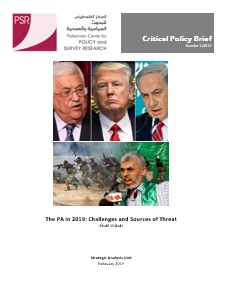
It is increasingly becoming clear that the Palestinians will find themselves in 2019 simultaneously confronting several challenges, a situation unparallel since the end of the second intifada at the end of 2004. At once, they might find themselves confronting an American peace plan they reject, a West Bank-Gaza Strip split intensifying into permanent separation, a financial and economic crisis that threatens to halt the work of many public institutions and reduces the ability of the Palestinian Authority (PA) to pay salaries to its public sector, and an internal political crisis that questions the legitimacy of the political system as a single political faction finds itself dominating the PA without electoral legitimacy.
The ability of the PA to survive under these conditions is possible, but not certain. The aim of this paper is to explore these challenges, to analyze the role played by various players, such as Israel, the US, Hamas, and the PA and its leadership, in destabilizing the PA, and to present various recommendations that seek to strengthen the ability of the Palestinians to successfully confront these challenges.
Four Challenges
Needless to say, the failure, since the Oslo Agreement was signed, to end the occupation and build an independent Palestinian state has been the greatest challenge to the Palestinian national movement. This failure has deprived the Palestinians of freedom, self-determination and sovereignty over their own land and to exploit their resources and develop their economy. It has allowed the consolidation of the occupation by multiplying the size of the settler population by four times. The failure to reach a peace agreement captures the essence of this crisis as negotiations took place with Israeli political parties that represented the range of the political spectrum, from the left to the right, and under an American sponsorship representing Republicans and Democrats alike.
On top of these conditions, the chances for a successful American peace initiative seem slim to non-existent. The Trump Administration is the most pro-Israel since the creation of that state. Israeli negotiating positions today represent the most hardline Israeli stance since bilateral negotiations began. These positions deny the Palestinians their most minimal needs in a peace settlement. Moreover, the regional environment is not conducive to reaching an agreement, as the major Arab countries are preoccupied with the Iranian threat and the war against terror, and many of these countries, such as Egypt and Saudi Arabia, are willing to work with Israel, even if covertly, thereby giving it an incentive to marginalize the Palestinian issue and to exploit the opportunity to normalize its relations with these countries.
Moreover, the current PA boycott of the Trump Administration limits Palestinian ability to influence the American decision making and reduces PA input into the design of the US peace plan. The boycott makes it possible for president Donald Trump to punish the Palestinians in ways that affect their vital interests in various issues, such as UNRWA, refugees, PLO representation in Washington DC, American economic and security support, and others. It is likely that the Palestinian side will reject the American peace plan that might be presented to the two sides after the holding of the Israeli elections in April. It is almost certain that a negative Palestinian response to the plan will have consequences that might damage the PA’s economy and its ability to deliver services to the public. The US reaction might also create conditions that could signal a green light to Israel to annex one or more of the settlement blocs or to greatly expand settlement construction thereby eliminating the option of a two-state solution.
The ability of the Palestinian side to confront this fast-approaching challenge is constrained by the PA failure to deal with a second challenge: the internal fragmentation and the repeated failure to achieve reconciliation and reunify the West Bank and the Gaza Strip. The PA decision, in December 2018, to dissolve the Palestinian Legislative Council (PLC) indicates that the PA has concluded that the road to reconciliation and reunification is now closed. That decision, and Hamas’ response to it, also demonstrate that Fatah and the Islamist faction continue to contribute, intentionally and unintentionally, to the deepening of the split, ultimately making it permanent. Despite the fact that the PLC has not met since the split in 2007, it served as a symbol of the territorial unity of the PA in its two geographic areas, the West Bank (including East Jerusalem) and the Gaza Strip, just as the PLO’s National Council (PNC) serves as a symbol of the unity of the Palestinian people and its representation despite the fact that the PNC has not met for 20 years before its last meeting in 2018 (with the exception of an emergency meeting in 2009). Similarly, the dissolution of the Reconciliation Government and the effort to form a new government serve a similar purpose in diminishing the chances for reunification. It is true that the reconciliation government has contributed to deepening the split through the implementation, without reservation, of the decisions of the PA leadership to impose sanctions on the Gaza Strip that included reducing Gazan access to electricity and other services and reducing the salary payment to PA employees from the Gaza Strip. Nonetheless, it is the only remaining public institution that was formed by a joint Fatah-Hamas consultation expressing the intention of the two sides to work together.
Imposing sanctions on the Gaza Strip, dissolving the PLC, and replacing the reconciliation government with one controlled entirely by Fatah will most likely consolidate the split and open the door to further isolation of the Gaza Strip thereby making it possible for Israel, Egypt, Qatar, and other players to work together to indirectly strengthen Hamas’ control over the Strip in the hope of preventing the collapse of that Hamas-controlled area and to ease the severe humanitarian conditions prevailing there today in order to prevent the eruption of another Hamas-Israel war or the transformation of that area into a safe haven for terror against Egypt and Israel. A successful conclusion of a long-term deal in the Gaza Strip, facilitated by financial support from some of the Arab countries, such as Qatar or the United Arab Emirates, might force the PA to impose additional sanctions against the Strip which might include stopping all salary payments and reducing financial and administrative services in health, education, and others areas. Such escalation, while aiming at preventing the establishment of a Hamas mini-state in the Strip, could quickly lead to a permanent separation between the two geographic areas of the PA regardless of the good intentions of all those responsible.
A third challenge, the threat to the financial stability and economic growth of the PA, reduces the ability of the PA to address the first two challenges. The ability of the PA to deliver services to Palestinians in the West Bank and the Gaza Strip is linked directly to its economic conditions and financial stability, both linked to the level of financial and economic support from donor countries and the willingness of Israel to implement its commitment to transfer the custom revenues it collects on behalf of the PA. The suspension of the American civil and security assistance and the Israeli partial or full suspension of the transfer of PA funds will dramatically increase the PA financial deficit and will constraint its ability to pay salaries or provide critical social and security services it currently provides. There is no doubt that the PA can continue to shoulder its financial responsibilities for a year or more, as long as various Arab and international donors continue to provide critically needed budget assistance. However, this ability will gradually diminish and it is not certain that the PA will be able after that to enforce law and order or provide full educational, health or social services for most of the Palestinian areas, particularly those located outside the main cities. Moreover, any serious economic deterioration or financial instability will greatly impact conditions in the Gaza Strip leading to economic strangulation and possible armed conflict that can only dramatically worsen the current humanitarian conditions.
A fourth challenge, a growing public questioning of PA legitimacy, will further complicate the efforts of the Palestinian leadership to deal effectively with American and Israeli efforts to block the road to a quick end to the Israeli occupation and the establishment of a Palestinian state. In the absence of presidential and parliamentary elections, and given the one-party rule currently prevailing in the West Bank despite the fact that this party had in fact lost the last Palestinian elections in 2006, the PA cannot gain a significant measure of public trust. Public questioning of PA legitimacy is currently accompanied by a total absence of formal accountability in the political system, a severe weakness in the independence of the judiciary, and constraints on free expression and on the independence and pluralism of civil society and non-governmental organizations. All these shortcomings are the product of policies pursued by the PA leadership during the past 12 years.
Needless to say, it was Hamas’ 2007 resort to violence to resolve a domestic political conflict that provided the trigger to all these ills. But it is also true that it was the non-democratic, and sometimes the anti-democratic, nature of the PA ruling elite, particularly during the past six years, that closed the door to any meaningful accountability or to any opportunity to transition to any measure of democracy. Most members of this elite did not appreciate the meaning of democracy and viewed it as imposing unnecessary constraints on their pursuit of control. Moreover, the intra-Fatah conflict, particularly between president Abbas and Mohammad Dahlan, a PLC member from Fatah, left its destructive impact on the PA as it provided the impetus to release it from any serious commitment to the Basic Law or rule of law. In disregard to rule of law and the Basic Law, the PA leadership gave itself the power to annul the parliamentary immunity of Dahlan and some members of the PLC, to interfere in the functioning of the judiciary, and to constrain the work of Palestinian NGOs. Moreover, the absence of international scrutiny of PA’s authoritarian tendencies, particularly from the EU and its member states, and particularly since the deterioration of the Arab Spring into civil wars and terror, contributed to removing any serious brakes on the way to one-man rule in the Palestinian political system.
A huge loss of public trust in the PA and its government was one of the severest consequences of this absence of legitimacy and the slide to authoritarianism. This loss of trust was demonstrated in the internal fight over the Social Security Law between the PA and the Palestinian civil society. Distrusting the PA manifested itself in other occasions such as when the PA could not mobilize a large public mass to protest against the American decisions regarding Jerusalem, such as the Trump Administration recognition of that city as the capital of Israel or when the US actually moved its embassy to Jerusalem. It is expected that this distrust in the PA will pose an additional impediment to PA efforts to mobilize public opposition to the US “Deal of the Century” or Israeli measures to expand or even annex settlements.
Six Sources of Threat
Addressing the four challenges described above requires an understanding of the main sources of threat to PA stability. There are three external sources and three internal ones. The external sources of threat include Israel, the US and several regional powers. The three internal sources include Hamas, the PA leadership and ruling elite, and the absence of a constitutionally sanctioned process to select a successor to president Abbas. Israel plays the most important role: it is the occupying power and the most able to threaten PA stability and indeed survival. Israeli settlement expansion and confiscation of Palestinian land pose a threat to the integrity of Palestinian territories and could in the medium term permanently close the door to the two-state solution. Moreover, settlers’ violence poses a threat to the security and safety of Palestinians in rural areas and expose the failure and incompetence of the PA to provide a minimum level of security to areas outside the main Palestinian cities. Israel controls the main sources of Palestinian wealth, such as land, oil, and water and collects custom duties that provide a lifeline for the PA and its institutions, as these funds constitute the lion share of PA salary payment to the public sector. Roadblocks and checkpoints erected by the Israeli army to protect settlers are able to paralyze movement on Palestinian roads, diminish growth, and weaken PA ability to enforce law and order. Israeli army incursions into Palestinian cities pose a severe moral threat and serve as a source of humiliation to the PA and its security services. Israeli control over Palestinian land in area C eliminates any possible expansion or reconstruction of PA infrastructure by blocking plans for new roads and highways, laying pipes for electricity, water or communication lines, or to build new cities or exploit these areas for tourism.
Current unconditional US support for Israel provides the occupying power with the capacity to maintain its occupation of Palestinian land. The US international stature poses a direct impediment to PA efforts to utilize the international system as an effective tool in ending the occupation. Moreover, the US uses its economic support to the PA as a means of pressure to force it to change its policy and forgo available option (the case of joining the International Criminal Court was one such example) or to suspend financial support to force the PA to reengage the US peace team. The PA suspended contacts with the Trump Administration immediately after the US recognized Jerusalem, in December 2017, as the capital of Israel. The US can use its international political and financial status to impose further sanctions on the PA that could hinder the activities of the Palestinian banking system, prosecute members of the ruling elite in American courts as terrorists, suspend existing commercial agreements and other facilities provided by the US to the Palestinian private sector, impose restrictions on Palestinian travel to the US or even withdraw American recognition of the PA passport. The US can use its monopoly over Palestinian-Israeli peace making in order to destroy the two-state option. Indeed, it can do so directly by encouraging Israeli settlement expansion and confiscation of Palestinian land or by submitting plans that aim at creating a Palestinian entity, or a protectorate, under Israel’s security control, one without sovereignty over parts of East Jerusalem or over Muslim and Christian holy places in its Old City, and without a just solution to the refugee problem. Submitting such ideas is tantamount to closing the door for a peaceful Palestinian-Israeli settlement for a long time to come.
The third source of threat comes from regional actors. For example, Iran arms one Palestinian faction against another and promotes policies that contradict those of the PA. If successful, Iran has the potential of significantly destabilizing the PA and threatening its security. Different regional powers, with good intentions, can contribute to the consolidation of the split. For example, Qatar’s, and even Egypt’s, support for Hamas, while aiming at ending the split and preventing the deterioration of the humanitarian conditions in the Gaza Strip, can strengthen its control over that area and weaken PA leverage over the Islamist group. Finally, it goes without saying that a close Arab-Israeli coordination with Israel, while aiming at containing Iran, might create conditions in which Arab players, such as Saudi Arabia, might lend support to the American peace plan despite a Palestinian assessment that the plan neither fully ends the Israeli occupation nor insures the creation of a truly independent and sovereign Palestinian state.
Internal sources of threat to PA stability start with Hamas. Hamas’ resort to arms to settle intra-Palestinian quarrels created a state of animosity and fear in the political system leading to greater willingness on the part of its rival, Fatah, and the PA leadership to exclude that group. Hamas has essentially made itself enemy number one to the PA and the Palestinian president and the perceived threat it poses has been one of the main reasons for the continued and sustained security coordination with Israel even after the Oslo process was announced dead by the PA. Moreover, Hamas’ exclusive control over the Gaza Strip is detrimental to Palestinian national unity, greatly harming the prospects for rule of law and eliminating any chance for a transition to democracy. Hamas’ own example of authoritarianism, in the model it crafted in the Gaza Strip, damages public confidence in democracy and raises question marks in some quarters regarding that system’s appropriateness to Palestinians.
Furthermore, Hamas’ insistence on maintaining its armed wing and militia and its use of these forces in internal conflicts, as demonstrated in 2007, place a huge impediment to reconciliation and make it impossible to create a system that enjoys monopoly over coercive force. In the West Bank, Hamas’ resort to armed attacks against the Israelis destabilizes the PA and places it in constant fear of a Hamas use of force to achieve political ends, including the possibility of violently taking over control over PA institutions, if and when the Islamist faction manages to rebuild an effective armed wing. It is becoming clear that the internal Palestinian power struggle has acquired a military dimension, one that will be impossible to neutralize unless all rival political factions are disarmed. Yet, it is evident today that such a goal is not realistic, at least in the short term. Such a conclusion points to the unpleasant realization that it is highly unlikely that the Palestinians can, in the short term, create an inclusive political system.
The second internal source of threat to PA stability comes in fact from within it, from its own leadership and ruling elite. As indicated above, governance during the past years has witnessed serious corrosion in rule of law as the PA leadership abandoned the constitutional legitimacy that brought it to power. This development has been detrimental to public confidence in the leadership and the elite. The anti-democratic policies pursued by both, the PA president and the reconciliation government, deepen public distrust and make it impossible for the PA to stretch its hand to Hamas in reconciliation, or even containment, and strengthens the PA’s one-man rule and the authoritarian tendencies of its elite. Greater authoritarianism reduces any hope for any short-term transition to democracy and weakens the ability of the PA to mobilize the masses to protest against American and Israeli anti-Palestinian policies.
The third source of internal threat comes from the absence of any constitutional process to fill the vacuum that will be created after Abbas. The dissolution of the PLC directed a strong blow not only to the prospect of reconciliation, but also to the ability of the Palestinians to agree on a succession process acceptable to most factions in the West Bank and the Gaza Strip. The Basic Law gives the PLC speaker the job of an interim president when the position of president is vacant for any reason. Without such a constitutional process, the PA will continue to slide toward authoritarianism and the chances for fragmentation within Fatah and perhaps an internal armed conflict will increase. Such a development will make it easier for external actors to intervene in an attempt to impose their agenda on the two parts of the Palestinian territories. It is true that this is a worst-case scenario, but ignoring this source of threat to PA stability, or turning to non-constitutional means to address it, can weaken the ability of the Palestinians to confront any of the four challenges mentioned above.
Recommendations
To avoid the bleakest expectations and to improve the ability of the PA to confront the challenges identified above, the Palestinian leadership and the ruling elite need to change the current path. In the first place, the change should start by embarking on a reconciliation process that aims at gradually reunifying the West Bank and the Gaza Strip. Such reconciliation can gradually restore legitimacy to the political system by allowing the holding of presidential and parliamentary elections and by committing the parties to the Basic Law and rule of law. Slowing down and gradually reversing the slide to authoritarianism will help restore the credibility of the Palestinian leadership thereby restoring public trust in the PA and its government and positioning the PA to be more effective in confronting the remaining two challenges: confronting US efforts in peacemaking and reengaging the US administration with confidence and confronting the approaching economic crisis that will begin to worsen in the second half of 2019 without finding itself facing potential intra-Palestinian confrontations that can only weaken the Palestinians’ ability to confront any of the challenges to their future.
Secondly, an urgent need exists to restore public trust in the PA. This cannot be achieved by holding parliamentary elections alone. Insistence on holding parliamentary, but not presidential, elections, as the PA leadership does today, can only trigger a wide scale boycott from most factions and will make it impossible to hold elections in the Gaza Strip. Restricting the elections to the West Bank, as the PA leadership is currently contemplating, will deal a severe blow to the prospects for reunification. Only the holding of parliamentary and presidential elections in both, the West Bank and the Gaza Strip, can bring about a wider public and factional participation in both areas.
Thirdly, in the next few weeks, the PA should focus its efforts on neutralizing a potential regional threat by strengthening its relations with Egypt, Saudi Arabia and Jordan with the aim of forming a Palestinian-Arab coalition whose mandate should be to jointly examine the US peace plan and jointly respond to it. If successful, the PA should then seek to work with its Arab partners to develop a joint plan that can provide the PA with the means to maintain its financial stability.
Finally, the PA should take advantage of the great media attention that will accompany the release of the Trump plan by offering its own joint Palestinian-Arab peace plan. This counter proposal should build on progress made in previous Palestinian-Israeli negotiations (two states, 1967 borders with equal swaps, two capitals in Jerusalem, and a multilateral military presence in the Jordan Valley) and on the Arab Peace Initiative. Such joint Palestinian-Arab peace plan will most likely find support in many countries of the world including those of the EU.
___________________________________
* Khalil Shikaki is the director of the Palestinian Center for Policy and Survey Research (Ramallah). He is also a senior fellow at the Crown Center for Middle East Studies at Brandeis University. He finished his Ph.D. in Political Science from Columbia University in 1985, and taught at several Palestinian and American universities. Since 1993, Dr. Shikaki has conducted more than 200 polls among Palestinians in the West Bank and the Gaza Strip. His research has focused on Palestinian state building, public opinion, transition to democracy, and the impact of domestic Palestinian politics on the peace process. He is the co-author of Arabs and Israelis: Conflict and Peacemaking in the Middle East (Palgrave Macmillan, 2013), with Abdel Monem Said Aly and Shai Feldman. Other recent publications include "The Future of Israel-Palestine: a One-State Reality in the Making," NOREF Report, May 2012;"Coping with the Arab Spring; Palestinian Domestic and Regional Ramifications, " Middle East Brief, no. 58, Crown Center for Middle East Policy, Brandeis University, December 2011; and Public Opinion in the Israeli-Palestinian Conflict: The Public Imperative During the Second Intifada, with Yaacov Shamir, Indiana University Press, 2010.
Thirty years after the signing of the Oslo Accords, about two thirds describe conditions today as worse than they were before that agreement; two thirds think it has damaged Palestinian national interests, three quarters think Israel does not implement it; and a majority supports abandoning it despite the fact that about half believes that abandoning it would lead to the collapse of the PA and the return of the Israeli Civil Administration.
6-9 September 2023

These are the results of the latest poll conducted by the Palestinian Center for Policy and Survey Research (PSR) in the West Bank and the Gaza Strip between 6 and 9 September 2023. The period leading up to the poll witnessed a number of important developments, including the 30th anniversary of the signing of the Oslo Accords, the occupation of the Jenin refugee camp by the Israeli army and the killing of 12 Palestinian residents of the camp, and the visit of President Abbas to the camp after the withdrawal of the Israeli army. During this period, Palestinian faction leaders also met in City of El Alamein in Egypt in the presence of President Abbas but failed to agree on a joint statement. During this period, settler terrorist acts in Palestinian areas of the West Bank increased, as did armed attacks by Palestinians against settlers and Israelis. Finally, there have been press reports that there are US-Saudi negotiations to reach an agreement to normalize Saudi-Israeli relations and that Palestinian-Saudi and Palestinian-American meetings have been held to set Palestinian conditions for this normalization agreement. This press release addresses these issues and covers other matters such as the general conditions in the Palestinian territories, the peace process and future possible directions for Palestinians in the absence of a viable peace process. Total size of the sample is 1270 adults interviewed face to face in 127 randomly selected locations. Margin of error is +/-3%.
For further details, contact PSR director, Dr. Khalil Shikaki, or Walid Ladadweh at tel. 02-296 4933 or email pcpsr@pcpsr.org
Main Findings:
On the occasion of the 30th anniversary of the Oslo Accords, we asked the public a series of questions to gauge their position today on this agreement and its outcome. As we found five years ago, a majority (this time just under two-thirds) believes that the situation today is worse than it was before the implementation of the Oslo Accords. The vast majority still believes that it was wrong to sign that agreement. Today, a majority wants the PA to abandon the agreement and just over two-thirds believe that the agreement has harmed Palestinian interests. Above all, more than three quarters of the public believe that Israel does not implement this agreement all or most of the time.
In light of recent talk of a possible normalization of relations between Saudi Arabia and Israel, the poll asked the public what it thinks of the impact of such normalization on the chances of achieving Palestinian-Israeli peace. A majority says it would be detrimental to the chances of peace. However, the results indicate significant differences between the attitudes of residents of the Gaza Strip, some of whom tend to see positive aspects of normalization, and those of West Bankers, who show firm rejection of it. However, the largest percentage in both regions believes that normalization with Israel is not acceptable before the Arab-Israeli conflict is resolved. Moreover, a large majority, more than 70%, opposes a Palestinian engagement with the Saudis or the Americans to discuss Palestinian conditions for accepting the Saudi normalization.
We also asked about internal Palestinian reconciliation. The poll found that the vast majority believes that the meeting of the leadership of factions in the Egyptian City of El Alamein, about two months ago, was a failure. Among those who view the meeting as a failure, the percentage that places the blame on the Fatah leadership is greater than those who blame Hamas. However, one-third of the public places the blame for the failure on other parties.
Despite the failure of the reconciliation meeting in El Alamein and the greater blame placed on the Fatah leadership, Hamas's popularity has not changed compared to three months ago. In fact, Fatah's popularity improved in both the West Bank and the Gaza Strip. Perhaps the reason why Hamas' standing has not improved is the recent marches in the Gaza Strip demanding better living conditions. This may also have contributed to improving Fatah's image. As for President Abbas, although there are signs that his position might have improved slightly, in light of his decision to retire most governors, most of the indicators of improvement, such as the slight rise in his popularity if presidential elections were held between him and Ismail Haniyeh of Hamas, are due to the high percentage of boycott of presidential elections in which only these two candidates were competing.
Finally, we asked about Palestinian-Israeli relations. The findings show a rise, higher than the margin of error, in support for the two-state solution, reaching about a third. Nonetheless, the overwhelming majority still believes that this solution is no longer feasible due to settlement expansion. At the same time, these results indicate an increase in support for unarmed popular resistance, and a similar increase in support for a return to confrontation and armed intifada. Moreover, nearly half of West Bankers believe that the formation of armed groups from the towns and villages subjected to violent attacks by settlers is the most effective solution in combating settler terrorism.
| (1) 30 years after the signing of the Oslo Agreement: |
- A large majority of 73% knows the exact year in which the Oslo Accords were signed, but the rest do not know or chose the wrong year.
- 49% believe that the PA does not implement the Oslo agreement today while 44% believe it does that always or most of the time. When asked about the current Israeli government, 76% say it does not implement the Oslo agreement today while only 17% say it implements it all or most of the time.
As shown in the following two figures, Gazans are more likely than West Bankers to think that Israel is currently implementing the Oslo Agreement, while there are no differences in perception in the two areas regarding the PA implementation of that agreement.

- A majority of 64% believes that the situation today is slightly worse or much worse than it was before the Oslo agreement while 20% believe it is much better or slightly better, and 12% believe the situation today is the same as before the Oslo agreement. On the twenty-fifth anniversary of the signing of the Oslo Accords (i.e. September 2018), 73% said the situation today is worse than before the Oslo Agreement while 13% said the situation is better than before the Oslo Agreement. As shown in figure (3) below, today, in contrast with the situation five years ago, Gazans are more likely than West Bankers to view the Oslo Agreement more positively.
Figure (3): Public assessment of conditions before and after the Oslo Agreement, in 2018 and in 2023

- A majority of 68% believes that the Oslo agreement harmed Palestinian interests while only 11% believe it served Palestinian interests and 17% believe it did not serve and did not harm Palestinian interests. On the twenty-fifth anniversary of the signing of the Oslo Accords, 65% said the agreement harmed Palestinian interests and 16% said it served Palestinian interests.
- A majority of 71% believes it was wrong for the PLO to sign the Oslo agreement while 23% believe it was right to do so.
- A majority of 63% supports the PA abandoning the Oslo agreement while 31% oppose it. As shown in figure (4) below, Gazans are much more likely than West Bankers to oppose the abandonment of the Oslo Agreement.
Figure (4): support or oppose the Palestinian Authority's abandonment of the Oslo Accords

- 46% believe that the most likely scenario if the PA suspends the implementation of the Oslo agreement is the collapse of the PA and possibly the return of the Israeli Civil Administration while 40% believe that the most likely scenario if the PA stops implementing the Oslo agreement is a reversal of Israel’s current policy, perhaps ending its settlement expansion and returning to negotiations.
| (2) Normalization of relations between Saudi Arabia and Israel: |
- A majority of 56% believes that reaching an agreement between Saudi Arabia and Israel to normalize relations constitutes a harmful development that would negatively affect the chances of reaching a Palestinian-Israeli peace (this percentage reaches 69% in the West Bank and drops to 38% in the Gaza Strip). By contrast, 17% (29% in the Gaza Strip and 8% in the West Bank) believe such normalization could improve the chances for reaching Palestinian-Israeli peace; 24% believe it is neither harmful nor beneficial.
- We presented the public with five possible conditions related to the Palestinian-Israeli front that Saudi Arabia could demand from Israel in exchange for normalization with it and asked them to choose the condition they prefer the most. A majority of 53% (59% in the West Bank and 43% in the Gaza Strip) said it rejects all such conditions altogether because normalization with Israel is not permissible before resolving the Arab-Israeli conflict. But 12% chose the release of a number of prisoners; 10% chose Israel's recognition of the two-state solution based on the 1967 borders; 8% chose to transfer Area C land to Palestinian control; another 8% chose the release of tax revenues funds withheld by Israel; and 7% chose Israel's commitment not to annex any Palestinian areas in the West Bank.
As shown in figure (5) below, Gazans are more willing than West Bankers to consider Palestinian conditions for Saudi normalization with Israel and that Gazans are interested mainly in the transfer of control over land to the PA and in an Israeli acknowledgement of the two-state solution based on the 1967 borders.
Figure (5): If it is up to you, which of the following conditions should Saudi Arabia demand in order to normalize its relations with Israel?

- We asked the public about support for a PA entry into negotiations with Saudia Arabia and the US over the setting of Palestinian conditions for Saudi normalization with Israel, such as Israeli transfer of land or the opening of the PLO representative office in Washington DC. An overwhelming majority (72%) opposes a PA entry into such negotiations (79% in the West Bank and 61% in the Gaza Strip) while 24% (38% in the Gaza Strip and 14% in the West Bank) support it.
| (3) Legislative and presidential elections: |
- If new presidential elections were held today and only two candidates, Mahmoud Abbas and Ismail Haniyeh, the voter turnout would be only 42%, and among those who would participate, Abbas would receive 37% of the vote and Haniyeh 58% (compared to 56% for Haniyeh and 33% for Abbas three months ago). In the Gaza Strip, the vote for Abbas stands at 33% and for Haniyeh at 64%, while in the West Bank Abbas receives 43% and Haniyeh 50%. If the competition is between Marwan Barghouti and Haniyeh, participation would rise to 59% and among those voting, Barghouti receives 60% and Haniyeh 37%. If the competition were between Mohammad Shtayyeh and Ismail Haniyeh, participation would drop to only 41%, with Shtayyeh receiving 33% and Haniyeh receiving 62%.
- In a closed question, we asked the public to select the person they prefer to see as President Abbas's successor. The largest percentage (34%) said they prefer Marwan Barghouti; 17% preferred Ismail Haniyeh; 6% preferred Mohammed Dahlan, 5% preferred Khaled Meshaal, 3% preferred Yahya al-Sinwar, Muhammad Shtayyeh, and Hussein al-Sheikh, and 30% said they did not know or chose someone else.
- Level of satisfaction with the performance of president Abbas stands at 22% and dissatisfaction at 76%. Satisfaction with Abbas stands at 21% in the West Bank and 24% in the Gaza Strip. Three months ago, satisfaction with Abbas stood at 17% and dissatisfaction at 80%. 78% want Abbas to resign while 19% want him to remain in office. Three months ago, 80% said they want Abbas to resign. Demand for Abbas' resignation stands at 78% in the West Bank and 79% in the Gaza Strip.
- If new parliamentary elections were held today with the participation of all political forces that participated in the 2006 elections, 64% say they would participate in them, and among these participants, Fateh receives 36%, Hamas' Change and Reform 34%, all other lists combined 9%, and 21% say they have not yet decided whom they will vote for. Three months ago, vote for Hamas stood at 34% and Fatah at 33%. Vote for Hamas in the Gaza Strip stands today at 44% (compared to 44% three months ago) and for Fateh at 32% (compared to 28% three months ago). In the West Bank, vote for Hamas stands at 24% (compared to 25% three months ago) and Fatah at 40% (compared to 34% three months ago).
- 27% believe that Hamas is the most deserving of representing and leading the Palestinian people today while 24% believe that Fateh under the leadership of Abbas is more deserving; 44% believe both are unworthy of representation and leadership. Three months ago, 31% said Hamas is the most deserving, 21% said Fateh led by Abbas is the most deserving, and 43% said both are unworthy of representation and leadership.
| (4) Domestic Conditions : |
- Positive evaluation of conditions in the Gaza Strip stands at 10% and positive evaluation of conditions in the West Bank stands at 21%. Despite this, perception of personal safety and security in the Gaza Strip stands at 69% and perception of security in the West Bank stands at only 48%. Three months ago, perception of security in the West Bank stood at 46% and in the Gaza Strip at 71%.
- Perception of corruption in PA institutions stands at 87%; 72% believe that there is corruption in Hamas-run institutions in the Gaza Strip. Three months ago, 84% said there is corruption in the PA institutions and 73% said there is corruption in public institutions run by Hamas.
- 42% of West Bankers believe that people can criticize the PA in the West Bank without fear while a majority of 56% believes it is not possible. Among residents of the Gaza Strip, 39% believe that criticism of the Hamas authority can be made without fear while 59% believe it is not possible.
- A majority of 62% believes that the PA has become a burden on the Palestinian people and only 35% believe it is an asset for the Palestinian people. Three months ago, almost identical percentage of 63% said the PA is a burden and 33% said it was an achievement.
- 53% support, and 38% oppose, President Abbas' move to retire 12 governors in the West Bank and Gaza Strip; 53% agree that Abbas' move to retire the governors is a step in the right direction to reform the PA and inject new and young blood into it while 38% believe it is not.
- An overwhelming majority (78%) believes that Abbas' visit to Jenin refugee camp after the withdrawal of the Israeli army did not contribute to improving relations between citizens and the Palestinian leadership while 20% believe it did.
- 59% believe that the marches held in the Gaza Strip a month ago to demand better living conditions were a reaction to the difficulties of life while 35% believe they were motivated by foreign political agendas.
- 73% (82% in the West Bank and 60% in the Gaza Strip) believe that there are political prisoners in PA prisons while 21% believe there are none.
- A majority of 60% of the public (67% in the West Bank and 51% in the Gaza Strip) is concerned that clashes between members of armed groups and Palestinian security forces could lead to clashes and violence that could threaten stability in the PA.
- 39% believe that filing a complaint with the Public Prosecution office against AMAN (the Palestinian independent institution that monitors corruption), for publishing information about suspicions of corruption related to some officials in the case of the whitewashing of settlements’ dates, will scare citizens and institutions from reporting suspicions of corruption while 32% believe it will encourage citizens and institutions to report suspicions of corruption; 20% believe that such a complaint will have no impact on reporting suspicions of corruption.
- When asked why the office of the president has filed a complaint against AMAN, 59% said it was to punish whistleblowers and 22% said it was because the information published was incorrect.
- We asked the participants which TV station they had watched the most over the past three months. Findings show that Al Jazeera TV viewership is the highest at 28%, followed by Al Aqsa TV (11%), Palestine TV (9%), Palestine Today (8%), Ma'an TV (7%), and Al Arabiya and Al Mayadeen (3% each).
| (5) Reconciliation and the reunification of the West Bank and the Gaza Strip: |
- An overwhelming majority of the public (78%; 81% in the West Bank and 72% in the Gaza Strip) believes that the meeting of Palestinian factional leaders in El Alamein in Egypt in the presence of PA president Mahmoud Abbas was a failure while 12% believe it was a success.
- The largest percentage of those who believe that the meeting was a failure (34%; 38% in the West Bank and 26% in the Gaza Strip) blame the failure on the leadership of other forces and actors (other than Fateh and Hamas) while 29% (40% in the Gaza Strip and 23% in the West Bank) blame the failure on the leadership of Fateh, and 18% (25% in the Gaza Strip and 14% in the West Bank) place the blame on Hamas’ leadership.
- The public is evenly divided in its position regarding Islamic Jihad's boycott of the meeting in El Alamein with 44% saying the movement should have participated while 43% believe the boycott was justified.
- 24% (38% in the Gaza Strip and 15% in the West Bank) are optimistic about the success of reconciliation while 73% are not optimistic. Three months ago, 22% said they were optimistic.
| (6) Palestinian-Israeli Relations and the Peace process: |
- 32% support and 67% oppose the idea of a two-state solution, which was presented to the public without providing details of the solution. Three months ago, support for this solution in a similar question stood at 28%. Support for the two-state solution is linked to public assessment of the feasibility of such a solution and the chances for the establishment of a Palestinian state. Today, 71% believe the two-state solution is no longer practical due to settlement expansion but 27% believe it is still practical. Moreover, 76% believe that the chances for the establishment of an independent Palestinian state alongside Israel in the next five years are slim or nonextant, and 23% believe the chances are medium or high. Three months ago, 71% said that the two-state solution is no longer practical due to settlement expansion.
- When asked about public support and opposition to specific policy measures to break the stalemate: 58% supported joining more international organizations; 53% supported resort to unarmed popular resistance; 58% supported a return to confrontations and armed intifada; 52% supported dissolving the PA; and 27% supported abandoning the two-state solution and demanding one state for Palestinians and Israelis. Three months ago, 53% supported a return to confrontations and armed intifada; 49% supported the dissolution of the PA; and 26% supported abandoning the two-state solution in favor of one state.
As shown in figure (6) below, Palestinian support for resort to arms increase 10 percentage points since the formation of the current far right Israel government and that support for dissolving the PA has increase five percentage points.
Figure (6): Comparison between public support and opposition to specific options to break the deadlock, today and a year ago

- When asked about the best way to end occupation and establish an independent state, the public was divided into three groups: a majority of 53% (51% in the Gaza Strip and 54% in the West Bank) said it was armed struggle; 20% said it was negotiations; and 24% said it was popular non-violent resistance. Three months ago, 52% said armed struggle was the best way and 21% said negotiations were the best way.
- An overwhelming majority (82%) believes that the Israeli army did not achieve its goal of arresting or killing fighters from the Jenin Brigade and other groups during its occupation of the camp more than two months ago.
- In light of the increase in settler terrorist attacks against Palestinian towns and villages, we asked the public what means are most effective in combating this terrorism that are also the most feasible. The largest percentage (45%, 47% in the West Bank and 43% in the Gaza Strip) chose the formation of armed groups by residents of the targeted areas in order to protect their areas; 29% chose to deploy Palestinian police forces in the targeted areas; 13% chose the demand that the Israeli army take measures to prevent settler terrorism; and only 9% chose to form unarmed groups of residents of the targeted areas to protect their areas.
Figure (7) below, show the extent of the public distrust, particularly in the West Bank, in the role of the Israeli army in protecting the vulnerable communities and that the trust of the public in the Palestinian police is much less than the trust it places in the armed groups.
Figure (7): Which one of the following methods do you think is the most effective in combating settlers’ terrorism, such as the attacks on Huwara, Turmusayya and Um, and at the same time the most realistic.

- In light of demonstrations against the Netanyahu government, 39% believe the chances of these demonstrations turning into a civil war inside Israel are low, another 23% say they are nonexistent, and only 35% think they are high.
| (7) Most vital Palestinian goals and the main problems confronting Palestinians today: |
- 37% believe that the first most vital Palestinian goal should be to end Israeli occupation in the areas occupied in 1967 and build a Palestinian state in the West Bank and the Gaza Strip with East Jerusalem as its capital. By contrast, 30% believe the first most vital goal should be to obtain the right of return of refugees to their 1948 towns and villages, 18% believe that the first and most vital goal should be to build a pious or moral individual and a religious society, one that applies all Islamic teachings and 14% believes it should be to establish a democratic political system that respects freedoms and rights of Palestinians.
- In a question about the main problem confronting Palestinian society today, the largest percentage, 25% (11% in the Gaz Strip and 35% in the West Bank), say it is corruption; 24% (33% in the Gaza Strip and 18% in the West Bank) say it is unemployment and poverty; 18% say it is the continuation of the occupation and settlement construction; 17% (26% in the Gaza Strip and 10% in the West Bank) say it is continued siege and blockade of the Gaza Strip; 10% say it is the split between the West Bank and the Gaza Strip; and 4% say it is the weakness of the judiciary and the absence of liberties, accountability and democracy.
- When asked about the most pressing problem confronting the Palestinians today, the largest percentage (37%) said it is the Israeli occupation, while 22% said it is corruption, 15% said it is unemployment; 14% said it is the split between the West Bank and the Gaza Strip, 7% said it is the internal violence, and 1% said it is the inadequate infrastructure.
This poll has been conducted in cooperation with the Konrad-Adenauer-Stiftung in Ramallah
11 February 2020
94% of the Palestinians reject the “Deal of the Century;” large majorities support various responses to the plan including ending the WBGS split, the withdrawal of PA recognition of Israel, the ending of security coordination with Israel, the ending of the implementation of the Oslo agreement, and the resort to armed struggle; more than 80% believe the plan returns the conflict to its existential roots; support for the two-state solution drops to its lowest level since the signing of the Oslo agreement; and while about two-thirds endorse president Abbas’s policy against the plan, about 70% believe that he will not keep his word or follow through
5-8 February 2020
This poll has been conducted in cooperation with the Konrad-Adenauer-Stiftung in Ramallah

These are the results of the latest poll conducted by the Palestinian Center for Policy and Survey Research (PSR) in the West Bank and the Gaza Strip between 5-8 February 2020. The period before the conduct of the poll witnessed several developments including the release of the Trump’s “Deal of the Century” and its immediate rejection by the Palestinian leadership. The Arab foreign ministers met in Cairo few days later and unanimously rejected the plan. A similar rejection followed by representatives of the Islamic countries. Despite the consensus, some Arab countries expressed timid welcome of US efforts and three Arab countries sent their ambassadors to the event in the White House in which the plan was announced. Internally, Fatah and Hamas issued conciliatory statements calling for reconciliation but this was not followed by any concrete measures and efforts to hold Palestinian elections witnessed some serious setbacks. In Palestinian-Israeli relations, tensions rose significantly during the fieldwork period as popular confrontations developed in various cities and signs of an emerging trade crisis were visible. This press release addresses many of these issues and covers other matters such as Palestinian parliamentary and presidential elections, general conditions in the Palestinian territories, the peace process and the future possible directions for Palestinians in the absence of a viable peace process. Total size of the sample is 1270 adults interviewed face to face in 127 randomly selected locations. Margin of error is +/-3%.
For further details, contact PSR director, Dr. Khalil Shikaki, or Walid Ladadweh at tel. 02-296 4933 or email pcpsr@pcpsr.org.
Main Findings:
This quarterly poll was conducted one month earlier than planned in order to measure, in a timely manner, the immediate public response to the American plan known as the “Deal of the Century.” Findings show a
Palestinian consensus against the plan as a package and against each of its components, including the economic part if linked to acceptance of the political section of the plan. Moreover, more than 80% of the public believe that the plan has returned the Palestinian-Israeli conflict to its existential roots. The majority speculates that the Trump plan has been deliberately designed to ensure a Palestinian rejection in order for the US to allow Israel to unilaterally annex the Jordan valley and the Jewish settlements.
Findings also show that two-thirds of the public support president Abbas’ policy against the plan. But the majority, ranging between two-thirds and three quarters, does not trust the president’s word, as it believes he will not implement his own decision to end relations with Israel and the US. In response to the Trump plan, the overwhelming majority wants the president to end the split between the West Bank and the Gaza Strip, to withdraw PA recognition of Israel, to end security coordination, to stop the implementation of the Oslo agreement, and to even resort to armed struggle.
Findings also show unprecedented decline in support for the two-state solution to less than 40%, the lowest reported by PSR since the signing of the Oslo agreement. They also show a rise in the percentage of those who think that the most effective means of ending the occupation is armed struggle; they also show a decline in the percentage of those who think negotiation is the most effective means.
In domestic matters, finding show a decline in Abbas’ popularity and that of Fatah compared to our findings two-months ago. They also show a rise in the popularity of Hamas’ Ismael Haniyyeh during the same period. If presidential elections were to take place today, 50% would vote for Haniyyeh. Findings also show a drop in the level of optimism regarding the prospects of holding of parliamentary elections soon. But optimism about the prospects for reconciliation increases a little compared to two months ago and about half of the public indicates that if elections were to take place today, they would contribute to the reunification of the West Bank and the Gaza Strip.
(1) US “Deal of the Century”:
- We presented to the respondents the various components of the American plan, known as the “Deal of the Century,” one component after the other, and asked them if they support or oppose each. We then asked the public about the entire plan as one package. Opposition to the package stood at 94% and support at 4%. Opposition to the components ranged between 91%, for the item on the billions in economic support conditioned on accepting the political plan, and 95%, for the item on Jerusalem and the Palestinian capital and the one on holy places.
- Similarly, 94% believe that a majority of Palestinians is opposed to the plan and 3% believe a majority supports it.
- By contrast, 70% believe that a majority of Israeli Jews support the American plan while 23% think a Jewish majority is opposed to it.
- A majority of 65% expresses support and 27% express opposition for the policy outlined by president Abbas against the Trump plan in which he stated that he is ending relations with Israel and the US including security relations. But a majority of 68% believes that the PA president will not implement his decision to end security coordination with Israel and 73% believe that he will not actually turn conditions to where they were before the Oslo agreement. This seems to be the reason why despite supporting his policy, a majority of 58% is dissatisfied with the actual response of the PA leadership to the American plan; 38% are satisfied.
- In light of the terms of the US plan, an overwhelming majority of 82% believe the plan brings the conflict with Israel to where it originally was, as an existential conflict, while 7% think the plan makes peace more attainable.
- If the Palestinians accept the Deal of the Century, what are the chances that such acceptance would lead to the end of the Israeli occupation and to the building of a Palestinian state? 58% think the chances are zero; 21% think the chances are less than 50%; and 7% think that the chances are more than 50%.
- We proposed to the public 10 possible responses to the American plan and asked it about its support and opposition to each response; expectation regarding what the PA will adopt or allow as a response; and its expectations regarding what will actually happen on the ground:
|

- Nonetheless, a majority of 69% believes the “Deal of the Century” will fail due to Palestinian opposition while 26% think it will succeed despite that opposition.
- We asked the public about its view on why the Trump Administration designed this its plan in the manner it did: a majority of 60% said the Administration deliberately wanted the Palestinians to reject the plan so that Israel can annex the Jordan Valley and the settlements while 34% thought the US actually expected the Palestinian weakness to force them to accept the plan.
- We asked the public to speculate about the motivation of the three Arab countries (UAE, Bahrain, and Oman) that participated in the event in the White House in which the Trump plan was revealed: 83% said they wanted to demonstrate their support for Israel; 6% said they wanted to demonstrate support to Israel and the Palestinians, and only 3% said they wanted to demonstrate support for the Palestinians alone. The Arab League’s unanimous decision to reject the Trump plan notwithstanding, 83% of the Palestinians believe that the Palestinians must nonetheless rely only on themselves while 14% believe they can rely on the Arab countries.
- A majority of 76% is opposed and 11% are not opposed to a resumption of dialogue between the Palestinian leadership and the Trump Administration. Official contacts between the PA and the US government were suspended by the PA after the US, in December 2017, recognized Jerusalem as the capital of Israel. Two months ago 69% said they were opposed to the resumption of dialogue with the US.
- A majority of 59% expects president Trump to lose the next US presidential election and 35% expect him to win it. Similarly, a majority of 53% expects the indictment of Netanyahu in corruption charges to lead to his ouster from leadership in Israel soon while 41% expect him to succeed in staying in power despite the indictment. Two months ago, 58% expected Netanyahu to be removed from power.
(2) The peace process:
- Support for the concept of the two-state solution stands at 39% and opposition at 59%. No description or details were provided for the concept. Two months ago, support for the concept stood at 42%. 36% of the public believe that a majority of the Palestinians supports this solution and 57% believe that the majority opposes it.
- A majority of 61% believes that the two-state solution is no longer practical or feasible due to the expansion of Israeli settlements while 33% believe that the solution remains practical. Moreover, 76% believe that the chances for the creation of a Palestinian state alongside the state of Israel in the next five years are slim or nonexistence while 22% believe the chances to be medium or high.
- The most preferred way out of the current status quo is “reaching a peace agreement with Israel” according to 22% of the public while 45% prefer waging “an armed struggle against the Israeli occupation.” Only 15% prefer “waging a non-violent resistance” and 14% prefer to keep the status quo. Two months ago, 29% said that they prefer reaching a peace agreement with Israel and 39% said they prefer waging an armed struggle.
- When asked about the most effective means of ending the Israeli occupation, half of the public (50%) chose armed struggle, 21% negotiations, and 23% popular resistance. Two months ago, 47% chose armed struggle and 26% chose negotiations.
(3) Legislative and presidential election
- 62% of the public want president Abbas to resign while 33% want him to remain in office. Two months ago, 61% said they want Abbas to resign. Demand for Abbas’ resignation stands at 52% in the West Bank and 78% in the Gaza Strip. Two months ago, demand for Abbas resignation stood at 52% in the West Bank and 73% in the Gaza Strip.
- Level of satisfaction with the performance of president Abbas stands at 37% and dissatisfaction at 60%. Level of satisfaction with Abbas stands at 47% in the West Bank and 22% in the Gaza Strip. Two months ago, satisfaction with Abbas stood at 37% (43% in the West Bank and 27% in the Gaza Strip).
- Only 33% think president Abbas is the best Fatah candidate for the presidency while 43% think that Fatah has better candidates; 25% say they do not know or have no opinion on the matter.
- If new presidential elections were held today and only two were nominated, Mahmoud Abbas and Ismail Haniyeh, the former would receive 44% and the latter 49% of the vote (compared to 49% for Abbas and 44% for Haniyeh two months ago). In the Gaza Strip, Abbas receives 32% of the vote (compared to 37% two months ago) and Haniyeh receives 63% (compared to 56% two months ago). In the West Bank, Abbas receives 54% (compared to 58% two months ago) and Haniyeh 38% (compared to 34% two months ago). If the competition was between Marwan Barghouti and Ismail Haniyeh, Barghouti receives 57% and Haniyeh 38%.
- We asked about potential Abbas successors: If president Abbas does not nominate himself in a new election, 36% prefer to see Marwan Barghouti replacing him, while 24% prefer Ismail Haniyeh. Mohammad Dahlan is preferred by 6% (1% in the West Bank and 12% in the Gaza Strip), Mustafa Barghouti by 4%, and Khalid Mishal and Salam Fayyad by 3% each.
- We also asked the public about its willingness to participate in the upcoming elections and if so, to whom it will vote. If new legislative elections were held today with the participation of all factions, 68% say they would participate in such elections. Of those who would participate, 32% say they will vote for Hamas and 38% say they will vote for Fatah, 12% will vote for all other third parties combined, and 18% are undecided. Two months ago, vote for Hamas stood at 32% and Fatah at 40%. Vote for Hamas in the Gaza Strip stands today at 43% (compared to 41% two months ago) and for Fatah at 30% (compared to 32% two months ago). In the West Bank, vote for Hamas stands at 22% (compared to 24% two months ago) and Fatah at 45% (compared to 46% wo months ago).
- We asked the public about its expectations regarding the outcome of the upcoming elections: 39% (44% in the West Bank and 31% in the Gaza Strip) expect Fatah to win the upcoming legislative elections while only 26% (19% in the West Bank and 37% in the Gaza Strip) expect Hamas to win.
- A plurality of 45% of the public expects general elections to take place in the Palestinian territories in the near future; 43% believe no elections will take place. Two months ago, a majority of 52% expected elections to take place soon.
- 43% support the holding of simultaneous parliamentary and presidential elections and oppose a separation between the two, while 20% say they support the holding of parliamentary elections to be followed few months later by presidential elections, and 23% prefer simultaneous presidential and parliamentary elections but do not oppose separating them by few months.
- 46% (51% in the West Bank and 37% in the Gaza Strip) say that if Israel prevented Palestinian legislative elections in East Jerusalem, voting should be made possible for the residents in any polling station in the Jerusalem governorate or in the West Bank; 46% disagree and say that no election should take place if Israel prevents it in East Jerusalem. Two months ago, a majority of 56% said that if Israel prevented East Jerusalemites from voting in the city, they should be allowed to vote in any polling station in the Jerusalem governorate or in the West Bank.
- 51% trust and 42% do not trust the integrity of the Palestinian Election Commission in managing the election process. Similarly, only 45% believe, and 45% do not believe, that the upcoming parliamentary elections will be free and fair.
- Moreover, only 47% trust, and 47% do not trust, the ability of the West Bank Palestinian police to protect the election process and the ballot boxes with integrity and without bias. Similarly, only 49% trust, and 40% do not trust, the ability of the Gaza Strip police to protect the election process and the ballot boxes with integrity and without bias.
- A majority of 63% say that it will not be possible, and 32% say it will be possible, for all candidate lists, especially Hamas’, to conduct their election campaigns in the West Bank without restrictions or interference from the Palestinian security services. Similarly, a majority of 55% says that it will not be possible, and 39% say it will be possible, for all candidate lists, especially Fatah’s, to conduct their election campaigns in the Gaza Strip without restrictions or interference from the Gaza security services.
- 70% believe that if Hamas wins the upcoming elections, Fatah will not accept the results and will not allow it to form a government with full jurisdiction in the West Bank and the Gaza Strip; 24% think Fatah will indeed allow Hamas to do so. Similarly, 60% believe that if Fatah wins the upcoming elections, Hamas will not accept the results and will not allow it to form a government with full jurisdiction in the West Bank and the Gaza Strip; 34% think Hamas will indeed allow Fatah to do so.
(4) Domestic conditions:
- Positive evaluation of conditions in the Gaza Strip stands at 5% and positive evaluation of conditions in the West Bank stands at 21%.
- Nonetheless, perception of safety and security in the Gaza Strip stands at 74% and in the West Bank at 58%.
- 23% of the public say they want to emigrate due to political, security, and economic conditions. The percentage rises in the Gaza Strip to 28% and declines in the West Bank to 19%.
- Only 42% of the West Bankers say that people can criticize the authority in their area without fear and 54% say that they cannot. In the Gaza Strip, 55% say that people in the Gaza Strip can criticize Hamas authority without fear and 42% say they cannot.
- Perception of corruption in PA institutions stands at 85% while perception of corruption in the institutions controlled by Hamas in the Gaza Strip stands at 65%.
- The public is divided over its assessment of the PA: 47% view it as a burden on the Palestinian people while 46% view it as an asset for the Palestinian people.
- With more than ten months passing since the formation of the Shtayyeh government, findings indicate that a majority, or a plurality, of the public views its performance as similar to that of the previous government in matters of security (50%), the economy (41%), the reunification of the West Bank and the Gaza Strip (50%), the preparation to hold general elections (49%), and the protection of liberties and human rights (51%). But a percentage ranging between 26% and 42% indicates that it believes the performance to be worse than that of the previous government while a percentage ranging between 13% and 24% indicates that the performance of the Shtayyeh government is better than that of the previous government. These findings indicate a slight decline in public’s positive evaluation of the of the Shtayyeh government compared to our findings two months ago.
- Responding to a question about expectations regarding the ability of the Shtayyeh government to make progress in reconciliation and reunification, 55% expects failure; only 35% expects success. In a similar question about the ability of the new government to organize legislative or legislative and presidential elections in the West Bank and the Gaza Strip, a plurality of 48% expects failure and 41% expect success. In another question about the ability of the new government to improve economic conditions, a majority of 55% expects failure and 35% expects success.
- Half of the public (50%: 58% in the West Bank and 38% in the Gaza Strip) believes that it will not receive a fair trial if it finds itself in a Palestinian court while 42% (33% in the West Bank and 55% in the Gaza Strip) believe that will receive a fair trial.
- A majority of 54% (64% in the West Bank and 40% in the Gaza Strip) thinks that the Palestinian judiciary rules according to whims and interests; 41% disagree and believe that it rules according to the law.
- We asked the public about its viewership habits in the last two months. Findings indicate that Al Jazeera TV viewership remains the highest, standing at 20%, followed by Al Aqsa TV and Palestine TV (14% each), Maan TV at 13% each, Palestine Today TV at 10%, al Mayadeen at 5%, and Al Arabiya at 4%.
(5) Reconciliation:
- 40% are optimistic and 56% are pessimistic about the success of reconciliation. Two months ago, optimism stood at only 36%.
- 49% are optimistic, and 45% are not optimistic, that the upcoming legislative elections will contribute to the reunification of the West Bank and the Gaza Strip.
- A majority of 58% believes that the chances for a Hamas-Israel agreement on a long term hudna or cessation of violence are slim while 30% believe the chances are medium and only 8% believe the chances are high.
(6) Most vital Palestinian goals and the main problems confronting Palestinians today:
- 49% believe that the first most vital Palestinian goal should be to end Israeli occupation in the areas occupied in 1967 and build a Palestinian state in the West Bank and the Gaza Strip with East Jerusalem as its capital. By contrast, 30% believe the first most vital goal should be to obtain the right of return of refugees to their 1948 towns and villages, 10% believe that it should be to build a pious or moral individual and a religious society, one that applies all Islamic teachings, and 10% believe that the first and most vital goal should be to establish a democratic political system that respects freedoms and rights of Palestinians.
- The most serious problem confronting Palestinian society today in the eyes of 29% of the public is the continuation of occupation and settlement activities followed by poverty and unemployment in the eyes of 28%, and the spread of corruption in public institutions (25%); 14% say it is the siege of the Gaza Strip and the closure of its crossings.
14 March 2023
In light of the recent events in Huwara and the northern West Bank, Palestinian public attitudes become more militant as support for armed struggle rises, support for the two-state solution drops, and the vast majority opposes the Aqaba meeting; parallel to that, trust in the PA declines, demand for the resignation of president Abbas rises, and for the first time since the creation of the PA, a majority says that its dissolution or collapse serves the interest of the Palestinian people
8-11 March 2023
This poll has been conducted in cooperation with the Konrad-Adenauer-Stiftung in Ramallah

These are the results of the latest poll conducted by the Palestinian Center for Policy and Survey Research (PSR) in the West Bank and the Gaza Strip between 8 and 11 March 2023. The period before the conduct of the poll witnessed several developments including the continuation of the teachers’ strike in public schools, the imposition by the PA of one Shekel added to each telecommunication bill as a donation to an East Jerusalem fund, the holding of student elections at Hebron University in which a Fatah affiliated bloc won against a Hamas affiliated one. In Palestinian-Israeli relations, armed confrontations continued to escalate in the West Bank, the PA announced a suspension of security coordination with Israel, and Israel took punitive measures against the PA including the confiscation and withholding of funds. Settlers attacked the town of Huwara and burned dozens of homes with residents inside as well as shops and cars and killed one civilian in a revenge attack following the killing of two settlers in the town earlier that day. A Palestinian-Israeli meeting took place in Aqaba, in the presence of Egyptian, Jordanian, and American delegations, to discuss means of de-escalation and the ending of unilateral measures. In Israel, tens of thousands demonstrated against the Netanyahu government’s plan to change the judicial system. Regionally, an earthquake hit Turkey and Syria bringing vast destruction and the death of tens of thousands.
This press release addresses these issues and covers other matters such as the general conditions in the Palestinian territories, the peace process and future possible directions for Palestinians in the absence of a viable peace process. Total size of the sample is 1200 adults interviewed face to face in 120 randomly selected locations. Margin of error is +/-3%.
For further details, contact PSR director, Dr. Khalil Shikaki, or Walid Ladadweh at tel. 02-296 4933 or email pcpsr@pcpsr.org
Main Findings:
The findings of the first quarter of 2023 indicate that the internal factional balance of power remains unchanged, with parity between Fatah and Hamas, if new parliamentary elections were to take place today, and a majority vote for Hamas’ candidate, Ismail Haniyyeh, over Mahmud Abbas in presidential elections. Satisfaction with president Abbas drops four percentage points and the demand for resignation increases by two points.
Public evaluation of internal conditions points to a greater deterioration in the standing of the PA and a significant loss of trust in it. Findings show a rise in the belief that the PA is now a burden on the Palestinian people and for the first time in our polls, a majority supports the dissolution of the PA and views its collapse as an interest for the Palestinian people. In fact, a majority thinks that the continued existence of the PA serves the interests of Israel and that its dissolution or collapse would strengthen Palestinian armed groups.
The declining status of the PA can also be seen in the vast public support, standing at 70% in the West Bank, for the strike of the West Bank teachers in public schools and the belief of about 80% or more of the public that the current PA government will fail in conducting elections, reunifying the West Bank and the Gaza Strip, or improving economic conditions. Loss of trust in the PA can be seen in the overwhelming opposition to the PA’s imposition of a one-Shekel tax on the telecommunication bill to support East Jerusalem. On top of that opposition, about 80% say the money will not really go to East Jerusalemites.
Findings of the current quarter point a significant decline in the support for the two-state solution accompanied by an increase in the percentage of those who think this solution is no longer practical or feasible due to settlement expansion. Furthermore, the public expresses widespread pessimism about the ability of international organizations and the international community, including the US, the EU, and the Arab states, to impose sanctions on the current Israeli government to pressure it to change its settlement policy or its violations of international law.
In light of all that, findings show a rise in the percentage of those who support a return to armed confrontation and intifada. In fact, 70% of West Bankers expect the eruption of a third armed intifada. Moreover, more than 70% declare support for the latest Huwara shooting attack against settlers; two thirds support the formation of armed groups, such as the Jenin Battalion or the Lions’ Den; and almost all express the view that the PA security services should not arrest or disarm members of these groups. More than 60% of the West Bankers believe that members of these armed groups will resist with arms any attempt by the PA security services to disarm or arrest them. Public support for armed resistance is further confirmed by overwhelming opposition to the Palestinian participation in the Aqaba meeting. Almost all Palestinians think Israel will not honor its commitments in that meeting. A large majority, standing at 70%, think Israeli counter measures, which are meant to punish those who commit armed attacks or their families, such as home demolition, expulsion, or the imposition of the death penalty, will only lead to an increase in the intensity of such attacks.
On the background of the settlers’ attack on Huwara and given the current right wing government in Israel, two thirds of the public expect an increase in these attacks. In light of the call by the Israeli finance minister to wipe out Huwara, a large minority, approaching almost half of the public, expect Israel to commit massacres and force a large-scale mass expulsion. Three quarters of the public view the Huwara settlers’ attack as an expression of the behavior of the Israeli government and army rather than the behavior of the most extreme settlers.
(1) Armed escalation, security coordination, the Aqaba meeting, and a third intifada:
- A vast majority of 73% is against and only 21% are in favor of the Palestinian attendance of the Aqaba meeting which took place last month in order to stop the escalation of the armed conflict in the West Bank.
- 84% think Israel will not honor its commitments in the Aqaba meeting; only 12% think Israel will implement its commitments.
- 64% say that now, after the Aqaba meeting, they are less optimistic regarding possible improvement in Palestinian-Israeli relations, such as the prospects for the implementation of confidence building measures or the slowing down of settlement expansion next year; only 8% say they are more optimistic and 24% say they are neither more nor less optimistic.
- 68% of the public (71% in the Gaza Strip and 66% in the West Bank) say they are in favor of forming armed groups such as the “Lions’ Den,” which do not take orders from the PA and are not part of the PA security services; 25% are against that.
- Nonetheless, 52% are worried that the formation of such armed groups could lead to armed clashes with the PA security services; 44% are not worried.
- 83% say they are against the surrender of the armed groups’ members and their arms to the PA in order to receive protection against Israeli assassination; 12% say they are for it.
- The vast majority (87%) says the PA does not have the right to arrest member of these armed groups in order to prevent them from carrying out attacks against Israel or to provide them with protection; only 8% say they favor it.
- A majority of 58% expects these armed groups to expand and spread to other areas in the West Bank; 15% expect Israel to succeed in arresting or killing their members; and 14% expect the PA to succeed in containing or coopting these groups.
- A majority of 61% (69% in the West Bank and 48% in the Gaza Strip) expect security conditions in the West Bank to continue to escalate leading to the eruption of a third armed intifada; 36% say they do not expect a third intifada.
- If security conditions escalate further or if a third intifada were to erupt, a majority of 62% does not expect the PA security services to join forces with the Palestinian armed groups; 33% say they expect them to do so.
- A majority of 56% says they do not expect the PA to deploy its security forces in the Jenin refugee camp or the old city of Nablus and other areas in which armed groups have recently been formed in order to enforce law and order and ensure “one authority-one gun” by disarming these groups and arresting their member in return for concessions that Israel might provide; 37% say they expect the PA to do so.
- If the PA attempted to disarm the newly created armed groups, a majority of 59% thinks that members of these groups will use their arms to resist the PA security services; 8% think they will surrender; and 23% think they will resist the PA but non-violently.
- A majority of 63% says it supports the ending of security coordination with Israel that was announced recently by the PA while 32% say they are opposed to it. But the overwhelming majority (79%) thinks the PA did not actually suspend security coordination with Israel; only 13% think it did.
- The vast majority (77%) thinks Israel will not stop its army incursions into PA territories in order to encourage the PA to return to security coordination; 18% think Israel will do so. 61% think the PA will not return to security coordination if Israel continued its daily incursions while 32% think the PA will resume security coordination even if the Israeli army incursions continue.
- 70% (73% in the West Bank and 66% in the Gaza Strip) believe the Israel measures aimed at punishing Palestinian attackers and their families, such as demolishing their homes, or expelling them, or imposing the death penalty, will lead to greater armed attacks; 8% think these measures will lead to lesser attacks; and 20% think they will have no impact on armed attacks.
(2) Whose interest is served by the continued existence or the collapse of the PA?
- The largest percentage (41%) says Israeli punitive measures against the PA aim at weaking it; 27% think Israel aims at forcing a PA collapse; and 27% think Israel does not want to weaken the PA or bring it to collapse.
- When asked to define Israel’s interest regarding the PA, its continued existence or its collapse, the majority (57%) says the survival of the PA is in Israel’s interest while 39% think Israel’s interest lies in the collapse of the PA.
- When asked to define the interest of the Palestinian people regarding the PA, its continued existence or its collapse or dissolution, a majority of 52% says the Palestinian people’s interest lies in the collapse or dissolution of the PA while 42% define the continued existence of the PA as a Palestinian interest.
- In the event that the PA becomes weak or collapses, such a development is seen by 57% of the public as leading to the strengthening of the armed groups in the West Bank while 12% think it will weaken them; 27% think it will neither weaken nor strengthen the armed groups.
- If it becomes pretty clear that Israel aims at weakening the PA or even forcing its collapse, 67% of the public thinks the major Arab countries, such as Egypt or Saudi Arabia, will abandon the PA; 28% think they will stand with the PA.
(3) The shooting in Huwara, the settler’s terror, and the absence of PA police:
- A large majority of 71% say they support the shooting of two settlers in Huwara while 21% express opposition to this and similar armed attacks.
- Three quarters (75%) believe the settlers’ terror attack on Huwara after the killing of the two settlers is an expression of the policy of the Israeli government and army while 20% think it is an expression of the behavior of the extreme settlers only.
- Two thirds (67%) expect increased settlers’ attacks under the current right wing Israeli government, but 16% say there will less attacks, and 14% think the frequency of settlers’ attacks will remain unchanged.
- When asked why the PA police and other security services were unable to protect the residents of Huwara and other towns located in area B of the West Bank, despite the fact that the PA has jurisdiction over law enforcement in such areas, the public was divided into four groups. One group of 32% thinks the PA leadership and government prefer to maintain security coordination with Israel over protecting its own people. A second group, of 27%, thinks the PA police and national security forces do not wish to engage the Israeli army in an armed confrontation. A third group, of 24%, thinks the PA police does not have a jurisdiction over the settlers and cannot arrest them. A fourth group, of 11%, thinks the settlers’ attacks occur during the night when the PA police is not present in the targeted areas.
- When asked what should the PA do to protect the residents of Huwara and other towns located in area B of the West Bank, the largest percentage (39%) says it should form civil guards units made up of volunteers from these towns; 27% say it should build police stations or place permanent police units in these areas; 13% say it should complain to the UN and the International Criminal Court; and 9% say it should issue statements of condemnation.
- In light of the call by Smotrich, the Israeli minister of finance, to wipe out the town of Huwara, a large minority of 44% expects the Israeli government to commit massacres and force a mass expulsion of Palestinians if and when Palestinian armed attacks expand; but a majority of 53% says it does not expect that.
(4) Legislative and presidential elections:
- 68% say they support the holding of presidential and legislative elections in the Palestinian territories in the near future while 28% say they do not support that. Demand for elections stands at 76% in the Gaza Strip and 63% in the West Bank. However, a majority of 69% believes no legislative, or legislative and presidential, elections will take place soon.
- If new presidential elections were held today and only two were nominated, Mahmoud Abbas and Ismail Haniyeh, only 46% would participate and from among those, Abbas would receive 36% and Haniyeh 52% of the votes (compared to 54% for Haniyeh and 36% for Abbas three months ago). In the Gaza Strip, Abbas receives 35% of the votes and Haniyeh receives 61%. In the West Bank, Abbas receives 37% and Haniyeh 43%. If the competition was between Marwan Barghouti and Ismail Haniyeh, participation would increase to 62% and from among those, Barghouti receives 58% and Haniyeh 37%. If the competition is between Prime Minister Mohammad Shtayyeh and Haniyyeh, participation rate would decrease to 43% and from among those, the former receives 29% and the latter 60%.
- If Abbas does not run for elections, the public prefers Marwan Barghouti to succeed him as the largest percentage (35%) selected him in a closed-ended question, followed by Ismail Haniyyeh (18%), Khalid Mish’al (5%), Mohammad Dahlan and Mohammad Shtayyeh (4% each), Yahya al Sinwar (3%), and Hussein al Sheikh (2%); 26% said they do not know or have not decided.
- Level of satisfaction with the performance of president Abbas stands at 19% and dissatisfaction at 77%. Level of satisfaction with Abbas stands at 17% in the West Bank and 22% in the Gaza Strip. Satisfaction with the performance of Abbas three months ago stood at 23% and dissatisfaction at 73%. Moreover, a vast majority of 77% of the public wants president Abbas to resign while only 18% want him to remain in office. Three months ago, 75% said they want Abbas to resign. Demand for Abbas’ resignation stands today at 76% in the West Bank and 78% in the Gaza Strip.
- If new legislative elections were held today with the participation of all factions that participated in the 2006 elections, 67% say they would participate. Of those who would participate, 33% say they will vote for Hamas and 35% say they will vote for Fatah, 9% will vote for all third parties combined, and 22% are undecided. Three months ago, vote for Hamas stood at 34% and Fatah at 34%. Vote for Hamas in the Gaza Strip stands today at 45% (compared to 43% three months ago) and for Fatah at 32% (compared to 30% three months ago). In the West Bank, vote for Hamas stands at 23% (compared to 26% three months ago) and Fatah at 38% (compared to 38% three months ago).
- 26% say Hamas is most deserving of representing and leading the Palestinian people while 24% think Fatah under president Abbas is the most deserving of representing and leading the Palestinians; 44% think neither side deserves such a role. Three months ago, 28% selected Hamas, 25% Fatah under Abbas, and 40% said neither side deserves such a role.
- A majority of 53% thinks that the recent student election results of Hebron University, in which the student bloc affiliated with Fatah won sixty percent of the vote against the Islamic bloc, which received forty percent of the vote, does not necessarily reflect the balance of power between Fatah and Hamas in the larger Palestinian society in the West Bank or in the Hebron district; 19% think it reflects the balance of power in the Palestinian society in the West Bank; and 15% think it reflects the balance of power in the Hebron district.
(5) Domestic conditions, the “assassination” of Yasir Arafat, independence of the Judiciary, and those responsible for the drowning of Palestinian emigrants:
- Positive evaluation of conditions in the Gaza Strip stands at 9% and positive evaluation of conditions in the West Bank stands at 19%.
- Nonetheless, perception of safety and security in the Gaza Strip stands at 73% and in the West Bank at 46%. Three months ago, the perception of safety and security in the West Bank stood at 64% and at 77% in the Gaza Strip.
- Perception of corruption in PA institutions stands at 82%. When asked about institutions controlled by Hamas in the Gaza Strip, 71% indicated that there is corruption in these institutions. Three months ago, 81% said there is corruption in PA institutions and 69% said there is corruption in public institutions controlled by Hamas.
- 46% of West Bankers think people in the West Bank can criticize the PA without fear while 51% think they cannot. In the Gaza Strip, 48% think people in the Strip can criticize Hamas’ authorities without fear and 51% think they cannot.
- In its assessment of the PA, a majority of the Palestinians (63%) views it as a burden on the Palestinian people while 33% view it as an asset for the Palestinian people. Three months ago, 59% viewed the PA as a burden and 36% viewed it as an asset.
- 22% are optimistic and 75% are pessimistic about the success of reconciliation. Three months ago, optimism stood at 26%.
- After more than three years since the formation of the Shtayyeh government, findings indicate persistent pessimism. Responding to a question about expectations regarding the ability of the Shtayyeh government to make progress in reconciliation and reunification, 81% expect failure; only 14% expect success. When asked about the ability of the government to organize legislative or legislative and presidential elections in the West Bank and the Gaza Strip, 16% of the public expect success and 79% expect failure. In another question about the ability of the new government to improve economic conditions, a majority of 81% expects failure and 16% expects success.
- 24% of the public say they want to emigrate due to political, security, and economic conditions. The percentage in the Gaza Strip stands at 32% and in the West Bank at 19%. Three months ago, 20% of West Bankers expressed a desire to emigrate and 30% of Gazans expressed the same desire.
- A vast majority of 71% says it opposes the imposition of tax of one Shekel on each telecommunication bill to support an East Jerusalem fund and 28% say are in favor. A large majority of 79% thinks the collected funds will not go to the benefit of East Jerusalemites while only 12% think the money will go to the residents of East Jerusalem.
- A majority of 56% says it supports the strike of the public school teachers in the West Bank while 42% say they are against it. Support for the strike in the West Bank rises to 65% and declines to 44% in the Gaza Strip.
- In light of the devastating earthquake in Turkey and Syria last month, a majority of 52% thinks that the chances that a similar one might hit Palestine during this or next year are slim to nonexistent while 36% think they are high or medium. When asked about their impressions about the PA’s capacity to deal with such earthquake if it were to happen in Palestine, the vast majority (81%) thinks it is slight or nonexistent while 18% think it is high or medium.
- We asked the public about its TV viewership habits in the last three months. Findings indicate that al Jazeera TV has the highest viewership, standing at 28%, followed by al Aqsa TV (14%), Palestine TV (11%), Palestine Today TV (9%), Maan TV (6%), al Arabiya (3%), and al Mayadeen (2%).
(6) Palestinian-Israeli Relations, the Peace process, and the decision to go to ICJ:
- Support for the concept of the two-state solution stands at 27% and opposition stands at 71%. No description or details were provided for the concept. Three months ago, support for the concept stood at 32%.
- A majority of 74% believes that the two-state solution is no longer practical or feasible due to the expansion of Israeli settlements while 24% believe that the solution remains practical. Moreover, 74% believe that the chances for the creation of a Palestinian state alongside the state of Israel in the next five years are slim or nonexistence while 23% believe the chances to be medium or high. Three months ago, only 69% said the two-state solution was no longer feasible or practical due to settlement expansion.
- Reflecting on the latest UN speech of president Abbas in which he described the situation on the ground in the West Bank as “apartheid” and that the Palestinian people will demand equal rights in one state for two peoples, 22% say that they are in favor of such one state solution while 75% expressed opposition. Three months ago, support for Abbas’ position on the one-state solution stood at 26%.
- When asked about support for specific policy choices to break the current deadlock, 57% supported joining more international organizations; 49% supported resort to non-violent resistance; 58% supported return to armed confrontations and intifada; 52% supported dissolving the PA; and 28% supported abandoning the two-state solution and embracing a one state solution for Palestinians and Israelis. Three months ago, 55% supported a return to armed confrontations and intifada; 48% supported dissolving the PA; and 27% supported abandoning the two-state solution in favor of a one-state solution.
- When asked about the most effective means of ending the Israeli occupation and building an independent state, the public split into three groups: 54% chose armed struggle (55% in the Gaza Strip and 54% in the West Bank), 18% negotiations, and 23% popular resistance. Three months ago, 51% chose armed struggle and 21% chose negotiations.
- A vast majority of 69% says that international organizations, such as the International Criminal Court or the International Court of Justice, will not be able to constrain Israeli policies that violate international law and that these organizations will be content with expressions of opposition and condemnation. Only 13% think they will be able to constrain these Israeli policies while 12% think they will have a limited impact.
- The overwhelming majority (84%) thinks the Biden Administration will not impose sanctions on Israel to pressure it to change its settlement policy; only 12% think the US will impose such sanctions.
- Similarly, 82% think the European Union and European countries like France, the UK, and Germany will not impost sanctions on Israel in order to pressure it to change its settlement policy; 14% think they will do so.
- Moreover, 83% think the Arab countries that have recently normalized relations with Israel, such as UAE, Bahrain, Morocco, and Sudan, will not impose sanctions on Israel in order to pressure it to change its settlement policy; only 15% think they will do so.
- In light of the anti-government demonstrations in Israel, half of the public (50%) thinks they could lead to the fall of the Netanyahu government while 44% think they do not expect that to happen.
(7) Most vital Palestinian goals and the main problems confronting Palestinians today:
- 37% believe that the first most vital Palestinian goal should be to end Israeli occupation in the areas occupied in 1967 and build a Palestinian state in the West Bank and the Gaza Strip with East Jerusalem as its capital. By contrast, 31% believe the first most vital goal should be to obtain the right of return of refugees to their 1948 towns and villages, 16% believe that the first and most vital goal should be to build a pious or moral individual and a religious society, one that applies all Islamic teachings and 15% believes it should be to establish a democratic political system that respects freedoms and rights of Palestinians.
- In a question about the main problem confronting Palestinian society today, the largest percentage, 26% (12% in the Gaz Strip and 35% in the West Bank), say it is corruption; 21% (26% in the Gaza Strip and 18% in the West Bank) say it is unemployment and poverty; 20% say it is the continuation of the occupation and settlement construction; 16% (26% in the Gaza Strip and 9% in the West Bank) say it is continued siege and blockade of the Gaza Strip; 11% say it is the split between the West Bank and the Gaza Strip; and 4% say it is the weakness of the judiciary and the absence of liberties, accountability and democracy.
- When asked about the most pressing problem confronting the Palestinians today, the largest percentage (38%) said it is the Israeli occupation, while 24% said it is corruption, 15% said it is the split or division, 13% said it is unemployment, and 5% said it is the internal violence.
One Week Before Palestinian Presidential Elections:
65% for Mahmud Abbas and 22% for Mustafa Barghouti
31 Dec.04 - 2 January 2005
These are the results of the latest poll conducted by the Palestinian Center for Policy and Survey Research in the West Bank and the Gaza Strip on Thursday and Friday 30 and 31 December 2004. Total size of the sample is 1319 adults interviewed face to face in 120 randomly selected locations. Margin of error is 3% and rejection rate 2%.
For further details, contact PSR director, Dr. Khalil Shikaki or Ayoub Mustafa, at Tel 02-296 4933 or email pcpsr@pcpsr.org.
- · Among those planning to participate in the presidential elections, 65% say they will vote for Mahmud Abbas, 22% for Mustafa Barghouti, 5% for all other candidates combined, and 8% remain undecided.
- · Popularity of Mahmud Abbas increases in the Gaza Strip (70%) compared to the West Bank (62%), among men (68%) compared to women (62%), among supporters of Fateh (84%) compared to supporters of Hamas and the PFLP (51% and 24% respectively), among the illiterates (75%) compared to those with BA degree (64%), among employees, craftsmen, laborers and the unemployed (76%, 73%, 69% and 69% respectively) compared to students (53%), among those working in the public sector (75%) compared to those working in the private sector (66%), and among the married (67%) compared to the unmarried (59%). Popularity of Mustafa Barghouti increases in the West Bank (24%) compared to the Gaza Strip (19%), in cities (26%) compared to villages and refugee camps (20% and 19% respectively), among women (25%) compared to men (19%), and among supporters of the PFLP (65%) compared to supporters of Fateh and Hamas (10% and 32% respectively).
- · A majority of 71% believe that Mahmud Abbas is the most able among all candidates to reach a peace agreement with Israel; 61% believe he is the most able to improve economic conditions; 60% believe he is the most able to enforce law and order; 50% believe he is the most able to protect national unity; 42% believe he is the most able to protect the right of return; and 26% believe he is the most able to keep the armed intifada going.
- · If Marwan Barghouti nominated himself, 38% of the public say they would have voted for him (34% of Abbas’ voters and 54% of Mustafa Barghouti’s voters say they would have voted for Marwan Barghouti). If Marwan Barghouti was a candidate, the voting results, based on current intentions, would therefore have been as follows: 43% for Marwan Barghouti, 39% for Mahmud Abbas, 9% for Mustafa Barghouti, 3% for all other candidates combined, and 7% are undecided.
- · If the choice in these elections were between Mahmud Zahhar (of Hamas), Marwan Barghouti, and Mahmud Abbas, public opinion would be divided as follows: 37% for Abbas, 29% for Marwan Barghouti, and 19% for Zahhar.
- · 49% support and 49% oppose the views of Mahmud Abbas calling for an end to the militarization of the intifada and cessation of the use of arms.
- · Support for Fateh reaches 41%, Hamas 20%, and nonaffiliated 28%. The combined total for all Islamists (Hamas, Islamic Jihad, and independent Islamists) reaches 26%. Support for Hamas increases in the Gaza Strip to 28% and decreases in the West Bank to 15%.
Results in Numbers
| Total% | West Bank % | Gaza Strip% |
01) The following is a list of all the candidates who nominated themselves or declared their intentions to nominate themselves in the upcoming presidential elections scheduled for January 9. Tell us if you have known them or heard about them before I read their names to you now. | |||
01-1) Bassam Salhi | |||
1) Yes | 45.7 | 50.5 | 37.8 |
2) No | 54.3 | 49.5 | 62.2 |
01-2) Taysir Khalid | |||
1) Yes | 51.3 | 57.0 | 41.8 |
2) No | 48.7 | 43.0 | 58.2 |
01-3) Mahmud Abbas (Abu Mazin) | |||
1) Yes | 99.1 | 99.4 | 98.6 |
2) No | 0.9 | 0.6 | 1.4 |
01-4) Abdul Karim Shbair | |||
1) Yes | 26.2 | 21.1 | 34.5 |
2) No | 73.8 | 78.9 | 65.5 |
01-5) Mustafa Barghouti |
|
|
|
1) Yes | 95.8 | 96.7 | 94.1 |
2) No | 4.2 | 3.3 | 5.9 |
01-6) Sayyid Baraka | |||
1) Yes | 22.5 | 19.8 | 27.1 |
2) No | 77.5 | 80.2 | 72.9 |
01-7) Abdul Halim al Ashkar | |||
1) Yes | 36.1 | 37.9 | 33.1 |
2) No | 63.9 | 62.1 | 66.9 |
02) Who among those candidates are most able to carry out the following tasks: | |||
02-1 1 reach a peace agreement with Israel | |||
1) Bassam Salhi | 0.5 | 0.7 | 0.2 |
2) Taysir Khalid | 0.8 | 0.8 | 0.6 |
3) Mahmud Abbas (Abu Mazin) | 71.3 | 69.3 | 73.9 |
4) Abdul Karim Shbair | 0.2 | 0.0 | 0.6 |
5) Mustafa Barghouti | 8.9 | 10.2 | 6.7 |
6) Sayyid Baraka | 0.2 | 0.1 | 0.4 |
7) Abdul Halim al Ashkar | 0.5 | 0.6 | 0.4 |
8) No Opinion/ Don’t know | 6.3 | 6.4 | 6.1 |
9) None of them | 11.2 | 11.3 | 11.1 |
02-2) Protect the right of retrun | |||
1) Bassam Salhi | 1.1 | 1.5 | 0.6 |
2) Taysir Khalid | 1.0 | 1.5 | 0.2 |
3) Mahmud Abbas (Abu Mazin) | 41.8 | 40.7 | 43.8 |
4) Abdul Karim Shbair | 0.2 | 0.0 | 0.6 |
5) Mustafa Barghouti | 20.0 | 21.0 | 18.4 |
6) Sayyid Baraka | 0.4 | 0.4 | 0.4 |
7) Abdul Halim al Ashkar | 1.3 | 1.2 | 1.4 |
8) No Opinion/ Don’t know | 11.4 | 11.5 | 11.3 |
9) None of them | 22.7 | 22.3 | 23.2 |
02-3) protect national unity and prevent internal infighting | |||
1) Bassam Salhi | 1.3 | 1.3 | 1.2 |
2) Taysir Khalid | 1.0 | 1.2 | 0.6 |
3) Mahmud Abbas (Abu Mazin) | 50.3 | 48.3 | 53.7 |
4) Abdul Karim Shbair | 0.1 | 0.0 | 0.2 |
5) Mustafa Barghouti | 17.7 | 18.9 | 15.6 |
6) Sayyid Baraka | 0.5 | 0.4 | 0.8 |
7) Abdul Halim al Ashkar | 1.3 | 1.3 | 1.2 |
8) No Opinion/ Don’t know | 12.7 | 12.7 | 12.7 |
9) None of them | 15.1 | 15.8 | 13.9 |
02-4 improve Palestinian economic conditions | |||
1) Bassam Salhi | 1.1 | 1.3 | 0.6 |
2) Taysir Khalid | 0.6 | 0.8 | 0.2 |
3) Mahmud Abbas (Abu Mazin) | 61.0 | 57.5 | 66.9 |
4) Abdul Karim Shbair | 0.2 | 0.0 | 0.4 |
5) Mustafa Barghouti | 12.4 | 14.6 | 8.9 |
6) Sayyid Baraka | 0.3 | 0.1 | 0.6 |
7) Abdul Halim al Ashkar | 0.8 | 0.7 | 0.8 |
8) No Opinion/ Don’t know | 10.3 | 10.8 | 9.5 |
9) None of them | 13.3 | 14.1 | 12.1 |
02-5) enforce law and order in the West Bank and the Gaza Strip | |||
1) Bassam Salhi | 0.8 | 1.0 | 0.4 |
2) Taysir Khalid | 0.8 | 1.2 | 0.2 |
3) Mahmud Abbas (Abu Mazin) | 60.4 | 60.6 | 60.2 |
4) Abdul Karim Shbair | 0.1 | 0.0 | 0.2 |
5) Mustafa Barghouti | 10.5 | 11.5 | 8.7 |
6) Sayyid Baraka | 0.4 | 0.2 | 0.6 |
7) Abdul Halim al Ashkar | 0.7 | 0.5 | 1.0 |
8) No Opinion/ Don’t know | 11.5 | 11.7 | 11.3 |
9) None of them | 14.9 | 13.3 | 17.4 |
02-6) Insure the continuation of the armed intifada | |||
1) Bassam Salhi | 0.9 | 1.1 | 0.6 |
2) Taysir Khalid | 2.4 | 3.2 | 1.0 |
3) Mahmud Abbas (Abu Mazin) | 26.4 | 24.9 | 28.9 |
4) Abdul Karim Shbair | 0.3 | 0.0 | 0.8 |
5) Mustafa Barghouti | 19.6 | 20.1 | 18.6 |
6) Sayyid Baraka | 0.8 | 0.5 | 1.4 |
7) Abdul Halim al Ashkar | 1.3 | 1.5 | 1.0 |
8) No Opinion/ Don’t know | 17.9 | 18.3 | 17.2 |
9) None of them | 30.3 | 30.5 | 30.2 |
03) If you participate in the presidential elections, whom would you elect from among those listed? | |||
1) Bassam Salhi | 1.0 | 1.5 | 0.2 |
2) Taysir Khalid | 1.5 | 2.1 | 0.7 |
3) Mahmud Abbas (Abu Mazin) | 65.1 | 61.8 | 70.4 |
4) Abdul Karim Shbair | 0.1 | 0.0 | 0.2 |
5) Mustafa Barghouti | 22.0 | 23.8 | 19.1 |
6) Sayyid Baraka | 0.5 | 0.0 | 1.4 |
7) Abdul Halim al Ashkar | 2.0 | 2.1 | 1.9 |
8) No Opinion /Don’t Know | 7.7 | 8.8 | 6.0 |
04) From his jail, Marwan Barghouti has decided not to nominate himself as a presidential candidate. If he did nominate himself, would you have voted for him or would you have voted for the candidate you have indicated in the previous question or would you have not voted for him or any other candidate? | |||
1) I would have voted for MarwanBarghouti | 38.3 | 34.1 | 45.5 |
2) I would have voted for the candidate I have indicated in the previous question | 45.0 | 47.6 | 40.6 |
3) I would not vote for Marwan Barghouti or any other candidate | 3.0 | 2.8 | 3.4 |
4) I will not participate in the elections | 10.3 | 11.1 | 8.9 |
5) No Opinion /Don’t Know | 3.4 | 4.5 | 1.6 |
05) If it was up to you, who among the following three individuals would you prefer to become the president of the Palestinian Authority? | |||
1) Mahmud Zahhar | 18.5 | 16.4 | 21.8 |
2) Mahmud Abbas (Abu Mazin) | 37.4 | 39.1 | 34.5 |
3) Marwan Barghouti | 29.1 | 27.9 | 31.1 |
4) None of the above | 12.2 | 12.8 | 11.3 |
5) No Opinion /Don’t Know | 2.9 | 3.9 | 1.2 |
06) Mahmud Abbas (Abu Mazin) has announced that the use of arms in the current intifada is harmful and stressed the need to stop the militarization of the intifada and the cessation of the use of arms. Do you support or oppose this position taken by him? | |||
1) Strongly support | 11.1 | 11.1 | 11.1 |
2) Support | 37.9 | 41.8 | 31.3 |
3) Oppose | 38.5 | 35.4 | 43.6 |
4) Strongly oppose | 10.0 | 8.9 | 11.9 |
5) No opinion/ do not know | 2.6 | 2.9 | 2.0 |
07) Which of the following political parties do you support? | |||
1) PPP | 1.2 | 1.5 | 0.8 |
2) PFLP | 3.1 | 2.9 | 3.4 |
3) Fateh | 40.9 | 42.1 | 39.0 |
4) Hamas | 19.9 | 15.1 | 27.9 |
5) DFLP | 0.6 | 1.0 | 0.0 |
6) Islamic Jihad | 2.7 | 3.5 | 1.4 |
7) Independent Islamists | 3.6 | 3.8 | 3.2 |
8) Independent Nationalists | 6.1 | 7.3 | 4.0 |
9) None of the above | 20.5 | 21.0 | 19.6 |
10) Other, specify | 1.4 | 1.8 | 0.6 |
Evaluation of the Performance of PLC and PA, the Status of Democracy, Corruption, Attitudes Toward Proposed Legislation on Weapons, Political Parties, and Public Assembly, the Peace Process, and the Iraqi Crisis
5-7 March 1998
These are the results of opinion poll #32, conducted by the Center for Palestine Research & Studies, between 5-7 March 1998. The poll deals with evaluation of the performance of PLC and PA, the status of democracy, corruption, attitudes toward proposed legislation on weapons, political parties, and public assembly, the peace process, and the Iraqi crisis The total sample size of this poll is 1328 from Palestinians 18 years and older, of which 822 in the West Bank and 506 in the Gaza Strip. The margin of error is + 3% and the non-response rate is 3%.
1. Evaluation of the Performance of the PLC and the PNA
- Positive evaluation of the performance of the PLC reached 49% in this poll compared to 51% in the December 1997 poll and to 42% in the September 1997 poll.
- Positive evaluation of the performance of the PLC increases among women (57%) compared to men (41%), illiterates (55%) compared to BA degree holders (37%), housewives (58%) compared to employees (37%), low income people (51%) compared to high income people (38%), and Fateh supporters (58%) compared to Hamas supporters (40%).
- The results also show a relatively high level of positive evaluation for the performance of the PLC district representatives from Rafah (63%),Hebron (62%), Jenin (58%), Ramallah (56%), and Nablus (53%), and relatively low level of positive evaluation for the performance of those from Deir al-Balah (40%), Jabalia (43%), Bethlehem (46%), and Jerusalem (47%).
- Positive evaluation of the performance of the Cabinet reached 59% compared to 61% three months ago. The highest levels of positive evaluation went to the government performance in the areas of education (71%), followed by maintenance of security (67%) and health (61%). The lowest levels of positive evaluation went to performance in the areas of the economy (25%) followed by the protection of human rights and democracy (38%). These findings are similar to those obtained three months ago.
- Positive evaluation of the performance of the judiciary reached 53%, the police forces (71%), and the presidency (74%). These results show similar trends as those obtained in the December 1997 poll.
- The positive evaluation of the performance of the opposition factions and political parties increased slightly from 37% in September 1997 to 40% in the current poll.
2. Attitudes Regarding Proposed Legislation:
The poll surveyed public opinion regarding important aspects of three proposed laws under consideration by the PLC. The proposed legislation deals with the right to public assembly, political parties, and carrying weapons.
- A large majority of 72% supports the proposed legislation requiring a PA prior permission for holding public meetings while only 23% oppose it. Support increases in the Gaza Strip, among the least educated, those with the least income, farmers and Fateh supporters. Support decreases in the West Bank, among the most educated, those with the highest income, and supporters of Hamas and small parties such as People's Party and Feda.
- A large majority of 74% supports the demand in the proposed legislation that Palestinian factions and organizations must license any weapons they might have, while only 20% expressed opposition to this requirement "under the present conditions." Opposition to the proposed legislation increases in the Gaza Strip (25%) compared to the West Bank (17%), among men (27%) compared to women (14%), those with BA degrees (41%) compared to illiterates (12%), and Hamas supporters (27%) compared to Fateh's (20%).
- A large majority of 72% supports the demand in the proposed legislation that Palestinian factions and organizations must register themselves at the Justice Ministry as political parties, while only 16% expressed opposition to this requirement "under the present conditions."
3. Status of Democracy in Palestine
- A minority of 28% believes that the Palestinian political system is moving in the direction of democracy and protection of human rights, while a large percentage of 47% believes that it is moving in a middle direction between democracy and dictatorship. The poll found that 46% believe that the status of democracy and human rights is good or very good. This percentage reached 50% in April 1997 and 34% in September 1997. Moreover, a majority of 56% believes that people in the West Bank and Gaza Strip can not criticize the PA without fear. This percentage stood at 58% in September 1997. Only 25% believe that there is free press in the Palestinian areas (compared to 21% in September 1997), while 35% believe that there is a free press to some extent only.
- The belief that people can not criticize the PA without fear increases in the Gaza Strip (63%) compared to the West Bank (52%), among refugee camp residents (67%) compared to residents of towns and villages (50%), BA degree holders (65%) compared to illiterates (47%), students (65%) compared to retired persons (33%), those with the highest income (65%) compared to those with the lowest income (55%), and supporters of the PFLP (75%) and Hamas (65%) compared to supporters of Fateh (52%).
- The poll shows that 22% feel great comfort when dealing with official Palestinian offices, while 32% feel some comfort. Only 16% feel uncomfortable while dealing with official offices and departments.
- Only 35% of respondents have confidence in the ability of the Palestinian judicial authority to undo injustice inflicted upon them by a Palestinian side or by an official from a ministry or the security services. But 38% believe that it might be able to do so. Only a minority of 21% expressed confidence that it will not be able to do so.
4. Corruption:
- A majority of 61% expressed the belief that corruption exists in the PA institutions, while only 26% believe that it does not. The percentages of those who believe in the existence of corruption in PA institutions stood at 63% in November, 65% in September, 63% in June, and 57% in April 1997. About 50% of the respondents believe that corruption in PA institutions will increase or remain the same in the future, while 42% believe that it will decrease.
- The belief in the spread of corruption increases in the Gaza Strip (65%) compared to the West Bank (58%), among residents of refugee camps (70%) compared to city residents (61%), men (70%) compared to women (53%), young respondents (67% for those between 18-22 years old) compared to older ones (48% for those over 52 years old), refugees (68%) compared to non-refugees (57%), BA degree holders (84%) compared to illiterates (36%), students (80%) compared to housewives (49%), those employed in the public sector (83%) compared to the those in the private sector (70%), the highest income respondents (80%) compared to the lowest income ones (57%), and supporters of Hamas (76%) compared to supporters of Fateh (58%).
5. The Peace Process:
- Despite the current deadlock in the Palestinian-Israeli peace process, 67% of the respondents continue to support the Oslo Agreement while 29% oppose it. A CPRS November 1997 poll found 68% supporting the "peace process" while a September 1997 poll found 59% supporting the Oslo Agreement and 34% opposing it. Support for the Oslo Agreement increases in the Gaza Strip (70%) compared to the West Bank (65%), in towns and villages (70%) compared to refugee camps (62%), and among women (74%) compared to men (58%), the oldest respondents (76%) compared to the youngest ones (58%), the illiterates (85%) compared to those with BA degrees (44%), housewives (75%) compared to students (49%), those with the lowest income (71%) compared to those with the highest income (%), and supporters of Fateh (81%) compared to supporters of Hamas (37%).
6. PA Performance During the Iraqi Crises:
- A majority of 65% found the performance of the PLC during the Iraqi crisis to be good or very good, while 62% thought the same of the Cabinet performance, and 57% of the performance of the security forces.
7. Political Affiliation:
- Fateh received the largest level of support (46%) while Hamas came second with only 9%. The findings show a rise in support for Fateh from the 39% level it had in December 1997, while the level of support for Hamas decreased by three percentage points from the 12% it had three months ago. The total support for the Islamists stood at 14% compared to 18% last December. During the same period, the percentage of the independents and nonaffiliated decreased by three percentage points to the current level of 35%..... More
Poll 33 Evaluation of the Performance of PLC and PA, Corruption, Attitudes Regarding new Legislative Elections, Local Elections, and Oslo Peace Agreement ,
3-6 June 1998
These are the results of opinion poll #33, conducted by the Center for Palestine Research & Studies, between 3-6 June 1998. The poll deals with evaluation of the performance of PLC and PA, corruption, attitudes regarding new legislative elections, and Oslo peace agreement. The total sample size of this poll is 1330 from Palestinians 18 years and older, of which 802 in the West Bank and 528 in the Gaza Strip. The margin of error is + 3% and the non-response rate is 3%.
1) Decrease in the percentage of positive evaluation of the performance of the PLC, Cabinet, and Presidency
- Positive evaluation of the performance of the PLC reached 45% in this poll compared to 49% in a CPRS March 1998 poll, 51% in December 1997, and 42% in September 1997.
- As in previous surveys, positive evaluation of the PLC is lower in the Gaza Strip (39%) compared to the West Bank (48%), among residents of cities (40%) compared to residents of towns and villages (53%), among men (35%) compared to women (53%), among refugees (39%) compared to non-refugees (49%), among holders of BA degree (28%) compared to holders of primary school certificate (52%), among students (32%) compared to housewives (56%), and among supporters of the PFLP (26%) compared to supporters of Fateh (56%).
- One reason for the poor showing of the PLC is the belief among a majority of Palestinians that the Council's performance in the area of issuing new legislation has been poor. Only 25% believed that the work of the PLC in issuing 14 proposed laws was satisfactory, while 54% believed it to be insufficient. It is also noticeable that the man in the street blamed both the legislative and the executive authorities for the lack of more unified and applied Palestinian laws in the West Bank and Gaza. About 48% blamed the two sides, while 16% blamed the PLC alone and 22% blamed the executive authority alone.
- The Palestinian Presidency received the highest positive rating reaching 71%, followed by the Police and security services (67%), the Cabinet (53%), the judicial authority (48%), the PLC (45%), and finally the Palestinian opposition (41%).
- These results indicate a continued decline in the positive evaluation of the performance of the cabinet from 61%, six months ago, to 59% three months ago, to 53% in this poll. The results also show a decline in the percentage of positive evaluation of the judicial authority from 53%, three months ago, to the current level of 48%. Moreover, the percentages of positive evaluation of both, the presidency and the security forces, have each decreased by three percentage points within a period of three months. .
2) Two-Thirds Believe Corruption Exists in the PA
- Over 65% agree that corruption exists in the institutions and agencies of the Palestinian Authority, while only 23% do not agree. The results show an increase in the percentage of those who believe in the existence of corruption form 61% in March 1998 and 63% in November 1997. About a year ago, the percentage was 57%. Meanwhile, 55% expressed the belief that corruption will increase or remain the same in the future. This percentage stood at 50% about three months ago.
- The belief in the existence of corruption increases among men (74%) compared to women (56%), among holders of BA degree (90%) compared to illiterates (46%), among students (78%) compared to housewives (53%), among those with monthly income of less JD900 (81%) compared to those with income of less than JD300 (60%), and among supporters of Hamas (83%) compared to those who support Fateh (54%).
3) A Majority Supports Holding New Legislative Elections in 1999
- A majority of 58% supported the holding of new legislative elections in May 1999 after the end of the transitional period of self-rule. Only 23% supported an extension of mandate for the current PLC, while 12% opposed both the new elections and the extension of mandate.
- Support for holding new elections is stronger among residents of the Gaza Strip (61%) compared to those residing in the West Bank (55%), among men (62%) compared to women (53%), among those between 23-27 years of age (60%) compared to those over 53 years of age (49%), among the holders of BA degree (69%) compared to illiterates (41%), and among students (68%) compared to housewives (52%). The holding of new legislative elections finds almost equal support among supporters of Fateh (61%) and Hamas (59%).
- If new legislative elections are held, only 36% intend to vote for one or more of the current members of the PLC while another 36% intend to vote for new candidates and 20% do not intend to participate in elections at all.
- Members of the PLC who received the greatest support from their constituencies include Haidar Abdul Shafi, Abed Rabbo Owen, Mohammad Hijazi, Sulieman al-Roumi, Sa'di al-Kurunz, Ibrahim Habbash, Freih Abu Medein, Nabil Sha'ath, Abdul Karim Abu Salah, and Imad al-Falouji in the Gaza Strip, and Hanan Ashrawi, Ahmad Qurie, Salah al-Ta'mari, Bishara Doud, Jamal al-Shati, Azam al-Ahmad,Abbas Zaki, Abdul Jawad Salih, Hasan Khraisha, and al-Tayyib Abdul Rahim.
4) The Street is Divided Over the Immediate Holding of Local elections
- Only 48% support the immediate holding of local elections while 45% support the postponement of local elections until after Israel carry out further redeployment from the West Bank. Support for immediate elections increases in the areas of Tulkarm (70%), Khanyounis (60%), and Jabalya (54%) and decreases in the areas of Deir al-Balah (42%), Bethlehem (43%), and Jenin (43%). Support decreases also among residents of refugee camps (42%) compared to cities (50%), among illiterates (39%) compared to holders of BA degree (65%), and among housewives (43%) compared to professionals (69%). The levels of support are not very different among supporters of Fateh (49%) and Hamas (45%).
5. Decrease in the Level of Support for Oslo to 62%
- Findings show a drop of support for the Oslo agreement form 67% in March 1998 to 62% in the current poll. Opposition to Oslo increased from 29% to 33% during the same period. Support for Oslo increases in the areas of Jenin (74%) and Rafah (70%) and decreases in the areas of Ramallah and Hebron (55%). Support for Olso also increased in villages and towns (67%) compared to refugee camps (58%), among women (69%) compared to men (54%), among nonrefugees (65%) compared to refugees (59%), among illiterates (77%) compared to holders of BA degrees (38%), among housewives (72%) compared to students (49%), among those with income of less than JD300 (66%) compared to those with income of more than JD900 (51%), and among supporters of Fateh (77%) compared to Hamas (37%).
6. Political Affiliation: Decrease in Support for Fateh; Increase in Support for Hamas
- Support for Fateh dropped from 46% in March 1998 to 42% in this poll while support for Hamas increased from 9% to 12 % during the same period. Support for all Islamists reached 17% while support for the national opposition did not exceed 3%. The non-affiliated stood at 37%....More
13 December 2022
The World Cup in Qatar helps to restore Palestinian public trust in the Arab World after years of disappointment; and in light of the escalating armed clashes in the West Bank and the near formation of a right wing and extreme government in Israel, the Palestinian public becomes more hardline while indicating a greater confidence in the efficacy of armed struggle
7-10 December 2022
This poll has been conducted in cooperation with the Konrad-Adenauer-Stiftung in Ramallah
These are the results of the latest poll conducted by the Palestinian Center for Policy and Survey Research (PSR) in the West Bank and the Gaza Strip between 7 and 10 December 2022. The period before the conduct of the poll witnessed several developments including a decision by the President of the Palestinian Authority (PA), Mahmoud Abbas, to form a high judicial council under his chairmanship, a new reconciliation agreement reached in Algeria by Palestinian factions, and media outlets reporting various cases of drowning of Palestinian emigrants in the Mediterranean Sea. On the Israeli side, after winning the November parliamentary elections, the Likud and other right wing and extreme right-wing groups agreed to form a governing coalition under Benjamin Netanyahu’s premiership. In Palestinian-Israeli relations, a UN agency adopted a decision to seek the advisory opinion of the International Court of Justice on the legality of the Israeli occupation. Moreover, various armed groups resisting the Israeli occupation in the northern parts of the West Bank, such as the “Lions’ Den,” which received a wide press coverage, went public during this period. In Qatar, the World Cup football games started and were widely followed by the Palestinians due to a considerable expression of support for and solidarity with Palestine by the fans attending the games.
This press release addresses these issues and covers other matters such as the general conditions in the Palestinian territories, the peace process and future possible directions for Palestinians in the absence of a viable peace process. Total size of the sample is 1200 adults interviewed face to face in 120 randomly selected locations. Margin of error is +/-3%.
For further details, contact PSR director, Dr. Khalil Shikaki, or Walid Ladadweh at tel. 02-296 4933 or email pcpsr@pcpsr.org
Main Findings:
The findings of the last quarter of 2022 point to a limited change in the domestic balance of power favoring Hamas and centering in the West Bank. Moreover, the popularity of president Abbas drops several percentage points, mostly in the West Bank. In other domestic issues, findings indicate that only one quarter of the public thinks that the factional agreement in Algeria will lead to actual reconciliation between Fatah and Hamas and the level of pessimism about the prospects for reunification exceeds 70%. Findings also show that the public views negatively Abbas’ decree forming a high council for the judiciary under his chairmanship as only one in five Palestinians think it aims to strengthen the judiciary while a vast majority of more than 70% think it aims at weakening the independence of the judiciary.
The findings of the current quarter also indicate a significant decline in the level of support for the two-state solution accompanied by a significant rise in the percentage of those who think this solution is no longer feasible or possible due to settlement expansion. This change is not accompanied by an increase in the percentage of those who support the one-state solution in which Palestinians and Israeli Jews enjoy equal rights. To the contrary, support in the current quarter for this one-state solution has also dropped. These findings point to the possibility that the change in attitudes toward the political settlement with Israel reflects a hardening of public attitudes signifying less willingness to compromise. This hardening of attitudes can also be seen in the significant rise in support, in the West Bank, for a return to armed intifada. Furthermore, findings show a significant decrease, in both the West Bank and the Gaza Strip, in the percentage of those who view positively Israeli-Palestinian confidence building measures. On top of that, more than 70% of the public support the idea of forming armed groups, such as the “Lions’ Den,” and only one in ten says the PA has the right to arrest members of these groups or disarm them.
These findings come in a context of three major political and security-related developments, during the current quarter, that might have shaped Palestinian public attitudes, particularly in the West Bank:
- Perhaps the single most important development has been the escalating military clashes between Palestinian armed groups and the Israeli army in the northern part of the West Bank. The number of armed clashes and Israeli military incursions and the number of Palestinian casualties have been unprecedented since the end of the second intifada. This particular development sheds light on the fact that the most significant changes in our findings are centered in the West Bank.
- The results of the Israeli elections and the start of negotiations to form a right-wing coalition government, between the Likud, the religious parties, and the extreme right wing in Israeli politics, might have contributed to the increase in the percentage of those who think the two-state solution is no longer practical or possible. This same development might have also contributed to the rise in the belief that armed struggle, not negotiations, is the most effective means of ending the Israeli occupation. Indeed, the findings indicate that a large Palestinian majority expects the worse from the upcoming Israeli government including high expectation that it will change the status quo in holy places in al Haram al Sharif in East Jerusalem, expel Palestinian families from their homes in East Jerusalem, transfer Bedouin residents, such as Arab al Jahalin, from their villages and encampments in the southeastern parts of Jerusalem to other locations, and annex settlements or the Jordan Valley to Israel.
- Finally, it is clear from the findings that the pro-Palestine scenes at the World Cup in Qatar have contributed to a restoration of the confidence of the Palestinians in the justice of their cause and their right to resist the occupation by all legitimate means. The vast majority of the Palestinians say they have now regained much, or some, of the lost confidence in the Arab peoples in light of the solidarity with Palestine expressed by the fans during the football games. The findings show strong association between the restoration of trust and attitudes regarding the two-state solution and the return to an armed intifada.
(1) “Lions’ Den” and other armed groups:
- 72% of the public (84% in the Gaza Strip and 65% in the West Bank) say they are in favor of forming armed groups such as the “Lions’ Den,” which do not take orders from the PA and are not part of the PA security services; 22% are against that.
- Nonetheless, 59% are worried that the formation of such armed groups could lead to armed clashes with the PA security services; 39% are not worried.
- 79% say they are against the surrender of the armed groups’ members and their arms to the PA in order to receive protection against Israeli assassination; 17% say they are for it.
- The vast majority (87%) says the PA does not have the right to arrest member of these armed groups in order to prevent them from carrying out attacks against Israel or to provide them with protection; only 10% say they favor it.
- A majority of 59% expects these armed groups to expand and spread to other areas in the West Bank; 15% expect Israel to succeed in arresting or killing their members; and 14% expect the PA to succeed in containing or coopting these groups.
(2) The formation of a new Israeli government of right wing and extreme right
- A majority of 61% expects the policies of the upcoming Israeli government, that is currently being formed under the leadership of Netanyahu from the right wing and the extreme right, to be more extreme and aggressive while 30% expect them to be similar to the current policies; 4% expect them to be less extreme.
- A majority of 58% expects the upcoming Israeli government under Netanyahu to change the status quo in al Haram al Sharif in East Jerusalem by allowing Jews to pray at the site; 38% do not expect that.
- A majority of 64% expects the upcoming Israeli government under Netanyahu to expel Palestinian families from al Sheikh Jarrah neighborhood in East Jerusalem; 33% do not expect that.
- A majority of 68% expects the new Israeli government under Netanyahu to transfer the Palestinian Bedouin community currently living in the area between Jerusalem and Jericho, such as Arab al Jahalin, in order to build a big settlement to the east of Abu Din and al Ezariyya; 28% do not expect that.
- A majority of 69% expects the upcoming Israeli government under Netanyahu to annex settlements or the Jordan Valley to Israel; 27% do not expect that.
- A majority of 67% is less optimistic about the prospects of an improvement in Palestinian-Israeli relations, such as reaching new agreements on confidence building measures or reducing the expansion of the settlements during next year; 12% say they are more optimistic today; and 20% are neither optimistic nor pessimistic.
(3) Legislative and presidential elections:
- 69% say they support the holding of presidential and legislative elections in the Palestinian territories in the near future while 29% say they do not support that. Demand for elections stands at 75% in the Gaza Strip and 65% in the West Bank. However, a majority of 63% believes no legislative, or legislative and presidential, elections will take place soon.
- If new presidential elections were held today and only two were nominated, Mahmoud Abbas and Ismail Haniyeh, only 46% would participate and from among those, Abbas would receive 36% and Haniyeh 54% of the votes (compared to 53% for Haniyeh and 38% for Abbas three months ago). In the Gaza Strip, Abbas receives 36% of the votes and Haniyeh receives 60%. In the West Bank, Abbas receives 36% and Haniyeh 46%. If the competition was between Marwan Barghouti and Ismail Haniyeh, participation would increase to 62% and from among those, Barghouti receives 61% and Haniyeh 34%. If the competition is between Prime Minister Mohammad Shtayyeh and Haniyyeh, participation rate would decrease to 43% and from among those, the former receives 31% and the latter 60%.
- If Abbas does not run for elections, the public prefers Marwan Barghouti to succeed him as the largest percentage (39%) selected him in a closed-ended question, followed by Ismail Haniyyeh (17%), Mohammad Dahlan (5%), Yahya al Sinwar (4%), Mohammad Shtayyeh, Khalid Mish’al and Hussein al Sheikh (3% each), and 22% said they do not know or have not decided.
- Level of satisfaction with the performance of president Abbas stands at 23% and dissatisfaction at 73%. Level of satisfaction with Abbas stands at 23% in the West Bank and 23% in the Gaza Strip. Satisfaction with the performance of Abbas three months ago stood at 26% and dissatisfaction at 74%. Moreover, a vast majority of 75% of the public wants president Abbas to resign while only 20% want him to remain in office. Three months ago, 74% said they want Abbas to resign. Demand for Abbas’ resignation stands today at 73% in the West Bank and 79% in the Gaza Strip.
- If new legislative elections were held today with the participation of all factions that participated in the 2006 elections, 65% say they would participate. Of those who would participate, 34% say they will vote for Hamas and 34% say they will vote for Fatah, 10% will vote for all third parties combined, and 21% are undecided. Three months ago, vote for Hamas stood at 32% and Fatah at 34%. Vote for Hamas in the Gaza Strip stands today at 43% (compared to 44% three months ago) and for Fatah at 30% (compared to 29% three months ago). In the West Bank, vote for Hamas stands at 26% (compared to 21% three months ago) and Fatah at 38% (compared to 38% three months ago).
- 28% say Hamas is most deserving of representing and leading the Palestinian people while 25% think Fatah under president Abbas is the most deserving of representing and leading the Palestinians; 40% think neither side deserves such a role. Three months ago, 27% selected Hamas, 26% Fatah under Abbas, and 42% said neither side deserves such a role.
(4) Domestic conditions, the “assassination” of Yasir Arafat, independence of the Judiciary, and those responsible for the drowning of Palestinian emigrants:
- In light of the leaks in the media regarding the investigation into the death of Yasir Arafat, 50% of the public believe a Palestinian party or actor had implemented the plot to get rid of Arafat but that the planning had been done by Israel; 24% think no Palestinian actor or party had been involved in the death of Arafat; and 14% think a Palestinian party or actor had plotted and implemented the killing of Arafat.
- A large majority of 72% thinks the decree issued by president Abbas to form a high judiciary council under his chairmanship was meant to weaken the independence of the judiciary; 19% think it was meant to strengthen it.
- We asked the public about the party indirectly responsible for the drowning in the Mediterranean Sea of Palestinian emigrants from the Gaza Strip while attempting to illegally reach Europe. The largest percentage (27%) puts the responsibility on Hamas, 24% on Israel, 18% on the PA, another 18% blame the emigrants themselves, and 3% blame Egypt.
- 24% of the public say they want to emigrate due to political, security, and economic conditions. The percentage in the Gaza Strip stands at 30% and in the West Bank at 20%. Three months ago, 23% of West Bankers expressed a desire to emigrate and 29% of Gazans expressed the same desire.
- Positive evaluation of conditions in the Gaza Strip stands at 6% and positive evaluation of conditions in the West Bank stands at 22%.
- Nonetheless, perception of safety and security in the Gaza Strip stands at 77% and in the West Bank at 46%.
- Perception of corruption in PA institutions stands at 81%. When asked about institutions controlled by Hamas in the Gaza Strip, 69% indicated that there is corruption in these institutions. Three months ago, 86% said there is corruption in PA institutions and 73% said there is corruption in public institutions controlled by Hamas.
- 46% of West Bankers think people in the West Bank can criticize the PA without fear while 51% think they cannot. In the Gaza Strip, 48% think people in the Strip can criticize Hamas’ authorities without fear and 51% think they cannot.
- In its assessment of the PA, a majority of the Palestinians (59%) views it as a burden on the Palestinian people while 36% view it as an asset for the Palestinian people. Three months ago, 57% viewed the PA as a burden and 38% viewed it as an asset.
- 26% are optimistic and 72% are pessimistic about the success of reconciliation. Three months ago, optimism stood at 25%. When asked about the prospects for the implementation of the agreement reached in factional meetings sponsored by Algeria, only 26% expressed the belief that the agreement would lead to actual reconciliation while 67% expressed the belief that it will not lead to reconciliation.
- After more than three years since the formation of the Shtayyeh government, findings indicate persistent pessimism. Responding to a question about expectations regarding the ability of the Shtayyeh government to make progress in reconciliation and reunification, 78% expect failure; only 18% expect success. When asked about the ability of the government to organize legislative or legislative and presidential elections in the West Bank and the Gaza Strip, 20% of the public expect success and 76% expect failure. In another question about the ability of the new government to improve economic conditions, a majority of 79% expects failure and 17% expects success.
- We asked the public about its TV viewership habits in the last three months. Findings indicate that al Jazeera TV has the highest viewership, standing at 31%, followed by Palestine TV (13%), al Aqsa TV (11%), Palestine Today TV (9%), Maan TV (6%), al Arabiya (3%), and al Mayadeen (2%).
(5) Palestinian-Israeli Relations, the Peace process, and the decision to go to ICJ:
- Support for the concept of the two-state solution stands at 32% and opposition stands at 66%. No description or details were provided for the concept. Three months ago, support for the concept stood at 37%.
- A majority of 69% believes that the two-state solution is no longer practical or feasible due to the expansion of Israeli settlements while 28% believe that the solution remains practical. Moreover, 72% believe that the chances for the creation of a Palestinian state alongside the state of Israel in the next five years are slim or nonexistence while 25% believe the chances to be medium or high. Three months ago, only 64% said the two-state solution was no longer feasible or practical due to settlement expansion.
- Reflecting on the latest UN speech of president Abbas in which he described the situation on the ground in the West Bank as “apartheid” and that the Palestinian people will demand equal rights in one state for two peoples, 26% say that they are in favor of such one state solution while 71% expressed opposition. Three months ago, support for Abbas’ position on the one-state solution stood at 30%.
- When asked about support for specific policy choices to break the current deadlock, 59% supported joining more international organizations; 51% supported resort to non-violent resistance; 55% supported return to armed confrontations and intifada; 48% supported dissolving the PA; and 27% supported abandoning the two-state solution and embracing a one state solution for Palestinians and Israelis. Three months ago, 48% supported a return to armed confrontations and intifada; 46% supported dissolving the PA; and 23% supported abandoning the two-state solution in favor of a one-state solution.
- When asked about the most effective means of ending the Israeli occupation and building an independent state, the public split into three groups: 51% chose armed struggle (53% in the Gaza Strip and 50% in the West Bank), 21% negotiations, and 23% popular resistance. Three months ago, 41% chose armed struggle and 30% chose negotiations.
- We asked the public about its views regarding Palestinian-Israeli confidence building measures that would improve living conditions in the West Bank and the Gaza Strip, such as approval of family unification permits or making available to the PA additional financial resources. A majority of 57% said it looks positively, while 38% said it looks negatively, at such measures. Three months ago, 69% of the public said it viewed these measures positively.
- When asked about PA negotiations with the upcoming Israeli prime minister, Netanyahu, 47% said they opposed such negotiations while 25% said they support negotiations with him on a peace agreement and confidence building measures while 11% said they support negotiations if restricted to a peace agreement and 12% said they support negotiations with him if restricted to confidence building measures. In other words, a total of 36% are in favor of negotiations with Netanyahu about a peace agreement and 37% are in favor of negotiations with him about confidence building measures. In light of the decision by a UN agency to go to the International Court of Justice (ICJ) to ask for its consultative opinion on the legality of the Israeli occupation, half of the public (50%) say the decision and any opinion by the ICJ will have no benefits for the Palestinian people; 28% say the benefit will be symbolic but will have no impact on Israeli policies; 16% say the decision will have an impact on constraining Israeli policies on matters such as settlement construction.
(6) World Cup in Qatar:
- 66% of the Palestinians say that they now, after having seen the scenes of solidarity and support for Palestine in the World Cup in Qatar, have regained much of the trust in the Arab peoples after many disappointments stemming from the Arab normalization with Israel; 21% say they have regained some of that trust; 5% say their trust in the Arab peoples has remained small; and 4% say they have no trust at all in the Arab World.
- In light of the Qatari organization of the World Cup, 68% of the Palestinians say they think Qatar’s international standing has improved a lot compared to where it was before; 17% say it has improved somewhat; 8% say Qatar’s standing has not changed; and 1% say it has worsened.
- We asked the public about its predictions for the winner in the World Cup. When the number of remaining country teams was eight, 48% said it expected Morocco to win; when the number of country teams went down to six, 54% expected Morocco to win. By contrast, 22% expect Argentina to win; and 15% expect France to win.
(7) Most vital Palestinian goals and the main problems confronting Palestinians today:
- 39% believe that the first most vital Palestinian goal should be to end Israeli occupation in the areas occupied in 1967 and build a Palestinian state in the West Bank and the Gaza Strip with East Jerusalem as its capital. By contrast, 33% believe the first most vital goal should be to obtain the right of return of refugees to their 1948 towns and villages, 14% believe that the first and most vital goal should be to build a pious or moral individual and a religious society, one that applies all Islamic teachings and 13% believes it should be to establish a democratic political system that respects freedoms and rights of Palestinians.
- In a question about the main problem confronting Palestinian society today, the largest percentage, 25% (8% in the Gaz Strip and 36% in the West Bank), say it is corruption; 21% (26% in the Gaza Strip and 17% in the West Bank) say it is unemployment and poverty; 20% say it is the continuation of the occupation and settlement construction; 17% (26% in the Gaza Strip and 11% in the West Bank) say it is continued siege and blockade of the Gaza Strip; 10% say it is the split between the West Bank and the Gaza Strip; and 4% say it is the weakness of the judiciary and the absence of liberties, accountability and democracy.
- When asked about the most pressing problem confronting the Palestinians today, the largest percentage (38%) said it is the Israeli occupation, while 22% said it is corruption, 15% said it is unemployment, 15% said it is the split or division, and 6% said it is the internal violence.
The overwhelming majority of the Palestinians views the decision of the UAE to normalize relations with Israel as a betrayal or abandonment of the Palestinian cause, one that serves only the interests of Israel. A similar majority thinks that Saudi Arabia and Egypt, by endorsing that normalization, have in effect abandoned the Palestinian leadership. But most Palestinians also place the blame on themselves because they are divided and have normalized relations with Israel long before others
9-12 September 2020

These are the results of the latest poll conducted by the Palestinian Center for Policy and Survey Research (PSR) in the West Bank and the Gaza Strip between 9-12 September 2020. The period before the conduct of the poll witnessed several developments including a US announcement about an agreement between the UAE and Israel to normalize relations between the two countries. This normalization agreement stipulated an Israeli suspension or delay of the planned annexation of parts of the West Bank. The period also witnessed a rise in the daily number of coronavirus infections and continued stalemate in Palestinian-Israeli relations that followed a PA decision to sever all security and civil links with Israel which led during the past months to a significant financial loss to the PA. This PA decision came in response to an Israeli announcement about the intention to annex about 30% of the West Bank. This press release addresses these issues and covers other matters such as Palestinian parliamentary and presidential elections, general conditions in the Palestinian territories, the peace process and the future possible directions for Palestinians in the absence of a viable peace process. Total size of the sample is 1270 adults interviewed face to face in 127 randomly selected locations. Margin of error is +/-3%.
For further details, contact PSR director, Dr. Khalil Shikaki, or Walid Ladadweh at tel. 02-296 4933 or email pcpsr@pcpsr.org.
(1) UAE-Israel normalization agreement:
- 86% believe the UAE-Israel normalization agreement benefits Israel only
- 80% describe their feelings toward the agreement as: treason, abandonment, and insult
- 70% think other Arab countries will follow the UAE and 82% think Saudi Arabia will be next as well
- 78% view the Egyptian welcome of the normalization agreement as an abandonment of the PA leadership
- But 57% believe the majority of the Arab public opinion is opposed to the current Arab normalization with Israel
- 53% blame the Palestinians for the agreement and 62% view it as a failure for Palestinian Diplomacy
A majority of 63% view the normalization agreement between the UAE and Israel as a major event that represents a significant regional shift while 32% view as minor development. Findings show a consensus (86%) that the agreement serves only the interests of Israel while 8% think it serves the interests of both the Palestinians and the Israelis and only 1% think it serves the interests of the Palestinians only. We asked the public to pick one word that represents its sentiments toward the normalization agreement: the majority (53%) picked “treason” or “betrayal,” 17% picked “abandonment,” 13% “insult,” 9% “indifference,” 6% “sadness,” while only 1% picked words like “satisfaction,” “pride,” and “joy.” The percentage of those who picked “treason” is higher in the West Bank (57%) compared to the Gaza Strip (47%), in cities and villages (54% and 57% respectively) compared to refugee camps (35%), among men (56%) compared to women (50%), among those whose age is 50 years and above (55%) compared to those whose age is between 18 and 22 years (45%), among employees (55%) compared to students (44%), and among those with the lowest income (58%) compared to those with the highest income (45%).
Most Palestinians (57%) believe that the majority among the Arab public is opposed to the normalization agreement while 20% believe an Arab majority supports it. A large majority (70%) believes that other Arab countries, such as Bahrain, Oman, Sudan, and Morocco, will sign similar agreements with Israel while 24% believe they will not do that. An overwhelming majority (80%) believes that Saudi Arabia has given the green light to the UAE to sign the normalization agreement and a similar majority (82%) believes that Saudi Arabia too will sign a similar public agreement. Similarly, an overwhelming majority of the public (78%) believes that the Egyptian position welcoming the agreement represents an abandonment of the Palestinian leadership led by Abbas while 18% do not share this view. A majority of 55% believes that Mohammad Dahlan was one of the participants in the making of the UAE-Israel normalization agreement while 24% do not share this view.
Nonetheless, a majority of 53% believes that the blame for the normalization deal falls on the shoulders of the Palestinians themselves due to their division and due to the fact that they have recognized Israel and normalized relations with it long before the others; 42% disagree with this view. Also, a majority of 62% views the UAE defection from the previous declared Arab consensus on Palestine as a great failure for Palestinian diplomacy; 31% do not share this view. The percentage of those who blame the Palestinians is higher among residents of refugee camps (66%) compared to residents of villages and cities (54% and 52% respectively), among those whose age is 50 years and above (56%) compared to those whose age is between 18 and 22 years (45%), among farmers, merchants, and professionals (70%, 64% and 63% respectively) compared to laborers and students (45% each), among those who work in the private and non-governmental sectors (57%) compared to those who work in the Palestinian Authority (50%), among those with the highest income (60%) compared to those with the lowest income (51%), and among supporters of Hamas (55%) compared to supporters of Fatah (50%).
(2) Annexation and the severing of relations with Israel in post UAE-Israel normalization:
- Three quarters believe the Israeli annexation has been postponed a little, but that it will take place soon
- 62% are opposed to a Palestinian resumption of security coordination but 50% support resumption of civil/financial coordination
- Findings show great worry about the Israeli failure to transfer Palestinian clearance revenues to the PA; 59% worry about the eruption of violence; and 59% worry about PA collapse
- A majority of 61% does not expect the return of the Israeli military government in case of PA collapse and three quarters do not prefer such a return
Three quarters of the public (75%) believe that the normalization agreement forces Israel to merely postpone annexation while 19% think it forces it to put an end to it. Now, after the normalization agreement, a majority of 62% is opposed to the restoration of security coordination with Israel while 32% are in favor of restoring it. But half of the public (50%) supports, and 45% oppose, the restoration of civil and fiscal coordination with Israel. If Israel conditioned resumption of civil and fiscal coordination with a resumption of security coordination, a majority of 59% will oppose, and 35% will support, the resumption of relations. Support for the resumption of civil and financial coordination is higher in the West Bank (55%) compared to the Gaza Strip (42%), in villages (61%) compared to cities and refugee camps (48% and 49% respectively), among those whose age is 50 years and above (53%) compared those whose age is between 18 and 22 years (43%), among those who work in the private and non-governmental sector (53%) compared to those who work in the PA (40%), among those with the highest income (54%) compared to those with the lowest income (48%), among the somewhat religious (58%) compared to the religious (42%), and among supporters of Fatah (58%) compared to supporters of Hamas and third parties (43% each).
In response to an actual Israeli annexation of Palestinian territories, the public is divided on how to respond. When asked to choose one of five possible responses, 28% favored resumption of armed struggle, 20% selected stopping the implementation of the Oslo agreement, another 20% favored return to negotiations with Israel and the US on the basis of a Palestinian peace plan, 19% preferred waging nonviolent resistance, and 6% selected the abandonment of the two-state solution in favor of a one-state solution.
The public indicates great worries about the future in case of continued severing of relations with Israel. For example, 74% say they are worried that Israel will stop transfer of clearance revenues, which would mean that the PA would not be able to pay the public sector. 75% say they are worried that patients would not be able to travel from the Gaza Strip to the West Bank or Israel for medical treatment. 77% are worried that they would soon witness shortages or complete cut-off in supplies of water and electricity from Israel. 59% are worried that armed clashes would erupt with Israel. Another 59% are worried that the PA would collapse or fail to deliver services. 70% are worried that security chaos and anarchy would return to Palestinian life. Finally, 60% say they are worried that they would not be able to travel abroad via Jordan.
It is interesting to note that despite the great worry, a majority of the public (63%) does not believe that the PA has in fact ended security coordination with Israel and only 30% believe it indeed did. A majority of 61% does not expect Israel to resume its military rule and that of its civil administration now after Abbas’ decision to sever relations with Israel and his invitation to Israel to assume full responsibility for the occupied territories. One third (32%) expects Israel to do so. A large majority of 75% says it does not prefer the return of Israeli military rule or civil administration while only 21% say they do prefer that.
(3) The Peace process and the US “Deal of the Century”:
- Decline in support for the two-state solution from 45% three months ago to 39% in this poll
- Most effective means of ending occupation is armed struggle in the eyes of 41% of the public and negotiations in the eyes of 24% of the public
- 92% reject the Trump peace plan, known as the deal of the century
- 71% are opposed to a Palestinian resumption of dialogue with the US administration
- Only 21% expect positive change in US policy toward Palestine if Biden wins the US presidential elections
Support for the concept of the two-state solution declines to 39% and opposition stands at 58%. No description or details were provided for the concept. Three months ago, support for the concept stood at 45%. A majority of 62% believes that the two-state solution is no longer practical or feasible due to the expansion of Israeli settlements while 31% believe that the solution remains practical. Moreover, 77% believe that the chances for the creation of a Palestinian state alongside the state of Israel in the next five years are slim or nonexistence while 20% believe the chances to be medium or high.
The most preferred way out of the current status quo is “reaching a peace agreement with Israel” according to 27% of the public while 36% prefer waging “an armed struggle against the Israeli occupation.” 14% prefer “waging a non-violent resistance” and 14% prefer to keep the status quo. Three months ago, 28% said that they prefer reaching a peace agreement with Israel and 38% said they prefer waging an armed struggle. When asked about the most effective means of ending the Israeli occupation, 41% chose armed struggle, 24% negotiations, and 26% popular resistance. Three months ago, 45% chose armed struggle and 24% chose negotiations. The belief that armed struggle is the most effective means of ending the occupation is higher in the Gaza Strip (54%) compared to the West Bank (32%), among residents of refugee camps (53%) compared to residents of cities and villages (41% and 35% respectively), among men (48%) compared to women (34%), among those whose age is between 18 and 22 years (44%) compared to those whose age is 50 years and above (39%), among those who have a BA degree (47%) compared to the illiterates (29%), among students (57%) compared to housewives and professionals (29% and 38% respectively), among those who work in the PA (56%) compared to those who work in the private and non-governmental sector (43%), among those with the lowest income (46%) compared to those with the highest income (32%), among the religious (49%) compared to the somewhat religious and the non-religious (34% and 32% respectively), and among supporters of Hamas (62%) compared to supporters of Fatah and third parties (36% and 35% respectively).
We asked the public about the Trump plan, known as the “deal of the century:” 92% say they oppose it and 5% say they support it. Three months ago, 88% expressed opposition to the plan. If the Palestinians accept the Deal of the Century, what are the chances that such acceptance would lead to the end of the Israeli occupation and to the building of a Palestinian state? 55% think the chances are zero; 26% think the chances are less than 50%; and only 16% think that the chances are 50% or more.
A majority of 71% is opposed and 19% are not opposed to a resumption of dialogue between the Palestinian leadership and the Trump Administration. Official contacts between the PA and the US government were suspended by the PA after the US, in December 2017, recognized Jerusalem as the capital of Israel. Three months ago, 69% said they were opposed to the resumption of dialogue with the US.
A majority of 61% expects president Trump to lose the next US presidential election and 30% expect him to win it. Nonetheless, only 21% expect a positive change if Biden wins while 34% believe US policy will not change and 35% expect it to become worse.
(4) PA performance during the COVID-19 pandemic:
- Satisfaction with the performance of the government in dealing with the Coronavirus crisis ranges between 64%, for the performance of the security services, and 48%, for the performance of the prime minister
- A majority between 52% and 70% indicate it has been hurt economically as a result of the pandemic
A two-third majority (68%) is satisfied with the measure taken by the PA to prevent travel between the various governorates in order to contain the Coronavirus pandemic. Similarly, the findings show that the majority is satisfied with the performance of the various entities and individuals involved in the management of the Coronavirus crisis. For example, 64% express satisfaction with the performance of the security services deployed in their areas and 57% are satisfied with the performance of the governor in their area. On the other hand, satisfaction with the performance of the prime minister Mohammad Shtayyeh stands at 48% today compared to 62% three months ago.
The majority indicates that it has been harmed economically as a result of the pandemic: 70% say their income or salary has been reduced; 61% say their income or salary has been stopped; and 52% say they stopped working or became unemployed.
A majority of 55% say that are dissatisfied with the PA decision during the past several months to stop cooperation and coordination with Israel in the health sector with the aim of combating the coronavirus, 42% are satisfied with that decision.
(5) Legislative and presidential election
- 62% want the resignation of the president and satisfaction with his performance stands at 31%
- In presidential elections between Abbas and Ismail Haniyyeh, the former receives 39% of the vote and the latter 52%
- But in a presidential elections between Marwan Barghouti and Ismail Haniyyeh, the former receives 55% of the vote and the latter 39%
- In parliamentary elections, Fatah receives 38% of the vote and Hamas 34%
62% of the public want president Abbas to resign while 31% want him to remain in office. Three months ago, 58% said they want Abbas to resign. Demand for Abbas’ resignation stands at 54% in the West Bank and 74% in the Gaza Strip. Demand for Abbas’ resignation is also higher in cities (65%) compared to refugee camps and villages (61% and 46% respectively), among men (65%) compared to women (60%), among those whose age is between 18 and 22 years (70%) compared to those whose age is 50 years and above (60%), among holders of BA degree (72%) compared to the illiterates (44%), among merchants, students, professionals, and employees (73%, 68%, 68%, and 67% respectively) compared to housewives and laborers (58% and 61% respectively), among those with the lowest income (63%) compared to those with the highest income (53%), among the religious (66%) compared to the somewhat religious (58%), and among supporters of Hamas (74%) compared to supporters of third parties and Fatah (56% and 49% respectively).
Level of satisfaction with the performance of president Abbas stands at 31% and dissatisfaction at 63%. Level of satisfaction with Abbas stands at 36% in the West Bank and 24% in the Gaza Strip. Three months ago, satisfaction with Abbas stood at 36% (44% in the West Bank and 24% in the Gaza Strip).
If new presidential elections were held today and only two were nominated, Mahmoud Abbas and Ismail Haniyeh, the former would receive 39% and the latter 52% of the vote (compared to 42% for Abbas and 49% for Haniyeh threw months ago). In the Gaza Strip, Abbas receives 32% of the vote (compared to 32% three months ago) and Haniyeh receives 62% (compared to 61% three months ago). In the West Bank, Abbas receives 46% (compared to 51% three months ago) and Haniyeh 42% (compared to 38% three months ago). If the competition was between Marwan Barghouti and Ismail Haniyeh, Barghouti receives 55% and Haniyeh 39%. If the competition is between prime minister Mohammad Shtayyeh and Haniyyeh, the former receives 41% and the latter 51%.
We asked in an open-ended question about potential Abbas successors: If president Abbas does not nominate himself in a new election, 22% prefer to see Marwan Barghouti replacing him, while 18% prefer Ismail Haniyeh. Mohammad Dahlan is preferred by 7% (1% in the West Bank and 15% in the Gaza Strip), Mohammad Shtayyeh is preferred by 5%, Mustafa Barghouti by 4%, Khalid Mishal by 3%, and Salam Fayyad by 2%.
We also asked the public about its willingness to participate in the upcoming elections and if so, to whom it will vote. If new legislative elections were held today with the participation of all factions, 61% say they would participate in such elections. Of those who would participate, 34% say they will vote for Hamas and 38% say they will vote for Fatah, 8% will vote for all other third parties combined, and 20% are undecided. Three months ago, vote for Hamas stood at 34% and Fatah at 36%. Vote for Hamas in the Gaza Strip stands today at 45% (compared to 47% three months ago) and for Fatah at 30% (compared to 28% three months ago). In the West Bank, vote for Hamas stands at 23% (compared to 23% three months ago) and Fatah at 46% (compared to 42% three months ago).
(6) Domestic conditions:
- Perception of safety and security in the Gaza Strip stands at 71% and in the West Bank at 57%
- Wish to emigrate stands at 25% in the Gaza Strip and 24% in the West Bank
- A majority of 62% views the PA as a burden on the Palestinian people and 33% view it as an asset
- Public expectations do not reflect optimism about the prospects for reconciliation, the holding of elections, or the improvement of economic conditions
- 64% believe the Palestinian judiciary and courts rule according to interests and whims and 31% believe they rule according to the law
Positive evaluation of conditions in the Gaza Strip stands at 5% and positive evaluation of conditions in the West Bank stands at 16%. Nonetheless, perception of safety and security in the Gaza Strip stands at 71% and in the West Bank at 57%. 24% of the public say they want to emigrate due to political, security, and economic conditions. The percentage in the Gaza Strip stands at 25% and in the West Bank at 24%. Three months ago, only 18% of West Bankers expressed a desire to emigrate.
Perception of corruption in PA institutions stands at 80%. Three months ago, 81% expressed a similar view. The public is divided over its assessment of the PA: a majority of 62% views it as a burden on the Palestinian people while 33% view it as an asset for the Palestinian people. Three months ago, only 52% viewed the PA as a burden.
A year and a half since the formation of the Shtayyeh government, findings indicate persistent pessimism. Responding to a question about expectations regarding the ability of the Shtayyeh government to make progress in reconciliation and reunification, 60% expect failure; only 31% expect success. In a similar question about the ability of the new government to organize legislative or legislative and presidential elections in the West Bank and the Gaza Strip, a majority of 58% expects failure and 33% expect success. In another question about the ability of the new government to improve economic conditions, a majority of 61% expects failure and 32% expects success. An overwhelming majority of the public (80%) is opposed to the arrest by the PA security services of activists who were planning to demonstrate or were demonstrating against corruption in the PA while 17% support these arrests.
56% (66% in the West Bank and 41% in the Gaza Strip) believes that it will not receive a fair trial if it finds itself in a Palestinian court while 36% (23% in the West Bank and 55% in the Gaza Strip) believe that will receive a fair trial. Six month ago, 42% said it believes it will receive a fair trial. A majority of 64% (75% in the West Bank and 49% in the Gaza Strip) thinks that the Palestinian judiciary rules according to whims and interests; 31% disagree and believe that it rules according to the law. Six month ago, 41% said the judiciary and courts rule according to the law.
We asked the public about its viewership habits in the last three months. Findings indicate that Al Jazeera TV viewership remains the highest, standing at 19%, followed by Palestine TV (15%), Al Aqsa TV (13%), Maan TV at 12%, Palestine Today TV at 11%, Al Arabiya and al Mayadeen at 4% each, and finally al Manar at 2%.
(7) Reconciliation:
- A majority of 59% are pessimistic about the prospects for reconciliation
- 41% believe reunification will never be possible
37% are optimistic and 59% are pessimistic about the success of reconciliation. three months ago, optimism stood at 29%. Similarly, 41% believe that unity will not be resumed and that two separate entities will evolve in the West Bank and the Gaza Strip while 45% believe unity will eventually return but only after a long time and only 11% believe unity will return soon.
(8) Muslims in China:
- 83% of the public believe that Palestinians should be in solidarity with the Uighur Muslims against the Chinese government
- 80% support the position of the Turkish president in transforming the Hagia Sophia museum into a mosque
80% of the Palestinians believe that if press reports about the treatment of the Uighur Muslims in China are true, Palestinians should condemn the Chines policy towards its Muslim community and 15% disagree with that. Support for condemning China in such case is a little higher in the West Bank (81%) compared to the Gaza Strip (77%), in villages (90%) compared to cities and refugee camps (79% and 68% respectively), and among supporters of Fatah (83%) compared to supporters of Hamas and third parties (77% and 76% respectively).
An overwhelming majority of 79% indicates that it does not believe the statement of the Chinese government that the camps built by China to allegedly detain the Uighur Muslims are in fact teaching centers aiming at eradicating extremism; 10% believe the Chinese statement. Similarly, an overwhelming majority of 83% believes that world Muslims should express solidarity with the Uighur Muslims against the Chinese government while 10% disagree with that.
An overwhelming majority of 80% approves of the Turkish president Erdogan’s decision to transform the Hagia Sophia museum into a mosque; 16% disapprove. Approval of the Erdogan decision is higher in villages (88%) compared to cities and refugee camps (78% respectively), and among those with the lowest income (79%) compared to those with the highest income (68%).
(9) Most vital Palestinian goals and the main problems confronting Palestinians today:
- 42% believe that the most vital Palestinian goal should be the ending of the Israeli occupation and the establishment of a Palestinian state
- 27% think the most serious problem confronting Palestinians today is poverty and unemployment
42% believe that the first most vital Palestinian goal should be to end Israeli occupation in the areas occupied in 1967 and build a Palestinian state in the West Bank and the Gaza Strip with East Jerusalem as its capital. By contrast, 29% believe the first most vital goal should be to obtain the right of return of refugees to their 1948 towns and villages, 15% believe that the first and most vital goal should be to build a pious or moral individual and a religious society, one that applies all Islamic teachings; 13% believe it should be to establish a democratic political system that respects freedoms and rights of Palestinians.
The most serious problem confronting Palestinian society today is poverty and unemployment in the eyes of 27%, the spread of corruption in public institutions in the eyes of 25%, the continuation of occupation and settlement activities in the eyes of 24%, the continued siege of the Gaza Strip and the closure of its crossings in the eyes of 13%, and the lack of national unity in the eyes of 10%.
This poll has been conducted in cooperation with the Konrad-Adenauer-Stiftung in Ramallah