
Special Poll 
Results of PSR Exit Polls For Palestinian Presidential and Local Elections
In The Presidential Elections, Mahmud Abbas Won Because He Was Perceived As Most Able To Improve The Economy And Make Progress In The Peace Process; In The Local Elections Hamas Won Because Its Candidates Were Seen As Uncorrupt
December 2004 - January 2005
PSR conducted three exit polls during the recent local and presidential elections. The presidential elections’ exit poll was conducted on 9 January 2005 and aimed at understanding electoral behavior of voters and to predict the outcome of the elections. PSR published its predictions immediately upon the closing of election centers. The size of the sample used for prediction purposes reached 8400. The sample used for survey research purposes reached 1545. The local elections’ exit polls were conducted on 23 December 2004 in the West Bank and on 27 January 2005 in the Gaza Strip. Here too, we sought to understand electoral behavior and to predict the outcome of the elections. PSR predicted the outcome of the Gaza elections in a press statement that was issued upon the closure of the voting stations. For prediction purposes, we interviewed 5400 voters in the West Bank and 3500 in the Gaza Strip; and for survey research purposes we interviewed a randomly selected sample of 1297 voters in the West Bank and 940 in the Gaza Strip.
Polls’ findings show that the considerations of the voters in the presidential elections were different from those of the voters in the local elections. In the presidential elections, voters wanted a president who is able to improve the economic conditions and to resume the peace process. In the local elections, the integrity/incorruptibility of the candidates was the primary consideration. In the presidential elections, Mahmud Abbas was the candidate most perceived to meet voters’ requirements. In the local elections, Hamas candidates were perceived by the voters to be most uncorrupt while Fateh’s candidates (with whom voters shared similar views on the need to return to peace negotiations) were abandoned because most voters saw them tainted with corruption.
For further details, contact PSR director, Dr. Khalil Shikaki at telephone 02 296 4933 or email at: pcpsr@pcpsr.org.
Presidential Elections
The sample for the presidential exit poll was selected from 120 polling stations randomly selected from among a total of 3040 stations provided by the Palestinian Central Elections Commission (PCEC). The randomly selected polling stations were distributed all over West Bank and Gaza Strip districts in accordance with the size of voters in each district. Polling was coordinated with PCEC in order to insure that PSR work does not influence the election process. The following findings are based on interviews with 1545 randomly selected voters.
Main Findings:
Abbas’ Voters vs. Barghouti’s
Mahmud Abbas received more support in the Gaza Strip than in the West Bank. He also received more votes among the less educated, the employees, those working in the public sector, married voters, older people, the more religious, and the most supportive of the peace process and from Fateh. Mustafa Barghouti received more support in the West Bank than in the Gaza Strip. He also received more support among the more educated, students, those working in the private sector, the unmarried, the young, the less religious, the less supportive of the peace process, and among supporters of the PFLP, Hamas, independents, and the non-affiliated...
PRESS RELEASE
TWO THIRDS AMONG PALESTINIANS, ISRAELI JEWS AND ISRAELI ARABS SUPPORT THE MUTUAL RECOGNITION OF ISRAEL AS THE STATE OF THE JEWISH PEOPLE AND PALESTINE AS THE STATE OF THE PALESTINIAN PEOPLE
The Palestinian Center for Policy and Survey Research (PSR) in Ramallah and the Harry S. Truman Research Institute for the Advancement of Peace at the Hebrew University of Jerusalem, conducted a joint survey of Palestinian and Israeli public opinion between September 7 and 21 , 2005.*
The poll was designed to explore one of the most difficult issues in the Israeli-Palestinian dispute: the recognition of the Jewish identity of Israel by Palestinians and Israeli Arabs and the recognition of the Palestinian identity in a Palestinian state by Israelis. In addition the poll examined changes in Israelis and Palestinians’ attitudes on a range of issues related to the conflict following the disengagement, both publics’ assessments of future developments and Palestinians’ attitudes on the forthcoming legislative council elections.
This is the 13th joint poll in an ongoing research project on the opinions of the two publics. The first poll was conducted in July 2000 in the wake of the Camp David summit.
The poll was planned and supervised by Dr. Yaacov Shamir, professor of Communication and Journalism at the Hebrew University, and Dr. Khalil Shikaki, professor of Political Science and director of PSR. The two surveys included both identical questions as well as specific questions for each public. A representative sample of 1369 Palestinians in 120 locations in the West Bank, Gaza Strip and East Jerusalem was interviewed face-to-face with a sampling error of 3%. The interviews were conducted September 7-9. The Israeli data are based on telephone interviews with a representative sample of 499 Israeli Jews and a representative sample of 451 Israeli Arabs. The Israeli sample was properly weighted according to the proportion of the respective sectors in the population to produce the overall Israeli estimates (overall sampling error of 3.9%). The interviews were conducted in Hebrew, Arabic and Russian between September 11 and 19.
The following summary highlights the findings of the joint poll. For further details on the Palestinian survey, contact Dr. Khalil Shikaki at tel. 02-2964933 or email kshikaki@pcpsr.org. On the Israeli survey, contact Dr. Yaacov Shamir at tel. 03-6419429 or email jshamir@mscc.huji.ac.il
*This joint survey was conducted with the support of the Ford Foundation Cairo office and the Konrad Adenauer Foundation in Ramallah.
Summary of Results
(1) Mutual recognition of identity: Consistent majority support for a mutual recognition of Israel as the state of the Jewish people and Palestine as the state of the Palestinian people
66% of the Israelis and 63% of the Palestinians support a mutual recognition of Israel as the state of the Jewish people and Palestine as the state of the Palestinian people after the establishment of an independent Palestinian state and the settlement of all issues in dispute. 29% of the Israelis and 35% of the Palestinians oppose such a step. Among Israeli Jews 67% support and 29% oppose this mutual recognition of identity. Even more remarkable is the majority support for this step among Israeli Arabs: 63% support and 34% oppose it. This result indicates that despite their frustration and marginalization as citizens, they are willing to accept the definition of Israel as the state of the Jewish people, concurrently with the recognition of a Palestinian identity and a Palestinian state. Similar levels of support among Israelis and Palestinians were obtained in December 2004, suggesting that support for this sensitive and disputed issue of national identity has made inroads in both societies. 55% of the Israelis and 53% of the Palestinians know that a majority in their society supports a mutual recognition of identity. These levels of awareness indicate that this step has acquired normative legitimacy in both societies. However the two publics seem to be less aware of the support for such a mutual recognition in the other public: 50% of the Israelis believe there is majority support for such recognition among Palestinians; and only 43% among Palestinians believe that most Israelis support it. (2) Framing the disengagement Following the completion of the disengagement, 59% of Israelis report that they have supported it compared to 34% who state they opposed it. An overwhelming majority of the Palestinians (84%) but also a slim majority among Israelis (51%) see Sharon's plan to evacuate the Israeli settlements from Gaza as a victory for the Palestinian armed struggle against Israel. 47% among Israelis and 15% among Palestinians don’t see it as such. In addition, 60% of the Israelis and 73% of the Palestinians believe that the Palestinian Intifada and armed confrontations have helped Palestinians achieve national and political goals that negotiations could not achieve. Yet, surprisingly, this Palestinian assessment of the role of armed struggle in the context of disengagement and the intifada does not lead to increased support for violence against Israelis. To the contrary, 77% indicate support and 22% indicate opposition for maintaining the current ceasefire; support for the suicide attack that took place in Beer Sheva around the end of August did not exceed 37% while a majority of 56% opposed it. Moreover, 62% oppose and 35% support continued attacks against Israel from the Gaza Strip and 60% support and 37% oppose collection of arms from armed factions in Gaza after a full Israeli withdrawal from the Strip. Similarly, while 40% of the Palestinians give Hamas most credit for evacuating the Gaza Strip (compared to 32% to Fateh and the PA), it is Fateh, not Hamas that benefits from the greater optimism that prevailed with the Israeli withdrawal: if elections are held today, 47% would vote for Fateh while only 30% would vote for Hamas. Three months ago, 44% said they would vote for Fateh and 33% for Hamas. With the Israeli withdrawal, Palestinian priorities are shifting towards economic conditions, fighting corruption, and enforcing law and order. Here too, Fateh seems to gain indirectly from disengagement. Most Palestinians believe Fateh is more able than Hamas to deliver improved economic conditions (priority # 1 for Palestinians today), reach a peace agreement with Israel, and enforce law and order. Hamas, however is perceived as the most able to fight corruption (priority # 2 for Palestinians today). Palestinian focus on state building, rather than violence, is also seen in the strong support (73%) for the establishment of a Palestinian state with the 1967 lines as its borders that would start first in the Gaza Strip and gradually extend to the West Bank. 25% oppose such a state. (3) Conditions in the Gaza strip following the disengagement Israel’s disengagement from the Gaza strip created mixed expectations for the future among Palestinians. On the optimistic side, 64% of the Palestinians expect economic conditions in the Gaza strip to improve and 57% believe that the peace process with Israel will be enhanced. On the pessimistic side, 57% of the Palestinians fear that the Gaza strip will become a “big prison”. Indeed Israelis are quite reluctant to relax the closure on the strip. 58% of the Israelis oppose the crossing of Palestinian laborers from the Gaza into Israel compared to 40% who support it. 45% oppose the construction of a railroad to connect the Gaza strip and the West Bank while protecting Israel’s security needs, while 49% support it. However, 53% of the Israelis support the opening of the Gaza port for fishing and sailing under the supervision of the Israeli navy while 41% oppose it. Only 5% of Israelis think that Israel should bear responsibility for maintaining orderly living conditions in the Gaza strip following the disengagement. 56% think this is the responsibility of the Palestinian Authority, and 38% think it is the responsibility of both. (4) Impact of the disengagement on attitudes towards settlers and assessments of the future of the settlement project The decisive manner in which the disengagement has been carried out seems to have bolstered somewhat Israeli beliefs that Sharon is planning and capable of carrying out further unilateral disengagements in the West Bank. While 52% of the Israelis thought so in June - two months before the disengagement, 56% of the Israeli public believe so now following the completion of the disengagement. As to the future of the settlements in the longer run, 50% of the Israeli public (compared to 58% in June), believe that in the coming years the number of settlements in the West Bank will decrease. 19% expect the number of settlements to increase (18% in June). In contrast, a majority of the Palestinians (52%) fear that the number of settlements will increase in the future and 39% think it will decline compared to 52% and 33% respectively who thought so in June. The percent of Israelis supporting the dismantling of most of the settlements in the territories as part of a peace agreement with the Palestinians decreased considerably following the disengagement. While 67% supported such a step in March and 62% supported it in June just before the disengagement, 54% support it now. However Israelis’ assessments of the settlements’ contribution to Israel’s national security did not change following the disengagement. 38% of the Israelis believe that the settlements contribute to Israel’s national security (37% in June), while 36% believe they hurt it (39% in June). 21% think that settlements neither contribute nor hurt (19% in June). If future evacuation of settlements will take place as part of a peace agreement with the Palestinians, 44% of Israelis believe that Jewish inhabitants of the settlements should be allowed to continue living there under Palestinian rule if they wish to do so, while 53% oppose it. As to the Palestinians, only 26% support allowing settlers wishing to live in the West Bank under Palestinian rule to do so, while 72% oppose it. (5) Focus on Jerusalem: The barrier and the E-1 plan
In our survey we examined two of the most critical and sensitive areas of contention between Israel and the Palestinians in recent months and in the future: the barrier built by Israel around Jerusalem (“Otef Yerushalaim”) and the E-1 development plan in the corridor between Jerusalem and Ma’ale Edumim. On the first issue, Israelis were told that The security fence surrounding Jerusalem, will eventually bring about 200,000 Palestinians under Israeli rule and will separate other 55,000 Palestinians from the city. They were then asked whether the construction of the fence will strengthen or weaken Israel’s grip over Jerusalem, whether it increases or decreases the level of security in the Jewish neighborhoods of Jerusalem and whether they support or oppose the construction of the barrier around Jerusalem. 51% believe it will strengthen Israel’s hold on Jerusalem while 39% believe it will weaken it and 3% think it will have no impact. 73% believe the barrier will increase the level of security in the Jewish neighborhoods in Jerusalem compared to 17% who believe security will decrease and 6% feel it will have no impact on the level of security. 62% of the Israelis support and only 30% oppose the construction of the barrier surrounding Jerusalem. On the second issue Israelis were informed that the government has begun infrastructure work in the area located between Ma’ale Edumim and Jerusalem with the intention to join together the two municipalities. If this plan comes through it will substantially impair the territorial contiguity between the northern and southern parts of the West Bank. They were then asked if this plan increases or decreases the likelihood for a political settlement between Israel and the Palestinians, whether it strengthens or weakens Israel’s grip over Jerusalem and the extent to which they support or oppose the plan. 22% of the Israelis believe the plan will increase the likelihood of a political settlement between Israel and the Palestinians, 57% believe it will decrease the likelihood for a settlement, and 8% think it will have no impact. 66% believe the plan will strengthen the grip over Jerusalem in the future, compared to 19% who believe it will weaken Israel’s hold on Jerusalem, and 7% who believe it will have no impact. 57% of the Israelis support and 28% oppose the plan. (6) Expectations for future developments and how to proceed from here.
Both publics were asked to assess the coming developments following the successful implementation of the disengagement and the new date set for the parliamentary elections in the Palestinian Authority in January
- 5% of the Israelis and 25% of the Palestinians believe that negotiations between the parties will resume soon enough and armed confrontations will stop. 58% of the Israelis and 60% of the Palestinians believe that negotiations will resume but some armed attacks will continue; and 32% of the Israelis and 11% of the Palestinians believe that armed confrontations will not stop and the two sides will not return to negotiations.
- The poll examined Israeli and Palestinian preferences concerning the next steps that should be taken in the course of the peace process. Both publics seem to differ greatly on the specific route they prefer for that purpose. 69% of the Palestinians prefer immediate return to final status negotiations on all issues in dispute at once and 25% prefer a gradual step by step approach. Among Israelis, 59% prefer a gradual a step by step approach and 33% prefer a final status solution of all issues at once.
- If talks on a comprehensive solution begin, only 37% of the Israelis and 30% of the Palestinians believe it is possible to reach these days a compromise settlement with the current leadership of the other side. 59% among Israelis and 68% among Palestinians believe such a settlement is currently impossible.
- When asked to assess how soon will a political settlement between Israel and the Palestinians be achieved, 36% of the Palestinians and 22% of the Israelis believe a political settlement is not possible ever, 30% of the Israelis and 38% of the Palestinians believe it will be achieved in the next generation or many generation to come, 39% of the Israelis and 20% of the Palestinians think it will be reached in the next decade or the next few years.
- If a compromise settlement is nevertheless reached, 49% of the Palestinians but only 18% of the Israelis believe Abu Mazin is strong enough to convince his people to accept such as settlement. As to Sharon’s ability to deliver a comprehensive settlement, 59% of the Israelis and 53% of the Palestinians believe he is strong enough to do that.
- In the same context, 57% of the Palestinians and 60% of the Israelis support the Quartet’s Roadmap plan, compared to 40% among Palestinians and 34% among Israelis who oppose it.
- 47% of the Israelis believe that Israel should negotiate also with the Hamas if it is necessary in order to reach a compromise agreement; 50% oppose it.
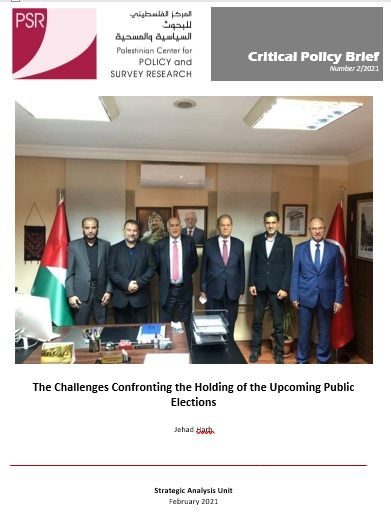 February 2021
The Challenges Confronting the Holding of the Upcoming Public Elections
Jehad Harb
The decree issued by president Abbas on the 15th of January 2021 calling for the holding of public elections is a highly significant step toward the actual holding of these elections, both legislative and presidential. The elections are to be held separately, in May for the parliament and in July for the president. The decree indicates that separate elections will follow these two for the National Council of the Palestine Liberation Organization (PLO). The revisions introduced on 11 January 2021 in the amened decreed law of the election law number 1 for the year 2007 remove some of the challenges and impediments and made it possible for the president to call for the elections with the agreement of all factions.
But the presidential decree and the amendments to the 2007 law did not provide answers to several remaining key issues that could derail the process and prevent the holding of elections. These include the manner in which elections can be held in East Jerusalem, the formation of the election court, the policing of the election process, the new conditions required for nomination, and the change in the title of the PA president to that of the president of the Palestinian state.
This policy brief reviews the main challenges and impediments that might derail the upcoming elections. It also offers recommendations to the Palestinian Authority (PA) and the main political factions that are expected to meet in Cairo in the next few days, in the hope of arriving at political and logistical solutions capable of ensuring the smooth running of the elections.
Amendments to the election law: some issues addressed; others ignored
Needless to say, holding general elections is a critical step to build a democratic and a legitimate system; a matter that must be stressed given the fact that the electoral terms of the president and the Palestinian Legislative Council (PLC) have expired nine years ago, back in January 2010, and given the fact that the political system has lost the capacity to affect a democratic transition in case the position of the PA president becomes vacant. Elections are also essential as the means to bypass the failed efforts to restore national unity, renew the legitimacy of the Palestinian political system, and restore the balance between the three branches of that system and ensure the implementation of the principle of the separation of powers.
The revisions expressed by the amended law are a step forward in the effort to facilitate the holding of the elections and are in harmony with the outcome of the recent dialogue held between Fatah and Hamas to overcome the problems that have derailed previous efforts to hold elections. These revisions included the following: (1) the adoption of an agree electoral system allowing full proportional representation in which the entire Palestinian territories serve as a single electoral district; (2) amending the article that required simultaneous presidential and parliamentary election thereby allowing the holding of separate elections, one after the other; (3) cancel the precondition that required participating electoral lists to abide by the PLO as the sole legitimate representative of the Palestinian people and by the Declaration of Independence and replace those with a commitment to abide by the Basic Law; (4) changing the women quota required in each of the electoral lists by increasing it to a minimum of 26%; and, (5) resolving some issues related to the time allowed for objections to decisions made by the Palestinian Central Election Commission (CEC).
Challenges and recommendations:
The actual holding of legislative election on 22 May and presidential elections on 31 July requires engagement from all factions in a dialogue that addresses those outstanding and disputed legal and logistical issues and comes to an agreement on the following six challenges:
The first challenge stems from the need for an Israeli approval for holding the elections in East Jerusalem, as has been the case in the PA elections that took place in 1996, 2005, and 2006. It is not certain that such an approval can come before the holding of the upcoming Israeli elections in March and the formation of a new Israeli government. Moreover, Israel might find itself having difficulties forming a new governmental coalition, given the precedents of the past three elections, which means that an Israeli response to a Palestinian request might never arrive.
Recommendations: (1) The Palestinian leadership should enlist international support to bring about pressure on Israel to allow Palestinians to vote in the city in accordance with the interim agreement on elections. (2) Ensuring the participation of East Jerusalemites in the elections should be viewed as an element of Palestinian struggle over Jerusalem and therefore the PA should, if Israel refused to allow them to participate, use this occasion to mobilize the city residents in a popular resistance campaign that aims at forcing Israel to allow the elections to take place in the city. (3) CEC should allow East Jerusalemites to participate in any voting station in the district of Jerusalem once they have registered to vote in that station.
The second challenge is the need to find consensus on the election court that would have to adjudicate all petitions, complaints and objections, related to the election process. Article 20 of the 2007 election law stipulates the formation of an election court by a presidential decree. The court is to consist of eight judges nominated by the Supreme Judicial Council (SJC). Given the fact that the split between the West Bank and the Gaza Strip has led to a split in the judiciary, with one in the West Bank appointed by the PA in Ramallah and one in the Gaza Strip appointed by the Hamas government, a need exists to agree on the means of selecting the members of the election court. The 2011 reconciliation agreement specified the formation of an election court from a chief judge and eight members to be nominated by a newly-created SJC that would be formed in implementation of the agreement. But this agreed upon body was never formed, even after the formation of the reconciliation government in 2014.
Recommendation: it is essential to issue a special law that would stipulate the formation of an election court and to give it immunity against cases that might be brought before the high court and to ensure acceptance and respect from all factions. The following are ways of doing that:
(1) Provide the Supreme Judicial Council the mandate to appoint the members of the election court from among those of the justice sector in the West Bank among whom there is already Gazan judges residing in the West Bank. This option ensures the legitimacy of the election court while respecting the role of the PA formal justice system and while enjoying the trust of the international community. But this option can be seen as undermining the justice system in the Gaza Strip which has been nurtured by Hamas during the past 13 years and might be seen as blocking any future efforts to integrate its members into a unified justice sector thereby leading Hamas to reject it.
(2) The formation of an election court from judges from both areas equally, or proportionate to the population size in the two areas. This option helps overcome this impediment but in return it might be seen as conferring legitimacy on the Gazan justice sector, particularly those who were appointed by Hamas since 2007.
(3) The formation of an election court from retired judges from the West Bank and the Gaza Strip. This option allows the factions to bypass the problem of the affiliation or biases of the judges or their loyalties, to Fatah or Hamas.
(4) The reconstitution of the election court that existed during the last general elections, in 2006, regardless of their current addresses, the Gaza Strip or the West Bank, and regardless of whether they have retired. Any shortages due to death can be met by enlisting retired judges while maintain the geographic distribution of the previous court.
The third challenge is to find an effective and acceptable security for the election process, particularly on the day of the election: would each of the two police establishments, the one in the West Bank and the one in the Gaza Strip, provide security in its area of operation? According to article 88 of the 2007 election law “the police will ensure the safety and security of the election process and the safety of the citizens.” This poses two questions, one about the neutrality of the police in the two areas and the other about the legitimacy of the police operation in the Gaza Strip. On de facto basis, CEC will find it essential to rely on Gazan area police in order to provide security to the voting stations. But this might bring about court cases that might challenge such a decision which in turn might lead West Bank courts to declare the CEC measure illegal thereby preventing the holding of elections in the Gaza Strip. To avoid such scenario, measures should be taken to protect such a step from legal deliberations.
Recommendations: Fatah and Hamas should reach an understanding according to which the two police forces, in the West Bank and the Gaza Strip, would commit themselves to full neutrality, agreeing to operate in accordance with rules set by CEC during the election process and on the voting day. Technical means can also be used to verify police compliance, for example, by installing cameras at all voting stations and in the areas around them. These and similar measures that can provide assurances regarding the safety of the ballot boxes can help provide peace of mind and reduce the concerns about the free and fair nature of the elections.
The fourth challenge is specific to the presidential elections. The January 2021 amendments replaced the title of the president from “PA president” to “president of the State of Palestine.” Moreover, article three of the amended law stated that “the president of the State of Palestine, Chairman of the PLO, the sole and legitimate representative of the Palestinian people, issues a presidential decree calling for presidential or legislative elections…” Article four states that “elections for the office of the president of the State of Palestine will take place in free and secret ballot.” It should be pointed out however that the election for the president of the State of Palestine, who is also the chairman of the PLO, is vitally different from the election for the PA president. The PA elections are limited to the areas of the West Bank (including East Jerusalem) and the Gaza Stirp while the president of Palestine is a president for all Palestinians, in Palestine and in the diaspora.
This amendment might generate conflict within the PLO if the winner of the presidential elections is not a member of the PLO Executive Committee or even a member of the PLO itself. It also denies Palestinians living outside the occupied territories the right to select their president because they are entitled to participate in the PA elections and because they have no right to return to the PA areas to participate in the election. Moreover, the amendment will force the PLO to change its own bylaws which stipulate the election process of its chairman. These PLO bylaws stipulate that members of the PLO Executive Committee are the ones who elect their chairman and that member of that committee are elected from within the membership of the PLO National Council.
On top of that, the change in the title of the president requires a revision in the terms of the Oslo Accords and the elections protocols agreed to in these accords if the Palestinians do not wish to provide Israel with an excuse to prevent presidential elections in East Jerusalem. Israel, who does not recognize the state of Palestine, can claim that the Oslo terms call for the election of a PA president and that the change to a president of the State of Palestine is an unacceptable unilateral step that violates these terms.
Recommendations: It is essential to reconsider the change brought about by this amendment with a view to abandon it and return to the original language of a PA president. There are two reasons for this recommendation: (1) to prevent a clash between the two Palestinian political system, the PA’s and that of the PLO while at the same time avoiding a situation in which the PA and PLO become subject of Israeli occupation; (2) to prevent Israel from using the amendment as a pretext to prevent East Jerusalemites from voting in the presidential elections by claiming that existing agreement calls only for the election of a PA president.
The fifth challenge is highlighted by another January 2021 amendment to the election law. This amendment altered article 8 in the 2007 and 2005 election law versions on the nomination process. It requested that for the nomination of certain officials in public and civil society positions, a resignation must be submitted and it must be accepted by the relevant authority, in writing, before that official can submit his or her candidacy application. Indeed, the application is required to be accompanied by a letter of acceptance of the resignation. The resignation must be effective on or before the day set for the closing date of nomination: “The following groups cannot nominate themselves for the presidency or the membership of the PLC until they resign from their positions and provide evidence of the acceptance of their resignation letter.”
This amendment restricts the right of nomination of certain category of official, particularly those in the public sector, by conditioning their nomination to approval by higher authorities including those in the government or the president’s office. Moreover, these higher authorities might postpone the issuance of the letter of acceptance of the resignation until the day after the closing date for nomination. In doing so, they would deprive these officials from the right to nominate themselves while at the same time denying them their jobs, form which they have just submitted a letter of resignation.
Recommendations: The right of elected and appointed officials to nomination should not force them to choose between that right and the right to have a decent job and living condition. Furthermore, given the fact that the Palestinian electoral system is now based fully on proportional representation, it should be clear that employees should be able to remain in their positions because their parties and factions are the ones who mostly organize the election campaign, not the individual candidates themselves. This should ease somewhat the concern that these candidates would exploit the public resources available to them during the election campaign. It is therefore suggested that we return to the original text in the pervious versions of the law that assumes that the resignation once submitted would be sufficient and would become valid on the closing date for nomination without requiring evidence of resignation acceptance. The return to the original clause in the election law allows PA and civil society officials to return to their position if they decide in the last minute to cancel their candidacy or alternatively seek an unpaid leave of absence from work until the announcement of the results of the elections.
The sixth challenge is to ensure that the entire election process is fully fair and free, that all factions receive the same treatment in being allowed to campaign freely without constraints or threats and that they are free to mobilize public support and publicize their election platforms. Moreover, the two authorities should strive to create an environment opposed to hate speech, violence, and any forms of coercion or actions that might be interpreted as physical assault on the election campaign of any faction and that the two security sectors commit themselves to refrain from any arrests or detentions targeting the opposition.
Recommendation: free and fair elections require the effective presence of observers and monitors, both from the Arab world and the international community, in addition to CEC and the Palestinian civil society. Forces should be combined to ensure comprehensive monitoring of the entire electoral process, from A to Z, and should not be restricted to the day of elections. Such extensive presence of observers and monitors can provide a level of confidence in the process and a peace of mind. Such presence can also deter violations and force those in charge, the governments and the police forces, to act in an impartial manner.
Joint Israeli- Palestinian Public Opinion Poll
THREATENED ISRAELIS AND PALESTINIANS DISENCHANTED WITH THE PEACE PROCESS AND SUPPORT FURTHER VIOLENCE
These are the results of the most recent poll conducted jointly by the Harry S. Truman Research Institute for the Advancement of Peace at the Hebrew University of Jerusalem and the Palestinian Center for Policy and Survey Research in Ramallah, between March 12 and 17, 2008.
The weeks preceding the poll were characterized by increased violence between Israel and Hamas in the Gaza Strip, with Hamas intensifying its rocket shelling on Israeli civilian communities; an Israeli incursion into Gaza that left more than 130 Palestinians dead; and a shooting attack in West Jerusalem that led to the death of 8 Israeli religious students.
The joint poll examined Israelis and Palestinians’ assessments of the negotiations launched by the Annapolis conference and are currently going on between Olmert and Abu Mazin. It further examined Israeli and Palestinian attitudes regarding a permanent settlement along the lines of the Saudi (Arab league) plan and Israelis’ attitudes towards a full evacuation of the Golan Heights in return for a complete peace agreement with Syria.
The findings indicate that both Israelis and Palestinians do not hold high hopes for the Abu Mazin–Olmert talks, don’t see them as beneficial and believe they should be stopped. With regard to the Saudi plan, Israelis oppose it while Palestinians support it. A majority of Israelis also oppose the evacuation of the Golan for peace with Syria. At the same time there is considerable support for launching rockets and suicide attacks among Palestinians, and support for retaliatory operations in Gaza among Israelis. This combination looks explosive and may perpetuate further escalation in violence between the two sides.
The Palestinian sample size is 1270 adults interviewed face-to-face in the West Bank and Gaza Strip in 127 randomly selected locations between March 13 and 15, 2008. The margin of error is 3%. The Israeli sample includes 597 adult Israelis interviewed by phone in Hebrew Arabic or Russian between March 12 and 17, 2008. The margin of error is 4%. The poll was planned and supervised by Dr. Yaacov Shamir, the Harry S. Truman Research Institute for the Advancement of Peace and the Department of Communication and Journalism at the Hebrew University and Dr. Khalil Shikaki, director of the Palestinian Center for Policy and Survey Research (PSR).
For further details on the Palestinian survey contact PSR director, Dr. Khalil Shikaki or Walid Ladadweh, at tel. 02-296 4933 or email pcpsr@pcpsr.org. On the Israeli survey, contact Dr. Yaacov Shamir at tel. 03-6419429 or email jshamir@mscc.huji.ac.il.
*This joint survey was conducted with the support of the Ford Foundation Cairo office and the Konrad Adenauer Foundation in Ramallah.
MAIN FINDINGS
(A) Peace Process:
- 57% of the Israelis oppose and 40% support the Saudi initiative which calls for Arab recognition of and normalization of relations with Israel after it ends its occupation of Arab territories occupied in 1967 and after the establishment of a Palestinian state. Among Palestinians, 66% support the plan and 32% oppose it
- 44% of the Israelis support and 54% oppose talks with Hamas if needed to reach a compromise agreement with the Palestinians. However a sizeable Israeli majority (62%) support and only 34% oppose talks with a national unity government composed jointly of Hamas and Fatah if such a government is reestablished.
- Similarly, 45% of the Israelis support and 51% oppose the release of Marwan Barghouti from prison and negotiation with him, if needed to reach such an agreement.
- 67% of the Israelis support and 29% oppose mutual recognition of Israel as the state for the Jewish people and Palestine as the state for the Palestinian people as part of a permanent status agreement. Among Palestinians, 55% support and 44% oppose this step.
- 53% of the Israelis believe that the meetings between Mahmud Abbas and Ehud Olmert are not beneficial and should be stopped while 39% believe they should continue. Palestinians show greater disappointment with these talks. Among Palestinians a sizeable majority of 75% believe the talks should come to a halt while only 21% believe they are beneficial and should be continued.
- 66% among Israelis and 68% of the Palestinians believe that the chances for the establishment of a Palestinian state during the next five years are non-existent or weak. Only 31% of Israelis and 30% of Palestinians believe chances are fair or high.
- 59% of Israelis oppose full evacuation of the Golan Heights in return for a complete peace agreement with Syria, and 25% support it.
(B) Threat perceptions and support of violence
- Following the renewed wave of violence, both Israelis and Palestinians’ threat levels increased significantly compared to our December 2007 poll.
- Among Israelis, 74% are worried that they or their family may be harmed by Arabs in their daily life, compared to 64% in our December 2007 poll -- an increase of 10 percentage points. Among Palestinians 63% fear that their security and safety and that of their family is not assured compared to 53% three months ago, a similar 10 percentage points increase.
- 13% of the Israelis also fear that Hezbollah will react to the assassination of Imad Mughniyeh by resuming the bombing and shooting of IDF forces along the border, 21% fear that it will retaliate by resuming the rocket launches on Israeli towns, 42% believe it will perform terrorists attacks against Jews and Israelis around the world and only 13% believe it will restrain itself and will not respond.
Consistent with the gloomy expectations from the peace process and the heightened threat feelings, Palestinians support of violent acts against Israel is staggering while Israeli support for military action in Gaza remains stable.
- An overwhelming majority of 84% support and 13% oppose the shooting attack that took place in a religious school in West Jerusalem. Support for this attack is greater in the Gaza Strip (91%) compared to theWest Bank (79%).
- 64% support and 33% oppose launching rockets from the Gaza Strip against Israeli towns and cities such as Sderot and Ashkelon.
- Among Israelis only 27% believe that if the shelling of Israeli communities from the Gaza Strip continues, Israel should use primarily diplomatic rather than military steps, 29% of the Israelis suggest that Israel should reoccupy the Gaza Strip and stay there and 41% think that Israel should carry out ad-hoc operations against the shelling and get out. Surprisingly these figures did not change from three months ago.
The Peace Process, Bir Zeit University Incident, the Status of Palestinian Democracy, Corruption, Elections for the President and vice-President, and Political Affiliation
30 March - 1 April 2000
1. The Peace Process
- 71% support the current peace process and 25% oppose it
- 44% support armed attacks against Israelis and 49% oppose them
- Level of confidence in Barak's government continues to drop reaching 13%, and 77% do not trust it
- Only 33% believe that it is possible to reach a mutually acceptable permanent settlement to all issues of final status negotiations and 59% do not believe that it is possible
- 46% expect, and 28% do not expect, the current peace process to lead to the establishment of a Palestinian state in the near future
- 49% support the establishment of a Palestinian state in September 2000 even without an agreement with Israel and 38% prefer to wait until a mutual Israeli-Palestinian agreement is reached
- 53% describe their economic conditions as worse than they were before the peace process and 9% describe them as better
- Optimism about the future remains high at 63% and pessimism at 31%
The overall picture emerging from the values of the peace indicators measured in this poll shows a growing discontent with the peace process among Palestinians. Despite the fact that the percentage of support for the current peace process remains unchanged as in the February 2000 poll (71%), the results show an increase in the percentage of support for armed attacks against Israelis from 39% to 44% during the same period. Confidence in Barak's government continues its slow decrease reaching 13% in this poll. Confidence in Barak's government peaked in July 1999 reaching 29%.
The results also show a decline in the percentage of those who believe that the current peace process will lead to the establishment of a Palestinian state in the near future from 50% in December 1999 to 46% in this poll. The percentage of those who describe their economic condition today as being worse than it was before the start of the peace process also rose from 51% to 53%, and the percentage of those who describe their conditions as being better than before declined from 13% to 9% during the same period. A slight increase has also been recorded in the percentage of those who do not believe that it is possible to reach a mutually acceptable solution to issues of final status negotiations reaching 59% in this poll.
Despite the change in the peace indicators during the past few months, the level of optimism regarding Palestinian future remains high at 63%. Also, the percentage of those who support the establishment of a Palestinian state in September 2000 even without an agreement with Israel remains unchanged at 49%.
2.Bir Zeit University Incident:
- 30% supported demonstration and stone throwing by Bir Zeit University students at the French Prime Minister while 38% supported the demonstration and opposed the stone throwing, and 14% opposed both the demonstration and the stone throwing
- 66% opposed the PA step of arresting Bir Zeit University students accused of throwing stones at the French Prime Minister while 14% supported it
- 30% view, and 47% do not view, France as a friend of the Palestinian people
The results show a wide spread support for Bir Zeit University students who were arrested by the Palestinian security services in the aftermath of demonstrations and stone throwing at the French Prime Minister Jospin during his visit to the university. These demonstrations and the stone throwing reflected students' anger at Jospin's characterization of Hizbullah attacks against Israelis as acts of terrorism. Nonetheless, only 30% supported, while 52% opposed, the stone throwing, and 38% supported the demonstrations alone.
Support for the demonstrations and stone throwing increases in Rafah (41%) and Hebron (39%) and decreases in Jabalia and Khanyounis (25% each) and Bethlehem (26%). Support also increases among men (34%) compared to women (26%); among holders of BA degree (35%) compared to those with elementary education (28%); among the unemployed (39%) and students (36%) compared to employees (25%) and housewives (26%); and among supporters of Hamas (44%) and the PFLP (39%) compared to supporters of Fateh (26%).
The results also show that two thirds of the Palestinians opposed the step taken by the Palestinian Authority in arresting Bir Zeit University students who were accused of participating in the stone throwing. The level of opposition to the PA step increases in the West Bank (69%) compared to the Gaza Strip (62%); in Rafah (86%), Ramallah (77%) Jerusalem ( 78%) and Hebron (70%) compared to Jabalia (50%) and Khanyounis (52%). It also increases among men (68%) compared to women (64%); among residents of refugee camps (71%) compared to residents of cities and towns (65%); among holders of BA degree (72%) compared to illiterates (55%); among students (79%) compared to housewives (59%); among those with the highest income (66%) compared to those with the lowest income (61%); and among supporters of Hamas and the PFLP (72% each) compared to supporters of Fateh (61%).
Finally, the results show an unexpectedly high level of belief (47%) that France is not a friend of the Palestinian People, while the percentage of those who believe that it is a friend does not exceed 30%. It is possible that this result may only reflect a Palestinian response to the statement made by Jospin and does not reflect the normal evaluation of the status of France as seen by the Palestinians especially in light of the declared French support for Palestinian rights. The belief that France is a friend increases in the Gaza Strip (33%) compared to the West Bank (28%); in Ramallah (46%) and Khanyounis (43%) compared to Jabalia (20%) and Hebron (24%); among men (35%) compared to women (24%); among residents of cities and towns (31%) compared to residents of refugee camps (23%); among holders of BA degree (36%) compared to illiterates (23%); among professionals (57%) and students (42%) compared to housewives (21%) and craftsmen (23%); among those with the highest income (53%) compared to those with the lowest income (27%); and among supporters of Fateh (42%) compared to supporters of Hamas (15%).
3. Domestic Conditions: Perception of Corruption and Democracy:
- 71% believe that corruption exists in PA institutions
- 66% of those who believe in the existence of corruption believe that it will increase or remain the same in the future
- Positive evaluation of Palestinian democracy drops to 22%
- 65% believe that people can not criticize the PA without fear
The results show negative trends in all indicators of domestic conditions. The percentage of those who believe that corruption exists in PA institutions increased from 60% in the last poll in February 2000 to 71% in this poll. The percentage of those who believe that corruption will increase or remain the same increased from 64% to 66% during the same period. The percentage of the positive evaluation of Palestinian democracy decreased from 28% in February to 22% in this poll. Finally, the percentage of those who believe that people can not criticize the PA without fear increased from 62% to 65% during the same period.
These results, and those in the next section, are the worst to be recorded since 1996. They reflect the frustrating conditions of the Palestinians since the Petition of the Twenty including the events of the past few weeks such as the Bir Zeit university incident, the teachers' strike, and the events at al Deheisha refugee camp in the aftermath of the Pope's visit.
4. Elections for the President and vice-President and Political Affiliation:
- In elections for the presidency, Arafat's popularity drops to 39% for the first time since 1994, while Haider Abdul Shafi receives 12% and Ahmad Yasin 14%
- In elections for the vice-presidency among four candidates, Abdul Shafi receives the largest percentage (37%) followed by Faisal al Husseini (23%), Ahmad Qurie' (13%), and Mahmud Abbas (12%)
- Fateh receives the support of 35%, Hamas 13%, PFLP 3%, Islamic Jihad 4%, and the non-affiliated 39%
The results show a significant decline in the popularity of Yasir Arafat from 47% last February to 39% in this poll. The current percentage is the worst since we began asking about Arafat's popularity in 1994. The lowest percentage recorded in the past was 43%. The popularity of Haidar Abdul Shafi remained unchanged at 12% while that of Ahmad Yasin increased from 10% last February to 14% in this poll.
Arafat's popularity increases in the Gaza Strip (41%) compared to the West Bank (37%); in Nablus (47%) and Khanyounis (46%) compared to Hebron (28%) and Jerusalem (32%); among residents of villages and towns (41%) compared to residents of refugee camps (33%); among illiterates (40%) compared to holders of BA degree (30%); among workers and farmers (40%) and housewives (41%) compared to students (30%) and merchants (31%); and among supporters of Fateh (74%) compared to supporters of Hamas (12%).
In a competition for the office of the vice president among eight candidates, Haidar Abdul Shafi received the largest percentage of votes (17%) followed by Faisal al Husseini and Sa'eb Erikat (8% each), Mahmud Abbas and Farouq al Qaddumi (5% each), Hanan Ashrawi and Ahmad Qurie' (4% each), and Nabil Sha'ath (2%). In a competition among four candidates only, Abdul Shafi receives 37% of the votes followed by al Husseini (23%), Ahmad Qurie' (13%) and Mahmud Abbas (12%). These results are similar to those obtained last February.
Fateh's popularity continued to drop reaching 35% in this poll while Hamas' increased from 10% last February to 13% in this poll.
Joint Palestinian-Israeli Public Opinion Poll
Strong Preference among Palestinians and Israelis for a Comprehensive Settlement over an Interim Political Track
11-16 December 2006
These are the results of the most recent poll conducted jointly by the Harry S. Truman Research Institute for the Advancement of Peace at the Hebrew University of Jerusalem and the Palestinian Center for Policy and Survey Research in Ramallah, between December 11 and 16, 2006.
The joint poll examined a range of optional tracks for the resumption of the Israeli-Palestinian political process including the Roadmap, the Arab League (Saudi) plan, and an interim plan postponing the settlement of the refugees issue to the future. We also examined the Israeli leadership's degrees of freedom to begin negotiations with various configurations of a Palestinian government.
The findings indicate strong preference in both publics for the comprehensive settlement option with 58% of the Israelis and 81% of the Palestinians supporting this track compared to only 30% of the Israelis and 16% of the Palestinians supporting an interim track.
The joint poll further examined Israeli and Palestinian attitudes regarding a permanent settlement (along the lines of the Geneva Initiative and President Clinton’s package for a Palestinian-Israeli final status settlement) against the backdrop of the Israeli- Palestinian cease fire in Gaza. The results document a continuing decrease in support for that permanent status package and its parameters among Israelis throughout 2006, and overall stability among Palestinians. Despite the declining trend, among Israelis there is still a majority of 52% who support these parameters as a combined overall package. Among Palestinians, 48% support the package now, compared to 44% in June 2006 and 46% in December 2005 (see summary table below).
Total Palestinian sample size is 1270 adults interviewed face-to-face in the West Bank and Gaza Strip in 127 randomly selected locations between December 14 and 16, 2006. The margin of error is 3%. The Israeli sample includes 602 adult Israelis interviewed by phone in Hebrew Arabic or Russian between December 11 and 14, 2006. The margin of error is 4%. The poll was planned and supervised by Dr. Yaacov Shamir, the Harry S. Truman Research Institute for the Advancement of Peace and the Department of Communication and Journalism at the Hebrew University and Dr. Khalil Shikaki, director of the Palestinian Center for Policy and Survey Research (PSR).
For further details on the Palestinian survey contact PSR director, Dr. Khalil Shikaki or Walid Ladadweh, at tel. 02-296 4933 or email pcpsr@pcpsr.org. On the Israeli survey, contact Dr. Yaacov Shamir at tel. 03-6419429 or email jshamir@mscc.huji.ac.il.
MAIN FINDINGS
(A) Cease Fire Agreement
- 59% of the Israelis and 85% of the Palestinians support the recent cease fire agreement between Israel and the Palestinians in Gaza. 85% of the Palestinians support and 14% oppose extending the agreement to theWest Bank.
- The Palestinian public is split half with regard to the effects of launching rockets from the Gaza strip at Israeli towns. 48% believe it was beneficial to Palestinian interests while 48% believe it was harmful to their interests.
- 52% of the Israelis believe that neither side came out the winner in the current round of the conflict, 28% believe that the Palestinians won, 5% believe that Israel won and 13% believe that both won. Among Palestinians, 24% believe they won, 27% think Israel won, 29% believe neither won, and 18% believe that both sides won.
- 33% of the Palestinians also believe that they will gain more from the recent cease fire while 29% believe Israel will gain more, 25% believe both will gain and 11% think neither side will gain. As to Israelis, 40% believe Palestinians will gain more from the cease fire, 7% believe Israel will gain more 35% think both sides will gain and 16% think neither side will gain.
- As to the impact of the cease fire on the power struggle in the PA, 21% of the Palestinians think that Abu-Mazin and Fateh will gain more politically from the cease fire, 15% think Haniyeh and Hamas, 34% think both will gain, and 24% think neither side will gain more politically from the cease fire. Among Israelis, 29% believe the cease fire works more to the advantage of Haniyeh and Hamas, 23% believe Abu-Mazin and Fateh will gain more from it, 20% think both will gain, and 17% think neither side will gain more.
- Following the Gaza cease fire agreement, both sides’ expectations with regard to its longevity are rather low. 6% of the Israelis and 19% of the Palestinians believe that negotiations will resume soon enough and armed confrontations will stop, 40% of the Israelis and 38% of the Palestinians expect negotiations to resume but some armed attacks will continue, 52% of the Israelis and 37% of the Palestinians believe that confrontations will not stop and the two sides will not return to negotiations.
(B) Clinton/Geneva Parameters
The Clinton parameters for a Palestinian-Israeli permanent settlement were presented by President Clinton at a meeting with Israeli and Palestinian officials exactly six years ago, on December 23, 2000, following the collapse of the July 2000 Camp David summit. The Geneva Initiative was first made public around the end of 2003. These parameters address the most fundamental issues which underlie the Palestinian-Israeli conflict: (1) Final borders and territorial exchange; (2) Refugees; (3) Jerusalem; (4) A demilitarized Palestinian state; (5) Security arrangements; and (6) End of conflict. We addressed these issues in the past, in December 2003, December 2004, December 2005 and June 2006. In the current poll we revisited these crucial issues for the first time after the second war in Lebanon. In December 2003, respondents were explicitly told that the parameters were those of the Geneva Initiative. However, in the subsequent polls, respondents were not told that these were possible compromises in a final status settlement without explicitly naming the packages as those of Clinton or Geneva.
The findings indicate a slight decrease in support among Israelis and some increase in support among Palestinians compared to six months ago. Among Israelis, a majority of 52% support these parameters as a combined overall package, compared to 55% who supported them in June 2006. These results corroborate the declining support for the Clinton package among Israelis throughout 2006, whereas in January and December 2005 the level of support was 64%. Among Palestinians the level of support fluctuated in 2006 between 44% and 48% in the current poll marking a pattern of stability in Palestinians attitudes in this regard in 2006, down from 54% in December 2004.
(1) Final Borders and Territorial Exchange
Among Palestinians 61% support or strongly support and 37% oppose or strongly oppose an Israeli withdrawal from the West Bank and the Gaza Strip with the exception of some settlement areas in less than 3% of the West Bank that would be swapped with an equal amount of territory from Israel in accordance with a map that was presented to the Palestinian respondents. The map was identical to that presented to respondents in June 2006, when support for this compromise, with its map, stood at 54% and opposition at 44%.
Among Israelis 44% support and 54% oppose a Palestinian state in the entirety of “Judea, Samaria” and the Gaza Strip except for several large blocks of settlements in 3% of the West Bank which will be annexed to Israel.Israel will evacuate all other settlements, and the Palestinians will receive in return territory of similar size along the Gaza Strip. In June 2006, 47% of the Israelis supported this component while 47% opposed it.
(2) Refugees
Among Palestinians, 41% support and 54% oppose a refugee settlement in which both sides agree that the solution will be based on UN resolutions 194 and 242. The refugees would be given five choices for permanent residency. These are: the Palestinian state and the Israeli areas transferred to the Palestinian state in the territorial exchange mentioned above; no restrictions would be imposed on refugee return to these two areas. Residency in the other three areas (in host countries, third countries, and Israel) would be subject to the decision of these states. As a base for its decision Israel will consider the average number of refugees admitted to third countries likeAustralia, Canada, Europe, and others. All refugees would be entitled to compensation for their “refugeehood” and loss of property. In June 2006, 41% agreed with an identical compromise while 55% opposed it.
Among Israelis 38% support such an arrangement and 60% oppose it. In June 2006 43% supported it and 53% opposed.
(3) Jerusalem
In the Palestinian public 39% support and 59% oppose a Jerusalem compromise in which East Jerusalem would become the capital of the Palestinian state with Arab neighborhoods coming under Palestinian sovereignty and Jewish neighborhoods coming under Israeli sovereignty. The Old City (including al Haram al Sharif) would come under Palestinian sovereignty with the exception of the Jewish Quarter and the Wailing Wall that would come under Israeli sovereignty. In June 2006, an identical compromise obtained similar results with 35% supporting it and 63% opposing it.
Among Israelis, 38% agree and 60% disagree to this arrangement in which the Arab neighborhoods in Jerusalem including the old city and the Temple Mount will come under Palestinian sovereignty, the Jewish neighborhoods including the Jewish quarter and the Wailing Wall will come under Israeli sovereignty, East Jerusalem will become the capital of the Palestinian state and West Jerusalem the capital of Israel. In June 2006, 37% supported this arrangement and 60% opposed it.
(4) Demilitarized Palestinian State
Among Palestinians 28% support and 70% oppose the establishment of an independent Palestinian state that would have no army, but would have a strong security force and would have a multinational force deployed in it to ensure its security and safety. Israel and Palestine would be committed to end all forms of violence directed against each other. A similar compromise received in June 2006 25% support and opposition reached 74%.
Among Israelis 62% support and 36% oppose this arrangement compared to similar levels of 63% support and 36% opposition obtained in June 2006.
(5) Security Arrangements
In the Palestinian public 42% support and 55% oppose a compromise whereby the Palestinian state would have sovereignty over its land, water, and airspace, but Israel would have the right to use the Palestinian airspace for training purposes, and would maintain two early warning stations in the West Bank for 15 years. A multinational force would remain in the Palestinian state and in its border crossings for an indefinite period of time. The task of the multinational force would be to monitor the implementation of the agreement, and to monitor territorial borders and coast of the Palestinian state including the presence at its international crossings. In June 2006, 40% of the Palestinians supported this parameter while 57% opposed it.
In the Israeli public 51% support and 47% oppose this arrangement compared to 52% who supported it and 44% who opposed it in June 2006.
(6) End of Conflict
In the Palestinian public 62% support and 34% oppose a compromise on ending the conflict that would state that when the permanent status agreement is fully implemented, it will mean the end of the conflict and no further claims will be made by either side. The parties will recognize Palestine and Israel as the homelands of their respective peoples. An identical question received in June the support of 58% and the opposition of 40%.
In the Israeli public 68% support and 30% oppose this component in the final status framework. In June 2006, 70% of the Israelis supported it while 27% opposed it.
The Whole Package
Among Palestinians 48% support and 49% oppose the whole package combining the elements as one permanent status settlement. In June 2006, 44% supported and 52% opposed such a package.
This four percentage point increase in the level of support for the package among Palestinians deserves attention given the official and publicly endorsed Hamas government position toward a permanent peace agreement withIsrael. In this regard it is also important to stress the four percentage point increase in the “end of conflict” component which stands in open contradiction to Hamas refusal to such a clause and its willingness to grant Israel only a long range Hudna.
Among Israelis 52% support and 46% oppose all the above features together taken as one combined package. This constitutes a noticeable decline in support for the Clinton final status settlement package compared to six months ago when support stood at 55% support with 40% opposition.
36% of the Israelis assume that a majority in their society supports the Clinton parameters as a combined final status package; 53% believe that the majority opposes it. Among Palestinians 46% believe now that a majority in their society supports the Clinton parameters as a combined final status package and 38% believe that the majority opposes it.
Summary Table: Support for Clinton’s Permanent Settlement Framework (2003-2006)
| Israelis | Palestinians | ||||||||
Dec 03 | Jan 05 | Dec 05 | June 06 | Dec 06 | Dec 03 | Dec 04 | Dec 05 | June 06 | Dec 06 | |
1) Borders and Territorial Exchange | 47% | 55% | 53% | 47% | 44% | 57% | 63% | 55% | 54% | 61% |
2) Refugees | 35% | 44% | 43% | 43% | 38% | 25% | 46% | 40% | 41% | 41% |
3) Jerusalem | 41% | 39% | 38% | 37% | 38% | 46% | 44% | 33% | 35% | 39% |
4) Demilitarized Palestinian State | 61% | 68% | 69% | 63% | 62% | 36% | 27% | 20% | 25% | 28% |
5) Security Arrangements | 50% | 61% | 62% | 52% | 51% | 23% | 53% | 43% | 40% | 42% |
6) End of Conflict | 66% | 76% | 80% | 70% | 68% | 42% | 69% | 64% | 58% | 62% |
Overall Package | 47% | 64% | 64% | 55% | 52% | 39% | 54% | 46% | 44% | 48% |
(C) Other Optional tracks for the resumption of a political process
In addition to the Clinton parameters for a final status settlement, we examined in the poll a range of other optional tracks for the resumption of the Israeli-Palestinian political process including the Roadmap, the Arab League (Saudi) plan, and an interim plan postponing the settlement of the refugees issue to future negotiations. In addition we examined the degrees of freedom of the Israeli leadership to begin negotiations with various configurations of a Palestinian government.
- 60% of the Israelis and 49% of the Palestinians support the international Quartet’s Roadmap plan. These figures mark a consistent trend of decline in support for this plan in both publics from a peak of 65% support among Israelis and 60% support among Palestinians a year ago in December 2005. While the Roadmap remained the cornerstone of the Israeli government policy with regard to the resumption of a political process, and it still garners majority support among Israelis, it is losing support in the two publics, presumably because of the stalemate it caused in the process.
- As to the Arab League (Arab Saudi) plan, both publics seem to be quite ignorant about it. 47% of the Israelis and 44% of the Palestinians claimed they have never heard of the plan. Only 22% of the Israelis and 25% of the Palestinians said they know some or most of its details. After briefing our respondents on its essential elements, 29% of the Israelis and 59% of the Palestinians support the plan compared to 69% and 38% respectively who oppose it. This sizeable difference in support can be explained by the vague reference in the plan to the refugees issue and UN resolution 194, which is often interpreted by Israelis as allowing return of refugees to proper Israel and compensation.
- Another option examined in the current poll was to conduct Palestinian-Israeli negotiations on an interim settlement whereby a Palestinian state is established in the West Bank and the Gaza Strip. This option was juxtaposed against negotiations over a comprehensive settlement that would lead to permanent peace and end of conflict, with all issues, including refugees, resolved. The results indicate a strong preference in both publics for the comprehensive settlement with 58% of the Israelis and 81% of the Palestinians supporting this track compared to only 30% of the Israelis and 16% of the Palestinians supporting the interim track. Despite the clear preference among Palestinians for a permanent settlement, a majority of 58% would support and 37% would oppose an agreement that would establish a Palestinian state over 80% to 90% of the West Bank and all of the Gaza Strip to be followed by negotiations between the state of Israel and the state of Palestine to resolve all the other issues such as permanent borders, refugees, holy places in Jerusalem, and others.
- If in order to reach a compromise agreement with the Palestinians, Israel will have to release Marwan Barghouti from prison and negotiate with him, 43% of the Israelis support such a step compared to 53% who oppose it.
- 68% of the Israelis support negotiations between Israel and Abu Mazin over a final status settlement. Despite these levels of support only 46% of the Israelis believe that it is possible to reach nowadays a compromise settlement between Abu Mazin and Olmert.
- 66% of the Israelis support negotiations with a Palestinian national unity government which includes Hamas if needed to reach a compromise agreement.
- Even when a Hamas-led government is concerned, 54% of the Israelis support and 45% oppose talks with it if needed in order to reach a compromise agreement with the Palestinians. Among Palestinians, 62% support such talks while 34% oppose them.
(D) Other Conflict Resolution Issues
- A majority of 58% among Palestinians and 63% of the Israelis agrees with the proposal that after reaching a permanent agreement to all issues of the conflict, there would be mutual recognition of Israel as the state for the Jewish people and Palestine as the state for the Palestinian people. 40% and 34% respectively disagree to this step. 52% of the Palestinians and 55% of the Israelis believe that a majority in their public supports such a proposal, and 36% and 33% respectively think the majority opposes it. However both publics are only partly aware of the majority support for such a step in the other side. Only 44% of the Palestinians and 42% of the Israelis think the other side public supports this step.
- Both Israelis and Palestinians are split half with regard to their assessments of the achievements of the Palestinian Intifada. 49% of the Palestinians agree and 49% disagree with the claim that the intifada so far has achieved national and political goals that negotiations could not achieve. Among Israelis too, 48% agree and 51% disagree with this claim.
- As to Palestinians' general outlook regarding the prospects of a peace process with Israel, 21% believe that the peace process is not successful in ending the occupation and should be stopped in favor of resorting to armed action; 36% think the peace process should not be stopped because it still might succeed, 27% think the peace process has not failed and should be given more time and in the meanwhile armed action should be stopped, 11% believe that armed action is responsible for the stagnation of the peace process and if it is stopped the peace process would make progress.
(E) Palestinian Domestic Balance of Power
- A majority of 61% supports the holding of early presidential and parliamentary elections and 37% oppose that. If early parliamentary elections are held today, Hamas would receive 36% of the vote and Fateh would receive 42%. 12% would go to other lists and 10% remain undecided.
- If early presidential elections are held today and only two, Mahmud Abbas for Fateh and Ismail Haniyeh for Hamas, were to compete, Abbas would receive 46% of the vote and Haniyeh would receive 45%. 9% remain undecided. But if the presidential race was between Marwan Barghouti, representing Fateh, and Khalid Mish’al, representing Hamas, Marwan Barghouti would receive 57% of the vote and Khalid Mish’al would receive 36%. 7% remain undecided.
The Peace Process, the "Petition of the Twenty," PLC and PA performance, Status of Democracy and Corruption, Elections for the President and Vice President, and Political Affiliation
30 March - 1 April 2000
1. The Peace Process
- 71% support the current peace process and 25% oppose it
- 44% support armed attacks against Israelis and 49% oppose them
- Level of confidence in Barak's government continues to drop reaching 13%, and 77% do not trust it
- Only 33% believe that it is possible to reach a mutually acceptable permanent settlement to all issues of final status negotiations and 59% do not believe that it is possible
- 46% expect, and 28% do not expect, the current peace process to lead to the establishment of a Palestinian state in the near future
- 49% support the establishment of a Palestinian state in September 2000 even without an agreement with Israel and 38% prefer to wait until a mutual Israeli-Palestinian agreement is reached
- 53% describe their economic conditions as worse than they were before the peace process and 9% describe them as better
- Optimism about the future remains high at 63% and pessimism at 31%
The overall picture emerging from the values of the peace indicators measured in this poll shows a growing discontent with the peace process among Palestinians. Despite the fact that the percentage of support for the current peace process remains unchanged as in the February 2000 poll (71%), the results show an increase in the percentage of support for armed attacks against Israelis from 39% to 44% during the same period. Confidence in Barak's government continues its slow decrease reaching 13% in this poll. Confidence in Barak's government peaked in July 1999 reaching 29%.
The results also show a decline in the percentage of those who believe that the current peace process will lead to the establishment of a Palestinian state in the near future from 50% in December 1999 to 46% in this poll. The percentage of those who describe their economic condition today as being worse than it was before the start of the peace process also rose from 51% to 53%, and the percentage of those who describe their conditions as being better than before declined from 13% to 9% during the same period. A slight increase has also been recorded in the percentage of those who do not believe that it is possible to reach a mutually acceptable solution to issues of final status negotiations reaching 59% in this poll.
Despite the change in the peace indicators during the past few months, the level of optimism regarding Palestinian future remains high at 63%. Also, the percentage of those who support the establishment of a Palestinian state in September 2000 even without an agreement with Israel remains unchanged at 49%.
2.Bir Zeit University Incident:
- 30% supported demonstration and stone throwing by Bir Zeit University students at the French Prime Minister while 38% supported the demonstration and opposed the stone throwing, and 14% opposed both the demonstration and the stone throwing
- 66% opposed the PA step of arresting Bir Zeit University students accused of throwing stones at the French Prime Minister while 14% supported it
- 30% view, and 47% do not view, France as a friend of the Palestinian people
The results show a wide spread support for Bir Zeit University students who were arrested by the Palestinian security services in the aftermath of demonstrations and stone throwing at the French Prime Minister Jospin during his visit to the university. These demonstrations and the stone throwing reflected students' anger at Jospin's characterization of Hizbullah attacks against Israelis as acts of terrorism. Nonetheless, only 30% supported, while 52% opposed, the stone throwing, and 38% supported the demonstrations alone.
Support for the demonstrations and stone throwing increases in Rafah (41%) and Hebron (39%) and decreases in Jabalia and Khanyounis (25% each) and Bethlehem (26%). Support also increases among men (34%) compared to women (26%); among holders of BA degree (35%) compared to those with elementary education (28%); among the unemployed (39%) and students (36%) compared to employees (25%) and housewives (26%); and among supporters of Hamas (44%) and the PFLP (39%) compared to supporters of Fateh (26%).
The results also show that two thirds of the Palestinians opposed the step taken by the Palestinian Authority in arresting Bir Zeit University students who were accused of participating in the stone throwing. The level of opposition to the PA step increases in the West Bank (69%) compared to the Gaza Strip (62%); in Rafah (86%), Ramallah (77%) Jerusalem ( 78%) and Hebron (70%) compared to Jabalia (50%) and Khanyounis (52%). It also increases among men (68%) compared to women (64%); among residents of refugee camps (71%) compared to residents of cities and towns (65%); among holders of BA degree (72%) compared to illiterates (55%); among students (79%) compared to housewives (59%); among those with the highest income (66%) compared to those with the lowest income (61%); and among supporters of Hamas and the PFLP (72% each) compared to supporters of Fateh (61%).
Finally, the results show an unexpectedly high level of belief (47%) that France is not a friend of the Palestinian People, while the percentage of those who believe that it is a friend does not exceed 30%. It is possible that this result may only reflect a Palestinian response to the statement made by Jospin and does not reflect the normal evaluation of the status of France as seen by the Palestinians especially in light of the declared French support for Palestinian rights. The belief that France is a friend increases in the Gaza Strip (33%) compared to the West Bank (28%); in Ramallah (46%) and Khanyounis (43%) compared to Jabalia (20%) and Hebron (24%); among men (35%) compared to women (24%); among residents of cities and towns (31%) compared to residents of refugee camps (23%); among holders of BA degree (36%) compared to illiterates (23%); among professionals (57%) and students (42%) compared to housewives (21%) and craftsmen (23%); among those with the highest income (53%) compared to those with the lowest income (27%); and among supporters of Fateh (42%) compared to supporters of Hamas (15%).
3. Domestic Conditions: Perception of Corruption and Democracy:
- 71% believe that corruption exists in PA institutions
- 66% of those who believe in the existence of corruption believe that it will increase or remain the same in the future
- Positive evaluation of Palestinian democracy drops to 22%
- 65% believe that people can not criticize the PA without fear
The results show negative trends in all indicators of domestic conditions. The percentage of those who believe that corruption exists in PA institutions increased from 60% in the last poll in February 2000 to 71% in this poll. The percentage of those who believe that corruption will increase or remain the same increased from 64% to 66% during the same period. The percentage of the positive evaluation of Palestinian democracy decreased from 28% in February to 22% in this poll. Finally, the percentage of those who believe that people can not criticize the PA without fear increased from 62% to 65% during the same period.
These results, and those in the next section, are the worst to be recorded since 1996. They reflect the frustrating conditions of the Palestinians since the Petition of the Twenty including the events of the past few weeks such as the Bir Zeit university incident, the teachers' strike, and the events at al Deheisha refugee camp in the aftermath of the Pope's visit.
4. Elections for the President and vice-President and Political Affiliation:
- In elections for the presidency, Arafat's popularity drops to 39% for the first time since 1994, while Haider Abdul Shafi receives 12% and Ahmad Yasin 14%
- In elections for the vice-presidency among four candidates, Abdul Shafi receives the largest percentage (37%) followed by Faisal al Husseini (23%), Ahmad Qurie' (13%), and Mahmud Abbas (12%)
- Fateh receives the support of 35%, Hamas 13%, PFLP 3%, Islamic Jihad 4%, and the non-affiliated 39%
The results show a significant decline in the popularity of Yasir Arafat from 47% last February to 39% in this poll. The current percentage is the worst since we began asking about Arafat's popularity in 1994. The lowest percentage recorded in the past was 43%. The popularity of Haidar Abdul Shafi remained unchanged at 12% while that of Ahmad Yasin increased from 10% last February to 14% in this poll.
Arafat's popularity increases in the Gaza Strip (41%) compared to the West Bank (37%); in Nablus (47%) and Khanyounis (46%) compared to Hebron (28%) and Jerusalem (32%); among residents of villages and towns (41%) compared to residents of refugee camps (33%); among illiterates (40%) compared to holders of BA degree (30%); among workers and farmers (40%) and housewives (41%) compared to students (30%) and merchants (31%); and among supporters of Fateh (74%) compared to supporters of Hamas (12%).
In a competition for the office of the vice president among eight candidates, Haidar Abdul Shafi received the largest percentage of votes (17%) followed by Faisal al Husseini and Sa'eb Erikat (8% each), Mahmud Abbas and Farouq al Qaddumi (5% each), Hanan Ashrawi and Ahmad Qurie' (4% each), and Nabil Sha'ath (2%). In a competition among four candidates only, Abdul Shafi receives 37% of the votes followed by al Husseini (23%), Ahmad Qurie' (13%) and Mahmud Abbas (12%). These results are similar to those obtained last February.
Fateh's popularity continued to drop reaching 35% in this poll while Hamas' increased from 10% last February to 13% in this poll..... More
 October 2024
Did October the 7th and the Gaza War Put an End to the Palestinian-Israeli Peace Process and the Two-State Solution?
Khalil Shikaki
The developments of the past 13 months in Palestinian-Israeli relations generated contradictory outcomes impacting these relations. On the one hand, the interest in resolving the conflict, once and for all, is certainly greater today than it was immediately before these developments. On the other hand, the war has generated highly destructive outcomes at the societal and psychological levels of Palestinians and Israelis. The level of pain and suffering, hate, anger, distrust, and dehumanization is unprecedented. The speed of the decline in support for the two-state solution among Israeli Jews in just two years is also unprecedented. It is true that more Palestinians today, compared to two years earlier, favor that solution. Yet, the majority remains opposed to that solution and an even greater majority of Palestinians believe that the Israeli short-term and long-term goals are either genocide or expulsion. Leaders from both sides, who see that they have no domestic constituency for peace, are unlikely to embark on any serious negotiations to make peace based on that solution. Outside actors, including the US and other external regional and international actors are likely to be deterred from pushing for such a solution knowing the reluctance of such leaders and the strong opposition of the two publics.
Is there a way in which these leaders can be convinced that their publics will indeed support them if they decide to take the risk and engage in serious negotiations in the hope and expectation that the current war would be the last? This Policy Brief shows that despite the tremendous negative developments since October 7, recent evidence from joint Palestinian-Israeli surveys shows that the two publics are not an impediment to peace based on the two-state solution. The two peoples are certainly not a force for peace; but evidence-based research shows that if leaders embark today on serious negotiations to end the conflict, based on that solution, the willingness of the majority of the two publics to support them and to support the outcome of their negotiations is evidently clear.
Background:
The collapse of the US-led peace negotiations in 2014 can be viewed as the turning point after which support among Palestinians and Israeli Jews for the two-state solution begins to gradually decline. By the end of 2017, the majority among both publics expressed opposition to that solution. The main driver for the decline at that time was the belief, shared by both sides, that the two-state solution was no longer practical or feasible given the changes on the ground, such as settlement expansion, and other socio-political developments including the rising support for the right wing in Israel and the weakening of the PA and the continued division among the Palestinians.
The Palestinian constituency most opposed to the two-state solution includes supporters of Hamas and the youth. The opposition of the Hamas supporters is based on ideology and religious values, but the opposition of the youth is based neither on religion nor on ideology. Instead, it seems to be based on consideration of feasibility and views regarding domestic Palestinian politics and the prospects for democracy. The Palestinian youth tend to be the least religious and most liberal than any other age group in society. As it abandoned support for the two-state solution, the youth showed greater support for a democratic one-state solution with equal rights to Israeli Jews and Palestinians. Nonetheless, among the public as a whole, support for the two-state solution, was higher than the support given by the Palestinians to any other alternative.
Opposition to the two-state solution is higher among Israeli Jews compared to Israeli Arabs. It is also higher among the religious groups, both the ultra-Orthodox and the national religious communities. Similarly, opposition is relatively high among the group that identifies itself as “traditional.” These groups are the most likely to vote for right wing parties, such as the Likud, the extreme right, and the religious parties. Secular Jews show the lowest rates of opposition to that solution. Opposition to that solution is also higher among the youth with the gap in attitudes widening the most between those who are less than 35 years of age and those above 50 years of age. Given Israel’s demographic distribution, Israeli Jewish youth tend to come from those religious, national religious, and traditional backgrounds. For this reason, while Palestinian youth tend to favor a democratic one-state solution, the Israeli Jewish youth tend to favor a non-democratic one-state solution, whereby Palestinians are denied equal rights.
One year before October 7, 2023, a little over one third of Palestinians, one third of Israeli Jews and 60% of Israeli Arabs supported the two-state solution. At the time, these results reflected a significant drop in support compared to the findings of the joint survey two year earlier, in 2020, and represented the lowest level of support for all three groups, Palestinians, Israeli Jews, and Israeli Arabs in all joint Palestinian-Israeli surveys since 2000. In 2020, 43% of the Palestinians and 42% of Israeli Jews supported this solution. Still, in 2022 fewer Palestinians and Israeli Arabs supported the two possible alternatives indicated above, the one state with equality and the one undemocratic state. For Israeli Jews, however, support for one undemocratic state, for the first time since joint Palestinian-Israeli polls were conducted, was greater than the support for the two-state solution.
One year before October 7, we also found that support by Palestinians and Israeli Jews for a a detailed comprehensive peace package based on the concept of the two-state solution was the lowest compared to all previous rounds of the joint poll, staring in 2016. A little over a quarter of the Palestinians and a little less than a third of Israeli Jews supported the detailed package while support among Israeli Arabs was higher than 60%. Fifty four percent of all Israelis, 62% of Israeli Jews, and 72% of Palestinians were opposed to this two-state comprehensive package. The peace package outlined the following components that address all the main elements of the two-state solution: a de-militarized Palestinian state, an Israeli withdrawal to the Green Line with equal territorial exchange, family unification in Israel of 100,000 Palestinian refugees, West Jerusalem as the capital of Israel and East Jerusalem as the capital of Palestine, the Jewish Quarter and the Western Wall under Israeli sovereignty and the Muslim and Christian quarters and the al Haram al Sharif/Temple Mount under Palestinian sovereignty, Israeli and the future state of Palestine will be democratic, the bilateral agreement will be part of a larger peace agreement with all Arab states, the US and major Arab countries will ensure full implementation of the agreement by both sides, and the end of the conflict and claims.
The unseen psychosocial damage inflicted on the two societies since October the 7th:
The events of the past 13 months inflicted dramatic negative psychosocial damage on the two societies. The trauma associated with the ongoing conflict continues to exact a price from normal people making them anything but normal. Findings from the most recent joint Palestinian-Israeli survey, conducted in July 2024, show the extent of the damage. On both sides, among other things, people are unwilling to accept the humanity of the other side, distrust it beyond all previous levels, and view its own victimhood as greater than any other.
Vast majorities Palestinians and Israeli Jews justify the violence committed by its own side, Hamas on October the 7th and the Israeli government and military since that time, against the other by what the other had done. Israeli siege and blockade over the Gaza Strip are seen by the Palestinians as justifying what Hamas did. The Hamas attack on October 7 is seen by Israeli Jews as justifying what the Israeli military is doing in the ongoing war in the Gaza Strip. Moreover, close to 90% of Palestinians believe that the short-term goals of Israel in the current war is to commit genocide or conquer the land and expel the Palestinians from their homeland. In a mirror image, more than 90% of Israeli Jews believe that Hamas’ goal on October 7 was to commit genocide or conquer the land and expel the population from their homeland. Perception of the long-term aspiration of the other side is also grim with similar vast majorities on both sides believing that the other side wants to conquer the land, kill the population, expel them, or deny them political rights.
These destructive perceptions are amplified by strong perception of victimization on both sides. The overwhelming majority of Palestinians and Israeli Jews tend to view their own suffering as the worst compared to all other peoples who suffered from persecution and injustice. Three quarters on both sides view the conflict with the other sides in zero-sum terms, when one gains, the other loses; anything good for one side must, by definition, be bad for the other. The current level of distrust, about 90% or higher, is the highest ever recorded in the joint surveys since 2016 when the question was first systematically asked. It is not surprising under these conditions to find that while each side is readily able to humanize its own people by almost identical scores, close to 90 points on average, only 6 Palestinians and 14 Israeli Jews out of a hundred, on average, are willing to do the same for the other side. This wartime sweeping dehumanization of the other should be seen not only in terms of one’s perception of inherent qualities of the other but also as a statement regarding its behavior on October the 7th, for the Israeli public, and throughout the current war in Gaza, for the Palestinians.
These psychosocial outcomes seem to generate two important political implications, one impacting perception of land ownership and the other impacting perception of the way out of the conflict. The belief that the land between the Mediterranean Sea and the Jordan river, or historic Palestine, belongs to one’s own side, and not the other, has always been evident in our previous joint polls. But the intensity of this belief, particularly among Israeli Jews, has increased in the aftermath of October 7 and the ongoing war. Today, more than 90% of Palestinians and Israeli Jews believe that the land belongs entirely to their group. Moreover, the vast majority on both sides, but particularly among the Palestinians, deny that the land also belongs to the other side.
Finally, the war impacted attitudes regarding a way out of the conflict between a diplomatic and a military solution. Surprisingly, the findings of the joint poll show different public responses to this question among Palestinians and Israeli Jews. While a majority on both sides believes they have a military way out of the conflict, by defeating the other side, the Palestinians are more optimistic than Israeli Jews, 48% and 38% respectively, that diplomacy provides a viable route to ending the conflict.
Divergent views on the peace process:
As we saw in the preference for diplomatic vs. military way out, in which the Palestinians come out of the ongoing traumatic conditions more optimistic than Israeli Jews about the prospects of diplomacy, findings of the 2024 joint poll show additional divergent views between the two sides. The joint poll findings show differing political responses in other areas of political attitudes regarding Palestinian-Israeli relations, most importantly the two-state solution. While the Israeli Jewish support for the concept of the two-state solution declines in less than two years from one third (34%) to a little over a fifth (21%), a 13-point drop, Palestinian support for the same concept rises by 7 points from 33% in 2022 to 40% in 2024. Support for the same concept increases also among Israeli Arabs, from 60% to 72% during the same period. Among Israeli Jews, the current support for the two-state solution is the lowest since the peace process started more than 30 years ago.
The hardening of the Israeli Jewish attitudes after October the 7th can also be seen when exploring changing attitudes regarding alternatives to the two-state solution. The findings show an increased support for the “annexation of the West Bank without granting equal rights to Palestinians.” Support among Israeli Jews for this unequal and non-democratic one-state solution stands today at 42%, the highest ever recorded in the joint polls. In 2022, Israeli Jewish support for this annexation without equal rights to Palestinians stood at 37%. Among Palestinians and Israeli Arabs, support today for a one-state solution without equal rights for Israeli Jews stands at 33% and 17% respectively. In 2022, Palestinian support for this unequal, and non-democratic one-state solution stood at 30%. A second alternative to the two-state solution is a democratic and equal one-state. In July 2024, 25% of Palestinians and 14% of Israeli Jews supported it compared to 23% among Palestinians and 20% among Israeli Jews two years earlier. The support for these three solutions, the two-state, the democratic one-state, and the non-democratic one-state was measured in three separate questions. A review of the attitudes of those who support the democratic one-state solution shows that most of them also support the two-state solution and that some of the supporters of the non-democratic state also support the two-state solution.
Indeed, when one measures the total net support for the three solutions, while giving the priority to the two-state solution, that is without the overlapping support to other solutions, the total comes out to much less than one hundred percentage points. In fact, the 2024 findings show that 44% of all Palestinians and 34% of all Israeli Jews do not support any solution at all. In 2022, the size of this group, which one can call the “undecided,” stood at 47% among the Palestinians and 27% among Israeli Jews. This finding might be good news to supporters of the two-state solution. Indeed, almost half of the total increase in the Palestinian support for the two-state solution (3 percentage points) came from this group and half of the decrease (7 percentage points) in Israeli Jewish support for the two-state solution moved to this group rather than embraced a clearly defined alternative. In other words, the “undecided” might be the easiest group to convert back to the two-state solution
A further exploration of the 2024 findings adds further evidence demonstrating the divergent attitudes in the post October 7 and the Gaza War environment. When Palestinians and Israelis were presented with a detailed 11-point peace package, based on the two-state solution (as described above in the last paragraph of the background section of this Brief), identical to the one presented to them in three previous joint polls between 2018 and 2022, findings show a drop in Israeli Jewish support by 6 percentage points and a rise in Palestinian support by 7 points compared to the 2022 findings. Today’s support for this detailed peace package stands at 69% among Israeli Arabs, 34% among Palestinians and 25% among Israeli Jews. The opposition to the peace package stands at 65% of Israeli Jews, 63% of Palestinians, and 13% of Israeli Arabs. It is worth noting that while the support of the Palestinians for the detailed peace package is a 6-point lower than their support for the undefined concept of the two-state solution, the support of the Israeli Jews for the detailed package is actually a 4-point higher than their support for the concept of the two-state solution. This Israeli Jewish finding is contrary to all other joint poll results during all previous joint polls, where respondents were more willing to support the concept but reject its detailed description.
Still, joint findings show that public opinion is not an impediment to peace based on the two-state solution:
The first post October 7 joint poll sought to assess the willingness of the two publics to show flexibility under various scenarios and conditions of negative and positive incentives. The negative incentives are those scenarios generated by fear of war expansion into the West Bank, Lebanon, and the region, with the participation of Iran. The positive incentives are those that seek to address the vital needs of the two sides, with or without granting a similar concession to the other side. Findings show that fear of war can serve as a driver for peace and can illicit greater willingness to compromise. Moreover, incentives remain highly effective in reversing hardline views and bringing about a majority support among the two publics for the detailed peace package described above.
Fear of regional war: Most of the Palestinians and Israelis expect the current on-going war to expand into the West Bank and expect it to eventually expand into a regional war with the direct participation of Iran. This is the view expressed by 53% of the Palestinians and 62% of Israeli Jews. When asked who might win such an expanded war, a small majority of Palestinians (53%) expressed the view that the winner will be the forces opposed to Israel while only 20% expected Israel to win. Among Israeli Jews, 79% expect Israel to win and only 8% expect the other side to win.
Support for the US vision for peace: The joint poll explored support for the peace vision outlined by the Biden Administration in the aftermath of the October 7 attack and the subsequent war in Gaza. The vision was described as having four components that begin with a ceasefire agreement and release of hostages and prisoners, a revitalized PA, a two-state solution with irreversible steps in that direction, and regional peace and Saudi-Israeli normalization. A slim majority on both sides expressed opposition: 51% of Palestinians and 54% of Israeli Jews; only 17% of Israeli Arabs expressed opposition. Support stood at 83% among Israeli Arabs, 46% among Israeli Jews, and 45% among Palestinians. Clearly, the widening of the circle of peace to include the entire region and the linkage created by the US vision between the ceasefire, the two-state solution, the strengthening of the PA, and the regional peace were highly effective in increasing the support for two-state solution among both publics from the original levels (40% among the Palestinians and 21% among Israeli Jews) to more than doubling it among Israeli Jews and increasing it by 6 points among the Palestinians.
Forcing a choice between bi-lateral and regional peace and regional war: When the question to the respondents became blunt, a forced choice between the two possibilities mentioned above, the expansion of the war or the embrace of the two-state solution and regional peace, the two publics made yet another enormous leap. Almost two-thirds of the Palestinians (65%), 55% of Israeli Jews, and 89% of Israeli Arabs preferred peace; the opposition among the Palestinians stood at 29% and among Israeli Jews at 45%.
Incentives work: Incentives are policy measures that leaders can negotiate with the other side in order to garner greater public support among their constituencies. Since June 2016, in eight experiments, the joint poll tested dozens of such incentives in order to assess their effectiveness in doing exactly that, making the detailed two-state package more attractive. These experiments produced a successful set of one-sided incentives that were later paired to produce meaningful two-sided incentives in which one side receives an important concession from the other side and in return agrees to grant an important incentive to the other side. Yet, given the considerable psychosocial damage inflicted on the two societies since October 7, it would be reasonable to question the continued utility of incentives that might have proven effective under very different conditions in the past. The 2024 joint poll sets out to test the continued utility of these incentives, The findings show that they are as effective today as they were in the past or even more so.
Six one-sided incentives aiming at raising support for the detailed two-state solution package were offered to each side. These included measures such as security cooperation, ending mutual incitement, allowing Palestinian laborers to continue to work in Israel, allowing Israeli factories to continue to operate in the future Palestinian state, acknowledgement of historic and religious links and recognition of national identity, easing the absorption of refugees by providing them with homes and lands, and release of Palestinian prisoners, can each produce a majority support on both sides, increasing it, among the Palestinians up to 55%. The results among Israeli Jews were even better, give the lower baseline of support, showing one-sided incentives leading to a majority support for the peace package, increasing it up to 60%.
When these incentives were paired, according to which each side receives an incentive but must grant an incentive to the other, they were obviously expected, as we saw in all previous experiments, to be less successful than the one-sided measures. But here too the findings were also promising. Five out of the six pairs increased Israeli Jewish support and one (fighting incitement in textbooks on both sides) produced a majority Jewish support for the package, increasing it from 25% to 61%. The results on the Palestinian side were almost as successful: four pairs increased support and one increased it from 34% to 54% (allowing Palestinian laborers to continue to work inside Israel in return for the continued operation of the current Israeli West Bank factories in the future Palestinian state).
Conclusion
More than a year of brutal war has hardened public opinion among Palestinians and Israelis and poisoned mutual perception of each other. Although similar developments have been seen before during previous wars, the current development is unprecedented in its intensity. However, as we saw in previous wars, such intensity normally weakens within months after the end of the violence. Moreover, survey research among the peoples of the two societies shows no evidence that the current change is the product of ideological or religious transformation. Instead, the change reflects greater fear and pain that can be reduced by calculated policy change by the leaders of the two sides. Fear can also be positive: fear of war can be capitalized on to generate greater public support for peace. This conclusion however only emphasizes the necessity for strong, legitimate, and courageous leaderships committed to the goal of peace that neither side now has.
Under the right conditions, with a strong leadership in place, policy measures in the form of incentives specifically designed as unpaired (one-sided benefits) or paired (two-sided, providing benefits and imposing costs), continue to play a critical role in reducing the hardening of attitudes leading to a significant reversal of hardline attitudes and producing majority support for permanent peace and end of conflict on both sides.
These conclusions lead to two policy implications:
(1) Public opinion today is clearly not a force for peace; but evidence shows that it is also not an impediment to peace.
(2) While societal forces are important in leading societies toward peace, only strong, legitimate, and credible leadership can produce the desired change that can transform the environment to one conducive to peacemaking.
The Peace Process, Evaluation of PA Performance, Status of Democracy, Corruption, Death Penalty, Developments in Jordan, Elections for the President and Vice President, and Political Affiliation
15-17 April 1999
These are the results of opinion poll # 40, conducted by the Center for Palestine Research & Studies, between 15-17 April 1999. The poll deals with the Peace Process, evaluation of PA performance, status of democracy, corruption, death penalty, developments in Jordan, elections for the president and vice president, and political affiliation.
The total sample size of this poll is 1315 from Palestinians 18 years and older, of which 820 in the West Bank and 495 in the Gaza Strip. The margin of error is + 3% and the non-response rate is 3%.
1. Peace Process
- Support for the peace process reaches 70% and opposition 26%
- Support for armed attacks against Israelis rises to 45% and opposition reaches 48%
- Support for a declaration of independence on May 4, 1999 drops from 52% two months ago to 43% now, and support for postponement reaches 48%
- 19% believe that Barak is more capable of moving the peace process forward, while only 3% think the same of Netanyahu, and 63% see no difference between the two
Poll results show a high level of support for the peace process (70%) even if it indicates a slight drop from the 73% obtained two months ago. The results show that support for the peace process increases in towns and villages (75%) compared to cities (66%). The level of support is also affected by the level of education, with 78% among the illiterates and 57% among BA degree holders. Support for the peace process is also affected by occupation: it increases among farmers (86%) and housewives (79%) and decreases among students (61%). Support also increases among those with the least income (73%) and decreases among those with the highest income (57%). It increases among supporters of Fateh (84%) and decreases among supporters of Hamas (47%).
Despite the high level of support for the peace process, support for armed attacks against Israelis has risen from 41% two months ago to 45% in this poll. Opposition to armed attacks stands at 48%. This development shows a return to the pre Wye River agreement situation in which large sections of the Palestinian street supported the peace process and armed attacks simultaneously. The consistent support for the peace process and the fluctuation in the support for violence point to the possible conclusion that many Palestinians view the latter as a means of moving the former forward and not as an alternative to it.
The results also reveal a decline in support for the unilateral declaration of statehood in 4 May 1999 standing today at 43% compared to the levels obtained two and three months ago (52% and 57% respectively). The decline may have been influenced by the recent talk by Palestinian officials about a possible postponement of the declaration. Support for postponement has increased from 39% two months ago to 48% today.
The poll shows that the Palestinians do not count much on the results of the Israeli elections. The majority (63%) does not see a difference between the Likud and Labor in terms of their ability to move the peace process forward. Nonetheless, more Palestinians (19%) think that a government led by Barak is better for the peace process, while only 3% believe that a government led by Nehatnyahu is better.
2. Evaluation of the Performance of the Palestinian Political Institutions
- Positive evaluation of the PLC performance reaches 43%
- Positive evaluation of the presidency reaches 53%, security services 52%, cabinet 47%, the judiciary 42%, and opposition parties and factions 33%
The results show a decline in the positive evaluation of the performance of all Palestinian political institutions. The PLC received a positive evaluation of 43%, compared to 49% three months ago. The presidency received a positive evaluation of 53%, compared to 56% three months ago. The security services received a positive evaluation of 52%, compared to 56% three months ago. The cabinet received a positive evaluation of 47% compared to 49% three months ago. Finally, the judiciary received a positive evaluation of 42% compared to 48% three months ago. It is worth mentioning that the highest level of positive evaluation for the PLC performance stood at 51% in December 1997, 63% for the cabinet in December 1996, 55% for the judiciary in April 1997, 77% for the security services in April 1997, and 79% for the presidency in April 1997.
3. Conditions of Democracy and Corruption in the Palestinian areas
- Positive evaluation of Palestinian democracy reaches 26%, its lowest level since 1996
- Positive evaluation of democracy in Israel reaches 66%, in the US 54%, and in France 45%
- Positive evaluation of democracy in Jordan reaches 30%, and in Egypt 24%
- A majority of 56% believes that people, today, can not criticize the PA without fear (37%)
- Belief that corruption exists in PA institutions reaches 71%, its highest level ever, while a majority of 61% believes that it will increase or remain the same in the future
- People believe that corruption exists in ministries and government offices (76%), in the security services (77%), in the PLC (49%), and in the office of the presidency (40%)
The results indicate that the positive evaluation of the state of democracy in Palestine has reached its lowest level ever with a percentage of 26%. Two months ago, that level stood at 36%, while the highest level stood at 50% two years ago. The percentage of those who believe that people can not criticize the PA without fear stands today at 56%.
It is evident from the survey that the majority of the Palestinians views positively the state of democracy in Israel (66%), followed by that of the US (54%), and France (45%). The positive evaluation of democracy in Jordan remained unchanged at 30%.
The results also indicate that the belief in the existence of corruption in PA institutions has reached its highest levels ever, standing at 71%. Two months ago, that level stood at 54%, while the lowest level stood at 49% in September 1996. The percentage of those who believe that corruption will increase in the future or remain as it is today, increased from 58% two months ago to 61% today.
It is worth noticing that the belief in the existence of corruption in the security services has increased from 70% two months ago to 77% today. It has also increased from 37% to 40% with regard to corruption in the office of the presidency, and from 47% to 49% with regard to corruption in the PLC.
Belief in the existence of corruption increases especially in the Gaza Strip (76%) compared to the West Bank (68%), in Gaza City (80%) and refugee camps (78%) compared to towns and villages (65%), among men (79%) compared to women (62%), among the younger ages, between 18-22 years old, (75%) compared to those over 52 years old (66%), among holders of BA degrees (88%) compared to the illiterates (53%), among students (83%) compared to housewives (58%), among those working in the public sector (90%) compared to those in the private sector (78%), among the high income people (86%) compared to low income people (67%), and among supporters of Hamas (78%) compared to supporters of Fateh (70%).
4. The position on the death penalty
- Only 10% support the death penalty in all normal, political, and security cases, while 27% oppose it in all cases
- 65% support the death penalty in cases involving normal crimes only
- 66% oppose the death penalty in political and security cases
The results show that a majority of Palestinians (65%) supports the death penalty for normal crimes and 27% oppose it. A similar majority of 66%, however, opposes the death penalty in political and security cases, and only 10% support it.
Opposition to the death penalty in all normal and political cases increases in the West Bank (32%) compared to the Gaza Strip (18%), in Nablus (41%) compared to Deir al-Balah (13%), in towns and villages (30%) compared to refugee camps (18%), among women (30%) compared to men (23%), among those between 48-52 yeold (38%) compared to thosebetween 18-22 years old (25%), among the illiterates (36%) compared to those with BA degrees (27%), among the middle income people, with monthly earnings of JD 600-900, (36%) compared to high income (23%) and low income people (27%).
5. Recent Developments in Jordan
- 46% view positively the recent developments in Jordan, and 7% view it negatively
- 35% believe that these developments will have no impact on Palestinian-Jordanian relations
While about a third of the respondents believes that the recent changes in Jordan will have no impact on Jordanian-Palestinian relations, a larger percentage (46%) believes that they will have a positive one, and a small percentage (7%) believe they will have a negative one. The level of those who believe that it will have a positive impact increases among holders of BA degrees (50%) compared to the illiterates (40%), among students (50%) compared to laborers (38%), among those who work in the public sector (50%) compared to those working in the private sector (41%), and among those with the lowest income (46%) compared to those with the highest income (34%).
6. Elections and Political Sympathy
- Only 24% support extending the life of the current PLC after May 4, 1999, while 54% support holding new legislative elections
- In presidential elections, Yassir Arafat receives the support of 46%, Ahmad Yasin 11%, and Haidar Abdul Shafi 10%
- In elections for the office of vice president involving three candidates, Haidar Abdul Shafi receives the support of 38%, Saeb Erikat 23%, and Faisal al-Husseini 22%
- In elections for the office of vice president involving Husseini and Erikat only, the first receives the support of 39% and the second 34%
- In elections for the office of vice president involving Abdul Shafi and Erikat only, the first receives the support of 48% and the second 36%
- In elections for the office of vice president involving Abdul Shafi and Husseini only, the first receives the support of 51% and the second 33%
- Fateh receives the support of 39%, Hamas 12%, Islamic Jihad 4%, the PFLP 3%, and the nonaffiliated stand at 38%
The results indicate that a majority of 54% supports holding new legislative elections, while about a quarter supports the renewal of the mandate of the current PLC beyond May 4, 1999. A percentage of 14% supports neither choices. Support for holding new legislative elections increases in the Gaza Strip (59%) compared to the West Bank (50%), in cities (59%) compared to towns and villages (48%), among men (61%) compared to women (46%), among those between 18-22 years old (64%) compared to those over 52 years old (46%), among holders of BA degree (66%) compared to illiterates (41%), among students (64%) compared to housewives (44%), among those working in the public sector (67%) compared to those working in the private sector (59%), among the high income people (69%) compared to the low income people (50%), and among supporters of Fateh (55%) compared to supporters of Hamas (52%).
The results indicate that Yassir Arafats popularity remains the same (46%) as it was two months ago. The same is true with regard to Ahmad Yassins (11%) and Haidar Abdul Shafi (10%). Arafats popularity stood at 51% in the Gaza Strip and 43% in the West Bank. Yassin and Abdul Shafis popularity is almost equal in the West Bank and the Gaza Strip.
In a competition among eight candidates for the position of the vice president, Abdul Shafi received the highest percentage of votes (14%), followed by Saeb Erikat (8%), Faisal al-Husseini and Farouq al Qaddoumi (7% each), Ahmad Qurai and Hanan Ashrawi (6% each), Mahmoud Abbas (4%), and Nabil Shaath (3%).
In a competition among three candidates for the position of the vice president, Abdul Shafi received 38% of the vote, followed by Erikat (23%) and Husseini (22%). Abdul Shafi received more votes in the Gaza Strip (48%) than in the West Bank (31%), while the other two received more votes in the West Bank than in the Gaza Strip.
When the competition was among Abdul Shafi and Erikat only, the first received 48% and the second received 36%. When it was among Abdul Shafi and Husseini, the first received 51% and the second 33%. When it was among Husseini and Erikat, the first received 39% and the second 34%.
The results show a slight increase in support for Fateh (39% compared to 37% two months ago. Hamas popularity remain the same as it was two months ago) (12%); and so did the PFLPs (3%). The total support for the Islamists stood at 19%, and the nonaffiliated stood at 38%....More
WHILE SHARPLY DIVIDED OVER THE CEASEFIRE AND BOMBING ATTACKS AGAINST CIVILIANS, AN OVERWHELMING MAJORITY SUPPORTS POLITICAL REFORM BUT HAVE DOUBTS ABOUT THE PA'S INTENTIONS TO IMPLEMENT IT 
18-21 August 2002
These are the results of opinion poll # 5, conducted by the Palestinian Center for Policy and Survey Research (PSR) between 18-21 August 2002. The poll deals with the public attitudes toward the peace process and reconciliation, armed confrontations, evaluation of the PA performance, political reform, and the popularity of Arafat, Fateh, and Islamist groups. The total sample size of this poll is 1320 from Palestinians 18 years and older, interviewed face-to-face, in 120 locations in the West Bank (814) and the Gaza Strip (506). The margin of error is 3%.
MAIN RESULTS:
I. Peace Process and Reconciliation
- 48% support, and 50% oppose, the gradual implementation of a ceasefire and an Israeli withdrawal from PA areas
- 43% support, and 53% oppose, internal Palestinian efforts aiming at ending bombing attacks against civilians inside Israel
- 31% support, and 65% oppose, a security role for Egypt and Jordan in the West Bank and the Gaza Strip
- Only 16% expect return to negotiations and an end to violent confrontations
- 70% believe that armed confrontations have helped achieve Palestinian national rights in ways that negotiations could not
- 52% support, and 46% oppose, bombing attacks against civilians inside Israel, but more that 90% support armed attacks against soldiers and settlers
- 73% support reconciliation between the Israeli and Palestinian peoples after reaching a peace agreement and the establishment of a Palestinian state
More than two thirds of the Palestinians (70%) continue to believe that armed confrontations have helped achieve Palestinian national rights in ways that negotiations could not. The impact of this belief is seen in the sharp division within the Palestinian society over the gradual implementation of a ceasefire and an Israel withdrawal from PA areas with 48% supporting and 50% opposing it. It can also be seen in the majority opposition to internal Palestinian efforts that seek to build a consensus around the need to put an end to bombing attacks against civilians inside Israel with 53% opposing and 43% supporting such efforts. The results show also that 52% still support bombing attack
against civilians inside Israel. This result is identical to that of our last poll in May 2002. Support for attacks against Israeli civilians reached 58% in December 2001. Support for attacks against soldiers and settlers remained unchanged at 92% and 91% respectively.
Support for the continuation of armed confrontations can also be seen in the opposition of almost two-thirds (65%) to the deployment of Jordanian and Egyptian security trainers in the Palestinian areas. This large opposition may be due to Palestinian belief that the purpose of the deployment of the trainers is to enforce a ceasefire if the need arise. However, despite the efforts to arrange a ceasefire and to deploy Egyptian and Jordanian trainers, only a small minority of 16% expects to see an end to violence and a return to negotiations soon.
Despite the hard-line attitude regarding the ceasefire and the targeting of civilians and despite the low expectations regarding return to negotiations and cessation of violence, almost three-quarters of the Palestinians are still supportive of reconciliation between the two peoples after a peace agreement is reached and a Palestinian state is established and recognized by the state of Israel. However, this commitment to reconciliation, based on a two-state solution, does not mean that all three quarters believe it will actually happen. Indeed, 43% of all Palestinians believe that reconciliation will never happen. Moreover, while support, as in all previous polls, is very high for open borders between the two states (84%) and for joint economic institutions and ventures (68%), only one-third supports taking legal steps to prohibit incitement against Israel (33%). Moreover, only a minority of 22% supports the formation of joint political institutions (aiming at the establishment of a confederation between the two states), and even a smaller minority (8%) supports the adoption of school curriculum that recognizes the state of Israel and does not demand the return of all Palestine to the Palestinians. It is clear that support for reconciliation is motivated by purely cost-benefit calculations.
Support for the gradual ceasefire and Israeli army withdrawal increases in the areas of Jerusalem (60%), Tulkarm (57%), Jenin (56%) and Ramallah (54%) and decreases in Deir al Balah (34%), Bethlehem (41%), Hebron (45%) and Rafah (44%). It also increases in towns and villages (51%) compared to refugee camps (42%); among non-refugees (50%) compared to refugees (45%); among women (53%) compared to men (43%); among illiterates (56%) compared to holders of BA degree (46%); among housewives (54%) compared to professionals (25%); and among supporters of Fateh (57%) and nonaffiliated (52%) compared to supporters of Hamas (40%) and PFLP (30%).
Support for the efforts to create a consensus prohibiting the targeting of Israeli civilians is strongest in the West Bank (48%) compared to the Gaza Strip (37%); in the areas of Jenin (55%), Hebron (54%), Ramallah (53%) and Gaza City (53%) compared to areas of Rafah (24%), Deir al Balah (25%), Khan Younis (29%), Jabalia (35%) and Bethlehem (36%). Support also increases in cities (47%) compared to refugee camps (32%); and among supporters of Fateh (50%) compared to supporters of Hamas (31%).
II. Jordanian Obstacles to Travel and the Desire to Emigrate
- 31% believe that Jordan is right, and 66% believe it is wrong, in putting obstacles making it difficult to travel from the West Bank to Jordan
- 19% say that current conditions forces them to seek permanent emigration from the West Bank and the Gaza Strip
The results show a clear rejection of the Jordanian position regarding Palestinian travel across the Allenby bridge. Two-thirds believe that Jordan is wrong in putting obstacles making it difficult for Palestinians to travel to Jordan. The survey question pointed out that Jordan imposes such obstacles for fear of Palestinian mass emigration to Jordan. The opposition to the Jordanian policy may be due to the fact that only a minority of 19% thinks of permanently emigrating from the Palestinian areas. For this reason, the majority sees no justification for the Jordanian move. Previous polls conducted before the intifada, between 1998 and 2000, showed that a percentage between 21% and 26% thought of permanently emigrating from the West Bank and the Gaza Strip.
The belief that Jordan is right in putting obstacles to Palestinian travel across the Allenby Bridge increases in the Gaza Strip (41%) compared to the West Bank (24%); among refugees (36%) compared to non-refugees (27%); among illiterates (37%) compared to holders of BA degree (23%), among retired persons (57%) compared to students (21%) and farmers (20%); and among supporters of Fateh (34%) compared to supporters of PFLP (23%) and Hamas (30%).
Desire to emigrate increases among the young (26%) compared to the old (4%); among residents of cities (22%) compared to residents of refugee camps (16%); among men (21%) compared to women (16%); among holders of BA degree (28%) compare to illiterates (5%); among professionals (38%) and craftsmen (30%) compared to farmers (3%); among those who work in the private sector (25%) compared to those working in the public sector (13%); among the unmarried (30%) compared to the married (16%); and among the least religious (38%) compared to the most religious (11%).
III. Palestinian Political Reform
- 84% support, and 14% oppose, fundamental reforms in the PA
- 69% support, and 22% oppose, the appointment or election of a PA prime mini
- 44% support, and 48% oppose, changing the Palestinian political system so that power would reside into the hands of a prime minister making the office of the president ceremonial
- Only 25% have confidence, and 62% have no confidence, in the ability of the new PA government to reform internal political conditions and deal with Israel
- Only 34% believe that the new PA government intends to implement the One-Hundred Day Program of political and financial reform
Support for PA political reform is still very high reaching 84%, but less than it was last May when it stood at 91%. The small drop in support for reform may be due to the belief of some Palestinians that some demands of reform might be motivated by peace and security related factors rather than by the desire for democracy and good governance. It is possible that the speech by the US president in June, with its focus on Palestinian regime change, may have contributed to this drop. The continued US talk about the need to turn the PA presidency into a ceremonial office may have also led to the reduction in support to this particular item in the reform agenda from 48% last May to 44% in this survey. Opposition to this reform measure, making the residency ceremonial, has increased form 44% last May to 48% in this poll.
Despite the sharp division over the need to turn the Palestinian presidency into a ceremonial office, a large majority (69%) supports the appointment or election of a prime minister. Obviously, an overwhelming majority (92%) of those who support turning the presidency into a ceremonial office supports the appointment or election of a prime minister. However, a large part (41%) of those who support the appointment or election of a prime minister does not see in this office a substitute for the office of the Palestinian presidency.
Support for turning the Palestinian presidency into a ceremonial office increases in cities (50%) compared to refugee camps (38%); among men (53%) compared to women (35%); among holders of BA degree (53%) compared to illiterates (39%); among merchants (61%), craftsmen (57%) and professionals (56%) compared to housewives (34%); and among the least religious (57%) compared to the most religious (38%).
Despite the high demand for reform, only a quarter of the Palestinians have confidence in the ability of the new government to implement political reform and deal with Israel. Indeed, only 34% believe that the government has the intention of implementing its own One-Hundred Day Program for political and financial reform.
IV. Perceptions of Corruption and Democratization
- 85% believe there is corruption in PA institutions
- Only 30% are convinced that efforts of the PA finance minister to unify revenue and expenditure operations will lead to the elimination of financial corruption in the PA
- Only 16% give positive evaluation to Palestinian democracy under the PA
The results indicate an increase in the percentage of those who believe there is corruption in the PA from 83% in the last poll, in May 2002, to 85% in this poll. Similarly, positive evaluation of Palestinian democracy dropped from 21% last May to 16% in this poll. This is the lowest level of positive evaluation registered since the establishment of the PA. Despite assurances from the PA minister of finance that progress has been made in unifying revenue and expenditure operations, only 30% are convinced that such progress would eliminate financial corruption. Moreover, a majority of 58% is convinced that corruption in the PA will increase or remain the same in the future.
The confidence in the ability of the finance minister to combat financial corruption increases in the Gaza Strip (34%) compared to the West Bank (27%); among illiterates (36%) compared to holders of BA degree (30%); among those who work in the public sector (37%) compared to those who work in the private sector (28%); among those with the lowest income (32%) compared to those with the highest income (12%) and among supporters of Fateh (36%) compared to supporters of Hamas (28%) and non-affiliated (27%).
V. Elections, Popularity of Arafat and Political Affiliation
- 69% would participate in Palestinian elections when held in January 2003
- For the presidency: 34% would elect Arafat (compared to 35% last May, 36% in July and 46% in July 2000), 15% would elect Ahmad Yasin and 13% Haidar Abdul Shafi
- For the office of a vice president: support for Barghouti increases from 19% last May to 23% in this poll
- Fateh has the support of 26% of the street compared to 32% last May, 28% in December 2001, and 37% in July 2000. Support for the Islamists increases from 25% last May to 27% in this poll
The poll shows that Arafat's popularity has remained almost unchanged since last May standing at 34%. Arafat's popularity stood at 35% last May, 36% in December 2001, 33% in July 2001, and 46% in July 2000. On the other hand, the popularity of Marwan Barghouti increased during the past three months from 19% to 23%. Barghouti's popularity stood at 11% in December 2001 while his name did not show up in PSR polls before the intifada. In a third place came Ahmad Yasin, with 15%, Haidar Abdul Shafi with 13%, Sa'eb Erikat with 8%, Farouq Qaddoumi with 6%, Hanan Ashrawi with 4%, and Mahmud Abbas with 3%.
The poll also shows that 69% would participate in the January 2003 general political elections. It also shows a slight increase in the support for the Islamists and a decrease in the support for Fateh. Support for the Islamists increased from 25% last May to 27% in this poll. Support for the Islamists stood at 25% in December 2001 and 17% in July 2000. Support for Fateh dropped to 26%, which is the lowest level ever registered for that faction. Fateh's popularity stood at 32% in May 2002, 28% in December 2001, and 37% in July 2000. In December 1995, support for Fateh peaked to 55%.
Support for Arafat increases in the Gaza Strip (37%) compared to West Bank (32%); in the areas of Ramallah (49%) Gaza City (43%), Khan Younis (41%), Rafah (38%), and Nablus (36%) compared to Jerusalem (18%), Tulkarm (26%), Jenin (29%), and Hebron (28%); among the illiterates (36%) compared to holders of BA degree (26%); among the farmers (45%) and housewives (36%) compared to professionals (25%), students (26%), merchants (28%), and craftsmen (29%); among those with the lowest income (37%) compared to those with the highest income (21%); and among supporters of Fateh (69%) compared to supporters of Hamas (17%) and the nonaffiliated (26%).
Support for Marwan Barghouti increases in Nablus (33%) compared to Jerusalem (13%); among the youngest (34%) compared to the oldest (14%); among the women (27%) compared to men (20%); among students (30%) compared to professionals (6%); and among supporters of Fateh (33%) compared to Hamas (22%).
SPSS Data File:
