
28 June 2022
Significant drop in support for Fatah and its leadership and a similar drop in support for the two-state solution and the one democratic state accompanied by a rise in support for a return to armed intifada and a majority support for the recent armed attacks inside Israel; but about two-thirds view positively “confidence building” measures and the largest percentage of West Bankers is opposed to armed attacks 
22-25 June 2022
This poll has been conducted in cooperation with the Konrad-Adenauer-Stiftung in Ramallah

These are the results of the latest poll conducted by the Palestinian Center for Policy and Survey Research (PSR) in the West Bank and the Gaza Strip between 22 and 25 June 2022. The period before the conduct of the poll witnessed several developments including several armed attacks by Palestinians against Israelis inside Israel, the Israeli army incursions into Jenin’s refugee camp, and the killing of al Jazeera journalists Shireen Abu Akleh by Israeli gunfire in one of the Jenin incursions. Other developments included the organization of the Flag March by the Israeli right wing inside the Old City of East Jerusalem without ending up in an armed confrontation between Hamas and Israel as many had expected. Internally, a student body associated with Hamas was able to win the majority of seats in the Birzeit University student council elections, President Abbas transferred control of the secretariate of the Palestinian Legislative Council to the Speaker of the PLO National Council, and assigned to the PLO Executive Committee member from Fatah, Hussien al Sheikh, the responsibilities of the Committee’s secretariate. This press release addresses these issues and covers other matters such as the general conditions in the Palestinian territories, the peace process and future possible directions for Palestinians in the absence of a viable peace process. Total size of the sample is 1270 adults interviewed face to face in 127 randomly selected locations. Margin of error is +/-3%.
For further details, contact PSR director, Dr. Khalil Shikaki, or Walid Ladadweh at tel. 02-296 4933 or email pcpsr@pcpsr.org.
Main Findings:
The results of the second quarter of 2022 show a significant change in the domestic balance of power in favor of Hamas and its leadership only three months after Fatah had managed to restore some of the popularity it had lost in the aftermath of the April 2021 cancellation of the legislative and presidential elections, the May 2021 war between Hamas and Israel, and the killing of the opposition figure Nizar Banat at the hands of the Palestinian security services.
Today, Hamas and Fatah enjoy almost the same level of public support, with the gap narrowing to one percentage point in favor of Hamas after it was six points in favor of Fatah in March 2022. It is noticeable that the drop in Fatah’s popularity has occurred in both the West Bank and the Gaza Strip, though the drop has been greater in the latter. Fatah’s declining popularity is evident in two other ways. For one, the gap in popularity between the head of Fatah, President Abbas, and the head of Hamas, Ismail Haniyyeh, has now reached 22 points in favor of Haniyyeh after it was only 16 points three months ago. Moreover, the demand for Abbas’ resignation, from the presidency of the Palestinian Authority (PA), has risen to over three quarters while those still in favor of Abbas have dwindled in size to less than one fifth of the public. Another indicator of Fatah’s decline can be seen when looking at the widening gap between those who think Hamas is the more deserving of representing and leading the Palestinian people compared to those who think “Fatah under Abbas” is more deserving than Hamas. Today, the gap stands at 10 percentage points in favor of Hamas compared to just two points in favor of Hamas three months ago.
Perhaps one of the main reasons behind the shift in the internal balance of power has been the rise of Hamas' role over the past few months in defending Jerusalem. Other reasons might have been the release by the PA of those Preventive Security men accused of killing Nizar Banat on bail, or because the vast majority of the public believes that the Palestinian government does not make an effort to mitigate the consequences of the rise in prices, or the objection of the majority of the public to President Abbas's internal decisions, such as the transfer of powers over the Secretariat of the Palestinian Legislative Council to the Speaker of the PLO National Council or the appointment of PLO Executive Committee member Hussein al-Sheikh to serve as the head of the Secretariat of that Committee,.
In Palestinian-Israeli relations, the results for the second quarter indicate a significant decline in support for the two-state solution. The results show one of the likely reasons for the decline: a significant increase in the belief that a two-state solution is no longer feasible or practical due to settlement expansion, rising to 70%. But the findings also indicate a similar decline in support for a one-state solution with equal rights for Jews and Palestinians, indicating a hardening of public attitudes similar to what we saw in mid-2021 in the aftermath of the Hamas-Israel war. Support for a return to an armed uprising is also rising to form a clear majority, reinforced by a broad support for the recent shootings inside Israel by individual Palestinians who did not belong to known forces and movements. However, there are significant differences in the attitudes of Gazans compared to West Bankers, where the largest percentage of the latter remains opposed to armed attacks.
Increased Palestinian-Israeli clashes over the past three months may have contributed to this attitudinal shift regarding Palestinian-Israeli relations, starting with the Israeli Flag March, the repeated incursions into the Jenin camp, the killing of the very well-known and liked Al Jazeera journalist Shireen Abu Akleh, the crackdown by the Israeli police on the raising of the Palestinian flag, and the frequent confrontations between the Israeli police and the Palestinian worshippers at the Al-Aqsa Mosque; all might have led to a hardening of the Palestinian public attitudes.
However, it is worth noting that the percentage of those viewing positively the recent "confidence-building" measures between the PA and Israel has risen to about two-thirds. Moreover, despite the rising tension over al Aqsa Mosque, the majority continues to view the Palestinian-Israeli conflict as a national conflict, over land and sovereignty, rather than a religious conflict.
(1) Legislative and presidential elections:
- 71% say they support the holding of presidential and legislative elections in the Palestinian territories in the near future while 25% say they do not support that. Demand for elections stands at 80% in the Gaza Strip and 65% in the West Bank. However, a majority of 54% believes no legislative or legislative and presidential elections will take place soon.
- If new presidential elections were held today and only two were nominated, Mahmoud Abbas and Ismail Haniyeh, only 49% would participate and from among those, Abbas would receive 33% and Haniyeh 55% of the votes (compared to 54% for Haniyeh and 38% for Abbas three months ago). In the Gaza Strip, Abbas receives 35% of the votes and Haniyeh receives 62%. In the West Bank, Abbas receives 31% and Haniyeh 50%. If the competition was between Marwan Barghouti and Ismail Haniyeh, participation would increase to 66% and from among those, Barghouti receives 61% and Haniyeh 34%. If the competition is between Prime Minister Mohammad Shtayyeh and Haniyyeh, participation rate would decrease to 47% and from among those, the former receives 26% and the latter 61%.
- If Abbas does not run for elections, the public prefers Marwan Barghouti to succeed him as the largest percentage (30%) selected him in an open-ended question, followed by Ismail Haniyyeh (16%), Mohammad Dahlan (6%), Yahya al Sinwar (4%), and Hussein al Sheikh (3%), and 34% said they do not know or have not decided. It is worth noting that this is the first time that al Sheikh’s name has been mentioned by the respondents in an open-ended question. This means that we will continue to ask about his standing as a successor in the next four quarterly poll. In an closed ended questions about succession, Marwan Barghouti is preferred by 39%, Haniyyeh by 19%, Dahlan by 6%, Sinwar by 5%, Khalid Mishal by 2%, and Mustafa Barghouti and Salam Fayyad by 1% each. Al Sheikh’s name was not among those listed in the closed ended question.
- Level of satisfaction with the performance of president Abbas stands at 23% and dissatisfaction at 73%. Level of satisfaction with Abbas stands at 23% in the West Bank and 22% in the Gaza Strip. Satisfaction with the performance of Abbas three months ago stood at 27% and dissatisfaction at 70%. Moreover, a vast majority of 77% of the public want president Abbas to resign while only 18% want him to remain in office. Three months ago, 73% said they want Abbas to resign. Demand for Abbas’ resignation stands at 72% in the West Bank and 84% in the Gaza Strip.
- If new legislative elections were held today with the participation of all factions that participated in the 2006 elections, 69% say they would participate. Of those who would participate, 36% say they will vote for Hamas and 35% say they will vote for Fatah, 7% will vote for all other third parties combined, and 20% are undecided. Three months ago, vote for Hamas stood at 36% and Fatah at 42%. Vote for Hamas in the Gaza Strip stands today at 43% (compared to 47% three months ago) and for Fatah at 32% (compared to 37% three months ago). In the West Bank, vote for Hamas stands at 30% (compared to 27% three months ago) and Fatah at 37% (compared to 47% three months ago).
- The largest percentage (33%) says Hamas is most deserving of representing and leading the Palestinian people while 23% think Fatah under president Abbas is the most deserving of representing and leading the Palestinians; 38% think neither side deserves such a role. Three months ago, 31% selected Hamas, 29% Fatah under Abbas, and 33% said neither side deserves such a role.
(2) Domestic conditions and satisfaction with the Shtayyeh government:
- A majority of 57% is opposed to President Abbas’ decision to transfer the responsibility over the Secretariate of the Palestinian Legislative Council to the Speaker of the PLO National Council; only 27% support Abbas’ decision.
- Similarly, a majority of 61% are opposed to Abbas’ decision to ask the PLO’s Executive Committee member from Fatah, Husein al Sheikh, to assume the responsibility over the secretariate of that Committee; only 23% support Abbas’ decision.
- In explaining the reasons for the electoral victory of the Hamas-affiliated student body at Birzeit University, the majority (59%) attributed it to students’ dissatisfaction with the performance of the PA while about one third (32%) said the victory came as a result in a shift in public opinion in favor of Hamas.
- The majority (57%) of the public says it was supportive of the teachers’ strike who were demanding better representational and associational rights from the government and led to a partial halt to the educational process in public schools; 31% say they were opposed. Support for the strike is higher in the West Bank compared to the Gaza Strip, 63% and 48% respectively.
- The vast majority (79%) says the Palestinian government is not doing enough to reduce prices, while 18% say it is doing so.
- Positive evaluation of conditions in the Gaza Strip stands at 8% and positive evaluation of conditions in the West Bank stands at 26%.
- Nonetheless, perception of safety and security in the Gaza Strip stands at 74% and in the West Bank at 48%.
- 26% of the public say they want to emigrate due to political, security, and economic conditions. The percentage in the Gaza Strip stands at 27% and in the West Bank at 26%. Three months ago, 20% of West Bankers expressed a desire to emigrate and 37% of Gazans expressed the same desire.
- Perception of corruption in PA institutions stands at 86%. When asked about institutions controlled by Hamas in the Gaza Strip, 71% indicated that there is corruption in these institutions. Three months ago, 84% said there is corruption in PA institutions and 69% said there is corruption in public institutions controlled by Hamas.
- 42% of West Bankers think people in the West Bank can criticize the PA without fear while 54% think they cannot. In the Gaza Strip, 38% think people in the Strip can criticize Hamas’ authorities without fear and 62% think they cannot.
- In its assessment of the PA, a majority of the Palestinians (59%) views it as a burden on the Palestinian people while 36% view it as an asset for the Palestinian people. Three months ago, 55% viewed the PA as a burden and 39% viewed it as an asset.
- 26% are optimistic and 70% are pessimistic about the success of reconciliation. Three months ago, optimism stood at 28%.
- After more than three years since the formation of the Shtayyeh government, findings indicate persistent pessimism. Responding to a question about expectations regarding the ability of the Shtayyeh government to make progress in reconciliation and reunification, 73% expect failure; only 21% expect success. When asked about the ability of the government to organize legislative or legislative and presidential elections in the West Bank and the Gaza Strip, 23% of the public expect success and 69% expect failure. In another question about the ability of the new government to improve economic conditions, a majority of 75% expects failure and 19% expects success.
- The majority is satisfied with the performance of the various actors involved in the management of the Coronavirus crisis: 63% express satisfaction with the performance of the security services deployed in their areas and 63% are satisfied with the performance of the ministry of health. However, satisfaction with the performance of the prime minister in the management of the coronavirus crisis stands at 41%. Three months ago, satisfaction with the prime minister’s performance in the coronavirus crisis stood at 46%.
- We asked the public about its viewership habits in the last three months. Findings indicate that al Jazeera TV has the highest viewership, standing at 36%, followed by al Aqsa TV and Palestine TV (11% each), Palestine TV (10%), Maan (6%), al Arabiya (3%), al Mayadeen (2%), and al Manar (1%).
(3) Palestinian-Israeli Relations and the Peace process:
- Support for the concept of the two-state solution stands at 28% and opposition stands at 69%. No description or details were provided for the concept. Three months ago, support for the concept stood at 40%.
- Reflecting on the latest UN speech of president Abbas in which he described the situation on the ground in the West Bank as “apartheid” and that the Palestinian people will demand equal rights in one state for two peoples, only 22% say that they are in favor of such one state solution while 75% expressed opposition. Three months ago, support for Abbas’ position on the one-state solution stood at 32%.
- When asked about support for specific policy choices to break the current deadlock, 56% supported joining more international organizations; 48% supported resort to non-violent resistance; 55% supported return to armed confrontations and intifada; 47% supported dissolving the PA; and 23% supported abandoning the two-state solution and embracing a one state solution for Palestinians and Israelis. Three months ago, 51% supported a return to armed confrontations and intifada; 49% supported dissolving the PA; and 32% supported abandoning the two-state solution in favor of a one-state solution.
- A majority of 59% says that the armed attack inside Israel carried out by Palestinians unaffiliated with known armed groups contributes to the national interest of ending the occupation; 37% believe the armed attacks do not contribute to the national interest. Gazans are more likely to view such attacks positively compared to the West Bankers, 77% and 46% respectively. Worth noting also that 47% of West Bankers believe the armed attacks do not contribute to the national interest.
- Similarly, a majority of 56% (73% in the Gaza Strip and 44% in the West Bank) supports armed attacks similar to those carried out lately by unaffiliated Palestinians against Israelis inside Israel; 39% (26% in the Gaza Strip and 48% in the West Bank) say they are opposed to such armed attacks.
- A majority of 56% expects the acts of armed resistance in the Jenin refugee camp to spread to other parts of the West Bank. However, a large minority of 41% expects the acts of armed resistance to remain restricted to the Jenin camp.
- We asked the public about its views regarding Palestinian-Israeli confidence building measures that would improve living conditions in the West Bank and the Gaza Strip, such as approval of family unification permits or making available to the PA additional financial resources. A majority of 65% said it looks positively, while 30% said it looks negatively, at such measures. Three months ago, 63% of the public said it viewed these measures positively.
- A majority of 70% believes that the two-state solution is no longer practical or feasible due to the expansion of Israeli settlements while 27% believe that the solution remains practical. Moreover, 77% believe that the chances for the creation of a Palestinian state alongside the state of Israel in the next five years are slim or nonexistence while 19% believe the chances to be medium or high. Three months ago, only 60% said the two-state solution was no longer feasible or practical due to settlement expansion.
- When asked about the most effective means of ending the Israeli occupation and building an independent state, the public split into three groups: 50% chose armed struggle (62% in the Gaza Strip and 43% in the West Bank), 22% negotiations, and 21% popular resistance. Three months ago, 44% chose armed struggle and 25% chose negotiations.
- Under current conditions, a majority of 69% opposes and 22% support an unconditional resumption of Palestinian-Israeli negotiations.
- 65% are opposed, and 29% are supportive, of a return to dialogue with the new US administration under president Joe Biden.
- The vast majority (78%) believes the Qur'an contains a prophecy on the demise of the State of Israel, while 17% say it does not. However, the majority (63%) does not believe the assessment, stated by few Qur'anic scholars, that verses in the Qur'an predict the exact year of the demise of Israel and that it is the year 2022; 25% say they believe it.
- When asked why they think Hamas did not launch rockets against Israel on the day of the Flag March throughout East Jerusalem, the largest percentage (35%) said that the movement did not want to be dragged into a battle it was not prepared for; one third said that Hamas was willing to comply with the advice and mediation of Arab and international actors. Only 13% said it was afraid of the Israeli reaction against it and the Gaza Strip. One tenth (11%) said that Hamas did not threaten to launch rockets against Israel if he Flag March took place in the Old City of East Jerusalem.
- The largest percentage (40%) believes that Hamas’ unwillingness to launch rockets against Israel during the Flag March will encourage Israeli to take more measures against Jerusalem and al Aqsa Mosque. By contrast, 26% said that Hamas’ decision will deter Israel in the future, and 28% said it will neither encourage nor deter Israel.
- A consensus is emerging regarding the killing of the al Jazeera journalist Shireen Abu Akleh: 92% believe Israel has deliberately sought to kill her while only 5% think the killing by the Israeli army was accidental.
- A majority of 61% believes that the reasons the Israeli police attacked the funeral procession of Abu Akleh in Jerusalem had to do with the fac that the funeral demonstrated the unity of the Palestinians, Muslims and Christians alike. On the other hand, one third thinks that the police attack was prompted by the raising of the Palestinian flag during the funeral.
- When asked why Israel insists on preventing the raising of the Palestinian flag in Jerusalem and other occupied territories and in areas inside Israel, the public was split evenly, 49% said the reason has to do with Israeli rejection of the Palestinian national identity while an identical percentage said it has to do with Israeli fear of the Palestinian national identity.
- A majority of 53% (56% in the West Bank and 48% in the Gaza Strip) says that despite the repeated incidents of attacks by the Israeli police against Palestinian worshipers at al Aqsa Mosque, the conflict remains first and foremost over land and sovereignty while 45% say the conflict has now become first and foremost a religious one.
- We asked the public about the expectations that the US aid to the PA will soon resume and asked if they welcome or do not welcome aid resumption. The public is evenly split on US aid: 48% welcome it and 49% do not. It is worth noting that Gazans are more likely to welcome US aid, by 59%, while the percentage drops to 40% in the West Bank.
(4) The war between Russia and Ukraine:
- The largest percentage of the public (42%) blames Russia for starting the war with Ukraine while 35% blame Ukraine.
- An overwhelming majority (75%) wants the PA to stay neutral in the conflict in the Ukraine while 14% believe the PA should stand with Russia and 6% think it should stand with Ukraine.
- A majority of 43% says it is worried that the Russian-Ukraine war might expand to include other counties; 53% are not worried. Three months ago, the percentage of those expressing worry that the war would expand stood at 54%.
(5) Most vital Palestinian goals and the main problems confronting Palestinians today:
- 45% believe that the first most vital Palestinian goal should be to end Israeli occupation in the areas occupied in 1967 and build a Palestinian state in the West Bank and the Gaza Strip with East Jerusalem as its capital. By contrast, 32% believe the first most vital goal should be to obtain the right of return of refugees to their 1948 towns and villages, 12% believe that the first and most vital goal should be to build a pious or moral individual and a religious society, one that applies all Islamic teachings and 9% believes it should be to establish a democratic political system that respects freedoms and rights of Palestinians.
- In a question about the main problem confronting the Palestinians today, the largest percentage, 26% (29% in the Gaz Strip and 23% in the West Bank), said it is unemployment and poverty; 25% (13% in the Gaza Strip and 32% in the West Bank) said it is corruption in the PA; 17% (24% in the Gaza Strip and 12% in the West Bank) said it is the continued siege and blockade of the Gaza Strip; 16% said it is the continuation of the occupation and settlement construction; 13% (17% in the Gaza Strip and 11% in the West Bank) said it is the split between the West Bank and the Gaza Strip; and 4% said it is the weakness of the judiciary and the absence of liberties, accountability and democracy.
- When asked about the most pressing problem confronting the Palestinians today, the largest percentage (32%) said it is the Israeli occupation, while 23% said it is corruption, 17% said it is unemployment, 16% said it is the split or division, and 8% said it is the internal violence.
As about 80% reject the Trump peace plan expecting it to deny the Palestinians their most vital needs, the popularity of Fatah and Abbas rises as a result of the recent PA confrontation with Israel and the popularity of Hamas and Haniyyeh drops as a result of the forceful suppression of recent popular protests in the Gaza Strip, and as less than 30% of West Bankers indicate willingness to participate in the vote if restricted to parliamentary elections in the West Bank, three quarters demand the simultaneous holding of presidential and parliamentary elections in both the West Bank and the Gaza Strip 
13-16 March 2019
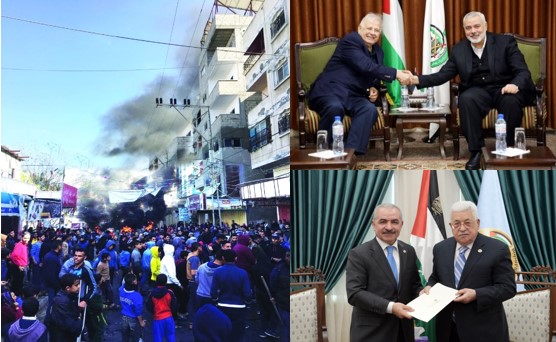
This poll has been conducted in cooperation with the Konrad-Adenauer-Stiftung in Ramallah
hese are the results of the latest poll conducted by the Palestinian Center for Policy and Survey Research (PSR) in the West Bank and the Gaza Strip between 13-16 March 2019. The period before the conduct of the fieldwork of the poll witnessed several developments including the dissolution of the Palestinian Legislative Council (PLC) by the PA president, the announcement that a new PLC, but not presidential, elections will take place in the West Bank and the Gaza Strip within six months, the selection of Mohammad Shtayyeh to be the next prime minister following the resignation of the Hamdallah government, and the eruption of demonstrations in the Gaza Strip against high cost of living conditions and their violent suppression by Hamas’ police and armed wing . The period also witnessed the implementation of Israel’s decision to deduct a small amount of the Palestinian custom revenues it transfers every month to the PA and the PA response refusing to accept any of these funds, a Palestinian-Israeli escalation in al-Aqsa Mosque in the aftermath of a Waqf decision to re-open Bab al Rahma (Gate of Mercy) area for Muslim prayer and an Israeli ban on prayer in that area, and the formation of a new Israeli electoral list representing the center in preparation for Israeli parliamentary elections which are scheduled to take place next month. Finally, the US Administration announced during this period its intentions to release its peace plan, known as the “Deal of the Century,” after the holding of the Israeli elections. This press release addresses many of these issues and covers other matters such as Palestinian parliamentary and presidential elections, general conditions in the Palestinian territories, the peace process and the future possible directions for Palestinians in the absence of a viable process. Total size of the sample is 1270 adults interviewed face to face in 127 randomly selected locations. Margin of error is +/-3%.
For further details, contact PSR director, Dr. Khalil Shikaki, or Walid Ladadweh at tel. 02-296 4933 or email pcpsr@pcpsr.org.
Main Findings:
Findings of the first quarter of 2019 indicate a rise in support for the two-state solution, but the largest percentage remains opposed to this solution. Support for negotiations, as the most effective means of establishing a
Palestinian state rises while the belief that armed struggle is the most effective means drops. But distrust in the seriousness of the Trump Administration increases. Similarly, findings show a significant rise in the belief that the Trump plan will not include a Palestinian state, nor will it include a reference to East Jerusalem as a capital for the state, or an emphasis on the 1967 borders, or a call to a just solution to the refugee problem, or a call to end the Israeli occupation and the withdrawal of the Israeli army. Given all these doubts about the plan, about 80% demand that the PA leadership reject the American plan when made public.
Findings also show that about three quarters of the public demand the simultaneous holding of presidential and parliamentary elections in both the West Bank and the Gaza Strip. A similar percentage indicates its rejection of holding parliamentary elections if no presidential elections were held at the same time and if restricted to the West Bank. 60% would oppose elections, even if held in both the West Bank and the Gaza Strip, if restricted to a parliamentary vote. If the PA manages to hold parliamentary elections only and only in the West Bank, less than 30% of West Bankers say they will participate in that vote.
Findings also show that if presidential elections are held today, Abbas would win against Hamas’ Haniyyeh. Three months ago, Haniyyeh was able to win against Abbas. Abbas’ recent confrontation with the Israeli government over payment to the families of prisoners and martyrs and the deduction from the Palestinian custom revenues might have contributed to the rise in his popularity. By contrast, Hamas’ violent suppression of the recent popular demonstrations in the Gaza Strip might have contributed to the decline in support for Haniyyeh. If parliamentary elections are held today, Fatah would win the largest share of the vote indicating a significant rise in its popularity compared to our findings three months ago. Support for Hamas on the other hand drops slightly compared to our findings three months ago. Vote for the two factions has probably been affected by the same factors that affected support for Abbas and Haniyyeh.
Findings indicate that the public is evenly divided over the selection of Shtayyeh as the next prime minister, one satisfied and the other dissatisfied with the selection. But the largest percentage believe a government led by Shtayyeh will not succeed in unifying the West Bank and the Gaza Strip, or in organizing elections, or in improving Palestinian economic conditions. Given the Israeli decision to deduct part of the custom revenues Israel transfers to the PA on monthly basis and the PA response by refusing to accept any of those funds, a large majority expresses pessimism about the ability of the PA to pay salaries to its public sector and a majority says that this development could lead to PA collapse.
(1) Presidential and parliamentary elections:
- 72% want simultaneous legislative and presidential elections and 74% are opposed to holding legislative elections in the West Bank only
- 54% say they will not participate in legislative election even if it is held in both the West Bank and the Gaza Strip and 62% of the West Bankers say they will not participate in legislative elections if restricted to the West Bank
- 64% are worried that domestic conditions could deteriorate toward conflict if the office of the presidency becomes vacant
- 60% want the president to resign and 35% want him to remain in office; but if new elections take place, in which Abbas and Ismail Haniyyeh participate, the former wins 51% of the vote and the latter wins 41%
- If new parliamentary elections were to take place today, Fatah would win 39% of the vote and Hamas 32%
- 54% view, and 42% do not view, the PLO as the sole legitimate representative of the Palestinian people
Only 43% of the public expect elections, parliamentary or parliamentary and presidential, to take place in the Palestinian territories in the near future; 46% believe no elections will take place. An overwhelming majority (72%) wants elections to be for both, a parliament and a president, while only 10% want parliamentary elections only. 13% do not want any elections. The belief that presidential and parliamentary elections will take place soon is stronger among those whose age is 50 years or higher (44%) compared to those whose age is between 18 and 22 years (39%), among women (45%) compared to men (41%), among residents of villages/towns (46%) compared to residents of refugee camps (41%), among those who ended elementary school only (56%) compared to those who finished their BA (37%), among those who work in the public sector (46%) compared to those who work in the private sector (41%), among the married (45%) compared to the unmarried (39%), among the religious (47%) compared to the somewhat religious and the non-religious (42% and 29% respectively), among supporters of the peace process (49%) compared to those who are opposed to the peace process (35%), and among supporters of Fatah (55%) compared to supporters of Hamas and third parties (44% and 36% respectively).
An overwhelming majority (72%) expects Israel to refuse to allow election to take place in East Jerusalem and 15% expect Israel to allow it. Similarly, 53% believe that Hamas will not allow election to take place in the Gaza Strip if such vote was restricted to parliamentary elections and 33% believe it will allow such election. If elections were for a parliament and a president, 66% want Hamas to participate and to allow them in the Gaza Strip while 26% say they do not want Hamas to participate or allow elections in the Gaza Strip. But if elections were for a parliament only, 59% say they want Hamas to participate and to allow them in the Gaza Strip while 32% would oppose that.
About three quarters (74%) oppose and 19% support the holding of parliamentary elections only and only in the West Bank. Similarly, 61% oppose and 31% support the holding of parliamentary elections only even if they are to take place in both the West Bank and the Gaza Strip. 54% say they will not participate in West Bank-Gaza Strip elections if they were restricted to a parliamentary vote and 41% say they will participate in such elections. Willingness to participate in the elections, if restricted to the PLC but were held in both the West Bank and the Gaza Strip, is higher among those whose age is 50 years of higher (44%) compared to those whose age is between 18 and 22 years (37%), among men (47%) compared to women (35%), among residents of villages/towns (46%) compared to cities (40%), among holders of BA degree (41%) compared to those who finished elementary school (33%), among the religious (45%) compared to the somewhat religious and the non-religious (39% and 35% respectively), and among supporters of Fatah and supporters of Hamas (61% and 51% respectively) compared to supporters of third parties (41%).
Similarly, 62% say they will not participate in elections if they were parliamentary only and if they were to take place in the West Bank only; 29% say they will participate in such elections. Willingness among West Bankers to participate in the elections, if restricted to the PLC and were held in the West Bank only, is higher among men (30%) compared to women (27%), in refugee camps and villages/towns (38% and 36% respectively) compared to cities (25%), among those whose age is 50 years or higher (32%) compared to those whose age is between 18 and 22 years (24%), among the religious (32%) compared to the somewhat religious and the non-religious (28% and 18% respectively), among supporters of Fatah (50%) compared to supporters of Hamas and third parties (29% and 24% respectively).
If elections were parliamentary only and took place only in the West Bank but some of the members of the new parliament were from the Gaza Strip, only 50% say such a parliament would represent both the West Bank and the Gaza Strip while 34% say it would represent the West Bank only. In the Gaza Strip, the largest percentage (48%) say such a parliament would represent the West Bank only and 45% say it would represent both areas.
54% are dissatisfied with the dissolution of the PLC while 37% say they are satisfied. It is worth noting that three months ago, before the actual dissolution of the PLC, 47% said they would support its dissolution and 43% said they would oppose such a step. Today, 53% view the dissolution of the PLC as illegal and unconstitutional while 33% view it as legal and constitutional.
64% are worried and 34% are not worried that domestic conditions would deteriorate in case the position of the president become vacant. But 47% believe that when the position of the president is vacant, Palestinian factions will be able to reach an agreement on conducting presidential elections in the West Bank and the Gaza Strip in order to elect a successor; 45% believe that the factions will not reach such an agreement. Despite this, 60% of the public want president Abbas to resign while 35% want him to remain in office. Three months ago, 64% said they want Abbas to resign. Demand for Abbas’ resignation stands at 55% in the West Bank and 68% in the Gaza Strip. Three months ago, demand for Abbas resignation stood at 55% in the West Bank and 77% in the Gaza Strip.
Level of satisfaction with the performance of president Abbas stands at 34% and dissatisfaction at 62%. Level of satisfaction with Abbas stands at 40% in the West Bank and 24% in the Gaza Strip. Three months ago, satisfaction with Abbas stood at 32% (38% in the West Bank and 23% in the Gaza Strip). If new presidential elections were held today and only two were nominated, Mahmoud Abbas and Ismail Haniyeh, the former would receive 51% and the latter 41% of the vote (compared to 42% for Abbas and 49% for Haniyeh three months ago). In the Gaza Strip, Abbas receives 47% of the vote (compared to 36% three months ago) and Haniyeh receives 51% (compared to 62% three months ago). In the West Bank, Abbas receives 55% (compared to 46% three months ago) and Haniyeh 33% (compared to 41% three months ago). If the competition was between Marwan Barghouti and Ismail Haniyeh, Barghouti receives 64% and Haniyeh 33%. If president Abbas does not nominate himself in a new election, 35% prefer to see Marwan Barghouti replacing him, while 19% prefer Ismail Haniyeh. Mohammad Dahlan is preferred by 7% (2% in the West Bank and 16% in the Gaza Strip). Rami al Hamdallah is selected by 4%; Khalid Mishal, Saeb Erikat, and Mustafa Barghouti by 3% each, and Salam Fayyad by 2%.
If new legislative elections were held today with the participation of all factions, 70% say they would participate in such elections. Of those who would participate, 32% say they would vote for Hamas and 39% say they would vote for Fatah, 8% would vote for all other third parties combined, and 18% are undecided. Three months ago, vote for Hamas stood at 34% and Fatah at 35%. Vote for Hamas in the Gaza Strip stands today at 39% (compared to 39% three months ago) and for Fatah at 32% (compared to 31% three months ago). In the West Bank, vote for Hamas stands at 26% (compared to 29% three months ago) and Fatah at 45% (compared to 39% three months ago).
A majority of 54% view and 42% do not view the PLO as the sole legitimate representative of the Palestinian people. It is worth noting that the belief that the PLO is the sole legitimate representative of the Palestinian people stood at 58% nine months ago and at 69% thirteen years ago. The belief that the PLO is the sole legitimate representative of the Palestinian people is higher in the West Bank (56%) compared to the Gaza Strip (51%), among residents of villages/towns (60%) compared residents of cities and refugee camps (55% and 42% respectively), among non-refugees (58%) compared to refugees (49%), among those whose age is 50 years or higher (58%) compared to those whose age is between 18 and 22 years (50%), among the illiterates (67%) compared to those who hold a BA degree (58%), among those who work in the public sector (58%) compared to those who work in the private sector (53%), among the married (56%) compared o the unmarried (49%), among the somewhat religious (57%) compared to the religious (51%), among the supporters of the peace process (66%) compared to those who oppose the peace process (33%), and among supporters of Fatah (85%) compared to supporters of Hamas and third parties (30% and 49% respectively).
9
(2) Mohammad Shtayyeh, a new prime minister:
- 38% are satisfied and 40% are dissatisfied with the selection of Mohammad Shtayyeh as the designated prime minister
- The largest percentage believes that a government headed by Shtayyeh will not succeed in reunifying the West Bank and the Gaza Strip, or holding elections in the West Bank and the Gaza Strip, or improving the economic conditions
38% are satisfied and 40% are dissatisfied with the selection of Mohammad Shtayyeh as the next prime minister. In the Gaza Strip, dissatisfaction reaches 52%. The largest percentage (48%) believes that a government led by Shtayyeh will not succeed in achieving reconciliation and unifying the West Bank and the Gaza Strip while 35% believe it will succeed. Similarly, the largest percentage (44%) believes that a government led by Shtayyeh will not be able to organize legislative and presidential elections in the West Bank and the Gaza Strip while 40% think it will succeed. Half of the public believes that a Shtayyeh government will not be able to improve economic conditions in the PA while 36% believe it will be able to do that. Satisfaction with the selection of Shtayyeh is higher in the West Bank (41%) compared to the Gaza Strip (34%), among men (41%) compared to women (36%), in villages/towns (44%) compared to cities and refugee camps (37% and 36% respectively), among non-refugees (41%) compared to refugees (34%), among those whose age is 50 or above (40%) compared to those whose age is between 18 and 22 years (33%), among those who work in the public sector (49%) compared to those who work in the private sector (38%), among the somewhat religious (40%) compared to the religious and the non-religious (36% and 35% respectively), among supporters of the peace process (46%) compared to those who oppose the peace process (24%), and among supporters of Fatah (65%) compared to supporters of Hamas and third parties (18% and 34% respectively).
(3) Domestic conditions:
- 69% are worried that the PA will not be able to pay salaries and 54% are worried that it will collapse
- The largest percentage (37%) believes that Israel is responsible for the deteriorating conditions in the Gaza Strip, 25% blame the PA and the president, and 21% blame Hamas
- Perception of safety and security stands at 64% in the Gaza Strip and 57% in the West Bank; despite this, 43% of Gazans, compare to only 20% of West Bankers, say they want to emigrate
- 82% believe that corruption exists in PA institutions
- 47% view the PA as a burden on the Palestinian people and 47% view it as an asset
Now after Israel deducted part of the custom revenues it transfers to the PA and after the PA has refused to accept the incomplete transfer, an overwhelming majority (69%) is worried and 25% are not worried that the PA will not be able to pay salaries to its public sector. Moreover 54% are worried and 40% are not worried that the PA’s inability to pay salaries to its public sector will lead to PA collapse. The percentage of those who are worried is higher in the Gaza Strip (58%) compared to the West Bank (51%), among women (57%) compared to men (50%), in refugee camps and cities (55% and 54% respectively) compared to villages/towns (49%), among non-refugees (55%) compared to refugees (51%), among the illiterates (68%) compared to holders of BA degree (51%), among housewives and laborers (60% and 57% respectively) compared to professionals and students (39% and 48% respectively), and among supporters of third parties and supporters of Fatah (61% and 55% respectively) compared to supporters of Hamas (47%).
Positive evaluation of conditions in the Gaza Strip stands at 4% and positive evaluation of conditions in the West Bank stands at 20%. In a close-ended question, we asked respondents to identify the party or side responsible for the worsening conditions in the Gaza Strip: Israel, Hamas, the PA and Abbas, Egypt, or others. The largest percentage (37%) blames Israel while 25% blame Abbas and the PA, 21% blame Hamas, 4% blame Egypt, and 9% blame others. Responses of West Bankers differ from those of Gazans: 41% of Gazans, compared to 16% of West Bankers, blame Abbas and the PA and 27% of Gazans, compared to 17% of West Bankers, blame Hamas.
Perception of safety and security in the Gaza Strip stands at 64%. In the West Bank perception of safety and security stands at 57%. Three months ago, perception of safety and security in the Gaza Strip stood at 55% and in the West Bank at 47%. Despite that, 29% of the public say they want to emigrate due to political, security, and economic conditions. The percentage rises in the Gaza Strip to 43% and declines in the West Bank to 20%.
Only 32% of the West Bankers say that people can criticize the authority in their area without fear and 65% say that they cannot. In the Gaza Strip, 41% say that people can criticize the authority in their area without fear and 53% believe that they cannot. Perception of corruption in PA institutions stands at 82%. The public is divided over the assessment of the PA: 47% view it as a burden on the Palestinian people while 47% view it as an asset for the Palestinian people. The belief that the PA is an asset is higher in the West Bank (51%) compared to the Gaza Strip (41%), in cities and villages/towns (49% each) compared to refugee camps (37%), among those whose age is 50 years or higher (49%) compared to those whose age is between 18 and 22 years (43%), among laborers, housewives, and employees (53%, 49%, and 45% respectively) compared to students and professionals (38% and 41% respectively), among those who are married (49%) compared to the unmarried (42%), among the somewhat religious (50%) compared to the religious (43%) among supporters of the peace process (61%) compared to those who are opposed to the peace process (23%), and among supporters of Fatah (84%) compared to supporters of Hamas and third parties (21% and 42% respectively).
We asked the public about its viewership habits in the last two months. Findings indicate that Al Jazeera TV viewership remains the highest, standing at 18%, followed by Palestine and Al Aqsa TV (14% each), Maan TV and Palestine Today (at 12% each), Al Arabiya (at 6%) and al Mayadeen (at 5%).
(4) Reconciliation and the reconciliation government:
- 67% are not optimistic and 30% are optimistic about the prospects of reconciliation
- 82% demand the ending of the sanctions imposed by the PA on the Gaza Strip
30% are optimistic and 67% are pessimistic about the success of reconciliation. Three months ago, optimism stood at 29%. The public is opposed to Abbas’ position that Hamas must fully hand over control over the Gaza Strip to the reconciliation government, including the ministries, the security sector, and the “arms:” only 38% agrees with Abbas’ demand but a majority of 58% disagrees. Three months ago, 34% said they agreed with Abbas. When the question of “arms” was further clarified by asking the public if it supports or opposes the continued existence of armed factional battalions in the Gaza Strip alongside the official PA security sector forces, 71% said that they prefer to keep the armed battalions in place and only 24% said that they oppose the continued existence of the armed battalions in the Gaza Strip. It is worth noting that on this matter, there are no major differences between the attitudes of the West Bankers and Gazans. Moreover, an overwhelming majority (82%) demands that the PA immediately lift all the measures taken against the Gaza Strip, such as public sector’s salary deductions and the reduction in access to electricity; only 14% say that such measures should be removed only after Hamas fully hands over control over the Strip to the reconciliation government.
5) The peace process
- 48% support and 50% oppose the two-state solution; but 58% believe that the two-state solution is not practical or feasible due to settlement expansion
- The best means of establishing a Palestinian state is negotiation in the eyes of 37%, while 36% think it is armed struggle, and 22% think it is non-violent resistance
- 47% support a return to an armed intifada
- 64% believe that visits by Israeli officials to Arab countries are harmful to the efforts to resolve the Palestinian-Israeli conflict while 8% think they are helpful
- 51% expect the right wing and Netanyahu to win the upcoming Israeli elections and 22% expect the center to win
Support for the concept of the two-state solution stands at 48% and opposition at 50%. No description or details were provided for the concept. Three months ago, support for the concept stood at 43%. Yet, when we asked the public to choose between the two-state solution, the one-state solution, or any other third solution, 49% said they prefer the two-state solution, 17% said they prefer the one-state solution, and 23% preferred some other solution. It should be noted however that in this question we have defined the two-state solution to mean “a Palestinian state alongside Israel based on the 1967 borders and East Jerusalem as its capital.” The one-state solution was defined as “a state that includes Israel, the West Bank and the Gaza Strip in which Palestinians and Israeli Jews enjoy equal rights in all matters.” Three months ago, support for the two-state solution stood at 45%, for the one state solution at 22%, and 23% preferred a third undefined alternative.
The preference for the one-state solution over the others is higher in the West Bank (21%) compared to the Gaza Strip (12%), among non-refugees (20%) compared to refugees (13%), among the illiterates (29%) compared to holders of BA degree (13%), among the non-religious and the somewhat religious (27% and 20% respectively) compared to the religious (12%), among supporters of the peace process (21%) compared to those who are opposed to the peace process (13%), and among Fatah supporters (19%) compared to supporters of Hamas and third parties (9% and 14% respectively).
A majority of 58% believes that the two-state solution is no longer practical or feasible due to the expansion of Israeli settlements while 37% believe that the solution remains practical. Moreover, 77% believe that the chances for the creation of a Palestinian state alongside the state of Israel in the next five years are slim or nonexistence while 21% believe the chances to be medium or high. The most preferred way out of the current status quo is “reaching a peace agreement with Israel” according to 39% of the public while 30% prefer waging “an armed struggle against the Israeli occupation.” Only 11% prefer “waging a non-violent resistance” and a minority of 17% prefers to keep the status quo. Three months ago, 34% said that they prefer reaching a peace agreement with Israel and 34% said they prefer waging an armed struggle.
Support for waging an armed struggle is higher in the Gaza Strip (38%) compared to the West Bank (25%), among residents of refugee camps (40%) compared to residents of cities and villages/towns (30% and 25% respectively), among refugees (33%) compared to non-refugees (28%), among those whose age is between 18 and 22 years (38%) compared to those whose age is 50 years or higher (26%), among those who hold a BA degree (29%) compared to the illiterates (13%), among students (46%) compared to farmers, housewives, laborers, and employees (8%, 26%, 31% and 31% respectively), among the non-married (37%) compared to the married (28%), among the religious (34%) compared to the somewhat religious (27%), among those who are opposed to the peace process (51%) compared to supporters of the peace process (19%), and among supporters of Hamas (52%) compared to supporters of Fatah and third parties (18% and 23%).
The public is divided over the role of negotiations and armed struggle in the establishment of a Palestinian state next to the state of Israel: 37% think that negotiation is the most effective means while 36% think armed struggle is the most effective means, while 22% believe that non-violent resistance is the most effective. Three months ago, 28% said negotiation is the most effective means and 44% said armed struggle is the most effective means. In light of the suspension of peace negotiations, Palestinians support various alternative directions: 55% support popular non-violent resistance; 47% support a return to an armed intifada; 41% support dissolving the PA; and 31% support abandoning the two-state solution and demanding the establishment of one state for Palestinians and Israelis. Three months ago, 54% said they prefer a return to armed intifada and 47% said they prefer to dissolve the PA.
65% support and 31% oppose the PLO Central Council’s decision to stop security coordination with Israel. But 78% believe that the PA leadership and security services will not stop security coordination with Israel. More than three quarters (76%) believe that if Israel ban Muslim prayer at al Rahma Gate (Gate of Mercy) area, Palestinian protests will succeed, as the case was with the metal detector gates, in forcing Israel to allow such prayer; 21% believe Palestinian protests will not succeed this time. A majority 64% believe that visits of Israeli officials to Arab countries damage the chances for resolving the Palestinian-Israeli conflict; 8% believe the visits help to promote peace and 26% believe they neither help nor hurt conflict resolution.
A slim majority of 51% expect the Israeli right wing led by Netanyahu to win the upcoming Israeli elections and 22% expect the center-left led by Gantz to win the elections. But three quarters believe that even if the center-left win the elections, conditions will stay as they are today or become worse; only 10% expect Palestinian-Israeli conditions to improve in that case.
6) Trump’s Peace Plan:
- Between 78% and 84% believe that the Trump peace plan will not call for the creation of a Palestinian state, or for East Jerusalem to be its capital, or for borders to be based on the 1967 lines, or for a just solution to the refugees’ problem, or for the ending of occupation and the withdrawal of the Israeli army
- 79% believe that the PA leadership should reject the Trump plan and 14% believe it should accept it
- 64% oppose and 23% support the resumption of PA contacts with the US Administration
An overwhelming majority (83%) believes that the Trump Administration is not serious about launching a new peace plan and 12% believe it is serious. We asked the public about its expectations from the plan, if and when it is submitted to the parties. A large majority of 79% believes that if the US does indeed offer a peace plan, it will not call for the establishment of a Palestinian state next to the state of Israel; 15% believe it will. A similar percentage (81%) believes that the plan will not call for a Palestinian capital in East Jerusalem; 14% believe it will. 78% believe the Trump plan will not call for the borders of the Palestinian state to be based on the lines of June 1967 with minor mutual land swaps; 17% believe it will. An overwhelming majority of 84% believes the plan will not call for a just solution to the refugee problem; 10% believe it will. Similarly, 84% believe the plan will not call for the ending of the Israeli occupation and the withdrawal of the Israeli army from the areas occupied in 1967; 11% believe it will. For all of the above, 79% believe that the Palestinian leadership should reject the US plan, if offered, and 14% believe it should accept it.
But if the Trump plan does indeed include all such items, such as a Palestinian state with East Jerusalem as its capital, with borders based on the 1967 lines, a just solution to the refugees’ problem, and an Israeli army withdrawal from the territories occupied in 1967, a majority of 52% calls for rejecting it and 43% call for accepting it. Call for accepting the plan is higher in the Gaza Strip, standing at 55% while the call for rejecting it is higher in the West Bank, standing at 59%. Support for accepting the American plan if it contains all these Palestinian needs is also higher among men (46%) compared to women (40%), in refugee camps (48%) compared to villages/towns and cities (41% and 43% respectively), among refugees (47%) compared to non-refugees (41%), among holders of PA degree (49%) compared to the illiterates (35%), among those who work in the public sector (55%) compared to those who work in the private sector (41%), among supporters of the peace process (50%) compared to those who are opposed to the peace process (33%), and among supporters of Fatah and third parties (54% and 49% respectively) compared to supporters of Hamas (34%).
A majority of 64% is opposed and 23% is not opposed to a resumption of dialogue between the Palestinian leadership and the Trump Administration. Official contacts between the PA and the US government were suspended by the PA after the US recognized Jerusalem as the capital of Israel. Opposition to the resumption of dialogue with the US is higher in the West Bank (70%) compared to the Gaza Strip (54%), in villages/towns (71%) compared to cities and refugee camps (64% and 57% respectively), among non-refugees (66%) compared to refugees (62%), among those who are opposed to the peace process (75%) compared to supporters of the peace process (61%), and among supporters of Hamas and third parties (69% and 68% respectively) compared to supporters of Fatah (59%).
21September 2021
While almost all Palestinians followed the news about the Gilboa prison break on daily basis viewing it as inspiring to popular resistance, the killing of the opposition activist Nizar Banat and the PA behavior in its aftermath damage the standing of the PA as almost 80% of the public demand the resignation of president Abbas
15-18 September 2021
This poll has been conducted in cooperation with the Konrad-Adenauer-Stiftung in Ramallah

These are the results of the latest poll conducted by the Palestinian Center for Policy and Survey Research (PSR) in the West Bank and the Gaza Strip between 15-18 September 2021. The period before the conduct of the poll witnessed several developments including the killing of a political activist, Nizar Banat, right after his arrest and sever beating by the Palestinian security services, the eruption of widespread demonstrations against the PA demanding justice for Banat, the escape of six Palestinian prisoners from the Gilboa prison in Israel and the capture of four of them (just before the fieldwork began), the continued Egyptian-mediated Hamas-Israeli negotiations to strengthen the ceasefire reached in May and begin the process of reconstruction, the meeting of PA president Mahmoud Abbas with the Israeli defense minister Benny Gantz in Ramallah to talk about Palestinian-Israeli relations and means of improving them while strengthening the PA by implementing various trust-building measures. This press release addresses these issues and covers other matters such as the general conditions in the Palestinian territories, the peace process and future possible directions for Palestinians in the absence of a viable peace process. Total size of the sample is 1270 adults interviewed face to face in 127 randomly selected locations. Margin of error is +/-3%.
For further details, contact PSR director, Dr. Khalil Shikaki, or Walid Ladadweh at tel. 02-296 4933 or email pcpsr@pcpsr.org.
Main Findings:
Findings of the third quarter of 2021 show the centrality of domestic issues on shaping public attitudes. Three developments in particular are worth observing: the killing of the political activist Nizar Banat by PA security services, the manner in which PA security services dealt with protests during the last few months, and the residual impact of the last Hamas-Israel war of May 2021. Findings also show the great importance attached by the public to the issue of prisoners in Israeli jails. Impacted by all of the above, findings reflect continued PA loss of status and support.
A large majority rejects that the notion that the killing of Banat was a mistake unintentionally made by security officers. Instead, the public is confident that the death of the political activist was premediated, ordered by the political or security leadership. Because of that, the public is not
satisfied with the step taken by the PA to ensure justice by putting all security officers involved on trial. The public is also angry with the manner in which the PA cracked down on public protests that demanded justice in the Banat case. In fact, three quarters view the behavior of the security services as a violation of liberties and human rights.
Findings show that the overwhelming majority of the public has been following, on daily basis, the news regarding the escape of six Palestinian prisoners from the Gilboa prison in Israel. The overwhelming majority views the prisoners’ behavior, even after they were captured, as inspiring to the Palestinians to rise and take the initiative to resist the occupation. Yet, on this issue of public consensus, one in which the PA is not a party, the Palestinian leadership and the security establishment do not come out looking good at all. While the public is easily convinced by Hamas’ proclamations and plans for freeing the prisoners, the PA is distrusted with the majority believes that the PA security services would not defend the prisoners.
The impact of the May 2021 confrontations in Jerusalem and the war between Hamas and Israel is still strongly felt in this poll. An overwhelming majority still thinks Hamas came out the winner and that Hamas goal has been to defend East Jerusalemites and al Aqsa Mosque. Indeed, the largest percentage (but not the majority) believes that Hamas is more deserving of representing and leading the Palestinian people. The majority calls upon Hamas to relaunch rockets against Israel if East Jerusalemites are expelled from their homes in the city or if restrictions are imposed on Palestinian access to al Aqsa Mosque. Nonetheless, it is worth noting that now, after three months have passed since our last poll, we do see some decline in some of those indicators that measure the ascendance of Hamas. In almost all indicators, we see a small decline ranging between two to eight percentage points.
If new presidential and parliamentary elections were to take place today, Hamas would do relatively well compared to Fatah. This is particularly true for a presidential election, assuming president Abbas is Fatah’s candidate. The outcome would be dramatically different and more beneficial to Fatah if its candidate for the presidency is Marwan Barghouti. Most importantly for Fatah, findings show a significant increase in the demand for Abbas’ resignation, with almost 80% making the demand, an unprecedent PSR finding.
Findings show that in the context of increased Covid-19 infection rates, the majority is in favor of mandatory vaccination; but opposition is slightly more than a third. Yet, even among those who reject making vaccination mandatory to all of the public, a minority favors making it mandatory to those working in the public sector such as schools and ministries.
Findings on the peace process show continued but slow decline in support for the two-state solution. They also show high levels of support for armed struggle as the best means of ending the occupation with almost half of the public endorsing this position. Consistent with that we find a slim majority opposing a resumption of Palestinian-Israeli negotiations under the sponsorship of the Quartet. Despite this, a majority of Palestinians view positively the confidence building measures that would improve living conditions in the West Bank and the Gaza Strip.
1) Prisoners escape from the Gilboa prison:
- An overwhelming majority of Palestinians (86%) says that it has heard about and followed on daily basis the news about the escape of the six Palestinian prisoners from the Gilboa prison in Israel and the capture of some of them while 12% say they did that occasionally and only 2% say they have not heard about or followed the news
- Similarly, 87% say the escape of the six prisoners and the capture of some of them will serve as an inspiration to Palestinians outside the prison to take the initiative and actively work toward the ending of occupation; only 7% think the escape and capture will have the opposite impact of bringing frustration and despair; 5% say it will have no impact.
- 81% believe that Hamas will soon succeed in making a deal with Israel on a prisoners’ exchange that will include the release of the escaped and recaptured prisoners; 14% believe no such exchange will take place soon.
- On the other hand, if the escaped prisoners managed to reach the Palestinian territories, only 24% think the PA security services would in this case protect them while 68% think they would not do so.
2) The death of Nizar Banat:
- A majority of 63% of the public believes that the killing of Nizar Banat soon after his arrest by PA security officials was a deliberate measure ordered by the PA political or security leaders while only 22% believe it was an unintentional mistake by those who arrested him.
- 63% support and 28% oppose the demonstrations that erupted after the death of Banat demanding the departure of the president from office and the removal of his government.
- A large majority of 69% feels the measures take by the PA to ensure justice in the Banat case, including putting on trial all 14 security officials who took part in his arrest, are insufficient; only 20% think they are sufficient.
- Almost three quarters (74%) believe the steps taken by the PA security services in arresting the demonstrators who demanded justice for Banat is a violation of liberties and human rights while only 18% view these measures as a legitimate enforcement of law and order.
3) Three months after the Jerusalem confrontations and the war between Hamas and Israel:
- An overwhelming majority of Palestinians (71%) believes that Hamas has come out a winner in its last war with Israel while only 3% think Israel came out a winner; 21% say no one came out a winner and 3% think both sides came out winners. Three months ago, 77% thought Hamas came out the winner. Moreover, 63% think that Hamas has achieved its declared goal behind firing rockets at Israel: to force Israel to stop the expulsion of the families in al Shaikh Jarrah and to bring to an end Israeli restriction on Muslim access to al Aqsa; 29% think it did not. Three months ago, 65% said Hamas has achieved its declared goal
- 67% think that Hamas’ decision to launch rockets at Israeli cities came in defense of Jerusalem and al Aqsa Mosque while 10% think it came as a protest against the PA cancelation of elections with the aim of weakening the PA leadership; 19% think Hamas’ decision was motivated by these two drivers. Three months ago, 72% thought that Hamas’ decision came in defense of Jerusalem and al Aqsa Mosque.
- In light of the recent confrontations with Israel, 45% think Hamas is most deserving of representing and leading the Palestinian people while only 19% think Fatah under president Abbas is the most deserving of representing and leading the Palestinians; 28% think neither side deserve such a role. Three months ago, 53% thought Hamas is more deserving of representation and leadership and 14% thought Fatah under the leadership of Abbas is the more deserving.
- If Israel expels the families of al Shaikh Jarrah or reimposes restrictions on access to al Aqsa Mosque, 60% believe the response in this case should be the launching of rockets at Israeli cities, while 20% think it should be the waging of non-violent resistance, and 13% believe Palestinians should respond by submitting a complaint to the UN and the International Criminal Court (ICC).
4) Legislative and presidential elections:
- 73% say they support the holding of presidential and legislative elections in the Palestinian territories in the near future while 23% say they do not support that. Demand for elections stands at 82% in the Gaza Strip and 67% in the West Bank. But a majority of 56% (63% in the Gaza Strip and 52% in the West Bank) believe no legislative or legislative and presidential elections will take place soon.
- If new presidential elections were held today and only two were nominated, Mahmoud Abbas and Ismail Haniyeh, only 51% would participate and from among those, Abbas would receive 34% and Haniyeh 56% of the votes (compared to 59% for Haniyeh and 27% for Abbas three months ago). In the Gaza Strip, Abbas receives 34% of the votes (compared to 30% three months ago) and Haniyeh receives 61% (compared to 60% three months ago). In the West Bank, Abbas receives 33% (compared to 25% three months ago) and Haniyeh 52% (compared to 59% three months ago). If the competition was between Marwan Barghouti and Ismail Haniyeh, participation would increase to 66% and from among those Barghouti receives 55% and Haniyeh 39%. If the competition is between prime minister Mohammad Shtayyeh and Haniyyeh, participation rate would decrease to 49% and from among those the former receives 31% and the latter 60%. Three months ago, Shtayyeh received the support of 26% and Haniyyeh 63%.
- If Abbas does not run for elections, the public would vote for the following: 33% say they want Marwan Barghouti, 22% say Ismail Haniyyeh, 6% say Dahlan and another 6% say Yahia Sinwar, Khalid Mishaal and Mustafa Barghouti 3% each, and Salam Fayyad 2%.
- Level of satisfaction with the performance of president Abbas stands at 24% and dissatisfaction at 73%. Level of satisfaction with Abbas stands at 22% in the West Bank and 26% in the Gaza Strip. Satisfaction with the performance of Abbas six months ago stood at 32% and dissatisfaction at 65%. Moreover, 78% of the public want president Abbas to resign while only 19% want him to remain in office. Three months ago, 68% said they want Abbas to resign. Demand for Abbas’ resignation stands at 78% in the West Bank and 77% in the Gaza Strip.
- If new legislative elections were held today with the participation of all factions that participated in the 2006 elections, 68% say they would participate. Of those who would participate, 37% say they will vote for Hamas and 32% say they will vote for Fatah, 13% will vote for all other third parties combined, and 18% are undecided. Three months ago, vote for Hamas stood at 41% and Fatah at 30%. Vote for Hamas in the Gaza Strip stands today at 47% (compared to 45% three months ago) and for Fatah at 27% (compared to 28% three months ago). In the West Bank, vote for Hamas stands at 28% (compared to 38% three months ago) and Fatah at 38% (compared to 32% three months ago).
5) Domestic conditions and satisfaction with the Shtayyeh government:
- Positive evaluation of conditions in the Gaza Strip stands at 7% and positive evaluation of conditions in the West Bank stands at 23%.
- Nonetheless, perception of safety and security in the Gaza Strip stands at 67% and in the West Bank at 59%.
- 27% of the public say they want to emigrate due to political, security, and economic conditions. The percentage in the Gaza Strip stands at 36% and in the West Bank at 21%. Three months ago, 15% of West Bankers expressed a desire to emigrate and 42% of Gazans expressed the same desire.
- Perception of corruption in PA institutions stands at 83%. When asked about institutions controlled by Hamas in the Gaza Strip, 61% indicated that there is corruption in these institutions. Three months ago, 84% said there is corruption in PA institutions and 57% said there is corruption in public institutions controlled by Hamas.
- 38% of West Bankers think people in the West Bank can criticize the PA without fear while 58% think they cannot. When asked to evaluate the status of democracy and human rights in the West Bank, 18% of West Bankers said it was good or very good. In the Gaza Strip, 58% think people in the Strip can criticize Hamas’ authorities without fear and 37% think they cannot. When asked to evaluate the status of democracy and human rights in the Gaza Strip, 43% of Gazans said it was good or very good.
- In its assessment of the PA, a majority of the Palestinians (59%) views it as a burden on the Palestinian people while 34% view it as an asset for the Palestinian people. Three months ago, 56% viewed the PA as a burden and 35% viewed it as an asset.
- 32% are optimistic and 63% are pessimistic about the success of reconciliation. Three months ago, optimism stood at 41%.
- After more than two years since the formation of the Shtayyeh government, findings indicate persistent pessimism. Responding to a question about expectations regarding the ability of the Shtayyeh government to make progress in reconciliation and reunification, 70% expect failure; only 22% expect success. When asked about the ability of the government to organize legislative or legislative and presidential elections in the West Bank and the Gaza Strip, 29% of the public expect success and 63% expect failure. In another question about the ability of the new government to improve economic conditions, a majority of 64% expects failure and 30% expects success.
- We asked the public about its view regarding the demands for a change in the current PA government. A majority of 54% expresses support for comprehensive change leading to the appointment of a new government and a new prime minister, while 26% want only to change some of the ministers, and 14% do not want to make any change and want the government to stay as it is.
- We also asked the public about its views on the recuring internal violence similar to the one witnessed recently in which an incident between two individuals led to widespread family and tribal violence. A majority of 57% expressed the view that such incidents indicate a weak pubic trust in the justice system including law enforcement agencies; but 35% expressed the view that such incidents reflect the traditional nature of Palestinian society that is difficult or impossible to change.
- When asked how should the PA deal with such incidents, 66% expressed the view that first and foremost, the PA should strengthen the law enforcement authorities while 27% expressed the view that the PA should strengthen the tribal reform committees and cooperate with them.
- We asked the public about its viewership habits in the last three months. Findings indicate that al Jazeera TV has the highest viewership, standing at 23%, followed by Palestine TV (14%), al Aqsa TV (12%), Palestine Today (11%), Maan (10%), al Mayadeen (4%), al Arabiya (3%), and al Manar (2%).
6) The Coronavirus: Mandatory vaccination and PA performance during the pandemic:
- With the big rise in the number of Covid infections, we asked the public about the steps it thinks the PA government should take in order to protect people from the pandemic: 39% said it should follow the normal procedures of enforcing social distance, face masks, and payment of fines for violators; a similar percentage (37%) said it should make vaccination mandatory to all those who are allowed to take it; 5% said it should impose a full closure; and 15% said they are in favor of all of the above.
- When asked specifically about mandatory vaccination, a majority of 63% expressed support while 35% expressed opposition.
- Among those who reject mandatory vaccination, 29% are in favor, and 69% are not in favor, of making it mandatory to those who work in the public sector such as those working in schools and ministries.
- 48% (55% in the West Bank and 39% in the Gaza Strip) report that they have already received the coronavirus vaccination; 27% (19% in the West Bank and 38% in the Gaza Strip) says that they are willing to take the vaccine when available; and 24 say they and their families are not willing to take the vaccine when it becomes available to them.
- 74% (84% in the Gaza Strip and 68% in the West Bank) are satisfied with the efforts made by the government to obtain the vaccine and 24% are dissatisfied.
- 45% are satisfied with the measures taken by the PA to contain the spread of the coronavirus while 53% are dissatisfied.
- The majority is satisfied with the performance of the various actors involved in the management of the Coronavirus crisis: 59% express satisfaction with the performance of the security services deployed in their areas and 63% are satisfied with the performance of the ministry of health. But satisfaction with the performance of the prime minister in the management of the Coronavirus crisis stands at only 39%.
7) The Palestinian-Israeli Peace process and the new Israeli government:
- Support for the concept of the two-state solution stands at 36% and opposition stands at 62%. No description or details were provided for the concept. Three months ago, support for the concept stood at 39%.
- A majority of 63% believes that the two-state solution is no longer practical or feasible due to the expansion of Israeli settlements while 32% believe that the solution remains practical. Moreover, 73% believe that the chances for the creation of a Palestinian state alongside the state of Israel in the next five years are slim or nonexistence while 23% believe the chances to be medium or high.
- The most preferred way out of the current status quo is “reaching a peace agreement with Israel” according to 28% of the public while 39% prefer waging “an armed struggle against the Israeli occupation.” 10% prefer “waging a non-violent resistance” and 18% prefer to keep the status quo. Three months ago, 27% said that they prefer reaching a peace agreement with Israel and 39% said they prefer waging an armed struggle.
- When asked about the most effective means of ending the Israeli occupation, the public split into three groups: 48% chose armed struggle, 28% negotiations, and 19% popular resistance. Three months ago, 49% chose armed struggle and 27% chose negotiations.
- We asked the public to speculate about the reasons for the lack of mass popular participation in non-violent resistance and provided the following list: trust in leadership and parties, burden of living conditions, or loss of will to fight. The largest percentage (44%) replied that it is due to lack of trust in the PA political leadership and; 39% said it has to do with the preoccupation and the burden of daily living conditions; and only 16% selected the loss of the will to fight.
- Under current conditions, a majority of 61% opposes and 24% support an unconditional resumption of Palestinian-Israeli negotiations.
- When asked about support for specific policy choices, 63% supported joining more international organizations; 54% supported resort to non-violent resistance; 54% supported return to armed confrontations and intifada; 47% supported dissolving the PA; and 27% supported abandoning the two-state solution and embracing a one state solution for Palestinians and Israelis. Three months ago, 60% supported a return to confrontations and armed intifada, 47% supported dissolving the PA, and 20% supported the abandonment of the two-state solution in favor of a one-state solution.
- 58% are opposed, and 36% are supportive, of a return to dialogue with the new US administration under president Joe Biden. Support for a return to Palestinian-Israeli negotiations under the leadership of the international Quartet stands at 39% and 52% are opposed. Moreover, 49% do not believe, and 41% believe, that the election of Biden and the resumption of American aid to the PA opens the door for a return to Palestinian-Israeli negotiations within the framework of the two-state solution.
- We asked the public about its views regarding Palestinian-Israeli confidence building measures that would improve living conditions in the West Bank and the Gaza Strip, such as approval of family unification permits or making available to the PA additional financial resources. A majority of 56% said it looks positively, while 35% said it looks negatively, at such measures.
8) American withdrawal from Afghanistan:
- 40% view the events leading to the withdrawal of the US from Afghanistan as a victory for Taliban against the US and its Afghani allies. But a third (33%) thinks that the events leading to the US withdrawal were orchestrated ahead of time between the US and Taliban; 27% say they not know.
- The largest percentage of the public (43%) does not expect what happened in Afghanistan to happen in Palestine in case of an Israeli withdrawal from the West Bank, a scenario in which such withdrawal would lead to the collapse of the PA and its government and the takeover of armed Islamist groups, such as Hamas; but 36% believe this scenario could indeed happen and 21% do not know.
- Moreover, 46% believe the Palestinians should learn a lesson from what happened in Afghanistan by strengthening the forces of armed resistance, but not the PA and its government, while 28% think the lesson should lead us to strengthen the PA and its legitimacy so that it would not collapse as the Afghani government did.
9) Most vital Palestinian goals and the main problems confronting Palestinians today:
- 44% believe that the first most vital Palestinian goal should be to end Israeli occupation in the areas occupied in 1967 and build a Palestinian state in the West Bank and the Gaza Strip with East Jerusalem as its capital. By contrast, 32% believe the first most vital goal should be to obtain the right of return of refugees to their 1948 towns and villages, 12% believe that the first and most vital goal should be to build a pious or moral individual and a religious society, one that applies all Islamic teachings and 10% believes it should be to establish a democratic political system that respects freedoms and rights of Palestinians.
- In a question about the two main problems confronting the Palestinians today, the largest (36%; 31% in the Gaz Strip and 40% in the West Bank) said it is the continued siege and blockade percentage of the Gaza Strip, 23% said it is the unemployment and poverty, 13% said it is the continuation of the occupation, 12% said it is the split between the West Bank and the Gaza Strip, 10% said it is the spread of corruption, and 6% said it is the weakness of the judiciary and the absence of liberties, accountability and democracy.
13 December 2022
The World Cup in Qatar helps to restore Palestinian public trust in the Arab World after years of disappointment; and in light of the escalating armed clashes in the West Bank and the near formation of a right wing and extreme government in Israel, the Palestinian public becomes more hardline while indicating a greater confidence in the efficacy of armed struggle
7-10 December 2022
This poll has been conducted in cooperation with the Konrad-Adenauer-Stiftung in Ramallah
These are the results of the latest poll conducted by the Palestinian Center for Policy and Survey Research (PSR) in the West Bank and the Gaza Strip between 7 and 10 December 2022. The period before the conduct of the poll witnessed several developments including a decision by the President of the Palestinian Authority (PA), Mahmoud Abbas, to form a high judicial council under his chairmanship, a new reconciliation agreement reached in Algeria by Palestinian factions, and media outlets reporting various cases of drowning of Palestinian emigrants in the Mediterranean Sea. On the Israeli side, after winning the November parliamentary elections, the Likud and other right wing and extreme right-wing groups agreed to form a governing coalition under Benjamin Netanyahu’s premiership. In Palestinian-Israeli relations, a UN agency adopted a decision to seek the advisory opinion of the International Court of Justice on the legality of the Israeli occupation. Moreover, various armed groups resisting the Israeli occupation in the northern parts of the West Bank, such as the “Lions’ Den,” which received a wide press coverage, went public during this period. In Qatar, the World Cup football games started and were widely followed by the Palestinians due to a considerable expression of support for and solidarity with Palestine by the fans attending the games.
This press release addresses these issues and covers other matters such as the general conditions in the Palestinian territories, the peace process and future possible directions for Palestinians in the absence of a viable peace process. Total size of the sample is 1200 adults interviewed face to face in 120 randomly selected locations. Margin of error is +/-3%.
For further details, contact PSR director, Dr. Khalil Shikaki, or Walid Ladadweh at tel. 02-296 4933 or email pcpsr@pcpsr.org
Main Findings:
The findings of the last quarter of 2022 point to a limited change in the domestic balance of power favoring Hamas and centering in the West Bank. Moreover, the popularity of president Abbas drops several percentage points, mostly in the West Bank. In other domestic issues, findings indicate that only one quarter of the public thinks that the factional agreement in Algeria will lead to actual reconciliation between Fatah and Hamas and the level of pessimism about the prospects for reunification exceeds 70%. Findings also show that the public views negatively Abbas’ decree forming a high council for the judiciary under his chairmanship as only one in five Palestinians think it aims to strengthen the judiciary while a vast majority of more than 70% think it aims at weakening the independence of the judiciary.
The findings of the current quarter also indicate a significant decline in the level of support for the two-state solution accompanied by a significant rise in the percentage of those who think this solution is no longer feasible or possible due to settlement expansion. This change is not accompanied by an increase in the percentage of those who support the one-state solution in which Palestinians and Israeli Jews enjoy equal rights. To the contrary, support in the current quarter for this one-state solution has also dropped. These findings point to the possibility that the change in attitudes toward the political settlement with Israel reflects a hardening of public attitudes signifying less willingness to compromise. This hardening of attitudes can also be seen in the significant rise in support, in the West Bank, for a return to armed intifada. Furthermore, findings show a significant decrease, in both the West Bank and the Gaza Strip, in the percentage of those who view positively Israeli-Palestinian confidence building measures. On top of that, more than 70% of the public support the idea of forming armed groups, such as the “Lions’ Den,” and only one in ten says the PA has the right to arrest members of these groups or disarm them.
These findings come in a context of three major political and security-related developments, during the current quarter, that might have shaped Palestinian public attitudes, particularly in the West Bank:
- Perhaps the single most important development has been the escalating military clashes between Palestinian armed groups and the Israeli army in the northern part of the West Bank. The number of armed clashes and Israeli military incursions and the number of Palestinian casualties have been unprecedented since the end of the second intifada. This particular development sheds light on the fact that the most significant changes in our findings are centered in the West Bank.
- The results of the Israeli elections and the start of negotiations to form a right-wing coalition government, between the Likud, the religious parties, and the extreme right wing in Israeli politics, might have contributed to the increase in the percentage of those who think the two-state solution is no longer practical or possible. This same development might have also contributed to the rise in the belief that armed struggle, not negotiations, is the most effective means of ending the Israeli occupation. Indeed, the findings indicate that a large Palestinian majority expects the worse from the upcoming Israeli government including high expectation that it will change the status quo in holy places in al Haram al Sharif in East Jerusalem, expel Palestinian families from their homes in East Jerusalem, transfer Bedouin residents, such as Arab al Jahalin, from their villages and encampments in the southeastern parts of Jerusalem to other locations, and annex settlements or the Jordan Valley to Israel.
- Finally, it is clear from the findings that the pro-Palestine scenes at the World Cup in Qatar have contributed to a restoration of the confidence of the Palestinians in the justice of their cause and their right to resist the occupation by all legitimate means. The vast majority of the Palestinians say they have now regained much, or some, of the lost confidence in the Arab peoples in light of the solidarity with Palestine expressed by the fans during the football games. The findings show strong association between the restoration of trust and attitudes regarding the two-state solution and the return to an armed intifada.
(1) “Lions’ Den” and other armed groups:
- 72% of the public (84% in the Gaza Strip and 65% in the West Bank) say they are in favor of forming armed groups such as the “Lions’ Den,” which do not take orders from the PA and are not part of the PA security services; 22% are against that.
- Nonetheless, 59% are worried that the formation of such armed groups could lead to armed clashes with the PA security services; 39% are not worried.
- 79% say they are against the surrender of the armed groups’ members and their arms to the PA in order to receive protection against Israeli assassination; 17% say they are for it.
- The vast majority (87%) says the PA does not have the right to arrest member of these armed groups in order to prevent them from carrying out attacks against Israel or to provide them with protection; only 10% say they favor it.
- A majority of 59% expects these armed groups to expand and spread to other areas in the West Bank; 15% expect Israel to succeed in arresting or killing their members; and 14% expect the PA to succeed in containing or coopting these groups.
(2) The formation of a new Israeli government of right wing and extreme right
- A majority of 61% expects the policies of the upcoming Israeli government, that is currently being formed under the leadership of Netanyahu from the right wing and the extreme right, to be more extreme and aggressive while 30% expect them to be similar to the current policies; 4% expect them to be less extreme.
- A majority of 58% expects the upcoming Israeli government under Netanyahu to change the status quo in al Haram al Sharif in East Jerusalem by allowing Jews to pray at the site; 38% do not expect that.
- A majority of 64% expects the upcoming Israeli government under Netanyahu to expel Palestinian families from al Sheikh Jarrah neighborhood in East Jerusalem; 33% do not expect that.
- A majority of 68% expects the new Israeli government under Netanyahu to transfer the Palestinian Bedouin community currently living in the area between Jerusalem and Jericho, such as Arab al Jahalin, in order to build a big settlement to the east of Abu Din and al Ezariyya; 28% do not expect that.
- A majority of 69% expects the upcoming Israeli government under Netanyahu to annex settlements or the Jordan Valley to Israel; 27% do not expect that.
- A majority of 67% is less optimistic about the prospects of an improvement in Palestinian-Israeli relations, such as reaching new agreements on confidence building measures or reducing the expansion of the settlements during next year; 12% say they are more optimistic today; and 20% are neither optimistic nor pessimistic.
(3) Legislative and presidential elections:
- 69% say they support the holding of presidential and legislative elections in the Palestinian territories in the near future while 29% say they do not support that. Demand for elections stands at 75% in the Gaza Strip and 65% in the West Bank. However, a majority of 63% believes no legislative, or legislative and presidential, elections will take place soon.
- If new presidential elections were held today and only two were nominated, Mahmoud Abbas and Ismail Haniyeh, only 46% would participate and from among those, Abbas would receive 36% and Haniyeh 54% of the votes (compared to 53% for Haniyeh and 38% for Abbas three months ago). In the Gaza Strip, Abbas receives 36% of the votes and Haniyeh receives 60%. In the West Bank, Abbas receives 36% and Haniyeh 46%. If the competition was between Marwan Barghouti and Ismail Haniyeh, participation would increase to 62% and from among those, Barghouti receives 61% and Haniyeh 34%. If the competition is between Prime Minister Mohammad Shtayyeh and Haniyyeh, participation rate would decrease to 43% and from among those, the former receives 31% and the latter 60%.
- If Abbas does not run for elections, the public prefers Marwan Barghouti to succeed him as the largest percentage (39%) selected him in a closed-ended question, followed by Ismail Haniyyeh (17%), Mohammad Dahlan (5%), Yahya al Sinwar (4%), Mohammad Shtayyeh, Khalid Mish’al and Hussein al Sheikh (3% each), and 22% said they do not know or have not decided.
- Level of satisfaction with the performance of president Abbas stands at 23% and dissatisfaction at 73%. Level of satisfaction with Abbas stands at 23% in the West Bank and 23% in the Gaza Strip. Satisfaction with the performance of Abbas three months ago stood at 26% and dissatisfaction at 74%. Moreover, a vast majority of 75% of the public wants president Abbas to resign while only 20% want him to remain in office. Three months ago, 74% said they want Abbas to resign. Demand for Abbas’ resignation stands today at 73% in the West Bank and 79% in the Gaza Strip.
- If new legislative elections were held today with the participation of all factions that participated in the 2006 elections, 65% say they would participate. Of those who would participate, 34% say they will vote for Hamas and 34% say they will vote for Fatah, 10% will vote for all third parties combined, and 21% are undecided. Three months ago, vote for Hamas stood at 32% and Fatah at 34%. Vote for Hamas in the Gaza Strip stands today at 43% (compared to 44% three months ago) and for Fatah at 30% (compared to 29% three months ago). In the West Bank, vote for Hamas stands at 26% (compared to 21% three months ago) and Fatah at 38% (compared to 38% three months ago).
- 28% say Hamas is most deserving of representing and leading the Palestinian people while 25% think Fatah under president Abbas is the most deserving of representing and leading the Palestinians; 40% think neither side deserves such a role. Three months ago, 27% selected Hamas, 26% Fatah under Abbas, and 42% said neither side deserves such a role.
(4) Domestic conditions, the “assassination” of Yasir Arafat, independence of the Judiciary, and those responsible for the drowning of Palestinian emigrants:
- In light of the leaks in the media regarding the investigation into the death of Yasir Arafat, 50% of the public believe a Palestinian party or actor had implemented the plot to get rid of Arafat but that the planning had been done by Israel; 24% think no Palestinian actor or party had been involved in the death of Arafat; and 14% think a Palestinian party or actor had plotted and implemented the killing of Arafat.
- A large majority of 72% thinks the decree issued by president Abbas to form a high judiciary council under his chairmanship was meant to weaken the independence of the judiciary; 19% think it was meant to strengthen it.
- We asked the public about the party indirectly responsible for the drowning in the Mediterranean Sea of Palestinian emigrants from the Gaza Strip while attempting to illegally reach Europe. The largest percentage (27%) puts the responsibility on Hamas, 24% on Israel, 18% on the PA, another 18% blame the emigrants themselves, and 3% blame Egypt.
- 24% of the public say they want to emigrate due to political, security, and economic conditions. The percentage in the Gaza Strip stands at 30% and in the West Bank at 20%. Three months ago, 23% of West Bankers expressed a desire to emigrate and 29% of Gazans expressed the same desire.
- Positive evaluation of conditions in the Gaza Strip stands at 6% and positive evaluation of conditions in the West Bank stands at 22%.
- Nonetheless, perception of safety and security in the Gaza Strip stands at 77% and in the West Bank at 46%.
- Perception of corruption in PA institutions stands at 81%. When asked about institutions controlled by Hamas in the Gaza Strip, 69% indicated that there is corruption in these institutions. Three months ago, 86% said there is corruption in PA institutions and 73% said there is corruption in public institutions controlled by Hamas.
- 46% of West Bankers think people in the West Bank can criticize the PA without fear while 51% think they cannot. In the Gaza Strip, 48% think people in the Strip can criticize Hamas’ authorities without fear and 51% think they cannot.
- In its assessment of the PA, a majority of the Palestinians (59%) views it as a burden on the Palestinian people while 36% view it as an asset for the Palestinian people. Three months ago, 57% viewed the PA as a burden and 38% viewed it as an asset.
- 26% are optimistic and 72% are pessimistic about the success of reconciliation. Three months ago, optimism stood at 25%. When asked about the prospects for the implementation of the agreement reached in factional meetings sponsored by Algeria, only 26% expressed the belief that the agreement would lead to actual reconciliation while 67% expressed the belief that it will not lead to reconciliation.
- After more than three years since the formation of the Shtayyeh government, findings indicate persistent pessimism. Responding to a question about expectations regarding the ability of the Shtayyeh government to make progress in reconciliation and reunification, 78% expect failure; only 18% expect success. When asked about the ability of the government to organize legislative or legislative and presidential elections in the West Bank and the Gaza Strip, 20% of the public expect success and 76% expect failure. In another question about the ability of the new government to improve economic conditions, a majority of 79% expects failure and 17% expects success.
- We asked the public about its TV viewership habits in the last three months. Findings indicate that al Jazeera TV has the highest viewership, standing at 31%, followed by Palestine TV (13%), al Aqsa TV (11%), Palestine Today TV (9%), Maan TV (6%), al Arabiya (3%), and al Mayadeen (2%).
(5) Palestinian-Israeli Relations, the Peace process, and the decision to go to ICJ:
- Support for the concept of the two-state solution stands at 32% and opposition stands at 66%. No description or details were provided for the concept. Three months ago, support for the concept stood at 37%.
- A majority of 69% believes that the two-state solution is no longer practical or feasible due to the expansion of Israeli settlements while 28% believe that the solution remains practical. Moreover, 72% believe that the chances for the creation of a Palestinian state alongside the state of Israel in the next five years are slim or nonexistence while 25% believe the chances to be medium or high. Three months ago, only 64% said the two-state solution was no longer feasible or practical due to settlement expansion.
- Reflecting on the latest UN speech of president Abbas in which he described the situation on the ground in the West Bank as “apartheid” and that the Palestinian people will demand equal rights in one state for two peoples, 26% say that they are in favor of such one state solution while 71% expressed opposition. Three months ago, support for Abbas’ position on the one-state solution stood at 30%.
- When asked about support for specific policy choices to break the current deadlock, 59% supported joining more international organizations; 51% supported resort to non-violent resistance; 55% supported return to armed confrontations and intifada; 48% supported dissolving the PA; and 27% supported abandoning the two-state solution and embracing a one state solution for Palestinians and Israelis. Three months ago, 48% supported a return to armed confrontations and intifada; 46% supported dissolving the PA; and 23% supported abandoning the two-state solution in favor of a one-state solution.
- When asked about the most effective means of ending the Israeli occupation and building an independent state, the public split into three groups: 51% chose armed struggle (53% in the Gaza Strip and 50% in the West Bank), 21% negotiations, and 23% popular resistance. Three months ago, 41% chose armed struggle and 30% chose negotiations.
- We asked the public about its views regarding Palestinian-Israeli confidence building measures that would improve living conditions in the West Bank and the Gaza Strip, such as approval of family unification permits or making available to the PA additional financial resources. A majority of 57% said it looks positively, while 38% said it looks negatively, at such measures. Three months ago, 69% of the public said it viewed these measures positively.
- When asked about PA negotiations with the upcoming Israeli prime minister, Netanyahu, 47% said they opposed such negotiations while 25% said they support negotiations with him on a peace agreement and confidence building measures while 11% said they support negotiations if restricted to a peace agreement and 12% said they support negotiations with him if restricted to confidence building measures. In other words, a total of 36% are in favor of negotiations with Netanyahu about a peace agreement and 37% are in favor of negotiations with him about confidence building measures. In light of the decision by a UN agency to go to the International Court of Justice (ICJ) to ask for its consultative opinion on the legality of the Israeli occupation, half of the public (50%) say the decision and any opinion by the ICJ will have no benefits for the Palestinian people; 28% say the benefit will be symbolic but will have no impact on Israeli policies; 16% say the decision will have an impact on constraining Israeli policies on matters such as settlement construction.
(6) World Cup in Qatar:
- 66% of the Palestinians say that they now, after having seen the scenes of solidarity and support for Palestine in the World Cup in Qatar, have regained much of the trust in the Arab peoples after many disappointments stemming from the Arab normalization with Israel; 21% say they have regained some of that trust; 5% say their trust in the Arab peoples has remained small; and 4% say they have no trust at all in the Arab World.
- In light of the Qatari organization of the World Cup, 68% of the Palestinians say they think Qatar’s international standing has improved a lot compared to where it was before; 17% say it has improved somewhat; 8% say Qatar’s standing has not changed; and 1% say it has worsened.
- We asked the public about its predictions for the winner in the World Cup. When the number of remaining country teams was eight, 48% said it expected Morocco to win; when the number of country teams went down to six, 54% expected Morocco to win. By contrast, 22% expect Argentina to win; and 15% expect France to win.
(7) Most vital Palestinian goals and the main problems confronting Palestinians today:
- 39% believe that the first most vital Palestinian goal should be to end Israeli occupation in the areas occupied in 1967 and build a Palestinian state in the West Bank and the Gaza Strip with East Jerusalem as its capital. By contrast, 33% believe the first most vital goal should be to obtain the right of return of refugees to their 1948 towns and villages, 14% believe that the first and most vital goal should be to build a pious or moral individual and a religious society, one that applies all Islamic teachings and 13% believes it should be to establish a democratic political system that respects freedoms and rights of Palestinians.
- In a question about the main problem confronting Palestinian society today, the largest percentage, 25% (8% in the Gaz Strip and 36% in the West Bank), say it is corruption; 21% (26% in the Gaza Strip and 17% in the West Bank) say it is unemployment and poverty; 20% say it is the continuation of the occupation and settlement construction; 17% (26% in the Gaza Strip and 11% in the West Bank) say it is continued siege and blockade of the Gaza Strip; 10% say it is the split between the West Bank and the Gaza Strip; and 4% say it is the weakness of the judiciary and the absence of liberties, accountability and democracy.
- When asked about the most pressing problem confronting the Palestinians today, the largest percentage (38%) said it is the Israeli occupation, while 22% said it is corruption, 15% said it is unemployment, 15% said it is the split or division, and 6% said it is the internal violence.
22 March 2022
The public favors a neutral stand in the Russian war against Ukraine even as slightly more people blame Russia for starting the war; closer to home, Israel-PA “confidence building measures” are increasingly viewed favorably even as two-thirds share the view that Israel is an apartheid state; and domestically, ten months after the Israel-Hamas War, Fatah’s popularity returns to its pre-May 2021 level despite the fact that almost three quarters continue to demand the resignation of president Abbas
16-20 March 2022
This poll has been conducted in cooperation with the Konrad-Adenauer-Stiftung in Ramallah

These are the results of the latest poll conducted by the Palestinian Center for Policy and Survey Research (PSR) in the West Bank and the Gaza Strip between 16 and 20 March 2022. The period before the conduct of the poll witnessed several domestic developments including the launching of a second round of the local election campaigns in the West Bank and the holding of a special session for the PLO Central Council in which important decisions relevant to Palestinian-Israeli relations and the filling of several senior positions in the organization’s leadership. It also witnessed increased settlers’ attacks in areas labeled B and C of the West Bank and increased tension in the Shaikh Jarrah neighborhood in East Jerusalem. Amnesty International issued a report in which it characterized Israel as an apartheid state. Finally, after weeks of anticipation, war erupted between Russia and Ukraine. This press release addresses these issues and covers other matters such as the general conditions in the Palestinian territories, the peace process and future possible directions for Palestinians in the absence of a viable peace process. Total size of the sample is 1200 adults interviewed face to face in 120 randomly selected locations. Margin of error is +/-3%.
For further details, contact PSR director, Dr. Khalil Shikaki, or Walid Ladadweh at tel. 02-296 4933 or email pcpsr@pcpsr.org.
Main Findings:
The results of the first quarter of 2022 indicate a return to the internal balance of power between Fatah and Hamas, as the case was before the May 2021 Israel-Hamas war. In other words, ten months after the war, Fatah's popularity returns to outperform Hamas’. It is noticeable that Fatah's popularity is rising equally in the West Bank and Gaza Strip. In other words, the rise is unlikely to be associated with the launch of the West Bank’s local election campaigns. The local elections, scheduled to take place on 26 March, will take place only in the West Bank. However, the rise might be linked to two things:
(1) the success of the so-called "confidence-building steps" between the Palestinian Authority (PA) and Israel, and (2) Hamas's inability to translate the gains it made in the May war with Israel to positive change on the ground in the Gaza Strip or East Jerusalem.
However, President Abbas' popularity has not risen. Indeed, Hamas’ leader, Ismail Haniyeh is still able to win presidential elections in which only the two compete. Fatah's competitiveness is also clearly diminished when its name is associated with President Abbas', as Hamas continues to outperform Fatah when the latter is listed as "Fatah under the leadership of President Abbas." For example, when asked about the party most deserving of representing the Palestinian people, Hamas or “Fatah under President Abbas' leadership,” Hamas still beats Fatah, even if just by a little.
The results also indicate that a large majority of the Palestinian public wants the PA to take a neutral stand in the Russian-Ukrainian war, although more people blame Russia for starting that war. The results show a small majority indicating concern about the prospect of war expansion and the entry of other countries in it. Moreover, a large majority says it expects prices to rise sharply in Palestine because of that war. When asked to compare the Palestinian-Israeli conflict to that of the Ukraine and Russia, the majority asserts that the war has demonstrated a western double standards as the US and Europe show no willingness to impose any sanctions on Israel, while showing a great enthusiasm to impose crushing sanctions on Russia. Moreover, more than three quarters of the public believe that the war has also shown European discrimination in the treatment of refugees from Ukraine as opposed to refugees from the Middle Eastern wars.
We also asked the public about the PLO’s Central Council meeting in Ramallah at the beginning of February and the resolutions it made. The findings show that a majority, albeit small, believes that the current PLO remains the sole legitimate representative of the Palestinian people. However, a larger majority believes that this particular meeting of the Central Council was illegitimate, although a majority, of more than sixty percent, supports the decisions it took. Perhaps the main reason for delegitimizing this meeting relates to the rejection of the results of the elections that were held during its sessions, with only a quarter or less accepting these election results, and the absence of Hamas and Islamic Jihad from the meeting. Two-thirds of the public say that Hamas’ and Islamic Jihad's entry into the PLO will make it more representative of the Palestinian people.
On Palestinian-Israeli relations, poll findings show that support for a two-state solution remains almost the same as it was three months ago while support for a one-state solution, with equal rights for Jews and Palestinians, rises to about a third during the same period. Despite the increased level of approval for the one-state solution, two thirds of the public support the description of Israel is an apartheid state. Indeed, the public sees the publication of the report of Amnesty International on the subject as an indication of the beginning of a shift in Western public opinion in favor of the Palestinians, as previously happened in the case of South Africa.
The results also show an increase in support for confrontations and an armed uprising and a decrease in the belief in the effectiveness of negotiations. Finally, in this survey, we asked, for the first time, about the belief in a Qur'anic prophecy about the demise of Israel. We found that a vast majority actually believes that such prophesy does indeed exist in the Qur'an. However, the poll found that most of the public does not believe the assessment that 2022 is the precise year of Israel's demise. Even among religious people and the believers of the existence of this prophecy in the Qur'an, only a minority believes the assessment regarding a specific year.
(1) The war between Russia and Ukraine:
- The largest percentage of the public (43%) blames Russia for starting the war with Ukraine while 40% blame Ukraine.
- An overwhelming majority (71%) wants the PA to stay neutral in the conflict in the Ukraine while 14% believe the PA should stand with Russia and 10% think it should stand with Ukraine.
- A majority of 54% says it is worried that the Russian-Ukraine war might expand to include other counties; 42% are not worried.
- The overwhelming majority thinks Palestine will be impacted by the war in the Ukraine while only 5% think the war will have no impact on Palestine. 63% think it will lead to a sharp rise in prices, 26% think Israel will exploit it to expand settlements and annex Palestinian territories, and 1% think it could lead to expansion of armed confrontations between Palestinians and Israelis.
- A majority of 57% says the war show the double standard of US and Europe when the conflict is about the Israeli occupation of the Palestinian territories compared to that of Russia-Ukraine conflict; 28% think the two conflicts are different, and 10% think the Western countries stand against the Israeli occupation just as they stand against the Russian occupation of Ukraine.
- An overwhelming majority of 76% thinks there is a difference in the manner in which Europe treats refugees from Ukraine compared to its treatment of refugees from the Middle East; refugees from Arab and Islamic countries are treated badly and in a discriminatory manner.
(2) PLO Central Council’s meeting and decisions:
- More than 60% support the decisions made by the PLO Central Council in its latest meeting in February 2022: 67% support the suspension of the PLO recognition of Israel and 61% support the decision to end the implementation of agreements with Israel including security coordination.
- Despite the fact that a majority of 62% support the Central Council’s decision to defer to the PLO Executive Committee on the setting of a mechanism to implement the Council’s decisions, a majority of 59% thinks the Executive Committee will not implement these decisions while only 31% think it will implement them.
- Indeed, 56% share the belief expressed by those who boycotted the Council’s meeting in viewing the session as illegitimate; only 29% think the session was legitimate.
- The largest percentage is not in favor of the election of the various members of the Central Council to senior positions in the PLO: only 24% support the election of Rouhi Fattouh as the Speaker of the PLO’s National Council; 26% support the election of Hussein al Shaikh to the Executive Committee; and only 22% support the election of Mohammad Mustafa or Ramzi Rihan to that committee.
- However, a majority of 51% views the current PLO as its own sole legitimate representative and 53% say the PLO is viewed by the Palestinian people as their sole legitimate representative.
- If the PLO is reformed and Hamas and Islamic Jihad become members in that organization, 65% think it would in this case become more representative of the Palestinian people while 12% think that, in this case, it will become less representative of the Palestinian people.
(3) Legislative and presidential elections:
- 72% say they support the holding of presidential and legislative elections in the Palestinian territories in the near future while 26% say they do not support that. Demand for elections stands at 75% in the Gaza Strip and 69% in the West Bank. However, a majority of 52% (57% in the Gaza Strip and 48% in the West Bank) believe no legislative or legislative and presidential elections will take place soon.
- If new presidential elections were held today and only two were nominated, Mahmoud Abbas and Ismail Haniyeh, only 51% would participate and from among those, Abbas would receive 38% and Haniyeh 54% of the votes (compared to 58% for Haniyeh and 35% for Abbas three months ago). In the Gaza Strip, Abbas receives 35% of the votes and Haniyeh receives 62%. In the West Bank, Abbas receives 41% and Haniyeh 47%. If the competition was between Marwan Barghouti and Ismail Haniyeh, participation would increase to 64% and from among those, Barghouti receives 59% and Haniyeh 37%. If the competition is between Prime Minister Mohammad Shtayyeh and Haniyyeh, participation rate would decrease to 50% and from among those, the former receives 33% and the latter 60%.
- If Abbas does not run for elections, the public would vote for the following: 37% say they want Marwan Barghouti, 20% say Ismail Haniyyeh, 6% say Dahlan and 4% say Yahia Sinwar, Khalid Mishaal 3%, and Mustafa Barghouti and Salam Fayyad 2% each.
- Level of satisfaction with the performance of president Abbas stands at 27% and dissatisfaction at 70%. Level of satisfaction with Abbas stands at 29% in the West Bank and 25% in the Gaza Strip. Satisfaction with the performance of Abbas three months ago stood at 26% and dissatisfaction at 71%. Moreover, 73% of the public want president Abbas to resign while only 23% want him to remain in office. Three months ago, 74% said they want Abbas to resign. Demand for Abbas’ resignation stands at 71% in the West Bank and 76% in the Gaza Strip.
- If new legislative elections were held today with the participation of all factions that participated in the 2006 elections, 64% say they would participate. Of those who would participate, 36% say they will vote for Hamas and 42% say they will vote for Fatah, 8% will vote for all other third parties combined, and 14% are undecided. Three months ago, vote for Hamas stood at 38% and Fatah at 35%. Vote for Hamas in the Gaza Strip stands today at 47% (compared to 47% three months ago) and for Fatah at 37% (compared to 29% three months ago). In the West Bank, vote for Hamas stands at 27% (compared to 30% three months ago) and Fatah at 47% (compared to 40% three months ago).
- The largest percentage (31%) says Hamas is most deserving of representing and leading the Palestinian people while 29% think Fatah under president Abbas is the most deserving of representing and leading the Palestinians; 33% think neither side deserves such a role. Three months ago, 34% selected Hamas, 23% Fatah under Abbas, and 36% said neither side deserves such a role.
- In the areas in which the second stage of local elections are set to take place soon, 55% say they will participate in these elections and 38% say they will not participate.
- When asked about the most important consideration that will influence their vote in the upcoming local elections, the largest percentage (42%) select the ability to deliver services to their area of residence; 14% select the political party of the list, another 14% select the closeness of the list to family and friends, and another 14% sat their vote will be influenced by the ability of the list to combat corruption. 9% say that their vote will depend on the extent to which the members of the list are religious, and 7% say it depends on the level of education among the list members.
(4) Domestic conditions and satisfaction with the Shtayyeh government:
- A majority of 54% say that the current rise in the cost of living affects them significantly or very significantly, while 45% say it affects them moderately or slightly.
- The vast majority (79%) says the Palestinian government is not doing enough to reduce prices, while 19% say it is doing so.
- Positive evaluation of conditions in the Gaza Strip stands at 7% and positive evaluation of conditions in the West Bank stands at 25%.
- Nonetheless, perception of safety and security in the Gaza Strip stands at 73% and in the West Bank at 57%.
- 27% of the public say they want to emigrate due to political, security, and economic conditions. The percentage in the Gaza Strip stands at 37% and in the West Bank at 20%. Three months ago, 23% of West Bankers expressed a desire to emigrate and 31% of Gazans expressed the same desire.
- Perception of corruption in PA institutions stands at 84%. When asked about institutions controlled by Hamas in the Gaza Strip, 69% indicated that there is corruption in these institutions. Three months ago, 84% said there is corruption in PA institutions and 69% said there is corruption in public institutions controlled by Hamas.
- 35% of West Bankers think people in the West Bank can criticize the PA without fear while 60% think they cannot. In the Gaza Strip, 42% think people in the Strip can criticize Hamas’ authorities without fear and 56% think they cannot.
- In its assessment of the PA, a majority of the Palestinians (55%) views it as a burden on the Palestinian people while 39% view it as an asset for the Palestinian people. Three months ago, 56% viewed the PA as a burden and 39% viewed it as an asset.
- 28% are optimistic and 69% are pessimistic about the success of reconciliation. Three months ago, optimism stood at 39%.
- After more than two years since the formation of the Shtayyeh government, findings indicate persistent pessimism. Responding to a question about expectations regarding the ability of the Shtayyeh government to make progress in reconciliation and reunification, 74% expect failure; only 20% expect success. When asked about the ability of the government to organize legislative or legislative and presidential elections in the West Bank and the Gaza Strip, 28% of the public expect success and 67% expect failure. In another question about the ability of the new government to improve economic conditions, a majority of 71% expects failure and 25% expects success.
- The vast majority (70%) says that domestic violence in which individual killings turn into family and clan confrontations for revenge reflects primarily the society's weak confidence in the justice and law enforcement system, while 27% say it reflects the traditional and tribal nature of Palestinian society.
- To stop these incidents of internal violence, the vast majority (72%) says law enforcement services should be strengthened, while 24% say tribal reform committees should be strengthened.
- We asked the public about its viewership habits in the last three months. Findings indicate that al Jazeera TV has the highest viewership, standing at 28%, followed by al Aqsa TV (12%), Palestine TV and Maan (11% each), Palestine Today (9%), al Arabiya (5%), and al Mayadeen (4%).
(5) The Coronavirus and PA performance during the pandemic:
- 53% are satisfied with the measures taken by the PA to contain the spread of the coronavirus while 46% are dissatisfied. Three months ago, 57% expressed satisfaction.
- The majority is satisfied with the performance of the various actors involved in the management of the Coronavirus crisis: 65% express satisfaction with the performance of the security services deployed in their areas and 67% are satisfied with the performance of the ministry of health. However, satisfaction with the performance of the prime minister in the management of the coronavirus crisis stands at 46%. Three months ago, satisfaction with the prime minister’s performance in the coronavirus crisis stood at 46%.
(6) Palestinian-Israeli Relations and the Peace process:
- Support for the concept of the two-state solution stands at 40% and opposition stands at 58%. No description or details were provided for the concept. Three months ago, support for the concept stood at 39%.
- Reflecting on the latest UN speech of president Abbas in which he described the situation on the ground in the West Bank as “apartheid” and that the Palestinian people will demand equal rights in one state for two peoples, only 32% say that they are in favor of such one state solution while 63% expressed opposition.
- When asked about support for specific policy choices to break the current deadlock, 60% supported joining more international organizations; 52% supported resort to non-violent resistance; 52% supported return to armed confrontations and intifada; 49% supported dissolving the PA; and 32% supported abandoning the two-state solution and embracing a one state solution for Palestinians and Israelis. Three months ago, 50% supported a return to armed confrontations and intifada; 48% supported dissolving the PA; and 24% supported abandoning the two-state solution in favor of a one-state solution.
- We asked the public about its views regarding Palestinian-Israeli confidence building measures that would improve living conditions in the West Bank and the Gaza Strip, such as approval of family unification permits or making available to the PA additional financial resources. A majority of 63% said it looks positively, while 30% said it looks negatively, at such measures. Three months ago, 61% of the public said it viewed these measures positively.
- A majority of 60% believes that the two-state solution is no longer practical or feasible due to the expansion of Israeli settlements while 36% believe that the solution remains practical. Moreover, 68% believe that the chances for the creation of a Palestinian state alongside the state of Israel in the next five years are slim or nonexistence while 30% believe the chances to be medium or high.
- When asked about the most effective means of ending the Israeli occupation and building an independent state, the public split into three groups: 44% chose armed struggle, 25% negotiations, and 24% popular resistance. Three months ago, 42% chose armed struggle and 31% chose negotiations.
- Under current conditions, a majority of 70% opposes and 22% support an unconditional resumption of Palestinian-Israeli negotiations. However, when asked about a resumption of negotiations in a multilateral forum, support for a return to Palestinian-Israeli negotiations under the leadership of the international Quartet increase to 38%; 57% are opposed.
- 64% are opposed, and 30% are supportive, of a return to dialogue with the new US administration under president Joe Biden.
- The vast majority (73%) believes the Qur'an contains a prophecy on the demise of the State of Israel, while 22% say it does not. However, the majority (57%) does not believe the assessment, stated by few Qur'anic scholars, that verses in the Qur'an predict the exact year of the demise of Israel and that it is the year 2022; 32% say they believe it.
- Against the backdrop of the assassination of three members of the Al-Aqsa Martyrs Brigades in Nablus, a majority of 64% says it is the duty of the Palestinian security forces to confront the Israeli armed forces when they enter areas under the control of the PA: 32% say they do not agree.
- The main reason for the failure of the Israeli army to stop settlers’ terrorism in the eyes of a majority of 54% is that the settlers are a tool in the hands of the army and it uses them to fight the Palestinian residents in order to expel them from their land; 20% say the reason is that settlers are the decision makers in the Israeli government; 12% say that settlers hide and wear masks, and 10% say that the army does not have the jurisdiction to arrest settlers.
- When asked why the Palestinian police and national security forces could not protect the residents from settlers’ terrorism in Area B, the largest percentage (34%) says it is because the Palestinian leadership and government prefer to maintain security coordination with the Israeli army than to provide protection to the Palestinian population; 29% say it is because the Palestinian police and national security forces do not want to engage in armed conflict with the Israeli army; 20% say it is because the Palestinian police does not have jurisdiction to protect the residents of area B; and 12% say terrorist attacks take place at night when Palestinian security services are not present.
- Two-thirds of the public (65%) approve and 27% disapprove of the assessment that Israel is an apartheid state. Moreover, 48% agree and 40% disagree that Amnesty International's report on Israel's racism is an indication of a shift in Western public opinion in favor of Palestinians and against Israel, as it has previously did regarding apartheid in South Africa.
(7) Most vital Palestinian goals and the main problems confronting Palestinians today:
- 38% believe that the first most vital Palestinian goal should be to end Israeli occupation in the areas occupied in 1967 and build a Palestinian state in the West Bank and the Gaza Strip with East Jerusalem as its capital. By contrast, 33% believe the first most vital goal should be to obtain the right of return of refugees to their 1948 towns and villages, 14% believe that the first and most vital goal should be to build a pious or moral individual and a religious society, one that applies all Islamic teachings and 13% believes it should be to establish a democratic political system that respects freedoms and rights of Palestinians.
- In a question about the two main problems confronting the Palestinians today, the largest (25%; 17% in the Gaz Strip and 30% in the West Bank) said it is corruption in the PA; 24% said it is the unemployment and poverty, 19% said it is the continued siege and blockade of the Gaza Strip; 15% said it is the continuation of the occupation and settlement construction; 12% said it is the split between the West Bank and the Gaza Strip; and 4% said it is the weakness of the judiciary and the absence of liberties, accountability and democracy.
- When asked about the most pressing problem confronting the Palestinians today, the largest percentage (33%) said it is the Israeli occupation, while 28% said it is corruption, 14% said it is unemployment, 14% said it is the split or division, and 8% said it is the internal violence.
15 December 2020
Two thirds demand the resignation of president Abbas amidst a split around the resumption of coordination with Israel with a majority expressing the view that Israel came out the winner and fearing the step could expand Arab normalization deals with Israel and reduce the prospect for reconciliation and the holding of elections; but the majority expresses optimism about the Joe Biden election and support holding dialogue with the new U.S. administration
8-11 December 2020
This poll has been conducted in cooperation with the Konrad-Adenauer-Stiftung in Ramallah

These are the results of the latest poll conducted by the Palestinian Center for Policy and Survey Research (PSR) in the West Bank and the Gaza Strip between 8-11 December 2020. The period before the conduct of the poll witnessed several developments including the reversal of PA’s May 2020 decision to end security and civil coordination with Israel and the resumption of that coordination, the election of Joe Biden as president of the US, the signing of a normalization agreement between Sudan and Israel, and the failure of Palestinian reconciliation efforts to reach an agreement on holding Palestinian elections. This press release addresses these issues and covers other matters such as Palestinian parliamentary and presidential elections, general conditions in the Palestinian territories, the peace process and the future possible directions for Palestinians in the absence of a viable peace process. Total size of the sample is 1270 adults interviewed face to face in 127 randomly selected locations. Margin of error is +/-3%.
For further details, contact PSR director, Dr. Khalil Shikaki, or Walid Ladadweh at tel. 02-296 4933 or email pcpsr@pcpsr.org.
Main Findings:
Findings of the last quarter of 2020 show a majority is opposed to the PA leadership decision to resume coordination with Israel. Yet, they also show that this opposition is not strong and that it is in fact closer to a split between support and opposition. Even when it comes to security coordination with Israel, attitudes reflect an almost even split. Nonetheless, the findings paint a dark public assessment of Palestinian conditions in light of the return to coordination with Israel. The majority believes that Israel is the one to came out a winner from this political battle over coordination and that the Palestinian side is the one that paid the heavy price for engaging in it. Moreover, the overwhelming majority believes Israel has not in fact agreed to honor its commitments under signed agreement; indeed, this overwhelming majority thinks Israel has not abandoned its annexation plans for the Jordan Valley and West Bank settlements. On top of all that, the public thinks that the resumption of coordination will lead to greater Arab
normalization with Israel, greater settlement expansion, and greater chances for annexation while at the same time diminishing the chances for reconciliation and the holding of elections. But the majority does express satisfaction with the resumption of coordination in the health sector; expects Israelis and Palestinians to resume negotiations; and a large minority expects an improvement in economic conditions.
The optimism about a resumption of negotiations seems linked more to public belief that the electoral victory of Joe Biden in the US elections will lead to an improvement in Palestinian-American relations. Similarly, the expectations about improved economic conditions seem to reflect the belief of two thirds of the public that the Biden Administration will resume financial aid to the PA. Despite the fact that the majority of the public does not expect Biden to abandon the Trump Plan, known as the deal of the century, or reverse the decision to transfer the US embassy to Jerusalem, a clear majority is in favor of resuming dialogue with the new administration.
Yet, despite the optimism generated by the election of Biden, support for the two-state solution remains low, unchanged from September. Moreover, three quarters do not expect the creation of a Palestinian state along side Israel in the next five years, and the majority thinks the two-state solution is no longer practical or realistic because of settlement expansion. Nonetheless, we see in this poll an increase in the percentage of those who prefer to reach a peace agreement with Israel compared to three months ago while the percentage of those who prefer waging an armed struggle against occupation declines during the same period. Still, the largest percentage of the public views armed struggle as the most effective means of ending occupation.
On domestic condition, findings show that the percentage of those demanding the resignation of president Abbas has increased to two-thirds despite the fact that the balance between Hamas and Fatah support remains unchanged compared to the previous six months. Findings show that three quarters of the public demand the holding of general legislative and presidential elections but only a third or less expects the PA to hold them. If elections are held under current conditions, findings show a sharp split among Fatah voters: the largest percentage of them is more likely to vote for an independent list formed by Marwan Barghouti than for an official Fatah list formed by Abbas and the Fatah leadership. Moreover, if Mohammad Dahlan forms his own independent list, he is more likely to take away from the official Fatah list about one fifth of Fatah voters, particularly in the Gaza Strip.
Finally, findings show that only half of the public is willing to take the coronavirus vaccine, when available, while the other half refuses to take it.
(1) The resumption of PA coordination with Israel:
- A large minority of 44% (54% in the West Bank and 29% in the Gaza Strip) supports, and 53% oppose the decision by the PA leadership to resume civil and security coordination with Israel.
- When asked specifically about security coordination, 41% agreed, and 38% disagreed, with the statement that security coordination should be stopped even if it leads Israel to stop the transfer of clearance funds thereby stopping salary payment to PA employees; 18% said they neither agree nor disagree with the statement.
- A majority of 56% believes there is little or no chance the PA will reverse its decision and once again suspend security coordination with Israel; 13% think the chances of PA doing so are high or very high.
- A majority of 53% says that Israel came out the winner from the PA decision to stop and then resume coordination with Israel; only 9% think the PA came out a winner; 13% think both sides came out winners; and 22% think neither side came out a winner.
- A majority of 60% believes the Palestinians have paid a heavier price for stopping civil and security coordination with Israel while only 12% think Israel paid a heavier price.
- The overwhelming majority (82%) says that Israel has not in fact agreed to honor its signed commitments with the PA despite the written letter submitted to the PA; only 14% think Israel has indeed agreed to honor its commitments.
- Even if Israel agreed to honor its commitment to signed agreements with the PA, the overwhelming majority (89%) believes Israel will not in fact abide by such commitment; only 8% think Israel will abide by these commitments.
- Similarly, 87% believe that Israel has not abandoned its plan for the annexation of the Jordan Valley and the West Bank settlements; 8% think it has.
- Now, after the resumption of coordination with Israel, 43% expect, and 55% do not expect, an improvement in economic conditions.
- But two thirds (67%) expect, and 28% do not expect, the return of the Palestinian and Israeli sides to the negotiating table.
- A majority of 61% expects the resumption of coordination with Israel to lead to an increase in normalization agreements between Arab countries and Israel; 68% expect it to lead to greater settlement expansion; and 54% expect it to lead to greater chances for Israeli annexation of the Jordan Valley and the settlements in the West Bank.
- On the domestic implication of the resumption of coordination with Israel, 57% expect it to diminish the chances for reconciliation and the largest percentage (44%) expects it to diminish the chances for holding general Palestinian elections.
- But 60% are satisfied, and 36% are dissatisfied, with the resumption of PA coordination with Israel on health issues and the combating of the coronavirus pandemic.
- If Israel transfers partial clearance funds to the PA, the largest percentage (35%) thinks the PA should accept it and take Israel to the International Court of Justice to demand the rest of the funds; 28% say the PA should accept the partial transfer; and only 34% say the PA should not accept the partial transfer.
(2) Expectations from the Biden Administration and attitudes regarding resumption of Palestinian-American dialogue:
- Now that Biden has won the US presidential elections, a majority of 58% expects, and 36% do not expect, an improvement in Palestinian-American relations.
- In fact, two-thirds (68%) expect the new US administration to resume economic aid to the PA and 52% expect it to allow the reopening of PLO diplomatic mission in the US capital.
- Yet, only 37% expect the Biden Administration to re-open the US consulate in East Jerusalem; 29% expect it to abandon the Trump Plan, known as the deal of the century; 26% expect it to relocate the US embassy to Tel Aviv; and 22% expect it to reverse the decision to recognize Jerusalem as the capital of Israel.
- At the regional level, a large minority of 42% expects, and 46% do not expect, the new US administration to recommit itself to the nuclear deal with Iran.
- A majority of 59% supports and 36% oppose the resumption of Palestinian dialogue with the US under the new administration.
- But only 44% think, and 49% do not think, Palestinians should return to negotiations with Israel under US leadership.
(3) The Palestinian-Israeli Peace process:
- Support for the concept of the two-state solution declines to 40% and opposition stands at 59%. No description or details were provided for the concept. Three months ago, support for the concept stood at 39%.
- A majority of 62% believes that the two-state solution is no longer practical or feasible due to the expansion of Israeli settlements while 34% believe that the solution remains practical. Moreover, 75% believe that the chances for the creation of a Palestinian state alongside the state of Israel in the next five years are slim or nonexistence while 23% believe the chances to be medium or high.
- The most preferred way out of the current status quo is “reaching a peace agreement with Israel” according to 38% of the public while 29% prefer waging “an armed struggle against the Israeli occupation.” 10% prefer “waging a non-violent resistance” and 19% prefer to keep the status quo. Three months ago, 27% said that they prefer reaching a peace agreement with Israel and 35% said they prefer waging an armed struggle.
- When asked about the most effective means of ending the Israeli occupation, 39% chose armed struggle, 35% negotiations, and 18% popular resistance. Three months ago, 41% chose armed struggle and 24% chose negotiations.
- When asked about support for specific policy choices, 68% supported joining more international organizations; 63% supported resort to non-violent resistance; 48% supported return to armed confrontations and intifada; 44% supported dissolving the PA; and 29% supported abandoning the two-state solution and embracing a one state solution for Palestinians and Israelis.
(4) Taking the Coronavirus vaccine and PA performance during the COVID-19 pandemic:
- Only half of the public (50%) is willing to take the coronavirus vaccine when it is available and the other half refuses to take it.
- Half of the public (50%) is satisfied with the measure taken by the PA to contain the spread of coronavirus pandemic and 48% are dissatisfied.
- The majority is satisfied with the performance of the various entities and individuals involved in the management of the Coronavirus crisis: 65% express satisfaction with the performance of the security services deployed in their areas and 53% are satisfied with the performance of the governor in their area. On the other hand, satisfaction with the performance of the prime minister Mohammad Shtayyeh stands at 45% today compared to 48% three months ago and 62% six months ago.
- The majority indicates that it has been harmed economically as a result of the pandemic: 73% say their income or salary has been reduced; 62% say their income or salary has been stopped; and 54% say they stopped working or became unemployed.
(5) Legislative and presidential election
- Three quarters demand the holding of general legislative and presidential elections; but only 32% expect such elections to be held soon in the Palestinian territories.
- Among those who demand the holding of elections, the majority (55%) says it should be for simultaneous legislative and presidential elections with no separation between them; 22% prefer holding simultaneous legislative and presidential elections but are not opposed to separating the two by holding them at different dates; and 21% prefer holding legislative elections first followed few months later by presidential elections. A majority of 56% supports, and 39% oppose, holding general elections if Israel does not allow holding them in East Jerusalem.
- We asked the public about its willingness to participate in the upcoming elections and if so, to whom it will vote. If new legislative elections were held today with the participation of all factions, 69% say they would participate in such elections. Of those who would participate, 34% say they will vote for Hamas and 38% say they will vote for Fatah, 10% will vote for all other third parties combined, and 19% are undecided. Three months ago, vote for Hamas stood at 34% and Fatah at 38%. Vote for Hamas in the Gaza Strip stands today at 43% (compared to 45% three months ago) and for Fatah at 29% (compared to 30% three months ago). In the West Bank, vote for Hamas stands at 26% (compared to 23% three months ago) and Fatah at 45% (compared to 46% three months ago).
- If legislative elections are held today, 38% expect Fatah to win; 25% expect Hamas to win; 23% expect third parties and new lists that are unknow today to win.
- If Marwan Barghouti forms an electoral list independent of the official Fatah list formed by Abbas and Fatah leadership, 25% of the entire public say they would vote for this Barghouti list; only 19% say they would in this case vote for Fatah’s official list. But if Mohammad Dahlan forms his own independent list, only 7% of the entire public (mostly in the Gaza Strip) would vote for his list while 27% would vote for the official Fatah list.
- If new presidential elections were held today and only two were nominated, Mahmoud Abbas and Ismail Haniyeh, the former would receive 43% and the latter 50% of the vote (compared to 52% for Haniyeh and 39% for Abbas three months ago). In the Gaza Strip, Abbas receives 32% of the vote (compared to 32% three months ago) and Haniyeh receives 64% (compared to 62% three months ago). In the West Bank, Abbas receives 52% (compared to 46% three months ago) and Haniyeh 38% (compared to 42% three months ago). If the competition was between Marwan Barghouti and Ismail Haniyeh, Barghouti receives 61% and Haniyeh 37%. If the competition is between prime minister Mohammad Shtayyeh and Haniyyeh, the former receives 47% and the latter 47%. Three months ago, Shtayyeh received the support of 41% and Haniyyeh 51%.
- 66% of the public want president Abbas to resign while 30% want him to remain in office. Three months ago, 62% said they want Abbas to resign. Demand for Abbas’ resignation stands at 61% in the West Bank and 74% in the Gaza Strip.
- Level of satisfaction with the performance of president Abbas stands at 33% and dissatisfaction at 65%. Level of satisfaction with Abbas stands at 37% in the West Bank and 27% in the Gaza Strip. Three months ago, satisfaction with Abbas stood at 31% (36% in the West Bank and 24% in the Gaza Strip).
- We asked, in a close-ended question, about potential Abbas successors: If president Abbas does not nominate himself in a new election, 37% prefer to see Marwan Barghouti replacing him, while 23% prefer Ismail Haniyeh. Mohammad Dahlan is preferred by 7% (2% in the West Bank and 15% in the Gaza Strip), Khalid Mishal by 4%, and Salam Fayyad and Mustafa Barghouti by 3% each.
- If Fatah nominates Abbas as its candidate for the presidential elections, a majority of 52% of the public would view him as the wrong choice believing that Fatah has other better candidates; only 25% of the public think his is the best Fatah candidate. When asked to name a better candidate, 42% selected Marwan Barghouti, 10% selected Mohammad Dahlan, and 7% selected Mohammad Shtayyeh.
- The largest percentage (28%) says that the top priority for Palestinian elections should be to restore unity between the West Bank and the Gaza Strip; 24% say it is improving economic conditions; 18% say it is the removal of the siege and blockade over the Gaza Strip; 15% say it is to fight corruption; 6% say it is to bring back democracy; and another 6% say it is to strengthen resistance to occupation.
- 52% say if elections are held today under current conditions, they will not be fair and free; 41% do not agree with that. Moreover, 76% think that if Hamas wins the elections, Fatah will not accept the results and 58% think if Fatah wins the elections, Hamas will not accept the results.
(6) Domestic conditions and satisfaction with the Shtayyeh government:
- Positive evaluation of conditions in the Gaza Strip stands at 5% and positive evaluation of conditions in the West Bank stands at 19%.
- Nonetheless, perception of safety and security in the Gaza Strip stands at 72% and in the West Bank at 54%.
- 28% of the public say they want to emigrate due to political, security, and economic conditions. The percentage in the Gaza Strip stands at 38% and in the West Bank at 21%. Three months ago, 24% of West Bankers expressed a desire to emigrate and only 25% of Gazans expressed the same desire.
- Perception of corruption in PA institutions stands at 86%. Three months ago, 80% expressed a similar view. When asked about institutions controlled by Hamas in the Gaza Strip, only 63% indicated that there is corruption in these institutions.
- 45% of West Bankers think people in the West Bank can criticize the PA without fear while 51% think they cannot. In the Gaza Strip, 54% think people in the Strip can criticize Hamas authorities without fear and 46% think they cannot.
- The public is divided over its assessment of the PA: a majority of 55% views it as a burden on the Palestinian people while 41% view it as an asset for the Palestinian people. Three months ago, 62% viewed the PA as a burden.
- A year and nine months since the formation of the Shtayyeh government, findings indicate persistent pessimism. Responding to a question about expectations regarding the ability of the Shtayyeh government to make progress in reconciliation and reunification, 66% expect failure; only 27% expect success. In a similar question about the ability of the new government to organize legislative or legislative and presidential elections in the West Bank and the Gaza Strip, a majority of 61% expects failure and 32% expect success. In another question about the ability of the new government to improve economic conditions, a majority of 61% expects failure and 35% expects success.
- We asked the public about its viewership habits in the last three months. Findings indicate that Al Jazeera TV viewership remains the highest, standing at 22%, followed by Palestine TV, Al Aqsa TV, and Maan TV at 12% each, Palestine Today TV at 11%, Al Arabiya and al Mayadeen at 5% each, and finally al Manar at 1%.
(7) Reconciliation:
- An overwhelming majority (77%) thinks the reconciliation efforts are not serious and insufficient.
- Only 29% are optimistic and 68% are pessimistic about the success of reconciliation. Three months ago, optimism stood at 37%.
(8) The Arab Peace Initiative, Arab normalization with Israel, and Arab visits to Jerusalem:
- Three quarters of the public (75%) believe the Arab Peace Initiative is a thing of the past while 19% think it remains standing.
- 81% expect Saudi Arabic will soon join the Arab normalization train while 15% do not expect that.
- Only 11% believe that Arab normalization agreements help in resolving the conflict with Israel while 57% think they cause damage to the efforts to resolve the conflict.
- 29% say they are for and 69% say they are against visits from Arab countries, particularly from the Gulf, to East Jerusalem and for praying at Al Aqsa Mosque. But a majority of 52% says that these visitors should be allowed to pray at the mosque or should be left alone without interference.
(9) Most vital Palestinian goals and the main problems confronting Palestinians today:
- 45% believe that the first most vital Palestinian goal should be to end Israeli occupation in the areas occupied in 1967 and build a Palestinian state in the West Bank and the Gaza Strip with East Jerusalem as its capital. By contrast, 29% believe the first most vital goal should be to obtain the right of return of refugees to their 1948 towns and villages, 13% believe that the first and most vital goal should be to build a pious or moral individual and a religious society, one that applies all Islamic teachings and an identical percentage (13%) believes it should be to establish a democratic political system that respects freedoms and rights of Palestinians.
- The most serious problem confronting Palestinian society today is poverty and unemployment in the eyes of 29%, the continuation of occupation and settlement activities in the eyes of 26%, the spread of corruption in public institutions in the eyes of 20%, the continued siege of the Gaza Strip and the closure of its crossings in the eyes of 13%, and the lack of national unity in the eyes of 11%.
23 March 2021
With rising confidence that parliamentary elections will indeed take place soon, and given clear anxieties about the possibility that the siege and blockade over the Gaza Strip could then be tightened, the split consolidated, and that economic conditions could worsen, and given concerns about the potential reaction from the international community and Israel, public attitudes seem to shift a little in favor of Fatah and away from Hamas
14-19 March 2021
This poll has been conducted in cooperation with the Konrad-Adenauer-Stiftung in Ramallah
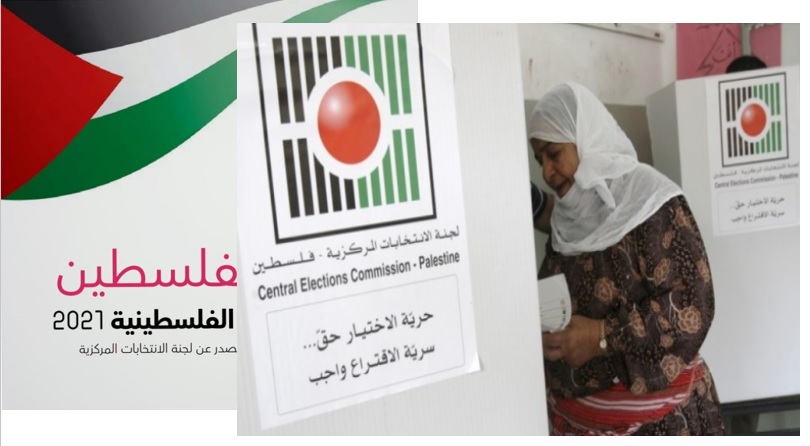
These are the results of the latest poll conducted by the Palestinian Center for Policy and Survey Research (PSR) in the West Bank and the Gaza Strip between 14-19 March 2021. The period before the conduct of the poll witnessed several developments including the announcement of a presidential decree to hold parliamentary elections on 22 May and presidential elections on 31 July 2021. It also witnessed a significant rise in number of coronavirus deaths and infections. The coronavirus vaccine was not made available in large numbers by the PA government during the period before the conduct of the poll. A limited vaccination process did however start using a small quantity that was made available to the PA. The process however was marred by accusations of favoritism and lack of transparency. The ICC issued a statement affirming jurisdiction over the occupied Palestinian territories. Joe Biden assumed his position as the new US president during this period. Israel announced the holding of new parliamentary elections to take place on 23 March. This press release addresses these issues and covers other matters such as the general conditions in the Palestinian territories, the peace process and the future possible directions for Palestinians in the absence of a viable peace process. Total size of the sample is 1200 adults interviewed face to face in 120 randomly selected locations. Margin of error is +/-3%.
For further details, contact PSR director, Dr. Khalil Shikaki, or Walid Ladadweh at tel. 02-296 4933 or email pcpsr@pcpsr.org.
Main Findings:
The focus of our poll for the first quarter of 2021 has been placed on the expected election process. Findings show that the overwhelming majority is still in favor of holding these elections and that the public is much more optimistic that these elections will indeed take place soon. This realization seems to have impacted attitudes and voting intentions, which are now probably more serious and calculated. The poll sought to explore public priorities and expectations in these elections. In particular, we sought to examine the likely consequences of the election results, particularly if Hamas wins and forms a government. The poll sought also to understand the implications of the emergence of rivals to Fatah, from within its own ranks, to the movement’s performance in the elections.
Findings show that the top priorities in these elections for the voters are four: the unification of the West Bank and the Gaza Strip, improving economic conditions, combating corruption, and the removal of the siege and blockade over the Gaza Strip. The largest percentage believes that a Hamas electoral victory would most likely have a negative impact on all these priorities except combating corruption where no negative impact is expected. These expectations might have affected voting intentions as the findings indicate a rise in the vote for Fatah and a decline in the willingness to vote for Hamas compared to our findings three months ago.
Fatah does have its own problems, particularly in the Gaza Strip, because of the probable competition over the likely Fatah’s votes from two independent electoral lists of Mohammad Dahlan and Naser al Qidwah. More seriously, if Marwan Barghouti decides to have his own electoral list, Fatah’s vote would split into two equivalent shares. As for other third parties outside Fatah and Hamas, such as those of the left, Salam Fayyad’s, Hasan Khraishah’s, and others, it is probably too early to reach definitive conclusions at this stage regarding the likelihood that most of these lists would pass the 1.5% electoral threshold. The findings do show that al Mubadarah, led by Mustafa Barghouti, and the Popular Front for the Liberation of Palestine would probably succeed in passing that threshold. For the presidency, the findings indicate a limited increase in public demand for Abbas’ resignation despite the fact that he is doing better than he did three months ago in a competition with Hamas’ leader Ismael Haniyyeh. The findings make it clear however that the public prefers to see Marwan Barghouti as the next president of the PA as he is preferred over all other potential candidates including Fatah’s Abbas and Hamas’ Haniyyeh.
In other domestic issues, public attitudes seem stable compared to three months ago. This applies to the perceptions of safety and security as well as corruption within the PA. There is however a limited rise in optimism regarding reconciliation and in the perception that people can criticize the PA without fear. Slightly less than what we found three months ago, a large segment of the public, almost half, is still reluctant or unwilling to be vaccinated.
On the peace process, findings show that support for the two-state solution remains unchanged. Similarly, public preference for armed struggle vs. negotiations remains almost unchanged. But findings do show that a majority is opposed to a return to an unconditional bi-lateral Palestinian-Israeli negotiation despite the optimism generated by the election of the new Biden Administration. On the other hand, despite its recent decision to assert jurisdiction over the occupied Palestinian territories, the public is not optimistic about the ability of the International Criminal Court, to restrict Israeli behavior in the occupied territories. In fact, a large majority thinks that no Israeli official will ever be prosecuted by the court.
(1) Legislative and presidential elections:
- 76% demand the holding of general legislative and presidential elections and 61% expect parliamentary elections to take place soon. Three months ago, only 32% expected the holding of Palestinian elections soon. If Israel refuses to allow elections to take place in the occupied City of East Jerusalem, 65% believe elections should nonetheless take place and that East Jerusalemites should be allowed to vote in places in the Jerusalem district just outside the city limits; 27% oppose that and demand the cancelation of elections if Israel does not allow East Jerusalemites to vote in their city. Three months ago, only 56% supported, and 39% opposed, the holding general elections if Israel does not allow them in East Jerusalem.
- But only 42% believe the elections will be free and fair and 48% think they will not be free and fair. Moreover, 69% believe that if Hamas wins the elections, Fatah will not accept the results and 60% say that if Fatah wins the elections, Hamas will not accept that outcome.
Legisl Legislative Elections:
- In an open-ended question, we asked the public to name the party or faction it nominates to lead the next PA government: 38% (40% in the West Bank and 34% in the Gaza Strip) nominated Fatah; 22% (15% in the West Bank and 33% in the Gaza Strip) nominated Hamas, 5% nominated an independent list, 2% nominated the Popular Front for the Liberation of Palestine (PFLP), 4% nominated other groups, and 29% did not nominate any party of faction. When asked about its expectations for the winner, 45% expected Fatah to win, 23% Hamas, 18% third or newly created parties.
- The poll sought to assess the role played by three prominent individuals associated with Fatah on the likely consequences for the movement if the three decide to run with their own independent lists:
| If Marwan Barghouti forms his own independent list, 28% of the public say they will vote for his list while 22% say they will vote for the official Fatah list formed by president Abbas. |
 | If Mohammad Dahlan forms his own independent list, 10% of the public say they will vote for his list while 29% say they will vote for the official Fatah list. |
| If Naser al Qidwah forms his own independent list, 7% of the public say they will vote for his list while 30% say they will vote for the official Fatah list. If Marwan Barghouti gives his support to al Qidwah’s list, support for it would rise to 11% and support for Fatah’s would drop to 28%. |
- A majority of 57% say they support and 38% say they oppose the formation of a joint Fatah-Hamas list to compete in the upcoming parliamentary elections.
- We asked the public which electoral list it will vote for in the upcoming elections. We sought to ascertain how respondents will vote in four different scenarios: (1) when the electoral lists are identical to those of 2006 elections, (2) when a joint Fatah-Hamas list is formed and Marwan Barghouti forms his own list, (3) when no joint list is created but Marwan Barghouti forms his own independent list, and (4) when no joint list is created and a Naser al Qidwah’s list replaces that of Marwan Barghouti’s. Here are the findings among those who say they intend to vote:
| 2006 lists: if new legislative elections were held today with the participation of all factions, 75% say they would participate in such elections. Of those who would participate, 30% say they will vote for Hamas and 43% say they will vote for Fatah, 8% will vote for all other third parties combined, and 18% are undecided. Three months ago, vote for Hamas stood at 34% and Fatah at 38%. Vote for Hamas in the Gaza Strip stands today at 36% (compared to 43% three months ago) and for Fatah at 32% (compared to 29% three months ago). In the West Bank, vote for Hamas stands at 25% (compared to 26% three months ago) and Fatah at 53% (compared to 45% three months ago). |
| Joint Fatah-Hamas list and a list for Marwan Barghouti: in this scenario, 78% indicate they will participate in the elections. Of those participating, 44% (41% in the West Bank and 48% in the Gaza Strip) say they will vote for the joint list, 28% (38% in the West Bank and 15% in the Gaza Strip) will vote for Marwan Barghouti’s list, 8% (2% in the West Bank and 15% in the Gaza Strip) will vote for Mohammad Dahlan’s list, 6% will vote for leftist and other lists, and 14% are undecided. |
| Independent Marwan Barghouti’s list and no joint list: in this scenario, 79% say they will participate in the elections. Of those who plan to participate, 27% (20% in the West Bank and 36% in the Gaza Strip) say they will vote for Hamas, 24% (27% in the West Bank and 19% in the Gaza Strip) intend to vote for Fatah, and 20% (29% in the West Bank and 9% in the Gaza Strip) intend to vote for the Marwan Barghouti’s list, 7% intend to vote for Dahlan’s, 5% for the National Initiative list (al Mobadarah) led by Mustafa Barghouti, 2% for the PFLP, 1% for Watan led by Hasan Khraisheh, and 1% for a list formed by Salam Fayyad, and 15% say they have not decided yet. |
| Independent list for Qidwah, no joint list, and no Marwan Barghouti’s list: In this scenario, 78% say they will participate and of those 32% (39% in the West Bank and 23% in the Gaza Strip) say they will vote for Fatah, 28% (21% in the West Bank and 36% in the Gaza Strip) say they will vote for Hamas, 6% for Dahlan’s, 5% for the National Initiative’s, 4% for Qidwah’s, 2% for the PFLP, 2% for Salam Fayyad, 1% for Watan led by Hasan Khraisheh, and 21% are undecided. |
- The largest percentage (28%) says that the top priority for Palestinian elections should be to restore unity between the West Bank and the Gaza Strip; 23% say it is improving economic conditions; 17% say it is to combat corruption; 12% say it is the removal of the siege and blockade over the Gaza Strip; 11% say it is the strengthening of resistance to occupation, 4% say it is to increase the prospects for peace, and 2% say it is to create a democratic political system. When asked who is the most able to deliver the top priority selected by the respondents, 31% selected Fatah, 22% Hamas, and 9% third parties. 15% say all the competing parties and factions can equally deliver on their priorities while 19% say none can deliver.
- We asked the public to speculate about the likely consequences of a Hamas victory on six issues: (1) the siege over the Gaza Strip, (2) Gaza-West Bank unity, (3) economic conditions, (4) corruption in the PA, (5) Hamas’s response to the Quartet conditions, and (6) Israel’s response to Hamas’ victory. These are the findings:
| Siege over Gaza: 49% say the siege will be tightened and 14% say it will be relaxed or removed and the rest said current conditions will remain unchanged. |
| West Bank-Gaza Strip unity: 36% say the split will be consolidated and 19% say the prospects for unity will increase. |
| Economic conditions: 45% say economic conditions will worsen and 17% say they will improve. |
| Corruption: 26% say corruption will decrease and 28% say it will increase |
| Quartet conditions: 62% say Hamas will not accept the conditions of the Quartet and 26% say it will accept them. |
| Israel’s reaction: a majority of 51% thinks that Israel will not allow Hamas to form a government in the West Bank, 28% think Israel will arrest Hamas’ members of the parliament, and only 11% think Israel will allow Hamas to form a government in the West Bank. |
- Similarly, we asked the public about the consequences of a Fatah victory for two issues: (1) corruption, and (2) West Bank-Gaza Strip unity. These are the findings:
| Corruption: 16% say corruption in the PA will decrease and 36% think it will increase. |
| Unity: 33% think separation will be consolidated while 22% think unity will be consolidated. |
Presl Presidential elections:
- In an open-ended question, we asked the public to state the name of the person it wants to be the next president of the PA. The largest percentage (22%) says Marwan Barghouti, 14% Ismail Haniyyeh, 9% Mahmoud Abbas, 7% Dahlan, 3% Khalid Mishal, 2% Mohammad Shtayyeh, 2% Mustafa Barghouti, and 1% Yahya Sinwar. About half of the public did not know or declined to mention a name.
- If Fatah nominates Abbas as its candidate for the presidential elections, a majority of 57% of the public would view him as the wrong choice believing Fatah has better candidates; only 23% of the public think Abbas is the best Fatah candidate. When asked to name a better candidate, 49% named Marwan Barghouti, 12% Mohammad Dahlan, 5% Mohammad Shtayyeh, and 4% Nasir al Qidwah.
- We asked, in a closed-ended question, about potential Abbas’ successors: If president Abbas does not nominate himself in a new presidential election, 40% prefer to see Marwan Barghouti replacing him, while 20% prefer Ismail Haniyeh. Mohammad Dahlan is preferred by 7% (1% in the West Bank and 16% in the Gaza Strip), Khalid Mishal and Mustafa Barghouti by 5% each, and Salam Fayyad by 2%.
- If new presidential elections were held today and only two were nominated, Mahmoud Abbas and Ismail Haniyeh, the former would receive 47% and the latter 46% of the votes (compared to 50% for Haniyeh and 43% for Abbas three months ago). In the Gaza Strip, Abbas receives 41% of the votes (compared to 32% three months ago) and Haniyeh receives 56% (compared to 64% three months ago). In the West Bank, Abbas receives 52% (compared to 52% three months ago) and Haniyeh 38% (compared to 38% three months ago). If the competition was between Marwan Barghouti and Ismail Haniyeh, Barghouti receives 63% and Haniyeh 33%. If the competition is between prime minister Mohammad Shtayyeh and Haniyyeh, the former receives 48% and the latter 44%. Three months ago, Shtayyeh received the support of 47% and Haniyyeh 47%.
- Level of satisfaction with the performance of president Abbas stands at 32% and dissatisfaction at 65%. Level of satisfaction with Abbas stands at 35% in the West Bank and 26% in the Gaza Strip. These figures are similar to those obtained three months ago. 68% of the public want president Abbas to resign while 26% want him to remain in office. Three months ago, 66% said they want Abbas to resign. Demand for Abbas’ resignation stands at 64% in the West Bank and 74% in the Gaza Strip.
(2) The Coronavirus vaccine and PA performance during the COVID-19 pandemic:
- A majority of 55% (65% in the Gaza Strip and 49% in the West Bank) says that it is willing to take the vaccine when available or has already received it; 43% (35% in the Gaza Strip and 49% in the West Bank) say they and their families are not willing to take the vaccine when it becomes available.
- 62% believe that the vaccination process in the West Bank has so far been lacking in transparency and justice while 33% believe the process has been transparent and just.
- 55% (36% in the Gaza Strip and 67% in the West Bank) are dissatisfied with the efforts made by the PA to obtain the vaccine and 43% (63% in the Gaza Strip and 30% in the West Bank) are satisfied.
- Half of the public (50%) are dissatisfied with the measures taken by the PA to contain the spread of the coronavirus while 47% are satisfied. Dissatisfaction in the West Bank stands at 61% and in the Gaza Strip at 34%.
- The majority is satisfied with the performance of the various actors involved in the management of the Coronavirus crisis: 60% express satisfaction with the performance of the security services deployed in their areas and 56% are satisfied with the performance of the ministry of health. Satisfaction with the performance of the prime minister stands at 45%.
(3) Domestic conditions and satisfaction with the Shtayyeh government:
- Positive evaluation of conditions in the Gaza Strip stands at 6% and positive evaluation of conditions in the West Bank stands at 19%.
- Nonetheless, perception of safety and security in the Gaza Strip stands at 68% and in the West Bank at 64%.
- 30% of the public say they want to emigrate due to political, security, and economic conditions. The percentage in the Gaza Strip stands at 40% and in the West Bank at 23%. Three months ago, 24% of West Bankers expressed a desire to emigrate and only 25% of Gazans expressed the same desire.
- Perception of corruption in PA institutions stands at 84%. When asked about institutions controlled by Hamas in the Gaza Strip, 70% indicated that there is corruption in these institutions.
- 43% of West Bankers think people in the West Bank can criticize the PA without fear while 53% think they cannot. In the Gaza Strip, 40% think people in the Strip can criticize Hamas’ authorities without fear and 58% think they cannot.
- The public is divided over its assessment of the PA: a slight majority of 51% views it as a burden on the Palestinian people while 44% view it as an asset for the Palestinian people. Three months ago, 41% viewed the PA as a burden.
- 58% oppose and 37% support making payments to the families of martyrs and prisoners based on need assessment and number of family members rather than on the act committed by the martyr or the number of years in jail.
- 34% are optimistic and 61% are pessimistic about the success of reconciliation. Three months ago, optimism stood at 29%.
- About two years since the formation of the Shtayyeh government, findings indicate persistent pessimism. Responding to a question about expectations regarding the ability of the Shtayyeh government to make progress in reconciliation and reunification, 61% expect failure; only 32% expect success. These results reflect a little increase in public expectations compared to three months ago when only 28% expected success. But when asked about the ability of the government to organize legislative or legislative and presidential elections in the West Bank and the Gaza Strip, half of the public expects success and 44% expects failure. Three months ago, 61% expected failure in holding elections. In another question about the ability of the new government to improve economic conditions, a majority of 60% expects failure and 32% expects success.
- We asked the public about its viewership habits in the last three months. Findings indicate that Palestine TV viewership has become the highest standing at 19%, followed by Al Jazeera TV, at 16%, followed by Maan, Al Aqsa TV, and Palestine Today TV at 11% each, Al Arabiya at 5%, al Manar at 3% and finally al Mayadeen at 1%.
(4) The Palestinian-Israeli Peace process, Israeli elections, and the implications of the recent ICC decision:
- Support for the concept of the two-state solution stands at 40% and opposition stands at 57%. No description or details were provided for the concept. Three months ago, support for the concept stood at 40%.
- A majority of 55% believes that the two-state solution is no longer practical or feasible due to the expansion of Israeli settlements while 38% believe that the solution remains practical. Moreover, 77% believe that the chances for the creation of a Palestinian state alongside the state of Israel in the next five years are slim or nonexistence while 20% believe the chances to be medium or high.
- The most preferred way out of the current status quo is “reaching a peace agreement with Israel” according to 36% of the public while 26% prefer waging “an armed struggle against the Israeli occupation.” 10% prefer “waging a non-violent resistance” and 21% prefer to keep the status quo. Three months ago, 38% said that they prefer reaching a peace agreement with Israel and 29% said they prefer waging an armed struggle.
- When asked about the most effective means of ending the Israeli occupation, the public split into three groups: 37% chose armed struggle, 36% negotiations, and 20% popular resistance. Three months ago, 39% chose armed struggle and 35% chose negotiations.
- Under current conditions, a majority of 58% opposes and 28% support an unconditional resumption of Palestinian-Israeli negotiations. But only 51% think the PA should not return to peace negotiations with Israel under the sponsorship of the Quartet, made up of the US, Russia, the EU, and the UN; 43% support such return to negotiations.
- When asked about support for specific policy choices, 66% supported joining more international organizations; 59% supported resort to non-violent resistance; 43% supported return to armed confrontations and intifada; 42% supported dissolving the PA; and 33% supported abandoning the two-state solution and embracing a one state solution for Palestinians and Israelis.
- In the upcoming Israeli elections, scheduled to take place today, 49% expect the Likud (under the leadership of Netanyahu) and its allies among the extreme right and the religious parties to win the elections while 23% expected victory to go to a coalition of right wing, center and leftist parties under the leadership of Saar, Gantz, Lapid, and others; 28% do not know.
- Two thirds (66%) of the public do not expect the decision of the International Criminal Court (ICC) confirming its jurisdiction over the occupied Palestinian territories to lead to restrictions on Israeli behavior in these territories while a quarter (25%) expects it to impose at least some restrictions.
- Similarly, a large majority of 73% believes that there will be no trials at the ICC for any Israeli officials; 21% think one or more Israeli officials might be prosecuted by that court.
(5) Expectations from the Biden Administration and attitudes regarding resumption of Palestinian-Israeli negotiations under its leadership:
- Now that Biden has won the US presidential elections, 50% expect, and 41% do not expect, the US to resume financial support to the PA.
- But a slight majority of 51% does not expect Biden’s policy toward the Palestinian-Israeli conflict to be more balanced and less biased in favor of Israel; 41% expect it to be more balanced and less biased compared to the previous US administration.
- 48% are opposed, and 44% are supportive, of a return to Palestinian-Israeli negotiations under the US leadership.
(6) Ten years after the Arab Spring:
- Ten years after the Arab Spring, 73% say they felt sympathy at the time with the Arab demonstrators while 18% say they did not feel sympathy.
- The public is divided into three groups in its evaluation of what the Arab demonstrators wanted: 33% say they wanted freedom from regime oppression, 28% say they wanted a way out of poverty and unemployment, and 20% say they wanted to combat corruption. Only 5% say they wanted to replace the existing regimes with Islamists and another 5% say they wanted to express opposition to pro-Western policies of their regimes.
- 37% believe the Arab Spring has left a negative impact on Palestinian conditions while 18% think it left a positive impact and 37% say it had neither negative nor positive impact.
- A majority of 56% indicates that it did not feel at the time that there was a need for similar demonstrations in Palestine while 36% say they felt such need at that time.
(7) Most vital Palestinian goals and the main problems confronting Palestinians today:
- 43% believe that the first most vital Palestinian goal should be to end Israeli occupation in the areas occupied in 1967 and build a Palestinian state in the West Bank and the Gaza Strip with East Jerusalem as its capital. By contrast, 31% believe the first most vital goal should be to obtain the right of return of refugees to their 1948 towns and villages, 14% believes it should be to establish a democratic political system that respects freedoms and rights of Palestinians, and 11% believe that the first and most vital goal should be to build a pious or moral individual and a religious society, one that applies all Islamic teachings.
- The most serious problem confronting Palestinian society today is poverty and unemployment in the eyes of 30%, the spread of corruption in public institutions in the eyes of 25%, the continuation of occupation and settlement activities in the eyes of 24%, the continued siege of the Gaza Strip and the closure of its crossings in the eyes of 13%, and the lack of national unity in the eyes of 6%.
15 June 2021
A semi-consensus that Hamas has won the May 2021 confrontation with Israel triggers a paradigm shift in public attitudes against the PA and its leadership and in favor of Hamas and armed struggle; moreover, a two-third majority rejects the PA decision to postpone the elections, 70% demand forcing legislative and presidential elections on Israel, and the majority says Hamas, not Fatah under Abbas, deserve to represent and lead the Palestinian people
9-12 June 2021
This poll has been conducted in cooperation with the Konrad-Adenauer-Stiftung in Ramallah

These are the results of the latest poll conducted by the Palestinian Center for Policy and Survey Research (PSR) in the West Bank and the Gaza Strip between 9-12 June 2021. The period before the conduct of the poll witnessed several developments including the decision by the PA president to postpone the holding of Palestinian elections that were scheduled to take place on 22 May 2021. It also witnessed the release of various Israeli decisions on an imminent expulsion of several Palestinian families from their homes in al Shaikh Jarrah and the impositions of various restrictions regarding Muslim’s access to al Aqsa Mosque during the month of Ramadan. These developments led to popular non-violent confrontations with the Israeli police and settlers in East Jerusalem that escalated to rocket attacks carried out be Hamas against Israeli cities. Hamas claimed that the attacks came in defense of East Jerusalem. The ensuing war between Hamas and Israel lasted for 11 days and led to the death of more than 250 Palestinians, including 66 children, and more than 10 Israelis, including two children. The period also witnessed a PA campaign to vaccinate Palestinian adults in the West Bank and the Gaza Strip against the coronavirus. The campaign led to a significant reduction in the daily rates of deaths and infections, particularly in the West Bank. This press release addresses these issues and covers other matters such as the general conditions in the Palestinian territories, the peace process and future possible directions for Palestinians in the absence of a viable peace process. Total size of the sample is 1200 adults interviewed face to face in 120 randomly selected locations. Margin of error is +/-3%.
For further details, contact PSR director, Dr. Khalil Shikaki, or Walid Ladadweh at tel. 02-296 4933 or email pcpsr@pcpsr.org.
Main Findings:
Findings of the second quarter of 2021 show significant changes in public attitudes toward the Palestinian Authority (PA) and its leadership, Hamas, and relations with Israel. Two drivers seem to have triggered the change: the popular confrontations in East Jerusalem, the Israel-Hamas war, and their public perception of their outcomes on the one hand and the postponement of elections by the PA leadership on the other.
The findings show a semi-public consensus that Hamas had won the confrontation with Israel and that Hamas’ launching of rockets at Israeli cities has been motivated by its desire to defend al Aqsa Mosque and the Palestinian families in al Shaikh Jarrah. Findings also show widespread public discontent with the performance of the PA government and leadership as well as Fatah during the confrontations and the war. They also show a two-third majority rejection of Abbas’ decision to postpone the elections. Two thirds of the public believe that Abbas has postponed the elections because he was afraid of their outcome, not because Israel has prevented the holding of elections in East Jerusalem.
As a result, support for Hamas, and willingness to vote for it, increases dramatically while support for Fatah drops significantly. Moreover, Hamas’ leader, Ismail Haniyyeh, manages to deliver an unprecedented victory over Abbas in a presidential election, if one is held today. Perhaps most importantly, a majority of the Palestinians think that Hamas is more deserving of representing and leading the Palestinian people while a small percentage thinks Fatah under Abbas’ leadership is the one who deserves to do that.
Findings also show that more than 70% want to hold legislative and presidential elections soon and a similar percentage wants the PA to impose elections in East Jerusalem despite Israeli objection, rather than wait for an Israeli approval. The poll results do not have good news for most of the newly created electoral lists that registered for the legislative elections as only nine out of 36 managed to cross the threshold of 1.5% required to win seats in the parliament.
The confrontations and the war between Hamas and Israel did not have an impact on the level of support for the two-state solution, which remained unchanged. But they did greatly impact other matters related to the Palestinian-Israeli conflict. For example, support for a return to armed confrontations and intifada rose sharply to 60%, and support for a resumption of negotiations with Israel and the belief that negotiation is the most effective means of ending occupation dropped. Moreover, the confrontations within Israel between the Palestinian citizens of Israel and the Israeli police seem to have contributed to a significant reduction in support for the one-state solution, which declined from a third to a fifth in three months.
It is worth noticing however that the current findings are not fundamentally different from similar findings we obtained in the past immediately after similar Hamas-Israel confrontations. Therefore, they might be reflecting a temporary emotional reaction that might revert back to where things stood before the confrontations. The change from emotional to normal attitudes usually takes three to six months, as can be seen in our previous polls. But it should be pointed out that a return to “normal” attitudes has in the past been associated with a Hamas failure to maintain its gains and a success on the part of the PA to take measures that helped to pacify the public and win back its trust.
For the new Israeli government led by prime minister Naftali Bennett, about a fifth seems to think that it is better for Israeli-Palestinian relations than a government led by Netanyahu. Findings also show that while the largest percentage, but not the majority, is opposed to the participation of the Unified Arab List led by Mansour Abbas in the current coalition government, a similar percentage does support (or does not oppose or support) such participation.
(1) Jerusalem confrontations and the war between Hamas and Israel:
- An overwhelming majority of Palestinians (77%) believes that Hamas has come out a winner in its last war with Israel while only 1% think Israel came out a winner; 18% say no one came out a winner and 2% think both sides came out winners. Moreover, 65% think that Hamas has achieved its declared goal behind firing rockets at Israel: to force Israel to stop the expulsion of the families in al Shaikh Jarrah and to bring to an end Israeli restriction on Muslim access to al Aqsa; 26% think it did not.
- 72% think that Hamas’ decision to launch rockets at Israeli cities came in defense of Jerusalem and al Aqsa Mosque while 9% think it came as a protest against the PA cancelation of elections with the aim of weakening the PA leadership; 17% think Hamas’ decision was motivated by these two drivers.
- In an evaluation of the performance of 10 local and regional actors during the Jerusalem confrontations and the ensuing war between Israel and Hamas, the overwhelming majority describes as excellent that of the residents of Jerusalem and its youth (89%) followed by that of Arab Palestinian citizens of Israel (86%), followed by that of Hamas (75%). About one fifth describes as excellent the performance of each of the following governments: Egypt’s (22%), Turkey’s (21%), Jordan’s (21%), and Iran’s (18%). Finally, only 13% describe as excellent the performance of Fatah, 11% the PA government, and 8% Abbas’.
- A majority of 64% views the residents of East Jerusalem as the group most willing to defend Jerusalem and its holy places, followed by Hamas at 29%, and the PA at 3%. In light of the recent confrontations with Israel, a majority of 53% think Hamas is most deserving of representing and leading the Palestinian people while 14% think Fatah under president Abbas is the most deserving of representing and leading the Palestinians.
- A majority of 60% thinks the participation of the Palestinian citizens of Israel in the recent confrontation was driven, first and foremost, by their desire to defend the holy sites, while 28% think it was driven by their desire to express rejection of integration in the Israeli society and their attachment to their national identity, and only 10% think it came as part of their struggle for equality and rejection of discrimination.
- If Israel expels the families of al Shaikh Jarrah or reimposes restrictions on access to al Aqsa Mosque, 68% believe the response in this case should be the launching of rockets at Israeli cities, while 18% think it should be the waging of non-violent resistance, and 9% believe Palestinians should respond by submitting a complaint to the UN and the International Criminal Court (ICC).
- When asked about their expectations from the PA under Abbas leadership in case Israel expelled the Shaikh Jarrah families, the largest percentage (38%) said the PA will do nothing; 24% said it will write a complaint to the UN and the ICC; 20% think it will end security coordination with Israel, and 14% think it will launch popular non-violent resistance.
- Public expectations from Hamas are very different: If Israel expels the Shaikh Jarrah families, 77% think Hamas will respond by launching rockets at Israeli cities; 10% think it will wage a non-violent campaign, 6% think it will issue protest statements, and only 5% think it will do nothing.
- A majority of 55% think Israel will not expel the Shaikh Jarrah families and 40% think it will.
- Two thirds of the public think there is a high or a medium chance that Hamas and Israel will reach a long-term truce that will ease the siege and blockade of the Gaza Strip; 31% think the chances are slim.
- A majority of 52% think that the incident in al Aqsa Mosque in which chants were made against the Jerusalem PA-appointed Mufti during his Friday sermon in the aftermath of the ceasefire between Israel and the “resistance” forces does not reflect its views while 44% think it does reflect them.
- 94% say they are proud of the performance of the Gaza Strip during the May confrontation with Israel while 6% say they are not. When asked about the main reason for being proud, 39% said they are proud because Gaza has delivered a military and rocket strike in defense of Jerusalem that demonstrated the weakness of the Israeli army; another 39% said they were proud because Gaza has brought the Palestinian cause back to forefront of Arab and international politics; and 13% said the reason they are proud is because Gaza has sacrificed and endured all the death and destruction while expressing patience and dignity in defense of Jerusalem.
(2) The postponement of the legislative and presidential elections:
- 65% oppose and 25% support the decision of president Abbas to postpone legislative and presidential elections because Israel refuses to allow the holding of elections in East Jerusalem. Two thirds of the public believe that Abbas postponed the elections because he was worried about the results while 25% think he postponed the elections because Israel refused to allow them in East Jerusalem.
- The largest percentage (43%) believes that there is no point in protesting Abbas’ decision to postpone the elections and that we should therefore accept it. On the other hand, 31% think that there should be protests but they should be conducted through non-violent demonstrations; 17% think the protests should be expressed through the courts and the judicial system routes.
- 72% say they support the holding of presidential and legislative elections in the Palestinian territories in the near future while 25% say they do not support that. Demand for elections stands at 80% in the Gaza Strip and 66% in the West Bank.
- 69% say we should not wait for an Israeli approval of elections in East Jerusalem and that we should impose these elections on Israel while 15% say it is better to wait for an Israeli approval. The majority (56%) of those who want the PA to hold elections without an Israeli approval demands holding elections immediately, 24% are in favor of holding the elections within three months, and 13% within a year or more. But about half of the Palestinians (49%) believes there will be no elections in the near future while 44% think elections will take place in the near future.
- If new presidential elections were held today and only two were nominated, Mahmoud Abbas and Ismail Haniyeh, the former would receive 27% and the latter 59% of the votes (compared to 46% for Haniyeh and 47% for Abbas three months ago). In the Gaza Strip, Abbas receives 30% of the votes (compared to 44% three months ago) and Haniyeh receives 60% (compared to 56% three months ago). In the West Bank, Abbas receives 25% (compared to 52% three months ago) and Haniyeh 59% (compared to 38% three months ago). If the competition was between Marwan Barghouti and Ismail Haniyeh, Barghouti receives 51% and Haniyeh 42%. If the competition is between prime minister Mohammad Shtayyeh and Haniyyeh, the former receives 26% and the latter 63%. Three months ago, Shtayyeh received the support of 48% and Haniyyeh 44%.
- In an open-ended question on the preferred president, in case Abbas is not nominated, 29% say they want Marwan Barghouti, 28% say Ismail Haniyyeh, 6% Dahlan, 3% Yahia Sinwar, and 2% for each of the following: Khalid Mishaal, Mohammad Shtayyeh, Mustafa Barghouti, and Salam Fayyad. In a closed-ended question, about potential Abbas successors, 29% say they prefer to see Marwan Barghouti replacing him, while 28% prefer Ismail Haniyeh. Mohammad Dahlan is preferred by 7% (1% in the West Bank and 16% in the Gaza Strip), Mustafa Barghouti and Salam Fayyad (3% each), and Khalid Mishal (2%).
- If new legislative elections were held today with the participation of all factions, that participated in the 2006 elections, 73% say they would participate in such elections. Of those who would participate, 41% say they will vote for Hamas and 30% say they will vote for Fatah, 12% will vote for all other third parties combined, and 17% are undecided. Three months ago, vote for Hamas stood at 30% and Fatah at 43%. Vote for Hamas in the Gaza Strip stands today at 45% (compared to 36% three months ago) and for Fatah at 28% (compared to 32% three months ago). In the West Bank, vote for Hamas stands at 38% (compared to 25% three months ago) and Fatah at 32% (compared to 53% three months ago).
- We also asked about the vote for the 36 electoral lists that registered to compete in the parliamentary elections that was scheduled for May 2021. Only nine lists managed to pass the threshold of 1.5%: the largest percentage went to Hamas’ list, “Jerusalem is Our Call” (36%) followed by Fatah’s list with 19%, “the freedom list” led by Nasser al Qidwah (9%), “the Future List” of Dahlan (3%), the “National Initiative” 2%, and the following lists managed to pass the threshold: the PFLP, “Together” led by Salam Fayyad, the “Democratic Change” led by Ibrahim Abu Hijlah, and “Palestine for All” led by Mufeed al Hasayneh.
(3) Domestic conditions and satisfaction with the Shtayyeh government:
- Positive evaluation of conditions in the Gaza Strip stands at 8% and positive evaluation of conditions in the West Bank stands at 24%.
- Nonetheless, perception of safety and security in the Gaza Strip stands at 65% and in the West Bank at 60%.
- 26% of the public say they want to emigrate due to political, security, and economic conditions. The percentage in the Gaza Strip stands at 42% and in the West Bank at 15%. Three months ago, 23% of West Bankers expressed a desire to emigrate and 40% of Gazans expressed the same desire.
- Perception of corruption in PA institutions stands at 84%. When asked about institutions controlled by Hamas in the Gaza Strip, 57% indicated that there is corruption in these institutions. Three months ago, 84% said there is corruption in PA institutions and 70% said there is corruption in public institutions controlled by Hamas.
- 46% of West Bankers think people in the West Bank can criticize the PA without fear while 52% think they cannot. When asked to evaluate the status of democracy and human rights in the West Bank, 19% of West Bankers said it was good or very good. In the Gaza Strip, 50% think people in the Strip can criticize Hamas’ authorities without fear and 47% think they cannot. When asked to evaluate the status of democracy and human rights in the Gaza Strip, 46% of Gazans said it was good or very good.
- The public is divided over its assessment of the PA: a slight majority of 56% views it as a burden on the Palestinian people while 35% view it as an asset for the Palestinian people. Three months ago, 51% viewed the PA as a burden and 44% viewed it as an asset.
- 70% oppose and 26% support making payments to the families of martyrs and prisoners based on need assessment and number of family members rather than on the act committed by the martyr or the number of years in jail.
- 41% are optimistic and 56% are pessimistic about the success of reconciliation. Three months ago, optimism stood at 34%.
- Two years since the formation of the Shtayyeh government, findings indicate persistent pessimism. Responding to a question about expectations regarding the ability of the Shtayyeh government to make progress in reconciliation and reunification, 65% expect failure; only 29% expect success. When asked about the ability of the government to organize legislative or legislative and presidential elections in the West Bank and the Gaza Strip, one third of the public expects success and 60% expects failure. In another question about the ability of the new government to improve economic conditions, a majority of 62% expects failure and 32% expects success.
- We asked the public about its viewership habits in the last three months. Findings indicate that al Jazeera TV has the highest viewership, standing at 36%, followed by al Aqsa TV (13%), Palestine TV (12%), Palestine Today (10%), Maan (7%), al Mayadeen (4%), al Arabiya (3%), and al Manar (1%).
(4) The Coronavirus vaccine and PA performance during the COVID-19 pandemic:
- 23% (28% in the West Bank and 16% in the Gaza Strip) report that they have already received the coronavirus vaccination; 40% (33% in the Gaza Strip and 51% in the West Bank) says that they are willing to take the vaccine when available; and 35% (37% in the West Bank and 32% in the Gaza Strip) say they and their families are not willing to take the vaccine when it becomes available to them.
- 66% (81% in the Gaza Strip and 57% in the West Bank) are satisfied with the efforts made by the government to obtain the vaccine and 31% (18% in the Gaza Strip and 40% in the West Bank) are dissatisfied.
- A majority of 57% are satisfied with the measures taken by the PA to contain the spread of the coronavirus while 41% are dissatisfied. Dissatisfaction in the West Bank stands at 48% and in the Gaza Strip at 30%.
- The majority is satisfied with the performance of the various actors involved in the management of the Coronavirus crisis: 63% express satisfaction with the performance of the security services deployed in their areas and 68% are satisfied with the performance of the ministry of health. Satisfaction with the performance of the prime minister in the management of the Coronavirus crisis stands at 49%.
(5) The Palestinian-Israeli Peace process and the new Israeli government:
- Support for the concept of the two-state solution stands at 39% and opposition stands at 58%. No description or details were provided for the concept. Three months ago, support for the concept stood at 40%.
- Support for the two-state solution increases to 41% and opposition drops to 56% when the borders of the Palestinian state are described as being based on the 1967 lines and its capital as East Jerusalem. When the public is asked to pick a choice from among three, 46% pick the two-state solution based on the 1967 lines, 10% pick a Palestinian-Israeli confederation, and only 6% pick a one-state for Jews and Arabs.
- We asked the public about its support for the idea of making Jerusalem, both East and West, an open city, whereby the Eastern part would be the capital of the Palestinian state and Western part would be the capital of the state of Israel. Less than a quarter (23%) supported and 73% opposed the idea.
- A majority of 61% believes that the two-state solution is no longer practical or feasible due to the expansion of Israeli settlements while 33% believe that the solution remains practical. Moreover, 67% believe that the chances for the creation of a Palestinian state alongside the state of Israel in the next five years are slim or nonexistence while 29% believe the chances to be medium or high.
- The most preferred way out of the current status quo is “reaching a peace agreement with Israel” according to 27% of the public while 39% prefer waging “an armed struggle against the Israeli occupation.” 11% prefer “waging a non-violent resistance” and 18% prefer to keep the status quo. Three months ago, 36% said that they prefer reaching a peace agreement with Israel and 26% said they prefer waging an armed struggle.
- When asked about the most effective means of ending the Israeli occupation, the public split into three groups: 49% chose armed struggle, 27% negotiations, and 18% popular resistance. Three months ago, 37% chose armed struggle and 36% chose negotiations.
- Under current conditions, a majority of 70% opposes and 19% support an unconditional resumption of Palestinian-Israeli negotiations.
- When asked about support for specific policy choices, 66% supported joining more international organizations; 58% supported resort to non-violent resistance; 60% supported return to armed confrontations and intifada; 47% supported dissolving the PA; and 20% supported abandoning the two-state solution and embracing a one state solution for Palestinians and Israelis. Three months ago, 43% supported a return to confrontations and armed intifada, 42% supported dissolving the PA, and 33% supported the abandonment of the two-state solution in favor of a one-state solution.
- 54% are opposed, and 39% are supportive, of a return to dialogue with the new US administration under president Joe Biden. Moreover, 63% are opposed, and 29% are supportive of a return to Palestinian-Israeli negotiations under the US leadership. Support for such negotiations stands at 38% under the leadership of the international Quartet and 55% are opposed. Moreover, 52% do not believe, and 38% believe, that the election of Biden and the resumption of American aid to the PA opens the door for a return to Palestinian-Israeli negotiations within the framework of the two-state solution.
- The largest percentage (45%) are opposed to the participation of Israeli Arab parties in the Israeli governmental coalitions while 26% say they support Mansour Abbas’ decision to join the current coalition in Israel, and 21% say they neither support or oppose such participation.
- About one fifth (19%) thinks that an Israeli government led by Naftali Bennett from the extreme right wing Yamina party will be better for Israeli-Palestinian relations than a government led by Netanyahu; a large majority of 69% disagree with that.
(6) Most vital Palestinian goals and the main problems confronting Palestinians today:
- 47% believe that the first most vital Palestinian goal should be to end Israeli occupation in the areas occupied in 1967 and build a Palestinian state in the West Bank and the Gaza Strip with East Jerusalem as its capital. By contrast, 34% believe the first most vital goal should be to obtain the right of return of refugees to their 1948 towns and villages, 10% believe that the first and most vital goal should be to build a pious or moral individual and a religious society, one that applies all Islamic teachings and 8% believes it should be to establish a democratic political system that respects freedoms and rights of Palestinians.
- In a question about the two main problems confronting the Palestinians today, the largest percentage (24%; 31% in the Gaz Strip and 20% in the West Bank) said it is the continued siege and blockade of the Gaza Strip, 21% (27% in the West Bank and 12% in the Gaza Strip) said it is the spread of corruption, 20% said it is the unemployment and poverty, 17% said it is the continuation of the occupation, 14% (19% in the Gaza Strip and 10% in the West Bank) said it is the split between the West Bank and the Gaza Strip, and 3% said it is the weakness of the judiciary and the absence of liberties, accountability and democracy.
August 2022
Would the Holding of Local Elections in the Gaza Strip Provide a Glimmer of Hope Out of the Impasse?
Omar Shaban
The current difficult economic, social and psychological conditions in the Gaza Strip can only be understood when analyzed in the context of the blockade and repeated wars it has been suffering from since 2007. These conditions must also be placed in the context of internal division and a political failure in which all reconciliation efforts and factional dialogue led nowhere. Even when a consensus emerged over holding general elections for the Legislative Council, the Presidency and the PLO National Council, success remained elusive. Nonetheless, while general elections cannot be held in the foreseeable future, the pressure of the successive crises in the Gaza Strip forces a search for a way out of the impasse. This paper proposes the holding of local elections in the Gaza Strip as a small step that might trigger a gradual wider process. Local elections have been held three times in the northern governorates of the PA without the Gaza Strip’s participation since 2005. The paper argues that these local elections might provide a mechanism to gradually break the impasse and provide an opportunity for change that might enhance the confidence of the local community and its participation in administration and governance, enhance communication and engagement between local municipalities and the world, and might allow attracting projects to address pressing environmental crises and problems in the Gaza Strip. The continuation of the current fait accompli will only have more negative effects on the population, regardless of how much Hamas strives to improve it. The movement has already been hurt in appointing mayors even if it has made an effort to appoint the best in the management of the local bodies.
The Gaza Strip after 15 years of closure, wars, and the absence of elections:
The status quo in the Gaza Strip is characterized by the following:
1) Blocked political horizon and the loss of the hope for change: The political divide has led to the disruption of the democratic process and the fragmentation of the Palestinian political system. Palestinian division is likely to persist given the absence of any serious prospects for Palestinian reconciliation. Local and regional reconciliation efforts have so far been met with failure. This aspect of the status quo has proven to be the most resilient and resistant to change.
Main qualitative indicators continue to deteriorate: The Israeli blockade and repeated wars have caused a sharp deterioration in all indicators of life in the Gaza Strip, including health, education and the economy, with 1.3 million of Gaza's 2.1 million Palestinians in need of food assistance,[1] unemployment levels rising to 46.6% during the first quarter of 2022 compared to the average of 34.8% in 2006, while 81.4% of Palestinian households in the Gaza Strip live below the poverty line[2].
Unending rounds of escalation between the factions in Gaza and the occupation army: Since 2007, the Gaza Strip has been subjected to five major wars, dozens of short violent eruptions, and military and security tensions, causing thousands of victims from all segments of society and destroying tens of thousands of homes and infrastructure.
Psycho-social effects and extremism: The split and infighting have directly contributed to dividing the political system leading to the absence of the democratic process and the denial of the right of the population to choose their representatives, leading further to a state of frustration, despair and lack of horizon among Gazans. This has also led to a rise in the desire to emigrate among young people reaching 37%,[3] to unprecedented levels of attempted suicides, widespread hate speech and incitement, and to the strengthening of the political and legal divide between the Gaza Strip and the West Bank.
Moreover, compelling living conditions, rampant manifestations of corruption in the political and economic classes, and the prevalence of revenge tendencies have led many young people to embrace extremist ideology.[4] Hamas leader Khalil al-Haya said in 2015 at a session at the headquarters of the Legislative Council in Gaza that "our message to the whole world, which fears terrorism and extremism, is that delaying reconstruction and maintaining the siege on the Gaza Strip produce a suitable environment for the spawning of extremism and the increase of terrorism."
Proceeding from the fact that: (1) the continuation of the economic and political situation as it is has become untenable and represents a constant threat to the unity of the people and the opportunities for economic growth and political development, (2) the absence of opportunities to achieve reconciliation adds a further threat to the future of the Gaza Strip , and (3) the rejection by both Egypt and the Palestinian Authority of the option of creating a trade zone between Egypt and the Gaza Strip (because in their view it promotes the separation of the Gaza Strip away from the West Bank and the Palestinian Authority) reduces the prospects of ecnonmic development, (4) continued Israeli imposition of severe restrictions on the quality of goods entering Gaza, under the pretext of preventing the entry of "dual-use" goods, and on trade exchange with the West Bank and Israel adds yet another economic constraint, the holding of municipal elections in Gaza's governorates may present a gateway to a gradual exit from the crisis.
Why elections?
There are four reasons that call for the holding of local elections in the Gaza Strip:
Responding to legal entitlement and a developmental requirement: Holding elections for local bodies is a fulfillment of legal obligation based on the terms of law. It also provides an opportunity for change and sustainable development. For the youth, it represents a sign of hope for a better future of political and social participation.
The renewal of legitimacy strengthens international engagement: The renewal of the legitimacy of local bodies that rely heavily on international support contributes significantly to obtaining grants, projects and assistance, especially since there are a wide range of challenges in the field of service delivery, deterioration of infrastructure, environmental, hygiene and health problems suffered by the governorates of the Gaza Strip.
Local elections could serve as a first step on the road to general elections: The holding of local elections in the Gaza Strip is a real opportunity to persuade the international community to meet the Palestinians' desire for change and push it to work harder with the Israeli government to facilitate the holding of general elections.
It serves Hamas' interest: The holding of elections for local bodies shows Hamas' faith in, and support for, the democratic process. In the past, it favored these elections and it now has an opportunity to demonstrate its real intentions. The movement's approval and the quest to complete local elections in the Gaza Strip will strengthen its position as a political movement seeking to gain leadership through the election process thereby improving its image in front of the Palestinian society and the world. It is worth mentioning that Joseph Borrell, representing the EU foreign policy establishment, indicated on April 30, 2021, that the postponement of the Palestinian general elections, the first in 15 years, was "very disappointing."[5] The EU had consistently supported the holding of credible, inclusive and transparent elections for all Palestinians. Thus, even if the results are not satisfactory to everyone, if Hamas wins, they will be acceptable to many among the international community. It is also worth mentioning that Hamas did participate, directly or indirectly, in the elections of local and various other societal bodies in the West Bank. Therefore, it goes without saying that it is the duty of Hamas to meet Gazans’ needs to elect their own local leaders.
Completing the local election process in the Gaza Strip
The Palestinian political system has almost never respected the constitutional and legal dates for elections, whether legislative, presidential or local. Indeed, elections were held only when serving the political needs of the various political actors. In light of the Palestinian division, an additional constraint has been added leading to the holding of elections in certain parts of the Palestinian territories while abstaining from holding them in others. This happened with the local elections in 2012 when Hamas refused to participate in these elections and prevented them from taking place in the Gaza Strip. At that time, Hamas argued that holding local elections would have "deepened the state of division and increased tension." Fatah on the other hand said that given the fact that the holding of comprehensive general elections was difficult, the least that could be done was to go ahead with local elections. In 2016, Hamas agreed to enter the elections and allow them to be held in Gaza, but no Gazan elections took place after the filing of appeals against six Fatah lists, all accepted by the Central Election Commission (CEC), leading to a decision by the High Court in Ramallah to allow the holding of elections in the West Bank but not in the Gaza Strip. In this case, the court’s reasoning was the “absence of a legitimate judiciary, one formed according to the Basic Law and other relevant laws.”
A breakthrough occurred in 2021 after a series of successful meetings between the CEC and the various Palestinian factions in the West Bank and Gaza Strip. All factions, including Hamas, agreed to hold general elections. The Palestinian President Mahmoud Abbas issued Decree No. 3 of 2021 on January 15 specifying the dates for the holding of legislative, presidential, and National Council elections in three stages.
Three months later, in April 2021, a presidential decree No. (12) of 2021 was issued, providing for the postponement of the general elections, where the first article stated "Postponement of the general legislative and presidential elections and the National Council.... until the conditions for holding them are met in all Palestinian territories, especially Jerusalem, the capital, in accordance with the provisions of the law.”
Soon after that, the PA decided to hold local elections in the West Bank, including Jerusalem, in two phases. However, it was postponed in Gaza due to Hamas’ objections. In a press release on March 13, 2022, Hamas stressed that “fragmented elections” promote the approach of authoritarianism and exclusion, and that there is no solution except through inclusive national and local elections based on consensus.[6] Additionally, Hamas set three main conditions in order for it to allow the holding of elections for local bodies in the Gaza Strip. These included: first, that local elections should be part of the general elections, including parliamentary and presidential elections, and not a substitute for them; second, that there should be a written pledge from President Mahmoud Abbas to ensure that elections will not be cancelled at the last minute; and thirdly, for the president to retract the amendments he has made to the local elections law relating to the jurisdiction of the courts of first instance.
What can be gained by completing the local elections by holding them in the Gaza Strip
The right to participate: The holding of local elections enhances the chances of participation in the electoral process, the right to compete and vote, and restores dynamism to the Gaza Strip thus triggering greater activism and restoring hope in the face of the current stagnation. It can pump a new blood creating opportunities to address pressing issues and environmental problems in local bodies, and moves citizens from talking about wars and destruction to talking about hope and the future.
Easing tension and spreading hope among young people: Young people make up about two-thirds of Gaza's population (of two million people), none of whom participated in any elections whatsoever. The last local elections were held in the Gaza Strip in 2005. Depriving young people of participation in the selection of their representatives is a violation of the constitution; marginalizing young people and signaling to them their lack of importance, leading some of them to extremism and frustration.
The completion of local elections is a confidence building measure that could serve as a small step towards reconciliation: the completion of local elections will only take place in coordination between all relevant parties, namely the Palestinian government, CEC, and Hamas. It is a new phase, not a new round of elections, and it requires approval from all parties. It will also be completed within the laws governing the electoral process that has already been held in the West Bank without the Gaza Strip. Therefore, it must have the same specifications and procedures for any elections held in Palestine based on the laws in force. This development will enhance the dialogue between the Palestinian factions, especially Hamas, with CEC, the PA, and Fatah. Coordination for the participation of international and civil society election monitoring teams will also legitimize these elections. Although optimism about reconciliation may be far from real, the holding of these local elections in the Gaza Strip can be seen as a small confidence building measure that might improve the chances of holding general elections when time becomes ripe for that process to restart. The holding of local elections in the Gaza Strip will be the first successful sign of a joint national effort since the split in 2007 and might generate greater trust between the two sides of the split, Fatah and Hamas, and will likely reopen the door for dialogue to address the problems of holding general elections.
Local elections are a competition for service delivery and should not be politicized: Local elections are not as politicized as general elections, but are elections to renew legitimacy at the level of local administration and inject new blood, ideas and programs to serve the local community in service delivery sectors. Its results are expected to be acceptable even if Hamas wins, as the community of donors already deals with most municipalities in the Gaza Strip, and their Hamas-appointed heads. Several trade union elections have already been held with the participation of the Gaza Strip, the most recent of which was the Bar Association elections. All factions competed in the union elections and internal and external parties accepted the legitimacy of those elections and their results. All of this enhances the chances of holding local elections and reduces concerns about the international reaction regardless of their results, as most members of the international community, which demands the holding of elections, will find it difficult to reject their results.
The difficulties of holding local elections in the Gaza Strip
Hamas' concerns: The most important challenge to holding local elections is Hamas' position as reflected in a letter it submitted to CEC. According to the CEC, Hamas has requested "written" guarantees before it would allow local elections to take place in the Gaza Strip. These guarantees sought to ensure that the election will not be postponed in the last minute. CEC added that Hamas's letter also included issues related to the electoral law, namely: "abolishing the composition of the Election Court and restoring the jurisdiction to decide on appeals to the courts of first instance in the West Bank and Gaza Strip.”[7]
Administrative and technical procedures for holding elections: There are legitimate questions and concerns about the technical and logistical aspects of holding elections in accordance with the existing laws. However, it should be noted that these issues and procedures are meant to facilitate, not complicate, the election process and that policy makers must show the required flexibility in putting them in place. Thus, when elections are desired and accepted by all parties, procedural and technical challenges should be addressed and overcome by consensus.
Conclusions
This paper argues that the holding of local elections in the Gaza Strip is essentially a completion of the election process that has already taken place but has not been implemented in that part of the Palestinian territory; it is not a separate electoral process. Moreover, it believes that success in this matter might trigger greater dynamism in the Gaza Strip turning it into a workshop on many levels, while strengthening the economy and community engagement. It might also produce greater dialogue and constructive debate instead of the state of tension, hate speech and despair prevailing today.
Based on a review of the motives and difficulties, the paper also considers that holding local elections is a viable and practical option and may even constitute a small bridge towards Palestinian reconciliation. The completion of the municipal elections strengthens the cohesion of the Gaza Strip with the northern governorates in the West Bank and achieves a tangible interest for the Palestinian Authority and the presidency. These elections are also in Hamas' interest in terms of easing societal tensions, addressing the phenomena of extremism and frustration, and easing the burdens of local government administration. They can also serve as a signal of Hamas’ commitment to pluralism, which will greatly help it gradually return to the formal Palestinian political system.
[1] See OCHA report Gaza Strip | The humanitarian impact of 15 years of the blockade - June 2022: Gaza Strip | The humanitarian impact of 15 years of the blockade - June 2022 | United Nations Office for the Coordination of Humanitarian Affairs - occupied Palestinian territory (ochaopt.org)
[2] See report on poverty in the Gaza Strip issued by the Palestinian Center for Human Rights: https://pchrgaza.org/ar/%D8%AA%D9%82%D8%B1%D9%8A%D8%B1-%D8%AD%D9%88%D9%8...\
[3] See Omar Shaban, What Future for the Gaza Strip in the Next Five Years?: Critical Policy Brief, Number 6/2021 | PCPSR
[4] See, piece by Ghassan al Za’aneen on the consequences of cancelling local elections (no date) : http://palthink.org/2017/05/1585/
[5] See, France 24, 30 April 2021: https://www.france24.com/ar/%D8%A7%D9%84%D8%B4%D8%B1%D9%82-%D8%A7%D9%84%...
[6] See, statement in al Risalah, 13 March 2022: https://alresalah.ps/post/256993/%D8%AD%D9%85%D8%A7%D8%B3-%D8%A7%D9%84%D...
[7] See, al Sharq al Awsat, 2 January 2022: https://aawsat.com/home/article/3394071/%D8%A7%D8%B3%D8%AA%D8%A8%D8%B9%D...
14 June 2023
On the 75th anniversary of the Nakba, the Palestinian public sees the WBGS split as the most damaging development that has happened since 1948, followed by the occupation of the West Bank and the Gaza Strip in 1967. But two-thirds of the public do not fear a repeat of the Nakba; to the contrary, two-thirds say Israel will not celebrate the centenary of its establishment, and the majority believes that the Palestinian people will be able in the future to recover Palestine and return its refugees to their homes.
7-11 June 2023
This poll has been conducted in cooperation with the Konrad-Adenauer-Stiftung in Ramallah

These are the results of the latest poll conducted by the Palestinian Center for Policy and Survey Research (PSR) in the West Bank and the Gaza Strip between 7 and 11 June 2023. The period before the conduct of the poll witnessed several important developments including the passing of 75 years since Nakba and the rocket exchange between Israel and the Gaza Strip. Hamas’ student body, the Islamic Bloc won student elections at Birzeit University and al Najah University. In a speech at the UN, president Abbas asked for international protection for the Palestinian people. In Israel, widespread demonstrations by the opposition to the Israeli government judicial reforms continued while in the West Bank violent confrontations between Palestinian armed groups and the Israeli army led to increased exposure to violence. Regionally, an Iranian-Saudi rapprochement create shock waves throughout the Middle East. This press release addresses these issues and covers other matters such as the general conditions in the Palestinian territories, the peace process and future possible directions for Palestinians in the absence of a viable peace process. Total size of the sample is 1270 adults interviewed face to face in 127 randomly selected locations. Margin of error is +/-3%.
For further details, contact PSR director, Dr. Khalil Shikaki, or Walid Ladadweh at tel. 02-296 4933 or email pcpsr@pcpsr.org
Main Findings:
This poll examines the 75th anniversary of the Nakba. Findings indicate that the overwhelming majority of Palestinians blame Arab or international parties or the Zionist movement for the Nakba, while internal Palestinian weakness comes at the bottom of the list. Although this outcome was expected, the small percentage that saw Palestinian weakness as responsible for the Nakba indicates the persistence of a huge Palestinian sense of victimhood. However, when asked about the most damaging developments since the Nakba, the largest percentage referred to internal division, the split between the West Bank and the Gaza Strip, while the Israeli 1967 occupation came in the second place. When asked about the best thing that happened to the Palestinians since the Nakba, about two-thirds listed two: the establishment of the PLO in the 1960s and the establishment of the PA in the 1990s, while a quarter believed that the formation of Hamas and Islamic Jihad and their entry into armed struggle in the 1980s was the best development followed by those who selected the formation of Fatah in the 1960s and its launch of armed struggle.
Findings also indicate that about two-thirds of the public do not fear a repeat of the Nakba. To the contrary, two-thirds of the public do not believe that Israel will celebrate its centenary, and a majority, albeit a small one, believes that the Palestinian people will, in the future, be able to recover Palestine and return its refugees to their homes.
The results of the second quarter of 2023 also indicate a decline in the popularity of Fatah and President Abbas in both the West Bank and Gaza Strip, accompanied by a decline in satisfaction with the president's performance, especially in light of his recent speech at the United Nations. The increased dissatisfaction led to greater demand for Abbas’ resignation, reaching 80%. The PA's standing is also worsening, with the percentage of those who believe that its continued existence is in Israel's interest increasing by six percentage points in three months while half of the public says that the collapse or dissolution of the PA serves the Palestinian interest.
We asked about the recent armed confrontations between the Gaza Strip and Israel. Although a small percentage of the Palestinian public believed that Hamas did not participate or participated to a small extent in these confrontations, Hamas's popularity was not damaged in either the West Bank or the Gaza Strip.
We explored attitudes on the peace process. Support for the two-state solution remains as low as it was three months ago. So does the support for the one-state solution with equal rights for Palestinians and Israeli Jews. We also asked about the most effective way to end the Israeli occupation. Although the majority still sees armed struggle as the best way to achieve this goal, this percentage has fallen by three points compared to three months ago. Expectations of a third intifada have also dropped dramatically in the West Bank, falling by 15 points.
Findings show that a quarter of the public views the pro judiciary protest demonstrations in Israel with admiration, with the largest percentage saying that the Israeli judicial system is independent while the Palestinian judiciary is subordinate to the president or the government. In comparing the two judicial systems, the Palestinian and the Israeli, only one-fifth of the Palestinian public believes that the Palestinian judiciary is independent of the executive branch.
On regional developments, the largest percentage believes that the Saudi-Iranian reconciliation will not have a negative or positive impact on the Palestinian issue in general or on the prospects for reconciliation between Fatah and Hamas, or on Saudi-Palestinian relations, or on Arab normalization with Israel, or even on stopping the war in Yemen. But between one-fifth and one-third expect the impact on all these issues to be positive.
| 1) 75 years after the Nakba: |
- On the occasion of the Nakba, the overwhelming majority places the blame for it on non-Palestinian parties while only 7% believe that the weakness of the Palestinian people is primarily responsible. The "weak and conspiratorial Arab role" comes first with 38%, followed by the British Mandate with 36%, and Zionist organizations and movements with 16%.
- The largest percentage (35%) believes that the split between the West Bank and the Gaza Strip is the most damaging development that has befallen the Palestinian people during the past seventy-five years; 32% believe that the occupation of the West Bank and the Gaza Strip in 1967 was the most damaging since the Nakba. With 25% selecting it, comes the inability of the refugees to return to their homes and the unresolved nature of the refugee problem; 7% believe that armed conflicts between Palestinians and Jordan, Syria and Lebanon were the most damaging development that happened during the past 75 years. The following figure shows that there are no significant differences in the perceptions of the Palestinian public in the West Bank compared to the Gaza Strip regarding these four damaging developments.

- When asked what has been the most positive or the best thing that has happened to the Palestinian people since the Nakba, the largest percentage (24%) said that it was the establishment of Islamic movements, such as Hamas and Islamic Jihad and their participation in armed struggle; 21% said that it was the eruption of the first and second intifada; 18% said the establishment of the PLO; 14% said the establishment of the PA in the mid-nineties, and 9% said it was the establishment of Fateh in the sixties and the launch of the armed struggle. The following figure shows that there are significant differences in the perceptions of the Palestinian public in the West Bank compared to the Gaza Strip regarding these positive developments.

- About two thirds (64%) say they do not fear a recurrence of the Nakba while 33% say they fear it will happen again.
- When asked about the most important lesson from the Nakba for the Palestinian people, the largest percentage (44%, of which 54% in the West Bank and 28% in the Gaza Strip) said it is the need to remain steadfast on the ground and to remain in the land even in the event of war; 23% believe it is the necessity of self-reliance rather than the reliance on Arab or friendly countries; and only 9% (15% in the Gaza Strip and 5% in the West Bank) believe it is the need to seek political solutions to the conflict with Israel.
- We asked about the main reasons for the flight of refugees from their homes in 1948: the largest percentage (43%) said it was the mass displacement by armed Zionist forces; a similar percentage (40%) said it was fear of massacres; and 15% said it was a desire to seek safer places.
- In comparing the current Palestinian leadership with the one that led the Palestinian people during the Nakba, the largest percentage (40%) said that neither leadership is better than the other as the performance of the two leaderships is not good; 23% said that the leadership of the Nakba was better than the current leadership while a similar percentage (22%) said the current leadership is the best; 10% said that neither is better than the other because both performed well.
- In describing the standing of the State of Israel today, the largest percentage of the public (42%; 51% in the West Bank and 28% in the Gaza Strip) said Israel is one of the most powerful countries in the world economically and militarily. By contrast, 35% (44% in the Gaza Strip and 28% in the West Bank) believe Israel is a weak and fragmented state on the verge of collapse; and 21% believe it is a normal state like most other small states in the world.
- When asked whether Israel will celebrate its 100th anniversary, a majority of two thirds (66%) says it will not do so while 27% say it will; 7% say it does not know.
- When asked whether the Palestinian people will be able in the future to regain Palestine and repatriate the refugees, a slim majority of 51% says that this will indeed happen while 45% believe that this will not happen.
| 2) Rocket exchange between the Gaza Strip and Israel: |
- The largest percentage of the Palestinian public, 32% (41% in the West Bank and only 18% in the Gaza Strip), believes that no side has won the recent rocket confrontations between Israel and the Gaza Strip. One quarter believes that all armed resistance groups in the Gaza Strip have emerged victorious. Additionally, 19% believe that Islamic Jihad has emerged victorious while 6% believe Hamas has won, i.e. 50% of the public believe that the Palestinian side emerged victorious. By contrast, 14% (23% in the Gaza Strip and 9% in the West Bank) believe that Israel has won.
- We asked the public what it thinks of Hamas's role in the most recent rocket confrontation between the Gaza Strip and Israel. The largest percentage (41%) said Hamas did not participate and that Islamic Jihad fought alone, while only 13% said Hamas participated fully in the confrontation alongside Islamic Jihad. 37% (46% in the Gaza Strip and 31% in the West Bank) said Hamas participated in the fighting but not with all its weight.
| 3) Armed escalation and a third intifada: |
- 71% of the public (79% in the Gaza Strip and 66% in the West Bank) say they are in favor of forming armed groups such as the “Lions’ Den” and the “Jenin Battalion,” which do not take orders from the PA and are not part of the PA security services; 23% are against that.
- Nonetheless, 55% are worried that the formation of such armed groups could lead to armed clashes with the PA security services; 41% are not worried.
- 80% say they are against the surrender of the armed groups’ members and their arms to the PA in order to receive protection against Israeli assassination; 16% say they are for it.
- The vast majority (86%) says the PA does not have the right to arrest member of these armed groups in order to prevent them from carrying out attacks against Israel or to provide them with protection; only 11% say they favor it.
- A majority of 58% expects these armed groups to expand and spread to other areas in the West Bank; 14% expect Israel to succeed in arresting or killing their members; and 16% expect the PA to succeed in containing or coopting these groups.
- A majority of 51% (54% in the West Bank and 47% in the Gaza Strip) expect security conditions in the West Bank to continue to escalate leading to the eruption of a third armed intifada; 36% say they do not expect a third intifada. It is worth noting that three months ago, 61% (69% in the West Bank and 48% in the Gaza Strip) expected the current escalation to lead to a third intifada.
| 4) Whose interest is served by the continued existence, or the collapse, of the PA? |
- The largest percentage (43%) says Israeli punitive measures against the PA aim at weaking it; 25% think Israel aims at forcing a PA collapse; and 28% think Israel does not want to weaken the PA or bring it to collapse.
- When asked to define Israel’s interest regarding the PA, its continued existence or its collapse, the majority (63%) says the survival of the PA is in Israel’s interest while 34% think Israel’s interest lies in the collapse of the PA. Three months ago, 57% said the continued existence of the PA is an Israeli interest.
- When asked to define the interest of the Palestinian people regarding the PA, its continued existence or its collapse or dissolution, half (50%) says the Palestinian people’s interest lies in the collapse or dissolution of the PA while 46% define the continued existence of the PA as a Palestinian interest. Three months ago, 52% said the interest of the Palestinian people lies in the PA dissolution or collapse.
- In the event that the PA becomes weak or collapses, such a development is seen by 50% of the public as leading to the strengthening of the armed groups in the West Bank while 13% think it will weaken them; 33% think it will neither weaken nor strengthen the armed groups.
| 5) Legislative and presidential elections: |
- 69% say they support the holding of presidential and legislative elections in the Palestinian territories in the near future while 28% say they do not support that. Demand for elections stands at 77% in the Gaza Strip and 63% in the West Bank. However, a majority of 67% believes no legislative, or legislative and presidential, elections will take place soon.
- If new presidential elections were held today and only two were nominated, Mahmoud Abbas and Ismail Haniyeh, only 46% would participate and from among those, Abbas would receive 33% and Haniyeh 56% of the votes (compared to 52% for Haniyeh and 36% for Abbas three months ago). In the Gaza Strip, Abbas receives 30% of the votes and Haniyeh receives 65%. In the West Bank, Abbas receives 37% and Haniyeh 47%. If the competition was between Marwan Barghouti and Ismail Haniyeh, participation would increase to 61% and from among those, Barghouti receives 57% and Haniyeh 38%. If the competition is between Prime Minister Mohammad Shtayyeh and Haniyyeh, participation rate would decrease to 43% and from among those, the former receives 28% and the latter 61%.
- In an open-ended question, where no names were provided to respondents, we asked the public to select a successor to president Abbas. The largest percentage (27%) selected Marwan Barghouti, 16% went to Haniyyeh, followed by Shtayyeh and Mohammad Dahlan (4% each), Khalid Mishal and Yahya al Sinwar (3% each), Hussein al Shaykh (2%), and 1% selected Mustafa Barghouti. A total of 41% said they do not know or do not support anyone.
- When the same question was asked in a close-ended format, with names provided, the public expressed preference to Marwan Barghouti to succeed Abbas by 35,, followed by Ismail Haniyyeh (17%), Khalid Mish’al, Mohammad Dahlan, and Mohammad Shtayyeh and Yahya al Sinwar (4% each), and Hussein al Sheikh (3%); 28% said they do not know or have not decided.
- Level of satisfaction with the performance of president Abbas stands at 17% and dissatisfaction at 80%. Level of satisfaction with Abbas stands at 17% in the West Bank and 19% in the Gaza Strip. Satisfaction with the performance of Abbas three months ago stood at 19% and dissatisfaction at 77%. Moreover, a vast majority of 80% of the public wants president Abbas to resign while only 16% want him to remain in office. Three months ago, 77% said they want Abbas to resign. Demand for Abbas’ resignation stands today at 78% in the West Bank and 84% in the Gaza Strip.
- 51% say they heard and 47% say they did not hear Abbas' recent speech at the UN in which he demanded international protection for the Palestinian people. But 82% of those who heard the speech say they are dissatisfied with what the president said in his speech while only17% of those who heard the speech say they are satisfied with it.
- If new legislative elections were held today with the participation of all factions that participated in the 2006 elections, 66% say they would participate. Of those who would participate, 34% say they will vote for Hamas and 31% say they will vote for Fatah, 11% will vote for all third parties combined, and 23% are undecided. Three months ago, vote for Hamas stood at 33% and Fatah at 35%. Vote for Hamas in the Gaza Strip stands today at 44% (compared to 45% three months ago) and for Fatah at 28% (compared to 32% three months ago). In the West Bank, vote for Hamas stands at 25% (compared to 23% three months ago) and Fatah at 34% (compared to 38% three months ago).
- 31% say Hamas is most deserving of representing and leading the Palestinian people while 21% think Fatah under president Abbas is the most deserving of representing and leading the Palestinians; 43% think neither side deserves such a role. Three months ago, 26% selected Hamas, 24% Fatah under Abbas, and 44% said neither side deserves such a role.
- A majority of 51% thinks that the recent student election results of Birzeit and al Najah universities, in which the student bloc affiliated with Hamas won over the student bloc affiliated with Fatah, does not reflect the balance of power in the Palestinian society in the West Bank or among the students in general; 46% think these results do reflect the positions of the total public in the West Bank.
| 6) Domestic conditions: |
- Positive evaluation of conditions in the Gaza Strip stands at 8% and positive evaluation of conditions in the West Bank stands at 22%.
- Nonetheless, perception of safety and security in the Gaza Strip stands at 71% and in the West Bank at 46%. Three months ago, the perception of safety and security in the West Bank stood at 46% and at 73% in the Gaza Strip.
- Perception of corruption in PA institutions stands at 84%. When asked about institutions controlled by Hamas in the Gaza Strip, 73% indicated that there is corruption in these institutions. Three months ago, 82% said there is corruption in PA institutions and 71% said there is corruption in public institutions controlled by Hamas.
- 40% of West Bankers think people in the West Bank can criticize the PA without fear while 55% think they cannot. In the Gaza Strip, 40% think people in the Strip can criticize Hamas’ authorities without fear and 59% think they cannot.
- In its assessment of the PA, a majority of the Palestinians (63%) views it as a burden on the Palestinian people while 33% view it as an asset for the Palestinian people. Three months ago, the findings were exactly the same: 63% viewed the PA as a burden and 33% viewed it as an asset.
- 23% are optimistic and 74% are pessimistic about the success of reconciliation. Three months ago, optimism stood at 22%.
- After more than four years since the formation of the Shtayyeh government, findings indicate persistent pessimism. Responding to a question about expectations regarding the ability of the Shtayyeh government to make progress in reconciliation and reunification, 81% expect failure; only 15% expect success. When asked about the ability of the government to organize legislative or legislative and presidential elections in the West Bank and the Gaza Strip, 16% of the public expect success and 79% expect failure. In another question about the ability of the new government to improve economic conditions, a majority of 81% expects failure and 16% expects success. The following figure shows that the trend, which started four years ago with a little optimistic expectation to begin with, have declined significantly over the last two years.

- 25% of the public say they want to emigrate due to political, security, and economic conditions. The percentage in the Gaza Strip stands at 29% and in the West Bank at 22%. Three months ago, 19% of West Bankers expressed a desire to emigrate and 32% of Gazans expressed the same desire.
- We asked the public about its TV viewership habits in the last three months. Findings indicate that al Jazeera TV has the highest viewership, standing at 33%, followed by al Aqsa TV (12%), Palestine TV and Palestine Today TV (9% each), Maan TV (5%), al Arabiya and al Mayadeen (at 3% each), and al Manar at 1%..
| 7) Palestinian-Israeli Relations and the Peace process: |
- Support for the concept of the two-state solution stands at 28% and opposition stands at 70%. No description or details were provided for the concept. Three months ago, support for the concept stood at 27%. Support for the two-state solution is correlated with perception of feasibility and the prospects for the creation of a Palestinian state. A vast majority of 71% believes that the two-state solution is no longer practical or feasible due to the expansion of Israeli settlements while 28% believe that the solution remains practical. Moreover, 78% believe that the chances for the creation of a Palestinian state alongside the state of Israel in the next five years are slim or nonexistence while 19% believe the chances to be medium or high. Three months ago, only 74% said the two-state solution was no longer feasible or practical due to settlement expansion. The following figure shows the significance of the correlation between support for the two-state solution and the perception of feasibility.

- Reflecting on the latest UN speech of president Abbas in which he described the situation on the ground in the West Bank as “apartheid” and that the Palestinian people will demand equal rights in one state for two peoples, 21% say that they are in favor of such one state solution while 76% expressed opposition. Three months ago, support for Abbas’ position on the one-state solution stood at 22%.
- When asked about support for specific policy choices to break the current deadlock, 56% supported joining more international organizations; 47% supported resort to non-violent resistance; 53% supported return to armed confrontations and intifada; 49% supported dissolving the PA; and 26% supported abandoning the two-state solution and embracing a one state solution for Palestinians and Israelis. Three months ago, 58% supported a return to armed confrontations and intifada; 52% supported dissolving the PA; and 27% supported abandoning the two-state solution in favor of a one-state solution.
- When asked about the most effective means of ending the Israeli occupation and building an independent state, the public split into three groups: 52% chose armed struggle (55% in the Gaza Strip and 49% in the West Bank), 21% negotiations, and 22% popular resistance. Three months ago, 54% chose armed struggle and 18% chose negotiations.
- In light of the anti-government demonstrations in Israel, 46% think they could lead to the fall of the Netanyahu government while 49% think they do not expect that to happen. Three months ago, 50% expected the fall of the Netanyahu government.
- When asked whether the public views the Israeli demonstrations against the Netanyahu government with admiration, a quarter (33% in the West Bank and 12% in the Gaza Strip) said these mass protests do indeed deserve admiration. But a larger percentage, standing at 35% (56% in the Gaza Strip and 21% in the West Bank) said they do not see in these demonstrations anything worth admiration and 38% (43% in the West Bank and 31% in the Gaza Strip) said the protest are of no concern for the Palestinian people.
- When comparing the Israeli and Palestinian judiciaries, the largest percentage of the Palestinians, standing at 36% (40% in the West Bank and 30% in the Gaza Strip), said that the Israeli judiciary is independent but the Palestinian judiciary is subordinate to the president or the government; 31% believe that the two judicial systems are not independent; 13% believe the Palestinian judiciary is independent and the Israeli judiciary is not; and 9% believe that the two judiciaries are independent.
| 8) Iranian-Saudi rapprochement: |
- 60% believe that reconciliation between Iran and Saudi Arabia will not leave a positive impact on the Palestinian issue while 30% believe it will reflect positively on it.
- 36% believe that the impact of such reconciliation on Palestinian-Saudi relations will not be negative or positive, while 28% believe it will have a positive impact and 26% believe it will have a negative impact.
- 38% believe that the impact of the Iranian-Saudi rapprochement on reconciliation between Fateh and Hamas will be neither negative nor positive; 27% believe it will have a negative impact, and 25% believe it will be positive.
- Moreover, 37% believe that reconciliation between Saudi Arabia and Iran will have neither negative nor positive impact on chances of stopping Arab normalization with Israel. But 35% believe that the effect will be negative and lead to further normalization and 19% believe it will be positive and stop or decrease normalization.
- Moreover, the largest percentage (39%) believes that the impact of the Iranian-Saudi rapprochement will be neither negative nor positive on stopping or reducing the intensity of the war in Yemen while 27% believe that it will have a positive impact and stop or reduce the war intensity, and 18% believe the impact will be negative and increase the intensity of that war.
| 9) Most vital Palestinian goals and the main problems confronting Palestinians today: |
- 38% believe that the first most vital Palestinian goal should be to end Israeli occupation in the areas occupied in 1967 and build a Palestinian state in the West Bank and the Gaza Strip with East Jerusalem as its capital. By contrast, 32% believe the first most vital goal should be to obtain the right of return of refugees to their 1948 towns and villages, 15% believe that the first and most vital goal should be to build a pious or moral individual and a religious society, one that applies all Islamic teachings and 14% believes it should be to establish a democratic political system that respects freedoms and rights of Palestinians.
- In a question about the main problem confronting Palestinian society today, the largest percentage, 25% (9% in the Gaz Strip and 35% in the West Bank), say it is corruption; 22% (30% in the Gaza Strip and 17% in the West Bank) say it is unemployment and poverty; 19% say it is the continuation of the occupation and settlement construction; 18% (30% in the Gaza Strip and 11% in the West Bank) say it is continued siege and blockade of the Gaza Strip; 10% say it is the split between the West Bank and the Gaza Strip; and 3% say it is the weakness of the judiciary and the absence of liberties, accountability and democracy. Not surprisingly, the following figure shows significant differences in the assessments of the West Bankers of the main problems compared to that of Gazans.

- When asked about the most pressing problem confronting the Palestinians today, the largest percentage (38%) said it is the Israeli occupation, while 22% said it is corruption, 18% said it is unemployment; 13% said it is the split between the West Bank and the Gaza Strip, 5% said it is the internal violence, and 1% said it is the inadequate infrastructure. The following figure shows that West Bankers and Gazans agree that the Israeli occupation is the most pressing problem, but differ in their assessment of the rest of the problems.
