
 11 November 2019
How to overcome current impediments to holding Palestinian parliamentary elections
Jehad Harb
Now that Hamas has consented, in its October 28th meeting with Hanna Nasser, Chairman of the Central Election Commission (CEC), to conduct successive elections, first parliamentary to be followed few months later by presidential elections, the single most difficult impediment to holding legislative elections in the West Bank and the Gaza Strip has been removed. This consent gives strong impetus to the idea that elections could serve as the means of ending the Palestinian split and restore national unity after many failed efforts and aborted agreements that were reached in the past in various Arab capitals and after the failure of the National Reconciliation Government during the past five years to implement past reunification agreements.
Nonetheless, the letter of President Mahmoud Abbas which was handed over to the chairman of CEC on 4 November renewed concerns about potential challenges that might impede the election process as it raises serious questions, such as: What election law must be applied to the upcoming elections? Which court must serve as the election court? Which police force must provide protection to the polling stations? And, what conditions, if any, should be applied to the candidates for the parliamentary and presidential elections.
Palestinians deserve to have a roadmap that answers all election-related questions. The roadmap’s answers should be reached through a serious debate, one that would help address those critical issues that have accumulated over time due to internal split and those that are likely to be generated by external dynamics, such as the outcome of the current Israeli government formation. Palestinians still remember the time in 2017 when they failed to hold local elections in the Gaza Strip due to disagreement over some of those issues. A repetition of that failure can be expected in the absence of clarity. Such failure might add further strain to the domestic conditions and abort the current path to reunification through election.
This Brief reviews the main challenges and impediments that might derail the upcoming elections. It also offers recommendations to the Palestinian Authority (PA) and the main political powers to resolve the political, legal, and technical problems so that elections can serve as the means to restore national unity and legitimacy to the political system.
Elections as a step on the road to restore unity and political legitimacy:
Needless to say, holding general elections is a critical step to build a democratic and legitimate system; a matter that must be stressed given the fact that the electoral terms of the president and the Palestinian Legislative Council (PLC) have expired nine years ago, back in January 2010, and given the fact that the political system has lost the capacity to affect a democratic transition in case the position of the PA president becomes vacant. Elections are also essential as the means to bypass the failed efforts to restore national unity. Abbas has already committed the PA to such elections when he spoke in September 2019 at the UN General Assembly. The fact that Abbas saw fit to do so from New York, rather than Ramallah, might hint to the possibility that he is under international pressure, particularly from the European Union, the biggest PA donor, to hold these elections.
Palestinians have the right to select their representatives. Indeed, it is their constitutional right. But it can also be seen as way out of the current political crisis which has consumed the legitimacy of the political institutions as it is no longer permissible to claim legitimacy based on elections that had taken place more than 13 years ago. It is also a way out of the current constitutional crisis in which the PLC term has ended long time ago. PLC elections provide an opportunity to restore some balance to the political system, reduce the authoritarian nature of the executive power, bring back accountability, protect the judicial system from outside intervention, provide wider guarantees of freedom and human rights, and reinforce the independence and the pluralistic nature of civil society.
A large majority of Palestinians, standing at 72%, wants the holding of general elections, according to poll 71, conducted by the Palestinian Center for Policy and Survey Research (PSR) in March 2019. Support for these elections increase to 83% in the Gaza Strip compared to 65% in the West Bank. A majority of 59% wants Hamas to participate in the legislative elections and to allow such elections to take place in the Gaza Strip. Needless to say, Hamas’ consent to participate in the upcoming PLC elections will strengthen the competitive nature of the elections and will make possible a comprehensive and institutional parliamentary debate. This participation will also unify Palestinian efforts to confront projects that aim at liquidating the Palestinian cause and to confront American and Israeli anti-Palestinian plans. At the same time, these elections give Palestinians the right to determine the direction of their future by voting for the socio-political program they prefer most. For all this, an enabling environment must be created to ensure the integrity and freedom of the elections as well as the guarantees from all political factions to respect and accept the outcome of these elections.
Challenges and impediments to holding elections:
For a successful holding of elections, all political factions must engage in a serious dialogue to agree on the legal and technical aspects of the electoral process. To move beyond the current discussion under the auspices of CEC to the actual holding of elections requires finding solutions to eight challenges or impediments:
The first challenge is to overcome the disagreement over the election law that must serve as the basis for a presidential decree that calls for elections and sets its date. There are two election laws: Law, by decree (1) for 2007 and Election Law (9) for 2005. Item 3 in Abbas’ letter to CEC indicates that “elections are to take place based on the full proportionality law.” This item defines the electoral system but not the election law. Nonetheless, a full proportional representation system can only be found in the 2007 law as it specifies that election is take place based on a “proportional system in which the country is one single electoral district.” But that law contains several controversial issues related to the election court, the police force in charge of protecting the election stations, and several others. These issues require prior agreement in order to ensure an environment conducive to successful elections.
Yet, Fatah insists that a presidential decree must be issued before holding a national debate on these exact issues. According to Hussein al Shaykh, a member of Fatah’s Central Committee, “A comprehensive national dialogue can commence after the president issues the election decree. The dialogue can include all political actors and aim at ensuring the success of the election process and make plans for a national partnership. Holding a dialogue before the issuing of the presidential decree is would take us back to square one in the dialogue of the deaf and will go nowhere.” By contrast, Hamas and other important factions stress, as indicated in a statement issued on 28 October, that before a decree is issued, a national comprehensive meeting should take place in order to find a common path to renew the national project and confront the dangers faced by the Palestinians and to explore all details related to the holding of elections and the means of insuring the success and immunity of the electoral process and the respect of its results while insuring its integrity and transparency.
Recommendation: President Abbas should call for a factional dialogue to take place within a specified period under the sponsorship of CEC in order to determine the election law which will serve as a basis for the presidential decree that will call the voters to parliamentary and presidential elections.
The second challenge is to ensure that a political will exists, not only to hold parliamentary elections, but also presidential soon after that. PSR poll 71 findings show that 49% of the public do not believe that elections will take place soon in the Palestinian territories while only 38% think elections will take place. This uncertainty reflects public distrust in the main political parties and the public belief that they have no political will to take serious measures to restore the reunification of the Palestinian territories.
It is clear that the two main parties, Fatah and Hamas, condition the holding of elections on an Israeli government approval of holding them in East Jerusalem and/or reaching a national consensus on the terms that would govern the election process. The second condition, obtaining consensus through dialogue, seems to open the door to a lengthy period of discussion that would go far beyond the mere election issues leading to a potential collapse of the dialogue. Fatah’s Central Committee member Jamal Muhaisen indicated that the “presidential decree must be the outcome of the deliberations taken place at the international scene regarding the holding of elections in East Jerusalem as well as the dialogue regarding its procedural issues with Hamas, so that when the decree is issued, it would not be blocked.”[1] A member of Hamas’ political bureau indicated that his movement “wants to prepare the ground so that it can become conducive to holding comprehensive elections, and that holding elections in Jerusalem is a national demand at all levels and that Hamas will be positive and will not impede the efforts to formulate an agreed national vision.” He added that “we must go to the elections with a national consensus that provides guarantees for respecting its outcome.”[2]
Similarly, there are concerns about the will to hold presidential elections soon after the holding of the parliamentary election. Some think that the PA president might back track on his commitment either because Hamas won the PLC elections or because he is afraid of losing them. In the past three years, PSR polls have shown that the outcome of a presidential election, between Mahmud Abbas from Fatah and Ismail Haniyyeh from Hamas, is uncertain; that a win by Abbas is doubtful.[3]
Recommendation: President Abbas should issue a decree calling for PLC and presidential elections while setting a different date for each, first for the PLC and few months later for the presidency. This measure might give the elections the needed credibility that is currently lacking.
The third challenge stems from the need for an Israeli approval for holding the elections in East Jerusalem, as has been the case in the general elections that took place since 1996. It might be difficult to obtain such an approval before the formation of a new Israeli government. In fact, Israel might find itself heading towards new elections, perhaps a third elections in 2019. This uncertainty might generate a similar uncertainty about the participation of East Jerusalemites in the Palestinian elections.
Recommendations: (1) The Palestinian leadership should enlist international support to bring about pressure on Israel to allow Palestinians to vote in the city in accordance with the interim agreement on elections. (2) Ensuring the participation of East Jerusalemites in the elections should be viewed as an element of Palestinian struggle over Jerusalem and therefore the PA should, if Israel refused to allow them to participate, use this occasion to mobilize the city residents in a popular resistance campaign that aims at forcing Israel to allow the elections to take place in the city. (3) CEC should allow East Jerusalemites to participate in any voting station in the district of Jerusalem once they have registered to vote in that station.
The fourth challenge revolves around the need for a bilateral Hamas-Fatah agreement on the electoral system. Hamas seems to prefer a mixed system, as agreed to in the reconciliation agreement of 2011, which determined that 75% of the seats would be won based on a proportional representation system and 25% based on a district-based majority system. In the 2006 parliamentary elections, Hamas won most of its seats in the districts. By contrast, the 2007 election law adopts a proportional representation system for all the seats. Sabri Saydam, member of Fatah’s Central Committee stated that Abbas instructed the chairman of CEC to abide by the 2007 election law with its proportional representation in which the entire country is one single district.[4]
Recommendation: In order to ensure a fair representation for all factions in the Palestinian politics, ensure a buy-in from all small groups, and perhaps prevent the emergence of a hegemon, the proportional representation system for all parliamentary seats should be adopted. But the possibility should be kept open for maintaining the districts. For example, for some seats, proportional representation can be applied to the entire country, serving as one electoral unit, while for other seats the same proportional representation system can be applied to electoral districts. The split into one or multiple districts can be 50/50 or in accordance with the 2011 reconciliation agreement, 75/25.
The fifth challenge is embedded in the 2007 election law, item 6 of article 45, which conditioned nomination of electoral lists on willingness to “abide by the PLO as the sole legitimate representative of the Palestinian people and by the Declaration of Independence (DoI) and the Basic Law.” Some aspects of this condition are controversial, as Hamas and some of the other factions are not members of the PLO and do not accept some of the terms of the DoI, such as the endorsement of the UN partition resolution. This condition was inserted in the law in 2007 in an effort to avoid the problems that emerged after Hamas won the 2006 elections and refused to accept the agreements that were signed by the PLO. Nonetheless, some of those who disagree with the PLO leadership refuse to abide by this article in the 2007 election law. If this condition is indeed imposed on all contenders, it would limit competition in Palestinian politics. Abandoning this condition does not undermine the status of the PLO and its representation of the Palestinian people; indeed members of the PLC automatically become members of the PLO National Council and they are obligated, in any case, by decisions made by this body regardless of their personal or factional views. Moreover, the 2005 Cairo Agreement, which was endorsed by all factions, including Fatah and Hamas, and led to the endorsement of the 2005 election law, did not impose at the time such condition on the non-PLO factions for participation in the 2006 elections.
Recommendation: As part of the dialogue underway with the various factions, it is recommended to forgo this condition and allow all factions to take part in the elections without imposing the PLO program on them. Indeed, the goal of the elections is to give the Palestinian public the opportunity to select the program it finds more acceptable.
The sixth challenge is the need to find consensus on the election court that would have to adjudicate all petitions, complaints and objections, related to the elections process. Article 20 of the 2007 election law stipulates the formation of an election court by a presidential decree. The court is to consist of eight judges nominated by the Supreme Judicial Council. Given the fact that the split between the West Bank and the Gaza Strip has led to a split in the judiciary, with one in the West Bank appointed by the PA in Ramallah and one in the Gaza Strip appointed by the Hamas government, a need exists to agree on the means of selecting the members of the election court. The 2011 reconciliation agreement specified the formation of an election court from a chief judge and eight members to be nominated by a newly-created Supreme Judicial Council that would be formed in implementation of the agreement. But this agreed upon body was never formed, even after the formation of the reconciliation government in 2014.
Recommendation: it is essential to issue a special law that would stipulate the formation of an election court and to give it immunity against cases that might be brought before the high court and to ensure acceptance and respect from all factions. The following are ways of doing that:
(1) Provide the current transitional Supreme Judicial Council, under chief justice Issa Abu Sharar, the mandate to appoint the members of the election court from among those of the justice sector in the West Bank among whom there is already Gazan judges residing in the West Bank. This option ensures the legitimacy of the election court while respecting the role of the PA formal justice system and while enjoying the trust of the international community. But this option can be seen as undermining the justice system in the Gaza Strip which has been nurtured by Hamas during the past 13 years and might be seen as blocking any future efforts to integrate its members into a unified justice sector thereby leading Hamas to reject it.
(2) The formation of an election court from judges from both areas equally, or proportionate to the population size in the two areas. This option helps overcome this impediment but in return it might be seen as conferring legitimacy on the Gazan justice sector, particularly those who were appointed by Hamas since 2007.
(3) The formation of an election court from retired judges from the West Bank and the Gaza Strip. This option allows the factions to bypass the problem of the affiliation or biases of the judges or their loyalties, to Fatah or Hamas.
(4) The reconstitution of the election court that existed during the last general elections, in 2006, regardless of their current addresses, the Gaza Strip or the West Bank, and regardless of whether they have retired. Any shortages due to death can be met by enlisting retired judges while maintain the geographic distribution of the previous court.
The seventh challenge is to find an effective and acceptable security for the election process, particularly on the day of the election: would each of the two police establishments, the one in the West Bank and the one in the Gaza Strip, provide security in its area of operation? According to article 88 of the 2007 election law “the [PA] police will ensure the safety and security of the election process and the safety of the citizens.” This poses two questions, one about the neutrality of the police in the two areas and the other about the legitimacy of the police operation in the Gaza Strip. On de facto basis, CEC will find it essential to rely on Gazan area police in order to provide security to the voting stations. But this might bring about court cases that might challenge such a decision which in turn might lead West Bank courts to declare the CEC measure illegal thereby preventing the holding of elections in the Gaza Strip. To avoid such scenario, measures should be taken to protect such a step from legal deliberations.
Recommendations: Fatah and Hamas should reach an understanding according to which the two police forces, in the West Bank and the Gaza Strip, would commit themselves to full neutrality, agreeing to operate in accordance with rules set by CEC during the election process and on the voting day. Technical means can also be used to verify police compliance, for example, by installing cameras at all voting stations and in the areas around them. These and similar measures that can provide assurances regarding the safety of the ballot boxes can help provide peace of mind and reduce the concerns about the free and fair nature of the elections.
The eight challenge is to ensure that the entire election process is fully fair and free, that all factions receive the same treatment in being allowed to campaign freely without constraints or threats and that they are free to mobilize public support and publicize their election platforms. Moreover, the two authorities should strive to create an environment opposed to hate speech, violence, and any forms of coercion or actions that might be interpreted as physical assault on the election campaign of any faction and that the two security sectors commit themselves to refrain from any arrests or detentions targeting the opposition.
Recommendation: free and fair elections require the effective presence of observers and monitors, both from the Arab world and the international community, in addition to CEC and the Palestinian civil society. Forces should be combined to ensure comprehensive monitoring of the entire electoral process, from A to Z, and should not be restricted to the day of elections. Such extensive presence of observers and monitors can provide a level of confidence in the process and a peace of mind. Such presence can also deter violations and force those in charge, the governments and the police forces, to act in an impartial manner.
3 July 2019
Ninety percent do not trust the US Administration, 80% supported the boycott of the Bahrain workshop, 80% view the participation of Arab countries as an abandonment of the Palestinian cause, three quarters want the PA to reject the US “Deal of the Century,” and the majority expects Israel to annex parts of the West Bank. Despite fears of PA collapse, the majority supports PA decision not to accept partial custom revenues. On domestic issues, Shtayyeh’s government has not yet earned public confidence, the leak about ministers’ salary raise deepens perceptions of PA corruption, and the majority rejects setting preconditions for reconciliation
27-30 June 2019
This poll has been conducted in cooperation with the Konrad-Adenauer-Stiftung in Ramallah

These are the results of the latest poll conducted by the Palestinian Center for Policy and Survey Research (PSR) in the West Bank and the Gaza Strip between 27-30 June 2019. The period before the conduct of the poll witnessed several developments including the formation of a new government led by Mohammad Shtayyeh, the intensification of the PA financial crisis as the PA was unable to provide full salary payment to its public sector, and the leaking of documents indicating illegal salary hikes for ministers by the previous government. It also witnessed the continued failure of reconciliation talks between Fatah and Hamas and the inability of Israel and Hamas to reach a long term hudna or cessation of violence. Jifna, a predominantly Christian town in the West Bank, came under attack from some Palestinian Muslims who had quarreled earlier with one of its residents. Despite the personal nature of the attack, it nonetheless generated concerns about Muslim-Christian tensions. In Israel, the right wing won the elections but could not form a government leading to the dissolution of the new parliament with new snap elections called for in September. This Israeli development led the Trump Administration to postpone the release of its long-awaited peace deal, the so-call “Deal of the Century.” This was followed by the holding of an economic workshop in Bahrain in which the US Administration unveiled the economic side of its peace plan. Finally, tensions escalated in the region after Iran downed a US unmanned drone, a further threat to the region as concerns grow about a possible war. This press release addresses many of these issues and covers other matters such as Palestinian parliamentary and presidential elections, general conditions in the Palestinian territories, the peace process and the future possible directions for Palestinians in the absence of a viable peace process. Total size of the sample is 1200 adults interviewed face to face in 120 randomly selected locations. Margin of error is +/-3%.
For further details, contact PSR director, Dr. Khalil Shikaki, or Walid Ladadweh at tel. 02-296 4933 or email pcpsr@pcpsr.org.
Main Findings:
Findings of the second quarter of 2019 show a widespread rejection of the US Administration, the “Deal of the Century,” and the Bahrain workshop: Ninety percent say that they do not believe or trust the US administration; about 80% supported the PA decision to boycott the Bahrain workshop; three quarters want the PA to reject the Trump peace plan when released; and more than three quarters believe that the US economic plan will not bring them economic prosperity. Similarly, an overwhelming majority reject the participation of Arab countries, like Saudi Arabia, Egypt and Jordan, in the Bahrain workshop and 80% view that participation as an abandonment of the Palestinian cause.
Findings also show that half of the public continues to oppose the two-state solution, a solution which is viewed by the majority as impractical or infeasible due to West Bank settlement expansion. The public is divided into three groups in its assessment of the most effective means of ending the Israeli occupation: armed action comes first followed by negotiations and then popular nonviolent resistance. Findings show that the majority expects the future Israeli government, that will be formed after the upcoming elections, to annex settlement areas in the West Bank, wage war against the Gaza Strip, and take measures that would bring about PA collapse.
On internal matters, the public is not yet willing to give the Shtayyeh government a passing grade, as most view its performance similar or worse than that of the previous government while a small number views positively that performance. Similarly, findings show that despite public support for the PA decision to refuse to accept the Israeli transfer of partial custom revenues, the majority is worried that this decision could lead to PA collapse. A large majority, more than two-thirds, views the sudden discovery that the former government has illegally increased the salaries of its ministers as an indication that PA corruption is deep rooted while only a quarter believes that PA corruption is limited and subject to accountability.
The majority of the public remains pessimistic about the prospects for reconciliation. A majority is opposed to those preconditions imposed on reconciliation by Fatah, i.e., the “one gun” demand, and Hamas, i.e., the demand to keep the “resistance arms.” Nonetheless, two thirds of those who oppose these two preconditions reject Abbas’s demand to disarm Hamas. Those who support preconditions are divided equally: one half sides with Hamas’s and the other with Fatah’s. As we found in previous polls, the overwhelming majority demands the immediate removal of sanctions imposed previously by Abbas against Hamas and the Gaza Strip.
Finally, findings show that the domestic balance of power remains largely stable compared to the first quarter. Fatah did manage to increase the gap in its popularity with Hamas slightly in its favor. But the gap in the vote for Abbas vs. Ismail Haniyyeh, in a presidential election, narrowed slightly in Haniyyeh’s favor. Moreover, the demand for Abbas’s resignation continues to decline despite the fact that it remains very high. The overwhelming majority of the public demands the holding of parliamentary and presidential elections and oppose elections restricted to the parliament.
(1) The Bahrain economic workshop and Trump peace plan:
- An overwhelming majority of the Palestinians (79%) supports the PA decision to boycott the Bahrain economic workshop while 15% are opposed.
- After describing the details of the economic part of the US peace plan, we asked public if it thinks the US Administration will succeed in implementing it: two thirds (68%) say it will not succeed and 22% say it will.
- Similarly, the overwhelming majority of the public (76%) says that based on what it has heard about the outcome of the Bahrain workshop, it does not expect the US economic plan to lead to Palestinian prosperity; 17% do expect it to do that.
- An overwhelming majority of 90% indicates that it does not trust the US Administration when it says that the goal of the Bahrain workshop is to improve Palestinian economic conditions; only 6% trust the US Administration.
- Similarly, 80% say that the participation of Arab countries, such as Saudi Arabia, Egypt, and Jordan, in the Bahrain workshop signifies an Arab abandonment of the Palestinians while 12% believe the participation of these countries signifies support for the Palestinians.
- When asked if it believes that the PA leadership will show willingness to accept the Trump peace plan in order to benefit from its economic dimension, about two thirds (65%) say it will not while 27% say it will.
- When asked to choose between economic prosperity and independence, the overwhelming majority (83%) opts for independence; only 15% chose economic prosperity.
- Can economic prosperity be achieved under Israeli occupation? 73% say it cannot, as restrictions imposed by the occupation impede prosperity, while 24% say that it is possible to have prosperity while still under occupation.
- When we shift to the political dimension of the Trump peace plan, the overwhelming majority (86%) says that based on what it has heard so far about the plan, it feels pessimistic about its content while only 9% express optimism.
- We asked the public if it thinks acceptance of the Trump peace plan by the PA would lead to the end of the Israeli occupation of the West Bank: 85% say no; only 10% say yes it would.
- When asked if it thinks the Trump peace plan permits Israel to annex a large part of the West Bank, a large majority of 72% says it does and only 22% say it does not.
- Almost three quarters (73%) believe that in response to Palestinian rejection of the Trump peace plan, the US will impose further sanctions on the Palestinians; 18% say it will amend its plan in case of Palestinian rejection.
- Nonetheless, three quarters believe that the Palestinian leadership should reject the US plan; 15% say it should accept it with reservations; and 4% believe it should accept it without reservation.
- Moreover, a majority of 66% is opposed and 24% is not opposed to a resumption of dialogue between the Palestinian leadership and the Trump Administration. Official contacts between the PA and the US government were suspended by the PA after the US, in December 2017, recognized Jerusalem as the capital of Israel.
(2) Presidential and parliamentary elections:
- Only 41% of the public expect elections, parliamentary or parliamentary and presidential, to take place in the Palestinian territories in the near future; 47% believe no elections will take place.
- An overwhelming majority (71%) wants elections to be for both, a parliament and a president, while only 11% want parliamentary elections only. 13% do not want any elections.
- If elections were held for a parliament and a president, 73% want Hamas to participate and to allow them in the Gaza Strip while 21% say they do not want Hamas to participate or allow elections in the Gaza Strip.
- 57% of the public want president Abbas to resign while 35% want him to remain in office. Three months ago, 60% said they want Abbas to resign. Demand for Abbas’ resignation stands at 49% in the West Bank and 71% in the Gaza Strip. Three months ago, demand for Abbas resignation stood at 55% in the West Bank and 68% in the Gaza Strip.
- Level of satisfaction with the performance of president Abbas stands at 37% and dissatisfaction at 58%. Level of satisfaction with Abbas stands at 42% in the West Bank and 27% in the Gaza Strip. Three months ago, satisfaction with Abbas stood at 34% (40% in the West Bank and 24% in the Gaza Strip).
- If new presidential elections were held today and only two were nominated, Mahmoud Abbas and Ismail Haniyeh, the former would receive 48% and the latter 42% of the vote (compared to 51% for Abbas and 41% for Haniyeh three months ago). In the Gaza Strip, Abbas receives 43% of the vote (compared to 47% three months ago) and Haniyeh receives 52% (compared to 51% three months ago). In the West Bank, Abbas receives 52% (compared to 55% three months ago) and Haniyeh 36% (compared to 33% three months ago). If the competition was between Marwan Barghouti and Ismail Haniyeh, Barghouti receives 59% and Haniyeh 34%.
- In an open-ended question, we ask about potential Abbas successors: If president Abbas does not nominate himself in a new election, 27% prefer to see Marwan Barghouti replacing him, while 18% prefer Ismail Haniyeh. Mohammad Dahlan is preferred by 4% (1% in the West Bank and 11% in the Gaza Strip) and Khalid Mishal, Salam Fayyad, and Mustafa Barghouti are selected after him by 2% each.
- If new legislative elections were held today with the participation of all factions, 67% say they would participate in such elections. Of those who would participate, 30% say they would vote for Hamas and 39% say they would vote for Fatah, 10% would vote for all other third parties combined, and 21% are undecided. Three months ago, vote for Hamas stood at 32% and Fatah at 39%. Vote for Hamas in the Gaza Strip stands today at 38% (compared to 39% three months ago) and for Fatah at 33% (compared to 32% three months ago). In the West Bank, vote for Hamas stands at 25% (compared to 26% three months ago) and Fatah at 43% (compared to 45% three months ago).
(3) A new government led by Mohammad Shtayyeh:
- With more than two months passing since the formation of the Shtayyeh government, findings indicate that a majority, or a plurality, of the public views its performance as similar to that of the previous government in matters of security (53%), the economy (44%), the reunification of the West Bank and the Gaza Strip (53%), the preparation to hold general elections (55%), and the protection of liberties and human rights (54%). But a percentage ranging between 45% and 24% indicates that it believes the performance to be worse than that of the previous government while a percentage ranging between 7% and 12% indicates that the performance of the Shtayyeh government is better than that of the previous government.
- Responding to a question about expectations regarding the ability of the Shtayyeh government to make progress in reconciliation and reunification, 59% expects failure; only 28% expects success.
- In a similar question about the ability of the new government to organize legislative or legislative and presidential elections in the West Bank and the Gaza Strip, a majority of 52% expects failure and 34% expects success.
- In another question about the ability of the new government to improve economic conditions, a majority of 57% expects failure and 30% expects success.
(3) Domestic conditions:
- A majority of 62% supports and 29% oppose the PA decision to refuse to accept a partial transfer of custom revenues. However, a majority of 52% says that it is worried that this decision could lead to the collapse of the PA while 39% indicat that it could not. A majority of 65% believes that the new Israeli government that will be formed after the upcoming elections will continue to deduct money from the Palestinian custom revenues while 25% expect it to stop this practice.
- Positive evaluation of conditions in the Gaza Strip stands at 5% and positive evaluation of conditions in the West Bank stands at 20%.
- Perception of safety and security in the Gaza Strip stands at 67%. In the West Bank perception of safety and security stands at 59%. Three months ago, perception of safety and security in the Gaza Strip stood at 64% and in the West Bank at 57%.
- 26% of the public say they want to emigrate due to political, security, and economic conditions. The percentage rises in the Gaza Strip to 42% and declines in the West Bank to 18%.
- Only 40% of the West Bankers say that people can criticize the authority in their area without fear and 57% say that they cannot. Three months ago, 65% of West Bankers said they could not criticize the PA in the West Bank without fear.
- Perception of corruption in PA institutions stands at 80%. When asked about the measures taken by the previous government in illegally raising the salaries of its ministers, 67% indicate that they believe that this kind of corruption is deep rooted in the PA while only 25% think it is partial and subject to accountability; 4% think that there is no corruption in the PA.
- The public is divided over its assessment of the PA: 48% view it as a burden on the Palestinian people while 46% view it as an asset for the Palestinian people.
- Asked about the implications of the incident in the predominantly Christian town of Jifna in the West Bank, in which a group of Palestinians attacked the town, 69% indicated that they believe Palestinian Christian-Muslim relations are normal, as one would expect from the people who belong to one nation; but 24% thought relations between the two communities might be heading to greater tensions.
- We asked the public about its viewership habits in the last two months. Findings indicate that Al Jazeera TV viewership remains the highest, standing at 21%, followed by Palestine TV (14%), Maan TV (13%), Al Aqsa TV (12%), Palestine TV (9%), and al Al Arabiya and al Mayadeen (4% each).
(4) Reconciliation and the reconciliation government:
- 33% are optimistic and 63% are pessimistic about the success of reconciliation. Three months ago, optimism stood at 30%.
- When asked about the preconditions imposed by Fatah (the demand for “one arm”) and Hamas (the demand for the preservation of the “arms of the resistance,”) on reconciliation and reunification, a majority of 53% of the public indicates that it opposes such preconditions and 38% indicate support.
- Among those who support the imposition of preconditions (i.e., the 38% of the public), the respondents are divided evenly between those who support Hamas’s precondition (42%) and those who supported Fatah’s (41%).
- However, among those who oppose the imposition of preconditions (i.e., the 53% of the public), the majority of the respondents (67%) indicates its opposition to disarming Hamas while only 29% express opposition to preserving party-affiliated armed groups alongside the PA security forces.
- Moreover, the overwhelming majority (79%) demands that the PA immediately lift all the measures taken against the Gaza Strip, such as public sector’s salary deductions and the reduction in access to electricity; only 17% say that such measures should be removed only after Hamas fully hands over control over the Strip to the PA government.
- A majority of 51% (down to 41% in the Gaza Strip) believes that the chances for a Hamas-Israel agreement on a long term hudna or cessation of violence are slim while 36% believe the chances are medium and only 8% believe the chances are high.
5) The peace process
- Support for the concept of the two-state solution stands at 47% and opposition at 50%. No description or details were provided for the concept. Three months ago, support for the concept stood at 48%. 44% of the public believe that a majority of the Palestinians supports this solution and 48% believe that the majority opposes it. Similarly, 48% support and 45% oppose the Arab Peace Initiative.
- A majority of 56% believes that the two-state solution is no longer practical or feasible due to the expansion of Israeli settlements while 40% believe that the solution remains practical. Moreover, 71% believe that the chances for the creation of a Palestinian state alongside the state of Israel in the next five years are slim or nonexistence while 26% believe the chances to be medium or high.
- The most preferred way out of the current status quo is “reaching a peace agreement with Israel” according to 36% of the public while 34% prefer waging “an armed struggle against the Israeli occupation.” Only 15% prefer “waging a non-violent resistance” and a minority of 10% prefers to keep the status quo. Three months ago, 39% said that they prefer reaching a peace agreement with Israel and 30% said they prefer waging an armed struggle.
- The public is divided over the role of negotiations and armed struggle in the establishment of a Palestinian state next to the state of Israel: 38% think armed struggle is the most effective means; 35% think that negotiation is the most effective means; and 23% believe that non-violent resistance is the most effective. Three months ago, 37% said negotiation is the most effective means and 36% said armed struggle is the most effective means.
- Similarly, when asked about the most effective means of ending the Israeli occupation, the public splits into three groups: 38% chose armed struggle, 31% negotiations, and 23% popular resistance.
- In light of the suspension of peace negotiations, Palestinians support various alternative directions: 62% support popular non-violent resistance; 47% support a return to an armed intifada; 38% support dissolving the PA; and 31% support abandoning the two-state solution and demanding the establishment of one state for Palestinians and Israelis. Three months ago, 47% said they prefer a return to armed intifada and 41% said they prefer to dissolve the PA.
- A majority of 57% expects the Israeli right wing led by Netanyahu to win the upcoming Israeli elections and 18% expect the center-left led by Gantz to win the elections.
- A majority of 59% expects the future Israeli government, that will be formed after the upcoming Israeli elections, to annex some West Bank settlements while 30% think the Israeli talk of annexation is merely an election campaign slogan.
- Similarly, 52% expect the future Israeli government to force the PA to collapse while 38% believe it will seek to maintain the PA.
- A majority of 56% believes the future Israeli government will wage a war against the Gaza Strip while 33% expects it to seek a long term hudna of cessation of violence with Hamas.
6) Most vital Palestinian goals and the main problems confronting Palestinians today:
- 44% believe that the first most vital Palestinian goal should be to end Israeli occupation in the areas occupied in 1967 and build a Palestinian state in the West Bank and the Gaza Strip with East Jerusalem as its capital. By contrast, 33% believe the first most vital goal should be to obtain the right of return of refugees to their 1948 towns and villages, 13% believe that it should be to build a pious or moral individual and a religious society, one that applies all Islamic teachings, and 10% believe that the first and most vital goal should be to establish a democratic political system that respects freedoms and rights of Palestinians.
- The most serious problem confronting Palestinian society today in the eyes of 32% of the public is poverty and unemployment while 29% say it is the continuation of occupation and settlement activities; 19% say it is the spread of corruption in public institutions; and 16% say it is the siege of the Gaza Strip and the closure of its crossings.
AFTER FOUR YEARS OF INTIFADA, AN OVERWHELMING SENSE OF INSECURITY PREVAILS AMONG PALESTINIANS LEADING TO HIGH LEVEL OF SUPPORT FOR BOMBING AND ROCKET ATTACKS ON ONE HAND AND TO HIGH LEVLES OF DEMAND FOR MUTUAL CESSATION OF VIOLENCE AND QUESTIONING OF THE EFFECTIVNESS OF ARMED ATTACKS ON THE OTHER
23-26 September 2004
These are the results of the latest poll conducted by the Palestinian Center for Policy and Survey Research in the West Bank and the Gaza Strip between September 23 and 26, 2004. The poll deals with the Intifada after four years, the Egyptian initiative and the Israeli withdrawal from the Gaza Strip, voter registration and voting intentions, Gaza’s chaos and disturbances, reform and the performance of Abu Ala’s government and other PA institutions, and finally, the popularity of Yasir Arafat, Marwan Barghouti, and political factions. Total size of the sample is 1319 adults interviewed face to face in the West Bank (824) and the Gaza Strip (495) in 120 randomly selected locations. Margin of error is 3% and rejection rate 2%.
For further details, contact PSR director, Dr. Khalil Shikaki or Ayoub Mustafa, at Tel 02-296 4933 or email pcpsr@pcpsr.org.
MAIN RESULTS:
This poll was conducted two months after the eruption of domestic disturbances in the Gaza Strip in July. These disturbances were accompanied by similar but more limited acts of lawlessness in the West Bank. The effects of this turmoil have been reflected in the findings of the poll which reflect a greater public worry and concern about the future. The poll was also conducted in the aftermath of the bombing attack against Israelis in Beer Shiva in early September. This attack came in the context of the continued mutual infliction of pain and suffering between Palestinians and Israelis. It is worth noting however, that the Palestinian share of the mutual violence that preceded the Beer Shiva attack has dropped dramatically while that of the Israelis has witnessed greater escalation particularly in the Gaza Strip.
Findings of the poll show high level of Palestinian frustration with national conditions as well as internal political conditions. There is an overwhelming sense of personal and family insecurity and serious concerns about the future in light of the perceived domestic power struggle and the perceived inability of the Palestinian Authority (PA) to control the internal situation. Doubts exist about the seriousness of the PA in holding elections, implementing reform, or dealing with corruption; the public therefore views PA performance in very negative terms. Facing entrenched occupation and very difficult security conditions, the public finds itself in the middle of a contradiction. On the one hand, it gives big support for the bombing attack in Beer Shiva in early September and for rocket attacks against Israel and its settlements and increasingly views the Israeli disengagement plan as victory for armed resistance. On the other hand, it shows an increased and wide spread support for mutual cessation of violence and for the Egyptian Initiative; it also raises questions about the effectiveness of armed attacks in confronting Israeli settlement expansion. Facing the deteriorating domestic situation, the public seems to be clear on what it wants: fundamental political reform and the resignation of the current government of Ahmad Qurai’ (Abu Ala’).
(1) After Four Years of Intifada
- 86% of the Palestinians feel they lack personal security and safety, but the largest percentage (41%) views unemployment and the spread of poverty as the most important problem confronting the Palestinians today
- 77% support the Beer Shiva bombing attack, but 83% want mutual cessation of violence
- Only 48% views armed attacks against Israelis as effective in confronting Israeli settlement expansion in the West Bank
- From among several controversial intifada practices, three receive wide spread support: firing of rockets into Israeli settlements in the Gaza Strip, firing of rockets from Beit Hanoun into Israel, and the “liquidation” of Palestinians accused of being Israeli spies
Despite the growing sense of insecurity after four years of intifada, the Palestinians place economic conditions on top of their hierarchy of priorities. The poll shows that 86% of the Palestinians feel a loss of personal security and safety. This percentage stood at 77% only three months ago. Despite this feeling, the largest percentage (41%) views unemployment and the spread of poverty as the most important problem confronting the Palestinians today followed by the continuation of the occupation and its daily practices (35%), the spread of corruption and lack of reform (15%), and finally, internal chaos (8%). Concern over economic conditions increases in the Gaza Strip compared to the West Bank despite the July turmoil and disturbances in the Strip. The percentage of those placing unemployment and poverty on top of their list in the Gaza Strip reached 44% while those placing internal chaos on top of the list did not exceed 6%.
The growing perception of threat and insecurity is reflected on attitudes towards armed attacks against Israelis. The poll shows a large percentage supporting bombing attacks inside Israle , including the Beer Shiva attack of early September which received the support of 77%. Yet, despite the widespread support for bombing attacks and despite the belief of 64% that armed confrontations have helped the Palestinians achieve their national rights in ways that negotiations could not, the overwhelming majority (83%) wants mutual cessation of violence and a large percentage (59%) says it will support taking measures to prevent attacks on Israel when an agreement is reached on a mutual cessation of violence. Moreover, despite the widespread support for armed attacks against Israelis, only 48% see them effective in confronting Israeli settlement expansion and 49% support nonviolent steps (such as a ceasefire and a return to negotiations) instead. If a peace agreement is signed by the two sides, three quarters would support reconciliation between the Palestinian and Israeli peoples.
Support for the Beer Shiva bombing attack increases in the Gaza Strip (87%) compared to the West Bank (71%), in refugee camps and cities (85% and 82% respectively) compared to towns and villages (70%), among women (81%) compared to men (74%), among refugees (82%) compared to non-refugees (74%), among housewives and students (82% and 78% respectively) compared to merchants (70%), and among supporters of Hamas (95%) compared to supporters of Fateh (68%).
From among a list of ten controversial intifada practices, the poll found that four are unacceptable to more than 90% of the public, three are acceptable to more than three quarters, and three are acceptable to a percentage ranging between a quarter to half of the public. In the first group, the unacceptable practices, we find the following: assassinations or attempted assassinations of public figures or journalists, the burning of PA headquarters or the offices of its security services, shootings in demonstrations and funerals, and the kidnapping of foreigners working or residing in Palestinian areas. In the second group, the acceptable practices, we find the following: firing of rockets into Israeli settlements in the Gaza Strip, firing of rockets from Beit Hanoun into Israel, and the “liquidation” of Palestinians accused of being Israeli spies. Practices that have some support, even if limited are: the kidnapping of officials accused of corruption (50% support), the appearance of masked men in public streets and squares (34% support), and the organization of armed marches in public streets and squares (28%).
Acceptance of the practice of firing rockets from Beit Hanoun into Israel increases in the West Bank (78%) compared to the Gaza Strip (71%), among students (83%) compared to merchants (63%), and among supporters of Hamas (86%) compared to supporters of Fateh (73%). It is interesting to note that while firing rockets from Beit Hanoun receives support from a majority of the Palestinians (75%), 59% of the residents of Beit Hanoun reject this intifada practice.
(2) The Egyptian Initiative and the Israeli Withdrawal from the Gaza Strip
- Support for the Egyptian initiative increases from 64% last June to 69% in this survey
- The percentage of those who view Sharon’s Plan as victory for armed struggle increased from 66% in March to 74% in this poll
- Concern grows over the consequences of the Sharon disengagement plan for internal Palestinian conditions
Poll findings show that support for the Egyptian initiative has increased from 64% last June to 69% in this survey while opposition decreased from 34% to 27%. Support for sending Egyptian security trainers and personnel to the Gaza Strip has increased from 53% to 57% during the same period. Support for the unification of the Palestinian security services under the control of the cabinet reaches 79% and support for the appointment of an empowered minister of interior reaches 85%. Moreover, 70% of the public support the Egyptian efforts to arrange for a ceasefire through a dialogue with the different factions.
The poll also shows that the percentage of those who view Sharon’s Plan as victory for armed struggle has increased from 66% in March to 74% in this poll. But if the Israeli withdrawal from Gaza is complete, a majority of 54% would oppose the continuation of violence from the Gaza Strip. The percentage of those opposed to the continuation of armed attacks from the Gaza Strip if withdrawal was complete increases in the Gaza Strip (57%) compared to the West Bank (52%), among merchants and housewives (60% and 56% respectively) compared to students (52%), among those with the highest income (68%) compared to those with the lowest income (53%), and among supporters of Fateh (62%) compared to supporters of Hamas (50%).
Findings indicate a growing concern among the public regarding possible consequences of the planned Israeli pull out of the Gaza Strip. A majority of 64% (compared to 59% last June) is worried about the possibility of an internal Palestinian power struggle in the Gaza Strip after the Israeli withdrawal and only 25% (compared to 30% last June) believe the PA has a high capacity to control the situation after the Israeli withdrawal.
(3) Voter Registration and Voting Intentions
- By September 23-26, 39% have registered to vote and two thirds of the unregistered intend to register
- Regarding voting intentions in local elections, a drop in the percentage of those intending to vote for the Islamists and for Fateh from 28% and 26% to 22% and 21% respectively
- Islamists are the strongest in the Gaza Strip with 30% intending to vote for Hamas and 18% for Fateh
The poll shows that 39% of the public have already registered to vote and 61% have not. Two thirds of those who have not registered say they intend to register. If this proves correct, a total of 80% would be expected to register if given sufficient time to do so. The current low level of registration may be due to the fact that only 56% believe that the PA is serious about holding national elections in the near future. If national or local elections take place in the near future, 72% say they will participate in them and 25% say they will not.
If local elections were to take place in the near future and if they were fair, 25% (compared to 34% last June) say they believe Fateh candidates would win them and 27% (as in last June) say they believe Hamas and Islamic Jihad candidates would win them. 16% say the winners would be independent candidates and 13% say they would be candidates of families. As to how the respondents themselves would behave, 22% (compared to 28% last June) say they will vote for Hamas and Islamic Jihad candidates, 21% (compared to 26% last June) for Fateh’s, 16% for independents, and 14% for family candidates. In the Gaza Strip, 30% will vote for Hamas and Islamic Jihad candidates, 18% for Fateh’s, 14% for independents, and 10% for family candidates.
(4) Gaza’s Chaos and Disturbances
- Percentage of those blaming the Palestinian leadership and the security services for the internal chaos and anarchy increases from 25% last March to 36% in this poll while the percentage of those blaming Israel drops from 63% to 54% during the same period
- Gaza July disturbances were motivated by internal factors according to 37% and external factors according to 18%
- 62% view Gaza July disturbances as a power struggle and 30% as a call for reform
The poll shows that 54% (compared to 63% last March) hold Israel responsible for the internal chaos and anarchy and 36% (compared to 25% last March) believe it is the responsibility of the PA leadership and security services. It also shows that Gaza’s July disturbances can be traced to internal factors in the eyes of 37% of the public and to external factors in the eyes of 18%. In the Gaza Strip, the belief in the internal causes reaches 43% and in the external causes 13%. 41% believe that the disturbances had internal and external causes at the same time. A majority of 62% explains the disturbances as internal power struggle while only 30% view them as a call for reform.
The percentage of those believing that the Gaza July disturbances was a call for reform increases in the Gaza Strip (34%) compared to the West Bank (28%), among the youngest (34%) compared to the oldest (23%), and among the illiterates (32%) compared to those holding a BA degree (23%).
(5) Reform and the Performance of Abu Ala’s Government and other PA Institutions
- 93% support internal and external calls for fundamental reform in the PA and the largest percentage blames the PA and its leadership for impeding reform
- Percentage of those calling on the prime minister to resign increases from 39% last March to 49% in this poll
- Evaluation of PA performance is negative but the performance of the opposition is viewed positively
- Percentage of those believing corruption exists in the PA remains very high at 88%
- Positive evaluation of democracy under the PA reaches 29%
The poll found that an overwhelming majority of 93% supports inside and outside calls for fundamental political reforms in the PA. But only 51% of the public believe the PA is serious about implementing the reforms called for by the Palestinian Legislative Council (PLC). The largest percentage (42%) believes that the PA (with its government, leadership and ministries according to 30% and President Arafat himself according to 12%) is the one that impedes the process of reform while 39% see Israeli occupation as the party responsible for impeding reform.
Percentage calling for the resignation of Abu Ala’s government increases from 39% last March to 49% in this poll. 39% do not want him to resign. An overwhelming majority believes that he did not succeed in achieving what he promised when he was first appointed. Furthermore, a majority refuses to give positive rating to the performance of all PA institutions. The least positive rating goes to the PLC (30%), the cabinet (33%), security services (35%), judicial authority and courts (39%), and the PA presidency (42%). But the opposition forces receives the highest level of positive evaluation (53%)
88% believe that corruption exists in the institutions of the PA, and among those two thirds believe that this corruption will remain the same or increase in the future. Corruption can be found in PA ministries and offices according to 84% of the public, in the PLC according to 73%, and in the PA presidency according to 64%. Positive evaluation of the status of democracy in the Palestinian areas does not exceed 29%, but two thirds believe that people today can criticize the PA without fear.
(6) Popularity of Yasir Arafat, Marwan Barghouti, and Political Factions
- In a competition over the presidency, Arafat’s popularity stands at 35%, and in a competition over the vice presidency Marwan Barghouti stands at 22%
- Fateh’s popularity stands at 29% and Hamas at 22%, but in the Gaza Strip Hamas stands at 30% and Fateh at 24%
In a race for the office of the president involving Yasir Arafat, Marwan Barghouti, and Mahmud Zahhar, Arafat receives the vote of 35%, Zahhar 15%, and Barghouti 13%. One quarter will not vote for any of the three. PSR selected the three names after asking the public to provide us with the names of their preferred candidates in an open question in its June poll. The names of the candidates who received 2% or more were used to form a closed list of presidential candidates in this poll. In the race for the office of a vice president, Marwan Barghouti came first with 22%, followed by Mahmud Zahhar and Haidar Abdul Shafi with 12% each, Saeb Erekat with 6%, Mohammad Dahlan with 4%, Ahmad Quari with 3% and Mahmud Abbas with 2%.
The gap in the popularity of Marwan Barghouti compared to that of Arafat decreases in the cities of Nablus (20% compared to 27% respectively), in Ramallah (13% to 30%), in Jabalia (15% to 28%), in Khanyounis (19% to 36%), in Deir al Balah (17% to 30%), in cities in general (15% to 34%), among holders of BA degree (16% to 23%), among women (14% to 33%), among those with the highest income (21% to 29%), and among supporters of Hamas (14% to 15%).
The popularity of Fateh stands at 29% and Hamas at 22%. Fateh popularity stood at 28% and Hamas at 24% three months ago. The poll found major differences between the West Bank and the Gaza Strip. Hamas’ popularity dropped in the West Bank from 21% last June to 17% in this poll while remaining stable at about 30% in the Gaza Strip. Fateh’s popularity on the other hand increased in the West Bank from 28% to 31% and dropped in the Gaza Strip from 27% to 24% during the same period. The total support for all Islamists (Hamas, Islamic Jihad, and independent Islamists) dropped in the West Bank and the Gaza Strip from 35% to 32%..... Full Report
SPSS Data File:

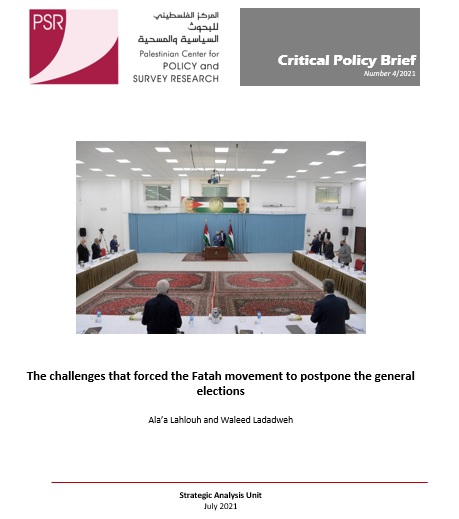 July 2021
The challenges that forced the Fatah movement to postpone the general elections
Ala’a Lahlouh and Waleed Ladadweh
On April 20, 2021, President Mahmoud Abbas issued a decree to postpone the legislative elections that were scheduled to be held in on May 22, 2021 in accordance with a previous decree issued on January 15, 2021. The decree to postpone the elections shocked the majority of the Palestinian public who wanted the elections to be held in order to bring about a change in Palestinian governance and to restore unity and end the West Bank-Gaza Strip split. It also surprised the international community that had hoped that these elections would result in a legitimate government that would represent all Palestinians. What prompted the Palestinian president to overlook all the wishes of the various factions, electoral blocs, the large majority of the Palestinian people, and the wishes of the international community? This paper aims to know the challenges that forced President Abbas and the Fatah movement to postpone the elections and how they can overcome these challenges.
The president's stated justifications for postponing the elections:
The Palestinian President announced that the postponement of the elections came, "in light of the decision of the expanded Palestinian leadership meeting, which included the Executive Committee of the Palestine Liberation Organization, the Central Committee of Fatah Movement, the leaders of the Palestinian national action factions, and national figures." He justified the postponement decision by stating that the Israeli occupation prevented the holding of elections in the city of Jerusalem, asserting that "there is no abandonment of Jerusalem, and there is no abandonment of the people's exercise of their democratic right in Jerusalem." The president added that "Israel has decided to kill the Arabs in Jerusalem, and we will not allow that."
However, these justifications were not sufficient to satisfy the various parties; Sixty-five percent of the Palestinians expressed their opposition to President Abbas' decision to postpone the general elections, and two-thirds said that the postponement came out of fear of the results, and not for the sake of Jerusalem, according to a poll conducted by the Palestinian Center for Policy and Survey Research (PSR) in June 2021.[1] In a statement, the European Union described the decision to postpone the Palestinian elections as "disappointing."[2] The head of the political bureau of "Hamas", Ismail Haniyeh, considered the reasons for postponing the elections “unconvincing at all.” He stressed in a speech that his movement is not in disagreement with Fatah or with any party on the necessity of holding elections in Jerusalem,"but the disagreement with brother Abu Mazen is on making our decision and the will of our people subordinate to the Israeli occupation, or on submitting to the will of the occupier, or on responding to the desire of this party or that."[3] Hamas also described Abbas's decision as "a coup against the path of partnership and national consensus, and it is not permissible to subordinate the entire national situation and our popular and national consensus to the agenda of a particular faction."[4]
The challenges that prompted the president and the Fatah movement to postpone the elections:
There is no doubt that the justifications provided by the president and the Fatah movement were not the real reasons behind postponing the elections. Undoubtedly, the president and the Fatah movement knew that postponing the elections would bring them into direct conflict with the majority of the public and other parties. However, the president postponed the elections; an action that reveals that the extent of the difficulties that the president and the Fatah movement would have faced if elections were held, and the results that would ensued. These difficulties, it seems, were greater, in their view, than the cost of clashing with the people and violating the demands to hold elections. What are the challenges that might have prompted the president and Fatah movement to postpone the elections?
First challenge: Fragmentation and lack of discipline within the movement itself
The Fatah movement faced great challenges during its journey in the Palestinian Authority in the 1996 and 2006 general elections, and in the various local elections during the past years. Perhaps the most important problems facing the Fatah movement in all the previous rounds of elections is the division in the movement's ranks and the defection of some of its leaders and cadres to run for the elections independently. After the issuance of a decree to hold the general elections, the leadership of the Fatah movement represented by President Abbas took a decision to prevent the members of the Central Committee, the Revolutionary Council, the secretaries of the regions, members of parliament and former ministers, in addition to the security and military leaders from running for elections and to give the young generation the opportunity to run in an attempt to renew the movement’s energies and to exhibit a new image capable of attracting voters. The movement's leadership established a set of organizational and professional criteria for those running for elections. This decision did not satisfy many of the movement's leaders, who were waiting for this opportunity to consolidate their leadership positions by running for the upcoming legislative elections.
In the last days of March, and before Fatah submitted its official list, restlessness and anger emerged from some Fatah cadres in some areas as a result of their exclusion from the official list or as a result of their placement in unguaranteed positions within the official list. This anger was manifested in regional and factional statements that announced their boycott of the elections and that they would not vote for the movement's list. Then came the talk, which gained credibility at the time, about the inclusion in the electoral list of a selected number of the members of the Central Committee of Fatah, in great contravention of the decision made by the movement’s leader, thus weakening the chances of the movement's youth to assume leadership positions.
Moreover, the article in the election law, that stipulated that presidential candidates must be part of existing electoral lists or political parties, posed a critical threat to Marwan Barghouti’s candidacy for the presidency. Consequently, the election law itself formed a strong motivation for him and his supporters to form a separate electoral list that would compete with the official movement’s list in order to guarantee that Barghouti can run for the presidential elections, even if the official movement list refused to allow him to do so.[5]
These events led to the formation of two electoral lists representing defectors from the Fattah movement, in addition to the Fatah’s formal list. Marwan Barghouti (Member of Fatah’s Central Committee) and Dr. Nasser Al-Qidwa (also a Central Committee member, dismissed for intending to run for elections outside Fatah’s formal list), formed, together, a list in the name of “The Freedom List.” Former leader in Fatah, Mohammad Dahlan, a former Central Committee member expelled from the movement some 10 years earlier, formed “The Future Bloc.”
The results of a poll conducted by PSR in mid-March showed that Fatah (formal and defectors) has the largest electoral base among the Palestinian forces and factions. In a question about voting in new parliamentary elections with the participation of all the political forces that participated in the 2006 elections, the results showed that an all Fatah’s list would receive the vote of 43% of the participants, while the Change and Reform List, affiliated with Hamas, gets 30%, and all other lists combined at 8%, and 18% said they have not yet decided who they will vote for.
However, concerns emerged when respondents were asked about other options that might occur in the elections, such as the intention of Al-Kidwa or Dahlan to form lists to compete in the legislative elections, while the position of the prisoner Barghouti was still ambiguous about his intention to form an electoral list at that time. But one of the options offered to the public was related to Marwan Barghouti's formation of an independent list. The results showed that in this case, the formal Fatah's list would receive only 24% of the vote, and Barghouti's list would receive 20%, Dahlan's list 7%, and Hamas' list would receive 27%. In another question about Al-Kidwa forming a separate list, Fateh's formal list would receive 32%, Hamas' list would receive 28%, Dahlan's list would receive 6%, and Al-Kidwa's list would receive 4%. The point of all this is that there are legitimate fears that Hamas would have gotten a plurality of the parliamentary seats in the Palestinian Legislative Council (PLC). However, this would certainly not give it the majority or even the ability to form a coalition government, unless the official Fatah movement led by President Abbas refused to establish a coalition government with Barghouti, Al-Kidwa and Dahlan.
Second challenge: The decline in President Mahmoud Abbas’ popularity
The recent years, especially since 2014, have witnessed a decline in the popularity of Palestinian President Mahmoud Abbas. President Abbas was elected to the presidency of the Palestinian Authority in January 2005 and was elected as the head of the Fatah movement at the sixth General Conference of the Fatah movement in 2009 and was re-elected at the seventh conference in 2016.
The year 2014 marked a turning point in President Abbas’ popularity, as public opinion polls showed a decline in his popularity in favor of Hamas candidate Ismail Haniyeh as a possible candidate for the presidential elections; not to mention the great challenge posed by the high popularity of the Marwan Barghouti. The decline in President Abbas’ popularity is due to a number of reasons, the most important of which are the following:
- The political horizon of the peace process is closed: President Abbas has always been a proponent of a peaceful solution and negotiations and is not in favor of violent means of resistance. But with the dominance of the Israeli right headed by Benjamin Netanyahu since 2009, the peace process reached a dead end. With the continuation of the Israeli settlement expansion that disrupts the geographic contiguity of the promised Palestinian state and continuation to Judaize the city of Jerusalem, the Palestinians refused to return to negotiations unless settlement expansion stops, and thus the issue remained between ebb and flow throughout the first term of President Obama. Despite the efforts and success of US Secretary of State John Kerry in conducting negotiations between the two parties in 2013-14, these efforts met the same fate of failure. After that, the negotiations entered a state of clinical death. Nonetheless, President Abbas remained committed to the option of negotiations as the only option. Despite his advocacy of peaceful popular resistance, the Palestinian leadership did not succeed in promoting or supporting this option in a manner that would have made it an effective weapon.
Public opinion polls show a decline among Palestinians in support of the two-state solution in recent years, from about 48 % in March 2019 to 39% in June 2021, according to opinion polls conducted by PSR during this period. This decline is probably the result of public perception that diplomacy has reaching a dead end. In addition, polls showed that negotiations are no longer considered by the Palestinians the most effective way to establish a Palestinian state.
- Public dissatisfaction, especially in the Gaza Strip, with President Abbas’ policy towards the Strip: Recent years have witnessed a sharp decline in the President Abbas’ popularity in the Gaza Strip. Public opinion polls showed that the president’s popularity declined dramatically after the Israeli war on the Gaza Strip in the summer of 2014, when it dropped from 53% in June[6] 2014 before the war to 38% in September 2014[7] after the war. These findings reflected the decline of Abbas’ popularity and the rise of Hamas’ Ismail Haniyeh in hypothetical presidential elections, according to two opinion polls conducted by PSR during that period. Gazans felt that they were alone in their battle with the occupation, and that the PA leadership was contributing to the siege imposed by Israel and Egypt. The decline in President Abbas’ popularity in the Gaza Strip continued after a series of measures taken by the PA leadership that reduced the delivery of basic services, such as electricity and health services, followed by measures against a large number of public employees in the Gaza Strip, including early and compulsory retirement and a suspension of salaries. Gazans saw these measures as punitive, targeting citizens in the Gaza Strip, which suffers from the scourge of the continuous and tight blockade since 2006.[8]
- The transformation of the Palestinian political system under his rule into an authoritarian regime that lacks accountability: The Hamas movement's control of the Gaza Strip led to the split between the West Bank and the Gaza Strip in June 2007, which in turn led to the absence of the PLC, and the transfer of all the legislative and oversight responsibilities to the executive authority, in particular to the head of the authority, Mahmoud Abbas. Within a few years, President Abbas issued about 300 laws by decrees, the vast majority of which are ordinary, not urgent or emergency laws. The number of these decrees far exceeds the number of laws that the PLC issued during its entire tenure (1996-2007). Without a parliament, there was no longer any accountability for the executive authority, with the exception of the little exercised occasionally by the judiciary, the press, and civil society. In recent years, there has also been a major seizure of power, represented by the dissolution of the PLC in December 2018 after more than 11 years of disruption. The judiciary was also weakened by the executive authority’s failure to implement the decisions issued by the courts, in addition to interfering in the affairs of the judiciary authority, which culminated in the Decree Law No. (40) of 2020 amending the Judicial Authority Law, which strengthened the executive authority’s dominance over the judiciary. This period also witnessed the targeting of civil society’s institutions through a set of measures against non-profit companies and civil organizations, leading to the enforcement of various new restrictions on these institutions, recently represented in Decree Law No. (7) of 2021 amending the Law of Charitable Societies and Civil Organizations.[9]
The damage caused by postponing the elections:
There is no doubt that the decision to postpone the elections and the subsequent events related to Jerusalem and then the Israeli war on the Gaza Strip were the worst and most unprecedented on their effect on the popularity of the president and the popularity of Fatah. At a time when the majority of the public (about 70%) wanted the elections to be held, the president indefinitely postponed the elections. At a time when the president said that the postponement was for the sake of Jerusalem, the majority of the Palestinians (about 65%) saw the postponement not for the sake of Jerusalem, but rather for fear of the election outcome. This was followed by the events in Jerusalem, for which the elections were supposed to have been postponed. However, the president, the Palestinian Authority, and the Fatah movement did not show the public that it is doing what was expected from them in defense of Jerusalem, as only 8% of the public described the president’s performance in defending Jerusalem as strong, 11% went to the PA, and 13% went to Fateh’s, while 75% of the public described the performance of Hamas as strong.[10]
All of this was reflected in a resounding decline in the President Abbas’ popularity and a drop in the popularity of Fatah. President Abbas' ability to compete in legislative elections against Haniyeh fell to its lowest level since his election in 2005, as Haniyeh outperformed Abbas by a wide margin (59% to 27% respectively), according to the results of public opinion poll No. (80) conducted by PSR in June 2021, compared to the results of public opinion poll No. (79) conducted by PSR in March 2021, where the results indicated at that time that Abbas had received 47%, compared to 46% for Ismail Haniyeh.
In June, the popularity of Fatah against Hamas also fell. If the legislative elections were held, the latter would outperform the former by 11 points in its favor, as Hamas won 41% of the vote compared to 30% for Fatah, according to the results of the above-mentioned poll. Fatah had outperformed Hamas three months earlier, obtaining 43% compared to 30% for Hamas in a poll conducted by PSR in March 2021.[11] . The majority (53%) in June also considered Hamas as more qualified to represent and lead the Palestinian people, compared to only 14% who believed that Fatah, led by President Abbas, is better qualified.
Recommendations:
This paper proposes three recommendations to the Fatah movement and its leaders: (1) reverse the decision to postpone the elections, (2) declare Fatah’s readiness to build a governmental coalition with other (defected) Fatah lists, and (3) announce the movement's intention to compete in the presidential elections with a candidate other than President Abbas.
- Conducting elections immediately, including Jerusalem, and challenging occupation measures
Holding elections has become an urgent Palestinian demand supported by the majority, just as holding them inside the city of Jerusalem is the demand of all Palestinians. However, if the Israeli government insists on its refusal to hold elections in Jerusalem, the Central Elections Committee must announce alternative solutions to hold the elections inside the city, and to have these solutions supported by the Palestinian forces and factions, led by the Fatah movement. The Election Committee, with the support of the Palestinian leadership, can place ballot boxes in front of Israeli post offices, address the European Consulates General accredited to Palestine to place the ballot boxes in their missions, place the ballot boxes in the courtyards of Al-Aqsa Mosque, and address the various churches to place the ballot boxes in their premises. It can also build the capacity to hold elections electronically.
Of course, the Israeli government will work to thwart the election process and will arrest those responsible for it and prevent citizens from going to the polls to exercise their basic rights to vote and choose their representatives. This will happen in front of the eyes of the world and the international media and Israel will be shown in opposition to Palestinian democracy. The PA should let the election day be a day of popular and peaceful resistance that President Abbas has always called for, and the Fatah movement has taken a lead in the city of Jerusalem. This would be the opposite of what Fatah and other factions have done in the past and would provide an opportunity to demonstrate support for the city and its residents to compensate for past failures. Holding elections in Jerusalem is a form of defiance of the occupation and is the best electoral propaganda for Fatah in its upcoming electoral campaign.
- Unity in the PLC
In light of the dispersion of Fatah’s electoral base among three blocs, it must use the election results in a way that enables it to become the largest electoral bloc by uniting its elements within the new PLC, especially if it wants to form a government away from Hamas. It is almost certain that the Freedom List (Barghouti and Al-Kidwa) and the Future List (Dahlan) will not make an alliance with Hamas, especially since the Future List’s regional allies (Egypt and the United Arab Emirates) will not allow it to do so in light of their conflict with the parent group (the Muslim Brotherhood) and in light of the tense relations with Hamas’ allies in the region. (Qatar, Turkey, and Iran).
- Run in the presidential elections with a new candidate.
It seems that President Abbas has become a source of weakness for Fatah's popularity. His long stay in power without elections and without achievements that can be presented to the people, at the level of the peace process or at the internal level, in addition to the deterioration of economic conditions, civil liberties, separation of power, have led to a majority demand for his resignation. It is certain that President Abbas is unable to win the presidential elections that will take place in the Palestinian territories any time soon. Moreover, the Fatah movement would be much stronger if it were under other leaders, such as Marwan Barghouti, who would take the movement in terms of the masses to great strides forward, as he would outperform his rival Ismail Haniyeh by a wide margin in any presidential election. President Abbas had previously announced several times during television interviews that he did not want to run in the presidential elections, and thus this statement opens the way for the Fatah movement to contest the upcoming presidential elections with a new presidential candidate from its own ranks. On the other hand, the Central Committee member Marwan Barghouti[12], who enjoys great popularity among the Palestinian public, announced his intention to run in any presidential elections. Public opinion polls over the past years have shown that Barghouti is the strongest candidate from within Fatah who can win any presidential elections with ease. The polls showed that Barghouti can compete with the Hamas candidate and beat him by a wide margin ranging between 20 and 30 points. On the other hand, polls showed that current Hamas leader has over the past years surpassed President Mahmoud Abbas on many occasions.[13]
The reason for Barghouti’s superiority in opinion polls is that his electoral base includes the various components of Palestinian society, including Fatah’s base, Islamists, leftists, independents, and others. On the other hand, president Abbas’s electoral base includes Fatah only and perhaps some minor PLO factions. A Hamas candidate’s base is mainly among Hamas supporters and Islamist independents. The latest poll conducted by PSR in June 2021,during the peak of the popularity of Hamas and its candidate Ismail Haniyeh, showed that in the event of new presidential elections in which only two candidates, Mahmoud Abbas and Ismail Haniyeh ran, the first would receive 27% of the votes and the second would receive 59%, but if the competition is between Marwan Barghouti and Haniyeh, then Barghouti would receive 51% and Haniyeh would receive 41%.[14]
[1] See: Results of Public Opinion Poll No. 80 conducted by the Palestinian Center for Policy and Survey Research. Public Opinion Poll No (80) | PCPSR
[3] https://arabic.sputniknews.com/arab_world/202104301048859402-%D8%B9%D8%A8%D8%A7%D8%B3-%D9%8A%D8%B5%D8%AF%D8%B1-%D9%85%D8%B1%D8%B3%D9%88%D9%85%D8%A7-%D8%A8%D8%AA%D8%A3%D8%AC%D9%8A%D9%84-%D8%A7%D9%84%D8%A7%D9%86%D8%AA%D8%AE%D8%A7%D8%A8%D8%A7%D8%AA-%D8%A7%D9%84%D9%81%D9%84%D8%B3%D8%B7%D9%8A%D9%86%D9%8A%D8%A9-%D8%B1%D8%B3%D9%85%D9%8A%D8%A7/
[4] Ibid.
[5] The Palestinian Gazette published a notice on March 18, 2021, about an error in Law No. (1) of 2021 amending Law No. (1) of 2007 regarding general elections. The content of this notice is that a candidate for the presidential elections is not required to be nominated by a political party or electoral list.
[8] In December 2017, 70% demanded the resignation of President Abbas: Results of Public Opinion Poll No. 66 | PCPSR
[9] This decision was suspended by law following local and external pressure.
[10] See: Results of Public Opinion Poll No. 80 conducted by the Palestinian Center for Policy and Survey Research. http://pcpsr.org/ar/node/844
[12] In the 2005 presidential elections, the prisoner Marwan Barghouti ran for the presidential elections, but later withdrew in favor of Fatah candidate Mahmoud Abbas.
[13]The Palestinian Center for Policy and Survey Research, the center's polls during 2014-2021. http://www.pcpsr.org/en/node/602
[14]Palestinian Center for Policy and Survey Research, Poll No. ( 80 ), June 2021. http://www.pcpsr.org/sites/default/files/Poll-79-Arabic%20Full%20Text.pdf
Favorability of the October 7 attack, the belief that Hamas will win the war, and support for Hamas continue to decline, but the overwhelming majority is opposed to Hamas disarmament and does not believe that release of the hostages will bring an end to the war. Nonetheless, about half of Gazans support the anti-Hamas demonstrations and almost half want to leave the Gaza Strip if they could. Support for the two-state solution remains unchanged but support for armed struggle drops
1-4 May 2025

These are the results of the latest poll conducted by the Palestinian Center for Policy and Survey Research (PSR) in the West Bank and the Gaza Strip between 1-4 May 2025. The period prior to the poll witnessed the continuation of the war on the Gaza Strip and the failure of all attempts to reach a new ceasefire after the collapse of the three-phase agreement reached on January 15, 2025, which lasted for a little more than two months after Israel refused to enter into negotiations to implement its second phase. During that period, the US president proposed the idea of displacing the residents of the Gaza Strip to Egypt and Jordan under the pretext of facilitating the reconstruction of the Gaza Strip, a proposal that was rejected by all concerned parties except Israel, which began to develop plans to carry out such displacement. Israel has also demanded the disarmament of Hamas as one of the conditions for stopping the war on the Gaza Strip. In a speech to the PLO's Central Council, the PA president called on Hamas to release the Israeli hostages and give up arms in order to deny Israel the pretext of continuing the war on Gaza. Meanwhile, the Israeli military incursion into the Jenin and Tulkarm areas in the West Bank continued, interrupted by clashes between the Israeli army and Palestinian armed groups in the northern West Bank. The Israeli army evacuated tens of thousands of people from the Jenin, Tulkarm and Nur Shams refugee camps and demolished dozens of buildings in those camps. Restrictions on the movement of Palestinians in the West Bank also continued and entrances to most towns and villages were closed by the Israeli army in order to prevent residents from accessing main roads. Settler violence against Palestinian towns and villages in unprotected areas in areas B and C also continued.
To ensure the safety of our data collectors in the Gaza Strip, interviews were conducted with residents in areas that did not witness armed clashes and whose residents have not been displaced or returned after being displaced, especially after the recent ceasefire during the first three months of this year. This poll covers all of the above issues as well as other issues such as domestic condition and the internal balance of power, the peace process and the alternatives available to the Palestinians in light of the current stalemate in that process.
This survey was conducted face-to-face in both the West Bank and Gaza Strip using tablets or phones. When each interview is completed, it is automatically sent directly to our server where only our researchers can access. There is no way for anyone to intercept or manipulate the collected data.
The sample size of this survey was 1270 people, of whom 830 were interviewed face-to-face in the West Bank (in 83 residential locations) and 440 in the Gaza Strip (in 44 locations). The margin of error stands at +/-3.5%.
For further details, contact PSR director, Dr. Khalil Shikaki at tel. 02-296 4933 or email pcpsr@pcpsr.org
Methodology of data collection in the Gaza Strip:
The interviews for this poll included 44 census “counting areas” in all areas of the Gaza Strip, with the exception of some areas whose residents were displaced in the Rafah governorate and some other specific areas of Gaza City, Khan Younis, and the northern Gaza Strip, so that the number of areas that were not accessible stood at 13 counting areas (five in the Rafah governorate, five in Gaza Governorate, two in Khan the Yunis governorate, and one in the northern Gaza Strip). Residents of these 13 displaced counting areas were interviewed in shelters and refugee camps in the same governorate from which they were displaced. These were randomly selected from an updated list of shelters and refugee camps located in their governorates, with the exception of the Rafah governorate, whose residents were displaced to areas in the Khan Younis governorate.
FIRST SERIOUS SIGNS OF OPTIMISM SINCE THE START OF INTIFDA
01-05 December 2004
These are the results of the latest poll conducted by the Palestinian Center for Policy and Survey Research in the West Bank and the Gaza Strip between December 01 and 05, 2004. The poll deals with Palestinian elections, the post Arafat era, support for violence and reconciliation, internal conditions and perceptions of reform, democracy and corruption, and American elections. Total size of the sample is 1319 adults interviewed face to face in the West Bank (836) and the Gaza Strip (483) in 120 randomly selected locations. Margin of error is 3 % and rejection rate is 2 %.
For further details, contact PSR director, Dr. Khalil Shikaki or Ayoub Mustafa, at tel 02-296 4933 or email pcpsr@pcpsr.org.
MAIN RESULTS:
The poll shows an emerging new reality in the Palestinian territories compared to the situation prevailing three months ago when we conducted our September 2004 poll. The most important changes indicate a more optimistic atmosphere with a significant drop in the level of support for Hamas and a big increase in the level of support for Fateh. It is worth remembering that similar trends were observed in December 1995, one month before the first Palestinian elections in January 1996.
The smooth transition of power after the death of Yasir Arafat, the virtual absence of violence despite the gloomy expectations, and the quick preparations for elections may have all been responsible for the new optimism. Hamas’ loss of support may be due to the fact that the Islamist movement had decided to boycott the upcoming presidential elections while the increase in support for Fateh might be explained by the appreciation people have for the way Fateh dealt with the succession issue. A bandwagoning effect may have also helped Fateh as new supporters might be expecting gains from supporting the faction that is most likely to win the upcoming elections.
Optimism can be seen in the fact that a majority believes that a compromise settlement can be reached with the current Israeli leadership and that both the Israeli and Palestinian leaders are strong enough to convince Israelis and Palestinians to accept such a compromise. Optimism can also be seen in the large increase in the percentage of those who believe that the roadmap can still be implemented and the large decrease in the percentage of those who believe that a political settlement with Israel is impossible. It can also be seen in terms of the greater expectation recorded in this poll regarding the chances for a return to negotiations and an end to the violence in the post Arafat era with Abu Mazin leading the PLO.
(1) Palestinian Elections:
- Mahmud Abbas and Marwan Barghouti in a close race with 40% for the first and 38% for the second
- Abbas is the most able to reach a peace agreement with Israel and Barghouti is the most able to protect the right of return
- If Hamas participates in the presidential elections, its candidate would receive 28% of the vote
- Barghouti is the person most preferred to lead Fateh, followed by Abbas and then Qaddoumi
- Large increase in the popularity of Fateh and a large decrease in the popularity of Hamas
The poll shows that if presidential elections were to be held today, the results would be close, with Mahmud Abbas receiving 40% of the votes and Marwan Barghouti receiving 38%. Mustafa Barghouti would receive 6% while all the other candidates would receive a total of 3% for all of them combined. 13% have not decided yet. The poll shows Abbas winning in the Gaza Strip (48% vs. 34% for Marwan Barghouti). But Marwan Barghouti wins in the West Bank (40% vs. 35% for Mahmud Abbas). These results represent the voting intentions of those planning to participate in the vote on January 9, 2005. The findings show that the level of non participation is going to be low (10%).
When compared to Mahmud Abbas’, support for Marwan Barghouti increases in West Bank cities (41% compared to 29%) while support for Abbas compared to Barghouti is higher in Gaza towns (57% compared to 31%) and Gaza cities (50% to 29%). But the gap between the two narrows in West Bank refugee camps, with 42% for Abbas and 40% for Barghouti. Men give more support for Abbas (46% compared to 31% for Barghouti) while women give more support for Barghouti (44% compared to 35% for Abbas). Young people between 18 and 22 years of age give more support to Barghouti (47% compared to 35% to Abbas). Older people give more support to Abbas. Illiterates give more support to Abbas (45%) compared to Barghouti (33%). Support for Abbas is higher among holders of BA degree (37% compared to Barghouti 32%). Students give more support to Barghouti (47%) compared to 35% to Abbas while support for Abbas is greater among farmers (50% to 29%), retired people (47% to 18%), unemployed (45% to 30%), and merchants (43% to 26%). Support for Abbas is higher among those working in the public sector (48% to 27%). Abbas receives more votes from those with low income and less votes from those with high income. Among Fateh supporters, 54% go to Abbas and 38% to Barghouti. But among Hamas supporters, 44% go to Barghouti and 24% to Abbas.
The poll shows that Mahmud Abbas is seen as the candidate most capable of reaching a peace agreement with Israel, improving the economic conditions, and enforcing law and order. Marwan Barghouti is viewed as the candidate most capable of protecting the right of return. The public evaluation of the ability of the two candidates to maintain national unity and prevent internal infighting is similar for both. If Hamas nominates Mahmud Zahhar as its candidate in the presidential elections, 28% say they would vote for him. And if the competition for the presidency is between Zahhar, Abbas, and Marwan Barghouti, 34% prefer Barghouti, 29% Abbas, and 24% Zahhar. The overwhelming majority (83%) of those who selected one of the three believes that the person they have chosen would be able to lead the Palestinian people under the current conditions.
In answers to an open question, 30% prefer to see Marwan Barghouti becoming the head of Fateh, while 26% preferred Mahmud Abbas and 7% want Farouq Qaddoumi as head of the movement. In the Gaza Strip, support for Abbas as head of Fateh reaches 31% (compared to 22% in the West Bank) and for Barghouti 28% (compared to 31% in the West Bank), and for Qaddoumi 5% (compared to 9% in the West Bank).
In local elections, 42% believe that Fateh candidates are likely to win, 20% believe Hamas/Islamic Jihad candidates are likely to win, 14% believe independent candidates are likely to win, and 11% believe that family candidates are likely to win. With regard to voting intentions, 37% say they will vote for Fateh candidates, 20% to Hamas/Islamic Jihad candidates, 13% to independents, and 11% to family candidates. Last September, only 21% said they intend to vote for Fateh candidates. In this poll, those intending to vote for Hamas/Islamic Jihad candidates reach 27% in the Gaza Strip compared to 16% in the West Bank.
The poll shows a significant increase in the popularity of Fateh from 29% last September to 40% in this poll. The increase is higher in the Gaza Strip, from 24% to 38%. The popularity of Hamas drops in the total West Bank and the Gaza Strip from 22% last September to 18% in this poll. In the Gaza Strip, Hamas’ popularity drops from 30% to 22%. The total level of support for all Islamists (Hamas, Islamic Jihad, and independent Islamists) drops in the West Bank and the Gaza Strip from 32% to 24% during the same period.
(2) A Post Arafat Era
- Great public satisfaction with the past performance of Arafat in national causes, medium satisfaction with his performance in ending the occupation and fighting corruption
- After Arafat, things will be better with regard to delivery of basic services, building strong public institutions, and building a democratic PA and will be worse with regard to protection of national rights in negotiations, promoting the Palestinian cause internationally, and fighting corruption
- A majority believes that Arafat died of poison and most think Israel was responsible for his death
- A majority is not worried about internal infighting after Arafat, but 50% expect his death to weaken Fateh
Poll findings show that 88% are satisfied with Arafat’s contribution to promoting the status of the Palestinian cause internationally, 86% with his contribution to protecting Palestinian rights in negotiations with Israel, 86% with his contribution in providing basic services such as health and education, 65% with his contribution to building an authority with democratic governance, 65% with his contribution to building public institutions able to enforce law and order, 54% with his contribution to ending the occupation of the West Bank and the Gaza Strip, and 51% with his contribution to fighting corruption in the PA.
In post Arafat period, the percentage of those believing that the situation would be better after Arafat is higher than the percentage of those who believe the situation would be worse in the following areas: provision of basic services such as health and education, building public institutions able to enforce law and order, and building an authority with democratic governance. The percentage of those believing that the situation would be better after Arafat is equal to the percentage of those who believe it will be worse in one area: ending the Israeli occupation. But the percentage of those believing the situation would be worse is higher than the percentage of those believing it would be better when it comes to the areas of protecting Palestinian rights in negotiations with Israel, in promoting the international status of the Palestinian cause, and in fighting corruption in the PA.
About 72% believe that Arafat died of poison and most of those believing in this (64%) believe that Israel is the party responsible for the poisoning while 22% believe that a Palestinian party is responsible.
After Arafat, a majority of 52% believe that there will be no internal infighting but 38% believe some internal infighting will take place but not civil war. Only 7% believe that a civil war will erupt. Half of the Palestinians expect Arafat’s death to weaken Fateh while one quarter expects it to strengthen Fateh.
(3) The Peace Process
- Wide scale support for a ceasefire and a majority believes that it is possible to reach a compromise settlement with Israel
- A majority supports the roadmap but about half believes that it can not be implemented today
- Increased optimism regarding the chances of a peace settlement with Israel and an increase in the percentage of those expecting return to negotiations soon
- A majority opposes continued armed attacks from the Gaza Strip after a complete Israeli withdrawal from the strip
- A majority views the Israeli disengagement plan from the Gaza Strip as victory for armed struggle
Poll findings show that support for a cease fire and for an immediate return to negotiations is very high, reaching 80% for each. The findings also show an increasing optimism regarding the chances for success in the peace process. A majority of 52% believes that it is possible today to negotiate a compromise settlement with the current Israeli leadership and 48% believe it is not possible. If such a settlement is reached, 58% believe that the Israeli leaders are strong enough to convince the Israelis to accept such a compromise settlement while 37% do not share this belief. Moreover, 56% of the Palestinians believe that Palestinian leaders are strong enough to convince the Palestinian people to accept a compromise settlement with Israel while 41% do not share this belief.
Belief that it is possible to reach a compromise settlement with the current Israeli leadership increases among women (57%) compared to men (46%), among the youngest (61%) compared to the oldest (49%), among non refugees (54%) compared to refugees (49%), among illiterates (68%) compared to holders of BA degree (46%), among students (66%) compared to professionals, the retired, and merchants (29%, 38%, and 41% respectively), and among supporters of Fateh (61%) compared to supporters of Hamas (38%).
With regard to the plan known as the roadmap, findings show that 59% support the plan and 38% oppose it. But 48% believe that the plan cannot be implemented any more while 46% believe it is possible to implement it. In July 2003, support for the roadmap reached 56% and opposition 41%, and last June, only 28% believed that the roadmap could still be implemented. Findings also show that the percentage of those believing that a political settlement with Israel is impossible stands now at 34%. In July 2001, ten months after the start of the current intifada, 46% said this was the end of the peace process. This finding confirms the sense of optimism mentioned above.
With regard to the post disengagement from Gaza, 59% will oppose and 38% will support the continuation of armed attacks from the strip if the Israeli withdrawal was complete. Opposition to continued attacks from Gaza increases in the Gaza Strip to 67% compared to 55% in the West Bank. Last September, 54% opposed and 42% supported continuation of armed attacks from the Gaza Strip after a complete withdrawal. The poll shows that 59% are worried about internal Palestinian infighting after the Israelis evacuate the Gaza Strip and only 29% believe the PA has high capacity to control matters in the strip after the Israeli withdrawal.
Three quarters of the Palestinians believe that Sharon’s plan to disengage from the Gaza Strip is a victory for Palestinian armed resistance against Israel and 23% do not see it as victory. 78% believe that most Palestinians view the plan as victory for the armed resistance. Last September, 71% believed that most Palestinians view the plan as victory.
Poll findings show further optimism regarding return to negotiations with a big increase in the percentage of those believing that now (in the aftermath of Arafat’s death and the appointment of Mahmud Abbas as chairman of the PLO) the two sides will return soon to negotiations and that armed confrontations will stop from 17% last September to 30% in this poll. The percentage of those believing that armed confrontations will not stop and the two sides will not return to negotiations drops from 37% last September to 12% in this poll. Indeed, a majority of 53% believe that the death of Arafat will increase the chances for a political settlement with Israel while only 23% believe that it would decrease those chances.
(4) Support for Violence and Reconciliation
- Decrease in the level of support for armed attacks against Israeli civilians to 49%
- About one third believes that the Palestinians have so far come out winners in the armed confrontations and a larger percentage believes that no one came out winner
- Increase in the level of support for reconciliation between the two peoples, reaching an unprecedented 81%
Support for armed attacks against Israeli civilians inside Israel drops from 54% last September to 49% in this poll. Opposition to such attacks increases from 44% to 48%. A majority of 58% says that it would support and 38% say it would oppose taking measures by the PA to prevent armed attacks against Israelis if an agreement on a mutual cessation of violence is reached. 82% support such an agreement on mutual cessation of violence. Nonetheless, 64% believe, and one third does not believe, that armed confrontations have helped achieve Palestinians national rights in ways that negotiations could not.
More than one third (35%) believes that Palestinians have come out winners in the ongoing armed conflict (compared to 40% last September) and 14% (compared to 16% last September) believe Israel came out a winner. But the highest percentage (44%) is for those who believe neither side came out a winner. In the Gaza Strip, the percentage of those believing that the Palestinians came out winners reaches 46% compared to 28% in the West Bank. Yet, 43% among all Palestinians (compared to 48% last June) believe that most Palestinians believe they came out winners and 59% (compared to 51%) believe the Israelis think Palestinians came out winners.
Belief that no one so far came out a winner increases in the West Bank (48%) compared to the Gaza Strip (37%), among non refugees in the Gaza Strip (44%) compared to refugees in the strip (35%), among holders of BA degree (50%) compared to illiterates (36%), among professionals, students, and the unemployed (71%, 50%, and 50% respectively) compared to farmers, craftsmen and laborers (25%, 35%, and 39% respectively), and among supporters of Fateh (46%) compared to supporters of Hamas (37%).
The level of support for reconciliation has never been higher reaching 81% (compared to 75% last September). But 34% (compared to 47%) believe that reconciliation is not possible ever.
(5) Internal Situation and Perceptions of Reform, Democracy and Corruption
- Evaluation of Palestinian conditions today is negative and 95% believe that there is wide scale suffering and more than three quarters feel a loss of security and safety
- Great majority supports calls for reform, only 30% gives a positive evaluation of democracy in Palestine, and belief in the existence of corruption in the PA remains very high at 87%
About three quarters of the Palestinians assess Palestinian conditions these days as being bad or very bad and 95% believe that Palestinians in the West Bank and the Gaza Strip suffer much or very much. But only 67% say that they personally suffer much or very much. Moreover, 76% feel that their security and safety and that of their family are not assured while 24% believe they are assured.
With regard to issues of governance, little has changed. An overwhelming majority of 93% support internal and external calls for fundamental reforms within the PA and 30% give Palestinian democracy positive evaluation. Yet, 62% believe that people can criticize the PA without fear while only 34% believe that people can not do that. A large majority of 87% believes that there is corruption in PA institutions and among those 60% believe that this corruption will increase or remain the same in the future.
(6) American Elections
- About one third views the re election of Bush as increasing the chances for peace while a similar percentage views it as decreasing those chances
- Three quarters believes the second Bush administration will be more supportive of Israel than the first one
Poll findings show that the Palestinians are divided in their evaluation of the impact of the reelection of the US president George Bush on the chances for the peace process. About one third (32%) believes that the reelection of Bush as US president for another four years will increase the chances for a political settlement with Israel but a similar percentage (34%) believes it will decrease those chances. But a clear majority feels pessimistic regarding the ability of the new US administration to play the role of an honest broker with more than three quarters of the Palestinians (76%) believing that the second Bush administration will be more supportive of Israel during the next four years and only 9% believe it will be less supportive..... Full Report
SPSS Data File:
Joint Palestinian-Israeli Public Opinion Poll
Stable Majority Support for Clinton’s Final Status Package Among Israelis but Decline in Support Among Palestinians Large support in both publics for the extension of the cease fire
These are the results of the most recent poll conducted December 6-15 jointly by the Harry S. Truman Research Institute for the Advancement of Peace at the Hebrew University of Jerusalem and the Palestinian Center for Policy and Survey Research in Ramallah
The joint poll examined the impact of the recent political developments in Israel and primary and local elections in the Palestinian Authority on Israeli and Palestinian attitudes regarding President Clinton’s package for a Palestinian Israeli final status settlement. We examined this package twice before in December 2003 and December 2004. This is the first time we revisit theses issues in the post disengagement era. The findings indicate virtual stability in Israeli majority support for Clinton’s package but a noticeable decline in Palestinian support for this package compared to last December.
The poll further examined both publics’ reactions to the extension of the current ceasefire and to a plan to cope with the members of armed groups belonging to Hamas, Islamic Jihad, and Fateh. Most Palestinians (80%) and Israelis (80%) support the extension of the ceasefire. An overwhelming majority among Palestinians (81%) support the absorbance of the Palestinian armed factions into the Palestinian Authority security forces. More surprisingly, among Israelis, there is also majority support (53%) for this plan for dismantling the Palestinian armed factions.
Two other important issues explored in the Israeli sample were Israelis’ acceptance of negotiations with the Hamas and the release of Marwan Barghouti from prison. 50% of the Israelis support and 47% oppose negotiations with Hamas if this is called for in order to reach a compromise agreement with the Palestinians. 34% support the release of Barghouti and negotiations with him if this is required to reach a compromise settlement.
Other issues examined in this poll are attitudes towards the Israeli Palestinian Agreement on the Rafah Crossing, and Israeli and Palestinian voting intentions in the coming elections in both political systems.
Total Palestinian sample size is 1316 adults interviewed face-to-face in the West Bank and Gaza Strip in 118 randomly selected locations between December 6 and 8, 2005. The margin of error is 3%. The Israeli sample includes 600 adult Israelis interviewed by phone in Hebrew Arabic or Russian between December 8 and 15, 2005. The margin of error is 4%.
The poll was planned and supervised by Dr. Yaacov Shamir, the Harry S. Truman Research Institute for the Advancement of Peace and the Department of Communication and Journalism at the Hebrew University and Dr. Khalil Shikaki, director of the Palestinian Center for Policy and Survey Research (PSR).
For further details on the Palestinian survey contact PSR director, Dr. Khalil Shikaki or Walid Ladadweh, at tel 02-296 4933 or email pcpsr@pcpsr.org. On the Israeli survey, contact Dr. Yaacov Shamir at tel. 03-6419429 or email jshamir@mscc.huji.ac.il.
Summary of Findings
(A) Clinton Parameters
The Clinton parameters for a Palestinian-Israeli permanent settlement were presented by President Clinton at a meeting with Israeli and Palestinian officials December 23, 2000, following the collapse of the July 2000 Camp David summit. These parameters address the most fundamental issues which underlie the Palestinian-Israeli conflict including (1) Final borders and territorial exchange, (2) Refugees, (3) Jerusalem, (4) A demilitarized Palestinian state, (5) Security arrangements, and (6) End of conflict. We addressed these issues twice before in December 2003 and December 2004. In the current poll we revisit these crucial issues for the first time afterIsrael’s evacuation of the Gaza Strip and following the significant political developments in both societies in recent weeks.
The findings indicate stability in the level of support among Israelis and decline in support among Palestinians compared to one year ago. Among Israelis a majority of 64% support these parameters as a combined overall package just like a year ago. Among Palestinians however 46% support the package now compared to a majority of 54% last year.
Apparently these results reflect the joint impact of each public’s disappointment with the results of the disengagement and the recent dramatic developments in the Israeli and Palestinian political scenes. Among Israelis we would expect increased willingness to compromise given Sharon’s signals of moderation. This is presumably offset by the renewed violence from the Gaza Strip which frustrates many Israelis who supported the disengagement. Palestinian decline in support for Clinton’s parameters similarly reflects the fierce political electoral competition in the PA which feeds more militant attitudes combined with disappointment with the meager outcome the Israeli disengagement from the Gaza Strip yielded.
(1) Final Borders and Territorial Exchange
Among Palestinians 55% support or strongly support and 42% oppose or strongly oppose an Israeli withdrawal from the West Bank and the Gaza Strip with the exception of some settlement areas in less than 3% of the West Bank that would be swapped with an equal amount of territory from Israel in accordance with a map that was presented to the Palestinian respondents. The map was identical to that presented to respondents in December 2004. At that time, support for this compromise, with its map, stood at 63% and opposition at 35%.
Among Israelis 53% support and 42% oppose a Palestinian state in the entirety of Judea Samaria and the Gaza Strip except for several large blocks of settlements in 3% of the West Bank which will be annexed to Israel.Israel will evacuate all other settlements, and the Palestinians will receive in return territory of similar size along the Gaza Strip. In January 2005, 55% of the Israelis supported this component while 43% opposed it.
(2) Refugees
Among Palestinians, 40% support and 57% oppose a refugee settlement in which both sides agree that the solution will be based on UN resolutions 194 and 242. The refugees would be given five choices for permanent residency. These are: the Palestinian state and the Israeli areas transferred to the Palestinian state in the territorial exchange mentioned above; no restrictions would be imposed on refugee return to these two areas. Residency in the other three areas (in host countries, third countries, and Israel) would be subject to the decision of these states. As a base for its decision Israel will consider the average number of refugees admitted to third countries likeAustralia, Canada, Europe, and others. All refugees would be entitled to compensation for their “refugeehood” and loss of property. In December 2004, 46% agreed with an identical compromise while 50% opposed it.
Among Israelis 43% support such an arrangement and 53% oppose it compared to 44% who supported it in January 2004 and 52% who opposed it.
(3) Jerusalem
In the Palestinian public 33% support and 65% oppose a Jerusalem compromise in which East Jerusalem would become the capital of the Palestinian state with Arab neighborhoods coming under Palestinian sovereignty and Jewish neighborhoods coming under Israel sovereignty. The Old City (including al Haram al Sharif) would come under Palestinian sovereignty with the exception of the Jewish Quarter and the Wailing Wall that would come under Israeli sovereignty. In December 2004, an identical compromise had a higher reception with 44% supporting it and 54% opposing it.
Among Israelis, 38% agree and 60% disagree to this arrangement in which the Arab neighborhoods in Jerusalem including the old city and the Temple Mount will come under Palestinian sovereignty, the Jewish neighborhoods including the Jewish quarter and the Wailing Wall will come under Israeli sovereignty, East Jerusalem will become the capital of the Palestinian state and West Jerusalem the capital of Israel. In January 2005, 39% supported this arrangement and 60% opposed it.
(4) Demilitarized Palestinian State
Among Palestinians 20% support and 78% oppose the establishment of an independent Palestinian state that would have no army, but would have a strong security force and would have a multinational force deployed in it to ensure its security and safety. Israel and Palestine would be committed to end all forms of violence directed against each other. A similar compromise received in December 2004 the support of 27% and the opposition of 71%.
Among Israelis 69% agree and 30% disagree to this arrangement compared to 68% who agreed and 30% who disagreed to it a year ago in January 2005.
(5) Security Arrangements
In the Palestinian public 43% support and 55% oppose a compromise whereby the Palestinian state would have sovereignty over its land, water, and airspace, but Israel will have the right to use the Palestinian airspace for training purposes, and would maintain two early warning stations in the West Bank for 15 years. A multinational force would remain in the Palestinian state and in its border crossings for an indefinite period of time. The task of the multinational force would be to monitor the implementation of the agreement, and to monitor territorial borders and coast of the Palestinian state including the presence at its international crossings. In December 2004, 53% of the Palestinians supported this parameter while 45% opposed it.
In the Israeli public 62% support and 33% oppose this arrangement compared to 61% who supported it and 37% who opposed it a year ago in January 2005.
(6) End of Conflict
In the Palestinian public 64% support and 34% oppose a compromise on ending the conflict that would state that when the permanent status agreement is fully implemented, it will mean the end of the conflict and no further claims will be made by either side. The parties will recognize Palestine and Israel as the homelands of their respective peoples. An identical question received in December 2004 the support of 69% and the opposition of 29%.
In the Israeli public 80% support and 18% oppose this component in the final status framework. In January 2005, 76% of the Israelis supported it while 23% opposed it.
The Whole Package
Among Palestinians 46% support and 50% oppose the whole package combining the elements as one permanent status settlement. In December 2004, 54% supported and 44% opposed such a package.
Among Israelis 64% support and 33% oppose all the above features together taken as one combined package, just like a year ago.
46% of the Israelis know that a majority in their society supports the Clinton parameters as a combined final status package. 39% believe that the majority opposes it. This level of awareness indicates that despite the solid support for the package it has not acquired widespread normative legitimacy in the Israeli public. Among Palestinians 43% believe now that a majority in their society supports the Clinton parameters as a combined final status package and 47% believe that the majority opposes it. In addition a plurality in both Palestinian and Israeli societies believe that the other side’s majority opposes such a package. 46% of the Israelis and 52% of the Palestinians think so.
Summary Table of the Findings
Support for Clinton’s Permanent Settlement Framework Among Israelis and Palestinians (2003-2005) | ||||||
| Israelis | Palestinians | ||||
Dec. 2003 | Jan. 2005 | Dec. 2005 | Dec. 2003 | Dec. 2004 | Dec. 2005 | |
1) Borders and Territorial Exchange | 47% | 55% | 53% | 57% | 63% | 55% |
2) Refugees | 35% | 44% | 43% | 25% | 46% | 40% |
3) Jerusalem | 41% | 39% | 38% | 46% | 44% | 33% |
4) Demilitarized Palestinian State | 61% | 68% | 69% | 36% | 27% | 20% |
5) Security Arrangements | 50% | 61% | 62% | 23% | 53% | 43% |
6) End of Conflict | 66% | 76% | 80% | 42% | 69% | 64% |
Overall Package | 47% | 64% | 64% | 39% | 54% | 46% |
|
|
|
|
|
|
|
(B) Other Conflict Resolution Issues
- 60% of the Palestinians support and 36% oppose the roadmap plan. Among Israelis 65% support the plan compared to 31% who oppose it.
- Despite these levels of support both publics are not very optimistic regarding the pace in which a Palestinian Israeli political settlement will be reached. 23% of the Israelis and 44% of the Palestinians believe a political settlement is not possible ever, 36% of the Israelis and 31% of the Palestinians believe it will be achieved in the next generation or many generation to come, 34% of the Israelis and 19% of the Palestinians think it will be reached in the next decade or the next few years.
- If in order to reach a compromise agreement with the Palestinians, Israel will have to release Marwan Barghouti from prison and negotiate with him, 34% of the Israelis support such a step compared to 62% who oppose it.
- 50% of the Israelis support and 47% oppose negotiations with Hamas if Israel will have to do it in order to reach a compromise agreement with the Palestinians
- 53% of the Israelis support and 40% oppose a proposal to disarm the organizations that belong to Hamas, Jihad and Fatah by integrating them into the Palestinian security forces under the supervision of the PA. 81% of the Palestinians support the proposal to absorb the members of these armed groups into the security services whereby all armed forces become part of the Palestinian Authority compared to only 17% who oppose it.
- 80% of the Palestinians and 80% of the Israelis support the extension of the cease fire which expires at the end of this month.
(C) Palestinian-Israeli Agreement on Crossings
- 41% of the Palestinians support and 56% oppose the agreement for the opening of the Rafah crossing between Gaza and Egypt. According to the agreement, the crossing will be operated by the PA and Egypt under the supervision of European Union and Israeli observers will monitor it through video broadcasts. Among Israelis, 56% support and 40% oppose it.
- With regard to the presence of the European Union observers, 58% of the Palestinians and only 37% of the Israelis oppose their role in the crossing.
- 37% of the Palestinians believe the agreement weakens Palestinian sovereignty compared to 58% who think the opposite.
- 61% of the Palestinians oppose the resumption of violence from the Gaza Strip towards Israel, as most (84%) expect that resumption of violence will lead to the closing of the crossing. 62% of the Palestinians also suspect that Israel will not continue to implement the agreement on crossing and movement.
- Following the agreement on crossings, only 19% among Palestinians feel that the freedom of movement between the West Bank and the Gaza strip has improved compared to 57% who expected such an improvement in September. More generally, 45% of the Palestinians believe that the situation in the Gaza Strip has become better than before the disengagement compared to 52% who think it became worse or remained the same. 55% believe Gaza has remained a big prison
(D) Attitudes Towards Settlements and the Disengagement
- An overwhelming majority of the Palestinians (82%) but also 50% of the Israelis see the evacuation of the Israeli settlements from Gaza as a victory for the Palestinian armed struggle against Israel. 48% among Israelis and 17% among Palestinians don’t see it as such. In addition, 68% of the Palestinians believe that the Palestinian Intifada and armed confrontations have helped Palestinians achieve national and political goals that negotiations could not achieve. Nevertheless 46% of the Palestinians don’t see the evacuation of settlements from the Gaza strip as the beginning of the end of the occupation and the establishment of a state compared to 52% who do see it as such.
- Considering the outcome of the disengagement in Gaza, 49% of the Israelis believe they will support future unilateral disengagement plans in the West Bank Compared to 43% who will oppose them.
- The percent of Israelis supporting the dismantling of most of the settlements in the territories as part of a peace agreement with the Palestinians returned to the levels from before the disengagement. 62% supported such a step in June just before the disengagement, and 61% support it now. Israelis’ assessments of the settlements’ contribution to Israel’s national security decreased somewhat following the disengagement. 32% of the Israelis believe that the settlements contribute to Israel’s national security (37% in June), while 40% believe they hurt it (39% in June). 23% think that settlements neither contribute nor hurt (19% in June).
- As to the future of the settlements in the longer run, 64% of the Israeli public, believe that in the coming years the number of settlements in the West Bank will decrease (compared to 50% who thought so in September), 14% expect the number of settlements to increase (19% in September). In contrast, among Palestinians 45% fear that the number of settlements will increase in the future and 42% think it will decline. In September, 52% and 39% respectively thought so.
(E) Israeli Elections
- At the time of the survey, 17% have not decided yet whom to vote for in the coming election, 12% of Israeli eligible voters claim they will not vote. Ariel Sharon’s party “Kadima” obtains 27% of the vote, the Labor party headed by Amir Peretz obtains 15% of the vote, and the Likud 6% of the vote.
- 13% of the Israelis believe that the elections will focus mainly on the political process with the Palestinians, 20% believe it will center around security issues, 48% think it will focus on social/economic issues, and 7% think it will focus on corruption.
- 33% of the Israelis believe that Amir Peretz will deal better with Israel’s social/economic problems compared to 29% who think that Sharon will do it better and 16% who believe in Netanyahu’s skills. However with respect to security and foreign affairs issues, Sharon comes out the favorite with 60% who believe he can deal with those better. 19% believe it is Netanyahu who can handle these issues better, and 12% believe Amir Peretz will do this job better.
- 46% of the Israeli public believe that Sharon leaving the Likud and forming a new party will increase the chances for a peace process with the Palestinians compared to 5% who believe the chances will decline, and 41% who believe it will have no impact. . Among the Palestinians, only 20% believe that Sharon’s step will increase chances for the peace process compared to 36% who believe it will decline and 35% who believe it will have no impact.
- In the same context, 72% of the Israelis believe that Sharon is able to convince the Israeli public to accept a compromise agreement with the Palestinians if such an agreement is reached. Only 29% however think that Amir Peretz will be able to do this.
(F) Palestinian Elections
- If elections are held today, findings show that 78% of the Palestinians would participate (compared to 74% last September).
- Among those intending to participate in the upcoming parliamentary elections, 50% will vote for Fateh, 32% for Hamas, 9% for other factions and groups including independents, and 9% remain undecided. Last September, Fateh received 47% of the vote, while Hamas received 30%, others factions 11%, and 11% were undecided. In the Gaza Strip, vote for Fateh increases from 47% to 53% during the same period.
- In a closed question, in a contest for the office of PA president between Mahmud Abbas, Mahmud Zahhar, and Mustafa Barghouti, Abbas comes first with 41% followed by Zahhar with 21% and Barghouti with 19%. These results are similar to those obtained in our last poll in September.
- In a closed question with a list of five candidates, in a contest over the office of prime minister, Marwan Barghouti comes first with 36% followed by Zahhar with 20%, Mustafa Barghouti with 14%, Dahlan with 11%, and Qurai with 6%. Last September, Marwan Barghouti received 30%, Zahhar 22%, Mustafa Barghouti 17%, Dahlan 8%, and Qurai 8%.
- Among the whole population (those intending and those not intending to participate in the elections), support for Fateh reaches 45% and Hamas 28%. Last September, support for Fateh stood at 39% and Hamas at 27%. Support for Fateh in the Gaza Strip increases from 40% to 49% during the same period.
26 January 2026
Report I: Governance and the Domestic Balance of Power after Two Years of War on the Gaza Strip
Gaza War reshaped Palestinian society: priorities shifted from growth to basic services; trust mixed but satisfaction fell; civil liberties eroded. Public still values democracy yet increasingly favors a strong leader who can deliver stability. Politically, Fatah's support has collapsed, while Hamas has maintained its base, but the largest group is the politically alienated. Social norms grew more conservative. This landscape signals a deep crisis of governance and a public desire for new leadership.
8-26 October 2025

These are summary findings from the latest round of the Arab Barometer survey in Palestine, the ninth since these surveys began in the Arab world nearly twenty years ago. The survey was conducted by the institute for Polling and Survey Research West Bank and Gaza Strip during 8–26 October 2025.
The period preceding the survey witnessed several important developments, including the continuation of the war on the Gaza Strip until a ceasefire was reached two days after fieldwork began. In the West Bank, settler violence and terror continued against vulnerable, unprotected Palestinian towns without intervention by either the Palestinian or Israeli police to stop these assaults—indeed with complicity and even encouragement in some cases from the Israeli government and with the army providing protection to settlers only. The Israeli army enforced closures on Palestinian areas and restricted Palestinians’ access to main roads in the West Bank.
The ceasefire in the Gaza Strip came as part of what is known as the 20‑point Trump Plan, which made no reference to the situation in the West Bank. The period before fieldwork also saw a sharp decline in government services due to Israeli punitive measures against the Palestinian Authority (PA), including the seizure of clearance revenues, which forced the PA to pay only a portion of public‑sector salaries and curtailed its ability to provide many basic services. Israel also imposed stringent conditions, demanding “reforms” rejected by Palestinian public opinion—such as amending school curricula and halting payments to the families of prisoners and martyrs.
This first report on the results of the ninth Arab Barometer (AB9) survey in Palestine addresses two important issues: governance and the internal balance of power in the Palestinian territories. Subsequent reports will cover other aspects of the findings, such as conditions in the Gaza Strip, peace, and international relations. Although the focus here is on AB9 findings regarding these two topics, the report compares them to those of the previous AB survey conducted two years earlier.
It should be noted that most governance‑related topics in this report were not asked in the Gaza Strip due to the war conditions; in Gaza the focus was on living and humanitarian conditions and other topics related to the Gaza war.
Methodology: |
Interviews for AB9 were conducted face‑to‑face between 8 and 26 October 2025 with a random sample of 1,655 adults across 160 residential localities in the West Bank, Gaza Strip, and Jerusalem. The sample size was 855 in the Gaza Strip and 800 in the West Bank, in 80 locations in each; the margin of error was ±3%. All West Bank interviews were conducted in “counting areas,” as defined by the Palestinian Central Bureau of Statistics. In the Gaza Strip, interviews were held in 33 counting areas; the remainder were conducted in a representative sample of shelters, built-up and tent shelters, selected by systematic random selection, with quotas to represent areas destroyed by the war or those that were not safely accessible because they were under Israeli military occupation. For comparison, this report cites another survey conducted in late September/early October 2023—i.e., just before October 7 of that year—the eighth Arab Barometer (AB8) survey. The Palestine reports for that survey can be found here: |
Main Findings: A Society in Transition: Palestinian Public Opinion Before and After October 7 |
This first report of AB9 in Palestine examines governance under the PA, as well as the internal balance of power. A comparative analysis of the two Barometer surveys conducted in Palestine—on the eve of the October 7, 2023 attack (AB8) and two years later in October 2025 (AB9)—reveals a society profoundly reshaped by war, trauma, and political disappointment. The results portray a public whose immediate priorities shifted from the economy to survival; whose trust in institutions changed selectively; and whose views on governance, democracy, and leadership hardened in response to a harsh new reality. Comparing AB8 and AB9 provides a data‑driven narrative of a Palestinian society transformed by the shock of war. The period between the eve of October 7, 2023 and October 2025 was a rupture: it accelerated some pre‑existing trends and generated entirely new social and political dynamics. The data point to four key insights into this new reality.
First, the war reshaped public priorities: The Gaza war changed Palestinian public priorities, not only in the Gaza Strip—as a later report will show—but also in the West Bank. Before the war, Palestinians, like many publics, prioritized long‑term economic development. AB8 data showed the economy as the dominant concern. AB9 reveals a notable shift: as life itself came under threat, the public re‑prioritized basic needs—education and health. In the West Bank, demand for education and health care rose while concern with economic development receded: the percentage of those prioritizing education increased from 25% to 30%. This is not merely a change of opinion; it reflects a society grappling with existential fears—an indicator of a population in survival mode, where the building blocks of a functioning future take precedence over abstract economic growth. This foundational shift explains why, despite a rise in trust in some institutions, satisfaction with government performance collapsed precisely in these sectors. Public demand for basic services has become existential, and the PA is failing to meet it. While trust in some government institutions rose slightly, satisfaction with government performance actually fell—particularly in the vital education and health sectors. The public remains highly pessimistic about the PA’s ability to address core challenges like unemployment, price inflation, and security. Meanwhile, the desire to emigrate is growing, driven by a potent mix of economic despair, security fears, and political hopelessness.
Second, the public sits in a deep governance paradox: it yearns for democracy yet is increasingly willing to accept authoritarianism in exchange for stability. Politically, the Gaza war sparked a large increase in public interest in politics—from 29% to 39%—as Palestinians confront existential questions about their future. Yet this heightened interest is accompanied by a bleak assessment of civil liberties: beliefs that freedom of expression and the right to protest are guaranteed collapsed, with only 16% and 13% respectively feeling these rights are protected. This has fueled a desire for faster, more decisive reform, even as a cautious majority still prefers gradualism. Despite these pressures, baseline attitudes toward democracy remain surprisingly stable: both waves show strong, steady, and principled support for democracy as the best system of governance—60% still hold this view. However, the war exposed a deep pragmatism born of despair. While Palestinians value democracy in principle, an increasing majority now prioritizes a strong leader (51%, up from 41%) who can deliver economic stability and impose order, even at democracy’s expense. This shift is reflected in the public’s deteriorating view of Western democracies, with a sharp drop in confidence in the American and German models. Although the principled preference remains, lived experience since October 7—of chaos, violence, and institutional collapse—has severely eroded confidence in democratic practice. The sharp rise in support for a “strong leader” and the prevalent belief that order and economic stability outweigh the type of political system are the clearest indicators. Palestinians have not abandoned democratic rights—as evidenced by anger over declining civil liberties—but they have lost faith in any democratic process’s capacity to rescue them from the current crisis. This has opened a dangerous window for a form of “authoritarian pragmatism.”
Third, the internal political map has been redrawn—but not in the way many outside observers might expect: the immediate outcome is not increased support for Hamas, but rather a catastrophic collapse of Fatah and PA legitimacy in the West Bank. Fatah’s voter base has nearly halved, an indictment of its inaction and loss of initiative during the war. Fatah’s support in the West Bank has collapsed—from 23% to 14%—while Hamas’s support remained relatively stable and even dipped slightly in Gaza, where it maintained its core base, leaving it a permanent actor that cannot be ignored in any future political arrangement. The real “winner,” however, is deep, broad political alienation: over half of the population refuses to align with or identify with any faction. In a hypothetical presidential election, imprisoned Fatah figure Marwan Barghouti remains the frontrunner, clearly outpacing both Hamas’s Khaled Mishal and the incumbent President Mahmoud Abbas. Barghouti’s sustained popularity is crucial: he is not merely a Fatah leader; he symbolizes a different politics—combining resistance with a vision of unity and clean governance. His continued lead in presidential polling across both waves confirms that the public seeks a leader who can transcend the failed models of both the PA and Hamas.
Fourth, the war appears to have triggered a social retrenchment toward more conservative, traditional norms, especially regarding gender roles: Along with religiosity remaining high, there is a notable increase in support for traditional gender roles: 75% now agree that men are better suited as political leaders—up sharply from 63% two years ago. This suggests societal retrenchment in response to instability and deep crisis. The sharp rise in the belief that men are better political leaders is a significant, troubling development. In times of acute crisis and social collapse, societies often revert to traditional hierarchies and patriarchal structures as imagined sources of order and stability. This finding indicates that the shock of war has not only reshaped Palestinian politics but has also begun to undo some social progress achieved in previous years, with long‑term implications for women’s rights and participation in public life.
In short, Palestine in late 2025 is a society scarred by loss, defined by disappointment, grappling with fundamental questions about its future. The public is more politically engaged but feels less free; desires democracy but longs for stability; and is deeply alienated from its current political leadership. These Arab Barometer findings do not point to an imminent solution or a clear path forward, but they paint a vivid portrait of a people at a historic crossroads, forced to navigate a landscape in which many old certainties have been swept away.
1) Media |
The war reshaped media consumption habits. While social media remains a primary news source for 60% of Palestinians, its dominance has fallen from 74% in 2023. Television, by contrast, has made a dramatic comeback, with 35% now relying on it as a main news source, up from just 17%—likely due to the war in Gaza and daily TV coverage. Al Jazeera remains overwhelmingly the dominant and most trusted news outlet, cited by 85% of respondents as their top source of news.
2) Public Priorities, Trust in Institutions, and Satisfaction with Government and Service Delivery: |
Priorities: The Gaza war altered some public priorities in the West Bank. Before the conflict, economic concerns were paramount: in AB8, 25% of West Bankers cited economic development as their top priority. By AB9, economic development is no longer the top priority, standing today at 23%, as it is overtaken by a rise in the prioritization of education (up from 25% to 30%) and health (from 13% to 15%). This shift reflects a society grappling with disruption and anxiety, in which the core pillars of social well‑being take precedence over long‑term economic growth.

Trust in government: Paradoxically, even as daily life became more dangerous, trust in some public institutions—including the government—saw increases, albeit modest in some cases. This may reflect a “rally around the flag” effect during a national crisis. Seventy‑one percent say they distrust or trust the Palestinian government only a little, while just 25% say they have trust or great trust—an eight‑point increase from 17% two years earlier (AB8).

When West Bank residents were asked about trust in the PA government in the West Bank, 23% said they trust it and 76% said they do not (vs. 19% and 76% respectively two years earlier). When Gaza Strip residents in AB9 were asked about trust in the Gaza government (i.e., Hamas’s government), 32% said they trust it and 67% said they do not.

Trust in the PA president: In the West Bank, distrust of the PA president rose by five points to 77%, while trust fell from 22% in AB8 to 19% in AB9.

Trust in the police and National Security Forces: In the West Bank, trust in the Palestinian police rose to 47% (from 38% two years ago), while distrust stands at 53% (down from 58%). Notably, distrust of the National Security Forces is higher than distrust of the police—an unusual change from two years ago, when distrust levels were identical. The likely reason is the heightened sense of threat from Israeli settlers and the public perception that the National Security Forces are not protecting them from this threat, despite the forces’ raison d’être and the significant resources allocated to them—compared to the police, which are responsible for crime prevention. Nonetheless, perhaps due to growing fear of external threats, trust in the National Security Forces in the West Bank is 39% (up five points), and distrust is 58% (unchanged from AB8). Two years ago, trust stood at 34%.


Perception of safety: AB9 shows a clear rise in feelings of insecurity. In AB8, when West Bankers were asked about safety in their area or neighborhood, 74% said their area was very or somewhat safe, while only 26% said it was unsafe. AB9 found that the sense of safety has dropped to 58%, while the sense of insecurity has risen to 42%.

Trust in the courts and judiciary: Sixty‑three percent of Palestinians express distrust in the courts and judiciary, while 34% express trust. Two years earlier, just 27% said they trusted the courts and legal system.

Trust in civil society: Trust in civil society organizations rose to 38% in AB9, up from 27% in AB8 (2023). Fifty‑nine percent say they do not trust CSOs.

Trust in religious leaders: Trust in religious leaders stands at 25%, a six‑point increase over AB8 (2023). In AB9, 71% express distrust in religious leaders.

Trust in Hamas: AB9 indicates a huge increase in trust in Hamas—from 18% in AB8 to 46% in AB9. Forty‑three percent say they do not trust Hamas.

Trust in aid and service institutions in Gaza: We asked Gaza residents about their trust in three institutions: UNRWA, the Red Crescent, and the Gaza Humanitarian Foundation. Trust in UNRWA stands at 75%; in the Red Cross at 66%; and in the Gaza Humanitarian Foundation at 22%.
Satisfaction with government performance: We asked the Palestinian public in the West Bank about satisfaction with overall government performance and with specific sectors such as the education system, health care, garbage collection, electricity provision, and water supply. Despite nominal increases in trust in public institutions, AB9 found a decline in overall satisfaction. Satisfaction with government performance fell slightly from 32% to 29%, with a catastrophic collapse in satisfaction with the education system (from 44% to 21%). The public remains highly pessimistic about the PA’s ability to address core challenges such as unemployment (13% satisfied), narrowing the gap between rich and poor (14%), or reducing prices (11%).
• Overall satisfaction with government performance is 29%, and dissatisfaction 69%—a three‑point decline in satisfaction compared to AB8.
• Satisfaction with the education system is 21%, dissatisfaction 78%—a 23‑point drop in satisfaction compared to AB8 (2023).
• Satisfaction with the health care system is 47%, dissatisfaction 53%—a six‑point decline in satisfaction from AB8.
• Satisfaction with garbage collection is 70%, dissatisfaction 30%—an 18‑point increase in satisfaction compared to AB8.
• Satisfaction with electricity provision is 76% (dissatisfaction 24%); satisfaction with water availability is 47% (dissatisfaction 52%).

Assessment of government performance: We asked West Bank Palestinians to assess government performance in three areas: providing security, narrowing the rich‑poor gap, and keeping prices low:
• Positive assessment (“good” or “very good”) for providing security is 31%; negative assessment (“bad” or “very bad”) is 67%—a two‑point drop in positive assessment compared to AB8 (2023).

• Positive assessment for narrowing the gap between rich and poor is 14%; negative 80%—a two‑point increase in positive assessment from AB8 (2023).

• Positive assessment for “keeping prices low” is 11%; negative 89%—a four‑point rise in positive assessment compared to AB7.

Government responsiveness: We asked West Bank residents how responsive the government is to people’s demands. Only 17% believe the government is very or largely responsive; 81% say it is not very or not at all responsive. These views are similar to AB8 when 16% said the government was responsive and 83% said it was not.

3) Perceptions of Corruption and Government Anti Corruption Efforts |
An overwhelming majority of West Bank Palestinians (87%) believe there is corruption in PA institutions—either to a great extent (62%) or to some extent (24%). Five percent say it exists to a small extent, and 4% say it does not exist at all. These results are lower than in AB8, when 94% of West Bank Palestinians believed there was corruption in PA institutions—either to a great extent (67%) or to some extent (27%)—and slightly lower than AB7 (2021).

We also asked about the extent of government efforts to combat corruption. Sixty‑nine percent believe the government is not fighting corruption at all or is doing so only to a small extent (44% “not at all,” 25% “to a small extent”). By contrast, 29% believe it is fighting corruption (5% “to a great extent,” 24% “to a moderate extent”). In 2023, 64% believed the government was not fighting corruption or only to a small extent, and 35% believed it was (12% “great extent,” 23% “moderate”)—a six‑point decline in the percentage of those who think the PA is combating corruption.

4) Political Participation, Freedoms, Democracy, Migration, and Social Attitudes |
The war on the Gaza Strip led to a notable increase in public interest in politics—from 28% to 39%. Yet this increased interest is accompanied by a bleak assessment of civil liberties under the PA: the share believing freedom of expression is guaranteed fell from 27% to 16%, and the share believing the right to participate in demonstrations is guaranteed fell from 25% to 13%. This has fueled a desire for faster, more decisive reform, with the share preferring immediate, one‑off reforms rather than gradual reforms rising from 32% to 38%.
This has likely contributed to a growing sense of despair. Despair is evident in the desire to emigrate: a quarter of West Bank residents (24%) now consider leaving Palestine, driven primarily by economic reasons (71%), security (38%), and politics (37%)—all notably more prominent since 2023 when only 21% expressed a desire to emigrate.
Despite these pressures, baseline attitudes toward democracy remain surprisingly stable: 60% still see it as the best system of governance. However, the war has revealed a deep‑seated pragmatism born of despair. While Palestinians value democracy in principle, a slim majority now supports a strong leader (51%, up from 41%) who can deliver stability and order, even at the expense of democratic practice. This is reinforced by the belief of 68% that the nature of the political system does not matter so long as the government is able to solve economic problems. The war has also worsened views of Western democracies, with positive evaluations of American democracy falling from 57% to 42% and of German democracy from 56% to 42%.
The war has also left its mark on socio‑religious attitudes. While overall religiosity remains high and largely stable, there is a marked shift toward more conservative gender norms. The percentage of those who agree that men are better suited as political leaders rose from 63% to 75%. Similarly, the share who believe men should have the final say in family matters rose from 44% to 57%. This signals a societal shift toward traditional patriarchal structures in response to instability and deep crisis.
5) Leadership and the Domestic Balance of Power |
We examined the domestic balance of power among Palestinian political parties in three ways: support for different political leaders, party support, and parliamentary voting behavior.
Presidential elections: To gauge the popularity of Palestinian figures, we asked about voting intentions in a hypothetical race among the incumbent President Mahmoud Abbas and the two most popular and well‑known rivals: Fatah’s Marwan Barghouti and Hamas’s Khaled Mishal. The question on leaders’ popularity was restricted to the Gaza Strip and was not asked in the West Bank, which typically tends to support Marwan Barghouti and reject President Abbas. In a hypothetical presidential election, Fatah leader Marwan Barghouti remains the frontrunner in the Gaza Strip, with 30% of the vote, followed by Hamas’s Khaled Mishal (22%), while the incumbent Mahmoud Abbas trails far behind at 13%. These figures do not differ significantly from 2023, indicating that Barghouti’s standing as a symbol of resistance and unity transcends the immediate political aftershocks of the war—even though he, like Abbas, is a Fatah leader at a time when Fatah’s popularity has collapsed, as discussed below. Thirty‑four percent say they would not participate in such an election. In AB8, the results were 32% for Barghouti, 24% for Hamas’s then‑candidate Ismail Haniyeh, and 12% for Abbas.
Factional support: The party support question was restricted to the West Bank and not asked in Gaza. When asked “Which party is closest to you?”, respondents chose Fatah at 18% (vs. 30% before the war in AB8), Hamas at 24% (vs. 17% before the war), third powers at 7% (vs. 6% before), while a slim majority of 51% (vs. 47% before) chose “none of the above.”
 | |
|
Parliamentary elections: AB9 examined voting behavior in both the West Bank and the Gaza Strip—how respondents would vote in new legislative elections in each area. The results show that the Fatah vote share is 16% (14% in the West Bank, 19% in the Gaza Strip), compared to 24% in AB8 two years earlier; the “Change and Reform” list (Hamas) stands at just 19% (17% in the West Bank, 22% in Gaza). Ten percent would vote for third parties that competed in the last legislative elections in 2006, and 14% would vote for none of the competing parties.
The reason the Fatah and Hamas vote shares are lower than the simple party support figures cited above is that a large number of respondents refuse to participate in elections. Non‑participation in this survey stands at 41% (47% in the West Bank and 32% in Gaza). In other words, the survey found that 55% of the overall public either refused to vote or chose “none of the above.” When voting is limited to those who would actually participate, Fatah’s share rises to 27% (25% in the West Bank, 28% in Gaza), Hamas’s to 33% (33% in the West Bank, 32% in Gaza), and the undecided—or those who chose “none of the above”—to 24%.


Notably, among likely voters, Hamas’s vote share in AB9 is higher among those aged 30 and above (35%) compared to just 25% among 18–29‑year‑olds. By contrast, the undecided share among youth reaches 27%, while among older voters the third party and undecided shares are 15% and 23% respectively. Religiosity is a better indicator of intended voting patterns: Hamas support is 34% among the religious, 32% among the moderately religious, and 9% among the non‑religious. Fatah’s support is 25% among the religious, 28% among the moderately religious, and 43% among the non‑religious. Third party support is 21% among the religious, 12% among the moderately religious, and 18% among the non‑religious. The undecided are drawn primarily from the non‑religious and moderately religious, and lastly from the religious.
AB9: Demographic variables affecting electoral behavior.
Electoral lists | Men | Women | 18-29 | 30 years and above | Religious | Somewhat religious | Unreligious |
Fatah | 30% | 23% | 26% | 27% | 25% | 28% | 43% |
Change and Reform (Hamas) | 30% | 36% | 25% | 35% | 34% | 32% | 9% |
Third parties | 15% | 19% | 22% | 15% | 21% | 12% | 18% |
Undecided | 26% | 22% | 27% | 23% | 20% | 28% | 30% |
In the aftermath of Israel’s military operation in Gaza and the February elections, Israelis and Palestinians share hawkish positions and gloomy expectations regarding the peace process
Among other findings of the joint Truman PSR poll: Both Palestinians and Israelis believe that given the outcome of the Israeli military operation in Gaza, Palestinians are worse off than before the operation. Two thirds of Israelis believe that Israel stopped its military operation in Gaza too early, but only 30% think that Israel should reoccupy the Gaza Strip and stay there if shelling of Israeli communities continues
These are the results of the most recent poll conducted jointly by the Harry S. Truman Research Institute for the Advancement of Peace at the Hebrew University of Jerusalem and the Palestinian Center for Policy and Survey Research in Ramallah, between March 1-7, 2009. This joint survey was conducted with the support of the Ford Foundation Cairo office and the Konrad Adenauer Stiftung in Ramallah and Jerusalem.
Both Israelis and Palestinians oppose return to Palestinian-Israeli final status negotiations before the Roadmap conditions for each side are met -- cessation of Palestinian violence on one hand and an Israeli freeze on settlement activity on the other. Both sides are also pessimistic with regard to the prospects of the establishment of an independent Palestinian state next to the state of Israel in the near future and the ability of the new Israeli government to reach a settlement.
Support for a cease fire between Israel and Hamas in Gaza has been steadily declining among Israelis in the last months and reached 48% in our March poll. Among Palestinians support for a cease fire is stable, and 75% of Palestinians support it.
The joint poll also examined threat perceptions and support for violence in the aftermath of the Israeli military operation in Gaza and domestic political issues on both sides.
The Palestinian sample size was 1270 adults interviewed face-to-face in the West Bank, East Jerusalem and Gaza Strip in 127 randomly selected locations between March 5-7, 2009. The margin of error is 3%. The Israeli sample includes 602 adult Israelis interviewed by phone in Hebrew Arabic or Russian between March 1-3, 2009. The margin of error is 4.5%. The poll was planned and supervised by Dr. Yaacov Shamir, the Harry S. Truman Research Institute for the Advancement of Peace and the Department of Communication and Journalism at the Hebrew University, and Dr. Khalil Shikaki, director of the Palestinian Center for Policy and Survey Research (PSR).
For further details on the Palestinian survey contact PSR director, Dr. Khalil Shikaki or Walid Ladadweh, at tel. 02-2964933 or email pcpsr@pcpsr.org. On the Israeli survey, contact Dr. Yaacov Shamir at tel. 03-6419429 or email jshamir@mscc.huji.ac.il.
MAIN FINDINGS
(A) Negotiation Tracks on the Agenda
The Israeli-Palestinian track
- 48% of the Israelis support the renewal of the cease fire with Hamas in Gaza and 47% oppose it. These results indicate further decline in support for a cease fire in the last six months: in December 2008 51% supported it and 44% opposed it, and in September 55% supported and 39% opposed it. Among Palestinians support for a cease fire is similar to what it was in December: 75% support and 23% oppose the renewal of the cease fire in Gaza
- 50% of the Israelis support and 48% oppose talks with Hamas if needed to reach a compromise agreement with the Palestinians. In December 2008, 55% supported and 43% opposed such talks. A sizeable Israeli majority (69%) support and only 27% oppose talks with a national unity government composed jointly of Hamas and Fatah if such a government is reestablished. In December 2008 these figures were 67% and 30% respectively.
- 38% of the Palestinians support and 58% oppose return to Palestinian-Israeli final status negotiations before an Israeli freeze on settlement activity. 40% of Israelis support and 58% oppose return to Palestinian-Israeli final status negotiations before cessation of Palestinian violence.
- 70% of the Israeli public don’t believe that the new Israeli government will succeed to lead Israel to a final status settlement with the Palestinians, while 18% believe it will succeed. Among the Palestinians, 7% expect that negotiations with the new government will be more successful in ending settlement expansion and bringing peace, and 62% expect settlements to continue to expand and peace efforts to fail. In this regard, 70% of the Palestinians think that there is no difference between Israeli right-wing parties and parties of the center and left; 26% think that there are differences between them.
- 73% of the Palestinians and 60% among Israelis think that chances for the establishment of an independent Palestinian State next to the State of Israel in the next five years are non-existent or low; 24% of the Palestinians and 37% of the Israelis believe the chances are medium or high.
- 58% of the Israelis and 50% of the Palestinians agree that after the establishment of an independent Palestinian state and the settlement of all issues in dispute, including the refugees and Jerusalem issues, there will be a mutual recognition of Israel as the state of the Jewish people and Palestine as the state of the Palestinian people.
The Arab League (Saudi) Plan
- 64% of the Israelis oppose and 33% support the Saudi initiative which calls for Arab recognition of and normalization of relations with Israel after it ends its occupation of Arab territories occupied in 1967 and after the establishment of a Palestinian state. The plan calls for Israeli retreat from all territories occupied in 1967 including Gaza the West Bank, Jerusalem and the Golan Heights, and the establishment of a Palestinian state. The refugees problem will be resolved through negotiation in a just and agreed upon manner and in accordance with UN resolution 194. In return, all Arab states will recognize Israel and its right to secure borders, will sign peace treaties with her and establish normal diplomatic relation. In our December 2008 poll 61% of the Israelis opposed the plan while 36% supported it. Among Palestinians, 58% support the plan and 39% oppose it; in December 2008, 66% supported the plan and 30% opposed it.
Israeli-Syrian Track
- 63% of Israelis oppose full evacuation of the Golan Heights in return for a complete peace agreement with Syria, and 28% support it. If in the peace agreement, Syria will commit to disconnect itself from Iran and stop its support of Hizbulla and Hamas, support increases to 39%.
- 71% of the Israeli public do not believe that the new Israeli government will succeed to lead Israel to a peace agreement with Syria, while 19% believe it will succeed.
(B) Conflict Management, Threat Perceptions and Support for Violence
- Among Israelis, 30% suggest that Israel should reoccupy the Gaza Strip and stay there if the shelling of Israeli communities from the Gaza Strip continues; 38% think that Israel should carry out ad-hoc operations against the shelling and get out; 28% believe that Israel should use primarily diplomatic rather than military steps.
- 43% of the Israelis believe that Israel cannot overthrow the Hamas regime in Gaza while 55% believe it can.
- With regard to the recent military operation of Israel in Gaza, 66% of the Israelis believe that Israel stopped the operation too early, 15% think it was stopped too late, and 16% think it was stopped in the right time
- 11% of the Palestinians believe that given the outcome of the Israeli operation in Gaza Palestinians are today better off than before the operation, 71% believe they are worse off, while 17% think they are about the same. Among Israelis, 16% believe Palestinians are today better off than before the operation, 58% believe they are worse off, and 22% think they are about the same.
- Now in the aftermath of the Israeli operation in Gaza, 11% of the Palestinians and 7% of the Israelis expect that the two sides will go back to negotiations and that armed confrontations will stop. On the other hand, 33% and 40% respectively believe that armed confrontations will not stop and the two sides will not return to negotiations. 50% of the Palestinians and 51% of the Israelis believe that the two sides will return to negotiations but some armed confrontations will continue.
- 44% among Israelis, think that Palestinian armed confrontations so far have helped them to achieve national and political goals that negotiations could not achieve; 52% of the Israelis don’t think so.
- 54% of the Palestinians support and 42% oppose armed attacks against Israeli civilians inside Israel.
- Among Israelis, 60% are worried that they or their family may be harmed by Arabs in their daily life. Among Palestinians 50% fear that their security and safety and that of their family are not assured.
- A majority of the Israeli public believe (54%) that Israel should bomb the Iranian nuclear reactor if the efforts of the international community to prevent Iran from developing nuclear weapons fail. 35% oppose it.
(C) Israeli Domestic Political Affairs
- 57% of the Israeli public support and 37% oppose a law proposed by the Israel Beitenu party which makes civil rights conditional upon a declaration of loyalty to the state.
- 50% of the Israeli public support and 32% oppose a law proposed by the Israel Beitenu party that will permit registration as a couple for those banned by the religious establishment to marry (similar to civic marriage).
- In the poll we also examined the Israeli public's assessments of the current economic crisis. 62% blame the world economic crisis and the globalization process; 25% put the blame on mismanagement of the economy by the current and previous government. 7% percent of the Israelis believe that the crisis stems mainly from the Intifada and the cessation of foreign investments, and 4% blame welfare payments which don't encourage people to go out to work. As to the conditions needed to put the economy back on track, 70% believe it is possible to solve the crisis without a political process with the Palestinians, while 27% believe that it is impossible. In the 2003 economic crisis (in our April 2003 poll), most Israelis believed that the crisis stemmed mainly from the Intifada which brought about the cessation of foreign investments, and about half believed it was impossible to solve the crisis without a political process with the Palestinians.
- Israelis were asked about their preferences about government spending in several areas. 94% of the public support more spending for creating jobs, 86% support more spending for healthcare, 84% support more spending for education and only 59% support more spending for national security. On the other hand, 51% prefer to reduce spending on settlements, and 54% would like to see less spending for religious establishments and seminaries. These results are very similar to those obtained in our April 2003 poll which followed the 2003 elections with respect to jobs and healthcare. Support for increased government spending for education and national security increased by about 10%; while opposition to spending on settlements and religious establishments dropped by 19% and 12% respectively.
(D) Palestinian Domestic Political Affairs
- If new presidential elections were held today and the two candidates were Ismail Haniyeh and Mahmud Abbas, the former receives 47% of the vote and the later 45%. Three months ago, Abbas received 48% and Haniyeh 38%. In the Gaza Strip Abbas wins with 50% of the vote compared to 44% for Haniyeh. But if the competition was between Marwan Barghouti and Haniyeh, the former wins with 61% of the vote compared to 34% for Haniyeh. Three months ago, Barghouti received 59% and Haniyeh 32%.
- Popularity of Hamas increases from 28% in our December 2008 poll to 33% in this poll while the popularity of Fateh drops from 42% to 40% during the same period. The gap between Fateh and Hamas reaches 12 percentage points in favor of Fateh in the Gaza Strip but reaches only 3 percentage points in the West Bank, also in favor of Fateh.
- Decline in the popularity of Abbas and Fateh reflects a decline in the percentage of popular satisfaction with the performance of president Abbas from 46% three months ago to 40% in this poll. Moreover, positive evaluation of the performance of Salam Fayyad’s government declines from 34% to 32% during the same period while positive evaluation of the performance of Haniyeh’s government increases significantly from 36% to 43%.
- Moreover, it seems that public perception of the ending of Abbas’s term in office is leading 27% to believe that the legitimate president today is the Speaker of the Palestinian Legislative Council, and 24% to believe that there is no legitimate president today, while only 39% believe that the legitimate president today is Abbas.
Palestinian Public Opinion Poll No (41)
Massive support for going to the UN, but a majority expects US and Israeli financial and political sanctions and three quarters want an actual exercise of sovereignty throughout the West Bank
15-17 September 2011
These are the results of the latest poll conducted by the Palestinian Center for Policy and Survey Research (PSR) in the West Bank and the Gaza Strip between 15-17 September 2011. The poll was conducted after the PLO declaration of its intention to seek membership in the UN. President Abbas announced the intention to go to the UNSC during data collection. This press release covers Palestinian attitudes regarding the UN issue, the performance of the governments of Salam Fayyad and Ismail Haniyeh, the internal balance of power between Fateh and Hamas, and the views of the public on the most vital Palestinian goals and the most serious problems confronting Palestinians today. Total size of the sample is 1200 adults interviewed face to face in 120 randomly selected locations. Margin of error is 3%.
For further details, contact PSR director, Dr. Khalil Shikaki, or Walid Ladadweh at tel 02-296 4933 or email pcpsr@pcpsr.org.
Main Findings:
Findings of the third quarter of 2011 show that a semi consensus is evolving over the issue of seeking UN membership and recognition of Palestinian statehood despite the fact that a large majority believes that the step will lead to the suspension of American financial support and Israeli custom transfers and will lead to greater hardships on the ground with more Israeli checkpoints and settlement activities. Findings also show that the overwhelming majority of the public want the PA to exercise actual sovereignty throughout the entire West Bank and to insist on assuming control over the Allenby Crossing with Jordan even if such steps lead to a confrontation with the Israeli army and settlers. While findings show widespread opposition to return to an armed intifada, a majority supports, and wants to participate in, large scale peaceful demonstrations. Only 50% however expect Palestine to become a member of the UN this month.
Findings also show that the popularity of Abbas and Fateh has increased somewhat in light of the debate over the UN step. Findings also show a surprising increase in the percentage of those who wish to immigrate from the Gaza Strip, reaching 50%. They also show widespread criticism of, and objection to, Hamas’ government decision to ban travel of Gazan students to the US for studies and to the decision requiring prior approval of NGO staff to travel abroad to participate in conferences. Findings also show very little support to the decision by the PA Attorney General to ban the airing of the satirical TV series “Watan ala Watar” seeing the decision as a violation of the freedom of expression.
(1) Going to the UN:
- 83% support and 16% oppose going to the UN to obtain membership for a Palestinian state.
- In response to the Palestinian UN efforts, 78% expect Israel to stop transfer of custom funds to the PA and 64% expect the US to stop its financial support to the Palestinians.
- 77% expect the US to use its veto power at the UNSC to prevent admittance of the State of Palestine to the UN.
- After the UN vote, 75% want the PA to exercise sovereignty throughout the West Bank and 73% want the PA to assert control over the Allenby crossing with Jordan.
- A majority of 61% supports non-violent resistance as the means to impose Palestinian sovereignty and 54% say they want to participate in peaceful demonstrations.
- By contrast, only 35% support, and 64% oppose, return to an armed intifada.
83% support and 16% oppose going to the UNSC to obtain recognition of Palestine as a state. Moreover, 74% believe that there is no point in returning to negotiations with Israel without acceptable terms of reference or without freezing settlement construction and that therefore president Abbas is right in seeking UN involvement. Support for going to the UN reaches 86% in the Gaza Strip and 81% in the West Bank. Support for the step increases among supporters of the peace process (87%) compared to those who oppose the peace process (70%), and among supporters of Fateh (91%) compared to supporters of Hamas (78%).
In response to the Palestinian decision to go to the UN, an overwhelming majority of 78% expects Israel to suspend transfer of custom funds to the PA or to suspend the transfer and take additional measures to make occupation harsher by setting more checkpoints and expanding settlement construction. Similarly, 64% expect the US to respond to the UN drive by suspending its financial contribution to the PA or by suspending the contribution and imposing political restrictions. 77% expect the US to use its veto power at the UNSC to prevent admission of Palestine to the UN but 58% believe that most European countries will recognize the new state of Palestine. 50% expect Palestine to become a UN member state this September and 43% do not expect that.
After the UN recognition of Palestine as a state, 75% (76% in the West Bank and 71% in the Gaza Strip) want the PA to exercise sovereignty throughout the entire West Bank even if such a measure leads to a confrontation between the PA and the Israeli army and settlers. Support for imposition of Palestinian sovereignty increases in the West Bank (76%) compared to the Gaza Strip (71%), among supporters of the peace process (80%) compared to those opposed to the peace process (69%), among those with most use of internet (82%) compared to those who do not use the internet (73%), and among supporters of Fateh (79%) compared to supporters of Hamas (66%). Similarly, 73% (71% in the West Bank and 77% in the Gaza Strip) want the PA to assert Palestinian sovereignty over the Allenby crossing with Jordan even if such a step leads to the closure of the crossing.
Only 35% support a return to an armed intifada and 64% oppose it. By contrast, 61% support resort to popular, unarmed and non-violent resistance and 54% say they will participate in peaceful demonstrations that would seek to breach checkpoints and block roads used by Israeli army and settlers after the UN recognition of the state of Palestine. Moreover, an identical percentage says that if large scale peaceful demonstrations were to take place in the West Bank and East Jerusalem, they would contribute to the process of ending Israeli occupation. Belief that peaceful demonstrations can contribute to ending occupation is higher in the Gaza Strip (66%) compared to the West Bank (48%), among supporters of the peace process (57%) compared to those opposed to the peace process (50%), and among holders of BA degree (58%) compared to illiterates (39%).
(2) Conditions in the West Bank and the Gaza Strip, performance of the governments of Fayyad and Haniyeh, and presidency and legislative elections
- Positive evaluation of conditions in the West Bank is higher than that of conditions in the Gaza Strip in areas of general conditions, freedom of the press, and the ability of citizens to criticize authorities without fear. But percentage of those who believe corruption exists in PA institutions in the West Bank is higher than percentage of those who believe corruption exists in Hamas’ public institutions in the Gaza Strip.
- Positive evaluation of the performance of Haniyeh’s government stands at 34% and Fayyad’s at 53%.
- 49% of Gazans say they want to immigrate while in the West Bank only 28% want to do the same.
- Satisfaction with the performance of president Abbas stands at 52% and dissatisfaction at 44%.
- If new presidential elections were to take place today, Abbas would receive 59% of the vote and Haniyeh 34%.
- If new legislative elections were to take place today, Hamas would receive 29% of the vote, Fateh 45%, third parties combined 13%, and 14% remain undecided.
- 23% support and 42% oppose the decision by the PA’s Attorney General to ban the satirical series “Watan ala Watar” and 35% have no opinion.
- 20% support and 71% oppose the decision of the Hamas government in the Gaza Strip to ban the travel of students to the US to continue their studies.
23% describe conditions in the Gaza Strip as good or very good and 50% describe them as bad or very bad. By contrast, 39% describe conditions in the West Bank as good or very good and 30% describe them as bad or very bad. Moreover, 65% say there is, or there is to some extent, press freedom in the West Bank and 30% say there is no such freedom in the West Bank. By contrast, only 48% say there is, or there is to some extent, press freedom in the Gaza Strip while 38% say there is no such freedom in the Gaza Strip. 36% say people in the West Bank can criticize the authority in the West Bank without fear. By contrast, 26% say people in the Gaza Strip can criticize the authorities in Gaza without fear. On the other hand, 71% say there is corruption in the PA institutions in the West Bank while only 58% say there is corruption in the institutions of the dismissed government in the Gaza Strip. These percentages are similar to those obtained three months ago. Perception of safety and security stands at 68% in the West Bank and 65% in the Gaza Strip.
Positive evaluation of the performance of the governments of Ismail Haniyeh stands at 34% and Salam Fayyad’s at 53%. Three months ago, these percentages stood at 39% and 43% respectively. Findings show that the percentage of Gazans who say they seek immigration to other countries stands at 49%; in the West Bank, the percentage stands at 28%. Three months ago, these figures stood at 40% and 26% respectively.
Percentage of satisfaction with the performance of President Abbas stands at 52% while 44% say they are dissatisfied with his performance. Satisfaction with the performance of the president stands at 39% in the Gaza Strip and 59% in the West Bank. If new presidential elections are held today, and only two were nominated, Abbas would receive the vote of 59% and Haniyeh 34% of the vote of those participating. The rate of participation in such election would reach 60%. These results indicate a significant increase in Abbas’ popularity and a decline in Haniyeh’s compared to the situation three months ago when Abbas received the support of 54% and Haniyeh 38%. Support for Abbas reaches 63% in the West Bank and 51% in the Gaza Strip while support for Haniyeh stands at 29% in the West Bank and 42% in the Gaza Strip. Support for Abbas increases also among men (62%) compared to women (55%) while support for Haniyeh increases among women (39%) compared to men (30%). If the presidential elections were between Marwan Barghouti and Ismail Haniyeh, the former would receive 65% and the latter would receive 30% of the participants’ votes. The rate of participation in this case would reach 67%.
If new legislative elections are held today with the participation of all factions, 67% say they would participate in such elections. Of those who would participate, 29% say they would vote for Hamas and 45% say they would vote for Fateh, 13% would vote for all other third parties combined, and 14% are undecided. These results indicate an increase of three percentage points in Fateh’s popularity compared to the situation three months ago. Vote for Hamas in the Gaza Strip in this poll stands at 36 % and in the West Bank 25%. Vote for Fateh in the Gaza Strip stands at 43% and in the West Bank 46%.
Only 23% support the decision by PA’s Attorney General to ban the satirical TV series “Watan ala Watar” and 42% oppose the decision while 35% have no opinion on the matter. Supporters of the decision accuse the series of mocking PA institutions and ridiculing its leaders or being of low quality and repulsive. Opposition to the decision is based on the argument that it represents a gross violation of freedom of expression or because it is not up to the Attorney General to suspend a TV series. Opposition to the decision is higher among the youth, between the ages of 18 and 28 years of age (50%) compared to those between the ages of 29 and 39 (44%) and those whose age is 40 or above (35%), among those who oppose the peace process (50%) compared to those who support the peace process (40%), among those with most use of internet (56%) compared to those who do not use the internet (32%), and among holders of BA degree (47%) compared to illiterates (16%). Opposition to the decision stands at 42% among supporters of Fateh and 39% among supporters of Hamas.
71% oppose and 20% support the decision by the Hamas government to prevent students who received scholarships from Amideast to travel to the US for studies. Similarly, 63% oppose and 27% support the decision by the Hamas government instructing staff of NGOs wishing to travel abroad to attend conferences to submit a request for permission to travel two weeks in advance of travel date. Opposition to the Hamas government’s decision to ban travel of students to the US is higher in the West Bank (76%) compared to the Gaza Strip (63%), among the youth between the ages of 18 and 28 years of age (76%) compared to those whose age is 40 or over (69%), among those who say they are “somewhat religious” (77%) compared to those who say they are religious (64%) among supporters of the peace process (77%) compared to those opposed to the peace process (54%), among those with most use of internet (81%) compared to those who do not use the internet (70%), among holders of BA degree (77%) compared to illiterates (49%), and among supporters of Fateh (83%) compared to supporters of Hamas (45%).
(3) The Peace Process
- 55% support and 40% oppose the Arab Peace Initiative
- 46% support and 52% oppose a mutual recognition of national identity of Israel and Palestine
- 73% are worried and 27% are not worried that they or members of their family would be hurt by Israelis or their land will be confiscated or homes demolished
- 58% believe that Israel’s long term goal is to annex the West Bank and expel its inhabitants and 19% believe that its goal is to annex the West Bank and deny Palestinians their political rights
55% of the Palestinians support the Saudi initiative and 40% oppose it. The plan calls for Arab recognition of and normalization of relations with Israel after it ends its occupation of Arab territories occupied in 1967 and after the establishment of a Palestinian state. The plan calls for Israeli retreat from all territories occupied in 1967 including Gaza the West Bank, Jerusalem and the Golan Heights, and the establishment of a Palestinian state. The refugee problem will be resolved through negotiations in a just and agreed upon manner and in accordance with UN resolution 194. Inreturn, all Arab states will recognize Israel and its right to secure borders, will sign peace treaties with her and establish normal diplomatic relations. In our June 2011 poll there was a similar level of support for the plan. Findings also show that 46% support and 52% oppose a mutual recognition of Israel as the state for the Jewish People and Palestine as the state for the Palestinian people after the resolution of all issues of conflict and the establishment of a Palestinian state. These figures are similar to those obtained in our last poll in June.
Moreover, 73% are worried and 27% are not worried that they or a member of their family may be hurt by Israelis in their daily life or that their land would be confiscated or home demolished. The level of perceived threat regarding the aspirations of Israel in the long run is very high. 58% of Palestinians think that Israel’s goals are to extend its borders to cover all the area between the Jordan River and the Mediterranean Sea and expel its Arab citizens, and 19% think the goals are to annex the West Bank while denying political rights to the Palestinians. Only 21% think Israel’s aspirations in the long run are to withdraw from part or all of the territories occupied in 1967.
(4) Most vital Palestinian goals and the main problems confronting Palestinians today:
- 59% believe that Israeli withdrawal and the establishment of a Palestinian state with the 1967 borders with East Jerusalem as its capital is the most vital Palestinian goal while 24% believe that the most vital goal should be to obtain the right of return
- Problems of poverty and unemployment, the absence of national unity, and the continuation of Israeli occupation are seen equally as the top three problems facing Palestinians today.
The largest percentage (59%) believes that the first most vital Palestinian goal should be to end Israeli occupation in the areas occupied in 1967 and build a Palestinian state in the West Bank and the Gaza Strip with East Jerusalem as its capital. By contrast, 24% believe the first most vital goal should be to obtain the right of return of refugees to their 1948 towns and villages, 11% believe that it should be to build a pious or moral individual and a religious society, one that applies all Islamic teachings, and 7% believe that the first and most vital goal should be to establish a democratic political system that respects freedoms and rights of Palestinians. Three months ago, only 48% viewed statehood within the 1967 borders as the most vital goal. It is likely that the drive to gain UN membership and recognition has pushed this goal to the top priority for a greater number of Palestinians. The belief that Palestinian statehood should be the most vital goal increases in the West Bank (63%) compared to the Gaza Strip (50%), among supporters of the peace process (65%) compared to those opposed to the peace process (46%), among supporters of Fateh (64%) compared to supporters of Hamas (58%), and among illiterates and those with elementary education (70%) compared to holders of BA degree (54%).
Five main problems confront Palestinians today: the most serious problem in the eyes of 25% of the public is the spread of poverty and unemployment while an identical percentage believes that it is the absence of national unity due to the West Bank-Gaza Strip, and 24% believe that it is the continuation of occupation and settlement activities while 13% believe it to be the corruption in some public institutions, and 7% believe it to be the siege and the closure of the Gaza border crossings..... Full Report