
13 July 2017
Widespread public rejection of two PA’s decisions: to reduce salary payments to its Gazan employees, and to suspend payment to cover the cost of Israeli-supplied electricity to the Gaza Strip; in the meanwhile, an almost total consensus rejects pressure on the PA to terminate payments to Palestinian security prisoners, and the largest percentage rejects any Hamas-Dahlan deal to jointly run the Gaza Strip seeing it as leading to total split between the West Bank and the Gaza Strip, but the findings point to clear differences on this matter between the West Bank and the Gaza Strip
29 June-1 July 2017

These are the results of the latest poll conducted by the Palestinian Center for Policy and Survey Research (PSR) in the West Bank and the Gaza Strip between 29 June and 1 July 2017. Internally, the period before the poll witnessed various important developments: the PA instituted a partial deduction, about 30% of the salary, on payments to its public sector in the Gaza Strip; the PA partially stopped covering the cost of Israeli-supplied electricity to the Gaza Strip; Hamas elected Ismail Haniyeh as the head of its Political Bureau and Yahya Sinwar as head of the movement in the Gaza Strip; Hamas engaged in negotiations with the group led by Mohammad Dahlan in an effort to ease conditions in the Gaza Strip; and Hamas also issued a new document reflecting its current principles and positions. Moreover, Palestinian prisoners in Israeli jails carried out a hunger strike. This press release addresses these issues and covers other matters such as Palestinian elections, general conditions in the Palestinian territories, and national reconciliation. It also covers some aspects of the peace process and intra Arab relations. Total size of the sample is 1200 adults interviewed face to face in 120 randomly selected locations. Margin of error is 3%.
For further details, contact PSR director, Dr. Khalil Shikaki, or Walid Ladadweh at tel. 02-296 4933 or email pcpsr@pcpsr.org.
Main Findings:
Findings of the second quarter of 2017 show that the overwhelming majority of the Palestinian public rejects the recent PA measures to deduct part of the salaries of its public sector in the Gaza Strip and to stop covering the cost of Israeli-supplied electricity to the Gaza Strip. The largest percentage view these measures as aiming at imposing economic hardships on the population in order to force it to reject Hamas’ rule. Very few people think the PA has taken these measures due to the financial problems it currently faces. Findings also show a semi consensus against the termination of the PA payments to the security prisoners in Israeli jails;
but half of the public believes that the PA will indeed acquiesce to the external pressure and suspend the payments.
The largest percentage of the public is opposed to any Hamas-Dahlan agreement that would lead the two sides to share the administration of the Gaza Strip, fearing that such an agreement would lead to the complete separation between the West Bank and the Gaza Strip. It is worth noting however, that a majority of Gazans would support such an agreement, if one is indeed reached.
After the Trump’s visit to Palestine and Israel, most of the public remain pessimistic about the future of Palestinian-Israeli relation and the Palestinian-American relation. But it is worth noting that the level of support for a return to an armed intifada has declined significantly during the past three months. Perhaps the decline is due to public perception of the negligible outcome of such attacks, such as knifings and shooting, on the Israeli side. In other words, the public might view them as ineffective and counterproductive given the fact that the last attack has led to the denial of access to Jerusalem and holy places during the month of Ramadan.
Finally, findings show that the overwhelming majority believes that the Arab World has turned away from the Palestine cause and has become an ally of Israel against Iran. On intra-Arab matters, the public stands with Qatar against the measures taken by Saudi Arabia, Egypt, and the UAE against it.
(1) The Crisis of electricity in Gaza and the reduction in the salaries of PA employees in the Gaza Strip:
- 84% oppose PA measure to stop covering costs of electricity to Gaza
- 88% oppose the reduction of salary payments to PA employees in the Gaza Strip
- Most of the public believe that the aim of the PA is to pressure the Gazans and punish Hamas
An overwhelming majority of 84% are opposed to the measure taken by the PA to stop covering the Israeli-supplied electricity to the Gaza Strip; only 10% support that measure. Opposition to the measure increases in the West Bank (87%) compared to the Gaza Strip (80%), among supporters of Hamas and third parties (93% and 90% respectively) compared to supporters of Fatah (73%), among the illiterates (87%) compared to those who hold BA degree (83%), and among students (87%) compared to employees (77%).
Similarly, an overwhelming majority of 88% are opposed to the step taken by the PA, reducing the amount of salary payments to its employees in the Gaza Strip; only 8% support the step. 40% believe that the step has been taken by the PA in order to impose economic pressure on the Gazans in order to force them to reject Hamas’ rule; 37% believe the PA aimed at punishing Hamas in order to force it to accept its conditions for reconciliation, and 16% believe that the PA has taken the step due to the difficult financial conditions it faces. The belief that the PA seeks to impose economic difficulties on Gazans is higher in the Gaza Strip (44%) compared to the West Bank (37%), among supporters of third parties and Hamas (47% each) compared to supporters of Fatah (32%), among the married (41% compared to the unmarried (37%), and among the holders of BA degree (46%) compared to those who finished elementary school only (34%).
(2) Hamas-Dahlan meetings, the election of Haniyeh and Sinwar, reconciliation, and the reconciliation government:
- 50% believe that a Hamas-Dahlan agreement would lead to the total separation between the West Bank and the Gaza Strip
- 48% oppose and 40% support a Hamas-Dahlan agreement
- 78% believe that the PA pressure on Gaza and Hamas will not succeed in achieving PA goals
- 47% want and 38% do not want Hamas to accept PA and Abbas’ conditions for reconciliation
- 64% are pessimistic about the chances for reconciliation
- 61% are dissatisfied with the performance of the reconciliation government
50% believe that a Hamas-Dahlan agreement to create a joint administration for the Gaza Strip, if true, would lead to the total separation between the West Bank and the Gaza Strip while 38% believe that such an agreement would not lead to the total separation between the two areas. The belief that it will lead to the total separation between the two areas stands at 51% in the West Bank and 50% in the Gaza Strip. This percentage rises to 55% among men compared to 46% among women, 56% among Fatah supporters, 50% among supporters of third parties, and 46% among Hamas supporters. It stands at 56% among holders of BA degree compared to 34% among the illiterates, and 60% among the employees compared to 42% among housewives.
48% indicate that they would be opposed to such an agreement between Hamas and Dahlan while 40% indicate that they would be supportive. Support for such an agreement stands at 61% in the Gaza Strip compared to only 29% in the West Bank. Similarly, support is higher among the youth, between the ages of 18 and 22 (38%) compared to those whose age is 50 or above (32%), among supporters of third parties and Hamas (64% and 53% respectively) compared to supporters of Fatah (35%), among holders of BA degree (44%) compared to illiterates (15%), among refugees (48%) compared to non-refugees (33%), and among those who work in the public sector (45%) compared to those who work in the private and non-governmental sectors (36%).
78% believe that the PA measure that suspended payment to cover the cost of Israeli-supplied electricity to the Gaza Strip, and similar other measures to pressure Hamas, will not succeed in ending the separation between the West Bank and the Gaza Strip; only 13% think such measures can succeed in ending the separation. Nonetheless, 47% of the public demand that Hamas accept the conditions put forward by the PA and Abbas if such acceptance can lead to improving conditions in the Gaza Strip; 38% demand that Hamas reject such conditions.
31% believe that the election of Ismail Haniyeh and Yahiya Sinwar as Hamas leaders will weaken the chances for reconciliation; 25% believe it will lead to strengthen the chances; and 33% think it will have no impact on the chances for reconciliation. Optimism about the success of reconciliation and the end of the split stands today at 27% and pessimism at 64%. These findings are similar to those obtained three months ago.
26% say they are satisfied and 61% say they are dissatisfied with the performance of the reconciliation government. In the Gaza Strip, dissatisfaction stands at 73% and in the West Bank at 56%.
(3) PA payments to Palestinian security prisoners in Israeli jails:
- 91% oppose the suspension of PA payments to Palestinian security prisoners
- But 44% expect the PA to stop making the payments to the security prisoners
91% are opposed to the suspension of PA payments to Palestinian security prisoners in Israeli jails; only 7% support such measure. Nonetheless, 46% believe that the PA will not stop making those payments to Palestinian security prisoners while 44% believe it will stop making them. The belief that the PA will indeed stop the payments is higher in the Gaza Strip (46%) compared to the West Bank (43%), among men (47%) compared to women (41%), among the youth, between 18-22 years old (50%) compared to those who are 50 years old or higher (38%), among supporters of Hamas and third parties (50% and 46% respectively) compared to supporters of Fatah (39%) among holders of BA degree (47%) compared to illiterates (35%), and among the employees (46%) compared to housewives (40%).
(4) Prisoners’ hunger strike:
- 57% believe that the prisoners’ hunger strike has been partially successful
- 69% believe that the strike has improved the leadership position of Barghouti
57% believe that the hunger strike by Palestinian prisoners in Israeli jails has partially succeeded while 28% believe it fully succeeded; 13% believe it has failed. Nonetheless, 69% believe that the hunger strike has enhanced the leadership status and role of Marwan Barghouti among the Palestinians while only 12% believe it has not done that. In fact, the strike did not improve the standing of Barghouti since the level of support for him in this poll, compared to that of Haniyeh or Abbas, did not change significantly, as we see below.
(5) Hamas’ new document:
- Half of those who have heard about the new Hamas document believes that it deviates from Hamas’ position as reflected in the charter and the other half believes that it maintains the same positions as in the charter
- 30% believe that Hamas’ principle motivation behind the release of the new document is to present itself as a moderate movement
The majority (53%) has not heard about Hamas’ new document; but 21% (of the total sample) believe the new document differs from some of Hamas’ basic principles and positions; 20% (of the total sample) believe it has maintained Hamas’ traditional principles and positions. 30% believe that the primary motivation behind the publication of the new document is Hamas’ desire to present itself to the world as a moderate movement; 18% believe that Hamas sought to reiterate its traditional positions as outlined in its original charter of 1987; and 16% think that Hamas sought to document the recent positions that the movement has adopted since it issued its original charter.
(6) Presidential and parliamentary elections:
- 62% want president Abbas to resign
- Satisfaction with the performance of the president stands at 34% and dissatisfaction at 61%
- In presidential elections between Abbas and Ismail Haniyeh, each receives 45%
- In presidential elections between Marwan Barghouti and Haniyeh, the former receives 59% and the latter 35%
- In parliamentary elections, Fatah receives 39%, Hamas 29%, and third parties combined 10% of the vote
62% of the public want president Abbas to resign while 31% want him to remain in office. Three months ago, 64% said they want Abbas to resign. Demand for Abbas’ resignation stands at 55% in the West Bank and 75% in the Gaza Strip. Three months ago demand for Abbas resignation stood at 61% in the West Bank and 70% in the Gaza Strip. Level of satisfaction with the performance of president Abbas stands at 34% and dissatisfaction at 61%. Level of satisfaction with Abbas stands at 39% in the West Bank and 24% in the Gaza Strip. Three months ago, satisfaction with Abbas stood at 36% (41% in the West Bank and 29% in the Gaza Strip).
If president Abbas does not nominate himself in a new election, 35% prefer to see Marwan Barghouti replacing him, while 19% prefer Ismail Haniyeh; Mohammad Dahlan 7%; Khalid Mishal and Rami al Hamdallah (5% each), and Salam Fayyad and Mustapha Barghouti (3% each); and Saeb Erekat at 1%. It is worth mentioning that Barghouti was preferred over all others by 33%. It is also worth mentioning that Dahlan (who, in this poll, is preferred over all others by 18% in the Gaza Strip compared to only 1% in the West Bank) has not gained more support in the Strip, in comparison to his standing three months ago, as a result of the agreement he has been reported to have made with Hamas.
If new presidential elections were held today and only two were nominated, Ismail Haniyeh and Mahmoud Abbas, each would receive 45% of the vote (compared to 47% each three months ago). In the Gaza Strip, Abbas receives 39% of the vote (compared to 46% three months ago) and Haniyeh receives 55% (compared to 50% three months ago). In the West Bank Abbas receives 50% (compared to 47% three months ago) and Haniyeh 40% (compared to 45% three months ago). If presidential elections were between three: Mahmud Abbas, Marwan Barghouti and Ismail Haniyeh, Abbas would receive 22%, Barghouti 41% and Haniyeh 32%. If presidential elections were between two: Marwan Barghouti and Ismail Haniyeh, Barghouti receives 59% and Haniyeh 35%. Here too, it is worth mentioning that support for Barghouti against Haniyeh and Abbas stood at 40% three months ago and 59% against Haniyeh alone, figures that are very similar to his current standing.
If new legislative elections were held today with the participation of all factions, 64% say they would participate in such elections. Of those who would participate, 29% say they would vote for Hamas and 39% say they would vote for Fatah, 10% would vote for all other third parties combined, and 24% are undecided. Three months ago, vote for Hamas stood at 30% and Fatah at 36%. Vote for Hamas in the Gaza Strip stands today at 35% (compared to 34% three months ago) and for Fatah at 36% (compared to 37% three months ago). In the West Bank, vote for Hamas stands at 24% (compared to 28% three months ago) and Fatah at 40% (compared to 36% three months ago).
(7) Domestic conditions:
- Positive evaluation of conditions in the Gaza Strip stands at 8% and in the West Bank at 24%
- Perception of safety and security in the Gaza Strip stands at 43% and in the West Bank at 53%
- 47% of Gazans and 23% of West Bank seek to emigrate
Positive evaluation of conditions in the Gaza Strip stands at 8% and positive evaluation of conditions in the West Bank stands at 24%. 47% of the public believe that conditions in the Gaza Strip would improve if Hamas accepted PA and Abbas conditions for reconciliation. Perception of safety and security in the Gaza Strip stands at 43%. In the West Bank perception of safety and security stands at 53%. Three months ago, perception of safety and security in the Gaza Strip stood at 38% and in the West Bank at 50%. Findings show that the percentage of Gazans who say they seek to immigrate to other countries stands at 47%; in the West Bank, the percentage stands at 23%.
We asked the public about its viewership habits in the last two months. Findings indicate that Al Jazeera TV viewership is the highest, standing at 19%, followed by Maan TV (at 14%), Palestine TV and Filasteen al Youm (Palestine Today) (at 13%), al Aqsa TV (at 11%), Al Arabiya and al Quds TV at 5% each), and al Mayadeen at 3%.
Perception of corruption in PA institutions stands at 79%. Moreover, only 36% of the Palestinian public say people in the West Bank can criticize the PA without fear; 58% of the public say that people cannot criticize the PA without fear.
(8) The peace process:
- Support for a return to an armed intifada drops from 51% three months ago to 39% in this poll
- After Trump’s visit, 51% believe that Palestinian-Israeli relations will worsen
- Similarly, 50% believe that Palestinian-American relations will worsen
- 43% believe that the election of Haniyeh and Sinwar to Hamas leadership will lead to escalation with Israel
In the absence of peace negotiations, 74% support joining more international organizations, 54% support non-violent popular resistance, 39% support a return to an armed intifada, and 44% support the dissolution of the Palestinian Authority. Three months ago, support for a return to an armed intifada stood at 51%. Support for return to armed intifada is higher in the Gaza Strip (47%) compared to the West Bank (35%), among men (44%) compared to women (34%), and among supporters of Hamas (66%) compared to supporters of Fatah and third parties (27% and 42% respectively).
After the visit of the US president, Trump, to Palestine and Israel, 51% believe that Palestinian-Israeli relation will continue to deteriorate, 13% think it will improve, and 33% think it will remain unchanged. Similarly, 50% think Palestinian-American relation will continue to deteriorate, 11% think it will improve and 34% think it will remain unchanged.
43% believe that the election of Ismail Haniyeh and Yahiya Sinwar to Hamas’ leadership roles will lead to escalation in Hamas-Israel relations; 15% think it will lead to greater calm in the relation, and 30% think it will have no impact on Hamas-Israel relation.
(9) The Arab World and the Qatar crisis:
- 80% of the public think that the Arab World is preoccupied with its own concerns and that Palestinian is no longer its principle cause
- 67% stand against the measure taken against Qatar by Saudi Arabia, Egypt, and UAE
80% (compared to 76% three months ago) say the Arab World is too preoccupied with its own concerns, internal conflicts, and the conflict with Iran and that Palestine is no longer the Arab’s principal or primary issue or cause. Only 18% think Palestine remains the Arab’s principal cause. Similarly, 68% (compared to 59% three months ago) believe that there is an Arab Sunni alliance with Israel against Iran despite the continued Israeli occupation of Arab land while 21% believe that the Arabs would not ally themselves with Israel until it ends its occupation and allows the creation of a Palestinian state.
Two thirds (67%) of the public is opposed to the steps taken by Saudi Arabia, Egypt, and the UAE against Qatar and only 12% support them. Support for Qatar is higher in the West Bank (71%) compared to the Gaza Strip (61%), among men (69%) compared to women (65%), among those whose age is between 18 and 22 years (70%) compared to those whose age is 50 or above (65%), and among supporters of Hamas (79%) compared to supporters of Fatah and third parties (60% and 64% respectively).
(10) Most vital Palestinian goals and the main problems confronting Palestinians today:
- 43% believe that the most vital goal of the Palestinian people should be the ending of occupation and the building of a state
- In the eyes of 28% of the public, the most serious problem confronting Palestinians today is corruption within the PA
43% believe that the first most vital Palestinian goal should be to end Israeli occupation in the areas occupied in 1967 and build a Palestinian state in the Wet Bank and the Gaza Strip with East Jerusalem as its capital. By contrast, 29% believe the first most vital goal should be to obtain the right of return of refugees to their 1948 towns and villages, 16% believe that it should be to build a pious or moral individual and a religious society, one that applies all Islamic teachings, and 13% believe that the first and most vital goal should be to establish a democratic political system that respects freedoms and rights of Palestinians.
The most serious problem confronting Palestinian society today is the spread of corruption in public institutions in the eyes of 28% of the public while 24% believe it is poverty and unemployment; 22% say it is the continuation of occupation and settlement activities; 20% say it is the siege of the Gaza Strip and the closure of its crossings; and 4% say it is the absence of national unity.
 January 2019
Role of Public Opinion in the Resilience/Resolution of the Palestinian-Israeli Conflict
Khalil Shikaki and Dahlia Scheindlin
The Palestinian-Israeli Pulse is a joint poll conducted by the Palestinian Center for Policy and Survey Research (PSR) in Ramallah jointly with the Israel Democracy Institute (IDI) and the Tami Steinmetz Center for Peace Research (TSC), Tel Aviv University. Funding for the Pulse was provided by the European Union (EU), the Netherlands Representative Office in Ramallah, and the UNDP/PAPP on behalf of the Representative Office of Japan to Palestine. Five joint polls have been conducted during the period between June 2016 and June-July 2018. The Palestinian sample size ranged between 1270 and 2150 adults interviewed face-to-face in the West Bank, East Jerusalem and Gaza Strip. The Israeli sample ranged between 900 and 1600 Israelis, with occasional oversamples of settlers and Arab citizens. The margin of error ranged between +/-2.5% and +/-3%.
The surveys tested the details of a permanent peace agreement, incentives for those who were opposed to the agreement, perceptions of the other and levels of mistrust and fear of the other, and alternative scenarios to the two-state solution, including both equal and unequal versions of one state, and a confederation of two states.
The polls were planned and supervised by Dr. Khalil Shikaki, director of PSR, Walid Ladadweh, head of PSR’s polling unit, Dr. Tamar Hermann, the academic director of IDI’s Guttman Center for Surveys, and Dr. Dahlia Scheindlin and Dr. Ephraim Lavie from TSC.
The views and opinions expressed in this report are those of the authors and do not necessarily reflect the official policy or position of European Union (EU), the Netherlands Representative Office in Ramallah, the UNDP/PAPP, or the Representative Office of Japan to Palestine.
Role of Public Opinion in the Resilience/Resolution of the Palestinian-Israeli Conflict
Khalil Shikaki*, Dahlia Scheindlin**
*Director of the Palestinian Center for Policy and Survey Research, Ramallah, Palestine - **Tami Steinmetz Center for Peace Research at Tel Aviv University
Had Palestinian and Israeli negotiators reached a peace agreement any time during the past two decades, public opinion on both sides would have supported it. The same is probably true today, but reaching that support will be more difficult, as the starting point – the initial base of support – is weaker. Today, political leaders would need to work harder to win over a sufficient portion of the opposition on both sides. They will need adjustments or additions to the agreement, and external guarantees will be important as well. Under the right circumstances, a majority on both sides can support a permanent peace agreement. The public therefore, is not a direct obstacle to peace.
But at the same time, the public is not a driving force for peace on either side. The people are not taking the lead to demand progress from their leaders. Public despair helps sustain the conflict and ensure its perpetuation. Indeed, large portion of Israelis and Palestinians have elected, or would elect leaders who are unlikely to move ahead on peace at all. Public opinion in both Palestine and Israel is therefore not an impediment to an agreement but it will not drive one forward without a significant change of circumstances.
The guiding question of this research has been whether public opinion can be channeled away from the prevailing sense of inertia and despair. The study has sought to leverage the potential for public support, seeking all means by which the majority can still support peace.
To do this, we examine the following aspects here:
- What has happened to support for the two-state solution, and what are the main reasons for the erosion of support over the years? Who are the constituencies driving the decline in support?
- What is the map of opinions at present regarding the detailed items of a two-state agreement, which items present the greatest obstacles for each side – keeping each side apart?
- Are attitudes flexible and dynamic? Experience over the decades with actual changes in policy and negotiations indicates that they are. On this basis, we have asked throughout the project – can we confirm that attitudes are still flexible? What can shift the dynamics of slow erosion of support, and how can we reach a majority who state that they would support an agreement in the future?
- The Bad News: Declining support for the two-state solution and reasons for the shift
Over the three years of the project, support for a two-state solution has fallen steadily on both sides – not a precipitous crash but a slow decline.
The past decade has witnessed significant hardening of views among Palestinians and Israelis. Recent survey research findings[1] show an illustrative example, as in Chart 1 below. The findings show a drop in support for the two-state solution, during the period between 2006 and June 2018, from 71% among the Palestinians to 43% today and a parallel drop in Israeli support from 68% to 49%. This is the lowest level of support for this concept among the two publics during the past two years of the Pulse, the lowest in more than a decade, when a steady decline in support began, and the lowest in almost two decades of joint Palestinian-Israeli survey research.

The most troubling aspect of the decline in the level of support for the two-state solution is the fact that the youth in particular are the least supportive. As chart 2 below shows, Palestinians and Israeli Jews between the ages of 18 and 24 are the least supportive of the idea. In fact, among Israeli Jews, only 27%, compared to 51% among those who are over 55 years or older, are still supportive. While, among the Palestinians, the gap for same two groups in narrower, 41% to 55% respectively. The fact that age is such a decisive factor is highly instructive. This could mean that the future will bring even lower levels of support for this solution.

Other findings confirm the trend of decline in support for compromise. For example, support for a comprehensive peace agreement package, along the terms of the Clinton Parameters of 2000, the Geneva Initiative of 2003, and the outcome of the 2008 bilateral negotiations between the Palestinian President Mahmoud Abbas and the former Israeli Prime Minister Ehud Olmert, has also dropped over the past 15 years.[1] For example, while in December 2004, right after the death of Yasser Arafat, support for a comprehensive peace package stood at 54% among Palestinians and 57% among Israeli Jews, attitudes shifted by December 2014 when only 38% of the Palestinians and 41% of Israeli Jews supported that same package. In June 2018, in response to a similar-- but not identical—package, only 37% of the Palestinians and 39% of Israeli Jews gave their support (46% among all Israelis, factoring in high support from Arab citizens of Israel).
Still, the constituency for a two-state solution is still the largest on both sides, relative to those who support only some other approach.
Explaining the Decline
We identify three main sources of opposition and decline.
First, as in the past, part of the opposition to a two-state resolution emerges from the value system of minority groups who are highly motivated and highly opposed for ideological reasons: the national-religious and Haredi Israelis and the Palestinian Islamists. Most Palestinians, close to 70%, are in fact secular nationalist, not Islamists. Similarly, nearly 80% of Israelis are secular or traditionalists; only about one-fifth to one-quarter are religious or ultra-religious. However, traditionalists are significantly more likely to oppose peace than secular Jews as well, albeit for somewhat different reasons from the hardline, ideological opposition of the most religious Israelis.
Second, mutual perceptions of each side are generally poor; only a minority on each side expresses trust in the other or believes the other side supports peace. The majority on both sides believes that the other side does not want peace, is not trustworthy, does not support the two-state solution, and believes that the other side entertains deep-seated but hidden long term aspiration to wipe out the other side from existence.
Third, the main development over the last two years is a clear decline in perceptions that the two-state solution is even viable. At present, the two publics are highly skeptical about whether it is possible to reach a two-state solution given the wide-ranging spread of settlements: in June 2018, a majority of Palestinians (56%) and a plurality of Israelis (47%) say it is no longer feasible, in a mild upward trend on both sides. Indeed, the perception of viability is a critical driver of support for compromise. The decline in perceived viability goes hand in hand with a decline in support, as shown in the following graph.

This decline in both perceived viability and support is clear when considering trends on the Israeli side: there is a clear decline on these measures among the left, seculars and to some extent the centrist population, more so than on the right (who begin at a lower rate and remained mostly constant). These communities are not ideologically opposed to a two-state solution – but their perception that it is no longer viable is causing them to lose hope and therefore support.
- Mapping the opposition: Which aspects of negotiations and peace are obstacles?
On several critical issues, Israelis today are much more of a problem than the Palestinians; and on others, the Palestinians pose a greater problem.
In the most general sense, the Israelis are content with the status quo of continued occupation while the Palestinians are highly dissatisfied with it. This gap is most striking when observing the responses to a question about the overall conditions of life in Palestine and in Israel. Israelis show general contentment, with about half who say things are good and only 18% in June 2018 who say things are actually bad or very bad (the remainder are in-between); while just 15% among Palestinians say conditions are good – the vast majority, 62%, say conditions are bad. The more content Israelis are with the status quo they are the more likely the Israeli public will continue to support right wing politics and politicians. Most Israelis, including the mainstream, remain opposed to dismantling settlements, a critical requirement in any peace agreement.
Palestinians show significant flexibility on a critical issue for Israelis: demography and the maintenance of a Jewish majority. Nearly half of the Palestinians is willing to accept a permanent agreement that allows only one hundred thousand refugees, rather than all 6 million, to return to their homes and property inside Israel. On the other hand, the majority of Palestinians opposes mutual recognition of the two-states as the homeland of their peoples, and show strong commitment to the principle of the right of return to ’48 Israel – which prompts high resistance and backlash from Israelis. Further, the geo-political division between Gaza/Hamas and the West Bank/PA and the inability to transition to a democratic political system and a pluralistic civil society constitute an impediment to mutual confidence-building with Israeli society.
When examining the specific items of a two-state agreement as based on previous rounds of negotiations and adjusted over time the pattern of gaps between the two sides is clear. The two sides are highly polarized or mutually rejectionist over the issues of:
- Demilitarization of the Palestinian state (59% Israelis support this, Palestinians reject it with just 20% support)
- Refugee arrangement of a two-state solution (48% of Palestinians support it, but just 21% of Israeli Jews)
- The issue of dividing Jerusalem along the lines of the two-state plans receives only minimal support, between one-fifth and one-quarter on both sides and the majority of both sides reject it; this finding has been consistent throughout the period of the project
- Even the basic issue of borders to divide the land based on mutual territorial swaps receives the support of a minority on both sides, albeit more than the Jerusalem compromises
- Encouraging Signs: why the public is not an impediment to peace
Despite the inauspicious starting point, three positive indicators remain: public preference for diplomacy is relatively high, no other concept is more popular than the two-state solution, and incentives designed to increase support for compromise have proven to be highly effective.
First, despite the alarming developments regarding the substance of peace, the preference of the two publics is for peaceful means of conflict resolution. By June 2018, over forty percent of the Palestinian (41%) and Israeli public (45%) preferred reaching a peace agreement as the best means of changing the status quo. Only one-quarter (27%) of Palestinians and one- fifth of Israelis preferred violence or armed struggle as the preferred means of change. However, there are dangers here too: The portion of Israelis who believed “a definitive war” is the next step has risen eight points over the last year, from June 2017. The portion of Palestinians who support uprising rose sharply in December 2017, then dropped dramatically again in June. This shows how quickly both publics can come to support military strategies. Following the brinksmanship in Gaza in November, it is likely that large portions on both sides could come to support a new war.
The second positive indicator is that despite the gradual decline in support for the two-state solution, this approach remains by far, the most preferred solution by the two publics. As one can see in the following figures, alternatives, such as a democratic one-state solution, an apartheid one-state reality (one in which one side controls the entire land and denies equal rights to the other side), and expulsion (one in which one side expels or “transfers” the population of the other side) remain less popular than the two-state solution. The core constituencies for the strongest of these alternatives on each side, those who would support these, and only these alternatives, are less than half the size of the two-state constituency (19% of Israeli Jews support one equal state compared to 43% for two states; 17% of Palestinians support the transfer approach, compared to 43% for two states), as seen in the figures below.

A closer examination of the split within the Palestinian side shows that support for the two-state solution is greater than the support for any of the alternatives in both the West Bank and the Gaza Strip and most importantly among supporters of all factions except Hamas: among Hamas supporters in 2018, the highest portion support none of the approaches, and a slightly higher portion support expulsion than two states. The most religious support two states at a lower rate than the less religious – similar to Israeli Jews.
A similar examination of the Israeli Jewish side shows that support for the two-state solution is highest only among secular and traditional Jews, but not among the religious (who prefer apartheid over all other) and the Ultra-Orthodox (where the two states constituency is the same size as those who support an apartheid approach). When looking at the Israeli political spectrum, support for the two-state solution is highest among those who place themselves on the left and the center but not among those who place themselves on the right. Those who place themselves on the right side of the Israeli political spectrum prefer apartheid over all others.
This affirms the initial observation that while the population of both sides can still come to support two states, the process of getting there is held back by specific minorities who form the hard core of opposition on both sides.
The third and most important factor is the consistent finding over the last two years of survey research that support for a comprehensive agreement can be significantly increased, to levels that exceed two thirds on both sides, if various constituencies are given a stake in its success. For Palestinians, the most effective incentive, the one that persuades the greatest number of those who initially opposed an agreement, is the release of Palestinian prisoners as part of the agreement. This incentive alone causes over half of the opposition to change their minds and support an agreement, increasing total support for the comprehensive package to 70%. Similarly, access to the Israeli labor market and free movement for the two peoples between the two states are almost as effective. Intangible incentives, when offered to Palestinians, can be as effective. For example, an Israeli acknowledgement of the historic and religious roots of the Palestinians in historic Palestine or the Israeli recognition of the Arab and Islamic character of the Palestinian state is highly effective.

Similarly, an Israeli acknowledgement of responsibility for the creation of the refugee problem and/or an Israeli apology to the refugees for the suffering they have endured since 1948 can change the attitudes of a large minority of those opposed to compromise. Finally, leadership can play a significant role in increasing Palestinian support for compromise: Marwan Barghouti’s support for a comprehensive peace package can convince a third of the Palestinian opposition to switch position from opposition to support.
Similarly, on the Israeli side, both tangible and intangible incentives can increase the level of support for such a comprehensive package that implements the two-state solution from a large minority to approximately two-thirds. Effective tangible incentives include the following: compensation to Israeli Jews who left property behind in Arab countries when they immigrated to Israel after 1948 and assurance of permission for all Jews to visit the Temple Mount )al Haram al Sharif) and Palestinians changing textbooks to remove incitement against Jews; a defense treaty with the US, and peace, normal relations, and economic ventures with Arab countries. Ongoing security cooperation with Palestinians raises total support to nearly 60%. A combination of two such incentives can increase the support among Israeli Jews to more than 60%. Intangible incentives such as a Palestinian recognition of Israel as a Jewish state and an acknowledgement of the Jewish historic and religious ties to the land are also highly effective. Public endorsement of the peace package by leaders, such as Netanyahu, can also be an incentive to change minds of nearly 30% of those who oppose the plan.

Improving the agreement
In our fifth survey in the series and after two years of testing, in a pilot test, the top three incentives that were effective on both sides were incorporated into the basic agreement itself. None of these three are inherently controversial, and are perceived by both sides as win-win aspects rather than as a concession to the other:
- Ensuring that the Palestinian state would be democratic
- Providing guarantees from Arab countries and the US
- Full normalization and greater integration into the Arab Middle East following an agreement, as per the Arab Peace Initiative
The results of this pilot experiment showed a success for the research process: when tested among half of the sample as the core two-state peace plan, while the other half of respondents were offered only the original plan, the improved plan performed significantly better. Among Palestinians, 42% supported the new plan, five points higher than those who supported the original one; among Israelis the improved plan reached a majority for the first time in this phase of polling: 53% - although only 45% among Israeli Jews. By contrast, the original plan received the support of 46% of all Israelis but only 39% of Israeli Jews. Most importantly, the new plan achieved much stronger results among key constituencies within Israel – such as self-defined centrists, who went from 44% to 58% support when the two half-samples were compared. But gains were also clear among the toughest groups of ideologically opposed respondents. On the Palestinian side the gains were fairly even across different sectors but especially – and critically – among the religious respondents, and the youngest (18-22).
Changing minds
In the final survey, we also conducted a second experiment, a continuation of the pilot test mentioned above. Taking the eight most successful incentives on each side, we moved a step beyond the optimism of positive incentives and told each side about a corresponding incentive that would be offered to the other side. The goal was to mirror a realistic scenario in which each side will have to confront the other side getting incentives and gains that it might not like, but simultaneously enjoying its own incentives. Would support for the agreement based on incentives for each side, but alongside incentives for the other side change the dynamics?

The basic finding is that these pairs showing mutual gains in addition to the regular plan for a two-state peace, were not as successful as one-sided gain. All respondents were asked about the pairs, and some stated that the paired incentives made them more likely to support an agreement - others said it made them less likely. This was the case on both sides. The survey therefore calculated the net gain for support of an agreement after adding those who switched to the original level of support or opposition.
For the Israelis, six of the eight pairs were able to raise the total support and four of them pushed total support over 50%. The pair offering to change Palestinian textbooks, while Israelis would do the same, raised support to 61%.

For Palestinians, the pairs were not as successful: just two of them raised support above the original level, but not by a significant margin. Further, in all cases, opposition to the plan remained higher than support. Still, the findings affirmed earlier tests – the strongest incentive pair involved the release of Palestinian prisoners.

Conclusion and Recommendations
The most critical factor leading to declining support for a two-state agreement is the perceived lack of feasibility. Breaking down the reasons for this perception we find different aspects on the two sides: For Israelis, the sense that the status quo is good enough leads to complacency. For Palestinians, the sense that settlement spread has gone too far, abandonment by the US as a negotiator (and increasingly by the Arab world) is leading to the conclusion that there is no hope.
Both of these can be changed: The American-led peace framework that is expected to be released can remind Israelis that even the American President believes that reaching a resolution is a priority that cannot be permanently deferred.
For Palestinians – the plan is unlikely to provide true independence and sovereignty, but it can be an opportunity to respond by proposing the right kind of plan as long as attention will be focused on the issue. The core elements of that plan can be drawn from the successful items that have emerged from this research.
Raising the level of perceived feasibility is key.
Beyond that, two further recommendation are worth pursuing: Any regional development that will contribute either to increased likelihood of reaching a plan or successful implementation of a plan, should be considered a top priority. Strengthening the institutions of Palestinian political and civic life is such an aspect: it will provide greater immediate benefit to Palestinians, but also significantly strengthens the prospects for both Israeli and Palestinian acceptance of a two-state solution at any point. And in reality it will probably make that solution more sustainable.
The final recommendation is to continue searching for incentives that are mutually acceptable. Our research will continue this process through survey experiments based on policy analysis. The more new ideas that can be incorporated into an old plan, or adjustments that are perceived as mutually beneficial, the greater the possibility that visionary leaders in the future will have a basis for making peace.
[1] The package typically includes components such as a de-militarized Palestinian state, an Israeli withdrawal to the 1967 or Green Line with equal territorial exchange, a family unification in Israel of 100,000 Palestinian refugees, West Jerusalem as the capital of Israel and East Jerusalem as the capital of Palestine, the Jewish Quarter and the Western Wall under Israeli sovereignty and the Muslim and Christian quarters and the al Haram al Sharif/Temple Mount under Palestinian sovereignty, and the end of the conflict and claims.
[1] All findings are taken from the Palestinian-Israeli Pulse, a joint Palestinian-Israeli survey research project funded by the EU and other donors. The Pulse is currently designed and implemented by the Palestinian Center for Policy and Survey Research in Ramallah (PSR) and the Tami Steinmetz Center for Peace Research (TSC), Tel Aviv University. Data from the polls have been analyzed by Khalil Shikaki and Walid Ladadwa from PSR, and from TSC, Dahlia Scheindlin and David Reis. Poll results can be accessed by visiting: http://pcpsr.org/en/node/680
On The Eve Of The Israeli Withdrawal From The Gaza Strip, 84% See It As Victory For Armed Resistance And 40% Give Hamas Most Of The Credit For It; But 62% Are Opposed To Continued Attacks Against Israelis From The Gaza Strip, 60% Support Collection Of Arms From Armed Groups In Gaza, Fateh’s Electoral Standing Improved At Hamas’ Expense (47% To 30%), Optimism Prevails Over Pessimism, And 73% Support The Establishment Of A Palestinian State In The Gaza Strip That Would Gradually Extend To The West Bank
7-9 September 2005
These are the results of the latest poll conducted by the Palestinian Center for Policy and Survey Research in the West Bank and the Gaza Strip between September 7-9, 2005. The poll deals with Palestinian conditions on the eve of the Israeli withdrawal from the Gaza Strip, the future of the peace process after disengagement, voting intentions and considerations in the upcoming Palestinian elections, and domestic Palestinian conditions. Total size of the sample is 1368 adults interviewed face to face in the West Bank (892) and the Gaza Strip (476) in 120 randomly selected locations. Margin of error is 3%.
For further details, contact PSR director, Dr. Khalil Shikaki, or Walid Ladadweh at tel 02-296 4933 or email pcpsr@pcpsr.org.
Main Findings
Focus in this poll has been placed on Palestinian perception of the meaning of the Israeli withdrawal from the Gaza Strip in the context of the implementation of the Israeli disengagement plan and public expectations of the day after with focus on the future of the peace process. The poll also focused on the upcoming Palestinian parliamentary elections in terms of voters’ intentions and behavior.
Three main findings emerge:
(1) The Palestinian public views the Israeli withdrawal from the Gaza Strip as victory for armed resistance to occupation; it gives Hamas most of the credit for this achievement.
(2) In the meanwhile, with the Israeli withdrawal from the Gaza Strip underway, public top priorities are shifting: focus is now placed on matters of reconstruction and state building such as economic conditions, corruption, and law and order.
(3) The change in priorities is weakening interest in armed resistance and increases demands for its cessation. Moreover, the change in the hierarchy of priorities in weakening the electoral appeal of Hamas and strengthening that of Fateh in anticipation of the upcoming parliamentary elections.
It is evident that the unilateral nature of the Israeli withdrawal from the Gaza Strip has generated conflicting dynamics: on the one hand, a greater appreciation of the role of violence, and thereby the need to keep the armed pressure on Israel and to protect the arms of the resisting groups; on the other hand, a greater optimism about the future and the critical and urgent need to begin the process of reconstruction and state building, and thereby the need to maintain the existing ceasefire and the consolidation of Fateh’s position.
(1) Prevailing Conditions on the Eve of Israeli Withdrawal from the Gaza Strip
- 84% view Israeli withdrawal from the Gaza Strip as victory for armed resistance and 40% give Hamas most of the credit for that achievement
- But a majority of 62% opposes continued armed resistance from the Gaza Strip and 60% support collection of arms from armed factions in the Strip
- 77% support the continuation of the current ceasefire and 56% oppose (and 37%) support the suicide attack that took place in Beer Sheva in August
- Priorities of the public focus on reconstruction and 73% support the creation of a Palestinian state along the 1967 borders that would start in the Gaza Strip and gradually extends to the West Bank
- Optimistic expectations prevails, particularly in the Gaza Strip, but fears remain
Findings show significant increase in the percentage of those who see the Israeli withdrawal as victory for armed resistance from 72% in our last survey in June to 84% in this survey. The largest percentage (40%) gives Hamas most of the credit for this achievement while only 21% give the credit to the PA and 11% to Fateh. Belief that Hamas deserves most of the credit increases among women (44%) compared to men (36%), among holders of the preparatory certificate (47%) compared to holders of university degree (32%), among housewives (45%) compared to employees and farmers (29% each), among those would definitely refuse to buy a lottery ticket (45%) compared to those who would definitely agree to buy one (32%), among those working in the private sector (40%) compared to those working in the public sector (29%), among the married (42%) compared to the unmarried (33%), and among Hamas supporters (69%) compared to supporters of Fateh (24%).
Despite the high public appreciation for armed resistance and for Hamas, findings show a majority opposition to continued armed attacks. 62% oppose (and 35% support) continuation of armed attacks from the Gaza Strip after a full Israeli withdrawal from that area. Opposition to armed attacks from the Gaza Strip after the Israeli withdrawal is greater in Gaza than in the West Bank (65% and 60% respectively). Findings also show that that a majority of 77% supports the continuation of the current ceasefire while only 22% oppose its continuation. This attitude is reflected in the opposition of 56% (and support of 37%) to the suicide attack that took place in August 2005 in Beer Sheva. Opposition to armed attacks is also reflected in the majority support (60%) for collection of arms from armed factions in the Gaza Strip; 37% oppose such a step. Percentage of support for the Gaza collection of arms is equal in the Gaza Strip to that of the West Bank but it increases among those definitely wishing to buy lottery tickets (73%) compared to those definitely opposed to buying lottery tickets (46%) and among Fateh’s supporters (74%) compared to Hamas’ supporters (43%).
The high positive evaluation of the role of violence while simultaneously opposing its continuation reflects a shift in public priorities towards a focus on reconstruction where poverty and unemployment comes at the top of the public list of priorities (40%) followed by occupation and corruption (25% each) and internal anarchy (8%). In June 2005, these percentages stood at 34% for poverty and unemployment, 33% for occupation, 24% for corruption, and 8% for internal anarchy.
Similarly, findings show strong support (73%) for the establishment of a Palestinian state (with the 1967 lines as its borders) that would start in the Gaza Strip and gradually extends to the West Bank. The idea of a Gaza-first state receives identical support in the West Bank as in the Gaza Strip. But it finds greater support among those intending to vote for Fateh in the upcoming parliamentary elections (82%) compared to those intending to vote for Hamas (67%). It is important to point out that the question clearly identifies the borders of the state as those of the 1967, and therefore some or all respondents might have assumed that no further negotiations would be required to determine the final borders of the state. In other words, one should not assume that support for this Gaza-first state is automatically equivalent to support for the state with provisional borders referred to in the Road Map.
The Israeli withdrawal from the Gaza Strip has created an optimistic atmosphere, particularly in the Gaza Strip. For example, findings show optimistic expectations regarding future improvement in the economic conditions among 64% of the public, progress in the peace process among 57%, links between the West Bank and the Gaza Strip between 57%, the view that the Israeli withdrawal from the Gaza Strip is the beginning of the end of the Israeli occupation among 56%, and the view that further withdrawals will take place in the West Bank in the future among 60%. But pessimism remains high, particularly in the West Bank, regarding the possibility of continued Israeli control over the Rafah crossing and thereby the transformation of the Gaza Strip into a big prison (among 57%) and the expectation that the Israeli withdrawal will be followed by internal infighting (among 60%). It is worth noting that the poll was conducted during the period in which Musa Arafat, security advisor to PA president, was assassinated in the Gaza Strip.
(2) Future of the Peace Process after Disengagement
- 69% support going to comprehensive final status negotiations and only 25% support a gradual interim solution
- Support for the Road Map plan stands at 57% and opposition at 40%
- If permanent status negotiations start with the Sharon government, only 30% expect that it would lead to an agreement while 68% believe that agreement is not possible
- But if a compromise is reached with the current Israeli leadership, 53% believe Sharon is strong enough to convince the Israeli people to accept it and 50% believe Palestinian president Mahmud Abbas is strong enough to convince the Palestinian people to accept it.
- 63% support (and 35% oppose) a two-state solution whereby the state of Israel is recognized as the state for the Jewish people and Palestine is recognized as the state for the Palestinian people
- Level of support for reconciliation between the two peoples after the establishment of a Palestinians state reaches 75% and opposition 24%
Findings show strong support (69%) for comprehensive final status negotiations with the aim of reaching a permanent status agreement rather than an interim or gradual solution which receives the support of only 25%. They also show that support for the Road Map remains unchanged at 57% and opposition at 40%. But support for final and comprehensive negotiations does not mean optimism about their outcome with the current Israeli government of Ariel Sharon. Indeed, 68% believe an agreement with Sharon is not possible while only 30% believe that such an agreement is possible. Nonetheless, if a compromise agreement is reached with the current Israeli leadership, 53% of the Palestinians believe thatSharon is strong enough to be able to convince the Israelis to accept it. Moreover, 50% of the Palestinians believe the Palestinian president, Mahmud Abbas, is strong enough to convince the Palestinians to accept it.
A compromise agreement acceptable to 63% of the Palestinians is one based on a mutual recognition of identity whereby a Palestinian state is established next to the state of Israel and all final status issues are resolved. Israel in this case, would be recognized as the state of the Jewish people and Palestine as the state of the Palestinian people. Opposition to this compromise reaches 35%. (In December 2004, identical results regarding this compromise were obtained.) If a two-state solution is reached, 75% of the Palestinians would support reconciliation between the two peoples. Support for facets of reconciliation varies with 87% supporting open borders for labor and goods between the two states, 70% supporting joint economic ventures and institutions, 38% supporting enacting laws prohibiting incitement, 36% supporting joint political institutions aiming at creating a confederation between the two states, and 10% supporting text books that would recognize the state of Israel and does not call for the return of all Palestine to the Palestinians.
(3) Voting Intentions and Considerations in the Upcoming Legislative Elections
- 74% say they will participate in the upcoming parliamentary elections; 47% of the likely voters will vote for Fateh, 30% for Hamas, 11% for other groups, and 11% remain undecided
- Ability to fight corruption is the first top voting consideration followed by name of list or political party, ability to improve economic conditions, ability to reach a peace agreement with Israel, and ability to protect national unity.
- Hamas is the most able to fight corruption and Fateh is the most able to improve economic conditions, move the peace process forward, and protect national unity
- Mahmud Abbas is the preferred candidate for the presidency and Marwan Barghouti for the position of the vice president and the position of prime minister
Findings show that 74% of the Palestinians will participate in the upcoming parliamentary elections in January 2006. Voting intentions among the likely participants indicate an increase of Fateh’s support from 44% last June to 47% in this poll and a drop in Hamas’ support from 33% to 30% during the same period. 11% will vote for other factions and groups and 11% remain undecided. From among eight vital considerations in voting for election lists, # (1) is the ability to fight corruption receiving 24%, # (2) the name or affiliation of the list with 19%, # (3) ability to improve economic conditions with 15%, # (4) ability to reach a peace agreement with Israel with 14%, # (5) ability to maintain national unity with 10%, # (6) ability to enforce law and order with 8%, # (7) ability to protect refugee rights in negotiations with 6%, and finally # (8) ability to insure the continuation of the intifada with 4%.
Hamas is the most able to fight corruption (receiving 46% vs. 37% to Fateh) and to insure the continuation of the intifada (receiving 62% vs. 24% to Fateh). Fateh is perceived as the most able to improve the economy (receiving 46% vs. 31% for Hamas), to push the peace process forward (receiving 64% for Fateh vs. 21% for Hamas), to protect national unity (receiving 46% vs. 37% for Hamas), to enforce law and order (receiving 54% vs. 31% for Hamas) and to protect refugee rights (receiving 44% for Fateh and 37% for Hamas).
In a closed question, in a contest for the position of PA president between Mahmud Abbas (Fateh), Mahmud Zahhar (Hamas), and Mustafa Barghouti (others), Abbas comes first with 44% followed by Zahhar with 21% and Barghouti with 19%. In a closed question, in a contest over the position of vice president, Marwan Barghouti receives the greatest level of support with 24% followed by Mahmud Zahhar with 14%, Ismail Haniyyah with 13%, Mohammad Dahlan and Mustafa Barghouti with 9% each, Farouq Qaddoumi with 8%, and finally Ahmad Qurai and Saeb Erikat with 6% each. In a closed question, in a contest over the position of prime minister, Marwan Barghouti comes first with 30% followed by Zahhar with 22%, Mustafa Barghouti with 17%, and Qurai and Dahlan with 8% each. Public satisfaction with the performance of PA president Mahmud Abbas increases from 60% last June to 64% in this poll.
(4) Domestic Conditions and Political Sympathies
- 87% believe that corruption exists in PA institutions; among those, 61% believe that corruption will increase or remain the same in the future
- Only 36% say that their security and safety and that of their family is insured these days and 64% say it is not
- Positive evaluation of Palestinian democracy stands at 32%
- The popularity of Fateh stands at 39% and Hamas at 27% (compared to 41% and 30% respectively in June 2005)
Findings show that an overwhelming majority (87%) believes that corruption exists in PA institutions. A majority among those (61%) believes that this corruption will increase or remain the same in the future. Only 33% believe that corruption will decrease in the future. The percentage of those who believe corruption does not exist in the PA does not exceed 9%.
Findings also show that about two thirds (64%) believe that these days they and their families lack security and safety while only 36% say they now have security and safety. A clear difference exists between the West Bank and the Gaza Strip, with more Gazans feeling safe and secure than West Bankers (55% to 25% respectively).
As for the status of democracy in the Palestinian areas, 32% (compared to 37% last June) give it a positive evaluation.
Popularity of Fateh stands today at 39% compared to 41% last June. Fateh’s popularity in the West Bank is almost identical to its popularity in the Gaza Strip (38% and 40% respectively). Hamas’ popularity dropped from 30% to 27% during the same period. Hamas’ popularity is higher in the Gaza Strip (32%) compared to the West Bank (25%). ... Full Report
SPSS Data File:

20 March 2024
With humanitarian conditions in the Gaza Strip worsening, support for Hamas declines in the West Bank and the Gaza Strip; and as support for armed struggle drops in both the West Bank and the Gaza Strip, support for the two-state solution rises in the Gaza Strip only. Nonetheless, wide popular support for October the 7th offensive remains unchanged and the standing of the Palestinian Authority and its leadership remains extremely weak
5 -10 March 2024
This poll has been conducted in cooperation with the Konrad-Adenauer-Stiftung in Ramallah

These are the results of the latest poll conducted by the Palestinian Center for Policy and Survey Research (PSR) in the West Bank and the Gaza Strip between 5-10 March 2024. The period leading up to the poll witnessed the continuation and expansion of the war on the Gaza Strip to include a ground offensive in the center and south of the Gaza Strip, with few exceptions. This development led to an worsening of the humanitarian suffering, the displacement of hundreds of thousands more, the killing of some thirty thousand, mostly women and children, and the arrival of signs of famine in the northern Gaza Strip, which has received little food aid delivery. There were also fears of the magnitude of the catastrophe that may befall the Rafah area if the ground war spreads to it. South Africa has filed a complaint against Israel at the International Court of Justice accusing it of genocide against the Palestinian people in the Gaza Strip. Efforts to reach a ceasefire before the start of Ramadan have failed during this period, although these efforts led by Qatar, Egypt and the United States have continued. Talk of the day after the war continued with little progress. But talk of the need to revitalize the Palestinian Authority (PA) led to the resignation of Mohammad Shtayyeh's government and talk of possible alternatives. Meanwhile, restrictions on the movement of Palestinians in the West Bank continued, as the entrances to most towns and villages were blocked by the Israeli army in order to prevent residents from accessing the main roads. Settler violence against Palestinian towns and villages in certain vulnerable parts of areas B and C also continued.
This poll covers all these issues, in addition to others such as the peace process and the alternatives options available to the Palestinians in light of the current stalemate in that process.
To ensure the safety of our data collectors in the Gaza Strip, we have restricted the interviews with residents and displaced persons to specific areas where there was no on-going daily fighting. These areas included the Rafah area, parts of the Khanyounis area, the central Gaza Strip, and all shelters in these areas. Our data collectors were not deployed in the besieged northern Gaza area nor in parts in the central Gaza Strip and parts in the Khanyounis area that saw daily fighting or Israeli army deployment.
The data collection dates where selected carefully in the hope that the interviews would be conducted under two different conditions: continued war and a ceasefire. We hoped (1) to be able to document and measure the change that might be generated by the ceasefire, which we expected to take place on the first day of the month of Ramadan, and (2) to be able compare the findings under the two conditions. Therefore, half of the interviews were completed during the first three days of data collection. At that point, on the fourth day, 8 March, we suspended data collection in order to assess the prospects for a ceasefire. On that day, we concluded that no ceasefire would take place as we originally expected. Therefore, we resumed data collection on the fifth day and continued until 10 March.
The sample size of this poll is 1580 adults, of whom 830 were interviewed face to face in the West Bank (in 83 locations) and 750 in the Gaza Strip (in 75 locations). Given the uncertainty about the population distribution in the Gaza Strip, we almost doubled the size of the sample in that area in order to lower the margin of error, which stands at +/-3%. The combined West Bank-Gaza Strip data file was reweighted to reflect the actual proportionate size of the population in the two Palestinian areas. Therefore, the sample is representative of the residents of the two areas.
For further details, contact PSR director, Dr. Khalil Shikaki, or Walid Ladadweh at tel. 02-296 4933 or email pcpsr@pcpsr.org

Summary of the Main Findings: |
As in our previous poll, conducted three months ago, most of the questions asked in the first quarter of 2024 revolved around October the 7th offensive and the subsequent Israeli war and ground invasion of the Gaza Strip, the unprecedented humanitarian suffering of the population, the horrors and atrocities of the war, the debate about the future of the Gaza Strip after the war, the likely repercussions of an Israeli ground offensive in Rafah, the South African case before the International Court of Justice, and public satisfaction with the performance of the various relevant actors during the war. One of the surprising developments documented in this poll is that the differences between the attitudes of West Bankers compared to Gazans have narrowed on most of these issues. One reason for this might have been the fact that the data in the West Bank, for the pervious poll, was collected during the release by Israel of West Bank prisoners as part of the Hamas-Israel ceasefire agreement. Other than the ceasefire, no equivalent development was unfolding in the Gaza Strip at that time. This poll also examined the impact of the war on the internal balance of power, support for the Palestinian leadership, and the Palestinian-Israeli relations and the peace process.
We begin with the humanitarian and living conditions. Conditions in the Gaza Strip continue to worsen. The poll shows that the majority of Gazans are still unable to find food, that the shelters where they now live lack most of the basic needs, and that efforts to have access to some of the basic needs involve great difficulties and risks. It is also worth noting that there are significant complaints of discrimination, on political grounds, in the distribution of humanitarian aid. But perhaps the most disturbing is that fact that almost 80% of Gazans report that at least one of their family members have been killed or injured. Three months ago, only 64% reported the same. Indeed, 60% report today that at least one family member has been killed. Almost two-thirds blame Israel for their suffering and most of the others blame the US; in the Gaza Strip, only 9%, a 10-point drop from our previous poll, blame Hamas.
While support for Hamas’ offensive on October the 7th remains as high as it was three months ago, Palestinian support in the West Bank has in fact dropped by 11 points while, surprisingly, support in the Gaza Strip has increased by 14 points. It is clear from the findings however, that support for the offensive does not mean support for Hamas. Instead, the findings show that three quarters of the Palestinians believe that the offensive has put the Palestinian-Israeli issue at the center of attention after years of neglect at the regional and international levels.
As we have found in the previous poll, almost all Palestinians think Israel is committing war crimes while almost all believe Hamas is not committing war crimes in the current war. Moreover, more than 90% believe that Hamas did not commit any atrocities against Israel civilians during its October the 7th offensive. Only one in five Palestinians has seen videos showing atrocities committed by Hamas. Only one fifth of those who did not see the videos had access to such videos but decided not to see them; the rest report that the media they watched did not show these videos. The findings show that those who have seen the videos are almost 10 times more likely to think that Hamas men have committed atrocities on October 7.
We explored possible ramifications of an Israeli ground offensive in Rafah. The findings show that only one quarter of Gazans think an Israeli ground operation in Rafah would lead to a mass rush to the border with Egypt. Indeed, 70% of Gazans say that even if the Rafah-Egypt barrier is to collapse they would not seek safety in Egypt. Perhaps one reason for the reluctance to cross the border is the fact that almost 70% of Gazans think the Egyptian army and police will shoot at those crossing the borders.
The vast majority is satisfied with the South African efforts to take Israel to the International Court of Justice (ICJ) accusing it of genocide. But two thirds of the public express dissatisfaction with the court’s decision that did not ask Israel to abide by a ceasefire. Moreover, less than 40% think the ICJ will eventually convict Israel of genocide. But even if convicted, more than 70% of the Palestinians think Israel will not reassess its continued occupation of the Palestinian territories.
The findings show that while half of the West Bankers are optimistic about a ceasefire soon, only a little over a quarter of Gazans express the same expectation. Indeed, the largest percentage of Gazans (38%) expects the war to continue. Surprisingly however, while less West Bankers expect Hamas to win, compared to our findings three months ago, more Gazans express that expectation today. Indeed, Gazans’ expectation that Israel will win the war has dropped by one third.
Furthermore, while less West Bankers think today, compared to three months ago, that Hamas will remain in control of the Gaza Strip in the future, more Gazans now think Hamas will be in control. Indeed, almost 60% of Gazans think that. When asked about their own preference, Gazans’ support for continued Hamas control over the Gaza Strip has increased to more than 50%, a 14-point rise. Indeed, given the magnitude of the suffering in the Gaza Strip, this seems to be the most counter intuitive finding of the entire poll. Nonetheless, it is consistent with the increase in the percentage of Gazans who think Hamas will win the current war. This is particularly interesting because the opposite happened in the West Bank, with the preference for Hamas staying in control dropping significantly while West Bankers’ expectations that Hamas will win dropped by 14 points.
As we did in our previous poll, we asked in the current one about public satisfaction with the role played during the war by various Palestinian, Arab/regional, and international actors. The findings show similar results, with the satisfaction with Hamas and Yahya Sinwar remaining very high. By contrast, satisfaction with Fatah and president Abbas remains very low. At the regional level, satisfaction with Yemen and Qatar increases while satisfaction with Iran, Jordan, and Egypt remains low. Indeed, satisfaction with Egypt in particular has drops by half in both the West Bank and the Gaza Strip. None of the international players, including Russai, receive high satisfaction. The findings continue to show almost zero satisfaction with the US.
We explored the impact of the war on the internal Palestinian balance of power. The current poll indicates a significant change compared to the previous one. In total, only one third of the Palestinians support Hamas today, an 11-point drop. The drop has been almost equal in the West Bank and the Gaza Strip. However, Fatah does not benefit from the drop in support for Hamas as its own support remains unchanged compared to our findings three months ago. It is worth remembering that our previous poll was conducted during the release of Palestinian women and children as part of the Hamas-Israel ceasefire agreement. Undoubtedly, Hamas’ popularity benefited greatly as a result of that deal.
At the leadership level, the current poll also shows significant change. The most important change is the rise in support for Marwan Barghouti. In presidential elections against current president Mahmoud Abbas and Hamas’ leader Ismail Haniyeh, Barghouti wins the majority of those participating in the elections. In a two-way competition between Barghouti and Haniyeh, the former wins by more than 60% of the participating voters. These findings indicate an 11-point rise in the vote for Barghouti among voters and an 8-point drop in the vote for Haniyeh. By contrast, in the two-way competition is between Haniyeh and Abbas, the former wins 70% of the participating voters. Indeed, the demand for the resignation of president Abbas, while declining a little in the Gaza Strip, has increased slightly in the West Bank.
Also domestically, the resignation of the Shtayyeh government is not seen as a sign of reform and the vast majority rejects the appointment of Mohammad Mustafa as prime minister. More than 60% of the public want a government that is neither under the control of a political party nor under the control of president Abbas. Two thirds continue to express the belief that the PA is now a burden on the Palestinian people and the majority favors its dissolution. Finally, perception of personal and family safety and security in the West Bank keep dropping, as 9 out of 10 West Bankers say they do not feel safe or secure.
On Palestinian-Israeli relations, the findings are also different than those reported in our previous poll three months ago. Two findings are worth noting: support for the two-state solution has increased significantly and support for armed struggle has dropped significantly. However, the increased support for the two-state solution, while dramatic, came only from the Gaza Strip, a 27-point increase, while remaining stable in the West Bank. Given three choices for ending the Israeli occupation, the current findings indicate a 17-point decrease in support for armed struggle; a 5-point rise in support for negotiations; and a 5-point rise in support for non-violence. The drop in three months in support for armed struggle comes equally from the West Bank and the Gaza Strip.
1) October the 7th and the War in Gaza: |
1. Support for Hamas’ decision to launch the October the 7th offensive remains unchanged:
- As we did in our previous poll three months ago, we asked the respondents in this poll what they thought of Hamas’ decision to launch the October the 7th offensive. A vast majority of 71%, compared to 72% in December 2023, say it was correct. However, despite the stability of the total response, the findings do show significant change when looking at the two areas separately. As the figure below shows, the perception that the decision of the offensive was correct drops in the West Bank by 11 points and increases in the Gaza Strip by 14 points.

- The continued and consistent support for Hamas’ offensive despite significant changes in public attitudes during the past three months, including a significant decline in Hamas’ popularity in both the West Bank and the Gaza Strip, as we will see later in this report, can be partially explained by the findings regarding a question about the diplomatic fallout from that offensive and the Israeli response to it. We asked the public if it thinks that “the war on Gaza since October 7 has revived international attention to the Israeli-Palestinian conflict that it could lead to increased recognition of Palestinian statehood.” Three quarters say “yes”; only 22% say “no.”
2. Humanitarian conditions in the Gaza Strip:
- Only 44% of Gazans say they have enough food for a day or two and 55% say they do not. These are almost identical to the same findings we obtained three months ago. It is worth remembering that we did not conduct any interviews in the besieged northern parts of the Gaza Strip.
- When they need food or water, only 19% of Gazans say they can reach a place where they can have access to assistance; another 77% say they can but with a great difficulty or risk, and 4% say they cannot.
- Sixty percent of all Gazans say a member of their family has been killed during the current war. In a separate question, 68% say a member of their family has been injured. When combining the two questions, the findings show that 78% say a member of their family has been either killed or injured; only 22% of Gazans say none of their family members have been killed or injured. Three months ago, 64% of Gazans said a member of their family had been killed or injured during the current war.
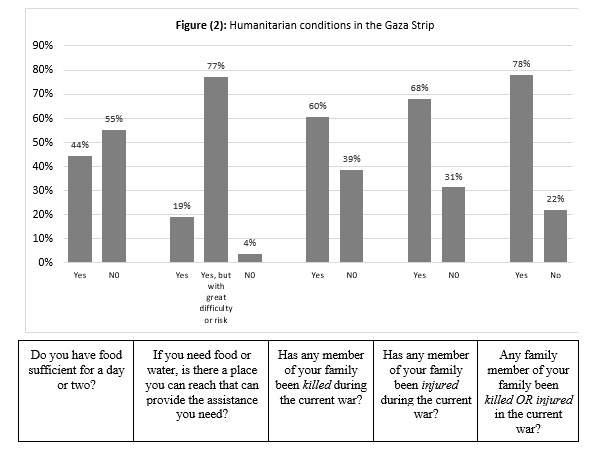
- We asked Gazans about the availability of essential needs: water, food, electricity, tents, covers, clothing, medical care, and toilets. Those who said “Yes, available” ranged between 10% for tents and 33% for water. But the largest percent said these needs are available but with great difficulty and risk. This was particularly the case for medical care, tents, food, water, and electricity. The needs that seem unavailable at all for the largest percentage of Gazans are tents, clothing, and covers.

We asked those in shelters about the identity of the organizers in charge. The majority of the respondents (62%) said it was UNRWA, 15% said it was government, 13% local Palestinian group, and 8% said other international organization.

- We asked respondents to assess, based on their personal experience, the fairness of aid distribution to displaced residents currently in shelters. The vast majority (70%) said it was discriminatory while only 27% said it was fair. When we crosstabulated these responses based on the identity of the shelters’ organizers, it becomes clear, as shown in the following figure, that greatest complaint (90%) comes from those in shelters organized by local Palestinian groups, followed by those organized by UNRWA, other international organizations, and the government.

- A majority of 64% (compared to 52% three months ago) blames Israel for the current suffering of Gazans in the current war while 20% (compared to 26% three months ago) place the blame on the US; only 7% (compared to 11% three months ago) place the blame on Hamas, and 6% (compared to 9% three months ago) blame the PA. It is worth noting that the percentage of Gazans who place the blame on Hamas has dropped from 19% to 9%.
3. War crimes and atrocities:
- As we found in the previous poll, almost all Palestinians (94% think Israel has committed war crimes during the current war. By contrast, only 5% (compared to 10% three months ago) think Hamas also committed such crimes; 4% think Israel has not committed such crimes and 91% think Hamas did not commit war crimes during the current war.
- 80% (compared to 85% in December 2023) say they did not see videos, shown by international news outlets, showing acts committed by Hamas against Israeli civilians, such as the killing of women and children in their homes; only 19% (11% in the West Bank and 30% in the Gaza Strip) saw these videos.
- We asked those who did not see the videos to tell us the reasons they have not seen them: 60% said that the media they watched did not show them while 20% (14% in the West Bank and 31% in the Gaza Strip) said that they did not want to watch them.
- When asked if Hamas did commit these atrocities that are seen in these videos, the overwhelming majority (93%) said no, it did not, and only 5% said it did. As shown in the figure below, the belief that Hamas fighters have committed atrocities against civilians is higher among those who did watch videos showing such atrocities (17%) compared to those who did not (2%).

4. Possible ramifications of an Israeli ground invasion of Rafah:
We explored three possible ramifications of an Israeli invasion of Rafah: people rushing to cross the border with Egypt, perception of likely Egyptian police and army response to such development, and the likely behavior of the residents and displaced person when they see people crossing the border toward Egypt:
- We asked the public to speculate about the likely behavior of Rafah residents and displaced persons in the event of an Israeli invasion of that city: would these people in this case rush to safety on the Egyptian side? While half of the West Bankers expect them to do so, only 24% of Gazans say residents and displaced person would rush towards the border and cross to safety in Egypt. In total, 40% said they think they would and 51% said they think they would not.
- We then examined public perception of the likely behavior of the Egyptian army and police, on the other side of the border, when seeing masses of people rushing and crossing the border into Egypt. Findings show a majority of 61% thinks the Egyptian army and police would indeed shoot at those crossing the borders. Gazans are more likely than West Bankers to think so, 68% and 55% respectively.

- We asked Gazans about their own behavior if they see people rushing toward the Egyptian border and seeing the separation barrier between Egypt and Rafah falling, would they leave home or shelter in search of safety and cross the borders with the others? Almost 70% said no, they would not; only 25% said yes, they would.

5. South Africa and the case of genocide at the International Court of Justice
- We asked the public about its satisfaction or dissatisfaction with South Africa for bringing the case of genocide against Israel to the international Court of Justice (ICJ). The vast majority (78%) expressed satisfaction; only 19% expressed dissatisfaction. But almost two thirds of the public (65%) expressed dissatisfaction with the court’s decision that did not ask Israel to abide by a ceasefire; only 31% expressed satisfaction with the court’s decision. Moreover, only 37% expressed the belief that the ICJ would indeed eventually convict Israel of genocide. A majority of 59% said it did not expect the ICJ to issue such a conviction.
- Finally, when asked if such conviction, if it happens, would contribute to force Israel to consider ending its occupation of the Palestinian territories in the West Bank and the Gaza Strip, a majority of 72% said no; only 23% said yes. It is noticeable that Gazans, as shown below, show a little more satisfaction with the court’s decision and optimism regarding the likely court decision and the impact of such a decision on the larger question of the Israeli occupation of the Palestinian territories.

6. Expectations regarding the ceasefire and who will win the war
- We asked the public about its expectations for the following weeks and months regarding the war and the prospects for a ceasefire. The largest percentage (40%) expect Israel and Hamas to reach a permanent ceasefire while 27% expect the continuation of the war and 25% expect the expansion of the war to include other regional and non-regional states and actors. The expectations of a ceasefire is much higher in the West Bank than in the Gaza Strip, 50% and 27% respectively. The largest percentage of Gazans (38%) expects the war to continue while only 20% of West Bankers expect that.

- As we did in December 2023, we asked in the current poll “who will win” this war. Today, the majority expects Hamas to win. But it is a little smaller majority than we found three months ago, 64% and 70% respectively. It is worth noting, as indicated in the figure below, that today, more Gazans expect Hamas to win than three months ago, 56% and 50% respectively. By contrast, today, less West Bankers expect Hamas to win than three months ago, 69% and 83% respectively. It is worth noting also that while almost no one in the West Bank expect Israel to win the current war, almost one fifth (19%) of Gazans expect Israel to win. The current percent of those Gazans who expect Israel to win is more than a third less than the case three months ago, 19% and 31% respectively.

7. “The Day After:” Who will rule Gaza after the war?
- We asked the respondents to speculate about the party that will be in control of the Gaza Strip in the day after the end of the current war. Gazans and West Bankers agree by 59%, for each side, that it will be Hamas. This represents a drop of 5 points compared to our findings three months ago. The drop came from the West Bank, declining by 14 points while in the Gaza Strip the percentage of those who thought Hamas will be in control increased by 8 points. Only 5% think the Israeli army will be in control; 9% selected a PA under president Abbas, and another 9% selected the PA without Abbas; 2% selected one or more Arab country; and 2% selected the UN.
- When asked about their own preferences for the party that should be in control in the Gaza Strip after the war, 59% (64% in the West Bank and 52% in the Gaza Strip) selected Hamas; 13% selected the PA without President Abbas; 11% selected the PA with Abbas; 3% selected one or more Arab country;1% selected the UN, and 1% selected the Israeli army. Three months ago, we asked an identical question, but with a slightly different set of options to choose from. At that time, a similar percentage (60% in total; 75% in the West Bank and 38% in the Gaza Strip) selected Hamas as the party preferred by the respondents to control the Gaza Strip after the war. The change in the preferences of the Gazans, with a 14-point increase among them selecting Hamas today, is one of the most intriguing findings of the current poll. But it is consistent with the increase, indicated above, in the percentage of Gazans who think Hamas will win the current war. This is particularly interesting because the opposite happened in the West Bank, with the preference for Hamas dropping significantly by 11 points. Yet, this West Bank finding is consistent with the significant decrease by 14 points, also indicated above, in the percentage of West Bankers who think Hamas will win the war.

- In another question involving speculation about the most likely scenario for the day after the war, the results were almost identical, to the question asked above, as 59% said Hamas will return to control the Gaza Strip. But unlike the first question above, 63% of the West Banker and only 52% in the Gazans expected that. The reason for the change has to do with the available set of scenarios we provided in which we omitted the option of a return of the PA without president Abbas and provided new possibilities, such as the establishment by Israel of local authorities, tribal and family control, the emergence of multiple armed groups. The return of the PA under Abbas was expected by 11%, 6% expected Israel to establish local authorities, another 6% expected the Israeli army to assume control, 4% expected control by tribes and families, and another 4% expected the establishment of multiple armed groups.
- Here too we asked about preferences regarding these scenarios. Given the new choices, the most important change, compared to the earlier question, about preferences in the day after the war, has been the rise in the percentage that selected Hamas. As shown in the figure below, the return of Hamas reaches 63%, with a 7-point increase in the Gaza Strip compared to only 2-point increase in the West Bank. Gazans were also more likely to increase their support for the return of the PA, even if under Abbas’ control, with a 14-point rise. West Bankers increased their support for a PA under Abbas by only 3 points.

- Our previous poll in December 2023 asked about the deployment of an Arab security contingent from Egypt and Jordan in the Gaza Strip. At that time, three months ago, we found a 70% opposition to the idea even if the forces were deployed to assist the PA security forces. In this poll, we asked the respondents to speculate about attitudes of Gazans toward a possible deployment of Turkish forces in the Gaza Strip. But this scenario stated that such deployment would take place with Hamas’ approval and international cover and funding. The findings show the majority thinks Gazans would reject the idea. The assessment of Gazans however shows a split with 51% believing Gazans would welcome the deployment and 48% believing they would reject it.

- Finally, we asked the public about if it is for or against an idea of a long-term vision for the day after in which the US and an Arab coalition comprising Egypt, Saudi Arabia, and Jordan would develop a plan that would strengthen the PA, restore negotiations based on the two-state solution, and bring about an Arab-Israeli peace and normalization. Almost three quarters (73%) said it stands against the idea and only 23% said it stands for it. It is worth noting that the support for the idea among Gazans is much higher than it is among West Bankers, 36% and 14% respectively.+

8. Satisfaction with relevant Palestinian, regional, and international actors:
- The vast majority (83%) thinks the US administration repeated declarations about the reaching a two-state solution are not serious; only 15% (9% in the West Bank and 23% in the Gaza Strip) think they are serious.
- As we did in our previous poll, we asked in the current one about public satisfaction with the role played during the war by various Palestinian, Arab/regional, and international actors:
1. On the Palestinian side, satisfaction with the role of Hamas remains stable at 70% (75% in the West Bank and 62% in the Gaza Strip) was the highest followed by the role played by Yehia Sinwar (61%; 68% in the West Bank and 52% in the Gaza Strip), Fatah (27%; 24% in the West Bank and 32% in the Gaza Strip), and president Abbas (14%; 8% in the West Bank and 22% in the Gaza Strip). As the figure below indicates, support for Hamas, while indeed stable for the total, has in fact dropped in the West Bank by 10 points, from 85% three months ago to 75% today. The opposite happened in the Gaza Strip: satisfaction with Hamas increased by 10 points. Satisfaction with Sinwar remains stable in the Gaza Strip and drops 13 points in the West Bank. Satisfaction with Fatah increases by 5 points for the total, 1 point in the West Bank and 11 points in the Gaza Strip. Finally, satisfaction with Abbas increases by 3 points, 1 point in the West Bank and 5 points in the Gaza Strip.

2. For the Arab/regional actors, as in our previous poll, the highest level of satisfaction goes to Yemen (83%; 88% in the West Bank and 75% in the Gaza Strip), followed by Qatar (56%), Hizballah (48%), Iran (30%), Jordan (22%), and Egypt (12%). The following figure shows the distribution of satisfaction in the two polls over the West Bank and the Gaza Strip. In the Gaza Strip, the figure shows a significant rise in satisfaction with Yemen and Qatar and a decrease in satisfaction with Hezbollah and Egypt. In the West Bank, the figure shows a rise in satisfaction with Hezbollah and a decrease in satisfaction with Qatar, Iran, Jordan, and Egypt. The regional Arab country that has lost satisfaction in both the West Bank and the Gaza Strip is Egypt, cut down by half to 12% for the total, 5% in the West Bank and 23% in the Gaza Strip.

3. For the non-regional international actors, the highest level of satisfaction goes to Russia (19%, 21% in the West Bank and 16% in the Gaza Strip), followed by the UN (7%), and the US (1%). The following figure shows a drop of 3 points in satisfaction with Russia for the total sample. The drop came from the Gaza Strip (12 points) while satisfaction with Russia in the West Bank increased by 4 points. Satisfaction with the US performance remains non-existent.

(2) Parliamentary and presidential elections and the domestic balance of power: |
If a presidential competition is to take place between three, Marwan Barghouti from Fatah, Mahmoud Abbas, also from Fatah, and Ismael Haniyeh from Hamas, participation in the election would stand at 72%; vote for Marwan Barghouti would stand at 40%, the highest rate in the last three hypothetical elections since September 2023, followed by Haniyeh at 23%, and Abbas at 8%. Among the voters, Barghouti receives 56%, Haniyeh 32%, and Abbas 11%. Three months ago, support for Barghouti among the voters stood at 47% and Haniyeh at 43%, and Abbas at 7%. These findings show Barghouti’s vote increasing by 9 points while vote for Haniyeh drops by 11 points.

- However, if the new presidential elections were held with only two candidates, Mahmoud Abbas from Fatah and Ismail Haniyeh from Hamas, competing, the voter turnout would drop to 52%; vote for Haniyeh would stand at 37% and Abbas at 11%. Among the voters, Haniyeh would receive 70% and Abbas 22%. Three months ago, the vote for Abbas among the voters stood at 16% and vote for Haniyeh stood at 78%.

- But if the two presidential candidates were Marwan Barghouti from Fatah and Haniyeh from Hamas, participation would rise to 69%; 42% would vote for Barghouti and 26% for Haniyeh. Among the voters, Barghouti would receive 62% and Haniyeh 37%. These findings indicate a rise in the vote for Barghouti among voters by 11 points and a drop in the vote for Haniyeh by 8 points.

- If the two presidential candidates were Haniyeh from Hamas and a different Fatah candidate, prime minister Mohammad Shtayyeh, participation would drop to 53%; 13% would vote for Shtayyeh and 38% for Haniyeh. Among the voters, Shtayyeh receives 24% and Haniyeh 72%.

- Finally, if the two presidential candidates were Haniyeh from Hamas and a non-Fatah candidate, Mustafa Barghouti, the leader of al Mubadara and a former presidential candidate, the voter turnout rises slightly to 56%; Mustafa Barghouti receives 23% and Haniyyeh 31%. Among the voters, Mustafa Barghouti receives 40% of the vote and Haniyyeh 56%.

- In a closed question, we asked the public to select the person they prefer to see as President Abbas's successor. The largest percentage (40%) said they prefer Marwan Barghouti; 19% preferred Ismail Haniyeh; 10% chose Yahya al Sinwar; 6% chose Hussein al-Sheikh; 4% preferred Mohammed Dahlan, 2% preferred Khaled Meshaal, 1% chose Muhammad Shtayyeh, and 18% said they did not know or chose someone else. It is worth noting that the preference for Dahlan, al-Sheikh, and Shtayyeh comes almost only from the Gaza Strip.
- Level of satisfaction with the performance of president Abbas stands at 16% and dissatisfaction at 81%. Satisfaction with Abbas stands at 8% in the West Bank (compared to 10% three months ago) and 27% in the Gaza Strip (compared to 19% three months ago). Six months ago, before the October 7 war, satisfaction with Abbas stood at 22% and dissatisfaction at 76%.
- 84% want Abbas to resign while 14% want him to remain in office. Three months ago, 88% said they want Abbas to resign. Six months ago, 78% wanted him to resign. Demand for Abbas' resignation today stands at 93% in the West Bank and 71% in the Gaza Strip.

- When asked which political party or political trend they support, the largest percentage selected Hamas (34%), followed by Fatah (17%), while 11% selected other or third-party groups, and 37% said none of them or did not know. Three months ago, 43% supported Hamas and 17% selected Fatah. Six months ago, before the current war, support for Hamas stood at 22% and support for Fatah stood at 26%.This means that support for Hamas during the past three months has witnessed an 11-point drop while support for Fatah remained unchanged during the same period. In the West Bank, support for Hamas today stands at 35% (compared to 44% three months ago), and for Fatah at 12% (compared to 16% three months ago). In the Gaza Strip, support for Hamas today stands at 34% (compared to 42% three months ago) and support for Fatah at 25% (compared to 18% three months ago).

- However, if new parliamentary elections were held today with the participation of all political forces that participated in the 2006 elections, only 64% say they would participate in them, 30% would vote for Hamas, 14% for Fatah, 6% for third parties, and 15% remain undecided. Among the voters, support for Hamas stands at 47%, Fatah 22%, third parties 9%, and the undecided at 24%. Compared to our findings three months ago, the current results among the voters indicate a 4-point drop by for Hamas and a 3-point rise by Fatah. In the Gaza Strip, vote for Hamas among the voters stands today at 45% (compared to 52% three months ago and 44% six months ago) and vote for Fatah among the voters stands today at 26% (compared to 21% three months ago and 32% six months ago). In the West Bank, vote for Hamas among the voters stands today at 48% (compared to 50% three months ago and 24% six months ago) and vote for Fatah among the voters stands today at 16% (compared to 18% three months ago and 40% six months ago).

- 49% (compared to 54% three months ago) believe that Hamas is the most deserving of representing and leading the Palestinian people today while 17% (compared to 13% three months ago) believe that Fateh under the leadership of Abbas is more deserving; 29% (compared to 26% three months ago) believe both are unworthy of representation and leadership. Six months ago, 27% said Hamas is the most deserving, 24% said Fateh led by Abbas is the most deserving, and 44% said both are unworthy of representation and leadership.
(3) Domestic conditions, the resignation of Shtayyeh, and perception of safety and security: |
- We asked the public about the meaning of the resignation of the government of prime minister Mohammad Shtayyeh: is it, in its view, a step toward reforming the PA? A majority of 62% said it is not and only 30% said it is. Gazans are more likely than West Bankers to view the resignation as a step toward reform, 41% and 23% respectively.
- In the aftermath of the resignation of prime minister Shtayyeh, two candidates emerged as the most likely successors: Mohammad Mustafa (reportedly favored by Abbas) and Salam Fayyad (reportedly favored by some regional and international donors). We asked the public, which of the two it favors: 55% said none of them; 22% favored Fayyad and 10% favored Mustafa. Eventually, after the completion of data collection, Mustafa was appointed by Abbas as his next prime minister.
- We asked the public about the make-up and source of authority for the new government: a national unity government that would come under the control of a political party, control of president Abbas, or one that does not come under the control of Abbas or a political party. As the figure below shoes, 62% opted for the third choice while only a quarter selected the two other choices combined. It is worth noting that Gazans are less likely than West Bankers to go for the third choice.

- A majority of 65% (compared to 68% three months ago) believes that the PA has become a burden on the Palestinian people and only 27% (compared to 28% three months ago) believe it is an asset for the Palestinian people. Six months ago, 62% said the PA is a burden and 35% said it was an achievement.
- We asked the public in the West Bank about its personal and family safety and security. The findings show that only 11% feel safe and secure while 89% feel unsafe and unsecure. Three months ago, the perception of safety stood at 14% and six months ago at 48%.
- Aljazeera is the most watched TV station in Palestine with 61% selecting it as the one they watched the most during the past two months. West Bankers are more likely than Gazans to watch Aljazeera as 45% of Gazans (compared to 10% in the West Bank) say they do not watch or have no access to TV these days. The second most popular TV station is Palestine Today (4%), followed by Alarabiyya and al Mayadeen (3% each), Palestine TV (2%), Alaqsa and Ma’an (1% each).
(4) Palestinian-Israeli Relations and the Peace process: |
- 45% support and 52% oppose the idea of a two-state solution, which was presented to the public without providing details of the solution. Three months ago, support for this solution in a similar question stood at 34% and six months ago support stood at 32%. In the current poll, support for this solution came from Gaza Strip, a 27-point increase while remaining stable in the West Bank at 34%.

- Support for the two-state solution is usually linked to public assessment of the feasibility of such a solution and the chances for the establishment of a Palestinian state. Today, 61% (compared to 65% three months ago) believe the two-state solution is no longer practical due to settlement expansion but 37% (compared to 32% three months ago) believe it is still practical. Six months ago, 71% said that the two-state solution is no longer practical due to settlement expansion. Moreover, 72% believe that the chances for the establishment of an independent Palestinian state alongside Israel in the next five years are slim or nonextant, and 27% believe the chances are medium or high.
- When asked about public support and opposition to specific policy measures to break the stalemate: 62% supported joining more international organizations; 45% supported resort to unarmed popular resistance; 55% supported a return to confrontations and armed intifada; 58% supported dissolving the PA; and 24% supported abandoning the two-state solution and demanding one state for Palestinians and Israelis. Three months ago, 69% supported a return to confrontations and armed intifada; 39% supported resort to unarmed popular resistance; 58% supported the dissolution of the PA; and 29% supported abandoning the two-state solution in favor of one state. Six months ago, before the current war, 58% supported a return to confrontations and armed intifada; 53% supported resort to unarmed popular resistance; 52% supported the dissolution of the PA; and 27% supported abandoning the two-state solution in favor of one state.
- We offered the public three methods to end the Israeli occupation and establish an independent state and asked it to select the most effective. 46% (51% in the West Bank and 39% in the Gaza Strip) selected “armed struggle;” 25% (27% in the West Bank and 23% in the Gaza Strip) selected negotiations; and 18% (12% in the West Bank and 27% in the Gaza Strip) selected popular non-violent resistance. As shown in the figure below, these findings indicate a 17-point drop in support for armed struggle; a 5-point rise in support for negotiations; and a 5-point rise in support for non-violence. The drop in three months in support for armed struggle comes equally from both the West Bank and the Gaza Strip.

- Support and opposition to negotiations is seen in the results to a question about attitudes regarding “a return to Palestinian-Israeli peace negotiations in order to achieve a two-state solution under international and Arab auspice.” Support for such return to negotiations received the support of 38% (46% in the Gaza Strip and 33% in the West Bank) of the public.

- In light of the increase in settler terrorist attacks against Palestinian towns and villages, we asked West Bankers what means are most effective in combating this terrorism that are also the most feasible.
The largest percentage (41%) chose the formation of armed groups by residents of the targeted areas in order to protect their areas; 23% chose to deploy Palestinian police forces in the targeted areas; another 23% chose the demand that the Israeli army take measures to prevent settler terrorism; and only 8% chose the formation, by residents of the targeted areas, of unarmed groups to protect their areas. As the figure below indicates, these results show significant change compared to out findings three months ago. The most important change is a 15-point drop in support for the formation of armed groups, an 8-point increase in the demand for protection by the PA police; and a 7-point increase in the demand for an Israeli army measures to stop the settlers.

(5) Most vital Palestinian goals and the most pressing problems confronting Palestinians today: |
- 42% believe that the first most vital Palestinian goal should be to end Israeli occupation in the areas occupied in 1967 and build a Palestinian state in the West Bank and the Gaza Strip with East Jerusalem as its capital. By contrast, 33% believe the first most vital goal should be to obtain the right of return of refugees to their 1948 towns and villages; 13% believe that the first and most vital goal should be to build a pious or moral individual and a religious society, one that applies all Islamic teachings; and 11% believe it should be to establish a democratic political system that respects freedoms and rights of Palestinians.
- When asked about the most pressing problem confronting the Palestinians today, the largest percentage (56%; 66% in the Gaza Strip and 50% in the West Bank) said it is the continued war in the Gaza Strip; (23%) said it is the Israeli occupation; 8% said it is corruption; 6% said it is unemployment; and 5% said it is the split between the West Bank and the Gaza Strip. Three months ago, (51%, 42% in the West Bank and 64% in the Gaza Strip) said it is the continued war in the Gaza Strip; and 32% said it is the Israeli occupation.
In the aftermath of Israel’s military operation in Gaza and the February elections, Israelis and Palestinians share hawkish positions and gloomy expectations regarding the peace process
Among other findings of the joint Truman PSR poll: Both Palestinians and Israelis believe that given the outcome of the Israeli military operation in Gaza, Palestinians are worse off than before the operation. Two thirds of Israelis believe that Israel stopped its military operation in Gaza too early, but only 30% think that Israel should reoccupy the Gaza Strip and stay there if shelling of Israeli communities continues
These are the results of the most recent poll conducted jointly by the Harry S. Truman Research Institute for the Advancement of Peace at the Hebrew University of Jerusalem and the Palestinian Center for Policy and Survey Research in Ramallah, between March 1-7, 2009. This joint survey was conducted with the support of the Ford Foundation Cairo office and the Konrad Adenauer Stiftung in Ramallah and Jerusalem.
Both Israelis and Palestinians oppose return to Palestinian-Israeli final status negotiations before the Roadmap conditions for each side are met -- cessation of Palestinian violence on one hand and an Israeli freeze on settlement activity on the other. Both sides are also pessimistic with regard to the prospects of the establishment of an independent Palestinian state next to the state of Israel in the near future and the ability of the new Israeli government to reach a settlement.
Support for a cease fire between Israel and Hamas in Gaza has been steadily declining among Israelis in the last months and reached 48% in our March poll. Among Palestinians support for a cease fire is stable, and 75% of Palestinians support it.
The joint poll also examined threat perceptions and support for violence in the aftermath of the Israeli military operation in Gaza and domestic political issues on both sides.
The Palestinian sample size was 1270 adults interviewed face-to-face in the West Bank, East Jerusalem and Gaza Strip in 127 randomly selected locations between March 5-7, 2009. The margin of error is 3%. The Israeli sample includes 602 adult Israelis interviewed by phone in Hebrew Arabic or Russian between March 1-3, 2009. The margin of error is 4.5%. The poll was planned and supervised by Dr. Yaacov Shamir, the Harry S. Truman Research Institute for the Advancement of Peace and the Department of Communication and Journalism at the Hebrew University, and Dr. Khalil Shikaki, director of the Palestinian Center for Policy and Survey Research (PSR).
For further details on the Palestinian survey contact PSR director, Dr. Khalil Shikaki or Walid Ladadweh, at tel. 02-2964933 or email pcpsr@pcpsr.org. On the Israeli survey, contact Dr. Yaacov Shamir at tel. 03-6419429 or email jshamir@mscc.huji.ac.il.
MAIN FINDINGS
(A) Negotiation Tracks on the Agenda
The Israeli-Palestinian track
- 48% of the Israelis support the renewal of the cease fire with Hamas in Gaza and 47% oppose it. These results indicate further decline in support for a cease fire in the last six months: in December 2008 51% supported it and 44% opposed it, and in September 55% supported and 39% opposed it. Among Palestinians support for a cease fire is similar to what it was in December: 75% support and 23% oppose the renewal of the cease fire in Gaza
- 50% of the Israelis support and 48% oppose talks with Hamas if needed to reach a compromise agreement with the Palestinians. In December 2008, 55% supported and 43% opposed such talks. A sizeable Israeli majority (69%) support and only 27% oppose talks with a national unity government composed jointly of Hamas and Fatah if such a government is reestablished. In December 2008 these figures were 67% and 30% respectively.
- 38% of the Palestinians support and 58% oppose return to Palestinian-Israeli final status negotiations before an Israeli freeze on settlement activity. 40% of Israelis support and 58% oppose return to Palestinian-Israeli final status negotiations before cessation of Palestinian violence.
- 70% of the Israeli public don’t believe that the new Israeli government will succeed to lead Israel to a final status settlement with the Palestinians, while 18% believe it will succeed. Among the Palestinians, 7% expect that negotiations with the new government will be more successful in ending settlement expansion and bringing peace, and 62% expect settlements to continue to expand and peace efforts to fail. In this regard, 70% of the Palestinians think that there is no difference between Israeli right-wing parties and parties of the center and left; 26% think that there are differences between them.
- 73% of the Palestinians and 60% among Israelis think that chances for the establishment of an independent Palestinian State next to the State of Israel in the next five years are non-existent or low; 24% of the Palestinians and 37% of the Israelis believe the chances are medium or high.
- 58% of the Israelis and 50% of the Palestinians agree that after the establishment of an independent Palestinian state and the settlement of all issues in dispute, including the refugees and Jerusalem issues, there will be a mutual recognition of Israel as the state of the Jewish people and Palestine as the state of the Palestinian people.
The Arab League (Saudi) Plan
- 64% of the Israelis oppose and 33% support the Saudi initiative which calls for Arab recognition of and normalization of relations with Israel after it ends its occupation of Arab territories occupied in 1967 and after the establishment of a Palestinian state. The plan calls for Israeli retreat from all territories occupied in 1967 including Gaza the West Bank, Jerusalem and the Golan Heights, and the establishment of a Palestinian state. The refugees problem will be resolved through negotiation in a just and agreed upon manner and in accordance with UN resolution 194. In return, all Arab states will recognize Israel and its right to secure borders, will sign peace treaties with her and establish normal diplomatic relation. In our December 2008 poll 61% of the Israelis opposed the plan while 36% supported it. Among Palestinians, 58% support the plan and 39% oppose it; in December 2008, 66% supported the plan and 30% opposed it.
Israeli-Syrian Track
- 63% of Israelis oppose full evacuation of the Golan Heights in return for a complete peace agreement with Syria, and 28% support it. If in the peace agreement, Syria will commit to disconnect itself from Iran and stop its support of Hizbulla and Hamas, support increases to 39%.
- 71% of the Israeli public do not believe that the new Israeli government will succeed to lead Israel to a peace agreement with Syria, while 19% believe it will succeed.
(B) Conflict Management, Threat Perceptions and Support for Violence
- Among Israelis, 30% suggest that Israel should reoccupy the Gaza Strip and stay there if the shelling of Israeli communities from the Gaza Strip continues; 38% think that Israel should carry out ad-hoc operations against the shelling and get out; 28% believe that Israel should use primarily diplomatic rather than military steps.
- 43% of the Israelis believe that Israel cannot overthrow the Hamas regime in Gaza while 55% believe it can.
- With regard to the recent military operation of Israel in Gaza, 66% of the Israelis believe that Israel stopped the operation too early, 15% think it was stopped too late, and 16% think it was stopped in the right time
- 11% of the Palestinians believe that given the outcome of the Israeli operation in Gaza Palestinians are today better off than before the operation, 71% believe they are worse off, while 17% think they are about the same. Among Israelis, 16% believe Palestinians are today better off than before the operation, 58% believe they are worse off, and 22% think they are about the same.
- Now in the aftermath of the Israeli operation in Gaza, 11% of the Palestinians and 7% of the Israelis expect that the two sides will go back to negotiations and that armed confrontations will stop. On the other hand, 33% and 40% respectively believe that armed confrontations will not stop and the two sides will not return to negotiations. 50% of the Palestinians and 51% of the Israelis believe that the two sides will return to negotiations but some armed confrontations will continue.
- 44% among Israelis, think that Palestinian armed confrontations so far have helped them to achieve national and political goals that negotiations could not achieve; 52% of the Israelis don’t think so.
- 54% of the Palestinians support and 42% oppose armed attacks against Israeli civilians inside Israel.
- Among Israelis, 60% are worried that they or their family may be harmed by Arabs in their daily life. Among Palestinians 50% fear that their security and safety and that of their family are not assured.
- A majority of the Israeli public believe (54%) that Israel should bomb the Iranian nuclear reactor if the efforts of the international community to prevent Iran from developing nuclear weapons fail. 35% oppose it.
(C) Israeli Domestic Political Affairs
- 57% of the Israeli public support and 37% oppose a law proposed by the Israel Beitenu party which makes civil rights conditional upon a declaration of loyalty to the state.
- 50% of the Israeli public support and 32% oppose a law proposed by the Israel Beitenu party that will permit registration as a couple for those banned by the religious establishment to marry (similar to civic marriage).
- In the poll we also examined the Israeli public's assessments of the current economic crisis. 62% blame the world economic crisis and the globalization process; 25% put the blame on mismanagement of the economy by the current and previous government. 7% percent of the Israelis believe that the crisis stems mainly from the Intifada and the cessation of foreign investments, and 4% blame welfare payments which don't encourage people to go out to work. As to the conditions needed to put the economy back on track, 70% believe it is possible to solve the crisis without a political process with the Palestinians, while 27% believe that it is impossible. In the 2003 economic crisis (in our April 2003 poll), most Israelis believed that the crisis stemmed mainly from the Intifada which brought about the cessation of foreign investments, and about half believed it was impossible to solve the crisis without a political process with the Palestinians.
- Israelis were asked about their preferences about government spending in several areas. 94% of the public support more spending for creating jobs, 86% support more spending for healthcare, 84% support more spending for education and only 59% support more spending for national security. On the other hand, 51% prefer to reduce spending on settlements, and 54% would like to see less spending for religious establishments and seminaries. These results are very similar to those obtained in our April 2003 poll which followed the 2003 elections with respect to jobs and healthcare. Support for increased government spending for education and national security increased by about 10%; while opposition to spending on settlements and religious establishments dropped by 19% and 12% respectively.
(D) Palestinian Domestic Political Affairs
- If new presidential elections were held today and the two candidates were Ismail Haniyeh and Mahmud Abbas, the former receives 47% of the vote and the later 45%. Three months ago, Abbas received 48% and Haniyeh 38%. In the Gaza Strip Abbas wins with 50% of the vote compared to 44% for Haniyeh. But if the competition was between Marwan Barghouti and Haniyeh, the former wins with 61% of the vote compared to 34% for Haniyeh. Three months ago, Barghouti received 59% and Haniyeh 32%.
- Popularity of Hamas increases from 28% in our December 2008 poll to 33% in this poll while the popularity of Fateh drops from 42% to 40% during the same period. The gap between Fateh and Hamas reaches 12 percentage points in favor of Fateh in the Gaza Strip but reaches only 3 percentage points in the West Bank, also in favor of Fateh.
- Decline in the popularity of Abbas and Fateh reflects a decline in the percentage of popular satisfaction with the performance of president Abbas from 46% three months ago to 40% in this poll. Moreover, positive evaluation of the performance of Salam Fayyad’s government declines from 34% to 32% during the same period while positive evaluation of the performance of Haniyeh’s government increases significantly from 36% to 43%.
- Moreover, it seems that public perception of the ending of Abbas’s term in office is leading 27% to believe that the legitimate president today is the Speaker of the Palestinian Legislative Council, and 24% to believe that there is no legitimate president today, while only 39% believe that the legitimate president today is Abbas.
Palestinian Public Opinion Poll No (38)
In the fourth quarter of 2010:
While demand for holding local elections increases, and while pessimism regarding the chances for reconciliation increases, and while criticism of the PA for suppression of freedoms increases, credibility of the authorities in the West Bank and the Gaza Strip diminishes, support for a permanent settlement along the lines of the Clinton Parameters and the Geneva Initiative decreases, and two thirds oppose return to negotiations with Israel before it freezes settlement construction despite the fact that a majority believes Israel would be the first to benefit from no negotiations
16-18 December 2010
These are the results of the latest poll conducted by the Palestinian Center for Policy and Survey Research (PSR) in the West Bank and the Gaza Strip between 16-18 December 2010. Before the conduct of the poll, authorities in the West Bank arrested a Hamas cell and accused it of plotting to assassinate the governor of Nablus and Hamas sentenced three Fateh members to death after convicting them of killing a Gazan mosque preacher. A meeting in Damascus between Fateh and Hamas representatives failed to reach an agreement on reconciliation. On the peace process front, the US announced that it has ceased to press Israel on the need to freeze settlement construction and urged Palestinians and Israelis to enter into indirect negotiations it promised to sponsor. This poll covers issues related to domestic conditions: the performance of the governments of Salam Fayyad and Ismail Haniyeh, the internal balance of power between Fateh and Hamas, the future of reconciliation and reunification, and the views of the public on the most vital Palestinian goals and the most serious problems confronting Palestinians today. The poll also covers issues related to the peace process and public attitude toward a permanent settlement as well as Palestinian perception of the views of the Israeli Jewish majority of various calls and proposed legislation that seeks to discriminate against Arabs. Total size of the sample is 1270 adults interviewed face to face in 127 randomly selected locations. Margin of error is 3%. For further details, contact PSR director, Dr. Khalil Shikaki, or Walid Ladadwehat tel 02-296 4933 or email pcpsr@pcpsr.org.
Main Findings:
Findings of the fourth quarter of 2010 indicate an increase in the level of pessimism regarding the chances for reconciliation and restoration of unity between the West Bank and the Gaza Strip. They also indicate an overwhelming rejection of alternative forms of relations between the West Bank and the Gaza Strip such as a confederation or separate elections in each region. Findings also show widespread distrust in the authorities in both the West Bank and the Gaza Strip regarding Fateh-Hamas relationship. For example, only a quarter or less believe as true the news about a Hamas plot to assassinate the governor of Nablus or that the three Fateh members sentenced to death in Gaza have received a fair trial. Findings also point out to a significant and continued deterioration in public perception of the level of freedoms enjoyed by citizens in the West Bank and the Gaza Strip since the split between these two areas in June 2007. For example, belief that citizens can criticize the authorities in the West Bank without fear retreated from 56% in September 2007 to 27% in this poll. Similarly a retreat occurred in the belief that citizens can criticize the authorities in the Gaza Strip without fear from 52% to 19% during the same period. It is worth noting that 70% of the public in the West Bank and the Gaza Strip believe that the government of Salam Fayyad should conduct local elections now that the Palestinian Supreme Court of Justice has annulled a previous decision by the government to cancel local elections that were scheduled to take place last July.
Finally, findings show that the balance of power between Fateh and Hamas has remained almost unchanged compared to the situation during the third quarter of the year. The same is true regarding the popularity of president Mahmud Abbas and Ismail Haniyeh. Moreover, findings regarding the balance of power in the fourth quarter of this year are very similar to those of the final quarter of 2009 which means that the internal and external developments throughout 2010 has left no impact on this critical issue of internal balance between Fateh and Hamas and Abbas andHaniyeh.
Findings show that two thirds of the public oppose return to US-sponsored indirect negotiations with Israel. But they also show that almost 60% believe that Israel would be the one to benefit from such a step while only 13% believe that Palestinians would benefit from not returning to negotiations. Findings also show that the public is still uncertain about the best alternative to negotiations: two groups support almost equally two options, going to the US Security Council and waging violent confrontations. A third group prefers a non violent resistance and a fourth prefers to dissolve the PA.
(1) Domestic Conditions
- · 17% describe conditions in the Gaza Strip as good or very good and 35% describe conditions in the West Bank as good or very good
- · 61% believe corruption exists in the institutions of the dismissed government in the Gaza Strip and 71% believe corruption exists in PA institutions in the West Bank
- · 60% believe that freedom of press exists, or exists to some extent, in the West Bank while 42% believe it exists, or exists to some extent, in the Gaza Strip
- · 27% believe that people can criticize the authorities in the West Bank without fear while 19% believe that people can criticize the authorities in the Gaza Strip without fear
- · Perception of personal safety and security stands at 61% among residents of the West Bank and 58% among residents of the Gaza Strip
- · Positive evaluation of the performance of the government of Ismail Haniyeh stands at 36% and Fayyad’s government at 43%, and 23% believe that Haniyeh’s government is the legitimate one while 29% believe that Fayyad’s government is the legitimate one
- · Satisfaction with the performance of president Mahmud Abbas stands at 50% and dissatisfaction at 45%
- · If new presidential elections were to take place today, Abbas would receive 56% and Haniyeh 38%, and if the candidates wereMarwan Barghouti and Haniyeh, the former would receive 65% and the latter 31%
- · If new parliamentary elections were to take place today, Hamas would receive 25% of the vote, Fateh 44%, all other lists combined 11%, and 20% remain undecided
- · Pessimism about the chances for reconciliation increases with 39% believing that current separation is permanent
- · If Hamas wins the next elections, chances for reconciliation and chances for removing the current siege would decrease while such chances would increase if Fateh wins the next elections
- · 65% reject alternative forms of association between the West Bank and the Gaza Strip, such as a confederation, and 32% support them; moreover, 76% reject and 22% accept holding separate elections in the West Bank and the Gaza Strip
- · Less than one quarter believes that Hamas was indeed planning to assassinate the governor of Nablus and only 22% believe the three Fateh members sentenced to death in the Gaza Strip have received a fair trial
- · 48% believe that the most vital Palestinian goal should be to end occupation and build a state and 21% believe it should be to build a pious or moral individual and a religious society, 20% believe it should be the right of return and 11% believe it should be democracy
- · 70% believe that that the government of Salam Fayyad should hold local elections and 24% believe it should not
17% describe conditions in the Gaza Strip as good or very good and 62% describe them as bad or very bad. In our last poll, three months ago, in September-October, only 11% describe conditions in the Gaza Strip as good or very good and 70% said it was bad or very bad. By contrast, 35% describe conditions in the West Bank as good or very good and only 31% describe them as bad or very bad. Three months ago, these percentages stood at 33% and 34% respectively. The evaluation of the residents of the West Bank to conditions in Gaza is not different from the evaluation of the residents of the Gaza Strip. But there is a difference between the evaluation of West Bank residents compared to that of the Gazans regarding West Bank conditions: 43% of the Gazans believe these conditions to be good or very good but 31% of West Bankers believe them to be good or very good.
71% say there is corruption in the PA institutions in the West Bank while only 61% say there is corruption in the institutions of the dismissed government in the Gaza Strip. These percentages are similar to those obtained three months ago. Among residents of the West Bank, 72%, compared to 69% among Gazans, believe there is corruption in the PA in the West Bank. By contrast, a higher percentage of Gazans believe there is corruption in the public institutions of the dismissed government in the Gaza Strip reaching 66% compared to 57% among residents of the West Bank.
60% say there is, or there is to some extent, press freedom in the West Bank and 34% say there is no such freedom in the West Bank. By contrast, 42% say there is, or there is to some extent, press freedom in the Gaza Strip while 47% say there is no such freedom in the Gaza Strip. These results are similar to those obtained three months ago. Yet, only 27% say people in the West Bank can criticize the authority in the West Bank without fear. By contrast, only 19% say people in the Gaza Strip can criticize the authorities in Gaza without fear. Since the split between the West Bank and the Gaza Strip, in June 2007, these percentages have witnessed gradual and significant decrease. As the table below shows, belief that people can criticize the authorities in the West Bank without fear stood at 56% while 52% believed that people can criticize the authorities without fear in the Gaza Strip. These percentages dropped in August 2008 to 47% for criticizing the authorities in the West Bank and 42% for criticizing the authorities in the Gaza Strip. A further drop occurred last September to 30% and 24% respectively.
Table (1): Gradual decrease in belief about the ability to criticize authorities in the West Bank or Gaza Strip since the spilt between the two areas
Date | Ability to criticize authorities in the West Bank | Ability to criticize authorities in the Gaza Strip |
December 2010 | 27% | 19% |
September 2010 | 30% | 24% |
March 2009 | 37% | 29% |
August 2008 | 47% | 42% |
September 2007 | 56% | 52% |
Perception of safety and security stands at 61% in the West Bank and 58% in the Gaza Strip. These results are similar to those obtained three months ago.
Positive evaluation of the performance of the governments of Ismail Haniyeh and Salam Fayyad remains unchanged as it was three months ago standing at 36% for the Haniyeh’s government and 43% for the Fayyad government. But findings show an increase in the percentage of Gazanswho say that political, security, and economic conditions force them to seek immigration to other countries from 37% three months ago to 45% in this poll. In the West Bank, the percentage of those wishing to immigrate remains unchanged at 24%.
Percentage of satisfaction with the performance of President Abbas did not change during the past three months standing today at 50% while 45% say they are not satisfied. Satisfaction with the performance of the president stands at 47% in the Gaza Strip and 52% in the West Bank.
23% say the government of Haniyeh is the legitimate Palestinian government and 29% say the Fayyad government is the legitimate one. 34% say both governments are illegitimate. These results indicate a slight decrease in the percentage of those who view the Haniyeh government as legitimate. The percentage of those who believe Haniyeh’s government is the legitimate one stands at 26% in the Gaza Strip compared to 21% in the West Bank. The percentage of those who believe Fayyad’s government is the legitimate one stands at 31% in the Gaza Strip compared to 28% in the West Bank.
If new presidential elections are held today, and only two were nominated, Abbas would receive the vote of 56% and Haniyeh 38% of the vote of those participating. The rate of participation in such election would reach 59%. Three months ago, Abbas received 57% and Haniyeh 36%. In the Gaza Strip, Abbas receives 53% and Haniyeh 43% and in the West Bank Abbas receives 59% and Haniyeh 34%. If the presidential elections were between Marwan Barghouti and Ismail Haniyeh, the former would receive 65% and the latter would receive 31% of the participants’ votes. The rate of participation in this case would reach 69%. In the Gaza Strip, Barghouti receives 61% and Haniyeh 37% and in the West Bank Barghoutireceives 68% and Haniyeh 27%. These results are similar to those obtained three months ago. Most popular figures selected by the public as possible vice presidents from a list of five provided to respondents are Marwan Barghouti (selected by 27% of the public), Ismail Haniyeh (18%),Salam Fayyad (16%) Mustafa Barghouti (11%), and Saeb Erekat (5%).
If new legislative elections are held today with the participation of all factions, 69% say they would participate in such elections. Of those who would participate, 25% say they would vote for Hamas and 44% say they would vote for Fateh, 11% would vote for all other third parties combined, and 20% are undecided. These results are similar to those obtained three months ago. Vote for Hamas in the Gaza Strip is 26% and in the West Bank 24%. Vote for Fateh in the Gaza Strip is 48% and in the West Bank 42%.
In light of the failure of the latest Damascus meeting between Fateh and Hamas, the public remains pessimistic about the future of reconciliation and the restoration of unity between the West Bank and the Gaza Strip: belief that the split is permanent increases from 30% three months ago to 39% in this poll. Percentage of those who believe that unity will be restored soon drops from 14% to 8% during the same period. 49%, compared to 51% three months ago, say unity will return but only after a long time. Findings show that responsibility for the continued split between the West Bank and the Gaza Strip is placed on Hamas by 15% of the respondents and on Fateh by 13% and on both together by 62%. But when asked about the future of the unity of the West Bank and the Gaza Strip if Hamas wins new elections, 55% say such a win would consolidate the split. But if Fateh wins, only 31% say its win would consolidate the split. Only 13% say a Hamas electoral victory would consolidate unity while 30% say a Fateh electoral victory would consolidate unity. Moreover, findings show that 86% believes that if Hamas wins the next presidential and legislative elections such victory would lead to the consolidation of the siege and boycott on the Palestinian government or would keep things as they are today. But if Fateh wins the next elections, only 41% believe this would lead to the tightening of the siege and blockade or would keep conditions as they are today. 55% believe that a Fateh victory would lead to the lifting of the siege and boycott but only 10% believe a Hamas victory would lead to the lifting of the siege and boycott.
65% reject and 32% accept an alternative relationship between the West Bank and the Gaza Strip -- other than a full restoration of unity -- such as a confederation even if this alternative is temporary. In the confederate system that was rejected by two thirds, the government of Haniyeh would continue to administer the affairs of the Gaza Strip and the government of Fayyad would continue to administer the affairs of the West Bank, but President Abbas would preside over the two regions. Support for this alternative reaches 26% in the Gaza Strip and 36% in the West Bank. Similarly, only 22% support and 76% oppose the holding of separate elections, one in the West Bank administered by the Fayyad government and one in the Gaza Strip administered by the Haniyeh government, even if this leads to the election of one legislative council and one president for the two regions. Support for the separate elections reaches 19% in the Gaza Strip and 24% in the West Bank.
Less than one quarter (24%) believes that Hamas was indeed plotting to assassinate the governor of Nablus and 41% do not believe that while 35% say they do not know or are not certain. Belief that Hamas was indeed plotting to assassinate the governor reaches 30% in the Gaza Strip compared to 21% in the West Bank. Similarly, only 22% believe that the three Fateh members sentenced to death by a court in the Gaza Strip --after being convicted of killing a Gaza Mosque preacher-- have received a fair trial. 46% believe that they did not receive a fair trial and 32% are not sure or do not know. Belief that the trial was fair reaches 28% in the Gaza Strip compared to 19% in the West Bank.
The largest percentage (48%) believes that the first most vital Palestinian goal should be to end Israeli occupation in the areas occupied in 1967 and build a Palestinian state in the West Bank and the Gaza Strip with East Jerusalem as its capital. By contrast, only 21% believe the first most vital goal should be to build a pious or moral individual and a religious society, one that applies all Islamic teachings, and only 20% believe that the first and most vital goal should be to obtain the right of return to refuges to their 1948 towns and villages, and only 11% believe that the first most vital goal should be to establish a democratic political system that respects freedoms and rights of Palestinians. The largest percentage (39%) believes that the second most vital Palestinian goal should be to obtain the right of return to refuges to their 1948 towns and villages. By contrast, only 24% believe that the second most vital goal should be to end Israeli occupation in the areas occupied in 1967 and build a Palestinian state in the West Bank and the Gaza Strip with East Jerusalem as its capital, 22% believe the second most vital goal should be to build a pious or moral individual and a religious society, one that applies all Islamic teachings, and 16% believe that the second and most vital goal should be to establish a democratic political system that respects freedoms and rights of Palestinians.
The most serious problem confronting Palestinian society today is the spread of poverty and unemployment in the eyes of 28% of the public while 26% believe the most serious problem is the absence of national unity due to the split, 24% believe the most serious problem is the continuation of occupation and settlement activities, 10% believe it to be the siege and the closure of the Gaza border crossings, and 10% believe it to be the corruption in some public institutions.
Findings show that 70% of the Palestinian public believe that now in the aftermath of the decision by the Supreme Court of Justice to annul the decision of the government of Salam Fayyad to cancel local elections, the government should hold local elections. 24% believe that the government should not hold local elections. Demand for local elections is higher in the West Bank (79%) than in the Gaza Strip (57%). It is worth noting that last June a majority of 56% of West Bank residents expressed its wish to participate in the local elections scheduled for July and that 51% of the Palestinians in the West Bank and the Gaza Strip believed at that time that these elections would be fair while 37% believed they would not be fair. Last March, support for holding local elections stood at 54% (60% in the West Bank and 46% in the Gaza Strip).
(2) Peace Process
- 54% support and 42% oppose the Arab Peace Initiative
- 40% support and 58% oppose a permanent settlement based on the Clinton Parameters and the Geneva Initiative; highest level of support (58%) goes to the item on ending the conflict and lowest (24%) to the item on state demilitarization, a state without an army.
- 49% support and 49% oppose recognition of Israel as the state for the Jewish people in return for a recognition of Palestine as the state for the Palestinian people after all issues of the conflict are resolved and a Palestinian state is established
- 75% are worried and 25% are not worried that they or members of their families will be hurt at the hands of Israelis in their daily life or that their land will be confiscated or homes demolished
- 71% believe that the chances for establishing a Palestinian state in the next five years are slim or non existent and 27% believe the chances are medium or high
- 67% oppose and 30% support return to negotiations without a settlement freeze but 59% believe that Israel would benefit more from such a step
- In the absence of negotiations, 31% prefer to go the US Security Council, 29% prefer return to armed confrontations, 16% prefer non violent confrontations, and 16% prefer to dissolve the PA
Findings show a majority support (54%) for the Arab Peace Initiative while 42% oppose it. But a majority of 58% opposes, and 40% support, a package of a permanent status agreement based on the Clinton Parameters and the Geneva Initiative. Support for this package stood at 38% in August 2009 and 49% in June 2010. The Clinton parameters for a Palestinian-Israeli permanent settlement were presented by President Clinton at a meeting with Israeli and Palestinian officials almost ten years ago, on December 23, 2000, following the collapse of the July 2000 Camp David summit. The Geneva Initiative, along similar lines, was made public around the end of 2003. These parameters address the most fundamental issues which underlie the Palestinian-Israeli conflict: (1) final borders and territorial exchange; (2) refugees; (3) Jerusalem; (4) a demilitarized Palestinian state; (5) security arrangements; and (6) end of conflict. We have been addressing these issues periodically since December 2003, and in the current poll we revisited these crucial issues following the diplomatic activity of the US with regard to the conflict and the US efforts to revive indirect negotiations.
Findings, as the summary table below shows, indicate that the public rejects all the items in the package with the exception of the one dealing with the end of conflict. The following is a summary of the items and the attitudes to each:
(1) Final Borders and Territorial Exchange: 49% support or strongly support and 50% oppose or strongly oppose an Israeli withdrawal from the West Bank and the Gaza Strip with the exception of some settlement areas in less than 3% of the West Bank that would be swapped with an equal amount of territory from Israel in accordance with a map that was presented to the Palestinian respondents. The map was identical to that presented to respondents in June 2010, when support for this compromise, with its map, stood at 60% and opposition at 38%.
(2) Refugees: 41% support and 57% oppose a refugee settlement in which both sides agree that the solution will be based on UN resolutions 194 and 242. The refugees would be given five choices for permanent residency. These are: the Palestinian state and the Israeli areas transferred to the Palestinian state in the territorial exchange mentioned above; no restrictions would be imposed on refugee return to these two areas. Residency in the other three areas (in host countries, third countries, and Israel) would be subject to the decision of these states. As a base for its decision Israel will consider the average number of refugees admitted to third countries like Australia, Canada, Europe, and others. All refugees would be entitled to compensation for their “refugeehood” and loss of property. In June 2010, 48% agreed with an identical compromise while 49% opposed it.
(3) Jerusalem: 36% support and 63% oppose a Jerusalem compromise in which East Jerusalem would become the capital of the Palestinian state with Arab neighborhoods coming under Palestinian sovereignty and Jewish neighborhoods coming under Israeli sovereignty. The Old City (including al Haram al Sharif) would come under Palestinian sovereignty with the exception of the Jewish Quarter and the Wailing Wall that would come under Israeli sovereignty. In June 2010, an identical compromise obtained 37% support and 62% opposition.
(4) Demilitarized Palestinian State: 24% support and 74% oppose the establishment of an independent Palestinian state that would have no army, but would have a strong security force and would have a multinational force deployed in it to ensure its security and safety. Israel and Palestine would be committed to end all forms of violence directed against each other. A similar compromise received in June 2010, 28% support, and opposition reached 70%. This item receives the lowest level of support by Palestinians. Unlike the refugees and Jerusalem components, this issue has not received due attention in public discourse, as it should, since it may become a major stumbling block in the efforts to reach a settlement.
(5) Security Arrangements: 38% support and 61% oppose a compromise whereby the Palestinian state would have sovereignty over its land, water, and airspace, but Israel would have the right to use the Palestinian airspace for training purposes, and would maintain two early warning stations in the West Bank for 15 years. A multinational force would remain in the Palestinian state and in its border crossings for an indefinite period of time. The task of the multinational force would be to monitor the implementation of the agreement, and to monitor territorial borders and coast of the Palestinian state including the presence at its international crossings. In June 2010, 41% of the Palestinians supported this parameter while 57% opposed it.
(6) End of Conflict: 58% support and 41% oppose a compromise on ending the conflict that would state that when the permanent status agreement is fully implemented, it will mean the end of the conflict and no further claims will be made by either side. The parties will recognize Palestine and Israel as the homelands of their respective peoples. The comparable figures in June 2010 were 63% support and 35% opposition.
ummary Table: Support for Clinton’s Permanent Settlement/ Geneva Initiative Framework 2003-2010
| Dec 2003 | Dec 2004 | Dec 2005 | Dec 2006 | Dec 2007 | Dec 2008 | Aug 2009 | June 2010 | Dec 2010 |
1) Borders and Territorial Exchange | 57% | 63% | 55% | 61% | 56% | 54% | 49% | 60% | 49% |
2) Refugees | 25% | 46% | 40% | 41% | 39% | 40% | 37% | 48% | 41% |
3) Jerusalem | 46% | 44% | 33% | 39% | 36% | 36% | 31% | 37% | 36% |
4) Demilitarized State | 36% | 27% | 20% | 28% | 23% | 27% | 24% | 28% | 24% |
5) Security Arrangements | 23% | 53% | 43% | 42% | 51% | 35% | 34% | 41% | 38% |
6) End of Conflict | 42% | 69% | 64% | 62% | 66% | 55% | 55% | 63% | 58% |
Overall Package | 39% | 54% | 46% | 48% | 47% | 41% | 38% | 49% | 40% |
Support for the package is higher in the Gaza Strip, standing at 49%, than in the West Bank, standing at 35%.
Findings show that the Palestinians are divided into two equal halves in support and opposition to the proposal that calls for mutual recognition of national identity with Palestinians recognizing Israel as the state for the Jewish people and Israelis recognizing Palestine as the state for the Palestinian people after all issues of the conflict have been settled and after a Palestinian state has been established. These figures are similar to those obtained in our last poll, three months ago.
Findings also show that an overwhelming majority (75%) is worried that they or members of their families would be hurt by Israelis in their daily life or that their land would be confiscated or homes demolished. Percentage of worry is slightly higher in the Gaza Strip (77%) compared to the West Bank (75%). Findings also show an overwhelming majority pessimistic about the chances for the establishment of a Palestinian state alongside Israel in the next five years: 71% believe chances to be slim or non existent and 27% believe them to be medium or high.
Findings also indicate that two thirds of the public oppose entering into US-sponsored indirect negotiations and 30% support it. Despite the clear opposition, a majority of 59% believes that Israel would be the one to benefit from such step in which Palestinians boycott negotiations. Only 13% believe Palestinians would be one to benefit and 16% believe the two sides will not benefit and 9% believe the two sides will benefit from such a step.
Finally, findings indicate that the public is still uncertain about the preferred alternative to negotiations: two alternatives are supported almost equally, going to the UN Security Council receives 31% support and waging armed confrontations against Israel receives 29% support. Two other alternatives receive lesser but equal support: waging a non violent confrontation and dissolving the PA, with each receiving 16%. While going to the UN Security Council receives similar support from residents of the West Bank and the Gaza Strip (32% and 30% respectively), regional differences exist regarding other alternatives. Support for waging armed confrontations stands at 39% among Gazans but only 24% among West Bankers. Support for non violent confrontations stands at 18% among West Bankers but only 13% among Gazans. Support for dissolving the PA receives similar support in the two areas: 15% in the Gaza Strip and 17% in the West Bank.
(3) Discrimination and racism in Israeli society:
- 71% believe a majority of Israeli Jews supports the call of Rabbis prohibiting renting apartments to Arabs in the city of Safed.
- 75% believe a majority of Israeli Jews supports the proposed Israeli law that would allow Israeli villages and towns to reject new non Jewish residents, such as Arabs
- 78% believe a majority of Israeli Jews supports the proposed Israeli law that would ban the use of head and face cover for women (burqa) in public places
- 71% believe a majority of Israeli Jews supports the proposed Israeli law that require non Jewish candidates for citizenship to pledge allegiance to Israel as Jewish and democratic
In this poll, we have asked Palestinians to assess the views of the majority of Israeli Jews toward a number of issues that indicate discrimination against non Jews such as the call for a ban on renting homes to Arabs in Safed and a number of proposed laws with a racist bent. Findings show that the overwhelming majority of Palestinians believe that a majority of Israeli Jews supports such steps. 71% believe a majority of Israeli Jews supports the call by a large number of Rabbis calling for a ban on renting homes and apartments to Arabs. Only 24% believe a majority of Israeli Jews does not support the call of the Rabbis.
We also found that 75% of the public believe that a majority of Israeli Jews support the proposed law that would allow Israeli villages and towns to reject admission on non Jewish residents while only 20% believe a majority of Israeli Jews reject the proposed law. Similarly, findings show that 78% believe that a majority of Israeli Jews supports the proposed law that would ban the wearing of the burqa by women, covering head and face, in public places in Israel while only 17% believe a majority of Israelis does not support the proposed law. We also found that 71% of the Palestinians believe that a majority of Israeli Jews supports the proposed Israeli law that would require non Jewish candidates for citizenship to pledge allegiance to Israel as Jewish and democratic while only 23% believe a majority of Israeli Jews does not support the proposed law.....Full Report
SPSS Data File:
Joint Israeli-Palestinian Public Opinion Poll
ISRAELIS AND PALESTINIANS SUPPORT THE EGYPTIAN INITIATIVE AND THE DEPLOYMENT OF INTERNATIONAL PRESENCE IN THE GAZA STRIP AFTER ISRAEL'SWITHDRAWAL AS PART OF SHARON'S DISENGAGEMENT PLAN.
23-27 June 2004
The Palestinian Center for Policy and Survey Research (PSR) in Ramallah and the Harry S. Truman Research Institute for the Advancement of Peace at the Hebrew University, Jerusalem, conducted a joint survey of Palestinian and Israeli public opinion between June 23 and 27, 2004.
The poll was designed to examine Palestinian and Israeli attitudes toward Prime Minister Sharon's modified disengagement plan and the Egyptian proposal to assume some responsibilities in the Gaza strip. In addition the Palestinian public was asked about the coming local elections in the Palestinian Authority and the Israeli public was asked about the Attorney General decision on the Greek Island affair. This is the ninth joint poll in an ongoing research project on the opinions of the two publics. The first poll was conducted in July 2000 in the wake of the Camp David summit.
The poll was planned and supervised by Dr. Yaacov Shamir, professor of Communication and Journalism at the Hebrew University, and Dr. Khalil Shikaki, professor of Political Science and director of PSR. The two surveys included both identical questions as well as specific questions for each public. A representative sample of 1320 Palestinians in 120 locations in the West Bank, Gaza Strip and East Jerusalem was interviewed face-to-face with a sampling error of 3%. The interviews were conducted between June 24-27. The Israeli data are based on telephone interviews with a representative sample of the general Israeli public with 502 Israelis (sampling error of 4.5%). The interviews were conducted in Hebrew, Arabic and Russian between June 23-27.
The following summary highlights the findings of the joint poll. For further details on the Palestinian survey, contact Dr. Khalil Shikaki at tel. 02-2964933 or email kshikaki@pcpsr.org. On the Israeli survey, contact Dr.Yaacov Shamir at tel. 03-6419429 or email jshamir@mscc.huji.ac.il.
Summary of Results
(1) The Modified Disengagement Plan
- Little less than two-thirds of the Palestinians (64%) and 54% of the Israelis pledge general support for the Egyptian initiative proposed in the context of Sharon's disengagement plan. 39% of the Israelis and 32% of the Palestinians oppose it. The initiative calls for the unification of the Palestinian security services under the control of the cabinet, the appointment of an effective interior minister, and the deployment of Egyptian military advisers and security officials in the Gaza Strip to assist in the implementation of a mutual ceasefire plan. Palestinians were also asked about the individual components of the initiative. Here their level of support varies. 81% support the unification of the security services under the control of the cabinet, 87% support the appointment of a strong minister of interior, but only 53% support the deployment of Egyptian military advisers and security officials in the Gaza Strip.
- Israelis and Palestinians also support the deployment of an armed international force in the Gaza Strip that would be responsible for security in the Rafah international border crossing and the Egyptian-Palestinian border. 53% of the Israelis and 60% of the Palestinians support such a step, while 43% of the Israelis and 39% of the Palestinians oppose it. In addition 70% of the Palestinians and 52% of the Israelis support international presence aimed at rebuilding PA civil institutions. 64% of the Palestinians and 43% of the Israelis support international presence aimed at rebuilding PA security services; 78% of the Palestinians support international presence aimed at rebuilding the Palestinian economy and infrastructure and 61% of the Palestinians support the deployment of international forces in the settlements in order to take custody of them and maintain control until an Israeli-Palestinian agreement on their future is reached.
- Two thirds of the Israeli public (66%) support and 31% oppose Sharon's modified disengagement plan. Moreover, 68% of the Israeli public support and 31% oppose dismantling most of the settlements in the occupied territories as part of a peace agreement with the Palestinians. Among Palestinians, support for Sharon's disengagement plan does not exceed 34% while 65%% oppose it. In March 2004, 73% of the Palestinians and 64% of the Israelis welcomed the original plan when it was first announced. This marks a meaningful drop in Palestinians' support for the plan and a small increase in Israelis' support since its announcement. On the other hand both publics' expectations as to the chances for the plan to be implemented have barely changed since March 2004 despite the changes in the initial plan, which now require subsequent government decisions before the actual evacuation begins. 49% of the Israelis and 24% of the Palestinians believe now that the plan will eventually be implemented compared to 54% of the Israelis and 24% of the Palestinians who believed in March 2004 that Sharon was serious about implementing it.
- After the Israeli withdrawal from Gaza, 59% of the Palestinians are worried about possible Palestinian infighting. Only 30% of the Palestinians and 10% of the Israelis believe the PA has high capacity to control the situation after the withdrawal, and only 31% of the Palestinians and 8% of the Israelis believe life in Gaza will fully resume in an orderly manner. However while 59% of the Palestinians believe the PA will be the body that will assume control over the Gaza Strip after the withdrawal only 27% of Israelis see this happen. 45% of the Israelis believe that the Gaza Strip will fall into the hands of factions and armed groups but only 26% of the Palestinians think so.
- An overwhelming majority of the Palestinians (90%) supports Hamas’ participation in the administration of the Gaza Strip after the Israeli withdrawal and the most preferred percentage of control over decision making to be given to Hamas is 50%. Israelis are much more reserved with respect to the Hamas. Only 35% of the Israelis accept the possibility of the Hamas taking part in the administration of the Gaza strip, while 60% deem it unacceptable.
(2) State of the Armed Conflict, Peace Process and Reconciliation
- Despite the fact that 69% of the Palestinians believe that armed attacks have helped achieve national goals that negotiations could not achieve, only 40% believe they came out winners so far in the ongoing armed conflict that has started in September 2000. 37% believe no one won while 16% believe Israel is the winner. Israelis too don't see themselves as winners in the current conflict. Only 11% of the Israeli public thinkIsrael has won; 57% of the Israelis believe that neither side won, and 26% feel that Palestinians are the winners. Contrary to Palestinians however, most Israelis (57%) don't believe that the armed Intifada has paid Palestinians off in achieving for them political goals that negotiations could not achieve.
- A majority of the Palestinians (59%) supports continued suicide bombings inside Israel if an opportunity arises. Similarly, a great majority of the Israelis (67%) support pursuing the policy of focused assassinations if an opportunity arises despite the decrease in the level mutual of violence in the past few months. The level of perceived threat in both publics also remains high with 78% of the Israelis and 77% of the Palestinians feeling that their safety and that of their families are not assured these days. Thus support for mutual cessation of violence remains very high (90% among Israelis and 79% among Palestinians). If such cessation is obtained, a majority of 55% of the Palestinians would support taking measures by the PA to prevent further armed attacks on Israeli targets. Also support for long range reconciliation between the two peoples remains very high (72% among Palestinians and 80% among Israelis) even though 43% of the Palestinians and 28% of the Israelis believe such reconciliation is not possible ever.
(3) Domestic Israeli Issues: The Greek Island Affair
- Three quarters of the Israeli public (76%) believe that there exist today in Israel corrupt relationships between those in power and big money. 39% of the Israeli public believe that the Legal Counselor's decision in the Greek Island affair will contribute to rise in corruption. 47% think it will not make any difference and only 6% believe it will contribute to decline in corruption. 63% of the Israeli public think that if an ordinary citizen would have been suspected of similar illegal affairs attributed to Sharon, the chances that the Legal Counselor would have reached a similar decision in his case are low or very low.
- 35% of the Israelis trusted the Chief Prosecutor's (Arbel) decision, 33% trusted the Legal Counselor's decision (Mazuz), 12% did not trust either one, and 21% did not know or refused to answer.
(4) Domestic Palestinian Issues:
a: Local Elections
- If local elections were held soon and were fair, 34% of the respondents think Fateh candidates would win, 27% think Hamas candidates would win, 18% think independents would win, and only 9% think family candidates would win. As to how the respondents themselves would behave, 28% said they will vote for Hamas and Islamic Jihad candidates, 26% for Fateh’s, 17% for independents, and 9% for family candidates. In the Gaza Strip, 32% will vote for Hamas and Islamic Jihad candidates, 23% for Fateh’s, 18% for independents, and 7% for family candidates.
- A solid majority of 70% supports the participation of refugee camp residents in the municipal council elections within which these camps are located, 23% support holding separate elections for these camps to elect local committees for the camps, and only 5% oppose the participation of refugee camps in the local elections.
b: Reform and Corruption
- An overwhelming majority (92%) supports inside and outside calls for fundamental political reforms on the PA. But only 40% of the public believe the PA is actually carrying out such reform.
- 87% believe that corruption exists in the institutions of the PA, and among those more than two thirds believe that this corruption will remain the same or increase in the future. Moreover, two thirds believe that officials and others involved in or accused of corruption are often not charged or brought to account.
c: Popularity of Yasir Arafat, Marwan Barghouti, and Political Factions
- In an open question (without a list of names presented to respondents) regarding the election of the PA president, a majority of 54% votes for Yasir Arafat. No one else received 2% or more of the vote with the exception of Marwan Barghouti and Mahmud Zahhar (2% for each). But in a closed question (with a list of only two names presented to respondents) Arafat received 49% and Haidar Abdul Shafi 10%.
- In another open question, this time regarding the election of a vice president, Ahmad Qurai (Abu Ala’) received 9%, followed by Marwan Barghouti (8%). But in a closed question, Barghouti came first with 25%.
- The popularity of Fateh has remained unchanged from last March (28%) but that of Hamas increased from 20% to 24% during the same period. Combined Islamist strength (Hamas, Islamic Jihad, and independent Islamists) increased from 29% last March to 35% in this poll.
28 October 2025
A Dual Crisis- Palestinian Public Opinion Amidst Occupation and a Leadership Vacuum:
Palestinian opinion is polarized: the Trump Plan is widely known but support is split, with Gazans more favorable than West Bankers. Majorities back Hamas’s response yet reject disarming Hamas; most doubt the plan will end the war or deliver statehood. A leadership crisis endures—dissatisfaction with Abbas and the PA, Marwan Barghouti leading, and Hamas outpolling Fatah. Since Oct 7, support for the attack persists even as expectations of Hamas victory wane. Gazans are more open to negotiated arrangements;` West Bankers favor armed struggle. Across both, skepticism of external plans coexists with demands for elections and self-defense.
22-25 October 2025

These are the results of the latest poll conducted by PCPSR-Polling and Survey Research in the West Bank and the Gaza Strip between 22-25 October 2025. The immediate period prior to the poll witnessed the announcement of the Trump Plan at the end of September followed by a ceasefire agreement between Hamas and Israel based on that plan. Few days before the conduct of the poll interviews, Israeli hostages were and Palestinian hostages were released by Hamas and Israel respectively. Israel allowed humanitarian aid to enter the Gaza Strip and president Trump announced the end of the two-year Gaza War. Meanwhile, conditions in the West Bank continued to deteriorate due to increased settler violence. Settler attacks wreaked havoc on Palestinians during olive harvest which normally take place in October. The Israeli army evacuated tens of thousands of people from the Jenin, Tulkarm and Nur Shams refugee camps and demolished dozens of buildings in those camps. Restrictions on the movement of Palestinians in the West Bank also continued and entrances to most towns and villages were closed by the Israeli army in order to prevent residents from accessing main roads.
This poll covers all of the above issues as well as other issues such as domestic condition and the internal balance of power, the peace process and the alternatives available to the Palestinians in light of the current stalemate in that process.
To ensure the safety of our data collectors in the Gaza Strip, interviews were conducted with residents in areas to the west, south and north of what came to be known as the “yellow line,” areas that were free of Israeli army presence. Residents of the areas that were under Israeli military occupation, such as Rafah, and parts of Northern Gaza, and Khanyounis, were interviewed in shelters.
This survey was conducted face-to-face in both the West Bank and Gaza Strip using tablets or phones. When each interview is completed, it is automatically sent directly to our server where only our researchers can access. There is no way for anyone to intercept or manipulate the collected data.
The sample size of this survey was 1200 people, of whom 760 were interviewed face-to-face in the West Bank (in 76 residential locations) and 440 in the Gaza Strip (in 44 locations). Interviews in the Gaza Strip were conducted in 23 “counting areas,” or areas that existed before the war but were mostly destroyed. Residents of these “counting areas,” including those whose homes were completely or partially destroyed were interviewed either in their original homes or in tents erected between the rubbles of their homes. Residents of inaccessible areas, such as those of Rafah and most of Northern Gaza, were interviewed in 6 built-up shelters and 15 tent shelters.
The margin of error stands at +/-3.5%.
For further details, contact PSR director, Dr. Khalil Shikaki at tel. 02-296 4933 or email pcpsr@pcpsr.org
Summary of the Main Findings: |
Palestinian opinion on the Trump Plan is widely known and split: roughly seven in ten have heard of it, and when framed in Arab/Islamic terms support is near even, with Gazans much more favorable than West Bankers. Majorities back Hamas’s response yet draw a hard red line against disarming Hamas. Most doubt the plan will end the war or produce a state within five years; many expect renewed fighting, and nearly half anticipate Arab normalization even without statehood. Gazans are more optimistic than West Bankers about PA reforms. Palestinian public opinion reveals a profound crisis of confidence in the current leadership. Overwhelming dissatisfaction with President Abbas and a Palestinian Authority viewed as corrupt creates a leadership vacuum, filled by Fatah’s popular Marwan Barghouti in presidential polls, while Hamas consistently outpolls Fatah as a party. Regarding the October 7th war, majority support for Hamas’s decision to attack persists, even as expectations of its victory decline. However, a core, cross-regional red line remains: overwhelming opposition to disarming Hamas, complicating any post-war arrangement. A stark divide separates the Palestinian territories: despite immense suffering, Gazans exhibit greater pragmatism, showing more openness to negotiated settlements and practical governance. Conversely, West Bankers are more skeptical of external plans and more supportive of armed struggle. Overall, deep skepticism about the viability of external peace plans prevails, alongside a strong public demand for internal legitimacy through elections and self-reliant security, reflecting deep distrust in both the PA and the Israeli army. This complex landscape suggests that any sustainable path forward must address the dual crises of Israeli occupation and internal leadership legitimacy.
The following is a summary of the main findings:
The Trump Plan: Awareness of the Trump Plan is high: more than 70% have heard of it; but Palestinian public opinion on the Plan is deeply ambivalent, shaped by its framing and a significant divide between the West Bank and Gaza. Presented with a favorable “Arab and Islamic” framing, the plan is nearly split (47% support vs. 49% opposition), yet this masks a stark regional difference: almost 60% of Gazans support the framed plan, while the same percentage of West Bankers oppose it. Support is also higher among those aware of the plan (50% vs about 40% among the unaware of the plan). Despite this ambivalence toward the plan itself, there is strong majority support for Hamas’s response to it, coupled with high satisfaction with the prisoner exchange list Hamas secured. This support is linked to a core red line: about 70% of Palestinians, including almost 80% in the West Bank and 55% in Gaza, staunchly oppose the disarmament of Hamas, even as a condition to prevent the war’s return.
Overwhelming skepticism clouds the plan's long-term prospects. A vast majority (70%) does not believe it will lead to a Palestinian state within five years, and most (more than 60%) doubt it will permanently end the war. This pessimism is more pronounced in the West Bank, where residents are also more likely to expect the conflict to resume soon. Furthermore, nearly half believe the plan will facilitate Arab normalization with Israel even without a Palestinian state. While Gazans express some optimism that PA reforms could create a path to statehood, West Bankers remain largely unconvinced.
The Day After arrangements in the Gaza Strip: Palestinian opinion on "day after" governance in Gaza is deeply divided, revealing significant distrust in external plans and a strong preference for autonomous Palestinian control, though with notable regional differences. A slight majority opposes a committee of unaffiliated professionals managing Gaza under an international umbrella, as envisioned in the Trump Plan. However, this opposition flips to strong support from both West Bankers and Gazans when the proposal is framed as a Palestinian-led expert committee overseeing reconstruction with international support, omitting any mention of political non-affiliation.
There is minimal appetite for a return of direct Palestinian Authority (PA) control; only one-third of the public favors a scenario where the PA has full or shared governance. The idea of an armed Arab force entering Gaza to maintain security is overwhelmingly rejected by almost 70%, especially in the West Bank. Opposition softens somewhat, particularly in Gaza, if the force's mission is framed around border security and cooperation with local police, explicitly omitting the controversial goal of disarming Hamas. This highlights a core red line: any arrangement seen as undermining Palestinian arms is widely opposed. Finally, the prospect of the PA merely "coordinating" the work of an expert committee is met with majority opposition in the West Bank but finds majority support in Gaza, underscoring Gaza’s greater willingness to engage with pragmatic governance solutions.
October 7 and the Gaza War: Public opinion following the October 7th war reveals complex and evolving attitudes. Support for Hamas’s decision to launch the offensive, while declining from its peak, remains a majority at more than 50%, with recent gains in Gaza and sustained high support in the West Bank. Humanitarian conditions in Gaza present a stark contrast: while food access has significantly improved, a staggering 72% of Gazans report a family member has been killed or injured, and the vast majority have been displaced multiple times. Most Palestinians continue to blame Israel for this suffering, and a near-unanimous do not believe Hamas committed the atrocities against civilians depicted in international media.
Politically, expectations of a Hamas victory have fallen to about 40%, revealing a major split: West Bankers remain more optimistic, while a notable portion of Gazans, 3 in 10, now anticipate an Israeli win. This has not translated into a desire for capitulation, as an overwhelming majority opposes disarming Hamas to end the war, including 85% in the West Bank and 55% in Gaza. Satisfaction ratings reflect these dynamics, with Hamas (60%) enjoying far greater approval than President Abbas (about 20%). Regionally, Yemen’s Houthis are most popular, then Qatar, Hezbollah, Iran, Turkey, Jordan, and Saudi Arabia. Internationally, China comes first followed by Russia, Spain, France, UK, and finally the US or President Trump.
Domestic conditions: A profound sense of insecurity pervades the West Bank, where 85% of residents feel unsafe—a dramatic decline from about half two years prior. This is compounded by a widespread belief that the PA institutions are corrupt. Recent dismissals—of the transportation minister accused of bribery and the Director General of Crossings and Borders—do not convince most; more than half say these are not serious signals of an anti‑corruption drive. Consequently, a majority views the PA as a burden on the Palestinian people, compared to 40% who see it as an asset. Asked which step the PA should prioritize to address conditions in Gaza, enable West Bank–Gaza reunification, and engage Israel/international actors on statehood, the largest percentage favors holding presidential and legislative elections including Hamas, followed by forming a national unity government including Hamas, and thirdly ensure immediate reconciliation with Hamas. Media consumption is dominated by Al Jazeera, with far higher viewership than any other.
Palestinian elections: About two thirds support holding presidential and legislative elections in the West Bank and Gaza a year after the current Gaza ceasefire; support is higher in the West Bank than Gaza, suggesting some Gazans who oppose a one‑year timeline may prefer earlier elections. Yet 60% believe the PA does not genuinely intend to hold elections within a year and do not expect them to occur within a year, while only about one third think they will, with little difference between the two Palestinian areas. Furthermore, a significant majority opposes President Abbas’s precondition that all electoral candidates must accept PLO obligations, including agreements with Israel. This opposition is particularly strong in the West Bank. On the logistical challenge of voting in East Jerusalem if Israel bars East Jerusalem voting under Oslo arrangements, the largest percentage favors internet voting, followed by voting in holy places, and finally bussing voters to PA‑controlled areas.
Public opinion reveals continued profound dissatisfaction with President Mahmoud Abbas, with three quarters disapproving of his performance and 80% wanting his resignation. This unpopularity is reflected in presidential polls where Abbas secures only 13% of the vote. In sharp contrast, Fatah’s Marwan Barghouti emerges as the most popular leader, decisively winning hypothetical elections against Hamas’s Khalid Mishal in both three-way and two-way contests. On the party level, Hamas maintains a significant lead over Fatah, both in general preference and in a potential legislative election. This is reinforced by the perception that Hamas is more deserving of leadership than Fatah under Abbas. However, a substantial segment of the public is deeply disillusioned with the status quo, as nearly a third believe neither party is worthy of representing the Palestinian people. In terms of political dynamics, findings clearly indicate that public support for Hamas has grown over the past two years, a trend observed in both Palestinian areas but more pronounced in the West Bank.
Palestinian-Israeli Peace Process: Palestinian public opinion on a political settlement is deeply divided and conditional. A slight majority opposes the general concept of a two-state solution, a sentiment rooted in the belief that it is no longer practical due to settlement expansion. Support for the solution erodes further when linked to compromises like demilitarization or Arab normalization. This reveals a stark internal divide: Gazans are consistently far more supportive of negotiated settlements, even with significant conditions, than West Bankers. For example, support for a detailed two-state agreement is nearly twice as high in Gaza. Regarding strategies to end the occupation, there is a notable tension. While non-violent tactics like joining international organizations garner majority support, "armed struggle" is still viewed as the single most effective method, particularly in the West Bank. This is mirrored in responses to settler violence, where an overwhelming majority feels unprotected by both the complicit Israeli army and absent PA police forces, leading to significant public backing for either deploying PA police or forming local armed groups to ensure community defense.
| Main Findings |
(1) The Trump Plan and the arrangements for the Day After: |
- The majority of the Palestinians (71%) has heard of the Trump Plan, three quarters in the West Bank and about two-thirds (65%) in the Gaza Strip. We presented the public with the Trump Plan, using the Arab and Islamic framing of that plan as follows: the plan ends to the war on Gaza, releases hostages and Palestinian prisoners, abandons the forced transfer of Gazans, allows the entry of humanitarian aid, requires the gradual Israeli withdrawal from the Gaza Strip, requires the disarmament of Hamas, requires reforming the Palestinian Authority, and calls for the start of a political process toward the establishment of a Palestinian state. Given this deliberate framing of the Trump Plan, we asked the public whether it supports or oppose it: 47% supported the plan in this Arab and Islamic framing and 49% opposed it. Support is much higher in the Gaza Strip compared Satisfaction to the West Bank, 59% and 39% respectively. Support is also higher among those who have heard of the plan compared to those who have not: 50% t0 39% respectively.
- A majority of the Palestinians (62%) supports Hamas’ response to the Trump plan, with greater supported in the West Bank compared to the Gaza Strip, 65% and 56% respectively. Support is much higher among those who have heard of the plan compared to those who did not hear of it: 71% and 41% respectively. We asked specifically about public satisfaction with the names of Palestinian prisoners whose release Hamas has secured. A vast majority (69%) of all Palestinians indicated satisfaction, but satisfaction is much higher in the West Bank compared to the Gaza Strip, 76% and 59% respectively.
- The majority of Palestinians (62%) does not think the Trump Plan will succeed in ending the War in the Gaza Strip once and for all. Although Palestinians in both the West Bank and the Gaza Strip do not think the Trump Plan will indeed bring a permanent end to the war, this pessimism is higher in the West Bank than in the Gaza Strip, 67% and 54% respectively; only 42% of Gazans and 27% of West Bankers believe it will indeed put an end to the war once and for all. Moreover, in light of the statement by the Israeli prime minister Netanyahu that after the return of the hostages to Israel, Israel will return to the war on Gaza if Hamas does not give up its arms, a majority in the West Bank (59%) thinks the Gaza war will return soon while Gazans are divided evenly, 49%-48%. In the West Bank, only 33% think the war on Gaza will not return soon.
- The public in both the West Bank and the Gaza Strip, but more in the former, is highly opposed (69%) to the element in the Trump plan that demands the disarmament of Hamas in the Gaza Strip even “if this is a condition for the war to not to return the Gaza Strip,” with opposition standing at 78% in the West Bank and 55% in the Gaza Strip. Support for disarming Hamas stands at 18% in the West Bank and 44% in the Gaza Strip.
- The vast majority of West Bankers and Gazans (70%) do not believe that the Trump Plan will lead to the establishment of an independent Palestinian state in the West Bank and the Gaza Strip within the next five years; only 21% of West Bankers and 34% of Gazans think it will indeed lead to that.
- We asked the public about its views regarding the role of PA reforms, “if fully implemented,” in opening “the door to the establishment of a future Palestinian state in a manner that fulfills the aspirations of the Palestinian people:” While a majority of Gazans (59%) are optimistic that such real reforms would indeed achieve that outcome, the opposite is true in the West Bank, with only 44% think it would do that. A slim majority of West Bankers (51%) do not believe that such reforms, even if fully implemented, would indeed lead to the establishment of a Palestinian state.
- But when asked about the possibility that the Trump Plan “will lead to Arab and Islamic normalization with Israel within a year or two from now, even if a Palestinian state has not been established before then,” a half of the Palestinians (49%) said it will indeed lead to that while 48% said it will not. Both, West Bankers and Gazans, think that, 53% and 42% respectively think the Trump Plan will lead to Arab normalization with Israel even if a Palestinian state has not been established.
- We asked the public about the Day After arrangements pertaining to governing Gaza, the role of the PA, and the role of international bodies: We started by asking the public about its support and opposition to the formation of a Palestinian committee of professionals, that is not affiliated with the PA or Hamas, to manage the affairs of the Gaza Strip under and international umbrella in the accordance to the Trump Plan. A majority of 53% said it is opposed to such committee but a large minority (45%) supported it. It is noticeable that a slim majority of 51% of Gazans supported the formation of this committee while only 41% of the West Bankers supported it.
- When the question about the nature of this committee of Palestinian professionals omits reference to the fact that the committee will not be affiliated with Hamas or the PA and when the international auspices is linked to the implementation of the reconstruction program, attitudes change and the gap between West Bankers and Gazans narrow considerably. Indeed, a large majority of Palestinians (67% in total, 67% in the West Bank and 66% in the Gaza Strip) supports the “administration of the Gaza Strip by a committee of Palestinian experts and specialists, including the implementation of the reconstruction program under international auspices and support.” Opposition stands at 31%.
- We asked the public about its support for an alternative governing arrangement for the Gaza Strip whereby the PA would resume full control over governance in the Gaza Strip including the management of reconstruction. The largest percentage (41%) expressed opposition to the two options (44% in the West Bank and 37% in the Gaza Strip); about a quarter (24%) preferred the independent committee of professional; a similar percentage (23%) expressed support for the return of the PA to fully control the Gaza Strip; and a small percentage of 10% expressed preference to the committee if it came under the administration of the PA. In other words, only 33% prefer a full or shared PA control over the Gaza Strip.
- In the event in which the Palestinian committee of professional assumes responsibility over the affairs of the Gaza Strip under an international umbrella in accordance of the Trump Plan, a large majority (68%) would be opposed to the entry of an armed Arab force from Egypt, Jordan, and other Arab and Islamic countries to maintain security and disarm Hamas. It is worth noting that the opposition is much greater in the West Bank compared to the Gaza Strip, 78% and 52% respectively.
- When the question omits reference to one of the missions of the international force, disarming Hamas, public response changes, particularly in the Gaza Strip. We asked about support and opposition to the “entry into Gaza of an international force from Arab States whose mission is to secure the borders, prevent the entry of arms and ensure internal security in cooperation with the Committee of Experts and the local Palestinian police.” A majority of Gazans (53%) and a large minority of West Bankers (43%) supported this mission while 47% of Gazans and 60% of West Bankers opposed it.
- We asked about support and opposition to a specific role for the PA in which it would “coordinate” the work of the committee of experts and professionals in the administration of the Gaza Strip. A majority of West Bankers (56%) expressed opposition while only 40% expressed support, while a majority of Gazans (54%) supported and 45% opposed that “coordination.”
(2) October the 7th and the War in Gaza: |
1. Support for Hamas’ decision to launch the October the 7th offensive continues to decline: |
- For the sixth time since October 7, 2023, we asked respondents from the West Bank and the Gaza Strip what they thought of Hamas' decision to launch the October 7 attack, whether it was correct or incorrect: 53% compared to 50%, in May 2025, and 54% in September 2024, and 67% in June 2024, and 71% in March 2024, said it was the right decision. The increase in this poll came from the Gaza Strip, where it stands today at 44%, an increase of 7 percentage points, and 59% in the West Bank, compared to an identical percentage in May 2025.

2. Humanitarian conditions in the Gaza Strip: |
- 87% of Gazans say they have enough food for a day or two; 13% say they don't have enough food for a day or two. These results show a significant improvement over the results we obtained five months ago when only 53% said they had enough food for a day or two.
- 51% of Gazans say that one or more members of their family were killed during the current war, and in a separate question, 63% say that one or more members of their family were injured during this war. When combining the answers to the two questions and omitting the overlap, the results show that 72% report that one or more of their family members have been killed or injured. These results are almost identical with those we obtained five months ago.

- We asked residents of the Gaza Strip how often they had to move from one shelter to another since the war began on October 7, 2023: 31% said it ranged from two to three times, 36% said it ranged from four to six times, 13% said it ranged between 7 and 10 times, and 7% said it was once.
- A majority of 54% (compared to 51% five months ago) blames Israel for the current suffering of Gazans while 24% (compared to 28% five months ago) blame the US; only 14% (compared to 12% five months ago) blame Hamas; and only 6% (compared to 7% five months ago) blame the PA. It is worth noting that the percentage of Gazans blaming Hamas stood at 21% in the current poll compared to 23% five months ago.
3. War crimes and atrocities: |
- When asked if Hamas had committed the atrocities seen in the videos shown by international media displaying acts or atrocities committed by Hamas members against Israeli civilians, such as killing women and children in their homes. The overwhelming majority (86%) said it did not commit such atrocities, and only 10% said it did.
4. Expectations regarding the ceasefire and who will win the war |
- As we did in our previous five polls since the war, we asked in the current poll about the party that will emerge victorious in this war: 39% of the public expects Hamas to win, compared to 43% five months ago, 50% 12 months ago, and 67% 15 months ago. It is worth noting, as the figure below shows, that a larger percentage of Gazans, at 27% today, expect Hamas to win compared to the results five months ago. However, Hamas's expectation of victory has dropped in the West Bank, where today it stands at only 48% compared to 56% five months ago. It is also worth noting that while 6% in the West Bank expect Israel to win the current war, 29% of Gazans expect Israel to win.

5. Disarming Hamas and the expectation regarding ending the war |
- When asked whether it supports or opposes the disarmament of Hamas in the Gaza Strip in order to permanently end the war on the Gaza Strip, an overwhelming majority of 69% (87% in the West Bank and 55% in the Gaza Strip) said it is opposed to that; only 29% support it.
6. Satisfaction with selected Palestinian, regional, and international actors: |
- As we did in our previous poll, we asked in the current one about public satisfaction with the role played during the war by various Palestinian, Arab/regional, and international actors:
- On the Palestinian side, satisfaction with Hamas' performance rises to 60% (66% in the West Bank and 51% in the Gaza Strip), followed by Fateh (30%; 25% in the West Bank and 39% in the Gaza Strip), the PA (29%; 23% in the West Bank and 38% in the Gaza Strip), and finally, president Abbas (21%; 16% in the West Bak and 29% in the Gaza Strip).

- As for satisfaction with Arab/regional actors, the highest satisfaction rate went to Houthis in Yemen, as we found in our previous polls, today at 74% (84% in the West Bank and 60% in the Gaza Strip), followed by Qatar (52%), Hezbollah (50%), and Iran (44%). The findings show a significant rise in satisfaction with Qatar, Hizballah and Iran. We also asked, in this poll, about satisfaction with Turkey, Jordan, and Saudi Arabia and the findings were 42%, 34%, and 27% respectively.

- For the international actors, China received the highest satisfaction (34%), followed by Russia (25%), and the United States (6%; in this poll we asked about president Trump). We also asked, in this poll, about satisfaction with Spain, the UK, and France and the findings were 35%, 14%, and 20% respectively.

(3) Parliamentary and presidential elections and the domestic balance of power: |
- When asked about its support and opposition to the holding of Palestinian elections in the West Bank and the Gaza Strip after a year of the current ceasefire in the Gaza Strip, the majority (65%) said yes and only 32% said no. The majority in the West Bank is much larger than that in the Gaza Strip, 72% and 54% respectively, which might mean that those opposed to the holding of these elections might wish to hold these elections sooner than a full year from now.
- However, we found that the majority of the Palestinians (60%), with little differences between West Bankers and Gazans, believe the PA does not really intend to hold presidential and legislative elections a year from now; only a third believe the PA will hold such elections. Therefore, an identical majority (60%) does not think that Palestinian presidential and legislative elections will indeed be held a year from now. Only a third believe elections will indeed be held within a year from now.
- The majority of the public (63%) is opposed to the condition set by president Mahmoud Abbas on those who wish to participate in the elections, which required them to accept all the obligations of the PLO, including the agreements with Israel. The opposition is wider in the West Bank compared to the Gaza Strip, 70% and 52% respectively; and support for this condition stands at 24% in the West Bank and 48% in the Gaza Strip.
- We asked the public about its view on the best arrangements that would allow East Jerusalemites to participate in future Palestinian elections if Israel does not allow them to do so according to arrangement stipulated in the Oslo agreement. Three alternative arrangements were offered to the public: the largest percentage (41%) selected “voting through the Internet,” followed by “voting in the holy places,” selected by 31%; and finally, 22% selected providing “ free transportation of voters in buses to areas under the control of the Palestinian Authority.”
- We asked the public about its perception of Hamas two years after the Gaza war: has their support for the organization increased or decreased: 18% said its support for Hamas was big and it has not changed while 19% said its support increased a lot, and 17% said its support increased a little. By contrast, 16% said it did not support Hamas before and that its opposition to Hamas has not changed; 12% said its support decreased a little, and 10% said its support for Hamas has decreased a lot. The conclusion from these numbers is that the past two years have led to greater support for Hamas rather than the opposite and that this conclusion is true in both the West Bank and the Gaza Strip, but more so in the former.
- If presidential elections were held between three candidates, Marwan Barghouti of Fatah, Mahmoud Abbas of Fatah, and Khalid Mishal of Hamas, turnout would be 68%. Vote for Marwan Barghouti among the participants in the elections stands at 49%, followed by Khalid Mishal (36%) and Abbas (13). The following figure shows the results of the vote among all participants in the poll including those who do not intend to participate in the elections.

- If only two candidates were in the competition for the presidency, Mahmoud Abbas of Fatah and Khalid Mishal of Hamas, turnout would drop to 53%. In this case, among the actual voters Mishal stands at 63% and Abbas at 27%. Five months ago, only 25% among the actual voters chose Abbas and 68% chose Hamas’s candidate. The following figure shows the results of the vote among all participants in the poll including those who do not intend to participate in the elections.

- If the two presidential candidates were Marwan Barghouti of Fatah and Mishal of Hamas, turnout would rise to 64%. In this case, the vote for Barghouti among the participants in the elections would be 58% and for Mishal 39%. The following figure shows the results of the vote among all participants in the poll including those who do not intend to participate in the elections.

- In a closed question, we asked the public to choose the person it deems appropriate as President Abbas's successor from a predetermined list of options. The largest percentage (39%) said they prefer Marwan Barghouti, 25% said they prefer Khalid Mishal, 11% chose Mohammed Dahlan, 7% chose Mustafa Barghouti, and 18% said they do not know or chose someone other than those listed.
- Satisfaction with President Abbas' performance stands at 23% and dissatisfaction at 75%. Satisfaction with Abbas stands at 18% in the West Bank (compared to 13% five months ago) and in the Gaza Strip at 31% (compared to 29% five months ago).
- 80% want President Abbas to resign while 20% want him to remain in office. Five months ago, 81% said they want the president to resign. Today, 83% of the demand for the president's resignation comes from the West Bank and 73% comes from the Gaza Strip.

- When asked which political party or movement they support, the largest percentage (35%) said they prefer Hamas, followed by Fatah (24%), 9% selected third parties, and 32% said they do not support any of them or do not know. Five months ago, 32% said they support Hamas and 21% said they support Fatah. These results mean that support for Hamas over the past five months has increased by 3 percentage points, and the same is true for Fatah. Support for Hamas today stands at 32% in the West Bank (compared to 29% five months ago) and for Fatah at 20% (compared to 18% five months ago). In the Gaza Strip, support for Hamas stands at 41% (compared to 37% five months ago) and support for Fatah at 29% (compared to 25% five months ago).

- But if new legislative elections were held today with the participation of all political forces that participated in the 2006 elections, 65% say they will participate in them, and among the participants in the elections 44% say they will vote for Hamas, 30% for Fatah, 10% for third parties, and 16% have not yet decided. Compared to the results we obtained five months ago, the current results among voters actually participating in the elections indicate a very minor increase in the vote for both, Hamas and Fatah. In the Gaza Strip, vote for Hamas among voters participating in the elections stands at 49% (compared to 49% five months ago), and vote for Fatah among voters participating in the elections stands at 32% (compared to 30% five months ago). In the West Bank, vote for Hamas stands at 40% (compared to 38% five months ago) and Fatah among voters participating in elections stands at 29% (compared to 27% five months ago). The following figure shows the results of the vote among all participants in the poll including those who do not intend to participate in the elections.

- 41% (compared to 40% five months ago) believe that Hamas is the most deserving of representing and leading the Palestinian people today while 22% (compared to 19% five months ago) believe that Fatah led by president Abbas is the most deserving. Less than a third, (31%) compared to 35% seven months ago, believe both are unworthy of representation and leadership.
(4) Domestic conditions: |
- We asked the public in the West Bank about its personal and family safety and security. The findings show that only 15% feel safe and secure while 85% feel unsafe and unsecure. Five months ago, the perception of safety stood at 11% and two year ago at 48%.
- The poll found that 80% of the Palestinians (92% in the West Bank and 61% in the Gaza Strip) believe that there is corruption in the institutions of the Palestinian Authority. We asked the public about its views regarding the recent steps taken by the Palestinian Authority, such as the dismissal of the current government's Minister of Transportation, who is accused of bribery, or the Director General of Crossings and Borders. A slim majority (52%) does not think such steps represent a serious indication of the PA's intention to fight corruption while 45% think that they do indicate that.
- We asked the public about its views on the most important measures that the PA leadership should take now “to address the current conditions in Gaza in a manner that would allow the reunification of the West Bank and the Gaza Strip and negotiation with Israel and the international community regarding the establishment of a Palestinian state.” Three choices were offered: the largest percentage (37%) selected “the conduct presidential and legislative elections with the participation of all political factions including Hamas,” followed by the formation of “a national unity government that would include all political factions including Hamas,” selected by 31% ; and finally came bringing about “immediate reconciliation with Hamas as a first step,” selected by 27%.
- Al Jazeera is the most watched TV station in Palestine as 58% selecting it as the one they watched the most during the past two months. Due to the current war conditions, residents of the West Bankers are more likely than Gazans to watch Aljazeera, 74% and 34% respectively. The second most popular stations is Palestine Today and Al-Aqsa TV (3% each), followed by Palestine TV and Al-Arabiya and Al-Mayadeen TV (2% each), and finally Ma'an (1% each).
- A majority of 56% (compared to 60% five months ago) believes that the PA has become a burden on the Palestinian people and 40% (compared to 35% five months ago) believe it is an asset for the Palestinian people.
(5) Palestinian-Israeli Relations and the Peace process: |
- 45% support and 53% oppose the concept of a two-state solution, which was presented to the public without providing details. Last September, support for this solution in a similar question stood at 40%. As the figure below show, the rise in support in this poll came entirely from the Gaza Strip.

- Support for a two-state solution is usually linked to public assessment of the feasibility of such a solution and the chances for a Palestinian state. Today, 56% (compared to 64% five months ago) believe that the two-state solution is no longer practical due to settlement expansion, but 41% (compared to 33% five months ago) believe it remains practical. Moreover, 61% believe that the chances for the establishment of an independent Palestinian state alongside Israel in the next five years are slim or non-existent and 37% believe the chances are medium or high.
- In the context of the two-state solution, but with few added details, we asked about support and opposition to the establishment of an independent Palestinian state on the borders of June 4, 1967, one that would be demilitarized, with East Jerusalem as its capital, with limited land swaps so that it can live in peace with the State of Israel, with international guarantees. A majority of 53% expressed opposition and 44% expressed support. It is worth noting that support in the Gaza Stirp for this solution, with its various conditions, is almost twice in the Gaza Strip compared to the West Bank, 61% and 33% respectively. Opposition to this solution stands at 63% in the West Bank and 39% in the Gaza Strip.
- In the same context, but one in which we added the issue of Arab normalization with Israel, we found a majority of Palestinians (59%) in both the West Bank and the Gaza Strip, 63%% and 54% respectively, do not support “reaching a political and security agreement to end the Palestinian-Israeli conflict that includes the establishment of a Palestinian state through a regional agreement between the Arab states and Israel and the normalization of relations between them,” while 34% of West Bankers and 45% of the Gazans do support such agreement.
- We came back again to the same two-state solution issue. This time we asked the public if it agrees or disagrees with the following sentence: "I support a Palestinian political agreement that guarantees an end to the war, an end to the occupation, the establishment of a demilitarized Palestinian state and the normalization of relations between Israel and neighboring Arab states:” two thirds expressed opposition and only 31% expressed support. Support is higher among Gazans compared to West Bankers, 45% and 22% respectively. Opposition stands at 75% in the West Bank and 55% in the Gaza Strip.
- We asked about the public support for three possible solutions to the conflict: the two-state solution based on the 1967 borders, the solution of a confederation between the two states of Palestine and Israel, and a one-state solution in which the Jews and Palestinians live with equality, 47% (47% in the West Bank and 47% in the Gaza Strip) prefer the two-state solution based on the 1967 borders, while 18% (8% in the West Bank and 33% in the Gaza Strip) prefer a confederation between two states. 12% (10% in the West Bank and 14% in the Gaza Strip) prefer the establishment of a single state with equality between the two sides. 24% said they did not know or did not want to answer.
- When asked about the public's support or opposition to specific political measures to break the deadlock, 73% supported joining more international organizations, 54% supported resorting to unarmed popular resistance, 41% supported a return to confrontations and armed intifada, 45% supported the dissolution of the Palestinian Authority, and 27% supported abandoning the two-state solution and demanding one state for Palestinians and Israelis. Five months ago, 46% supported a return to confrontations and an armed intifada, 50% supported unarmed popular resistance, 42% supported the dissolution of the PA, and 26% supported abandoning the two-state solution in favor of a one-state solution.
- We found that a majority of 53% thinks that the recognition of Palestine by France, Britian, Canada, Australia, and other European countries brings the Palestinians closers to ending the Israeli occupation and reaching a real Palestinian state; 45% do not think so.
- A larger majority (65%) thinks that the global popular solidarity with the Palestinian people, such as the Global Steadfastness Flotilla, the ships breaking the siege, the popular demonstrations in the capitals of the world, and the decline in support for Israel in the world, including in the United States, does bring the Palestinians closer to ending the occupation and reaching a real state; one third do not think so.
- We presented the public with three ways to end the Israeli occupation and establish an independent Palestinian state and asked them to choose the most effective one: 41% (49% in the West Bank and 30% in the Gaza Strip) chose "armed struggle"; 36% (37% in the West Bank and 35% in the Gaza Strip) chose negotiations; and 19% (13% in the West Bank and 29% in the Gaza Strip) chose popular peaceful resistance. As shown in the figure below, these results indicate a very slight decrease in support for armed struggle, a 3-percentage point increase in support for negotiations, and a very slight decrease in support for peaceful resistance.

- We asked the public about the most effective means to confront settler terrorism: relying on the Israeli army to prevent such attacks, deploying Palestinian police forces in areas subject to attack, forming armed groups from the residents of those areas, or forming unarmed groups from those areas. The results were as follows:
- The option to deploy Palestinian police forces in these areas came in first place with 30% support. Similarly, reliance on the Israeli army came also in the first place with 30%.
- A quarter of the public said that forming armed groups is the most effective option
- The option of forming unarmed groups came last with only 10% opting for it.
- However, when asked about the role of the Israeli army in preventing or stopping settler attacks, a majority of 75% say the army supports settler attacks
- Moreover, an overwhelming majority (93%) say that the Palestinian security services do not enter the areas that are attacked by settlers, whether during or after the attacks.
(6) Most vital Palestinian goals and the most pressing problems confronting Palestinians today: |
- 41% believe that the first most vital Palestinian goal should be to end Israeli occupation in the areas occupied in 1967 and build a Palestinian state in the West Bank and the Gaza Strip with East Jerusalem as its capital. By contrast, 32% believe the first most vital goal should be to obtain the right of return of refugees to their 1948 towns and villages; 15% believe that the first and most vital goal should be to build a pious or moral individual and a religious society, one that applies all Islamic teachings; and 10% believe it should be to establish a democratic political system that respects freedoms and rights of Palestinians.
- When asked about the most pressing problem confronting the Palestinians today, the largest percentage (43%; 46% in the Gaza Strip and 40% in the West Bank) said it is the Israeli occupation; 22% said it is the continued war in the Gaza Strip; 12% said it is settlers’ attacks in the West Bank; 12% said it is corruption; and 8% said it is unemployment. Five months ago, 43% said it is the continued war in the Gaza Strip and 30% said it is the Israeli occupation.
27 December 2018
A large majority rejects the Social Security Law, two-thirds are dissatisfied with the reconciliation government, and almost two-thirds demand the resignation of president Abbas. In the meanwhile, three quarters of the Palestinians welcome the role played by Qatar in the Gaza Strip and the last Palestinian-Israeli armed confrontations in the Gaza Strip and in the West Bank significantly increase the popularity of Hamas and the support for an armed intifada and decrease the support for diplomacy and negotiations. Indeed, three quarters demand Palestinian rejection of the Trump peace plan viewing it as failing to meet any of the basic needs of the Palestinians 
12-16 December 2018

These are the results of the latest poll conducted by the Palestinian Center for Policy and Survey Research (PSR) in the West Bank and the Gaza Strip between 12-16 December 2018. The period before the conduct of the fieldwork of the poll witnessed several developments including the intensification of popular opposition to the Social Security Law, the failure of reconciliation efforts, the release of a report indicating that President Abbas intends to dissolve the Palestinian Legislative Council (PLC), the transfer of the Qatari funds to Israel to cover the cost of fuel for the Gaza power station, and the direct Qatari payment to Gazan employees of the former Hamas government. Also, it was revealed during this period that some Palestinians have sold property to Israeli Jews in East Jerusalem and other places in the West Bank. Despite the efforts to calm conditions in the Gaza Strip, this period witnessed a serious escalation in violence between Hamas and Israel. The US Administration announced its intention to make public its own plan for Palestinian-Israeli peace. The Israeli prime minister visited Oman and Israeli ministers visited the United Arab Emirates. Finally, a major violent escalation took place in the West Bank during the period of the fieldwork for this poll. This press release addresses all these issues and covers other matters such as parliamentary and presidential elections, general conditions in the Palestinian territories, the peace process and the future possible directions for Palestinians in the absence of a viable process. Total size of the sample is 1270 adults interviewed face to face in 127 randomly selected locations. Margin of error is +/-3%.
For further details, contact PSR director, Dr. Khalil Shikaki, or Walid Ladadweh at tel. 02-296 4933 or email pcpsr@pcpsr.org.
Main Findings:
Findings of the last quarter of 2018 indicate a significant increase in Hamas’ popularity in both the West Bank and the Gaza Strip. The violent confrontations in both the West Bank and the Gaza Strip were probably responsible for this change. Moreover, Hamas’ success in insuring Gazan access to fuel and money to pay the salaries of its former government employees probably contributed to this outcome. Support for Fatah remains relatively unchanged. Moreover, support for Hamas leader, Ismail Haniyeh rises in the Gaza Strip while support for President Mahmoud
Abbas declines in both the West Bank and the Gaza Strip. If new presidential elections are held today, findings show that Haniyeh would most likely be the winner. If parliamentary elections are held today, Fatah and Hamas are likely to receive the same levels of support.
Findings also show that the public has lost hope for a successful reconciliation between Fatah and Hamas and that a large majority is dissatisfied with the performance of the reconciliation government. They also show that the public is highly opposed to the policies of president Abbas toward the Gaza Strip including his demand for the full transfer of control over the Strip by Hamas to the reconciliation government and his demand for one gun. Indeed, the public supports the continued presence of armed battalions of the various factions alongside the official PA security services in the Gaza Strip. An overwhelming majority demands the ending of sanctions imposed by President Abbas on the Gaza Strip such as the decrease in salaries and in the amount of electricity provided to Gazans. But it is worth noting that a large percentage supports the dissolution of the Palestinian Legislative Council (PLC) despite the fact that more than one third believes that such a step is harmful to the reconciliation efforts.
Findings also show a widespread opposition to the Social Security Law reaching almost a consensus among West Bankers who believe that the law applies to them or will have an impact on them or their families. It is evident that the distrust in the government and the belief that the law is unjust are the most important drivers of the opposition to the law.
The majority views the results of the last confrontation between Hamas and Israel in the Gaza Strip as a victory for Hamas. Indeed, an even larger majority than before continues to support Hamas-Israel indirect negotiations for a long term tahdia or truce. The majority also supports the current agreement between Hamas and Israel that allows Qatari-funded Israeli fuel as well as Qatar money to reach the Gaza Strip despite opposition by the PA to this Qatari role. In fact, findings show that three quarters of the Palestinians welcome the Qatari role in the Gaza Strip, both in terms of paying for the fuel needed for the generation of electricity and for the payment of the salaries of the employees of the former Hamas government. Despite all of this, the public tends to believe that the current ceasefire in the Gaza Strip will collapse shortly and that such a collapse will lead to a widescale war against the Gaza Strip.
Findings regarding the peace process indicate a significant decline in support for the two-state solution and a considerable rise in support for an armed intifada. They also show a significant rise in the perception that the two-state solution is no longer feasible due to settlement expansion in the West Bank. Moreover, an overwhelming majority believes that the Trump Administration is not serious about promoting peace between Palestinians and Israelis. Palestinians believe that the Trump peace plan, when and if one is ever presented, will not call for any of the following: the establishment of a Palestinian state, East Jerusalem as a capital of the state of Palestine, the June 1967 lines as a basis for setting borders of Palestine, a just solution to the refugee problem, or ending the Israeli occupation and the withdrawal of the Israeli army from the Palestinian territories occupied in 1967. For this reason, three quarters of the Palestinians demand a rejection of the Trump plan. But findings also indicate that a large minority believes that the US mediation is indispensable for any peace negotiations with Israel. Moreover, the public is split in its attitude toward the Trump plan if it does indeed contain all these vital elements that the public currently thinks will be absent.
(1) Presidential and parliamentary elections:
- 64% want Abbas to resign and 32% want him to remain in office
- In new presidential elections between Abbas and Ismail Haniyeh, the former receives 42% and the latter 49% of the public vote; if the elections were between Marwan Barghouti and Haniyeh, the former receives 55% of the vote and the latter 40%
- In parliamentary elections, Fatah receives 35% and Hamas 34% of the popular vote.
A majority of 64% of the public wants president Abbas to resign while 32% want him to remain in office. Three months ago, 62% said they want Abbas to resign. Demand for Abbas’ resignation stands at 55% in the West Bank and 77% in the Gaza Strip. Three months ago, demand for Abbas resignation stood at 52% in the West Bank and 78% in the Gaza Strip. Level of satisfaction with the performance of president Abbas stands at 32% and dissatisfaction at 65%. Level of satisfaction with Abbas stands at 38% in the West Bank and 23% in the Gaza Strip. Three months ago, satisfaction with Abbas stood at 35% (42% in the West Bank and 23% in the Gaza Strip).
If new presidential elections were held today and only two were nominated, Mahmoud Abbas and Ismail Haniyeh, the former would receive 42% and the latter 49% of the vote (compared to 47% for Abbas and 45% for Haniyeh three months ago). In the Gaza Strip, Abbas receives 36% of the vote (compared to 41% three months ago) and Haniyeh receives 62% (compared to 56% three months ago). In the West Bank, Abbas receives 46% (compared to 51% three months ago) and Haniyeh 41% (compared to 41% three months ago). If the competition was between Marwan Barghouti and Ismail Haniyeh, Barghouti receives 55% and Haniyeh 40%. If president Abbas does not nominate himself in a new election, 29% prefer to see Marwan Barghouti replacing him, while 24% prefer Ismail Haniyeh. Mohammad Dahlan is preferred by 6% (1% in the West Bank and 16% in the Gaza Strip). Rami al Hamdallah is selected by 5%; Khalid Mishal by 4%; Mustafa Barghouti and Saeb Erikat by 2%; and Salam Fayyad by 1% each.
If new legislative elections were held today with the participation of all factions, 69% say they would participate in such elections. Of those who would participate, 34% say they would vote for Hamas and 35% say they would vote for Fatah, 10% would vote for all other third parties combined, and 21% are undecided. Three months ago, vote for Hamas stood at 27% and Fatah at 36%. Vote for Hamas in the Gaza Strip stands today at 39% (compared to 34% three months ago) and for Fatah at 31% (compared to 32% three months ago). In the West Bank, vote for Hamas stands at 29% (compared to 21% three months ago) and Fatah at 39% (compared to 38% three months ago).
(2) Domestic conditions:
- 4% think conditions in Gaza are good and 14% think conditions in the West Bank are good
- 43% blame Abbas and the PA and 21% blame Hamas for the worsening conditions in the Gaza Strip
- 55% of Gazans and 47% of West Bankers feel safe and secure
- 48% of Gazans and 22% of West Bankers want to emigrate
- Belief that PA institutions are corrupt stands at 80%
- 53% believe that the PA has become a burden on the Palestinian people
Positive evaluation of conditions in the Gaza Strip stands at 4% and positive evaluation of conditions in the West Bank stands at 14%. In a close-ended question, we asked respondents to identify the party or side responsible for the worsening conditions in the Gaza Strip: Hamas, the PA and Abbas, Egypt, or others. The largest percentage (43%) blames the PA, president Abbas, and the reconciliation government; 21% blame Hamas, 9% blame Egypt, and 20% blame others. Responses of West Bankers differ from those of Gazans: 58% of Gazans, compared to 34% of West Bankers, blame the PA, Abbas and the reconciliation government; and 28% of Gazans, compared to 17% of West Bankers, blame Hamas.
Perception of safety and security in the Gaza Strip stands at 55%. In the West Bank perception of safety and security stands at 47%. Three months ago, perception of safety and security in the Gaza Strip stood at 45% and in the West Bank at 48%. One third )32%) of the public says it wants to emigrate due to political, security, and economic conditions. The percentage rises in the Gaza Strip to 48% and declines in the West Bank to 22%. Only 35% of the West Bankers say that people can criticize the authority in their area without fear and 61% say that they cannot. In the Gaza Strip, 48% say that people can criticize the authority in their area without fear and 50% believe that they cannot. Perception of corruption in PA institutions stands at 80%. A majority of the public (53%) views the PA as a burden on the Palestinian people while 42% view it as an asset for the Palestinian people.
We asked the public about its viewership habits in the last two months. Findings indicate that Al Jazeera TV viewership remains the highest, standing at 20%, followed by Al Aqsa TV (14%), Ma’an TV, Palestine TV, and Palestine Today (at 12% each), al Mayadeen and al Quds TV (5% each), and Al Arabiya (at 4%).
(3) Reconciliation and the reconciliation government:
- 66% are dissatisfied and 23% are satisfied with the performance of the reconciliation government
- Optimism about the success of reconciliation stands at 29% and pessimism at 66%
- Large majorities are opposed to Abbas policies toward the Gaza Strip and Hamas and 77% demand the removal of the sanctions imposed against the Gaza Strip and Hamas
- 47% support and 43% oppose the dissolution of the Palestinian Legislative Council
Less than a quarter (23%) is satisfied and 66% are dissatisfied with the performance of the reconciliation government. Three months ago, satisfaction stood at 22%. 29% are optimistic and 66% are pessimistic about the success of reconciliation. Three months ago, optimism stood at 30%.
The public is opposed to Abbas’ position that Hamas must fully hand over control over the Gaza Strip to the reconciliation government, including the ministries, the security sector, and the “arms:” only 34% agrees with Abbas’ demand but a majority of 61% disagrees. Three months ago, 31% said they agreed with Abbas. When the question of “arms” was further clarified by asking the public if it supports or opposes the continued existence of armed factional battalions in the Gaza Strip alongside the official PA security sector forces, more than two-thirds (68%) said that they prefer to keep the armed battalions in place and only 25% said that they oppose the continued existence of the armed battalions in the Gaza Strip. It is worth noting that on this matter, there are no differences between the attitudes of the West Bankers and Gazans. Moreover, an overwhelming majority (77%) demands that the PA immediately lift all the measures taken against the Gaza Strip, such as public sector’s salary deductions and the reduction in access to electricity; only 18% say that such measures should be removed only after Hamas fully hands over control over the Strip to the reconciliation government. It is worth mentioning that the demand for the immediate lifting of PA measures stands at 80% in the West Bank and 73% in the Gaza Strip.
The largest percentage (47%) supports the dissolution of the Palestinian Legislative Council and 43% are opposed to that. Nonetheless, 37% believe that such a dissolution will harm the prospects of reconciliation while 21% believe it will improve the chances for reconciliation, and 34% believe it will have no impact on the reconciliation. Support for dissolving the PLC is higher in the West Bank (52%) than in the Gaza Strip (38%), among men (51%) compared to women (42%), among holders of BA degree (45%) compared to the illiterates (38%), among the unreligious and the somewhat religious (62% and 50% respectively) compared to the religious (39%), and among supporters of Fatah (52%) compared to supporters of Hamas (38%).
4) Israel-Hamas confrontations in the Gaza Strip and the long-term tahdia, or truce:
- 61% support and 33% oppose a long term tahdia agreement between Hamas and Israel even if it was arrived at in the absence of reconciliation
- Two thirds of the public support the current arrangement between Hamas and Israel that allows the entry of Qatari fuel and money into the Gaza Strip
- But the majority expects the current ceasefire to collapse soon and worries that it would lead to widescale war
A majority of 61% (compared to 55% three months ago) supports and 33% oppose a Hamas-Israel long-term tahdia, or cessation of violence, even in the absence of reconciliation between Fatah and Hamas. The agreement would entail the opening of the border crossing with Egypt and access to a seaport and an airport in a neighboring area in return for a Hamas enforcement of a long-term ceasefire as well as ending the Return Marches and the incendiary kites. Support for this long-term cessation of violence is higher in the Gaza Strip (64%) than in the West Bank (59%). Two-thirds (67%) support a limited tahdia (quiet) that would allow the entry into the Gaza Strip of Qatari fuel and money in return for stopping the confrontations along the Gaza-Israel border area including the incendiary balloons. Opposition to this tahdia stands at 28%. Support for this tahdia stands at 72% in the Gaza Strip and 64% in the West Bank.
But a majority of 62% believes the current ceasefire between Hamas and Israel will not last for long and that it will collapse soon while 32% believe it will last for a long or a medium period. If the current ceasefire collapses, a majority of 62% believes it will lead to a widescale war between Hamas and Israel while 31% believe that a collapse of the ceasefire will not lead to a widescale war. But the public is split over the chances for reaching a long term Tahdia that would ease the siege and stop the confrontation: 50% believe the chances are high or medium and 48% think the chances are non-existent.
A majority of 62% thinks that Hamas has come out victorious from the most recent confrontation with Israel while 31% think it has not come out victorious. By contrast, about two-thirds (66%) are dissatisfied and 25% are satisfied with the position taken by the PA and the PA leadership during the most recent confrontation in the Gaza Strip.
5) Social Security Law
- 51% are opposed to the implementation of the Social Security Law, 13% support implementing it, and 9% want it revised
- The main reasons for opposing the law are the belief that it is unjust (49%) and the distrust in the government (32%)
Only 44% of the public believe that the Social Security Law applies to them or that they will be impacted by its implementation while 46% believe it does not apply to them or will not affect them. In its position toward the Social Security Law, the public is divided into three groups: (1) the largest one (51%) is opposed to the implementation of the law now or in the future; (2) only 13% support the implementation of the law now; and (3) 9% support the implementation of the law but only after it is revised. It is noticeable that opposition to the law in the West Bank is higher than it is in the Gaza Strip (65% and 28% respectively). Moreover, Opposition to the implementation of the law now or in the future is higher among those who say that the law applies to them or will affect them, reaching two-thirds (67%); and this is particularly true among West Bankers as opposition to the law stands among them at 84%. Opposition to the law is also higher among the illiterates (55%) compared to the holders of BA degree (51%), among those whose age is 50 years or above (56%) compared to those whose age is between 18 and 22 years (44%), and among laborers and employees (62% and 54% respectively) compared to students and the retirees (36% and 35% respectively).
In an open question, addressed to those who said that they oppose the implementation of the law, we asked about the reasons for the opposition. Three answers were provided: 49% said the law is unjust, 32% said they do not trust the government and fear its corruption, and 14% said that their salaries are already too small and they cannot afford further cuts. Even if the law was revised as some demand, only 31% believe that the Social Security Fund or the government will actually make the payment to the retirees; a majority of 56% believes that the Fund and the government will not honor their commitment to pay the retirement wages.
6) Sale of Palestinian property to Israeli Jews
- 88% call Palestinians who sell property to Israeli Jews as traitors
- 64% believe that the deterrent punishment for sale of property to Israeli Jews is the death penalty
An overwhelming majority of the public (88%) designates other Palestinians who sell property to Israeli Jews in East Jerusalem and other occupied territories as traitors while 9% call them corrupt and unpatriotic. Three quarters believe that the current penalties for sale of property to Israeli Jews in East Jerusalem and other places do not provide a deterrence against such sales while 14% believe the current penalties provide a sufficient deterrent. When, in an open question, we asked the public to identify a deterrent punishment, about two-thirds (64%) said it is the death penalty while 22% said imprisonment. Findings show that more than three quarters (78%) are dissatisfied and 17% are satisfied with the measures taken by the PA to deter sale of properties by Palestinians to Israeli Jews.
7) Role of Qatar in the Gaza Strip
- Three quarters back the Qatari efforts to support the Gazan electricity sector
- 79% support the Qatari payment of salaries of the former Hamas government employees
More than three quarters (78%) support the Qatari efforts to support the electricity sector in the Gaza Strip despite the fact that the PA is opposed to this Qatari effort; opposition to Qatari efforts does not exceed 19%. More significantly, an overwhelming majority of 79% supports the Qatari payment of salaries to the employees of the former Hamas government in the Gaza Strip despite the fact that the PA is opposed to this payment; opposition to the payment does not exceed 19%. Generally speaking, a large majority of 73% looks positively, and only 25% looks negatively, at the role played by Qatar on the Palestinian issue, particularly in the Gaza Strip. It is noticeable that there are no differences between the views of Gazans and West Bankers (73% and 72% respectively) regarding the Qatari role. But support is higher among the youth whose age is between 18 and 22 years (77%) compared to those whose age is 50 years and above (69%), among the illiterates (73%) compared to the holders of BA degree (66%), among women (76%) compared to men (69%), among the religious (82%) compared to the somewhat religious and the unreligious (68% and 50% respectively), and among supporters of Hamas (88%) compared to supporters of Fatah (53%).
8) Decisions of the Palestinian Central Council of the PLO
- 67% support the Central Council’s decision to suspend recognition of Israel
- 72% support the Central Council’s decision to stop security coordination with Israel
Two thirds (67%) support and 29% oppose the Central Council’s decision to suspend Palestinian recognition of the state of Israel until Israel recognizes the state of Palestine. Similarly, 72% support and 23% oppose the Central Council’s decision to stop security coordination with Israel; but more than two-thirds (70%) believe that the Palestinian leadership will not implement that decision and only 23% believe it will.
9) The peace process
- 43% support the two-state solution; 52% support it when borders are identified as 1967 lines
- In choosing between a two-state solution and a one-state solution, 45% support the former and 22% the latter
- 63% believe the two-state solution is no longer feasible due to settlement expansion
- 44% believe that armed struggle is the most effective means of establishing a Palestinian state
- 59% believe that Israel’s long-term aspiration is to annex Palestinian land and expel its population
- 54% oppose and 40% support a confederation between Jordan and the state of Palestine
Support for the concept of the two-state solution stands at 43% and opposition at 55%. No description or details were provided for the concept. Three months ago, support for the concept stood at 47%. But support for the two-state solution rises to 52% when the borders of the Palestinian state are described as those of the 4th of June 1967. Yet, when we asked the public to choose between the two-state solution, the one-state solution, or any other third solution, 45% said they prefer the two-state solution, 22% said they prefer the one-state solution, and 23% preferred some other solution. It should be noted however that in this question we have defined the two-state solution to mean “a Palestinian state alongside Israel based on the 1967 borders and East Jerusalem as its capital.” The one-state solution was defined as “a state that includes Israel, the West Bank and the Gaza Strip in which Palestinians and Israeli Jews enjoy equal rights in all matters.” Three months ago, support for the two-state solution stood at 53%, for the one state solution at 24%, and 14% preferred a third undefined alternative.
A majority of 63% believes that the two-state solution is no longer practical or feasible due to the expansion of Israeli settlements while 35% believe that the solution remains practical. Moreover, 73% believe that the chances for the creation of a Palestinian state alongside the state of Israel in the next five years are slim or nonexistence while 26% believe the chances to be medium or high.
The most preferred way out of the current status quo is “reaching a peace agreement with Israel;” according to 34% of the public while an identical percentage prefers waging “an armed struggle against the Israeli occupation.” Only 11% prefer “waging a non-violent resistance” and a minority of 16% prefers to keep the status quo. Three months ago, 40% said that they prefer reaching a peace agreement with Israel. But a large minority of 44% thinks that armed struggle is the most effective means of establishing a Palestinian state next to the state of Israel while 28% believe that negotiation is the most effective means and 23% think non-violent resistance is the most effective. Three months ago, 39% said negotiation is the most effective means and 33% said armed struggle is the most effective means.
An overwhelming majority of 77% says they are worried that in their daily life they would be hurt by Israelis or that their land would be confiscated or homes demolished; 23% say they are not worried. 59% believe that Israel’s long-term aspiration is to expand the state of Israel to stretch from the Jordan River to the Mediterranean Sea and to expel the Palestinian population, and 23% think that Israel aims at annexing the occupied territories and deny the Palestinian citizens their rights. By contrast, only 18% think that Israel’s long-term aspiration is to insure its security and then withdraw from all or parts of the occupied territories.
In light of the suspension of peace negotiations, Palestinians support various alternative directions: 71% support joining more international organizations; 61% support popular non-violence resistance; 54% support a return to an armed intifada; 47% support dissolving the PA; and 32% support abandoning the two-state solution and demanding the establishment of one state for Palestinians and Israelis. Three months ago, only 46% said they prefer a return to armed intifada and 42% said they prefer to dissolve the PA.
Support for an armed intifada is higher in the Gaza Strip (60%) than in the West Bank (51%), among the youth between the ages of 18 and 22 years (65%) compared to those whose age is 50 years or higher (55%), among holders of BA degree (55%) compared to the illiterates (44%), among men (57%) compared to women (52%), among students (63%) compared to laborers (47%), among the religious (62%) compared to the somewhat religious (49%), among those who oppose the peace process (81%) compared to those who support the peace process (41%), and among supporters of Hamas (76%) compared to supporters of Fatah (36%).
Support for abandoning the two-state solution and adopting the one-state solution is higher in the Gaza Strip (36%) compared to the West Bank (29%), among men (35%) compared to women (28%), among students (34%) compared to housewives (28%), among the unreligious and the somewhat religious (44% and 33% respectively) compared to the religious (29%), among supporters of the peace process (35%) compared to those who oppose the peace process (24%), and among supporters of Fatah and third parties (42% and 32% respectively) compared to supporters of Hamas (25%).
Half of the public (50%) opposes and 47% support in principle the holding of Palestinian-Israeli negotiations in order to resolve the conflict. If a Palestinian state is established, about two-thirds (68%) want it to be armed with heavy weapons, such as tanks and air force, while 27% want it to have a strong security force but without heavy arms. After the establishment of a Palestinian state, a majority of 54% is opposed to the idea of a confederation between that state and Jordan while 40% support the idea. Support for the confederation with Jordan is higher in the Gaza Strip (49%) compared to the West Bank (34%), among students (47%) compared to merchants (29%), among the religious (43%) compared to the somewhat religious (38%), among supporters of the peace process (46%) compared to those who oppose the peace process (31%), and among Fatah suppoers (54%) compared to supporters of Hamas (41%).
10) Trump’s Peace Plan:
- 73% believe that the chances for the success of Trump’s peace plan are slim or non-existent
- 72% believe the Trump plan will not call for the establishment of a Palestinian state
- 74% believe that the Palestinian leadership should reject the Trump peace plan
- 59% are opposed to the resumption of dialogue with the Trump Administration
- But 43% believe that the US role is indispensable in any Palestinian-Israeli negotiations
An overwhelming majority (80%) believes that the Trump Administration is not serious about launching a new peace plan and 16% believe it is serious. If the Trump Administration does nonetheless offer such a peace plan, 73% believe the chances for its success are slim or non-existent and 24% believe the chances are high or medium. A large majority of 72% believes that if the US does indeed offer a peace plan, it will not call for the establishment of a Palestinian state next to the state of Israel; 22% believe it will. A similar percentage (75%) believes that the plan will not call for a Palestinian capital in East Jerusalem; 21% believe it will. 67% believe the Trump plan will not call for the borders of the Palestinian state to be based on the lines of June 1967 with minor mutual land swaps; 26% believe it will. An overwhelming majority of 80% believes the plan will not call for a just solution to the refugee problem; 16% believe it will. Similarly, 77% believe the plan will not call for the ending of the Israeli occupation and the withdrawal of the Israeli army from the areas occupied in 1967; 19% believe it will.
An overwhelming majority of 74% believes that the Palestinian leadership should reject the Trump peace plan, if offered, and 21% believe it should accept it. The demand for rejecting the US plan is higher in the West Bank (83%) compared to the Gaza Strip (59%), among holders of BA degree (76%) compared to the illiterates (71%), among those who are opposed to the peace process (82%) compared to supporters of the peace process (68%), and among supporters of Hamas (83%) compared to supporters of Fatah (60%).
But if the Trump plan does indeed include all such items, a Palestinian state with East Jerusalem as its capital, with borders based on the 1967 lines, a just solution to the refugees’ problem, and an Israeli army withdrawal from the territories occupied in 1967, the largest percentage (49%) calls for rejecting it and 44% call for accepting it. Support for such a plan that includes all these items is higher in the Gaza Strip (57%) compared to the West Bank (36%), among men (48%) compared to women (41%), among holders of BA degree (44%) compared to the illiterates (39%), among the somewhat religious (46%) compared to the religious (41%), among supporters of the peace process (49%) compared to those who are opposed to the peace process (33%), and among supporters of Fatah (62%) compared to supporters of Hamas (34%).
A majority of 59% is opposed and 28% is not opposed to a resumption of dialogue between the Palestinian leadership and the Trump Administration. Official contacts between the PA and the US government were suspended by the PA after the US recognized Jerusalem as the capital of Israel. We asked the public if Palestinian-Israeli negotiations can be sustained without the US role as a mediator: A majority of 52% believes that it can while 43% view the US role as indispensable. The belief that the US role is dispensable is higher among the youth between 18 and 22 years (55%) compared to those whose age is 50 years or higher (47%), among the religious (57%) compared to the somewhat religious (48%), among those who are opposed to the peace process (58%) compared to supporters of the peace process (51%), among holders of BA degree (55%) compared to the illiterates (50%), and among supporters of Hamas (56%) compared to supporters of Fatah (47%).
11) Israeli relations with Arab countries:
- 78% think Palestine in no longer the Arab’s primary cause
- 60% view Israeli leaders’ visits to Arab countries as harming to the efforts to resolve the Palestinian-Israeli conflict and 60% believe that Arab countries that invite Israeli leaders do so in order to win the support of the Trump Administration
An overwhelming majority (78%) believes that the Arab World is preoccupied with its problems and internal conflicts and that Palestine is not its primary cause; 21% believe that Palestine remains the primary cause of the Arab World. Moreover, 72% believe that an alliance already exists between Sunni Arabs and Israel against Iran despite the continued Israeli occupation; 21% disagrees with this assessment. A majority of 60% believes that the visits by Israeli leaders to Arab countries are harming the prospects for peace while 10% believe they contribute to peace making; 27% believe they neither help nor hinder peace making. We asked the public to speculate about the motivation of some of the Arab countries in allowing such Israeli visits to their capitals. A majority of 60% said that they want to win the support of the Trump Administration, 17% said they are seeking to fight Iran, and 12% said they are interested in promoting Palestinian-Israeli peace process.
(12) Most vital Palestinian goals and the main problems confronting Palestinians today:
- 46% say that ending occupation and building a state should be the most vital Palestinian national goal
- 29% view continued occupation and settlement construction as the most serious problem confronting Palestinians
46% believe that the first most vital Palestinian goal should be to end Israeli occupation in the areas occupied in 1967 and build a Palestinian state in the West Bank and the Gaza Strip with East Jerusalem as its capital. By contrast, 30% believe the first most vital goal should be to obtain the right of return of refugees to their 1948 towns and villages, 14% believe that it should be to build a pious or moral individual and a religious society, one that applies all Islamic teachings, and 11% believe that the first and most vital goal should be to establish a democratic political system that respects freedoms and rights of Palestinians. The most serious problem confronting Palestinian society today in the eyes of 29% of the public is the continuation of occupation and settlement activities while 26% say it is poverty and unemployment; 25% say it is the spread of corruption in public institutions; 15% say it is the siege of the Gaza Strip and the closure of its crossings; and 3% say it is the absence of national unity.
(13) The murder of Jamal Khashoggi:
- 51% believe that the Saudi Crown Prince is responsible for the murder of Khashoggi
A majority of 51% believes that Crown Prince Mohammad Bin Salman is the person responsible for the murder of Jamal Khashoggi, while 26% put the blame for the murder on King Salman, and 9% put it on those employees reporting to the two leaders.
PSR's Domestic Politics Unit seeks to examine the Palestinian domestic scene and the process of governance. It focuses on the different facets of state building and political change. Issues of interest include institution building, security sector reform transition to democracy, clean government, civics, political trends, and political alignment. DPU seeks to develop various quantitative political indicators with a special focus on developing a Palestinian democracy index, a security sector index, as well as trends in political affiliation and the domestic balance of power.
Palestinian Split:
- Fateh-Hamas Agreement: A Deal worth Nurturing - Dr. Khalil Shikaki - 11.February.2007