
2 July 2019
The Power Struggle Between Fatah and Hamas Prevents Palestinian Reconciliation and Reunification 
Khalil Shikaki
To change the status quo, the Gaza Strip confronts four alternatives: (1) a unifying reconciliation that allows the Strip to return to the control of the Palestinian Authority (PA); (2) a long-term agreement with Israel that would ease the current siege and blockade and allow greater Hamas control; (3) a war with Israel; or (4) the imposition of further PA sanctions on Hamas. Given the developments since Hamas’s violent takeover of the Gaza Strip in 2007, the prospects for reconciliation seem low while medium for a long-term deal with Israel and high for a war or further sanctions.
A fourth war between Israel and Gaza or the imposition of further sanctions will probably fail to significantly alter the current political landscape but might help postpone the moment of truth or might facilitate a long-term deal between Hamas and Israel. Such a deal will most likely generate further long-term fragmentation in the Palestinian national movement and, in the long run, enforce a more permanent separation between the West Bank and the Gaza Strip while in the meanwhile trigger immediate PA administrative and financial sanctions on the Gaza Strip. A Hamas-Israel long term deal will also widen the internal socio-political rift and will probably be detrimental to any chance for a future transition to democracy in the two entities.
It seems logical that the realization of this dynamic, not to mention other mutual threats, is sufficient to force Hamas and Fatah to look for new ways to give reconciliation a chance. But it does not. Why? This Brief provides an analysis of the positions of the two sides, as well as the positions of other relevant players. It describes the price that must be paid by both sides to give reconciliation a chance and why the two sides have so far refused to pay that price.
(1) The future of the Gaza Strip: the status quo and its alternatives:
The future of the Gaza Strip is characterized by dangers and risks; its current political and economic conditions leave no room for optimism. No state recognizes Hamas’s rule over the Gaza Strip despite the fact that its two neighbors deal with it as the de facto authority. Others, such as the PA, Qatar, the UN and other international actors do the same. All agree that living conditions are continuously worsening. Less than a year ago, a UN report, issued by UNCTAD, indicated that by 2020, the Strip will become uninhabitable, confirming a report issued by the UN back in 2012. Since 2006, Israel has imposed a see, air, and land blockade and a siege over the Gaza Strip. The siege and blockade have worsened since 2007 after Hamas assumed full control over the Strip. After three wars between Hamas and Israel since 2008, unemployment has increased to more than 50%, rising to more than 60% among the youth, and more than 80% of the population rely on some sort of aid. All economic sectors, along with health, education, power, food, and water, suffer from a deep crisis and a crumpling infrastructure. Last March, various popular demonstrations erupted against Hamas’s rule protesting harsh living conditions. They were confronted by Hamas’s use of severe force. For all of that, it is not surprising that about half of the Gazan residents wish to emigrate in search for survival and better life.[1]
Palestinian and regional actors have explored various ways of addressing the crisis in Gaza. The following paragraphs describe the four ideas that have received the greatest attention:
A) Reconciliation between Fatah and Hamas: Fatah’s and Hamas’s policies toward Gaza have become clearer over the past couple of years. Abbas’ policy is based on three pillars: (1) a determination to restore full PA control over the Strip; (2) a reliance on sanctions and political pressure as the means to force Hamas to surrender full control to his government; and in the meanwhile (3) insure that Hamas fails to acquire legitimacy or a capacity to transform the Strip into a functioning entity or a mini-state. Hamas confronts Abbas’s policy with a position reflecting various levels of flexibility and rigidness with the aim of achieving the following three goals: (1) getting rid of the financial and political burden of its rule over the Gaza Strip in a manner that allows it to regain legitimacy and a reintegration into the PA political system; (2) insure its continued military control over the Strip in a manner that guarantees its survival and gives it the last word over all Gazan affairs; and (3) use its military capacity to acquire greater internal legitimacy, as the symbol of resistance, and force Israel to make concessions to improve Gazan conditions.
In other words, the PA, which spends about 100 million US dollars per month in the Gaza Strip, says that a reconciliation that allows its government a full control over the Gaza Strip is the only way out. The PA rests its position on its own interpretation of the terms of the October 2017 Cairo reconciliation deal facilitated by Egypt. That agreement however does not it provide the PA a full security control over the Strip; indeed, it does not address the issue. But president Abbas made it clear at that time that the success of reconciliation is dependent on Hamas’s readiness, along with other factions, to disarm and disband its armed wing. He made it clear that any empowerment of the government must mean “one authority, one law, one administration, one arm, and certainly one political program, that of the PLO.”[2]
By contrast, Hamas’s new leadership in the Gaza Strip, led by Yahya Sinwar, showed significant flexibility in its readiness to surrender almost full civil control to the PA government. It was this flexibility that allowed the 2017 deal to be made. But Hamas rejects Abbas’ interpretation of the terms of that deal insisting that its guns are “resistance arms” that are as legitimate as the PA, if not more. Hamas leaders made it clear that the subject is not open for discussion; that it is a red line. Sinwar declared that “no one in the world can disarm us, to the contrary, we intend to amass more arms in order to protect our people.”[3] Despite the fact that the other relevant actors, such as Egypt, Qatar, the UN, Israel, the EU, the US, and others appreciate the PA position and welcome it, all of them assume that it cannot be implemented at this time. Instead, they are willing to support a gradual PA return to the Gaza Strip even if Hamas is not disarmed in the short term.
B) Long term agreement between Hamas and Israel: In the absence of reconciliation, Hamas will find itself searching for alternative means to improve living conditions and consolidate its control over the Gaza Strip. One such alternative is to reach a long term cessation of violence, a hudna, with Israel that allows for the easing of the siege while providing Hamas with the financial capacity to deliver services, through foreign aid such as that of Qatar, or through custom and tax revenues that can be generated by directly collecting custom duties and other taxes on goods that enter the Gaza Strip. This solution to the crisis in the Gaza Strip finds some support among Israeli right-wing circles viewing it as the means to sustain and consolidate Palestinian divisions thereby reducing the prospects for Palestinian statehood.[4] The idea gained serious attention in mid-2018 after most relevant players came to the conclusion that reconciliation was no longer a viable option, at least in the short run.
This alternative does not require disarming Hamas but it seeks to bring about a significant improvement in economic and living conditions of Gazans, greater freedom of movement for individuals, entry of some banned goods, such as cement, and the opening of the Strip’s border crossings. It also seeks to solve some of Gaza’s long-term problems, such as electricity and water, and perhaps explor ways to gain access to seaport and airport services. Hamas also hopes to convince Egypt to permanently open the Rafah crossing for the movement of passengers and goods on both directions so that the Strip would be able to import and export through Egypt, not just Israel, which in turn would allow Hamas to directly impose its own customs and thereby improve its administration and service delivery. For this solution to succeed, Hamas would have to agree not only to a ceasefire, but also to a resolution to the issue of Israeli prisoners held by Hamas, stop building offensive tunnels under Israeli territories, and stop those border activities that started with the March of Return, such as incendiary balloons and others. For Israel, such an arrangement would insure quite along its southern borders allowing it to devote its attention to Iran and deal more effectively with the US regional plans as well as the so-called “Deal of the Century” and the possibility of annexing parts of the West Bank.[5]
C) The military solution: Hamas does not have an effective military solution to the crisis in the Gaza Strip. But things are different for Israel. Some Israelis, such as former minister of defense Avigdor Lieberman and the Likud Knesset member, Avi Dichter, think that Israel can and should destroy Hamas’s military infrastructure and reoccupy the Gaza Strip for an extended period during which preparation can be made for the possible return of the PA or the imposition of some other arrangement.
Israel, however, does not have a Palestinian, Arab, or international partner for such war. Moreover, it seems that the Israeli army estimates that the cost of a military action along these lines would be very high and would outweigh the potential benefits and that a full control over the Gaza Strip would require the re-occupation of the Strip for years, not months, and that the elimination of Hamas’s power would leave the Strip in chaos and ruin creating fertile ground for groups and ideas more extremist than those of Hamas. Moreover, this solution finds resistance from some of the right wing figures who hope to keep Hamas as a potential threat to the PA thereby keeping the Palestinians divided.
D) Palestinian financial and administrative pressure: As long as Hamas rejects PA demands for “one gun,” the belief that more pressure might work is likely to gain momentum within circles close to Abbas. The PA might impose further punishment similar to what it inflicted in the past and might expand the previous measures by considerably reducing the monthly funds it transfers to Gaza and by stopping many of the services, in the social and communication sectors, it currently provides. It might also deny Hamas’s legitimacy in the West Bank and hold elections restricted to that area.
It is likely that such steps would meet strong opposition from Israel, Egypt, Qatar, and the UN due to concerns regarding the implications of such measures on the humanitarian conditions in the Gaza Strip and the increased prospects for another war between Hamas and Israel. Most of the Palestinian public will most likely oppose such measures. Indeed, current polls indicate that more than 80% of the public demand that the PA remove all sanctions currently imposed on the Gaza Strip.[6]
(2) Why Fatah and Hamas prevent reunification
Assigning blame for the continuation of the split is no mystery. Both Fatah and Hamas are equally responsible. Both parties impose preconditions; placing their partisan interests over those of the public: Hamas refuses to abandon the “resistance arms” and Fatah refuses to abandon the demand for “one gun.” The truth is the “resistance arms” is nothing but a military infrastructure that provides Hamas with power and immunity allowing it to control the Gaza Strip and acquire a regional standing. Similarly, “one gun” gives Fatah the exclusive control over the formal Palestinian security sector, as most of its personnel comes from its own ranks, which in turn allows it to easily gain hegemony over the Palestinian political system.
It is true that Hamas’s military capacity plays a central role in resisting any Israeli incursions in or attacks on the Gaza Strip. Yet, this fact does not negate the role it plays in bolstering the power of a political party and that Hamas has actually used this capacity in 2007 to settle scores with Fatah and militarily defeat forces loyal to the elected president in an internal strife thereby giving it a domestic advantage and consequently splitting the Palestinian authority politically and territorially. It also goes without saying that the PA needs to have full control and monopoly over coercive force in order to be able to enforce law and order, insure internal security, help deliver justice and other public services, and empower the private sector. But here too, there is no doubt that “one guan” guarantees continued control over the entire political system by a political party that in fact lost the parliamentary elections and has no legal claim to “one gun” without winning new parliamentary and presidential elections.
Moreover, it is not clear that Hamas’s military capacity is essential for protecting the Gaza Strip. Israel has unilaterally withdrawn from that area and, given the economic, demographic, and political costs, is not indicating serious interest in reoccupying it. Similarly, Fatah’s insistence for “one gun” is belied by the constant presence of Israeli troops in PA-controlled areas in the West Bank, a presence that undoubtedly harms PA standing among the Palestinians but does not prevent it from dominating the domestic scene.
(3) The public as a spectator:
True, the Palestinian public, or most of it, is a spectator watching a losing political game played by Fatah and Hamas. It expects those who benefit from disunity to put an end to it. This however does not mean that the public has not given its own view regarding the positions of the two sides. Public opinion surveys show clearly that a majority of the Palestinians rejects the imposition of preconditions on reconciliation, as those stated by Fatah and Hamas. True, the overwhelming majority of the public (78%) wants the entire unified security sector to come under the control of the PA government. Yet, the public sees no contradiction between siding with a unified chain of PA security command and the continued existence of the various Gazan armed groups. Indeed, responding to Abbas’s demand for “one gun,” 72% of the public indicated opposition to disarming these groups as a condition for reunification.[7] In other words, the public, notwithstanding the fact that it was Hamas who initiated the process that led to disunity and used arms, the “resistance arms,” no less, to defeat its domestic opposition, rejects the views of Fatah and the PA and sides with Hamas. Why is the public so forgiving?
It is obvious that the public is strongly in favor of a single unified authority in the West Bank and the Gaza Strip and that it supports a PA monopoly over coercive force as the means to enforce law and order and maintain internal security. But the public, which is also strongly in favor of national unity as a top priority, realizes that it is impossible to disarm Hamas without triggering a civil war. Therefore, it is willing to temporarily turn a blind eye to Hamas arms, pending the restoration of unity and the establishment of a new legitimate political system. More importantly, part of the Palestinian public, even if not the majority, believes that ending Israeli occupation cannot be achieved except by resort to arms and that the continued existence of armed groups in the Gaza Strip, despite its risks to societal peace and PA capacity, remains a national necessity more important than the “one gun.”
(4) Conclusion: the price of unity:
The main Palestinian beneficiaries from the current split are Fatah and Hamas; both are willing to sacrifice the public interest in order to maintain their own party interests. In doing so, they, knowingly or unknowingly, weaken the Palestinian position at a critical moment in their history, a moment in which they have lost most of their Arab allies and have become victims to a regional conflict that threatens their interests. In tolerating a situation in which two million Palestinians are deprived of participation in their country’s economic, social, and technological development and in which two authoritarian political systems, devoid of accountability and oversight, are created, the two parties show a lack of responsibility and an abandonment of the initiative. All Palestinians pay for this outcome, as regaining the initiative is unlikely without regaining unity.
But unity can only be regained incrementally. Indeed, only an electoral legitimacy is stronger than the legitimacy of the “resistance arms,” thereby making it possible to enforce a “one gun” policy. Thus, the price that must be asked of Fatah in order to achieve unity is to agree to postpone the demand for “one gun” until after the holding of elections. Similarly, the price that must be asked of Hamas is to commit itself to accept the verdict of the voters. To make the “resistance arms” or the “one gun” sacred is to sacrifice national unity in order to preserve the selfish interests of a political party. Both sides should use the election campaign as an opportunity to lobby for their positions and both should accept the judgement of the public. One should not expect success from any other alternative.
[1] Wish to emigrate stood in March 2019 t 43% in the Gaza Strip compared to 20% in the West Bank. The Gazan percentage stood at 48% in December 2018. See polls by the Palestinian Center for Policy and Survey Research; see: http://pcpsr.org/en/node/752 and also: http://pcpsr.org/en/node/740
[2] The PA president made his position clear in a speech in front of Fatah’s Revolutionary Council in October 2017, see: https://alqabas.com/444569/. Earlier in that month, Abbas told an Egyptian TV station, CBC, that: “If someone from Fatah in the West Bank carries a gone other than the legitimate gun, I would arrest him, and this is what I intend to do in the Gaza Strip. There must be one legitimate gun …. I will not allow the replication of the Hezbollah model.” See, https://www.annahar.com/article/675427-عباس-يرفض-استنساخ-تجربة-حزب-الله-في-لبنان-سنتسلم-كل-شيء-في-غزة
Abbas went back to the same theme less than a year later when he said in front of the PLO Central Council in August 15, 2018: “We do not want militias in the Gaza Strip; only one legitimate gun is allowed, we want one gun in both the West Bank and the Gaza Strip.” See: https://www.alwatanvoice.com/arabic/news/2018/08/15/1166660.html
[3] Hamas leaders issued several statements in October 2017, right after the signing of the agreement. Sinwar’s statement, issued on 24 October, confirmed that Hamas has indeed made big concessions for the sake of reconciliation, but made it clear that “our arms are indispensable,” adding: “as a nation, we are still in a national liberation phase.” See, https://www.alwatanvoice.com/arabic/content/print/1092903.html. See also, hadfnews.ps/post/34030/السنوار-لا-أحد-يمكنه-نزع-سلاح-المقاومة-ويدعو-عباس-لزيارة-غزة
Husam Badran, one of Hamas’s senior leaders, was emphatic: “We refuse any discussion of the future of the arms of the resistance, not now nor in the future.” See, https://alqabas.com/444569/
Hamas leader, Ismail Haniyyeh, showed some flexibility in an interview in an Egyptian TV station: “We are ready to institute a mechanism and a strategy with Fatah and other factions on how to operate the resistance arms and decision. See, https://www.alhadath.ps/article/65739/هنية-مستعدون-لوضع-استراتيجية-مع-الفصائل-ل%d8
Haniyyeh added: “the arms of the [civil] security sector should be unified and should come under the control of the state.”
[4] See for example the plan proposed by Israeli minister of intelligence and transportation, Israel Katz, in June 2016 to build an artificial island off the coast of the Gaza Strip. The island would contain facilities for a port, an airport, and an infrastructure for water desalination and power generation and would be supervised by the Palestinians and international actors. Israeli defense minister, Avigdor Lieberman opposed the idea when it was proposed. Despite that opposition, the plan was submitted to the Israeli cabinet for discussion in more than one occasion between 2016-2018. The idea was first proposed in 2000 by a joint Dutch-Israeli team. See: https://www.albawaba.com/news/israel-revisits-plan-build-artificial-islands-coast-gaza-1070762 and,
[5] After a recent security cabinet meeting in June, a Palestinian website reported that Yuval Steinitz, Israel's Minister of Energy, has indicated that a long term deal with Hamas is feasible, see: https://www.alwatanvoice.com/arabic/news/2019/06/20/1252753.html#ixzz5rVAPwxhw
[6] PSR’s March 2019 poll indicated that 82% of the public demand removal of all sanctions, see: http://pcpsr.org/en/node/752
[7] See PSR’s December 2018 poll: http://pcpsr.org/en/node/740
More than 60% of Gazans report losing family members in the current war on Gaza, but two-thirds of the public continue to support the October 7 attack, and 80% believe it put the Palestinian issue at the center of global attention. About half of Gazans expects Hamas to win the war and return to rule the Gaza Strip; a quarter of Gazans expects Israel to win. Increased demand for the resignation of President Abbas is accompanied by a rise in Hamas’ and Marwan Barghouti's popularity. Increased support for armed struggle is accompanied by a drop in support for the two-state solution; more than 60% support the dissolution of the PA 
26 May-1 June 2024

These are the results of the latest poll conducted by the Palestinian Center for Policy and Survey Research (PSR) in the West Bank and the Gaza Strip between May 26 and June 1, 2024. The period prior to the poll witnessed the continuation and expansion of the war on the Gaza Strip, to include the ground offensive in the outskirts of the city of Rafah in the southern Gaza Strip, the occupation of the Rafah crossing with Egypt, the control of the Salah al-Din Corridor, also known as Philadelphia Corridor, and the return of the Israeli army to occupy Jabalia and other areas in the northern Gaza Strip. These developments led to an escalation of humanitarian suffering, and the displacement of about one million displaced and non-displaced people from the Rafah area and shelters to the Al-Mawasi area and other areas from which the Israeli army withdrew in the Khan Younis area, Deir al-Balah and other areas in the central Gaza Strip. Famine has also intensified in the northern Gaza Strip and other areas with little aid arriving those areas due to the closure of the Rafah crossing with Egypt after it was occupied by the Israeli army and the inability of the US-constructed floating dock in the north of the Strip, which became inactive due to storms. The Prosecutor of the International Criminal Court (ICC) announced that he has asked the court to issue arrest warrants for Israeli Prime Minister Benjamin Netanyahu and Defense Minister Yoav Galant, Hamas leader Ismail Haniyeh, head of a movement in the Gaza Strip Yahya Sinwar, and the commander of its military wing, Muhammad Deif. Efforts to reach a ceasefire failed during this period, despite the continuation of these efforts led by Qatar, Egypt and the United States, and despite Hamas' acceptance, in early May, of a ceasefire agreement presented to it by Egyptian mediators.
Talk of the “day after” continued with little progress due to the Israeli government's rejection of the idea. But talk of the need to reform and “revitalize” the PA led to the formation of a new Palestinian government, made up of professionals, headed by economist Muhammad Mustafa. Meanwhile, restrictions on the movement of Palestinians in the West Bank continued, and the entrances to most towns and villages continued to be closed by the Israeli army in order to prevent residents from accessing main roads. Settler violence against Palestinian towns and villages in unprotected areas in areas B and C of the West Bank also continued.
To ensure the safety of our data collectors in the Gaza Strip, interviews were conducted with residents in specific areas where no active combat was present. The areas covered included parts of the Rafah and Khan Younis areas and the central Gaza Strip and all shelters therein, but not the northern besieged enclave and other areas of combat in the central Gaza Strip and in the eastern area of Rafah. This poll covers all of the above issues as well as other issues such as the domestic conditions and the domestic balance of power, the peace process and the alternative options available to the Palestinians in light of the current stalemate in that process.
The sample size of this poll was 1570 adults, of whom 760 were interviewed face-to-face in the West Bank (in 76 residential locations) and 750 in the Gaza Strip (in 75 locations). Due to the uncertainty about the exact population size and distribution at that moment in the Gaza Strip, we almost doubled the sample size in that area in order to reduce the margin of error. The total sample was reweighted to reflect the actual relative size of the population in the two Palestinian areas. Thus, the sample used is representative of the entire populations of the two regions. The margin of error stands at +/-3%.
For further details, contact PSR director, Dr. Khalil Shikaki, or Walid Ladadweh at tel. 02-296 4933 or email pcpsr@pcpsr.org
Methodology of data collection in the Gaza Strip: |
As we did in our previous poll three months ago, 75 communities were selected from residents of Rafah, Khan Younis, Al-Mawasi, Deir al-Balah and other areas in the central Gaza Strip and from the displaced people who were sheltering in those areas under the instructions of the Israeli army, so that these communities were either "counting areas," according to the classification of the Palestinian Bureau of Statistics, as was done in Rafah, some areas of Khan Younis and the central Gaza Strip, or displaced communities in built-up shelters, which are schools and other institutions affiliated with the government or UNRWA, or tent gatherings located in the areas of Rafah, Khan Younis, Al-Mawasi and the central Gaza Strip. The sample was drawn according to the following methodology: 1) In the "counting areas" specified by the Palestinian Bureau of Statistics, where the number of these areas reached 29. 2) In the built-up shelters, a regular random sample was withdrawn from the lists of these centers that were obtained, representing all the shelter centers in western Rafah, Deir al-Balah and other areas in central Gaza Strip, Rafah and Khan Younis areas, and the number of these areas reached 20. 3) In the tent gatherings in the areas of Rafah, Khan Younis, Al-Mawasi and the central Gaza Strip, where satellite maps showing the locations of these communities were relied upon. These areas were divided into blocks and a regular random sample of 26 blocks was drawn. In each "counting area", built-up shelter, or tent gathering, 10 people were randomly selected for interviews while taking into account gender and age distribution. Refusal to conduct interviews was 9%. It is worth noting that 51% of the public in the Gaza Strip say they were displaced to their current location, where they were interviewed, because of the Israeli invasion of Rafah starting on May 6, while the remaining 49% say they were not displaced to their current location because of that particular attack.
|
Main Findings: |
As in our previous two polls, three and six months ago, most of the questions in this poll, covering the second quarter of 2024, revolved around the October 7 attack and the subsequent Israel-Hamas war and the Israeli ground invasion of the Gaza Strip, the unprecedented human suffering of the Gaza Strip's residents, the atrocities of the war, the debate regarding the future of the Gaza Strip after the war, the possibility of fully invading Rafah and its repercussions, the decision of the Prosecutor General of the International Criminal Court (ICC) to request the arrest of leaders from Israel and Hamas, and public satisfaction with the performance of the various parties during the war. It should be noted that the samples in all three surveys does not include residents of the northern Gaza Strip who have remained in their homes since the beginning of the war due to the inability of our researchers to reach them and the lack of reliable data on their numbers and whereabouts in that area. It should also be noted that data from the current poll and the one immediately preceding it were collected during the ongoing fighting in the Gaza Strip, while the first poll was conducted during Israel's release of prisoners from the West Bank as part of the ceasefire agreement between Hamas and Israel. Apart from the ceasefire, there was no similar development taking place in the Gaza Strip at that time, i.e. the end of November 2023. The current poll, as in the previous two polls, covers the consequences of the war on the internal balance of power, support for the Palestinian leadership, Palestinian-Israeli relations, and the political process.
Findings indicate that about 80% of Gazans have lost a relative or that a relative has been injured in the current war. Nevertheless, two thirds of the public support the October 7 attack and nearly 80% believe it has placed the Palestinian issue at the center of global attention. Although an overwhelming majority does not believe that the ICC's decisions, if issued, would lead to the arrest of leaders in Israel or Hamas, a majority believes such decisions could contribute to speeding the process of ending the war. Findings also indicate that two thirds of the public expect Hamas to win the war on Gaza, but this percentage drops to only about half in the Gaza Strip. Also, only half of Gazans expects Hamas to return to controlling the Strip after the war. While the public supports the text of the declaration of the Arab summit in Manama, the vast majority disagrees with President Abbas's statements at that summit. Demand for Abbas' resignation is increasing and the findings show a rise in the popularity of Hamas and Marwan Barghouti. Findings also indicate a significant drop in in the Gaza Strip in the support for the two-state solution, although about half of the public believes that the Palestinian priority should be ending the occupation and establishing an independent Palestinian state. By contrast, support for armed struggle rises and support for dissolving the PA stands at more than 60%.
Humanitarian conditions: We start with the humanitarian and living conditions in the central and southern Gaza Strip. There has been a slight increase in the percentage of those who have lost relatives in this war to more than 60% and the results, as in the previous poll, indicate that about 80% of Gazans say that at least one of their family members has been killed or injured. The survey shows improvements in some indicators that have been monitored, such as the possibility of finding food, but the overwhelming majority still say they cannot reach those places where they can access food or water without a great difficulty or risk and that the shelters where they now live lack most of the basic needs. Thirty percent of Gazans say that the pier established by the US military on the coast of northern Gaza contributes to alleviating the suffering of the population through the delivery of humanitarian aid, but a majority says it does not. It should also be noted that there are significant complaints of discrimination on political grounds in the distribution of humanitarian aid, and that this percentage has increased to three-quarters in this survey. Nearly two-thirds blame Israel for their suffering, and most others blame the United States. Putting the blame on Hamas in the Gaza Strip does not exceed 8%.
Support for the attack on October 7: While overall support for the October 7 Hamas offensive remains high, it has seen a four-percentage point decline compared to the previous poll, now at two-thirds. The decrease in this percentage came from the Gaza Strip, which saw a decrease of 14 percentage points. It is important to note that support for this attack, as we will see later, does not necessarily mean support for Hamas and does not mean support for any killings or atrocities committed against civilians. Support comes from another motive: findings show that more than 80% of Palestinians believe that the attack has put the Palestinian issue at the center of attention and eliminated years of neglect at the regional and international levels.
War crimes: As we found in the previous two polls, three and six months ago, almost all Palestinians believe that Israel is committing war crimes today while almost all believe that Hamas is not committing war crimes. Moreover, more than 90% believe that Hamas did not commit any atrocities against Israeli civilians on the seventh of October. Only one in ten Palestinians have seen videos showing atrocities committed by Hamas. The results show that those who watched the videos are about fifteen times more likely than those who did not to believe that Hamas fighters committed atrocities on October 7. It is useful in this context to mention that Al Jazeera is the most watched TV news station in Palestine as about 70% chose it as the most watched station during the past two months. Due to the current war conditions, West Bankers are more inclined than Gazans to watch Al Jazeera, with 83% of West Bankers saying it is their preferred channel.
The ICJ and the attack on Rafah: Three quarters of the public expect the ICJ to fail to stop a comprehensive ground invasion of Rafah because the US would protect Israel from the court's decisions. The percentage of Gazans who believe that an Israeli ground incursion into the entire city of Rafah will lead to a mass rush of people and displaced persons towards the border with Egypt is rising to about a third today, an increase of 6 points compared to our findings three months ago. It should be noted that Israeli tanks had entered the eastern area of Rafah and occupied the border with Egypt and the Salah al-Din, or Philadelphia, Corridor between Rafah and Egypt before data collection began for this poll.
The ICC: In light of the ICC prosecutor general's decision to request the court to issue arrest warrants for the Israeli prime minister Netanyahu and defense minister Galant, and three Hamas leaders, an overwhelming majority (71%) believes that the Israeli leaders will not actually be arrested and prosecuted. However, just under half believe that a court order for the arrest of Netanyahu and Galant could contribute to ending the war on the Gaza Strip. A similar percentage )71%) also believes that even if the ICC issues arrest warrants against them, Hamas leaders will not actually be arrested and tried even based on an ICC decision. A majority in the West Bank and one-third of Gazans believe that the ICC decision against Hamas leaders will only increase the movement's popularity.
Ceasefire and who comes out the winner: Two-thirds said they support Hamas' decision, announced before the Israeli occupation of the Rafah crossing, to accept the ceasefire proposal submitted by Egypt. A majority expected Hamas and Israel to reach a ceasefire agreement in the next few days. As we did in the previous two polls, we asked in the current one who would emerge victorious in this war, and a two-thirds majority said they expected Hamas to win, an increase of 4 percentage points compared to our previous poll three months ago. It is worth noting however that fewer Gazans, at just 48%, now expect Hamas to win, a decrease of 8 percentage points compared to the results three months ago. It's also worth noting that while almost no one in the West Bank expects Israel to win the current war, a quarter of Gazans expects Israel to win.
Who will control Gaza after the war: Unlike the previous poll, a larger percentage of West Bankers says today, compared to three months ago, that the Gaza Strip will remain under Hamas’ control, while more Gazans now believe that Hamas will not be the ruling power in the future. In a similar question, which included speculation or estimates regarding the most likely scenario for the day after the war, the results were close to the first question, with half of Gazans saying that Hamas would return to control the Gaza Strip. We asked about the public's opinion of these scenarios. A little more than half of Gazans said they would prefer the return of Hamas, compared to about two-thirds in the West Bank. More than a quarter of Gazans said they would prefer a new Palestinian Authority with an elected president, parliament and government, an option that was not available in our previous poll.
Deployment of Arab security forces in the Gaza Strip: In December 2023, we asked the public about its view towards the deployment in the Gaza Strip of an Arab security force, from Egypt and Jordan. At the time, we found widespread opposition of 70% to the idea even if these forces were deployed to assist the Palestinian security forces. In this poll, opposition to such a security force rises to 75%.
The Manama Arab Summit and Abbas statement: We asked the public how satisfied it was with the statement of the recent Arab summit in Manama, which demanded an immediate ceasefire in the Gaza Strip, Israel's withdrawal from the Gaza Strip and the convening of an international peace conference. The public was divided into two completely equal groups in terms of satisfaction or dissatisfaction. However, when asked whether or not they agree with Abbas' statement at that same Arab Summit in Manama in which he said that "the Hamas attack on the seventh of October provided Israel with more pretexts and justifications to attack the Gaza Strip," more than three quarters of the public said they disagreed with it. A larger percentage, about 80%, said they also disagreed with President Abbas' statement at the Summit that "Hamas's position rejecting ending the split and accepting international legitimacy served the Israeli plan to perpetuate the separation of the Gaza Strip from the West Bank."
Satisfaction with the performance of various parties during the war: As we did in the previous two polls, we asked in the current one about public satisfaction with the role played during the war by Palestinian, Arab/regional and international actors. The results show similar levels of satisfaction to the previous two polls, except for a significant rise in satisfaction with Iran.
 | The percentage of satisfaction with Hamas and Yahya Sinwar remains very high. By contrast, satisfaction with Fatah and President Abbas continues to decline. The findings also suggests that the public is unwilling to give the new prime minister, Mohammad Mustafa, a chance to improve the government's performance, perhaps because he is close to President Abbas or perhaps the public does not know much about him. |
| At the regional level, the highest satisfaction rate went to Yemen, Hezbollah, Qatar, and Iran, with Jordan and Egypt far behind them and in low rates. Evident in this poll is the increase in satisfaction with Iran, by an additional 19 percentage points compared to three months ago, probably due to Iran's direct missile attack on Israel in April. But despite this spike in satisfaction with Iran's role in the war, it is odd that the majority of Palestinians see this attack as a show or a play rather than an Iranian determination to support the Palestinians. It is useful to see the division between the West Bank and Gaza Strip on this, with a majority of Gazans, versus only a third in the West Bank, saying that the Iranian missile attack was in support of the Palestinian people rather than theatrics. |
| As for international non-regional actors, Russia had the highest satisfaction rating, slightly more than a quarter, followed by the United Nations, Germany, and the United States. |
| In the context of the public's perception of the international repercussions triggered by the war on Gaza, the Palestinian public is optimistic that student protests at American universities will indeed bring about a change in US policy to make it more supportive of the Palestinian side or less supportive of the Israeli side, with about 70% believing this. |
Support for Palestinian factions: When asked which political party or movement they prefer, the largest percentage (40%) said they prefer Hamas, followed by Fateh (20%), 8% chose third forces, and one third said they do not support any of them or have no opinion. These results mean that support for Hamas over the past three months has increased by 6 percentage points; support for Fatah has risen by 3 percentage points over the same period. In the same context, just over half believe that Hamas is the most deserving of representing and leading the Palestinian people today while only 16% believe that Fateh under the leadership of Abbas is the most deserving.
Support for Palestinian leaders: At the leadership level, the current poll shows that support for Marwan Barghouti continues to rise. In a presidential election between three candidates, incumbent President Mahmoud Abbas, Hamas leader Ismail Haniyeh and Marwan Barghouti, a Fatah leader currently in an Israeli jail, Barghouti wins a majority of participants. In a two-way competition between Barghouti and Haniyeh, the former wins the vote of about 60% of the participating voters. In an open-ended question, i.e. without predetermined responses, we asked the public to name their preferred candidate to be president of the PA after Abbas. Marwan Barghouti came first, with 29% of the public mentioning his name, followed by Ismail Haniyeh (14%), Mohammed Dahlan (8%), Yahya Sinwar (7%), and Mustafa Barghouti (2%).
Demand for the resignation of president Abbas: Satisfaction with Abbas' performance stands at 12% and dissatisfaction with 85%. About 90% want the president to resign. Today, 94% of West Bankers and 83% of Gazans demand the resignation of the president.
The new government of Mohammad Mustafa: An overwhelming majority (72%) believes that the new Palestinian government appointed by President Mahmoud Abbas and formed in March will not succeed in carrying out reforms that the previous government headed by Mohammad Shtayyeh was unable to carryout. In all of the reform items we asked about, we found that Gazans are more optimistic than West Bankers about the new government's ability to succeed, but a majority there also does not believe that the government will succeed in any of the reforms agenda items.
What the public wants from the PA leadership: We asked the public for the second time since October 7 what political measures the PA leadership should take immediately to help address the effects of the current war in the Gaza Strip. We presented the public with three sets of priorities: reconciliation and reunification of the West Bank and the Gaza Strip, the formation of a new PA national unity government, and the leadership and management of humanitarian service delivery to the Gaza Strip. In the current poll, the percentage that chose the first priority, to achieve immediate reconciliation and unification of the West Bank and the Gaza Strip, has risen to more than half. The formation of a national unity government “to negotiate with Israel and the international community an end to the war and the rebuilding of the Gaza Strip in the future,” came second with one-third selecting it. The rest chose the third priority whereby the PA "leads a campaign to provide humanitarian services to the people of Gaza in cooperation with Egypt and the international community."
Support for the two-state solution: On Palestinian-Israeli relations, the results differ markedly from the results of the previous poll we published three months ago. Support for a two-state solution stands at just one-third and a majority says it supports armed struggle. In this regard, it is worth noting two findings: unlike the previous poll, in the current one, support for the two-state solution decreased significantly, and support for armed struggle increased. But the decline in support for a two-state solution came almost completely from the Gaza Strip, a dramatic drop of 30 percentage points. Despite this, nearly half, in both the Gaza Strip and the West Bank, believe that the top most vital goal for the Palestinian people should be an “Israeli withdrawal to the 1967 borders and the establishment of a Palestinian state in the West Bank and the Gaza Strip with East Jerusalem as its capital.”
Support for Armed struggle: When considering three possible options for Palestinians to break the current deadlock in the political process to end the Israeli occupation, current findings point to an 8 percentage point rise in support for armed struggle to nearly one-third; and a 4-percentage point increase in support for non-violent resistance to nearly half. More than 60% supported the dissolution of the Palestinian Authority, and more than a fifth supported abandoning the two-state solution and demanding one state for Palestinians and Israelis. Moreover, we we presented the public with three possible means of ending Israeli occupation and establishing an independent Palestinian state and asked them to choose the most effective, a little over half chose "armed struggle"; and a quarter chose negotiations. These results indicate an 8-percentage point increase in support for armed struggle with support for negotiations remaining unchanged. The rise in support for armed struggle comes from the Gaza Strip, where this percentage rises by 17 points.
Saudi-Israeli normalization: The poll found significant opposition of three quarters of the public to Saudi-Israeli normalization, even if it is conditioned on Israel accepting a Palestinian state and taking concrete and irreversible steps toward that goal.
The fall of the Netanyahu government: The Palestinian public is optimistic that Netanyahu's government can fall soon and that quick elections will be held in Israel. However, even if this happens and a new Israeli government is established without Netanyahu, the majority does not believe that this government will be willing to negotiate with the Palestinian side to end the occupation on the basis of a two-state solution.
How to respond to settler violence: Finally, in light of the increase in settler deadly attacks against Palestinian towns and villages, we asked West Bankers about the most effective, and at the same time, most realistic, means of combating this violence: To protect their areas, a little less than half chose to form armed groups by residents of the targeted areas, a little more than a quarter chose to deploy Palestinian police forces in the targeted areas, and about a fifth said they supported the demand for the “Israeli army to take effective measures to prevent settler terrorism.” A small percentage supported the “formation of unarmed groups by the residents of the targeted areas.” These results show a limited increase of 4 percentage points in support for the formation of armed groups compared to results obtained three months ago.
(1) October the 7th and the War in Gaza: |
- Two thirds think Hamas’ decision to launch the October 7 attack was correct; 82% think it has revived international attention to the Israeli-Palestinian conflict and that it could lead to increased recognition of Palestinian statehood
- Sixty one percent of all Gazans say a member of their family has been killed during the current war.
- 63% blame Israel for the current suffering of Gazans while 22% place the blame on the US; only 8% blame Hamas
- 91% think Hamas did not commit atrocities on October 7 and 90% say they did not see videos showing acts committed by Hamas against Israeli civilians, such as the killing of women and children in their homes
- 71% believe that Netanyahu and Galant, will not be arrested and tried while 26% believe they will be; an identical percentage believes that Hamas leaders Haniyeh and Sinwar will not be arrested or tried
- 68% support Hamas' decision, announced in early May, to accept the ceasefire proposal
- 67% expect Hamas to win the war but Gazans are less optimistic with only 48%, expecting Hamas to win compared
- 61% say they prefer to have Hamas in control of the Gaza Strip after the war
- 76% disagree with Abbas statement at the Arab Summit in Manama that "Hamas' attack on October 7 provided Israel with more pretexts and justifications to attack the Gaza Strip;" 79% said they disagree with Abbas' statement at the same conference that "Hamas' position rejecting ending the split and accepting international legitimacy served the Israeli plan to consolidate the separation of the Gaza Strip from the West Bank"
- On PA priorities: 51% want the PA leadership to seek an immediate reconciliation and unification of the West Bank and the Gaza Strip;” 33% want it to form a national unity government and 12%, want the PA to lead a campaign to provide humanitarian services to the people
- Satisfaction with Hamas' performance during the war stands at 75%, with Yahya Sinwar’s at 65%, with Fateh’s 24%, with President Abbas’ 10%, and new prime minister Muhammad Mustafa’s 9%
- For the Arab/regional actors, the highest satisfaction rate went to Yemen, at 80%, Hezbollah (57%), Qatar (55%), Iran (49%), Jordan (25%), and Egypt (18%)
- For the international actors, satisfaction with Russia stands at 26%, with United Nations at 12%), Germany at 6%, and the United States at 3%
1. Support for Hamas’ decision to launch the October the 7th offensive remains unchanged: |
For the third time since October 7, we asked the respondents in this poll what they thought of Hamas’ decision to launch the October the 7th offensive. Two thirds, compared to 71% in March 2024 and 72% in December 2023, say it was correct. As the figure below shows, the drop in supporting the decision came from the Gaza Strip. Current support in that area stands at 57% compared to 71% three months ago and 57% six months ago. The belief that Hamas' decision to launch the October 7 attack was correct increases among supporters of Hamas, third parties, those who do not support any of the well-known political forces, and among who say they would not participate in elections if they were held today (82%, 70%, 64%, and 62% respectively) compared to supporters of Fateh (48%).

Despite a four-percentage point drop in positively viewing the October 7 attach decision, the belief that the war on Gaza since that attack has "revived international attention to the Israeli-Palestinian conflict and that it could lead to increased recognition of Palestinian statehood" rose by six percentage points to 82% while only 18% said that it did not do so.
2. Humanitarian conditions in the Gaza Strip: |
64% of Gazans say they have enough food for a day or two; 36% say they don't have enough food for a day or two. These results show a significant improvement compared to the results we obtained three months ago when only 44% said they had enough food for a day or two. It is important to recall that the data collection did not include the northern area of the besieged Gaza Strip which, according to international reports, is currently witnessing a growing famine.
When they need food or water, only 26% of Gazans say they can reach a place where they can get help. 72% say they can but with great difficulty or risk, and 2% say they cannot. These results reflect a slight improvement compared to the situation three months ago.
Sixty one percent of all Gazans say a member of their family has been killed during the current war. In a separate question, 65% say a member of their family has been injured. When combining the two questions, the findings show that 78% say a member of their family has been either killed or injured; only 22% of Gazans say none of their family members have been killed or injured. Three months ago, 60% of Gazans said that one or more members of their family had been killed in the war and 78% were killed or injured during the current war.

We asked Gazans about the availability of essential needs like water, food, electricity, tents, blankets, clothes, medical care, and toilets. The percentage of those who said "yes, available" ranged from 26% for tents to 44% for food. But a larger percentage said they could be obtained or accessed, but with great difficulty and risk. This was especially the case for medical care, tents, food, water and electricity. The results show that the seemingly unmet needs for most residents of the Gaza Strip are tents, clothes, blankets, medical care and electricity to charge telephones. These results constitute an improvement in most of these indicators compared to our findings three months ago.

We asked those in shelters about the identity of the organizers in charge. The majority of the respondents (53%) said it was UNRWA, 17% said it was government, 15% local Palestinian group, and 11% said other international organization. These findings indicate a nine-percentage point decrease in the proportion of UNRWA-supervised shelters and an increase in the other percentages, essentially due to the fact that the number of built-up shelters, such as schools, has decreased while the number of tent gatherings has increased due to the recent displacement from Rafah to the Mawasi area.
We asked respondents to assess, based on their personal experience, the fairness of aid distribution to displaced residents currently in shelters. The vast majority (76%) said it was discriminatory while only 24% said it was fair. Three months ago, 70% said it was discriminatory.
We asked the public what they thought of the role of the temporary pier, established by the US military on the coast of northern Gaza, in delivering humanitarian aid. A majority of 78% said that this initiative does not contribute to alleviating the suffering of the population while 22% said it does. A larger percentage of Gazans, almost twice as much as we found in the West Bank, says that the American pier contributes to alleviating the suffering of the residents, 30% and 16% respectively.
A majority of 63% (compared to 64% three months ago) blames Israel for the current suffering of Gazans in the current war while 22% (compared to 20% three months ago) place the blame on the US; only 8% (compared to 7% three months ago) place the blame on Hamas, and only 4% (compared to 6% three months ago) blame the PA. It is worth noting that the percentage of Gazans who place the blame on Hamas stands today at 10% compared to 9% three months ago.
3. War crimes and atrocities: |
As we found in the previous two polls, three and six months ago, almost all Palestinians (97% think Israel has committed war crimes during the current war. By contrast, only 9% (compared to 5% three months ago) think Hamas also committed such crimes; 2% think Israel has not committed such crimes and 88% think Hamas did not commit war crimes during the current war.
Ninety percent, compared to 80% three months ago, say they did not see videos, shown by international news outlets, showing acts committed by Hamas against Israeli civilians, such as the killing of women and children in their homes; only 9% (6% in the West Bank and 13% in the Gaza Strip) saw these videos.
When asked if Hamas did commit these atrocities that are seen in these videos, the overwhelming majority (91%) said no, it did not, and only 7% said it did. As shown in the figure below, the belief that Hamas fighters have committed atrocities against civilians is higher among those who did watch videos showing such atrocities (44%) compared to those who did not (3%).

4. Possible ramifications of an Israeli ground invasion of Rafah: |
Three quarters of the public expect the ICJ to fail to stop the Israeli offensive on Rafah because the US will protect Israel from the court's decisions while only 20% believe the ICJ will succeed in forcing Israel to stop its attack on Rafah.
We asked the public to speculate on the likely behavior of Rafah residents and displaced persons in the event of an Israeli ground tank invasion of that city: would these people in this case rush to safety on the Egyptian side? 31% of Gazans and 38% of West Bankers say that in that case residents and displaced people would rush towards the border and cross to safety in Egypt. Overall, 35%, compared to 40% three months ago, said they thought they would and 62% said they thought they wouldn't. It should be noted that Israeli tanks had entered the eastern area of Rafah and occupied the border crossing and the Salah al-Din or Philadelphia Corridor between Rafah and Egypt before data collection began.
5. The International Criminal Court |
In light of the ICC prosecutor's decision to request the court to issue arrest warrants against the Israeli prime minister and the defense minister, an overwhelming majority (71%) believes that the two, Netanyahu and Galant, will not actually be arrested and tried while 26% believe they will be.
Despite this, 45% believe that a court order for the arrest of Netanyahu and Galant would contribute to ending the war on the Gaza Strip while 52% believe it would not contribute to ending the war.
Moreover, an identical percentage (71%) believes that Hamas leader Ismail Haniyeh and Hamas leader in the Gaza Strip Yahya Sinwar will not actually be arrested and tried even if a decision is issued by the ICC at the request of the Prosecutor General of that court. By contrast, 23% believe they will be arrested if a decision is issued.
We asked about the impact of the ICC's decision to arrest and try Haniyeh and Sinwar on the level of popular support for Hamas in the Palestinian territories. Half of all Palestinians (59% in the West Bank and 34% in the Gaza Strip) believe it will increase the popularity of the movement while 15% believe it will decrease it and 33% believe it will have no impact on the movement's popularity.

6. Expectations regarding the ceasefire and who will win the war: |
68% support Hamas' decision, announced in early May just before Israel's occupation of the Rafah crossing, to accept the ceasefire proposal submitted by Egypt while 26% (33% in the Gaza Strip and 22% in the West Bank) oppose it. A majority of 58% expected Hamas and Israel to reach a ceasefire in the next few days while 39% did not expect it.
As we did in December 2023, we asked in the current poll who will emerge victorious in this war. A majority of 67% expects Hamas to win, compared to 64% three months ago and 70% six months ago. It is worth noting, as the figure below shows, that fewer Gazans today, at only 48%, expect Hamas to win compared to the results three and six months ago, when the percentages stood at 56% and 50%, respectively. By contrast, a larger percentage of West Bankers today, 79%, expect Hamas to win compared to the previous poll, at 69%. It's also worth noting that while almost no one in the West Bank expects Israel to win the current war, a quarter of Gazans expects Israel to win.

7. “The Day After:” Who will rule Gaza after the war? |
We asked the respondents to speculate about the party that will be in control of the Gaza Strip in the day after the end of the current war. A majority of 56% think it will be Hamas. However, unlike previous polls, there are significant differences between West Bankers and Gazans, with only 46% of Gazans saying Hamas will actually control that area, compared to a higher 62% in the West Bank, up from 59% in both areas three months ago. The current total represents a decrease of 3 percentage points compared to the results obtained three months ago. Only 4% believe that the Israeli army will be in control of the Gaza Strip. 11% believe that a new PA with an elected president, parliament, and government will be in control, 6% believe the current PA headed by Abbas will be in control, 7% believe the current PA but without Abbas will be in control, 2% choose one or more Arab states, and 2% choose the UN.
When asked who the public would prefer to control the Gaza Strip after the war, 61% (71% in the West Bank and 46% in the Gaza Strip) said it was Hamas, 16% chose a new Palestinian Authority with an elected president, parliament and government, 6% chose the current PA without Abbas, 6% also chose the return of the PA but under Abbas' control, 2% chose the UN, 1% selected one or more Arab states, and 1% selected the Israeli army. Three months ago, we asked an identical question, but with a slightly different set of options. At that time, 59% (64% in the West Bank and 52% in the Gaza Strip) preferred to see Hamas return to control the Gaza Strip after the war. Preference for Hamas to remain in control of the Gaza Strip after the war increases among the least educated (64%) compared to the most educated (56%), among supporters of Hamas, third parties, those who do not support any of the well-known political forces, and among those who say they would not participate in elections if they were held today (76%, 61%, 59%, and 50% respectively) compared to supporters of Fateh (44%).

In a similar question that included speculation or estimates regarding the most likely scenario for the day after the war, the results were almost identical to the question posed above with 57% (62% in the West Bank and 51% in the Gaza Strip) saying that Hamas would return to control the Gaza Strip. 21% expected a new PA to be established with an elected president, parliament, and government, 6% expected the return of the PA under Abbas, 2% expected Israel to form local authorities, 2% expected the Israeli army to take over, 2% expected tribes and families to take over, and 1% expected multiple armed groups to assume control in the Gaza Strip.
Here too we asked about preferences regarding these scenarios. Preference for the return of Hamas stands at 59% (64% in the West Bank and 52% in the Gaza Strip). Support for a new PA with an elected president, parliament, and government stands at 25%, and 6% support the return of the PA under Abbas.

In December 2023, we asked about the public's attitude towards the deployment of an Arab security force from Egypt and Jordan in the Gaza Strip. At that time, we found widespread opposition, standing at 70%, to the idea even if these forces were deployed to assist the Palestinian security forces. In this poll, opposition to such a security force rises to 75% and support stands at only 23%.
8. The Arab Summit in Manama and the Abbas statement at that conference: |
We asked the public how satisfied it was with the statement of the recent Arab summit in Manama, which demanded an immediate ceasefire in the Gaza Strip, Israel's withdrawal from the Gaza Strip and the convening of an international peace conference. The public was divided into two equal parts: 48% (55% in the Gaza Strip and 44% in the West Bank) said they were satisfied with the statement and an identical percentage said they were dissatisfied.
We asked the public whether or not they agree with Abbas' statement at the Arab Summit in Manama that "Hamas' attack on October 7 provided Israel with more pretexts and justifications to attack the Gaza Strip." More than three quarters (76%) disagree and only 20% agree with Abbas’ statement.
A larger percentage (79%) said they disagree with Abbas' statement at the same conference that "Hamas' position rejecting ending the split and accepting international legitimacy served the Israeli plan to consolidate the separation of the Gaza Strip from the West Bank." Only 17% (29% in the Gaza Strip and 9% in the West Bank) agree with this statement. Opposition to Abbas' statements that Hamas' refusal to end the division served Israel's plan to consolidate the separation of the Gaza Strip from the West Bank increases among residents of the West Bank (86%) compared to the residents of the Gaza Strip (68%), among supporters of Hamas, those who would not participate in the elections if they were held today, those who do not intend to vote for any of the known parties and forces, and among supporters of third parties (90%, 80%, 77%, and 69% respectively) compared to supporters of Fateh (62%), and among those who lost relatives in the current war (73%) compared to those who had no relatives killed (61%).

9. What Palestinians want from their leadership and the level of satisfaction with selected Palestinian, regional, and international actors: |
We asked the public for the second time what political measures the PA leadership should take today to help address the effects of the current war in the Gaza Strip. We presented the public with three options: reconciliation, the formation of a national unity government, and the provision of humanitarian services. In the current poll, the percentage that opted for “ an immediate reconciliation and unification of the West Bank and the Gaza Strip” has risen from 42% to 51% today. Second came “the formation of a national unity government whose mission is to negotiate with Israel and the international community an end to the war and the rebuilding of the Gaza Strip in the future,” with 33% opting for it, compared to 37% three months ago. The third option, chosen by only 12%, was for the PA to "lead a campaign to provide humanitarian services to the people of Gaza in cooperation with Egypt and the international community." It is worth noting that support in the Gaza Strip for reconciliation and reunification is higher than in the West Bank, 61% and 44% respectively, while support for the formation of a national unity government is higher in the West Bank than in the Gaza Strip, 36% and 29% respectively.
As we did in our previous poll, we asked in the current one about public satisfaction with the role played during the war by various Palestinian, Arab/regional, and international actors:
- On Palestinian actors, satisfaction with Hamas' performance increases to 75% (82% in the West Bank and 64% in the Gaza Strip), followed by Yahya Sinwar (65%; 76% in the West Bank and 50% in the Gaza Strip), Fateh (24%; 25% in the West Bank and 23% in the Gaza Strip), President Abbas (10%; 8% in the West Bank and 14% in the Gaza Strip), and new prime minister Muhammad Mustafa (9%; 13% in the Gaza Strip and 6% in the West Bank). Taken together, these findings, as indicated in the figure below, indicate an increase in satisfaction with Hamas and Sinwar compared to the situation three months ago. It also indicates that satisfaction with President Abbas and Fatah declined during the same period, and that the public is unwilling to give the new prime minister a chance to improve the performance of the government, perhaps because he is close to President Abbas or perhaps due to the fact that the public knows little about him.

- For the Arab/regional actors, the highest satisfaction rate went to Yemen, as we found in our previous poll, where today it stands at 80% (86% in the West Bank and 71% in the Gaza Strip), followed by Hezbollah (57%), Qatar (55%), Iran (49%), Jordan (25%), and Egypt (18%). The following figure shows the distribution of satisfaction in the current and previous poll in the West Bank and Gaza Strip. The 19-percentage point rise in satisfaction with Iran is tangible, almost certainly due to Iran's direct missile attack on Israel in April. The percentage of those who view the Iranian attack as supporting the Palestinian people increases among the Gaza Strip (52%) compared to the West Bank (33%), among the most educated (44%) compared to the least educated (39%), among supporters of Hamas who do not support any of the well-known parties and supporters of third parties (50%, 48%, and 47%) compared to supporters of Fateh and those who say they would not participate in elections if they were held today (33% and 30% respectively).
But despite this significant increase in satisfaction with Iran's role in the war, it is surprising that a majority of Palestinians (57%) sees the attack as a show or theatrics while only 41% believe it was an act of support for the Palestinian people. It is interesting to see the division between the West Bank and the Gaza Strip on this, with a majority of 52% of Gazans compared to only 33% of West Bankers saying it was in support of the Palestinian people.

- For the international actors, Russia received the highest satisfaction (26%; 31% in the Gaza Strip and 23% in the West Bank), followed by the United Nations (12%), Germany (6%), and the United States (3%). Compared to our previous poll, the current results show a 4-percentage point increase in satisfaction with Russia, with the increase coming from the Gaza Strip (15 points) while satisfaction with Russia in the West Bank increased by only two points. Satisfaction with the United Nations has doubled, while remaining small, and satisfaction with U.S. performance also remains small.

In the context of the public's perception of the international developments triggered by the war on Gaza, the majority is optimistic about the ability of student protests in American universities to bring about a change in US policy making it more supportive of the Palestinian side or less supportive of the Israeli side (69% believe this while only 29% do not.
(2) Parliamentary and presidential elections and the domestic balance of power: |
- In presidential elections between Marwan Barghouti from Fatah, Mahmoud Abbas, also from Fatah, and Ismael Haniyeh from Hamas, vote for Marwan Barghouti would stand at 42%, followed by Haniyeh at 27%, and Abbas at 5%.
- If the two presidential candidates were Barghouti and Haniyeh, 44% would vote for Barghouti and 29% for Haniyeh.
- 89% want Abbas to resign while 10% want him to remain in office.
- When asked which political party they support, 40% selected Hamas, 20% Fatah, 8% selected other or third-parties, and 33% said none of them or did not know
- If a presidential competition is to take place between three, Marwan Barghouti from Fatah, Mahmoud Abbas, also from Fatah, and Ismael Haniyeh from Hamas, participation in the election would stand at 76%; vote for Marwan Barghouti would stand at 42%, the highest rate since September 2023, followed by Haniyeh at 27%, and Abbas at 5%. Among those who plan to vote, Barghouti receives 56%, Haniyeh 36%, and Abbas 6%. Three months ago, support for Barghouti among those planning to vote stood at 56% and Haniyeh at 32%, and Abbas at 11%.

However, if the new presidential elections were held with only two candidates, Mahmoud Abbas from Fatah and Ismail Haniyeh from Hamas, competing, the voter turnout would drop to 57%; vote for Haniyeh would stand at 43% and Abbas at 11%. Among those intending to vote, Haniyeh would receive 76% and Abbas 20%. Three months ago, the vote for Abbas among those intending to vote stood at 22% and vote for Haniyeh stood at 70%.

But if the two presidential candidates were Marwan Barghouti from Fatah and Haniyeh from Hamas, participation would rise to 74%; 44% would vote for Barghouti and 29% for Haniyeh. Among those intending to vote, Barghouti would receive 59% and Haniyeh 39%. These findings indicate a drop in the vote for Barghouti among those intending to vote by 3 points and a rise in the vote for Haniyeh by 2 points.

In our annual open-ended question, i.e. without predetermined options, we asked the public to name their preferred candidate to be president of the PA after Abbas. Marwan Barghouti came first, with 27% of the public, followed by Ismail Haniyeh (14%), Mohammed Dahlan (8%), Yahya Sinwar (7%), and Mustafa Barghouti (2%).
In a closed question, with predetermined options, we asked the public to select the person they prefer to see as President Abbas's successor. The largest percentage (39%) said they prefer Marwan Barghouti; 23% preferred Ismail Haniyeh; 8% chose Yahya al Sinwar and Mohammad Dahlan; 2% chose Hussein al-Sheikh and Muhammad Shtayyeh; 1% preferred Khaled Meshaal, and 16% said they did not know or chose someone else. It is worth noting that the preference for Dahlan, al-Sheikh, and Shtayyeh, as in our previous survey, comes almost only from the Gaza Strip.
Level of satisfaction with the performance of president Abbas stands at 12% and dissatisfaction at 86%. Satisfaction with Abbas stands at 8% in the West Bank (compared to 8% three months ago) and 19% in the Gaza Strip (compared to 27% three months ago). Nine months ago, before the October 7 war, satisfaction with Abbas stood at 22% and dissatisfaction at 76%.
89% want Abbas to resign while 10% want him to remain in office. Three months ago, 84% said they want Abbas to resign. Nine months ago, 78% wanted him to resign. Demand for Abbas' resignation today stands at 94% in the West Bank and 83% in the Gaza Strip.

When asked which political party or political trend they support, the largest percentage selected Hamas (40%), followed by Fatah (20%), while 8% selected other or third-party groups, and 33% said none of them or did not know. Three months ago, 34% supported Hamas and 17% selected Fatah. Nine months ago, before the current war, support for Hamas stood at 22% and support for Fatah stood at 26%. This means that support for Hamas during the past three months has witnessed an 6-point rise while support for Fatah rose 3 points during the same period. In the West Bank, support for Hamas today stands at 41% (compared to 35% three months ago), and for Fatah at 17% (compared to 12% three months ago). In the Gaza Strip, support for Hamas today stands at 38% (compared to 34% three months ago) and support for Fatah at 24% (compared to 25% three months ago).

However, if new parliamentary elections were held today with the participation of all political forces that participated in the 2006 elections, only 70% say they would participate in them, 32% would vote for Hamas, 17% for Fatah, 4% for third parties, and 16% remain undecided. Among those intending to vote, support for Hamas stands at 46%, Fatah 25%, third parties 6%, and the undecided at 25%. Compared to our findings three months ago, the current results among those intending to vote indicate a 1-point drop by for Hamas and a 3-point rise by Fatah. In the Gaza Strip, vote for Hamas among those intending to vote stands today at 44% (compared to 45% three months ago and 44% nine months ago) and vote for Fatah among those intending to vote stands today at 30% (compared to 26% three months ago and 32% nine months ago). In the West Bank, vote for Hamas among the voters stands today at 48% (compared to 48% three months ago and 24% nine months ago) and vote for Fatah among those intending to vote stands today at 21% (compared to 16% three months ago and 40% nine months ago).

51% (compared to 49% three months ago) believe that Hamas is the most deserving of representing and leading the Palestinian people today while 16% (compared to 17% three months ago) believe that Fateh under the leadership of Abbas is more deserving; 27% (compared to 29% three months ago) believe both are unworthy of representation and leadership. Nine months ago, 27% said Hamas is the most deserving, 24% said Fateh led by Abbas is the most deserving, and 44% said both are unworthy of representation and leadership. The percentage of those who believe that Hamas is more worthy of representing and leading the Palestinian people than Fateh under the leadership of President Abbas increases in the West Bank (59%) compared to the Gaza Strip (38%), among supporters of Hamas (88%) compared to those who do not prefer any of the well-known parties and movements, those who would not participate in elections if they were held today, supporters of third parties, and supporters of Fateh (43%, 39%, 35%, and 12% respectively), and among those who lost relatives in the current war (43%) compared to those for whom no one was killed relatives (32%).
(3) New Palestinian government, media, PA status, and perception of safety and security: |
- 72% believe that the new Palestinian government of Mohammad Mustafa will not succeed in carrying out reforms that the previous government headed by Mohammad Shtayyeh was unable to do
- 77% believe that the new government of Mustafa will not succeed in combating corruption and 67% say it will not succeed in reforming PA institutions
- Aljazeera is the most watched TV station in Palestine with 68% selecting it as the one they watched the most during the past two months; the second most popular TV station is Alaqsa (4%) followed by Palestine TV (3%), Palestine Today, Al-Arabiya, Ma’an and al Mayadeen (2% each).
- 69% believe that the PA has become a burden on the Palestinian people and only 27% believe it is an asset for the Palestinian people
- Only 13% of the West Bankers feel safe and secure while 87% feel unsafe and unsecure.
- An overwhelming majority (72%) believes that the new Palestinian government appointed by President Mahmoud Abbas and formed in March will not succeed in carrying out reforms that the previous government headed by Mohammad Shtayyeh was unable to do. By contrast, 21% believe it will succeed.
- We also asked the public about its expectations for the new government , such as carrying out specific reforms announced by this government or meeting the priorities of the public:
| 77% believe that the new government will not succeed in combating corruption |
| 74% say it will not succeed in strengthening steadfastness in East Jerusalem |
| 73% believe that the government will not succeed in pushing for reconciliation and unification of the West Bank and the Gaza Strip |
| 72% believe it will not succeed in improving economic conditions in the West Bank and the Gaza Strip |
| 71% believe it will not succeed in holding legislative and presidential elections |
| 71% say it will not succeed in providing relief for the Gaza Strip and reconstruction in the future |
| 71% say it will not succeed in ensuring financial stability |
| 71% say it will not succeed in empowering the judiciary and re-establishing the rule of law |
| 67% say it will not succeed in reforming PA institutions |
It is important to note, as the following figure shows, that in all of these measures, Gazans are more optimistic than West Bankers about the new government's ability to succeed, but the majority there also does not believe that the government will succeed in any of these reforms.

Aljazeera is the most watched TV station in Palestine with 68% selecting it as the one they watched the most during the past two months. West Bankers are more likely than Gazans to watch Aljazeera, 82% and 46% respectively. The second most popular TV station is Alaqsa (4%) followed by Palestine TV (3%), Palestine Today, Al-Arabiya, Ma’an and al Mayadeen (2% each).
A majority of 69% (compared to 65% three months ago) believes that the PA has become a burden on the Palestinian people and only 27% (compared to 27% three months ago) believe it is an asset for the Palestinian people. Nine months ago, 62% said the PA is a burden and 35% said it was an achievement.
We asked the public in the West Bank about its personal and family safety and security. The findings show that only 13% feel safe and secure while 87% feel unsafe and unsecure. Three months ago, the perception of safety stood at 11% and nine months ago at 48%.
(4) Palestinian-Israeli Relations and the Peace process: |
- 32% support and 65% oppose the idea of a two-state solution; 63% believe the two-state solution is no longer practical due to settlement expansion
- 63% support a return to confrontations and armed intifada; 62% support dissolving the PA; and 22% support abandoning the two-state solution and demanding one state for Palestinians and Israelis
- 54% think “armed struggle” is the most effective means of ending the Israeli occupation, 25% think negotiations is most effective, and 16% think popular non-violent resistance is the most effective
- Three quarters are opposed to a Saudi-Israeli normalization deal even if it is conditional on Israel accepting a Palestinian state and taking concrete and irreversible steps toward that goal.
- 63% are optimistic about the possibility of the fall of the Netanyahu government in the near future and the holding of quick elections in Israel
- In light of the increase in settler attacks against Palestinian towns and villages, 45% believe the formation of armed groups is the most effective means of confronting the settlers; 27% chose to deploy Palestinian police forces in the targeted areas
32% support and 65% oppose the idea of a two-state solution, which was presented to the public without providing details of the solution. Three months ago, support for this solution in a similar question stood at 45% and six months ago support stood at 34%. In the current poll, support for this solution came from Gaza Strip, a 30-point increase while dropping only two points in the West Bank.

Support for the two-state solution is usually linked to public assessment of the feasibility of such a solution and the chances for the establishment of a Palestinian state. Today, 61% (compared to 63% three months ago) believe the two-state solution is no longer practical due to settlement expansion but 34% (compared to 37% three months ago) believe it is still practical. Moreover, 68% believe that the chances for the establishment of an independent Palestinian state alongside Israel in the next five years are slim or nonextant, and 31% believe the chances are medium or high.
When asked about its support and opposition to specific policy measures to break the stalemate: 66% supported joining more international organizations; 49% supported resort to unarmed popular resistance; 63% supported a return to confrontations and armed intifada; 62% supported dissolving the PA; and 22% supported abandoning” the two-state solution and demanding one state for Palestinians and Israelis. Three months /’, 55% supported a return to confrontations and armed intifada; 45% supported resort to unarmed popular resistance; 58% supported the dissolution of the PA; and 24% supported abandoning the two-state solution in favor of one state.

We offered the public three methods to end the Israeli occupation and establish an independent state and asked it to select the most effective. 54% (52% in the West Bank and 56% in the Gaza Strip) selected “armed struggle;” 25% (26% in the West Bank and 24% in the Gaza Strip) selected negotiations; and 16% (14% in the West Bank and 19% in the Gaza Strip) selected popular non-violent resistance. As shown in the figure below, these findings indicate an 8-point rise in support for armed struggle despite the fact that support for negotiations did not change; and a 2-point drop in support for non-violence. The rise in support for armed struggle comes from the Gaza Strip, where it increases by 17 points.

The poll found significant opposition of three quarters to Saudi-Israeli normalization, even if it is conditional on Israel accepting a Palestinian state and taking concrete and irreversible steps toward that goal. Only 21% support this process.
The public is optimistic about the possibility of the fall of the Netanyahu government in the near future and the holding of quick elections in Israel: 63% believe this while 34% do not. However, if this happens and a new Israeli government is established without Netanyahu, a majority of 54% does not believe that such a government would be willing to negotiate with the Palestinian side an end to the Israeli occupation on the basis of the two-state solution while 41% believe so.
In light of the increase in settler terrorist attacks against Palestinian towns and villages, we asked West Bankers what means are most effective in combating this terrorism that are also the most realistic and feasible. The largest percentage (45%) chose the formation of armed groups by residents of the targeted areas in order to protect their areas; 27% chose to deploy Palestinian police forces in the targeted areas; another 19% chose the demand that the Israeli army take measures to prevent settler terrorism; and only 6% chose the formation, by residents of the targeted areas, of unarmed groups to protect their areas. As the figure below indicates there is 4-point rise in support for the formation of armed groups when compared to the finding of March, a 4-point increase in the demand for protection by the PA police; and a 4-point drop in the demand for an Israeli army measures to stop the settlers.

(5) Most vital Palestinian goals and the most pressing problems confronting Palestinians today: |
- 47% believe that the first most vital Palestinian goal should be to end Israeli occupation in the areas occupied in 1967 and build a Palestinian state in the West Bank and the Gaza Strip with East Jerusalem as its capital.
- Half of the Palestinians think the most pressing problem confronting the Palestinians today is the continued war in the Gaza Strip; 28% think it is the Israeli occupation
47% believe that the first most vital Palestinian goal should be to end Israeli occupation in the areas occupied in 1967 and build a Palestinian state in the West Bank and the Gaza Strip with East Jerusalem as its capital. By contrast, 31% believe the first most vital goal should be to obtain the right of return of refugees to their 1948 towns and villages; 12% believe that the first and most vital goal should be to build a pious or moral individual and a religious society, one that applies all Islamic teachings; and 9% believe it should be to establish a democratic political system that respects freedoms and rights of Palestinians.
When asked about the most pressing problem confronting the Palestinians today, the largest percentage (50%; 57% in the Gaza Strip and 45% in the West Bank) said it is the continued war in the Gaza Strip; 28% said it is the Israeli occupation; 8% said it is corruption; 8% said it is unemployment; and 5% said it is the split between the West Bank and the Gaza Strip. Three months ago, 56% (50% in the West Bank and 66% in the Gaza Strip) said it is the continued war in the Gaza Strip; and 23% said it is the Israeli occupation.
______________________________________________
This poll has been conducted in cooperation with the Konrad-Adenauer-Stiftung in Ramallah
23 January - 03 February 2008
These are the results of the latest poll conducted by the Palestinian Center for Policy and Survey Research (PSR) in the West Bank and the Gaza Strip between 23 January and 3 February 2008. This period witnessed the forced opening of the Rafah Crossings by Hamas and the march of hundreds of thousands of Gazans across the border with Egypt. Total size of the sample is 3430 adults (2198 in the West Bank and 1232 in the Gaza Strip) interviewed face to face in 245 randomly selected locations. Margin of error is 2%.
For further details, contact PSR director, Dr. Khalil Shikaki, or Walid Ladadweh at tel 02-296 4933 or email pcpsr@pcpsr.org.
Main Findings:
Findings indicate a clear increase in the popularity of Hamas compared to that of Fateh. This is the first time since March 2006 in which we witness an increase in Hamas’s popularity. The increase reflects public appreciation, particularly in the Gaza Strip, of Hamas’s role in forcing open the borders of the Gaza Strip with Egypt. But the improved standing of Hamas does not mean public acceptance of its military takeover of the Gaza Strip as the overwhelming majority continues to reject Hamas’s June 2007 violent takeover.
- Hamas’s popularity increases from 31% to 34% and Fateh’s drops from 49% to 46% in one month between December 2007 and January 2008. In the Gaza Strip, the popularity of Hamas increases from 33% to 39% and the popularity of Fateh decreases from 52% to 46% during the same period.
- The popularity of Mahmud Abbas stands at 51% and Ismail Haniyeh at 43%. In the Gaza Strip, Abbas’s popularity stands at 50% and Haniyeh’s at 46%. If the competition is between Marwan Barghouti and Ismail Haniyeh, the former receives the support of 60% and the latter 35%. In the Gaza Strip, Barghouti receives 56% and Haniyeh 42%. In December 2007, Abbas’s popularity stood at 56% and Haniyeh’s at 37%.
- Satisfaction with the performance of Abbas drops from 50% last December to 46% in this poll. Satisfaction with the performance of Ismail Haniyeh stands at 44%. In the Gaza Strip, satisfaction with the performance of Haniyeh is greater than satisfaction with the performance of Abbas; the former receives 52% and the latter 48%.
- Positive evaluation of the performance of the government of Ismail Haniyeh reaches 37% compared to 36% for the performance of the government of Salam Fayyad. In the Gaza Strip, positive evaluation of the performance of Haniyeh’s government stands at 43% and Fayyad’s 37%.
- 31% of the public believes that Haniyeh’s government is the one that has legitimacy while 33% say Fayyad’s government is the one that has legitimacy. 24% say the two governments lack legitimacy and 8% say the two governments are legitimate. In the Gaza Strip, Haniyeh’s government is perceived as more legitimate (35%) than Fayyad’s (33%). In December 2007, only 27% said Haniyeh’s government was legitimate and 37% said Fayyad’s government was legitimate.
- Despite improvement in Hamas’s public standing, the majority (72%) still opposes its violent takeover of the Gaza Strip; only a quarter supports it. In the Gaza Strip, opposition to Hamas’s takeover stands at 67% and support at 31%.
- The public says that conditions in the West Bank are better than conditions in the Gaza Strip in the realms of economy (4% for Gaza and 43% for the West Bank), enforcement of law and order (28% for Gaza and 54% for the West Bank), democracy and freedom of the press (27% for Gaza and 51% for the West Bank), and personal safety and security (54% for Gaza and 61% for the West Bank).
- 42% support the stand taken by Abbas and Fateh regarding return to dialogue with Hamas while 35% support the stand taken by Hamas. Support for Abbas and Fateh’s stand stood at 46% last December and support for Hamas’s stood at 27%.
4 July2021
A semi-consensus that Hamas has won the May 2021 confrontation with Israel triggers a paradigm shift in public attitudes against the PA and its leadership and in favor of Hamas and armed struggle; moreover, a two-third majority rejects the PA decision to postpone the elections, 70% demand forcing legislative and presidential elections on Israel, and the majority says Hamas, not Fatah under Abbas, deserve to represent and lead the Palestinian people
9-12 June 2021
This poll has been conducted in cooperation with the Konrad-Adenauer-Stiftung in Ramallah

These are the results of the latest poll conducted by the Palestinian Center for Policy and Survey Research (PSR) in the West Bank and the Gaza Strip between 9-12 June 2021. The period before the conduct of the poll witnessed several developments including the decision by the PA president to postpone the holding of Palestinian elections that were scheduled to take place on 22 May 2021. It also witnessed the release of various Israeli decisions on an imminent expulsion of several Palestinian families from their homes in al Shaikh Jarrah and the impositions of various restrictions regarding Muslim’s access to al Aqsa Mosque during the month of Ramadan. These developments led to popular non-violent confrontations with the Israeli police and settlers in East Jerusalem that escalated to rocket attacks carried out be Hamas against Israeli cities. Hamas claimed that the attacks came in defense of East Jerusalem. The ensuing war between Hamas and Israel lasted for 11 days and led to the death of more than 250 Palestinians, including 66 children, and more than 10 Israelis, including two children. The period also witnessed a PA campaign to vaccinate Palestinian adults in the West Bank and the Gaza Strip against the coronavirus. The campaign led to a significant reduction in the daily rates of deaths and infections, particularly in the West Bank. This press release addresses these issues and covers other matters such as the general conditions in the Palestinian territories, the peace process and future possible directions for Palestinians in the absence of a viable peace process. Total size of the sample is 1200 adults interviewed face to face in 120 randomly selected locations. Margin of error is +/-3%.
For further details, contact PSR director, Dr. Khalil Shikaki, or Walid Ladadweh at tel. 02-296 4933 or email pcpsr@pcpsr.org.
Main Findings:
Findings of the second quarter of 2021 show significant changes in public attitudes toward the Palestinian Authority (PA) and its leadership, Hamas, and relations with Israel. Two drivers seem to have triggered the change: the popular confrontations in East Jerusalem, the Israel-Hamas war, and their public perception of their outcomes on the one hand and the postponement of elections by the PA leadership on the other.
The findings show a semi-public consensus that Hamas had won the confrontation with Israel and that Hamas’ launching of rockets at Israeli cities has been motivated by its desire to defend al Aqsa Mosque and the Palestinian families in al Shaikh Jarrah. Findings also show widespread public discontent with the performance of the PA government and leadership as well as Fatah during the confrontations and the war. They also show a two-third majority rejection of Abbas’ decision to postpone the elections. Two thirds of the public believe that Abbas has postponed the elections because he was afraid of their outcome, not because Israel has prevented the holding of elections in East Jerusalem.
As a result, support for Hamas, and willingness to vote for it, increases dramatically while support for Fatah drops significantly. Moreover, Hamas’ leader, Ismail Haniyyeh, manages to deliver an unprecedented victory over Abbas in a presidential election, if one is held today. Perhaps most importantly, a majority of the Palestinians think that Hamas is more deserving of representing and leading the Palestinian people while a small percentage thinks Fatah under Abbas’ leadership is the one who deserves to do that.
Findings also show that more than 70% want to hold legislative and presidential elections soon and a similar percentage wants the PA to impose elections in East Jerusalem despite Israeli objection, rather than wait for an Israeli approval. The poll results do not have good news for most of the newly created electoral lists that registered for the legislative elections as only nine out of 36 managed to cross the threshold of 1.5% required to win seats in the parliament.
The confrontations and the war between Hamas and Israel did not have an impact on the level of support for the two-state solution, which remained unchanged. But they did greatly impact other matters related to the Palestinian-Israeli conflict. For example, support for a return to armed confrontations and intifada rose sharply to 60%, and support for a resumption of negotiations with Israel and the belief that negotiation is the most effective means of ending occupation dropped. Moreover, the confrontations within Israel between the Palestinian citizens of Israel and the Israeli police seem to have contributed to a significant reduction in support for the one-state solution, which declined from a third to a fifth in three months.
It is worth noticing however that the current findings are not fundamentally different from similar findings we obtained in the past immediately after similar Hamas-Israel confrontations. Therefore, they might be reflecting a temporary emotional reaction that might revert back to where things stood before the confrontations. The change from emotional to normal attitudes usually takes three to six months, as can be seen in our previous polls. But it should be pointed out that a return to “normal” attitudes has in the past been associated with a Hamas failure to maintain its gains and a success on the part of the PA to take measures that helped to pacify the public and win back its trust.
For the new Israeli government led by prime minister Naftali Bennett, about a fifth seems to think that it is better for Israeli-Palestinian relations than a government led by Netanyahu. Findings also show that while the largest percentage, but not the majority, is opposed to the participation of the Unified Arab List led by Mansour Abbas in the current coalition government, a similar percentage does support (or does not oppose or support) such participation.
1) Jerusalem confrontations and the war between Hamas and Israel:
- 77% think Hamas has won the last confrontation with Israel and 65% think it has achieved its goals
- 72% think Hamas’ motive was the defense of Jerusalem and al Aqsa Mosque
- In their evaluation of the performance of various local and regional actors, the public describe as “excellent” that of East Jerusalemites, Israeli Arabs, and Hamas
- 53% say Hamas, not Fatah under Abbas, deserves to represent and lead the Palestinian people; only 14% say Fatah under Abbas, not Hamas, deserves to represent and lead the Palestinians
- If Israel evict or expel the Palestinian families in al Shaikh Jarrah, 68% would support launching rockets at Israeli cities in retaliation
- 94% say they are proud of Gaza for its performance during the war
An overwhelming majority of Palestinians (77%) believes that Hamas has come out a winner in its last war with Israel while only 1% think Israel came out a winner; 18% say no one came out a winner and 2% think both sides came out winners. Moreover, 65% think that Hamas has achieved its declared goal behind firing rockets at Israel: to force Israel to stop the expulsion of the families in al Shaikh Jarrah and to bring to an end Israeli restriction on Muslim access to al Aqsa; 26% think it did not. 72% think that Hamas’ decision to launch rockets at Israeli cities came in defense of Jerusalem and al Aqsa Mosque while 9% think it came as a protest against the PA cancelation of elections with the aim of weakening the PA leadership; 17% think Hamas’ decision was motivated by these two drivers.
In an evaluation of the performance of 10 local and regional actors during the Jerusalem confrontations and the ensuing war between Israel and Hamas, the overwhelming majority describes as “excellent” that of the residents of Jerusalem and its youth (89%) followed by that of Arab Palestinian citizens of Israel (86%), followed by that of Hamas (75%). About one fifth describes as excellent the performance of each of the following governments: Egypt’s (22%), Turkey’s (21%), Jordan’s (21%), and Iran’s (18%). Finally, only 13% describe as excellent the performance of Fatah, 11% the PA government, and 8% Abbas’. The belief that Hamas’ performance was “excellent” is higher in the West Bank (80%) compared to the Gaza Strip (67%), in villages/towns (85%) compared to cities and refugee camps (74% and 71% respectively), among holders of BA degree (69%) compared to illiterates (56%), among those who work in the private and non-governmental sector (78%) compared to those who work in the public sector (67%), and among supporters of Hamas and third parties (88% and 75% respectively) compared to supporters of Fatah (64%). t
A majority of 64% views the residents of East Jerusalem as the group most willing to defend Jerusalem and its holy places, followed by Hamas at 29%, and the PA at 3%. In light of the recent confrontations with Israel, a majority of 53% think Hamas is most deserving of representing and leading the Palestinian people while 14% think Fatah under president Abbas is the most deserving of representing and leading the Palestinians. The belief that Hamas, not Fatah under Abbas, should represent and lead the Palestinians is higher in cities (54%) compared to villages/towns and refugees (49% each), among holders of BA degree (52%) compared to the illiterates (47%), among farmers and housewives (57% and 56% respectively) compared to merchants and students (47% and48% respectively) among those with the least income (59%) compared to those with the highest income (51%), among the religious (59%) compared to the somewhat religious and the unreligios (50% and 35% respectively), and among supporters of Hamas (93%) compared to supporters of Fatah and third parties (22% and 36% respectively).
A majority of 60% thinks the participation of the Palestinian citizens of Israel in the recent confrontation was driven, first and foremost, by their desire to defend the holy sites, while 28% think it was driven by their desire to express rejection of integration in the Israeli society and their attachment to their national identity, and only 10% think it came as part of their struggle for equality and rejection of discrimination.
If Israel expels the families of al Shaikh Jarrah or reimposes restrictions on access to al Aqsa Mosque, 68% believe the response in this case should be the launching of rockets at Israeli cities, while 18% think it should be the waging of non-violent resistance, and 9% believe Palestinians should respond by submitting a complaint to the UN and the International Criminal Court (ICC). When asked about their expectations from the PA under Abbas leadership in case Israel expelled the Shaikh Jarrah families, the largest percentage (38%) said the PA will do nothing; 24% said it will write a complaint to the UN and the ICC; 20% think it will end security coordination with Israel, and 14% think it will launch popular non-violent resistance.
Public expectations from Hamas are very different: If Israel expels the Shaikh Jarrah families, 77% think Hamas will respond by launching rockets at Israeli cities; 10% think it will wage a non-violent campaign, 6% think it will issue protest statements, and only 5% think it will do nothing. But a majority of 55% think Israel will not expel the Shaikh Jarrah families and 40% think it will.
Two thirds of the public think there is a high or a medium chance that Hamas and Israel will reach a long-term truce that will ease the siege and blockade of the Gaza Strip; 31% think the chances are slim.
A majority of 52% think that the incident in al Aqsa Mosque in which chants were made against the Jerusalem PA-appointed Mufti during his Friday sermon in the aftermath of the ceasefire between Israel and the “resistance” forces does not reflect its views while 44% think it does reflect them.
94% say they are proud of the performance of the Gaza Strip during the May confrontation with Israel while 6% say they are not. When asked about the main reason for being proud, 39% said they are proud because Gaza has delivered a military and rocket strike in defense of Jerusalem that demonstrated the weakness of the Israeli army; another 39% said they were proud because Gaza has brought the Palestinian cause back to forefront of Arab and international politics; and 13% said the reason they are proud is because Gaza has sacrificed and endured all the death and destruction while expressing patience and dignity in defense of Jerusalem. The percentage of those who are proud of Gaza because it delivered a military and rocket strike to Israel is higher in the West Bank (42%) compared to the Gaza Strip (35%), in villages and refugee camps (51% and 45% respectively) compared to cities (36%), among women (42%) compared to men (35%), among those who hold a BA degree (37%) compared to the illiterates (29%), among those who work in the private and nongovernmental sector (38%) compared to those who work in the public sector (34%), among the religious (47%) compared to the somewhat religious and the unreligious (35% and 25% respectively), and among supporters of Hamas (48%) compared to supporters of Fatah and third parties (34% and 39% respectively).
2) The postponement of the legislative and presidential elections:
- 65% oppose the decision by president Abbas to postpone the elections and two thirds think the postponement came due to his fear of its outcome
- 72% demand the holding of presidential and parliamentary elections soon and 69% do not want a permission from Israel for holding them in East Jerusalem
- Ismail Haniyyeh wins in a presidential elections if held today by 59% against president Abbas who receives only 27%
- If the competition was between Marwan Barghouti and Ismail Haniyyeh, the former wins by 51% and the latter receives 42%
- In a new parliamentary elections, Hamas receives 41% of the popular vote and Fatah 30%
- Most of the new electoral lists that were formed in preparation for holding parliamentary elections in May could not pass the electoral threshold
65% oppose and 25% support the decision of president Abbas to postpone legislative and presidential elections because Israel refuses to allow the holding of elections in East Jerusalem. Two thirds of the public believe that Abbas postponed the elections because he was worried about the results while 25% think he postponed the elections because Israel refused to allow them in East Jerusalem. Opposition to the postponement decision is higher in the Gaza Strip (73%) compared to the West Bank (59%), in cities and villages (66% and 63% respectively) compared to refugee camps (57%), among men (67%) compared to women (62%), among refugees (68%) compared to non refugees (62%), among those who carry an AB degree (72%) compared to illiterates (43%), among merchants and professionals (76% and 66% respectively) compared to housewives (62%), among those who work in the private sector (68%) compared to those who work in the public sector (63%), and among supporters of Hamas and third parties (88% and 75% respectively) compared to supporters of Fatah (48%). Similarly, the belief that president Abbas postponed the elections because he was afraid of their outcome is higher cities (69%) compared to villages/towns (60%), among holders of BA degree (72%) compared to the illiterates (41%), among merchants, professionals and students (75%, 73%, and 70% respectively) compared to farmers and housewives (65% and 66% respectively), among those who work in the private and non-governmental sector (70%) compared to those who work in the public sector (63%), and among supporters of Hamas and third parties (88% and 70% respectively) compared to supporters of Fatah (41%).
The largest percentage (43%) believes that there is no point in protesting Abbas’ decision to postpone the elections and that we should therefore accept it. On the other hand, 31% think that there should be protests but they should be conducted through non-violent demonstrations; 17% think the protests should be expressed through the courts and the judicial system routes.
72% say they support the holding of presidential and legislative elections in the Palestinian territories in the near future while 25% say they do not support that. Demand for elections stands at 80% in the Gaza Strip and 66% in the West Bank. 69% say we should not wait for an Israeli approval of elections in East Jerusalem and that we should impose these elections on Israel while 15% say it is better to wait for an Israeli approval. The majority (56%) of those who want the PA to hold elections without an Israeli approval demands holding elections immediately, 24% are in favor of holding the elections within three months, and 13% within a year or more. But about half of the Palestinians (49%) believes there will be no elections in the near future while 44% think elections will take place in the near future.
If new presidential elections were held today and only two were nominated, Mahmoud Abbas and Ismail Haniyeh, the former would receive 27% and the latter 59% of the votes (compared to 46% for Haniyeh and 47% for Abbas three months ago). In the Gaza Strip, Abbas receives 30% of the votes (compared to 44% three months ago) and Haniyeh receives 60% (compared to 56% three months ago). In the West Bank, Abbas receives 25% (compared to 52% three months ago) and Haniyeh 59% (compared to 38% three months ago). If the competition was between Marwan Barghouti and Ismail Haniyeh, Barghouti receives 51% and Haniyeh 42%. If the competition is between prime minister Mohammad Shtayyeh and Haniyyeh, the former receives 26% and the latter 63%. Three months ago, Shtayyeh received the support of 48% and Haniyyeh 44%.
In an open-ended question on the preferred president, in case Abbas is not nominated, 29% say they want Marwan Barghouti, 28% say Ismail Haniyyeh, 6% Dahlan, 3% Yahia Sinwar, and 2% for each of the following: Khalid Mishaal, Mohammad Shtayyeh, Mustafa Barghouti, and Salam Fayyad. In a closed-ended question, about potential Abbas successors, 29% say they prefer to see Marwan Barghouti replacing him, while 28% prefer Ismail Haniyeh. Mohammad Dahlan is preferred by 7% (1% in the West Bank and 16% in the Gaza Strip), Mustafa Barghouti and Salam Fayyad (3% each), and Khalid Mishal (2%).
If new legislative elections were held today with the participation of all factions, that participated in the 2006 elections, 73% say they would participate in such elections. Of those who would participate, 41% say they will vote for Hamas and 30% say they will vote for Fatah, 12% will vote for all other third parties combined, and 17% are undecided. Three months ago, vote for Hamas stood at 30% and Fatah at 43%. Vote for Hamas in the Gaza Strip stands today at 45% (compared to 36% three months ago) and for Fatah at 28% (compared to 32% three months ago). In the West Bank, vote for Hamas stands at 38% (compared to 25% three months ago) and Fatah at 32% (compared to 53% three months ago).
We also asked about the vote for the 36 electoral lists that registered to compete in the parliamentary elections that was scheduled for May 2021. Only nine lists managed to pass the threshold of 1.5%: the largest percentage went to Hamas’ list, “Jerusalem is Our Call” (36%) followed by Fatah’s list with 19%, “the freedom list” led by Nasser al Qidwah (9%), “the Future List” of Dahlan (3%), the “National Initiative” 2%, and the following lists managed to pass the threshold: the PFLP, “Together” led by Salam Fayyad, the “Democratic Change” led by Ibrahim Abu Hijlah, and “Palestine for All” led by Mufeed al Hasayneh.
(3) Domestic conditions and satisfaction with the Shtayyeh government:
- Perception of safety and security stands at 65% in the Gaza Strip and 60% in the West Bank; but 42% of Gazans, compared to only 15% in the West Bank, say they want to emigrate
- 84% say there is corruption in the institutions of the PA and 57% say there is corruption in the institutions run by Hamas
- 56% say the PA is a burden on the Palestinian people and 35% view is as an asset
- Optimism about the prospects for reconciliation stands at 41% and pessimism at 56%
- The expectations that the Shtayyeh government will succeed in delivering reconciliation holding elections, or improving economic conditions stand at 30% or less
Positive evaluation of conditions in the Gaza Strip stands at 8% and positive evaluation of conditions in the West Bank stands at 24%. Nonetheless, perception of safety and security in the Gaza Strip stands at 65% and in the West Bank at 60%. 26% of the public say they want to emigrate due to political, security, and economic conditions. The percentage in the Gaza Strip stands at 42% and in the West Bank at 15%. Three months ago, 23% of West Bankers expressed a desire to emigrate and 40% of Gazans expressed the same desire.
Perception of corruption in PA institutions stands at 84%. When asked about institutions controlled by Hamas in the Gaza Strip, 57% indicated that there is corruption in these institutions. Three months ago, 84% said there is corruption in PA institutions and 70% said there is corruption in public institutions controlled by Hamas. 46% of West Bankers think people in the West Bank can criticize the PA without fear while 52% think they cannot. When asked to evaluate the status of democracy and human rights in the West Bank, 19% of West Bankers said it was good or very good. In the Gaza Strip, 50% think people in the Strip can criticize Hamas’ authorities without fear and 47% think they cannot. When asked to evaluate the status of democracy and human rights in the Gaza Strip, 46% of Gazans said it was good or very good. The public is divided over its assessment of the PA: a slight majority of 56% views it as a burden on the Palestinian people while 35% view it as an asset for the Palestinian people. Three months ago, 51% viewed the PA as a burden and 44% viewed it as an asset.
70% oppose and 26% support making payments to the families of martyrs and prisoners based on need assessment and number of family members rather than on the act committed by the martyr or the number of years in jail.
41% are optimistic and 56% are pessimistic about the success of reconciliation. Three months ago, optimism stood at 34%. Two years since the formation of the Shtayyeh government, findings indicate persistent pessimism. Responding to a question about expectations regarding the ability of the Shtayyeh government to make progress in reconciliation and reunification, 65% expect failure; only 29% expect success. When asked about the ability of the government to organize legislative or legislative and presidential elections in the West Bank and the Gaza Strip, one third of the public expects success and 60% expects failure. In another question about the ability of the new government to improve economic conditions, a majority of 62% expects failure and 32% expects success.
We asked the public about its viewership habits in the last three months. Findings indicate that al Jazeera TV has the highest viewership, standing at 36%, followed by al Aqsa TV (13%), Palestine TV (12%), Palestine Today (10%), Maan (7%), al Mayadeen (4%), al Arabiya (3%), and al Manar (1%).
(4) The Coronavirus vaccine and PA performance during the COVID-19 pandemic:
- Percentage of those who say they have received the coronavirus vaccine stands at 37% in the West Bank and 32% in the Gaza Strip
- 66% are satisfied with the efforts made by their government to make the vaccine available
- A majority of 57% are satisfied with the PA efforts to contain the spread of the coronavirus
23% (28% in the West Bank and 16% in the Gaza Strip) report that they have already received the coronavirus vaccination; 40% (33% in the Gaza Strip and 51% in the West Bank) says that they are willing to take the vaccine when available; and 35% (37% in the West Bank and 32% in the Gaza Strip) say they and their families are not willing to take the vaccine when it becomes available to them. Also, 66% (81% in the Gaza Strip and 57% in the West Bank) are satisfied with the efforts made by the government to obtain the vaccine and 31% (18% in the Gaza Strip and 40% in the West Bank) are dissatisfied.
A majority of 57% are satisfied with the measures taken by the PA to contain the spread of the coronavirus while 41% are dissatisfied. Dissatisfaction in the West Bank stands at 48% and in the Gaza Strip at 30%. The majority is satisfied with the performance of the various actors involved in the management of the Coronavirus crisis: 63% express satisfaction with the performance of the security services deployed in their areas and 68% are satisfied with the performance of the ministry of health. Satisfaction with the performance of the prime minister in the management of the Coronavirus crisis stands at 49%.
(5) The Palestinian-Israeli Peace process and the new Israeli government:
- Support for the two-state solution stands at 39% and opposition at 58%; but a majority of 61% believes that the two-state solution is no longer practical due to settlement expansion
- 49% believe that armed struggle is the most effective means of ending the occupation while 27% believe in negotiations
- 70% are opposed to a return to negotiations with Israel without conditions
- A drop in support for the one-state solution in three months from 33% to 20%
- 54% are opposed to return to dialogue with the new American administration and 63% are opposed to return to negotiations led by the US
- Only 19% of the public believe the new Israeli government under prime minister Bennett will be better for Palestinian-Israeli negotiations compared to a Netanyahu government
Support for the concept of the two-state solution stands at 39% and opposition stands at 58%. No description or details were provided for the concept. Three months ago, support for the concept stood at 40%. Support for the two-state solution increases to 41% and opposition drops to 56% when the borders of the Palestinian state are described as being based on the 1967 lines and its capital as East Jerusalem. When the public is asked to pick a choice from among three, 46% pick the two-state solution based on the 1967 lines, 10% pick a Palestinian-Israeli confederation, and only 6% pick a one-state for Jews and Arabs. We asked the public about its support for the idea of making Jerusalem, both East and West, an open city, whereby the Eastern part would be the capital of the Palestinian state and Western part would be the capital of the state of Israel. Less than a quarter (23%) supported and 73% opposed the idea.
A majority of 61% believes that the two-state solution is no longer practical or feasible due to the expansion of Israeli settlements while 33% believe that the solution remains practical. Moreover, 67% believe that the chances for the creation of a Palestinian state alongside the state of Israel in the next five years are slim or nonexistence while 29% believe the chances to be medium or high.
The most preferred way out of the current status quo is “reaching a peace agreement with Israel” according to 27% of the public while 39% prefer waging “an armed struggle against the Israeli occupation.” 11% prefer “waging a non-violent resistance” and 18% prefer to keep the status quo. Three months ago, 36% said that they prefer reaching a peace agreement with Israel and 26% said they prefer waging an armed struggle.
When asked about the most effective means of ending the Israeli occupation, the public split into three groups: 49% chose armed struggle, 27% negotiations, and 18% popular resistance. Three months ago, 37% chose armed struggle and 36% chose negotiations. Under current conditions, a majority of 70% opposes and 19% support an unconditional resumption of Palestinian-Israeli negotiations.
When asked about support for specific policy choices, 66% supported joining more international organizations; 58% supported resort to non-violent resistance; 60% supported return to armed confrontations and intifada; 47% supported dissolving the PA; and 20% supported abandoning the two-state solution and embracing a one state solution for Palestinians and Israelis. Three months ago, 43% supported a return to confrontations and armed intifada, 42% supported dissolving the PA, and 33% supported the abandonment of the two-state solution in favor of a one-state solution.
54% are opposed, and 39% are supportive, of a return to dialogue with the new US administration under president Joe Biden. Moreover, 63% are opposed, and 29% are supportive of a return to Palestinian-Israeli negotiations under the US leadership. Support for such negotiations stands at 38% under the leadership of the international Quartet and 55% are opposed. Moreover, 52% do not believe, and 38% believe, that the election of Biden and the resumption of American aid to the PA opens the door for a return to Palestinian-Israeli negotiations within the framework of the two-state solution.
The largest percentage (45%) are opposed to the participation of Israeli Arab parties in the Israeli governmental coalitions while 26% say they support Mansour Abbas’ decision to join the current coalition in Israel, and 21% say they neither support or oppose such participation. About one fifth (19%) thinks that an Israeli government led by Naftali Bennett from the extreme right wing Yamina party will be better for Israeli-Palestinian relations than a government led by Netanyahu; a large majority of 69% disagree with that.
(6) Most vital Palestinian goals and the main problems confronting Palestinians today:
- 47% view ending the Israeli occupation and building a Palestinian state as the top priority of the Palestinian people
- 24% believe that the Gaza siege is the main problem that confronts Palestinian society today and 21% think it is the spread of corruption
47% believe that the first most vital Palestinian goal should be to end Israeli occupation in the areas occupied in 1967 and build a Palestinian state in the West Bank and the Gaza Strip with East Jerusalem as its capital. By contrast, 34% believe the first most vital goal should be to obtain the right of return of refugees to their 1948 towns and villages, 10% believe that the first and most vital goal should be to build a pious or moral individual and a religious society, one that applies all Islamic teachings and 8% believes it should be to establish a democratic political system that respects freedoms and rights of Palestinians.
In a question about the two main problems confronting the Palestinians today, the largest percentage (24%; 31% in the Gaz Strip and 20% in the West Bank) said it is the continued siege and blockade of the Gaza Strip, 21% (27% in the West Bank and 12% in the Gaza Strip) said it is the spread of corruption, 20% said it is the unemployment and poverty, 17% said it is the continuation of the occupation, 14% (19% in the Gaza Strip and 10% in the West Bank) said it is the split between the West Bank and the Gaza Strip, and 3% said it is the weakness of the judiciary and the absence of liberties, accountability and democracy.
Polls conducted in the year 2024:
- Poll #93:For the first time since October 7, 2023, simultaneously in the West Bank and the Gaza Strip, findings show significant drop in the favorability of the October 7 attack and in the expectations that Hamas will win the current war, and a moderate drop in the level of support for Hamas; moreover, findings show a drop in the Gaza Strip in the preference for a continued Hamas control over that area in the day after the war and a rise in the preference for PA control. Nonetheless, despite all that, support for Hamas remains the highest compared to all Palestinian factions. Furthermore, findings show significant rise in support for the two-state solution accompanied by a drop in the preference for armed struggle and a rise in the preference for negotiations as the best means of ending the Israeli occupation. -3-7 September 2024
- Poll #92: More than 60% of Gazans report losing family members in the current war on Gaza, but two-thirds of the public continue to support the October 7 attack, and 80% believe it put the Palestinian issue at the center of global attention. About half of Gazans expects Hamas to win the war and return to rule the Gaza Strip; a quarter of Gazans expects Israel to win. Increased demand for the resignation of President Abbas is accompanied by a rise in Hamas’ and Marwan Barghouti's popularity. Increased support for armed struggle is accompanied by a drop in support for the two-state solution; more than 60% support the dissolution of the PA - 26 May-1 June 2024
- Poll #91:With humanitarian conditions in the Gaza Strip worsening, support for Hamas declines in the West Bank and the Gaza Strip; and as support for armed struggle drops in both the West Bank and the Gaza Strip, support for the two-state solution rises in the Gaza Strip only. Nonetheless, wide popular support for October the 7th offensive remains unchanged and the standing of the Palestinian Authority and its leadership remains extremely weak 5 -10 March 2024
Polls conducted in the year 2023:
- Poll #90:Wide public support for Hamas’ offensive on October the 7th, but the vast majority denies that Hamas has committed atrocities against Israeli civilians. The war increases Hamas’ popularity and greatly weakens the standing of the PA and its leadership; nonetheless, the majority of the Palestinians remains unsupportive of Hamas. Support for armed struggle rises, particularly in the West Bank and in response to settlers’ violence, but support for the two-state solution rises somewhat. The overwhelming majority condemns the positions taken by the US and the main European powers during the war and express the belief that they have lost their moral compass 22 November-2 December 2023
- Poll #89:Thirty years after the signing of the Oslo Accords, about two thirds describe conditions today as worse than they were before that agreement; two thirds think it has damaged Palestinian national interests, three quarters think Israel does not implement it; and a majority supports abandoning it despite the fact that about half believes that abandoning it would lead to the collapse of the PA and the return of the Israeli Civil Administration. 6-9 September 2023
- Poll #88: On the 75th anniversary of the Nakba, the Palestinian public sees the WBGS split as the most damaging development that has happened since 1948, followed by the occupation of the West Bank and the Gaza Strip in 1967. But two-thirds of the public do not fear a repeat of the Nakba; to the contrary, two-thirds say Israel will not celebrate the centenary of its establishment, and the majority believes that the Palestinian people will be able in the future to recover Palestine and return its refugees to their homes. 7-11 June 2023
- Poll #87: In light of the recent events in Huwara and the northern West Bank, Palestinian public attitudes become more militant as support for armed struggle rises, support for the two-state solution drops, and the vast majority opposes the Aqaba meeting; parallel to that, trust in the PA declines, demand for the resignation of president Abbas rises, and for the first time since the creation of the PA, a majority says that its dissolution or collapse serves the interest of the Palestinian people 8-11 March 2023
Polls conducted in the year 2022:
- Poll #86: The World Cup in Qatar helps to restore Palestinian public trust in the Arab World after years of disappointment; and in light of the escalating armed clashes in the West Bank and the near formation of a right wing and extreme government in Israel, the Palestinian public becomes more hardline while indicating a greater confidence in the efficacy of armed struggle - 7-10 December 2022
- Poll #85:While the domestic balance of power shifts a little in favor of Fatah, about 70% express worry, in light of the attempt to assassinate Dr. Nasser al Sha’ir, that internal armed strife might erupt at one point in the future, almost 90% do not trust the statements by the PA government regarding the transfer to Palestinian banks of the salaries of laborers who work in Israel, and about 80% oppose plans by the PA to cut down the size of the public sector employees; in Israeli-Palestinian relations, support for the two-state solution and for the one-state solution rises while support for armed attacks declines and support for negotiations increases - 13-17 September 2022
- Poll #84: Significant drop in support for Fatah and its leadership and a similar drop in support for the two-state solution and the one democratic state accompanied by a rise in support for a return to armed intifada and a majority support for the recent armed attacks inside Israel; but about two-thirds view positively “confidence building” measures and the largest percentage of West Bankers is opposed to armed attacks - 22-25 June 2022
Poll #83: The public favors a neutral stand in the Russian war against Ukraine even as slightly more people blame Russia for starting the war; closer to home, Israel-PA “confidence building measures” are increasingly viewed favorably even as two-thirds share the view that Israel is an apartheid state; and domestically, ten months after the Israel-Hamas War, Fatah’s popularity returns to its pre-May 2021 level despite the fact that - almost three quarters continue to demand the resignation of president Abbas-16-20 March 2022
Polls conducted in the year 2021
- Poll #82: Optimism about the holding the second phase of local elections and Fatah is more popular than Hamas in West Bank cities; but three quarters of the public demand the resignation of president Abbas while Hamas’ standing, as a potential representative and leader of the Palestinian people, witnesses a setback; in Palestinian-Israeli relations, support increases for confidence building measures to improve daily living conditions - 8-11 December 2021
- Pre-local elections: Palestinian Public Opinion Poll: Six months after the postponement of the legislative elections and months after the Hamas-Israel fourth War and the killing of Nizar Banat, and two months before the holding of the first phase of the local elections, Fatah recovers some of its lost support which gives it the ability to compete in the first phase of the local election but it remains unable to win in the second phase 14-23 October 2021
- Poll #81:While almost all Palestinians followed the news about the Gilboa prison break on daily basis viewing it as inspiring to popular resistance, the killing of the opposition activist Nizar Banat and the PA behavior in its aftermath damage the standing of the PA as almost 80% of the public demand the resignation of president Abbas 15-18 September 2021
- Poll #80: A semi-consensus that Hamas has won the May 2021 confrontation with Israel triggers a paradigm shift in public attitudes against the PA and its leadership and in favor of Hamas and armed struggle; moreover, a two-third majority rejects the PA decision to postpone the elections, 70% demand forcing legislative and presidential elections on Israel, and the majority says Hamas, not Fatah under Abbas, deserve to represent and lead the Palestinian people 9-12 June 2021
- Poll #79: With rising confidence that parliamentary elections will indeed take place soon, and given clear anxieties about the possibility that the siege and blockade over the Gaza Strip could then be tightened, the split consolidated, and that economic conditions could worsen, and given concerns about the potential reaction from the international community and Israel, public attitudes seem to shift a little in favor of Fatah and away from Hamas 14-19 March 2021
Polls conducted in the year 2020
- Poll #78: Two thirds demand the resignation of president Abbas amidst a split around the resumption of coordination with Israel with a majority expressing the view that Israel came out the winner and fearing the step could expand Arab normalization deals with Israel and reduce the prospect for reconciliation and the holding of elections; but the majority expresses optimism about the Joe Biden election and support holding dialogue with the new U.S. administration 8-11 December 2020
- Poll #77: The overwhelming majority of the Palestinians views the decision of the UAE to normalize relations with Israel as a betrayal or abandonment of the Palestinian cause, one that serves only the interests of Israel. A similar majority thinks that Saudi Arabia and Egypt, by endorsing that normalization, have in effect abandoned the Palestinian leadership. But most Palestinians also place the blame on themselves because they are divided and have normalized relations with Israel long before others 9-12 September 2020
- Poll #76: Two-thirds of the public expect Israel to annex the Jordan Valley and the settlement areas in the West Bank and the majority expresses support for the PA policy of ceasing to implement the Oslo agreement and to sever relations with Israel. But large majorities express worry about the likely consequences of the PA policy on them and on their daily lives. Findings also show that despite a decrease in the popularity of president Abbas and Fatah movement in this poll, large majorities of the pubic are satisfied with the performance of the government in managing the Corona crisis.17-20 June 2020
- Public Opinion Poll :Migration of Palestinian Christians: Drivers and Means of Combating it Results of a public opinion poll among Palestinian Christians 27 January-23 February 2020
- Poll #75: 94% of the Palestinians reject the “Deal of the Century;” large majorities support various responses to the plan including ending the WBGS split, the withdrawal of PA recognition of Israel, the ending of security coordination with Israel, the ending of the implementation of the Oslo agreement, and the resort to armed struggle; more than 80% believe the plan returns the conflict to its existential roots; support for the two-state solution drops to its lowest level since the signing of the Oslo agreement; and while about two-thirds endorse president Abbas’s policy against the plan, about 70% believe that he will not keep his word or follow through 5-8 February 2020
Polls conducted in the year 2019
- Poll #74: While optimism about the prospects for holding elections rises and a majority thinks that they should be held regardless of the Israeli position on East Jerusalem’s participation, half of the public thinks elections, if they were to take place, will neither be free nor fair; indeed, a majority does not have faith in the integrity or neutrality of the police forces, in both the West Bank and the Gaza Strip, in protecting the election process and a large majority believes that whoever loses the elections will reject the results. On the peace process, two thirds view the US announcement about the legality of Israeli settlements as destructive to the two-state solution and will lead to an Israeli annexation of parts of the West Bank 11-14 December 2019
- Poll #73: While a majority is dissatisfied with the behavior of the PA and Palestinian factions in response to the Israeli demolition of homes in Wadi al Hommos, a greater majority believes that Abbas’ response, to stop implementation of agreements with Israel, is merely a media stunt and will not be implemented; and while support for two-state solution declines, support for armed attacks rises and an overwhelming majority rejects the US “deal of the century” and believes it will not end the occupation. In domestic matters, an overwhelming majority views “honor killing” as a heinous crime, a majority has no trust in the Palestinian judiciary, and more than 60% demand the resignation of president Abbas
 - 11-14 September 2019
 - Poll #72: Ninety percent do not trust the US Administration, 80% supported the boycott of the Bahrain workshop, 80% view the participation of Arab countries as an abandonment of the Palestinian cause, three quarters want the PA to reject the US “Deal of the Century,” and the majority expects Israel to annex parts of the West Bank. Despite fears of PA collapse, the majority supports PA decision not to accept partial custom revenues. On domestic issues, Shtayyeh’s government has not yet earned public confidence, the leak about ministers’ salary raise deepens perceptions of PA corruption, and the majority rejects setting preconditions for reconciliation-27-30 June 2019
Polls conducted in the year 2018
- Poll #70: A large majority rejects the Social Security Law, two-thirds are dissatisfied with the reconciliation government, and almost two-thirds demand the resignation of president Abbas. In the meanwhile, three quarters of the Palestinians welcome the role played by Qatar in the Gaza Strip and the last Palestinian-Israeli armed confrontations in the Gaza Strip and in the West Bank significantly increase the popularity of Hamas and the support for an armed intifada and decrease the support for diplomacy and negotiations. Indeed, three quarters demand Palestinian rejection of the Trump peace plan viewing it as failing to meet any of the basic needs of the Palestinians - 12-16 December 2018
- Poll #69: As Fatah and Hamas lose popular support and more than 60% demand the resignation of president Abbas, and as half of the public views the PA as a burden on the Palestinian people, two-thirds reject a Palestinian-Jordanian confederation, three-quarters view conditions today as worse than those prevailing before the Oslo agreement, and 90% view the Trump Administration as biased in favor of Israel; and despite the ending of US aid to UNRWA and the PA, 60% oppose resumption of contacts with the Administration and a majority expects US efforts to fail in shutting down UNRWA - 5-8 September 2018
- Poll #68: Abbas’ standing improves but the public is worried about possible deterioration in internal conditions in case of his absence and the majority demands compliance with the Basic Law in selecting his successor, as the case was in Arafat’s succession. By contrast, the public is dissatisfied with the manner in which the PNC managed its recent meeting and with the ability of the PLO leadership it elected to represent Palestine and its diaspora. An overwhelming majority demands immediate halt to all measures taken by the PA against Gaza. Despite wide support for popular resistance, the majority believes that the March of Return has failed to achieve its goals -25 June-1 July 2018
- Poll #67: While an overwhelming majority of Palestinians expresses rejection of the American role in the peace process and rejects ideas attributed to the “Deal of the Century,” the failure of reconciliation, the recent Gaza explosion, the worsening living and humanitarian conditions in the Gaza Strip, concerns about PA eavesdropping on citizens’ phone calls, diminished chances for democracy, and other concerns cast a shadow of pessimism, frustration, and despair over the public leaving it with no trust in its leadership and very little optimism about the medium or even the long term future - 14-17 March 2018
Polls conducted in the year 2017
- Poll #66: The American step increases Abbas’ weakness, raises further suspicion concerning the role of regional powers, and increases calls for armed action: More than 90% view the US recognition of Jerusalem as capital of Israel as a threat to Palestinian interests and the largest percentage demands a strong response that includes a return to an armed intifada. Moreover, the overwhelming majority does not trust Trump’s peace intentions, nor trust the major Arab allies of the US, and 70% demand Abbas’ resignation, and a majority demands the resignation of the reconciliation government if it does not immediately lift the PA sanctions imposed on the Gaza Strip - 7-10 December 2017
- Poll #65: An overwhelming majority of Palestinians is worried about the future of liberties in Palestine, two-thirds demand the resignation of President Abbas, and half of the public views the Palestinian Authority as a burden on the Palestinian people; but the confrontations at the gates of al Haram al Sharif (Noble Sanctuary) increase confidence in popular non-violent resistance at a time when about three quarters believe that the Trump Administration is not serious about Palestinian-Israeli peace -14-16 September 2017
- Poll #64: Widespread public rejection of two PA’s decisions: to reduce salary payments to its Gazan employees, and to suspend payment to cover the cost of Israeli-supplied electricity to the Gaza Strip; in the meanwhile, an almost total consensus rejects pressure on the PA to terminate payments to Palestinian security prisoners, and the largest percentage rejects any Hamas-Dahlan deal to jointly run the Gaza Strip seeing it as leading to total split between the West Bank and the Gaza Strip, but the findings point to clear differences on this matter between the West Bank and the Gaza Strip-29 June-1 July 2017
- Poll #63: On the 50th anniversary of the Israeli occupation of the West Bank and the Gaza Strip, a majority believes that most of the Arab and European countries do not stand with the Palestinian people; but the overwhelming majority believes that God stands with the Palestinians and that the occupation will end soon or within five to ten years - 8-11 March 2017
Polls conducted in the year 2016
- Poll #62: Two thirds of the Palestinian public believe that the two-state solution is no longer viable; in the meanwhile, a majority does not have confidence in the newly elected Fatah leadership and about two thirds demand Abbas resignation. -8-10 December 2016 -

- Poll #61: A majority rejects the high court decision to stop the local election process and views it as politically motivated and aimed at canceling the elections. On the political process, support for an armed intifada drops but the public is opposed to holding a meeting in Moscow between Abbas and Netanyahu and does not expect the French initiative to succeed - 22-24 September 2016
- Poll #60: With half of the public thinking that the recent Palestinian little uprising, or habba, has come to an end and with support for stabbing attacks continuing to decline and Hamas’ popularity slipping, half of the public supports the French Initiative but only a small percentage expects it to succeed- 2-4 June 2016
- Poll #59:A Majority backs a two-state solution and support for knifing attacks drops, but majorities in the West Bank and in the Gaza Strip continue to support a return to an armed intifada and 60% of West Bankers and three quarters of Gazans believe that if the current confrontations develop into an armed intifada, it would help achieve national rights in ways negotiations could not 17-19 March 2016
- German Poll 2016- Press Release: Palestinian Perception of Germany and its Policy on the Palestinian-Israeli Conflict
Polls conducted in the year 2015
- Poll #58:Three trends found in the last quarter continue: two thirds of the public demand Abbas resignation; two-thirds support an armed intifada and the current wave of stabbings; and support for the two-state solution continues to decline -10-12 December 2015
- Poll #57:As 80% of the public believe that Palestine is no longer the Primary Arab cause, as the public declines to grant confidence to the PLO and its Executive Committee, and as two thirds of the public believe that the PA is not doing all it can to protect Palestinians against settlers’ terrorism and view it as a burden on the Palestinian people, popularity of president Abbas and Fatah declines and two thirds demand the president’s resignation; indeed a majority supports a return to armed intifada. 17-19 September 2015
- Poll #56:With only one third of Palestinians satisfied with the Gaza War accomplishments and only one third satisfied with the performance of the reconciliation government, half of Gazans say they are thinking about emigrating and the largest percentage believes that Israel came out a winner in the battle at FIFA. Nonetheless, Ismail Haniyeh and Hamas would win the elections in Gaza Strip while Abbas and Fatah would win in the West Bank. 4-6 June 2015
Polls conducted in the year 2014
- German Poll: Palestinian Perception of Germany and its Policy on the Palestinian-Israeli Conflict . 3-6 December 2014
- Poll #54: Four months after the Gaza War, optimism about national reconciliation decreases while the popularity of Hamas and Ismail Haniyeh remains higher than that of Fatah and Abbas; in the meanwhile, support for peace compromises decreases while worry about Israel’s agenda for al Haram al Sharif drives greater support for violence against Israelis . 3-6 December 2014
- Poll #53: One month after the end of the Gaza War: a drop is found in the level of satisfaction with war achievements, in support for Hamas and Ismail Haniyeh, and in support for an armed intifada; but the public still favors Hamas’ “way” over negotiations, and Hamas and Haniyeh are still more popular than Fatah and Mahmud Abbas. 25-27 September 2014
- Special Gaza War Poll: Gaza War ends with a victory for Hamas leading to a great increase in its popularity and the popularity of its approach of armed resistance: for the first time since 2006, Hamas wins parliamentary and presidential elections if they were to take place today while West Bankers support transferring Hamas’ approach to the West Bank- 26-30 August 2014
- Poll #52: Success of reconciliation creates great expectations and restores confidence in the PA; meanwhile a majority does not view reconciliation as closing the door to negotiations with Israel; to the contrary, a majority supports the two-state solution and wants the conciliation government to accept existing agreements with Israel. 5-7 June 2014
- Poll #51: While a majority would reject the Framework document if it includes recognition of Israel as the state of the Jewish people, most Palestinians support extending negotiations and postponing joining international organizations to the end of the year in return for an Israeli release of new Palestinian prisoners; a majority also believes that Abbas will accept the Framework document and will extend negotiation to the end of 2014. 20-22 March 2014
Polls conducted in the year 2013
- Poll #50: While half of the public favors negotiations with Israel, three quarters reject a permanent settlement if it includes a 10-year transitional phase during which the Israeli army remains deployed in the Jordan Valley; and while fewer people believe that Hamas’ way is the best way to end occupation and build a state, satisfaction with the performance of Abbas and Hamdallah increases and more people believe that Abbas’ is the best way - 19-22 December 2013
- Poll #49: Palestinian public is spilt regarding the resumption of direct negotiations with Israel and pessimistic regarding the chances for success, but if the talks do lead to a peace agreement, the public believes that a majority of the Palestinians will approve it in a referendum. 19-21 September 2013
- Poll #48: While less than a third of the public views the Palestinian Authority as an accomplishment, and while half describes their leadership as a failed one, and while 80% thinks the West Bank-Gaza Strip split is permanent or long term, support for a confederation with Jordan rises; and while the public rejects Kerry’s ideas for return to negotiations without pre-conditions, a large majority supports going to the International Criminal Court in order to stop settlement expansion even if such a step leads to PA collapse 13-15 June 2013
- Poll #47: Popularity of Hamas and Haniyeh drops and the popularity of Fateh and Abbas rises but pessimism regarding reconciliation prevails once again and a majority believes the new Obama administration will not succeed in reviving the peace process. 28-30 March 2013
Polls conducted in the year 2012
- Poll #46: In the aftermath of the Gaza War: Hamas’ way is preferred by the majority over Abbas’ way as the most effective in ending occupation and building a Palestinian state and Haniyeh defeats Abbas in a presidential election13-15 December 2012
- Poll #45: Mixed news for the PA: satisfaction with Abbas, Fateh, and Fayyad are down, positive evaluation of conditions in the West Bank is lower than positive evaluation of conditions in the Gaza Strip, and three quarters believe protests in the West Bank will continue and escalate, but about 70% side with Abbas in opposing return to negotiations before Israel freezes settlement construction and accepts the 1967 lines with swaps as a base for negotiations and almost three quarters support a UN bid seeking international recognition of Palestinian Statehood 13-15 September 2012
- Poll #44: While the popularity of Fateh and President Abbas drops, and while Hamas' popularity improves, popular criticism of crackdown on freedoms increases and opposition to a two-state solution rises 21-23 June 2012
Polls conducted in the year 2011
- Poll #42: While Hamas wins greater public confidence and appreciation in the aftermath of the prisoner exchange deal, likely vote for the group remains unchanged and while the public opposes return to negotiations without terms of reference and a settlement freeze, support for a permanent status compromise increases 15-17 December 2011
- Poll #41: Massive support for going to the UN, but a majority expects US and Israeli financial and political sanctions and three quarters want an actual exercise of sovereignty throughout the West Bank 15-17 September 2011
- Poll #40: Palestinians want Abbas’ and PLO’s policy to be the platform of the reconciliation government and Fayyad to be its prime minister; an overwhelming majority wants a real state in September, one that exercises sovereignty in area C and at the international crossings with Jordan; and a majority wants to participate in big peaceful demonstrations that would breach checkpoints and block roads of Israeli settlers and army 16-18 June 2011
- Poll #39: While youth revolts in the Arab World pose a threat to Hamas and its government in the Gaza Strip, al Jazeera leaks of PLO documents recording Palestinian-Israeli negotiations pose a threat to Fateh and the Palestinian Authority in the West Bank, and the US use of its veto power against the UNSC resolution denouncing Israeli settlements destroys much of American credibility in the peace process 17-19 March 2011
Polls conducted in the year 2010
- Poll #38: In the fourth quarter of 2010: While demand for holding local elections increases, and while pessimism regarding the chances for reconciliation increases, and while criticism of the PA for suppression of freedoms increases, credibility of the authorities in the West Bank and the Gaza Strip diminishes, support for a permanent settlement along the lines of the Clinton Parameters and the Geneva Initiative decreases, and two thirds oppose return to negotiations with Israel before it freezes settlement construction despite the fact that a majority believes Israel would be the first to benefit from no negotiations. 16-18 December 2010
- Poll #37: A confused and uncertain public: While the Majority Opposes Return to Negotiations Under the Shadow of Settlement Construction, and While the Majority Opposes Alternatives to Negotiations Such as Violence, the Dissolution of the Palestinian Authority, or the Adoption of a One-State Solution, and While the Majority Supports Alternatives Such as Going to the UNSC, a Unilateral Declaration of Statehood, and Resort to Non-Violent Resistance, the Overwhelming Majority has no Confidence in the Efficacy of any of the Alternatives it Supports. 30 September- 02 October 2010
- Special Poll: With a Total Absence of trust in the Intentions of Israel, the Netanyahu Government, and the Jerusalem Municipality Coupled with a Firm Belief in the Existence of Discrimination against Arabs, a Solid Majority Prefers Palestinian or International Sovereignty Over East Jerusalem. Yet, with High Levels of Satisfaction with Israeli Basic Services, and Significant Worry about Losing Israeli Medical Services, Free Movement Inside Israel, and Loss of Freedom of Expression in the Permanent Settlement, three Quarters of East Jerusalemites Prefer to See East and West Jerusalem as an Open City and One Quarter Prefers to Hold Israeli Citizenship 16 - 30 July 2010
- Poll #36: In the aftermath of the Free Gaza flotilla incident, Turkey is the most popular regional country, but Hamas’s popularity remains unchanged while Salam Fayyad and his government gain greater public support, and while support for compromise increases, two thirds remain pessimistic about the future of the peace process and the majority does not believe in the efficacy of alternative options to negotiations such as popular resistance or unilateral declaration of statehood. 10-13 June 2010
- Poll #35:While a majority of Palestinians supports holding local elections and while a majority supports the two-state solution, an overwhelming majority opposes the proximity talks in the absence of a settlement freeze in East Jerusalem and the popularity and legitimacy of the president weaken in light of corruption reports and in light of the ending of his electoral term 4-6 March 2010
Polls conducted in the year 2009
- Poll #34: While the status of President Abbas and Prime Minister Fayyad improves a little, the majority supports Abbas’s decision not to run in the next elections and opposes return to negotiations before the implementation of a comprehensive freeze on settlement construction and about 40% support return to armed intifada as an alternative to negotiations 10-12 December 2009
- Poll #33: While the popularity of Abbas and Fateh increases and the popularity of Ismail Haniyeh and Hamas decreases, and while the public shows some enthusiasm for a strong American role in the peace process and greater support for the Arab Peace Initiative, Palestinians are pessimistic about the chances for the reunification of the West Bank and the Gaza Strip and are less willing to accept concessions in a permanent settlement 13-15 August 2009
- Poll #32: While Abbas’s popularity improves and while a majority of Palestinians accepts Fateh’s position that a national unity government must accept agreements signed with Israel, and while a majority supports the two-state solution, pessimism prevails regarding the future of the peace process and the chances for Fateh-Hamas reconciliation 21-23 May 2009
- Poll #31: With the popularity of Abbas and Fayyad declining sharply and the popularity of Haniyeh and Hamas increasing significantly, the public becomes more hawkish and pessimistic about the peace process and the overwhelming majority believes Palestinians after the war on Gaza are worse off than before the war 5-7 March 2009
Polls conducted in the year 2008
- Poll #30: Palestinians want legislative and presidential elections in early 2009 to resolve Fateh-Hamas power struggle and want a strong intervention from the Obama Administration to resolve the conflict with Israel 3-5 December 2008
- Poll #29: As the gap between Mahmud Abbas and Ismail Haniyeh widens in favor of the former, a majority supports continuation of the current ceasefire between Hamas and Israel and prefers peace negotiations to free Palestinian prisoners but shows little confidence in diplomacy and supports kidnapping of Israeli soldiers in order to exchange them with Palestinian prisoners 28-30 August 2008
- Poll #28: With Abbas Regaining Some of his Popularity and Hamas losing some of its popularity, and despite widespread support for a ceasefire between Hamas and Israel, an overwhelming majority of Palestinians opposes a ceasefire that does not include the West Bank or does not stipulate an immediate opening of the Rafah crossing to Egypt - 5-7 June 2008
- Poll #27: With Increased Dissatisfaction with the Performance of Mahmud Abbas and with the Government of Ismail Haniyeh Seen as Having Greater Legitimacy and Better Performance than the Government of Salam Fayyad, and with Confidence in the Negotiations with Israel Collapsing, Hamas's and Haniyeh's Popularity Increase and Fateh's and Abbas's Decrease While Support for Rocket Launching and Suicide Attacks Increase - 13-15 March 2008
- Special Poll : Mass Rafah Border Crossing Consolidates Hamas's and Ismail Haniyeh's Standing and Weakens Fateh's and Mahmud Abbas's - 23 January - 03 February 2008.
Polls conducted in the year 2007
- Poll #26 : A Total Lack of Confidence in the Annapolis Process Keeps Hamas's Popularity Stable despite Worsening Conditions in the Gaza Strip - 11-16 December 2007
- Poll #25 : While Three Quarters of the Palestinians Reject Hamas's Military Action in the Gaza Strip and While Fateh and President Mahmud Abbas Gain Popular Support as a Result of Hamas's Step, and While a Majority Supports the Presidential Decree Regarding Election Law and Supports Early Elections, 40% Want the Government of Ismail Haniyeh to Stay in Power and Half of Gazans Feel They and Their Families are Secure and Safe in Their Homes - 06-08 September 2007
- Poll #24: Anger and lack of confidence prevails in the Palestinian Street: While Popularity of Hamas Decreases, and Status of Ismail Haniyeh and Mahmud Abbas Declines, and While the Public Loses Confidence in its Leadership, in Most of the Security Services, and in the Various Armed "Brigades," Three Quarters Demand Early Presidential and Parliamentary Elections and 63% support the American Security Plan -14-20 June 2007
- Poll #23 : An Overwhelming Majority is Satisfied with the Make-Up of the National Unity Government but the Public is Split into Two Equal Halves with Regard to its Acceptance of the Quartet Conditions and Almost Three Quarters are in Favor of the Saudi Initiative - 22-24 March 2007
Polls conducted in the year 2006
- Poll #22 : With Increased Public Dissatisfaction with the Performance of the President and the Hamas Government and with a Widening of the Gap Between the Popularity of Fateh and Hamas in Favor of the Former, a Majority Supports the Holding of Early Presidential and Parliamentary Elections, and is in Favor of the Arab (Saudi) Initiative, and Prefers a Comprehensive Settlement over an Interim Political Track - 14-16 December 2006
- Poll #21 : Despite Dissatisfaction with the Performance of the Hamas Government, Especially Regarding Salaries, and Despite Public Preference for a National Unity Government in which Fateh and Hamas are Equal, Hamas' Popularity Remains Largely Unchanged and the Majority does not Think it Should Recognize Israel - 14-16 September 2006
- Poll #20 : In An Environment of Increased Pessimism, Greater Support for Violence and Decreased Support For a Permanent Status Agreement Similar to the Clinton Parameters and the Geneva Document, Three Quarters Agree with the Prisoners' Document, but only 47% would Actually Vote for it if a Referendum is to Take Place Today - 15-18 June 2006
- Poll #19 : On The Eve of the Formation of the New Palestinian Government, Hamas' Popularity Increases and Fateh's Decreases, but a Majority of the Palestinians Wants the Continuation of the Peace Process and the Implementation of the Road Map and Supports a New Negotiated, rather than a Unilateral, Israeli Disengagement in the West Bank - 16-18 March 2006
- Special Poll - Results of PSR Exit Polls For Palestinian PLC Elections: On the Election Day for the Second Palestinian Parliament: A Crumpling Peace Process and a Greater Public Complaint of Corruption and Chaos Gave Hamas a limited Advantage Over Fateh, but Fragmentation within Fateh Turned that Advantage into an Overwhelming Victory 15 February 2006
- Special Poll: Few Days Before the Legislative Elections, a PSR Pre Election Poll Shows Hamas Impoving its Position at the National Level, but Fateh and Hamas Remain Tied in the Districts 21 January 2006
- Special Poll: Before the Start of the Election Campaign, and About One Month Before the Elections, a PSR Pre Election Poll Shows Fateh List Winning at the National Level While Showing a Tie Between Candidates of Fateh and Change and Reform in the Electoral Districts 01 January 2006
Polls conducted in the year 2005
- Special Poll - Results of PSR Exit Polls For Palestinian Presidential and Local Elections: In The Presidential Elections, Mahmud Abbas Won Because He Was Perceived As Most Able To Improve The Economy And Make Progress In The Peace Process; In The Local Elections Hamas Won Because Its Candidates Were Seen As Uncorrupt December 2004 - January 2005
- Poll #18 : With Optimism Fading, and Three Months After the Completion of the Israeli Unilateral Disengagement from the Gaza Strip, Support for a Permanent Settlement along the Clinton Parameters and the Geneva Initiative Drops, but a Large Majority Continues to Support the Hudna and Fateh's Popularity Increases - 06-08 December 2005
- Special Poll - Results of PSR Exit Poll For Palestinian Local Elections: Amid Widespread Belief that Corruption Exits in Existing Local Councils, and in Parallel with the Split Within Fateh, PSR's Local Elections' Exit Poll in the cities of Nablus, Ramallah, al-Bireh, and Jenin Shows First Signs of Crack in Fateh's Standing in the Legislative Elections 15 December 2005
- Poll #17 : On The Eve Of The Israeli Withdrawal From The Gaza Strip, 84% See It As Victory For Armed Resistance And 40% Give Hamas Most Of The Credit For It; But 62% Are Opposed To Continued Attacks Against Israelis From The Gaza Strip, 60% Support Collection Of Arms From Armed Groups In Gaza, Fateh's Electoral Standing Improved At Hamas' Expense (47% To 30%), Optimism Prevails Over Pessimism, And 73% Support The Establishment Of A Palestinian State In The Gaza Strip That Would Gradually Extend To The West Bank 07-09 September 2005
Poll #16 : Despite Negative Evaluation Of Palestinian Conditions Since The Election Of Abu Mazin, And Despite The Continued Rise In The Popularity Of Hamas, Expected Elections' Outcome Gives Fateh 44% And Hamas 33% Of The Seats Of The Next Plc 09-11 June 2005
Special Poll - Pre Elections: One Week Before Palestinian Presidential Elections:65% for Mahmud Abbas and 22% for Mustafa Barghouti. 31 Dec.04 - 2 January 2005
Polls conducted in the year 2004
Poll #14 : FIRST SERIOUS SIGNS OF OPTIMISM SINCE THE START OF INTIFDA. 01-05 December 2004
Special Poll - Pre Elections: I n the Post Arafat Era, Palestinians are More Willing to Compromise: For the First Time Majority Support for Clinton's Permanent Status Settlement Package.30 and 31 December 2004
- Poll #12 : In The Context Of The Sharon Disengagement Plan, Wide Support For The Egyptian Initiative And For Various Forms Of International Presence, But Ending Armed Attacks From he Gaza Strip Is Contingent On A Full Israeli Withdrawal From It 24-27 June 2004
- Poll #11 : While Three Quarters Of The Palestinians Welcome Sharon's Plan Of Withdrawal From Gaza And While Two Thirds See It As Victory For Armed Struggle Against Occupation, 58% Of The Palestinians Prefer To See The Palestinian Atuhority And Israel Negotiate The Withdrawal Plan And 61% Believe Sharon Is Not Serious And Will Not Withdraw 14-17 March 2004
Polls conducted in the year 2003
- Poll #10 : While A Majority Opposes The Geneva Document, Palestinian Attitudes Vary Regarding Its Core Components: A Large Majority Opposes The Refugee Solution And The Restrictions On Palestinian Sovereignty, But A Majority Endorses Equal Territorial Swaps And The Deployment Of A Multinational Force 04-09 December 2003
- Poll #9 : With Arafat's Populairty Reaching Its Highest Level In Five Years, Three Quarters Of The Palestinians Support The Maxim Resturant Suicide Bombing And Two Thirds Believe The Roadmap Is Dead. Nonetheless, An Overwhelming Majority Of 85% Supports Mutual Cessation Of Violence, Two Thirds Support Return To Hudna, And 59% Support Taking Measures Against Those Who Would Violate A Ceasefire. 07-14 October 2003
- PSR Polls on Palestinian Refugees: Results Of PSR Refugees' Polls In The West Bank/Gaza Strip, Jordan And Lebanon On Refugees' Preferences And Behavior In A Palestinian-Israeli Permanent Refugee Agreement. January - June 2003
- Poll # 8 : While Support For Abu Mazin Drops, Support For A Ceasefire Increases With A Majority Supporting Ending The Armed Intifada And Agreeing To A Mutual Recognition Of Israel As The State Of The Jewish People And Palestine As The State Of The Palestinian People. 19-22 June 2003
- Poll # 7 :Appointment of Prime Minister, Political Reform, Roadmap, War in Iraq, Arafat's Popularity, and Political Affiliation. 03-07 April 2003
Polls conducted in the year 2002
- Poll # 6 : While Indicating Important Shifts In Palestinian Public Attitudes Toward The Intifada And The Peace Process, Psr Poll Shows Significant Support For The Appointment Of A Prime Minister And Refusal To Give Confidence In The New Palestinian Government. 14-22 November 2002
- Poll # 5 : While Sharply Divided Over The Ceasefire And Bombing Attacks Against Civilians, An Overwhelming Majority Supports Political Reform But Have Doubts About The Pa's Intentions To Implement It. 18-21 August 2002
- Poll # 4 :Palestinians Give Less Support For Bombings Inside Israel While Two Thirds Support The Saudi Plan And 91% Support Reforming The Pa, But A Majority Opposes Arrests And Opposes The Agreements That Led To Ending The Siege On Arafat's Headquarter, Nativity Church, And Preventive Security Headquarter 15-18 May 2002
Polls conducted in the year 2001
- Poll # 3 :Palestinians Support The Ceasefire, Negotiations, And Reconciliation Between The Two Peoples But A Majority Opposes Arrests And Believe That Armed Confrontations Have Helped Achieve National Rights, 19-24 December 2001
- Poll # 2: The Mitchell Report, Cease Fire, and Return to Negotiations; Intifada and Armed Confrontations; Chances for Reconciliation; and, Internal Palestinian Conditions 5-9 July 2001
Polls conducted in the year 2000
With Abbas Regaining Some of his Popularity and Hamas losing some of its popularity, and despite widespread support for a ceasefire between Hamas and Israel, an overwhelming majority of Palestinians opposes a ceasefire that does not include the West Bank or does not stipulate an immediate opening of the Rafah crossing to Egypt
Palestinian Public Opinion Poll No (28)
With Abbas Regaining Some of his Popularity and Hamas losing some of its popularity, and despite widespread support for a ceasefire between Hamas and Israel, an overwhelming majority of Palestinians opposes a ceasefire that does not include the West Bank or does not stipulate an immediate opening of the Rafah crossing to Egypt
5-7 June 2008
These are the results of the latest poll conducted by the Palestinian Center for Policy and Survey Research (PSR) in the West Bank and the Gaza Strip between 5 and 7 June 2008. This period witnessed the declaration by the President of the Palestinian Authority (PA) Mahmud Abbas of his desire to renew dialogue with Hamas. It also witnessed continued closure of the Rafah border crossing despite Hamas’s attempt to open it. Indirect negotiations between Hamas and Israel on a ceasefire failed to produce agreement while the threat of a possible Israeli invasion of the Gaza Strip escalated further. Total size of the sample is 1270 adults interviewed face to face in 127 randomly selected locations. Margin of error is 3%. This press release covers domestic Palestinian issues; issues related to the peace process and Israeli-Palestinian relations will be covered in a separate joint Palestinian-Israeli press release. For further details, contact PSR director, Dr. Khalil Shikaki, or Walid Ladadweh at tel 02-296 4933 or email pcpsr@pcpsr.org.
Main Findings:
Findings indicate a limited decline in the various indicators of Hamas’s power in the second quarter of 2008 compared to the first quarter of the year. Decline can be seen in the popularity of the movement, the popularity of its prime minister Ismail Haniyeh, and in the percentage of those who describe Haniyeh’s government as legitimate. By contrast, Mahmud Abbas’s popularity and the positive evaluation of his performance increase compared to his standing in the first quarter of this year. Moreover, positive evaluation of conditions in the West Bank increases as feelings of safety and security improve. A majority believes that the recently deployed Palestinian security forces have succeeded in enforcing law and order in the areas of their deployment in the West Bank; this is particularly true in the Nablus and Jenin areas. As expected, the largest percentage believes that Abbas is more able than Hamas’s government in reaching a peace agreement with Israel. But surprisingly, the largest percentage believes that Abbas is also more able than Hamas’s government in forcing Israel to make more concessions to the Palestinians.
The changes in the second quarter of 2008 might have been the result of two developments: Abbas has taken the initiative away from Hamas when he gave the green light for a resumption of dialogue with Hamas and Hamas has failed in moving forward any of the issues it championed during this period. These issues included the opening of the Rafah border crossing and forcing Israel to agree to a ceasefire with the Islamist group. In the first quarter of this year, Abbas and his government, headed by Salam Fayyad, were seen by the public as impotent in confronting Israel’s policies such as settlement construction and the increased restrictions on movement. By contrast, Hamas was seen as successful in breaking the siege on Gaza and in retaliating against Israel by carrying out two major armed attacks inside Israel, such as the suicide attack in Dimona and the attack at Merkaz Harav religious school in West Jerusalem. The measures taken by Hamas in the first quarter of 2008 managed to present the Islamist group as successful in confronting Israel at a time when Abbas and his government were seen as lacking the initiative.
Findings also indicate that an overwhelming majority of Palestinians supports a ceasefire agreement between Hamas and Israel. But this support disappears if the agreement is to be restricted to the Gaza Strip and does not include the West Bank or if it does not stipulate the immediate opening of the Rafah crossing to Egypt. Findings also show stability in the Palestinian position regarding a permanent settlement along the lines of the Clinton Parameters or the Geneva Initiative with a minority support of less than half of the public. Finally, findings indicate that the idea that says that the two state solution is becoming difficult to achieve and that it is better for the Palestinians to embrace a one state solution where Palestinians and Jews would be equal is unacceptable to the majority of the Palestinians; indeed, only a little more than a quarter support it while the majority continues to support the two-state solution.
1) Domestic Palestinian Conditions
- Standing of Abbas improves as the gap between him and Ismail Haniyeh widens from almost zero to 12 percentage points during the past three months.
- Satisfaction with the performance of Abbas increases from 41% last March to 46% in this poll; moreover, positive evaluation of the performance of Salam Fayyad increases from 30% to 33%, and positive evaluation of the performance of Haniyeh decreases from 39% to 37% during the same period. Belief that Fayyad’s government is the legitimate one rises slightly to 31% and belief that Haniyeh’s government is the legitimate one diminishes slightly to 29%.
- Hamas’s popularity decreases from 35% last March to 31% in this poll; Fateh’s popularity remains stable standing today at 43% compared to 42% last March.
- Perception of safety and security improves in the West Bank during the past three months rising from 32% to 40%; 57% say that the deployment of Palestinian security forces in the West Bank has been successful in helping to enforce law and order.
- Positive evaluation of democracy in the West Bank is higher than in the Gaza Strip: 33% to 23%.
- 59% believe that the PA handling of the case of the smuggling of mobile phones in the car of the former PLC Speaker was a cover for corruption while only 28% believe it was a case of fighting corruption.
- A larger percentage believes that Abbas is more able than Hamas’s government to reach a peace agreement with Israel and to force Israel to make more concessions to the Palestinians.
The Gap between the standing of PA President Mahmud Abbas and Hamas’s Prime Minister Ismail Haniyeh has increased to 12 percentage points in favor of Abbas. If new presidential elections are held today, and the only two candidates were Abbas and Haniyeh, the former would receive the support of 52% and the latter 40%. This finding represents an increase in the popularity of Abbas which stood at 46% last March compared to 47% for Haniyeh. If the competition was between Marwan Barghouti and Haniyeh, the former would receive 61% to Haniyeh’s 34%. Level of non-participation in the presidential elections would reach 39% if the competition was between Abbas and Haniyeh and 27% if the competition was between Barghouti and Haniyeh. Satisfaction with the performance of Abbas reaches 46% in this poll (compared to 41% last March). Moreover, 33% (compared to 30% last March) say the performance of Fayyad’s government is good or very good and 38% say it is bad or very bad. By comparison, 37% (compared to 39% last March) say the performance of Haniyeh’s government is good or very good and 35% say it is bad or very bad.
Findings indicate that 45% (compared to 49% last March) believe that Haniyeh should stay in office as prime minister while 47% say he should not. By contrast, 42% (compared to 38% last March) say Fayyad’s government should stay in office and 51% say it should not. 29% say Haniyeh’s government is the legitimate Palestinian government and 31% say Fayyad’s government is the legitimate one; 7% say both governments are legitimate and 28% say both are illegitimate. Three months ago, 34% said Haniyeh’s government was legitimate while 29% said Fayyad’s was legitimate.
Moreover, the gap between Fateh and Hamas increases from 7 percentage points last March to 12 percentage points in this poll. If new parliamentary elections are to take place today, Hamas would receive 31% (compared to 35% last March) and Fateh would received 43% (compared to 42% last March).
Perception of personal and family security and safety increases in the West Bank from 32% last March to 40% in this poll. But the percentage of personal and family security and safety in the Gaza Strip is higher than in the West Bank as it reaches 49% (compared to 46% in Gaza last March). In this regard, 57% say that the deployment of the Palestinian security forces in some cities and towns in the West Bank has succeeded or somewhat succeeded in enforcing law and order while 34% say the deployment has failed to do that. Belief in the success of the security deployment is greatest in the areas of Nablus and Jenin (87% and 81% respectively) followed by Tulkarm (77%), Qalqilia (65%), Ramallah (59%), Bethlehem (57%), Hebron (50%), and Jerusalem (47%). When asked about their perceptions regarding the true purpose of the deployment, 35% said the purpose was to enforce law and order, 28% said it was to disarm the resistance forces, and 23% said it was both, the enforcement of law and order and the disarming of the resistance forces.
While only 23% give a positive evaluation of the status of democracy in the Gaza Strip under the Hamas government, the percentage for the West Bank under Fayyad’s government is higher (33%). Moreover, while only 5% describe the overall conditions of the Palestinians in the Gaza Strip as good or very good, the percentage for the overall conditions in the West Bank is higher (25%). A majority of 77% believes that corruption exists in PA institutions that are under the control of PA president and his government and only 14% believe there is no corruption in PA institutions. Among those who believe corruption exists in the PA, 60% believe this corruption will increase or remain the same in the future. Moreover, a majority of 59% describes PA handling of the case of the smuggling of mobile phones in the car of the former PLC Speaker of the Palestinian parliament as a cover for corruption while only 28% describe it as an example of fighting corruption.
About half of the Palestinians (49%) say that the PA under Mahmud Abbas is more able than Hamas’s government under Ismail Haniyeh to reach a peace agreement with Israel while only 15% say the Hamas government is more able to do so. Moreover, 41% believe that the PA under Abbas is more able than Hamas’s government to force Israel to make more concessions to the Palestinians while only 25% believe Hamas’s government is more able to do so. Even if the choice was between Abbas and Marwan Barghouti, Abbas comes on top with 31% while only 28% believe Barghouti would be more able than Abbas to force Israel to make more concessions to the Palestinians. Belief that Abbas is more able than Hamas to force Israel to make concessions can be seen both in the West Bank (40% to 24%) and the Gaza Strip (44% to 27%), but is more evident among women (45% to 23%) compared to men (37% to 27%), among supporters of the peace process (48% to 22%) compared to those opposed to the peace process (19% to 40%), among illiterates (48% to 18%) compared to those who hold a BA degree (31% to 27%), among those who intend to vote for Fateh’s list (64% to 11%) compared to those who intend to vote for Hamas’s list (31% to 53%).
2) Ceasefire, the One-State Solution, and the Peace Process
- An overwhelming majority supports a ceasefire with Israel, but a similar majority opposes the ceasefire if it does not include the West Bank or does not stipulate the immediate opening of the Rafah crossing to Egypt.
- In a comparison between the one-state solution and the two-state solution, 58% prefer the two-state solution and 27% prefer the one-state solution.
- Stability in the position of Palestinians regarding a permanent settlement along the lines of the Clinton Parameters and the Geneva Initiative; 46% support it and 52% oppose it.
- 56% support and 43% oppose mutual recognition of Israel and the state for the Jewish people and Palestine as the state for the Palestinian people after reaching a permanent settlement.
- 67% support and 28% oppose the Saudi peace initiative.
- 50% support the Roadmap and 47% oppose it.
- An overwhelming majority prefers a permanent settlement and only 15% prefers an interim one.
- 66% believe that the chances for the establishment of a Palestinian state during the next five years are either low or non existent.
- 76% believe that the negotiations launched by the Annapolis conference will fail.
- 68% believe that Olmert-Abbas meetings are not useful and should be stopped while only 27% believe they are useful and should continue.
- Support for armed attacks against Israelis drops from 67% to 55% during three months; similarly, support for launching rocket attacks from the Gaza Strip drops from 64% to 57% during the same period.
- Two thirds believe that success in the Syrian-Israeli track will not have a negative impact on the Palestinian-Israeli track.
Findings show that 78% support and 21% oppose a ceasefire agreement with Israel. But support decreases sharply to 23% if the agreement is to be restricted to the Gaza Strip and exclude the West Bank. Moreover, support drops further to 20% if the agreement does not include the immediate opening of the Gaza Crossings, especially the Rafah crossing to Egypt. Opposition to a ceasefire agreement that does not include the West Bank is high both in the Gaza Strip (78%) and the West Bank (74%). The same is true if the agreement does not stipulate the opening of the crossings, reaching 80% in the Gaza Strip and 78% in the West Bank.
Findings indicate that 38% believe that a one-state solution (one based on the establishment of a unified state that includes Israel, the West Bank and the Gaza Strip whereby Palestinian Arabs enjoy equal rights as Israeli Jews) is more difficult to achieve than a two-state solution (one in which a Palestinian state is established next to the state of Israel). But a similar percentage (36%) believes the two-state solution is more difficult to achieve, and 25% believe that the two solutions are equally difficult to achieve. Regardless of its difficulty, 58% say they prefer the two-state solution while only 27% prefer the one state solution. 10% prefer other solutions. Support for the two state solution compared to the one state solution increases in the West Bank (58% to 25%) compared to the Gaza Strip (56% to 31%), in rural areas (61% to 23%) compared to cities (57% to 28%) and refugee camps (50% to 36%), among supporters of the peace process (63% to 26%), compared to those opposed to the peace process (40% to 32%), among the illiterates (65% to 21%) compared to holders of BA degree (52% to 25%), among those who are certainly willing to buy a lottery ticket (75% to 17%) compared to those who are certainly unwilling to buy a lottery ticket ( 49% to 25%), among refugees (58% to 25%) compared to non-refugees (58% to 28%), and among those who intend to vote for Fateh’s list (68% to 25%) compared to those who intend to vote for Hamas’s list (46% to 30%).
Support for a permanent settlement along the Clinton Parameters and the Geneva Initiative remains stable with a minority support of 46% and 52% opposition. A majority of 63% supports the article on borders and territorial exchange and a majority of 56% supports the article on end of conflict. Only a minority supports all other articles: 28% support a state without an army, 38% support the Jerusalem compromise, 41% support the refugee compromise, and 38% support the security measures. Findings also indicate that 56% support and 43% oppose a mutual recognition of Israel as the state of the Jewish people and Palestine as the state for the Palestinian people after the two sides reach an agreement on all other issues of permanent settlement including Jerusalem and refugees. Moreover, 73% would support and 26% would oppose reconciliation between the two peoples after reaching a peace agreement. 67% support and 28% oppose the Saudi initiative which calls for Arab recognition of Israel and normalization of relations with it after its withdrawal from all occupied Arab territories and the establishment of a Palestinian state. Support for the Roadmap reaches 50% and opposition 47%. Findings indicate that the overwhelming majority (81%) prefers a comprehensive and permanent settlement that ends the conflict while only 15% prefer an interim settlement that leads to the establishment of a Palestinian state but postpone other issues such as refugees.
Findings show a pessimistic outlook dominating Palestinian expectations regarding the peace process. 66% believe that chances for the establishment of a Palestinian state in the next five years are low or non existent and only 30% believe the chances are medium or high. Moreover, 76% believe that the negotiations launched by the Annapolis Conference will fail and only 16% believe they will succeed. 75% believe that it is impossible these days to reach a permanent settlement with the current Olmert government while only 22% believe it is possible to reach an agreement with it. These percentages are similar to those we found during the past six months. For all of this, 68% believe that meetings between Abbas and Olmert are not useful and should be stopped while only 27% believe they are useful and should continue.
Support for armed attacks against Israeli civilians inside Israel drops from 67% last March to 55% in this poll. Moreover, support for launching rockets from the Gaza Strip against Israeli towns and cities such as Sderot and Ashkelon has dropped from 64% last march to 57% in this poll.
Finally, 32% believe that serious progress in Syrian-Israeli peace talks or reaching a peace agreement will contribute positively to Palestinian-Israeli negotiations, but 26% believe that such development would constitute an impediment in Palestinian-Israeli negotiations and 35% believe such progress will have no impact.
3) Conflict in Lebanon between Hezbollah and the Future trend
- 52% describe Hezbollah’s temporary armed control of West Beirut as legitimate and 36% describe it as illegitimate.
- Half of the public expects the eruption of civil war in Lebanon between the Sunnites and the Shiites in the aftermath of Hezbollah’s control over West Beirut.
- If civil war does erupt, 37% expect the Shiites to win and 18% expect he Sunnites to win.
- If such civil war erupts, 34% say they will support the Sunnites under the leadership of the Future trend and 21% say they will support the Shiites under the leadership of the Shiites and Hezbollah; 35% say they will support neither side.
Findings show that a majority of 52% view Hezbollah’s armed control over West Beirut in August as legitimate and 36% view it as illegitimate. Despite the fact that the Lebanese parties have reached an agreement in Doha to settle their differences, 45% of the Palestinians expect a return to civil war in Lebanon, this time between Sunnites and Shiites as a result of the Hezbollah behavior and the conflict between Hezbollah and the Future trend while 44% do not expect that. If civil war between Sunnites and Shiites erupts in Lebanon, 37% expect the Shiites under the leadership of Hezbollah and Amal movement to win it, 18% expect the Sunnites under the leadership of the Future trend to win it, 29% expect neither side to win it, and 16% do not know who would win it. As to which side they will support if civil war erupts, 34% say they will support the Sunnites under the leadership of the Future trend, 21% say they will support the Shiites under the leadership of Hezbollah and Amal movement, and 35% say they will support neither side. Support for Sunnites vs. Shiites increases in the Gaza Strip (45% to 14%) compared to the West Bank (28% to 26%), in refugee camps (43% to 14%) compared to cities (36% to 19%) and rural areas (29% to 26%), among supporters of the peace process (36% to 22%) compared to those opposed to the peace process (32% to 23%), among those who describe themselves as religious (37% to 20%) compared to those who describe themselves as somewhat religious (33% to 22%), among holders of BA degree (37% to 17%), compared to illiterates (20% to 32%), among those working in the public sector (44% to 15%), compared to those working in the private sector (33% to 23%), among those who certainly refuse to buy a lottery ticket (38% to 17%) compared to those who certainly accept to buy a lottery ticket (33% to 29%), among refugees (36% to 17%) compared to non refugees (33% to 24%), and among supporters of Fateh (44% to 18%) compared to supporters of Hamas (37% to 26%). ....Full Report
SPSS Data File:

13 December 2023
Wide public support for Hamas’ offensive on October the 7th, but the vast majority denies that Hamas has committed atrocities against Israeli civilians. The war increases Hamas’ popularity and greatly weakens the standing of the PA and its leadership; nonetheless, the majority of the Palestinians remains unsupportive of Hamas. Support for armed struggle rises, particularly in the West Bank and in response to settlers’ violence, but support for the two-state solution rises somewhat. The overwhelming majority condemns the positions taken by the US and the main European powers during the war and express the belief that they have lost their moral compass
22 November-2 December 2023
This poll has been conducted in cooperation with the Konrad-Adenauer-Stiftung in Ramallah
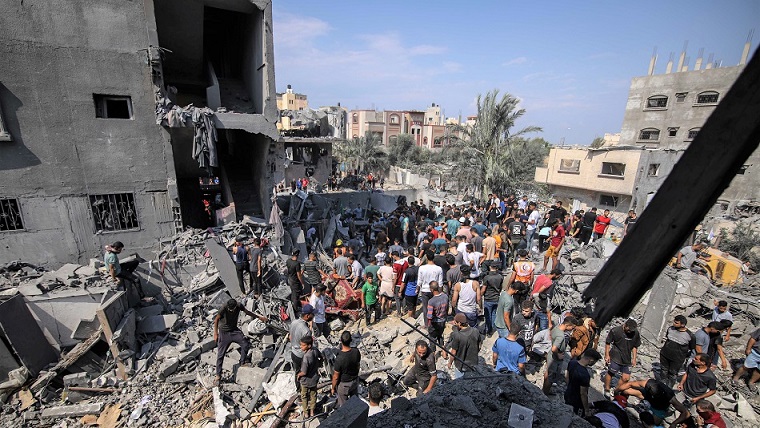
These are the results of the latest poll conducted by the Palestinian Center for Policy and Survey Research (PSR) in the West Bank and the Gaza Strip between 22 November and 2 December 2023. The period leading up to the poll witnessed the launch of Hamas’ October the 7th offensive against Israeli towns and military bases bordering the Gaza Strip and the Israeli launch of the current ground invasion of the Gaza Strip. Video images circulating in the international and Israeli media show that some Hamas fighters have committed attacks against Israeli civilians, including women and children, and took many of them hostages. International and Palestinian reports reported that thousands of Palestinians, mostly women and children, were killed by Israeli arial and tank bombardment. Israeli attacks targeted Palestinian hospitals, public buildings, and most other civilian infrastructure including tens of thousands of homes, with many neighborhoods leveled completely to the ground. In the meanwhile, in the West Bank, the Israeli army blocked or restricted Palestinian access to main roads while settler attacks increased against vulnerable towns and villages in various parts of the B and C areas.
To ensure the safety of our field researchers in the Gaza Strip, interviews with the residents were conducted during the ceasefire, which saw Palestinian women and children released from Israeli prisons in exchange for women and children held by Hamas.
The sample size of this poll is 1231 adults, of whom 750 were interviewed face to face in the West Bank and 481 in the Gaza Strip in 121 randomly selected locations. The sample is representative of the residents of the two areas. Due to the war in the Gaza Strip, we conducted interviews in the central and southern regions inside the selected sample homes, with the exception of one displaced area, where residents were interviewed in the shelter area where they had taken refuge. As for the northern Gaza Strip, residents were interviewed in 24 shelter locations, of which 20 belonged to UNRWA and 4 to governmental institutions. A total of 250 interviews were conducted in these shelters, and another 21 were conducted in the homes of relatives and friends of displaced people from the north. Despite the large representative sample, the margin of error for this poll is +/-4. The increase in the margin of error is due to the lack of precision regarding the number of residents who stayed in their homes, or in shelters, in the northern parts of the Gaza Strip which we did not sample.
For further details, contact PSR director, Dr. Khalil Shikaki, or Walid Ladadweh at tel. 02-296 4933 or email pcpsr@pcpsr.org
Main Findings:
Most of the questions asked in this last quarter of 2023 revolved around the October 7 offensive and the subsequent Israel-Hamas war and ground invasion of the Gaza Strip. It also covered the debate about the future of the Gaza Strip after the war and the Palestinian perception of the positions of the various relevant countries and actors. Findings indicate that a majority of the respondents believe that Hamas' decision to carry out the offensive is correct, and believe that the attack came in response to “settler attacks on Al-Aqsa Mosque and West Bank residents, and for the release of Palestinian prisoners.” It is worth noting that there are significant differences between the attitudes of the residents of the West Bank compared to those of the Gaza Strip, in terms of the “correctness” of the Hamas' decision (and other matters), as the attitudes of Gazans tend to show a greater degree of skepticism about that decision. It is clear from the findings that believing in the “correctness” of Hamas' decision does not mean support for all acts that might have been committed by Hamas fighters on October 7. The overwhelming majority of respondents say that they have not seen videos from international or social media showing atrocities committed by Hamas members against Israeli civilians that day, such as the killing of women and children in their homes. Indeed, more than 90% believe that Hamas fighters did not commit the atrocities contained in these videos. When asked what is or is not allowed in war, under international humanitarian law, the findings indicate that the vast majority believes that attacking or killing civilians in their homes is not permissible. The majority (except in the Gaza Strip) also believe that taking civilians as hostages or prisoners of war is also not permissible.
The findings also indicate that the majority believes that Israel will not succeed in eradicating Hamas, or in causing a second Palestinian Nakba, or in expelling the residents of the Gaza Strip. Indeed, a large majority believes that Hamas will emerge victorious from this war. A majority also says Hamas will resume control over the Gaza Strip after the war. The findings also indicate significant opposition to the deployment of an Arab security force in the Gaza Strip, even if its purpose is to provide support to the Palestinian Authority. The majority also opposes a role for Arab states in delivering services to the Gaza Strip, but this majority is far less than the majority that opposes an Arab security presence.
The findings indicate that the Palestinians are questioning the moral commitment of the US, and other West European countries, to the ethical values embodied in the international humanitarian law. They show widespread conviction that the positions of the United States and the major Western powers show total disregard to international humanitarian law and that their talk of a two-state solution is not serious. All or most Palestinians say they are dissatisfied with the positions of the United States, Germany, Britain, France, the United Nations, and even Russia in this war. Also, the overwhelming majority is dissatisfied with the performance of Arab or regional countries or parties such as Saudi Arabia, the UAE, Egypt and Jordan, while the percentage of satisfaction with the performance of Turkey and Iran is somewhat high, and a majority says that it is satisfied with the performance of Yemen, Qatar and Hezbollah. Dissatisfaction with Palestinian actors increases significantly when asked about the PA prime minister, the PA president, the PA, and Fatah. A majority of the public is satisfied only with the performance of Hamas, Yahya Sinwar and Ismail Haniyyah.
Findings indicate that the ongoing war between Hamas and Israel in the Gaza Strip has had a significant impact on a range of internal Palestinian issues and on Palestinian-Israeli relations. The most important of these effects can be summarized in the following changes:
- Support for Hamas has more than tripled in the West Bank compared to three months ago. In the Gaza Strip, support for Hamas increased but not significantly. Despite the increase in its popularity, the majority in both the West Bank and the Gaza Strip does not support Hamas. It is worth noting that support for Hamas usually rises temporarily during or immediately after a war and then returns to the previous level several months after the end of the war.
- Support for President Mahmoud Abbas and his Fateh party drops significantly. The same is true for the trust in the PA as a whole, as demand for its dissolution rises to nearly 60%, the highest percentage ever recorded in PSR polls. Demand for Abbas's resignation is rising to around 90 percent, and even higher in the West Bank. Despite the decline in support for Fatah and Abbas, the most popular Palestinian figure remains Marwan Barghouti, a Fatah leader. Barghouti is still able to beat Hamas’ candidate Ismail Haniyeh or any other.
- Support for armed struggle rises ten percentage points compared to three months ago, with more than 60% saying it is the best means of ending the Israeli occupation; in the West Bank, the percentage rises further to close to 70%. Moreover, a majority in the West Bank believes that the formation of armed groups in communities subject to settler attacks is the most effective means of combating settler terrorism against towns and villages in the West Bank.
- Despite the above-mentioned reference to the lack of confidence in the seriousness of US and European talk about reviving the two-state solution and despite the increase in support for armed struggle, support for the two-state solution has not dropped in this poll. To the contrary, support for this solution has increased slightly in both the West Bank and the Gaza Strip. This increase seems to come especially from those who believe that the US and European talk about the two-state solution is indeed serious.
| (1) October the 7th and the War in Gaza: |
1. Hamas’ decision to launch the October the 7th offensive:
- We asked respondents to speculate about Hamas’ reasons for waging its October the 7th offensive: a response to attacks on al Aqsa and to release prisoners as Hamas claimed or an Iranian plot to thwart Arab normalization with Israel. The overwhelming majority (81%; 89% in the West Bank and 69% in the Gaza Strip) said it was a “response to settler attacks on Al-Aqsa Mosque and on Palestinian citizens and for the release of prisoners from Israeli prisons;” while only 14% (5% in the West Bank and 27% in the Gaza Strip) thought it was an Iranian plot.
- We asked the respondents what they thought of Hamas’ decision to launch the October the 7th offensive given its outcome so far, a vast majority (72%; 82% in the West Bank and 57% in the Gaza Strip) said it was a correct decision and 22% (12% in the West Bank and 37% in the Gaza Strip) said it was incorrect.

2. The Israeli objectives in the Gaza war:
- Asked about its assessment of Israel’s objectives in the current war, the majority (53%) says it is to destroy the Gaza Strip and kill or expel its population; 42% (50% in the Gaza Strip and 37% in the West Bank) think the goal is to exact revenge against Hamas and the resistance and destroy them completely.
- When asked if Israel will succeed in causing a second Nakba for the Palestinians in the Gaza Strip, as some Israeli minister called for, 73% (83% in the West Bank and 59% in the Gaza Strip) said it will not and 24% (14% in the West Bank and 40% in the Gaza Strip) said it will succeed.
- But the vast majority (70%) thinks Israel will fail in achieving its goal in eradicating Hamas and the resistance while only 8% think it will succeed, and 21% think it will only weaken Hamas and the resistance. West Bankers are more certain than Gazans that Israel will fail, 87% and 44% respectively. Moreover, only 1% of West Bankers think Israeli will succeed in eradicating Hamas compared to 17% in the Gaza Strip.
- Similarly, the overwhelming majority (85%; 96% in the West Bank and 70% in the Gaza Strip) thinks that Israel will not succeed in expelling Gazans out of the Strip; Only 13% (3% in the West Bank and 29% in the Gaza Strip) think it will succeed.
3. Humanitarian conditions in the Gaza Strip:
- Only 44% of Gazans say they have enough food and water for a day or two and 56% say they do not.
- When they need food or water, only one third of Gazans say they can reach a place where they can have access to assistance while two thirds say they cannot.
- Almost two thirds (64%) of Gazan respondents say a member of their family have been killed or injured during the current war in Gaza; 36% say none of their family members have been killed or injured.

- A majority (52%) blames Israel for the current suffering of Gazans in the current war while 26% place the blame on the US; only 11% (6% in the West Bank and 19% in the Gaza Strip) place the blame on Hamas; and 9% blame the PA.
- We asked the respondents whether they support or oppose the release, now before the end of the war, of the detained Israeli women and children among the civilians in the hands of the resistance groups, in return for the release of Palestinian women and children in the Israeli prisons. The overwhelming majority (85%; 92% in the West Bank and 75% in the Gaza Strip) supported the exchange while only 13% (7% in the West Bank and 22% in the Gaza Strip) opposed it.
- A majority of 71% of the Palestinians in the West Bank and the Gaza Strip believe Gazans who left their homes during the war to safer areas will be able to return to these homes once the war stops. West Bankers are much more optimistic than Gazans, 83% and 53% respectively.
4. War crimes and atrocities:
- We offered the public a list of acts or measures and asked respondents whether they are permitted under international law. The majority (84%) said it allows taking soldiers prisoners. But the vast majority (78%) said it does not allow attacks on or the killing of civilians women and children in their homes; 77% said it does not allow the bombing of hospitals; 76% said it does not allow cutting electricity and water from the civilian population; and 52% said it does not allow taking civilians as prisoners of war.

- While 95% think Israel has committed war crimes during the current war, only 10% think Hamas also committed such crimes; 4% think Israel has not committed such crimes and 89% think Hamas did not commit war crimes during the current war.
- 85% say they did not see videos, shown by international news outlets, showing acts committed by Hamas against Israeli civilians, such as the killing of women and children in their homes; only 14% (7% in the West Bank and 25% in the Gaza Strip) saw these videos.
- When asked if Hamas did commit these atrocities, the overwhelming majority said no, it did not and only 7% (1% in the West Bank and 16% in the Gaza Strip) said it did.

5. When will the war stop and who will win?
- Half of the public (45% in the West Bank and 54% in the Gaza Strip) expect to see a ceasefire in Gaza in the upcoming weeks while a quarter (21% in the West Bank and 32% in the Gaza Strip) expect the war to continue for weeks and months. One fifth (28% in the West Bank and 9% in the Gaza Strip) expect Israel to “unilaterally end the war and begin to withdraw under the pressure from the resistance.” Only 2% expect that “Hamas and other resistance forces in Gaza will stop the fighting and withdraw to safer areas in the Gaza Strip.”
- While the vast majority of West Bankers (70%) thinks Hamas will emerge victorious in this war, only half of Gazans think the same. Similarly, while only 1% in the West Bank think Israel will emerge victorious, almost one third of Gazans (31%) think that; 14% (12% in the West Bank and 18% in the Gaza Strip) think neither one will emerge victorious.
6. Who will rule Gaza after the war?
- Almost two-thirds (64%) are opposed to the participation of the PA in meetings with the US, with the involvement of Arab countries such as Jordan and Egypt, in order to discuss the future of the Gaza Strip after the war stops. Only 33% (28% in the West Bank and 40% in the Gaza Strip) support PA participation in such meetings.
- We asked the respondents to speculate about the party that will be in control of the Gaza Strip in the day after the end of the current war. Almost two thirds (64%; 73% in the West Bank and 51% in the Gaza Strip) said it will be Hamas; 11% selected a PA national unity government but without President Abbas; 7% selected the PA with Abbas; 4% selected Israel; 3% selected one or more Arab country; 2% selected a national unity government under Abbas leadership; and 1% selected the UN.
- When asked about their own preferences for the party that should be in control in the Gaza Strip after the war, 60% (75% in the West Bank but only 38% in the Gaza Strip) selected Hamas; 16% selected a PA national unity government without President Abbas; 7% selected the PA with Abbas; 3% selected one or more Arab countries; 3% selected a national unity government under Abbas, and 2% selected the Israeli army.

- 72% (80% in the West Bank and 61% in the Gaza Strip) think Hamas will succeed in returning to rule over the Gaza Strip after the war despite Israel’s declared objective of eradicating that organization; 23% (15% in the West Bank and 36% in the Gaza Strip) do not think Hamas will succeed in resuming control over the Gaza Strip.
- After the end of the war, and in the event that the West Bank and the Gaza Strip are unified under the control of the Palestinian Authority, only 28% (20% in the West Bank and 39% in the Gaza Strip) would support and 70% (77% in the West Bank and 60% in the Gaza Strip) would oppose the deployment of an Arab security contingent, from countries like Egypt or Jordan, in order to provide support for the PA and help it to maintain security.
- But in the event that this Arab presence, after the end of the war, is to provide basic, administrative, and health services to the Palestinian residents in support of the PA, support would increase to 45% (43% in the West Bank and 48% in the Gaza Strip) but 53% (54% in the West Bank and 51% in the Gaza Strip) would still oppose that presence.

7. Satisfaction with relevant actors:
- The overwhelming majority of the Palestinians (87%) thinks that the response of the US and other major Western powers, such as the UK, France, and Germany, to the Israeli bombardment of the Gaza Strip indicates show disregard to international humanitarian law; only 10% (4% in the West Bank and 19% in the Gaza Strip) say the response indicates they are committed to that law.
- The vast majority (70%) thinks the recent talk about two-state solution in the US and other Western countries is not serious; 27% think it is.
- We asked about public satisfaction with the role played during the war by various Palestinian, Arab/regional, and international actors:
- On the Palestinian side, satisfaction with the role of Hamas (72%; 85% in the West Bank and 52% in the Gaza Strip) was the highest followed by the role played by Yehia Sinwar (69%; 81% in the West Bank and 52% in the Gaza Strip), Ismail Haniyyeh (51%; 57% in the West Bank and 43% in the Gaza Strip), Fatah (22%; 23% in the West Bank and 21% in the Gaza Strip), the PA (14%; 10% in the West Bank and 21% in the Gaza Strip), Mahmoud Abbas (11%; 7% in the West Bank and 17% in the Gaza Strip), and Mohammad Shtayyeh (10%; 6% in the West Bank and 16% in the Gaza Strip).

- For the Arab/regional actors, the highest level of satisfaction went to Yemen (80%; 89% in the West Bank and 68% in the Gaza Strip), followed by Qatar (56%), Hizballah (49%), Iran (35%), Turkey (34%), Jordan (24%), Egypt (23%), UAE (8), and finally Saudi Arabia (5%). The following figure shows the distribution of satisfaction over the West Bank and the Gaza Strip.

- For the non-regional international actors, the highest level of satisfaction went to Russia (22%, 17% in the West Bank and 28% in the Gaza Strip), followed by China (20%), Germany (7%), UN (6%), France (5%), UK (4%), and the US (1%). The following figure shows the distribution of satisfaction over the West Bank and the Gaza Strip.

| (2) Legislative and presidential elections: |
- If new presidential elections were held today and only two candidates, Mahmoud Abbas and Ismail Haniyeh, the voter turnout would be only 53%, and among those who would participate, Abbas would receive 16% of the vote and Haniyeh 78% (compared to 58% for Haniyeh and 37% for Abbas three months ago). In the Gaza Strip, the vote for Abbas stands at 24% and for Haniyeh at 71%, while in the West Bank Abbas receives 10% and Haniyeh 82%.

- If the presidential competition is between three, Marwan Barghouti, Abbas, and Haniyeh, participation would rise to 71% and among those voting, Barghouti receives 47%, Haniyeh 43%, and Abbas 7%. Three months ago, support for Barghouti stood at 49% and Haniyeh at 36%, and Abbas at 13%.

- If the presidential competition is between two, Marwan Barghouti and Haniyeh, participation would rise to 69% and among those voting, Barghouti receives 51% and Haniyeh 45%. Three months ago, support for Barghouti stood at 60% and Haniyeh at 37%.

- In a closed question, we asked the public to select the person they prefer to see as President Abbas's successor. The largest percentage (36%) said they prefer Marwan Barghouti; 19% preferred Ismail Haniyeh; 16% chose Yahya al Sinwar; 4% preferred Mohammed Dahlan, 3% preferred Khaled Meshaal, 2% chose Muhammad Shtayyeh, and 1% chose Hussein al-Sheikh; 18% said they did not know or chose someone else.
- Level of satisfaction with the performance of president Abbas stands at 14% and dissatisfaction at 85%. Satisfaction with Abbas stands at 10% in the West Bank and 19% in the Gaza Strip. Three months ago, satisfaction with Abbas stood at 22% and dissatisfaction at 76%.
- 88% want Abbas to resign while 12% want him to remain in office. Three months ago, 78% said they want Abbas to resign. Demand for Abbas' resignation stands at 92% in the West Bank and 81% in the Gaza Strip.
When asked which political party or political trend they support, the largest percentage selected Hamas (43%), followed by Fatah (17%), while 12% selected other or third-party groups, and 28% said none of them or did not know. Three months ago, support for Hamas stood at 22% and Fatah at 26%. In the West Bank, support for Hamas today stands at 44% (compared to 12% three months ago), and for Fatah at 16% (compared to 26% three months ago). In the Gaza Strip, support for Hamas today stands at 42% (compared to 38% three months ago) and support for Fatah at 18% (compared to 25% three months ago).

- However, if new parliamentary elections were held today with the participation of all political forces that participated in the 2006 elections, only 69% say they would participate in them, and among these participants, Fateh receives 19%, Hamas' Change and Reform 51%, all other lists combined 4%, and 25% say they have not yet decided whom they will vote for. Three months ago, vote for Hamas stood at 34% and Fatah at 36%. Vote for Hamas in the Gaza Strip stands today at 52% (compared to 44% three months ago) and for Fateh at 21% (compared to 32% three months ago). In the West Bank, vote for Hamas stands at 50% (compared to 24% three months ago) and Fatah at 18% (compared to 40% three months ago).
- 54% believe that Hamas is the most deserving of representing and leading the Palestinian people today while 13% believe that Fateh under the leadership of Abbas is more deserving; 26% believe both are unworthy of representation and leadership. Three months ago, 27% said Hamas is the most deserving, 24% said Fateh led by Abbas is the most deserving, and 44% said both are unworthy of representation and leadership.
(3) Domestic conditions: |
- The question about personal safety and security was asked in the West Bank only. The findings show that only 14% feel safe and secure while 86% feel unsafe and unsecure. Three months ago, the perception of safety stood at 48%.
- A majority of 68% believes that the PA has become a burden on the Palestinian people and only 28% believe it is an asset for the Palestinian people. Three months ago, 62% said the PA is a burden and 35% said it was an achievement.
(4) Palestinian-Israeli Relations and the Peace process: |
- 34% support and 64% oppose the idea of a two-state solution, which was presented to the public without providing details of the solution. Three months ago, support for this solution in a similar question stood at 32%.

- Support for the two-state solution is linked to public assessment of the feasibility of such a solution and the chances for the establishment of a Palestinian state. Today, 65% believe the two-state solution is no longer practical due to settlement expansion but 32% believe it is still practical. Moreover, 66% believe that the chances for the establishment of an independent Palestinian state alongside Israel in the next five years are slim or nonextant, and 32% believe the chances are medium or high. Three months ago, 71% said that the two-state solution is no longer practical due to settlement expansion.
- When asked about public support and opposition to specific policy measures to break the stalemate: 55% supported joining more international organizations; 39% supported resort to unarmed popular resistance; 69% supported a return to confrontations and armed intifada; 58% supported dissolving the PA; and 29% supported abandoning the two-state solution and demanding one state for Palestinians and Israelis. Three months ago, 58% supported a return to confrontations and armed intifada; 53% supported resort to unarmed popular resistance; 52% supported the dissolution of the PA; and 27% supported abandoning the two-state solution in favor of one state.
When asked about the best way to end occupation and establish an independent state, the public was divided into three groups: a majority of 63% (68% in the West Bank and 56% in the Gaza Strip) said it was armed struggle; 20% said it was negotiations; and 13% said it was popular non-violent resistance. Three months ago, 53% said armed struggle was the best way, 24% said popular non-violent resistance, and 20% said negotiation was the best way. As shown in figure (16) below, West Bankers’ support for resort to arms increased 19 percentage points since the formation of the current far right Israel government and increased another 14 points during the past three months.

- In light of the increase in settler terrorist attacks against Palestinian towns and villages, we again asked West Bankers what means are most effective in combating this terrorism that are also the most feasible. The majority (56%, compared to 47% three months ago) chose the formation of armed groups by residents of the targeted areas in order to protect their areas; 15% (compared to 30% three months ago) chose to deploy Palestinian police forces in the targeted areas; 16% (compared to 10% three months ago) chose the demand that the Israeli army take measures to prevent settler terrorism; and only 8% (compared to 8% three months ago) chose to form unarmed groups of residents of the targeted areas to protect their areas.
Figure (17) below, show the extent of the public distrust in the West Bank in the role of the Israeli army in protecting the vulnerable communities and that the trust of the public in the Palestinian police is much less than the trust it places in the armed groups and that trust in the PA police has declined in three months by half to reach the current 15%. It also show that a majority now supports the formation of armed groups as the most effective means of combating settler terror.

| (5) Most vital Palestinian goals and the most pressing problems confronting Palestinians today: |
- 43% believe that the first most vital Palestinian goal should be to end Israeli occupation in the areas occupied in 1967 and build a Palestinian state in the West Bank and the Gaza Strip with East Jerusalem as its capital. By contrast, 36% believe the first most vital goal should be to obtain the right of return of refugees to their 1948 towns and villages, 11% believe that the first and most vital goal should be to build a pious or moral individual and a religious society, one that applies all Islamic teachings and 7% believes it should be to establish a democratic political system that respects freedoms and rights of Palestinians.
- When asked about the most pressing problem confronting the Palestinians today, the largest percentage (51%, 42% in the West Bank and 64% in the Gaza Strip) said it is the continued war in the Gaza Strip; (32%) said it is the Israeli occupation, while 7% said it is the split between the West Bank and the Gaza Strip, 5% said it is unemployment, and 4% said it is corruption.
With the popularity of Abbas and Fayyad declining sharply and the popularity of Haniyeh and Hamas increasing significantly, the public becomes more hawkish and pessimistic about the peace process and the overwhelming majority believes Palestinians after the war on Gaza are worse off than before the war
5-7 March 2009
These are the results of the latest poll conducted by the Palestinian Center for Policy and Survey Research (PSR) in the West Bank and the Gaza Strip between 5 and 7 March 2009. The poll was conducted several weeks after the Israeli attack on the Gaza Strip. The poll period witnessed return of Palestinian factions to reconciliation talks sponsored by Egypt. The poll examines the following topics: domestic issues such as the balance of power, the performance and legitimacy of two governments, that of Ismail Haniyeh and Salam Fayyad, the peace process, and the Israeli elections. Total size of the sample is 1270 adults interviewed face to face in 127 randomly selected locations. Margin of error is 3%. For further details, contact PSR director, Dr. Khalil Shikaki, or Walid Ladadweh at tel 02-296 4933 or email pcpsr@pcpsr.org.
Main Findings:
Findings of the first quarter of 2009 indicate a significant increase in the popularity of Ismail Haniyeh and Hamas and decease in the popularity of president Mahmud Abbas and Fateh. They also indicate a significant decline in the status and legitimacy of Salam Fayyad. Despite these findings, Fateh’s popularity remains higher than that of Hamas. The two most important factors shaping public attitudes regarding these issues seem to be the Israeli offensive against Gaza, particularly the performance of Abbas and the government of Fayyad during the war, and public perceptions of the end of Abbas’s term in office and hence the loss of legitimacy suffered by the Fayyad’s government.
Findings also indicate a negative shift in Palestinian public attitudes regarding the peace process as the percentage of those willing to compromise goes down and the percentage of those supporting violence goes up. The public takes a hardline view regarding resumption of negotiations before Israel freezes settlement construction.
All this comes within a highly pessimistic context with a rise in the belief that a Palestinian state is not going to be established within the next five years and the majority expecting the electoral victory of the right wing in Israel to lead to the failure of the peace process and to an increase in settlement expansion.
(1) Domestic Palestinian Conditions
- If new presidential elections were held today and the two candidates were Ismail Haniyeh and Mahmud Abbas, the former receives 47% of the vote and the later 45%.
- But if the competition was between Marwan Barghouti and Haniyeh, the former wins with 61% of the vote compared to 34% for Haniyeh.
- Popularity of Hamas increases from 28% in our December 2008 poll to 33% in this poll while the popularity of Fateh drops from 42% to 40% during the same period.
- Decline in the popularity of Abbas and Fateh reflects a decline in the percentage of popular satisfaction with the performance of president Abbas from 46% three months ago to 40% in this poll. Moreover, positive evaluation of the performance of Salam Fayyad’s government declines from 34% to 32% during the same period while positive evaluation of the performance of Haniyeh’s government increases significantly from 36% to 43%.
- Despite the visible increase in the popularity of Hamas and Haniyeh, the overwhelming majority (71%) says that given the outcome of the Israeli war on Gaza, conditions of the Palestinians today are worse off than they were before the war, while only 11% say conditions today are better off than they were before the war. 17% say conditions have not changed.
- Similarly, Hamas’s call for the establishment of a new representative body that can serve as an umbrella for the resistance groups receives the support of only one third of the Palestinians while 57% say that the PLO should be maintained.
- The largest percentage (46%) believe that the most important priority for Palestinians today should be the unification of the West Bank and the Gaza Strip while 28% say it should be the return to quite and the opening of Gaza crossings and 25% say the top priority should be the reconstruction in the Gaza Strip.
- If Hamas wins new presidential and legislative elections, 63% of the public believe that such an outcome would lead to the tightening of the siege and boycott while an additional 19% say current conditions of boycott would remain the same and only 12% say a Hamas electoral victory would lead to the lifting of the siege and boycott.
- Similarly, if Hamas wins new presidential and legislative elections, 47% of the public believe that such an outcome would lead to the consolidation of the split between the West Bank and the Gaza Strip and an additional 23% say current conditions would remain the same but only 24% say a Hamas victory would lead to the consolidation of West Bank-Gaza Strip unity.
If new presidential elections were held today and the two candidates were Ismail Haniyeh and Mahmud Abbas, the former receives 47% of the vote and the later 45%. Three months ago, Abbas received 48% and Haniyeh 38%. But if the competition was between Marwan Barghouti and Haniyeh, the former wins with 61% of the vote compared to 34% for Haniyeh. Three months ago, Barghouti received 59% and Haniyeh 32%. Decline in the popularity of Abbas and Fateh reflects a decline in the percentage of popular satisfaction with the performance of president Abbas from 46% three months ago to 40% in this poll. Moreover, it seems that public perception of the ending of Abbas’s term in office is leading 27% to believe that the legitimate president today is the Speaker of the Palestinian Legislative Council, and 24% to believe that there is no legitimate president today, while only 39% believe that the legitimate president today is Abbas.
Findings indicate that the popularity of Haniyeh is higher in the West Bank (50%) than in the Gaza Strip (44%). The opposite is true for Abbas; he is more popular in the Gaza Strip (50%) than in the West Bank (41%). Haniyeh is more popular among women (53%) compared to men (41%) while Abbas is more popular among men (51%) than women (40%). Haniyeh is also more popular among those who describe themselves as “religious” (57%) and less popular among those who define themselves are “somewhat religious” (38%). Abbas on the other hand is more popular among the “somewhat religious” (55%) and less popular among the “religious” (35%).
Haniyeh is more popular among those opposed to the peace process (82%) and less popular among those supporting the peace process (35%). Abbas is more popular among supporters of the peace process (5%) and less popular among those opposed to the peace process (14%). Haniyeh is more popular among those over 47 years of age (55%) and less popular among those between the ages of 18-27 years (46%). On the other hand, Abbas is less popular among those over 47 years of age (35%) and more popular among all those younger than that, for example, reaching 50% among those whose age is between 38-47 years. Haniyeh is more popular among the illiterates (56%) and less popular among those with a BA degree (43%). Abbas is more popular among those who have a BA degree (50%) and less popular among the illiterates (34%). It is noticeable that Abbas popularity increases considerably among those employed in the public sector (72%) while Haniyeh’s popularity is very low among this group declining to 23%. Finally, as expected, Haniyeh is very popular among Hamas supporters (96%) while Abbas is very popular among Fateh supporters (90%). Among those voting for other parties, Abbas receives 51% while Haniyeh receives 36%. Among the undecided, Abbas receives 27% and Haniyeh 37%.
Popularity of Hamas increases from 28% in our December 2008 poll to 33% in this poll while the popularity of Fateh drops from 42% to 40% during the same period. The gap between Fateh and Hamas reaches 12 percentage points in favor of Fateh in the Gaza Strip but reaches only 3 percentage points in the West Bank, also in favor of Fateh.
Moreover, positive evaluation of the performance of Salam Fayyad’s government declines from 34% to 32% during the same period while positive evaluation of the performance of Haniyeh’s government increases significantly from 36% to 43%. In the competition over legitimacy between the governments of Haniyeh and Fayyad, 35% say Haniyeh’s government is the legitimate one while only 24% say Fayyad’s is the legitimate one. Thee months ago, 28% said Haniyeh’s government was the legitimate one and 30% said Fayyad’s government was the legitimate one.
Despite the visible increase in the popularity of Hamas and Haniyeh, the overwhelming majority (71%) says that given the outcome of the Israeli war on Gaza, conditions of the Palestinians today are worse off than they were before the war, while only 11% say conditions today are better off than they were before the war. 17% say conditions have not changed. In the Gaza Strip, the percentage of those who believe that Palestinians are worse off today reaches 79%.
Moreover, despite the decline in the popularity and status of Abbas and Fayyad, 25% say conditions in the West Bank are good while only 7% say conditions in the Gaza Strip are good.
Similarly, Hamas’s call for the establishment of a new representative body that can serve as an umbrella for the resistance groups receives the support of only one third of the Palestinians while 57% say that the PLO should be maintained.
The largest percentage (46%) believe that the most important priority for Palestinians today should be the unification of the West Bank and the Gaza Strip while 28% say it should be the return to quite and the opening of Gaza crossings and 25% say the top priority should be the reconstruction in the Gaza Strip. In the Gaza Strip, belief that Gaza reconstruction should be the top priority stand at 21% only compared to 27% in the West Bank.
Findings show that the belief that the top Palestinian priority today should be the unification of the West Bank and the Gaza Strip is equal in the West Bank and the Gaza Strip. But is more widespread among men (51%) than women (42%), among the “somewhat religious” (53%) compared to the “religious” (40%), among those holding a BA degree (51%) compared to the illiterates (33%), among employees (56%) compared to housewives (40%), and among Fateh voters (54%) compared to Hamas’s (40%).
Finally, Fateh’s greater popularity compared to Hamas’s reflects public perceptions regarding possible implications of election outcome on two major issues that seem to influence electoral behavior more than any other issue as we saw in our last poll in December. These two issues are the ending of siege and blockade and the unification of the West Bank and the Gaza Strip. Current findings indicate the following:
- if Hamas wins new presidential and legislative elections, 63% of the public believe that such an outcome would lead to the tightening of the siege and boycott while an additional 19% say current conditions of boycott would remain the same and only 12% say a Hamas electoral victory would lead to the lifting of the siege and boycott. By contrast, if Fateh wins new presidential and legislative elections, only 11% say that such outcome would lead to the tightening of the siege and boycott and an additional 24% say current conditions would remain the same, but the majority (61%) says a Fateh electoral victory would lead to the lifting of the siege and boycott. It is worth noting that the belief that a Fateh electoral victory would lead to the lifting of the siege increases significantly in the Gaza Strip reaching 76% and decreases to 52% in the West Bank.
- Similarly, if Hamas wins new presidential and legislative elections, 47% of the public believe that such an outcome would lead to the consolidation of the split between the West Bank and the Gaza Strip and an additional 23% say current conditions would remain the same but only 24% say a Hamas victory would lead to the consolidation of West Bank-Gaza Strip unity. By contrast, if Fateh wins new presidential and legislative elections only 31% say that such an outcome would lead to the consolidation of the split between the West Bank and the Gaza Strip and an additional 26% say current conditions would remain the same, but 37% say such a Fateh electoral victory would lead to the consolidation of West Bank-Gaza Strip unity. It is worth noting that the belief that a Hamas electoral victory lead to the consolidation of West Bank-Gaza Strip split increases considerably in the Gaza Strip compared to the West Bank (56% compared to 42%) while the belief that a Fateh electoral victory would lead to the consolidation of West Bank-Gaza Strip unity increases significantly in the Gaza Strip reaching 47%% and decreases to 31% in the West Bank. Belief that Hamas’s victory in the next elections would consolidate separation between the West Bank and the Gaza Strip is stronger in the Gaza Strip (56%) compared to the West Bank (42%), among residents of refugee camps (54%) compared to residents of cities (44%), among men (49%) compared to women (46%), among the “somewhat religious” (54%) compared the “religious” (40%), among those whose age is between 18-27 years (51%) compared to those whose age is over 47 years (42%), among refugees (53%) compared to non-refugees (42%), among those holding a BA degree (50%) compared to illiterates (35%), among employees and students (55% each) compared to farmers and laborers (28% and 38% respectively), among those working in the public sector (59%) compared to those working in the private sector (46%), and among Fateh voters (67%) compared to Hamas voters (32%).
(2) Peace Process
- 50% of the Palestinians agree and 48% disagree that after the establishment of an independent Palestinian state and the settlement of all issues in dispute, including the refugees and Jerusalem issues, there will be a mutual recognition of Israel as the state of the Jewish people and Palestine as the state of the Palestinian people. Support for this mutual recognition stood at 53% and opposition at 46% three months ago.
- 73% of the Palestinians think that chances for the establishment of an independent Palestinian State next to the State of Israel in the next five years are non-existent or low
- 58% support the Saudi Plan and 39% oppose it; in December 2008, 66% supported the plan and 30% opposed it.
- 54% of the Palestinians support and 42% oppose armed attacks against Israeli civilians inside Israel. Three months ago, support for such attacks stood at 48% and opposition at 49%.
- 38% of the Palestinians support and 58% oppose return to Palestinian-Israeli final status negotiations before an Israeli freeze on settlement activity.
Findings indicate a decline in public support for the peace process. For example, support for the Saudi initiative (which calls for full Israeli withdrawal from occupied Arab land and the establishment of a Palestinian state in return for a peace agreement with Israel and a normalization of relations between Israel and all Arab countries) drops from 77% three months ago to 58% in this poll. Opposition to the plan stands today at 39% compared to 30% in our last poll in December 2008. Moreover, willingness to accept mutual recognition of Israel as the state for the Jewish people and Palestine as the state for the Palestinian people after the establishment of a Palestinian state and the resolution of all problems of the conflict drops from 53% three months ago to 50% in this poll.
Findings also indicate that the overwhelming majority (73%) believe that the chances for the creation of an independent Palestinian state next to Israel during the next five years are slim to non-existent while only 24% of the Palestinians believe the chances are medium or high. Three months ago, these percentages stood at 70% and 29% respectively, indicating an increase in the level of pessimism.
Findings also indicate an increase in public support for armed attacks against Israeli civilians inside Israel from 48% in December 2008 to 54% in this poll. Opposition to armed attacks today stands at 43% compared to 49% three months ago. Support for armed attacks against Israeli targets increases in the Gaza Strip (67%) compared to the West Bank (47%), among the “religious” (59%) compared to the “somewhat religious” (49%), among those whose age is between 18-27 years (61%) compared to those whose age is over 47 years (53%), among those holding a BA degree (59%) compared to illiterates (52%), among students and employees (67% and 63% respectively) compared to merchants and housewives (37% and 51% respectively), and among Hamas voters (70%) compared to Fateh voters (45%).
Finally, Findings show that a majority opposes return to Palestinian-Israeli negations before Israel freezes settlement construction while 37% support return to negotiations despite continued Israeli settlement construction.Opposition to return to negotiations before freezing settlement construction increases in the West Bank (61%) compared to the Gaza Strip(53%), among men (66%) compared to women (50%), among those holding a BA degree (66%) compared to illiterates (48%), among employees and students (66% and 61% respectively) compared to laborers and housewives (53% and 51% respectively), and among Hamas voters (69%) compared to Fateh voters (47%).
(3) Israeli Elections
- 70% of the Palestinians think that there is no difference between Israeli right-wing parties and parties of the center and left; 26% think that there are differences between them.
- Only 7% expect that negotiations with the new Israeli government will be more successful in ending settlement expansion and bringing peace, and 62% expect settlements to continue to expand and peace efforts to fail. In this regard, Findings show
Findings show that a majority of Palestinians (70%) believe that there is no difference between the various Israeli parties of the right, center and left when it comes to the peace process while 26% say there is a difference. They also show a widespread pessimism regarding the chances of the peace process after the electoral victory of the right in the latest Israeli elections with 62% saying that the outcome of the elections will lead to increased settlement activities and a failure for peace efforts. 28% expect current conditions to remain unchanged and only 7% expect negotiations to succeed in ending settlement construction and achieving peace.
Belief that differences exist between the various right wing, center, and left wing Israeli parties increases among women (30%) compared to men (23%), among supporters of the peace process (30%) compared to those opposed to the peace process (16%), among those whose age is between 18-27 years (35%) compared to those whose age is over 47 years (20%), among illiterates (29%) compared to those holding BA degree (21%), among students (37%) compared to employees (23%), and among Fateh voters (33%) compared to Hamas voters (21%). Full Report
SPSS Data File:

September 2021
What Future for the Gaza Strip in the Next Five Years?
Omar Shaban
Since the Palestinian division occurred in June 2007, the Gaza Strip has become a geographical area with a political and legal context different from the West Bank. The Gaza Strip is a small area in size, but a large one in problems. It is under the rule of Hamas, which is not recognized in the Arab world, nor internationally. After Hamas took control of the Strip, Israel imposed a comprehensive blockade and exposed it to four, long, destructive wars and dozens of smaller armed confrontations over 14 years. The policy of the suffocating blockade enforced by Israel, as well as the repeated wars and military attacks, have created an unprecedented humanitarian crisis and resulted in massive destruction of infrastructure and all economic sectors and activities.[1] The Gaza Strip is supposedly part of the territory of the Palestinian Authority (PA) and the future state, according to international resolutions and the Oslo Agreement signed between the PLO and Israel. However, as it is not geographically connected to the remaining Palestinian territory, and, since the Palestinian division in 2007 that brought it outside the control of the PA, and the failure of attempts at reconciliation and unity, the question is again raised: ‘What is the future of the Gaza Strip within the next five years?’
Four assumptions:
The following discussion takes for granted the continuation of four aspects of the current status quo:
Continued Palestinian division, continued Hamas control of the Gaza Strip: Numerous attempts have failed to achieve reconciliation and reinstate the PA as the ruler of the Gaza Strip. The last attempt was the formation of the reconciliation government in June 2014, as a result of the Shati agreement of April 2014. After a break of several years, rounds of dialogue were renewed between representatives of Hamas and Fatah, hosted in the capitals Istanbul, Cairo and Doha in September 2020.[2] However, they did not succeed in achieving reconciliation. The failure of the reconciliation rounds means that Hamas will remain in power in the Gaza Strip. Israel does not conceal its efforts to prevent national reconciliation and stop the return of the PA rule over the Gaza Strip.
The Israeli-Palestinian conflict remains unresolved: The optimism that prevailed in Palestinian and international circles with President Joe Biden’s coming to power in the United States soon faded, as the new US administration did not initiate any move to resume the track of negotiations between the Palestinian Authority and Israel. The first communication between presidents Biden and Mahmoud Abbas took place because of the war between Israel and the factions in Gaza in May 2012. The US intervention, which came somewhat late, was prompted by the war on Gaza but was limited to economic interventions and financial assistance while removed from any political path. Further, the first meeting between President Abbas and the Israeli government, the meeting with defense minister Benny Gantz in August 2021, dealt only with security and economic and humanitarian issues and aimed at strengthening the Authority, enhancing security coordination and preventing collapse. Israeli media quoted Prime Minister Naftali Bennett’s statements, stressing that ‘there is no political process with the Palestinians, and there will not be such a process.[3] ’There is no political path in the foreseeable future.
Ongoing blockade and closure: With the end of the May 2021round of confrontations between Israel and the Gaza Strip, the new Israeli government announced its clear position of continuing the blockade of the Strip, preventing the reconstruction process, and linking any easing of hardships to the issue of the Israeli prisoners, ostensibly held in Gaza.[4] This Israeli intransigence saw some flexibility with regard to the blockade, where pressure from mediators forced the new Israeli government to allow some relief to avert a new war, including transferring part of the Qatari grant funds, allowing the entry of raw materials, including building materials, the expansion of the fishing zone, and allowing thousands of Gazan workers to enter Israel. However, these facilities do not amount to the lifting the total blockade imposed on the Gaza Strip.[5]
Current regional environment remains unchanged: It is expected that the regional environment will remain relatively stable, without a meaningful or qualitative change. The main relevant regional players are Egypt, Iran, Jordan, Turkey and Qatar. These countries, which represent the various interests in the region, are not united in their position on Hamas and the Gaza Strip. At a time when Iran, Turkey and Qatar’s relations are open with Hamas, providing humanitarian aid and some political recognition, the relationship of Egypt and Jordan with Hamas is witnessing much fluctuation, governed by a de facto reality and no more. Disputes among the countries of the region are clearly reflected in their relations with Hamas. These countries are preoccupied with their internal issues and have no intention of bringing about a qualitative change in their relations and positions on Hamas, in particular, and the Gaza Strip, in general.
Anticipating the future of the Gaza Strip in the next five years
In light of these assumptions, this paper examines the available and possible options for the Gaza Strip in the next five years. It is based on a reading of the positions of the relevant parties and the degree of their interaction with the internal environment, as well as the ongoing discussion within Hamas on alternatives paths to take to get out of the crisis that has persisted for 14 years. In an attempt to anticipate the future of the Gaza Strip in the next five years, three alternatives to the status quo can be identified: a the return of the Gaza Strip to PA control, a Hamas-Israel long term truce, and an independent Gaza entity.
First option: achieving reconciliation, returning the PA to rule, with the participation of Hamas
This scenario assumes the realization of full national reconciliation. Since the division, attempts have not ceased in order to achieve this. Yet, despite many reconciliation agreements (Aden 2008, Cairo 2011, Doha 2012, Al-Shati 2014, and Cairo 2017), the outcome has been failure. The presidential decree that came in January 2021[6] to hold legislative and presidential elections in May and July 2021 restored hope for national reconciliation. But this hope was soon dashed by the president’s decision to postpone the elections, under the pretext of Israel’s refusal to hold them in Jerusalem. This was preceded by a series of attempts towards national reconciliation between Hamas and Fatah, the most recent of which was on September 24, 2020 in Istanbul, resulting in a shared vision towards the resolution of the outstanding issues between the two parties, such as reforming the PLO, the appropriate means of resisting occupation, and the use of popular resistance.[7] With the postponement of the elections and the war on Gaza in May 2021 (which contributed to a significant increase in the popularity of Hamas and was accompanied by a severe deterioration in the position of the Palestinian Authority), and given the assassination of activist Nizar Banat, the vaccine deal with Israel, perceived by the public as the result of corruption within the PA, and other issues, the gap between the two movements widened, making reconciliation more elusive than before. An opinion poll conducted by the Palestinian Center for Policy and Survey Research shows that the popularity of the Palestinian president dropped dramatically after the Israeli aggression on the Gaza Strip in May 2021, falling, in a contest between Abbas and Hamas’ Ismail Haniyyeh, from 47% in March 2021 to 27% in June 2021. Further, the poll indicates that 53% view Hamas as the worthiest of representing and leading the Palestinian people, compared with only 14% in favor of the Fatah movement led by President Abbas.[8]
After the tripartite meeting in Cairo between the Palestinian and Egyptian presidents and the Jordanian king, in September 2021, President Mahmoud Abbas highlighted “the need” for Hamas to recognize international legitimacy, and added that “if it recognizes that legitimacy, we can immediately form a national unity government.”[9] This is a position previously rejected by Hamas and some Palestinian factions.
Within Hamas, there is no consensus among its leaders on the terms for reconciliation with the Palestinian Authority and the Fatah movement. Inconsistent statements have been made by Hamas leaders on the extent of concessions that must be made. This is also the case within the Fatah movement and some of its allied factions. Positions of the two sides reflect different convictions on who should emerge as the predominant Palestinian player. Additionally, several thorny issues prevent reconciliation, including Hamas’ insistence on retaining its weapons and military and security apparatus, contrary to the desire of President Mahmoud Abbas, who demand one-weapon and one-law and rejects the model of Lebanon’s Hezbollah in Gaza. There is another difficulty represented in the administrative and security integration of employees working with the Hamas government, financial collection, the judiciary, land, and the lifting of sanctions.
Moreover, there is a belief within the Hamas movement that time works to its advantage, as it accumulates more experience and support in the region, as happened with the May 2021 war. Hamas believes that the prospects for reconciliation will be better in the absence of the Palestinian president. In the meanwhile, this view is bolstered by sustained deterioration in the popularity of its rival, Abbas and Fatah, and the potential outbreak of an internal conflict on succession, both within Fatah and the PA. In other words, Hamas is not in a hurry for reconciliation.
Second option: reaching a long-term truce with Israel
Since Hamas assumed control over the Gaza Strip in 2007, its relations with Israel have been tense, occasionally oscillating between various priorities. The need to meet the needs of the population under its control and to assert its control came in conflict at times, with its desire to preserve its position as a leader of armed struggle against Israel. Following armed confrontations, concerns about rebuilding the Strip’s destroyed infrastructure constituted another priority. Hamas has signed several truce agreements with Israel after these wars (2009, 2012 and 2014), but they were of short duration. Hamas is conducting a semi-continuous dialogue with Israel, with Egyptian, Qatari and UN mediation, to obtain a number of economic and material improvements as well as opening of the crossings, issuance of permits to workers, and others. On the onset of each conflict, Israel withdraws these facilities and then renegotiates them.
In the meanwhile, Hamas confirms, now and then, that it does not want more extensive military clashes with Israel, but is seeking to stop the escalation, on condition of easing the blockade, yet without abandoning the principle of armed struggle against Israel. Hamas sees its rule of the Gaza Strip and continued discourse of resistance and struggle against occupation as necessary elements in the formulation of its identity that ensures continued support for it, as well as gaining the attention of third parties, both allies (Qatar, Turkey and Iran) and opponents (Israel, Egypt, the Palestinian Authority). Hamas bears the burden of governance and realizes that it needs some kind of relationship with the occupation, which is the main regulator of the Gaza Strip.
Hamas cannot go so far as to recognize Israel and sign a peace agreement with it. This position is driven by ideological reasons and its awareness that such a recognition would deprive it of its status as a resistance movement, and might cause it to lose popular support. Thus, it prefers to talk about a long-term truce. This position enables Hamas to retain its identity as a ‘resistance’ movement, and, at the same time, obtain important economic gains that enhance its ability to rule the Gaza Strip; in other words, combining resistance and governance. This Hamas’ equation is premised on obtaining humanitarian facilities and improvements, bypassing the blockade, and opening up the Gaza Strip to the outside world, in return for Israel enjoying calm on the borders for a long period of time. In the meanwhile, the Hamas movement oscillates between its past as a resistance movement, from which it departed, in part, in June 2007, and its present as a government tasked with caring for 2 million Palestinians. As things stand today, Hamas is at an intermediate stage between an armed organization and a government. Given this context, a long term truce with Israel fits Hamas’ intermediate goals.
Third option: an independent Gaza entity
In this alternative, the Gaza Strip becomes a small political entity on its own, one that enjoys sovereignty. In a wider context, this alternative maintains the current split as the Gaza Strip and the West Bank remain two territories that enjoy different levels of control or sovereignty. On de facto basis, the West Bank remains a region of cantons, becoming smaller with time, while enjoying administrative autonomy. It would remain nominally linked to Gaza, in which the rule would be more broadly independent. This scenario gains traction due to the long, ongoing Palestinian division, without prospects for reconciliation as the rift between Hamas and Fatah deepens.
After the long years of division, a feeling has grown among some segments of Palestinian society that it is impossible to achieve reconciliation and that the Gaza Strip must seriously consider finding exits from the humanitarian crisis. The division has also caused other societal, political and economic transformations, which, in turn, have contributed to deepening the separation between Gaza and the West Bank. This alternative finds support in Israeli national security circles that view positively the separation between the West Bank and Gaza. It has been articulated by General Giora Eiland, the architect of the notion of expanding the Gaza Strip. He has called on the Israeli governments to come out of its traditional caution and reach a comprehensive deal with the Gaza Strip, including an exchange of prisoners. This would lead to the de facto creation of a Gaza emirate or statelet and the transformation of Gaza into the center of a Palestinian state, with the cantons in the West Bank serving as satellites to it.[10]
The PA leadership, the Fatah movement, and many opinion writers have accused Hamas of seeking to establish an independent entity in the Gaza Strip.[11] This accusation found evidence in the fertile ground in provided by procedures adopted and decisions taken by Hamas since it took the reins of power in the Gaza Strip. These included the formation of an administrative commission for de facto rule of Gaza; the shuttle visits by many Hamas leaders to some countries as representatives of the Palestinian people; and the presentation of its political document in May 2017, the Hamas’ modified platform, by which it aimed at marketing itself as a political movement more flexible and adaptable to the requirements of the international community.[12]
In many occasions, Hamas, the movement and the government, stated that the Gaza Strip contributes to the budget of the Palestinian Authority and that the Gaza Strip can thrive if it obtains its own clearing funds. Hamas understands that the Gaza Strip has natural resources, such as gas, overlooks the Mediterranean Sea, and has a reasonable wealth of fish, all of which are resources that encourage the thinking that the Strip can rely on its own. Hamas has in many occasions rejected the idea of an independent Gaza entity and has always affirmed its declared position that there is “no state in Gaza and no state without Gaza.” But President Abbas stated to the Egyptian magazine Rose al-Yousef that Hamas conducts “security coordination with the occupation” and has conducted negotiations with Israel during the term of ousted Egyptian President Mohamed Morsi in order to establish a state in Gaza. Mousa Abu Marzouk, of Hamas, replied: ‘Mr. President, Hamas wants a state not only in Gaza, but in all of Palestine, and you cannot shirk your responsibilities towards besieged Gaza with these excuses.’[13]
Positions of the relevant states
Positions differ among the relevant states and stakeholders that have an impact on the situation in the Gaza Strip. The declared Israeli position is in maintaining the Palestinian division, sparing Israel from starting on a negotiation path with the Palestinians. Meanwhile, the Palestinian Authority’s consistent position is to prevent the separation of the Gaza Strip and keep it under its control in order to strengthen its negotiating cards with Israel, the United States and the region. Egypt and Jordan, which take an ideological stance hostile to Hamas, agree with this position. Both countries employ a de facto policy in engaging with the Hamas movement as the force present on the ground, but without allowing it to become an entity recognized internationally. They do not, at all, want to be neighbors to an independent entity governed by a movement that is part of the Muslim Brotherhood. In reviewing the three scenarios, the stark difference in the positions of these countries towards the future of the Gaza Strip becomes apparent. Israel prefers the option of stalling, or maintaining the status quo, until conditions ripen to allow the option of disengagement along a long term truce to mature. The proposal of Israeli Foreign Minister Yair Lapid, which he presented at the Herzliya conference this week, can be included in this scenario, which is in line with the Israeli strategic position based on maintaining the Palestinian division and limiting the capabilities of Hamas and other armed factions, while providing attractive facilities to Hamas.
Conclusion
It is clear, from the review of the alternatives above, that the future of the Gaza Strip is difficult to design without Hamas being a key actor. It goes without saying that Israel, the principal decision maker regarding the Gaza Strip, is not interested in signing a peace agreement with Hamas. But Israel is inclined to pursue the option of a long-term truce, lasting perhaps for 15 to 20 years. This option is in line with its strategic interest to preserve the Palestinian division and prevent the return of the Palestinian Authority to Gaza. Furthermore, maintaining a state of hostility is in the interest of both parties, Israel and Hamas. Each uses this hostility to justify its policies. Thus, Israel, on the one hand, attacks the Gaza Strip from time to time and pursue an ongoing policy of assassinations and detentions while on the other hand conducts indirect negotiations with Hamas in order to curb its power and assign its jurisdiction to ‘internal police’. This is a balanced equation, with carefully thought-out outputs that support the scenario of stalling. Immediately after the last round of war between Israel and the Gaza Strip, which lasted for 11 days, the coalition government, led by Naftali Bennett, resumed its hints at “security in exchange for calm” with limited economic improvements, in the context of emphasizing the continuation of the division and preventing the collapse of the rule of Hamas. Successive Israel governments have succeeded in convincing the Israeli public that the continued separation between the West Bank and Gaza is in Israel’s interest and is the most appropriate solution for it. Israel also realizes the need and desire of Hamas to continue ruling Gaza.
While the ideal option for Palestinians is to achieve reconciliation between Ramallah and Gaza, which would preserve the two-state solution, the most likely scenario in the next five years is the continuation of the status quo, with no viable alternative. It is the scenario that does not anger the PA and will not find serious objection from Egypt and Jordan; it is the option that has become familiar to the region.
[1] covid-19 crisis, https://bit.ly/3lDxior
[2] Al-Quds Al-Arabi: Expected rounds and contacts between Fatah and Hamas to discuss entering the elections with a joint list https://bit.ly/3CtddrY
[3] Al Jazeera.net: After Abbas and Gantz meeting, Bennett denies the existence of a political process with the Palestinians, Hamas and Islamic Jihad condemn https://bit.ly/3CtAycH
[4] RT Arabic: A dispute over Israeli prisoners held by ‘Hamas’ hinders the reconstruction of Gaza https://bit.ly/2ZfXXjT
[5] Madar: Naftali Bennett’s strategy and options regarding the Gaza Strip... Is there a radical change? https://bit.ly/3lHvOcX
[6] WAFA: The President issues a presidential decree setting the date for holding general elections in three stages https://bit.ly/3kmd6bd
[7] Anadolu: ‘Fatah’ and ‘Hamas’ conclude ‘Turkey’ talks in agreement on a ‘vision of dialogue’ https://bit.ly/2XsOYLh
[8] Palestinian Center for Policy and Survey Research, Results of Public Opinion Poll No. (80) https://bit.ly/39ky7wQ
[9] Rose al-Yousef magazine: Palestinian President Mahmoud Abbas in an interview with ‘Rose al-Yousef’: Peace initiatives are ‘dead’, and there is no alternative to reconsidering all agreements with Israel https://bit.ly/3zmPvvo
[10] Press Briefing by Maj. Gen. Giora Eiland - Head of the IDF Operation Branch - on the Tenet cease-fire agreement-14-Jun-2001, https://bit.ly/3Cn7Fz5
[11] Sama al-Akhbariya: The making of the State of Gaza, D. Ibrahim Abrash, https://bit.ly/2Z5ZxVb
[12] A Document of General Principles and Policies (Hamas Movement), https://bit.ly/3zkHpDl
[13] Palestine Today: Abu Marzouk: Hamas wants a state in all of Palestine, not just in Gaza. https://bit.ly/2Xut3TG
With humanitarian conditions in the Gaza Strip worsening, support for Hamas declines in the West Bank and the Gaza Strip; and as support for armed struggle drops in both the West Bank and the Gaza Strip, support for the two-state solution rises in the Gaza Strip only. Nonetheless, wide popular support for October the 7th offensive remains unchanged and the standing of the Palestinian Authority and its leadership remains extremely weak
5 -10 March 2024

These are the results of the latest poll conducted by the Palestinian Center for Policy and Survey Research (PSR) in the West Bank and the Gaza Strip between 5-10 March 2024. The period leading up to the poll witnessed the continuation and expansion of the war on the Gaza Strip to include a ground offensive in the center and south of the Gaza Strip, with few exceptions. This development led to an worsening of the humanitarian suffering, the displacement of hundreds of thousands more, the killing of some thirty thousand, mostly women and children, and the arrival of signs of famine in the northern Gaza Strip, which has received little food aid delivery. There were also fears of the magnitude of the catastrophe that may befall the Rafah area if the ground war spreads to it. South Africa has filed a complaint against Israel at the International Court of Justice accusing it of genocide against the Palestinian people in the Gaza Strip. Efforts to reach a ceasefire before the start of Ramadan have failed during this period, although these efforts led by Qatar, Egypt and the United States have continued. Talk of the day after the war continued with little progress. But talk of the need to revitalize the Palestinian Authority (PA) led to the resignation of Mohammad Shtayyeh's government and talk of possible alternatives. Meanwhile, restrictions on the movement of Palestinians in the West Bank continued, as the entrances to most towns and villages were blocked by the Israeli army in order to prevent residents from accessing the main roads. Settler violence against Palestinian towns and villages in certain vulnerable parts of areas B and C also continued.
This poll covers all these issues, in addition to others such as the peace process and the alternatives options available to the Palestinians in light of the current stalemate in that process.
To ensure the safety of our data collectors in the Gaza Strip, we have restricted the interviews with residents and displaced persons to specific areas where there was no on-going daily fighting. These areas included the Rafah area, parts of the Khanyounis area, the central Gaza Strip, and all shelters in these areas. Our data collectors were not deployed in the besieged northern Gaza area nor in parts in the central Gaza Strip and parts in the Khanyounis area that saw daily fighting or Israeli army deployment.
The data collection dates where selected carefully in the hope that the interviews would be conducted under two different conditions: continued war and a ceasefire. We hoped (1) to be able to document and measure the change that might be generated by the ceasefire, which we expected to take place on the first day of the month of Ramadan, and (2) to be able compare the findings under the two conditions. Therefore, half of the interviews were completed during the first three days of data collection. At that point, on the fourth day, 8 March, we suspended data collection in order to assess the prospects for a ceasefire. On that day, we concluded that no ceasefire would take place as we originally expected. Therefore, we resumed data collection on the fifth day and continued until 10 March.
The sample size of this poll is 1580 adults, of whom 830 were interviewed face to face in the West Bank (in 83 locations) and 750 in the Gaza Strip (in 75 locations). Given the uncertainty about the population distribution in the Gaza Strip, we almost doubled the size of the sample in that area in order to lower the margin of error, which stands at +/-3%. The combined West Bank-Gaza Strip data file was reweighted to reflect the actual proportionate size of the population in the two Palestinian areas. Therefore, the sample is representative of the residents of the two areas.
For further details, contact PSR director, Dr. Khalil Shikaki, or Walid Ladadweh at tel. 02-296 4933 or email pcpsr@pcpsr.org

Summary of the Main Findings: |
As in our previous poll, conducted three months ago, most of the questions asked in the first quarter of 2024 revolved around October the 7th offensive and the subsequent Israeli war and ground invasion of the Gaza Strip, the unprecedented humanitarian suffering of the population, the horrors and atrocities of the war, the debate about the future of the Gaza Strip after the war, the likely repercussions of an Israeli ground offensive in Rafah, the South African case before the International Court of Justice, and public satisfaction with the performance of the various relevant actors during the war. One of the surprising developments documented in this poll is that the differences between the attitudes of West Bankers compared to Gazans have narrowed on most of these issues. One reason for this might have been the fact that the data in the West Bank, for the pervious poll, was collected during the release by Israel of West Bank prisoners as part of the Hamas-Israel ceasefire agreement. Other than the ceasefire, no equivalent development was unfolding in the Gaza Strip at that time. This poll also examined the impact of the war on the internal balance of power, support for the Palestinian leadership, and the Palestinian-Israeli relations and the peace process.
We begin with the humanitarian and living conditions. Conditions in the Gaza Strip continue to worsen. The poll shows that the majority of Gazans are still unable to find food, that the shelters where they now live lack most of the basic needs, and that efforts to have access to some of the basic needs involve great difficulties and risks. It is also worth noting that there are significant complaints of discrimination, on political grounds, in the distribution of humanitarian aid. But perhaps the most disturbing is that fact that almost 80% of Gazans report that at least one of their family members have been killed or injured. Three months ago, only 64% reported the same. Indeed, 60% report today that at least one family member has been killed. Almost two-thirds blame Israel for their suffering and most of the others blame the US; in the Gaza Strip, only 9%, a 10-point drop from our previous poll, blame Hamas.
While support for Hamas’ offensive on October the 7th remains as high as it was three months ago, Palestinian support in the West Bank has in fact dropped by 11 points while, surprisingly, support in the Gaza Strip has increased by 14 points. It is clear from the findings however, that support for the offensive does not mean support for Hamas. Instead, the findings show that three quarters of the Palestinians believe that the offensive has put the Palestinian-Israeli issue at the center of attention after years of neglect at the regional and international levels.
As we have found in the previous poll, almost all Palestinians think Israel is committing war crimes while almost all believe Hamas is not committing war crimes in the current war. Moreover, more than 90% believe that Hamas did not commit any atrocities against Israel civilians during its October the 7th offensive. Only one in five Palestinians has seen videos showing atrocities committed by Hamas. Only one fifth of those who did not see the videos had access to such videos but decided not to see them; the rest report that the media they watched did not show these videos. The findings show that those who have seen the videos are almost 10 times more likely to think that Hamas men have committed atrocities on October 7.
We explored possible ramifications of an Israeli ground offensive in Rafah. The findings show that only one quarter of Gazans think an Israeli ground operation in Rafah would lead to a mass rush to the border with Egypt. Indeed, 70% of Gazans say that even if the Rafah-Egypt barrier is to collapse they would not seek safety in Egypt. Perhaps one reason for the reluctance to cross the border is the fact that almost 70% of Gazans think the Egyptian army and police will shoot at those crossing the borders.
The vast majority is satisfied with the South African efforts to take Israel to the International Court of Justice (ICJ) accusing it of genocide. But two thirds of the public express dissatisfaction with the court’s decision that did not ask Israel to abide by a ceasefire. Moreover, less than 40% think the ICJ will eventually convict Israel of genocide. But even if convicted, more than 70% of the Palestinians think Israel will not reassess its continued occupation of the Palestinian territories.
The findings show that while half of the West Bankers are optimistic about a ceasefire soon, only a little over a quarter of Gazans express the same expectation. Indeed, the largest percentage of Gazans (38%) expects the war to continue. Surprisingly however, while less West Bankers expect Hamas to win, compared to our findings three months ago, more Gazans express that expectation today. Indeed, Gazans’ expectation that Israel will win the war has dropped by one third.
Furthermore, while less West Bankers think today, compared to three months ago, that Hamas will remain in control of the Gaza Strip in the future, more Gazans now think Hamas will be in control. Indeed, almost 60% of Gazans think that. When asked about their own preference, Gazans’ support for continued Hamas control over the Gaza Strip has increased to more than 50%, a 14-point rise. Indeed, given the magnitude of the suffering in the Gaza Strip, this seems to be the most counter intuitive finding of the entire poll. Nonetheless, it is consistent with the increase in the percentage of Gazans who think Hamas will win the current war. This is particularly interesting because the opposite happened in the West Bank, with the preference for Hamas staying in control dropping significantly while West Bankers’ expectations that Hamas will win dropped by 14 points.
As we did in our previous poll, we asked in the current one about public satisfaction with the role played during the war by various Palestinian, Arab/regional, and international actors. The findings show similar results, with the satisfaction with Hamas and Yahya Sinwar remaining very high. By contrast, satisfaction with Fatah and president Abbas remains very low. At the regional level, satisfaction with Yemen and Qatar increases while satisfaction with Iran, Jordan, and Egypt remains low. Indeed, satisfaction with Egypt in particular has drops by half in both the West Bank and the Gaza Strip. None of the international players, including Russai, receive high satisfaction. The findings continue to show almost zero satisfaction with the US.
We explored the impact of the war on the internal Palestinian balance of power. The current poll indicates a significant change compared to the previous one. In total, only one third of the Palestinians support Hamas today, an 11-point drop. The drop has been almost equal in the West Bank and the Gaza Strip. However, Fatah does not benefit from the drop in support for Hamas as its own support remains unchanged compared to our findings three months ago. It is worth remembering that our previous poll was conducted during the release of Palestinian women and children as part of the Hamas-Israel ceasefire agreement. Undoubtedly, Hamas’ popularity benefited greatly as a result of that deal.
At the leadership level, the current poll also shows significant change. The most important change is the rise in support for Marwan Barghouti. In presidential elections against current president Mahmoud Abbas and Hamas’ leader Ismail Haniyeh, Barghouti wins the majority of those participating in the elections. In a two-way competition between Barghouti and Haniyeh, the former wins by more than 60% of the participating voters. These findings indicate an 11-point rise in the vote for Barghouti among voters and an 8-point drop in the vote for Haniyeh. By contrast, in the two-way competition is between Haniyeh and Abbas, the former wins 70% of the participating voters. Indeed, the demand for the resignation of president Abbas, while declining a little in the Gaza Strip, has increased slightly in the West Bank.
Also domestically, the resignation of the Shtayyeh government is not seen as a sign of reform and the vast majority rejects the appointment of Mohammad Mustafa as prime minister. More than 60% of the public want a government that is neither under the control of a political party nor under the control of president Abbas. Two thirds continue to express the belief that the PA is now a burden on the Palestinian people and the majority favors its dissolution. Finally, perception of personal and family safety and security in the West Bank keep dropping, as 9 out of 10 West Bankers say they do not feel safe or secure.
On Palestinian-Israeli relations, the findings are also different than those reported in our previous poll three months ago. Two findings are worth noting: support for the two-state solution has increased significantly and support for armed struggle has dropped significantly. However, the increased support for the two-state solution, while dramatic, came only from the Gaza Strip, a 27-point increase, while remaining stable in the West Bank. Given three choices for ending the Israeli occupation, the current findings indicate a 17-point decrease in support for armed struggle; a 5-point rise in support for negotiations; and a 5-point rise in support for non-violence. The drop in three months in support for armed struggle comes equally from the West Bank and the Gaza Strip.
1) October the 7th and the War in Gaza: |
1. Support for Hamas’ decision to launch the October the 7th offensive remains unchanged:
- As we did in our previous poll three months ago, we asked the respondents in this poll what they thought of Hamas’ decision to launch the October the 7th offensive. A vast majority of 71%, compared to 72% in December 2023, say it was correct. However, despite the stability of the total response, the findings do show significant change when looking at the two areas separately. As the figure below shows, the perception that the decision of the offensive was correct drops in the West Bank by 11 points and increases in the Gaza Strip by 14 points.

- The continued and consistent support for Hamas’ offensive despite significant changes in public attitudes during the past three months, including a significant decline in Hamas’ popularity in both the West Bank and the Gaza Strip, as we will see later in this report, can be partially explained by the findings regarding a question about the diplomatic fallout from that offensive and the Israeli response to it. We asked the public if it thinks that “the war on Gaza since October 7 has revived international attention to the Israeli-Palestinian conflict that it could lead to increased recognition of Palestinian statehood.” Three quarters say “yes”; only 22% say “no.”
2. Humanitarian conditions in the Gaza Strip:
- Only 44% of Gazans say they have enough food for a day or two and 55% say they do not. These are almost identical to the same findings we obtained three months ago. It is worth remembering that we did not conduct any interviews in the besieged northern parts of the Gaza Strip.
- When they need food or water, only 19% of Gazans say they can reach a place where they can have access to assistance; another 77% say they can but with a great difficulty or risk, and 4% say they cannot.
- Sixty percent of all Gazans say a member of their family has been killed during the current war. In a separate question, 68% say a member of their family has been injured. When combining the two questions, the findings show that 78% say a member of their family has been either killed or injured; only 22% of Gazans say none of their family members have been killed or injured. Three months ago, 64% of Gazans said a member of their family had been killed or injured during the current war.
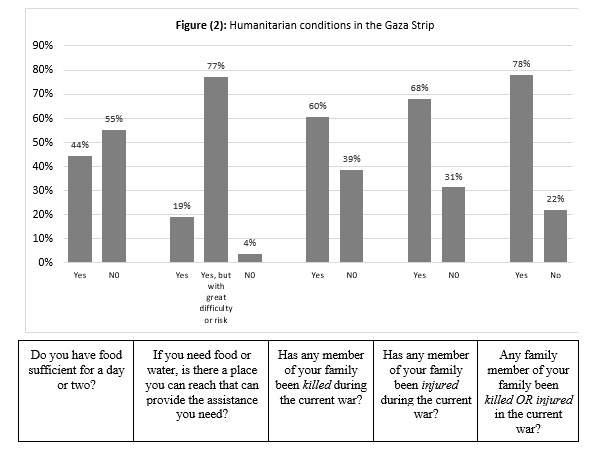
- We asked Gazans about the availability of essential needs: water, food, electricity, tents, covers, clothing, medical care, and toilets. Those who said “Yes, available” ranged between 10% for tents and 33% for water. But the largest percent said these needs are available but with great difficulty and risk. This was particularly the case for medical care, tents, food, water, and electricity. The needs that seem unavailable at all for the largest percentage of Gazans are tents, clothing, and covers.

We asked those in shelters about the identity of the organizers in charge. The majority of the respondents (62%) said it was UNRWA, 15% said it was government, 13% local Palestinian group, and 8% said other international organization.

- We asked respondents to assess, based on their personal experience, the fairness of aid distribution to displaced residents currently in shelters. The vast majority (70%) said it was discriminatory while only 27% said it was fair. When we crosstabulated these responses based on the identity of the shelters’ organizers, it becomes clear, as shown in the following figure, that greatest complaint (90%) comes from those in shelters organized by local Palestinian groups, followed by those organized by UNRWA, other international organizations, and the government.

- A majority of 64% (compared to 52% three months ago) blames Israel for the current suffering of Gazans in the current war while 20% (compared to 26% three months ago) place the blame on the US; only 7% (compared to 11% three months ago) place the blame on Hamas, and 6% (compared to 9% three months ago) blame the PA. It is worth noting that the percentage of Gazans who place the blame on Hamas has dropped from 19% to 9%.
3. War crimes and atrocities:
- As we found in the previous poll, almost all Palestinians (94% think Israel has committed war crimes during the current war. By contrast, only 5% (compared to 10% three months ago) think Hamas also committed such crimes; 4% think Israel has not committed such crimes and 91% think Hamas did not commit war crimes during the current war.
- 80% (compared to 85% in December 2023) say they did not see videos, shown by international news outlets, showing acts committed by Hamas against Israeli civilians, such as the killing of women and children in their homes; only 19% (11% in the West Bank and 30% in the Gaza Strip) saw these videos.
- We asked those who did not see the videos to tell us the reasons they have not seen them: 60% said that the media they watched did not show them while 20% (14% in the West Bank and 31% in the Gaza Strip) said that they did not want to watch them.
- When asked if Hamas did commit these atrocities that are seen in these videos, the overwhelming majority (93%) said no, it did not, and only 5% said it did. As shown in the figure below, the belief that Hamas fighters have committed atrocities against civilians is higher among those who did watch videos showing such atrocities (17%) compared to those who did not (2%).

4. Possible ramifications of an Israeli ground invasion of Rafah:
We explored three possible ramifications of an Israeli invasion of Rafah: people rushing to cross the border with Egypt, perception of likely Egyptian police and army response to such development, and the likely behavior of the residents and displaced person when they see people crossing the border toward Egypt:
- We asked the public to speculate about the likely behavior of Rafah residents and displaced persons in the event of an Israeli invasion of that city: would these people in this case rush to safety on the Egyptian side? While half of the West Bankers expect them to do so, only 24% of Gazans say residents and displaced person would rush towards the border and cross to safety in Egypt. In total, 40% said they think they would and 51% said they think they would not.
- We then examined public perception of the likely behavior of the Egyptian army and police, on the other side of the border, when seeing masses of people rushing and crossing the border into Egypt. Findings show a majority of 61% thinks the Egyptian army and police would indeed shoot at those crossing the borders. Gazans are more likely than West Bankers to think so, 68% and 55% respectively.

- We asked Gazans about their own behavior if they see people rushing toward the Egyptian border and seeing the separation barrier between Egypt and Rafah falling, would they leave home or shelter in search of safety and cross the borders with the others? Almost 70% said no, they would not; only 25% said yes, they would.

5. South Africa and the case of genocide at the International Court of Justice
- We asked the public about its satisfaction or dissatisfaction with South Africa for bringing the case of genocide against Israel to the international Court of Justice (ICJ). The vast majority (78%) expressed satisfaction; only 19% expressed dissatisfaction. But almost two thirds of the public (65%) expressed dissatisfaction with the court’s decision that did not ask Israel to abide by a ceasefire; only 31% expressed satisfaction with the court’s decision. Moreover, only 37% expressed the belief that the ICJ would indeed eventually convict Israel of genocide. A majority of 59% said it did not expect the ICJ to issue such a conviction.
- Finally, when asked if such conviction, if it happens, would contribute to force Israel to consider ending its occupation of the Palestinian territories in the West Bank and the Gaza Strip, a majority of 72% said no; only 23% said yes. It is noticeable that Gazans, as shown below, show a little more satisfaction with the court’s decision and optimism regarding the likely court decision and the impact of such a decision on the larger question of the Israeli occupation of the Palestinian territories.

6. Expectations regarding the ceasefire and who will win the war
- We asked the public about its expectations for the following weeks and months regarding the war and the prospects for a ceasefire. The largest percentage (40%) expect Israel and Hamas to reach a permanent ceasefire while 27% expect the continuation of the war and 25% expect the expansion of the war to include other regional and non-regional states and actors. The expectations of a ceasefire is much higher in the West Bank than in the Gaza Strip, 50% and 27% respectively. The largest percentage of Gazans (38%) expects the war to continue while only 20% of West Bankers expect that.

- As we did in December 2023, we asked in the current poll “who will win” this war. Today, the majority expects Hamas to win. But it is a little smaller majority than we found three months ago, 64% and 70% respectively. It is worth noting, as indicated in the figure below, that today, more Gazans expect Hamas to win than three months ago, 56% and 50% respectively. By contrast, today, less West Bankers expect Hamas to win than three months ago, 69% and 83% respectively. It is worth noting also that while almost no one in the West Bank expect Israel to win the current war, almost one fifth (19%) of Gazans expect Israel to win. The current percent of those Gazans who expect Israel to win is more than a third less than the case three months ago, 19% and 31% respectively.

7. “The Day After:” Who will rule Gaza after the war?
- We asked the respondents to speculate about the party that will be in control of the Gaza Strip in the day after the end of the current war. Gazans and West Bankers agree by 59%, for each side, that it will be Hamas. This represents a drop of 5 points compared to our findings three months ago. The drop came from the West Bank, declining by 14 points while in the Gaza Strip the percentage of those who thought Hamas will be in control increased by 8 points. Only 5% think the Israeli army will be in control; 9% selected a PA under president Abbas, and another 9% selected the PA without Abbas; 2% selected one or more Arab country; and 2% selected the UN.
- When asked about their own preferences for the party that should be in control in the Gaza Strip after the war, 59% (64% in the West Bank and 52% in the Gaza Strip) selected Hamas; 13% selected the PA without President Abbas; 11% selected the PA with Abbas; 3% selected one or more Arab country;1% selected the UN, and 1% selected the Israeli army. Three months ago, we asked an identical question, but with a slightly different set of options to choose from. At that time, a similar percentage (60% in total; 75% in the West Bank and 38% in the Gaza Strip) selected Hamas as the party preferred by the respondents to control the Gaza Strip after the war. The change in the preferences of the Gazans, with a 14-point increase among them selecting Hamas today, is one of the most intriguing findings of the current poll. But it is consistent with the increase, indicated above, in the percentage of Gazans who think Hamas will win the current war. This is particularly interesting because the opposite happened in the West Bank, with the preference for Hamas dropping significantly by 11 points. Yet, this West Bank finding is consistent with the significant decrease by 14 points, also indicated above, in the percentage of West Bankers who think Hamas will win the war.

- In another question involving speculation about the most likely scenario for the day after the war, the results were almost identical, to the question asked above, as 59% said Hamas will return to control the Gaza Strip. But unlike the first question above, 63% of the West Banker and only 52% in the Gazans expected that. The reason for the change has to do with the available set of scenarios we provided in which we omitted the option of a return of the PA without president Abbas and provided new possibilities, such as the establishment by Israel of local authorities, tribal and family control, the emergence of multiple armed groups. The return of the PA under Abbas was expected by 11%, 6% expected Israel to establish local authorities, another 6% expected the Israeli army to assume control, 4% expected control by tribes and families, and another 4% expected the establishment of multiple armed groups.
- Here too we asked about preferences regarding these scenarios. Given the new choices, the most important change, compared to the earlier question, about preferences in the day after the war, has been the rise in the percentage that selected Hamas. As shown in the figure below, the return of Hamas reaches 63%, with a 7-point increase in the Gaza Strip compared to only 2-point increase in the West Bank. Gazans were also more likely to increase their support for the return of the PA, even if under Abbas’ control, with a 14-point rise. West Bankers increased their support for a PA under Abbas by only 3 points.

- Our previous poll in December 2023 asked about the deployment of an Arab security contingent from Egypt and Jordan in the Gaza Strip. At that time, three months ago, we found a 70% opposition to the idea even if the forces were deployed to assist the PA security forces. In this poll, we asked about support for the “immediate deployment of an international force under the UN flag to temporarily police the Gaza Strip in order to end the current war and bring about an Israeli withdrawal.” Only one third supported this option and 63% opposed it. Support for it was higher in the West Bank than in the Gaza Strip (43% to 17% respectively).

- We also asked the respondents to speculate about attitudes of Gazans toward a possible deployment of Turkish forces in the Gaza Strip. But this scenario stated that such deployment would take place with Hamas’ approval and international cover and funding. The findings show the majority thinks Gazans would reject the idea. The assessment of Gazans however shows a split with 51% believing Gazans would welcome the deployment and 48% believing they would reject it.

- Finally, we asked the public about if it is for or against an idea of a long-term vision for the day after in which the US and an Arab coalition comprising Egypt, Saudi Arabia, and Jordan would develop a plan that would strengthen the PA, restore negotiations based on the two-state solution, and bring about an Arab-Israeli peace and normalization. Almost three quarters (73%) said it stands against the idea and only 23% said it stands for it. It is worth noting that the support for the idea among Gazans is much higher than it is among West Bankers, 36% and 14% respectively.+

8. Satisfaction with relevant Palestinian, regional, and international actors:
- The vast majority (83%) thinks the US administration repeated declarations about the reaching a two-state solution are not serious; only 15% (9% in the West Bank and 23% in the Gaza Strip) think they are serious.
- As we did in our previous poll, we asked in the current one about public satisfaction with the role played during the war by various Palestinian, Arab/regional, and international actors:
- On the Palestinian side, satisfaction with the role of Hamas remains stable at 70% (75% in the West Bank and 62% in the Gaza Strip) was the highest followed by the role played by Yehia Sinwar (61%; 68% in the West Bank and 52% in the Gaza Strip), Fatah (27%; 24% in the West Bank and 32% in the Gaza Strip), and president Abbas (14%; 8% in the West Bank and 22% in the Gaza Strip). As the figure below indicates, support for Hamas, while indeed stable for the total, has in fact dropped in the West Bank by 10 points, from 85% three months ago to 75% today. The opposite happened in the Gaza Strip: satisfaction with Hamas increased by 10 points. Satisfaction with Sinwar remains stable in the Gaza Strip and drops 13 points in the West Bank. Satisfaction with Fatah increases by 5 points for the total, 1 point in the West Bank and 11 points in the Gaza Strip. Finally, satisfaction with Abbas increases by 3 points, 1 point in the West Bank and 5 points in the Gaza Strip.

- For the Arab/regional actors, as in our previous poll, the highest level of satisfaction goes to Yemen (83%; 88% in the West Bank and 75% in the Gaza Strip), followed by Qatar (56%), Hizballah (48%), Iran (30%), Jordan (22%), and Egypt (12%). The following figure shows the distribution of satisfaction in the two polls over the West Bank and the Gaza Strip. In the Gaza Strip, the figure shows a significant rise in satisfaction with Yemen and Qatar and a decrease in satisfaction with Hezbollah and Egypt. In the West Bank, the figure shows a rise in satisfaction with Hezbollah and a decrease in satisfaction with Qatar, Iran, Jordan, and Egypt. The regional Arab country that has lost satisfaction in both the West Bank and the Gaza Strip is Egypt, cut down by half to 12% for the total, 5% in the West Bank and 23% in the Gaza Strip.

- For the non-regional international actors, the highest level of satisfaction goes to Russia (19%, 21% in the West Bank and 16% in the Gaza Strip), followed by Canada and the UN (7% each), and the US (1%). The following figure shows a drop of 3 points in satisfaction with Russia for the total sample. The drop came from the Gaza Strip (12 points) while satisfaction with Russia in the West Bank increased by 4 points. Satisfaction with the US performance remains non-existent.

9. What should the Palestinian Authority do?
- We asked about the policy measures that the PA leadership should take today to help address the current war in the Gaza Strip. Three policy options were provided. The largest percentage (42%) opted for bringing about an immediate reconciliation and reunification of the West Bank and the Gaza Strip. Secondly, selected by 37%, came the formation of a national unity government to negotiate with Israel and the international community the end of the war and the future reconstruction of the Gaza Strip. The third, selected by 14%, was for the PA to “lead the humanitarian service delivery to Gazans in cooperation with Egypt and the international community.” It is worth noting that for Gazans, the formation of a national unity government has been the most preferred measure, while for West Bankers, it has been reconciliation and reunification of the West Bank and the Gaza Strip. When compared to these two measures, both sides, West Bankers and Gazans, almost equally, viewed the humanitarian role as the least important.

(2) Parliamentary and presidential elections and the domestic balance of power: |
If a presidential competition is to take place between three, Marwan Barghouti from Fatah, Mahmoud Abbas, also from Fatah, and Ismael Haniyeh from Hamas, participation in the election would stand at 72%; vote for Marwan Barghouti would stand at 40%, the highest rate in the last three hypothetical elections since September 2023, followed by Haniyeh at 23%, and Abbas at 8%. Among the voters, Barghouti receives 56%, Haniyeh 32%, and Abbas 11%. Three months ago, support for Barghouti among the voters stood at 47% and Haniyeh at 43%, and Abbas at 7%. These findings show Barghouti’s vote increasing by 9 points while vote for Haniyeh drops by 11 points.

- However, if the new presidential elections were held with only two candidates, Mahmoud Abbas from Fatah and Ismail Haniyeh from Hamas, competing, the voter turnout would drop to 52%; vote for Haniyeh would stand at 37% and Abbas at 11%. Among the voters, Haniyeh would receive 70% and Abbas 22%. Three months ago, the vote for Abbas among the voters stood at 16% and vote for Haniyeh stood at 78%.

- But if the two presidential candidates were Marwan Barghouti from Fatah and Haniyeh from Hamas, participation would rise to 69%; 42% would vote for Barghouti and 26% for Haniyeh. Among the voters, Barghouti would receive 62% and Haniyeh 37%. These findings indicate a rise in the vote for Barghouti among voters by 11 points and a drop in the vote for Haniyeh by 8 points.

- If the two presidential candidates were Haniyeh from Hamas and a different Fatah candidate, prime minister Mohammad Shtayyeh, participation would drop to 53%; 13% would vote for Shtayyeh and 38% for Haniyeh. Among the voters, Shtayyeh receives 24% and Haniyeh 72%.

- Finally, if the two presidential candidates were Haniyeh from Hamas and a non-Fatah candidate, Mustafa Barghouti, the leader of al Mubadara and a former presidential candidate, the voter turnout rises slightly to 56%; Mustafa Barghouti receives 23% and Haniyyeh 31%. Among the voters, Mustafa Barghouti receives 40% of the vote and Haniyyeh 56%.

- In a closed question, we asked the public to select the person they prefer to see as President Abbas's successor. The largest percentage (40%) said they prefer Marwan Barghouti; 19% preferred Ismail Haniyeh; 10% chose Yahya al Sinwar; 6% chose Hussein al-Sheikh; 4% preferred Mohammed Dahlan, 2% preferred Khaled Meshaal, 1% chose Muhammad Shtayyeh, and 18% said they did not know or chose someone else. It is worth noting that the preference for Dahlan, al-Sheikh, and Shtayyeh comes almost only from the Gaza Strip.
- Level of satisfaction with the performance of president Abbas stands at 16% and dissatisfaction at 81%. Satisfaction with Abbas stands at 8% in the West Bank (compared to 10% three months ago) and 27% in the Gaza Strip (compared to 19% three months ago). Six months ago, before the October 7 war, satisfaction with Abbas stood at 22% and dissatisfaction at 76%.
- 84% want Abbas to resign while 14% want him to remain in office. Three months ago, 88% said they want Abbas to resign. Six months ago, 78% wanted him to resign. Demand for Abbas' resignation today stands at 93% in the West Bank and 71% in the Gaza Strip.

- When asked which political party or political trend they support, the largest percentage selected Hamas (34%), followed by Fatah (17%), while 11% selected other or third-party groups, and 37% said none of them or did not know. Three months ago, 43% supported Hamas and 17% selected Fatah. Six months ago, before the current war, support for Hamas stood at 22% and support for Fatah stood at 26%.This means that support for Hamas during the past three months has witnessed an 11-point drop while support for Fatah remained unchanged during the same period. In the West Bank, support for Hamas today stands at 35% (compared to 44% three months ago), and for Fatah at 12% (compared to 16% three months ago). In the Gaza Strip, support for Hamas today stands at 34% (compared to 42% three months ago) and support for Fatah at 25% (compared to 18% three months ago).

- However, if new parliamentary elections were held today with the participation of all political forces that participated in the 2006 elections, only 64% say they would participate in them, 30% would vote for Hamas, 14% for Fatah, 6% for third parties, and 15% remain undecided. Among the voters, support for Hamas stands at 47%, Fatah 22%, third parties 9%, and the undecided at 24%. Compared to our findings three months ago, the current results among the voters indicate a 4-point drop by for Hamas and a 3-point rise by Fatah. In the Gaza Strip, vote for Hamas among the voters stands today at 45% (compared to 52% three months ago and 44% six months ago) and vote for Fatah among the voters stands today at 26% (compared to 21% three months ago and 32% six months ago). In the West Bank, vote for Hamas among the voters stands today at 48% (compared to 50% three months ago and 24% six months ago) and vote for Fatah among the voters stands today at 16% (compared to 18% three months ago and 40% six months ago).

- 49% (compared to 54% three months ago) believe that Hamas is the most deserving of representing and leading the Palestinian people today while 17% (compared to 13% three months ago) believe that Fateh under the leadership of Abbas is more deserving; 29% (compared to 26% three months ago) believe both are unworthy of representation and leadership. Six months ago, 27% said Hamas is the most deserving, 24% said Fateh led by Abbas is the most deserving, and 44% said both are unworthy of representation and leadership.
(3) Domestic conditions, the resignation of Shtayyeh, and perception of safety and security: |
- We asked the public about the meaning of the resignation of the government of prime minister Mohammad Shtayyeh: is it, in its view, a step toward reforming the PA? A majority of 62% said it is not and only 30% said it is. Gazans are more likely than West Bankers to view the resignation as a step toward reform, 41% and 23% respectively.
- In the aftermath of the resignation of prime minister Shtayyeh, two candidates emerged as the most likely successors: Mohammad Mustafa (reportedly favored by Abbas) and Salam Fayyad (reportedly favored by some regional and international donors). We asked the public, which of the two it favors: 55% said none of them; 22% favored Fayyad and 10% favored Mustafa. Eventually, after the completion of data collection, Mustafa was appointed by Abbas as his next prime minister.
- We asked the public about the make-up and source of authority for the new government: a national unity government that would come under the control of a political party, control of president Abbas, or one that does not come under the control of Abbas or a political party. As the figure below shoes, 62% opted for the third choice while only a quarter selected the two other choices combined. It is worth noting that Gazans are less likely than West Bankers to go for the third choice.

- A majority of 65% (compared to 68% three months ago) believes that the PA has become a burden on the Palestinian people and only 27% (compared to 28% three months ago) believe it is an asset for the Palestinian people. Six months ago, 62% said the PA is a burden and 35% said it was an achievement.
- We asked the public in the West Bank about its personal and family safety and security. The findings show that only 11% feel safe and secure while 89% feel unsafe and unsecure. Three months ago, the perception of safety stood at 14% and six months ago at 48%.
- Aljazeera is the most watched TV station in Palestine with 61% selecting it as the one they watched the most during the past two months. West Bankers are more likely than Gazans to watch Aljazeera as 45% of Gazans (compared to 10% in the West Bank) say they do not watch or have no access to TV these days. The second most popular TV station is Palestine Today (4%), followed by Alarabiyya and al Mayadeen (3% each), Palestine TV (2%), Alaqsa and Ma’an (1% each).
(4) Palestinian-Israeli Relations and the Peace process: |
- 45% support and 52% oppose the idea of a two-state solution, which was presented to the public without providing details of the solution. Three months ago, support for this solution in a similar question stood at 34% and six months ago support stood at 32%. In the current poll, support for this solution came from Gaza Strip, a 27-point increase while remaining stable in the West Bank at 34%.

- Support for the two-state solution is usually linked to public assessment of the feasibility of such a solution and the chances for the establishment of a Palestinian state. Today, 61% (compared to 65% three months ago) believe the two-state solution is no longer practical due to settlement expansion but 37% (compared to 32% three months ago) believe it is still practical. Six months ago, 71% said that the two-state solution is no longer practical due to settlement expansion. Moreover, 72% believe that the chances for the establishment of an independent Palestinian state alongside Israel in the next five years are slim or nonextant, and 27% believe the chances are medium or high.
- When asked about public support and opposition to specific policy measures to break the stalemate: 62% supported joining more international organizations; 45% supported resort to unarmed popular resistance; 55% supported a return to confrontations and armed intifada; 58% supported dissolving the PA; and 24% supported abandoning the two-state solution and demanding one state for Palestinians and Israelis. Three months ago, 69% supported a return to confrontations and armed intifada; 39% supported resort to unarmed popular resistance; 58% supported the dissolution of the PA; and 29% supported abandoning the two-state solution in favor of one state. Six months ago, before the current war, 58% supported a return to confrontations and armed intifada; 53% supported resort to unarmed popular resistance; 52% supported the dissolution of the PA; and 27% supported abandoning the two-state solution in favor of one state.
- We offered the public three methods to end the Israeli occupation and establish an independent state and asked it to select the most effective. 46% (51% in the West Bank and 39% in the Gaza Strip) selected “armed struggle;” 25% (27% in the West Bank and 23% in the Gaza Strip) selected negotiations; and 18% (12% in the West Bank and 27% in the Gaza Strip) selected popular non-violent resistance. As shown in the figure below, these findings indicate a 17-point drop in support for armed struggle; a 5-point rise in support for negotiations; and a 5-point rise in support for non-violence. The drop in three months in support for armed struggle comes equally from both the West Bank and the Gaza Strip.

- Support and opposition to negotiations is seen in the results to a question about attitudes regarding “a return to Palestinian-Israeli peace negotiations in order to achieve a two-state solution under international and Arab auspice.” Support for such return to negotiations received the support of 38% (46% in the Gaza Strip and 33% in the West Bank) of the public.

- We asked the public about its willingness to compromise for the sake of peace: “if during negotiations, Israel agrees to make painful concessions to the Palestinian side, would you be willing in this case to support a similar Palestinian position in offering similar concessions to Israel?” A majority of 63% (70% in the West Bank and 52% in the Gaza Strip) said “no,” while only one third (33%; 46% in the Gaza Strip and 24% in the West Bank) said “yes.”
- We asked the public to tell us what kind of role it thinks the international community can play in address the Palestinian-Israeli conflict. The poll provided five different roles. The most popular role, receiving 39% support, was the one involving humanitarian assistance in providing basic needs of refugees and displaced persons; the second, receiving 29% support, was “mediation to bring the two sides to the negotiation table,” the third, receiving 11% support, was the provision of financial and socio-economic assistance to the Palestinian Authority; the fourth, with 8% support was the use of sanctions to force the parties to observe international law; and the fifth, with only 6% support, was building Palestinian public institutions.

- When asked to select the Western country trusted the most in helping Palestine and Israel make peace, two thirds selected “none of the above.” The list provided included four countries: the US, Canada, France, and Germany. From among the four Canada came second, after the US, with 8% favoring it. France came third and Germany fourth.

- We asked the public about its assessment of the potential impact of withholding financial support from UNRWA by some countries “because some of its staff have been accused of participating in Hamas’ October 7 offensive.” We asked the public to tell us if it thinks withholding support from UNRWA would contribute to increasing or decreasing the prospects for Palestinian-Israeli peace. The overwhelming majority thought the withholding of support would decrease the prospects for peace while only 5% thought it would do the opposite and increase the prospects for peace.

- In light of the increase in settler terrorist attacks against Palestinian towns and villages, we asked West Bankers what means are most effective in combating this terrorism that are also the most feasible.
- The largest percentage (41%) chose the formation of armed groups by residents of the targeted areas in order to protect their areas; 23% chose to deploy Palestinian police forces in the targeted areas; another 23% chose the demand that the Israeli army take measures to prevent settler terrorism; and only 8% chose the formation, by residents of the targeted areas, of unarmed groups to protect their areas. As the figure below indicates, these results show significant change compared to out findings three months ago. The most important change is a 15-point drop-in support for the formation of armed groups, an 8-point increase in the demand for protection by the PA police; and a 7-point increase in the demand for an Israeli army measures to stop the settlers.

(5) Most vital Palestinian goals and the most pressing problems confronting Palestinians today: |
- 42% believe that the first most vital Palestinian goal should be to end Israeli occupation in the areas occupied in 1967 and build a Palestinian state in the West Bank and the Gaza Strip with East Jerusalem as its capital. By contrast, 33% believe the first most vital goal should be to obtain the right of return of refugees to their 1948 towns and villages; 13% believe that the first and most vital goal should be to build a pious or moral individual and a religious society, one that applies all Islamic teachings; and 11% believe it should be to establish a democratic political system that respects freedoms and rights of Palestinians.
- When asked about the most pressing problem confronting the Palestinians today, the largest percentage (56%; 66% in the Gaza Strip and 50% in the West Bank) said it is the continued war in the Gaza Strip; (23%) said it is the Israeli occupation; 8% said it is corruption; 6% said it is unemployment; and 5% said it is the split between the West Bank and the Gaza Strip. Three months ago, (51%, 42% in the West Bank and 64% in the Gaza Strip) said it is the continued war in the Gaza Strip; and 32% said it is the Israeli occupation.