
PSR's survey research team has conducted over 200 public opinion polls during the past 20 years (See also CPRS Polls). It has a track record of conducting highly reliable, policy relevant, and informative surveys. Members of PSR Survey Research Unit have been engaged in several types of survey research activities including regular public opinion polls, a democracy index, the Arab Barometer, exposure to violence, and empirical studies of transition to democracy.
PSR survey research team has also conducted exit polls, a comprehensive socio-political survesy, student elections surveys, and several joint polls with partners in neighboring countries. PSR Survey Research Unit has a highly trained team of more than 200 fieldworkers and supervisors who are continuously updated on various means of effective interview techniques and survey methodology. Data collectors are trained in sampling techniques and survey and fieldwork methods.
PSR Survey Research Unit is known and respected internationally for its polling work and for its efforts to further objective survey research methodology in the area. Poll results are used by a wide variety of individuals and organizations, including political leaders, researchers, local and foreign press, diplomatic community members, and local grassroots institutions. The results of the polls are disseminated through publication in local and international press, lectures and meetings, in addition to the PSR mailing list of academic researchers, think tanks, diplomatic missions, and others. The Unit is committed to providing scholarly and objective analysis.

Joint Poll in year 2020:
Final Report/ January 2019:
- Role of Public Opinion in the Resilience/Resolution of the Palestinian-Israeli Conflict
 Khalil Shikaki and Dahlia Scheindlin
Policy Papers
1) Khalil Shikaki, “Peace versus the People,” Cairo Review of Global Affairs, Fall 2017
https://www.thecairoreview.com/essays/modi-in-israel/
2) Khalil Shikaki, “Do Palestinians Still Support the two-State Solution?” Foreign Affairs, September 2018
3) Khalil Shikaki and Dahlia Scheindlin, Two-State or One-State, English, Carnegie_Baker, fall 2018
https://carnegieendowment.org/files/CarnegieBaker_TwoStatesOrOne.pdf
4) Shai Feldman and Khalil Shikaki, “Trump Peace Plan,” ME Brief, the Crown Center for ME Studies, Brandeis University, April 2109
http://www.brandeis.edu/crown/publications/meb/meb126.pdf
5) خليل الشقاقي وداليا شيندلين، دولتان أم دولة واحدة
https://carnegieendowment.org/files/Palestine_Report_ARA.TXT.pdf
Summary Tables:
1) Table 1_ support of the general public for the original and modified packages and components
2) Table 2_ support of the problematic constituencies to package and components
3) Table 3_ Incentives to garner public support
4) Table 4_ incentives to garner problematic constituencies support
5) Table 5_ response of problematic constituencies to modified package
6) Table 6_ impact of paired incentives on support for package
7) Table 7_ sacred values and problematic constituencies
8) Table 8_ impact of positive perceptions of the other on TSS and package
9) Table 9_ impact of perception of the other on TSS and package
10) Table 10_ Palestinian and Israeli public support for TSS, one-state, and confederation
11) Table 11_ impact of elite perception on attitudes
Joint elite Polls:
- Joint Elite Poll 2: Elites on both sides are influenced by their perceptions of their society, and also by their perceptions of opinion on the opposing side: Those who believe their side or the other side is supportive of a two-state solution are more willing to take action and speak out in favor. But Palestinian and Israeli elites are just as divided by ideological attitudes and party identification as the general public on both sides; they may be more committed to their own attitudes over time than the general public, but also show a greater gap between theoretical positions and support for detailed policies. Pre-existing ideology influences reactions to new information about their own and the other side’s support for a two-state solution.
- Joint Elite Poll 1: Elites on both sides are influenced by their perceptions of their society, and also by their perceptions of opinion on the opposing side: Those who believe their side or the other side is supportive of a two-state solution are willing to take action and speak out in favor. But Palestinian and Israeli elites are just as divided by ideological attitudes and party identification as the general public on both sides. Pre-existing ideology influences reactions to new information about their own and the other side’s support for a two-state solution.

Joint Poll in year 2018:
Joint Poll in year 2017:
- Support for the two-state solution in principle falls below half for Palestinians and Israeli Jews – 46% of both populations support this solution today; Arab citizens of Israel are the only population showing a strong majority in favor (83%). Palestinian attitudes become more pessimistic in general and support for militancy rose following US President Trump’s recognition of Jerusalem as Israel’s capital. Jewish Israeli support for two states has not changed since June 2017 (47% in June). Still both sides prefer the two-state solution to all other conflict resolution options. Although only a minority of Israelis and Palestinians support the detailed package for implementation – 40% of Palestinians and 43% of Israelis (just 35% among Jews) – the opposition is still flexible: a package of incentives tested among those opposed to the solution showed that nearly half of Jews and 40% of Palestinians might change their minds to support the agreement under the right conditions, bringing support to a majority on both sides.
- Palestinian-Israeli Pulse: A Joint Elite Poll: Elites on both sides are influenced by their perceptions of their society, and also by their perceptions of opinion on the opposing side: Those who believe their side or the other side is supportive of a two-state solution are willing to take action and speak out in favor. But Palestinian and Israeli elites are just as divided by ideological attitudes and party identification as the general public on both sides. Pre-existing ideology influences reactions to new information about their own and the other side’s support for a two-state solution.
- Support for the two state solution rises among Palestinians but declines among Israeli Jews, while support for a comprehensive peace agreement remains unchanged among Palestinians but drops among Israeli Jews. But a package of incentives shows that attitudes are flexible on both sides, and motivates significant shift in favor of the peace package leading to majority support on both sides. Unilateral recognition of each side’s national claims is one of the most effective incentives for both. However, perceived lack of feasibility remains closely linked to rejection of the two-state solution and its package of implementation. 29 June-1 July, 2017
Joint Poll in year 2016:
- A majority of Israelis and just under half of Palestinians still support the two state solution in principle, but under half on both sides support the detailed framework for its implementation. However, despite mutual fear, distrust and pessimism regarding the likelihood and feasibility of the two-state solution, a majority of Palestinians and Israelis may support comprehensive peace agreement that ends the conflict if offered additional symbolic or concrete incentives. December 8 - 10, 2016
- slight majority of Israelis and Palestinians support the two-state solution. However, they do not trust each other, have disparate views on the terms of a permanent settlement, underestimate the level of compromise on the other side, and view its intentions as threatening. Nonetheless, at least a quarter of the opposition to a permanent settlement on both sides is flexible and it is likely that its opinion might be changed with the right incentives.2-4 June 2016
استطلاع مشترك عام 2023:
استطلاع مشترك عام 2020:
البيان الصحفي جدول النتائج
التقرير النهائي /كانون ثاني (يناير) 2019
- هل يساهم الرأي العام في تعزيز أم في حل الصراع الفلسطيني-الإسرائيلي؟ خليل الشقاقي وداليا شيندلين
أوراق سياساتية:
1) Khalil Shikaki, “Peace versus the People,” Cairo Review of Global Affairs, Fall 2017
https://www.thecairoreview.com/essays/modi-in-israel/
2) Khalil Shikaki, “Do Palestinians Still Support the two-State Solution?” Foreign Affairs, September 2018
3) Khalil Shikaki and Dahlia Scheindlin, Two-State or One-State, English, Carnegie_Baker, fall 2018
https://carnegieendowment.org/files/CarnegieBaker_TwoStatesOrOne.pdf
4) Shai Feldman and Khalil Shikaki, “Trump Peace Plan,” ME Brief, the Crown Center for ME Studies, Brandeis University, April 2109
http://www.brandeis.edu/crown/publications/meb/meb126.pdf
5) خليل الشقاقي وداليا شيندلين، دولتان أم دولة واحدة
https://carnegieendowment.org/files/Palestine_Report_ARA.TXT.pdf
قائمة الجداول:
1) جدول رقم -1  : تأييد الجمهور لخطة السلام الأصلية ولخطة السلام المعدلة والمكونات
2) جدول رقم -2 : تأييد المجموعات المتشددة لخطة السلام ومكوناتها
3) جدول رقم -3 : حوافز مقدمة للجمهور
4) جدول رقم -4 : حوافز مقدمة للمجموعات المتشددة
5) جدول رقم -5 : مواقف المجموعات المتشددة من خطة السلام المعدلة
6) جدول رقم -6 : تأثير الحوافز المزدوجة على تأييد خطة السلام
7) جدور رقم -7 : القيم المقدسة والمجموعات المتشددة
8) جدول رقم -8 : تأثير الانطباعات الإيجابية عن الطرف الآخر على الموقف من حل الدولتين وعلى تقدير أهداف الآخر
9) جدول رقم -9 : تأثير الانطباعات عن الطرف الآخر على الموقف من حل الدولتين ومن خطة السلام
10) جدول رقم -10 : تأييد حل الدولتين وحل الدولة الواحدة والكونفدرالية
11) جدول رقم -11 : تأثير انطباعات النخبة على مواقفها
استطلاعات النخبة:
- نبض الرأي العام الفلسطيني - الإسرائيلي: استطلاع النخبة رقم (2): تتأثر النخبة لدى الطرفين بانطباعاتها عن مواقف مجتمعها وبانطباعاتها عن مواقف المجتمع لدى الطرف الآخر بحيث أن الذين يعتقدون أن مجتمعهم أو المجتمع لدى الطرف الآخر مؤيد لحل الدولتين يبدون استعداداً لاتخاذ خطوات أو الإعراب عن التأييد لصالح هذا الحل. لكن النخبة الفلسطينية والإسرائيلية منقسمة حسب مواقفها الإيديولوجية وانتماءاتها السياسية مثلها في ذلك مثل بقية المجتمع لدى الطرفين، لكن النخبة قد تكون أكثر استقراراً في مواقفها مقارنة بالجمهور العام، وتبدو الفجوة أوسع لدى النخبة بين مواقفها من فكرة حل الدولتين مقارنة بموقفها من الخطة التفصيلية. تؤثر المواقف والانتماءات المسبقة على ردة فعل النخبة على المعطيات الجديدة حول مدى تأييد طرفهم أو الطرف الآخر لحل الدولتين
- نبض الرأي العام الفلسطيني - الإسرائيلي: استطلاع النخبة رقم (1): تتأثر النخبة لدى الطرفين بانطباعاتها عن مواقف مجتمعها وبانطباعاتها عن مواقف المجتمع لدى الطرف الآخر بحيث أن الذين يعتقدون أن مجتمعهم أو المجتمع لدى الطرف الآخر مؤيد لحل الدولتين يبدون استعداداً لاتخاذ خطوات أو الإعراب عن التأييد لصالح هذا الحل. لكن النخبة الفلسطينية والإسرائيلية منقسمة حسب مواقفها الإيديولوجية وانتماءاتها السياسية مثلها في ذلك مثل بقية المجتمع لدى الطرفين. تؤثر هذه المواقف والانتماءات المسبقة على ردة فعل النخبة على المعطيات الجديدة حول مدى تأييد طرفهم أو الطرف الآخر لحل الدولتين
ستطلاع مشترك عام 2018:
استطلاع مشترك عام 2017:
- ينخفض التأييد لحل الدولتين لأقل من النصف بين الفلسطينيين والإسرائيليين اليهود حيث لا يتجاوز 46% لكل منهما، لكن التأييد بين العرب الإسرائيليين يبقى كبيراً (83%). في أعقاب اعتراف الرئيس الأمريكي ترامب بالقدس عاصمة لإسرائيل يزيد التشاؤم حول فرص السلام بين الفلسطينيين وترتفع بينهم نسبة تأييد العمل المسلح. رغم ذلك، فإن تأييد الطرفين لحل الدولتين يفوق تأييدهما لأي من الخيارات الأخرى لحل الصراع. كذلك، بالرغم من أن أقلية فقط من الطرفين تؤيد رزمة مفصلة للحل الدائم (40% بين الفلسطينيين و43% بين الإسرائيليين كافة و35% بين اليهود الإسرائيليين فقط) فإن المعارضة لهذه الرزمة تبقى مرنة، حيث أن مجموعة من الحوافز التي تم اختبارها تظهر أن حوالي نصف المعارضين اليهود و40% من المعارضين الفلسطينيين على استعداد لتغيير مواقفهم وتأييد رزمة الحل الدائم في ظل ظروف مناسبة مما يرفع نسبة التأييد لتصبح الأغلبية.
- نبض الرأي العام الفلسطيني-الإسرائيلي: إستطلاع النخبة: تتأثر النخبة لدى الطرفين بانطباعاتها عن مواقف مجتمعها وبانطباعاتها عن مواقف المجتمع لدى الطرف الآخر بحيث أن الذين يعتقدون أن مجتمعهم أو المجتمع لدى الطرف الآخر مؤيد لحل الدولتين يبدون استعداداً لاتخاذ خطوات أو الإعراب عن التأييد لصالح هذا الحل. لكن النخبة الفلسطينية والإسرائيلية منقسمة حسب مواقفها الإيديولوجية وانتماءاتها السياسية مثلها في ذلك مثل بقية المجتمع لدى الطرفين. تؤثر هذه المواقف والانتماءات المسبقة على ردة فعل النخبة على المعطيات الجديدة حول مدى تأييد طرفهم أو الطرف الآخر لحل الدولتين
- ترتفع نسبة تأييد حل الدولتين بين الفلسطينيين وتنخفض بين الإسرائيليين اليهود، وتبقى نسبة تأييد رزمة شاملة مفصلة للحل الدائم بدون تغيير بين الفلسطينيين وتنخفض بين الإسرائيليين اليهود، لكن مجموعة من الحوافز تظهر وجود درجة من المرونة في المواقف وتحدث تغييراً ملموساً مؤيداً لرزمة السلام مؤدية لبلورة أغلبية من المؤيدين لدى الطرفين حيث يبدو أن اعترافاً بالمطالب القومية لكل طرف هو من أكثر الحوافز تأثيراً على الطرفين لكن الاعتقاد بأن حل الدولتين ليس واقعياً يبقى الأكثر دفعاً لرفض رزمة الحل الدائم.
استطلاع مشترك عام 2016:
- أغلبية من الإسرائيليين وأقل من النصف بقليل من الفلسطينيين يؤيدون حل الدولتين من حيث المبدأ، لكن أقل من النصف من الطرفين يؤيدون رزمة شاملة مفصلة لتطبيق هذا الحل. ومع ذلك، وبالرغم من الخوف المتبادل وانعدام الثقة وازدياد التشاؤم بخصوص فرص وإمكانات حل الدولتين، فإن أغلبية من الفلسطينيين والإسرائيليين قد يؤيدون اتفاق سلام شامل ينهي الصراع فيما لو اشتمل على حوافز إضافية رمزية أو ملموسة.
- رغم أن أغلبية ضئيلة من الفلسطينيين والإسرائيليين تؤيد حل الدولتين، إلا أن الطرفين لا يثقان ببعضهما، بل ومتباعدان في تصورهما للتسوية الدائمة، ويميلان للتقليل من مستوى قبول الحلول الوسط لدى الطرف الآخر، ويعتقدان أن نوايا الطرف الآخر تشكل تهديداً شديدا لهما؛ ورغم كل ذلك، فإن مواقف الربع، على الأقل من المعارضين للتسوية الدائمة لدى الطرفين تبقى مرنة ويمكن تغييرها عن طريق الحوافز المناسبة.
 كانون أول (ديسمبر) 2024
التفاف الجمهور حول برامج حكومة محمد مصطفى واولوياتها المعلنة: هل هو ممكن؟
وليد لدادوة
قبل الرئيس محمود عباس استقالة حكومة محمد اشتية بتاريخ 26 فبراير 2024ـ وهي الحكومة الثامنة عشر بعد ما يقارب 5 سنوات من تشكيلها في اذار2019، وتم تكليف محمد مصطفى بتشكيل الحكومة الفلسطينية والتي استلمت مهامها في 31 اذار 2024. لا شك ان تشكيل حكومة مصطفى قد جاء في اعقد ظروف يمر بها الفلسطينيون منذ تشكيل السلطة الفلسطينية حيث الحرب الطاحنة على قطاع غزة، وتردي الوضع الأمني في الضفة الغربية، والازمة المالية للسلطة الفلسطينية، وتردي الوضع الاقتصادي، وازدياد معدلات البطالة، والخلاف مع حركة حماس والفصائل الفلسطينية التي رفضت تشكيل هذه الحكومة[1]، وسخط شعبي عارم على أداء السلطة الفلسطينية والحكومة في كافة المجالات. شهدت الحكومة السابقة تراجعا مستمرا في ثقة الناس بها، وذلك منذ توليها وحتى استقالتها، فيما يتعلق بتحقيق أولوياتها التي وضعتها، او بتحقيق طموحات الناس المتوقعة منها. فهل ستنجح حكومة محمد مصطفى في كسب او تحسين ثقة الناس بها؟ وماذا يجب ان تفعل حتى تكسب هذه الثقة؟
نحاول في هذه الورقة القاء الضوء على أولويات الحكومة التي طرحتها، ومدى انسجامها مع أولويات الجمهور الفلسطيني، وما هي الأمور التي يجب ان تركز عليها الحكومة لتحقيق طموحات الفلسطينيين واولوياتهم ولنيل ثقتهم ودعمهم بخلاف ما حدث مع الحكومات السابقة، وتناقش مدى قدرة الحكومة على تحقيق هذه الأولويات.
التفاف الجمهور حول الحكومة او برامجها يتطلب فهم مواقفهم ورغباتهم:
قال محمد مصطفى في كلمته بمستهل جلسة الحكومة الأولى "رسالتنا ليست بالالتفاف حول الحكومة؛ بل حول برنامج عملها كبرنامج وطني شامل، وبالتالي يجب أن نكون جميعاً في ذات الجانب، وبذات الجهد الوطني الجامع، في جبهة واحدة، متماسكة ومتينة، لكي نستطيع تنفيذه، ولِيَعبُرَ شعبُنا من أصعب وأحلك الظروف إلى نور الحرية والاستقلال." وقال "ان على الفلسطينيين كافة ضرورة العمل على تمكين الحكومة وتسهيل عملها"[2]. ولكن من الواضح ان التفاف الجمهور حول برامج الحكومة وتمكينها وتسهيل عملها لابد ان يسبقه نيل ثقة هذا الجمهور بهذه الحكومة، ولن يكون هناك التفاف حول الحكومة واسنادها في غياب هذه الثقة.
تشير تصريحات رئيس الحكومة الى رغبته في تعزيز ثقة الجمهور بحكومته. ولكن هذه الرغبة وحدها لا تكفي، وللوصول الى ذلك يجب ان يكون هناك معرفة تامة بما يريده الفلسطينيون وما هي رغباتهم ومواقفهم تجاه الحكومة السابقة وادائها حتى تكسب هذه الحكومة التفاف الفلسطينيين حولها او حول برامجها.
انطباعات الفلسطينيين حول الحكومة السابقة :
لا شك ان حكومة محمد مصطفى، بالإضافة الى تشكيلها في ظروف صعبة كما أشرنا أعلاه، قد جاءت في ظل سخط شعبي وانطباعات سيئة لدى الفلسطينيين عن أداء السلطة كلها بشكل عام وذلك في مستويات عدة. يعاني النظام السياسي من فقدان الثقة لدى الغالبية من الفلسطينيين. تشير نتائج استطلاعات الرأي التي أجريت خلال السنة الماضية الى ان اغلبية الفلسطينيين في الضفة وغزة لا يثقون برئيس السلطة (73%) (بنسبة بلغت 75٪ في الضفة الغربية و71٪ في قطاع غزة)، كما ان نسبة من 74٪ لا تثق بالحكومة الفلسطينية و58% لا يثقون بالشرطة الفلسطينية وبقوات الامن الوطني، كما يعبر ثلثا الفلسطينيين عن عدم ثقتهم بالمحاكم والجهاز القضائي. و تشير النتائج أيضا الى ان الثقة في قدرات الحكومة السابقة منذ توليها وحتى اليوم قد انخفضت بشكل دراماتيكي فيما يتعلق بتحقيق أهدافها التي وضعتها، فقد انخفض الاعتقاد بقدرتها على تحقيق المصالحة من 33% في حزيران 2020 الى 15% في حزيران 2023ـ، كما انخفض الاعتقاد بنجاحها في اجراء انتخابات تشريعية ورئاسية من 34% الى 16% في نفس الفترة، وانخفض الاعتقاد بقدرتها على تحسين الوضع الاقتصادي من 34% الى 16% خلال نفس الفترة . ويقيم 62% أداء السلطة بتوفير الامن بالسيء، و85% يقيمون أدائها بالحفاظ على الأسعار منخفضة بالسيء، و81% يقيمون أدائها بتقليل الفجوة بين الأغنياء والفقراء بالسيء.[3]
اضف الى ذلك ان هناك سخطا لدى غالبية الفلسطينيين فيما يتعلق بأداء الحكومة حول تقديم الخدمات الأساسية، فقد قال 64% انهم غير راضين عن هذا الأداء بشكل عام حيث أن 51% غير راضين عن النظام التعليمي، 52% غير راضين عن النظام الصحي، و57% غير راضين عن جودة الشوارع، و53% غير راضين عن النظافة العامة، ويرى 79% ان الحكومة غير متجاوبة مع ما يريده الناس. يزداد الامر سوءا بسبب اعتقاد الغالبية الساحقة (85٪) بوجود فساد في مؤسسات السلطة الفلسطينية في الوقت الذي تعتقد الغالبية أيضا ان الحكومة لا تقوم بمكافحة الفساد. [4]
في ظل هذه المعطيات لا بد لحكومة محمد مصطفى، إذا كانت جادة في رغبتها بالتفاف الجمهور حولها وحول برنامجها، ان تكون مدركة لانطباعات الجمهور السلبية هذه حول مصداقية السلطة وأن تدرك أن قدرتها على احداث تغييرات إيجابية ذات مغزى لن يكون ممكنا إذا لم تضع في اعتباراتها اوليات الجمهور الراهنة، وان تظهر الجدية في العمل على تحقيقها بشكل يقنع الجمهور بمصداقيتها.
أولويات الجمهور الفلسطيني
أشار الاستطلاع الأخير الذي أجراه المركز الفلسطيني للبحوث السياسية والمسحية قبل الحرب على غزة الى ان اهم التحديات التي يواجهها المجتمع الفلسطيني هي تلك التي تتعلق بحياتهم اليومية وظروف معيشتهم وامنهم، فمن بين قائمة من التحديات اعتبرت النسبة الأكبر (29%) ان اهم هذه التحديات هو الوضع الاقتصادي، يليه عدم الاستقرار والامن الداخلي، ثم الفساد المالي والإداري (18%) ثم إرهاب المستوطنين (13%). فشلت كافة الحكومات السابقة في اقناع الجمهور بجديتها في العمل على مواجهة هذه التحديات، وازدادت الانطباعات تدريجيا لدى الناس بعدم الثقة بجدية الحكومة في العمل على تغيير الوضع الراهن.[5] لكن الحرب على غزة غيرت الأولويات حيث أصبح هم الكل الفلسطيني هو انهاء الحرب وتقديم الإغاثة الى قطاع غزة، كما تعاظم إرهاب المستوطنين وأصبح يهدد امن الفلسطينيين بشكل مضاعف.[6]
جاءت حكومة مصطفى للتعامل مع التحديات الجديدة التي انشأتها الحرب على قطاع غزة وما يعانيه الفلسطينيون أثر هذه الحرب، ولا شك ان اول أولويات الكل الفلسطيني في الوقت الراهن هو انهاء الحرب والقتل والتجويع الذي يقع على قطاع غزة. كما ان تردي الوضع الاقتصادي، وغياب الامن وازدياد ارهاب المستوطنين، وانتشار الانطباعات حول الفساد المالي والإداري هي أيضا من ضمن هذه الأولويات. يشير استطلاع المركز الفلسطيني في سبتمبر 2024 الى ان للجمهور رؤيته الخاصة في اهم التدابير الذي يجب ان تقوم بها الحكومة والنظام السياسي لمعالجة أثر هذه الحرب. ترى النسبة الأكبر (42%) ان تشكيل حكومة وحدة وطنية للتفاوض مع إسرائيل والمجتمع الدولي يجب أن تكون هي الأولوية الأولى، وترى نسبة من 38% ان تحقيق المصالحة وإعادة توحيد الضفة الغربية وقطاع غزة هو الأهم، فيما ترى نسبة من 16% أن الأولوية يجب أن تذهب نحو قيادة عملية تقديم الخدمات الإنسانية لسكان قطاع غزة بالتعاون مع مصر والمجتمع الدولي.[7]
أولويات حكومة محمد مصطفى
صرح محمد مصطفى، أن حكومته ستركز على ثلاث أولويات[8]، لما فيها من احتياجات طارئة وملحة لا تحتمل التأخير، وهي:
1) تخفيف معاناة أبناء شعبنا في قطاع غزة، بدءاً بالاحتياجات الطارئة للإغاثة الإنسانية، وانتهاءً بإعادة الإعمار، أمام الحرب الإجرامية والإبادة المتواصلة،
2) تحقيق استقرار الوضع المالي، بما يحقق الأمن الاقتصادي والاجتماعي، ويحافظ على متانة المؤسسات المالية والاقتصادية.
3) تنفيذ برنامج عمل طموح لإصلاح وتطوير أداء المؤسسات العامّة، من أجل تحقيق مزيد من الإنتاجية والشفافية والمساءلة، من خلال مراجعة وتصويب كثير من الإجراءات لتحقيق هذا الهدف.
تحتوي الأولويات وتفاصيلها التي وضعتها الحكومة في طياتها جزءا كبيرا من الأولويات التي يريدها الفلسطينيين، وخاصة فيما يتعلق بإنقاذ غزة، وتحسين الوضع الاقتصادي، ومحاربة الفساد المالي والإداري. في المقابل، تجاهلت القائمة اولويتين هامتين لدي الجمهور وهما إرهاب المستوطنين وعدم الاستقرار والامن الداخلي. وهذان امران كل يجب على الحكومة ان تتطرق لهما بشكل مفصل لأهميتهما لدى الجمهور في الوقت الذي تسعى فيه الحكومة، كما قال مصطفى، لكسب التفاف الجمهور حولها.
كما تبقى هذه الأولويات خطابية، بل ان الجمهور لا يكاد ينظر الى ما تعلنه الحكومة من خطط وبرامج وانما يحاكمها على ما يراه من تلبية رغباته واولوياته واقعيا. فمن الناحية النظرية فان برامج كافة الحكومات السابقة كانت مقبولة ولكنها بقيت على الورق وهو ما لا يرضي الجمهور. فثقة الجماهير والنخب السياسية في التزام النظام السياسي ككل بوعوده او قراراته متدنية. فقد إشارت استطلاعات الرأي العام مثلا إلى ان حوالي 60% من الجمهور اعتقدوا ان اللجنة التنفيذية لمنظمة التحرير لن تنفذ قرارات اتخذتها بشان العلاقة مع الاحتلال، ويقول عصام حج حسن[9] مدير ائتلاف امان بخصوص التزام الحكومة الجديدة بتنفيذ برامجها "ان برنامج الحكومة كما الحكومات السابقة من الناحية النظرية جيد ولكنه من الناحية العملية قد يفشل كما فشلت كافة الحكومات السابقة في تحقيق برامجها الاصلاحية لعدم وجود مجلس تشريعي يسائل الحكومة على تحقيق النتائج أو لضعف الارادة السياسية الحقيقية للاصلاح من قبل اطراف من خارج الحكومة".
كما يشير استطلاع رأي اجراه المركز الفلسطيني بعد ستة شهور على تشكيل حكومة مصطفى الى ان 15%[10] فقط من الفلسطينيين راضين عن دور حكومة محمد مصطفى في الحرب على غزة، وهو من المفروض الامر الذي تشكلت الحكومة من اجله. وتشير أيضا الى ان الغالبية العظمى من الفلسطينين يرون ان حكومة مصطفى لن تنجح في تحقيق أي من الأولويات التي قالت انها ستعمل عليها، إذ تقول نسبة من 71% أنها لن تنجح في إغاثة قطاع غزة وإعادة إعماره في المستقبل، وترى أغلبية مماثلة (69%) انها لن تنجح في القيام بإصلاحات لم تكن الحكومة السابقة برئاسة محمد اشتيه قادرة على القيام بها، حيث تقول نسبة من 75% أن الحكومة لن تنجح في الدفع نحو المصالحة وتوحيد الضفة والقطاع، وتقول نسبة من 72% أنها لن تنجح في تحسين الأوضاع الاقتصادية في الضفة والقطاع، وتقول نسبة من 73% أنها لن تنجح في إجراء انتخابات تشريعية ورئاسية.
يعزز هذه النتائج ما تصرح به الحكومة نفسها، فبالرغم من أن الحكومة تقول أنها وضعت الخطط للإغاثة والاعمار في غزة، وتوحيد المؤسسات في الضفة وغزة، والقيام بإصلاح مؤسساتي شامل، الا انها تقر انها حتى هذه اللحظة ما زالت في مكانها عاجزة عن عمل شيء حقيقي من الممكن ان يلمسه الجمهور. يقول وزير التخطيط في مقابلة أجريت معه في 19 نوفمبر 2024 مع جريدة القدس[11]، وذلك بعد اكثر نصف عام على تولي الحكومة مهامها والتي تم تشكيلها من أجل التعامل مع الوضع الذي فرضته الحرب على قطاع غزة وكان هذا اول أولوياتها: "أما في غزة، فإن الوضع الإنساني يتسم بالتعقيد الشديد، حيث تكمن أبرز التحديات في القيود المفروضة على الحركة والبنية التحتية المدمرة بشكل متكرر. أبرز ما نستطيع فعله هو إيصال صوت أطفالنا الصارخ إلى العالم، مطالبين بأن تستغل الدول ذات التأثير القوي في المجتمع الدولي للضغط على الاحتلال الإسرائيلي لوقف العدوان وإيقاف الدمار المستمر في غزة. كما نطالب أيضاً بزيادة المساعدات الإنسانية لتلبية احتياجات السكان المنكوبين."
وأما فيما يتعلق ببرنامج الإصلاح المؤسساتي، وهو الأولوية الثانية التي وضعتها الحكومة، فيقول الوزير: " كما وضعنا خطة إصلاحية وبدأنا بالفعل في تنفيذ جزء منها، لكن الجزء الأكبر من الخطة الشاملة لم نبدأ العمل فيه بعد. نحن على وشك البدء في تنفيذ باقي الخطة بعد استكمال النقاشات الداخلية في الحكومة حولها."[12]
حتى هذه اللحظة لا يوجد ما يشير الى أن هذه الحكومة تختلف عن الحكومات السابقة، فلا يوجد تقدم ملموس في تحسين الوضع الاقتصادي، وتوفير رواتب الموظفين، ولا توجد مؤشرات ملموسة في عملية اصلاح الفساد المالي والإداري، ولا مؤشرات ملموسة على العمل فيما يتعلق بقطاع غزة وإعادة الاعمار والإغاثة. كما ان الحكومة لم تبدي أي تقدم قيما يتعلق بأولويات الجمهور الأخرى، فلا تقدم في مجال توفير الامن للسكان المهددين من قبل المستوطنين، ولا في الاستقرار والامن الداخلي. حتى يثبث العكس، ستبقى قناعة الجمهور أن خطط الحكومة وبرامجها ستبقى دوما في طور الشعارات والامنيات التي لا يكترث لإمرها.
توصيات:
كيف يمكن للحكومة أن تغير هذه النظرة بما يجعل من الممكن التفاف الجمهور حولها؟ إذا ارادت الحكومة فعلا تغيير انطباعات الناس حولها، والتفافهم حول برنامجها او عملها لابد لها بالقيام بالأمور التالية والتي من شانها ان تجعل الجمهور يشعر بأن الحكومة جادة في المضي قدما بما أعلنته وبما يلبي رغبات وأولويات المواطنين:
1) إنهاء الحرب واغاثة أهلنا في غزة وإعادة الاعمار: جعلت الحكومة أحد اهم أولوياتها معالجة ما يعانيه أهلنا في القطاع ووضعت خطة طوارئ لذلك. ولكن لا يبدو ان الجماهير ولا النخب السياسية ترى تطبيقا مؤثرا على ارض الواقع يوحي بان الحكومة جدية في ذلك، وعليه لا بد للحكومة من اتخاذ بعض الإجراءات العملية والتي يلمسها الجمهور مثل:
- إن تشكيل حكومة وحدة وطنية للتفاوض مع إسرائيل والمجتمع الدولي هي، كما ذكرنا أعلاه، الأولوية الاولى للجمهور من بين التدابير التي من شأنها تخفيف المعاناة على أهلنا في غزة. وبالتالي فإن على الحكومة، رغم أن تشكيلها أصلا قد حاء معاكسا لذلك، ان تسعى بكل جهد للتواصل لتوافق مع حركة حماس والقوى الفلسطينية الأخرى والتشاور بشأن تشكيل مواقف موحدة تجاه العدوان والإغاثة وغيره.
- يشكل تحقيق المصالحة وإعادة توحيد الضفة الغربية والقطاع الأولوية الثانية وهي أيضا تخدم كتدبير فعال في التخفيف على أهلنا في القطاع. قد يتجاوز هذا الامر صلاحيات الحكومة وقدرتها ولكن لا بد للحكومة ان تبرهن للجمهور رغبتها في التحرك بهذا الاتجاه.
- على الحكومة تشكيل لجنة بمستوى عالي وبصفة دائمه تتخذ من مصر مقر لها تقوم بالعمل على الاشراف والتنظيم والضغط لتوفير المساعدات الغذائية والطبية وغيرها لسكان القطاع. على هذه اللجنة أن تقود ضغوطات دولية وجماهيرية على كافة المستويات من خلال المؤسسات الدولية والمحلية والمجتمع المدني وحشد ما يمكن بطريقة منظمة وممنهجة ومستمرة.
- على رئيس الوزراء زيارة قطاع غزة واتخاذ مقر مؤقت له هناك هدفه الاشراف على عمل هذه اللجنة مباشرة لمدة زمنية ولو قصيرة، ويكون ذلك بالتوافق المعلن او غير المعلن مع حركة حماس ومصر والمؤسسات الدولية المعنية.
2) مواجهة اعتداءات المستوطنين: على الرغم من ان الحكومة لم تعط هذه الأولوية حقها في خطتها إلا أنها ذات أولوية بالغة لأنها تتعلق أولا بحياة وأمن المواطنين، وتؤثر ثانيا علي نظرة المواطنين للأجهزة الأمنية ودورها في العمل الوطني وتوفير الأمن، وتتعلق ثالثا بالنظرة العامة تجاه السلطة والحكومة ومدى ضعفهما وخضوعهما للاحتلال.
تشكل اعتداء المستوطنين تهديدا للكل الفلسطيني، فهو غير مقتصرة على المناطق المصنفة (جيم)، التي لا تخضع لسيطرة السلطة الفلسطينية من حيث صلاحية فرض النظام والقانون، بل تشمل الاعتداءات كافة المناطق بما في ذلك مناطق (باء) وحتى مناطق (ألف) التي تخضع شكليا لسيطرة السلطة الفلسطينية القانونية والإدارية والأمنية. شهد عامي 2023 و2024 ارتفاعا في وتيرة اعتداءات المستوطنين على كافة المناطق الفلسطينية، حيث كان قد سجل 1300 اعتداء في عام 2023 لوحده، بزيادة بلغت 40% عن العام الذي سبقه. في استطلاع أجراه المركز الفلسطيني في نهاية سبتمبر وحتى 12 أكتوبر 2023 [13] قال 80% من سكان المناطق المصنفة (جيم) و73% من سكان مناطق (باء) و61% من سكان مناطق (ألف) أنهم يخشون حصول اعتداءات من المستوطنين عليهم. كما وجد الاستطلاع ان 56% من سكان مناطق (جيم) و21% في مناطق (باء) و7% من مناطق (ألف) قد تم فعلا الاعتداء عليهم من قبل المستوطنين.
وعليه لا بد للحكومة ان تظهر جدية في التعامل مع هذا الامر خاصة وان الجماهير والنخب السياسية واطياف المجتمع المختلفة على حد سواء يتوقعون منها ذلك (يقول جهاد حرب[14]: "يمكن للحكومة ان تعمل، بل يجب عليها ان تعمل، في حماية المواطنين من المستوطنين سواء بنشر قوات امن وطني او غيره." ويقول عصام حج حسن[15]: "على الرغم من ان الحكومة مقيدة بصلاحيتها بالاتفاقيات ولكن يمكن للحكومة الاستفادة من افراد المؤسسة الأمنية في مناطق سكناهم في تشكيل لجان دفاع ضد المستوطنين."
يمكن للحكومة ان تظهر للمواطن جديتها من خلال اتخاذ خطوات تشمل ما يلي:
- تحديد المناطق الأكثر عرضة لاعتداءات المستوطنين
- نشر قوة شرطية بصفة دائمة في هذه المناطق قد يكونون من سكان هذه المناطق من افراد الأجهزة الأمنية المختلفة (الشرطة والامن الوطني والمخابرات والوقائي وغيرها) وانتدابهم للعمل في جهاز الشرطة لتغطية كافة هذه المناطق بصفة دائمة، مع العلم ان 27% من الجمهور يرغبون في نشر قوات شرطية في تلك المناطق لحمايتهم من المستوطنين، وذلك كما اظهر استطلاع اجراه المركز الفلسطيني[16].
- سيشكل هذا الامر عامل ضغط على الجيش الإسرائيلي لمنع المستوطنين من هذه الاعتداءات مخافة تعرضهم للأذى عند مواجهتهم للقوات الشرطية الفلسطينية وذلك إضافة للضغوط التي يجب ممارستها من قبل الحكومة على الجانب الإسرائيلي من خلال المجتمع الدولي.
- العمل على تشكيل لجان شعبية بصفة دائمة في المناطق الأخرى الاقل عرضة للهجمات لحماية المواطنين، حيث قد يكون تشكيل هذه الجان، حتى وإن كانت غير مسلحة، رادعا للمستوطنين يمنعهم من الذهاب لتلك المناطق وتنفيذ اعتداءاتهم.
إذا اثبتت هذه الخطوات قدرتها في منع اعتداءات المستوطنين فإن أكثرية الفلسطينيين قد يتخلون عن المطالبة بتشكيل مجموعات مسلحة من سكان المناطق المستهدفة لمواجهة اعتداءات المستوطنين. إن تشكيل هذه المجموعات قد يزيد من فرص التصادم بين المواطنين والجيش الإسرائيلي وقد تزيد من فرص التصادم بين الجماهير والسلطة الفلسطينية والأجهزة الأمنية عند محاولة هذه السلطة اعتقال أو نزع السلاح ممن يحملونه.
3) تحسين الوضع الاقتصادي: يمكن رؤية تفاقم الوضع الاقتصادي في تقلص قدرة السلطة على دفع رواتب الموظفين العمومين الكاملة وتعطل العمل داخل إسرائيل وضعف الانتاج بسبب القيود الاسرائيلية علي الحركة والتنقل. صحيح ان السلطة تعاني من ازمة مالية خانقة، ولا يوجد فرصة للاستقرار المالي في المنظور القريب في ظل الحكومة الإسرائيلية الحالية، وفي ظل عدم رغبة الدول العربية في دعم السلطة الفلسطينية في شكلها الحالي، وفي ظل الضغوط التي يمارسها الأوروبيين والولايات المتحدة كثمن للدعم. رغم ذلك لا بد للحكومة في ظل هذه الظروف ان تتخذ بعض الإجراءات التي يلمسها المواطن ويشعر بصدقها حتى تستطيع تعزيز ثقة المواطن فيها ومنها:
- ترشيد المصروفات الحكومية والخاصة بكبار الموظفين بشكل يلمسه المواطن.
- دفع كامل الراتب للموظفين الذين تبلغ رواتبهم 3000 واقل حيث أن هؤلاء هم الفئة الأكبر جماهيريا والأكثر تضررا من الوضع الحالي.
- الترتيب مع البنوك بما يتعلق بالقروض بحيث لا تشكل عبئا على رواتب الموظفين المجزئة أصلا، والطلب من الشركات التي تقدم الخدمات العامة، مثل الكهرباء والماء والاتصالات والجامعات، بإجراء ترتيبات تخفف العبء على المواطنين، من خلال تأجيل او تجزئة الفواتير وغيرها بدون فوائد.
4) إصلاح مؤسسات السلطة ومحاربة الفساد: يشكل اصلاح مؤسسات السلطة ومحاربة الفساد أحد اهم الأولويات التي تبنتها الحكومات السابقة وأحد أهم أولويات الفلسطينيين على سواء. الا ان الأداء الفعلي للحكومات المتتالية على الأرض لم يكن مرضيا للفلسطينيين. فما زالت الأغلبية العظمى منهم تعتقد بوجود فساد في مؤسسات السلطة، وما زالت تعتقد الأغلبية أيضا ان السلطة تشكل عبء على الشعب الفلسطيني. ليست المشكلة في الخطة التي تضعها الحكومة ولكن المشكلة، كما يرى العديد من الباحثين والسياسيين، تكمن في قدرة الحكومة على تنفيذ هذه الخطة، كما يقول عصام حج حسن[17]: "إن عملية إصلاح حقيقية هي عملية أكبر من قدرات الحكومة". ويقول جهاد حرب مدير مركز ثبات للبحوث[18]: "إن عملية الإصلاح تحتاج الى خطوات جراحية لا تقتصر على الحكومة فقط". والأكثر من ذلك انهم يرون انه لا يمكن إجراء خطة إصلاح حقيقية من قبل الحكومة. يقول عصام حج حسين: "المطلوب هو أكبر من الحكومة، لأن منظمة التحرير هي جزء من عملية الإصلاح، الأجهزة الأمنية هي جزء من عملية الإصلاح، القطاع الخاص جزء من عملية الإصلاح، والأحزاب السياسية أيضا. وبالتالي لا يمكن ان تنجح عملية الإصلاح الا إذا كانت عملية شمولية". أشار علاء لحلوح في ورقة تم نشرها بعد تشكيل حكومة مصطفى تتعلق بالتحديات التي تواجه عملية الإصلاح بين فيها حجم التحديات التي تواجه هذه العملية والإنجازات المحدودة من قبل الحكومة في ذلك. خلص لحلوح الى نتيجة ان الحكومة بوضعها الحالي وبعدم توفر الثقة الجماهيرية غير قادرة على عملية اصلاح حقيقية: "لا تمتلك هذه الحكومة قاعدة شعبية مساندة، ولا ثقة جماهيرية ذات مغزى، ولا تمتلك ثقة برلمانية، بل ولا تمتلك تفويضا فصائليا مهما قل وزنه. بل تظهر الوقائع على الأرض حتى اللحظة ان هذه الحكومة لا تمتلك الرؤية ولا الجرأة ولا إمكانيات لمواجهة هذه التحديات.[19]"
مع ذلك لا بد للحكومة من القيام بالأمور التالية إذا ما ارادت ان تشعر الجمهور والسياسيين ومنظمات المجتمع المدني بأنها جدية في الإصلاح ومحاربة الفساد:
- العمل على تشكيل لجنة وطنية تضم كافة الاطياف الفلسطينية المؤثرة والقادرة على اتخاذ خطوات عملية على الأرض لتنفيذ عملية اصلاح حقيقية بحيث تضم الحكومة ومنظمة التحرير والأحزاب السياسية والمجتمع المدني والقطاع الخاص والأجهزة الأمنية وتتكون من اشخاص مشهود لهم بالمصداقية والوطنية والخبرة، وتعمل بشكل مهني دون الرضوخ لاي ضغوطات من أي جهة كانت.
- تفعيل محكمة جرائم الفساد بشكل جدي والتدليل للجمهور ان مسئولين متهمين بالفساد يحاكمون فعلا أمام تلك المحكمة.
5) اصلاح اليات التواصل مع الجماهير: بالإضافة الى الأمور المذكورة لا بد من ان تقوم الحكومة بتحسين عملية التواصل مع الجمهور بشكل مباشر وبوتيرة عالية لتظهر لهم الخطوات التي تقوم بها في المحاور الأربعة المذكورة أعلاه والإنجازات التي حققتها والصعوبات التي تواجهها. كما يجب على الحكومة ان تكون صادقة في خطابها مع الجمهور والابتعاد عن الوعود النظرية التي لا تستطيع تحقيقها. يوضح الكاتب جهاد حرب في ورقة تم نشرها مؤخرا بعنوان "الاتصال والتواصل المجتمعي ضرورة لإعادة رسم صورة الحكومة" مدى ضعف الاتصال والتواصل المجتمعي للحكومة وكيف يؤثر ذلك على صورة الحكومة امام الجماهير. يقول حرب: "مما لاشك فيه أنّ نجاح أي حكومة محمولٌ على الاستثمار في الاتصال والتواصل المجتمعي "الإخبار والإعلام التفاعلي" باعتبارهما ضرورة لتوضيح صورتها أمام المواطنين وبذات القدر مهمة لذات الحكومة نفسها لفهم مكامن الخلل وركائز النجاح من جهة، ولقدرتها على الوصول للمواطنين والاستجابة لاحتياجاتهم وفهم انطباعاتهم وطرق معالجتها من جهة ثانية، وتغيير الصورة النمطية عن الحكومة من جهة ثالثة، والتأثير في سلوكيات المجتمع وتحفيزهم للشراكة المجتمعية والمساهمة في تحمل الأعباء؛ خاصة أنّ المواطنين يدركون الظروف الصعبة التي تشكلت في ظلها حكومة د. محمد مصطفى من حيث استمرار الحرب الإسرائيلية على قطاع غزة وتفاقم الأزمة المالية وتردي الوضع الأمني بفعل الاحتلال في الضفة الغربية"[20]
الخلاصة:
هناك إذا إمكانية لاستعادة ثقة الناس بالحكومة والالتفاف حول برامجها ومساندتها. ولكن هل تستطيع الحكومة بوضعها الحالي، او هل لدى الحكومة قدرة على ان تعمل حسب أولويات الجمهور؟ بالنظر الى الراي العام ومتطلبات نيل ثقته فإن الجواب على ذلك يرتبط بقدرتها أولا علي تشكيل حكومة وحدة وطنية للتفاوض مع إسرائيل والمجتمع الدولي. لكن هذا لا يبدو أمرا تسعى له الحكومة ولا النظام السياسي، فهذه الحكومة تشكلت بدون توافق مع حركة حماس وهي غير مقبولة لدى هذه الحركة. كما أن أولوية الجمهور الثانية وهي تحقيق مصالحة فورية وإعادة توحيد الضفة الغربية وقطاع غزة هي أيضا خارج أولويات حكومة مصطفى. هناك إذا فجوة بين تطلعات الحكومة نحو كسب ثقة الجمهور وقدراتها الفعلية على نيل هذه الثقة. وعلى الرغم من ان التوصيات التي قدمت في هذه الورقة قد تقلل من هذه الفجوة إلا ان كسر الفجوة بشكل كامل سبقى صعب المنال في المدى المنظور.
[4] المصدر السابق
[9] عصام حج حسن ، المدير التنفيذي لائتلاف امان، مقابلة شخصية، مقابلة شخصية، 1 تموز (يوليو) 2024
[12] المصدر السابق
[13] https://www.pcpsr.org/sites/default/files/WB%20Security%20Poll_on%20settlers%20violence_12%20Nov%202023%20ARABIC.pdf
[14] جهاد حرب، المدير التنفيذي لمركز ثبات للبحوث، مقابلة شخصية، 4 تموز (يوليو) 2024
[15] عصام حج حسن، مصدر سابق
[17] عصام حج حسين، مصدر سابق
[18] جهاد حرب ، مصدر سابق

10 أيلول (سبتمبر) 2019
الفلسطينيون في موقع المبادرة:
حل السلطة وتبني استراتيجية حل الدولة الواحدة… الآن
حمادة جبر
تنطلق هذه الورقة من ثلاثة افتراضات. أولاً: موت حل الدولتين أو استحالة تحقيقه، وذلك بسبب التوسع الاستيطاني الاسرائيلي في أراضي الدولة الفلسطينية المنشودة وغياب القضية الفلسطينية عن برامج الأحزاب الفاعلة في اسرائيل من جهة، وغياب الأدوات الفلسطينية الفاعلة في الوضع الراهن للضغط على اسرائيل من جهة أخرى. وكذلك بسبب عجز أو عدم رغبة المجتمع الدولي في الضغط على اسرائيل لإنقاذ هذا الحل، فضلاً عن أن حل الدولتين لا يقدم حلاً عادلاً لقضية اللاجئين الفلسطينيين ولهذا السبب أيضاً يرى كثير من الفلسطينيين والاسرائيليين بأن حل الدولتين حتى لو تحقق فإنه لن يكون نهاية الصراع.
والافتراض الثاني هو أن إنهيار السلطة الفلسطينية مسألة وقت، إما لأسباب اقتصادية أو بسبب صراع داخلي على السلطة، فضلاً عن فقدانها لمبررات وجودها وفشلها في تقديم نفسها كنواة لدولة ديمقراطية تحترم حقوق مواطنيها وتفصل بين السلطات وغير فاسدة كما أرادها الفلسطينيون، حيث يقول 23% فقط من فلسطينيي الضفة الغربية وقطاع غزة بأن الديمقراطية في نظام الحكم في السلطة الفلسطينية جيدة أو جيدة جداً مقابل 57% لاسرائيل([1]).
أما الافتراض الثالث فهو إستحالة استمرار الوضع الراهن في المنطقة الواقعة بين البحر والنهر. إن الوضع الراهن ليس إلا صورة لواقع دولة واحدة تفرض فيه إسرائيل كل يوم مزيدا من الحقائق على الأرض لصالحها، وذلك بتمييز متزايد ضد الفلسطينيين. يجعل هذا التمييز من واقع الدولة الواحدة هذا نظاما عنصريا في مراحل متقدمة من التطور. مع ذلك، هناك فرصة -قد لا تدوم طويلاً- لدى الفلسطينيين لتغيير الوضع الراهن، بكشف عنصرية هذا الواقع المتبلور وفرض حل الدولة الديمقراطية الواحدة في فلسطين التاريخية، ولتحقيق مكاسب استراتيجية وتعويض الكثير من الخسائر التي نتجت عن مغامرة أوسلو.
إن الاستمرار في تبني والترويج لحل الدولتين من أطراف فلسطينية أو غيرها، هو مشاركة في استمرار معاناة الشعب الفلسطيني. بل إن هذا الخداع القائل بأن حل الدولتين مازال ممكناً قد يكلف الفلسطينيين نكبة ثانية. حل الدولتين مات وانتهى، وان السذاجة المتمثلة بتحميل الرئيس ترمب مسؤولية قتله، وبالتالي التعويل على ما بعد نهاية فترة رئاسته، غير صحيحة وغير مفيدة. بل إن ترمب -من حيث لا يدري- قد يكون فرصة يجب اقتناصها قبل فوات الأوان، حيث إن ما قام ويقوم به هو لوقف بائعي الأوهام للفلسطينيين عند حدهم وإجبار القيادة الفلسطينية للاعتراف بخطئها وتبني استراتيجية جديدة.
إن من يحكم فلسطين التاريخية منذ عام 1967 هي دولة واحدة وهي إسرائيل، وهذا الحكم استمر حتى بعد اتفاق أوسلو وانشاء جهاز السلطة الفلسطينية وحتى الآن. وجدت اسرائيل ضالتها في "عملية السلام" بالالتفاف على الانتفاضة الأولى من خلال انشاء جهاز السلطة الفلسطينية ليعفيها من وصمها بالدولة العنصرية الذي كانت موصومة به من قِبل الجمعية العامة للأمم المتحدة (قرار رقم 3379 عام 1975)([2]) قبل الغائه (قرار رقم 86/46 عام 1991)([3]) بعد 45 يوم فقط من انعقاد مؤتمر مدريد للسلام عام 1991. ولكن اليوم، بل مبكراً وبعد سنوات قليلة على أوسلو، بدأت تتكشف نوايا اسرائيل. وبالفعل لقد كسبت اسرائيل 25 عاماً كانت الأفضل في تاريخها على كافة المستويات من خلال إلهاء وإيهام الفلسطينيين بعملية سلام لا تنتهي بينما قامت وتقوم بتعزيز وجودها وسيطرتها والتحكم بكل مناحي الحياة اليومية للفلسطينيين، وكذلك سرقة الأراضي ومواردها وفرض أمر واقع جديد سيكون من يطالب بتغييره غير متصل بالواقع بنظر اسرائيل ونظر اللاعبين الدوليين الرئيسيين في العملية السياسية القائمة على حل الدولتين وحتى بنظر بعض الفلسطينيين.
نجحت اسرائيل باستغلال ضعف منظمة التحرير وتلهف قيادتها للعب دور جديد بعدما أصبحت تقريباً غير ذي صلة بحكم الجغرافيا وضعف وتساقط الحلفاء، وجفاف مواردها المالية، وفرضت عليها اتفاقاً هزيلاً في أوسلو يتم فيه انشاء سلطة فلسطينية لادارة شؤون الفسطينيين شكلياً بالنيابة عنها، حيث بدأت قيادة السلطة منذ اليوم الأول لإنشائها تتصرف كأنها دولة مستقلة في علاقتها مع شعبها وحلفائها، مُعطية الانطباع بأنها نواة الدولة الفلسطينية المنشودة، وليصبح فيما بعد من الصعب على هذه القيادة التفكير بالعودة خطوة للوراء. وعندما أدركت القيادة الفلسطينية بعد قمة كامب ديفيد عام 2000 بانه ليس باستطاعتها بيع مزيد من الأوهام لشعبها، وبدلاً من قلب الطاولة على الاحتلال بالتراجع خطوة للوراء وإرجاع الأمور إلى ما كانت عليه قبل أوسلو وذلك بحل السلطة الفلسطينية، برزت هنا الصعوبة التي راهنت عليها اسرئيل، أي عدم استعداد قيادة السلطة للتخلي عن مكتسباتها الشكلية والفردية.
المفارقة، أنه وبعد حوالي عشرين عاماً على انتهاء المرحلة الانتقالية (1999)، وفشل قمة كامب ديفيد (2000)، وفي ظل افتقار القيادة الفلسطيينة لأدوات الضغط والتأثير، وفشل استراتيجية التدويل وعزل إسرائيل، يبقى خيار حل السلطة الفلسطينية هو الخيار الوحيد بيد القيادة الفلسطينية لمحاولة إنقاذ ما يمكن إنقاذه. والدليل على أنه الخيار الوحيد هو تهديد رأس هرم منظمة التحرير والسلطة الفلسطينية منذ عشر سنوات بحلها و "تسليم المفاتيح" للاحتلال، وقراره بوقف العمل بالاتفاقيات الموقعة مع اسرائيل في شهر تموز/يوليو الماضي رداً على هدم بيوت فلسطينية يقع بعضها في منطقة "أ" في وادي الحمص في بلدة صور باهر قضاء القدس. ولكنها بقيت كما غيرها دون خطوات عملية وبأدنى مستوى من الجدية مما أفقدها المصداقية.
حل السلطة أو انتظار انهيارها؟
إن رهان اسرائيل سابق الذكر ما زال فعالاً لدرجة أن القيادة الفلسطينية مستعدة هذه المرة للمغامرة بالتمسك بالسلطة لآخر لحظة حتى انهيارها، بدلاً من المبادرة بحلها. وهذا الانهيار وشيك ويمكن أن يحدث في أي لحظة كما ذكرنا سابقاً، إما لأسباب اقتصادية وعدم قدرة السلطة الفلسطينية على الاستمرار بأداء المهام الموكلة لها، أو بسبب صراع داخلي على السلطة، حيث أن مخاطر هذا الصراع قد تضاعفت بعد حل المجلس التشريعي الذي حسب القانون الأساسي وفي حال عدم قدرة الرئيس على القيام بمهامه أو وفاته، يصبح رئيس المجلس التشريعي هو الرئيس ليقوم بالتحضير لانتخابات رئاسية خلال مدة شهربن وهذا هو السيناريو الذي حدث بعد وفاة الرئيس عرفات.
إن الفرق بين انتظار الانهيار والمبادرة بالحل هو فرق استراتيجي ومصيري. ففي سيناريو حل السلطة ستعود القيادة بأكملها لمنظمة التحرير والشعب معاً (ويا حبذا لو كان ذلك بالتوازي مع اجراء تغييرات واصلاحات من حيث طريقة صنع القرار وشمولية التمثيل داخل مؤسسات المنظمة لوقف النزيف المتسارع في رصيد شعار المنظمة كممثل شرعي ووحيد للفلسطينيين الذي يؤيده اليوم فقط 54%([4]) من فلسطينيي الضفة الغربية وقطاع غزة مقابل 69% قبل ثلاثة عشر عاماً) ليكونا في موقع المبادرة والقدرة على التحكم والتوجيه للاستراتيجية التي سيتم تبنيها وطرحها لمرحلة ما بعد حل السلطة. كذلك ينبغي على القيادة تزامناً مع ذلك إعطاء صلاحيات واسعة للبلديات والمجالس المحلية وتشكيل لجان شعبية في أحياء المدن والقرى لمساندة البلديات والمجالس المحلية في حفظ الأمن الداخلي وقيادة العمل الشعبي المقاوم. وعليها أيضاً المبادرة بجمع أسلحة الأجهزة الأمنية وتسليمها لطرف ثالث مثل الأمم المتحدة وذلك لتحقيق ثلاثة أهداف: أولاً، لتفادي محاولة إسرائيل جر الفلسطينيين لسيناريو الانتفاضة الثانية؛ وثانياً، خدمةً لاستراتيجية حل الدولة الواحدة التي سيتم تبنيها والقائمة على المقاومة الشعبية السلمية؛ وثالثاً، لضم المزيد من الاسرائيليين اليهود لمشاركة الفلسطينيين في نضالهم لإنهاء النظام العنصري.
أما في سيناريو الانهيار، وما يمكن أن يتلوه من فوضى وفلتان أمني وصراع مسلح، فإن إسرائيل ستكون في موقع المتحكم في الأمور لدرجة أنها قد تستغل هذا الوضع بارتكاب نكبة ثانية بحق الشعب الفلسطيني يكون مسرحها الضفة الغربية. بل إن اسرائيل كدولة قد لا تكون مشاركاً رئيسياً في النكبة الجديدة بترك الأمر للمستوطنين الذين تزايدت اعتداءاتهم في السنوات الأخيرة ووصل عددهم في الضفة الغربية إلى أكثر من 600 ألف([5]) مستوطن لا ينقصهم السلاح لارتكاب نكبة جديدة بحجة الدفاع عن النفس في أجواء الفوضى والفلتان الأمني التي من المرجح أن تنشأ عقب انهيار السلطة.
إذن، لتفادي هذه المخاطر، وتلك المتمثلة في خطة "صفقة القرن" (التي لا ننتظر إعلانها، بل ننتظر فرض وتطبيق آخر عناصرها) ينبغي على قيادة منظمة التحرير الآن ودون تردد أو انتظار أن تبادر بحل السلطة الفلسطينية التي فقدت مبررات وجودها لأسباب عدة ولكن أبرزها هو إنتهاء وهم الحل القائم على "حل الدولتين". كما أن وجود السلطة هو السبب الأهم للانقسام ووجودها هو الذي يعفي اسرئيل من كلفة احتلالها، بل إن الاقتصاد الاسرائيلي يستفيد بنسبة تفوق ال70%([6]) من مجموع المساعدات الدولية للفلسطينيين. وبحلها أيضاً، من المؤكد ان تستعيد القيادة الفلسطينية جزءاً كبيراً من ثقة الشعب بها (واسترجاع الثقة هو عنصر مركزي لتبني وإنجاح لاستراتيجية وبرنامج ما بعد الحل) التي هي شبه معدومة الآن. حيث أن حوالي نصف الفلسطينيين في الضفة الغربية وقطاع غزة يعتبرون السلطة عبء ويؤيدون حلها)[7](، رغم أنها المشغل الأكبر، ومقدم الخدمات الرئيسي لهم، وكذلك رغم الخوف من المجهول بغياب استراتيجية لما بعد الحل. ولو سألنا الفلسطينيين عن رأيهم بحل السلطة مع تقديم استراتيجية جديدة وواقعية لما بعد الحل فإن نسبة التأييد ستزداد بكل تأكيد إلى أغلبية واضحة لتنحصر المعارضة فقط بأصحاب المصالح الكبرى الذين تتعارض مصالحهم مع المصلحة الوطنية الجماعية.
من الصعب معرفة موقف وردة فعل حركة حماس -المسيطرة على قطاع غزة- من قرار حل السلطة الفسطينية. ولكن سيكون من الصعب عليها مواجهة إجماع شعبي على استراتيجية وطنية جديدة وواقعية تضمن حقوق الفلسطينيين.
استراتيجية ما بعد الحل: حل الدولة الواحدة
إن سياسة الانتظار التي انتهجتها القيادة الفلسطينية والتعويل تارة على نتائج انتخابات أمريكية هناك ونتائج انتخابات اسرائيلية هنا أو تغيير في سياسات الاتحاد الأوروبي ودوله لممارسة بعض الضغوط على اسرائيل قد فشلت فشلاً ذريعاً ودفعنا، وما زلنا ندفع، كفلسطينيين بسببها ثمناً باهظاً. أما خطة "صفقة القرن"، فبالتأكيد لا يمكن مواجهتها وإفشالها من خلال الانتظار أو الاكتفاء بالقول "لا" في الوقت الذي تطبق فيه على أرض الواقع. حان الوقت للاعتماد على أنفسنا فقط في فرض ما نريد ضمن خطة وطنية، والاستثمار في المواقف العربية والدولية ما أمكن، ولكن كعوامل مساعدة وليست أساسية.
خطة وطنية فلسطينية، واقعية، أخلاقية وتحظى بتأييد شعبي هي فقط الكفيلة بإفشال خطة "صفقة القرن" وغيرها من الخطط. هذه الخطة أو الاستراتيجة الفلسطينية يجب أن تكون قائمة على تبني حل الدولة الديمقراطية الواحدة في فلسطين التاريخية بحيث تضمن: (1) المساواة الكاملة بين كل مواطنيها، و(2) حق العودة للاجئين، و(3) ضمان عدم هيمنة مجموعة على أخرى، و(4) وضع خطط وبرامج قصيرة ومتوسطة المدى تعمل على جسر الفجوة بين مواطنيها في كل المجالات، خاصة في مجال الاقتصاد، على قاعدة تكافؤ الفرص والتمييز إيجابياً تجاه الفئات الفقيرة، ومجال الأمن بخطط دمج شاملة على كافة المستويات، وأخيراً، (5) يُحتم على الدولة الديمقراطية الواحدة اتباع سياسة خارجية قائمة على الحياد وعدم الدخول في أي محاور اقليمية أو دولية وذلك لأهمية هذه الدولة الدينية والتاريخية لدى معظم سكان الأرض ولصالح مستقبلها السياحي والتجاري الواعدين.
رغم أن حل الدولتين هو البرنامج الرسمي لمنظمة التحرير الفلسطينية، ورغم الجهد الاعلامي والتعبوي الذي استثمرت فيه المنظمة للترويج لهذا الحل، إلا أن نسبة التأييد لحل الدولتين بين الفلسطينيين والاسرائيليين اليوم هي الأدنى منذ أكثر من عقدين ولا تشكل أغلبية عند أي من الطرفين. في المقابل، ورغم عدم وجود حزب سياسي فلسطيني واحد يتبنى خيار حل الدولة الواحدة، ورغم شعور الفلسطينيين بضعفهم وعدم قدرة قيادتهم على إجبار الاسرائيليين على قبول حل الدولة الواحدة، فإن نسبة الفلسطينيين الذين يؤيدون التخلي عن حل الدولتين وتبني حل الدولة الواحدة تبلغ 31%([8]) وتقفز نسبة التأييد إلى أكثر من 39%([9]) في حال فشل حل الدولتين.
يجب أن تكون أدوات تحقيق هذه الاستراتيجية قائمة على المقاومة الشعبية السلمية الواسعة -حيث أن معظم الفلسطينيين (63%))[10]( يؤيدون هذا الشكل من المقاومة ولكن عند سؤالهم عن سبب ضعف مشاركة المواطنين في المقاومة الشعبية تقول النسبة الأكبر (39%))[11]( أنه يعود لعدم الثقة بالقيادة. وكما ذكر سابقاً لا يمكن استرجاع ثقة الجماهير إلّا بقرار بحجم حل السلطة وبالتالي فإن ثقة الجماهير المسترجعة بالقيادة ستجعلهم مشاركين فاعلين. ولدينا مثالان واضحان على ذلك: أولًا، المقاومة الشعبية الواسعة والناجحة في القدس -حيث لا وجود للسلطة- في صيف 2017 احتجاجًا على البوابات الالكترونية التي حاولت اسرائيل تركيبها على مداخل المسجد الأقصى في البلدة القديمة في ذلك الوقت. والمثال الثاني يتمثل بالمشاركة الجماهيرية الواسعة في مسيرات العودة الكبرى المستمرة منذ آذار 2018 على حدود قطاع غزة، حيث لا وجود للسلطة أيضاً. لنتخيل مسيرات مشابهة في الضفة الغربية والقدس، وفي مناطق ال48 المتعطشة لقيادة تكون جامعة لكل الفلسطينيين تشملهم بعد أن تخلت عنهم قيادة منظمة التحرير رسمياً منذ "أوسلو" وتركتهم لمصيرهم كأقلية مميز ضدها خاصة بعد سن قانون القومية اليهودية لاسرائيل. إذن، بالتوازي مع المسيرات الكبرى في كل أنحاء فلسطين التاريخية وفضح سياسات التمييز الإسرائيلية والمطالبة بإعادة تفعيل قرار الجمعية العام للأمم المتحدة رقم 3379 لعام 1975 الذي ساوى الصهيونية بالعنصرية، لنتخيل أيضاً الزخم الكبير الذي ستكتسبه حركة مقاطعة اسرائيل وفرض العقوبات وسحب الاستثماراتBDS وفي وقت قياسي، خاصة بانه سيكون من الصعب على الحكومات التي تحاول التضييق عليها ومحاربتها الاستمرار في ذلك خشية اتهامها بالدفاع عن واقع دولة واحدة يتصف بالعنصرية بات مكشوفا للجميع.
إن قدرة إسرائيل كدولة صغيرة على مواجهة وتحمل الوضع الجديد الناشئ المتمثل بالمظاهرات الشعبية الكبرى ووصمها سياساتها بالعنصرية والدعوة إلى مقاطعتها ستكون محدودة مما قد يجعلها تتجاوب مع مطالب الفلسطينيين بزمن قياسي، وذلك لتفادي الانعكاسات الفورية على صورتها وعلى اقتصادها الذي يتميز بالحداثة والسرعة ولا يحتمل الهزات والإرباك، وكذلك لتفادي الانعكاسات الفورية على قطاع السياحة الذي يُسجل أرقاماً قياسية متتالية آخرها عام 2018 حيث وصل عدد السائحين إلى أكثر من 4 ملايين سائح بإيرادات وصلت إلى 24 مليار شيكل (6.3 مليار دولار)([12]).
موقف الاسرائيليين:
رغم أن نسبة من 54%([13]) من الاسرائيليين اليهود يصفون الوضع في اسرائيل بالجيد أو جيد جداً و30% بالمتوسط و16% فقط بالسيء أو سيء جداً، فقد قالت نسبة بلغت أكثر من (20%)([14]) من الاسرائيليين اليهود بأنهم يؤيدون خيار الدولة الواحدة الذي تتساوى فيه حقوق كل المواطنين. إن القول باستحالة موافقة الاسرائيليين اليهود على خيار الدولة الواحدة لا يمكن اختباره دون وضع اسرائيل في وضع تكون مجبرة فيه -حسب الاستراتيجية المذكورة سابقاً- بالاختيار بين حل الدولتين أو حل الدولة الواحدة. كما يجب التذكير بوجود حوالي 2 مليون فلسطيني كمواطنين اسرائيليين يشكلون حوالي 20% من مُجمل السكان داخل اسرائيل، يؤيد أكثر من ثلثيهم([15])حل الدولة الواحدة. إن الأرقام أعلاه مؤشرات ايجابية جداَ لتقبُل بعض أطراف المجتمع الاسرائيلي لمطالب الفلسطينيين ضمن الاستراتيجية المذكورة سابقاً وكذلك لثقتهم بأن الدولة الديمقراطية الواحدة ستضمن لهم حقوقهم في المستقبل بغض النظر عن عددهم ومحاولة البعض تخويفهم من العامل الديمغرافي. وهنا من المهم الإشارة بأن هناك يهوداً اسرائيليين يصوتون لأحزاب عربية وأن أكثر من 30%([16]) من أصوات فلسطينيي الداخل في انتخابات الكنيست الأخيرة في نيسان الماضي قد ذهبت إلى أحزاب يهودية رغم وجود قائمتين عربيتين تضم أربعة أحزاب.
كذلك هناك عدة مبادرات تُطرح من قِبل اسرائيليين تأتي في إطار حل الدولة الواحدة مثل مبادرة الكونفدرالية "دولتان-وطن واحد" ومبادرة "حركة الاتحاد الفيدرالي"، إلا أنها مبادرات لا ترقى لمستوى حقوق وتطلعات الفلسطينيين ولكنها حتماً تبقى أفضل من الوضع الراهن ومن حل الدولتين في أحسن حالاته. كذلك أسس منذ حوالي عام مجموعة من فلسطينيي 48 وبمشاركة اسرائيليين يهود مبادرة بمسمى "حملة الدولة الديمقراطية الواحدة" تدعو إلى اقامة دولة ديمقراطية واحدة في فلسطين التاريخية تضمن المساواة بين كل مواطنيها وحق العودة وتفكيك النظام الاستعماري الصهيوني القائم. وتهدف هذه المجموعة لعقد مؤتمر للإعلان عن نفسها وعن برنامجها السياسي خلال هذا العام.
موقف المجتمع الدولي:
كما ذكر سابقاً، آن الأوان لنعتمد على أنفسنا بفرض وتحقيق ما نريد وتبقى العوامل الأخرى مثل الدور العربي والاسلامي والمجتمع الدولي عوامل مساعدة وليست أساسية. فالمجتمع الدولي، وخاصة في العشر سنوات الأخيرة، وعلى رأسه الاتحاد الاوروبي أكبر الداعمين لحل الدولتين، أصبح مهتماً بإدارة الصراع وإطالة الوضع الراهن أطول فترة ممكنة، وذلك يتضح بعدم ممارسة أي نوع من الضغوط على اسرائيل أولاً، ودعمه لنظام السلطة الفلسطينية السلطوي ثانياً، وكل هذا على حساب معاناة الشعب الفلسطيني. رغم ذلك، في خطابها أمام البرلمان الأوروبي بتاريخ 16/4/2019 قالت فيديريكا موغيريني الممثل الأعلى لسياسة الأمن والشؤون الخارجية للاتحاد الأوروبي: "الواقع أن حل الدولتين ليس فقط يتلاشى بل يجري تفكيكه قطعة تلو الأخرى".
كذلك يقر العديد من السياسيين والدبلوماسيين الأوروبيين بفشل وانتهاء حل الدولتين إلّا أنهم يجدون صعوبة بالإعتراف بذلك والتخلي عنه خاصة باستمرار تمسك الطرف الفلسطيني الرسمي به وبسبب استثمارهم بمليارات الدولارات في هذا الحل من جيوب دافعي الضرائب الأوروبيين. لذلك يفضل هؤلاء أن يأتي إعلان هذا الفشل من الأطراف المعنية. أما الولايات المتحدة الأمريكية، الراعي الرئيسي لعملية السلام، فمنذ قدوم ترمب للسلطة وفي أول مؤتمر صحفي مشترك مع نتنياهو في البيت الأبيض قال أنه سيؤيد أي حل يحبه الطرفان سواء كان حل الدولتين أو حل الدولة الواحدة. هذا يعني أن المجمتع الدولي الذي لم يفعل شيئا لانقاذ حل الدولتين، قد لا يُعارض حل الدولة الواحدة، بل إن حل السلطة وفضح واقع الدولة الواحدة المتبلور اليوم كنظام عنصري، قد يضعهم في موقف لا مفر لهم منه وهو رفض هذا النظام العنصري وتأييد دولة ديمقراطية تساوي بين جميع مواطنيها.
[3]https://unispal.un.org/DPA/DPR/unispal.nsf/9a798adbf322aff38525617b006d88d7/0aea0b9fe5c99b0885256a9b0061300c?OpenDocument
[6] http://www.shirhever.com/wp-content/uploads/2018/01/InternationalAidToPalestiniansFeedsTheIsraeliEconomy.pdf
[7] http://www.pcpsr.org/ar/node/622 يشير آخر استطلاع أجراه المركز الفلسطيني للبحوث السياسية والمسحية أن نسبة الذين يعتبرون أن السلطة عبء بلغت 48% وهبطت نسبة الذين يؤيدون حلها إلى 38%
[8]http://www.pcpsr.org/sites/default/files/Table%20of%20findings_Arabic%20Joint%20Poll%205%20June%202018.pdf
[9]http://www.pcpsr.org/sites/default/files/Table%20of%20findings_Arabic%20Joint%20Poll%205%20June%202018.pdf
[12] https://www.timesofisrael.com/israel-saw-record-breaking-4-million-tourists-in-2018-says-tourism-ministry/
 10 september 2019
Palestinians Taking the Initiative:
Dissolve the PA and Embrace a One-State Solution Strategy… Now
Hamada Jaber
This paper is grounded on three assumptions. First, it takes for granted the death or the impossibility of achieving the two-state solution due to the non-stop Israeli settlement expansion across the territories of the long-yearned for Palestinian state. Moreover, the Palestinian cause is off the agenda of the various Israeli parties and there is no genuine international willingness or ability to bring pressure to bear on Israel to have the withering solution off the hook. Many Palestinians and Israelis believe that by failing to provide a just solution to the problem of the Palestinian refugees, the two-state option, even if achieved, would not bring the conflict to an end.
Second, the collapse of the Palestinian Authority (PA), either due to economic causes or to internal conflict over power, is a mere matter of time. Falling short of the Palestinian people’s expectations, the PA has lost the grounds of its raison d'être and has failed to prove itself as a midwife for a corruption-free democratic state that respects citizenship rights and adheres to the separation of powers. For example, while 57 per cent of the Palestinians in the West Bank and the Gaza Strip deem Israel’s democracy good or very good, only 23 per cent do the same for the PA regime.[1]
Third, it is impossible to perpetuate the status quo that prevails today between the sea and the river. The status quo depicts a picture of a one-state reality in which Israel imposes every day more facts on the ground in its favor, with a growing discrimination against Palestinians. This discrimination renders the one-state reality as an advanced form of racism. Still, the Palestinians do have a chance, which may not last for long, to change the status quo by exposing the racism of this developing de facto reality and forcing the establishment of a democratic one-state solution in historic Palestine, one that can serve the interests of the Palestinians and compensate for the losses inflicted by the Oslo Accords.
The continued determined adoption and promotion of a two-state solution by Palestinians or other parties contributes to the perpetuation of the suffering of the Palestinian people. What is more, marketing the two-state solution as a viable option might cost the Palestinians a second Nakba (catastrophe). Bottom line, the two-state solution is dead and gone. It is, furthermore, nonsensical and incorrect to hold President Trump responsible for this eventuality, and thus rely on the day after the Trump Administration. Indeed, Trump, quite unwittingly, might be an opportunity to be seized on before it is too late. What he has done, and is doing, puts a stop to the Palestinian false hope dealers, railroading the Palestinian leadership to admit its mistake and adopt a new strategy.
Israel is the one and only ruling power in historic Palestine since 1967, and this rule continued even after the Oslo Accords and the establishment of the PA. Israel weaved its way through the “peace process” by circumventing the first intifada by establishing the PA to get out of the racism stigma hook. Zionism was recognized as a form of racism and racial discrimination by the United Nations General Assembly Resolution 3379.[2] It did not take but forty-five days after the Madrid Peace Conference in 1991 for that resolution to be nullified by Resolution 46/86 of 1991.[3] However, after only a few years of the Oslo Accords, Israel's intentions started to unfold. Israel won the very best 25 years in its history. On all levels, Israel distracted and deluded Palestinians with a never-ending peace process; meanwhile it enforced its control and power over all aspects Palestinian daily life. Buying time, Israel went on extending its control over more land and resources and imposing a new fait accompli. From the perspectives of many Israelis, some international actors, and even few Palestinians, whoever calls for changing the new status quo is disconnected from reality.
Israel succeeded in exploiting the Palestine Liberation Organization's (PLO) weakness and its leadership's eagerness to remain relevant - not to mention the collapse of its allies and the exhaustion of its financial resources. Israel used this state of affairs to impose on the PLO a poor agreement through the Oslo Accords. Striking two birds with one stone, Israel got rid of the racism stigma, which the first intifada revealed, while creating the PA to manage the affairs of the Palestinians on its behalf. From day one, the PA leadership began to act toward its people and allies as if it were an independent state, promoting itself as the nucleus of the desired Palestinian state. This made it difficult for it to consider going back to the pre “state” status. After the Camp David summit in 2000, the Palestinian leadership realized that it could not sell false hope to its people. Instead of turning the tables on the occupation, by taking a step back and returning the situation to what it was before Oslo, by dissolving the PA, the PA leadership showed an unwillingness to give up its formal and individual gains.
Ironically, two decades after the end of the transition period (1999) and the failure of the Camp David summit and as the strategy of internationalization and isolation of Israel fails, the dissolution of the PA remains the only option to try to save what can be saved. The proof for this can be clearly seen in the constant threats and warnings by the PA leadership, repeated many times during the past decade, to dissolve the PA and ‘hand over the keys’ to the occupation. This also applies to the Palestinian leadership’s decision to terminate the agreements signed with Israel last July in response to the demolition of Palestinian homes, some of which were located in area ‘A’ such as Wadi al-Hums in the town of Sur Baher, in Jerusalem. Like other decisions, the new one lacks credibility and remains unimplemented.
Dissolve the PA; do not wait for its collapse
What is sad and hard to believe today is that Israel’s bet is still valid to the point that the Palestinian leadership is ready to risk holding on to authority until it collapses instead of dissolving it. The collapse is imminent and can happen at any moment either due to economic reasons, the failure of the PA to carry out the tasks assigned to it, or due to internal conflict over power. The risks of this conflict are exacerbated by the dissolution of the Palestinian Legislative Council (PLC). The Basic Law indicates that if the office of the President of the PA becomes vacant, the Speaker of the PLC shall temporarily assume the powers and duties of the Presidency and prepare for free presidential elections within two months, just as happened after the death of President Yasser Arafat.
The difference between waiting for the PA collapse and initiating its dissolution is strategic and fateful. In the PA’s dissolution scenario, the leadership and the people will unite under the umbrella of the PLO. It would be highly recommended if parallel to the dissolution, changes and reforms in the PLO decision-making were made allowing for an inclusive representation. Such reforms would help to stop the massive drain on the PLO’s role as the sole legitimate representative of the Palestinians. Today, only 54%[4] of Palestinians in the West Bank and the Gaza Strip, compared to 69% 13 years ago, believe that the PLO is that kind of a representative. In parallel, the leadership should give wide powers to municipalities and local councils and form popular committees in the neighborhoods and villages to support municipalities and local councils in maintaining internal security and lead the popular resistance. It should also take the initiative to collect the arms of the security services and hand them over to a third party, such as the United Nations, in order to achieve three goals: (1) avoid Israel's attempt to drag the Palestinians into a situation similar to that of the second Intifada; (2) serve the strategy of a one-state solution which is based on peaceful popular resistance; and (3) attract more Israeli Jews to join the Palestinians in their struggle to end the racist de facto reality.
In the scenario of PA collapse, and its potential consequences, from anarchy, security chaos, and armed conflict, Israel would be in control to the point where it might exploit this situation by committing a second Nakba against the Palestinian people in the West Bank. Israel, as a state, may not even be a major participant in the new Nakba. Instead, it might leave the matter to settlers whose attacks have increased in recent years and their numbers reached more than 600,000[5] in the West Bank. Settlers do not lack the weapons to commit a new Nakba under the pretext of self-defense in an atmosphere of chaos and insecurity that is likely to arise after the collapse of the PA.
Therefore, dissolving the PA should be adopted as a policy that aims to avoid the unprecedented risks to the Palestinian cause. We can add to such risks the "Deal of the Century," a plan currently being imposed and implemented. The PLO leadership, without any hesitation or delay, should immediately dissolve the PA, an institution that has lost the justification for its existence. Another reason to dissolve the PA is that fact that its existence is the most crucial reason for the internal division. Furthermore, PA existence exempts Israel from shouldering the responsibility of the occupier. Indeed, the Israeli economy profits from more than 70%[6] of the total international aid for Palestinians. Also, by dissolving the PA, it is certain that the Palestinian leadership would regain a significant part of the people’s trust (regaining trust is a central element for the adoption and the success of the post-dissolution strategy and action plan), which is now virtually non-existent. Approximately half of the Palestinians in the West Bank and the Gaza Strip considers the PA a burden and supports its dissolution[7] although it is the largest employer, the main service provider for the public, and despite the fear of the unknown in the absence of a post-dissolution strategy. If, after embarking on a new and realistic post-dissolution strategy, we ask the Palestinians what they think of PA dissolution, the support will undoubtedly be much higher. Indeed, only those with vested interests -- interests that are incompatible with the collective national interest -- would remain opposed to its dissolution.
It is difficult to assess the likely reaction of Hamas (which controls the Gaza Strip) to the decision of dissolving the PA, but it will be difficult for it to stand against a popular consensus on a new and realistic national strategy that ensures the rights of the Palestinians.
A post-dissolution strategy: a one-state solution
The policy of wait-and-see, currently pursued by the Palestinian leadership, awaiting the results of the American or Israeli elections, or anticipating a change in the policy from the European Union and its member states, one that would exert pressure on Israel, has failed miserably. Palestinians paid and are paying a heavy price for it. The "Deal of the Century" certainly cannot be countered and foiled by waiting or simply saying "no" while it is being implemented on the ground. It is time to rely solely on ourselves to impose what we want within a national plan, and to invest in Arab and international positions as much as possible, but as enablers rather than essentials or doers.
A national, realistic, ethical, and popularly supported Palestinian plan is the only way to thwart “the Deal of the Century” and similar designs. This Palestinian plan must embrace a one democratic state solution in historic Palestine that guarantees:
- full equality for all its citizens;
- the right of return for refugees;
- no group dominates the other;
- the development of short and medium-term programs that seek to bridge the gap among the citizens in all spheres, especially the economic, on the basis of equal opportunity and positive discrimination towards the poor; the security sector must seek to integrate all, at all ranks and levels; and,
- that the one democratic state should pursue a foreign policy based on neutrality, i.e., that it will not engage in any international or regional alignment out of respect for the religious and historical significance of this land to a huge portion of humanity and in order to benefit from its promising tourism and commercial future.
The two-state solution is the official program for the PLO. Yet, despite the mobilizational efforts sought by the organization to promote this solution, the percentage of those supporting a two-state settlement between Palestinians and Israelis today is the lowest in more than two decades and does not constitute a majority on either side. On the other hand, although there is not a single Palestinian political party that embraces and promotes the option of a one-state solution, and despite Palestinian public perception of weakness and the inability of their leadership to compel the Israelis to accept a one-state solution, 31%[8] of the Palestinians support the abandonment of the two-state solution and the embrace a one-state solution. Indeed, the support for a one-state solution rises to 39% among those who reach the conclusion that the two-state solution is no longer feasible.[9]
The tools for achieving this strategy should be based on broad, peaceful, popular resistance. Most Palestinians support this form of resistance (63%)[10], but when asked why citizens are scarcely involved in the popular resistance, the largest percentage (39%)[11] say that it is due to the lack of public confidence in the leadership. As mentioned earlier, public confidence can only be restored by a bold decision, such as the decision to dissolve the PA. This will make the public an active participant in the non-violent resistance. We already have two clear examples of this. First, in the summer of 2017, Palestinians protested against the Israeli attempt to install electronic gates at the entrances to Al Aqsa Mosque in the Old City thereby providing an example of a broad and successful popular resistance in a place that lacked PA presence.
The second example is the massive public participation in the Great March of Return that has been ongoing since March 2018 on the Gaza Strip borders with Israel. Here too there is no PA presence. Imagine similar marches in the West Bank and Jerusalem. Or imagine the participation of the Palestinian citizens of Israel, from the 1948 areas, who are thirsty for an inclusive leadership for all Palestinians. These Palestinian citizens of Israel still suffer from the perception of abandonment resulting from the signing of the Oslo agreement by the PLO. This is particularly relevant today as the perception of being an oppressed minority has intensified since the recent Israeli adoption of the Nation State law. A great march in all parts of historic Palestine, exposing Israel’s discriminatory policies and demanding the restoration of the United Nations General Assembly resolution 3379 of 1975, which equated Zionism with racism, would also provide a momentum to the BDS movement (the Boycott, Divestment and Sanctions Movement targeting Israel). It will be difficult for those governments that seek to crack down on the movement to continue to do so for the fear of being accused of defending a one-state reality characterized by open discrimination, one that has been exposed to all.
Israel, as a small state, has a limited ability to confront and withstand the emerging new situation characterized by mass popular demonstrations, accusations of fostering a racist one-state reality, and calls for its boycott. This will force it to respond to the demands of the Palestinians in a record time, in order to avoid immediate repercussions on its image and on its economy, a modern and fast-growing economy that is unable to withstand major tremors and disruptions. This development would also have immediate repercussions on its tourism sector, which breaks consecutive records, most recently in 2018, where the number of tourists reached more than4 million with revenues reaching 24 billion NIS ($6.3 billion)[12].
Position of the Israelis
Although 54%[13] of Israeli Jews describe the situation in Israel as good or very good, 30% as average, and only 16% as bad or very bad, more than 20%[14] of them said in 2018 that they support the one-state option in which the rights of all citizens are equal. The claim that it is impossible for Israeli Jews to accept a one-state option cannot be credibly tested without putting Israel in a position where it is obliged, according to the aforementioned strategy, to choose between the two-state solution and the one-state solution. In addition, there are about two million Palestinians who are Israeli citizens or residents, forming 20% of the total population of Israel and more than two-thirds[15] of them support the one-state solution. The above-mentioned figures are positive indicators of the willingness of some Israelis to accept the Palestinian demands, if presented within the aforementioned strategy. It should be pointed out that these Israelis are probably confident that a one democratic state will guarantee their rights in the future regardless of their numbers. The attempts by some to intimidate them by raising the demographic factor are obviously ineffective. It should also be pointed out that there are some Israeli Jews who actually vote for Arab parties and that more than 30%[16]of the Palestinian citizens of Israel have in fact voted in April 2019 for Jewish parties.
Moreover, there are several initiatives that have been put forward by Israelis that fit within the framework of the one-state solution, such as the confederal initiatives: “Two States-One Homeland,” and the “Confederation” initiative. However, these are initiatives that do not live up to the rights and aspirations of all the Palestinians, but they are certainly better than the status quo and the two-state solution at its best. In addition, about a year ago, a group of Palestinian citizens of Israel, jointly with Israeli Jews, established an initiative called “One Democratic State Campaign” that calls for establishing “One Democratic State in historic Palestine that guarantees equality between all its citizens, the right of return, and the dismantling of the existing Zionist colonial regime.” This group aims to hold a conference to announce itself and its political agenda this year.
The position of the international community
As mentioned earlier, it is time to rely on ourselves, to impose what we want. Other factors such as the Arab and Islamic role, and that of the international community, provide an enabling environment and nothing more. The national community, led by the European Union, the biggest supporter of the two-state solution, has, especially in the last ten years, become interested in managing the conflict and prolonging the status quo for as long as possible. This can be seen in the fact that it has refrained from putting any pressure on Israel. At the same time, it has provided support for the authoritarian PA; all at the expense of the suffering of the Palestinian people. Yet, in its speech in front of the European Parliament on 16 April 2019, Federica Mogherini, the High Representative of the EU for Foreign Affairs and Security Policy, and the primary supporter of the two-state solution, said: “In fact, the two-state solution is not only fading, it is actually being dismantled piece by piece."
Many European politicians and diplomats recognize the demise of the two-state solution. But they find it hard to say so publicly given that fact that the Palestinian side continues to hold on to it and because of their multi-billion dollar investment in this solution from the pockets of European taxpayers. Therefore, they prefer that the declaration of its demise comes directly from the parties concerned. The Trump Administration, the main sponsor of the peace process, has at the first joint press conference between the US president and Netanyahu at the White House, indicated that it would support any solution that the two sides prefer, whether the two-state solution or the one-state solution. This means that the international community, which has done nothing to save the two-state solution, might not oppose a one-state solution. Indeed, the dissolution of the PA and the exposure of the one-state reality as nothing short of a system of discrimination, might put them in an unescapable position in which they have no choice but to support a democratic state that is equal to all its citizens.
[3]https://unispal.un.org/DPA/DPR/unispal.nsf/9a798adbf322aff38525617b006d88d7/0aea0b9fe5c99b0885256a9b0061300c?OpenDocument
[6] http://www.shirhever.com/wp-content/uploads/2018/01/InternationalAidToPalestiniansFeedsTheIsraeliEconomy.pdf
[7] See PSR poll of September 2015: http://www.pcpsr.org/en/node/621. The most recent PSR poll, conducted in June 2019 shows that 48% of the Palestinians continue to view the PA as a burden, but support for its dissolution has dropped to 38%: http://pcpsr.org/en/node/761
[8]http://www.pcpsr.org/sites/default/files/Table%20of%20Findings_English%20Joint%20Poll%203%20June%202017_1.pdf
[12] https://www.timesofisrael.com/israel-saw-record-breaking-4-million-tourists-in-2018-says-tourism-ministry/
كانون الثاني (يناير) 2026
بعد غزة:
التبعات طويلة الأمد للحرب والاستراتيجية الفلسطينية
خليل الشقاقي
لم يكن هجوم حماس في 7 أكتوبر 2023، والحرب المدمرة التي تلته على مدى عامين، مجرد حلقة مأساوية أخرى من العنف؛ بل كان حدثًا مزلزِلاً ومزعزعًا للنظام القائم غيّر بشكل لا رجعة فيه الصراع الإسرائيلي-الفلسطيني والنظام الإقليمي. وبالنظر إلى العقد المقبل، من الواضح أن الحرب قد حطمت نموذج "إدارة الصراع"، وأثارت أزمة شرعية عميقة للقانون الدولي والدبلوماسية الغربية، وفاقمت من حالة الفراغ السياسي العميق داخل الحركة الوطنية الفلسطينية. تصف هذه الورقة تلك التطورات الناجمة عن السابع من أكتوبر وحرب غزة المتوقع أن تدوم طويلا بعد تلك الحرب وتناقش كيفية التعامل السياساتي الفلسطيني معها. تقوم الورقة بتحليل تلك التبعات الدائمة للحرب، وتقيّم خطة ترامب للسلام وإشكالياتها الجوهرية، وتحدد الخيارات الاستراتيجية المتاحة لقيادة فلسطينية تجد نفسها تتصارع مع واقع جديد ومحفوف بالمخاطر. تستنتج الورقة أن أي مسار للمضي قدمًا يجب أن يبدأ من تجديد سياسي فلسطيني داخلي وليس من خطط خارجية حيث أصبحت الاستراتيجيات التقليدية القديمة عقيمة بفعل عالم أعادت صياغته صدمة الحرب.
(1) التبعات طويلة الأمد لحرب غزة
لم تكن حرب غزة مجرد جولة أخرى في حلقة مألوفة من الحروب؛ بل كانت صدمة للمنظومة القائمة كلها. وكما في حربي 1948 و1967، فإن آثارها ستقاس بالتحولات المؤسسية والقيمية وفي المواقف التي ستستمر إلى ما بعد أي وقف لإطلاق النار أو خطة ترامب لغزة. لقد أطلقت سلسلة من التحولات الهيكلية التي ستحدد العقد المقبل من الصراع الإسرائيلي-الفلسطيني والشرق الأوسط الأوسع. هذه الاتجاهات ليست عناوين عابرة، بل هي إعادة تنظيم جوهرية في الرأي العام، والقوة السياسية، والمعايير الدولية.
أولاً، أدّت الحرب إلى إعادة اصطفاف في الرأي العام العالمي. ففي الولايات المتحدة، انفتح شرخ عميق بين الأجيال والأحزاب. تظهر استطلاعات الرأي التي أجرتها مؤسسة غالوب بين عامي 2023 و[1]2025، ومركز بيو للأبحاث في أكتوبر [2]2025، واستطلاع جامعة ميريلاند الذي أجراه د. شيبلي تلحمي في يوليو-أغسطس 2025[3] أنه في حين يظل كبار السن والجمهوريون مؤيدين لإسرائيل بقوة، فإن غالبية الديمقراطيين والناخبين تحت سن 35 عامًا يعبرون الآن عن تعاطف أكبر مع الفلسطينيين. وهذه الفئة، التي تتشكل آراؤها بفعل وسائل التواصل الاجتماعي وإطار العدالة الاجتماعية، تدعم بشكل متزايد ربط المساعدات الأمريكية لإسرائيل بشروط. وفي داخل حركة "ماغا" (اجعلوا أمريكا عظيمة مرة أخرى)، ظهرت نزعة انعزالية قائمة على مبدأ "أمريكا أولاً"، تشكك في تكلفة التدخلات الخارجية، بما في ذلك المساعدات لإسرائيل، مما خلق شرخًا في الإجماع الجمهوري المؤيد لإسرائيل الذي كان يومًا ما متماسكًا.[4] وتجدر الإشارة إلى أن هذه التحولات المهمة في الولايات المتحدة تحدث في وقت أصبحت فيه إسرائيل أكثر اعتمادًا على الولايات المتحدة من أي وقت مضى، حيث يتزامن ذلك مع زيادة الاعتماد العسكري الإسرائيلي على الولايات المتحدة، مما يخلق تحديات لصانعي السياسات ويزيد من نسبة الاعتقادات بأن الدعم الأمريكي هو عامل "وجودي" لإسرائيل.[5] ووفقًا لصحيفة "نيويورك تايمز"، فإن اعتماد إسرائيل على الدعم السياسي والعسكري والاقتصادي الأمريكي أصبح "فاضحا" خلال الحرب الأخيرة، مما يجعل المعركة على الرأي العام الأمريكي حاسمة بالنسبة للمنظور الاستراتيجي لإسرائيل.[6] وينعكس هذا الاتجاه في أوروبا، حيث أدت المظاهرات الشعبية وأنشطة الشباب إلى زيادة التكلفة السياسية للدعم غير المشروط لسياسات إسرائيل.[7] وفي العالم العربي، يظهر الباروميتر العربي في جولته الثامنة[8] بعد السابع من أكتوبر وبدء حرب غزة أن أغلبية كبيرة تعارض التطبيع مع إسرائيل في غياب تنفيذ خطوات موثوقة نحو إقامة الدولة، وتؤكد تلك الجولة وجود آراء سلبية حادة تجاه الولايات المتحدة. وستُقيّد هذه المواقف لدى الرأي العام العربي عملية اتخاذ القرارات بشأن خيارات السياسة المتعلقة بإسرائيل وفلسطين.
ثانيًا، حطّمت الحرب النهج أو النموذج المسمى «إدارة الصراع» الذي ساد عقداً كاملاً. فقد افترض هذا النهج الذي أصبح عقيدة راسخة إمكانية «احتواء» الصراع عبر التنسيق الأمني والحوافز الاقتصادية وإطفاء الحرائق دورياً، وتجاوز الحل السياسي. نسف هجوم 7 أكتوبر والحرب اللاحقة هذا الافتراض، إذ أعاد العنفُ القضيةَ الفلسطينية إلى مركز الدبلوماسية الإقليمية والدولية، وأثبت ذلك أنّ بقاء شعب تحت الاحتلال لفترة طويلة هو أمر لا يمكن تجاهله، وأن تجاوز الفلسطينيين (وهو افتراض بل وأساس «الاتفاقات الإبراهيمية») لن ينتج اندماجاً أو تكاملا إقليمياً مستداماً. لقد بات التطبيع السعودي–الإسرائيلي غير قابلٍ للتسويق سياسياً بلا مكاسب فلسطينية. في إسرائيل، لا يعني هذا بالضرورة إحداث تحول أو توجه نحو حل الصراع؛ بل قد يُفضي إلى مرحلة أشدّ فظاعة من الإكراه والعنف.
ثالثاً، عجّلت الحرب من ظهور تدهور خطير في مكانة السلطة الفلسطينية وأطلقت أزمة تمثيل عميقة. قبل الحرب، كانت شرعية السلطة متآكلة. وأظهرت استطلاعات المركز الفلسطيني للبحوث السياسية والمسحية وجود أغلبية كاسحة ترى السلطة فاسدة وتطالب برحيل الرئيس عباس.[9] وقد وفّرت الحرب فرصة للحكومة الإسرائيلية اليمينية المتطرفة والمستوطنين لإضعاف السلطة وجعلها عاجزة. وثبّتت سلبية السلطة وعجزها عن حماية الناس من قلة جدواها. وخلال الحرب، ظلّ أكثر من 80% يرون السلطة فاسدة ويطالبون برحيل الرئيس. كانت السلطة غائبة، وقواتها الأمنية عاجزة عن حماية البلدات والتجمعات الضعيفة من إرهاب المستوطنين، ولم يكن لها دور في نقاش «اليوم التالي». برزت حماس مثخنة الجراح لكنها «صامدة» سياسياً لدى شرائح من الجمهور، حتى مع تراجع قدرتها على الحكم في غزة. والنتيجة فراغ تمثيلي: سلطة ضعيفة في الضفة، وبقايا نفوذ لحماس ومجموعات مسلّحة أخرى في غزة.
وقد أفضى ذلك إلى بروز فراغ قيادي مكتمِل سمح بإعادة «تعريب» إدارة الصراع، وهي نتيجة رابعة طويلة الأمد للحرب. فمنذ أواخر الستينيات، صار «القرار الوطني الفلسطيني المستقل» عقيدة أساسية لمنظمة التحرير. أعادت حرب غزة عقارب الساعة إلى الوراء. وأصبحت "مجموعة الاتصال" المكونة من السعودية، ومصر، والأردن، وقطر، والإمارات محور التخطيط لـ«اليوم التالي»؛ واستعادت مصر مركزيتها في الحفاظ على الأمن على حدود غزة؛ واحتكرت قطر ومصر الوساطة في ملف الأسرى ووقف إطلاق النار؛ وربطت عواصم الخليج تمويل إعادة الإعمار بإصلاح السلطة وبوجود أفق سياسي ذي مصداقية. إن الدول العربية—خصوصاً مصر والسعودية وقطر—أضحت مهندسة «اليوم التالي»، وتولت فعلياً وكالة القرار الفلسطيني. ومنح القصف الإسرائيلي للدوحة في سبتمبر/أيلول 2025 القوى العربية والإقليمية الكبرى حافزاً إضافياً لتولي إدارة الصراع. وهي اليوم المحاور الرئيس لواشنطن، تحدد شروط الإعمار والحكم المستقبلي عودةً إلى ما قبل تأسيس منظمة التحرير. وسيستمر هذا التطور ما دامت المؤسسات الفلسطينية تفتقر إلى الشرعية والقدرة، وما دام الغرب يُفوّض الاستقرار لشركائه العرب. وحتى يعيد الفلسطينيون بناء جسم وطني تمثيلي وشرعي، سيُدار الملف من العواصم العربية.
خامساً، قادت صدمة 7 أكتوبر إلى تصلّب خطِر في المجتمع الإسرائيلي وصعود سياسي متزايد لليمين الديني–القومي المتطرف. لم تُنتِج الصدمة مراجعة واسعة لمخاطر استمرار الاحتلال، بل عززت من الاحساس بالتهديد ودفعت المركز السياسي أكثر نحو اليمين. ويمكن أن يؤدي الاعتماد الإسرائيلي المتزايد على الولايات المتحدة الأقل تعاطفًا معها، كما رأينا أعلاه، إلى زيادة إحساس إسرائيل بضعفها ويدفعها لزيادة الاعتماد على القوة الغاشمة لدرء التهديدات المستقبلية المحتملة. بات المشهد واضحاً: انحسر معسكر السلام؛ وبات حل الدولتين يشكل خطراً؛ وتعزّزت المطالبات بالضم والانتقام. وترجم وزراء اليمين المتطرف وحركات المستوطنين ذلك إلى سياسات: تسريع الاستيطان وتقنين البؤر، استحداث أدوات مالية وإدارية لتعميق السيطرة، إفلات أكبر من العقاب على عنف المستوطنين، وخطاب أمني يقدّم الهيمنة على التوافق والحلول الوسط. بل إن السردية الإسرائيلية الغالبة اليوم للسابع من أكتوبر ليست الإيمان بحدوث فشل سياساتي، بل فشل في فرض الإرادة، بما ينتجه ذلك من رفض واسع للتسوية وخطاب يتمحور حول السيطرة الأمنية الدائمة. صارت أحزاب دينية–قومية مسيانية (أو خلاصية) كانت هامشية قبل بضع سنوات فقط مركزية في صنع القرار، وهي تدفع نحو ضمّ فعلي في الضفة وتكريس واقع دولة واحدة بحقوق غير متساوية. ويضمن هذا التحول عدم وجود أي حكومة إسرائيلية لديها التفويض السياسي لاتفاق سلام حقيقي في المستقبل المنظور. وبالتوازي، عادت صراعات ما قبل الحرب، أي الصراعات المدنية–العسكرية والدستورية (إصلاح القضاء، تجنيد الحريديم)، لتضع ائتلاف اليمين الشعبوي في مواجهة تيارات وسطية وليبرالية، بما فيها شبكات جنود الاحتياط. سيشهد العقد المقبل صراعاً داخلياً على طابع إسرائيل الديمقراطي وهويتها الدستورية يتعايش مع إجماع سياسي يرفض التنازلات الجوهرية من أجل السلام.
سادساً، أتاحت الحرب لإيران أن تُظهر قدرتها على التأثير في مستقبل المنطقة. لقد غيّر أداء «محور المقاومة» خلال الحرب—برغم كلفته الباهظة على ذلك المحور—معادلات الشرق الأوسط برمّتها، فزاد من حالة عدم الاستقرار واحتمالات الحرب. في هذا السياق، نجحت الحرب في تعطيل جهود التطبيع الفوقي بقيادة الولايات المتحدة، مانحةً المحور نصراً استراتيجياً. فقد جعلت التطبيع السعودي–الإسرائيلي مستحيلاً، وأعادت ربط الدبلوماسية الإقليمية بالقضية الفلسطينية. وبينما كانت التكلفة على إيران وحلفائها مدمرة، زاد المحور من رأسماله السياسي من خلال إظهار قدرة قسرية متكاملة: ضغط مدروس على شمال إسرائيل، ونيران بعيدة المدى، وتعطيل لممر بحري أساسي. رفعت هذه الأدوات كلفة التطبيع الذي يتجاوز الفلسطينيين؛ وربطت الرياض التطبيع بخطوات ذات مصداقية نحو الدولة الفلسطينية. والأهم من ذلك، جعلت الحرب المنطقة أكثر تقلباً وانكشافا وضمنت بقاء الصراع بؤرة اشتعال متقد بانتظار مواجهة أوسع. يتميز الشرق الأوسط اليوم بكونه مسرحا لعدم استقرار مزمن منخفض الوتيرة ومتعدد الجبهات، ولم يعد مجموعة أزمات معزولة، وأضحت القضية الفلسطينية مندمجة في تلك المنافسة الاستراتيجية الدامية.
أخيراً، فجّرت الحرب أزمة عميقة في النظام القانوني والمعياري الدولي. فقد رسخت إجراءات محكمة العدل الدولية والمحكمة الجنائية الدولية، إلى جانب الحملة السياسية على «الأونروا»، انطباعاً واسعاً في الجنوب العالمي بازدواجية المعايير الغربية. وأسّس تعليق تمويل «الأونروا» والضغط على الفاعلين الإنسانيين سابقة خطيرة. إن الأثر بعيد المدى واضح: ستفقد مزاعم الغرب بقيادة «نظام قائم على القواعد والأنظمة ذات الطابع العالمي» وزنها الأخلاقي حيث تظهر بوضوح الانتقائية في الالتزام بهذا النظام. لقد قَوّض التباين بين التزام الغرب بالقانون في أوكرانيا وتوفير غطاء دبلوماسي وعسكري لإسرائيل في غزة مصداقيته الأخلاقية، وأضعف شرعية المؤسسات الدولية وسرّع الانتقال إلى عالم أكثر تجزؤاً وتعدداً، يُنظَر فيه لـ«النظام القائم على القواعد» كأداة قوة وليس كمجموعة مبادئ كونية.
(2) عدم الثقة بإسرائيل، وفقدان الغرب لقوته الناعمة، وخطة ترامب
رافقت النتائج بعيدة المدى للحرب تطورات أخرى قد لا تكون نتيجة مباشرة أو قد لا تبلغ الديمومة ذاتها، لكنها تحمل آثاراً على الاستراتيجية الفلسطينية المقبلة: (1) إذ تُشكك في جدوى أي اتفاقات مستقبلية مع إسرائيل؛ (2) وتؤثر في بنية النظام الدولي الصاعد ومعاييره، بما قد ينعكس على المصالح الفلسطينية طويلة الأمد؛ و(3) وتؤطر لسياسة فلسطينية قصيرة المدى حيال غزة وخطة ترامب ذات النقاط العشرين.
الانطباعات السائدة بعدم موثوقية إسرائيل: أفرزت تجربة مفاوضات حرب غزة انطباعاً واسعاً لدى الفلسطينيين والعرب بأن إسرائيل لا تفاوض بحسن نية، وتستغل الغموض، وتؤجل الالتزامات الجوهرية، ولها تاريخ في التنصّل من الاتفاقات. لن يقوض ذلك من إمكانيات التفاوض بشكل كامل—فالحاجة إلى الاستقرار والصفقات التكتيكية ستبقي المحادثات قائمة —لكنه قد يحدّ من جدوى الاتفاقات ويغير كيفية تصميمها وتسويقها. لقد انتهى عهد «بناء الثقة» والتدرّج (كما في أوسلو). وستتسم المفاوضات المقبلة بالصفقات المتبادلة بدلاً من الثقة، حيث ستتطلب كل خطوة تحققًا وإنفاذًا دقيقين.
بالنسبة للفلسطينيين، يعني ذلك المطالبة بتنازلات فورية وضمانات قوية من أطراف ثالثة. حفاظاً على شرعيتها، ستحتاج أي قيادة سلطة قادمة لنبذ الاتفاقات المرحلية والمطالبة بخطوات لا رجعة فيها نحو السيادة منذ البداية. وبالنسبة للدول العربية، يزيد هذا التصور بشكل كبير من المخاطر السياسية للتعامل مع إسرائيل. سيُصرّ الوسطاء كالقاهرة والدوحة على دعم أميركي ودولي أوسع لضمان الامتثال، فيما سيجعل «المطبّعون» المحتملون—ولا سيما السعودية—أي اتفاق مرتهناً بضمانات أميركية وتقدّم ملموس وفوري نحو دولة فلسطينية. لقد ارتفع ثمن التطبيع كثيراً. وغدا نموذج ترحيل القضايا الجوهرية عملا متهوراً، مما يستدعي المطالبة بتنازلات إسرائيلية ملموسة في بداية أي مسار، مما يخلق عائقًا أعلى بكثير للنجاح الدبلوماسي.
التغيير المعياري والهيكلي في النظام الدولي: توطئةً للنتيجة السابعة للحرب كما ذكرنا أعلاه، خلّفت تلك الحرب جرحاً عميقاً في مصداقية الولايات المتحدة وأوروبا في العالم العربي والجنوب العالمي. لقد حطمت ازدواجية المعايير—بين خطاب القانون في أوكرانيا والدعم الدبلوماسي والعسكري لإسرائيل—ادعاء الغرب بقيادة «نظام قائم على القواعد». ليس هذه خلافاً عابراً، بل أزمة شرعية بنيوية. يحدث هذا الفراغ في المصداقية المعيارية في لحظة تحوّل بنيوي عالمي، ما يخلق فرصة استراتيجية للقوى غير الغربية وغير الأعضاء في الناتو كالصين وروسيا. تقدّم الصين، خصوصاً، بديلاً براغماتياً متوقعاً. إذ تقوم سياستها الخارجية على «عدم التدخل» وشراكات اقتصادية تبادلية تُرضي أنظمة سئمت «محاضرات» حقوق الإنسان. تستمد بكين مصداقيتها لا من رؤية أخلاقية مشتركة بل من موثوقيتها كشريك اقتصادي ومورّد سلاح، ومن خطابها المتسق (ولو كان مصلحيا) عن السيادة والتعددية القطبية. أما روسيا فتوفر سلاحاً، لكن لن يُنظر إليها كحليف استراتيجي؛ إذ قيّدت حرب أوكرانيا يدها عن إسناد حلفائها، كما ظهر في سوريا وإيران وفنزويلا وكوبا.
ستكون عواقب «تعددية القطبية» وتراجع القوة الناعمة الغربية صعبة التنبؤ. وعلى الأرجح ستبقى الولايات المتحدة— على الأقل في المدى المتوسط—الضامن الأمني الأول للمنطقة، لكن نفوذها سيغدو معتمدا أكثر وأكثر على الصفقات المصلحية التبادلية. وستواصل الدول العربية التحوط من خلال الموازنة بتنويع الشراكات—الاعتماد على واشنطن أمنياً، وعلى الصين اقتصادياً وتكنولوجياً وتسليحاً، وعلى روسيا في احتياجات أمنية واقتصادية انتقائية. لقد ضعفت قدرة الغرب على بناء ائتلافات واسعة والقيام بدور حكم أخلاقي، مُدشّناً نظاماً عالمياً أكثر تجزؤاً وتنافسية وأكثر اتجاها نحو التعددية القطبية. لقد كان تقسيم فلسطين في عام 1947 نتاجًا للنظام الدولي القائم على قواعد رسمتها الولايات المتحدة والدول المنتصرة بعد الحرب العالمية الثانية، ومع ذلك بقي ذلك التقسيم غير متحقق. أما النظام الجديد قيد التبلور فلا يَعِد الفلسطينيين لا بالاستقلال ولا بالمساواة؛ ونيل أي منهما سيتوقف على قدرتهم على تحديد مكانتهم وتشكيل مستقبلهم داخل هذا المشهد الجديد.
خطة ترامب للسلام: هدنة، لا سلام: إن خطة ترامب ذات العشرين نقطة لقطاع غزة—التي أرست وقف إطلاق نار وتبادل أسرى في مرحلتها الأولى في أواخر 2025، وأنشأت اللجنة الوطنية لإدارة غزة والهيئة التنفيذية لمجلس السلام غير الفلسطينية تحضيراً للمرحلة الثانية—ليست خريطة طريق لسلام مستدام، بل ترتيبٌ مهدد بالتجزئة والتعثر، يحقق أهدافاً فورية ويفشل استراتيجياً. فهندستها لا تنسجم مع الواقع السياسي، فتخلق «توقفا» في الحرب ولكن ليس مسارًا لحل الصراع الفلسطيني-الإسرائيلي الأكبر. فهي غير مستدامة بسبب وجود خمسة تحديات أساسية: (1) من المرجح أن يكون مطلبها بنزع سلاح حماس في غياب سلام أوسع ونهاية للاحتلال غير واقعي؛ إذ لن تقبل الجماعات الإسلامية التسليم بانكشافها المطلق أمام ضربات إسرائيل أو مجموعات موالية لها، ولديها في ذلك تأييد شعبي واسع—حتى داخل غزة—حيث تنعدم الثقة بالخارج وتبقى مخاوف التهجير والإبادة وتظل، في هذا الصدد، حماس وأسلحتها الرافعة الوحيدة التي يشعر بها سكان غزة. (2) إن نموذج الحكم المقترح—أي لجنة إدارية بإشراف أجنبي وقوة عسكرية خارجية بقيادة أميركية—هي صيغة «انتداب جديد» تنفي الوكالة الفلسطينية وتفتقر لشرعية محلية. ورغم أن اللجنة الإدارية ستتمتع بلا شك، في المدى القصير، بدعم كبير من سكان غزة، فإن عجزها عن تجاوز القيود الإسرائيلية أو تنفيذ الأجندة السياسية الأمريكية سيجعلها عاجزة وغير قادرة على تغيير الواقع على الأرض بشكل كبير لأكثر من مليوني غزي .(3) ينظر الفلسطينيون إلى "الأفق السياسي" الغامض للخطة، وهم محقون في ذلك، على أنه تهرب متعمد من قضايا السيادة الأساسية، بما في ذلك القضايا المتعلقة بالحدود والقدس، مما يجعل من المستحيل على أي زعيم فلسطيني أن يرى فيها أي شيء آخر غير "صفقة القرن" المشؤومة لعام 2020. (4) على الرغم من زيادة الرغبة الأمريكية في استخدام النفوذ للضغط على إسرائيل، تظل الخطة خاضعة لحق النقض السياسي الإسرائيلي، حيث ستكون أي حكومة يمينية صاحبة حق فيتو سياسي؛ إذ يعتمد نجاح الخطة على وجود شريك إسرائيلي وهمي لا تسمح به خريطة الحكم اليمينية المقيدة بأحزاب متطرفة تعارض الدولة الفلسطينية. (5) وأخيرًا، تفشل الخطة في حل أزمة التمثيل الفلسطيني، متجاوزة السلطة الفلسطينية بينما تتوقع منها الإصلاح، وتتفاوض مع حماس بينما تسعى إلى تهميشها.
وعليه، لن تُوحّد الخطة الضفة وغزة؛ بل ستُكرّس الانفصال من خلال إنشاء مسار حكم منفصل لقطاع غزة. وسيتم تقييد إعادة الإعمار بشدة بسبب المخاوف من تكرار تجارب العقد الماضي عندما دمرت العمليات العسكرية الإسرائيلية المتكررة جميع الاستثمارات في البنية التحتية والمنازل من قبل مصر وقطر والإمارات العربية المتحدة وغيرها. لذلك، ستكون إعادة الإعمار بطيئة ومشروطة بشدة، وليست إعادة تطوير شاملة.
إن الطريق الوحيد لتجاوز هذه الإشكالات هو قلب منطق الخطة: إعطاء الأولوية للانتخابات الفلسطينية الشاملة لإنتاج قيادة وطنية شرعية، وتحديد حل الدولتين أفقا سياسيا مبنيا وفق القانون الدولي، وجعل نزع السلاح نتيجة لتسوية نهائية لا شرطاً مسبقاً. دون ذلك ستكرر الخطة ببساطة إخفاقات الماضي.
(3) الخيارات الفلسطينية: استراتيجية وطنية جديدة
يجب أن تأخذ الاستراتيجية الفلسطينية الجديدة في الاعتبار جميع التبعات طويلة المدى لما بعد 7 أكتوبر—فتعترف بقيودٍها طويلة الأمد وتلتقط الفرص الناشئة، بما في ذلك ما يتيحه مسار النقاط العشرين من أمور إيجابية في خطة ترامب. إن من الواضح أن صعود اليمين الديني–القومي في إسرائيل، وأزمة القيادة الفلسطينية، وانهيار أوسلو، وانعدام الثقة بموثوقية الحكومات الإسرائيلية، كلها تضع الفلسطينيون عند مفترق استراتيجي. لقد انقضى زمن الاعتماد على وساطة الدبلوماسية الأميركية التقليدية.
إن من الواضح أن الحفاظ على البقاءُ الوطني يستلزم إعادة تأطير جذرية تبدأ بإعادة بناء الشرعية. إن الخطوة الأولى والأكثر إلحاحًا هي إقامة علاقة وثيقة وعملية مع اللجنة الوطنية الإدارية للقطاع وإجراء انتخابات رئاسية وتشريعية شاملة في الضفة الغربية وقطاع غزة، بآليات تكفل المشاركة. وهذا هو المسار الوحيد للحفاظ على الروابط مع قطاع غزة ولإنتاج قيادة جديدة شرعية ذات تفويض شعبي. وبعد الانتخابات، يجب تشكيل حكومة وحدة وطنية ذات تفويض واضح للقيام بالإصلاح الداخلي المطلوب بما في ذلك ما يلي: استعادة الحوكمة الصالحة وتوفير الخدمات الأساسية في الصحة والتعليم والأمن لكلا المنطقتين؛ الالتزام التام بالقانون الأساسي وتعديل جميع التشريعات التي صدرت بعد عام 2007 المخالفة لذلك القانون؛ توحيد المؤسسات العامة في الضفة الغربية وقطاع غزة؛ واتخاذ خطوات ذات مصداقية ضد الفساد، بما في ذلك إنشاء هيئة قضائية مستقلة لمكافحة الفساد.
بالتوازي مع ذلك، يجب إعادة بناء منظمة التحرير كمؤسسة فاعلة وتمثيلية لا قشرة فارغة. إن هذا يتطلب إجراء انتخابات لهيئاتها الحاكمة في الضفة الغربية وغزة والشتات، باستخدام جميع الوسائل التكنولوجية المتاحة لضمان مشاركة فلسطينية واسعة. يجب أن تتمتع منظمة التحرير الفلسطينية الجديدة بشرعية انتخابية، وأن يعاد تشكيلها لتشمل جميع الفصائل الرئيسية، وأن تلتزم بقواعدها وأنظمتها الداخلية، وألا تخضع بعد الآن لأهواء فرد واحد أو نخبة صغيرة. وفقط في ظل هذه الظروف يمكن لمنظمة التحرير الفلسطينية أن تعمل مرة أخرى كجهة وحيدة موثوقة للمفاوضات الدولية.
خارجيًا، يجب أن تبتعد الاستراتيجية الجديدة عن الارتهان أو الاعتماد شبه الكامل على الولايات المتحدة وأن تسعى نحو تبنى تعددية دولية قائمة على القيم والمبادئ. إن هذا يتطلب تعزيز التحالفات مع الدول الداعمة في الجنوب العالمي وفي أوروبا التي أظهرت التزامًا بالقانون الدولي. ويعني أيضًا التعامل مع قوى مثل الصين وروسيا ليس كمنقذين، بل كثقل جيوسياسي ذي قدرة على خلق حالة من التوازن في مجلس الأمن التابع للأمم المتحدة لعرقلة المبادرات التي تضر بالمصالح الفلسطينية. علاوة على ذلك، يجب تحويل الاستخدام المنهجي للمؤسسات القانونية الدولية — مثل محكمة العدل الدولية والمحكمة الجنائية الدولية — من تكتيك إلى ركيزة استراتيجية أساسية. ستعيد هذه "الحرب القانونية" صياغة الصراع كنضال ضد احتلال غير قانوني ذي عواقب قانونية واضحة، مما ينقل عبء الامتثال إلى إسرائيل كدولة احتلال وداعميها الدوليين.
وأخيراً، يجب إعادة تعريف الهدف الوطني بما ينسجم مع اتجاهات الرأي العام العالمي والواقع على الأرض. فنظرًا للاتجاهات السياسية الراهنة داخل إسرائيل، يبدو نموذج حل الدولتين التقليدي غير واقعي حاليًا. وبينما لا ينبغي التخلي عن هدف الدولة ذات السيادة، فإن المسار الأجدى هو تحويل النضال الآني من صراع حول الدولة إلى تحقيق الحقوق غير القابلة للتصرف: تقرير المصير؛ المساواة المدنية والسياسية الكاملة لكل من يعيش بين النهر والبحر؛ والعدالة للاجئين على أساس القانون الدولي.
إن هذا الإطار القائم على الحقوق يتمتع بميزة استراتيجية؛ إذ يستند إلى تغيّر المزاج العالمي ويجبر العالم على الاختيار بين دعم الحقوق المتساوية أو تأييد نظام التفوق العرقي، ويحول النضال الفلسطيني من نزاع إقليمي مستعصٍ إلى حركة عالمية مناهضة للفصل العنصري — وهو ميدان ستكون فيه إسرائيل أكثر ضعفًا. كما يوفّر هذا الإطار استراتيجية قائمة على الوحدة الداخلية والتحالفات الدولية ونضالٍ حقوقي المسارَ، وهو المسار الأكثر فاعلية للفلسطينيين لاستعادة تأثيرهم وقرارهم المستقل. ومن الأهمية بمكان أن يُبقي الإطار القائم على الحقوق كلا الأفقين أو الحلين النهائيين—المساواة في دولة واحدة والسيادة في دولتين—مفتوحين، فيما يُقدّم الأولوية الآن لمعركة الحماية والحرية الملموستَين.
(4) الخلاصة:
كانت حرب غزة حدثاً مفصلياً حطم أوهام "إدارة الصراع" وكشف عن الاهتراء العميق في كل من النظام الدولي والنظام السياسي الفلسطيني. وقد خلقت التبعات بعيدة المدى لهذه الحرب مشهداً استراتيجياً جديداً وأكثر خطورة. وفي هذه البيئة، فإن الأطر المفروضة من الخارج، مثل خطة ترامب، التي تتجاهل القضايا الجوهرية المتعلقة بالشرعية السياسية والسيادة، مصيرها الفشل. فقد تحقق هذه الخطط هدنةً أو وقفاً مؤقتاً للقتل الجماعي، لكنها لا تستطيع بناء سلام دائم.
بالنسبة للشعب الفلسطيني، فإن المسار للمضي قدماً لا يكمن في أروقة العواصم الأجنبية، بل في العمل الشاق والجوهري للتجديد الوطني. إن أزمة القيادة العميقة ليست مجرد عرض من أعراض استعصاء الصراع؛ بل هي عقبة رئيسية أمام حله. والاستراتيجية الوحيدة القابلة للتطبيق هي تلك التي تبدأ بإعادة بناء الشرعية الداخلية من خلال انتخابات ديمقراطية ووحدة وطنية. حينها، يمكن لقيادة فلسطينية متجددة وتمثيلية أن تتحول إلى استراتيجية عالمية جديدة: استراتيجية تتجاوز العملية الفاشلة التي تقودها الولايات المتحدة، لتبني بدلاً من ذلك تحالفاً دولياً واسعاً يرتكز على القانون الدولي ومطلب غير قابل للتفاوض بالمساواة في الحقوق. هذا طريق طويل وشاق، لكنه الطريق الوحيد الذي يوفر فرصة لكسر حلقة العنف المأساوية، ومعالجة الأزمتين المزدوجتين المتمثلتين في الاحتلال والشرعية الداخلية، اللتين لا تزالان تعصفان بالشعب الفلسطيني.
[1] يجد القارئ هنا مقارنة مختصرة:
https://www.axios.com/2025/07/29/israel-military-gaza-us-approval-low-gallup-survey والمزيد من التفاصيل هنا: https://news.gallup.com/poll/692948/u.s.-back-israel-military-action-gaza-new-low.aspx
[2] يجد القارئ هنا مقارنة تفصيلية للنتائج خلال عامي الحرب:
[3] https://sadat.umd.edu/sites/sadat.umd.edu/files/Questionnaire%20July%20August%202025%2009122025.pdf
[4] أنظر لهذا التقرير من نوفمبر 2025:
https://www.npr.org/2025/11/07/nx-s1-5558286/israel-republicans-antisemitism-carlson, وهذا التقرير لقناة فوكس الإخبارية في يناير 2026:
https://foxbaltimore.com/station/share/republican-split-on-israel-grows-wider-amid-conservative-infighting-gaza-war-donald-trump-jd-vance-tucker-carlson-ben-shapiro-megyn-kelly-steve-bannon; https://mondoweiss.net/2025/12/new-poll-shows-young-republicans-turning-against-israel/
[5] Leon Hadar, “Israel Is Growing More Dependent on a Less Sympathetic United States,” The National Interest, July 1, 2025: https://nationalinterest.org/blog/middle-east-watch/israel-is-growing-more-dependent-on-a-less-sympathetic-united-states.
[6] يمكن مراجعة تقرير نيويورك تايمز هنا:
https://www.nytimes.com/2025/10/12/world/middleeast/israel-us-polls-support.html
[7] أنظر مثلا هنا:
https://yougov.co.uk/international/articles/52279-net-favourability-towards-israel-reaches-new-lows-in-key-western-european-countries, وتجد هنا ملخصا بنتائج هذه الاستطلاعات والتوجهات:
[8] يمكنك الحصول على التفاصيل المتعلقة بنتائج الباروميتر العربي لجولة 2023-24 هنا:
https://www.arabbarometer.org/2025/01/support-for-the-two-state-solution-is-shifting-unexpectedly/, and here: https://www.arabbarometer.org/media-news/press-release-foreign-affairs-article-how-arab-public-opinion-constrains-normalization-with-israel/
[9] يمكنك الاطلاع على استطلاعات المركز الفلسطيني للبحوث السياسية والمسحية خلال فترة الحرب هنا:
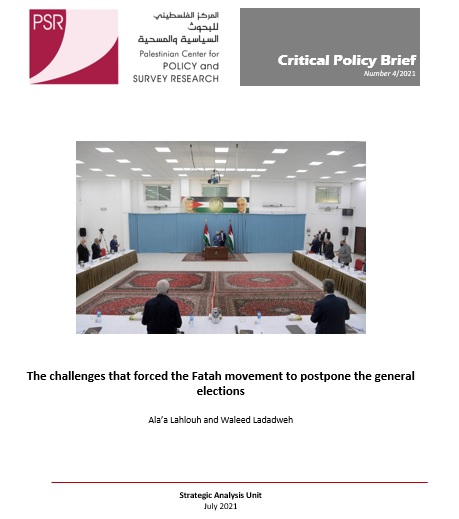 July 2021
The challenges that forced the Fatah movement to postpone the general elections
Ala’a Lahlouh and Waleed Ladadweh
On April 20, 2021, President Mahmoud Abbas issued a decree to postpone the legislative elections that were scheduled to be held in on May 22, 2021 in accordance with a previous decree issued on January 15, 2021. The decree to postpone the elections shocked the majority of the Palestinian public who wanted the elections to be held in order to bring about a change in Palestinian governance and to restore unity and end the West Bank-Gaza Strip split. It also surprised the international community that had hoped that these elections would result in a legitimate government that would represent all Palestinians. What prompted the Palestinian president to overlook all the wishes of the various factions, electoral blocs, the large majority of the Palestinian people, and the wishes of the international community? This paper aims to know the challenges that forced President Abbas and the Fatah movement to postpone the elections and how they can overcome these challenges.
The president's stated justifications for postponing the elections:
The Palestinian President announced that the postponement of the elections came, "in light of the decision of the expanded Palestinian leadership meeting, which included the Executive Committee of the Palestine Liberation Organization, the Central Committee of Fatah Movement, the leaders of the Palestinian national action factions, and national figures." He justified the postponement decision by stating that the Israeli occupation prevented the holding of elections in the city of Jerusalem, asserting that "there is no abandonment of Jerusalem, and there is no abandonment of the people's exercise of their democratic right in Jerusalem." The president added that "Israel has decided to kill the Arabs in Jerusalem, and we will not allow that."
However, these justifications were not sufficient to satisfy the various parties; Sixty-five percent of the Palestinians expressed their opposition to President Abbas' decision to postpone the general elections, and two-thirds said that the postponement came out of fear of the results, and not for the sake of Jerusalem, according to a poll conducted by the Palestinian Center for Policy and Survey Research (PSR) in June 2021.[1] In a statement, the European Union described the decision to postpone the Palestinian elections as "disappointing."[2] The head of the political bureau of "Hamas", Ismail Haniyeh, considered the reasons for postponing the elections “unconvincing at all.” He stressed in a speech that his movement is not in disagreement with Fatah or with any party on the necessity of holding elections in Jerusalem,"but the disagreement with brother Abu Mazen is on making our decision and the will of our people subordinate to the Israeli occupation, or on submitting to the will of the occupier, or on responding to the desire of this party or that."[3] Hamas also described Abbas's decision as "a coup against the path of partnership and national consensus, and it is not permissible to subordinate the entire national situation and our popular and national consensus to the agenda of a particular faction."[4]
The challenges that prompted the president and the Fatah movement to postpone the elections:
There is no doubt that the justifications provided by the president and the Fatah movement were not the real reasons behind postponing the elections. Undoubtedly, the president and the Fatah movement knew that postponing the elections would bring them into direct conflict with the majority of the public and other parties. However, the president postponed the elections; an action that reveals that the extent of the difficulties that the president and the Fatah movement would have faced if elections were held, and the results that would ensued. These difficulties, it seems, were greater, in their view, than the cost of clashing with the people and violating the demands to hold elections. What are the challenges that might have prompted the president and Fatah movement to postpone the elections?
First challenge: Fragmentation and lack of discipline within the movement itself
The Fatah movement faced great challenges during its journey in the Palestinian Authority in the 1996 and 2006 general elections, and in the various local elections during the past years. Perhaps the most important problems facing the Fatah movement in all the previous rounds of elections is the division in the movement's ranks and the defection of some of its leaders and cadres to run for the elections independently. After the issuance of a decree to hold the general elections, the leadership of the Fatah movement represented by President Abbas took a decision to prevent the members of the Central Committee, the Revolutionary Council, the secretaries of the regions, members of parliament and former ministers, in addition to the security and military leaders from running for elections and to give the young generation the opportunity to run in an attempt to renew the movement’s energies and to exhibit a new image capable of attracting voters. The movement's leadership established a set of organizational and professional criteria for those running for elections. This decision did not satisfy many of the movement's leaders, who were waiting for this opportunity to consolidate their leadership positions by running for the upcoming legislative elections.
In the last days of March, and before Fatah submitted its official list, restlessness and anger emerged from some Fatah cadres in some areas as a result of their exclusion from the official list or as a result of their placement in unguaranteed positions within the official list. This anger was manifested in regional and factional statements that announced their boycott of the elections and that they would not vote for the movement's list. Then came the talk, which gained credibility at the time, about the inclusion in the electoral list of a selected number of the members of the Central Committee of Fatah, in great contravention of the decision made by the movement’s leader, thus weakening the chances of the movement's youth to assume leadership positions.
Moreover, the article in the election law, that stipulated that presidential candidates must be part of existing electoral lists or political parties, posed a critical threat to Marwan Barghouti’s candidacy for the presidency. Consequently, the election law itself formed a strong motivation for him and his supporters to form a separate electoral list that would compete with the official movement’s list in order to guarantee that Barghouti can run for the presidential elections, even if the official movement list refused to allow him to do so.[5]
These events led to the formation of two electoral lists representing defectors from the Fattah movement, in addition to the Fatah’s formal list. Marwan Barghouti (Member of Fatah’s Central Committee) and Dr. Nasser Al-Qidwa (also a Central Committee member, dismissed for intending to run for elections outside Fatah’s formal list), formed, together, a list in the name of “The Freedom List.” Former leader in Fatah, Mohammad Dahlan, a former Central Committee member expelled from the movement some 10 years earlier, formed “The Future Bloc.”
The results of a poll conducted by PSR in mid-March showed that Fatah (formal and defectors) has the largest electoral base among the Palestinian forces and factions. In a question about voting in new parliamentary elections with the participation of all the political forces that participated in the 2006 elections, the results showed that an all Fatah’s list would receive the vote of 43% of the participants, while the Change and Reform List, affiliated with Hamas, gets 30%, and all other lists combined at 8%, and 18% said they have not yet decided who they will vote for.
However, concerns emerged when respondents were asked about other options that might occur in the elections, such as the intention of Al-Kidwa or Dahlan to form lists to compete in the legislative elections, while the position of the prisoner Barghouti was still ambiguous about his intention to form an electoral list at that time. But one of the options offered to the public was related to Marwan Barghouti's formation of an independent list. The results showed that in this case, the formal Fatah's list would receive only 24% of the vote, and Barghouti's list would receive 20%, Dahlan's list 7%, and Hamas' list would receive 27%. In another question about Al-Kidwa forming a separate list, Fateh's formal list would receive 32%, Hamas' list would receive 28%, Dahlan's list would receive 6%, and Al-Kidwa's list would receive 4%. The point of all this is that there are legitimate fears that Hamas would have gotten a plurality of the parliamentary seats in the Palestinian Legislative Council (PLC). However, this would certainly not give it the majority or even the ability to form a coalition government, unless the official Fatah movement led by President Abbas refused to establish a coalition government with Barghouti, Al-Kidwa and Dahlan.
Second challenge: The decline in President Mahmoud Abbas’ popularity
The recent years, especially since 2014, have witnessed a decline in the popularity of Palestinian President Mahmoud Abbas. President Abbas was elected to the presidency of the Palestinian Authority in January 2005 and was elected as the head of the Fatah movement at the sixth General Conference of the Fatah movement in 2009 and was re-elected at the seventh conference in 2016.
The year 2014 marked a turning point in President Abbas’ popularity, as public opinion polls showed a decline in his popularity in favor of Hamas candidate Ismail Haniyeh as a possible candidate for the presidential elections; not to mention the great challenge posed by the high popularity of the Marwan Barghouti. The decline in President Abbas’ popularity is due to a number of reasons, the most important of which are the following:
- The political horizon of the peace process is closed: President Abbas has always been a proponent of a peaceful solution and negotiations and is not in favor of violent means of resistance. But with the dominance of the Israeli right headed by Benjamin Netanyahu since 2009, the peace process reached a dead end. With the continuation of the Israeli settlement expansion that disrupts the geographic contiguity of the promised Palestinian state and continuation to Judaize the city of Jerusalem, the Palestinians refused to return to negotiations unless settlement expansion stops, and thus the issue remained between ebb and flow throughout the first term of President Obama. Despite the efforts and success of US Secretary of State John Kerry in conducting negotiations between the two parties in 2013-14, these efforts met the same fate of failure. After that, the negotiations entered a state of clinical death. Nonetheless, President Abbas remained committed to the option of negotiations as the only option. Despite his advocacy of peaceful popular resistance, the Palestinian leadership did not succeed in promoting or supporting this option in a manner that would have made it an effective weapon.
Public opinion polls show a decline among Palestinians in support of the two-state solution in recent years, from about 48 % in March 2019 to 39% in June 2021, according to opinion polls conducted by PSR during this period. This decline is probably the result of public perception that diplomacy has reaching a dead end. In addition, polls showed that negotiations are no longer considered by the Palestinians the most effective way to establish a Palestinian state.
- Public dissatisfaction, especially in the Gaza Strip, with President Abbas’ policy towards the Strip: Recent years have witnessed a sharp decline in the President Abbas’ popularity in the Gaza Strip. Public opinion polls showed that the president’s popularity declined dramatically after the Israeli war on the Gaza Strip in the summer of 2014, when it dropped from 53% in June[6] 2014 before the war to 38% in September 2014[7] after the war. These findings reflected the decline of Abbas’ popularity and the rise of Hamas’ Ismail Haniyeh in hypothetical presidential elections, according to two opinion polls conducted by PSR during that period. Gazans felt that they were alone in their battle with the occupation, and that the PA leadership was contributing to the siege imposed by Israel and Egypt. The decline in President Abbas’ popularity in the Gaza Strip continued after a series of measures taken by the PA leadership that reduced the delivery of basic services, such as electricity and health services, followed by measures against a large number of public employees in the Gaza Strip, including early and compulsory retirement and a suspension of salaries. Gazans saw these measures as punitive, targeting citizens in the Gaza Strip, which suffers from the scourge of the continuous and tight blockade since 2006.[8]
- The transformation of the Palestinian political system under his rule into an authoritarian regime that lacks accountability: The Hamas movement's control of the Gaza Strip led to the split between the West Bank and the Gaza Strip in June 2007, which in turn led to the absence of the PLC, and the transfer of all the legislative and oversight responsibilities to the executive authority, in particular to the head of the authority, Mahmoud Abbas. Within a few years, President Abbas issued about 300 laws by decrees, the vast majority of which are ordinary, not urgent or emergency laws. The number of these decrees far exceeds the number of laws that the PLC issued during its entire tenure (1996-2007). Without a parliament, there was no longer any accountability for the executive authority, with the exception of the little exercised occasionally by the judiciary, the press, and civil society. In recent years, there has also been a major seizure of power, represented by the dissolution of the PLC in December 2018 after more than 11 years of disruption. The judiciary was also weakened by the executive authority’s failure to implement the decisions issued by the courts, in addition to interfering in the affairs of the judiciary authority, which culminated in the Decree Law No. (40) of 2020 amending the Judicial Authority Law, which strengthened the executive authority’s dominance over the judiciary. This period also witnessed the targeting of civil society’s institutions through a set of measures against non-profit companies and civil organizations, leading to the enforcement of various new restrictions on these institutions, recently represented in Decree Law No. (7) of 2021 amending the Law of Charitable Societies and Civil Organizations.[9]
The damage caused by postponing the elections:
There is no doubt that the decision to postpone the elections and the subsequent events related to Jerusalem and then the Israeli war on the Gaza Strip were the worst and most unprecedented on their effect on the popularity of the president and the popularity of Fatah. At a time when the majority of the public (about 70%) wanted the elections to be held, the president indefinitely postponed the elections. At a time when the president said that the postponement was for the sake of Jerusalem, the majority of the Palestinians (about 65%) saw the postponement not for the sake of Jerusalem, but rather for fear of the election outcome. This was followed by the events in Jerusalem, for which the elections were supposed to have been postponed. However, the president, the Palestinian Authority, and the Fatah movement did not show the public that it is doing what was expected from them in defense of Jerusalem, as only 8% of the public described the president’s performance in defending Jerusalem as strong, 11% went to the PA, and 13% went to Fateh’s, while 75% of the public described the performance of Hamas as strong.[10]
All of this was reflected in a resounding decline in the President Abbas’ popularity and a drop in the popularity of Fatah. President Abbas' ability to compete in legislative elections against Haniyeh fell to its lowest level since his election in 2005, as Haniyeh outperformed Abbas by a wide margin (59% to 27% respectively), according to the results of public opinion poll No. (80) conducted by PSR in June 2021, compared to the results of public opinion poll No. (79) conducted by PSR in March 2021, where the results indicated at that time that Abbas had received 47%, compared to 46% for Ismail Haniyeh.
In June, the popularity of Fatah against Hamas also fell. If the legislative elections were held, the latter would outperform the former by 11 points in its favor, as Hamas won 41% of the vote compared to 30% for Fatah, according to the results of the above-mentioned poll. Fatah had outperformed Hamas three months earlier, obtaining 43% compared to 30% for Hamas in a poll conducted by PSR in March 2021.[11] . The majority (53%) in June also considered Hamas as more qualified to represent and lead the Palestinian people, compared to only 14% who believed that Fatah, led by President Abbas, is better qualified.
Recommendations:
This paper proposes three recommendations to the Fatah movement and its leaders: (1) reverse the decision to postpone the elections, (2) declare Fatah’s readiness to build a governmental coalition with other (defected) Fatah lists, and (3) announce the movement's intention to compete in the presidential elections with a candidate other than President Abbas.
- Conducting elections immediately, including Jerusalem, and challenging occupation measures
Holding elections has become an urgent Palestinian demand supported by the majority, just as holding them inside the city of Jerusalem is the demand of all Palestinians. However, if the Israeli government insists on its refusal to hold elections in Jerusalem, the Central Elections Committee must announce alternative solutions to hold the elections inside the city, and to have these solutions supported by the Palestinian forces and factions, led by the Fatah movement. The Election Committee, with the support of the Palestinian leadership, can place ballot boxes in front of Israeli post offices, address the European Consulates General accredited to Palestine to place the ballot boxes in their missions, place the ballot boxes in the courtyards of Al-Aqsa Mosque, and address the various churches to place the ballot boxes in their premises. It can also build the capacity to hold elections electronically.
Of course, the Israeli government will work to thwart the election process and will arrest those responsible for it and prevent citizens from going to the polls to exercise their basic rights to vote and choose their representatives. This will happen in front of the eyes of the world and the international media and Israel will be shown in opposition to Palestinian democracy. The PA should let the election day be a day of popular and peaceful resistance that President Abbas has always called for, and the Fatah movement has taken a lead in the city of Jerusalem. This would be the opposite of what Fatah and other factions have done in the past and would provide an opportunity to demonstrate support for the city and its residents to compensate for past failures. Holding elections in Jerusalem is a form of defiance of the occupation and is the best electoral propaganda for Fatah in its upcoming electoral campaign.
- Unity in the PLC
In light of the dispersion of Fatah’s electoral base among three blocs, it must use the election results in a way that enables it to become the largest electoral bloc by uniting its elements within the new PLC, especially if it wants to form a government away from Hamas. It is almost certain that the Freedom List (Barghouti and Al-Kidwa) and the Future List (Dahlan) will not make an alliance with Hamas, especially since the Future List’s regional allies (Egypt and the United Arab Emirates) will not allow it to do so in light of their conflict with the parent group (the Muslim Brotherhood) and in light of the tense relations with Hamas’ allies in the region. (Qatar, Turkey, and Iran).
- Run in the presidential elections with a new candidate.
It seems that President Abbas has become a source of weakness for Fatah's popularity. His long stay in power without elections and without achievements that can be presented to the people, at the level of the peace process or at the internal level, in addition to the deterioration of economic conditions, civil liberties, separation of power, have led to a majority demand for his resignation. It is certain that President Abbas is unable to win the presidential elections that will take place in the Palestinian territories any time soon. Moreover, the Fatah movement would be much stronger if it were under other leaders, such as Marwan Barghouti, who would take the movement in terms of the masses to great strides forward, as he would outperform his rival Ismail Haniyeh by a wide margin in any presidential election. President Abbas had previously announced several times during television interviews that he did not want to run in the presidential elections, and thus this statement opens the way for the Fatah movement to contest the upcoming presidential elections with a new presidential candidate from its own ranks. On the other hand, the Central Committee member Marwan Barghouti[12], who enjoys great popularity among the Palestinian public, announced his intention to run in any presidential elections. Public opinion polls over the past years have shown that Barghouti is the strongest candidate from within Fatah who can win any presidential elections with ease. The polls showed that Barghouti can compete with the Hamas candidate and beat him by a wide margin ranging between 20 and 30 points. On the other hand, polls showed that current Hamas leader has over the past years surpassed President Mahmoud Abbas on many occasions.[13]
The reason for Barghouti’s superiority in opinion polls is that his electoral base includes the various components of Palestinian society, including Fatah’s base, Islamists, leftists, independents, and others. On the other hand, president Abbas’s electoral base includes Fatah only and perhaps some minor PLO factions. A Hamas candidate’s base is mainly among Hamas supporters and Islamist independents. The latest poll conducted by PSR in June 2021,during the peak of the popularity of Hamas and its candidate Ismail Haniyeh, showed that in the event of new presidential elections in which only two candidates, Mahmoud Abbas and Ismail Haniyeh ran, the first would receive 27% of the votes and the second would receive 59%, but if the competition is between Marwan Barghouti and Haniyeh, then Barghouti would receive 51% and Haniyeh would receive 41%.[14]
[1] See: Results of Public Opinion Poll No. 80 conducted by the Palestinian Center for Policy and Survey Research. Public Opinion Poll No (80) | PCPSR
[3] https://arabic.sputniknews.com/arab_world/202104301048859402-%D8%B9%D8%A8%D8%A7%D8%B3-%D9%8A%D8%B5%D8%AF%D8%B1-%D9%85%D8%B1%D8%B3%D9%88%D9%85%D8%A7-%D8%A8%D8%AA%D8%A3%D8%AC%D9%8A%D9%84-%D8%A7%D9%84%D8%A7%D9%86%D8%AA%D8%AE%D8%A7%D8%A8%D8%A7%D8%AA-%D8%A7%D9%84%D9%81%D9%84%D8%B3%D8%B7%D9%8A%D9%86%D9%8A%D8%A9-%D8%B1%D8%B3%D9%85%D9%8A%D8%A7/
[4] Ibid.
[5] The Palestinian Gazette published a notice on March 18, 2021, about an error in Law No. (1) of 2021 amending Law No. (1) of 2007 regarding general elections. The content of this notice is that a candidate for the presidential elections is not required to be nominated by a political party or electoral list.
[8] In December 2017, 70% demanded the resignation of President Abbas: Results of Public Opinion Poll No. 66 | PCPSR
[9] This decision was suspended by law following local and external pressure.
[10] See: Results of Public Opinion Poll No. 80 conducted by the Palestinian Center for Policy and Survey Research. http://pcpsr.org/ar/node/844
[12] In the 2005 presidential elections, the prisoner Marwan Barghouti ran for the presidential elections, but later withdrew in favor of Fatah candidate Mahmoud Abbas.
[13]The Palestinian Center for Policy and Survey Research, the center's polls during 2014-2021. http://www.pcpsr.org/en/node/602
[14]Palestinian Center for Policy and Survey Research, Poll No. ( 80 ), June 2021. http://www.pcpsr.org/sites/default/files/Poll-79-Arabic%20Full%20Text.pdf
 July 2020
Thirteen Years After the West Bank-Gaza Strip Split:
Phased Policy Alternatives Between Reunification and Separation
Jehad Harb
On July 2, 2020, Jibril Rajoub, member of the Fatah Central Committee, and Saleh Al-Arouri, deputy head of the Hamas political bureau, held a joint press conference to announce joint plans to confront the Israeli annexation plan. The joint statement issued by the two men comes after a rift of more than two years. The statement did not refer to a vision of how to end the split and restore unity after thirteen years of internal Palestinian division. The ability of this meeting and subsequent dialogue to bridge differences between the two sides is unclear.
The solutions proposed since the 2011 Cairo Agreement to restore unity have failed to reach the intended goal, in part because of their ambitious goal of restoring full reunification. This failure reflect the inability to overcome existing obstacles as both sides refuse to abandon their goal of dominating and controlling the other while strengthening their own positions and manipulating the political system. Today, we remain unable to develop a unified Palestinian vision able to overcome this division or put in place interim solutions to end it. Indeed, the Palestinian public seems to have lost hope of a quick fix as the results of a poll conducted by the Palestinian Center for Policy and Survey Research (PSR) in June 2020 reveal that about two-thirds of the public are pessimistic about the possibility of restoring unity in the near future.[1]
Over the years of the split, a review has taken place of the nature and form of the Palestinian Authority’s administrative system and its relationship to the vision for the Palestinian political entity. This review sought to examine various organizational concepts, such as centralization vs. decentralization, integrative vs. federal or even confederal unity. Moreover, during the past thirteen years, the gap between the West Bank and the Gaza Strip has widened, not only due to the division, but also due to the totality of cultural, social, economic and legal factors and developments. The gap in citizens’ perception in the West Bank and the Gaza Strip has also widened, with increasing feelings of isolation and neglect among residents of the Gaza Strip, matched by a feeling of frustration and distrust in the political system and the future of the two-state solution.
In light of the current deadlock in the efforts to restore full unity, this critical brief aims to review three phased or temporary alternatives: a confederation, a federal system, and a decentralized administration. The assessment of each of these alternatives is based on four main considerations: (1) the ability to shorten the transitional period to end the split, (2) acceptance by the Palestinian public, (3) the ability to protect the goal of state-building in the context of the Palestinian-Israeli peace process, and (4) the ability to positively affect a transition to democracy in the Palestinian political system.
(1) Background: why this paper?
The restoration of unity is of great importance to the Palestinian people as a supreme national interest. But the gap widens between the positions of the two rival parties whenever the reconciliation dialogue affects their interests, status, or gains. Division and discord are also more entrenched with the passage of time. After thirteen years, the possibility of restoring unity has become more difficult than it was at the outset, due to institutional changes, cultural developments, and social structures that have evolved over time in order to accommodate and deal with the split.
The dialogues and signed agreements have failed, whether between Fatah and Hamas or the collective agreement signed by the Palestinian factions starting with the 2011 Cairo Agreement, through the Doha Agreement, the Beach Camp Agreement, and the October 2017 agreement to hand control of PA institutions in the Gaza Strip and management of the border crossings to a unity government. Successive governments have failed to unify institutions and create conditions to hold general elections, whether legislative or presidential. The last attempt to end the division, led by the Central Elections Commission, headed by Dr. Hanna Nasser as ‘mediator’, which aimed to conduct legislative elections as a step toward presidential elections and the restoration of unity, has also failed when the expected presidential decree was not issued, on the pretext of uncertainty about the possibility of holding these elections in Jerusalem. It seems that the conflicting parties still believe that they can achieve their aims to neutralize the other within the areas of their control, or take the reins of the political system while not allowing others access or participation. This is no longer feasible due to objective factors and the overriding forces of geography, material ability, and popular support.
Prevailing pessimism
Opinion polls by PSR[2] show the public to be pessimistic on reconciliation and restoration of unity in the near future. Ending the division and unifying the West Bank and Gaza Strip enjoys a wide public support as a supreme national interest. Results of PSR Poll #75, conducted in February 2020, show a 90% support (89% in the West Bank and 91% in the Gaza Strip) for ending the division and unifying the West Bank and the Gaza Strip as a response to the Trump plan and the Israeli annexation threat. Yet, only 29% of the public are optimistic about the prospects of reconciliation while 64% are not, according to the results of a PSR poll conducted in June 2020. Also, 41% believe that unity will not return and two separate entities will be established in the West Bank and Gaza while 40% believe unity will return, but after a long period; only 12% believe that it will return in the near future.[3]
Division widens the gap between residents of the two regions
In addition to the previous findings, PSR’s February 2020[4] poll shows important attitudinal differences between residents of the West Bank and the Gaza Strip on various issues, with a gap of more than 20 points, in some instances. For example, while 25% of Gazans see the continuing blockade and the closing of the Gaza’s border crossings as the top priority problem for the Palestinian Authority, only 8% of West Bankers feel the same. The same variation is reflected in the primacy of fighting corruption in PA institutions, with a difference of 23 points: 34% in the West Bank see it as the top priority, compared to 11% in the Gaza Strip.
The differences are wide in the level of religiosity with 30% of West Banker describing themselves as religious, compared to 50% of the Gazans; 67% of West Bankers describe themselves as somewhat religious, compared to 44% in the Strip. The gap increases by about 28 points in the evaluation of the performance of President Mahmoud Abbas since his election, with 77% of Gazans indicating dissatisfaction, compared to 49% in the West Bank. A difference also appears in the issue of holding elections even if, unlike the previous legislative and presidential elections that took place in 2005 and 2006, it results in voting by Jerusalem residents in polling stations outside the city, with 51% of West Bankers, compared to only 37% of Gazans supporting such electoral arrangement. There is a gap of 11 points between the opinion of the two groups in assessing the value of the Palestinian Authority, with 51% of West Bankers describing it as an asset for the Palestinian people, compared to 39% in the Gaza Strip. Conversely, 55% of Gazans see the PA as a burden on the Palestinian people, compared to 42% in the West Bank.
The gap increases to 21 points in the level of satisfaction with the Palestinian leadership’s response to the American plan, with 47% of West Bankers, compared to only 26% of Gazans, satisfied with that response. There are also differences on what should be done by the Palestinians in response to the Trump plan and the Israeli annexation threat, with 81% of Gazans in favor of a resort to armed struggle or a return to an armed uprising, versus 53% in the West Bank. Moreover, 59% of Gazans, compared to only 36% of West Bankers support a dissolution of the Palestinian Authority. Finally, 49% of Gazans, compared to 29% of West Bankers, support the abandonment of the two-state solution and embracing a one-state solution.
Effects of the split on the economic gap between the West Bank and Gaza Strip
Thirteen years of division have led to profound transformations in the economy of the Gaza Strip compared to that of the West Bank. This has been partly the result of the Israeli blockade of the Gaza Strip, that has continued for more than fourteen years, and repeated Israeli wars that have destroyed infrastructure, individual property and economic establishments, leading to a sharp decline in economic development. Additionally, the gap has been caused by the separation from the West Bank, which has received economic support from both international donors or broad government spending, whether in employment or investment in various sectors, as well as the flow of labor in Israel.
Some of the main economic indicators point to wide economic gaps. The poverty rate in the Gaza Strip for 2017, according to the Palestinian Central Bureau of Statistics, is 53%, compared to only 13% in the West Bank. Unemployment in the Gaza Strip is also three times higher than that in the West Bank (45% versus 15%).[5] The average daily wage for workers in the private sector drops to NIS 44 in the Gaza Strip compared to NIS 118 for workers in the West Bank. The total number of wage employees in the private sector who are paid less than the minimum wage (i.e., NIS 1,450) is about 109,000 workers, of which only 24,300 are found in the West Bank (representing about 22% of the total wage employees in the private sector in the West Bank) with a monthly wage rate of NIS 1,038, compared to 84,400 wage employees in the Gaza Strip (representing about 78% of the total wage employees in the private sector in the Gaza Strip) at a monthly wage of no more than NIS 700.[6]
According to the 2018 indicators of national accounts in Palestine, the gross domestic product was $15.6 billion, of which the West Bank contributed about $12.8 billion versus $2.8 billion only by the Gaza Strip. Per capita GDP in the Gaza Strip is about a third of that in the West Bank ($1,458 compared to $4,854).[7]
The Future of democracy
The split has halted the main pillar of the political system, free elections to choose one’s own representatives to the Palestinian Legislative Council (PLC) and elect the President of the PA. Ten years have passed since 2010, the date for the end of the term of the President and the PLC, according to the election law which the 2006 elections were based on.
The holding of Palestinian elections is essential to build a democratic system that enjoys legitimacy. The lack of elections in the West Bank and the Gaza Strip deprives the political system of the ability for democratic transition, impedes the right of citizens to choose their government representatives, and increases the political deadlock by the continued erosion of institutional legitimacy of the political system. There is no doubt that the lack of elections deprives PA institutions of accountability and legitimacy, keeps the judiciary subject to executive interventions, restricts public freedoms and human rights, and undermines the independence and pluralism of civil society.
Regional conflict and axis at Palestinian expense and continuation of the Gaza blockade
Thirteen years of internal division have transformed the Palestinian issue to become one of the components of the regional conflict. The alignment of Palestinian parties to regional powers and axis have also weakened the Palestinian front and limited the possibility of restoring unity due to the disputes between those outside forces. Palestinians, especially in the Gaza Strip, have been subjected to additional burdens resulting from regional conflicts.
Becoming part of the regional rivalry and scattering Palestinian and regional efforts while failing to establish a legitimate governing body, have made it more difficult to end the Israeli blockade. Instead, it gave Israel the opportunity to take advantage and gain acceptance for its imposed blockade by some international powers and kept the attention paid to the Gaza Strip restricted to humanitarian assistance, without regard to the Palestinian political needs of ending the occupation and establishing an independent state. This situation has also reinforced Israel’s claim that there is no peace partner capable of speaking on behalf of all Palestinians.
(2) Possible alternatives to full reunification
The widespread public desire to restore unity invites the political elite to consider temporary alternatives to a return to ‘full’ integrative unity, such as a federation or confederation which could provide a form of phased or temporary partial unity between the West Bank and Gaza. There is no doubt that a return to full unity-- represented by political and administrative control by the center (the capital) over the remaining parts, the existence of unified budgets, a single tax system, and the setting of developmental priorities and the control over public security by a single political authority-- is the best option to preserve territorial unity that the Palestinians seek to ensure in any future agreement with Israel. It is also the broadest expression of Palestinian nationalism, in the absence of fundamental differences in cultural structures. But the rival groups have failed since the 2011 Cairo Agreement to achieve this goal. The impeding dynamics of the rivalry, the desire to have access to the privileges of governance and its control, have remained in place. This brief presents three temporary alternatives to a possible restoration of unity between the West Bank and the Gaza Strip with the aim of overcoming the split and preventing it from leading to a permanent separation:[8]
Alternative one, a confederation: This temporary alternative is based on the establishment of two entities or “states,” one in the Gaza Strip and the other in the West Bank. The two would be separate but related through joint economic relations and the unification of external political positions within a joint council addressing the international community. This alternative offers the possibility of building separate institutional systems and granting them legitimacy through holding legislative and presidential elections in both states. It allows each state to choose the form and limits of its political system, and to select its economic system in accordance with its needs. But this alternative increases the risk of cementing separation and raises fears that it will not be possible to return in the future to full unity. Likewise, it raises the danger of Israel exploiting and marketing to the world that the Palestinian state already exists in the Gaza Strip, strengthening Israel’s control over the West Bank and implementing its ambitions to annex and control it. Also, it enables Israel to maintain its blockade of the Gaza Strip, “the hostile state controlled by Hamas.” In addition, there is a continued risk of failure to build a democratic system in either of the two states given the absence of any general elections for fourteen years.
Alternative two, a federation: A federal system is one with political and administrative decentralization, so that each “region” undertakes different economic policies, taxation systems, and budgets. The legal and educational systems may also be different. It allows control by the local authorities over the security forces. The local authorities derive their political and administrative jurisdiction from a political constitutional decision. The federal government controls security and foreign relations and signs agreements with outside powers.
This alternative maintains Palestinian central unity in a single state, while taking into account the needs, circumstances, and economic and cultural particularities of the population of each region separately. It offers a path to a democratic transition in each region and at the national level. A reunification of the institutional systems, as a transitional stage, allows for a gradual return to a fuller unity of the two regions. This alternative however preserves separation given the existence of two different legal systems, with each region adhering to the correctness of its regime. Separation might be strengthened in the presence of two systems of institutions competing for resources and jurisdiction leading to elite conflict over interests, influence and powers.
Alternative Three, decentralization: Decentralized unity represented by a centralized political and decentralized administrative authority is a third alternative to full unity. In this case, two regional administrative powers coexist in the West Bank and Gaza Strip. The two centers of administrative power coordinate the plans and efforts of the local authorities in each region, as each region has a degree of internal economic and administrative homogeneousness with which it can be considered an independent unit capable of crystallizing its individual developmental plans in light of general economic policies laid down by the central authority. In this system, the central authority assumes control over major decisions and adopts a single economic policy, while regional and local authorities adopt local tax systems, separate and distinct local budgets, and common elements in the legal and educational system at the state and local levels. Central, regional and local authorities cooperate in controlling the security forces according to specific rules, which reduce the grip of the central authority on the security services and contributes to enhancing their professionalism.
One of the advantages of this temporary alternative is that it maintains the political unity of the West Bank and Gaza Strip and it is the closest to full reunification. At the same time, it takes into account the needs, circumstances and economic and cultural capacities of the population of each region separately. It provides the means for a democratic transition at the national and local levels and promotes local development on the basis of administrative decentralization in the country. However, the fear remains of persisting partisan domination in the West Bank and Gaza Strip over the local establishment, on the one hand, and control of their security forces and the expansion of their separatist culture in the newly created institutions, on the other.
Conclusion:
There is no doubt that finding a way out of the current deadlock on the road to restore unity requires an open mind and new thinking in looking at the nature of the relationship between the West Bank and the Gaza Strip. This scrutiny should be done in the light of the multiple experiences in the world around us. Failure to do so risks the inevitability of a permanent separation over time. It also requires providing a solution that creates a balance between the interest in protecting the political system, preserving cultures, protecting the particularities of the population, and the special circumstances of each geographical area, with tools to link them effectively.
Under today’s conditions, decentralization, represented by the existence of a centralized political and decentralized administrative authority, as stated in the third alternative above, is the most capable of creating this balance. It provides mechanisms and tools for national fusion and promotes political unity between the West Bank and the Gaza Strip, while taking into account the needs, circumstances and economic and cultural capacities of the people of each region separately. It also allows the adoption of local development on the basis of administrative decentralization in the country, and gives the possibility of holding general elections to enhance the legitimacy of the political system and reduces the risks of a democratic transition. This alternative reduces the risks of permanent separation, which is a risk present in the two other alternatives, and is consistent with the position of the majority in Palestinian public, a majority of which (60%) rejects[9] other alternatives, such as a confederation. Decentralization also helps to reduce the suffering of the Palestinians in the Gaza Strip, unifies Palestinian efforts to confront Israeli colonization, and strengthens the official political position in international fora. In addition, with time, it can help bypass the existing obstacles to reach the full unity desired by the majority of the Palestinian people.
[1] See the Palestinian Center for Policy and Survey Research website: http://pcpsr.org/en/node/813
[2] See the public polls of the Palestinian Center for Policy and Survey Research: www.pcpsr.org
[5] Palestinian Central Bureau of Statistics, Palestine in Numbers, 2019. Ramallah, 2020: http://www.pcbs.gov.ps/Downloads/book2512.pdf
[6] See Palestinian Central Bureau of Statistics: http://www.pcbs.gov.ps/portals/_pcbs/PressRelease/Press_Ar_13-4-2020-lab.pdf
[7] Ibid., p. 60.
[8] For an early review of such ideas, see, Khalil Shikaki, West Bank and Gaza Strip: Future Political and Administrative Relations, Jerusalem: The Palestinian Academic Society for the Study of International Affairs (PASSIA), 1994, pp. 91-116. Likewise, see Jihad Harb, Opportunities and Obstacles to Restoring Unity between the West Bank and Gaza: Changes in the Political System and Public Administration since the Split, Ramallah: Palestinian Center for Policy and Survey Research, 2011, pp . 17-19.
[9] See results of Poll #76 of the Palestinian Center for Policy and Survey Research: http://pcpsr.org/sites/default/files/Poll-76-Arabic-Full%20Text.pdf
 November 2022
Birzeit Student Elections: Why Hamas Won and Fatah Lost
Alaa Lahluh Walid Ladadweh
Introduction:
The results of the student council elections at Birzeit University that took place in May 2022 came as a shock to supporters of Fatah after the heavy loss suffered by its student youth movement, al Shabiba, winning only 18 seats out of 51, compared to 28 seats for the Islamic Bloc, Al Kutlah al Islamiyyah, and 5 seats for the Student Pole, al Qutb al Tollabi, that represents leftist forces at the university. These results were shocking to Fatah because of the importance of the student elections, especially at Birzeit University, for what they represent for the future of the national movement. It was shocking because the students of this university, more than other university in the West Bank, represent many of the various regions of the West Bank as well as the various socio-economic classes and political currents thereby making the Birzeit elections a barometer of the attitudes and behavior of the educated Palestinian youth. Birzeit University has a special importance in the democratic process because this university has been a beacon of democratic practices preserving democratic traditions throughout the previous years in which Palestinians were deprived of national elections, while student elections were held annually at that university except in the most difficult conditions, such as the Covid pandemic in 2020 and 2021.
These elections came amid the near-total absence of democratic life in the Palestinian territories as no national elections have been held since 2005 and 2006, when presidential and legislative elections were held respectively. Back in December 2021 and earlier this year, in March 2022, local council elections were held in the West Bank, but they were not held in the Gaza Strip because of Hamas' objection to holding them in that part of the Palestinian territories
Background:
The past five years have witnessed a strong showing by Hamas’ Islamic Bloc at the expense of its main rival, al Shabiba, but without gaining a majority of Birzeit student vote. In the elections that preceded the closure of the university due to the Corona pandemic, in 2019-2020, al Shabiba was in fact able to win the same number of seats as the Islamic Bloc. The following figure shows the seat distribution at Birzeit University during the period between 2016-2022.
Figure (1): Distribution of Student Council Seats at Birzeit Student elections between 2016-2022

It should be noted that al Shabiba won all Birzeit University student elections that took place between 2007 and 2015, i.e., after Hamas violently took control of the Gaza Strip. For example, in 2008 it won 25 seats compared to 19 seats for the Islamic Bloc; in 2009 it won 24 seats compared to 22 for the Islamic Bloc; in 2010 and 2011 it won 31 seats and 29 seats respectively while the Islamic Bloc boycotted the student elections; in 2012 it won 26 seats compared to 19 seats for the Islamic Bloc; in 2013 and 2014 it won 23 seats compared to 20 seats for the Islamic Bloc.[1] During the two years that the Islamic Bloc boycotted the elections, the student turnout fell from 85% in 2009 to 58% and 50% respectively before rising again to 75% in 2012. Most of the votes that used to go to the Islamic Bloc abstained, resulting in lowering the number of votes required per seat from 117 in 2009 to 71 in the 2010 elections.[2]
The results of the Birzeit University student elections have opened the debate about the reasons behind Fatah's loss despite the group's greater popularity in the West Bank compared to that of Hamas as indicated by the most recent public opinion polls.[3] How can Fatah's loss by such a large margin be explained despite having such a great electoral base?
Explaining Fatah’s loss and Hamas’ victory
The loss of al Shabiba and the victory of the Islamic Bloc can be attributed to a number of reasons, the most prominent of which are the following five:
- Mistakes and blunders made by the Palestinian Authority (PA) during 2021
- Mistakes made by Fatah
- Internal problems within al Shabiba
- Hamas remains attractive to the youth
- Israel unintentionally helped Hamas
1. PA blunders and poor performance:
Over the past few years, the PA has taken a series of measures that have harmed the nature of the system of government that the Basic Law and another set of key laws had established in Palestine. Accountability and oversight over the work of the president and government have been abolished and the judiciary has been weakened and its independence threatened.[4] The year before the Birzeit University elections witnessed several events that contributed to al Shabiba’s loss including the postponement of the general elections (legislative and presidential) that were scheduled to be held in May and July 2021, the perceived PA mismanagement of the import of the coronavirus vaccines, and the killing of activist Nizar Banat during his arrest by the Palestinian security services. Public concern about corruption within the PA has been aggravated by the release of various reports including that of the Office of Financial and Administrative Control on the Ezz Waqf Fund and on Khalid Al-Hassan Hospital for Cancer Diseases.
There is considerable agreement among those interviewed for this Brief, among students, university professors, the public at large, or experts on the Palestinian political scene, that the PA's blunders and unpopular behavior were the main reasons for Fatah's loss. In-depth interviews with 14 Birzeit university students from different student political currents show that all of them agree that this has been the top most important factor shaping the outcome of the student elections: the students punished al Shabiba for the “crimes” of the PA.[5] One Birzeit University student who voted for the Islamic bloc says that the main reason for the Bloc's popularity is the link made by the students between the PA’s recent actions, such as the killing of Nizar Banat, and al Shabiba. Another student says that this shift in student attitudes did not occur in previous years because the magnitude of PA plunders in recent years has been unprecedented and the student awareness of these plunders has become much greater thanks to social media and the emergence of organized student groups, on WhatsApp and other platforms, that became much more active and effective compared to previous years. A new student at the university says that new students do not mainly look at the activities of the student blocs inside the university but rather look at the political situation in the country, and since the PA’s behavior has worsened in recent years, student perception of the PA is becoming overwhelmingly negative. Another student says that the main reason for the victory of the Islamic bloc is the great urge among the students to send a message to the PA and Fatah by voting against al Shabiba despite the fact that many of those students come in fact from Fatah affiliated families.
These findings are confirmed by university professors who witnessed various election rounds during past years. Reflecting the views of many, one lecturer at Birzeit University, who studied her bachelor's and master's degrees at the same university, asserted that Hamas’ victory was essentially a punishment for the PA and Fatah.
It is also the sentiment of the Palestinian public. The results of a public opinion poll conducted by the Palestinian Center for Policy and Survey Research right after the Birzeit University elections showed that 59% believe that the reason for the victory of the Islamic Bloc is a protest by students against the performance of the PA, while 32% of the Palestinian public believe that the reason for the Islamic Bloc victory is a shift among the Palestinian people towards greater support for Hamas.[6] But as can be seen in the following figure, while 70% of the likely Fatah voters think the vote for the Islamic Bloc was a punishment for the PA rather than a reward for Hamas, only 22% of likely Hamas voters think agree with that statement.
Figure (2): Reasons for the Islamic Bloc victory in Birzeit University student elections as expressed by the Palestinian public (PCPSR’s poll # 84, June 2022 )

In this context, it is useful to consider the attitudes of Palestinian youth in general towards the PA. The results of the latest polls conducted by the Palestinian Center for Policy and Survey Research conducted before the Birzeit elections indicate that the youths’ perception of the PA performance is highly negative. This negative perception leaves its impact on Fatah as well thereby reducing public support for it. As Figure (3) below indicates, the majority of 86% of the youth believes in the existence of corruption in PA institution, 73% think people cannot criticize the PA without fear, 64% are dissatisfied with the performance of president Abbas, and 57% want the president to resign.
Figure (3): Attitudes of youth between the ages of 18-22 regarding selected issues related to the PA (PCPSR’s poll # 83, June 2022)

2. Mistakes made by Fatah:
Fatah seems to lack a vision and strategy for how to deal with al Shabiba as a youth sector that represents its future. The movement seems to want to make its youth group a subordinate rather than a partner. It provides no guidelines for how the youth should relate to the Israeli occupation, a topic of the utmost importance to students and young people in general. To make things worse, Fatah lacks a clear vision on how to organize Palestinian society and deal with the day to day living conditions. Fatah’s failure in allowing its youth movement to develop its own national vision denies al Shabiba the ability to take the initiative and press the national leadership in the direction most favored by Palestinian youth.[7]
On top of that Fatah finds itself unable to distinguish itself from the PA, to the contrary, it provides full support to PA policies including those rejected by the overwhelming majority of the public. The example most cited by students and others is the manner in which Fatah dealt with the killing of Nizar Banat. Instead of distancing itself from the incident, Fatah mobilized its base and brought it to the streets to defend the PA in the face of public anger. This episode served as a dangerous precedent portraying Fatah as a party that assaults liberties and freedoms, rather than defending them, in total contradiction with Fatah’s values enshrined in its literature. Worse yet, Fatah dismissed its own Shabiba coordinator at Birzeit University and the organizing body working with him because the group issued a statement condemning the killing of Banat and rejecting repression and restrictions of freedoms. One student said that shortly before the elections, the Islamic Bloc focused its campaign on this and similar incidents to demonstrate how al Shabiba was no longer representing the aspiration of the youth and that, to the contrary, it was being used by the PA as a local militia to crack down on non-violent protests by the Palestinian civilians. Hamas distributed photos showing how Birzeit students from al Shabiba were taking part in counter demonstrations defending with the PA and its security officers. Reaction by the students to these images were decidedly negative generating a great deal of resentment against their own colleagues at the university.
Above all, Fatah has over the past years lacked the "revolutionary" discourse adopted by the movement's political rival, Hamas. Given the fact that Fatah has gained most of its popular base in the sixties and seventies of the last century as a result of its "revolutionary" discourse and action adopted and practiced by the movement in that past period. University students are considered to be among the most radical age groups in Palestinian society, one that most likely finds itself highly attracted to the "revolutionary" discourse that Fatah has now abandoned. PCPSR public opinion polls have shown, as indicated in the Figure (4) below, that a majority of 55% of the youth believe that armed struggle is the best means to achieve Palestinian goals of ending the occupation and establishing an independent state compared to only 14% of the youth who believe that negotiations are the best means. This of course is not the position adopted by the PA or the Fatah movement.
Figure (4): The most effective means of ending the Israeli occupation according to Palestinian youth between the ages of 18-22 vs. older Palestinians (PCPSR’s poll # 84, June 2022)

3. Al Shabiba’s internal problems:
Al Shabiba made its own significant contributions to its defeat. The following problems characterized the group’s behavior at Birzeit University in the months and years before the latest elections and doomed its chances of winning:
- Al Shabiba accepted to subordinate itself to the Fatah movement without any attempt to differentiate its position from that of the larger political movement: Al Shabiba at Birzeit University lost the leadership role when it acceded to interferences from Fatah in its internal affairs, for example by allowing it to appoint, rather than elect, the group’s coordinator and organizational body, thus subordinating itself to that of the larger movement.[8] One Birzeit University student, who voted for the Islamic Bloc, says that on top of existing links between al Shabiba and the PA, the group was in no position to declare any dissenting views because it was fully controlled by its mother organization, Fatah. In toeing the line, al Shabiba, therefore, had no choice but to threw its full weight behind the PA plunders, regardless of how distasteful and unpopular they were. With this in mind, students had no choice but to vote for its rival, the Islamic Bloc.[9]
- The absence of Al Shabiba organized activities and mobilization campaigns among the students compared to that of Hamas: One student says in her explanation of the advantage the Islamic Bloc had that while al Shabiba’s student activities were ad hoc and lacked consistency, the Islamic Bloc was much more organized and active in organizing student activities.
- Visible internal disagreements existed within al Shabiba’s own ranks and were based on geographical and regional bases: Conflicts within the ranks of al Shabiba were perceived by other students are evidence of discrimination practiced by the group against certain groups and geographic areas rather than disagreements based on an open exchange of ideas and genuine disagreements over policies. These perceptions turned students off and led them to stay away from the group.[10]
The failure of al Shabiba to act as a professional student union: Students expect their syndicate or union to aggregate their interests and protect them in negotiations with the university administration. Some students felt that, on occasions, al Shabiba failed to do that. They stressed that to be successful al Shabiba needed to pay greater attention to the needs of the students, as students, by helping to create an environment conducive to learning and scholarship. Indeed, many say the Student Pole, a rival, was the most successful in promoting pro student programs.[11]
- The absence of democratic practices within al Shabiba at Birzeit University: As indicated earlier, the leadership of al Shabiba before the latest student elections was appointed by the Fatah leadership. While some limited forms of mini elections continued to be seen in its activities, the group has stopped its previous practice in which its entire leadership was elected by a general conference of all members.[12] This lack of democratic practices has generated disappointment among the students, including among its own ranks, leading to indifference regarding the outcome of the student elections. Al Shabiba could not sell itself to the students as a democratic movement when it shunned democratic practices within its own ranks. It is worth noting that the election defeat forced Fatah to reevaluate its policy and to allow al Shabiba to hold its own elections; indeed, a new coordinator was elected but was soon arrested by the Israelis.
4. Hamas remains attractive:
Hamas has controlled the Gaza Strip since June 2007, and its control has contributed to a decline in its popularity for the following 8 years, until 2015, except for short periods during its armed confrontations with Israel. Despite the fact that Hamas does not offer a better model of governance than Fatah, it did manage to regain popularity as a result of a series of measures adopted by the PA and referred to earlier. Hamas prevents any democratic life in the Gaza Strip, where no local elections have been held, as has been done more than once in the West Bank. It does not allow student elections to be held in Palestinian universities located in the Gaza Strip. It interferes in trade union elections, allowing some and preventing others. The repression by the Hamas government in the Gaza Strip of the Bedna Neish (We Want to Live) movement back in 2019 contributed to the loss of the Islamic Bloc's popularity at Birzeit University. In that year, al Shabiba won more student votes than the Islamic Bloc.[13]
However, Hamas has been able to capitalize on its rhetoric regarding the resistance to occupation and the fact that it did engage in repeated armed confrontations with the Israeli army at a time when the Palestinian-Israeli peace process, championed by the PA, was dead and buried. The May 2021 war between Israel and Hamas led to a major spike in that movement’s popularity that benefited its student group, the Islamic Bloc. Within three months, Hamas managed to increase its popularity by one third as can be seen in the following figure.[14]
Figure (5): Voting intentions before and after the May 2021 war between Hamas and Israel (PCPSR’s polls # 79, March 2021 and # 80, June 2021)

5. How Israel, inadvertently, helps Hamas:
Days before the elections, the Israeli occupation forces carried out a series of arrests against a number of activists and candidates of the Islamic Bloc at the university. Hassan Farraj, a member of Fatah's Revolutionary Council and the person in charge of al Shabiba in the movement, believes that this interference by the occupation helps to increase the level of sympathy for the students of the Islamic Bloc and thus impacts the electoral preferences of the students. Farraj adds that these arrests create sympathy for those arrested by the occupation.[15] This was supported by a number of students, those who voted for al Shabiba and those who voted for the Islamic Bloc, who asserted that the arrests by the Israeli army contributes to increasing the popularity of the detainees and their student faction.
Recommendations:
The loss of al Shabiba and the victory of the Islamic Bloc can be attributed to a number of reasons, the most prominent of which is the mistakes and blunders made by the PA during 2021. Fatah and al Shabiba made their own mistakes as well; and Hamas was able to capitalize on its increased popularity in the aftermath of its May 2021 war with Israel.
The study concludes with a set of recommendations for the Palestinian Authority, Fatah, Hamas, and al Shabibah at Birzeit University.
To the PA:
- A policy of no-interference in student elections, as well as other student matters, especially by the Palestinian security services, is recommended. Such interference, when it occurs, reflects negatively on the results in light of the students' rejection of this PA behavior.
- It is recommended that the PA maintain the democratic process in the rest of the universities and unions and encourage the holding of elections in locations where they are not held.
To Fatah:
- The most important recommendation to Fatah is similar to the one made to the PA: stop the interference in the affairs of al Shabiba; give your youth the necessary space to make their own decisions and to act as a trade union serving the interests of its student base.
- Fatah should also reformulate its national program to be in sync with the national sentiments. For Fatah youth to win, they need to be seen as part of a leading movement engaged in the national struggle for liberty and freedom.
- Similarly, Fatah needs to be seen by the students as a movement in tune with the pulse of the public on local matters even if that means having distinctly different views than those of the PA.
- In particular, Fatah needs to reestablish its democratic credentials by holding its General Congress and electing its leadership in elections that are free of fear and intimidation with full representation to all sectors of its base.
To Hamas:
- The single most important recommendation to Hamas is to allow elections to be held regularly in local bodies, universities, trade unions, civil associations, etc., and allow more freedoms to dissenting activities and protests, and enable people to elect their representatives in their local councils. It is inconceivable that Hamas would pay tribute to its victories in West Bank universities while preventing elections and restricting freedoms in the Gaza Strip.
To the Shabiba:
- The single most important recommendation to al Shabiba is to move forward with strengthening its internal democratic practices and to hold internal elections for its bodies, as happened recently after the Birzeit University loss where its youth leadership was elected by the students.
- It should combat all negative phenomena within its ranks, such as regionalism and factionalism that lead to apathy, the dispersal of efforts, and the dispersal of votes.
- It should not embrace or defend unpopular PA policies as its own; as a youth movement it should strive to encourage critical thinking and open discussion of unpopular PA measures.
[1] See article by Hani al Masri, “Birzeit Elections, a turning point or a passing moment”,” https://www.masarat.ps/article/5966
[2] In 2009 al Shabiba received 2540 votes and in 2010 during the boycott by the Islamic Bloc it received 2200 only.
[3] See the most recent polls conducted by the Palestinian Center for Policy and Survey Research: https://www.pcpsr.org/sites/default/files/Poll-85-Arabic-press-release%2020Sep2022.pdf
[4] See, Khalil Shikaki, “Can a Newly Elected Parliament Repair the Damage Done to the Palestinian Political System in its Absence?” Critical Policy Brief, PCPSR, January 2021: http://pcpsr.org/en/node/831
[5] The 14-student interviews were conducted during the period 8-18 October 2022.
[6] PCPSR poll #84, June 2022: Public Opinion Poll No (84) | PCPSR
[7] An interview with Ibrahim Khraishah, former member of Fatah’s Revolutionary Council and a former head of Birzeit Student Council. The interview was conducted on 11 September 2022.
[8] Interview with Ibrahim Khraishah.
[9] Interview with student on 12 October 2022.
[10] Interview with Ibrahim Khraishah. One student said that chaos, disagreements and conflicts in al Shabiba’s ranks were widespread and visible to all to see while student members of the Islamic Bloc expressed curtesy and respect to each other in a show of solidarity and discipline.
[11] In a dialogue with students on 13 August 2022, six out of ten students testified that the Student Pole (the left) was the most effective in presenting the students with a student-friendly platform but that the students did not vote for it because they did not consider it a viable rival to al Shabiba or the Islamic Bloc.
[12] Interview with Ibrahim Khraishah.
[13] Interview with Hasan Farraj, a member of Fatah's Revolutionary Council and the person in charge of al Shabiba in the movement, on 17 August 2022.
[14] Compare the findings of PCPSR’s poll #79, in March 2021 (Press Release: Public Opinion Poll No (79) | PCPSR) with that of PCPSR’s poll #80, in June 2021, one month after the war with Israel: Public Opinion Poll No (80) | PCPSR
[15] The interview with Mr. Farraj took place in Ramallah on 17 August 2022.